
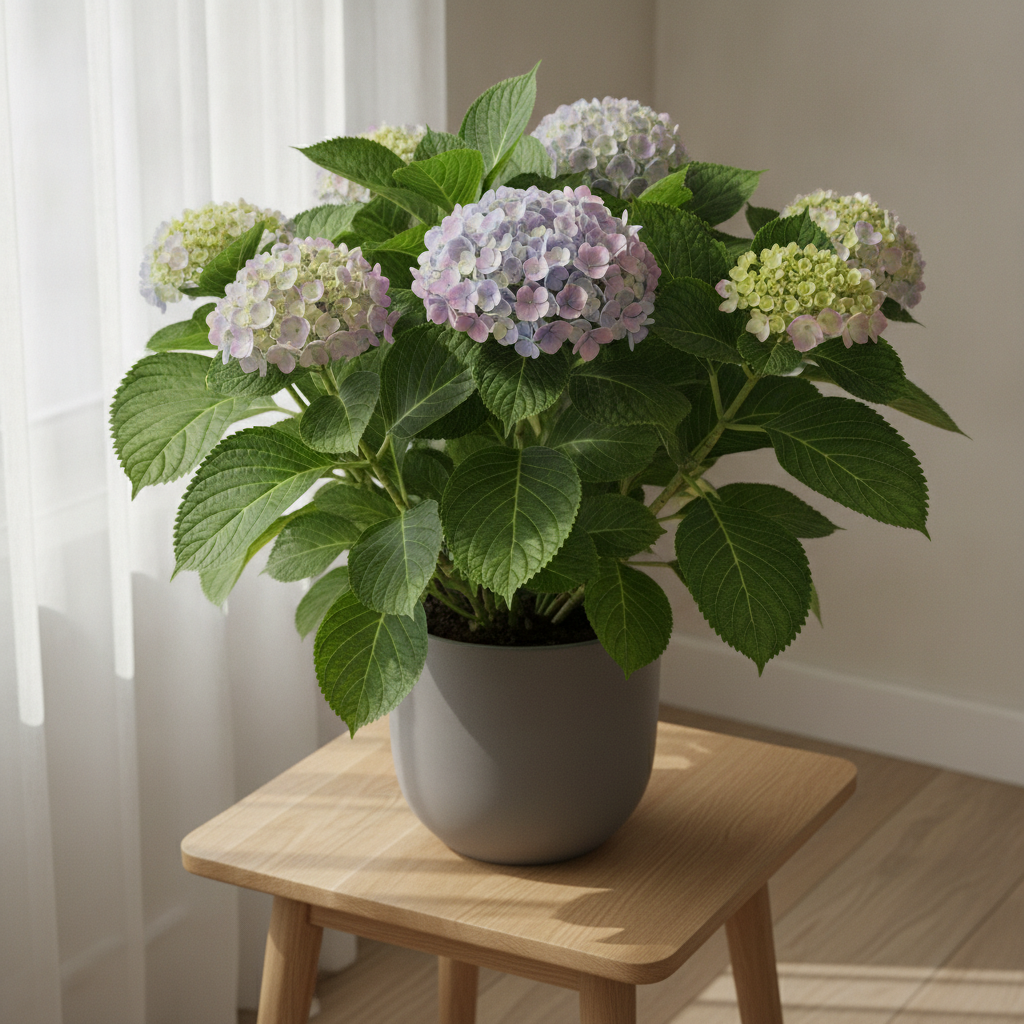
Few gift plants arrive with as much theatrical presence as the florist hydrangea, a potted form of Hydrangea macrophylla grown for its dense, dome-shaped flower heads in saturated blues, pinks and mauves. Known variously as the mophead hydrangea, bigleaf hydrangea or simply hydrangea, it is native to the coastal regions of Japan, where it grows as a deciduous woodland-edge shrub. The plants sold by florists and supermarkets in spring have been forced into early, lavish bloom in greenhouses, which is why a freshly bought specimen can look almost impossibly full of colour.
The florist hydrangea has a reputation for being temperamental indoors, and that reputation is only half deserved. It is genuinely thirsty, sensitive to dry air and warm rooms, and it does not naturally want to live its whole life in a pot on a windowsill. Yet understanding what the plant is actually asking for makes it far more manageable, and many growers eventually move their hydrangea into the garden where it can live for decades. This guide covers everything from light and watering to the famous trick of changing flower colour through soil chemistry, and throughout it draws the distinction between merely keeping a hydrangea alive and helping it genuinely thrive.
Contents
- Quick Reference
- Why the Florist Hydrangea Makes a Rewarding Houseplant
- Light Requirements
- Watering & Humidity
- Soil, Potting & Repotting
- Fertilising
- Propagation
- Pests & Diseases
- Popular Varieties
- Frequently Asked Questions
Quick Reference: Florist Hydrangea at a Glance
| Light | Bright, indirect light with a little gentle morning sun; protect from hot midday and afternoon sun |
| Watering | Keep the compost consistently moist, never waterlogged; a thirsty plant that wilts quickly when dry |
| Temperature | 15 to 21°C (59 to 70°F); tolerates cooler conditions and actively dislikes hot, stuffy rooms |
| Humidity | Moderate to high, around 50 to 60 per cent |
| Fertiliser | Balanced feed during active growth; specialised feeds adjust flower colour |
| Toxicity | Mildly toxic to cats, dogs and humans if eaten; contains cyanogenic glycosides |
Why the Florist Hydrangea Makes a Rewarding Houseplant
The appeal of the florist hydrangea begins with sheer abundance. A single well-grown plant can carry a dozen or more flower heads, each one a tight cluster of dozens of individual florets, so that the whole plant reads as a solid mound of colour rather than a collection of separate blooms. For a temporary display, few houseplants match it, and a hydrangea in full flower brings the kind of impact normally reserved for cut flowers but lasting weeks rather than days.
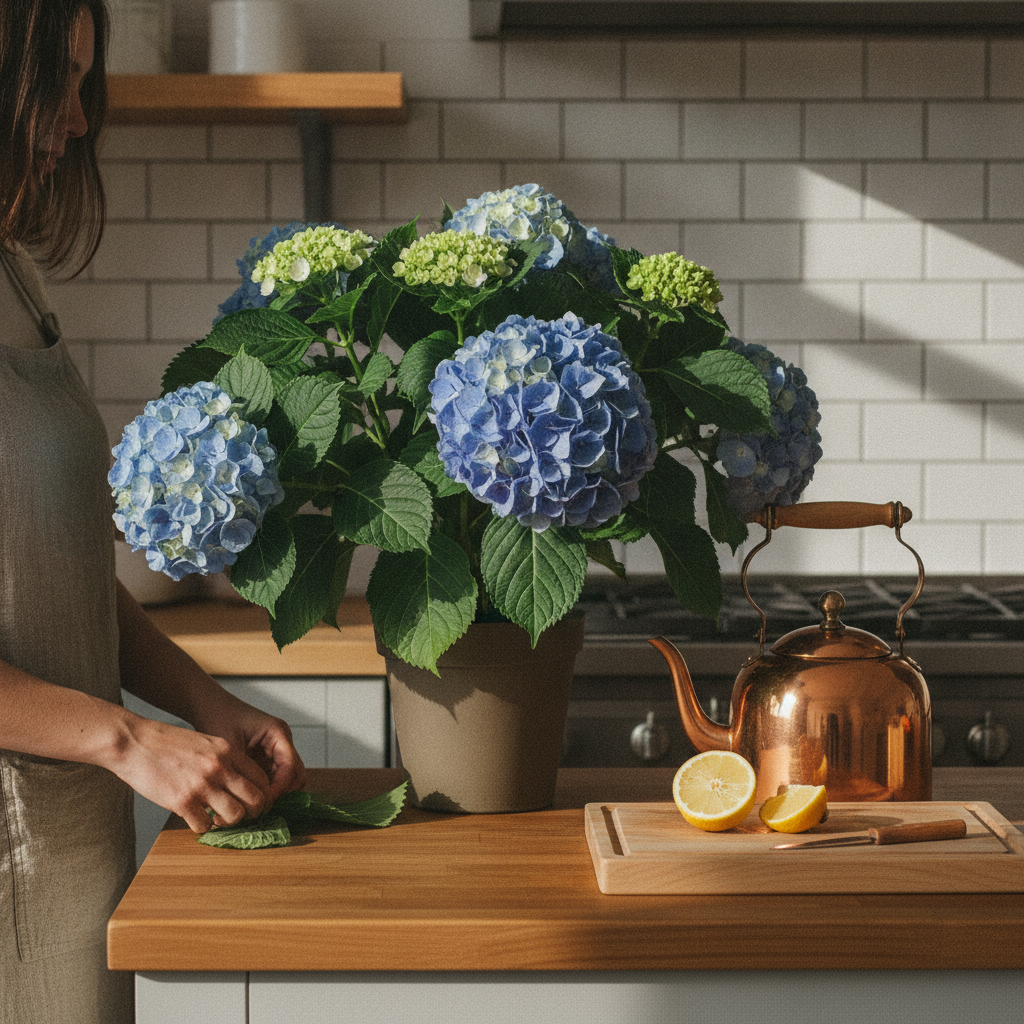
The second, more unusual reward is the plant’s chemistry. The florist hydrangea is one of the only common plants whose flower colour can be deliberately changed by the gardener, because the availability of aluminium in the soil, which is governed by pH, determines whether the blooms turn blue or pink. This makes the hydrangea something of a living experiment, and it is part of why the plant has fascinated growers for generations. Beyond the flowers, the broad, deeply veined and serrated leaves give the plant a lush, generous look even between flushes of bloom, and a hydrangea that is eventually planted outdoors can become a long-lived garden shrub that flowers reliably each summer for decades.
Important — Toxicity: All parts of Hydrangea macrophylla contain cyanogenic glycosides, compounds that can release small amounts of cyanide when chewed. The plant is considered mildly toxic to cats, dogs, horses and humans, and eating the leaves or flower buds can cause vomiting, lethargy and digestive upset. Poisoning is rare because the plant is unpalatable and large quantities are needed, but keep it out of reach of pets and small children, and wash your hands after pruning.
Light Requirements
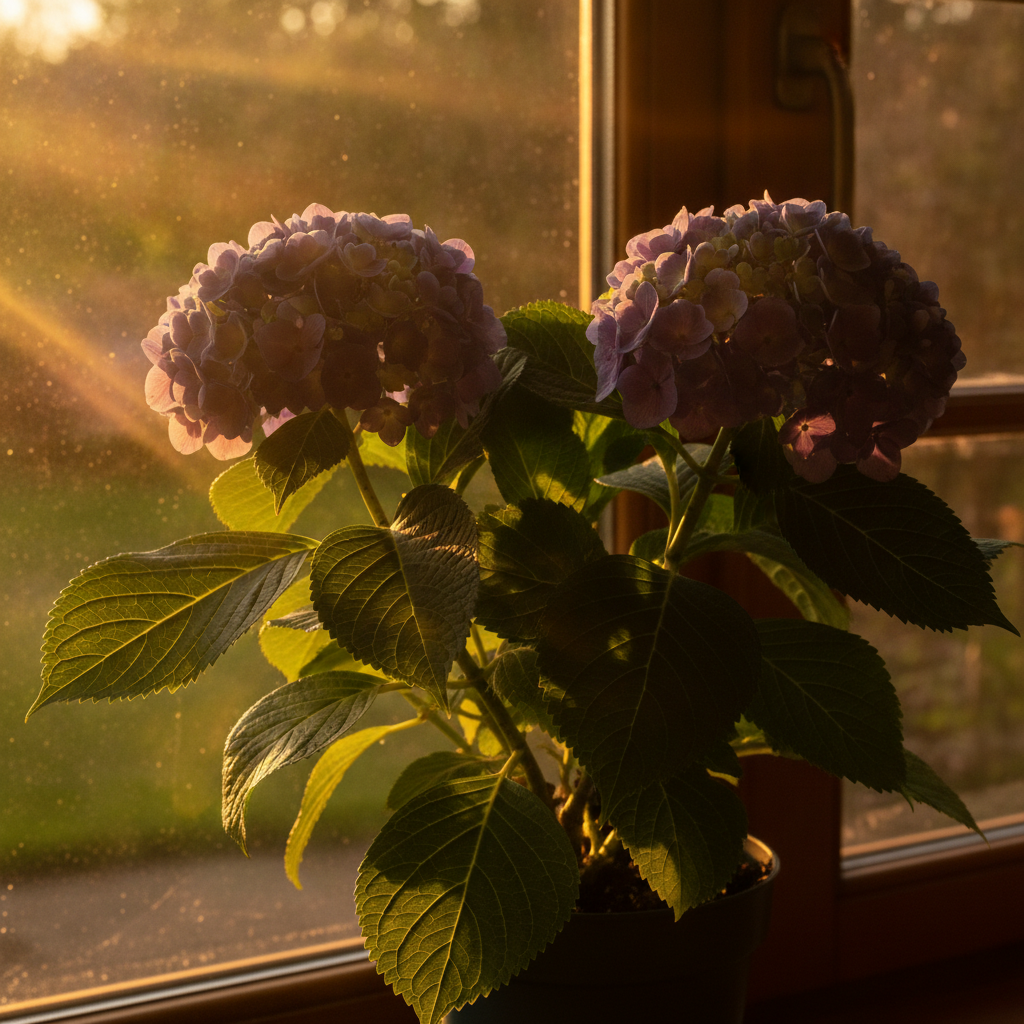
In the wild, the bigleaf hydrangea grows at the edges of woodland and in the dappled shade of taller plants, conditions that translate indoors to bright but filtered light. The plant wants plenty of brightness to keep its flowers coming and its leaves firm, but the large, thin leaves scorch easily under intense direct sun, especially when combined with the heat that builds up behind glass. The goal is generous light without a beam of hot sun falling directly on the foliage for hours at a time.
A position near a window that receives bright morning light and gentle, indirect light for the rest of the day suits the florist hydrangea well. A little soft early sun is beneficial and helps maintain flower colour, but the harsh light of midday and afternoon should be diffused by a sheer curtain or by setting the plant back from the glass. Indoors, a hydrangea that receives too little light becomes leggy and sparse, while one that gets too much hot sun develops scorched, papery patches and wilts even when the compost is moist.
Light Levels Explained
Indoor light is far dimmer than most people assume, and a spot that feels bright to the eye may be modest from a plant’s point of view. The table below sets out the broad categories of indoor light and where the florist hydrangea sits within them.
| Light Category | Approx. Level | Typical Location | Outcome |
|---|---|---|---|
| Direct sun | 20,000 lux and above | On a south-facing sill in summer | Leaf scorch and rapid wilting; too harsh |
| Bright indirect | 10,000 to 20,000 lux | Near an east window or set back from south | Ideal; firm leaves and long-lasting flowers |
| Medium | 5,000 to 10,000 lux | A metre or two from a bright window | Acceptable; growth and flowering slow a little |
| Low | 1,000 to 5,000 lux | Interior corner, north aspect | Leggy, weak growth; flowering poor |
| Very low | Below 1,000 lux | Hallway or windowless room | Decline; not suitable |
Window Orientation and Placement
South-facing window: The brightest aspect and potentially too hot for a hydrangea sitting on the sill. Place the plant a metre or so back, or diffuse the light with a sheer curtain, so the foliage never sits in a hot beam for long stretches.
East-facing window: Often the sweet spot. Cool, gentle morning sun followed by bright indirect light for the rest of the day matches the plant’s woodland-edge preferences almost perfectly.
West-facing window: Workable, though the afternoon sun here is strong and warm. Filter it or set the plant back a little to avoid scorch and the wilting that intense late light provokes.
North-facing window: The gentlest light, free of scorching sun, but often too dim to sustain heavy flowering. A hydrangea here will survive but tends towards sparse, drawn-out growth.
Pro Tip — Turn for Even Growth: Hydrangeas lean strongly towards their light source. Give the pot a quarter turn every few days so the plant develops an even, rounded shape rather than reaching lopsidedly towards the window.
How Light Affects Flowering and Leaf Health
Light drives the energy that a hydrangea pours into its enormous flower heads, so brightness and bloom quality are closely linked. A plant in good light holds its existing flowers longer and produces firmer, more deeply coloured leaves, while one in shade fades faster and grows soft, pale and stretched. Light does not change the blue-to-pink balance, which is governed entirely by soil chemistry, but it does affect overall vigour, and a vigorous plant simply colours up better.
Warning — Direct Sunlight: The large, thin leaves of Hydrangea macrophylla are among the first houseplant leaves to scorch. A few hours of hot summer sun through glass can leave bleached, crisp brown patches that never recover. If the plant wilts during the brightest part of the day even though the compost is wet, it is receiving too much heat and light, not too little water.
Artificial Lighting
A florist hydrangea can be supported through a dim spell with a full-spectrum LED grow light positioned 30 to 45 centimetres (12 to 18 inches) above the plant and run for around ten to twelve hours a day. Artificial light is most useful as a supplement in a poorly lit room rather than as the plant’s sole source, and because most people keep a forced hydrangea only through its flowering display, supplementary lighting is rarely essential. It comes into its own if you intend to overwinter the plant indoors before moving it outside.
Seasonal Adjustments
As a deciduous shrub, Hydrangea macrophylla naturally drops its leaves and rests over winter. A plant kept indoors will slow markedly as light levels fall in autumn, and you may move it closer to the brightest window to compensate. In the depths of winter many growers allow the plant a genuine dormant period in a cool, bright, frost-free place, watering only enough to stop the rootball drying out completely. As light strengthens in spring, fresh growth resumes and the plant can be moved back into a brighter, more active position.
Watering & Humidity
If there is one thing the florist hydrangea will not forgive, it is drought. The name hydrangea derives from the Greek for water vessel, and although that originally referred to the shape of the seed capsules, it is a fitting description of the plant’s appetite. Those big leaves and dense flower heads lose moisture rapidly, and a hydrangea that dries out will collapse into a dramatic, theatrical wilt within hours. The skill lies in keeping the compost evenly and reliably moist without letting it become a waterlogged bog.
When to Water
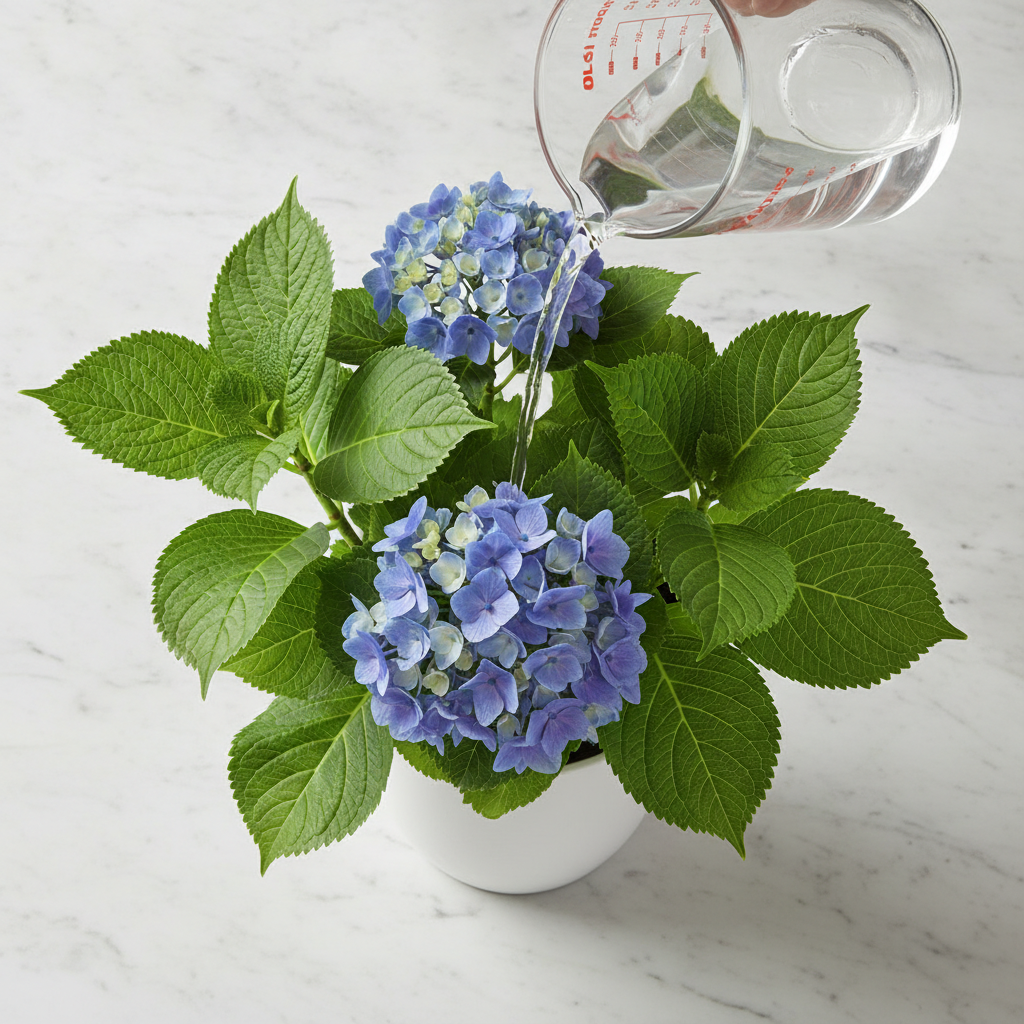
Check a florist hydrangea daily while it is in flower, because in a warm room it can drink remarkably fast. Feel the surface of the compost and lift the pot to judge its weight. Water as soon as the top centimetre begins to feel less than fully moist, aiming to keep the rootball at the consistency of a wrung-out sponge rather than letting it approach true dryness.
This plant breaks the usual houseplant rule of letting the compost dry between waterings. A hydrangea allowed to dry to the point of wilting suffers real stress every time, and repeated collapses shorten the life of the flowers and weaken the plant. At the same time, standing permanently in water suffocates the roots, so the balance is constant moisture with free drainage, not perpetual saturation.
Pro Tip — Reviving a Wilted Plant: If your hydrangea has collapsed from thirst, stand the whole pot in a basin of water for 20 to 30 minutes so the rootball rehydrates fully from below, then let it drain. A plant caught early usually recovers within a few hours. The trick only works once or twice before the flowers tire, so prevention beats rescue.
How to Water Correctly
- Use room-temperature water; cold water straight from the tap can shock the roots of a warm plant.
- Pour evenly over the surface of the compost until water flows freely from the drainage holes.
- Let the pot drain completely for several minutes before returning it to its cover pot or saucer.
- Tip away any water that collects in the saucer so the roots never sit in a standing pool.
- In hot weather or a heated room, check again later the same day, as a thirsty hydrangea may need a second drink.
Signs of Overwatering vs. Underwatering
| Symptom | Overwatering | Underwatering |
|---|---|---|
| Leaf colour | Yellowing of lower leaves | Dull, greying green before browning |
| Leaf texture | Soft, limp, sometimes translucent | Crisp, drooping then papery at the edges |
| Compost | Wet and heavy, may smell sour | Pulled away from the pot sides, very light |
| Roots | Brown, soft and mushy | Dry, brittle and pale |
| Recovery | Slow; rot may set in | Fast if rehydrated promptly |
Warning — Root Rot: A hydrangea left standing in a water-filled cover pot is the classic route to root rot. The roots turn brown and slimy, the plant wilts despite wet compost, and by the time the leaves yellow the damage is often advanced. If you suspect rot, remove the plant, cut away any soft brown roots, and repot into fresh, just-moist compost in a pot with working drainage.
Humidity Requirements
The florist hydrangea prefers moderate to fairly high humidity, around 50 to 60 per cent, which reflects its origins in the mild, moist climate of coastal Japan. The dry air of a centrally heated room in winter is one of the main reasons indoor hydrangeas struggle, as it accelerates moisture loss from the leaves and compounds the watering challenge.
Low humidity shows up as crisp brown leaf edges, faster wilting and flower heads that brown and dry prematurely. These symptoms often appear alongside, and can be mistaken for, underwatering, which is why a hydrangea in a hot, dry room can seem impossible to keep happy no matter how often it is watered.
Raising humidity helps considerably. Stand the pot on a tray of damp pebbles, group it with other plants, or run a humidifier nearby in winter. Keeping the plant in a cooler room also reduces the rate of moisture loss, which is one reason a cool, bright spare room often suits a hydrangea better than a warm living room. Misting offers only a brief lift and is no substitute for the steadier improvement of a pebble tray or humidifier.
Water Quality
Water quality matters more for hydrangeas than for most houseplants because it interacts with the flower-colour chemistry. Hard tap water tends to be alkaline and rich in dissolved minerals, which nudges blooms towards pink and can lock up the aluminium needed for blue flowers. If you are trying to keep a hydrangea blue, watering with collected rainwater, which is naturally soft and slightly acidic, makes a noticeable difference. For pink flowers, ordinary hard tap water is perfectly suitable. Whatever the source, let cold water reach room temperature before using it.
Soil, Potting & Repotting
The compost a hydrangea sits in does two jobs at once. It holds enough moisture to satisfy a thirsty plant while still draining freely enough to keep the roots breathing, and it provides the chemical environment that governs flower colour. Getting the mix right therefore matters both for the plant’s health and for the look of its blooms.
Ideal Soil Composition
A good hydrangea mix is based on a quality peat-free multipurpose or ericaceous compost, opened up with material that improves drainage and bulked with something that holds moisture without becoming sodden. The aim is a compost that stays evenly damp between waterings but never turns to mud.
| Component | Proportion | Function |
|---|---|---|
| Peat-free or ericaceous compost | 60 per cent | Base, holds moisture and nutrients |
| Composted bark or coir | 20 per cent | Adds structure and steady moisture retention |
| Perlite or coarse grit | 20 per cent | Improves drainage and air to the roots |
Soil pH is the lever that controls flower colour. An acidic mix below about pH 6, such as an ericaceous compost, makes aluminium available to the plant and pushes blooms towards blue. A neutral to alkaline mix above pH 7 locks that aluminium away and produces pink flowers. White-flowered varieties are largely unaffected and stay white regardless of pH.
Pro Tip — Quick Mix Recipe: For blue blooms, combine three parts ericaceous compost with one part composted bark and one part perlite, and water with rainwater. For pink, swap the ericaceous compost for a peat-free multipurpose mix and add a small handful of garden lime. The colour shift takes weeks to appear, so set the chemistry well before you want the new colour.
Choosing the Right Pot
Because the florist hydrangea drinks so heavily, the choice of pot has a direct effect on how often you will be reaching for the watering can. A slightly larger pot holds more moist compost and buffers the plant against drying out, while a small pot in a warm room can need topping up twice a day.
Drainage holes are non-negotiable. Decorative cover pots and foil sleeves are the hidden killer of gift hydrangeas, because water collects unseen in the bottom and rots the roots. Always grow the plant in an inner pot with open drainage holes and tip away anything that gathers in the outer container.
Pot material: Plastic and glazed ceramic hold moisture longest and suit a thirsty hydrangea well. Unglazed terracotta breathes and dries faster, which can be useful in a cool, humid spot but works against you in a warm room where the plant already struggles to stay hydrated.
Pot size: Move up by only one size at a time, choosing a pot two to four centimetres (one to two inches) wider than the current one. An oversized pot holds a reservoir of wet compost around roots that cannot yet reach it, which encourages rot.
When to Repot
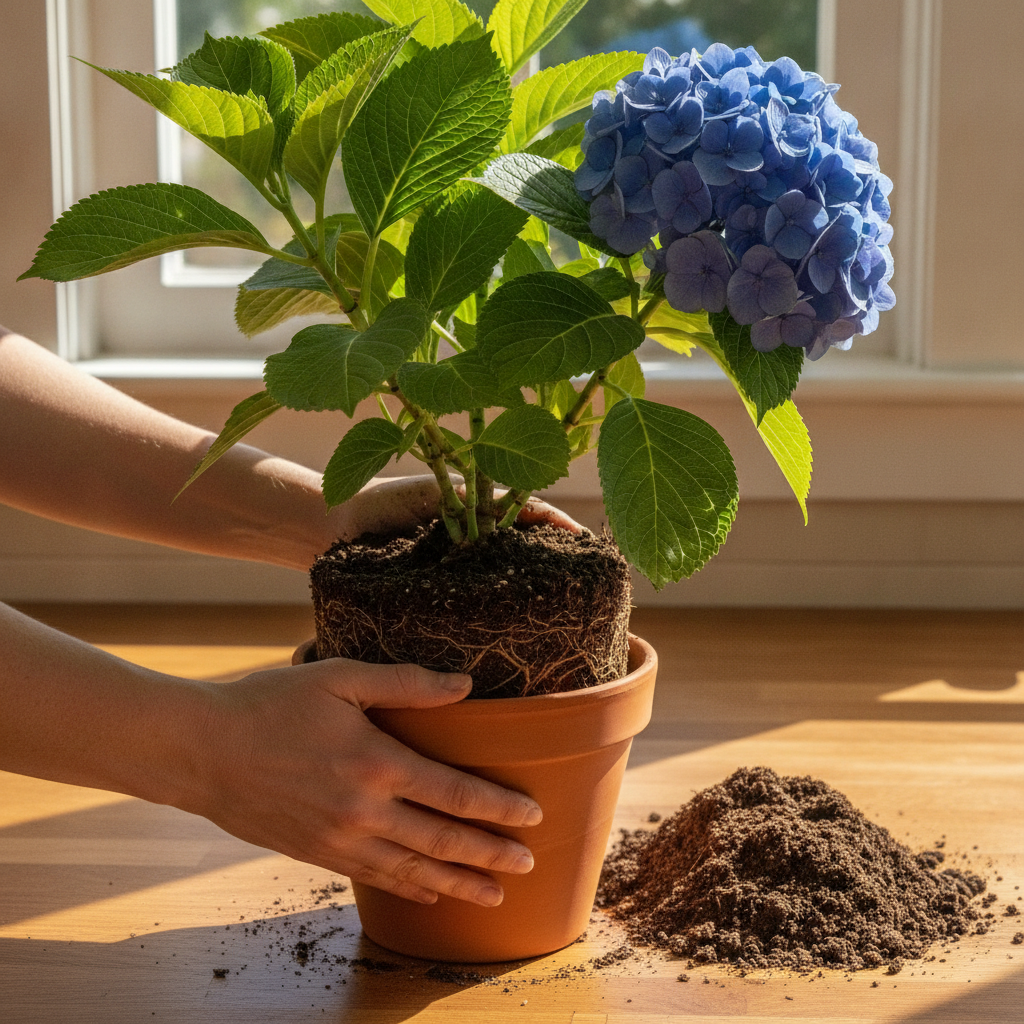
A freshly bought florist hydrangea is best left undisturbed while it is in full flower, then repotted once the first flush fades. After that, the plant generally needs moving on every spring as it grows, ideally just as new growth begins and before the main flowering. Signs that a repot is due include roots emerging from the drainage holes, water running straight through without wetting the compost, and a plant that wilts again almost as soon as it has been watered.
How to Repot: Step-by-Step
- Water the plant an hour beforehand so the rootball is moist and holds together.
- Slide the plant out of its pot, supporting the base of the stems, and inspect the roots.
- Tease apart any roots that are circling tightly around the rootball to encourage them outward.
- Add a layer of fresh mix to the new pot, then set the plant so its old soil line sits just below the rim.
- Fill around the sides with fresh compost, firming gently so there are no large air pockets.
- Water thoroughly to settle the compost, top up any that sinks, and return the plant to bright, indirect light.
Warning — Transplant Shock: A hydrangea repotted while in full flower often sulks, dropping flowers and wilting as its disturbed roots struggle to supply the heavy bloom. Wait until the main flush has faded before repotting, keep the freshly potted plant out of strong sun, and resist feeding for a few weeks while new roots establish.
Fertilising
Producing flower heads on the scale a hydrangea does takes a steady supply of nutrients, so regular but moderate feeding during the growing season pays off in stronger growth and better bloom. At the same time, the type of fertiliser you choose interacts with the colour chemistry, which makes feeding a hydrangea a slightly more considered task than feeding an ordinary foliage plant.
A freshly bought forced plant has usually been fed generously in the greenhouse and needs nothing for its first few weeks at home. Once it has settled and is putting out new growth, begin a gentle feeding routine through spring and summer, then taper off as autumn approaches and the plant heads towards its winter rest.
Understanding Plant Nutrients
Fertilisers are labelled with an NPK ratio describing the proportion of nitrogen, phosphorus and potassium they contain, the three nutrients plants use in the largest amounts. For hydrangeas, potassium is especially valuable because it supports flowering, while a separate cast of secondary nutrients and trace elements keeps the foliage healthy.
| Nutrient | Symbol | Primary Function | Deficiency Symptoms |
|---|---|---|---|
| Nitrogen | N | Leafy growth and green colour | Pale, yellowing older leaves; weak growth |
| Phosphorus | P | Root development and flowering | Dull leaves, poor roots; note it pushes colour to pink |
| Potassium | K | Flower quality and stress tolerance | Browning leaf edges, weak blooms |
| Iron | Fe | Chlorophyll production | Yellowing between veins on new leaves |
| Magnesium | Mg | Photosynthesis | Yellowing between veins on older leaves |
Types of Fertiliser
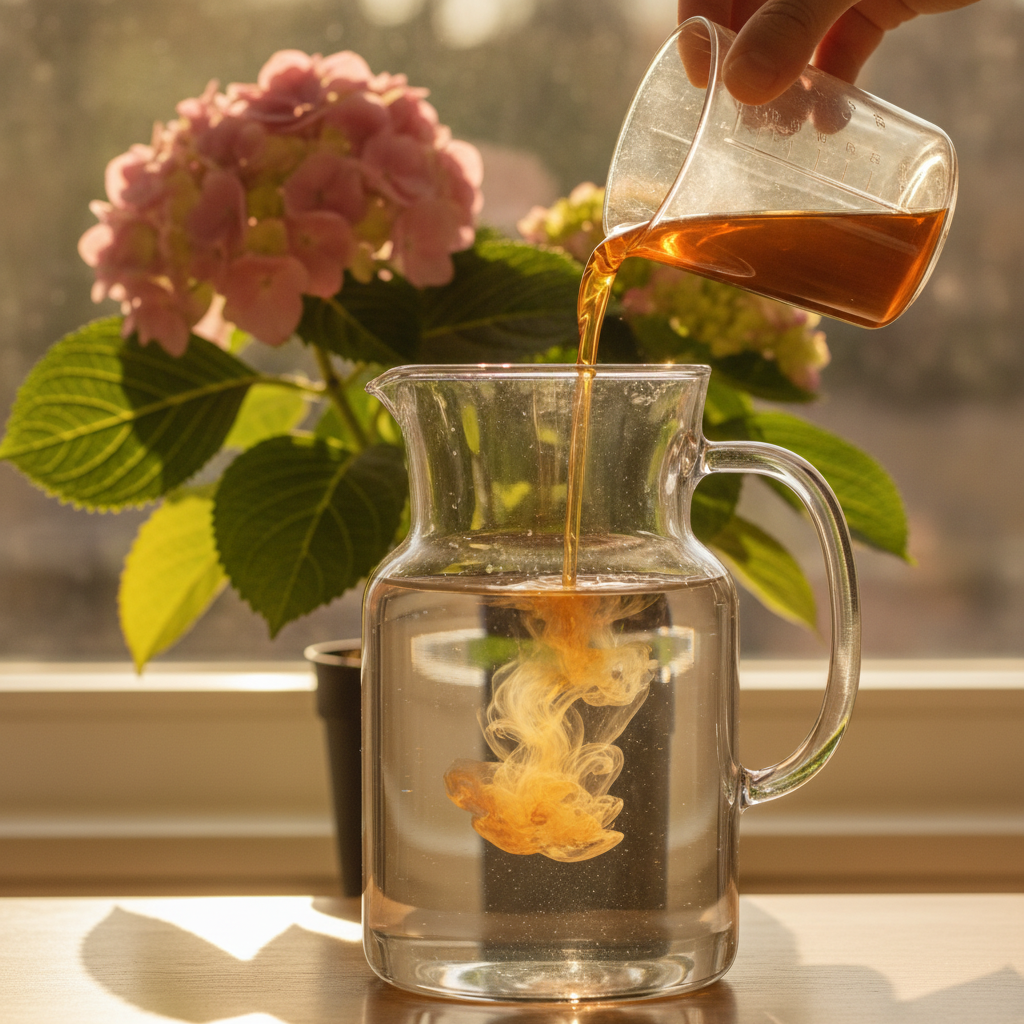
Liquid fertilisers: Diluted in water and applied during normal watering, liquid feeds give you the most control and act quickly, which makes them the easiest choice for a potted hydrangea. They are also the form in which specialist colour feeds are usually sold.
Slow-release granular: Coated granules mixed into the compost release nutrients gradually over several months. They are convenient and reduce the risk of overfeeding, but offer less precision if you are trying to steer flower colour.
Organic fertilisers: Materials such as worm castings, seaweed extract and well-rotted compost feed gently and improve the soil over time. They suit growers who prefer a low-intervention approach, though their nutrient content is milder and less exact.
Feeding Schedule
Feed roughly every two to four weeks from spring through to late summer with a balanced or potassium-rich liquid fertiliser at half the recommended strength. Stop feeding entirely in autumn and winter while the plant rests, as a dormant hydrangea cannot use the nutrients and unused fertiliser salts simply accumulate in the compost. If you are managing flower colour, choose your feed accordingly, since a high-phosphorus fertiliser tends to favour pink while a low-phosphorus, potassium-rich one supports blue.
Pro Tip — Less Is More: Hydrangeas respond better to frequent, dilute feeding than to occasional strong doses. Mixing your liquid feed at half strength and applying it more often keeps nutrient levels steady and avoids the leaf-tip scorch that comes from a sudden flush of concentrated fertiliser.
How to Fertilise
- Water the plant lightly first if the compost is dry, so feed never hits parched roots.
- Dilute the liquid fertiliser to half the label strength in room-temperature water.
- Apply evenly over the compost until it is moist throughout and a little drains away.
- Discard any runoff from the saucer so concentrated salts do not sit beneath the pot.
- Resume the normal watering routine and repeat at the chosen interval through the growing season.
Warning — Salt Build-Up: Over time, fertiliser salts accumulate in the compost and show as a white crust on the surface or pot rim, along with browning leaf edges. Every couple of months, flush the pot by running plenty of plain water through it until it drains freely from the base, which washes the excess salts away.
Propagation
The florist hydrangea is rewarding to propagate, and a single healthy plant can readily yield several new ones. Unlike many houseplants it cannot be grown from a leaf, but it roots willingly from sections of stem and from branches that are layered into the soil, both of which produce a true copy of the parent plant.
The best time to take cuttings is late spring to midsummer, when the plant is in active growth and producing soft, flexible new shoots. Choosing a non-flowering shoot is important, because a stem that is busy supporting a bloom puts its energy there rather than into making roots.
Understanding Nodes and Non-Flowering Shoots
A node is the slightly thickened point on a stem where leaves emerge, and it holds the cells that produce new roots. Every successful cutting must include at least one node buried in the rooting medium. The ideal cutting material is a soft, green, non-flowering shoot from the current season’s growth, taken from the tip of a stem and cut to include two or three pairs of leaves.
Softwood Stem Cuttings: Step-by-Step
Softwood cuttings are the quickest and most reliable way to multiply a hydrangea, and a batch taken in early summer is usually well rooted within a month.
- Cut a 10 to 15 centimetre (4 to 6 inch) non-flowering shoot just below a node, using clean, sharp secateurs.
- Remove the lower pairs of leaves, leaving one or two pairs at the top of the cutting.
- Cut the two remaining leaves in half across their width to reduce moisture loss while rooting.
- Dip the cut base in rooting hormone, then insert it into a small pot of moist, gritty cutting compost.
- Cover loosely with a clear bag or propagator lid to hold humidity, keeping it off the leaves.
- Keep warm in bright, indirect light, and pot on once new growth and resistance to a gentle tug show roots have formed.
Pro Tip — Keep the Air Humid: Softwood hydrangea cuttings lose water fast through their large leaves before they have roots to replace it. A covered propagator or a clear bag tented over the pot keeps the air around them humid and dramatically improves the strike rate, but vent it daily to prevent mould taking hold.
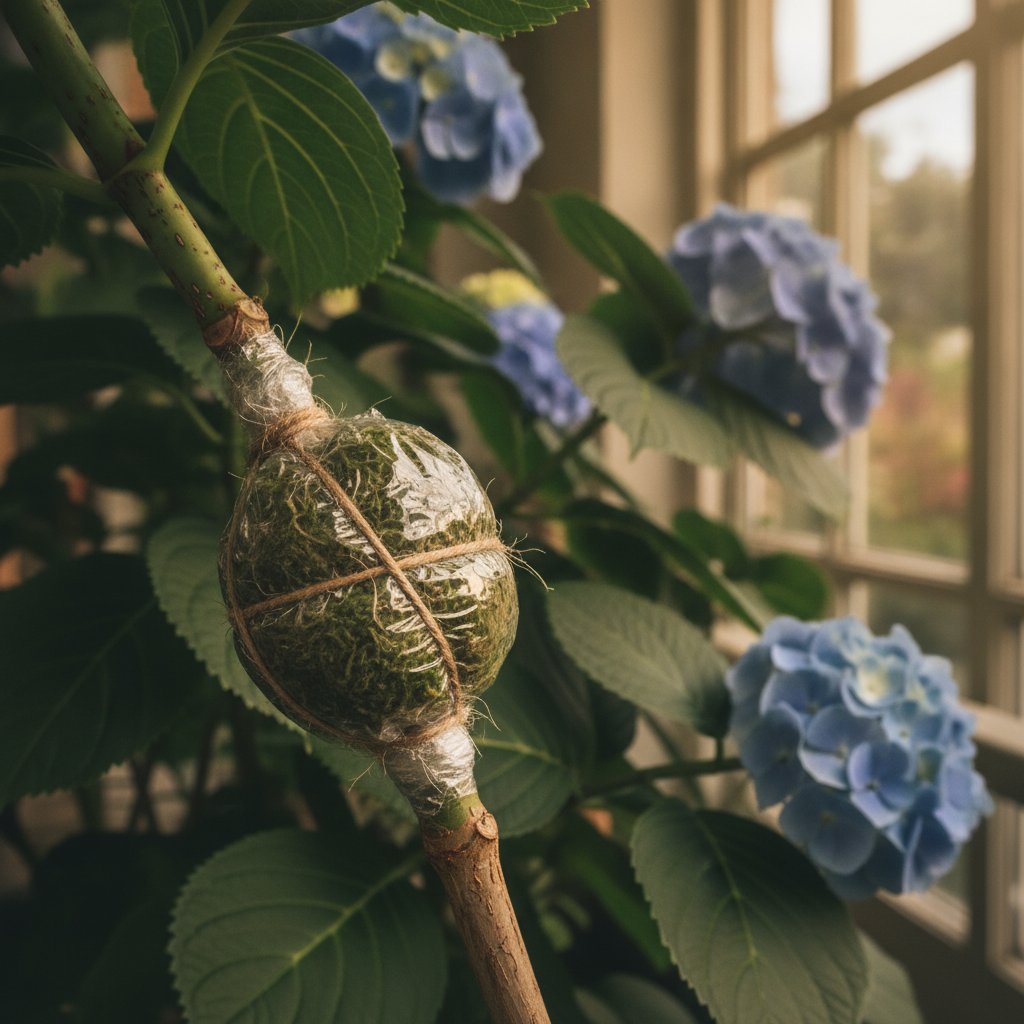
Layering: Step-by-Step
Layering is the most foolproof method because the new plant stays attached to its parent, drawing on it for water and food while it roots. It is ideal for a plant with low, flexible stems and asks for very little attention.
- Select a low, flexible stem that can be bent down to reach the surface of the compost.
- Lightly scrape or nick the underside of the stem at a node to stimulate rooting.
- Pin that section into moist compost with a loop of wire, leaving the growing tip exposed.
- Keep the compost evenly moist and leave the layer undisturbed for several weeks to a few months.
- Once it has rooted firmly, sever the new plant from the parent and pot it up on its own.
Troubleshooting Propagation
| Problem | Likely Cause | Solution |
|---|---|---|
| Cutting wilts and collapses | Too much moisture lost before rooting | Trim leaves further and raise humidity with a cover |
| Base turns black and soft | Rot from waterlogged or dirty medium | Use fresh, gritty compost and avoid overwatering |
| No roots after many weeks | Flowering shoot used, or too cold | Take non-flowering shoots and keep warm |
| Mould on leaves or medium | Stagnant, overly humid air | Vent the propagator daily and remove affected material |
Pests & Diseases
A healthy, well-watered hydrangea is reasonably resistant to trouble, but the soft new growth and large leaves that make it attractive also make it appealing to sap-sucking insects, and the moist conditions it enjoys can encourage fungal disease. Most problems are easy to manage when caught early, which makes regular inspection the single most useful habit a hydrangea grower can develop.
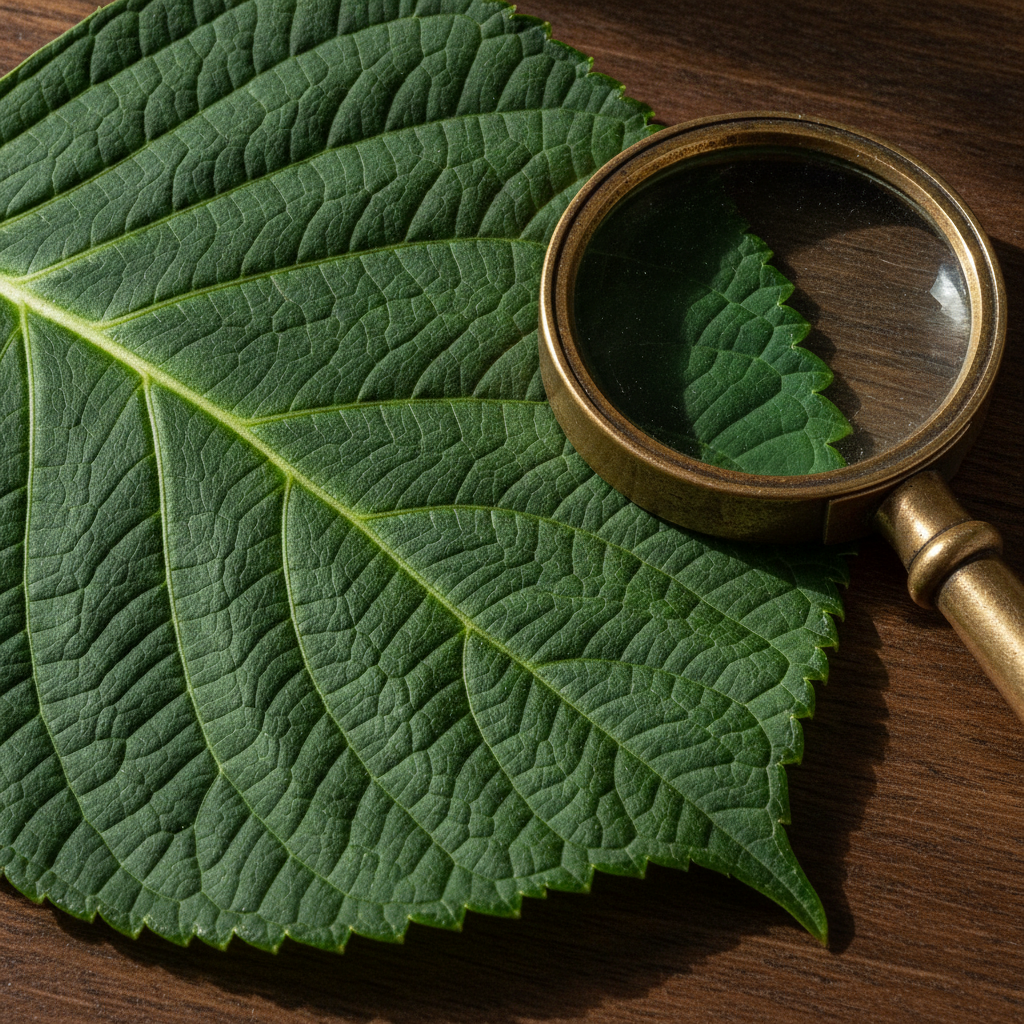
Look over your plant whenever you water it, paying particular attention to the undersides of leaves and the tender shoot tips where pests gather first. Catching an infestation while it is small means it can usually be dealt with by hand or with a simple spray, before it spreads to the whole plant or to its neighbours.
Common Pests
Aphids (Aphidoidea)
Aphids are small green, black or pink insects that cluster on soft new shoots and flower buds, sucking sap and leaving behind a sticky residue called honeydew that can turn black with sooty mould. Heavy infestations distort new growth and weaken the plant.
Treatment: Dislodge light infestations with a firm jet of water, or wipe them off by hand. For persistent colonies, spray with insecticidal soap or a diluted neem oil solution, repeating every week until the aphids are gone.
Spider Mites (Tetranychus urticae)
These tiny mites thrive in the warm, dry air that already stresses an indoor hydrangea. They speckle the leaves with fine pale dots, and in bad cases spin delicate webbing between the leaves and stems. A plant kept too warm and dry is especially vulnerable.
Treatment: Raise the humidity and lower the temperature to make conditions less favourable, rinse the foliage thoroughly, and treat with insecticidal soap or neem oil, paying close attention to the undersides of the leaves where mites breed.
Scale Insects (Coccoidea)
Scale appear as small brown or tan bumps along the stems and leaf veins, each one a stationary insect under a protective shell. They drain sap slowly, causing yellowing and weak growth, and like aphids they excrete honeydew.
Treatment: Dab individual scales with a cotton bud dipped in surgical spirit to dissolve their protective coating, then follow up with horticultural oil to smother any survivors. Check regularly, as scale is easily missed and slow to clear.
Common Diseases
Powdery Mildew (Erysiphe species)
Powdery mildew shows as a dusty white or grey coating on the leaves, most common when the air is humid but stagnant and the plant is crowded. It disfigures the foliage and, if unchecked, weakens the plant by reducing its ability to photosynthesise.
Treatment: Improve air circulation around the plant, remove the worst-affected leaves, and avoid wetting the foliage when watering. A fungicide, or a homemade spray of diluted potassium bicarbonate, controls a stubborn outbreak.
Grey Mould (Botrytis cinerea)
Botrytis is a fuzzy grey fungal growth that attacks ageing flowers and soft tissue, especially in cool, damp, still air. Hydrangea flower heads are prone to it as the blooms fade, and from there it can spread into the surrounding leaves.
Treatment: Remove and dispose of affected flowers and leaves promptly, improve ventilation, and avoid leaving spent blooms on the plant to rot. Keeping water off the flowers and foliage greatly reduces the risk.
Pest and Disease Summary
| Pest / Disease | Identification | Treatment |
|---|---|---|
| Aphids | Clusters of soft insects on new growth, sticky honeydew | Rinse off, then insecticidal soap or neem oil |
| Spider mites | Fine pale speckling and webbing, worst in dry warmth | Raise humidity, rinse, treat with soap or neem |
| Scale | Brown bumps on stems and veins, slow yellowing | Surgical spirit on a cotton bud, then horticultural oil |
| Powdery mildew | Dusty white coating on the leaves | Improve airflow, remove leaves, apply fungicide |
| Grey mould | Fuzzy grey growth on fading flowers | Remove affected parts, improve ventilation |
Prevention Strategies
Prevention rests on keeping the plant in good health and its surroundings well managed. A hydrangea that is properly watered, fed in season and given bright light with decent air movement is far less likely to fall to pests or disease than one that is stressed, and stress is what opens the door to most problems.
Inspect new plants before bringing them home and keep them apart from your other plants for a couple of weeks, since pests often arrive as hitchhikers. Remove fading flowers and fallen leaves promptly, avoid splashing water on the foliage, and resist crowding the plant against others, all of which deny pests and fungi the conditions they need to take hold.
Pro Tip — Neem as Routine Defence: A light, monthly spray of diluted neem oil over the leaves, including their undersides, works as a gentle preventative that discourages aphids, mites and scale before they establish. Apply it in the evening or out of direct sun so the wet leaves do not scorch, and always test on a single leaf first.
Popular Varieties
The florist hydrangea is sold under the umbrella of Hydrangea macrophylla, but that single species hides an enormous range of named cultivars differing in flower form, colour and habit. The most fundamental split is between the two flower shapes the species produces, the rounded mophead and the flatter lacecap, and almost every variety belongs to one camp or the other.
Mopheads, also called hortensias, carry the familiar dense, globe-shaped heads made up almost entirely of showy sterile florets. Lacecaps instead bear flat heads with a centre of tiny fertile flowers ringed by a halo of larger sterile ones, a more delicate and naturalistic look. Within both groups, colour ranges from white through pink and red to blue and purple, with many varieties shifting along that range according to soil pH.
| Variety | Flower Appearance | Light Needs | Growth Rate | Availability |
|---|---|---|---|---|
| Endless Summer | Large rounded mophead, blue to pink | Bright indirect | Moderate | Common |
| Nikko Blue | Classic blue mophead in acid soil | Bright indirect | Moderate | Common |
| Lacecap (Mariesii) | Flat head, sterile florets ringing fertile centre | Bright indirect | Moderate | Common |
| Lanarth White | White lacecap, pH-stable colour | Bright indirect | Moderate | Occasional |
| Ayesha | Cupped, lilac-tinged florets, unusual texture | Bright indirect | Moderate | Occasional |
| Glowing Embers | Deep crimson-red mophead | Bright indirect | Moderate | Occasional |
Featured Varieties
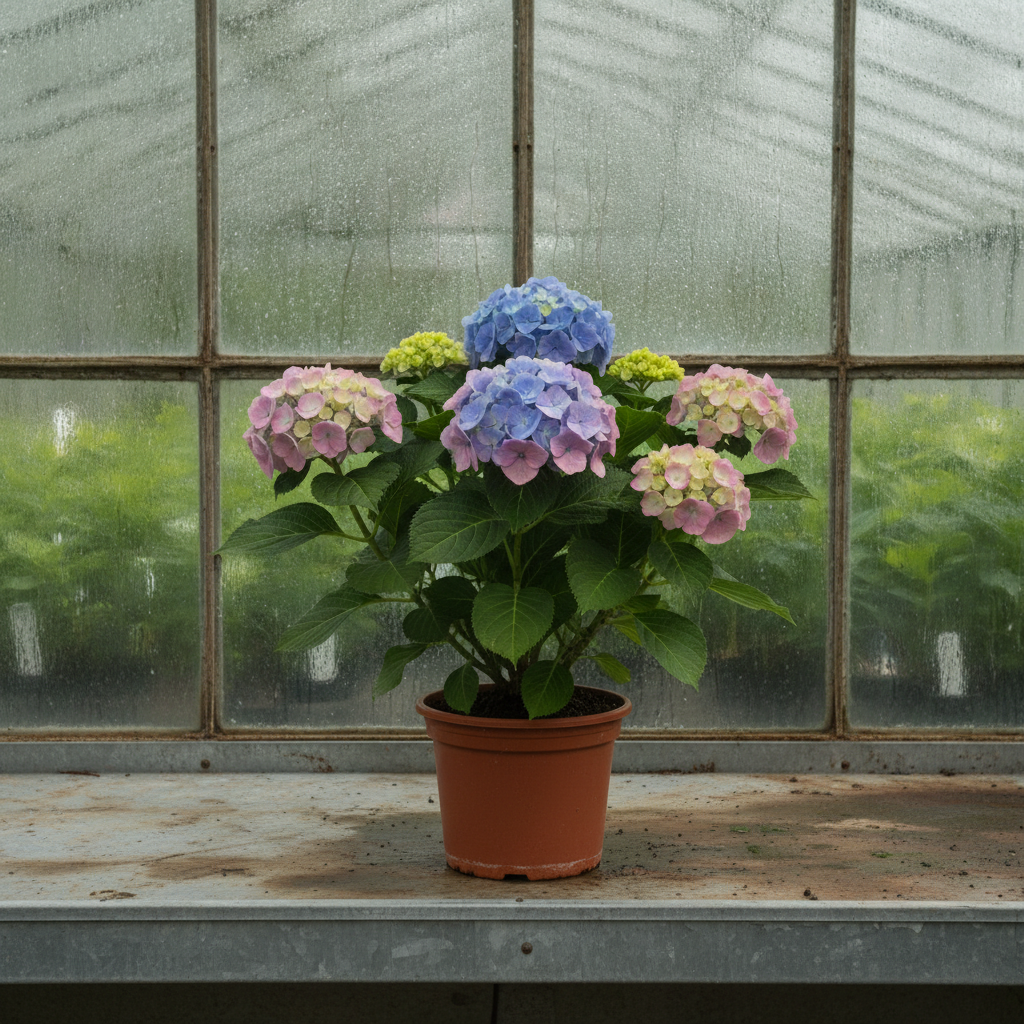
Endless Summer
A modern reblooming mophead that flowers on both old and new wood, so it keeps producing its large rounded heads through the season. The blooms shift from blue to soft pink depending on soil pH, and its compact, repeat-flowering habit makes it one of the most rewarding varieties for pot culture.
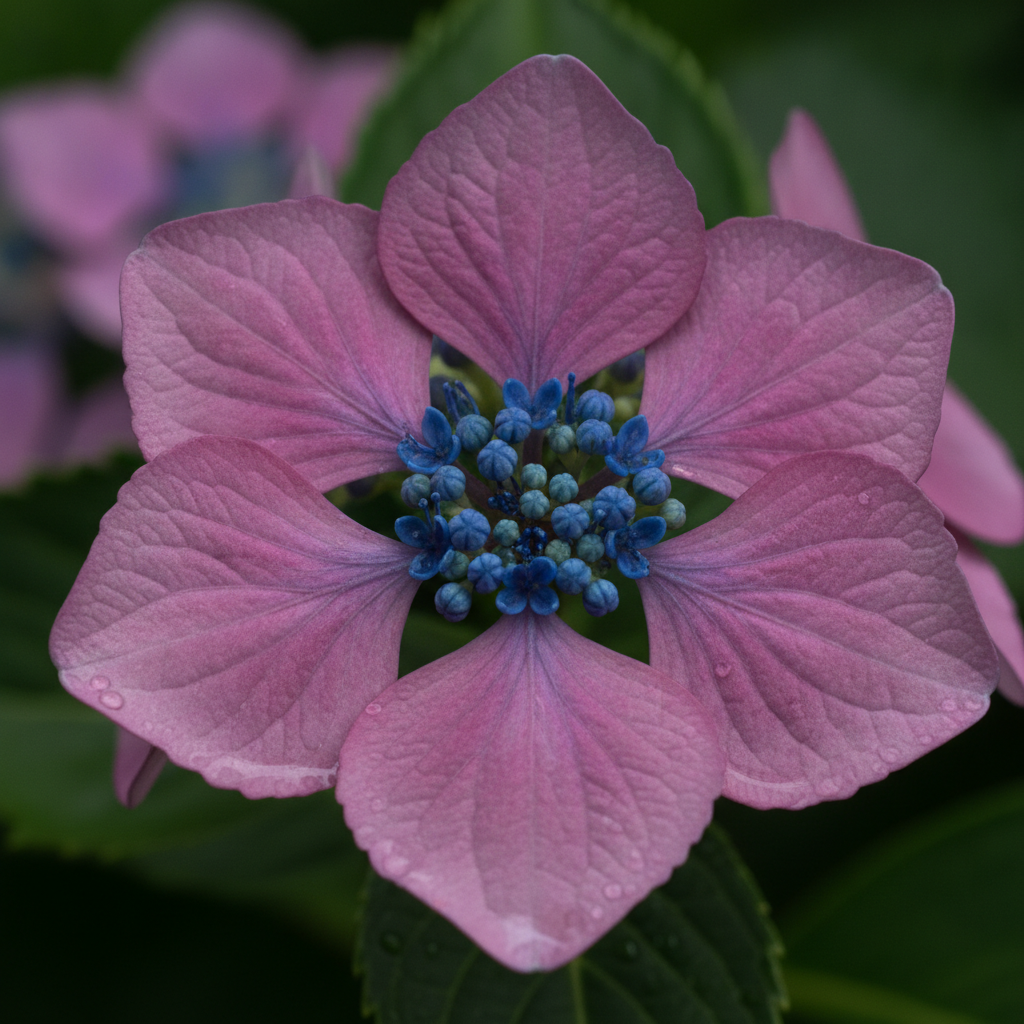
Lacecap
The lacecap forms swap the solid dome for a flattened, delicate head of tiny fertile flowers surrounded by a ring of showy sterile florets. The effect is lighter and more naturalistic than a mophead, and the open centre is loved by pollinators when the plant is grown outdoors.
Variety Profiles in Detail
Nikko Blue (Hydrangea macrophylla ‘Nikko Blue’)
One of the best-loved blue mopheads, Nikko Blue produces large, rounded heads of a clear sky blue when grown in acidic soil with available aluminium. In neutral or alkaline conditions the same plant turns pink or mauve, which makes it a classic demonstration of the colour chemistry that defines the species.
Lanarth White (Hydrangea macrophylla ‘Lanarth White’)
A refined lacecap whose white sterile florets stay white regardless of soil pH, ringing a centre that flushes blue or pink according to conditions. Its colour stability makes it a dependable choice for anyone who finds the shifting blues and pinks of other varieties unpredictable.
Glowing Embers (Hydrangea macrophylla ‘Glowing Embers’)
Grown for its rich crimson to ruby-red mophead flowers, Glowing Embers holds its warm colour best in neutral to alkaline soil, where the reds stay deep rather than drifting towards purple. It brings a bolder, warmer palette to a group otherwise dominated by cool blues and soft pinks.
Choosing the Right Variety for Your Space
When choosing a florist hydrangea, think first about flower form and colour stability rather than rarity. If you want a reliable, repeat-flowering plant for a pot, a compact reblooming mophead such as Endless Summer is hard to beat, while a lacecap suits anyone who prefers a lighter, more naturalistic bloom. If you intend to manage the colour, pick a blue or pink variety known to respond to pH, and if you would rather not bother with soil chemistry, a stable white avoids the question altogether. All of them share the same fundamental needs of cool, bright conditions and generous, consistent watering, so the choice comes down to looks rather than care.
Frequently Asked Questions
Why has my hydrangea suddenly wilted even though the soil is damp?
Wilting with moist compost usually means heat or light stress rather than thirst. The large leaves lose water faster than the roots can supply it when the plant sits in hot sun or a warm, dry room. Move it somewhere cooler and shaded from direct sun, and it should firm up again. If wilting persists with wet, sour-smelling compost, suspect root rot instead.
How do I change my hydrangea from pink to blue?
Blue flowers depend on the plant being able to take up aluminium, which happens only in acidic soil below about pH 6. Grow the plant in ericaceous compost, water with rainwater, and apply a specialist blueing feed or aluminium sulphate. The change is gradual and takes weeks to a full season, and white varieties cannot be turned blue at all.
Is the florist hydrangea safe around pets?
No, it is mildly toxic. All parts contain cyanogenic glycosides, and eating the leaves or buds can cause vomiting, lethargy and digestive upset in cats, dogs and humans. Serious poisoning is rare because a large quantity is needed, but keep the plant out of reach of pets and children to be safe.
Can I plant my gift hydrangea in the garden?
Yes, and many people do. A forced florist hydrangea is a true Hydrangea macrophylla and can be planted out once the risk of frost has passed, ideally after it has finished its indoor flowering. Harden it off gradually, choose a sheltered spot with morning sun and afternoon shade, and it can become a long-lived garden shrub in mild climates, roughly hardiness zones 6 to 9.
Why does my hydrangea have flowers but few leaves, or leaves but no flowers?
A forced plant pours its energy into the bloom it was sold with and may look top-heavy with flowers. Once those fade, it shifts to building leaves and roots, and a healthy plant naturally has a leafy, less floriferous phase. Too little light, over-pruning, or pruning at the wrong time can also leave a plant leafy but bloomless, since most macrophylla types flower on the previous year’s wood.
Should I cut off the faded flowers?
Removing spent blooms keeps the plant tidy and prevents grey mould taking hold in the decaying flowers. Cut back to just above a healthy pair of buds. Be cautious about hard pruning, though, because bigleaf hydrangeas set next year’s flower buds on this year’s stems, so cutting too far back can sacrifice the following season’s display.
How often should I water a florist hydrangea indoors?
There is no fixed schedule, because the rate depends on warmth, light and pot size, but in practice an indoor hydrangea in flower often needs water every day or two. Check it daily by feeling the compost and lifting the pot, and water whenever the surface starts to dry, keeping the rootball evenly moist without letting it sit in standing water.
My hydrangea’s leaves have brown, crispy edges. What is wrong?
Crispy brown edges point to dry air, underwatering, or a build-up of fertiliser salts, often a combination. Raise the humidity, keep the compost more consistently moist, and flush the pot with plenty of plain water to wash out accumulated salts. Moving the plant away from radiators and out of hot, dry rooms usually brings a clear improvement.






