
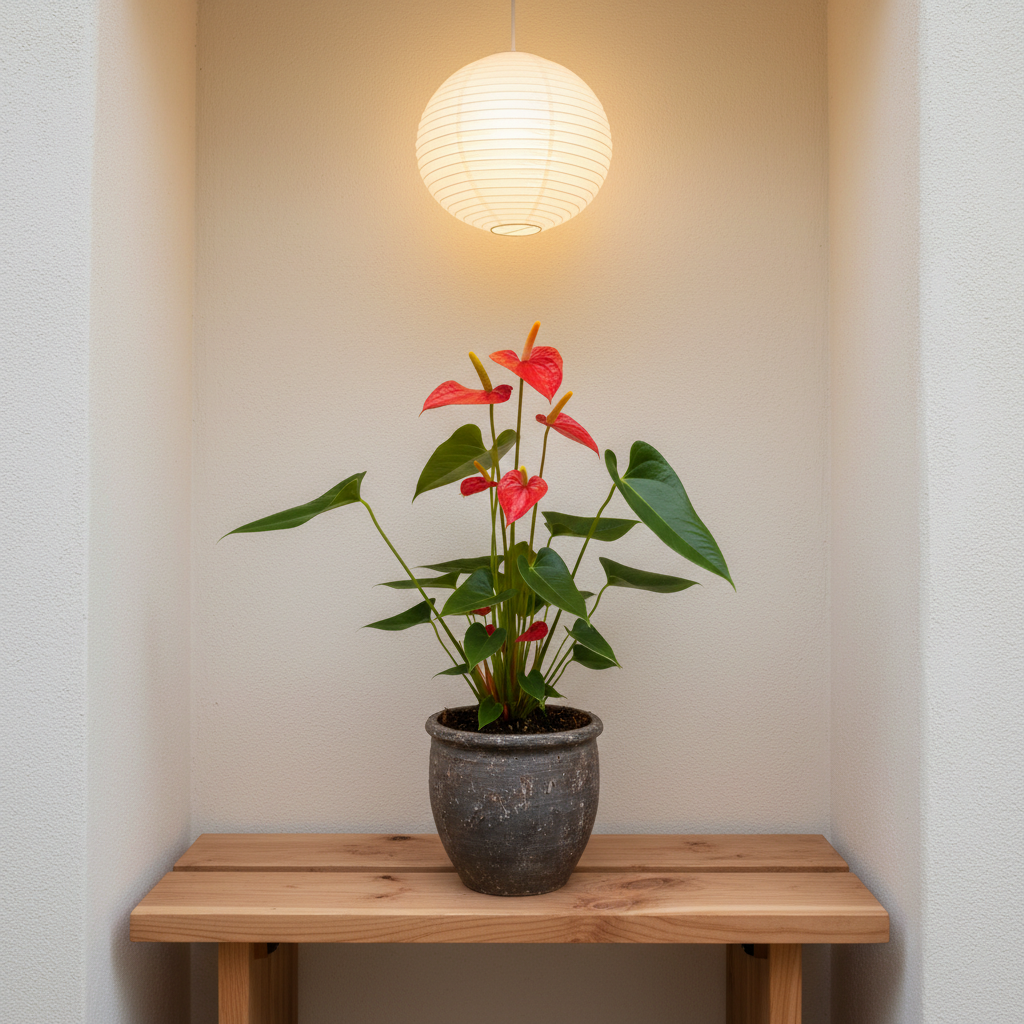
The Flamingo Lily (Anthurium scherzerianum) is the curly-spadixed sibling of the better-known Anthurium andraeanum, native to the cool mountain cloud forests of Costa Rica and Guatemala, where it grows as an epiphyte clinging to mossy trees in dappled, humid shade. Most people meet it for the first time in a florist or supermarket as a small flowering pot plant, instantly recognisable from the bright red, waxy spathe and the corkscrewed orange-red spadix that gives the species its common nickname of Pigtail Plant. Compared with its larger Caribbean relative, this species is smaller, slower, more inclined to flower repeatedly, and a touch more forgiving of cool rooms and uneven watering, which is a large part of why it has been a windowsill staple in Europe for well over a century.
Despite the supermarket reputation as a short-lived gift plant, a well-treated Flamingo Lily will live and bloom for decades. The trick is understanding that it is an epiphytic aroid, not a true houseplant in the leafy-shrub sense, so the rules that govern healthy growth are closer to those used for orchids than for a peace lily or pothos. This guide separates surviving from thriving: many readers will keep a Flamingo Lily alive simply by watering when the surface dries, but the real reward, dense year-round flowering and glossy, generously sized leaves, comes from getting the soil structure, watering rhythm, light angle and feeding regime right. Each section below works through one of those variables in detail.
Contents
- Quick Reference
- Why the Flamingo Lily Makes a Rewarding Houseplant
- Light Requirements
- Watering and Humidity
- Soil, Potting and Repotting
- Fertilising
- Propagation
- Pests and Diseases
- Popular Varieties
- Frequently Asked Questions
Quick Reference: Flamingo Lily at a Glance
| Light | Bright, indirect light. An east or filtered south window is ideal; tolerates moderate light but flowering drops sharply below about 1,000 lux. |
| Watering | Keep the chunky mix lightly and evenly moist. Water when the top 2 to 3 cm (about 1 inch) of substrate has just dried; never let the rootball sit in a saucer of water. |
| Temperature | 18 to 24 degrees Celsius (65 to 75 degrees Fahrenheit) year round. Avoid drops below 13 degrees Celsius (55 degrees Fahrenheit) and any cold draughts. |
| Humidity | 50 to 70 per cent is the sweet spot. Will live in 40 per cent but flowers fewer and leaves brown at the tips. |
| Fertiliser | Balanced or slightly phosphorus-leaning liquid feed at quarter to half strength, every 2 to 3 weeks from spring through early autumn; minimal in winter. |
| Soil | Chunky, very free-draining aroid mix: orchid bark, perlite and coco coir in roughly equal parts with a little charcoal. Standard potting compost on its own will rot the roots. |
| Repotting | Every 2 years in spring, only one pot size up. Roots like to be snug, not loose, in their pot. |
| Mature size | 30 to 45 cm (12 to 18 inches) tall and wide indoors, occasionally a touch larger in greenhouses. |
| Toxicity | Toxic to humans, cats and dogs if chewed or swallowed. Sap can irritate skin. Keep out of reach of small children and pets. |
Why the Flamingo Lily Makes a Rewarding Houseplant
Few houseplants flower for as much of the year as a happy Anthurium scherzerianum. In bright, humid conditions a mature specimen will produce a steady relay of spathes, each lasting six to eight weeks on the plant and remaining colourful even as the next one is forming, so that the visual effect is one of near-continuous bloom from early spring through autumn, with a brief winter pause. That alone sets it apart from most foliage houseplants, and from the showier but more demanding tropical orchids it is sometimes compared with.
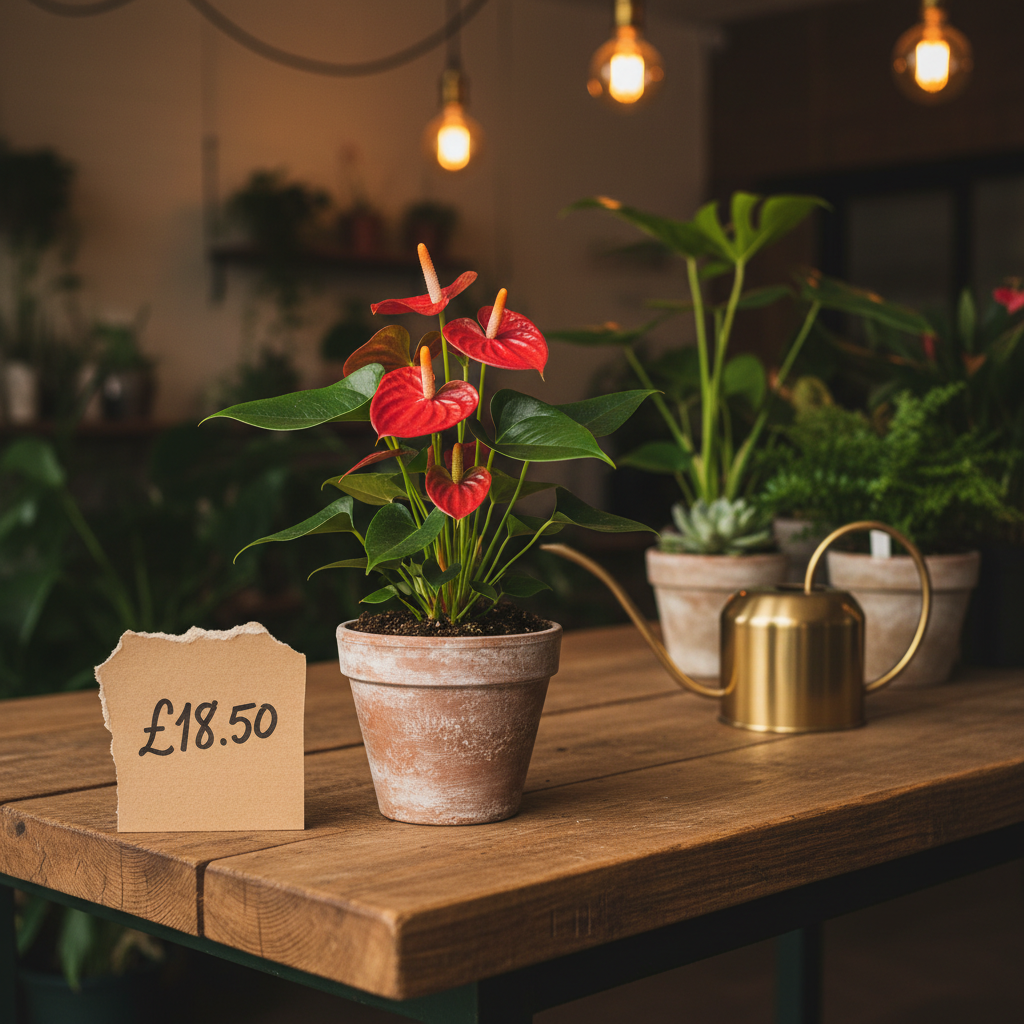
The second reason for its enduring popularity is scale. Unlike its cousin Anthurium andraeanum, which can stretch toward a metre tall with very long flower stems, A. scherzerianum stays compact, rarely exceeding 45 centimetres (about 18 inches) in cultivation. That makes it a natural windowsill, side-table or bathroom plant, easy to slot into a real home without rearranging the furniture. The leaves are smaller and more lance-shaped than the broad heart of andraeanum, dark glossy green and held on relatively short petioles, so the plant reads as tidy rather than sprawling.
The signature of the species, of course, is the curly spadix. While most anthuriums hold their spadix straight or only gently arched above a flat heart-shaped spathe, A. scherzerianum twists its spadix into a tight, almost spiral coil. The spathe itself is also subtly different, with a small backward curl at the tip and a slightly hooded carriage that gives the inflorescence a more sculptural, even animal quality. Children almost always notice the resemblance to a small flamingo’s neck and head before anyone tells them the common name.
Practically, the Flamingo Lily is also a tolerant houseplant. It survives in cooler rooms than most tropical aroids, handles short dry spells without dropping leaves, and forgives a degree of light variation that would silence most flowering plants. The flip side is that it is unforgiving of two specific mistakes, soggy soil and very low humidity, which is why those two sections of this guide are the longest. Get those right and the rest of the care barely needs thinking about.
Pro Tip — Buy in flower, not in bud: When buying a Flamingo Lily, choose a plant that already has one or two open spathes plus a third pushing up. A plant in tight bud may or may not open depending on how it has been transported; an in-flower plant proves the rootstock is performing.
Light Requirements
Light is the lever that controls flowering. A Flamingo Lily will survive in surprisingly low light, producing leaves that grow larger and darker as compensation, but it will not bloom until the average daily light level passes a certain threshold. For most homes that threshold corresponds to a position about a metre from a bright east window, or two to three metres back from an unobstructed south window with the harshest midday sun softened by a sheer curtain. Closer to the glass, the leaves scorch; further into the room, the plant settles into pure foliage mode and produces no spathes.
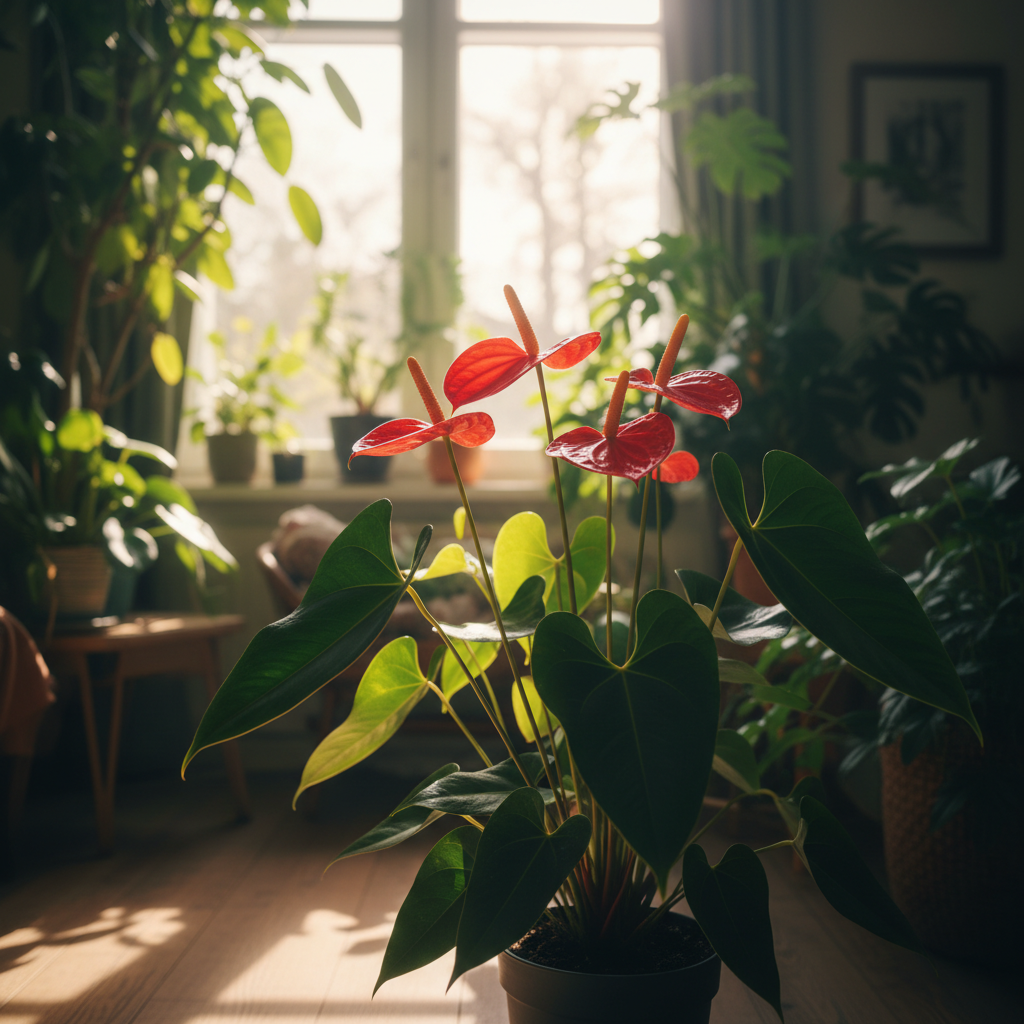
In numbers, aim for 10,000 to 20,000 lux at the leaves for several hours a day, peaking but not exceeding around 25,000 lux. That is bright by indoor standards but well short of full sun. A simple test is the shadow test: place your hand 30 centimetres above the foliage on a sunny midday, and the plant has good light if you can see a clear, soft-edged shadow with definite outline. A sharp, hard-edged shadow means too much direct sun; a vague, almost shapeless shadow means too little. Move the plant rather than the window, in 30 to 50 centimetre increments, until the shadow looks right.
Direction matters as much as quantity. East-facing windows give bright, warm morning light that the plant uses efficiently and then cools off through the afternoon, which suits the cloud-forest physiology. South-facing windows work too, but only with diffusion: a sheer curtain, frosted film or a tall companion plant sitting between the lily and the glass. West-facing windows are usable but tend to deliver light at the wrong time, with strong late-afternoon rays during summer that can crisp the spathes. North-facing windows, in the northern hemisphere, give light too dim for reliable blooming through winter, so a north-window Flamingo Lily often becomes a flowerless but otherwise healthy foliage plant from October to March.
Supplementary light is an easy fix in flats with limited window access. A small full-spectrum LED grow light positioned 30 to 40 centimetres above the plant, run for 10 to 12 hours a day, will sustain flowering through northern European winters when natural daylight drops to about 2 to 3 hours of usable intensity. The grow light does not need to be expensive; a basic 20 to 30 watt panel is more than enough for a single plant. Keep it on a simple plug timer to keep the day length consistent.
Signs of light stress are easy to read once you know them. Leaves that yellow uniformly across their full surface, especially the older ones nearest the soil, usually point to too much direct sun rather than nutrient deficiency. Brown crisp tips on the spathes or curled, papery edges on new leaves are also classic sun damage. Conversely, a plant getting too little light will produce smaller and smaller new leaves on noticeably longer petioles, with no flower buds appearing through a full season. Rotate the pot a quarter turn every week or two to keep growth even, since anthuriums lean strongly toward their light source over time.
Pro Tip — The bathroom trick: A bright bathroom window often combines the two things a Flamingo Lily wants most: high humidity from daily showering and filtered light from frosted glass. If your living room window is too dim, the bathroom is often the next best option.
Watering and Humidity
The single most common cause of death for the Flamingo Lily is overwatering, and the second is letting it sit so dry for so long that the root ball collapses and never rehydrates properly. Both problems trace back to the same misunderstanding: treating the plant like a leafy houseplant when its physiology is epiphytic. In its native cloud forest the roots are wrapped around tree bark or wedged into moss, surrounded by air and constantly dampened by passing rain and mist. The roots are designed to be wet briefly and then drained completely, over and over again, every day. A pot of stagnant soil is the exact opposite of that environment.
The simple rule is to water when the top 2 to 3 centimetres (about an inch) of the chunky mix has just dried. Push a finger into the substrate; if it feels barely damp at that depth, water; if it still feels noticeably moist, wait. Through the warm half of the year that usually translates into watering every 5 to 7 days; in winter, with cooler rooms and shorter days, the interval typically stretches to 10 to 14 days. Do not impose a fixed schedule, because the plant’s needs vary with temperature, humidity, light and pot type far more than with the calendar.
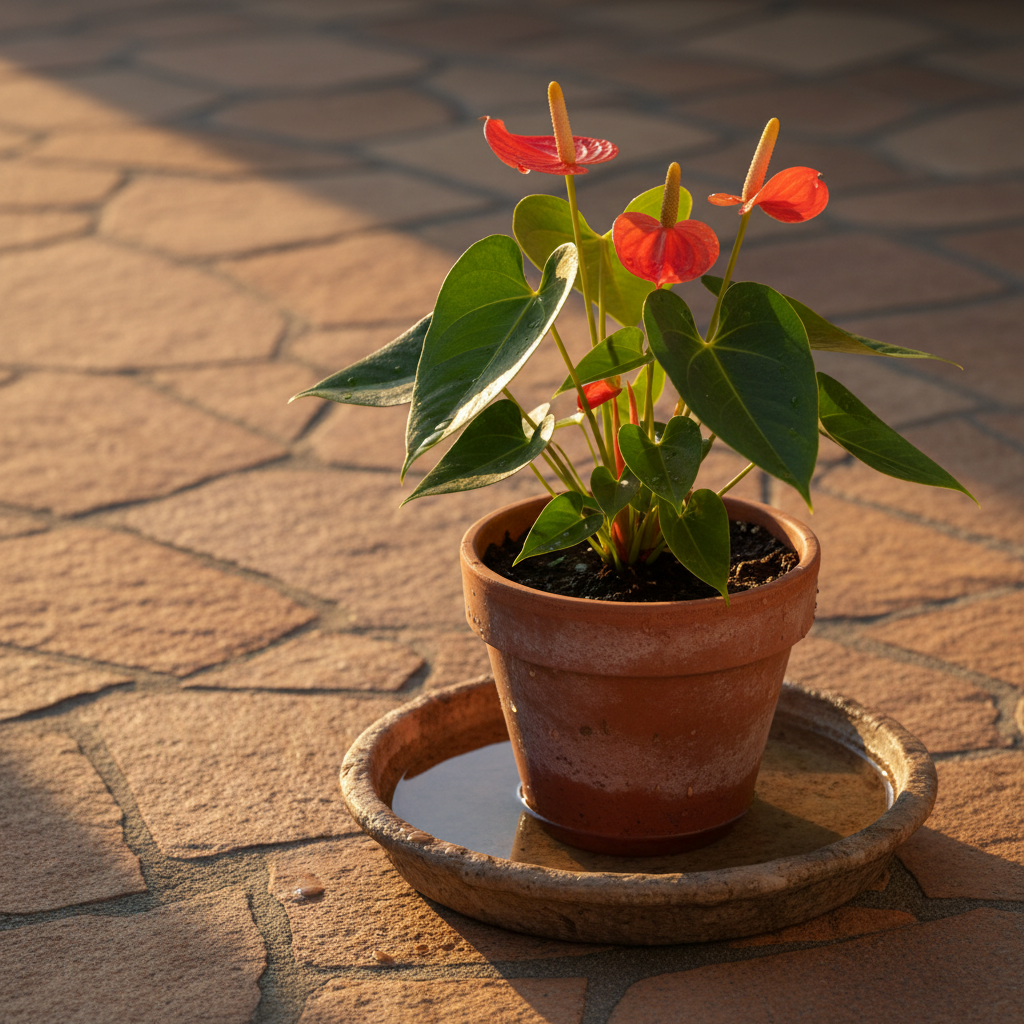
When watering, give a thorough soak. Run room-temperature water steadily through the pot until it streams freely from the drainage holes for ten or fifteen seconds, then let the pot drain fully before returning it to its decorative outer pot or saucer. Empty the saucer five minutes later. That single habit, draining and emptying, prevents the slow root rot that kills the majority of supermarket Flamingo Lilies within a year. Bottom watering, by setting the inner pot into a shallow dish of water for 15 to 20 minutes, is a perfectly acceptable alternative and reduces the risk of water-borne fungal spots on the foliage; just be sure to lift the pot out and let it drain afterwards.
Water quality matters more than for most houseplants. Anthuriums are mildly sensitive to chlorine and very sensitive to fluoride and sodium, which together cause the brown, papery leaf tips that owners often blame on humidity. If your tap water is hard or heavily treated, leave it standing uncovered for 24 hours before use, or switch to rainwater, distilled water or boiled-and-cooled water. The improvement in tip burn is usually obvious within one new leaf cycle.
Humidity
Humidity and watering work in tandem. A Flamingo Lily in 60 per cent humidity can go four or five days longer between waterings than the same plant in 30 per cent humidity, simply because less moisture is being pulled out of the leaves. Modern centrally heated homes often sit at 25 to 35 per cent during winter, which is dry enough to slow growth and brown the leaf tips even when watering is otherwise perfect. The fix is to raise the humidity locally rather than the watering frequency.
The most reliable way to do this is a small ultrasonic humidifier on a timer, run for a few hours each morning and evening within a metre of the plant. Pebble trays do a little but not much, since the evaporation surface is small compared with the volume of the room. Misting feels active but actually does very little for ambient humidity and can encourage fungal spots if water sits on the leaves overnight. Grouping plants together also helps, since collective transpiration raises the microclimate humidity in their immediate vicinity. A small monitoring hygrometer is the cheapest way to know what your plant is actually experiencing.
Temperature also affects watering needs. The Flamingo Lily is comfortable from about 18 to 24 degrees Celsius (65 to 75 degrees Fahrenheit) and slows noticeably below 15 degrees Celsius (59 degrees Fahrenheit). At cooler temperatures the plant uses less water, so the same watering frequency that suits a 22-degree living room will quickly become overwatering in a 15-degree winter bedroom. Cold draughts from open windows or air conditioning vents are a particular hazard, since they combine low temperature with high air movement and rapid dehydration of the leaves.
Warning — Cold tap water: Never water with cold water straight from the tap, especially in winter. A sudden chill to the roots can cause leaves to wilt within hours and trigger root rot in the days that follow. Always use water at room temperature, or even slightly warmed.
Soil, Potting and Repotting
The right substrate for a Flamingo Lily is closer to an orchid mix than a houseplant compost. The roots want air around them at all times, even when wet, and they want a substrate that drains within seconds of being watered rather than holding moisture for days. Standard peat-based potting compost, used alone, is fatal: it compacts, retains water, and starves the roots of oxygen, leading to root rot that is often undetected until the whole plant collapses.
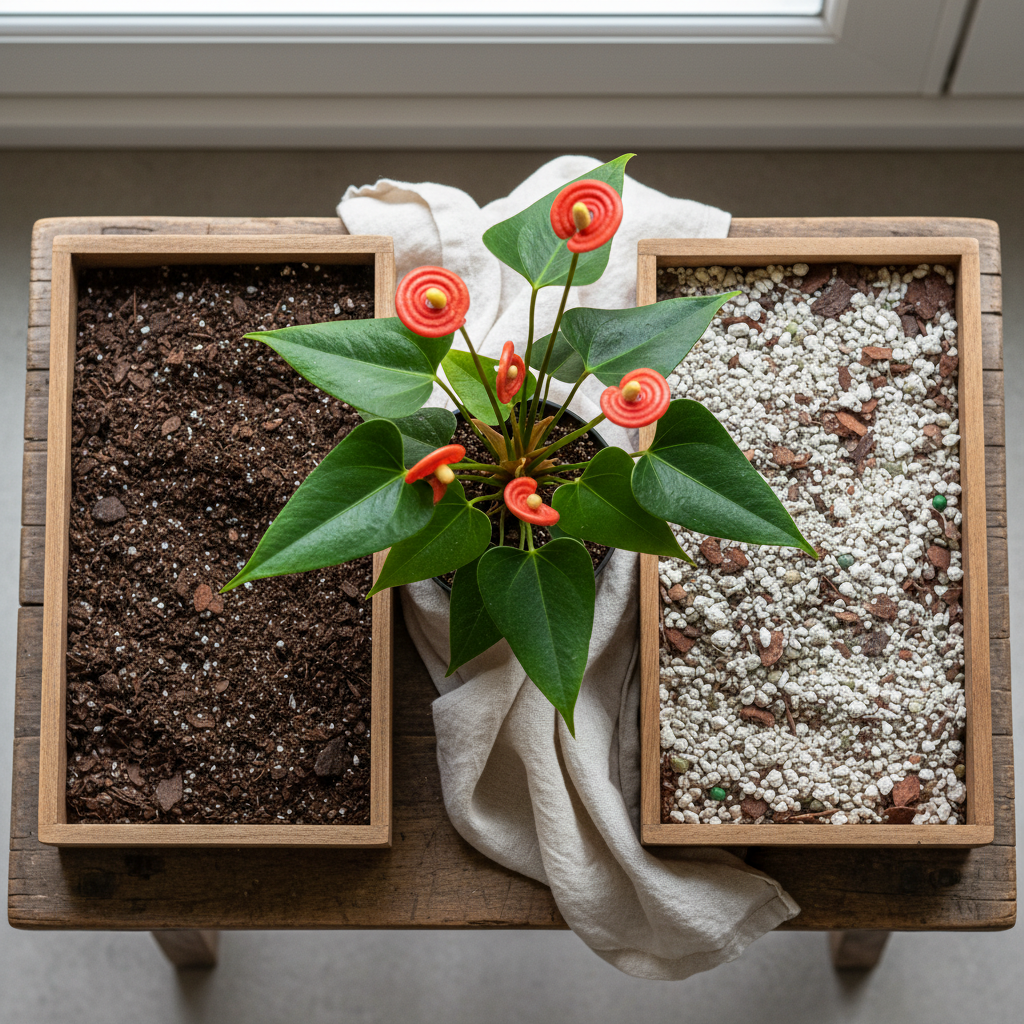
A simple, reliable mix that suits both A. scherzerianum and most other aroids is one part fine to medium orchid bark, one part perlite or pumice, and one part coco coir or sphagnum, with a small handful of horticultural charcoal added to keep the mix sweet over time. The orchid bark holds the chunky structure, the perlite provides air pockets, the coir holds just enough moisture to prevent rapid drying, and the charcoal absorbs the salts and impurities that would otherwise build up between repottings. Pre-bagged aroid mixes from specialist suppliers work too; avoid any product that lists peat or sphagnum as the first ingredient.
Pot choice
Pot material affects watering rhythm. Terracotta breathes through the walls, drying the substrate from the sides as well as the top; this suits anthuriums in damp houses but can dry too aggressively in centrally heated flats. Glazed ceramic and plastic retain moisture longer, which can be a help or a hindrance depending on your watering hand. Whichever material you choose, drainage holes are non-negotiable. A pot without holes is acceptable only as a decorative cachepot around an inner growing pot, never as the growing pot itself.
Size matters too, perhaps more for anthuriums than for most plants. The Flamingo Lily flowers best when slightly pot-bound, with its roots filling the available volume snugly. Over-potting into a much larger container leaves a ring of unused substrate around the rootball, which stays wet long after the central root mass has dried, and that wet ring is a textbook recipe for rot. When repotting, go up only one pot size at a time, roughly 2 to 3 centimetres larger in diameter.
When and how to repot
Most Flamingo Lilies need repotting every two years, although vigorous specimens fed regularly may need annual attention while slow-growing or older plants can go three years between repottings. The clearest signal is roots circling tightly inside the pot, often visible by gently lifting the rootball, or roots emerging from the drainage holes and looking for somewhere else to go. Spring, just as new leaves begin to form, is the best time to repot, because the plant has the energy to push fresh roots into the new substrate quickly.
- Water the plant lightly a day before repotting; this reduces transplant shock and makes the rootball easier to handle.
- Prepare the new pot by adding a 2 to 3 centimetre layer of fresh chunky mix at the bottom; do not add gravel as a drainage layer because it actually raises the perched water table inside the pot.
- Ease the plant out by squeezing the pot gently and tipping it sideways. If the rootball resists, run a thin knife around the inside edge.
- Examine the roots: healthy ones are firm, pale to light tan, and slightly fleshy. Dark, mushy or sour-smelling roots are rotting and should be trimmed away with sterilised secateurs.
- Tease apart any aggressively circling roots so they can grow outward into fresh substrate rather than continuing their spiral.
- Position the plant in the new pot at the same depth it sat before, with the base of the lowest leaves just above the substrate; never bury the crown.
- Backfill with chunky mix, settling it around the roots with gentle taps on the side of the pot rather than firm pressing with the fingers; you want air pockets, not compaction.
- Water lightly to settle the substrate, then put the plant somewhere bright but out of direct sun for a week to recover.
If the existing substrate is still chunky and not yet broken down, refresh rather than fully replace it. Lift the plant, remove only the loose outer two centimetres of mix, and add fresh substrate around the edges and on top. This is gentler on the roots than full repotting and is often all that is needed for younger plants on alternate years.
Fertilising
The Flamingo Lily is a moderate feeder, neither as hungry as a fast-growing Monstera nor as easily burned as a delicate fern. In an open, chunky substrate that holds very little nutrient reserve, regular dilute feeding is genuinely important, both to maintain dark green leaves and to fuel the recurrent flowering that is the species’ main appeal. Without feeding, growth slows quickly and the plant settles into a survival mode where it produces small new leaves but no further spathes.
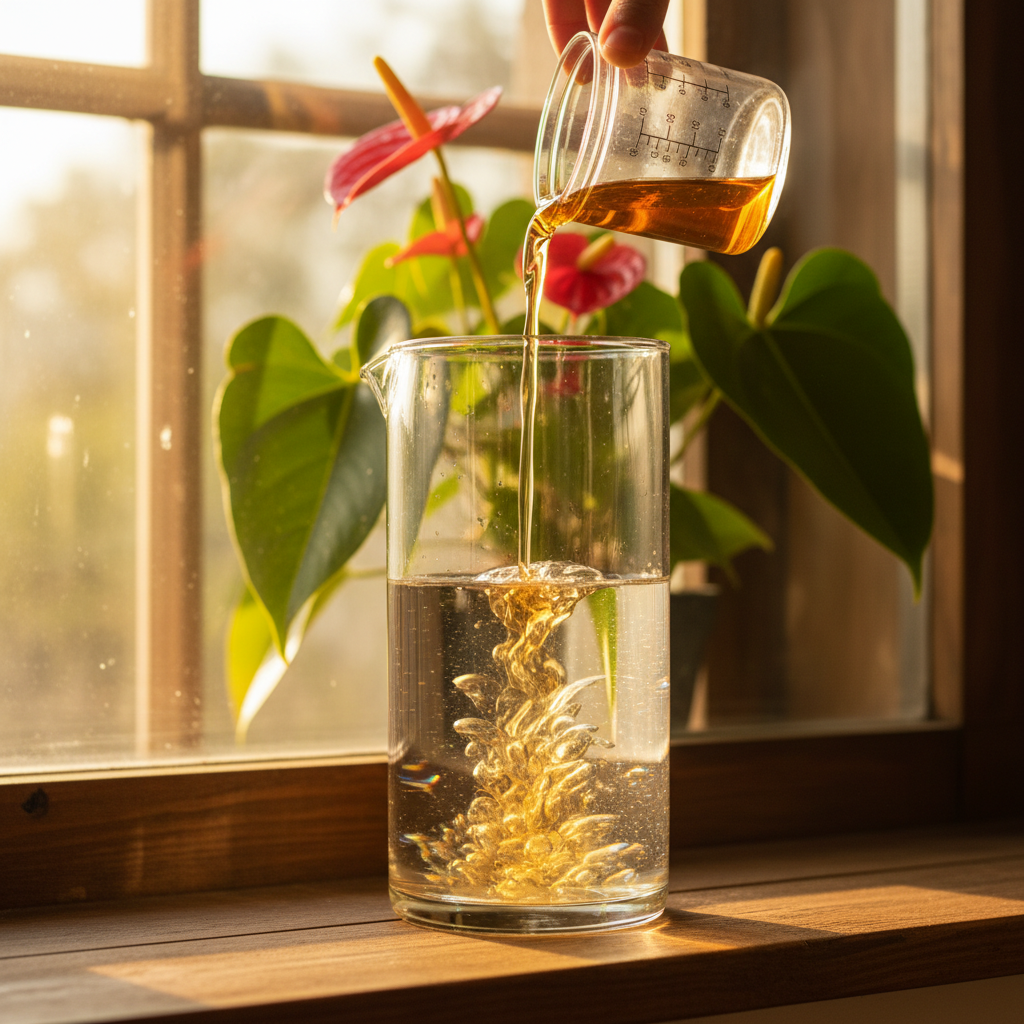
The simplest reliable approach is a general-purpose balanced liquid houseplant fertiliser, with N-P-K ratios in the rough range of 3-1-2 or 7-9-5, diluted to a quarter or at most half of the bottle’s stated strength, applied every two to three weeks during the active growth months between March and September. A slightly higher phosphorus number, like the 7-9-5 example above, encourages flowering; equal-balanced 7-7-7 also works well. Specialist orchid or anthurium feeds are excellent if available, since they are formulated with the chunky-substrate watering rhythm in mind.
Always apply fertiliser to substrate that is already lightly damp. Feeding a fully dry rootball risks burning the fine root tips, while feeding a sodden pot wastes most of the nutrient as it drains straight through. The simple sequence is to water the plant lightly with plain water, wait an hour, and then water again with the dilute fertiliser solution. This pre-wetting also lets the fertiliser spread evenly through the substrate rather than channelling along the dry pockets.
Reduce or stop feeding from late October through February. Light levels are at their lowest in those months, growth slows or pauses entirely, and unused fertiliser salts accumulate in the substrate. A single dilute feed in mid-winter is enough; some growers stop altogether through the dormancy and resume only with new growth in spring. If you suspect salt build-up, signalled by white crusting on the substrate surface or on the inside of the pot rim, leach the pot by running plain room-temperature water through it for two or three minutes, which flushes the accumulated salts out through the drainage holes.
Organic top-dressings work well as supplements rather than primary feeds. A thin sprinkle of worm castings on the surface every couple of months adds slow-release nutrients and supports beneficial substrate microbes. Avoid bulky compost-based top-dressings on aroids, since they tend to mat down and reduce the airflow that the chunky mix is specifically designed to provide.
Pro Tip — When in doubt, feed less: Anthuriums respond better to slightly underfeeding than to slightly overfeeding. Yellowing older leaves combined with crisp brown tips on new ones almost always signals salt build-up from too much fertiliser, not a deficiency, and the cure is a thorough flush rather than another feed.
Propagation
Unlike its andraeanum cousin, which can be propagated from stem cuttings if the stem has aerial roots, the Flamingo Lily is propagated almost exclusively by division of established clumps. Over time the plant produces side shoots, or pups, from the base of the main rootstock, each of which carries its own growing point and, eventually, its own root system. When a clump has three or more such pups, it can be divided into separate plants without harming the parent.
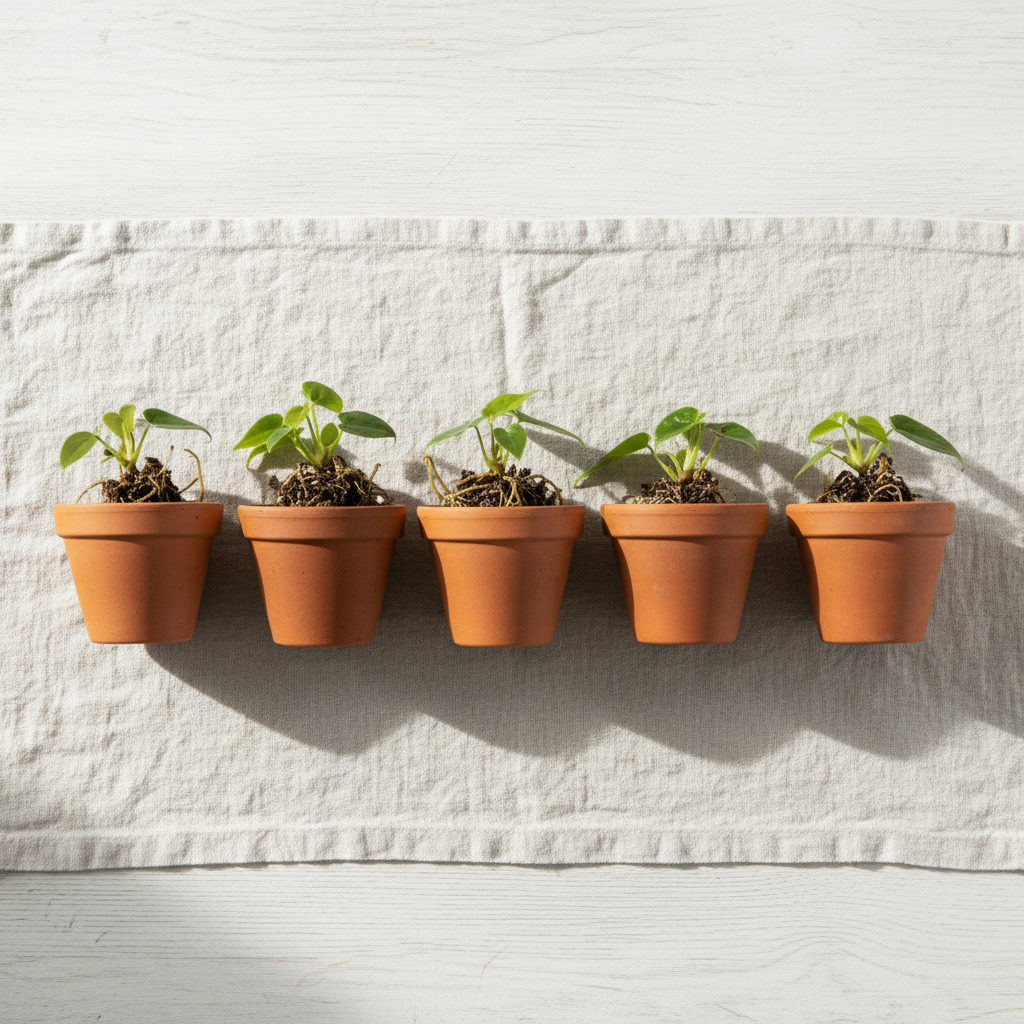
Spring is the ideal moment to divide, for the same reason as repotting: the plant has the warmth and rising light levels to recover quickly and push new roots into the fresh substrate. Combining division with the routine spring repotting is an efficient use of disturbance, since both involve lifting the plant out of its pot and inspecting the roots.
- Water the parent plant lightly a day before, to make the rootball flexible.
- Lift the plant out of its pot and gently shake or rinse away enough substrate to see the structure of the crown clearly; you are looking for distinct rosettes of leaves, each with its own attachment to the rootstock.
- Identify pups that have at least two or three of their own leaves and visible roots of their own, not just a leaf sprouting from the parent.
- Tease the pup apart with your fingers where possible. If the connection is too tough, use sterilised secateurs or a sharp knife to cut cleanly through the rhizome, keeping as many roots attached to each side as you can.
- Dust the cut surfaces with cinnamon or a sulphur-based powder, both of which discourage fungal entry through the wound.
- Pot each division into a small pot of fresh chunky aroid mix, choosing a pot only slightly larger than the rootball; oversized pots stay wet and rot the new roots.
- Water lightly to settle the substrate, then keep the divisions in a warm, bright but indirectly lit spot at 21 to 24 degrees Celsius (70 to 75 degrees Fahrenheit) with elevated humidity for the first three to four weeks.
- Resume normal watering once new leaf growth signals that the divisions have rooted in, usually four to eight weeks after division.
Seed propagation is technically possible, since a hand-pollinated spadix can produce orange berries containing viable seeds, but it is rarely worth the effort for the home grower. Germination is slow and erratic, the resulting seedlings take three to four years to flower, and most named cultivars do not come true from seed in any case. Division gives faster, more predictable, and visually identical results.
Tissue culture is the main commercial method behind the inexpensive supermarket plants, and explains why named cultivars are so widely available at low prices despite being slow to multiply by traditional means. It is not, however, a home-grower technique.
Pests and Diseases
Healthy Flamingo Lilies, grown in chunky substrate with good airflow and steady humidity, are relatively pest-resistant. Problems usually arrive either with newly purchased plants from a busy nursery or in association with an existing stress: dry air, poor light or chronic overwatering. Regular inspection of the leaf undersides and the leaf axils, ideally once a fortnight, catches almost every infestation while it is still trivial to deal with.

Spider mites
Spider mites are the most common pest, especially in dry winter rooms. They are tiny, about half a millimetre across, and live mostly on the leaf undersides where they pierce the cell walls and feed on the contents. Early signs are fine pale stippling across the upper leaf surface and, in heavier infestations, delicate webbing in the leaf axils and along the petioles. By the time webbing is obvious the population is already large. Treatment combines raising humidity, which mites dislike intensely, with rinsing the foliage thoroughly in tepid water in the shower, and following up with weekly applications of insecticidal soap or a 1 to 2 per cent neem oil spray for at least three weeks to catch successive hatchings.
Mealybugs
Mealybugs appear as small white fluffy specks tucked into leaf axils and along the underside of the midribs. They feed on sap and excrete a sticky honeydew that may attract sooty mould on the leaves below. For light infestations, dab each insect with a cotton bud soaked in 70 per cent isopropyl alcohol, which kills on contact and dissolves the protective waxy coating. For heavier infestations, follow with a neem oil or insecticidal soap spray every five to seven days for at least three weeks to break the lifecycle. Check thoroughly after each treatment, since mealybugs hide deep in tight crevices that are easy to miss.
Scale insects
Scale insects look like small brown or fawn-coloured bumps stuck firmly to the stems, petioles and sometimes the midribs. Unlike mealybugs they do not move once settled, which makes them easy to miss until the plant starts looking generally unwell. Scrape them off gently with a fingernail or a soft toothbrush and treat the plant with neem oil over several weeks. Crawler-stage juveniles are vulnerable to systemic insecticides if scale is recurrent or severe.
Thrips
Thrips are slender, fast-moving insects that scrape and rasp at leaf tissue, leaving silver streaks and small dark frass dots on the upper leaf surfaces. They particularly damage developing spathes, distorting them or causing them to abort. Yellow sticky traps capture flying adults and confirm an infestation; treatment is repeated sprays of insecticidal soap or systemic spinosad solutions over several weeks.
Root rot
Root rot is not technically a pest but a fungal complex, usually Pythium or Phytophthora, that takes hold in chronically waterlogged substrate. Symptoms are yellowing leaves, mushy bases at the crown, and a sour, swampy smell when the pot is lifted. By the time these are visible the situation is critical. Recovery is possible if any firm white root remains: unpot the plant, rinse the roots clean, cut away every soft or discoloured root back to firm tissue, dust the cuts with cinnamon or a fungicide, and repot into completely fresh chunky mix in a smaller pot than before. Hold off watering for a week, then keep the plant on the dry side of normal while it recovers.
Leaf spot diseases
Brown or black water-soaked spots on the foliage, with yellow halos, point to bacterial or fungal leaf spot infections that thrive in still air with persistent leaf wetness. Remove and dispose of affected leaves promptly, improve airflow around the plant, water at the base rather than over the foliage, and avoid misting. Persistent cases may need a copper-based fungicide spray.
Pro Tip — Quarantine new plants: Every new houseplant, whether from a supermarket, a specialist nursery or a swap with a friend, should spend at least two weeks well away from the rest of the collection. Two weeks is long enough for most pest infestations to become visible without exposing your existing plants.
Popular Varieties
Within the species Anthurium scherzerianum there is a surprising range of cultivars, most of them differentiated by spathe colour and pattern rather than by leaf form. The two highlighted below are the most consistently available and the most visually distinct, but garden-centre racks will often produce pink, salmon, peach and bicoloured forms that all belong to the same species. None of them changes the underlying care: light, water, substrate and feeding apply equally across the colour range.
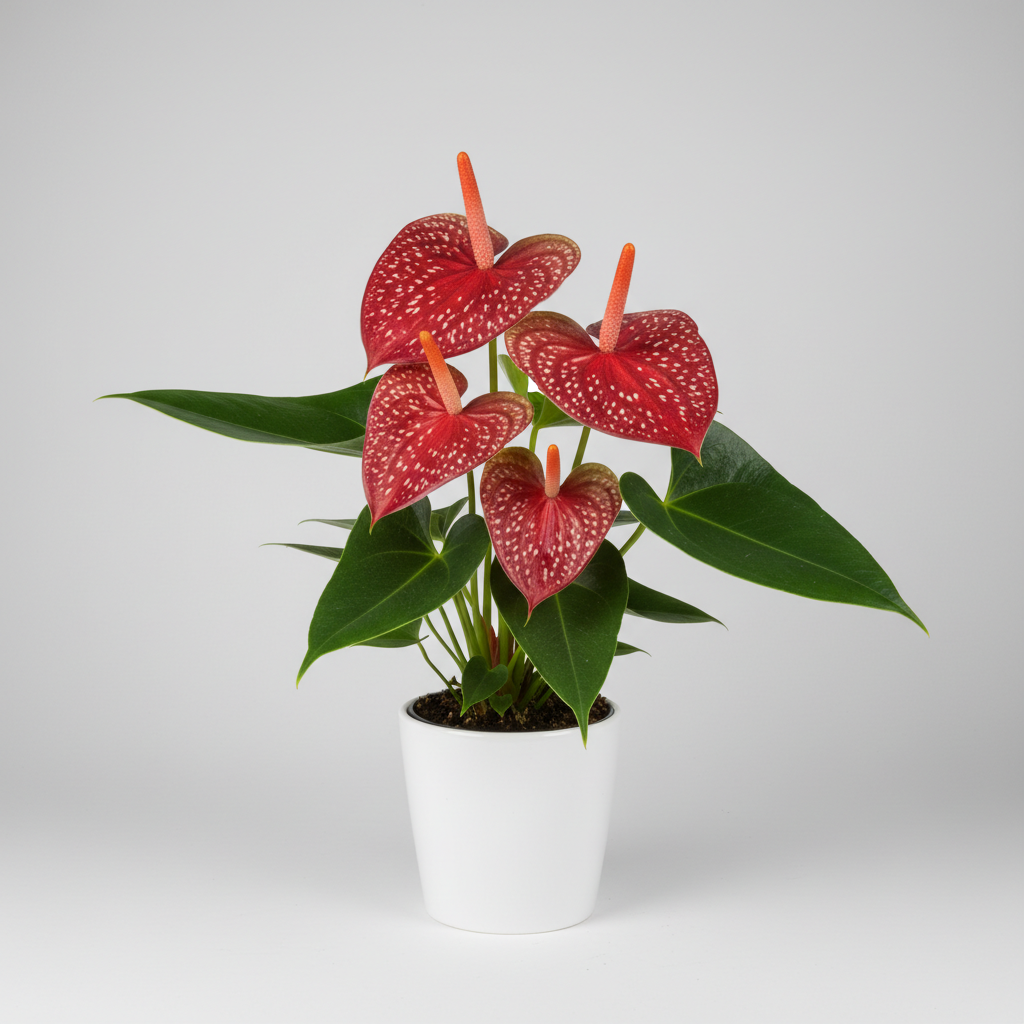
‘Rothschildianum’
One of the oldest named cultivars, dating from the late nineteenth century, ‘Rothschildianum’ carries a deep red spathe heavily speckled with creamy-white spots, paired with the trademark curly orange-red spadix. The variegation pattern varies slightly between plants and even between successive flowers on the same plant, which adds to its appeal for collectors. It tends to be a slightly slower grower than the plain red form but compensates with longer-lasting individual spathes, often holding colour for two months on the plant.
‘Album’
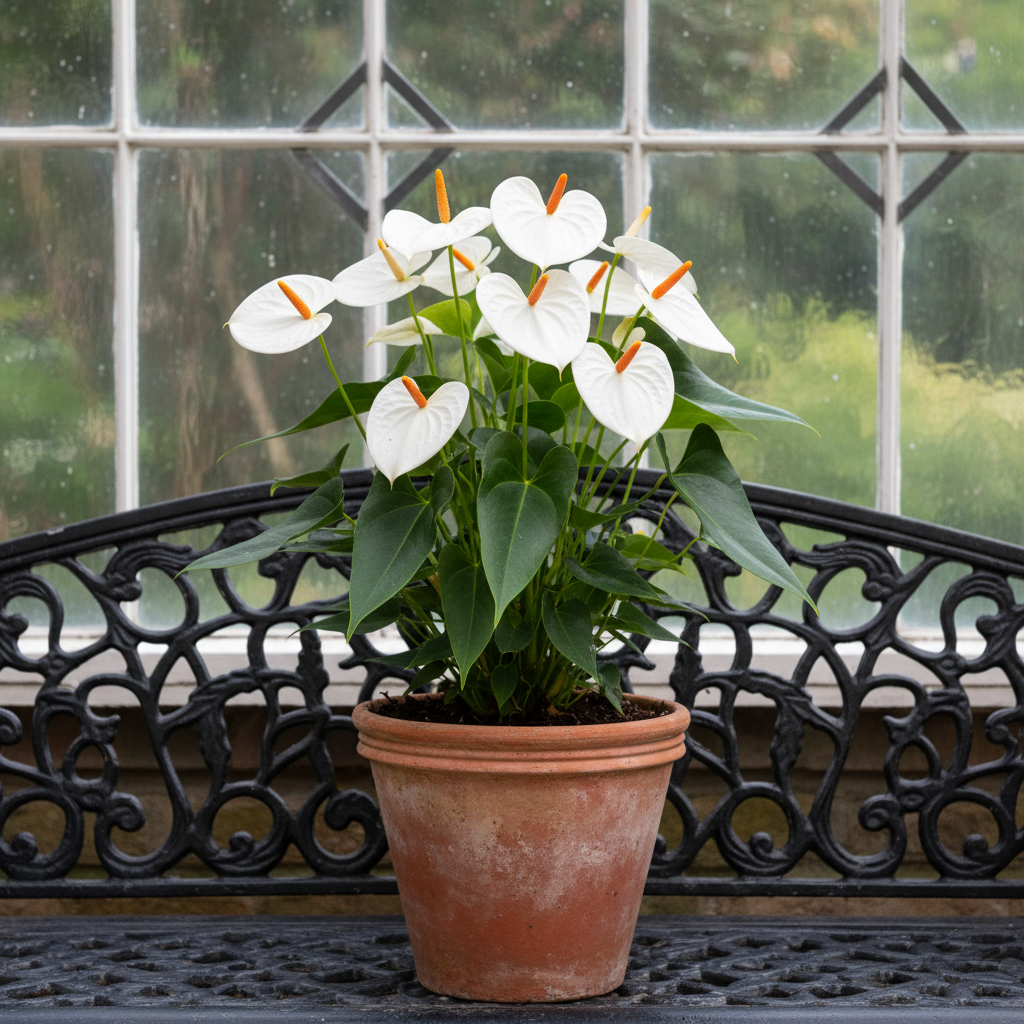
The classic white form, ‘Album’ shows the species in a calmer register: a pure ivory-white spathe with the curly bright orange spadix, contrasting beautifully against the deep glossy green foliage. It is a particularly good choice for minimal, Scandinavian or Japandi interiors where the brilliant red of the species form would dominate too much. Care is identical to the red, though some growers note that the white spathes are slightly more prone to bruising and so benefit from a position where they are not brushed by foot traffic or curtains.
Other cultivars worth looking out for
Beyond the two above, ‘Wardii’ produces unusually large, deep crimson spathes and tends to be a more vigorous grower. ‘Hawaiian Butterfly’ carries an unusual two-toned spathe in red and white. Pink-spathed forms are sold under various trade names including ‘Lacetta’ and ‘Lady Jane’. Genuinely peach or coral cultivars are scarcer but appear from specialist growers under names like ‘Coral’. As with most cultivar-heavy species, names drift between markets and over time, and the same plant may appear under different names in different countries.
Frequently Asked Questions
Why is my Flamingo Lily not flowering?
The most common cause is insufficient light. A Flamingo Lily that is otherwise healthy but has not flowered for several months almost always needs to move closer to a bright window, or to gain supplementary light from a small LED grow lamp. The second most common cause is overpotting, since the plant blooms best when slightly pot-bound. A third, less obvious cause is too much nitrogen-heavy fertiliser, which pushes leafy growth at the expense of flowers; switching to a balanced or phosphorus-leaning feed usually corrects this within one growing season.
Why are the leaf tips brown and crispy?
Brown crispy tips almost always trace to one of three causes: low humidity, salt build-up from fertiliser or tap water, or chronic underwatering. Check humidity with a small monitor; if it is below 40 per cent, raise it locally with a humidifier. Flush the substrate with plain water for a few minutes to leach out salts, and switch to rainwater or filtered water if your tap water is hard. If the tips appear after a stretch of total dryness, adjust watering frequency to keep the substrate evenly lightly moist rather than oscillating between bone dry and soaked.
Why are the flowers turning green?
A spathe that gradually fades from red, pink or white to green is doing exactly what it is supposed to do at the end of its life. The bright coloration is a youthful state, and as the inflorescence ages over six to ten weeks, chlorophyll takes over and the spathe greens before eventually browning and drying out. This is not a sign of poor care; it is the natural ageing process. Simply snip the old flower stem off near the base once it has fully greened, and the plant will redirect its energy into the next spathe.
Is the Flamingo Lily safe around cats and dogs?
No. Like nearly all aroids, Anthurium scherzerianum contains insoluble calcium oxalate crystals throughout its tissues. When chewed, these crystals cause intense burning in the mouth, drooling, vomiting and difficulty swallowing in cats and dogs, and similar symptoms in humans. The sap can also cause skin irritation in sensitive individuals. Place the plant where pets and small children cannot reach it, and wash your hands after handling cut stems.
How long does a Flamingo Lily live?
With reasonable care, a Flamingo Lily can live and flower for decades. Heirloom plants passed between generations are not uncommon, especially in older European households where the species was a Victorian and post-war favourite. Individual spathes last six to ten weeks, individual leaves several years, and the rootstock itself, divided periodically to keep it vigorous, indefinitely.
Can I move my Flamingo Lily outside in summer?
Yes, in warm climates and only with care. The plant benefits from the higher humidity and softer light of a shaded balcony or sheltered garden corner during the warmest months, provided night temperatures stay above 15 degrees Celsius (59 degrees Fahrenheit) and the position is sheltered from direct midday sun and from heavy rain. Bring it back indoors before night-time temperatures begin to slip toward 13 degrees Celsius (55 degrees Fahrenheit), usually in early autumn. Inspect carefully for hitchhiking pests before bringing it back in.
Does Anthurium scherzerianum clean indoor air?
The original NASA Clean Air Study from 1989, which is the source of most claims about air-purifying houseplants, did not specifically test Anthurium scherzerianum, but it did test the closely related Anthurium andraeanum, which removed ammonia, formaldehyde, xylene and toluene from sealed test chambers. By extension, the Flamingo Lily likely has similar capabilities. In practice, however, the effect at room scale is modest; ventilation does far more for indoor air quality than any single houseplant. Grow Flamingo Lilies for their beauty, and treat the air-cleaning as a small bonus.
What is the difference between Anthurium scherzerianum and Anthurium andraeanum?
The two species are often confused. A. andraeanum is larger, with broader, distinctly heart-shaped leaves and flat to slightly curved spathes held on tall stems above the foliage, often grown commercially as a cut flower. A. scherzerianum is more compact, with narrower lance-shaped leaves, shorter flower stems, and the diagnostic curly spadix that gives the species its common name. Care is broadly similar, but A. scherzerianum is the more tolerant of cooler rooms and somewhat easier as a windowsill plant for that reason.
For a plant with such a long history in the European houseplant trade, the Flamingo Lily remains a slightly under-appreciated companion. Treat it as the cloud-forest epiphyte it is, give it a chunky substrate, bright filtered light and steady humidity, and it will repay the attention with a long succession of those distinctive curly-tailed spathes for many years to come.






