
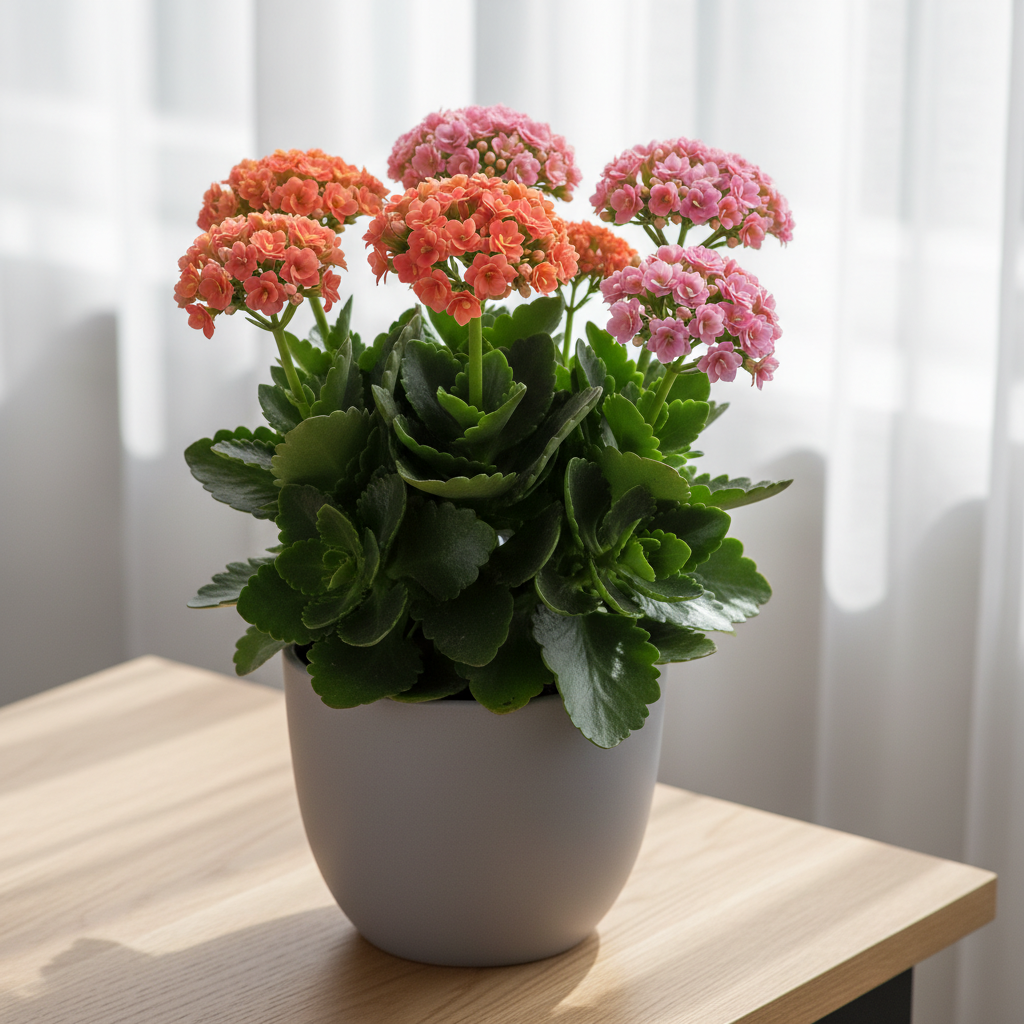
Flaming katy is the small, cheerful succulent responsible for a great deal of the colour that appears on supermarket shelves and florist counters in the depths of winter. Botanically it is Kalanchoe blossfeldiana, a member of the stonecrop family Crassulaceae from the rocky highlands of Madagascar, and it has been bred and rebred over the past century into one of the world’s best-selling flowering pot plants. Beyond “flaming katy” it travels under a quietly theatrical list of common names, including Madagascar widow’s thrill, Christmas kalanchoe, florist kalanchoe and simply kalanchoe, the last being a source of regular confusion because the wider genus contains more than a hundred species, most of which look nothing like it.
What separates this particular kalanchoe from its relatives is its long-flowering, brightly coloured umbel of four-petalled blooms held on slender stems above a tight rosette of glossy, scallop-edged succulent leaves. The plant has a reputation for being almost embarrassingly easy to keep alive, and it is — but keeping it alive is not the same as keeping it flowering, and that distinction is where most disappointment with flaming katy begins. This guide covers both: how to keep a flaming katy in robust health year on year, and how to coax it back into the same generous bloom it arrived with when you brought it home.
Contents
- Quick Reference
- Why Flaming Katy Makes a Rewarding Houseplant
- Light Requirements
- Watering and Humidity
- Soil, Potting and Repotting
- Fertilising
- Propagation
- Pests and Diseases
- Popular Varieties
- Frequently Asked Questions
Quick Reference: Flaming Katy at a Glance
| Botanical name | Kalanchoe blossfeldiana |
| Family | Crassulaceae |
| Native range | Madagascar (rocky highlands of Tsaratanana massif) |
| Mature size indoors | 20 to 45 cm (8 to 18 in) tall and wide |
| Light | Bright indirect light to a few hours of direct sun; needs strong light to rebloom |
| Watering | Allow the top half of the substrate to dry between waterings; reduce sharply in winter |
| Temperature | 15 to 24 degrees Celsius (59 to 75 Fahrenheit); tolerates a brief drop to 10 C (50 F) |
| Humidity | 30 to 50 per cent, average household air is fine; dislikes wet, stagnant humidity |
| Fertiliser | Balanced or bloom feed at quarter strength every 2 to 4 weeks in spring and summer |
| Soil | Free-draining cactus or succulent mix amended with extra perlite or pumice |
| Propagation | Stem-tip cuttings or leaf cuttings, callused before potting |
| Toxicity | Toxic to cats, dogs and other pets; mildly toxic to humans if eaten |
| Bloom trigger | Short-day photoperiod: six weeks of 14+ hours uninterrupted darkness per night |
| Lifespan | Often discarded after one season but can live and rebloom for many years |
Why Flaming Katy Makes a Rewarding Houseplant
The case for flaming katy rests on a rare combination in the houseplant world: it is a true succulent, so its water and care demands are gentle, and yet it produces a sustained flower display that can last six to eight weeks indoors. Most easy-care houseplants are valued chiefly for foliage; most flowering pot plants demand close attention. Flaming katy sits in the small overlap between the two, which is why it has been a fixture of winter florist counters since German hybridiser Robert Blossfeld introduced the species to European horticulture in 1932. The species name blossfeldiana honours him, and almost every coloured cultivar sold today descends from his early breeding stock crossed with hybrids developed in the Netherlands, Denmark and Israel over the following decades.

Beyond longevity of bloom, flaming katy offers a kind of confidence to nervous indoor gardeners. The thick, water-storing leaves forgive missed waterings. The compact rosette form does not outgrow a small flat. The plant rarely suffers serious pest problems if reasonable hygiene is observed. And when the flowers finally fade, the plant settles into a tidy, slow-growing succulent that asks for almost nothing for several months until the cycle begins again. It is also one of the few flowering houseplants that can be reliably reflowered at home, provided the grower understands its short-day photoperiod requirement. Mastering that single quirk transforms flaming katy from a disposable florist plant into a long-term resident.
Important — Toxicity: All parts of flaming katy contain bufadienolides, a class of cardiac glycosides that can disrupt heart rhythm. The plant is toxic to cats, dogs, rabbits and birds, and mildly toxic to humans if ingested in quantity. In pets, ingestion can cause vomiting, drooling, lethargy and, in larger doses, arrhythmia. Place the plant well out of reach of curious animals, and wash hands after pruning. If a pet has chewed the plant, contact a veterinarian.
Light Requirements
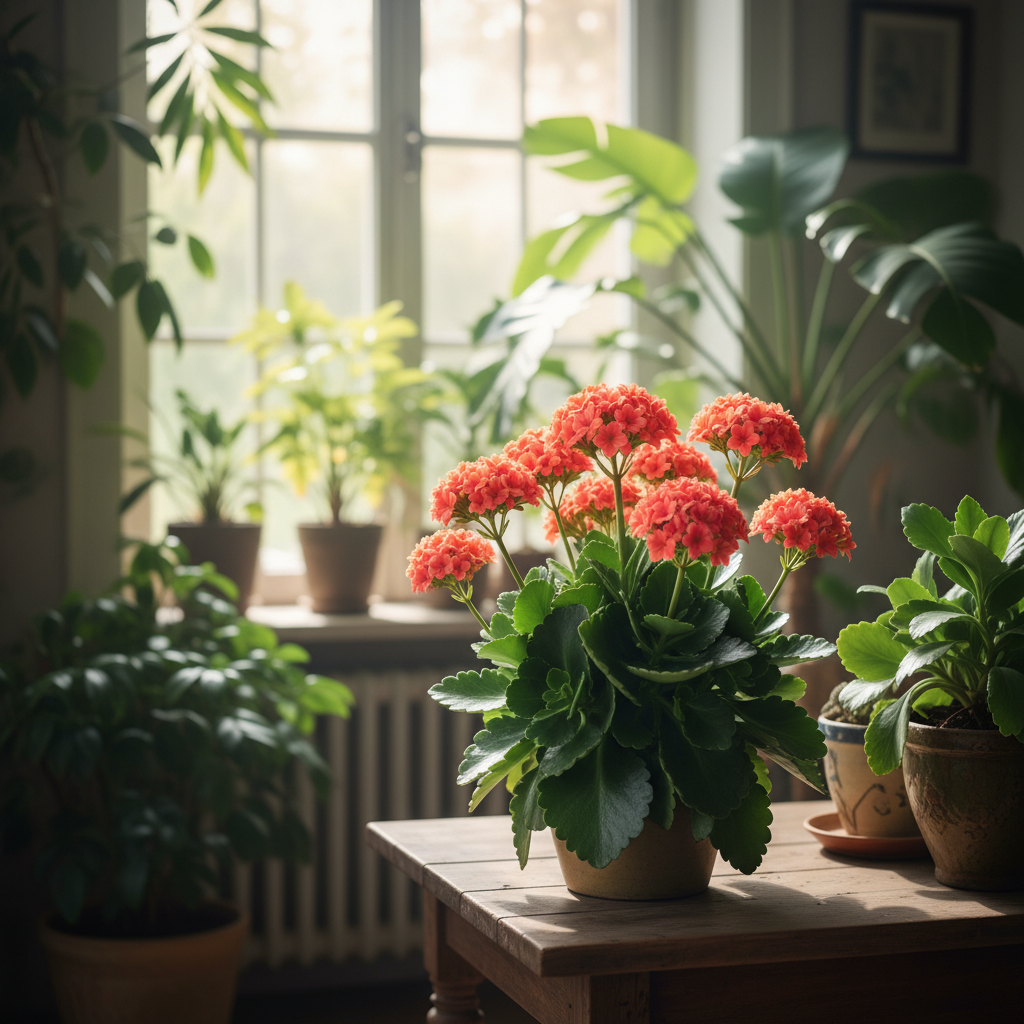
Flaming katy is a sun-loving plant by ancestry. Its wild habitat is the bright, rocky uplands of north-western Madagascar, where it grows in thin pockets of mineral soil exposed to long hours of strong tropical sun, tempered only by the occasional drift of dry-season cloud. Indoors that translates to a need for genuinely bright light, more than most foliage houseplants demand, and significantly more than a flowering kalanchoe will receive on an interior shelf two metres from a window.
The ideal location for a flaming katy is within one metre (three feet) of a south- or east-facing window, where it can receive several hours of either direct morning sun or filtered direct midday sun. In a north-facing room or a deep apartment in a northern latitude, a flaming katy will survive but will gradually lose its compactness, the leaves will pale and elongate, and the chance of reblooming the following season drops close to zero. Strong light is also what holds the rosette tight and keeps the leaves a deep, glossy green; weak light produces a stretched, sparse plant with pale, soft leaves.
Light Levels Explained
Plant light recommendations only make sense once “bright” and “low” are pinned to measurable values. The table below maps the four standard houseplant tiers to approximate footcandle and lux values and explains what each tier means for flaming katy specifically.
| Light Category | Approx. Level | Typical Location | Outcome for Flaming Katy |
|---|---|---|---|
| Direct sun | 10,000 to 80,000 lux | South-facing windowsill, conservatory, sunroom | Excellent in winter and early spring; risk of scorch in midsummer sun behind glass |
| Bright indirect | 5,000 to 10,000 lux | One metre from a south or east window, or directly in an east window | Ideal year-round; compact growth, deep leaf colour, reliable rebloom |
| Medium | 1,000 to 5,000 lux | North-facing windowsill, two metres from a south window | Survives well; growth slow, foliage pales, bloom poor or absent |
| Low | 200 to 1,000 lux | Interior corner, hallway away from windows | Decline within months; will not rebloom; suitable only as short-term display |
| Very low | Below 200 lux | Deep interior, windowless rooms | Unsuitable; plant will etiolate and slowly die |
Window Orientation and Placement
South-facing window: Excellent in autumn, winter and early spring, when the lower sun angle and shorter days mean the leaves rarely overheat behind glass. In summer, pull the plant back 30 to 60 cm (12 to 24 in) from the glass or drape a sheer curtain across the window during the brightest hours, otherwise the dark leaves can develop pale sunburn patches.
East-facing window: Arguably the best year-round position. Gentle, bright morning sun for two to four hours is well tolerated, after which the room remains bright but cooler. Flaming katy planted in an east window tends to keep the tightest rosette form and the most saturated leaf colour.
West-facing window: Works well, particularly in cooler climates. The afternoon sun is more intense than morning sun, so in hot summers expect to filter the glare with a curtain or move the plant a little further from the glass. The strong west light is excellent for triggering flower buds in early autumn.
North-facing window: Generally insufficient in northern latitudes for sustained flowering. The plant will live but will gradually elongate and stop blooming. If a north window is the only option, supplement with a small full-spectrum LED grow light for six to eight hours a day from autumn through to spring.
Pro Tip — Quarter Turns: Flaming katy leans into its light source more strongly than most succulents. Give the pot a quarter turn every time you water to keep the rosette symmetrical, otherwise the rear half of the plant will visibly lag the front half.
How Light Affects Flowering and Leaf Colour
Two distinct effects of light matter for flaming katy. The first is intensity, which governs growth quality and leaf colour. The second is daily duration (photoperiod), which governs when the plant decides to flower. Flaming katy is a quantitative short-day plant, meaning it initiates flower buds when nights become long enough, which in its native Madagascan winter occurs around the equinox. In a domestic setting this means uninterrupted darkness of 14 hours or more each night for at least six consecutive weeks is needed before the plant will set buds. Light pollution from a hallway lamp or a streetlight through a thin curtain is enough to reset the clock, which is why so many indoor-grown specimens fail to rebloom even in otherwise good conditions.
Warning — Direct Sunlight: A flaming katy moved abruptly from a shaded shop display straight onto a sunny summer windowsill behind glass can scorch within 48 hours, producing pale beige patches where the cellular layers cooked. Acclimate any new plant for one to two weeks by stepping it gradually closer to its final bright position.
Artificial Lighting
Flaming katy responds well to LED grow lights, which can substitute for poor natural light or augment a marginal window in midwinter. A modest 20- to 40-watt full-spectrum LED at 20 to 30 cm (8 to 12 in) above the plant for 10 to 12 hours a day will sustain a healthy rosette indefinitely. Importantly, the same lamp can be used to control flowering: keeping the plant under exactly 8 hours of light per day (and 16 hours of true darkness) for six weeks in autumn reliably triggers a synchronised bloom about eight to ten weeks later.
Seasonal Adjustments
In summer, especially in temperate regions where the sun arcs high through a window, expect to pull the pot back slightly from the glass or filter the brightest midday hours. In autumn and winter, the opposite applies: push the plant as close to the window as the temperature allows, since intensity drops off sharply with distance and the plant needs all the light it can get to stay compact through the dim months. From late September to early November is also the window for engineering rebloom — at any other time of year, day-length manipulation will not produce reliable results.
Watering and Humidity
Watering is where flaming katy is most often killed. It is a succulent, and like most succulents it is far better adapted to enduring a drought than to surviving a continually wet root zone. The thick leaves are essentially water-storage organs; the roots are fine and shallow and rot quickly if they sit in soggy soil. The mental model to carry is that of a small alpine plant, not a tropical one: brief generous rain followed by a long dry interval is what the plant evolved to expect.
When to Water
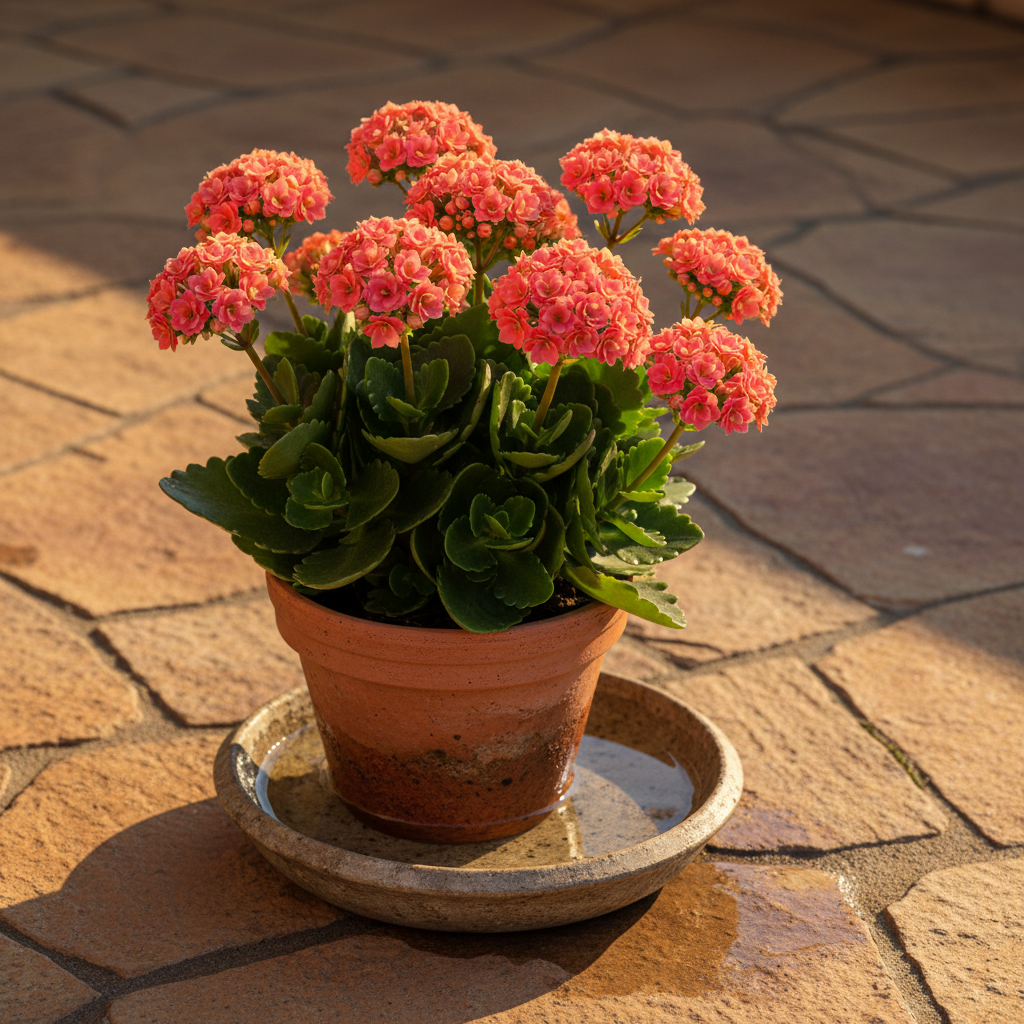
The simplest reliable rule is to let the top half of the substrate dry completely before watering again. In a 12 cm (5 in) pot in average household conditions, that usually means watering every 10 to 14 days in spring and summer and every three to four weeks in winter. The exact interval will depend on pot material, light, temperature, humidity and plant size, so probing the soil with a finger or a wooden skewer is more reliable than any calendar.
The leaves themselves give the clearest signal. A well-hydrated flaming katy has plump, firm leaves that feel cool and slightly springy. A leaf that begins to feel softer, thinner or that develops a faint wrinkle along the underside is asking for water. Conversely, a leaf that has yellowed or feels translucent and squishy is signalling overwatering, and the response is to stop watering immediately and inspect the roots.
Pro Tip — The Pot-Weight Test: Pick up the pot immediately after a thorough watering and again two weeks later. The difference in weight is striking once you have felt it, and pot-weight quickly becomes the most accurate way to judge whether your flaming katy actually needs water, without sticking fingers or skewers into the rootball.
How to Water Correctly
- Check that the top half of the substrate is dry. If still moist, wait and check again in a few days.
- Take the pot to a sink, or place it on a deep saucer if it cannot be moved.
- Water around the soil surface only, taking care not to splash the rosette or crown. Pour slowly until water flows freely from the drainage holes.
- Allow the pot to drain completely for 10 to 15 minutes; tip out any water still standing in the saucer.
- Return the plant to its display position; do not let it sit in a cachepot with pooled water.
- Note the date or simply remember the weight of the pot, and resist the urge to water again until the substrate test calls for it.
Signs of Overwatering vs. Underwatering
| Symptom | Overwatering | Underwatering |
|---|---|---|
| Leaf colour | Yellowing from the base of the plant upwards, often translucent | Dull green fading to pale grey-green, slow gradient from leaf tips |
| Leaf texture | Soft, squishy, sometimes weeping clear or brown sap when squeezed | Thinner than usual, faintly wrinkled along the underside, still firm |
| Soil | Dark, smells sour or musty, dries unevenly, may grow mould on the surface | Pulls away from the inside of the pot, dusty grey, fully dry to depth |
| Roots | Brown, mushy, dark and easily detached from the rootball | Pale, dry, intact but brittle at the tips |
| Stem base | Soft, dark, sometimes hollow; collapses when pressed | Firm, possibly slightly shrivelled at the very base |
Warning — Root Rot: Once root rot has reached the stem base, the plant cannot recover. The only salvage is to take a healthy stem-tip cutting from above the rotted zone, let it callus for several days, and start a new plant. Discard the original substrate and rinse or replace the pot before reusing it.
Humidity Requirements
Flaming katy is, refreshingly, one of the very few popular houseplants that does not want extra humidity. Its native habitat sees relative humidity dip into the 30 to 40 per cent range in the dry season, which closely mirrors the air in a centrally heated European home in winter. Most household environments fall comfortably inside its tolerance band of 30 to 60 per cent.
Trouble starts in the other direction. Humidity above 70 per cent, especially in poorly ventilated rooms, encourages fungal leaf spot, botrytis on spent flowers and powdery mildew on the foliage. Plants kept in steamy bathrooms or grouped tightly with humidity-loving tropicals will sometimes show a faint grey haze on the upper leaves within weeks. If this is happening, move the plant to a drier, better-ventilated spot rather than reaching for a fungicide.
Misting is unnecessary and actively counterproductive. Water trapped between leaves or in the crown of the rosette is a reliable route to crown rot and to a sticky dieback of the bloom stalks. Trying to raise humidity around flaming katy is a misapplication of advice that suits ferns and calatheas; for this plant, dry, moving air is preferable.
Water Quality
Flaming katy is largely indifferent to tap water in moderate hardness areas. In very hard-water regions, mineral build-up can show up over time as a chalky crust on the soil and around the pot rim, and occasionally as small pale spots on older leaves; rainwater or filtered water remedies this if the issue is significant. Avoid softened water from a domestic ion-exchange softener, since it is high in sodium, which the plant tolerates poorly. Aim to water at room temperature; cold tap water can briefly shock the roots in winter.
Soil, Potting and Repotting
Substrate matters more for flaming katy than for many flowering houseplants because the margin between adequate drainage and root rot is narrow. The plant is sold in a peat-heavy retail mix designed for nursery throughput, not long-term health, and many specimens decline simply because they are still in that mix six months after purchase. Switching to a free-draining gritty mix is one of the single most useful interventions for an indoor flaming katy.
Ideal Soil Composition
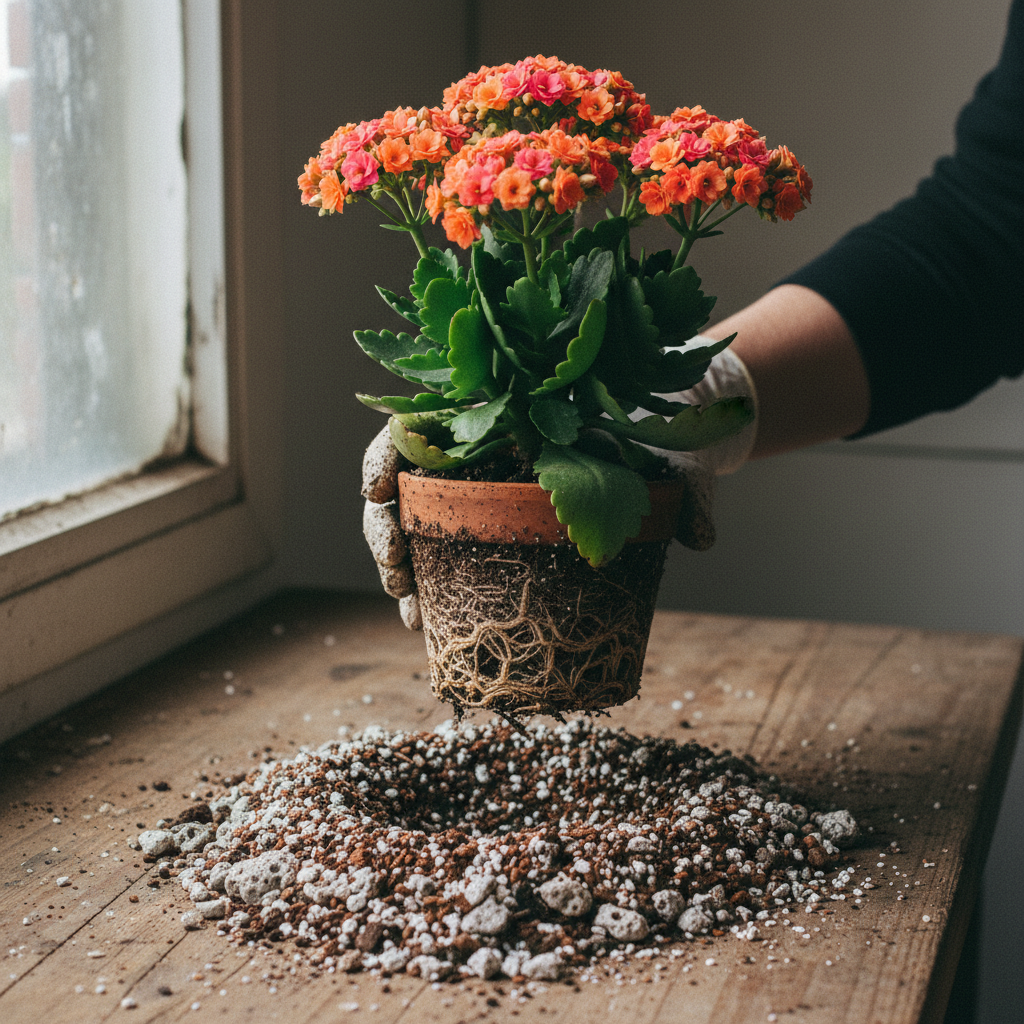
A good flaming katy mix balances quick drainage with just enough moisture retention to avoid the substrate drying to a crust within hours of watering. The aim is a structure that wets thoroughly, releases excess water within seconds, and dries front to back over one to two weeks. Pure mineral substrates work for advanced growers, but a peat-light, perlite-rich blend gives most home growers the best balance.
| Component | Proportion | Function |
|---|---|---|
| Commercial cactus and succulent mix | 50 per cent | Base structure, moderate water retention, mild nutrient buffer |
| Coarse perlite or pumice | 30 per cent | Air pockets, rapid drainage, prevents compaction |
| Coarse horticultural sand or fine grit (2 to 4 mm) | 15 per cent | Drainage and weight; helps anchor top-heavy flowering plants |
| Sieved coir or fine bark | 5 per cent | Small organic component for cation exchange and gentle moisture buffer |
The target pH for flaming katy is mildly acidic to neutral, in the range 6.0 to 7.0. Most commercial cactus mixes fall within this range out of the bag, and casual home gardeners do not need to test their pH actively. Avoid alkaline compost or mixes amended with significant amounts of dolomite lime, which can lock out iron over time and produce a slow yellowing across the foliage.
Pro Tip — Quick Mix Recipe: If reaching for a ready-made cactus mix, simply add an equal volume of perlite by eye before potting. The resulting “two-to-one perlite-boosted cactus mix” outperforms almost every retail substrate sold to flaming katy growers, and the difference in root health over the first six months is dramatic.
Choosing the Right Pot
The pot is a small but disproportionately important decision. Flaming katy has a shallow, fibrous root system that resents oversized containers. The wet, unoccupied substrate at the edges of a too-large pot stays soggy long after the centre has dried and is the most common cause of slow root rot. Match the pot diameter closely to the plant rather than reaching for the next size up out of habit.
Drainage holes are non-negotiable. A decorative pot without a drainage hole, however attractive, is a permanent risk for any succulent. Use such pots only as cachepots, with the plant in a plain plastic or terracotta inner pot that can be lifted out for watering. A drilled hole is far better than a layer of pebbles at the base, which does nothing to improve drainage and reduces the soil volume available for roots.
Pot material: Terracotta is the strongest match for flaming katy. Its porous walls allow the substrate to dry through the sides as well as the surface, which closely mimics the rapid wet-dry cycle of the plant’s habitat. Glazed ceramic, plastic and metal pots all work but will hold moisture longer; if using one, lengthen the interval between waterings accordingly.
Pot size: The new pot should be only two to three centimetres (one inch) wider than the previous one. A flaming katy that has just left a 10 cm nursery pot belongs in a 12 to 13 cm pot, not in a 17 or 20 cm pot. Resist the impulse to “give it space to grow”; this plant prefers a slightly snug container and flowers more readily when its roots feel the edge.
When to Repot
Flaming katy is a slow grower and does not need annual repotting. The reasonable schedule is once every two to three years, ideally in early spring as new growth resumes after winter rest and before the summer growth flush. Outside that window, repot only if the plant has fully filled its pot with roots, if water now runs straight through with no absorption, or if root rot is suspected and the substrate needs to be replaced as an emergency intervention.
How to Repot: Step-by-Step
- Water the plant lightly two days before repotting so the rootball holds together without being heavy.
- Prepare the new pot: a clean terracotta pot one size up, with a single drainage hole and a small piece of broken pottery or fine mesh laid over the hole to prevent substrate loss.
- Mix or pour your succulent substrate to one third of the pot depth.
- Slide the plant out of its old pot, supporting the rosette gently with one hand and tipping the pot with the other. If reluctant, tap the pot rim against a hard edge.
- Loosen the outer roots with the fingers, removing about a third of the old substrate. Trim any black, hollow or sour-smelling roots cleanly with sterilised scissors.
- Position the plant in the new pot so the crown sits about one centimetre below the rim. Backfill with fresh mix around the sides, tamping gently with the fingertips until firm but not compacted.
- Brush off any substrate caught in the rosette with a soft brush. Do not water immediately; wait three to five days to allow any damaged roots to callus before introducing moisture.
Warning — Transplant Shock: Flaming katy in full bloom often drops a flush of flowers a few days after repotting. This is a normal stress response and does not indicate a problem. If possible, repot before flower buds open or after the bloom has finished, and avoid feeding for the first month in the new pot.
Fertilising
Flaming katy is not a heavy feeder, but it is a flowering plant, and the energetic cost of producing dense flower clusters quickly depletes the small reservoir of nutrients in a freshly potted succulent mix. Without feeding, a flaming katy that flowered well in its first year often produces a sparse, washed-out display in the second, even if all other conditions are excellent. A modest, regular feed during the growing season is what closes that gap.
The principle is little, often, and weak. Concentrated feeding scorches the fine roots, while a thin solution applied during routine waterings keeps a steady supply of available nutrients without risking burn. Most failures come from following the dose on the bottle, which is calibrated for fast-growing tropicals rather than a slow-paced succulent.
Understanding Plant Nutrients
The three macronutrients listed on every fertiliser label — nitrogen, phosphorus and potassium, shown as the N-P-K ratio — drive the broad strokes of growth. Nitrogen powers leaves and stems, phosphorus supports root development and flower formation, and potassium regulates many processes from water balance to disease resistance. For a flowering succulent, a slight skew toward phosphorus and potassium and away from heavy nitrogen produces the best results.
| Nutrient | Symbol | Primary Function | Deficiency Symptoms |
|---|---|---|---|
| Nitrogen | N | Leaf and stem growth, chlorophyll synthesis | Pale, yellowing older leaves; slow, weak growth |
| Phosphorus | P | Root development, energy transfer, flower formation | Sparse flowering, dull dark green leaves, sometimes purplish tints on stems |
| Potassium | K | Water regulation, disease resistance, flower colour | Browning leaf edges, weak stems, faded bloom colours |
| Calcium | Ca | Cell wall structure, new growth integrity | Distorted new leaves, brown leaf tips, weak rosette |
| Magnesium | Mg | Central atom of the chlorophyll molecule | Interveinal yellowing on older leaves, veins remain green |
| Iron | Fe | Chlorophyll production, enzyme function | Yellowing of new leaves with dark green veins (chlorosis) |
Types of Fertiliser
Liquid fertilisers: The simplest option and the easiest to dose accurately. Choose a balanced houseplant feed (e.g. 10-10-10 or 7-7-7) or a bloom-specific formulation with slightly higher P and K (e.g. 3-7-7), and dilute it to a quarter of the label strength for flaming katy. Liquid feeds act quickly and are easily adjusted, which suits a plant whose appetite varies with the season.
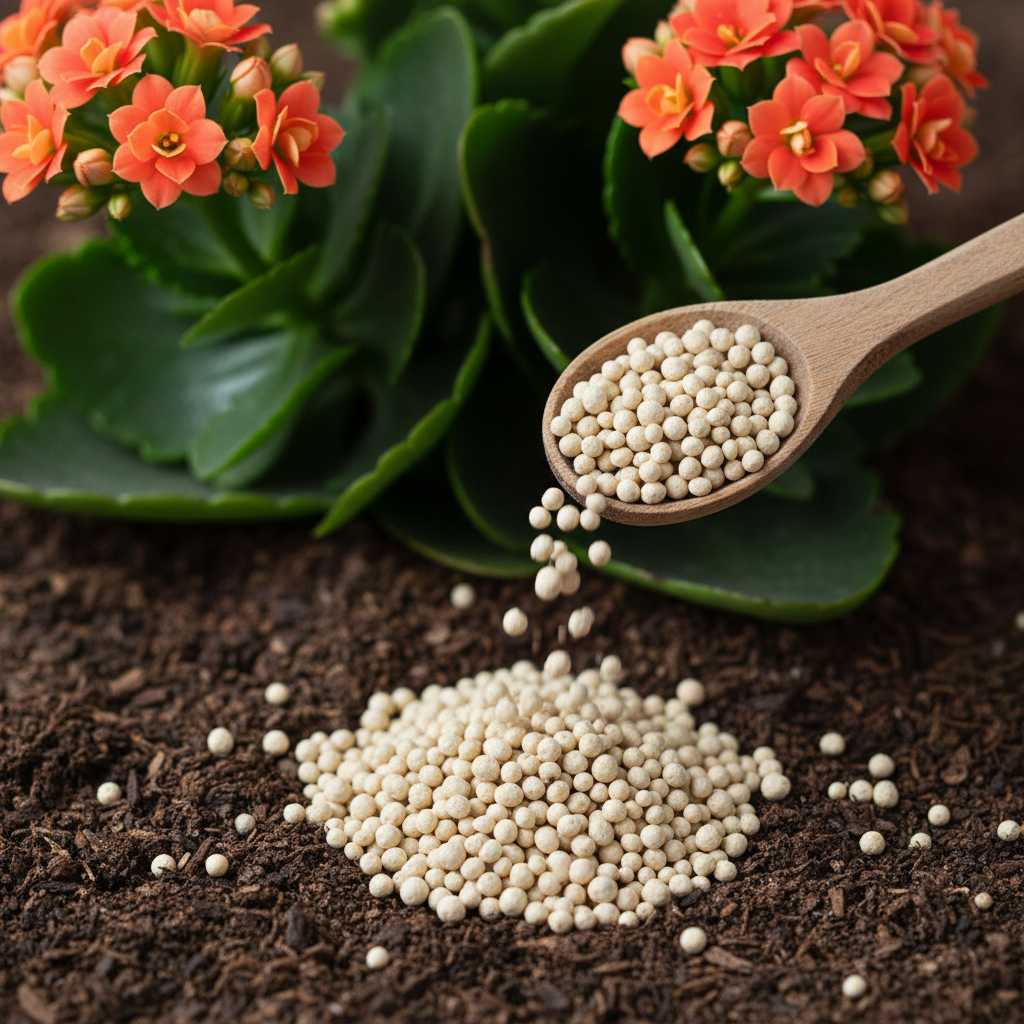
Slow-release granular: Coated prills release nutrients over three to six months in response to soil moisture and temperature. A small pinch sprinkled on the substrate in spring delivers a steady trickle of feed across the growing season with no further effort. Convenient, although less responsive if the plant shows signs of deficiency mid-season.
Organic fertilisers: Worm castings, compost tea or fish emulsion all work, although fish emulsion can smell strongly indoors. Worm castings make an excellent annual top-dressing applied 1 cm thick to the substrate surface in spring; they release nutrients slowly and improve substrate microbiology with almost no risk of burn.
Feeding Schedule
Feed flaming katy actively from late March to early September. During this window, a quarter-strength liquid feed applied every two to four weeks at routine watering is generous. From mid-September through to the end of February, withhold fertiliser entirely; growth slows, flowering is being induced and any excess feed encourages weak, sappy new leaves that flop and rot. A plant fed steadily through summer and starved through winter produces the most reliable flower flush in late autumn and early winter.
Pro Tip — Half Strength of Half Strength: If you are unsure, err on the side of dilution. A flaming katy fed at one-eighth strength every two weeks will perform better than one fed at full strength once a month, because the plant prefers a steady, low-concentration supply over occasional spikes. Excess fertiliser cannot be undone; insufficient feed shows up gradually and is easily corrected.
How to Fertilise
- Water the plant lightly with plain water first, especially if the substrate is fully dry. Feeding into bone-dry soil concentrates fertiliser on the few damp pockets and can scorch fine roots.
- Dilute the liquid fertiliser to a quarter of the recommended label strength in a clean watering can.
- Apply the diluted feed slowly around the soil surface, avoiding the leaves and crown. Water in until a small amount drains from the holes.
- Tip out any feed pooled in the saucer; never let the plant reabsorb the runoff, which is the most concentrated portion.
- Note the date and feed again no sooner than two weeks later, unless the plant is in a clearly active growth phase and shows it is using the nutrients.
Warning — Salt Build-Up: Repeated feeding without flushing leaves a slowly accumulating salt crust on the substrate surface and around the pot rim. Once or twice a year, water the plant heavily with plain rainwater or filtered water until at least twice the pot volume has run through; this leaches out accumulated salts and resets the chemical balance of the substrate.
Propagation
Flaming katy is one of the most cooperative houseplants to propagate. Like most Crassulaceae it strikes readily from stem-tip and leaf cuttings, requires no rooting hormone, and is reliably ready to be moved into substrate within four to six weeks of taking the cutting. The only widely encountered failure mode is rotting the cutting through too much moisture, which a callusing step entirely prevents.
The best time to propagate is from late spring to mid-summer, when the parent plant is in vigorous growth and ambient warmth speeds up rooting. Cuttings taken in autumn or winter will root eventually, but the process can stretch to three months and the success rate drops. Plan propagation alongside the post-bloom tidy-up: it is the moment when there is plenty of healthy stem material to take cuttings from and the parent benefits from the pruning anyway.
Understanding the Callusing Step
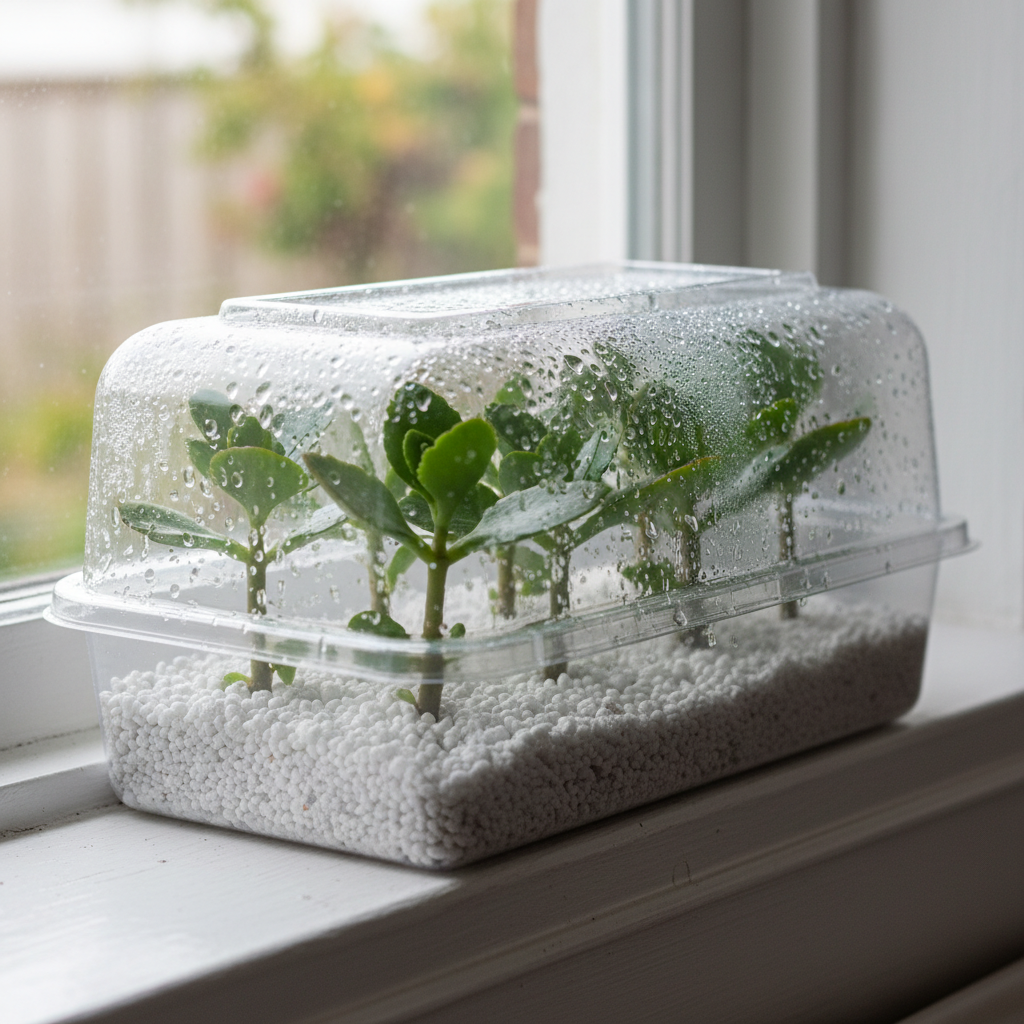
Every cutting begins with a wound, and any wound on a succulent is an open door for soil-borne pathogens until it has dried and sealed. Callusing simply means leaving the freshly cut surface exposed to dry air for two to seven days until a firm, slightly translucent skin forms over it. A callused cutting can sit in damp substrate or even in plain water without rotting; an uncallused one will frequently turn black at the base within a week. Skipping this step is the single most common reason a beginner’s flaming katy cuttings fail.
Stem-Tip Cuttings: Step-by-Step
Stem-tip cuttings are the most reliable and produce a plant identical to the parent (which matters when propagating named cultivars). The technique works on healthy non-flowering stems and on stems where the flowering crown has been removed.
- Select a healthy stem 7 to 10 cm (3 to 4 in) long from the parent plant, ideally with four to six pairs of leaves and no flower buds.
- With a sharp, clean blade, cut cleanly just below a leaf node. Avoid tearing the stem.
- Strip the lowest pair of leaves with a gentle sideways pull. The bare nodes are where new roots will form.
- Lay the cutting on a paper towel in a warm, shaded place and leave to callus for two to four days, until the cut end is dry and slightly toughened.
- Insert the callused stem 2 cm (one inch) deep into a tray or small pot of damp perlite, perlite-pumice mix, or fine cactus substrate.
- Place the tray in bright indirect light at 18 to 24 degrees Celsius (65 to 75 F). Mist the substrate every few days to keep it just barely damp.
- Check for resistance to a gentle tug after three to four weeks; firm anchorage indicates rooting. Pot up into a small succulent mix once roots are 2 to 3 cm long.
Pro Tip — Multiple Cuttings per Pot: Plant three or four rooted cuttings together in a single 10 cm pot to create a full, bushy young plant from the start. Solo cuttings look sparse for the first year; grouped cuttings flower together and create a much more attractive display sooner.
Leaf Cuttings: Step-by-Step
Leaf cuttings work but are slower and less consistent than stem cuttings. They are a good way to make many plants from a few leaves, and a useful fallback if the parent plant has been damaged and only intact leaves remain.
- Gently twist a healthy mature leaf away from the stem, ensuring the leaf base is intact. A clean twist works better than a cut.
- Lay the leaves on a paper towel or open tray in a shaded place and allow them to callus for three to seven days.
- Lay the callused leaves on the surface of damp succulent mix or perlite, base making contact with the substrate. Do not bury them.
- Keep in bright indirect light at 20 to 24 C (68 to 75 F); mist lightly every few days, never saturating the substrate.
- After four to eight weeks, small plantlets and tiny roots will form at the base of each leaf. The original leaf gradually withers as the new plantlet draws on its reserves.
- Once the plantlet has its own root system and three or four leaves, transfer it carefully into a small individual pot of succulent mix.
Troubleshooting Propagation
| Problem | Likely Cause | Solution |
|---|---|---|
| Cutting blackens at the base | Skipped callusing or substrate kept too wet | Recut cleanly above the rot, callus thoroughly, restart in barely damp medium |
| Cutting shrivels but does not root | Substrate too dry, or insufficient warmth | Mist the medium more often (still avoiding saturation); raise to 22 to 24 C |
| Leaves stay plump but show no plantlets | Variety reluctant to leaf-propagate; some hybrids barely respond | Switch to stem-tip cuttings, which work on every cultivar |
| Mould or grey fuzz on cuttings | Stagnant humid air, poor airflow under a closed dome | Prop the dome open or remove it entirely; increase ventilation, reduce misting |
Pests and Diseases
Flaming katy is not especially pest-prone, but its position on a bright windowsill puts it in the same neighbourhood as a half-dozen common pests of indoor succulents, and the sappy young flower stalks are an attractive target when they are present. Most issues are mild and respond well to early intervention with simple, mechanical or low-toxicity treatments. The plant rarely requires a systemic chemical response.
Diseases on the other hand are nearly always traceable to cultural mistakes, particularly to overwatering. A flaming katy on a sensible water regime in well-draining substrate will go years without a fungal or bacterial issue. The pests-and-diseases section below should therefore be read in conjunction with the watering and soil sections, since the same prevention strategies apply.
Common Pests
Mealybugs (Pseudococcus longispinus)
The most frequent pest of indoor kalanchoes. Mealybugs appear as small white, cottony tufts tucked into leaf axils, on stems near the crown, and occasionally on roots. They feed on plant sap and excrete sticky honeydew that can encourage sooty mould on leaves below. A heavy infestation distorts new growth and weakens flowering.
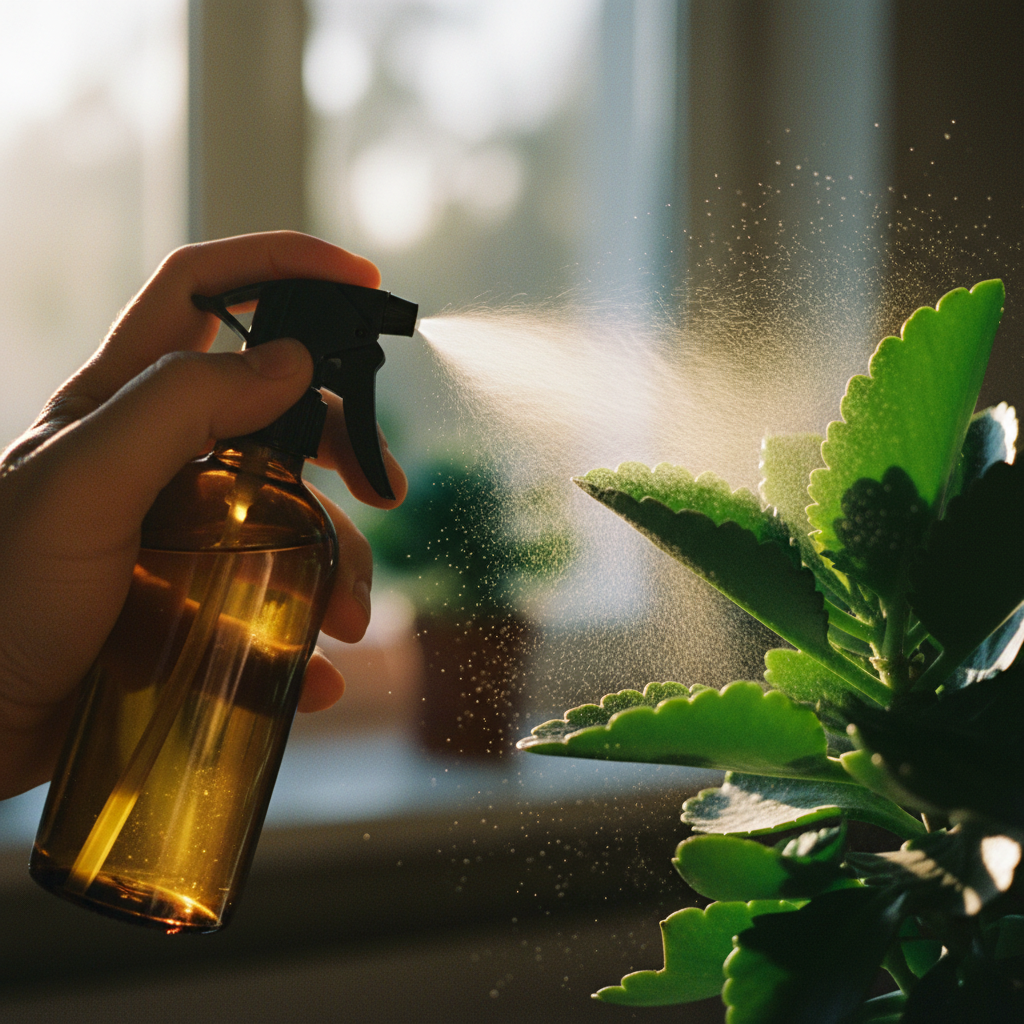
Treatment: Dab visible insects with a cotton bud soaked in 70 per cent isopropyl alcohol, which dissolves their protective wax in seconds. Follow with a thorough spray of insecticidal soap or a 1 per cent neem oil solution every five to seven days for three weeks to catch newly hatched crawlers. Isolate the plant from other houseplants during treatment.
Aphids (Aphis gossypii)
Small green, yellow or black soft-bodied insects clustering on flower stems and unopened buds. Aphids favour the tender tissue of new growth and can disfigure a flush of buds in days. Like mealybugs, they excrete honeydew. Indoor populations explode quickly because their natural predators are absent.
Treatment: Rinse the affected stems under a gentle stream of lukewarm water in the kitchen sink, taking care to support the rosette. Follow with insecticidal soap applied directly to the cluster. For repeat problems, a yellow sticky trap pushed into the substrate catches winged forms moving between plants.
Spider mites (Tetranychus urticae)
Less common on flaming katy than on humidity-loving houseplants, but they appear in warm, dry, dusty conditions. Symptoms include a fine pale stippling on the upper leaf surface, gritty dust on undersides, and in advanced cases a faint silken webbing in leaf axils. Mites prefer the lower, older leaves first.
Treatment: Wipe both leaf surfaces with a damp cloth to remove mites and eggs mechanically. Spray with a 1 per cent neem oil solution, covering leaf undersides thoroughly, and repeat at five-day intervals for three applications. Increase room ventilation; mites struggle in moving air.
Fungus gnats (Bradysia spp.)
Small dark flies hovering above the substrate, often the first sign of overwatering. The adult flies are merely a nuisance, but their larvae feed on fine roots and on the organic component of the substrate, which can stress a young or recently repotted plant.
Treatment: Allow the substrate to dry more fully between waterings, which breaks the larval life cycle. Top the soil with a 1 cm layer of coarse sand or fine grit to deny the adults a moist surface for laying eggs. Yellow sticky traps catch the adults. For persistent infestations, drench the substrate with a Bacillus thuringiensis israelensis solution.
Common Diseases
Root rot (Phytophthora and Pythium spp.)
The most serious disease of flaming katy, caused not by a single organism but by a small group of soil-borne oomycetes that thrive in cold, wet substrate. Symptoms include sudden leaf softening, basal stem blackening and a sour smell from the soil when watered. The plant often appears wilted despite wet soil, a giveaway sign that the roots are no longer functional.
Treatment: If caught early, unpot the plant, rinse the rootball clean, trim all dark and mushy roots back to healthy white tissue, dust the cuts with cinnamon powder (a mild natural fungicide), and replant in fresh dry substrate. Withhold water for a week. If rot has reached the stem, salvage a healthy stem-tip cutting and start a new plant from it.
Botrytis bloom rot (Botrytis cinerea)
A grey mould that attacks spent flowers and damaged tissue, particularly in cool, damp, poorly ventilated rooms. Affected flowers turn brown and soft, with a characteristic dusty grey fuzz visible against dark surfaces.
Treatment: Remove and discard affected flowers and stems immediately; do not compost them. Increase airflow around the plant by spacing it from neighbours or running a small fan nearby. Avoid wetting the foliage and crown when watering. In severe cases, a sulphur-based houseplant fungicide brings rapid control.
Powdery mildew (Oidium spp.)
A white powdery coating on the upper leaf surfaces, more common in humid, poorly ventilated conditions. The plant is rarely killed but its appearance suffers and flowering is reduced.
Treatment: Wipe affected leaves with a damp cloth, then spray with a dilute milk solution (one part full-fat milk to nine parts water) or a potassium bicarbonate solution. Improve airflow and reduce ambient humidity to break the cycle.
Pest and Disease Summary
| Pest / Disease | Identification | Treatment |
|---|---|---|
| Mealybugs | White cottony tufts in leaf axils and on stems | Alcohol swab, insecticidal soap or neem oil every 5 to 7 days |
| Aphids | Soft-bodied insects clustering on buds and new growth | Rinse with water, follow with insecticidal soap |
| Spider mites | Pale stippling and fine webbing on undersides | Wipe leaves, apply neem oil, increase ventilation |
| Fungus gnats | Small dark flies above moist substrate | Dry substrate more thoroughly between waterings, top with grit |
| Root rot | Soft black stem base, sour-smelling soil, sudden wilt | Unpot, trim roots, repot in dry mix; or restart from a cutting |
| Botrytis bloom rot | Grey fuzz on faded flowers, browning soft tissue | Remove affected parts, improve airflow, reduce moisture on foliage |
| Powdery mildew | White powdery coating on upper leaf surfaces | Wipe and spray with dilute milk or potassium bicarbonate solution |
Prevention Strategies
Prevention with flaming katy is largely a matter of culture rather than chemistry. The plant that gets sufficient light, water on a sensible cycle, free-draining substrate and modest air movement is the plant that resists almost every pest and disease above. Inspecting new arrivals from a shop or garden centre with a hand lens, isolating them for two weeks before introducing them to other plants, and removing spent flowers as they fade are simple habits that prevent the majority of problems.
A monthly five-minute check during routine watering catches issues at the earliest, easiest stage. Lift the plant, look at the underside of a few leaves, run a finger across the soil surface to feel for compaction and check the substrate for gnats. The whole inspection takes less than a minute per plant and pays back many times over in spared treatments.
Pro Tip — Neem Oil Made Practical: Mix 5 ml of cold-pressed neem oil and a few drops of mild liquid soap into 500 ml of warm water; the soap emulsifies the oil so it stays in suspension. Apply with a fine mister to leaf undersides in the evening (never in direct sun, which can scorch oiled foliage). This single bottle handles mealybugs, aphids, spider mites and a number of fungal issues at preventive doses.
Popular Varieties
Although only a single species, Kalanchoe blossfeldiana has been hybridised more intensively than almost any other succulent. Modern flaming katy in the trade rarely matches the wild type in flower form; instead, it is one of dozens of registered hybrid series bred for compactness, larger flower clusters and a much wider colour range. The differences between cultivars are almost entirely in the flowers — leaves are broadly similar across the species — but with bloom forms ranging from the classic four-petalled single to fully double rose-like rosettes, there is far more variation than a casual shopper would suspect.
Most plants sold today belong to one of four major commercial series: the original single-flowered hybrids; the double-flowered Calandiva line; the dwarf, free-flowering Queen series; and the very compact African and Forever series bred for small pots. The table below summarises the most widely grown groups and a few representative named cultivars, with notes on flower form, size and availability.
| Variety | Flower Form | Light Needs | Growth Rate | Availability |
|---|---|---|---|---|
| Original single-flowered hybrids | Classic four-petalled clusters in red, orange, pink, yellow, salmon, white | Bright indirect to a few hours of sun | Moderate | Very common; most florist stock |
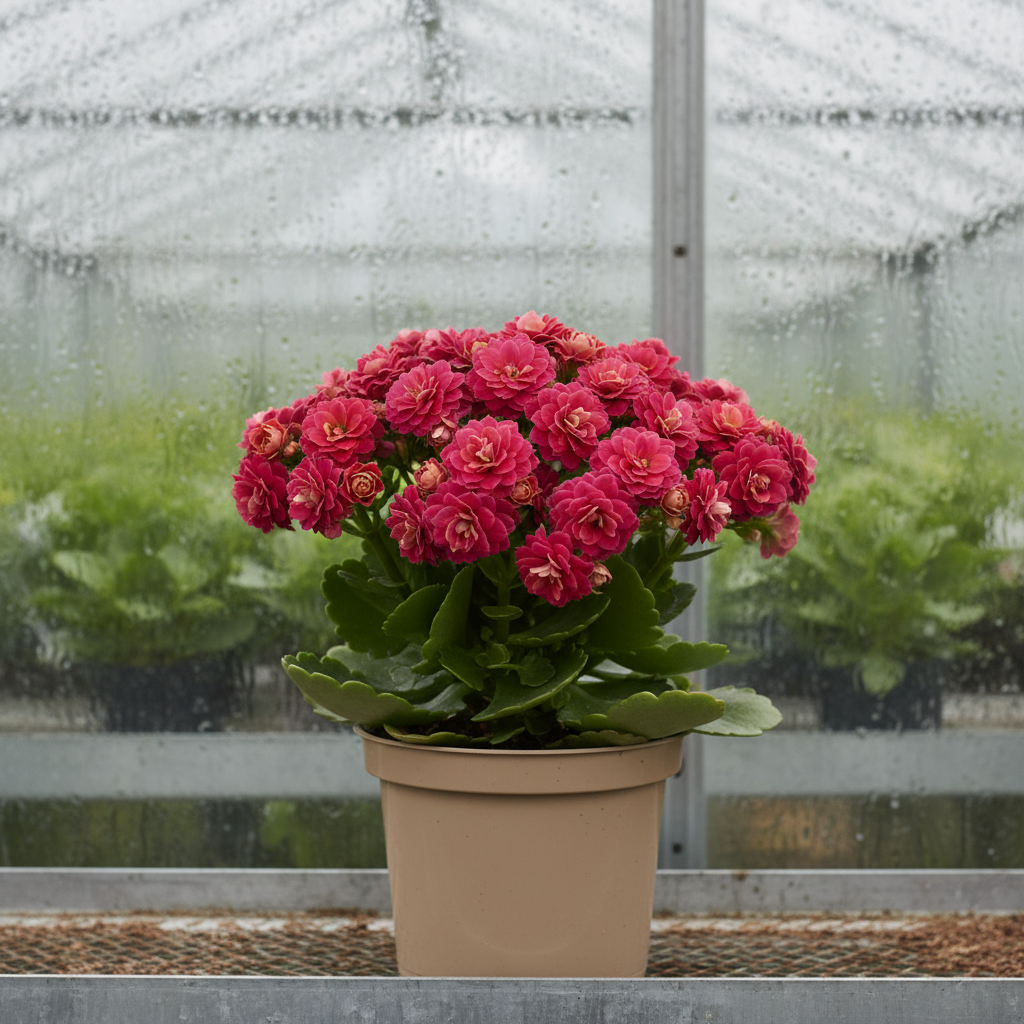
| ‘Calandiva’ series | Densely double, rose-like blooms of about 32 petals | Bright indirect to direct | Moderate | Common; supermarket and garden centre |
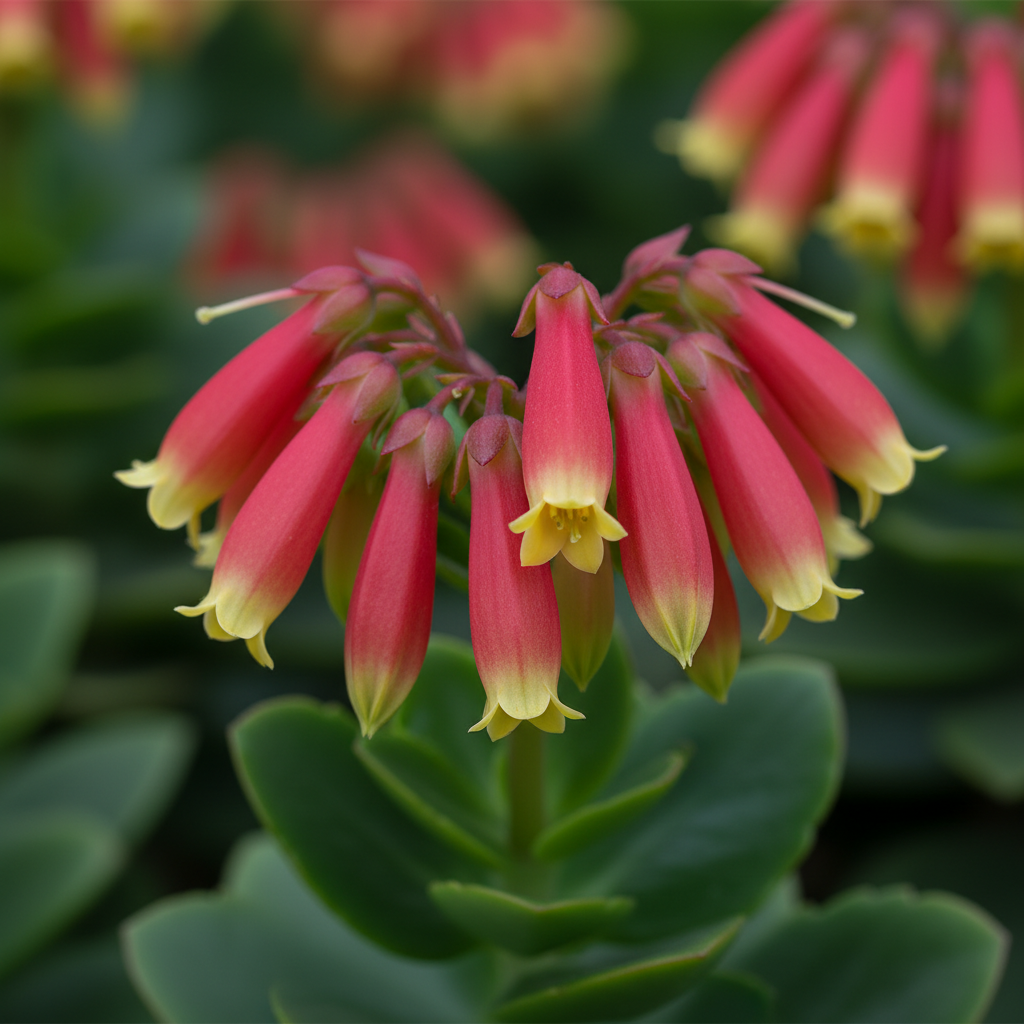
| ‘Wendy’ | Pendant tubular scarlet bells with creamy yellow tips | Bright indirect | Moderate to fast | Specialist nurseries and collectors |
| ‘Queen’ series | Single or semi-double blooms on very free-flowering compact plants | Bright indirect to direct | Moderate | Common in seasonal displays |
| ‘African’ and ‘Forever’ series | Compact, abundant single flowers, often in pastel tones | Bright indirect | Slow | Common in small pots for windowsill displays |
| ‘Pumila’ compact dwarf forms | Diminutive plants under 15 cm tall with proportionally small flowers | Bright indirect | Slow | Occasionally available from specialist growers |
| Variegated leaf hybrids | Standard single flowers with cream or pink margined leaves | Bright indirect, more than green-leaved forms | Slow | Uncommon; specialist nurseries |
Featured Varieties
‘Calandiva’
Bred in the Netherlands in the early 2000s and now arguably the best-known flaming katy series worldwide. Each bloom carries around 32 petals in a tight rose-like rosette, and a healthy plant produces dense clusters that can hold colour for up to eight weeks. Available in raspberry, salmon, yellow, white and bicolour combinations. Care identical to single-flowered forms; the doubled petal count is purely cosmetic and does not change the plant’s underlying requirements.
‘Wendy’
A striking hybrid often classified separately as Kalanchoe ‘Wendy’ but generally treated as a flaming katy cultivar for care purposes. Distinguished by elegant pendant tubular blooms in scarlet-red tipped with creamy yellow — a flower form quite unlike the typical four-petalled clusters of standard cultivars. The plant is slightly more vigorous than most flaming katies and tolerates a wider light range. Excellent for a hanging or raised position where its drooping flower stems can be properly admired.
Variety Profiles in Detail
‘Queen’ series (Kalanchoe blossfeldiana ‘Queen’ hybrids)
The Queen series was developed by Danish breeders in the 1990s for a free-flowering, compact habit. The flowers retain the classic four-petalled form but are produced in greater abundance per stem than older cultivars. Several distinct colour lines exist, including ‘Queen Lindsay’ (carmine red), ‘Queen Lara’ (pink) and ‘Queen Maria’ (yellow). The series is widely produced for seasonal supermarket sales and is one of the most consistent for repeat home flowering.
‘African’ series (Kalanchoe blossfeldiana ‘African’ hybrids)
Very compact, naturally short-day, ideal for tiny windowsill pots. The series tends towards softer pastel tones — peach, apricot, butter yellow — than the saturated reds of older cultivars. Plants rarely exceed 20 cm in height and width, making them an excellent choice for kitchen window ledges and other restricted spaces.
‘Forever’ series (Kalanchoe blossfeldiana ‘Forever’ hybrids)
Marketed for unusually long-lasting flower clusters, with some growers claiming 12 weeks of display under ideal conditions. The series includes ‘Forever Midi’ (medium plants) and ‘Forever Mini’ (very small forms), both of which inherit excellent rebloom characteristics. The genetic basis for the extended flower life is improved cold tolerance and slower senescence at the petal level.
Variegated forms
Variegated flaming katy cultivars are uncommon but worth seeking out. The most familiar carries cream or pale yellow margins on each leaf, with the flowers reduced in intensity to soft pinks or apricots. Variegated forms need notably brighter light than green-leaved cultivars, since the white sectors of leaf carry no chlorophyll and reduce overall photosynthetic capacity. Plants in inadequate light will revert to all-green growth.
Choosing the Right Variety for Your Space
For a small bright windowsill in a flat, an African or Forever Mini cultivar offers the best balance of size, free flowering and reliable rebloom. For a larger statement on a kitchen counter or bookshelf, the dense Calandiva double-flowered series gives the most visual impact, with the trade-off that the blooms can look almost artificial in their density. For a collector’s interest, ‘Wendy’ and the pendant-flowered forms stand apart from the mass-market crowd; they are also marginally easier to keep flowering year on year. New growers are best served by an original single-flowered hybrid in a 12 cm pot from a reputable supplier; once the basic care rhythm is mastered, branching into the more unusual cultivars becomes straightforward.
Frequently Asked Questions
My flaming katy looks healthy but it has not flowered in over a year. What is wrong?
Almost certainly a photoperiod issue rather than a care issue. Flaming katy is a short-day plant and needs at least six consecutive weeks of 14 or more hours of uninterrupted darkness each night to set buds. A single hallway light, a kitchen lamp left on after dinner, or a streetlight bleeding through a thin curtain is enough to reset the clock. Move the plant for six weeks in autumn to a room that is genuinely dark from late afternoon to early morning, and bud formation will normally follow.
The leaves are pale and stretched. Can I save it?
Yes. Etiolation from low light is fully reversible if caught early enough. Move the plant to a brighter position over a week or two so it acclimatises without scorching, then prune the stretched stems back hard, just above a leaf node, in late spring. The plant will branch from the cut points and produce a tighter, compact rosette over the following months.
Why are my flaming katy’s flowers fading so quickly?
Display life is most strongly affected by ambient temperature and light. Plants kept around 16 to 18 C (61 to 65 F) in bright indirect light hold their flowers two to three weeks longer than the same plant kept at 22 to 24 C (72 to 75 F) under low light. Move the blooming plant a little cooler and brighter for the duration of the display; also dead-head spent individual flowers promptly to keep the cluster looking fresh.
Should I cut off the flower stalks once flowering finishes?
Yes. Once all the flowers in a cluster have faded, prune the entire flower stalk back to the rosette using clean scissors. Leaving spent stalks in place encourages botrytis, wastes the plant’s energy on shrivelled tissue and slows the resumption of vegetative growth. After pruning, withhold fertiliser for a few weeks and let the plant rest before resuming normal feeding.
Is flaming katy really toxic to cats and dogs?
Yes. All parts of the plant contain bufadienolides, a class of cardiac glycosides similar to those found in foxglove and oleander. In cats and dogs, ingestion causes vomiting, lethargy and in larger doses cardiac arrhythmia. Fatalities are uncommon in pets but cases are reported, and the plant should be kept well out of reach. If a pet has chewed on a flaming katy, contact a veterinarian and bring a sample of the plant for identification.
Why are the lower leaves of my plant yellowing and dropping?
If a few of the very oldest leaves are dropping over weeks or months, this is normal senescence and not a concern. If multiple leaves anywhere on the plant are yellowing rapidly, the most common cause is overwatering, followed by overfeeding. Check the substrate moisture, lift the plant from its pot and inspect the roots for dark or mushy tissue, and reduce both water and feed if either is excessive. A flush of plain water through the substrate to rinse out accumulated salts often helps when overfeeding is suspected.
Can flaming katy be kept outdoors in summer?
Yes, and it tends to grow more robustly outdoors than indoors during warm weather. Move the plant outside once night temperatures stay reliably above 10 C (50 F), acclimatise it gradually to brighter light, and place it in dappled shade rather than direct midday sun for the first two weeks. Bring it back indoors well before night temperatures drop close to freezing in autumn. A summer outdoors can also help kickstart the photoperiodic flower induction as nights lengthen in late summer.
My plant is getting tall and leggy. Can I cut it back?
Yes. Flaming katy responds well to a hard prune. After flowering, cut each stem back to a healthy pair of leaves about 5 to 7 cm (2 to 3 in) from the soil. The plant will branch from below the cut points and rebuild a compact rosette over the following months. The prunings make perfect material for stem-tip cuttings; almost no parts of the plant need to be discarded.
How long does a flaming katy live?
The flowering pot plant industry treats flaming katy as a single-season disposable. With good care, however, individual plants can live and rebloom for at least five to seven years and well-tended specimens have been recorded living more than a decade. The plant becomes woodier and slightly more sprawling with age; a hard prune every couple of years rejuvenates a mature plant and keeps the rosettes tight.
What is the difference between flaming katy and other kalanchoes I see in shops?
The genus Kalanchoe contains more than 125 species, but only a handful appear in mainstream commerce. Flaming katy (K. blossfeldiana) is the small, brightly flowering pot plant. Other commonly sold relatives include the panda plant (K. tomentosa), grown for furry silver-grey leaves rather than flowers; the paddle plant (K. luciae, often sold as K. thyrsiflora), with broad blue-grey paddle-shaped leaves that blush red in cold; and the trailing chandelier plant or mother of thousands (K. delagoensis and K. daigremontiana), which grow miniature plantlets along their leaf margins. Care principles overlap broadly across the genus, but flaming katy is the only widely grown species sold primarily for its flowers.






