
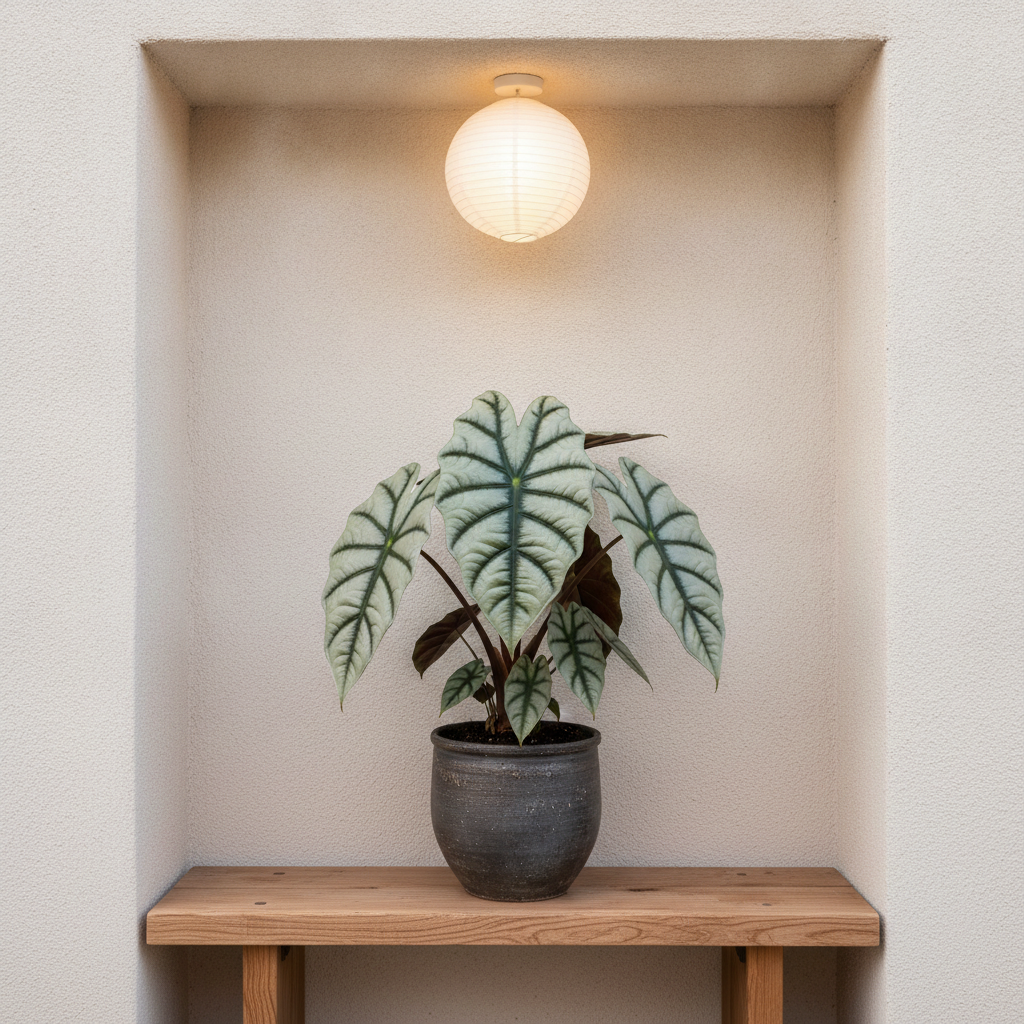
Few houseplants look quite as sculptural as the Dragon Scale Alocasia. A compact jewel aroid from the rainforests of Borneo, Alocasia baginda grows thick, stiff leaves the colour of weathered jade, each one stamped with deeply sunken veins that catch the light like the scales of a sleeping dragon. The surface has a faint metallic sheen, the texture is genuinely embossed rather than merely patterned, and the undersides are flushed with maroon. It is the sort of plant that stops people mid-conversation and pulls them across a room.
That beauty comes with a reputation for being temperamental, and the reputation is only half deserved. Dragon Scale Alocasia is not difficult so much as specific: it knows exactly what it wants and sulks loudly when it does not get it. Give it warmth, steady moisture, high humidity and a chunky airy mix, and it will reward you with leaf after architectural leaf. This guide covers everything that separates a Dragon Scale that merely survives from one that genuinely thrives, from reading its light through to coaxing offsets out of the soil.
Contents
- Quick Reference
- Why Dragon Scale Alocasia Makes a Striking Houseplant
- Light Requirements
- Watering & Humidity
- Soil, Potting & Repotting
- Fertilising
- Propagation
- Pests & Diseases
- Popular Varieties
- Frequently Asked Questions
Quick Reference: Dragon Scale Alocasia at a Glance
| Light | Bright, indirect light. No harsh direct midday sun. |
| Watering | Keep lightly and evenly moist. Water when the top 2 to 3 cm (about 1 inch) of mix begins to dry. |
| Temperature | 18 to 27 degrees Celsius (64 to 81 degrees Fahrenheit). Avoid anything below 15 degrees Celsius (59 degrees Fahrenheit). |
| Humidity | High, ideally 60 to 80 percent. Struggles below 50 percent. |
| Fertiliser | Dilute balanced feed every 3 to 4 weeks in spring and summer. |
| Toxicity | Toxic to cats, dogs and humans if chewed or swallowed (insoluble calcium oxalates). |
Why Dragon Scale Alocasia Makes a Striking Houseplant
The appeal of Alocasia baginda starts and ends with its leaves. Each blade is broadly heart-shaped to ovate, held semi-upright on a short petiole, and rarely exceeds 15 to 20 cm (6 to 8 inches) in length on an indoor plant. What makes it remarkable is the relief: the primary and secondary veins are pressed so deeply into the leaf that the surface between them bulges outward in raised, scale-like panels. Run a finger across a healthy leaf and you feel the texture before you see it. The base colour shifts between silvered sage and a deeper pewter green depending on the light, while the sunken veins read as near-black, and the contrast is what gives the plant its dragon-hide nickname.
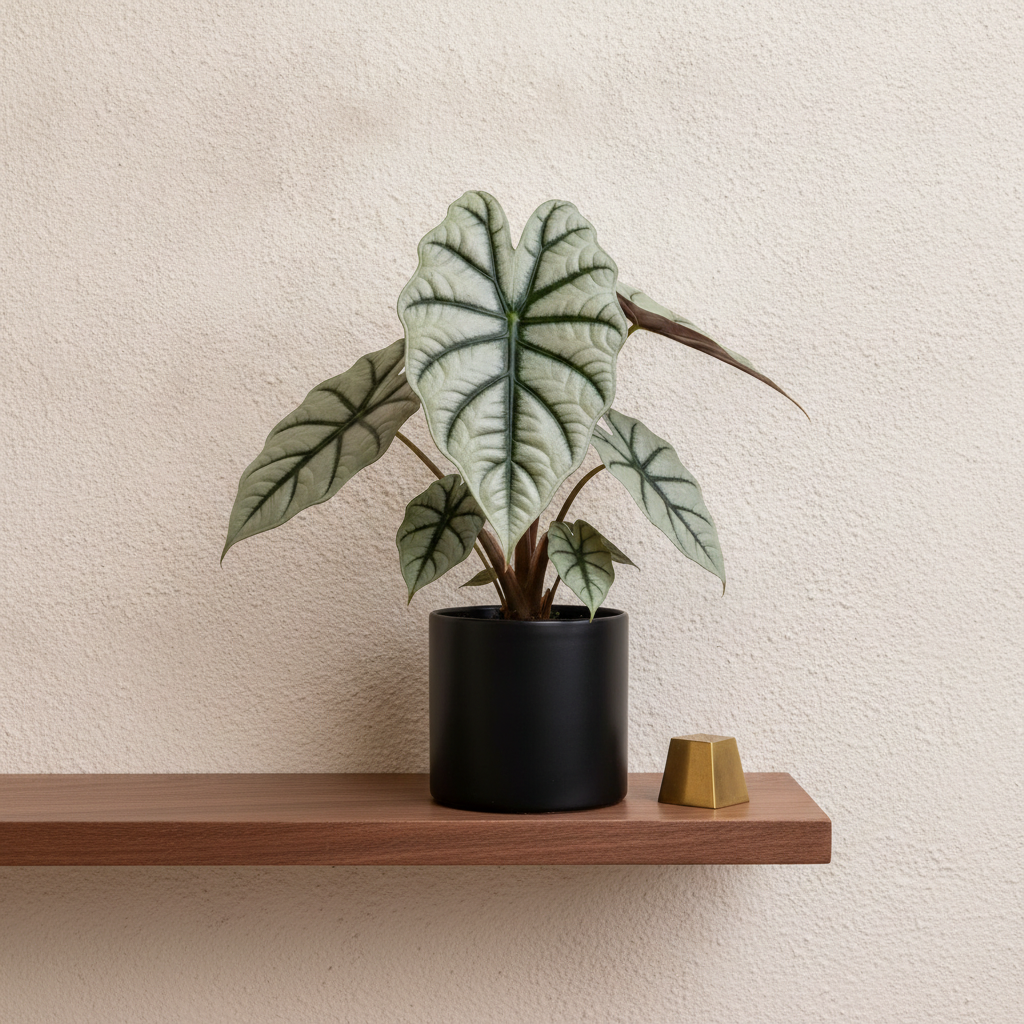
Beyond looks, the plant earns its place because it stays small. Unlike the towering Alocasia macrorrhizos or the fast-sprawling Alocasia zebrina, a Dragon Scale remains a tidy tabletop specimen for years, which makes it ideal for collectors short on floor space. It grows from an underground rhizome and naturally produces offsets, so a single plant slowly becomes a small clump and, in time, a supply of new plants to share. The trade-off is that it is firmly a plant for people who enjoy attentive care rather than a forgiving starter species. It will not tolerate the neglect a pothos shrugs off, but it asks for routine rather than skill.
Important — Toxicity: Every part of Alocasia baginda contains insoluble calcium oxalate crystals. Chewing or swallowing leaves or stems can cause intense burning of the mouth, drooling, swelling and vomiting in cats, dogs and people. Keep it well out of reach of pets and small children, and wash your hands after handling cut surfaces or sap.
Light Requirements
In the wild, Alocasia baginda grows on the floor and lower slopes of humid Bornean forest, where it receives the bright but filtered light that reaches the understorey rather than full overhead sun. Recreating that indoors means aiming for consistently bright, indirect light: enough that you could read comfortably beside the plant all day, but never the searing direct beam of a south-facing window at noon.
Get the light right and the plant produces compact growth, short petioles and richly contrasted leaves. Too little light and the new leaves emerge smaller and paler, the petioles stretch and lean toward the window, and growth slows to a crawl. Too much direct sun and the metallic surface bleaches, the deep green dulls, and crisp tan scorch marks appear along the leaf edges and high points of the embossed texture.
Light Levels Explained
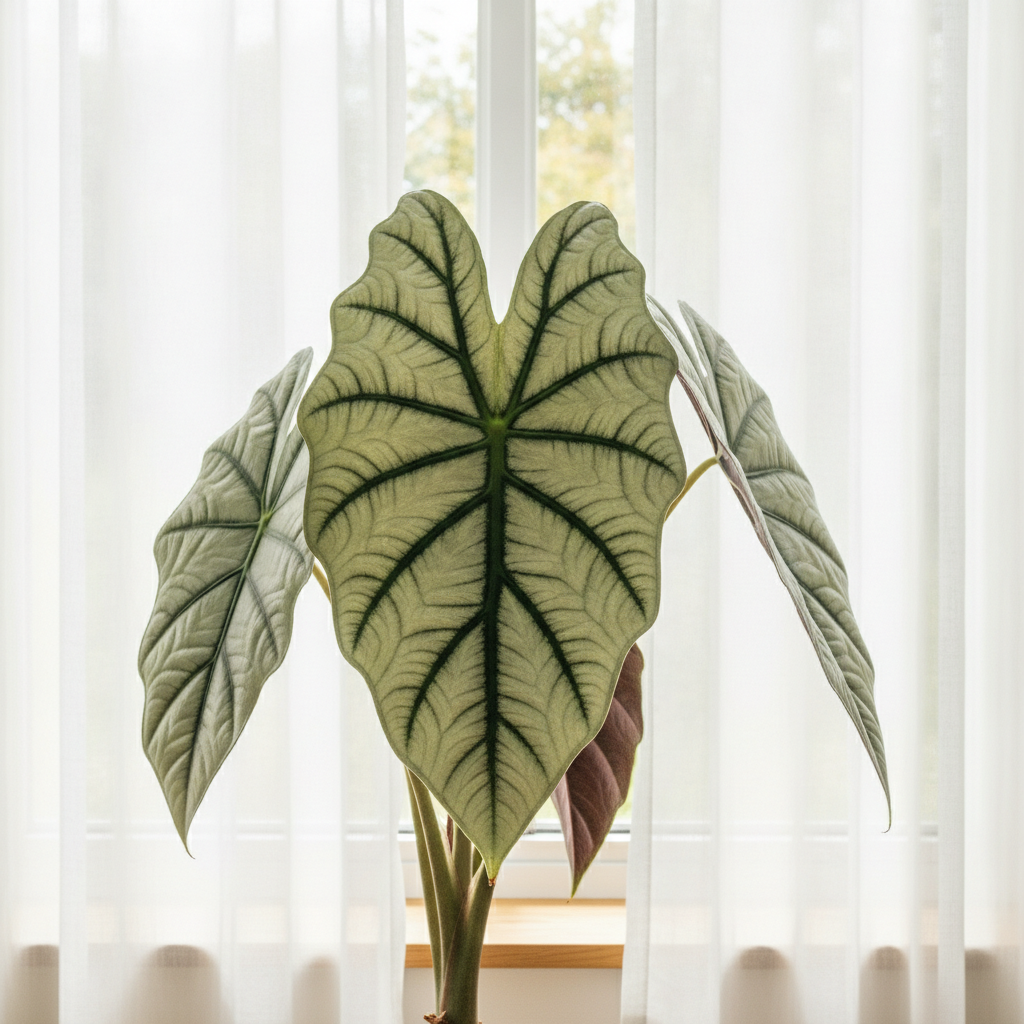
The table below translates the usual houseplant light categories into what each one means for a Dragon Scale Alocasia specifically, so you can match it to the spots available in your home.
| Light Category | Approx. Level | Typical Location | Outcome |
|---|---|---|---|
| Direct sun | Over 50,000 lux | On an unscreened south windowsill | Leaf scorch and bleaching, avoid |
| Bright indirect | 10,000 to 25,000 lux | Near an east or filtered south window | Ideal, best colour and form |
| Medium | 5,000 to 10,000 lux | A metre or two back from a bright window | Acceptable, slightly slower growth |
| Low | 1,000 to 5,000 lux | North-facing room interior | Leggy, pale, weak new leaves |
| Very low | Under 1,000 lux | Hallway or windowless corner | Decline and eventual dormancy |
Window Orientation and Placement
South-facing window: Workable but only with protection. Set the plant a metre back, or diffuse the glass with a sheer curtain so the midday sun never falls directly on the leaves. Unfiltered southern light in summer will scorch this plant within days.
East-facing window: Often the sweet spot. Gentle morning sun followed by bright, indirect light for the rest of the day suits a Dragon Scale perfectly and rarely causes scorch.
West-facing window: Good, with the same caution as a south aspect. The strong afternoon sun can be intense in summer, so pull the plant back from the glass or filter the light during the hottest months.
North-facing window: Usable in summer and bright climates, but often too dim in winter to keep growth strong. If a north window is your only option, be ready to supplement with a grow light through the darker months.
Pro Tip — Rotate for Even Growth: Alocasia leaves orient strongly toward the brightest source. Give the pot a quarter turn each time you water so the plant grows upright and balanced rather than leaning permanently toward the window.
How Light Affects Leaf Texture and Colour
The embossed, scaled appearance that makes this plant famous is partly a product of good light. In bright, indirect conditions the leaves emerge thick and stiff with strong contrast between the silvered surface and the dark sunken veins. In dim light the same plant produces thinner, flatter, greener leaves with far less of the three-dimensional relief, and the prized metallic quality fades. If your Dragon Scale has lost its drama, light is the first thing to correct.
Warning — Direct Sunlight: The single fastest way to ruin a Dragon Scale Alocasia is to move it from a shaded spot straight into direct sun. The leaves cannot adjust quickly and will develop irreversible bleached patches and crisp brown edges. Always increase light gradually over a week or two.
Artificial Lighting
Dragon Scale Alocasia responds very well to a full-spectrum LED grow light, which is often the simplest way to keep it happy through a dark winter or in a room without a good window. A panel or bulb in the 20 to 40 watt range positioned 30 to 45 cm (12 to 18 inches) above the plant, running for 10 to 12 hours a day, comfortably replaces a bright window. Because the plant stays small, even a single compact grow light is usually enough.
Seasonal Adjustments
Light intensity indoors can halve between summer and midwinter. As the days shorten, move the plant closer to its window or add supplementary lighting, and expect slower growth regardless. Many Dragon Scales enter a semi-dormant phase in winter, pausing leaf production and occasionally dropping an older leaf. This is normal. Keep the light steady, ease back on water, and wait for spring rather than forcing growth.
Watering & Humidity
Watering is where most Dragon Scale Alocasias are won or lost. The plant wants to stay evenly and lightly moist, never bone dry and never waterlogged. Its fleshy rhizome and fine roots rot quickly in soggy mix, yet the plant also collapses dramatically if allowed to dry out completely. The target is a mix that feels like a wrung-out sponge: damp throughout, with air still moving through it.
When to Water
Check the top 2 to 3 cm (about 1 inch) of the mix with a finger or a wooden skewer. When that upper layer starts to feel dry but the deeper mix is still slightly damp, it is time to water. In a warm, bright spring or summer this often means watering every 4 to 7 days, while in winter the interval can stretch to every 10 to 14 days. Always go by the feel of the mix rather than a fixed calendar.
Because the ideal mix for this plant is so chunky and free-draining, it dries faster than ordinary potting soil, which means light moisture and frequent checking matters more than heavy, infrequent soakings. A self-watering setup or a semi-hydroponic approach using an inert substrate suits Dragon Scale Alocasia particularly well, as it keeps moisture steady without the swings that trigger rot or wilting.
Pro Tip — Use Room-Temperature Water: Cold water straight from the tap can shock the roots of a tropical aroid and prompt leaf yellowing. Let water stand until it reaches room temperature, which also allows some chlorine to dissipate.
How to Water Correctly
- Check the top few centimetres of mix and water only when it has begun to dry.
- Pour room-temperature water slowly and evenly across the surface until it runs freely from the drainage holes.
- Let the pot drain completely for several minutes so no water sits at the base.
- Empty the saucer or cover pot, never leaving the plant standing in collected water.
- Return the plant to its spot and check again in a few days rather than topping up on a schedule.
Signs of Overwatering vs. Underwatering
| Symptom | Overwatering | Underwatering |
|---|---|---|
| Leaf colour | Yellowing, often starting with lower leaves | Dull, with browning crisp edges |
| Leaf texture | Soft, limp, sometimes translucent | Drooping then dry and papery |
| Soil | Stays wet for days, may smell sour | Pulls away from the pot, very dry |
| Roots | Brown, mushy, foul-smelling | Dry, brittle, pale |
| Stem base | Soft and blackened near the rhizome | Firm but the whole plant wilts |
Warning — Root Rot: Soft, blackened stems and a sour smell from the mix signal root rot, the most common killer of this plant. Unpot immediately, cut away every mushy root and any rotten section of rhizome with sterilised tools, dust the cuts, and repot into fresh, barely moist, very airy mix.
Humidity Requirements
If there is one non-negotiable for Alocasia baginda, it is humidity. This is a true rainforest plant that wants 60 to 80 percent relative humidity and visibly resents dry indoor air. Below about 50 percent it begins to struggle, and in the parched air of a heated winter room it will brown at the edges, refuse to unfurl new leaves cleanly, and become far more vulnerable to spider mites.
Low humidity shows itself as crisp brown leaf margins, new leaves that stick together or tear as they open, and a general loss of vigour even when watering and light are correct. If you see these signs and the watering is sound, raise the humidity before changing anything else.
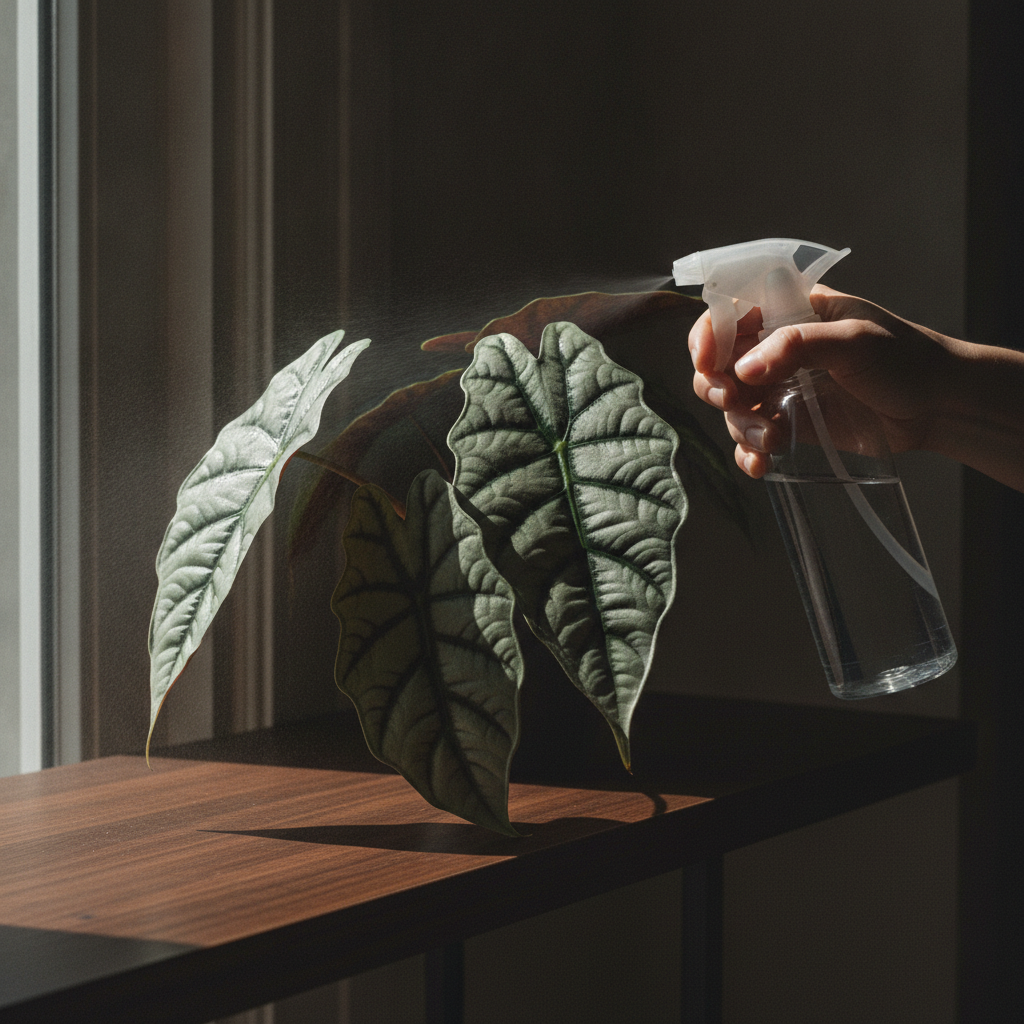
The most reliable way to keep humidity high is a small room humidifier running near the plant, which holds a steady level far better than misting. Grouping plants together, standing the pot on a wide tray of damp pebbles, or keeping the plant in a naturally humid room such as a bright bathroom all help. Misting gives only a brief lift and, if overdone on the textured leaves, can encourage fungal spotting, so treat it as a supplement rather than a solution.
Water Quality
Dragon Scale Alocasia is moderately sensitive to the minerals, chlorine and fluoride found in hard tap water, which can accumulate and contribute to brown leaf tips over time. Where possible use filtered, distilled or collected rainwater. If you only have tap water, letting it stand uncovered overnight before use allows some chlorine to evaporate and brings it to room temperature at the same time.
Soil, Potting & Repotting
The right substrate is the foundation of a healthy Dragon Scale. As a rhizomatous aroid with fine, rot-prone roots, it needs a mix that holds moisture but drains and breathes freely. Ordinary bagged potting soil, used straight, stays far too wet around the rhizome and is the second most common cause of failure after overwatering itself.
Ideal Soil Composition
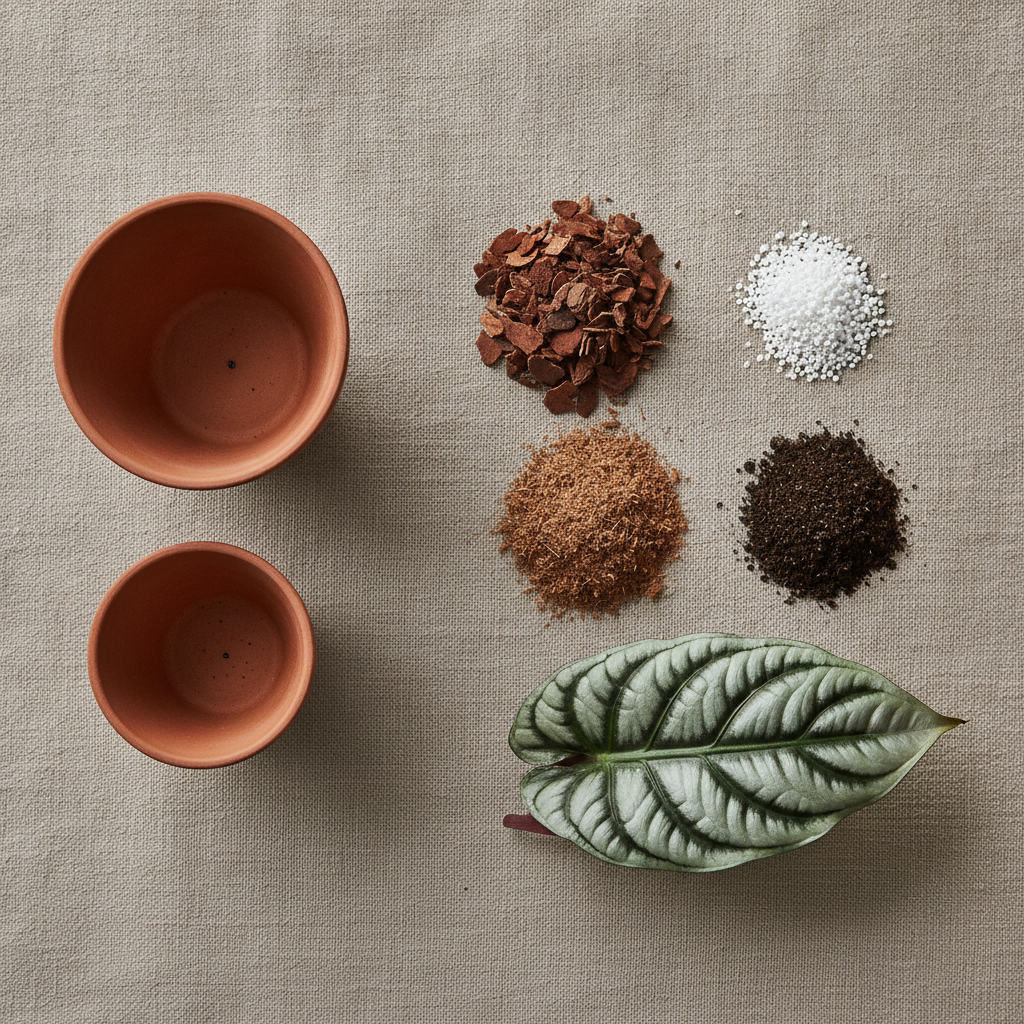
Think of the mix as a loose, open aroid blend rather than soil. The bulk should be chunky structural material that creates air pockets, with just enough finer organic matter to hold moisture and nutrients. The result should feel light in the hand and never compact into a dense block when wet.
| Component | Proportion | Function |
|---|---|---|
| Orchid bark | 30 percent | Creates structure and large air pockets |
| Perlite or pumice | 25 percent | Drainage and aeration, prevents compaction |
| Coco coir or peat | 25 percent | Holds even moisture without staying soggy |
| Quality potting mix | 15 percent | Base nutrients and a little body |
| Worm castings | 5 percent | Gentle, slow-release organic feed |
Dragon Scale Alocasia prefers a slightly acidic substrate, roughly pH 5.5 to 6.5, which is where it takes up nutrients most efficiently. A peat or coir based mix naturally sits in this range, so most growers never need to test or adjust it deliberately.
Pro Tip — Quick Mix Recipe: If you want a simple, repeatable blend, combine two parts orchid bark, two parts coco coir, two parts perlite and one part worm castings. It suits almost every jewel Alocasia and stores well in a sealed tub for future repotting.
Choosing the Right Pot
The pot matters as much as the mix because it controls how fast the substrate dries and how much air reaches the roots.
Drainage holes are non-negotiable. A Dragon Scale Alocasia should never sit in a pot without drainage. Any decorative cover pot must be emptied of run-off after every watering, because even a few hours standing in water can begin to rot the rhizome.
Pot material: Plastic and glazed ceramic retain moisture longer and pair well with the plant’s love of steady dampness. Terracotta breathes and dries faster, which can be useful if you tend to overwater, but it may need more frequent watering to keep the mix from drying out entirely.
Pot size: This plant likes to be a little snug. Choose a pot only 2 to 3 cm (about 1 inch) wider than the rhizome and root mass. An oversized pot holds a reservoir of wet mix the small root system cannot use, which invites rot, so resist the urge to give it room to grow into.
When to Repot
Dragon Scale Alocasia is a slow grower and prefers to stay slightly pot-bound, so it rarely needs repotting more than once every one to two years. Signs it is ready include roots circling the bottom or pushing through the drainage holes, several new offsets crowding the surface, or a mix that has broken down and no longer drains freely. The best time to repot is early spring, just as the plant resumes active growth, which lets it recover quickly.
How to Repot: Step-by-Step
- Water the plant a day ahead so the root ball is hydrated and holds together.
- Ease the plant out by tipping the pot and supporting the base, rather than pulling on the leaves.
- Gently tease away the old mix from the roots and rhizome, inspecting for any soft or blackened sections.
- Trim any mushy or dead roots with sterilised scissors, and separate offsets now if you wish to propagate.
- Position the plant in a pot only slightly larger, with fresh airy mix beneath and around the rhizome.
- Firm the mix lightly so the plant sits upright but the substrate stays loose, keeping the rhizome at its original depth.
- Water in thoroughly, let it drain, and keep the plant warm and humid while it settles.
Warning — Transplant Shock: Alocasias often sulk after repotting, sometimes dropping a leaf or pausing growth for a few weeks. Do not respond by overwatering or fertilising to revive it. Keep conditions stable, warm and humid, and let the plant recover at its own pace.
Fertilising
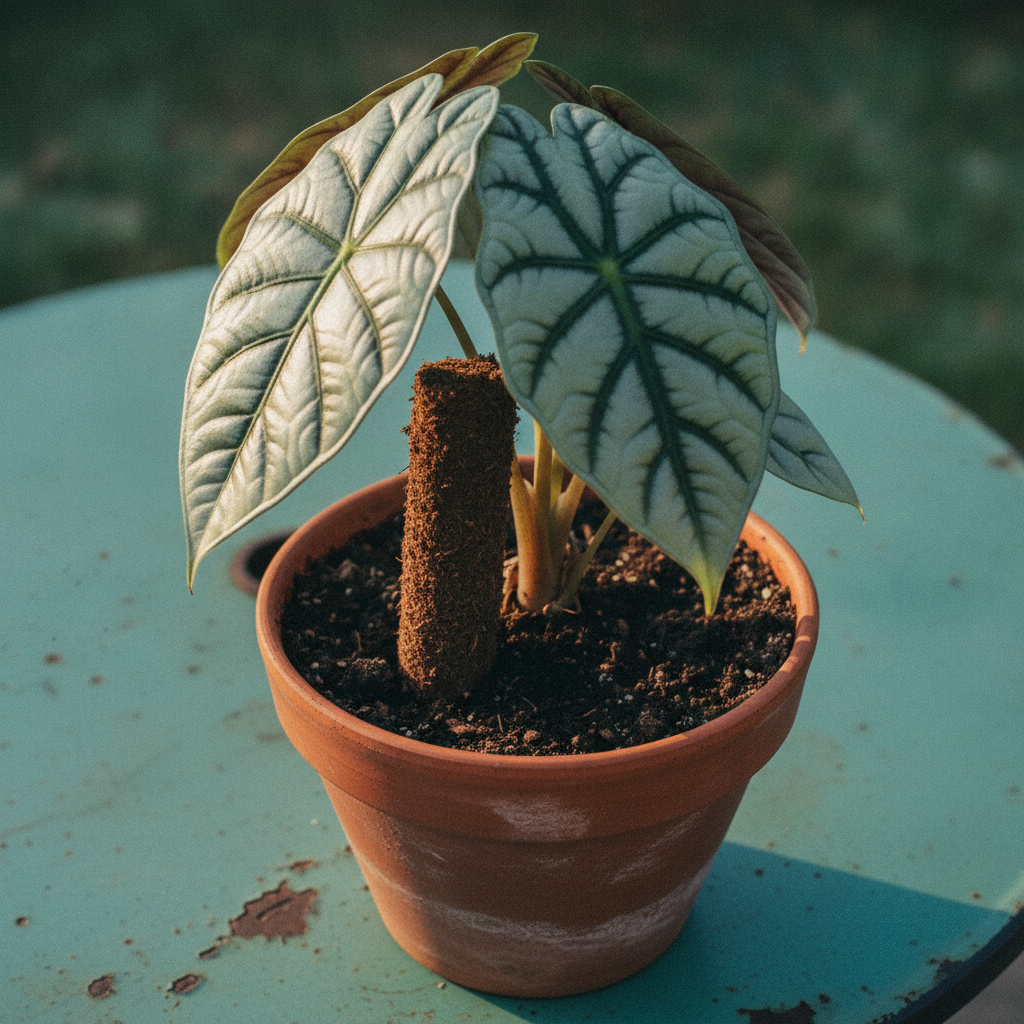
Dragon Scale Alocasia is a light to moderate feeder. It benefits from regular, dilute feeding during its active growing season, but it is also sensitive to the salt build-up that comes from overfeeding, which scorches its fine roots and browns the leaf tips. The guiding principle is little and often rather than occasional heavy doses.
Feeding fuels the steady production of those thick, textured leaves, but only when the plant is actually growing. Fertiliser applied to a dormant winter plant simply accumulates in the mix as unused salts, so timing matters as much as quantity.
Understanding Plant Nutrients
A balanced fertiliser supplies the three macronutrients shown on every label as the N-P-K ratio, alongside the secondary nutrients and trace elements that keep foliage healthy. For a foliage plant like this, nitrogen is the most important driver of leaf growth, but a balanced blend prevents the deficiencies that show up as discoloured or distorted leaves.
| Nutrient | Symbol | Primary Function | Deficiency Symptoms |
|---|---|---|---|
| Nitrogen | N | Leaf and stem growth, green colour | Pale, yellowing older leaves, slow growth |
| Phosphorus | P | Root development and energy transfer | Weak roots, stunted growth, dull leaves |
| Potassium | K | Overall vigour and water regulation | Browning leaf edges, weak stems |
| Calcium | Ca | Cell wall strength, new leaf formation | Distorted or poorly formed new leaves |
| Magnesium | Mg | Core of the chlorophyll molecule | Yellowing between the veins of older leaves |
| Iron | Fe | Chlorophyll production in new growth | Yellowing between veins of the newest leaves |
Types of Fertiliser
Liquid fertilisers: The easiest option for this plant, as they let you control the dose precisely. A balanced houseplant feed diluted to half strength and applied with watering gives steady, controllable nutrition.
Slow-release granular: Convenient and low-effort, releasing nutrients gradually over a few months. Use a light hand, as it is harder to flush out if salts begin to accumulate in the small pot.
Organic fertilisers: Worm castings, diluted seaweed and gentle organic blends feed slowly and improve the life of the mix, making them well suited to a plant that dislikes harsh chemical spikes.
Feeding Schedule
Feed every 3 to 4 weeks through spring and summer with a balanced fertiliser diluted to half the recommended strength. As growth slows in autumn, reduce the frequency, and stop feeding entirely through winter while the plant rests. Resume only when you see fresh growth pushing up in spring.
Pro Tip — Always Dilute: Mix feed at half the label strength for jewel Alocasias. Their fine roots burn easily, and you can always feed a little more often, but you cannot undo the leaf-tip scorch caused by a single strong dose.
How to Fertilise
- Water the plant lightly first so the roots are never fed while bone dry.
- Dilute a balanced liquid feed to half the recommended strength in room-temperature water.
- Apply evenly across the mix until it is moistened, avoiding splashing the leaves.
- Once every couple of months, flush the pot with plain water to wash out accumulated salts.
Warning — Salt Build-Up: A white crust on the soil surface or pot rim, paired with browning leaf tips, signals fertiliser salts accumulating in the mix. Flush the pot thoroughly with several pot-volumes of plain water and ease off feeding until the plant recovers.
Propagation
Unlike vining aroids that root readily from stem cuttings, Dragon Scale Alocasia cannot be propagated from a leaf or a piece of stem. It grows from a central rhizome and multiplies by producing offsets, small clones that emerge from the rhizome and from tiny bulb-like corms that form around the roots. Propagation therefore means dividing the plant or growing on its corms, not taking cuttings.
This is slow, patient work, but it is reliable and satisfying. The best time is spring or early summer, ideally combined with a routine repotting so you only disturb the roots once.
Understanding the Rhizome and Corms
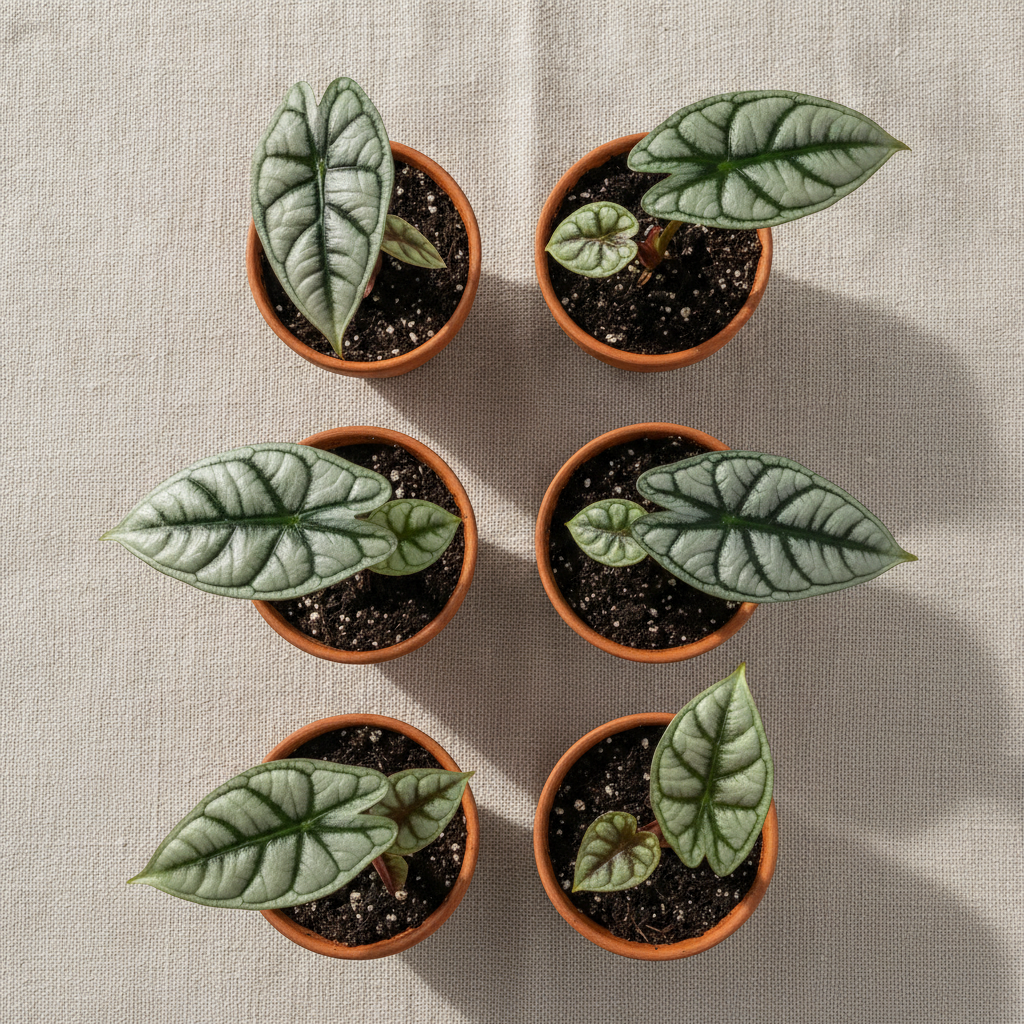
The rhizome is the thickened underground stem from which the leaves and roots grow. Around it, an established Dragon Scale produces offsets, complete miniature plants with their own roots, and corms, small rounded nodules that look like tiny bulbs and can each grow into a new plant. Both are your propagation material. Offsets with roots already attached establish fastest, while corms take longer but can be produced in greater numbers.
Division of Offsets: Step-by-Step
Division is the quickest route to a new plant because each offset already has leaves and roots. Look for offsets that have at least one leaf of their own and a small independent root system before separating them.
- Unpot the parent plant and gently clear the mix from the rhizome so you can see where the offsets join.
- Identify offsets that have their own roots and at least one leaf.
- Separate each offset by hand where it parts naturally, or cut it free with a sterilised blade, keeping as many of its roots intact as possible.
- Pot each offset into a small container of the same airy mix, keeping it snug rather than deep.
- Water lightly and place the new plant somewhere warm, bright and humid while it establishes.
Pro Tip — Sterilise Everything: Alocasia rhizomes are prone to rot at any cut surface. Wipe blades with isopropyl alcohol before dividing, and let larger cuts air-dry for an hour or dust them with cinnamon or sulphur before potting to reduce infection.
Growing On Corms: Step-by-Step
Corms are the slow but prolific option. Each pea-sized nodule can sprout into a new plant given warmth, moisture and patience, often over several weeks to a couple of months.
- While repotting, collect the small rounded corms you find among the roots, and peel off any papery brown outer skin.
- Place each corm pointed-side up, half-buried, on damp sphagnum moss or fine perlite in a covered container.
- Keep the container warm, brightly lit and humid, lifting the lid briefly every few days for fresh air.
- Keep the moss lightly moist and wait for a root and a tiny leaf to appear.
- Once a corm has a leaf and roots, pot it into a small container of airy mix and grow it on as normal.
Troubleshooting Propagation
| Problem | Likely Cause | Solution |
|---|---|---|
| Corm rots before sprouting | Too wet, or moss kept soggy | Keep moss barely damp and ventilate regularly |
| Offset wilts after division | Too few roots, or low humidity | Increase humidity and keep warm while it establishes |
| No growth for weeks | Normal slow pace, or too cool | Maintain warmth above 22 degrees Celsius and be patient |
| Mould on the moss | Stagnant, overly humid air | Open the container more often and remove affected moss |
Pests & Diseases
Dragon Scale Alocasia is unfortunately a magnet for spider mites, especially in the dry air it dislikes, and it can also attract the usual cast of houseplant pests. The single best defence is the same set of conditions that keeps the plant healthy: high humidity, good airflow and regular inspection.
Check your plant whenever you water, paying particular attention to the undersides of the leaves and the deep grooves of the embossed veins where pests like to hide. Catching an infestation early makes it far easier to clear.
Common Pests
Spider Mites (Tetranychus urticae)
The number one enemy of this plant. These tiny arachnids thrive in dry air, stippling the leaves with fine pale dots and spinning faint webbing in the leaf axils and along the veins. A badly affected plant looks dusty and faded, and the mites multiply explosively when humidity is low.
Treatment: Rinse the foliage thoroughly, then treat with insecticidal soap or neem oil, covering the undersides of leaves. Repeat every five to seven days for several cycles, and raise the humidity sharply, as steady moist air alone does much to suppress them.
Mealybugs (Pseudococcus species)
Soft, white, cottony insects that cluster in leaf joints, along petioles and around the rhizome. They suck sap and leave behind sticky honeydew that can turn into sooty mould, weakening the plant over time.
Treatment: Dab each mealybug directly with a cotton bud soaked in isopropyl alcohol, then follow up with neem oil or insecticidal soap. Check new growth and the soil surface carefully, as they hide well.
Thrips (Thrips species)
Slender, fast-moving insects that rasp at the leaf surface, leaving silvery streaks, pale scarring and distorted new growth. They are easily overlooked until the damage becomes obvious.
Treatment: Isolate the plant, prune the worst-affected leaves, and treat repeatedly with neem oil or insecticidal soap. Yellow sticky traps help monitor and reduce the flying adults.
Common Diseases
Root Rot (Pythium and Phytophthora species)
The most serious threat to a Dragon Scale Alocasia, caused by waterlogged mix that suffocates and rots the roots and rhizome. Signs include yellowing leaves, a soft blackened stem base and a sour smell from the soil.
Treatment: Unpot immediately, cut away all soft brown roots and any rotten rhizome with sterilised tools, dust the healthy cuts, and repot into fresh, barely moist, very airy mix. Reduce watering and improve drainage to prevent a recurrence.
Leaf Spot (various fungal and bacterial pathogens)
Brown or yellow-rimmed spots that appear on the leaves, often where water has been left sitting on the surface in still, overly humid air. Left unchecked the spots can spread and merge.
Treatment: Remove affected leaves, improve airflow around the plant, and avoid wetting the foliage when watering. A copper-based or general houseplant fungicide can help stubborn cases.
Pest and Disease Summary
| Pest / Disease | Identification | Treatment |
|---|---|---|
| Spider mites | Fine stippling, faint webbing, dusty look | Rinse, neem or soap repeatedly, raise humidity |
| Mealybugs | White cottony clusters in joints | Alcohol swab then neem or insecticidal soap |
| Thrips | Silvery streaks, distorted new growth | Isolate, prune, repeat neem treatments |
| Root rot | Yellow leaves, soft black stem, sour smell | Cut away rot, repot into fresh airy mix |
| Leaf spot | Brown or ringed spots on leaves | Remove leaves, improve airflow, keep foliage dry |
Prevention Strategies
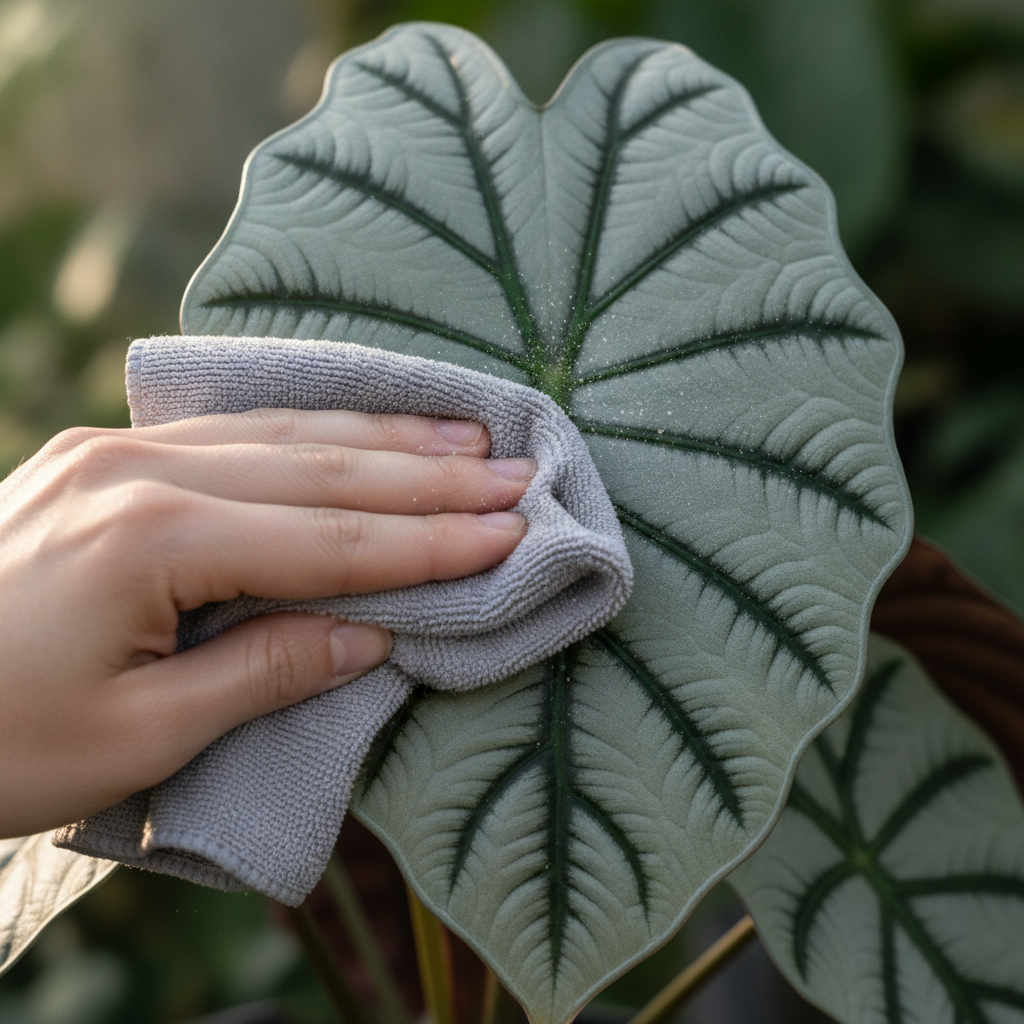
Prevention is far easier than cure with this plant. Keep humidity high to deny spider mites the dry conditions they love, ensure gentle airflow to discourage fungal problems, and inspect the leaves and stems every time you water. Wiping the foliage with a damp cloth removes dust, deters early pests and gives you a regular chance to spot trouble.
Always quarantine new plants for a couple of weeks before placing them near your Dragon Scale, since incoming pests are the most common way collections become infested. Healthy, well-watered, well-lit plants also resist and recover from attacks far better than stressed ones, so good general care is itself a form of pest control.
Pro Tip — Treat Early and Thoroughly: When you do treat for pests, repeat the application every five to seven days for at least three cycles to break the breeding cycle. A single treatment almost never clears spider mites, which is why so many infestations seem to come back.
Popular Varieties
Alocasia baginda is best known through two closely related cultivated forms, Dragon Scale and Silver Dragon, both selections of the same species that differ mainly in the colour and contrast of their foliage. They sit within the wider world of jewel Alocasias, a group of compact, heavily textured species prized by collectors.
Beyond the two baginda forms, growers often collect related jewel aroids alongside it for variety, since they share similar care. The table below sets the most popular Dragon Scale relatives and companions side by side.
| Variety | Leaf Appearance | Light Needs | Growth Rate | Availability |
|---|---|---|---|---|
| Dragon Scale | Silver-green, dark veins, heavy scaled relief | Bright indirect | Slow | Widely available |
| Silver Dragon | Frosted silver-mint, finer dark veining | Bright indirect | Slow | Common |
| Pink Dragon | Glossy green leaves on pink-blushed stems | Bright indirect | Moderate | Common |
| Black Velvet (A. reginula) | Near-black velvety leaves, white veins | Bright indirect | Slow | Common |
| Frydek (A. micholitziana) | Deep green velvet, bright white veins | Bright indirect | Moderate | Common |
| Maharani | Grey-green, leathery, heavily textured | Bright indirect | Very slow | Less common |
Featured Varieties
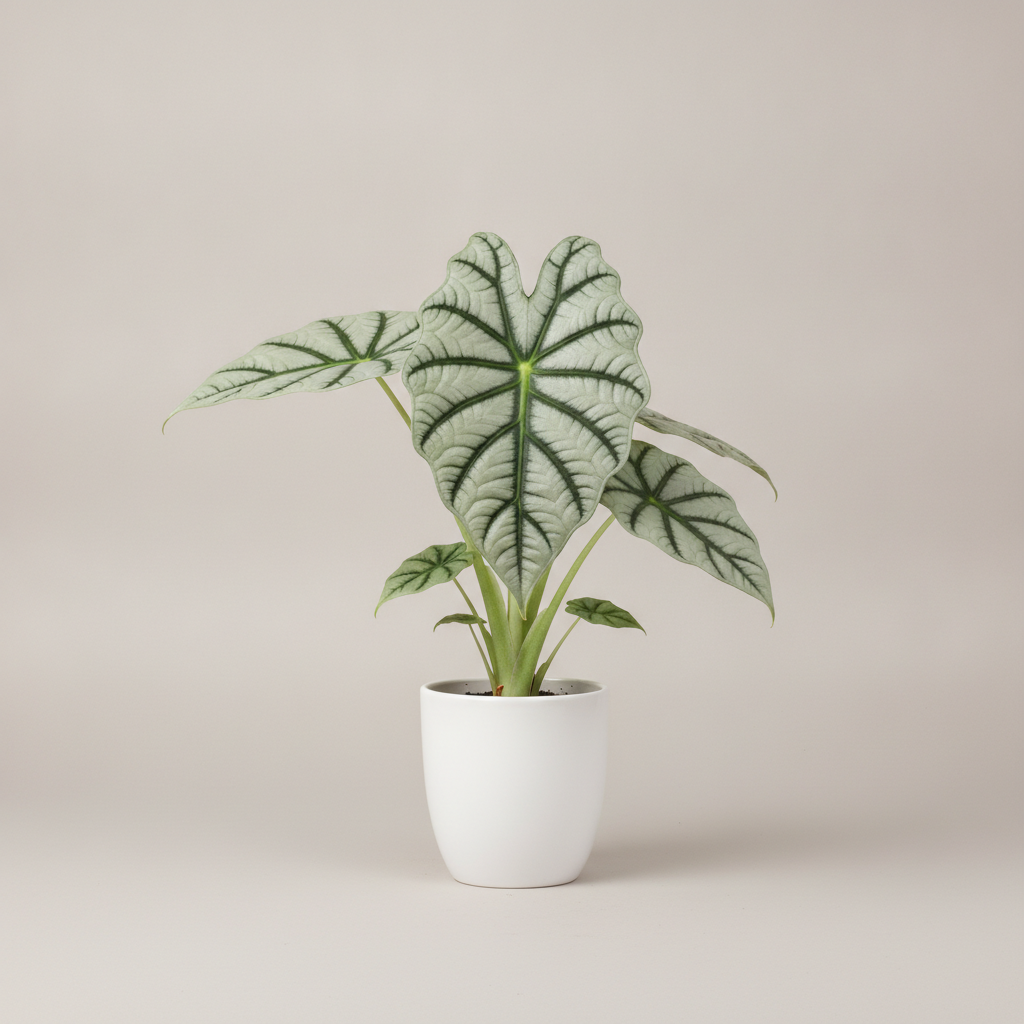
Dragon Scale
The original and most sought-after form, with silvered jade leaves, near-black sunken veins and a deeply embossed, reptilian texture that gives the plant its name.
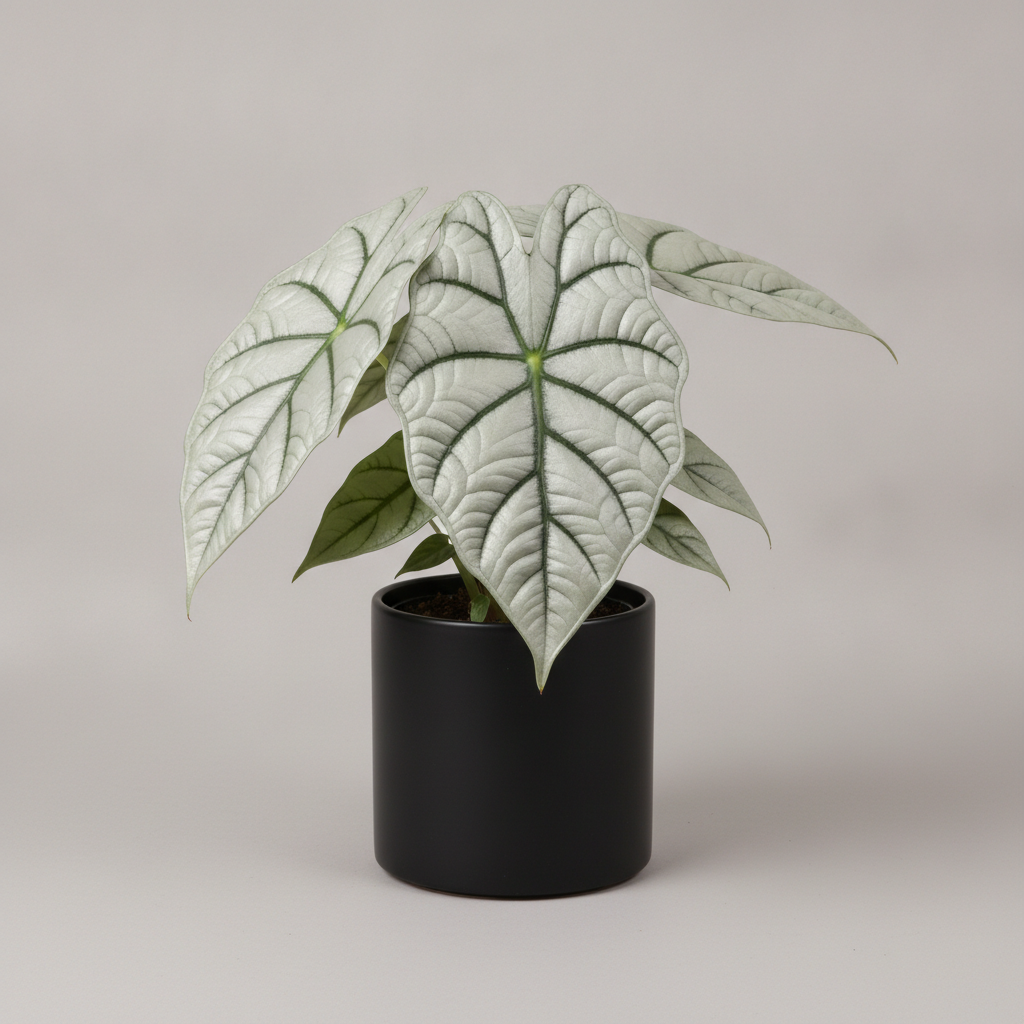
Silver Dragon
A paler, frostier selection with silver-mint leaves and finer dark veining, giving an overall cooler, more ghostly appearance than the classic Dragon Scale.
Variety Profiles in Detail
Dragon Scale (Alocasia baginda ‘Dragon Scale’)
This is the form most people mean when they say Dragon Scale Alocasia. Its leaves are thick and stiff, the surface a shifting silver-green, and the veins pressed so deeply that the leaf reads as genuinely three-dimensional. The maroon undersides add a further point of interest. It is slightly more forgiving than some jewel Alocasias once settled, but still demands high humidity and steady moisture.
Silver Dragon (Alocasia baginda ‘Silver Dragon’)
A sister selection of the same species, Silver Dragon trades the deep green of Dragon Scale for a frosted, almost metallic silver-mint, with the dark veins reduced to fine tracery. It tends to stay even more compact, making it a favourite for small terrariums and cabinet displays, and its care is identical to that of Dragon Scale.
Choosing the Right Variety for Your Space
Both baginda forms want the same conditions, so the choice is largely aesthetic: Dragon Scale for bold green-and-silver contrast, Silver Dragon for a cooler, paler look. If you can offer a humid, stable environment such as a glass cabinet or a bright bathroom, either will reward you, while a drier, more typical room makes both more challenging. For first-time Alocasia growers, the slightly hardier Dragon Scale is usually the easier place to start.
Frequently Asked Questions
Why are my Dragon Scale Alocasia leaves turning yellow?
The most common cause is overwatering, especially if the lower leaves yellow while the soil stays wet. It can also be a natural shedding of an old leaf, or a sign of low humidity or nutrient deficiency. Check the moisture of the mix first, and only adjust feeding or humidity once you have ruled out soggy roots.
Why is my Dragon Scale dropping leaves or going dormant?
Alocasias commonly slow down or pause in autumn and winter, sometimes dropping a leaf or two as they enter a semi-dormant rest. As long as the rhizome stays firm, this is normal. Keep the plant warm, ease off water, hold off feeding, and wait for new growth in spring rather than assuming the plant is dying.
How do I stop the leaf edges going brown and crispy?
Crispy brown edges almost always point to low humidity, and sometimes to mineral build-up from hard water or fertiliser salts. Raise the humidity to 60 percent or more with a humidifier, switch to filtered or rainwater, and flush the pot occasionally to clear salts. The damaged edges will not heal, but new leaves should emerge clean.
Is Dragon Scale Alocasia toxic to cats and dogs?
Yes. Like all Alocasias it contains insoluble calcium oxalate crystals, which cause burning, drooling, swelling and vomiting if any part is chewed or swallowed. Keep it out of reach of curious pets and children, and contact a vet or doctor if ingestion is suspected.
How big does a Dragon Scale Alocasia get?
It stays pleasingly compact. Indoors it typically reaches 30 to 60 cm (12 to 24 inches) tall, with individual leaves of around 15 to 20 cm (6 to 8 inches). Its small size and slow growth make it ideal for shelves, terrariums and plant cabinets rather than as a floor specimen.
Can I grow Dragon Scale Alocasia in a terrarium or cabinet?
Absolutely, and many growers find this the easiest way to keep it happy. A glass cabinet or large terrarium holds the high, stable humidity the plant craves and protects it from spider mites. Just ensure there is gentle airflow and good lighting so the enclosed space does not become stagnant.
Why won’t my new leaf unfurl properly?
New leaves that stick, tear or open crumpled are usually a sign of humidity that is too low. The emerging leaf needs moist air to slide free of its sheath. Raising the humidity around the plant, and gently misting only the unfurling leaf if needed, helps each new leaf open cleanly.
How often should I repot my Dragon Scale Alocasia?
Only every one to two years, as the plant grows slowly and prefers to be a little pot-bound. Repot in spring when you see roots emerging from the drainage holes or the mix has broken down, moving up just one pot size and refreshing the airy aroid mix at the same time.






