
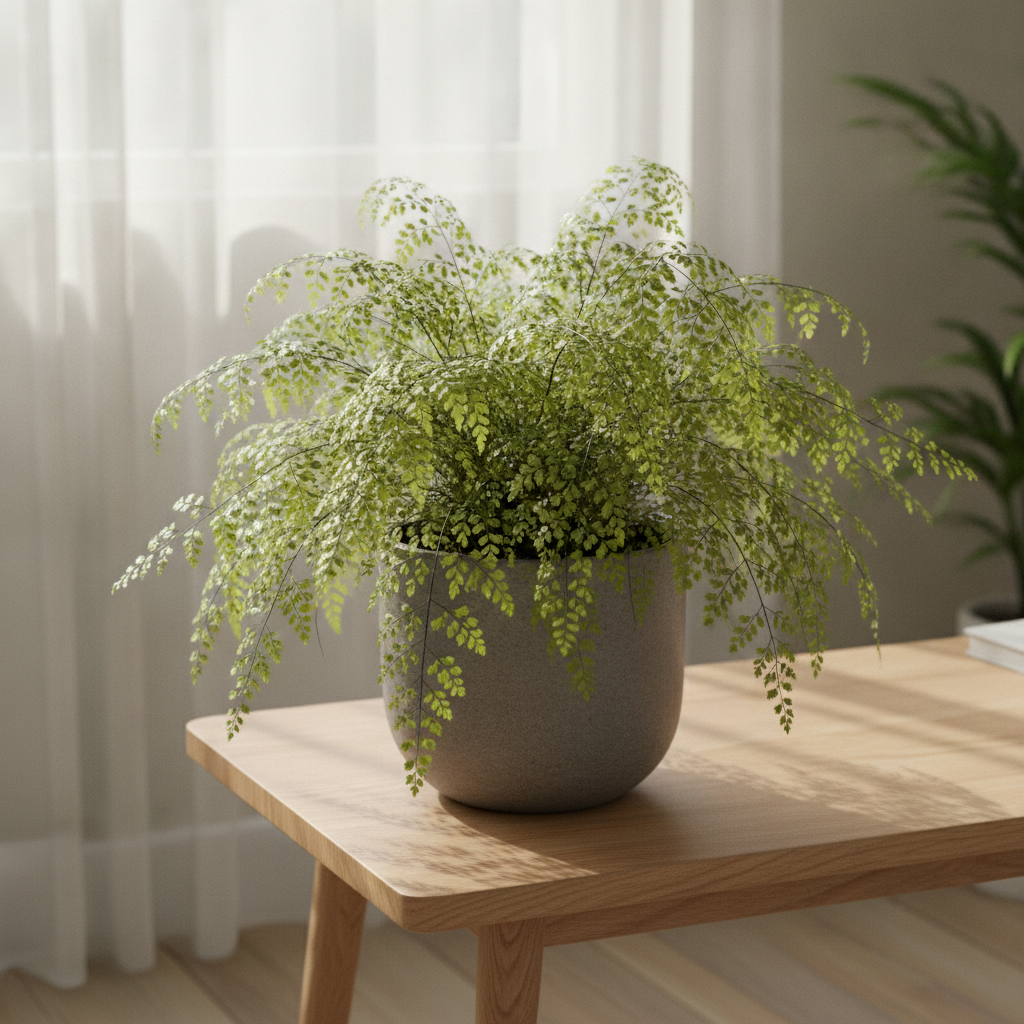
Few houseplants provoke as much devotion and despair in equal measure as the delta maidenhair fern (Adiantum raddianum). Its foliage is unmistakable: clouds of tiny, fan-shaped leaflets held on stems so fine and darkly polished they look like strands of black wire, the whole plant trembling at the slightest movement of air. It is one of the most beautiful ferns you can grow indoors, and also one of the most honest. A maidenhair will not hide its unhappiness the way a pothos might limp along uncomplaining for months. Let the soil dry out once, and within hours the fronds crisp to brittle brown lace. Learn to read that sensitivity, though, and you have a plant that rewards attentive care with a delicacy nothing else on the windowsill can match.
This guide covers everything you need to keep a delta maidenhair fern not merely alive but genuinely thriving: the light it prefers, why watering is the single most important thing you will do for it, how to build a soil that stays moist without turning sour, and how to divide a mature clump into new plants. The difference between a fern that survives and one that flourishes comes down to consistency, and consistency is something you can learn.
In This Guide
- Quick Reference
- Why Grow a Delta Maidenhair Fern
- Light
- Watering
- Soil and Potting
- Fertilising
- Propagation
- Pests and Problems
- Varieties
- Frequently Asked Questions
Quick Reference
The table below distils the essentials into a form you can scan at a glance. Everything here is expanded in detail throughout the guide, but if you take away only one thing, let it be this: a maidenhair fern must never dry out completely, and it must never sit in cold, stagnant water either. The narrow path between those two failures is where this plant lives.
| Botanical name | Adiantum raddianum |
| Common names | Delta maidenhair fern, maidenhair fern, delta maidenhair |
| Family | Pteridaceae |
| Origin | Tropical South America, chiefly Brazil and the Andes |
| Light | Bright, indirect light; no direct sun |
| Water | Keep soil evenly moist at all times; never allow it to dry out |
| Humidity | High, ideally 60 per cent or above |
| Temperature | 16 to 24 degrees C (61 to 75 degrees F) |
| Soil | Light, humus-rich, moisture-retentive but free-draining |
| Feeding | Weak balanced feed monthly through spring and summer |
| Growth habit | Arching, mounding clump 30 to 45 cm (12 to 18 in) tall and wide |
| Propagation | Division of the rhizome; spores for the patient |
| Toxicity | Non-toxic to cats, dogs and humans |
| Difficulty | Demanding; unforgiving of neglect |
Why Grow a Delta Maidenhair Fern
The delta maidenhair takes its common name from the shape of its fronds, which broaden into a rough triangle reminiscent of the Greek letter delta. The genus name Adiantum comes from the Greek adiantos, meaning unwetted, a reference to the way water beads and rolls off the fronds without ever seeming to soak them. It is a lovely paradox for a plant so utterly dependent on moisture: the leaves repel water even as the roots demand it constantly.
In the wild, Adiantum raddianum grows in the shaded, humid understorey of South American forests, often clinging to rocky banks and the mossy margins of streams and waterfalls. This origin explains almost everything about its needs indoors. It evolved in a place where the air is perpetually damp, the light is soft and filtered through a canopy, and the soil is a loose, leaf-littered layer that never quite dries. Recreate a version of those conditions in your home and the fern will forgive you a great deal. Ignore them, and no amount of good intentions will keep the foliage from turning to dust.
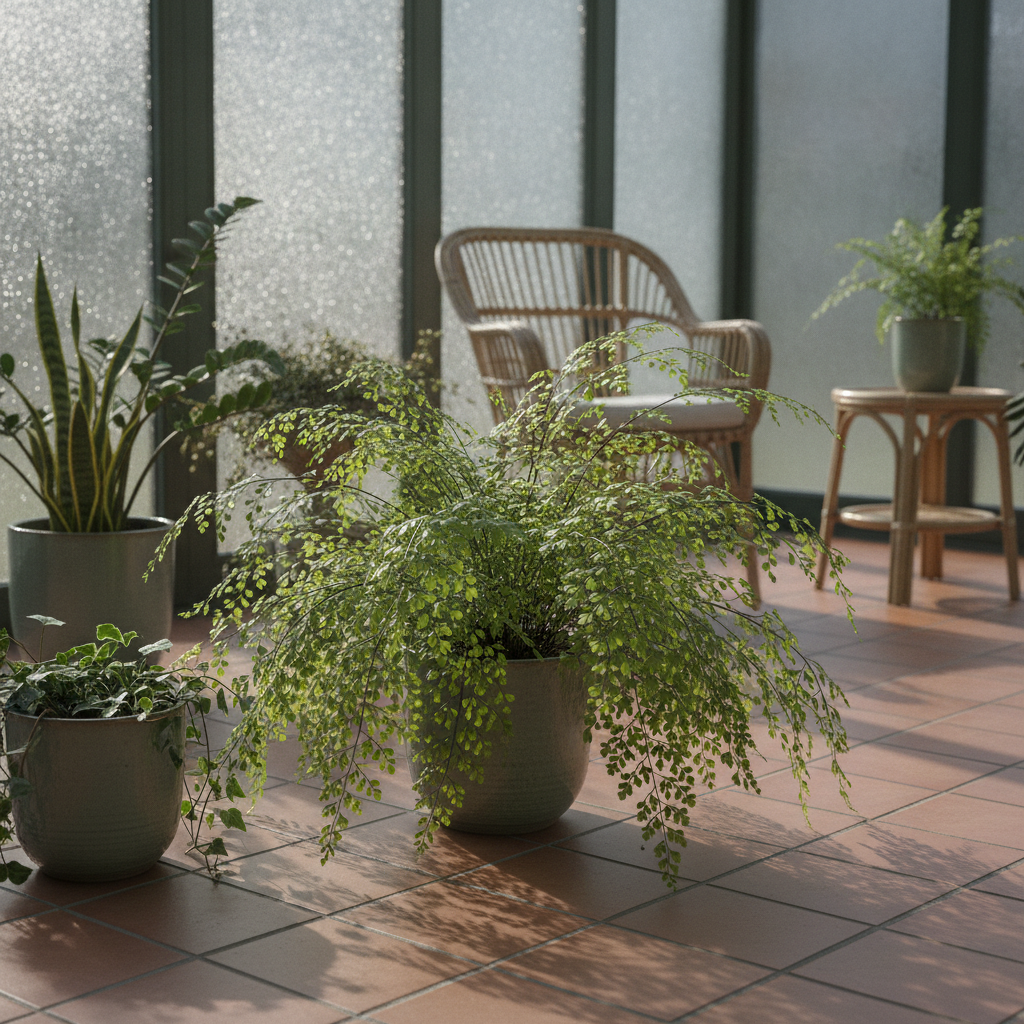
People grow it despite the difficulty because nothing else looks quite like it. The texture is impossibly fine, almost lace, and the plant has a way of catching light that gives it a luminous, feathery quality. Set against coarser foliage, a maidenhair adds a softness that lifts an entire group of plants. It is also genuinely non-toxic, safe around cats, dogs and curious children, which makes it a reassuring choice for households where a nibbled leaf is a real possibility. If you have kept easier plants and want a project that will make you a more observant, more responsive grower, the maidenhair is an excellent teacher.
Light
Bright, indirect light is the ideal for a delta maidenhair fern. Think of the dappled brightness on a forest floor rather than the flat glare of an open window. An east-facing windowsill that catches gentle morning sun, or a position a metre or so back from a brighter south or west window where the direct rays never quite reach, will both keep the plant happy. What it cannot tolerate is direct sunlight falling on the fronds. Even an hour of midday sun through glass will scorch those delicate leaflets, bleaching them pale and then browning the tips within a day or two.
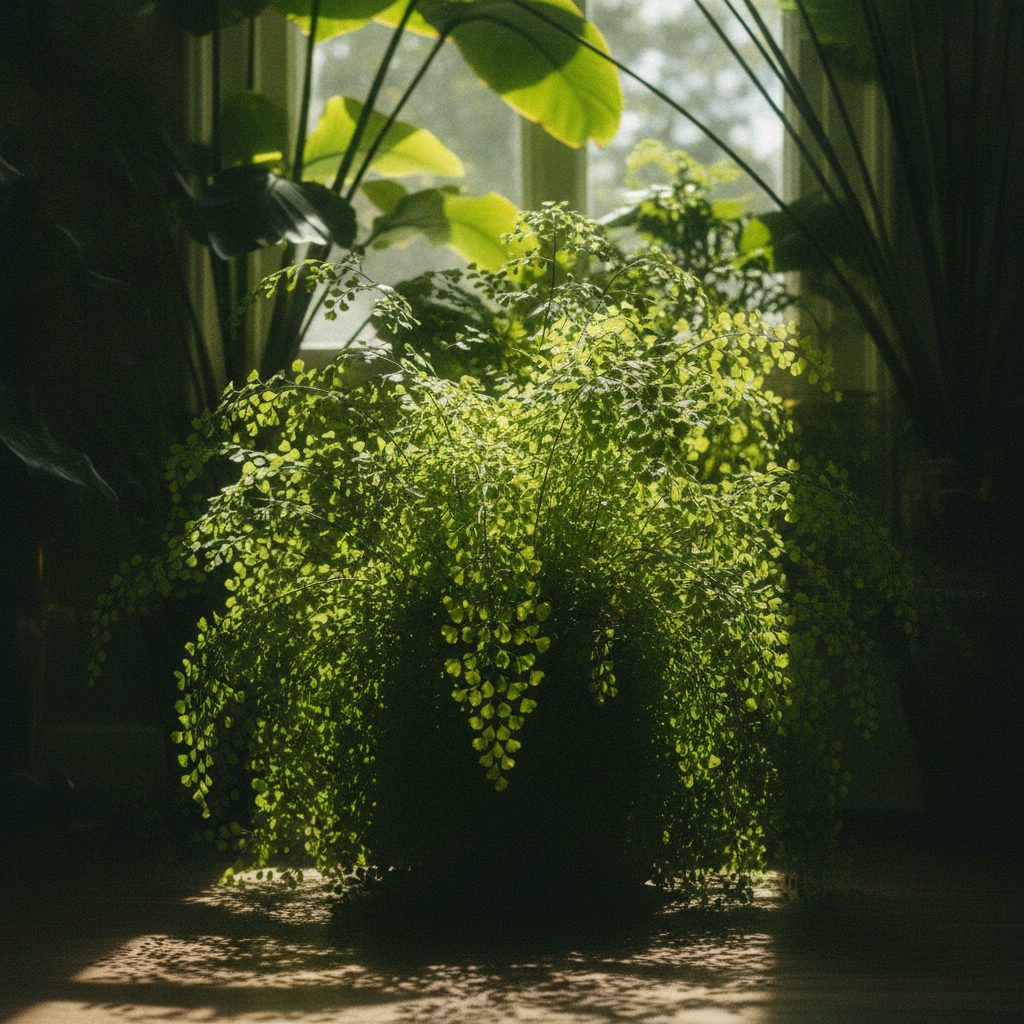
Too little light causes the opposite problem: a maidenhair kept in a genuinely dim corner will grow thin and sparse, producing fewer and paler fronds, and its natural fullness will slowly unravel. The plant is telling you it cannot photosynthesise enough to sustain the dense growth it wants to make. If your only available spot is short on natural light, a modest full-spectrum grow light on a timer for ten to twelve hours a day will comfortably make up the difference, and because maidenhairs want only moderate intensity, an inexpensive fixture placed a sensible distance away is plenty.
One quiet advantage of this fern is that it does well in the same low-to-medium light that suits a bathroom or a north-facing room, precisely the places where humidity tends to be highest. Pairing light and moisture in this way solves two of the plant’s needs at once, which is why so many successful maidenhairs live on a bathroom shelf or a shaded kitchen sill rather than in a bright, dry living room.
Pro Tip — Rotate for even growth: Give the pot a quarter turn each time you water. Maidenhairs lean gently towards their light source, and a regular turn keeps the mound symmetrical rather than one-sided over the months.
Watering
Watering is where a maidenhair fern is won or lost. The single non-negotiable rule is that the soil must stay evenly moist at all times. Not soggy, not waterlogged, but never, ever dry. Unlike almost every other popular houseplant, the maidenhair has no tolerance at all for a dry spell. Where a succulent stores water against drought and a pothos wilts theatrically but recovers, a maidenhair that dries out will simply collapse, its fronds crisping to brown within hours and, in a bad case, never regrowing from that flush at all.
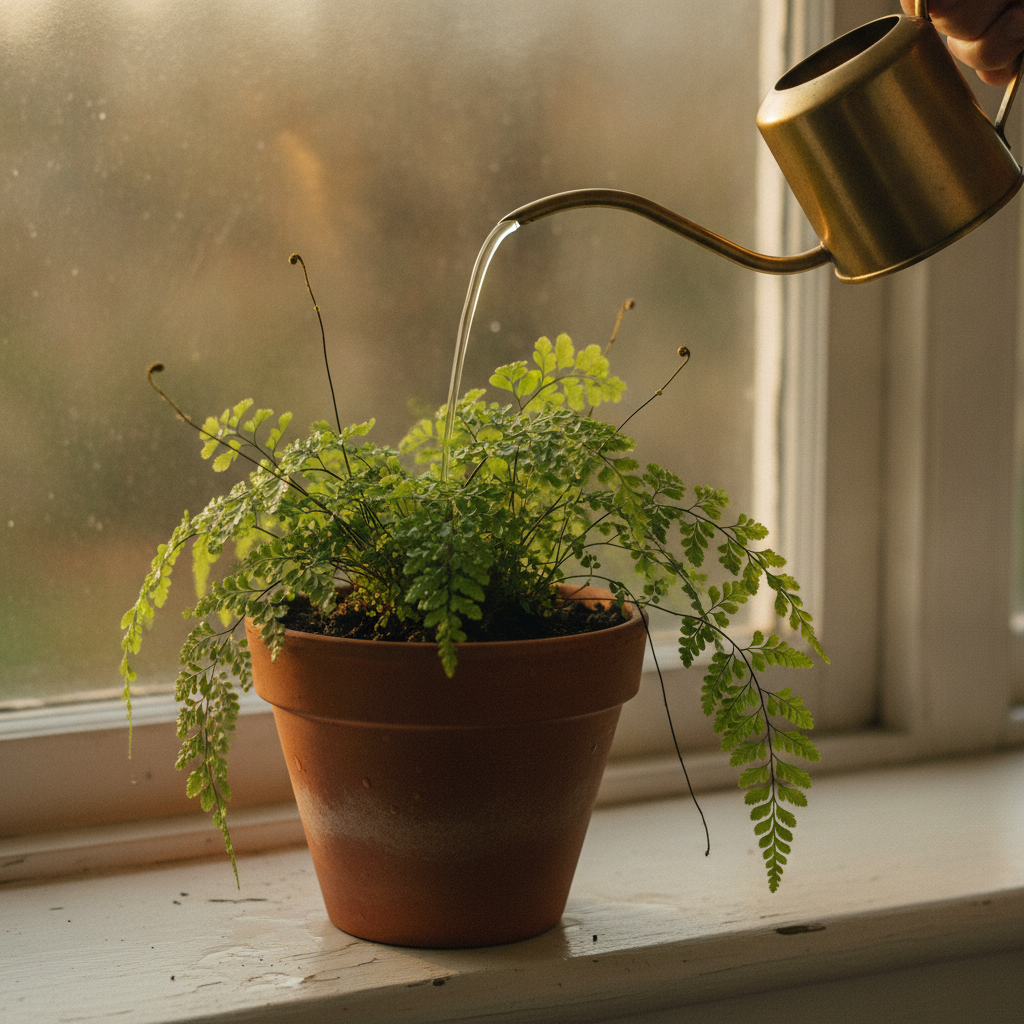
In practice this means checking the plant every day or two and watering as soon as the very top of the soil begins to feel less than damp. Depending on your home this may mean watering two or three times a week in summer and slightly less in winter, but the schedule matters less than the feel of the soil. Pour water in slowly until it runs from the drainage holes, let the excess drain away completely, and never leave the pot standing in a saucer of water, which will rot the fine roots just as surely as drought will kill the top. Many growers find that bottom watering, standing the pot in a shallow tray of water for ten minutes so the soil wicks up moisture from below, gives the most reliably even result and keeps the delicate crown dry.
Water quality matters more here than with most plants. Maidenhairs can be sensitive to the salts and chlorine in hard tap water, which show up over time as brown leaf margins. If your water is very hard, using rainwater, filtered water or tap water left to stand overnight will noticeably improve the health of the foliage. Whatever you use, water at room temperature rather than straight from a cold tap, as a shock of cold water can stress the roots.
Humidity is the close partner of watering and nearly as important. A maidenhair wants humidity of sixty per cent or more, well above the level of a typical centrally heated room. Grouping it with other plants, standing the pot on a wide tray of damp pebbles, or running a small humidifier nearby all help. A bathroom or kitchen, where steam and running water keep the air moist, is often the easiest place of all to succeed. Misting gives only a fleeting lift and, done heavily, can encourage fungal spotting, so treat it as a minor supplement rather than a substitute for genuinely humid air.
Warning — The point of no return: If your fern dries out and browns, do not assume it is dead. Cut all the crisped fronds back to the soil, keep the rootball consistently moist and humid, and new growth will very often push up within a few weeks. The roots survive long after the visible plant has failed.
Soil and Potting
The ideal soil for a maidenhair fern performs a careful balancing act: it must hold moisture readily so the plant never dries out, yet drain freely enough that the roots are never left sitting in stagnant water. A dense, heavy compost that stays sodden will suffocate and rot the fine root system, while a coarse, fast-draining mix built for succulents will dry too quickly and leave the plant parched between waterings. What you want is something light, open and rich in organic matter that behaves like the damp, leafy litter of a forest floor.
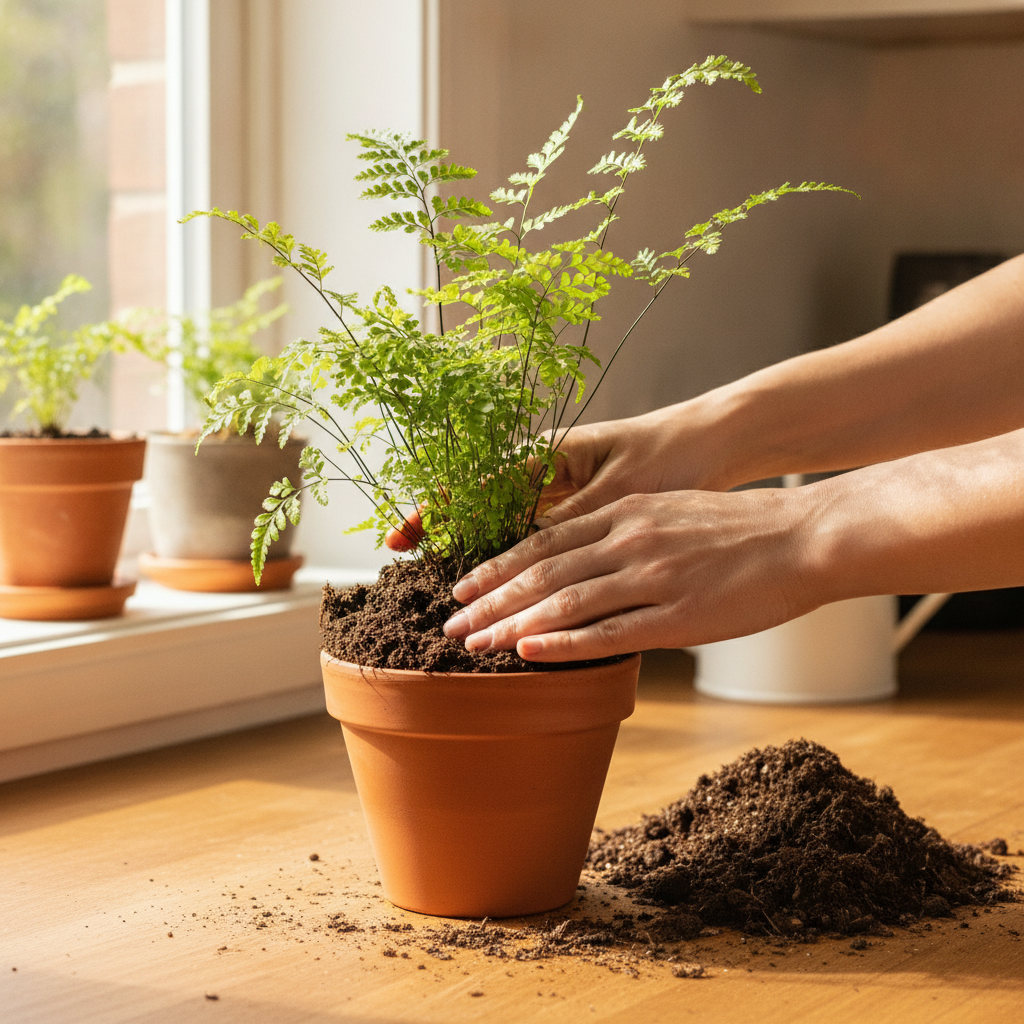
A reliable recipe is two parts good peat-free houseplant compost or coco coir to one part perlite for aeration, with a generous handful of fine bark or leaf mould stirred through to hold moisture and add structure. The coir and compost retain water, the perlite keeps the mix from compacting, and the organic matter feeds the roots gently as it breaks down. A maidenhair prefers a slightly acidic to neutral medium, which peat-free coir-based mixes naturally provide, so there is rarely any need to adjust the pH.
Choose a pot only slightly larger than the rootball and always one with drainage holes. Maidenhairs actually resent being over-potted, as a large volume of wet soil around a small root system stays damp for too long and invites rot. Plastic and glazed ceramic pots hold moisture better than unglazed terracotta, which wicks water away through its porous walls and can leave a maidenhair drying out faster than you can keep up with. If you love the look of terracotta, consider slipping a plastic nursery pot inside a terracotta cover pot to get the appearance without the moisture loss.
Repot in spring only when the plant is genuinely crowded, every couple of years or so, moving up just one pot size at a time. This is also the natural moment to divide a large clump, which we come to below. Handle the rootball gently, keep it moist throughout the process, and water thoroughly once the fern is settled into its fresh soil to close any air pockets around the roots.
Fertilising
Maidenhair ferns are light feeders, and the quickest way to damage one with kindness is to fertilise it too strongly. Their fine roots scorch easily on concentrated fertiliser salts, which show up as brown, burnt frond edges that look worryingly like the damage caused by drought. A gentle, diluted approach is always safest. During the active growing season of spring and summer, feed once a month with a balanced liquid houseplant fertiliser mixed to half, or even a quarter, of the strength recommended on the bottle.
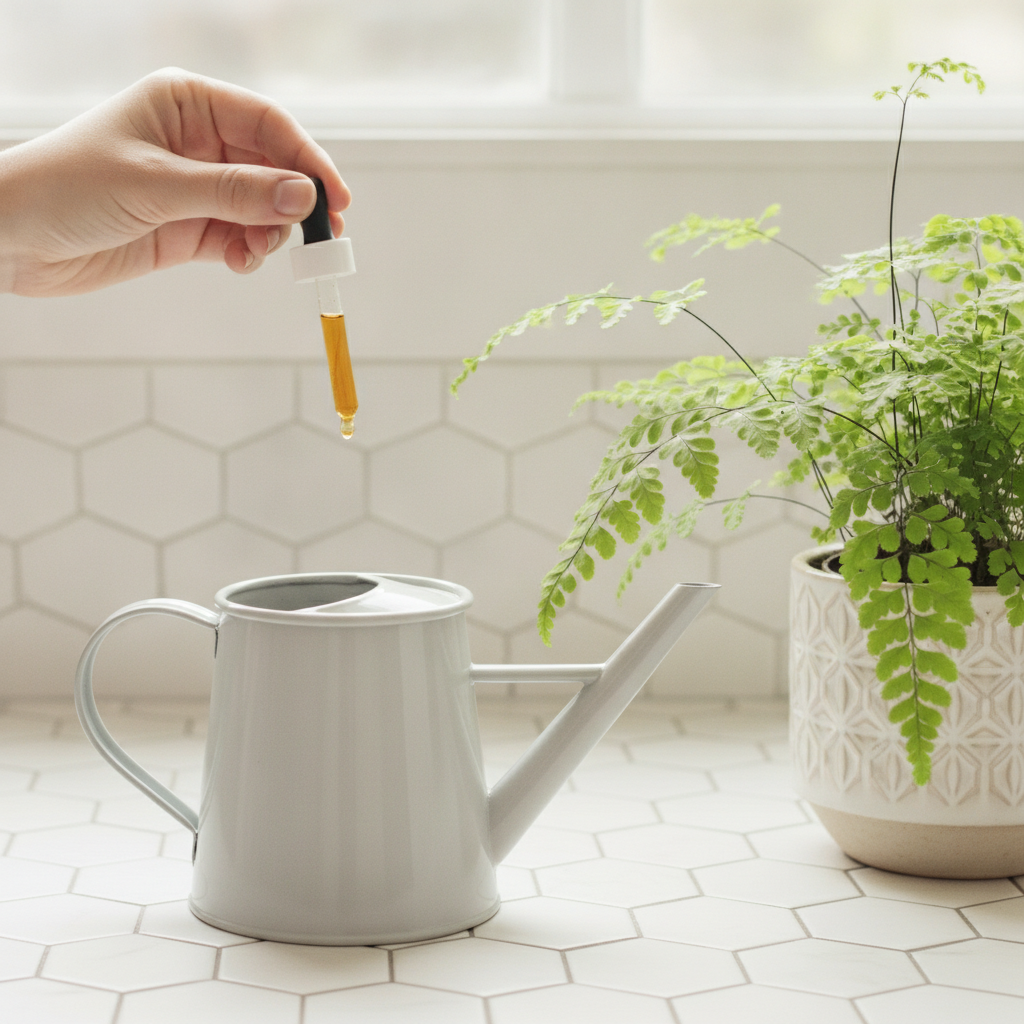
Always apply feed to soil that is already moist, never to a dry rootball, as fertiliser drawn into dry roots is far more likely to burn them. Watering the plant first and feeding second is a simple habit that prevents most problems. Through autumn and winter, when growth naturally slows, stop feeding altogether. The plant is resting, takes up little in the way of nutrients, and unused fertiliser will only build up as salts in the soil.
If you suspect a salt build-up, indicated by a white crust on the soil surface or the pot rim alongside browning frond tips, flush the pot through with plenty of plain water two or three times, letting it drain fully between flushes. This rinses accumulated salts out of the soil and often revives a fern that has been quietly over-fed. As with everything about this plant, restraint and consistency beat enthusiasm.
Propagation
The simplest and most reliable way to make more maidenhair ferns is by division. Unlike many houseplants, a maidenhair cannot be grown from a leaf or stem cutting, because a single frond has no dormant buds capable of forming a new plant. Instead, a mature clump is separated into smaller sections, each with its own portion of the creeping rhizome and roots, and each grows on into a full plant. The ideal time to divide is in spring, when the fern is entering its most vigorous growth and will recover quickly, and it pairs naturally with repotting.
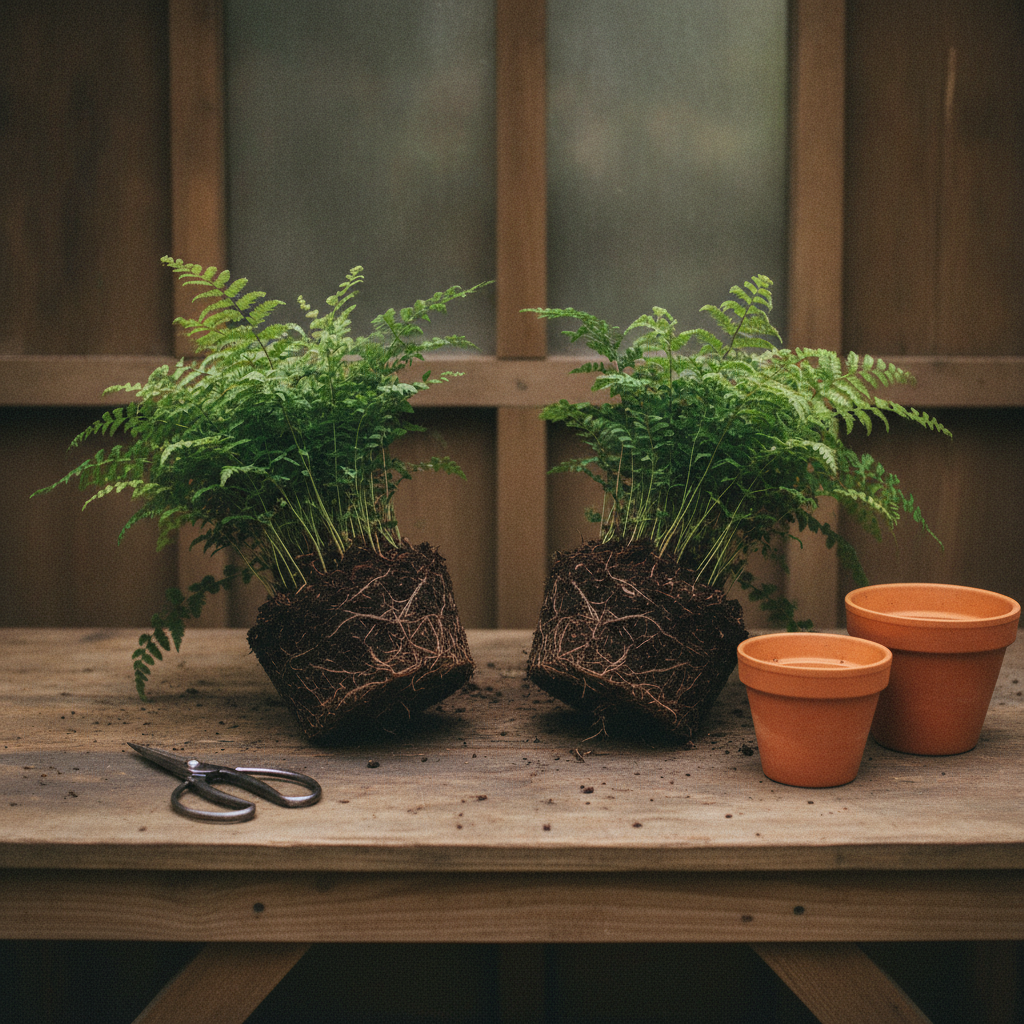
Work gently and quickly, keeping the roots from drying at any stage, and follow these steps:
- Water the fern well an hour or two beforehand so the rootball is fully hydrated and holds together.
- Slide the plant from its pot and gently tease away enough soil to see the structure of the rhizome and roots.
- Identify natural divisions in the clump, points where the plant separates into distinct crowns each carrying several fronds.
- Using clean, sharp scissors or a knife, cut the rhizome to separate the clump into two or three sections, making sure each piece keeps a healthy share of both roots and fronds.
- Pot each division into its own small pot of fresh, moisture-retentive fern mix, setting it at the same depth it grew before.
- Water thoroughly and place the new plants somewhere warm, shaded and humid while they recover.
Expect a little sulking after division. Some fronds may brown and die back as the plant redirects its energy into settling its disturbed roots, and this is normal. Keep the soil consistently moist and the humidity high, resist the urge to feed until you see fresh growth, and within a few weeks new fronds will begin to unfurl from each division.
The more advanced route is growing from spores, the fine dust-like reproductive bodies that form in the sori along the undersides of mature fronds. Sown onto damp, sterile compost and kept under cover in warm, humid conditions, spores can be raised into new ferns, but the process is slow, fiddly and takes many months to yield a recognisable plant. It is a rewarding experiment for the dedicated, but for simply increasing your collection, division is faster, easier and far more dependable.
Pests and Problems
The good news is that a healthy, well-watered maidenhair is rarely troubled by pests. The overwhelming majority of problems with this plant are cultural rather than biological, brown, crisping fronds caused by dry soil or dry air rather than by any insect. When pests do appear they tend to be the usual houseplant suspects, and the fine foliage makes chemical sprays a poor option, so gentle physical control is almost always the better approach.
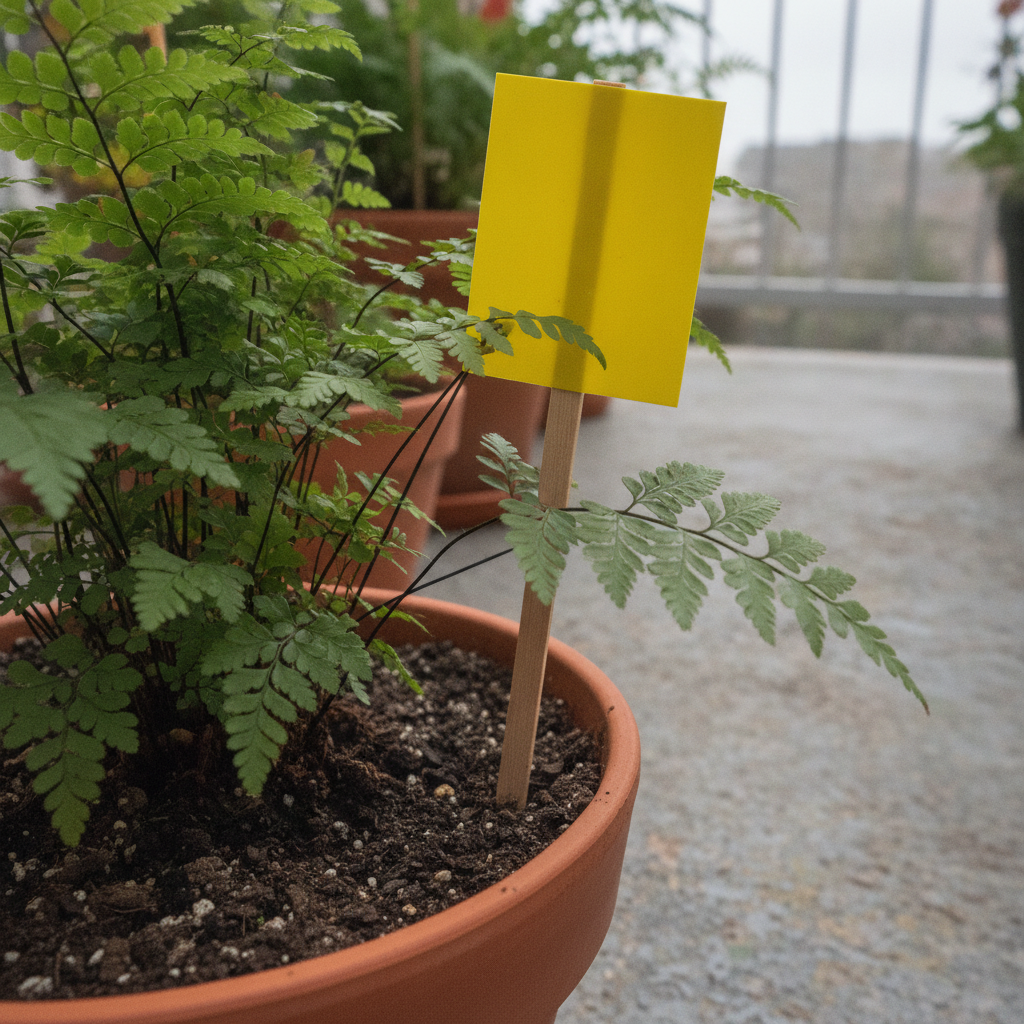
Because the soil is kept permanently moist, fungus gnats are the most common visitor, small dark flies whose larvae live in the top layer of damp compost. They are more a nuisance than a serious threat, and yellow sticky traps placed at the soil surface will catch the adults and break the breeding cycle. Scale and mealybugs turn up occasionally, the former as small brown limpet-like bumps on the stems, the latter as white cottony tufts in the leaf axils. Both are best dealt with by dabbing them off individually with a cotton bud, as the foliage is far too delicate to withstand vigorous wiping or oily sprays.
The table below sets out the problems you are most likely to meet and what each is telling you.
| Symptom | Likely cause | Remedy |
| Whole fronds crisp brown suddenly | Soil dried out completely | Cut back dead fronds, keep rootball moist and humid; new growth usually returns |
| Brown, dry leaf tips and margins | Low humidity, hard water or salt build-up | Raise humidity, switch to filtered or rainwater, flush the soil |
| Pale, bleached or scorched fronds | Direct sunlight | Move to bright but indirect light |
| Thin, sparse, leggy growth | Too little light | Move somewhere brighter or add a grow light |
| Small flies around the soil | Fungus gnats in damp compost | Use yellow sticky traps; let the very surface dry slightly between waterings |
| Yellowing, mushy base | Waterlogging and root rot | Improve drainage, never leave standing in water, repot if severe |
Whatever the cause, the recovery strategy is remarkably consistent: cut away the damaged fronds to make room for new ones, correct the underlying condition, and keep the plant warm, moist and humid while it regenerates. A maidenhair regrows readily from its rhizome, so even a fern that looks entirely finished is often only weeks away from a fresh flush of foliage.
Varieties
Adiantum raddianum has given rise to a number of cultivated forms, selected over the years for fuller growth, finer texture or greater vigour. All share the same essential needs, so choosing between them is a matter of look rather than care. Two of the most widely grown are shown below.
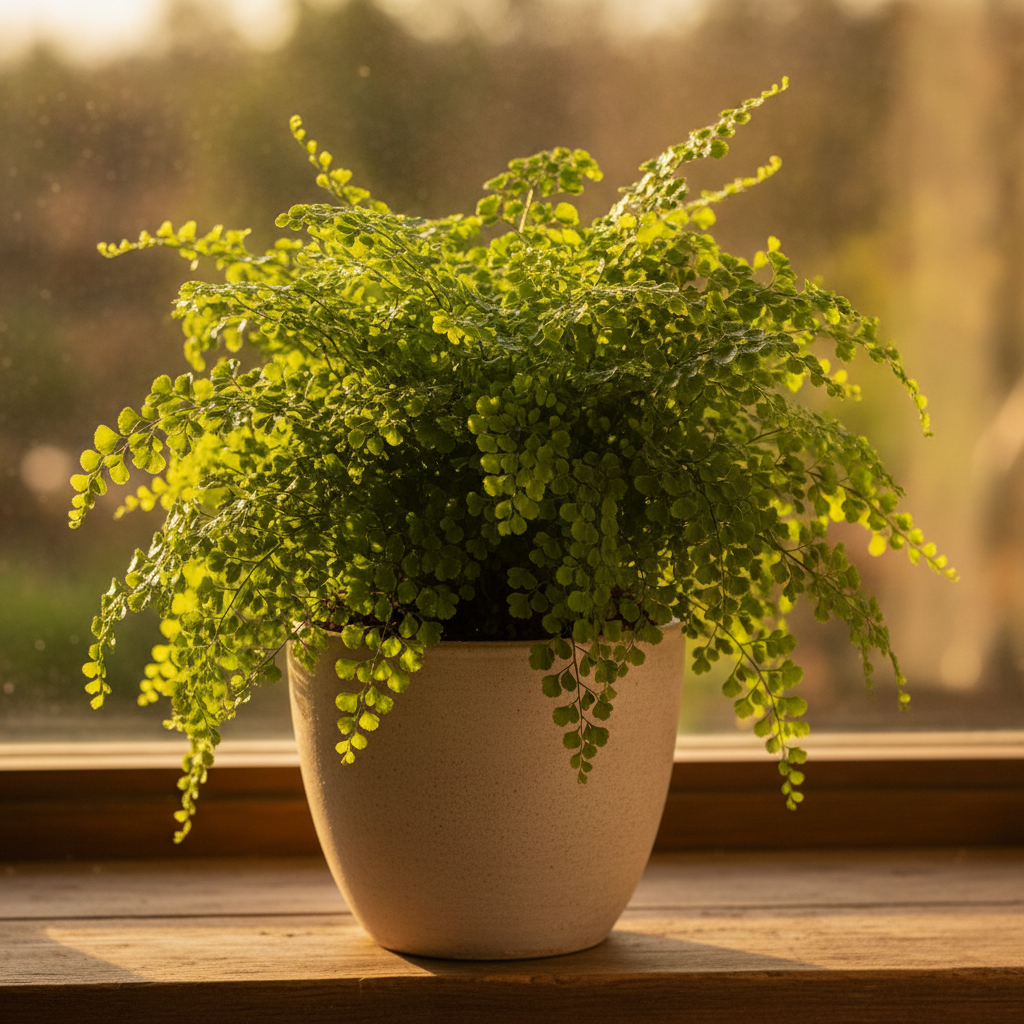
‘Fragrans’, sometimes sold as ‘Fragrantissima’, is the most popular and forgiving cultivar of the delta maidenhair. It is notably more vigorous and fast-growing than the species, filling its pot with dense, slightly larger and rounder bright-green leaflets. Its fuller, more robust habit makes it the best starting point for anyone new to maidenhairs, as it recovers from setbacks more readily than the finer forms.
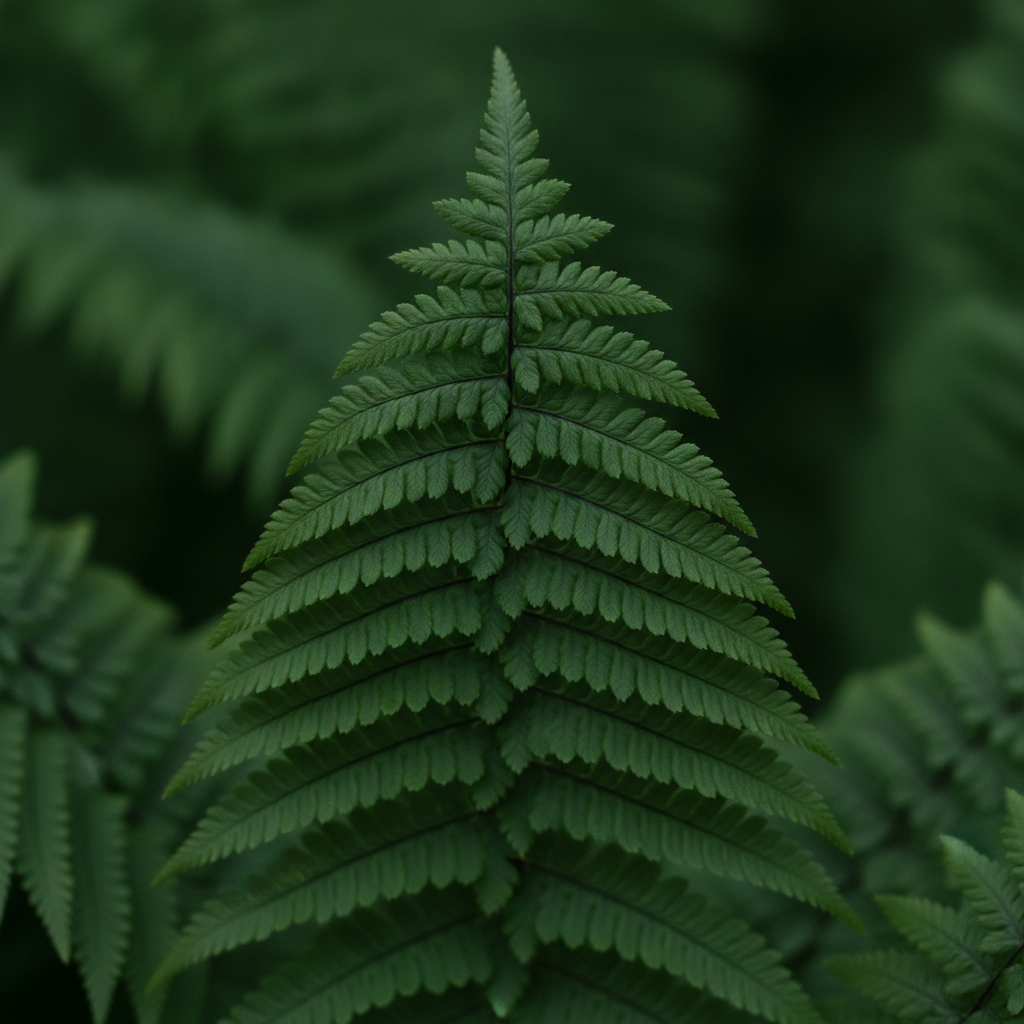
‘Fritz Luthii’ is prized for its neat, layered elegance. Its fronds are compact and tightly overlapping, built from finely cut, deep-green pinnae carried on especially dark stems, giving the plant a dense, tiered appearance. It is a little more demanding than ‘Fragrans’ but rewards the extra attention with one of the most refined silhouettes of any maidenhair, ideal as a specimen where its intricate texture can be admired up close.
Other forms worth seeking out include ‘Micropinnulum’, with unusually tiny, mossy leaflets, and ‘Kensington Gem’, a larger and more architectural selection. Whichever you choose, the care remains identical: steady moisture, high humidity, soft light and a gentle hand with the feed.
Frequently Asked Questions
Why does my maidenhair fern keep turning brown and crispy?
Almost always because the soil dried out, even briefly, or the air is too dry. Maidenhairs have no drought tolerance whatsoever and respond to a missed watering by crisping their fronds within hours. Keep the soil consistently moist, raise the humidity to sixty per cent or more, and cut back any browned fronds so the plant can push out fresh growth from the rhizome.
Is the delta maidenhair fern safe for cats and dogs?
Yes. Adiantum raddianum is non-toxic to both cats and dogs, as well as to humans, so it is a safe choice for homes with pets or young children. As with any plant, a pet that eats a large amount of foliage may get a mild stomach upset, but the fern itself contains no harmful compounds.
Can I revive a maidenhair fern that looks completely dead?
Very often, yes. As long as the roots and rhizome are still alive, a maidenhair can regenerate from what looks like a lost cause. Cut every dead frond back to soil level, keep the rootball evenly moist and the air humid, and place the pot somewhere warm and shaded. New fronds frequently appear within two to four weeks. It is well worth giving a browned fern a month before giving up on it.
How often should I water a delta maidenhair fern?
Often enough that the soil never dries out, which in a warm home usually means two to three times a week, though you should be guided by the feel of the soil rather than a fixed schedule. Check daily and water as soon as the surface begins to feel less than damp. Bottom watering, standing the pot briefly in a tray of water, is a good way to keep moisture even without wetting the delicate crown.
Where is the best place to keep a maidenhair fern in the house?
A bright bathroom or kitchen is often ideal, because these rooms combine the soft, indirect light the fern prefers with the higher humidity it needs. Anywhere out of direct sun, away from cold draughts and hot radiators, and where the air stays reasonably moist will suit it. A terrarium or a spot beside a humidifier works beautifully for the finer, fussier cultivars.
Do I need to mist my maidenhair fern?
Misting helps a little but is no substitute for genuinely humid air. The moisture from a mist evaporates within minutes, and heavy misting can leave fronds wet long enough to encourage fungal spots. A humidifier, a tray of damp pebbles beneath the pot, or grouping the fern with other plants all raise ambient humidity far more effectively and reliably than misting alone.
The delta maidenhair fern asks for attention, but it asks for the same things every day, and that consistency is easier to give than it first appears. Keep it moist, keep it humid, keep it out of direct sun, and feed it lightly through the growing months. Do those few things reliably and you will be rewarded with one of the most delicately beautiful plants it is possible to grow indoors.






