
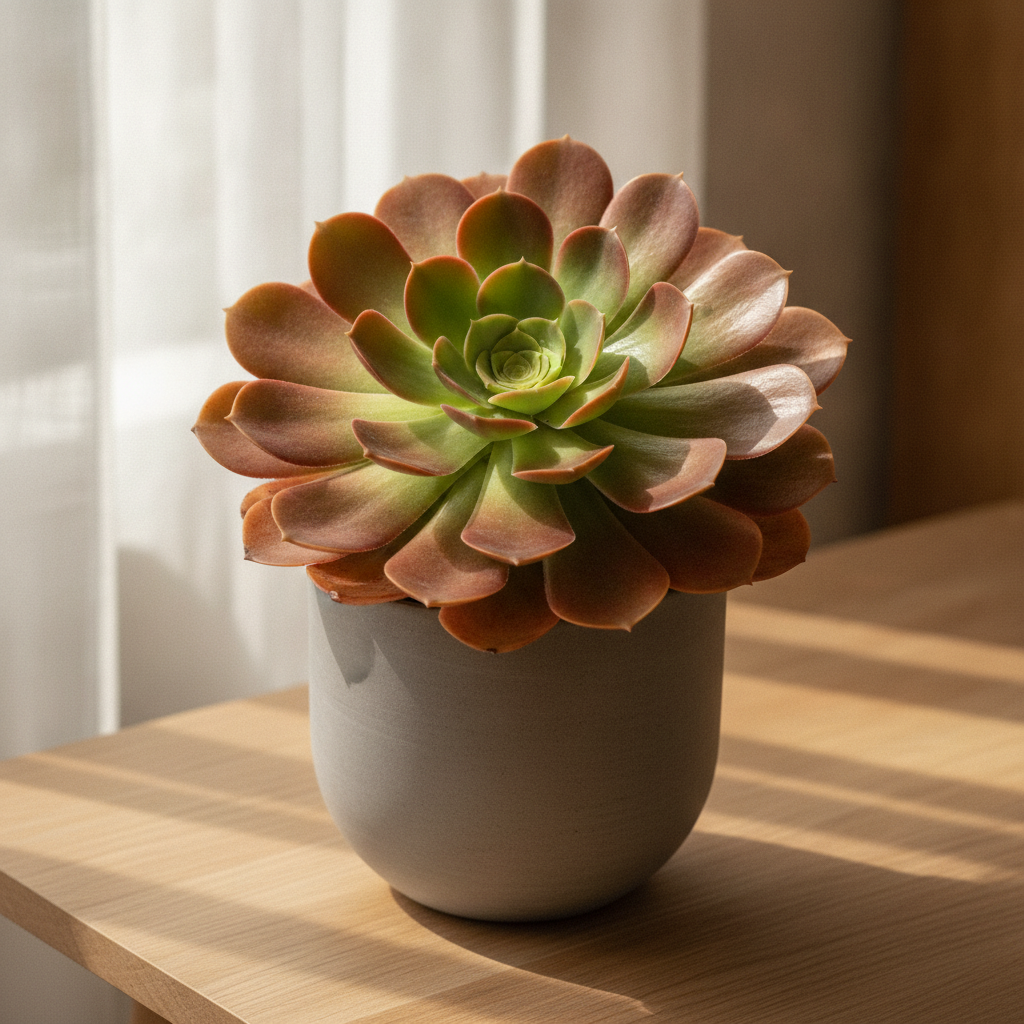
The copper pinwheel is one of the most sculptural succulents you can keep on a bright windowsill, a single broad rosette that can spread wider than a dinner plate and flush from apple-green to a burnished coppery-red when the light is strong. Known botanically as Aeonium nobile and sometimes sold as the giant aeonium, it is native to the western Canary Islands of La Palma and El Hierro, where it grows on rocky volcanic slopes and cliff faces. Among the aeoniums it stands apart: most of its relatives branch into clusters of small rosettes, but the copper pinwheel usually grows as one imposing solitary rosette on a short, thick stem, its fleshy leaves carrying a faintly sticky, waxy surface that catches dust and light in equal measure.
It has a reputation as an easy, forgiving succulent, and for the most part that reputation is deserved. The copper pinwheel asks for little beyond good light, a gritty pot that drains freely, and a grower who understands that it does most of its growing in the cool months and rests through the heat of summer. That single fact, its reversed growing season, is where the difference between merely surviving and genuinely thriving is decided. This guide covers everything from light and watering through soil, feeding, propagation and pests, so you can read the plant’s signals and give it the conditions that turn a pale, stretched rosette into a tight, coppery jewel.
Contents
- Quick Reference
- Why Copper Pinwheel Makes a Rewarding Houseplant
- Light Requirements
- Watering & Humidity
- Soil, Potting & Repotting
- Fertilising
- Propagation
- Pests & Diseases
- Popular Varieties
- Frequently Asked Questions
Quick Reference: Copper Pinwheel at a Glance
| Light | Very bright light with several hours of direct sun; brightest colour in full sun, with shade from the harshest summer midday rays |
| Watering | Soak thoroughly then let the mix dry out; water more in autumn to spring, sparingly through summer dormancy |
| Temperature | 10 to 24°C (50 to 75°F); protect from anything below about 4°C (39°F), not frost hardy |
| Humidity | Low to average household humidity; tolerates dry air well |
| Fertiliser | Dilute, low-nitrogen feed once a month during active autumn-to-spring growth; none in summer |
| Toxicity | Considered non-toxic to cats, dogs and humans, though the sticky sap may irritate sensitive skin |
Why Copper Pinwheel Makes a Rewarding Houseplant
Few succulents deliver as much visual drama from a single plant as the copper pinwheel. Where a jade plant or an echeveria offers a cluster of modest rosettes, Aeonium nobile concentrates all its energy into one large, flat, symmetrical wheel of leaves that can reach 40 to 50 centimetres (16 to 20 inches) across on a mature plant. The leaves are thick, broad and spoon-shaped, arranged in a tight spiral, and their surface has an unusual tacky, resinous feel that distinguishes the species from almost every other aeonium. In good light the green base colour deepens to bronze and coppery-red, giving the plant its common name and making it a natural focal point among a collection of greener succulents.
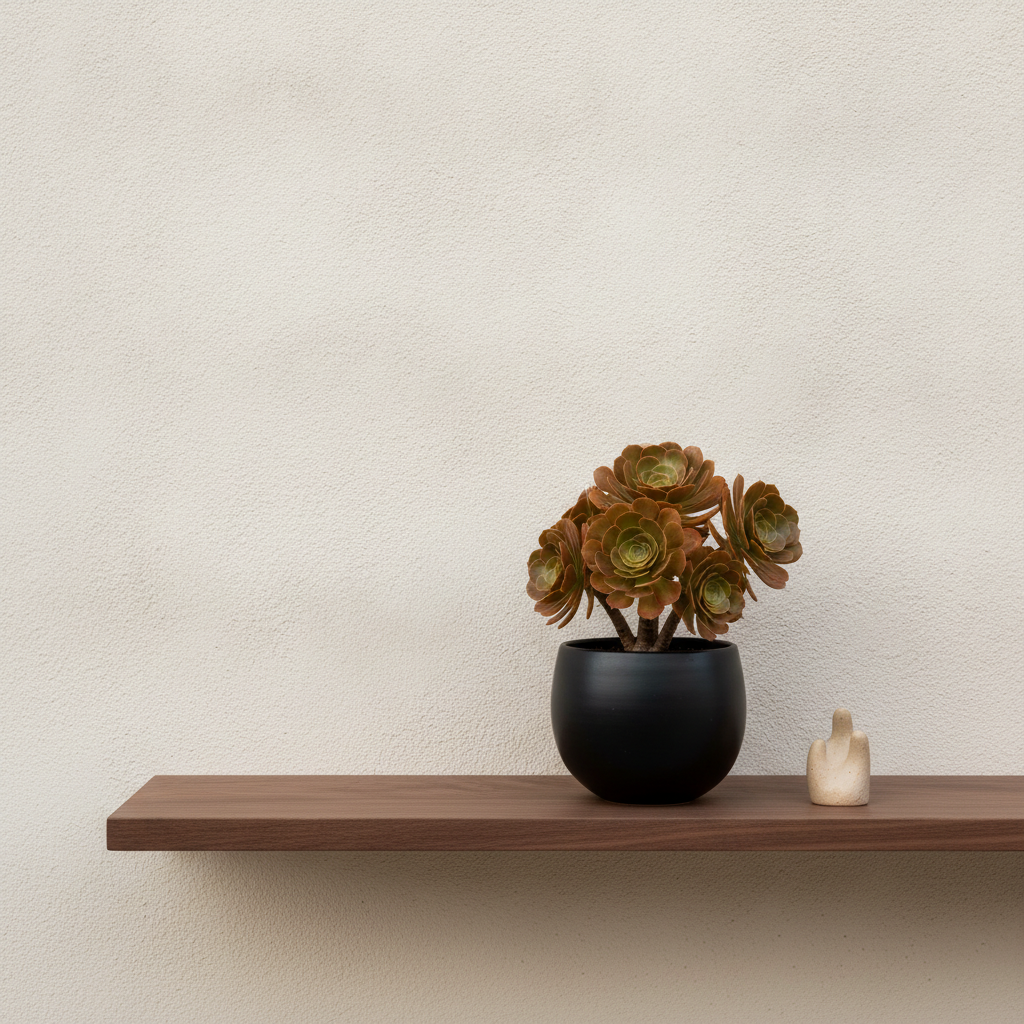
Beyond its looks, the copper pinwheel earns its place indoors through sheer resilience. It stores water in its fleshy leaves and stem, so it shrugs off the occasional missed watering that would finish off a thirstier plant, and it thrives in the dry indoor air that troubles ferns and calatheas. Its one genuine quirk is timing: as a winter grower it puts on most of its growth from autumn through spring and rests in summer, which is precisely the opposite of what many houseplant owners expect. Learn to feed and water it on that schedule and it rewards you with a dense, colourful rosette; ignore the schedule and it may sulk, stretch or drop leaves. It is also worth knowing that the plant is monocarpic, meaning a rosette flowers only once, at the end of its life, producing a spectacular domed head of deep red blooms before dying back.
Important — Toxicity: The copper pinwheel is generally regarded as non-toxic to cats, dogs and people, which makes it a safer choice than many popular houseplants. Even so, the milky, sticky sap can irritate sensitive skin or eyes, so wash your hands after taking cuttings and keep curious pets from chewing on the fleshy leaves.
Light Requirements
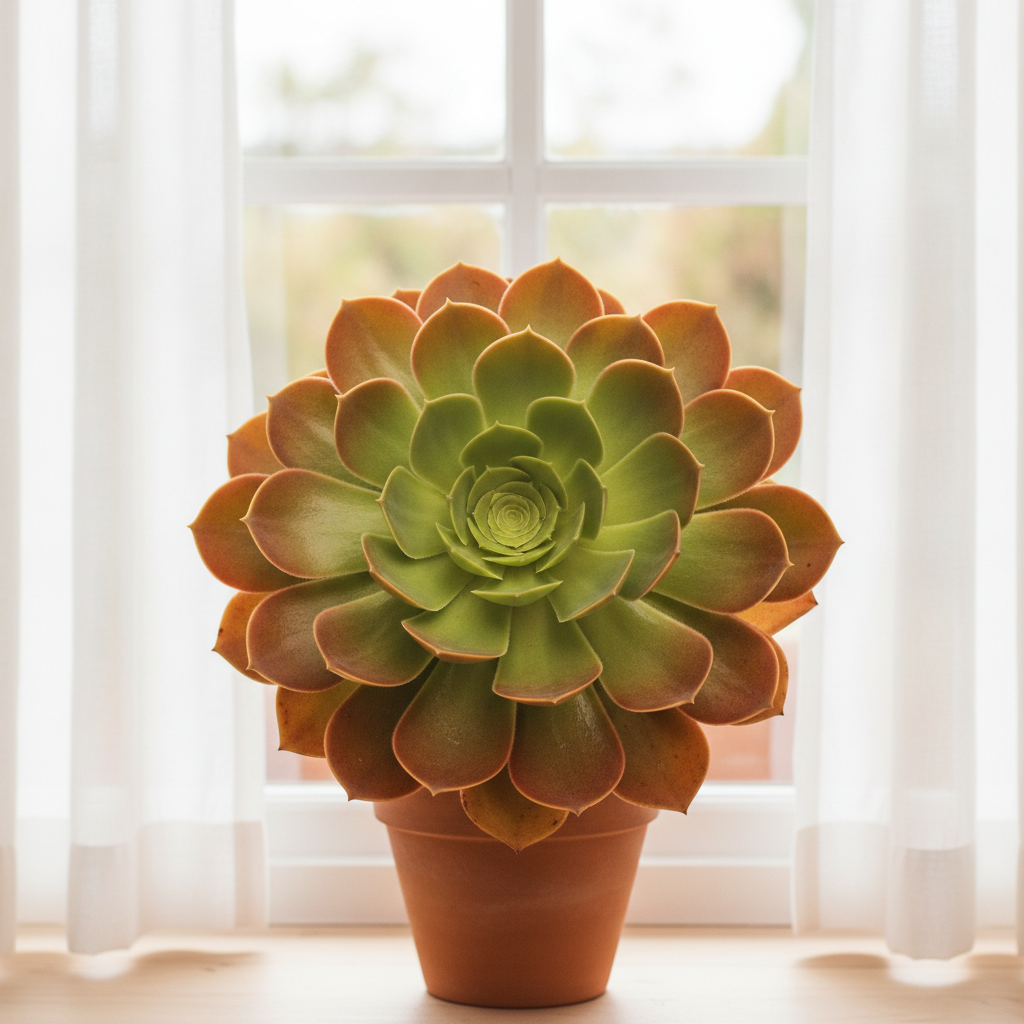
Light is the single most important factor in growing a good copper pinwheel, because it governs both the compactness of the rosette and the intensity of its colour. This is a plant of open, sunny volcanic slopes, and indoors it wants the brightest position you can offer. Given plenty of light, the leaves stay short, broad and tightly packed, and the coppery-red pigments develop fully. Starved of light, the same plant stretches, the leaves space out along an elongating stem, and the colour fades back to a flat, pale green.
The ideal is several hours of direct sun each day combined with bright ambient light for the rest. A spot right at a south-facing or west-facing window is usually perfect for most of the year. The main caveat is the intense midday sun of high summer, which, combined with the plant’s summer dormancy, can scorch the exposed crown; a light sheer curtain or a half-metre of setback protects it during those few peak weeks.
Light Levels Explained
The table below sets out how the copper pinwheel responds across the range of light conditions found in a typical home, from full sun to the dim interior of a room. Use it to judge whether your chosen spot will keep the plant tight and colourful or leave it stretched and green.
| Light Category | Approx. Level | Typical Location | Outcome |
|---|---|---|---|
| Direct sun | 20,000 lux and above | On a south or west windowsill | Compact rosette, deepest copper colour; protect crown from peak summer midday sun |
| Bright indirect | 10,000 to 20,000 lux | Just back from a sunny window | Healthy growth, good but slightly softer colour |
| Medium | 5,000 to 10,000 lux | A few metres from a bright window | Survives but slowly stretches, colour mostly green |
| Low | 1,000 to 5,000 lux | North room, interior wall | Etiolation, weak pale growth, leaf drop over time |
| Very low | Below 1,000 lux | Hallway, far corner | Unsustainable; the plant declines |
Window Orientation and Placement
South-facing window: The best choice in most homes for the greater part of the year, delivering the long hours of direct light the plant wants. In midsummer, filter the harshest midday sun with a sheer curtain to prevent scorch on the dormant crown.
East-facing window: A good option, giving gentle direct morning sun and bright light afterwards. Colour may be a touch softer than at a south window, but the risk of scorch is very low.
West-facing window: Also excellent, offering strong afternoon sun. Watch for heat build-up behind glass on hot afternoons, especially during the summer rest period.
North-facing window: Generally too dim to keep a copper pinwheel compact and coloured. The plant will survive for a while but slowly stretch and pale; supplement with a grow light if a north window is your only option.
Pro Tip — Rotate for Symmetry: Because the rosette is flat and grows toward the light, it will tilt and become lopsided if left facing one way. Give the pot a quarter turn every week or two so every side receives equal light and the rosette stays evenly round.
How Light Affects Leaf Colour
The coppery-red flush that gives the plant its name is a form of protective pigment, produced in response to strong light much as a suntan is. In bright sun the leaves build up these warm pigments and the whole rosette takes on a bronze, almost metallic sheen, particularly toward the leaf edges. In lower light the plant produces mostly chlorophyll instead, and the colour reverts to plain green. Neither state is unhealthy in itself, but the copper colouring is the reason most people grow the plant, and it only develops in genuinely bright conditions.
Warning — Direct Sunlight: A plant moved suddenly from a shop’s dim interior or a shaded shelf into full summer sun can scorch, developing pale bleached or brown patches on the upper leaf surfaces. Acclimatise it over two to three weeks, increasing sun exposure gradually, and be especially cautious during summer dormancy when the plant is least able to repair damage.
Artificial Lighting
Where natural light falls short, a full-spectrum LED grow light keeps a copper pinwheel compact and coloured. Position the light 20 to 30 centimetres (8 to 12 inches) above the rosette and run it for 10 to 12 hours a day. Because the plant grows through the darker autumn and winter months, supplementary lighting during that period is often more valuable than in summer, and it can make the difference between a tight, well-coloured rosette and a stretched one in a north-lit home.
Seasonal Adjustments
The copper pinwheel’s light needs shift with its unusual growth cycle. Through autumn, winter and spring, when it is actively growing, give it as much light as you can. In summer, when it goes dormant and its leaves may curl inward to conserve moisture, ease back on the most intense direct exposure to avoid scorching a plant that is not actively repairing itself. As the fiercest summer light softens into autumn, return it to its brightest position to trigger the new season’s growth.
Watering & Humidity
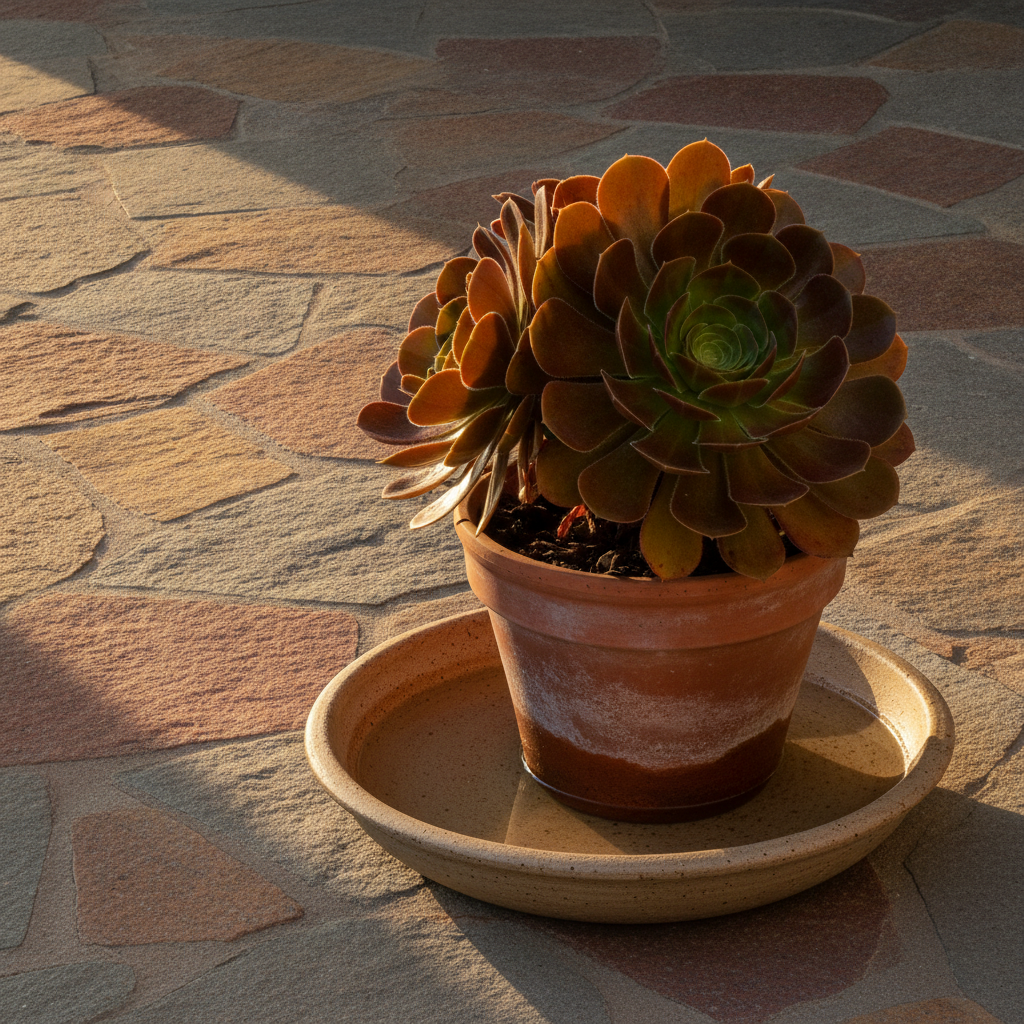
Watering a copper pinwheel well means matching your watering to its rhythm rather than to a fixed calendar. As a leaf and stem succulent it holds substantial water reserves, so the cardinal rule is to water thoroughly but infrequently, letting the potting mix dry out almost completely between drinks. Overwatering, especially during the summer rest, is by far the most common way to kill this plant.
When to Water
During active growth from autumn to spring, water when the top few centimetres of the mix have dried out, which in practice often means roughly once a week to once a fortnight depending on your home and pot. The leaves are the best guide: plump, firm leaves mean the plant is well hydrated, while leaves that begin to feel slightly soft or look a little wrinkled signal it is ready for a drink.
Through the summer dormancy the picture reverses. Growth slows or stops, the roots take up far less moisture, and watering on the old schedule quickly leads to rot. Cut back to an occasional light watering every three to four weeks, just enough to stop the plant shrivelling, and let the mix stay dry for longer stretches. A rosette that curls its outer leaves inward in summer is conserving water, not begging for it.
Pro Tip — Water the Soil, Not the Crown: Water sitting in the centre of the flat rosette can trigger crown rot, particularly in cool or dim conditions. Direct water at the soil surface or bottom-water in a tray, and if water does pool in the crown, tip the pot gently to drain it or dab it out with a tissue.
How to Water Correctly
- Check that the mix is dry by pushing a finger a few centimetres into the pot or lifting it to feel its weight; water only when it is light and dry.
- Water at the soil surface, or stand the pot in a shallow dish of water, avoiding the crown of the rosette.
- Let the plant drink until water runs freely from the drainage holes, ensuring the whole root ball is moistened.
- Allow the pot to drain completely and never leave it standing in a saucer of water.
- Wait until the mix has dried out almost entirely before watering again, extending the interval considerably in summer.
Signs of Overwatering vs. Underwatering
| Symptom | Overwatering | Underwatering |
|---|---|---|
| Leaf colour | Yellowing, translucent or blackening leaves | Duller colour, edges may brown and crisp |
| Leaf texture | Soft, mushy, water-soaked to the touch | Thin, wrinkled, flexible and deflated |
| Soil | Stays wet for many days, may smell sour | Bone dry, pulling away from the pot sides |
| Roots and stem | Blackened, soft stem base and rotting roots | Roots dry and intact, base still firm |
| Overall habit | Collapsing rosette, leaves dropping at a touch | Lower leaves shrivelling, rosette tightening |
Warning — Root Rot: A soft, darkening stem base is the most dangerous sign, because root and stem rot can spread fast and kill the plant. If you catch it early, cut away all the mushy tissue with a clean blade, let the healthy portion callus for several days, and re-root it as a fresh cutting; the original roots are often beyond saving.
Humidity Requirements
The copper pinwheel is thoroughly at home in ordinary, even dry, household air. Coming from breezy Canary Island slopes, it has no need for the raised humidity that tropical foliage plants demand, and typical indoor levels of 30 to 50 per cent suit it perfectly.
Problems from humidity, when they occur, come from too much rather than too little. Stagnant, damp air around the plant encourages fungal issues and rot, so good airflow matters more than any effort to raise moisture levels. There is no need to mist this plant, and misting the crown can in fact do harm by leaving water trapped among the leaves.
If anything, aim to keep the air moving. A room that gets an occasional airing, or a gentle fan in a stuffy space, does more good for a copper pinwheel than any humidity tray. Reserve extra care for winter, when cold windowsills combined with damp compost are the classic recipe for rot.
Water Quality
The copper pinwheel is not fussy about water quality and tolerates ordinary tap water in most areas. In regions with very hard water you may see a little mineral crust on the soil surface or pot rim over time; if that bothers you, or if your water is heavily softened, occasional use of rainwater or filtered water keeps things clean. Let cold tap water come up to room temperature before using it, as a shock of cold water on the roots is best avoided.
Soil, Potting & Repotting
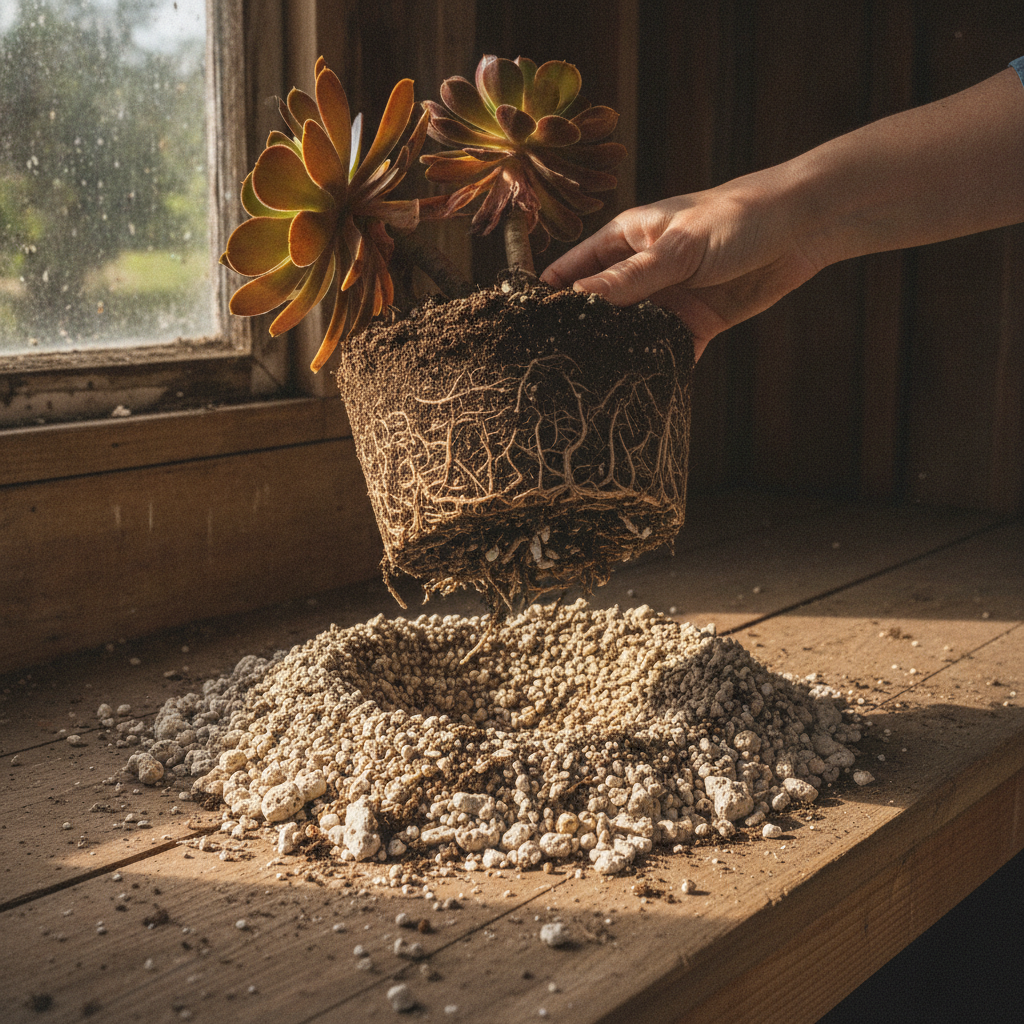
Everything about growing a copper pinwheel well comes back to drainage. In the wild its roots run through loose volcanic grit that never stays wet, and the closer you can come to that free-draining, airy character in a pot, the healthier the plant will be. A dense, moisture-retentive compost is the fastest route to root rot.
Ideal Soil Composition
A good copper pinwheel mix combines a base of standard potting compost for a little moisture and nutrition with a generous proportion of gritty, inorganic material to open it up and speed drainage. The aim is a substrate that wets through when you water but dries out within a few days rather than staying soggy.
| Component | Proportion | Function |
|---|---|---|
| Potting compost or coir | Around one third | Holds a little moisture and nutrients, gives structure |
| Perlite or pumice | Around one third | Creates air pockets and speeds drainage |
| Coarse grit or sharp sand | Around one third | Adds weight and mimics volcanic soils, prevents compaction |
| Optional fine bark | A small handful | Improves aeration and structure over time |
The copper pinwheel prefers a neutral to slightly acidic root zone, roughly pH 6.0 to 7.0, which most peat-free and standard composts fall within naturally. Precise pH management is rarely necessary; getting the drainage right matters far more than fine-tuning acidity.
Pro Tip — Quick Mix Recipe: For an easy blend, combine two parts of a bagged cactus and succulent compost with one part perlite or pumice. It takes two minutes to mix and gives the open, fast-draining structure the copper pinwheel needs without hunting down specialist ingredients.
Choosing the Right Pot
The pot you choose has as much influence on watering success as the mix itself, because it controls how quickly the root zone dries and how much room the roots have to sit in damp compost.
Drainage holes are non-negotiable. The copper pinwheel must never sit in standing water, so a pot with one or more open drainage holes is essential. Decorative cachepots without holes are fine as an outer cover only if you lift the plant out to water and let it drain fully before returning it.
Pot material: Terracotta is the ideal material for this plant. Its porous walls wick moisture out of the mix and let it dry faster, which suits a succulent that hates wet feet. Glazed ceramic and plastic hold moisture longer, so if you use them, lean even harder on a gritty mix and water more cautiously.
Pot size: Choose a pot only slightly larger than the root ball. A shallow, wide pot suits the plant’s flat rosette and modest, shallow root system better than a deep one, and an oversized pot holds a reservoir of damp compost around the roots that invites rot.
When to Repot
Copper pinwheels are slow, undemanding growers that dislike frequent disturbance, so repot only every two to three years or when the plant has clearly outgrown its pot. Signs it is time include roots emerging from the drainage holes, the rosette overhanging the pot rim, or a mix that has broken down and no longer drains freely. The best moment is early autumn, at the start of the active growing season, so the plant can settle in and root out while it is growing rather than dormant.
How to Repot: Step-by-Step
- Water lightly a day or two beforehand so the root ball holds together, then let the surface dry.
- Ease the plant out by tipping the pot and supporting the stem near the base rather than pulling on the rosette.
- Gently tease away old, spent compost from the roots and inspect them, trimming any that are black or mushy with a clean blade.
- Part-fill a clean pot with fresh gritty mix and set the plant at the same depth it grew before, never burying the lower leaves.
- Fill around the root ball with more mix, firming it lightly so the plant sits stable without being packed hard.
- Hold off watering for a week to let any disturbed or trimmed roots callus and heal, then resume normal watering.
Warning — Transplant Shock: Repotting into damp compost and watering straight away is the most common cause of post-repot rot in aeoniums. Always repot into dry or barely moist mix and wait several days before the first watering, giving nicked roots time to seal over.
Fertilising
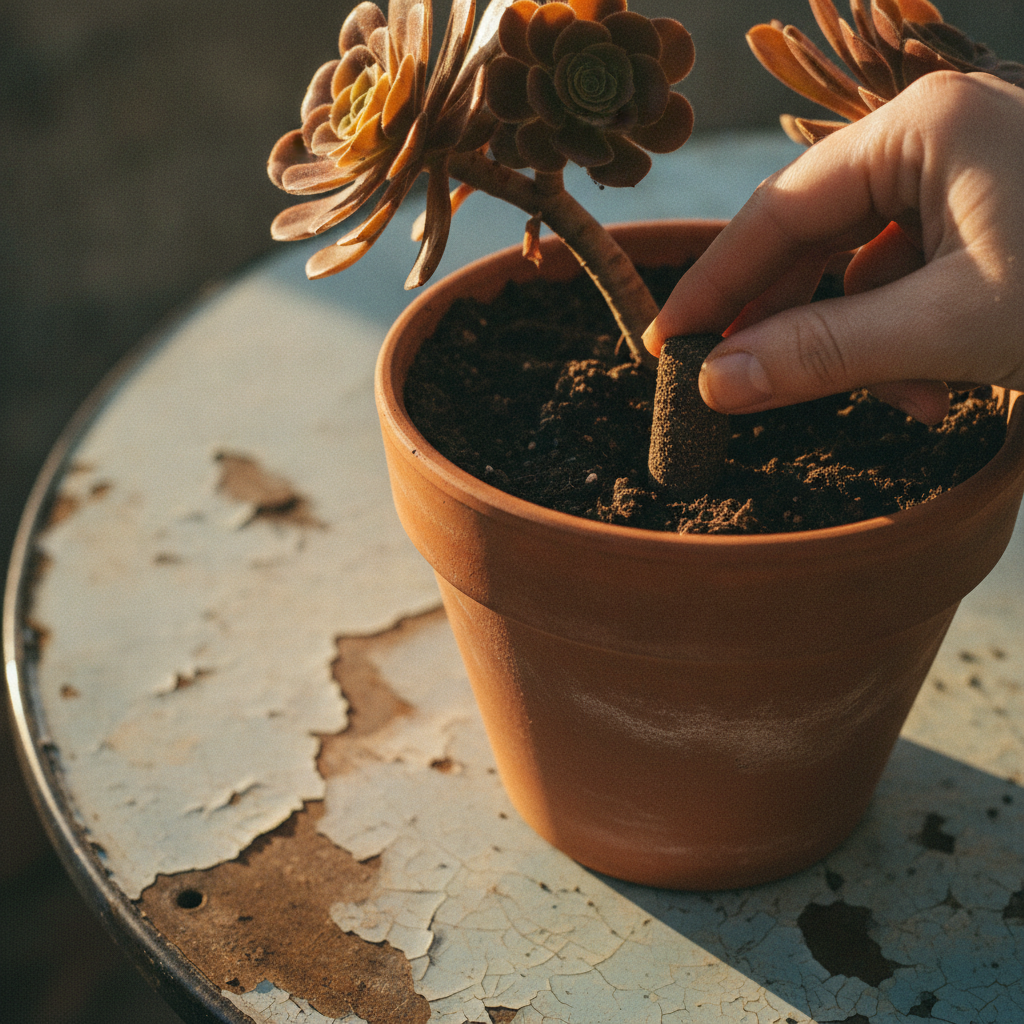
The copper pinwheel is a light feeder that grows perfectly well on very little supplementary nutrition. In its native rocky habitat it draws modest resources from thin volcanic soils, and in a pot it needs only a gentle top-up during its active season to keep the rosette full and healthy.
The timing of feeding matters more than the quantity. Because this is a winter grower, it should be fed through autumn, winter and spring, and left entirely unfed during its summer dormancy when it cannot use the nutrients and excess feed simply builds up as harmful salts in the compost.
Understanding Plant Nutrients
Plant fertilisers are described by their ratio of the three main nutrients, nitrogen, phosphorus and potassium, shown on the label as N-P-K. For a copper pinwheel a balanced or slightly low-nitrogen formula is best, because too much nitrogen drives soft, stretched growth at the expense of the compact form and rich colour you are aiming for. The table below summarises the roles of the key nutrients.
| Nutrient | Symbol | Primary Function | Deficiency Symptoms |
|---|---|---|---|
| Nitrogen | N | Leaf and stem growth | Pale, weak new growth, older leaves yellowing |
| Phosphorus | P | Root development and flowering | Poor roots, stunted, sometimes reddish growth |
| Potassium | K | Overall vigour and stress resistance | Yellow or browning leaf edges, weak plant |
| Calcium | Ca | Cell wall strength | Distorted or dying new growth |
| Magnesium | Mg | Core of the chlorophyll molecule | Yellowing between the veins of older leaves |
| Iron | Fe | Chlorophyll formation | Yellowing between veins on new leaves |
Types of Fertiliser
Liquid fertilisers: The easiest choice for a copper pinwheel, giving you full control over timing and strength. A liquid succulent or cactus feed, diluted to half the recommended rate, is ideal and lets you stop the moment dormancy begins.
Slow-release granular: Convenient but harder to control, as granules keep releasing nutrients on their own schedule regardless of the plant’s season. If you use them, apply at a light rate in autumn and avoid topping up before summer.
Organic fertilisers: Gentle options such as diluted worm-casting tea release nutrients slowly and are hard to overdo, which suits a plant this undemanding. They provide a mild, steady supply that pairs well with a gritty succulent mix.
Feeding Schedule
Feed roughly once a month with a half-strength diluted feed during the active growing months from early autumn through to late spring. Stop feeding entirely as summer approaches and the plant enters dormancy, resuming only when cooler weather and fresh growth signal that the new season has begun. A newly repotted plant in fresh compost needs no feeding for the first couple of months, as the new mix already carries enough nutrition.
Pro Tip — Less Is More: When in doubt, underfeed. A copper pinwheel kept slightly lean stays compact, firm and richly coloured, whereas an overfed one turns soft, green and floppy. Half-strength feed given occasionally always beats full-strength feed given often.
How to Fertilise
- Dilute a succulent or balanced liquid feed to half the strength stated on the bottle.
- Water the plant with plain water first if the mix is bone dry, to avoid feeding onto parched roots.
- Apply the diluted feed to the soil, keeping it off the leaves and out of the crown.
- Let the pot drain fully and never leave feed-laden water standing in the saucer.
- Flush the pot with plain water every few months to wash out any accumulated mineral salts.
Warning — Salt Build-Up: Feeding through summer dormancy, or feeding at full strength, lets fertiliser salts accumulate in the mix and scorch the roots, showing up as browned, crisping leaf tips. If you see a white crust on the soil or pot, flush the pot thoroughly with plain water several times to leach the salts away.
Propagation
Propagating a copper pinwheel calls for a slightly different approach from the branching aeoniums, because Aeonium nobile grows as a solitary rosette and rarely produces the side offsets that make its cousins so easy to multiply. That does not make it difficult, only a matter of using the right method.
The two reliable routes are stem cuttings, taken by removing the rosette with a length of stem, and seed, which is how the species naturally reproduces. Unlike echeverias and some other succulents, aeoniums generally will not grow from a single detached leaf, so leaf propagation is not worth attempting with this plant.
Understanding the Rosette and Stem
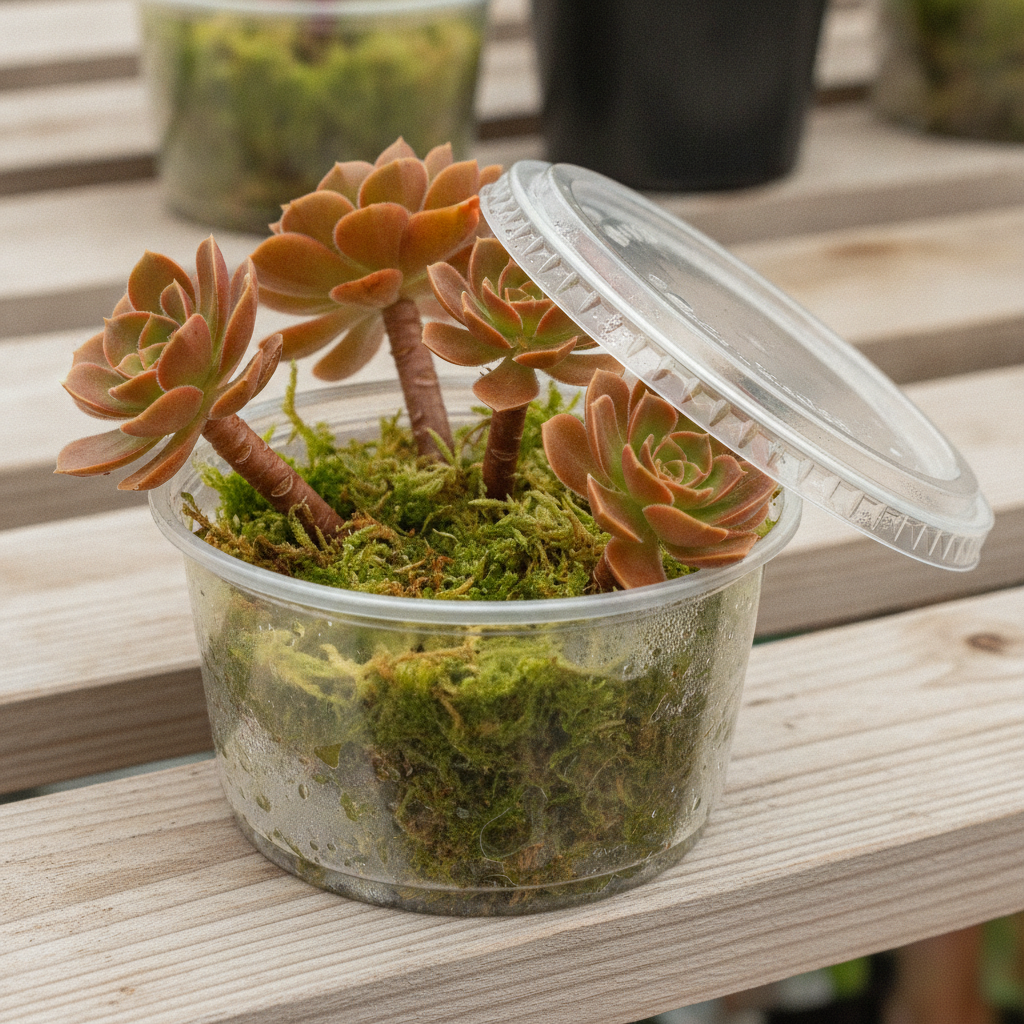
The key to propagating this plant is understanding that new roots form along the stem, not from the leaves. When you take a cutting you are really taking the whole rosette together with a section of stem, and it is that cut stem, once healed, that pushes out fresh roots. A cut surface that is allowed to dry and callus over first will root cleanly, whereas a fresh wet wound pushed straight into damp mix is likely to rot before it roots.
Stem Cuttings: Step-by-Step
Stem cuttings are the fastest and most dependable way to make a new copper pinwheel, and taking one from a plant that has begun to develop a stem also encourages the parent, in some cases, to branch from below the cut. Work at the start of the growing season for the quickest results.
- Using a clean, sharp knife, cut the rosette off with 3 to 5 centimetres (1 to 2 inches) of stem attached.
- Strip off the lowest few leaves to expose a clean length of stem for rooting.
- Set the cutting aside in a dry, shaded spot for several days to a week until the cut end forms a dry callus.
- Insert the callused stem into barely moist gritty mix or damp sphagnum moss, deep enough to hold the rosette upright.
- Keep it in bright, indirect light and mist the mix only lightly every few days rather than soaking it.
- After two to four weeks, roots should form; test with a gentle tug, and once anchored, begin normal watering.
Pro Tip — Let It Callus: Patience at the callusing stage is the single biggest factor in success. A cut left to dry for a week roots far more reliably than one planted the same day, because the sealed wound resists the rot that claims most failed cuttings.
Growing from Seed: Step-by-Step
Seed is the natural method and the only practical way to raise many plants at once, though it asks for more time and patience. It is also the route you will need if a treasured rosette has flowered, since flowering signals the end of that individual rosette’s life.
- Sow the fine seed thinly on the surface of a moist, well-draining seed mix and do not bury it, as light aids germination.
- Cover the tray with a clear lid or bag to hold humidity and place it in bright, indirect light.
- Keep the surface lightly moist and warm, around 18 to 22°C (64 to 72°F), until seedlings appear over one to several weeks.
- Once seedlings show, gradually ventilate to lower the humidity and prevent damping off.
- Prick out and pot on the young rosettes individually once they are large enough to handle safely.
Troubleshooting Propagation
| Problem | Likely Cause | Solution |
|---|---|---|
| Cutting rots at the base | Planted before callusing or kept too wet | Let cuttings dry a week first and keep the mix barely moist |
| No roots after many weeks | Taken during dormancy or too cold | Propagate in the autumn-to-spring growing season in warmth |
| Cutting shrivels away | Too dry or too much direct sun | Give bright indirect light and mist the mix lightly |
| Seeds fail to germinate | Seed buried, or surface dried out | Surface-sow and keep humidity high until sprouting |
Pests & Diseases
A healthy copper pinwheel grown in bright light with careful watering is largely trouble-free, and most problems that arise can be traced back to overwatering rather than to any pest. Even so, a few sap-sucking insects find their way onto aeoniums indoors, and knowing what to look for lets you deal with them early.
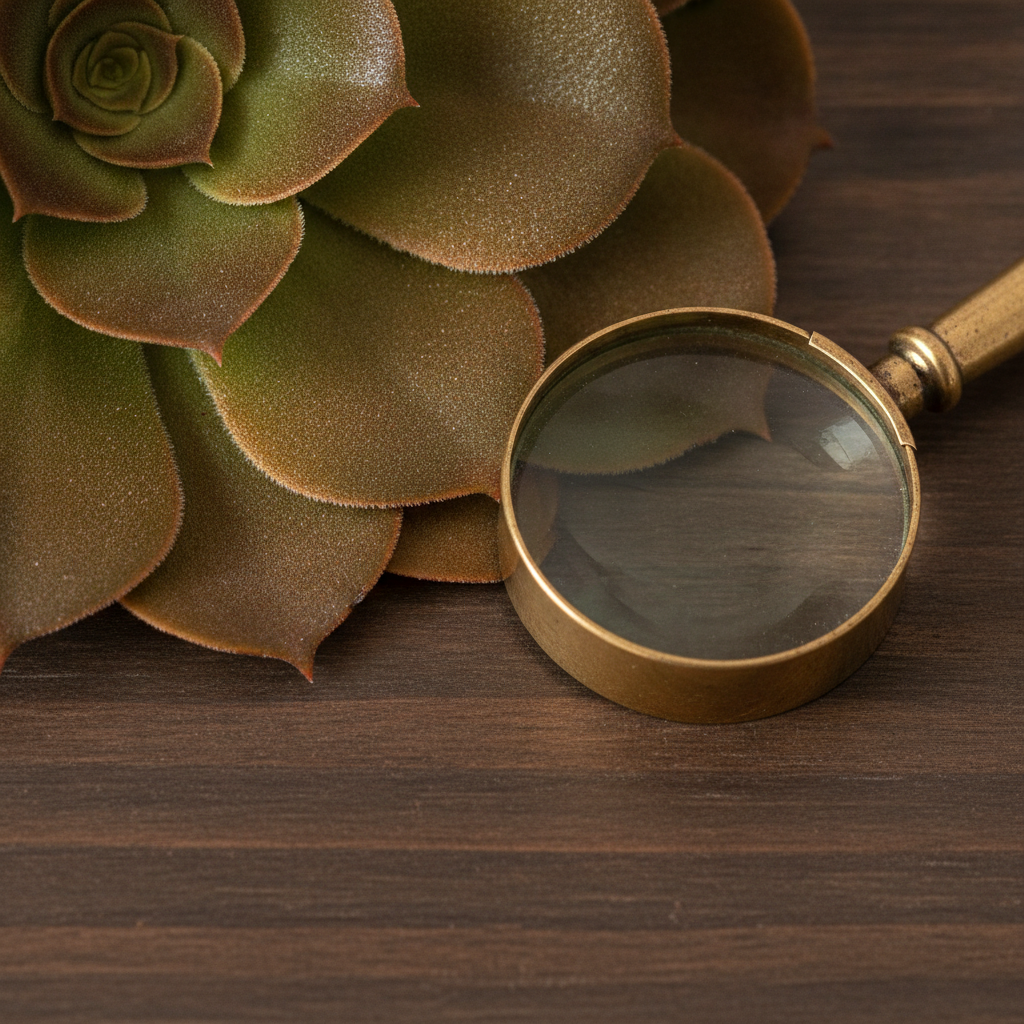
Regular inspection is the best defence. Because the leaves are broad and the rosette flat, pests have plenty of sheltered nooks in the leaf axils and crown, so run an eye over the plant whenever you water and act at the first sign of trouble.
Common Pests
Mealybugs (Pseudococcus species)
The most frequent pest of aeoniums, mealybugs appear as small, soft, white cottony blobs tucked into the leaf axils and the crown of the rosette. They suck sap, weaken the plant and leave a sticky residue that can turn into sooty mould.
Treatment: Dab each insect with a cotton bud dipped in isopropyl alcohol, then treat the whole plant with an insecticidal soap or diluted neem oil, repeating weekly until they are gone. Check nearby plants, as mealybugs spread easily.
Aphids (Aphidoidea)
Aphids are especially drawn to the tender flower stalks, should a rosette bloom, clustering in numbers on the soft new growth and secreting sticky honeydew. On the foliage itself they are less common but can still colonise fresh leaves.
Treatment: Rinse them off with a jet of water or wipe them away, then apply insecticidal soap to any that remain. A developing flower stalk is worth checking often, as aphid numbers can build up quickly there.
Vine weevil (Otiorhynchus sulcatus)
The real danger with vine weevil is underground, where the plump white grubs eat the roots and can hollow out the base of the plant before you notice anything above the soil. A rosette that suddenly wilts or topples despite correct watering may have lost its roots to grubs.
Treatment: Tip the plant out and check the root ball for the C-shaped grubs, removing any you find. Repot into fresh mix and, where infestations recur, a biological nematode drench applied to the compost gives effective control.
Fungus gnats (Sciaridae)
Small dark flies drifting around the pot are a sign the compost is being kept too wet, as their larvae live in damp soil and feed on organic matter and tender roots. They are more a symptom of overwatering than a serious pest in their own right.
Treatment: Let the mix dry out much more thoroughly between waterings, which alone usually breaks their cycle, and use yellow sticky traps to catch the adults. A gritty top dressing also discourages egg-laying.
Common Diseases
Root and stem rot (Pythium and Phytophthora)
By far the most serious threat to a copper pinwheel, rot sets in when the roots or stem base sit in cold, wet compost for too long. It shows as a softening, blackening stem and a rosette that loses firmness and may collapse, and it can move fast once established.
Treatment: Act at once by cutting away every trace of soft, discoloured tissue with a clean blade, then let the healthy top callus and re-root it as a fresh cutting. Improve drainage and cut back watering to prevent a repeat.
Crown rot (Botrytis and related fungi)
Water trapped in the centre of the flat rosette, especially in cool or poorly ventilated conditions, can rot the crown where the newest leaves emerge. The heart of the rosette turns brown and mushy while the outer leaves may still look sound.
Treatment: Remove affected leaves, keep water out of the crown in future, and improve airflow around the plant. In mild cases the rosette recovers once the centre is allowed to dry out completely.
Pest and Disease Summary
| Pest / Disease | Identification | Treatment |
|---|---|---|
| Mealybugs | White cottony clusters in leaf axils and crown | Alcohol swab, then insecticidal soap or neem, repeated |
| Aphids | Small green or black insects on soft new growth and flower stalks | Rinse off and apply insecticidal soap |
| Vine weevil | Wilting plant, C-shaped white grubs in the roots | Remove grubs, repot, apply nematodes if recurring |
| Fungus gnats | Small dark flies around a wet pot | Dry out the mix, use sticky traps and a grit top dressing |
| Root and stem rot | Soft, blackening stem base and collapsing rosette | Cut back to healthy tissue, callus and re-root |
| Crown rot | Brown, mushy centre of the rosette | Remove affected leaves, keep the crown dry, improve airflow |
Prevention Strategies
Prevention with this plant comes down to the same handful of habits that keep any succulent healthy: bright light, a fast-draining mix, careful watering that respects the summer rest, and good airflow. A copper pinwheel grown that way rarely troubles its owner with either pests or disease, because a firm, unstressed plant is far less inviting to sap-suckers and far more resistant to rot.
Quarantine any new plant for a couple of weeks before it joins your collection, inspect the crown and leaf axils each time you water, and deal with the first stray mealybug before it becomes a colony. Keeping the surrounding area clean of dropped leaves and spent flowers also removes the damp hiding places that pests and fungi favour.
Pro Tip — Isolate and Inspect: When you spot a pest, move the plant away from its neighbours straight away. The flat, sheltered rosette of a copper pinwheel makes it easy for mealybugs to hop to nearby succulents, and early isolation often saves a whole shelf from an outbreak.
Popular Varieties
Unlike the heavily bred branching aeoniums, the copper pinwheel is grown largely as the true species, and there are few named cultivars of Aeonium nobile itself. What you will encounter instead are different growing forms of the species, shaped by light and season, alongside a handful of closely related aeoniums that make natural companions on the same sunny shelf.
The table below sets out the species and its common forms together with a few kindred aeoniums often sold and grown beside it, so you can see at a glance how they compare in appearance and needs.
| Variety | Leaf Appearance | Light Needs | Growth Rate | Availability |
|---|---|---|---|---|
| Copper pinwheel (species) | Large flat rosette, green flushing coppery-red | Very bright, some direct sun | Slow | Specialist growers |
| Green shade form | Apple-green with only faint coppery tips | Bright indirect to some sun | Slow | Specialist growers |
| Sun-stressed copper form | Deep coppery-red and bronze across the whole leaf | Full sun | Slow | Specialist growers |
| Aeonium ‘Cyclops’ | Large red-bronze rosette with a green centre, a nobile hybrid | Full sun | Moderate | Common |
| Aeonium arboreum ‘Zwartkop’ | Near-black glossy branching rosettes | Full sun | Moderate | Very common |
| Aeonium ‘Kiwi’ | Small tricolour rosettes of cream, green and red | Bright indirect to sun | Fast | Very common |
Featured Varieties
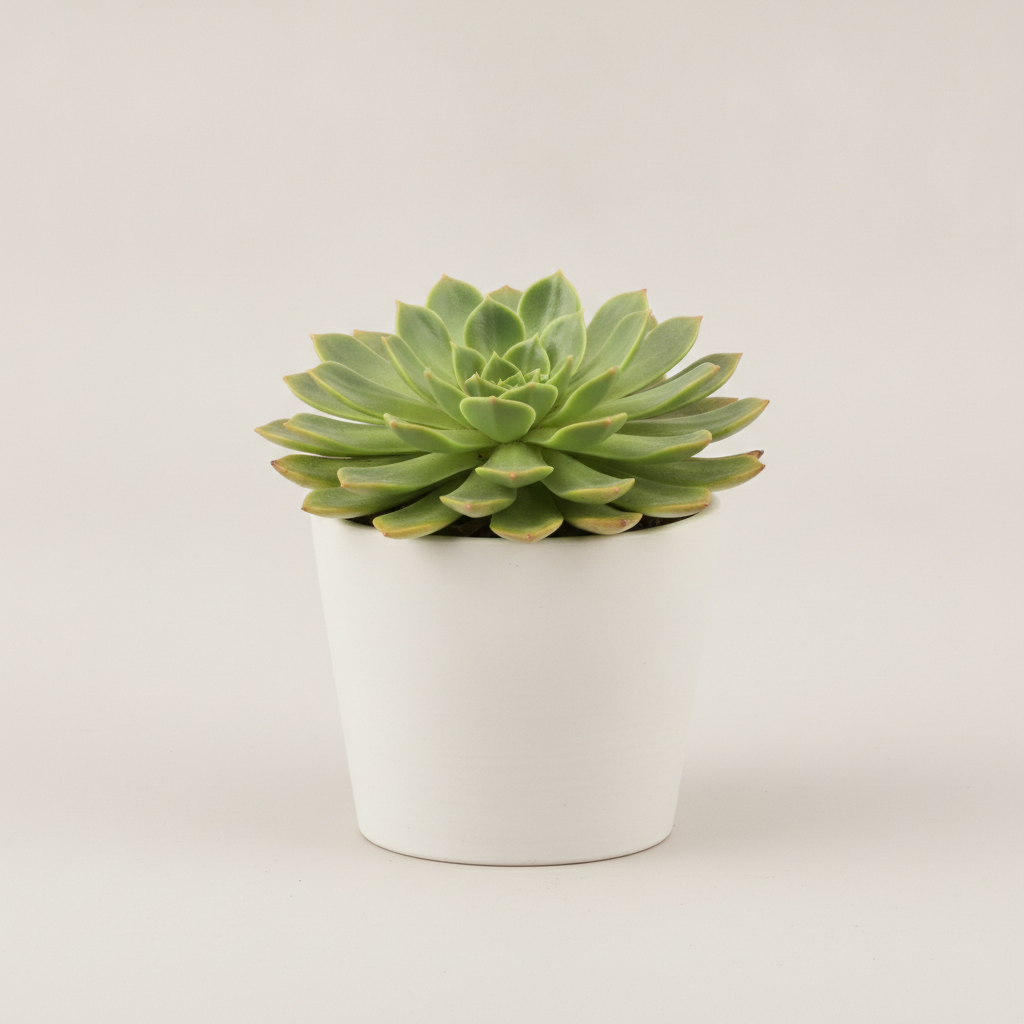
Green Shade Form
Grown in gentler light, the copper pinwheel keeps a fresh apple-green rosette with only a hint of copper at the leaf tips. It is the same plant simply expressing less pigment, and moving it into stronger sun will gradually bring the warmer colours through.
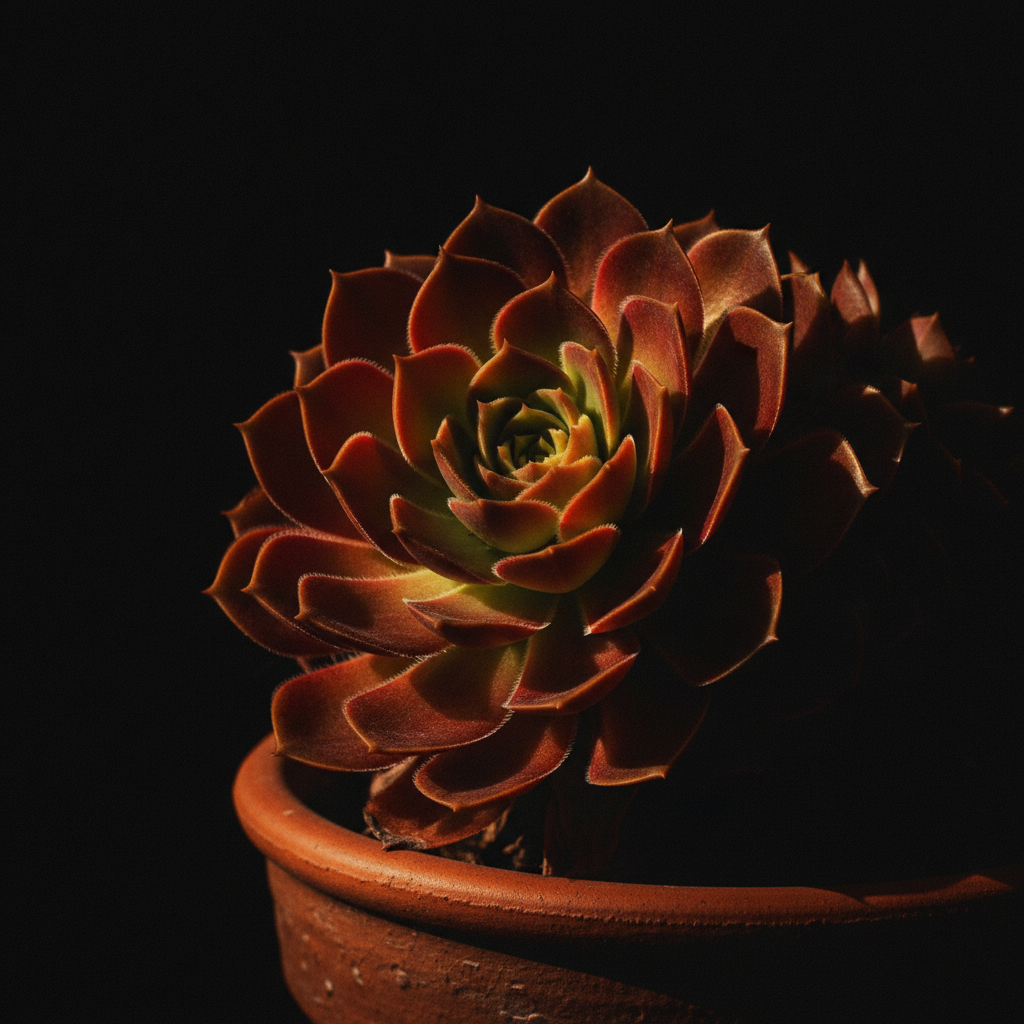
Sun-Stressed Copper Form
Given full sun and a touch of cool-season stress, the rosette flushes a deep coppery-red and bronze across the entire leaf surface. This is the look that gives the plant its name, and it is achieved through light and conditions rather than any special cultivar.
Variety Profiles in Detail
Copper Pinwheel (Aeonium nobile)
The true species is the star of this guide: a large, solitary, flat rosette on a short thick stem, with broad fleshy leaves and a distinctive tacky surface. It is slower and less widely available than the branching aeoniums but unmatched for the scale and drama of a single rosette, and it is famous among enthusiasts for the huge dome of red flowers it produces at the end of its life.
Aeonium ‘Cyclops’ (Aeonium ‘Cyclops’)
A vigorous hybrid derived in part from Aeonium nobile, ‘Cyclops’ offers much of the copper pinwheel’s size and colour with a faster, more forgiving habit. Its large rosettes glow red-bronze with a bright green eye at the centre, making it a popular and more readily available stand-in for gardeners drawn to the species but wanting something easier to grow.
Aeonium ‘Zwartkop’ (Aeonium arboreum ‘Zwartkop’)
Though very different in habit, the near-black ‘Zwartkop’ is one of the copper pinwheel’s most striking companions, branching into tall stems each topped with a glossy dark rosette. Placed beside the coppery, ground-hugging nobile it makes a bold contrast of colour and form on a sunny sill.
Choosing the Right Variety for Your Space
If you want the full drama of a single large coppery rosette and can offer a bright, sunny position, the true species is worth seeking out, accepting that it grows slowly and eventually flowers and dies. For a similar effect with more speed and easier availability, the hybrid ‘Cyclops’ is an excellent choice, while gardeners who prefer a clustering plant that multiplies freely may be happier with a branching aeonium such as ‘Zwartkop’ or ‘Kiwi’. Whichever you choose, the care described in this guide applies across the genus: bright light, a gritty pot, restrained watering and respect for the summer rest.
Frequently Asked Questions
Why is my copper pinwheel losing its lower leaves in summer?
Shedding some lower leaves through summer is normal behaviour for this and most aeoniums. As the plant enters its summer dormancy it draws resources from the oldest outer leaves, which shrivel and drop, and the rosette may curl inward to conserve water. Provided the centre stays firm and healthy, there is nothing wrong; simply water sparingly and wait for growth to resume in autumn.
My rosette is stretching and turning green. What went wrong?
Stretching, known as etiolation, together with a loss of the coppery colour, is a clear sign of insufficient light. The plant is reaching for a brighter source and producing more chlorophyll to cope. Move it to your sunniest window or add a grow light, and while the already stretched growth will not shorten again, new growth will come in tighter and more colourful.
How often should I water a copper pinwheel?
There is no fixed schedule, because it depends on the season, your home and your pot. In the active autumn-to-spring growing period, water thoroughly whenever the mix has dried out, often every week or two. In summer dormancy, cut right back to a light watering every three to four weeks. Always let the leaves and the dryness of the mix guide you rather than the calendar.
Is the copper pinwheel safe for cats and dogs?
Aeoniums, including the copper pinwheel, are generally considered non-toxic to cats and dogs, which sets them apart from many common houseplants. That said, no plant is meant to be eaten, and the sticky sap can cause mild stomach upset if chewed, so it is still sensible to discourage pets from nibbling on the leaves.
My plant is flowering. Is that a good sign?
A flowering copper pinwheel is a spectacular but bittersweet event. The species is monocarpic, so a rosette that produces its large dome of red flowers will set seed and then die, as flowering marks the end of that rosette’s life. Enjoy the display, collect seed if you wish to raise more, and take a stem cutting beforehand if you want to be sure of keeping the plant going.
Can I grow a copper pinwheel outdoors?
In a frost-free climate, roughly USDA zones 9b to 11, it grows happily outdoors in a bright, well-drained spot, and many growers move potted plants outside for the milder months elsewhere. It is not frost hardy, however, so where winters drop below about 4°C (39°F) it must come indoors or into a frost-free greenhouse before the cold sets in.
Why does the plant feel sticky?
The faintly tacky, resinous surface of the leaves is a natural feature of Aeonium nobile and one of the traits that distinguishes it from other aeoniums. It is nothing to worry about. If the stickiness is instead accompanied by a shiny film on the leaves and nearby surfaces, however, check for sap-sucking pests such as aphids or mealybugs, whose honeydew produces a similar feel.
How big does a copper pinwheel get?
A mature rosette can reach around 40 to 50 centimetres (16 to 20 inches) across, which is large for a single aeonium rosette, sitting on a short, thickened stem. Growth is slow, so it takes several years to reach full size, and its flat, spreading form makes it better suited to a wide, shallow pot than a tall one.






