
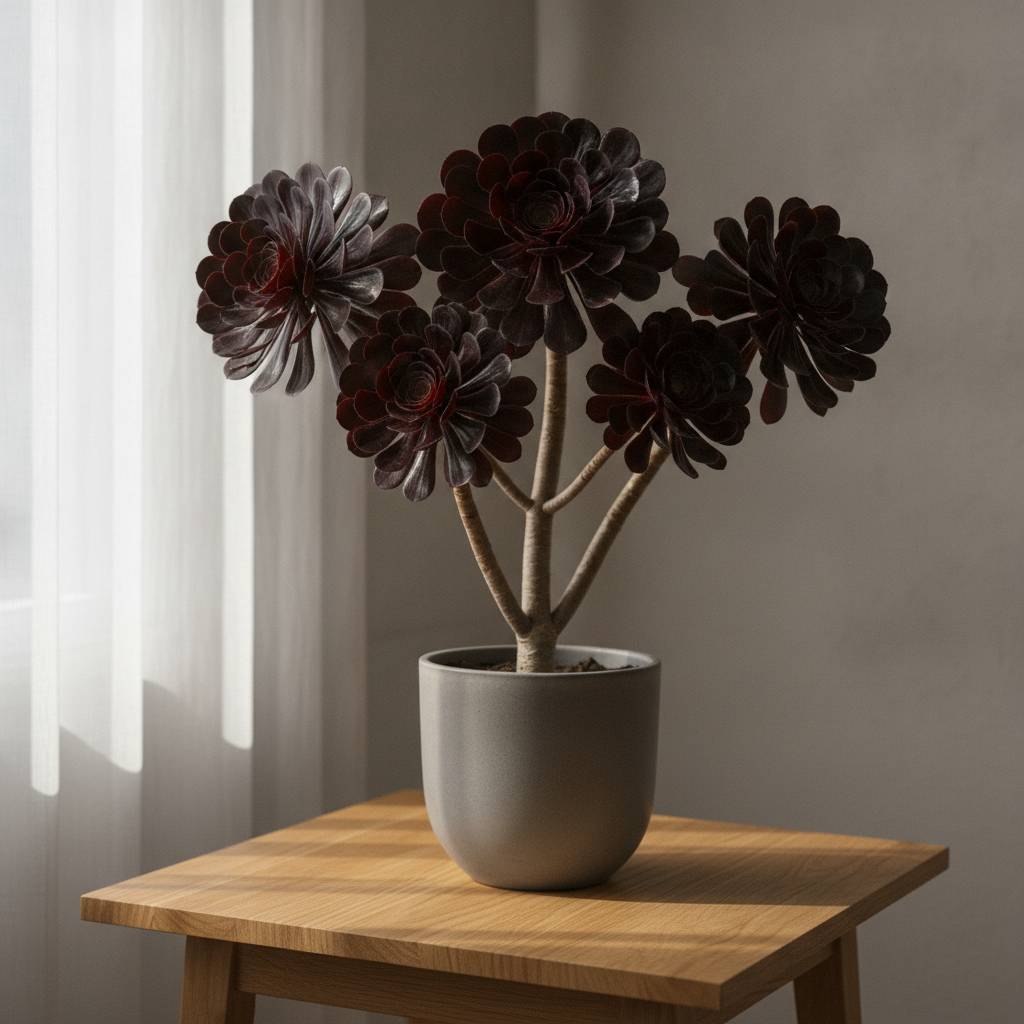
Few houseplants make a statement quite like the black rose aeonium, a branching succulent crowned with glossy rosettes so deeply pigmented they read as black against a sunlit wall. Known botanically as Aeonium arboreum in its dark cultivar form ‘Zwartkop’, a Dutch name meaning “black head”, it belongs to a genus of tree-like succulents native to the Canary Islands, where they cling to rocky coastal slopes in a mild, frost-free maritime climate. The saturated colour is not a trick of the light but a response to it: the leaves flood with purple-black anthocyanin pigment when grown in strong sun, fading to a leafy bronze-green in shade.
The black rose aeonium has a reputation as an easy succulent, and it largely earns it, but the plant runs on a calendar that catches many growers off guard. Unlike most houseplants, it is a winter grower that rests through the heat of summer, so the care that keeps it alive is almost the reverse of what instinct suggests. This guide covers everything that separates a merely surviving aeonium, leggy, pale and sulking, from one that thrives with tight, jewel-dark rosettes on sturdy stems: how much light it truly needs, how to water around its seasonal dormancy, the gritty soil it insists on, and how to turn one plant into many.
Contents
- Quick Reference
- Why Black Rose Aeonium Makes a Striking Houseplant
- Light Requirements
- Watering & Humidity
- Soil, Potting & Repotting
- Fertilising
- Propagation
- Pests & Diseases
- Popular Varieties
- Frequently Asked Questions
Quick Reference: Black Rose Aeonium at a Glance
| Light | Bright light with several hours of direct sun; the darkest colour develops in full sun |
| Watering | Water when the soil is dry in autumn to spring; keep nearly dry during summer rest |
| Temperature | 10 to 24 degrees Celsius (50 to 75 degrees Fahrenheit); protect from frost below 4 degrees Celsius (39 degrees Fahrenheit) |
| Humidity | Average household humidity; no misting needed and high humidity is a risk |
| Fertiliser | Dilute feed once a month during the autumn-to-spring growing season only |
| Toxicity | Generally considered non-toxic to cats and dogs; sap may cause mild skin or stomach irritation |
Why Black Rose Aeonium Makes a Striking Houseplant
The appeal of the black rose aeonium begins with its architecture. Each stem is topped with a flat, symmetrical rosette that can reach 15 to 20 centimetres (6 to 8 inches) across, the spoon-shaped leaves overlapping in a spiral so precise it looks turned on a lathe. As the plant matures it branches, so a single specimen can carry half a dozen dark rosettes at varying heights on bare, sculptural stems, giving it the silhouette of a miniature tree. In a bright window it holds a colour almost no other common houseplant can offer, a deep aubergine-black that throws the greens and greys of neighbouring plants into sharp relief.
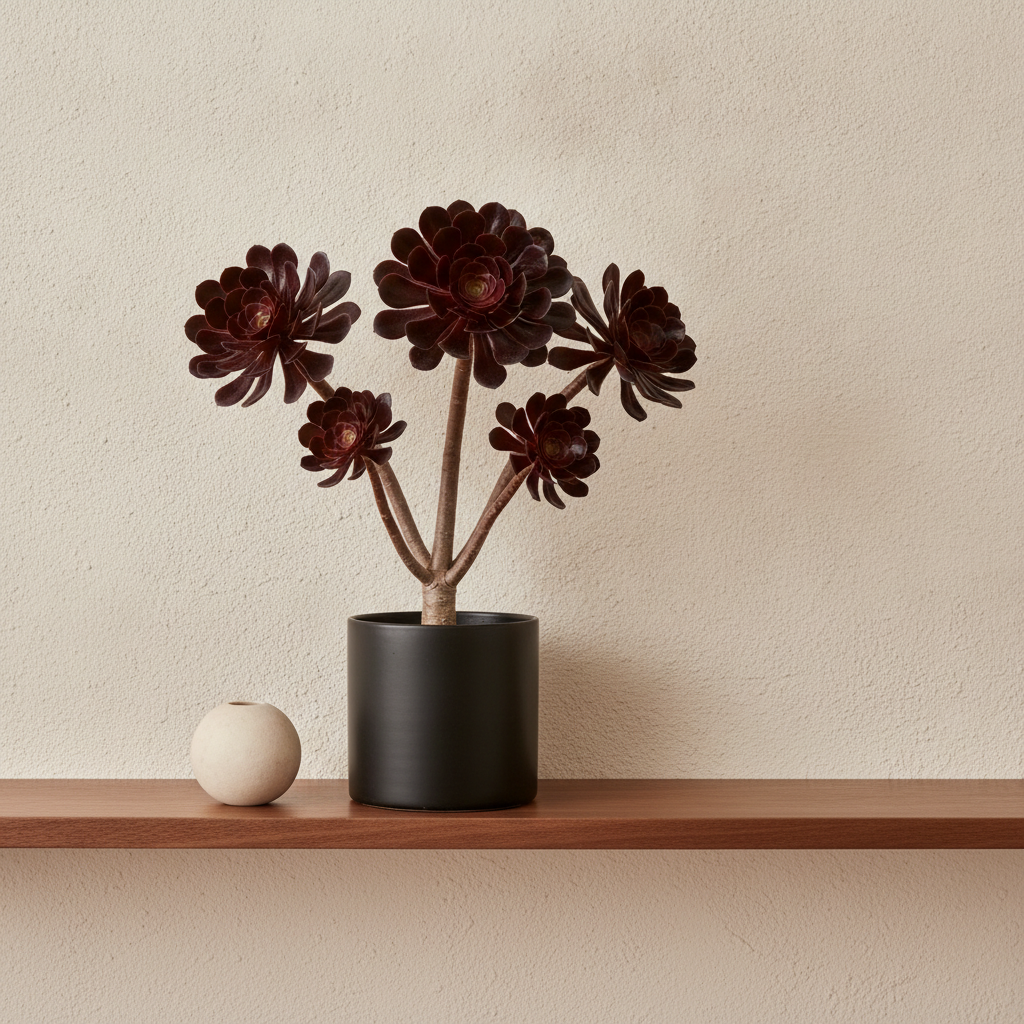
Beyond looks, it is a forgiving plant for anyone who tends to forget the watering can. As a succulent it stores moisture in its fleshy leaves and copes easily with a missed watering, and its winter-growing habit means it stays handsome through the darker months when many houseplants stall. The main adjustment for a new owner is mental rather than horticultural: learning to give the plant its brightest spot, to ease off water in high summer, and to accept that the occasional dropped lower leaf is normal housekeeping rather than a sign of trouble. Get those rhythms right and the black rose aeonium is among the most rewarding succulents you can grow indoors.
Important — Toxicity: Aeoniums are generally listed as non-toxic to cats and dogs, but the milky sap of the wider Crassulaceae and related succulents can cause mild mouth, stomach or skin irritation if chewed or handled heavily. Keep the plant out of reach of pets and children who might nibble it, and wash your hands after taking cuttings.
Light Requirements
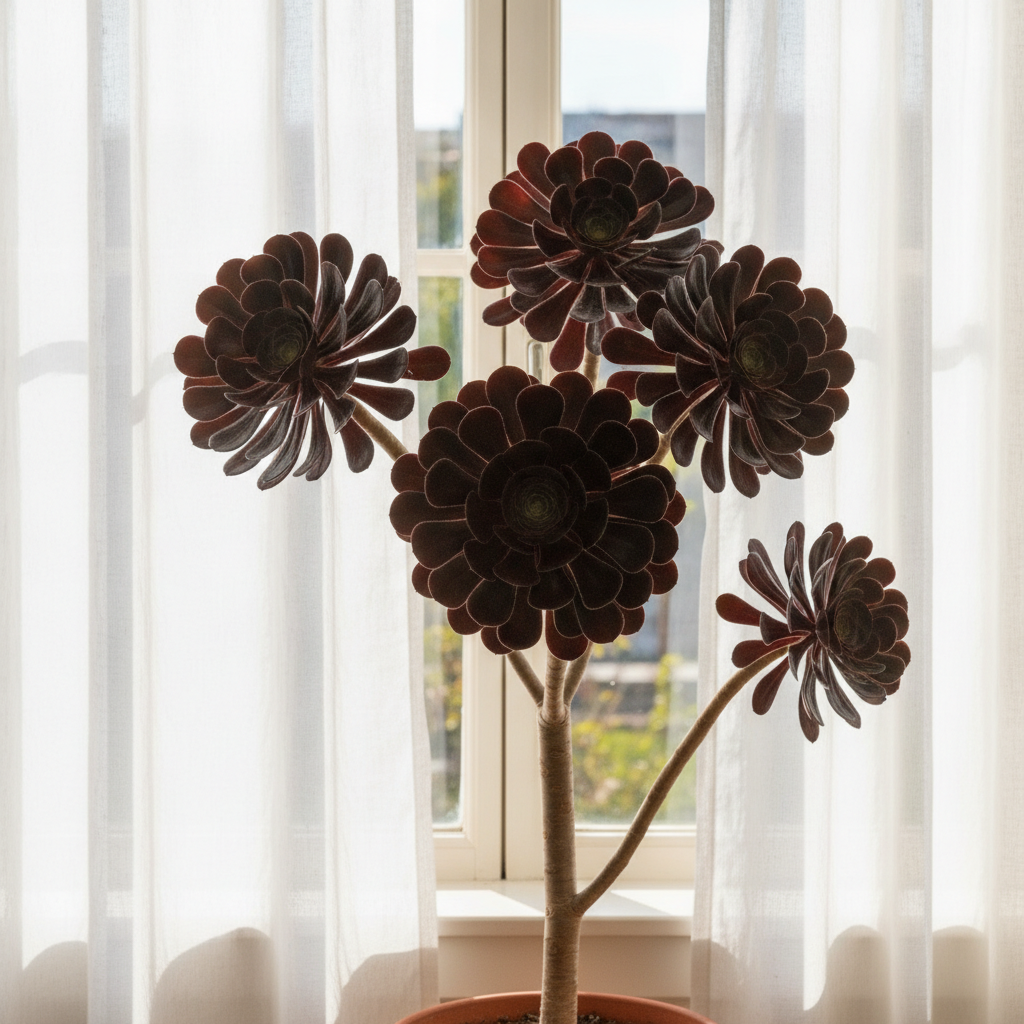
Light is the single most important factor in growing a good black rose aeonium, because light does not just power the plant, it creates the colour that makes the plant worth having. The dark pigment is anthocyanin, a sunscreen the leaves produce in response to strong light. Grow the plant in a dim corner and it will slowly turn a plain bronze-green, stretch towards the nearest window and open its rosettes into loose, floppy stars. Grow it in generous sun and the rosettes tighten, the stems stay stout, and the leaves deepen to their signature near-black.
Indoors, the ideal position is directly in front of the brightest window you have, where the plant can catch several hours of direct sun each day. A spot that also receives bright, uninterrupted daylight for the rest of the day will keep growth compact. This is one of the few houseplants that genuinely wants to be pressed right up against the glass rather than set back in the room.
Light Levels Explained
Understanding where your aeonium sits on the light scale helps you predict how it will behave. The table below translates the common light categories into what they mean for this particular succulent.
| Light Category | Approx. Level | Typical Location | Outcome |
|---|---|---|---|
| Full direct sun | Over 40,000 lux | Right at a south or west window, or outdoors in summer | Best colour, tightest rosettes, sturdy stems |
| Bright indirect | 15,000 to 40,000 lux | Just beside a bright window | Healthy but slightly greener, colour less intense |
| Medium | 5,000 to 15,000 lux | A metre or two back from a window | Stretching begins, rosettes loosen and lose colour |
| Low | 1,000 to 5,000 lux | North window or interior wall | Etiolation, pale bronze-green leaves, weak stems |
| Very low | Under 1,000 lux | Dim hallway or far corner | Decline over time; not sustainable |
Window Orientation and Placement
South-facing window: The best position in most homes, especially in the northern hemisphere. It delivers the long hours of strong light the plant needs for deep colour and compact growth. Acclimatise a new plant gradually to avoid scorch, but this is the aeonium’s happiest indoor home.
East-facing window: A good choice, offering bright, gentle morning sun. Colour may be slightly less intense than at a south window, but rosettes generally stay reasonably tight and the softer light carries little risk of scorch.
West-facing window: Also suitable, giving strong afternoon sun. The main thing to watch is heat build-up behind glass on hot summer afternoons, which can stress a plant that is already resting for the season.
North-facing window: Generally too dim for good colour. A black rose aeonium here will survive for a while but steadily green up, stretch and weaken. If a north window is your only option, plan to supplement with a grow light.
Pro Tip — Rotate for Even Growth: Aeoniums lean hard towards the light. Give the pot a quarter turn every few days so the rosettes stay symmetrical and the stems grow straight rather than curving towards the window.
How Light Affects Leaf Colour
The colour shift is fully reversible and worth understanding, because it is the clearest signal your plant sends about its light. In strong light the newest leaves emerge and darken to a purple-black, often keeping a small lime-green heart at the very centre of the rosette where the youngest leaves have not yet coloured. Move the plant somewhere dimmer and the next flush of growth will come in greener, the rosettes will widen and the spacing between leaves will increase. If you have inherited a pale, stretched plant, brighter light will not re-colour the existing leaves, but every new rosette from that point on will grow back dark and compact.
Warning — Direct Sunlight: Although this plant loves sun, a specimen grown indoors in low light can scorch if moved abruptly into fierce direct sun, developing pale or brown sunken patches. Introduce more light over a week or two, especially before moving a plant outdoors for summer.
Artificial Lighting
If natural light is limited, a full-spectrum LED grow light is an effective substitute and can maintain both compact growth and much of the dark colour. Position the light 20 to 30 centimetres (8 to 12 inches) above the rosettes and run it for around 10 to 12 hours a day. Because aeoniums do most of their growing in the cooler, darker half of the year, a grow light is particularly useful for carrying colour and form through a dim winter.
Seasonal Adjustments
The black rose aeonium grows actively in autumn, winter and spring and rests in summer, the opposite of most houseplants. During the growing months, give it every bit of light you can. In high summer, when the plant may pull its leaves inward into a tight protective cluster, easing it back from the most brutal afternoon glare can prevent unnecessary stress. As light levels fall in autumn, move the plant to your brightest window to fuel the coming growth spurt.
Watering & Humidity
Watering an aeonium correctly means working with its unusual seasonal rhythm rather than against it. These are succulents, so they store water in their leaves and resent constantly damp roots, but they are also thirstier than many desert succulents because their natural home is a mild, moist coastal climate rather than a true desert. The result is a plant that wants a proper drink when it is growing and near-drought when it is resting.
When to Water
During the autumn-to-spring growing season, water thoroughly once the top few centimetres of soil have dried out, then let the mix become nearly dry again before the next drink. In a bright, warm room this may mean watering every week to ten days, but always test the soil rather than following a fixed schedule. The leaves themselves are a useful gauge: plump, firm rosettes mean the plant is well hydrated, while leaves that feel soft or begin to wrinkle and curl signal thirst.
In summer the plant slows or stops, and its water needs drop sharply. Give only occasional light waterings, perhaps once every three or four weeks, just enough to stop the roots shrivelling and the lower leaves dropping en masse. Overwatering a dormant aeonium in hot weather is the single most common way to kill one, because the roots cannot use the moisture and quickly rot in the warm, wet soil.
Pro Tip — Read the Rosette: A little leaf curl and some shed lower leaves in summer are normal survival behaviour, not a cry for water. Resist the urge to soak a curled-up summer plant; wait for cooler autumn weather and it will relax and flush with new growth on its own.
How to Water Correctly
- Check that the soil is dry at least a few centimetres down and that the leaves are firm rather than swollen.
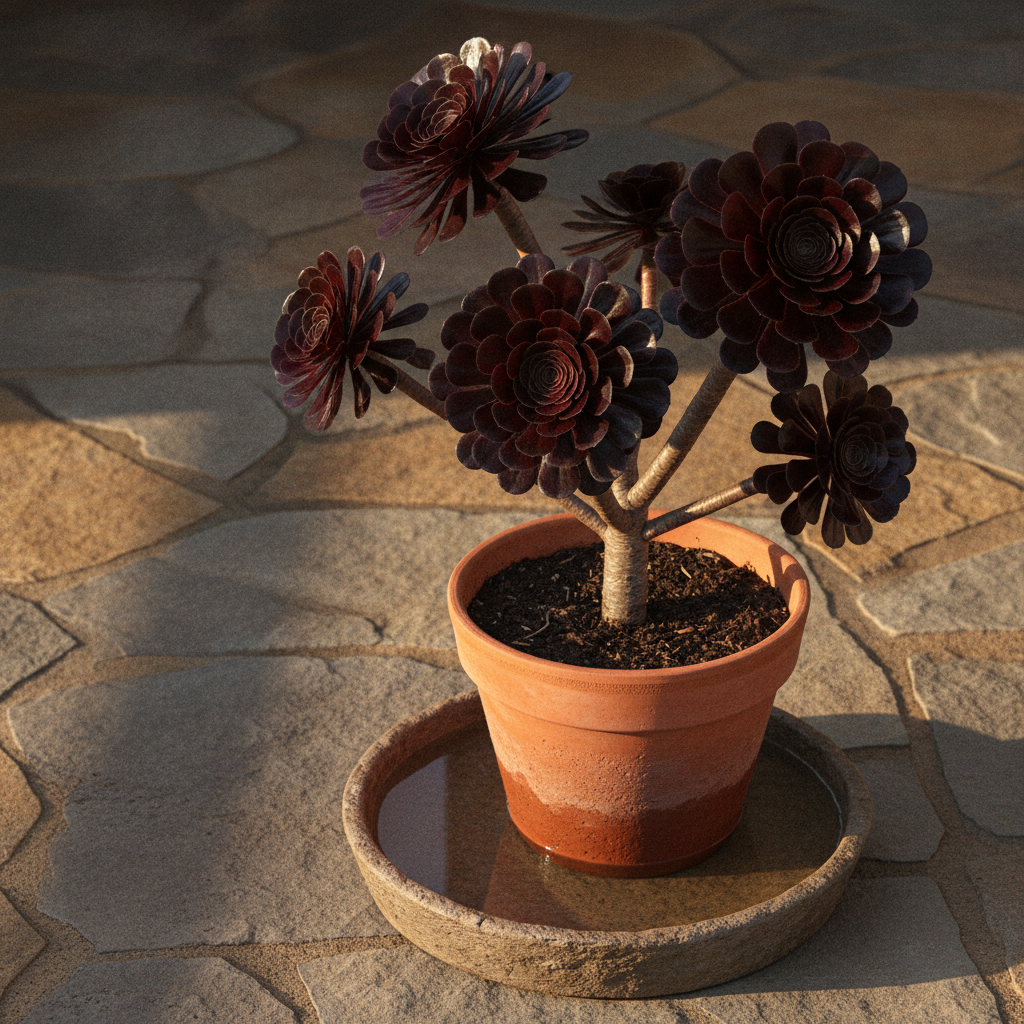
- Water at the soil surface, or stand the pot in a shallow tray of water to soak from below, keeping water out of the central rosette.
- If watering from the top, apply slowly and evenly until water runs freely from the drainage holes.
- Let the pot drain completely; never leave it standing in a saucer of water.
- Tip away any water that collects in the saucer within 15 minutes of watering.
- Wait until the mix is nearly dry again before repeating, reducing frequency in summer.
Signs of Overwatering vs. Underwatering
| Symptom | Overwatering | Underwatering |
|---|---|---|
| Leaf colour | Yellowing, translucent or blackening leaves | Colour holds but leaves dull slightly |
| Leaf texture | Soft, mushy, water-soaked feel | Wrinkled, flaccid, thin and curling inward |
| Soil | Stays wet for days, may smell sour | Bone dry throughout, pulls from pot edge |
| Roots | Brown, black, soft and foul-smelling | Dry and papery but firm |
| Stem base | Blackening or collapsing near soil line | Woody and firm, unaffected |
Warning — Root Rot: A blackening, softening stem base is the point of no return for a wet aeonium. If you see it, cut well above the affected tissue into clean, firm stem, let the cutting callous for several days and re-root it as a fresh plant. The rotted base is rarely recoverable.
Humidity Requirements
Humidity is refreshingly simple with this plant: ordinary household air suits it perfectly. Coming from an airy coastal environment, it tolerates the dry indoor air that troubles tropical foliage plants without complaint, and it needs no help to be comfortable in an average living room.
There are no meaningful low-humidity symptoms to watch for, which is unusual among houseplants. If anything, the risk runs the other way, since stagnant, humid air encourages fungal problems and rot on the fleshy rosettes.
For that reason, do not mist a black rose aeonium and do not stand it on a humidity tray. Instead, prioritise good airflow around the plant, which keeps the leaves dry between waterings and discourages both fungal disease and sap-sucking pests.
Water Quality
Aeoniums are not fussy about water quality and tolerate ordinary tap water well. If your water is very hard you may see faint mineral spotting on the leaves over time, which is cosmetic and easily wiped away. Rainwater or filtered water is a nice option if it is convenient, but it is not a requirement for keeping this plant healthy.
Soil, Potting & Repotting
The right soil does more of the work of keeping an aeonium alive than any other single factor besides light. Because the plant will not tolerate soggy roots, the mix must drain fast and dry out quickly, holding just enough moisture between waterings without ever staying waterlogged. A dense, peaty houseplant compost used straight from the bag is the wrong choice and a frequent cause of rot.
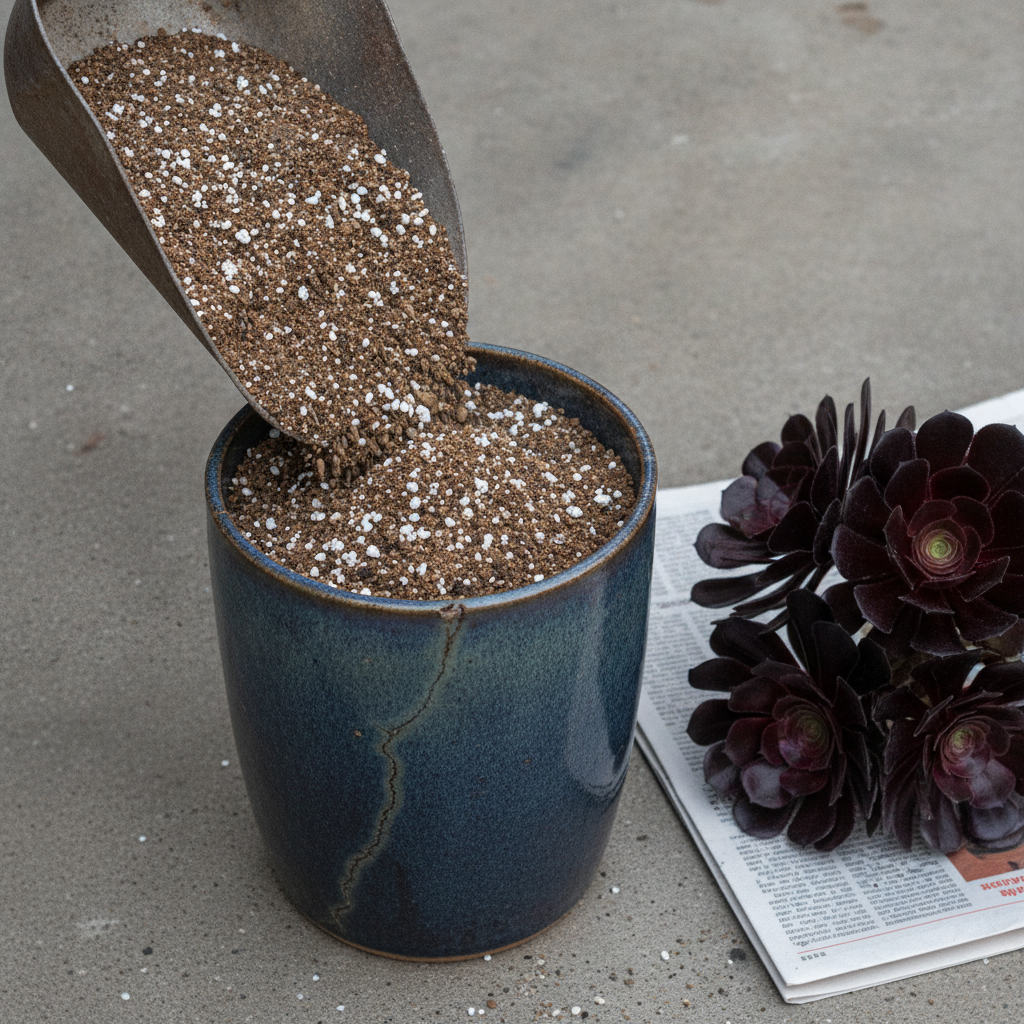
Ideal Soil Composition
The goal is a gritty, open mix with plenty of air spaces. A good starting point is a proprietary cactus and succulent compost cut with extra mineral grit, or a home blend built around the components below. Aeoniums have slightly higher organic-matter tolerance than desert cacti, so a little more compost is fine, but drainage always comes first.
| Component | Proportion | Function |
|---|---|---|
| Cactus or general potting compost | 50 per cent | Holds a little moisture and nutrients |
| Pumice or coarse perlite | 30 per cent | Creates air pockets and speeds drainage |
| Coarse horticultural grit or sand | 20 per cent | Adds weight and sharp drainage at the roots |
Aeoniums are relaxed about pH, growing well in anything from mildly acidic to slightly alkaline soil, roughly pH 6.0 to 7.5. As long as the mix drains freely, you do not need to test or adjust pH for this plant.
Pro Tip — Quick Mix Recipe: For a no-fuss blend, combine two handfuls of ordinary cactus compost with one handful of pumice and one handful of coarse grit. If a squeezed handful of the finished mix crumbles apart rather than holding together in a ball, the drainage is right.
Choosing the Right Pot
Pot choice works hand in hand with soil to control moisture. Because aeoniums have shallow, fibrous root systems, they do not need deep containers, and a wide, shallow pot suits their branching, top-heavy habit while helping the mix dry evenly.
Drainage holes are non-negotiable. Never plant a black rose aeonium in a pot without a drainage hole. Standing water at the base of the pot will rot the roots within days during warm weather, no matter how careful your watering.
Pot material: Unglazed terracotta is ideal, because its porous walls wick moisture out of the soil and let it breathe, buffering against overwatering. Glazed ceramic and plastic both work but hold moisture longer, so you will need to water a little less often in them.
Pot size: Choose a pot only slightly larger than the current root ball. An oversized pot holds a large volume of damp soil the small roots cannot dry out, which invites rot. The plant’s height can make tall specimens top-heavy, so a heavier terracotta or a broad base adds welcome stability.
When to Repot
Black rose aeoniums are slow, seasonal growers and are happy to stay in the same pot for two or three years. Repot when roots fill the container and emerge from the drainage holes, when the plant becomes unstable and top-heavy, or simply to refresh tired, broken-down soil. The best time is early autumn, as the plant wakes into its growing season, so it can settle its roots while actively growing. Avoid repotting in the heat of summer, when a disturbed, dormant plant recovers slowly.
How to Repot: Step-by-Step
- Water lightly a day or two before to make the plant less brittle, then let the surface dry.
- Ease the plant out of its pot, supporting the stems, and gently tease away old soil from the roots.
- Inspect the roots and trim away any that are black, mushy or dead with clean scissors.
- Part-fill the new pot with fresh gritty mix and position the plant at the same depth it grew before.
- Backfill around the roots, firming gently so the plant stands stable without compacting the mix.
- Top-dress with a thin layer of grit if you like, to keep the stem base dry and set off the dark rosettes.
- Wait about a week before watering to let any damaged roots heal, then resume normal care.
Warning — Transplant Shock: Watering immediately after repotting into fresh soil is a common cause of rot, because nicked roots are open wounds. Keep the newly potted plant dry and out of harsh sun for the first week, then water normally once it has settled.
Fertilising
Black rose aeoniums are light feeders, and in the wild they scrape a living from thin, rocky soils, so they neither expect nor want heavy feeding. A little fertiliser during the growing season keeps the rosettes full and the colour strong, but too much pushes soft, pale, stretched growth that undoes everything good light achieves.
The golden rule is to feed only when the plant is actively growing, which for an aeonium means autumn through spring. Never fertilise a dormant plant in summer, when it cannot use the nutrients and the salts simply accumulate in the soil.
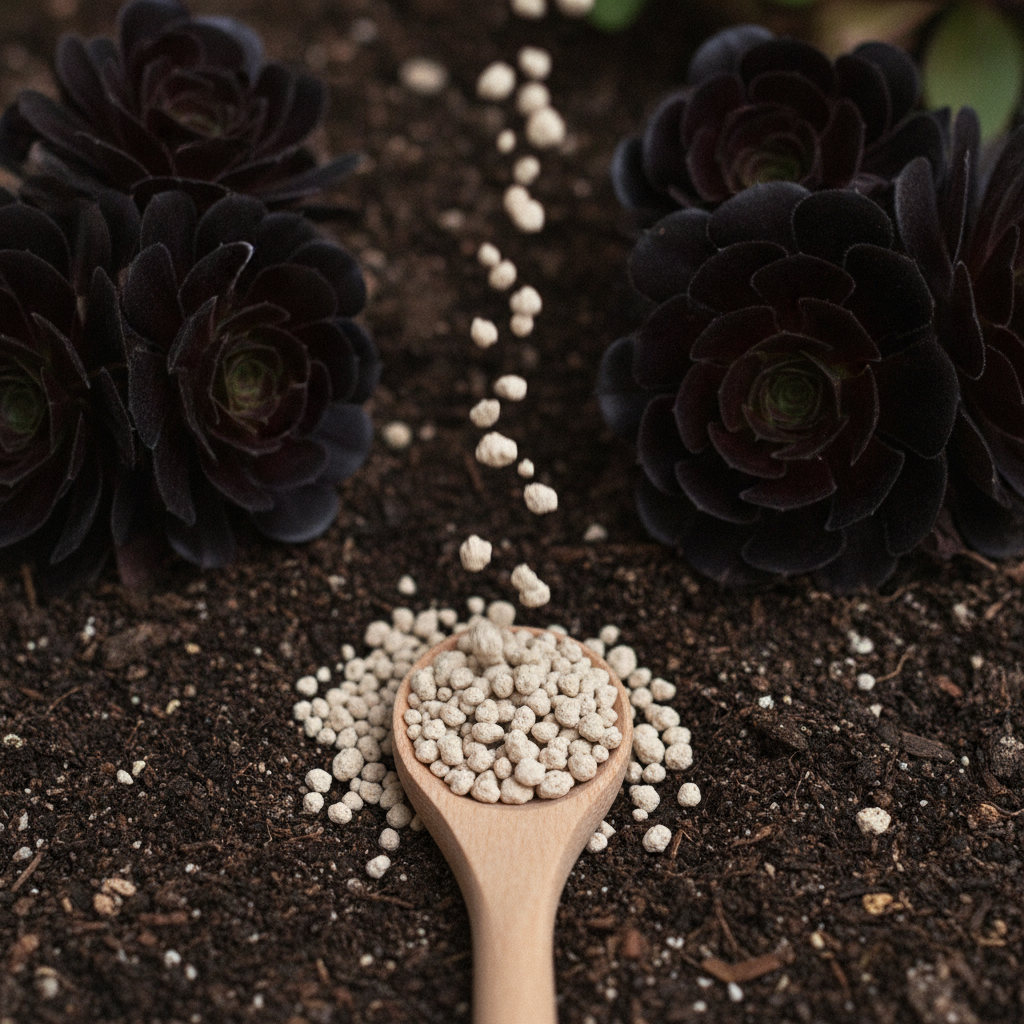
Understanding Plant Nutrients
Fertiliser labels show three numbers, the N-P-K ratio, standing for nitrogen, phosphorus and potassium. For a succulent grown for its foliage, a balanced or slightly low-nitrogen feed is ideal, since a nitrogen-heavy fertiliser encourages the lush, soft growth you want to avoid in a plant prized for tight, dark rosettes.
| Nutrient | Symbol | Primary Function | Deficiency Symptoms |
|---|---|---|---|
| Nitrogen | N | Leaf and stem growth | Pale, undersized new leaves, weak growth |
| Phosphorus | P | Root development and flowering | Poor rooting, dull colour, stunted growth |
| Potassium | K | Overall vigour and stress resistance | Yellowing leaf edges, soft growth |
| Calcium | Ca | Cell wall strength | Distorted or weak new growth |
| Magnesium | Mg | Core of the chlorophyll molecule | Yellowing between leaf veins |
| Iron | Fe | Chlorophyll production | Pale young leaves with green veins |
Types of Fertiliser
Liquid fertilisers: The easiest option for a succulent, giving you full control over dose and timing. Use a cactus and succulent feed, or a balanced houseplant feed diluted to half or quarter strength, applied to already-moist soil during the growing season.
Slow-release granular: A few slow-release prills worked into the surface at the start of the autumn growing season provide a gentle background of nutrients. Use sparingly, as these succulents need far less than the label doses aimed at leafy plants.
Organic fertilisers: A light top-dressing of worm castings or a dilute organic feed works well and is hard to overdo. Organic options release nutrients slowly and gently, which suits the modest appetite of an aeonium.
Feeding Schedule
Feed roughly once a month with a half-strength liquid feed through the active growing period from early autumn to late spring. Stop feeding entirely as the weather warms and the plant slows into its summer rest, and do not resume until it begins to grow again in autumn. A single yearly application of a little slow-release feed can replace liquid feeding if you prefer a hands-off approach.
Pro Tip — Less Is More: When in doubt, under-feed. A slightly hungry aeonium grows compact and richly coloured, while an over-fed one grows soft, pale and leggy. You can always add more, but you cannot un-stretch a plant.
How to Fertilise
- Confirm the plant is in active growth, in the autumn-to-spring season, before feeding at all.
- Dilute a liquid feed to half strength or less, following the succulent guidance on the label.
- Water lightly first if the soil is bone dry, so the feed does not scorch the roots.
- Apply the diluted feed to the soil, keeping it off the leaves and out of the rosette.
- Flush the pot with plain water every couple of months to wash out any accumulated salts.
Warning — Salt Build-Up: Fertiliser salts accumulate in fast-draining succulent mixes and can burn the roots, showing up as brown, crisp leaf tips. Leaching the pot occasionally with a generous flush of plain water clears the salts before they cause damage.
Propagation
Propagating a black rose aeonium is one of the great pleasures of growing it, because a single leggy or overgrown plant is really a supply of future plants waiting to be cut. Unlike many rosette succulents, aeoniums do not propagate reliably from single leaves; a detached leaf usually just shrivels. Instead, they root readily from stem cuttings taken from the rosette heads, and they naturally throw side branches that can be removed and rooted.
The best time to take cuttings is at the start of the autumn growing season, when the plant is gearing up to grow and cut stems root quickly. Cuttings taken in summer dormancy can work but are slower and more prone to sitting and sulking. This is also the ideal way to rejuvenate a plant that has grown tall and bare, since you can behead the leggy stems, root the tops, and often coax the old stumps to branch anew.
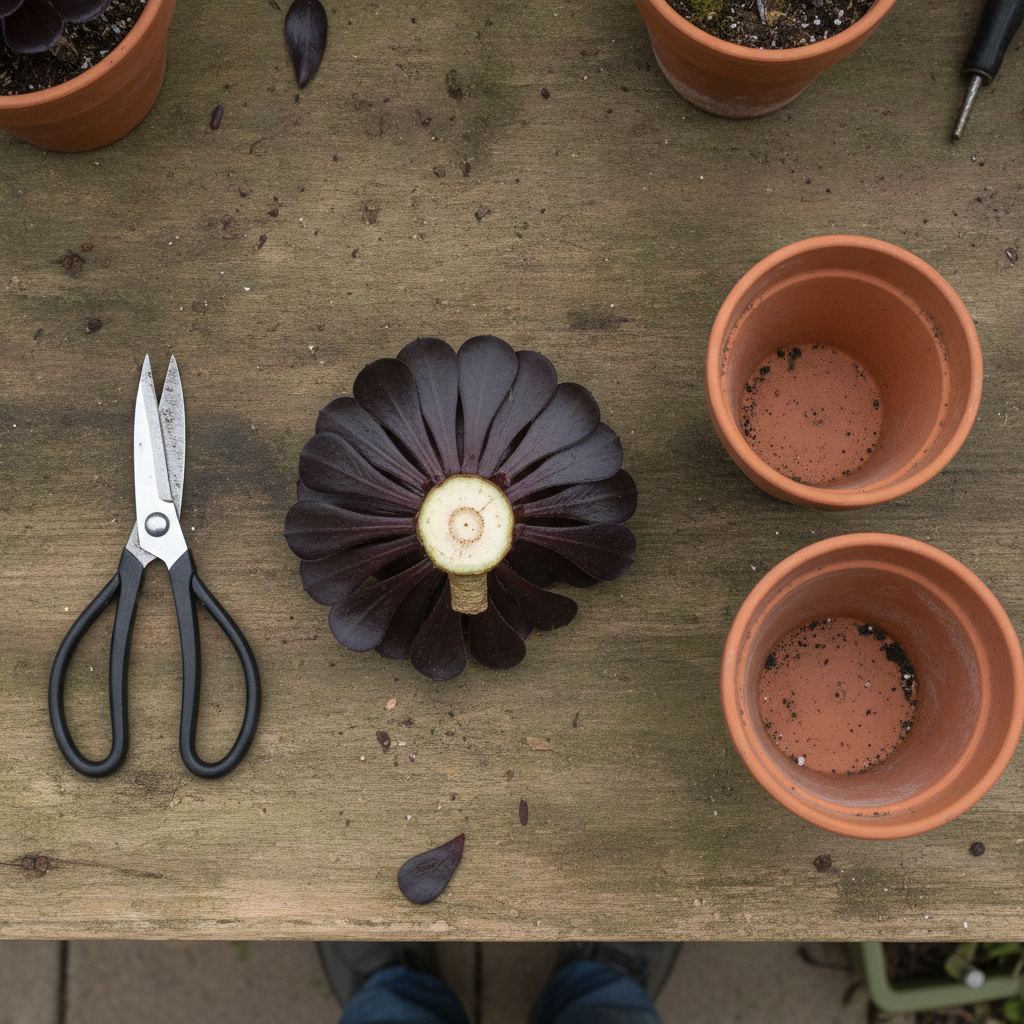
Understanding Stem Cuttings and Offsets
An aeonium rosette sits at the tip of a stem, and along that stem are dormant buds that can grow into new branches. When you cut a rosette off with a length of stem attached, that stem section produces fresh roots at the cut end, forming an independent plant. Below the cut, the remaining stem usually responds by pushing out one or more new side rosettes. Established plants also produce natural offsets, side branches that can be removed once they are large enough to fend for themselves. Both routes rely on the same principle: a clean cut, a period of drying so the wound seals, and a lightly moist, gritty medium to root into.
Rosette Stem Cuttings: Step-by-Step
This is the most reliable method and doubles as a way to reshape a straggly plant.
- Using a clean, sharp knife, cut a rosette from the plant leaving 5 to 10 centimetres (2 to 4 inches) of stem attached.
- Remove any lower leaves that would sit against or below the soil once potted.
- Set the cutting aside in a dry, shaded, airy spot for three to seven days until the cut end forms a dry callous.
- Insert the calloused stem into a pot of barely moist gritty succulent mix, deep enough to stand upright.
- Place in bright, indirect light and keep the mix only slightly moist, never wet.
- After two to four weeks, gently tug the cutting; resistance means roots have formed and you can water normally.
Pro Tip — Callous First, Always: The single biggest mistake with aeonium cuttings is planting them straight away. Letting the cut end dry into a firm callous for several days before potting is what stops the stem rotting the moment it touches damp soil.
Removing and Rooting Offsets: Step-by-Step
If your plant has branched and produced side rosettes, you can detach these as ready-made new plants.
- Choose a healthy side branch with its own developing rosette, ideally already showing tiny aerial roots.
- Cut it cleanly from the parent stem with a sterilised blade, keeping a short length of its own stem.
- Allow the cut to callous for several days exactly as for a stem cutting.
- Pot the calloused offset into gritty mix and treat it as a rooted cutting, watering only lightly until established.
Troubleshooting Propagation
| Problem | Likely Cause | Solution |
|---|---|---|
| Cutting rots at the base | Planted before callousing, or soil too wet | Callous longer, use grittier mix, water less |
| Cutting shrivels badly | Left too long before potting, or air too dry | Pot sooner after callousing, mist the air lightly, not the cutting |
| No roots after many weeks | Taken during summer dormancy or kept too cold | Be patient; roots speed up as autumn growth begins |
| Leaves drop from cutting | Normal stress, or too little light | Provide bright indirect light and wait for new growth |
Pests & Diseases
A well-grown black rose aeonium in bright light with good airflow is a fairly trouble-free plant, but it is not immune. The tight, layered rosettes offer perfect hiding places for small sap-sucking insects, and the fleshy leaves and stems are vulnerable to rot whenever they stay too wet.
Most problems are preventable and easy to catch if you look the plant over each time you water. Part the outer leaves occasionally and check the leaf axils and the growing point at the centre of the rosette, which is where trouble usually begins.
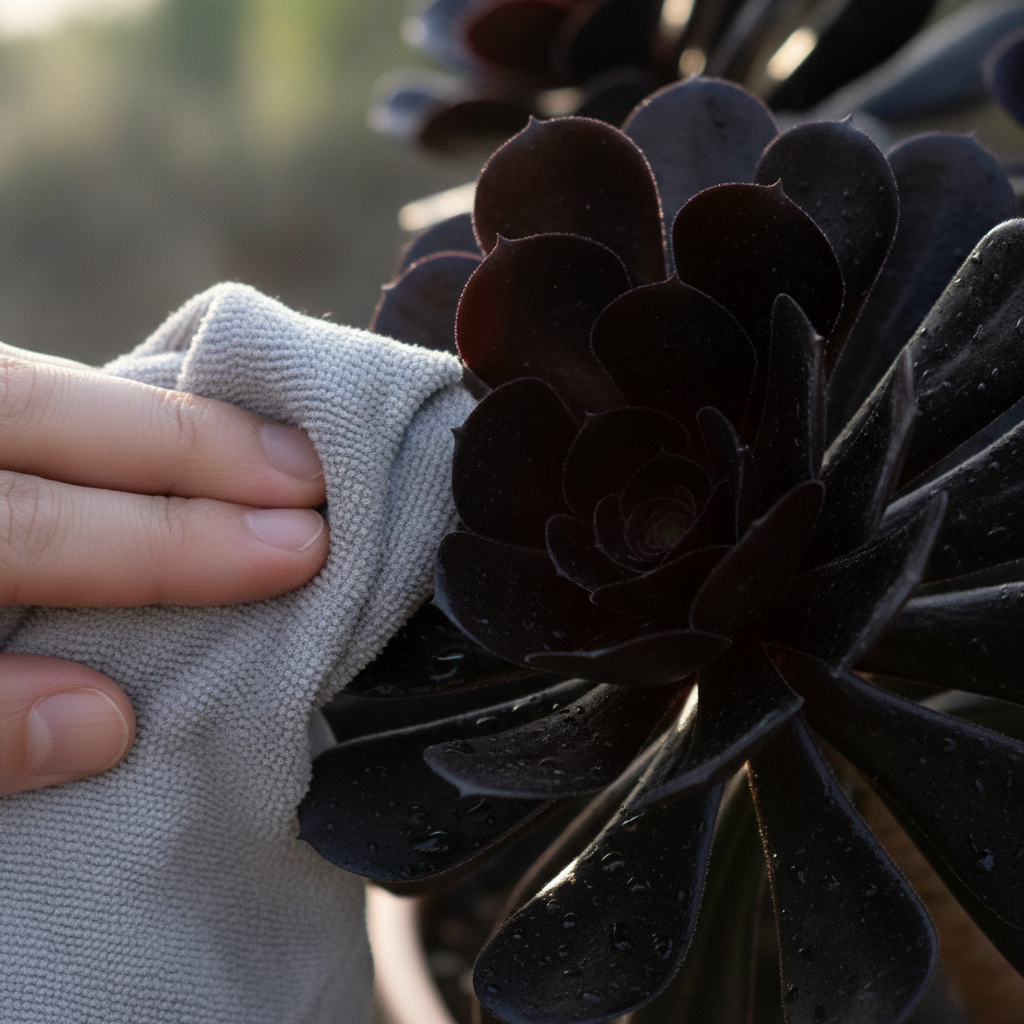
Common Pests
Aphids (Aphidoidea)
Aphids are the classic aeonium pest, clustering on the tender new growth at the rosette centre and, especially, on flower stalks, where they appear as tiny green, black or grey specks. They suck sap and excrete sticky honeydew that can turn sooty and black.
Treatment: Dislodge light infestations with a jet of water or wipe them off, then treat with insecticidal soap or a diluted neem oil spray every few days until clear. Cutting off a heavily infested flower stalk removes the problem at source.
Mealybugs (Pseudococcidae)
Mealybugs look like small tufts of white cotton wool tucked into the leaf axils and the crevices between overlapping leaves. They are slow-moving but persistent, weakening the plant and leaving honeydew behind.
Treatment: Dab each insect with a cotton bud dipped in isopropyl alcohol, which dissolves their protective coating on contact. Follow up with insecticidal soap and re-check the hidden crevices weekly, as mealybugs are easy to miss.
Scale insects (Coccoidea)
Scale appear as small, hard brown bumps on the stems and the undersides of leaves, often mistaken for part of the plant. They are firmly attached and sap-feeding, and a bad case can weaken a plant noticeably.
Treatment: Scrape or rub scale off gently with a fingernail or an alcohol-dipped cotton bud, then treat with neem oil or a systemic insecticide for stubborn cases. Isolate the plant until you are sure the scale is gone.
Common Diseases
Root and Stem Rot (Pythium and Fusarium species)
By far the most serious threat to an aeonium, rot sets in when roots or the stem base stay wet, particularly during warm summer dormancy. It shows as blackening, softening tissue at the soil line and collapsing rosettes.
Treatment: Act fast. Cut the plant back into clean, firm tissue well above the rot, discard the affected base and soil, callous the healthy cutting and re-root it. Prevention through gritty soil, careful watering and good airflow is far more reliable than any cure.
Fungal Leaf Spot (various fungi)
Damp, stagnant conditions can cause dark or sunken spots to form on the leaves, sometimes with a slightly soft margin. It is uncommon on a well-ventilated plant but can appear in crowded, humid displays.
Treatment: Remove affected leaves, improve airflow, keep water off the foliage and let the plant dry out more between waterings. A copper-based or general houseplant fungicide can help in persistent cases.
Pest and Disease Summary
| Pest / Disease | Identification | Treatment |
|---|---|---|
| Aphids | Tiny green, black or grey clusters on new growth and flower stalks | Rinse off, then insecticidal soap or neem oil |
| Mealybugs | White cottony tufts in leaf axils and crevices | Isopropyl alcohol on a cotton bud, then soap spray |
| Scale | Hard brown bumps on stems and leaf undersides | Scrape off, then neem or systemic insecticide |
| Root and stem rot | Blackening, soft, collapsing stem base | Cut back to clean tissue, re-root the healthy top |
| Fungal leaf spot | Dark or sunken spots on the leaves | Remove leaves, improve airflow, keep foliage dry |
Prevention Strategies
Prevention comes down to the same conditions that keep the plant looking its best: bright light, a gritty free-draining mix, careful seasonal watering and plenty of air movement around the rosettes. A plant grown this way is naturally resistant, and dry, well-lit foliage is far less inviting to both pests and fungi than the soft, crowded growth of an overwatered specimen in a dim corner.
Quarantine any new plant for a couple of weeks before it joins your collection, and inspect the rosette centres and leaf axils each time you water. Catching a handful of aphids or a single mealybug early takes a moment; dealing with a full infestation across several plants takes weeks.
Pro Tip — Neem as Routine: A light monthly wipe or spray with dilute neem oil during the growing season deters most sap-sucking pests before they establish. Apply it in the evening or out of direct sun so the treated leaves do not scorch.
Popular Varieties
The plant most people mean by “black rose aeonium” is Aeonium arboreum ‘Zwartkop’, but the wider Aeonium genus and the arboreum group in particular offer a whole spectrum of colours and forms, from near-black through bronze and copper to variegated cream and rose. Because these cultivars share the same easy care, collecting a few gives you a striking range of colour with no extra learning curve.
The varieties below are among the most widely grown and readily available, and several are close relatives or sports of ‘Zwartkop’ itself. Colour intensity in every one of them depends heavily on light, so expect all of them to darken in sun and green up in shade.
| Variety | Leaf Appearance | Light Needs | Growth Rate | Availability |
|---|---|---|---|---|
| ‘Zwartkop’ | Near-black deep purple rosettes with a green centre | Full sun for best colour | Moderate | Common |
| ‘Atropurpureum’ | Bronzy purple-red, greener at the centre | Bright to full sun | Moderate | Common |
| ‘Schwarzkopf’ | Very dark, near-black, similar to Zwartkop | Full sun | Moderate | Fairly common |
| ‘Velour’ (Mardi Gras) | Dark centre with a bronze-red outer ring | Bright to full sun | Moderate | Occasional |
| ‘Sunburst’ | Cream, green and pink variegation, larger rosettes | Bright, some direct sun | Moderate | Common |
| Aeonium arboreum (species) | Plain glossy green rosettes | Bright to full sun | Moderate to fast | Common |
Featured Varieties
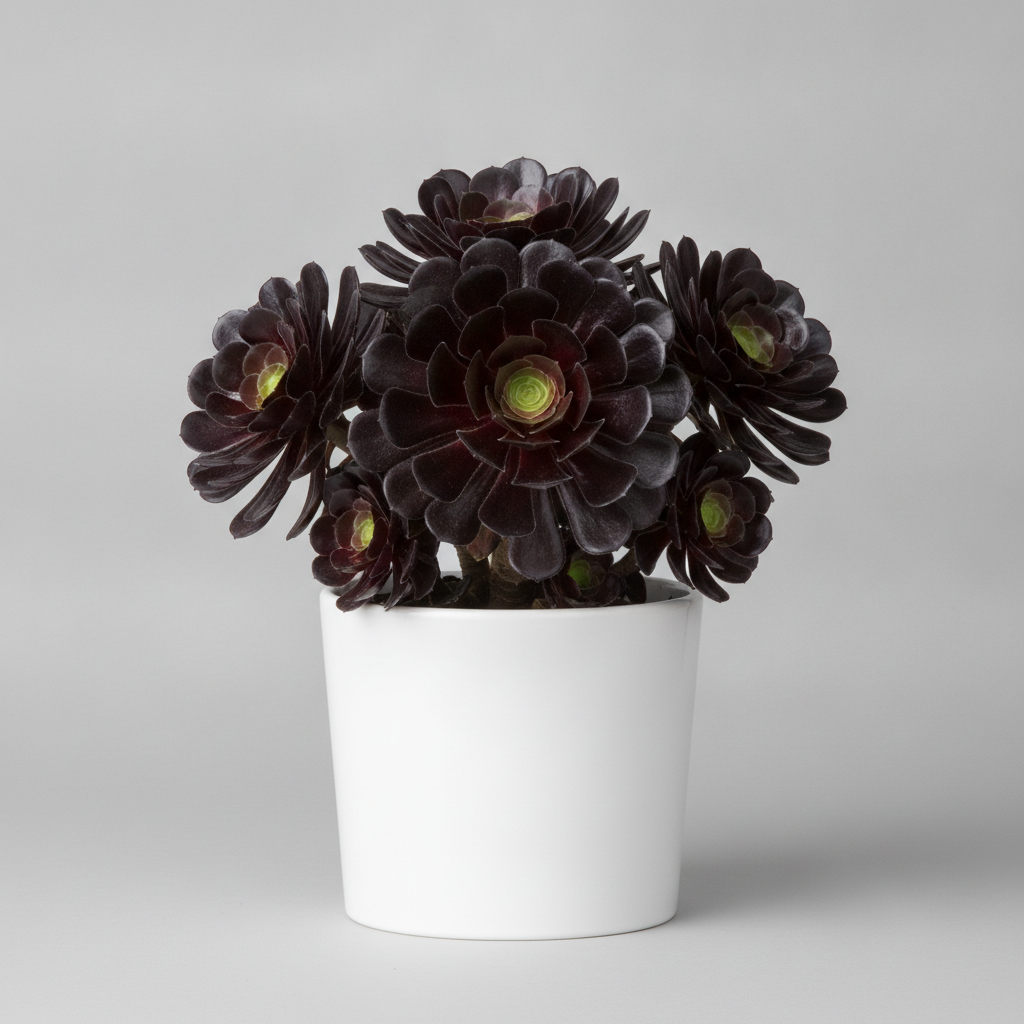
‘Zwartkop’
The darkest and most sought-after of the group, forming near-black rosettes that intensify to a glossy aubergine in strong sun, with a small lime-green heart of new growth. This is the classic black rose aeonium.
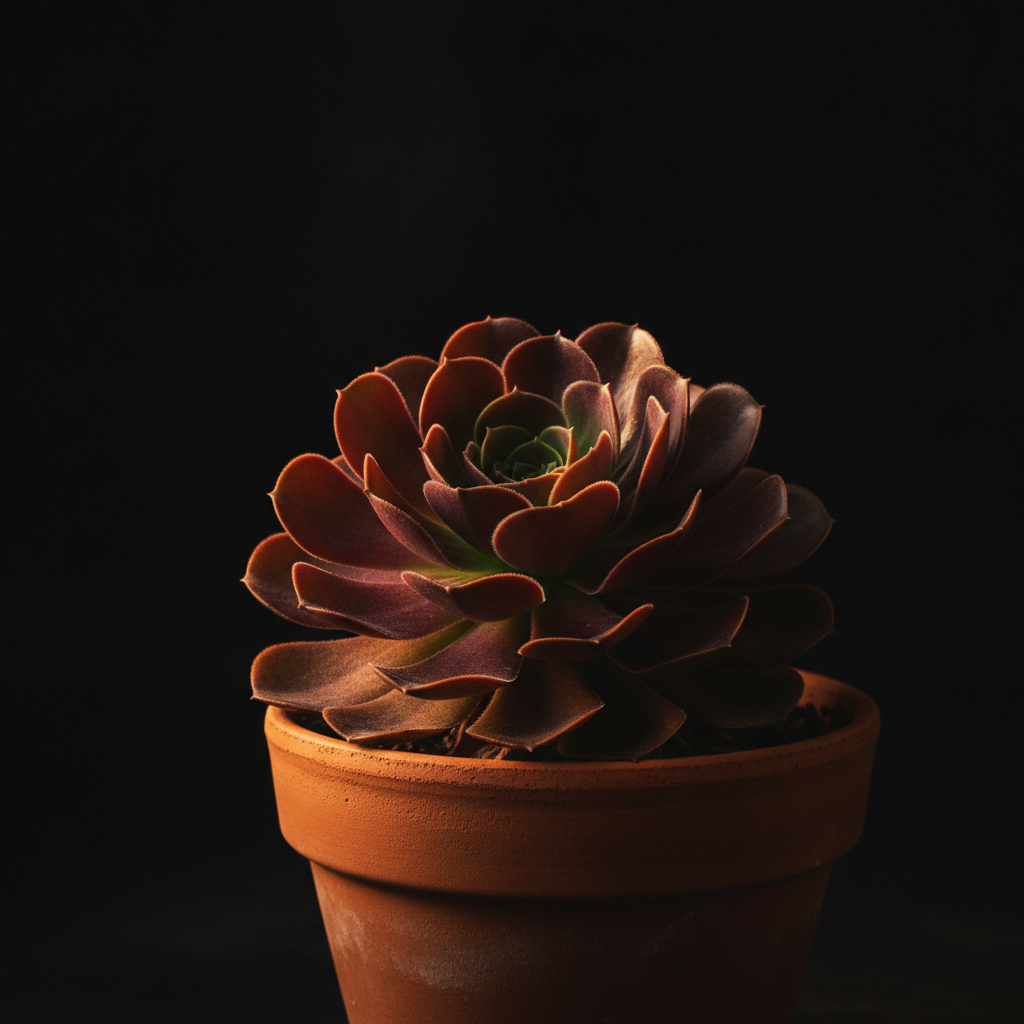
‘Atropurpureum’
A softer, warmer alternative with looser rosettes in bronzy purple-red and greener centres. It colours up to a rich coppery maroon in bright light and makes a fine companion to the darker ‘Zwartkop’.
Variety Profiles in Detail
‘Zwartkop’ (Aeonium arboreum ‘Zwartkop’)
The benchmark black aeonium, ‘Zwartkop’ is a branching, tree-like plant that can reach around a metre (three feet) tall over time, each stem tipped with a broad, glossy, almost black rosette. It demands the most sun of any variety here to reach its full colour, rewarding a bright window with an intensity of dark pigment that no other common houseplant matches.
‘Sunburst’ (Aeonium ‘Sunburst’)
A complete contrast, ‘Sunburst’ carries large variegated rosettes striped in cream, pale green and pink, the edges blushing rose-pink in strong light. Lower-growing and clumping rather than tall and tree-like, it pairs beautifully with the dark varieties and shares exactly the same winter-growing, summer-resting care.
Choosing the Right Variety for Your Space
If you have a genuinely bright, sunny window, ‘Zwartkop’ will give you the dramatic near-black colour that makes these plants famous, so let light be your guide. In a spot with good but slightly gentler light, the bronzy ‘Atropurpureum’ or the variegated ‘Sunburst’ will look excellent without needing the fiercest sun to earn their keep. Whichever you choose, remember that all aeoniums grow in winter and rest in summer, so a mixed collection can be cared for on a single, simple schedule.
Frequently Asked Questions
Why is my black rose aeonium turning green?
Greening is almost always a sign of too little light. The dark pigment is produced in response to strong sun, so a plant in shade reverts to bronze-green and grows loose and stretched. Move it to your brightest window and, although existing leaves will not re-darken, the new rosettes will grow back their signature near-black colour.
Why is my aeonium dropping its lower leaves?
Shedding older leaves from the bottom of the rosette is completely normal, especially as the plant enters summer dormancy and curls up to conserve moisture. It only signals a problem if the leaf loss is rapid and widespread alongside a soft, blackening stem, which points to rot from overwatering.
Why does my aeonium close up its leaves in summer?
Curling the rosette inward into a tight cluster is a natural protective response to summer heat and dormancy, not a sign of thirst. The plant is minimising the surface exposed to the sun to reduce water loss. Keep watering to a minimum and it will open up again and resume growth once cooler autumn weather arrives.
How often should I water a black rose aeonium?
Water when the soil has dried out during the autumn-to-spring growing season, which is often every week or ten days in a bright, warm room, and cut right back to a light drink every few weeks in summer. Always judge by the dryness of the soil and the firmness of the leaves rather than a fixed calendar.
Is the black rose aeonium safe for pets?
Aeoniums are generally regarded as non-toxic to cats and dogs and are not listed among the dangerous succulents. That said, the sap can cause mild irritation if chewed, and no plant is truly meant to be eaten, so it is still sensible to keep it out of reach of determined nibblers.
My aeonium has grown tall and leggy. What should I do?
Legginess comes from insufficient light, but it is easily fixed. Behead the stretched rosettes with a few centimetres of stem, callous and re-root them as new compact plants, and the old stumps will usually branch and produce fresh rosettes. Give the rejuvenated plants much brighter light to keep future growth tight.
Why did one of my rosettes flower and then die?
Individual aeonium rosettes are monocarpic, meaning a rosette that produces a tall cone of yellow flowers will die after setting seed. This is natural and not a sign of poor care. On a branching plant only the flowering rosette is lost, and you can take cuttings from the remaining heads to keep the plant going.
Can I grow my black rose aeonium outdoors?
Yes, in warm, frost-free conditions it thrives outdoors and colours up beautifully in full sun. In cooler climates, move it outside for the summer once nights are reliably mild, acclimatising it gradually to avoid scorch, and bring it back indoors before temperatures approach freezing, as it is not frost-hardy.
Why isn’t my aeonium growing in summer?
Because it is not supposed to. Black rose aeoniums are winter growers that rest through the heat of summer, so a lack of summer growth is exactly what to expect. Ease off water and feed during this rest, and the plant will burst back into active growth as the weather cools in autumn.






