
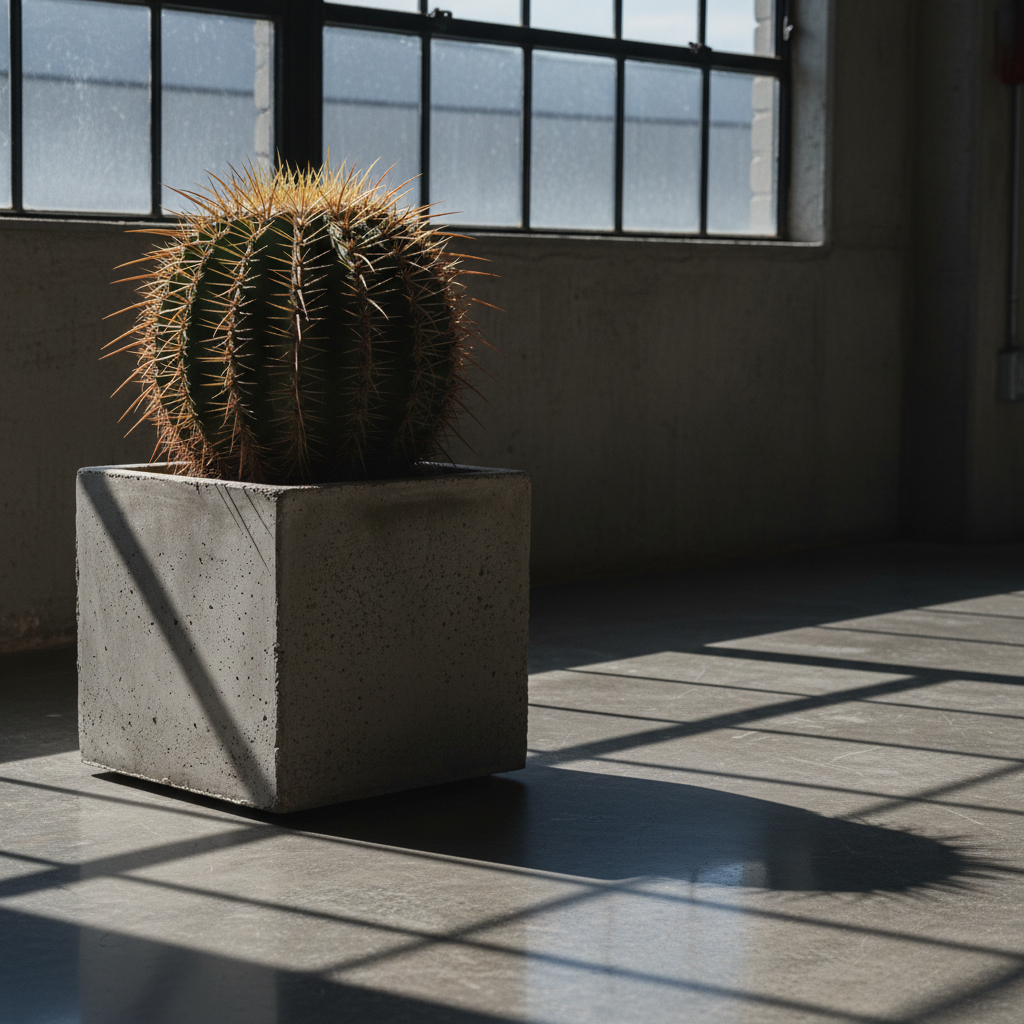
Few houseplants carry the quiet authority of a barrel cactus. Where a fern flutters and a pothos goes wandering, Ferocactus wislizeni simply sits: a ribbed green drum sheathed in hooked spines, looking exactly as unbothered as its kind has looked for the thousands of years they have weathered the Sonoran and Chihuahuan deserts. This is a plant built for endurance rather than fuss, and that single fact shapes almost everything about how you should care for it.
The species is often sold under a tangle of names: fishhook barrel cactus, Arizona barrel, candy barrel, or simply “barrel cactus”, a label it shares with several related desert species. Whatever it is called on the label, the care logic is the same. Give it blistering light, a gritty mix that drains in seconds, and water only when you are almost certain it does not need it. Get those three things right and the rest of this guide is detail. Get them wrong, and no amount of attention will save a cactus quietly rotting from the roots up.
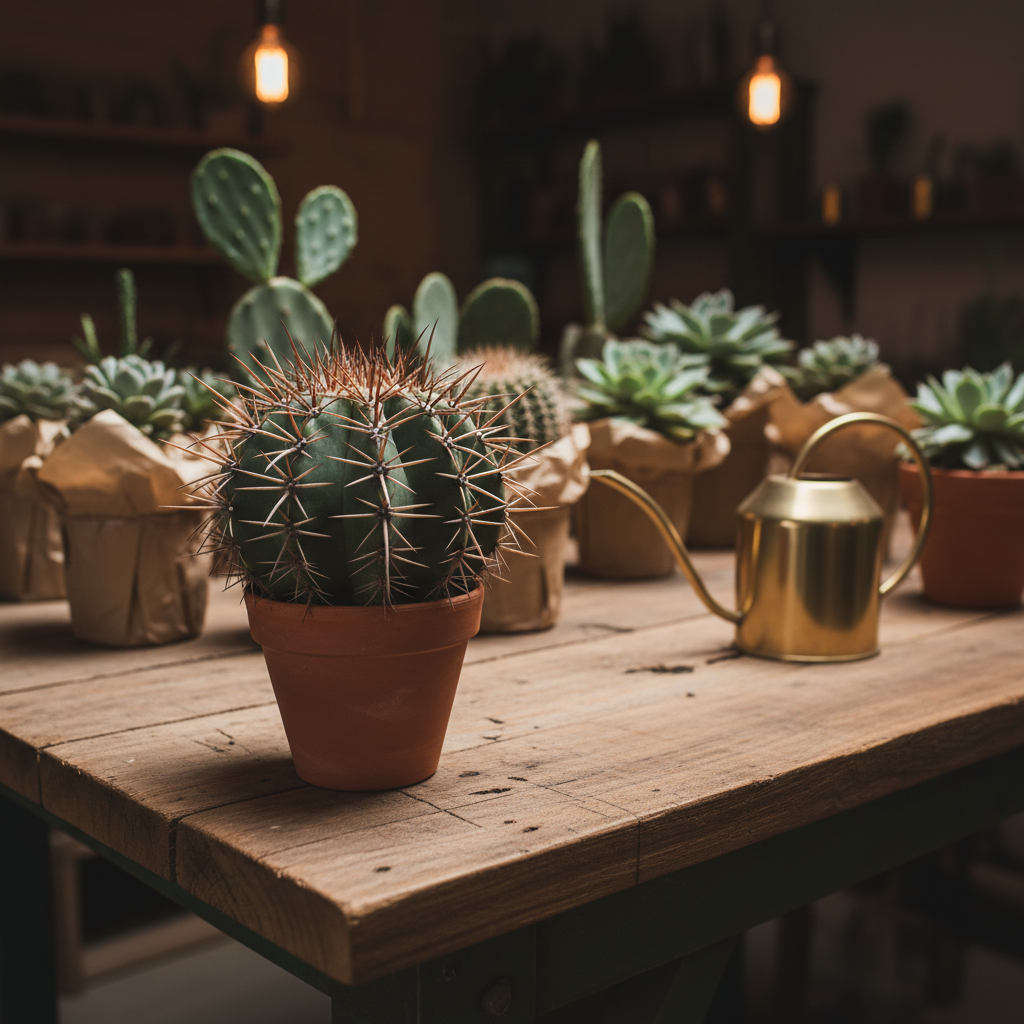
In This Guide
- Quick reference
- Why the barrel cactus makes a striking houseplant
- Light
- Watering
- Soil and potting
- Fertilising
- Propagation
- Pests and problems
- Varieties to know
- Frequently asked questions
Quick Reference
The table below is the short version of everything that follows. If you read nothing else, read this, then return to the watering and soil sections, which are where almost all barrel cactus deaths begin.
| Common names | Barrel cactus, fishhook barrel, Arizona barrel, candy barrel |
| Botanical name | Ferocactus wislizeni |
| Family | Cactaceae |
| Native range | Sonoran and Chihuahuan deserts of the south-western United States and northern Mexico |
| Mature size indoors | Typically 15 to 40 cm (6 to 16 in) tall over many years; far larger in habitat |
| Light | The brightest, most direct light you can offer, ideally a south-facing window |
| Water | Deeply but rarely; roughly every 2 to 3 weeks in summer, almost never in winter |
| Soil | Free-draining cactus or mineral mix with at least 50 per cent grit |
| Temperature | 18 to 30 degrees C (64 to 86 degrees F) in growth; a cool, dry winter rest at 5 to 12 degrees C (41 to 54 degrees F) |
| Humidity | Low; ordinary dry household air is ideal |
| Feeding | A weak low-nitrogen cactus feed once or twice across spring and summer |
| Toxicity | Non-toxic if eaten, but the hooked spines are a genuine injury risk |
| Difficulty | Easy, provided you resist the urge to water |
Why the Barrel Cactus Makes a Striking Houseplant
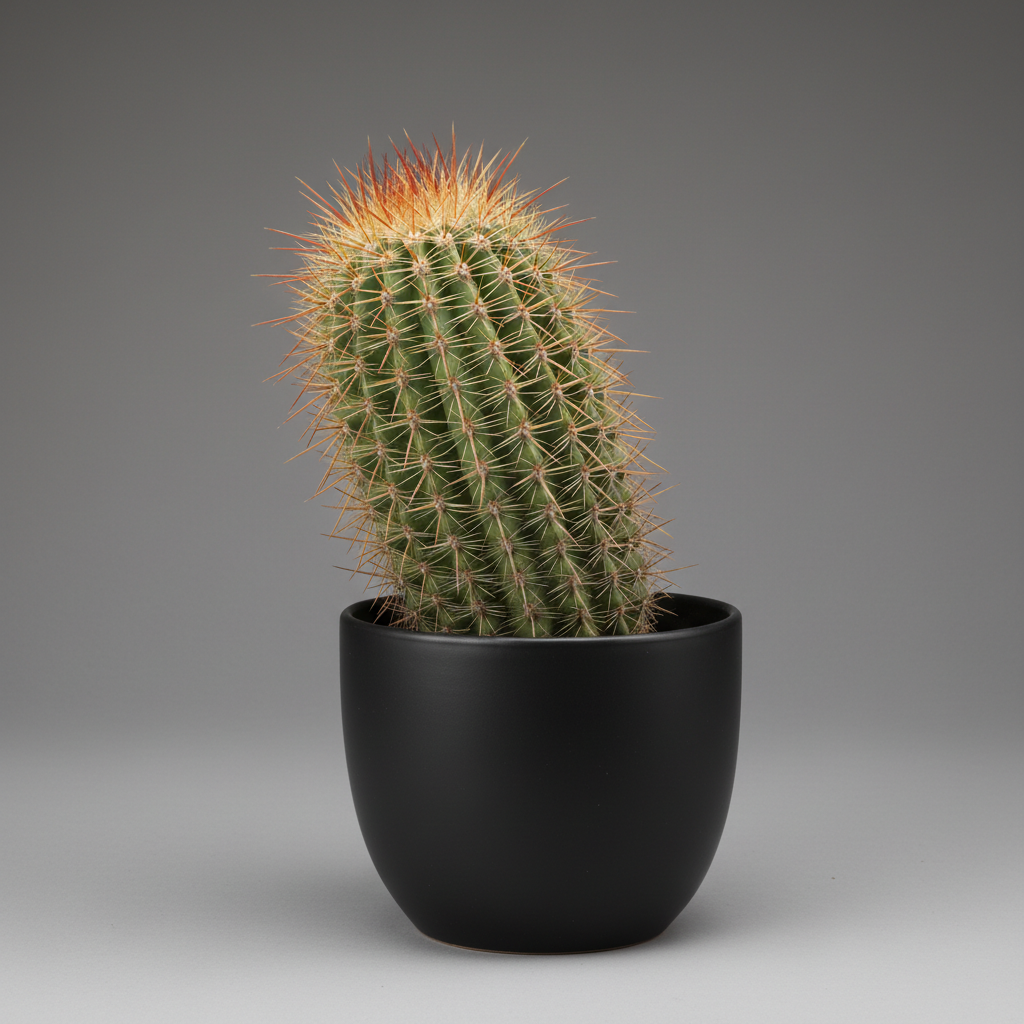
The appeal of a barrel cactus is almost architectural. Its body is a near-perfect ribbed cylinder, geometric in a way few living things manage, and as it ages those ribs deepen into accordion pleats that let the plant swell and shrink with the seasons. Over the green skin runs a lattice of spines, and on Ferocactus wislizeni the central spines are the showpiece: broad, flattened, often banded grey and red, and curved at the tip into the unmistakable fishhook that gives the plant one of its common names. A mature specimen catching low sunlight, every hook lit like wire, is one of the more sculptural objects you can put on a windowsill.
Beyond looks, the barrel cactus earns its place by asking for so little. It is among the most forgiving plants you can own, not because it tolerates poor conditions but because the conditions it wants happen to align with the way most homes are neglected: dry, bright and rarely fussed over. A barrel cactus will sit happily on a sunny ledge through a two-week holiday, a forgotten weekend, or an owner who simply loses interest for a month. In its native range it survives blistering summers and frost-touched winters, storing water in that swollen body to ride out droughts that would flatten almost anything else. That same reservoir is what lets it shrug off your forgetfulness indoors.
It is worth being honest about pace, though. This is a slow plant. A barrel cactus the size of a grapefruit may already be a decade old, and in cultivation it might add only a centimetre or two of height in a good year. The giant barrels you see photographed in the desert, chest-high and heavy enough to need two people to move, represent a century or more of growth. Indoors you are keeping a long-lived, slow-burning companion rather than a plant that will fill a corner by next spring. For many people that is precisely the point: a barrel cactus is something you grow alongside, not something you grow out of.
Pro Tip — Survive versus thrive: A barrel cactus will survive in a moderately bright room with occasional water, sitting green but static for years. It only begins to thrive, firming up, deepening in colour and eventually flowering, when it gets genuinely fierce light and a real seasonal rhythm of summer watering and winter drought.
Light
There is no such thing as too much light for a barrel cactus indoors. In the wild this plant grows in open desert with nothing between it and the sun from dawn to dusk, and no household window comes close to that intensity. Your job is therefore simple: find the brightest spot you have and put the cactus there. A south-facing window is the gold standard, ideally one where the plant sits right up against the glass rather than set back on a shelf where the light has already weakened.
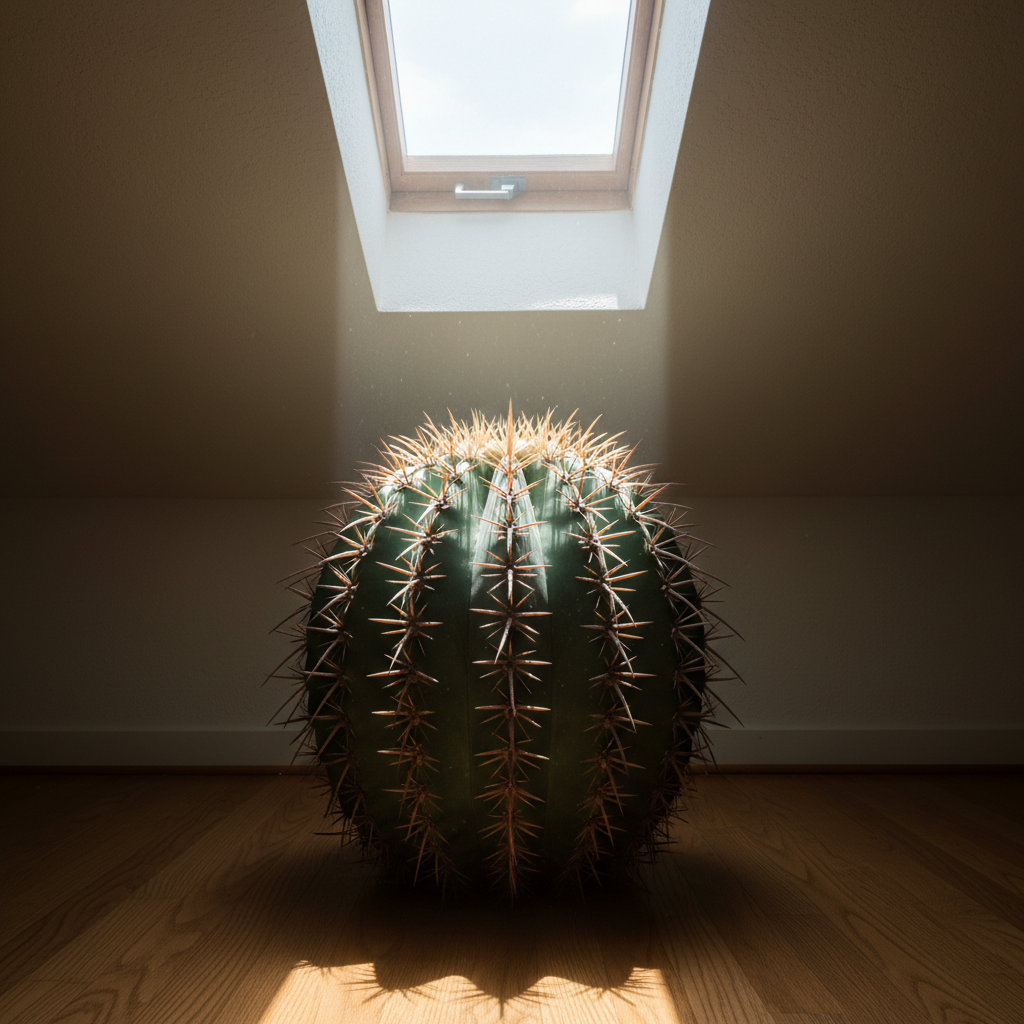
Light does more than fuel growth here; it shapes the plant. A barrel cactus grown in marginal light begins to etiolate, stretching at the crown into a paler, narrower, less heavily armoured growth that never recovers its proper form. Where a healthy plant is squat and broad, a light-starved one elongates and leans, and its new spines come in thin and sparse. If you notice the top of your cactus becoming a slightly different colour and shape from the older body below, weak light is almost always the cause. Move it closer to the glass before the deformation goes any further, because once a barrel has stretched, that section stays stretched for life.
One quirk of this species is worth knowing. Barrel cacti tend to lean toward the strongest light over time, growing faster on the shaded side so that the whole body tilts southward. This is the trait behind the “compass barrel” nickname applied to several Ferocactus species. Indoors it means a plant left untouched on a windowsill will gradually angle itself toward the glass. To keep it growing upright and symmetrical, give the pot a quarter turn every couple of weeks so each face takes its turn facing the light.
If you simply do not have a bright enough window, a barrel cactus is a strong candidate for a full-spectrum LED grow light. Run it for ten to twelve hours a day, positioned close to the plant, and you can keep a cactus in good form even in a north-facing flat. One caution applies to natural light: a cactus that has spent winter in a dim room should not be moved straight into fierce spring sun, because the unconditioned skin can scorch, leaving permanent pale or brown patches. Reintroduce strong light over a week or two, the same way you would ease your own skin into the first hot days of summer.
Watering
If a barrel cactus dies in your care, watering is overwhelmingly the reason, and almost always too much rather than too little. This plant evolved to bank water during brief desert rains and then live off that reserve through months of drought. Its roots are adapted to wet-then-dry cycles, not to sitting in consistently damp soil, and prolonged moisture around the base invites the rot that quietly destroys cacti from the inside.
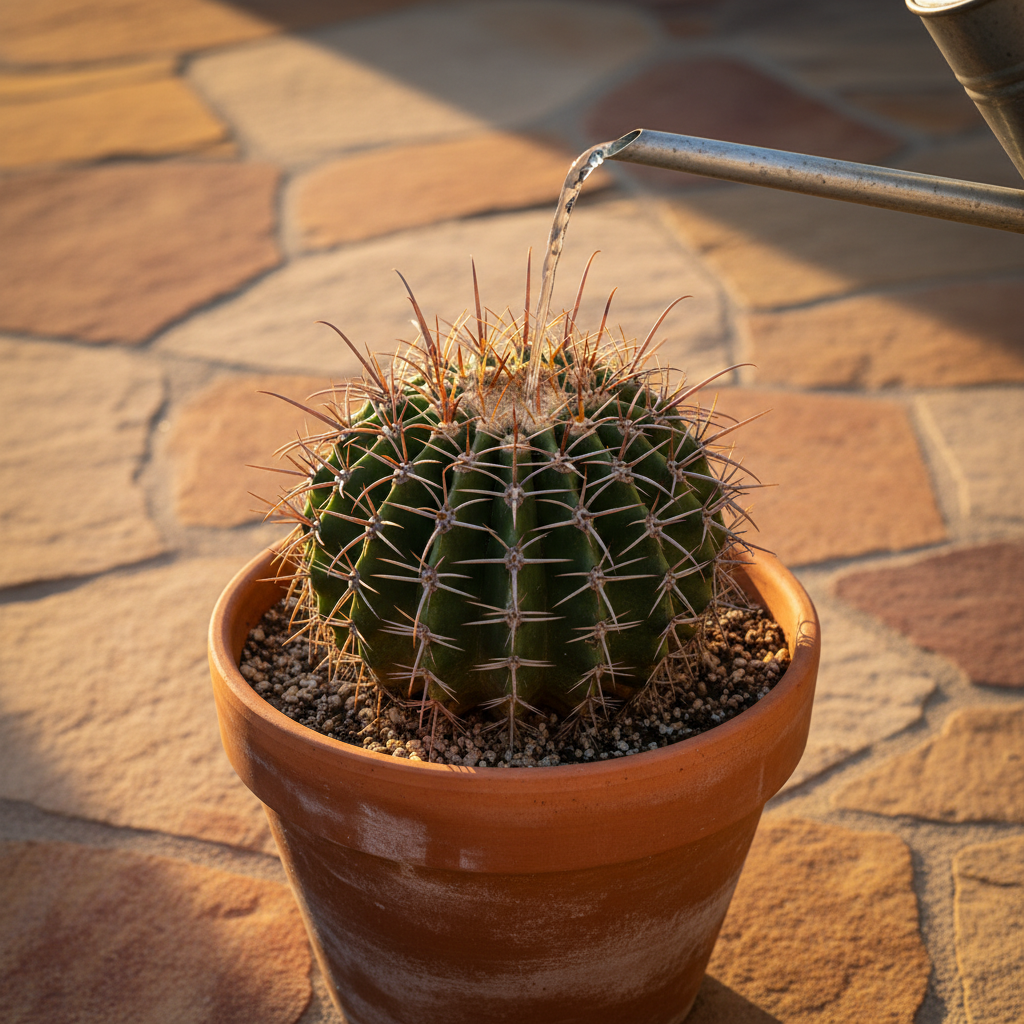
The method that works is the “soak and dry” approach. When you do water, water thoroughly: drench the mix until it runs freely from the drainage holes, so the entire root ball is wetted. Then do not touch it again until the soil has dried out completely, top to bottom. In a bright, warm room through spring and summer that might mean watering roughly every two to three weeks, but the calendar is only a rough guide. The reliable test is the soil itself. Push a wooden skewer to the bottom of the pot, or simply lift the pot to feel its weight; a dry pot is conspicuously light, a still-damp one noticeably heavy. Water only when everything is bone dry and the pot feels empty.
Winter changes the rules entirely. As light fades and temperatures drop, a barrel cactus enters a genuine dormancy, and its water needs fall close to zero. From late autumn through to early spring you should water sparingly, in many homes that means once a month at most, and in a cool winter rest it can mean not at all for weeks on end. A dormant cactus that is also being watered is the single most common recipe for winter rot. Keep it cool, keep it dry and let it sleep; the plant will not thank you for trying to keep it growing through the dark months.
Water quality and timing matter less than frequency, but a few habits help. Water in the morning so any stray moisture on the body evaporates through the day rather than sitting overnight. Avoid letting water pool in the crown among the spines, where it can encourage rot at the growing point. And never leave the pot standing in a saucer of run-off; tip it away within a few minutes so the roots are not left soaking.
Warning — The reservoir illusion: A barrel cactus stays plump and green for a long time even as its roots rot, because it is living off stored water. By the time the body softens, darkens or starts to lean, the damage below is often advanced. When in doubt, wait. An underwatered barrel recovers in days; an overwatered one frequently does not recover at all.
Soil and Potting
Soil is the silent partner to watering, and the two cannot be considered separately. The right mix is one that holds almost no standing water: it should wet through when you water, then drain and dry quickly so the roots spend most of their time in air rather than moisture. A heavy, peat-rich potting compost, however good for foliage plants, is actively dangerous under a barrel cactus, because it stays wet for days and turns every watering into a slow drowning.
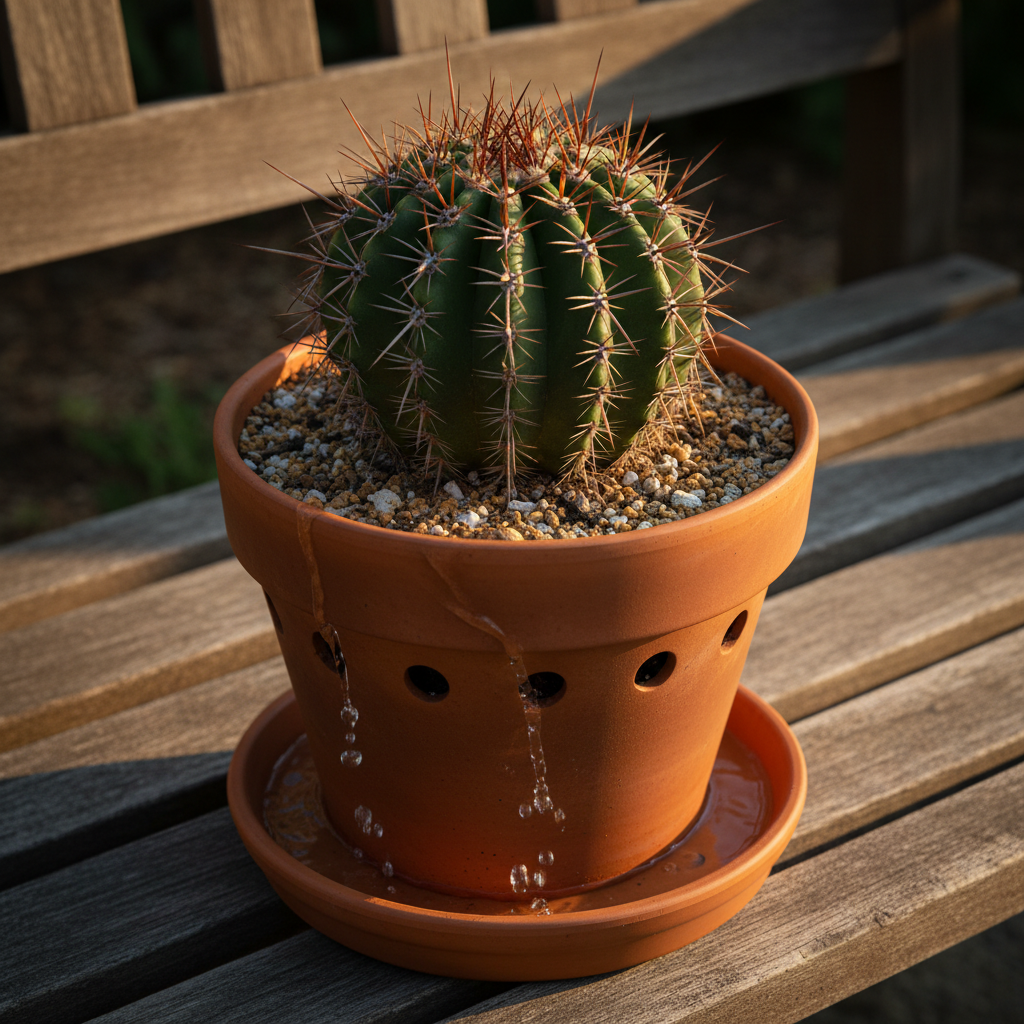
A reliable starting point is a mix that is roughly half organic material and half coarse mineral grit. Begin with a bagged cactus and succulent compost, then cut it heavily with pumice, coarse horticultural sand, fine gravel or perlite until at least half the volume is gritty mineral matter. Many experienced growers push the mineral fraction higher still, to two-thirds or more, especially in cooler or less bright homes where the mix dries more slowly. The look you are aiming for is gritty and loose, something water visibly rushes through rather than pooling on top.
The pot matters as much as what goes in it. A drainage hole is non-negotiable; no barrel cactus should ever sit in a sealed decorative pot without one. Terracotta is the traditional and still the best choice, because the porous clay wicks moisture out of the mix and breathes, drying the root ball faster than glazed ceramic or plastic. Choose a pot only slightly larger than the plant, since a barrel cactus in an oversized pot is surrounded by a large volume of slow-drying soil that it cannot use, again raising the rot risk. Snug is safe.
Because the plant grows so slowly, repotting is an infrequent event, needed perhaps every three to four years, or simply when the cactus has filled its pot or the old mix has broken down and lost its structure. Repot in spring as growth resumes, and let the plant dry out for a few days beforehand so the root ball comes away cleanly. Here the spines turn a routine job into a careful one: wrap the body in a thick band of folded newspaper, a strip of old carpet or a length of foam pipe lagging to make a handle you can grip without being hooked. After repotting, resist watering for a week to ten days, which gives any roots disturbed or nicked in the process time to callous over rather than sitting open in damp soil.
Fertilising
Coming from nutrient-poor desert soils, a barrel cactus has modest appetites and is easily overfed. It does benefit from a little feeding during active growth, but the emphasis is firmly on a little. The desert is not a fertile place, and a plant adapted to scarcity responds to a flood of nutrients with weak, swollen, rot-prone growth rather than the firm, well-armoured body you want.
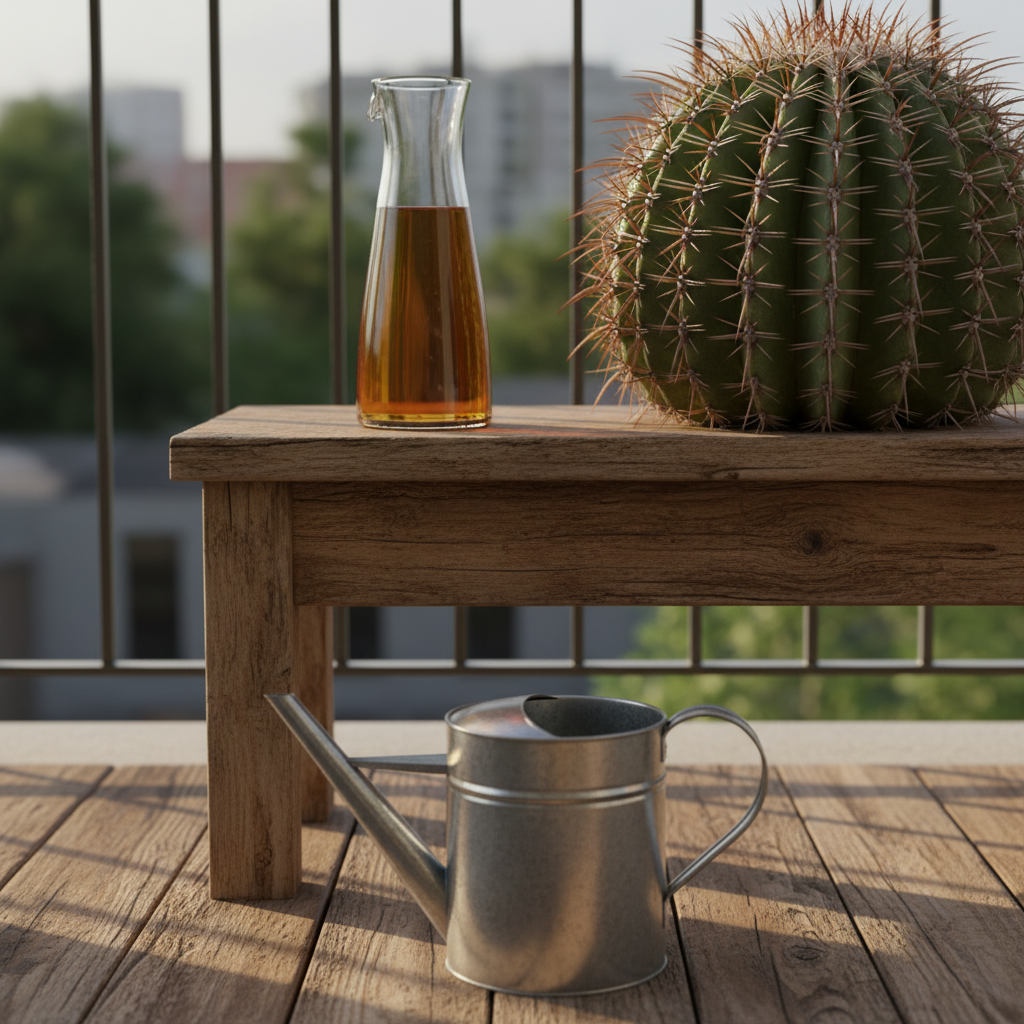
Reach for a fertiliser formulated for cacti and succulents, which is low in nitrogen and higher in potassium and phosphorus. High-nitrogen general houseplant feeds are the wrong tool here, because nitrogen drives soft, fast growth that a cactus is not built to support; the result is a body that splits, scars or develops the corky patches that follow over-rapid expansion. If a cactus feed is all you have, a balanced houseplant fertiliser diluted to a quarter of its normal strength will do, but a purpose-made one is better.
Timing is straightforward. Feed only during the spring and summer growing season, and only when the plant is in good health and actively growing. For most homes, one or two feeds across the whole season is plenty: dilute the fertiliser to half the recommended strength, apply it dissolved in your normal watering so the roots are already moist, and never feed a dry plant or one in winter dormancy. A barrel cactus that is fed lightly looks no different week to week, which is exactly right. If yours suddenly puts on a surge of pale, soft growth, that is a sign to stop feeding, not to do more.
Propagation
Propagation is where the barrel cactus tests a grower’s patience more than any other part of its care. Unlike the trailing aroids and succulents that root from a snipped stem in a jar of water, Ferocactus wislizeni offers no shortcut. It is a solitary, single-bodied cactus that you cannot take cuttings from, and the two genuine routes to new plants, seed and the occasional offset, both run on the plant’s own slow clock.
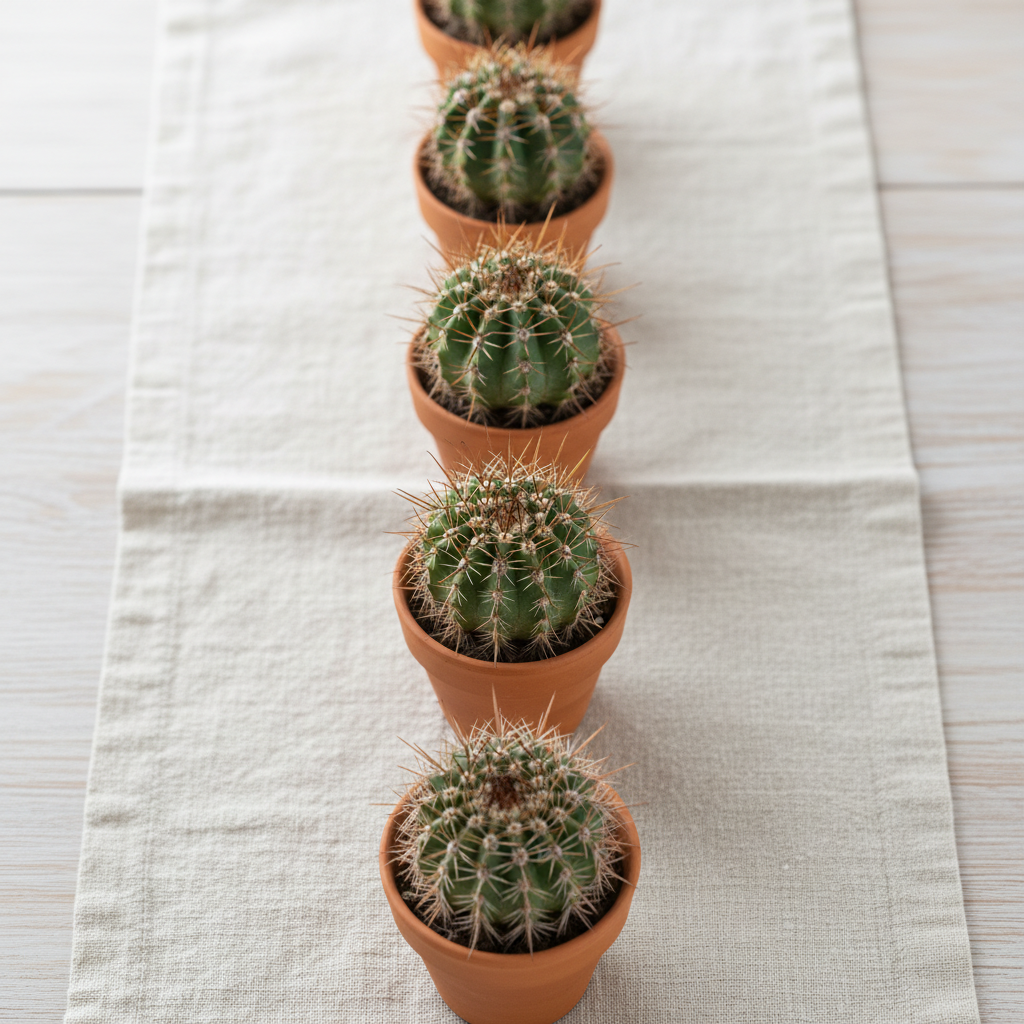
Seed is the way barrel cacti are produced in the trade and the only route that reliably yields plants. A flowering specimen sets seed inside the fleshy fruit that follows its blooms, and that seed, sown onto the surface of a gritty, sterile mix and kept warm and lightly humid, will germinate within a few weeks. From there, however, patience becomes the whole game: barrel cactus seedlings are tiny, pinhead-sized green spheres at first, and they grow at a glacial pace, taking several years to reach even a few centimetres across. It is a rewarding long-term project for anyone who enjoys raising plants from the very start, but it is not a way to fill your windowsill quickly.
Offsets are the other possibility, though an unreliable one. Most barrel cacti, including Ferocactus wislizeni, grow as a single body and never produce pups at all. Occasionally, often after the growing tip has been damaged, a plant will throw one or more offsets around its base. Where this happens you can propagate vegetatively: let the plant dry out, then carefully twist or cut an offset away from the parent, set it aside in a dry, shaded spot for several days until the cut surface forms a dry callous, and only then pot it into barely moist gritty mix. Withhold water for a week or so afterwards, then begin watering very sparingly until roots establish. If you are counting on offsets to multiply your collection, though, prepare to be disappointed; for this species, seed is the dependable path.
Pro Tip — Let every cut dry first: Whether you are dividing an offset or trimming away rot, never pot a fresh wound straight into damp soil. Give the cut surface several dry days to callous over. An open wound in moist mix is an invitation to exactly the rot you are trying to avoid.
Pests and Problems
A healthy barrel cactus is a robust thing, and most of the trouble it runs into is cultural rather than the work of pests. Even so, a handful of insects do find their way onto indoor cacti, and a short list of recurring problems accounts for nearly every barrel cactus that fails.

The pest you are most likely to meet is the mealybug, a small soft insect that hides as white cottony tufts in the crevices between ribs and among the spine clusters, where it is easily missed until a colony has built up. Closely related is scale, which appears as small brown or tan bumps stuck to the body. Both feed on the plant’s sap and weaken it over time. Because the spines make spraying and wiping awkward, the most precise treatment is to dab each insect directly with a cotton bud dipped in isopropyl alcohol, working carefully between the spines; repeat every few days until no new insects appear. In drier conditions spider mites can also occur, showing as fine speckling and faint webbing on the skin, and these respond to the same diligent inspection and treatment.
The far more serious threat is not an insect at all but root and stem rot, and it is almost always self-inflicted through overwatering or poorly draining soil. The early signs are easy to miss: the base of the plant softens, the green darkens toward brown or black, and the firm body begins to feel spongy or starts to lean as the roots give way beneath it. Caught very early, a rotting cactus can sometimes be saved by unpotting it, cutting away all the affected tissue back to firm clean flesh, letting the wound callous for several days, and repotting into fresh dry mix. Caught late, it cannot. Prevention is the only real cure, and it lives entirely in the watering and soil sections above.
A few cosmetic issues round out the list. Corky brown patches or scarring on the lower body are usually old, harmless and simply the marks of age or past stress, not active disease. Soft brown sunken spots that appear after a sudden move into strong sun are scorch, permanent but not dangerous, and avoidable by acclimatising the plant gradually. And a barrel cactus that is leaning, stretching or paling at the top is telling you, once again, that it wants more light. Read the body, water with restraint, and this is a plant that will outlast most of the others in your home.
| Symptom | Likely cause | What to do |
|---|---|---|
| Soft, dark or leaning base | Root or stem rot from overwatering | Cut back to firm tissue, callous, repot dry; reduce watering |
| White cottony tufts between ribs | Mealybugs | Dab with alcohol on a cotton bud; repeat every few days |
| Brown bumps on the body | Scale insects | Remove by hand or with alcohol; isolate the plant |
| Pale, stretched, leaning crown | Insufficient light | Move closer to a bright window or add a grow light |
| Sunken brown patches after a move | Sun scorch | Acclimatise to strong light gradually; damage is permanent but harmless |
| Wrinkled, shrunken body | Severe underwatering (rare) | Give one deep soak; it should plump up within days |
Varieties to Know
“Barrel cactus” is a common name shared across several desert genera, so what you buy under that label can vary. Within and alongside Ferocactus wislizeni itself, two forms are worth recognising, both grown the same way and both prized for their spines.
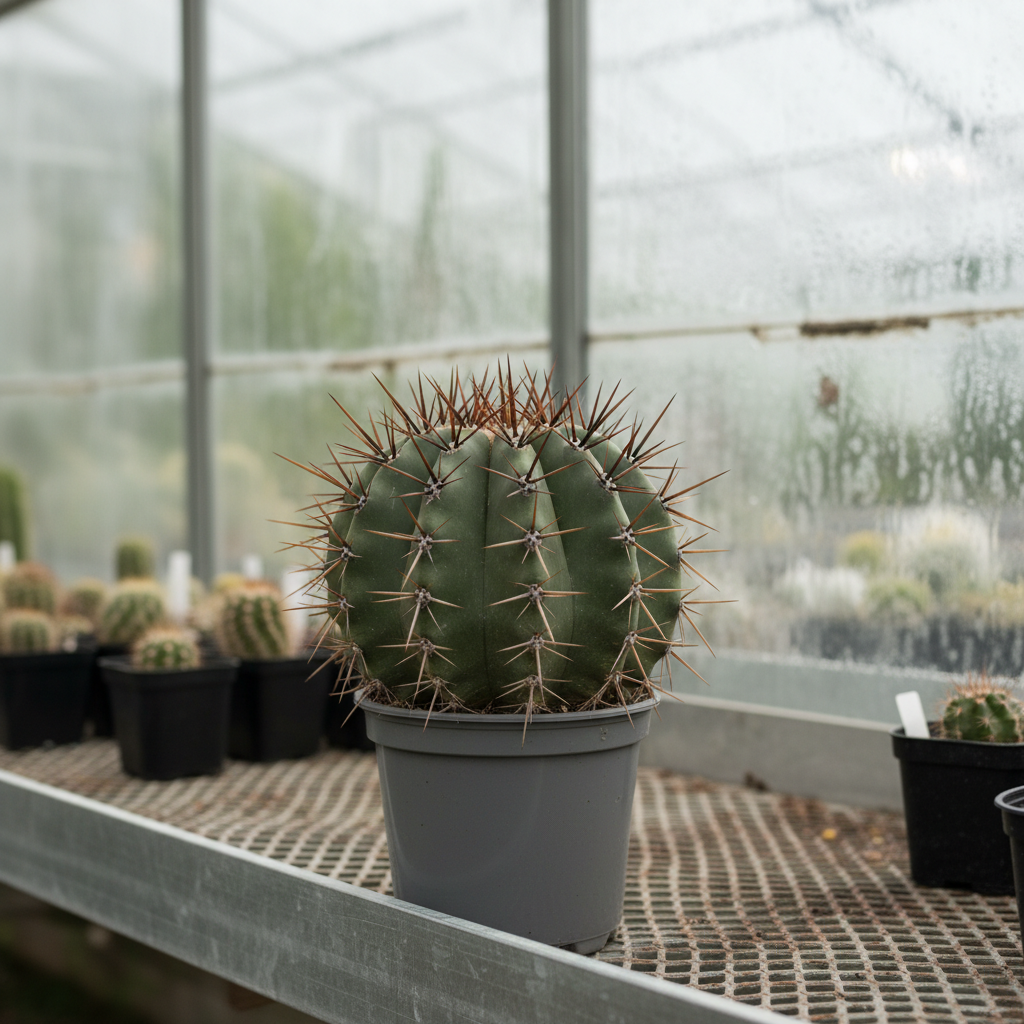
Fishhook Barrel
The classic form of Ferocactus wislizeni, named for its broad, flattened central spines that curl into a pronounced hook at the tip. The spines are often banded grey and red, and against the deeply ribbed green body they make this one of the most ornamental of the true barrels. Mature plants crown themselves in orange to yellow flowers in late summer.
Compass Barrel
A name applied to closely related barrels such as Ferocactus cylindraceus, distinguished by a more elongated, cylindrical body and dense spines that take on yellow to red tones. Its habit of leaning toward the sun is so reliable that desert travellers once used it to find south. Care is identical to the fishhook barrel: fierce light, gritty mix and restrained watering.
Frequently Asked Questions
How often should I water a barrel cactus?
Roughly every two to three weeks in the warm, bright months, and far less in winter, when many indoor plants want water only once a month or not at all. Treat those numbers as a guide rather than a rule: only water when the soil has dried out completely from top to bottom. The safest habit is to wait until the pot feels light and the mix is bone dry, then water deeply, then leave it alone again.
Why is my barrel cactus leaning to one side?
Usually it is leaning toward the light, a natural tendency in this species that earns related plants the “compass barrel” name. Rotate the pot a quarter turn every couple of weeks to keep growth even. If the lean is accompanied by a soft, darkening base rather than simply tilting toward the window, suspect root rot from overwatering instead, which is a more serious problem.
Is the barrel cactus toxic to pets or children?
The plant itself is not poisonous if eaten. The real hazard is physical: the stout, hooked spines can cause painful puncture wounds and are notoriously difficult to remove once they catch skin. Keep a barrel cactus well out of reach of curious pets and small children, and handle it with a folded-newspaper or foam collar rather than bare hands.
Will a barrel cactus flower indoors?
It can, but only on mature plants and only when conditions are close to ideal. Flowering generally requires years of growth, very strong light, and a genuine cool, dry winter rest to trigger bud formation. A young plant on a moderately bright sill is unlikely to bloom, so treat flowers as a long-term reward for good year-round care rather than something to expect soon.
Why has my barrel cactus stopped growing?
Most likely it has not; it is simply growing slowly, as this species always does, and a centimetre a year can be hard to notice. Genuine stalling usually points to too little light or a winter dormancy, both normal. As long as the body stays firm and green, a static barrel cactus is a healthy one. If growth has stopped and the plant is softening or discolouring, look to rot rather than to a lack of feeding.
Care for a barrel cactus and you are caring for a small piece of the desert: a plant that asks for sun, sharp drainage and the discipline to leave it alone. Match those conditions and it will reward you not with rapid growth but with something rarer, a slow, sculptural permanence that quietly outlasts almost everything else on the windowsill.






