
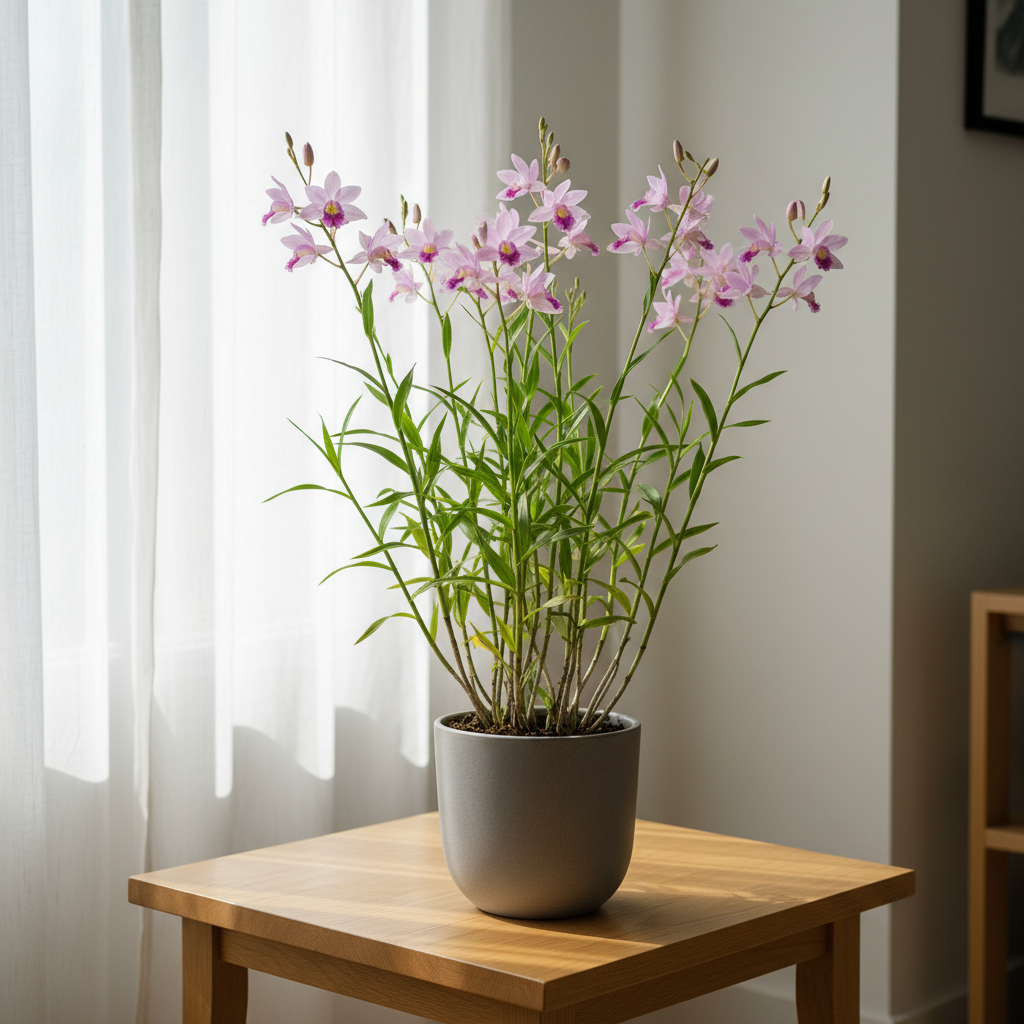
The bamboo orchid (Arundina graminifolia) is the rare terrestrial orchid that looks more like a slender stand of bamboo than the moth-shaped phalaenopsis most growers know. Native to a sweeping arc of tropical Asia from the Himalayan foothills through southern China, Thailand, Malaysia and Indonesia, it sends up clusters of upright reed-like canes a metre or more tall, dressed along their length with narrow grass-like leaves. From the cane tips emerge successive sprays of three-petalled flowers, typically lavender-pink with a frilled magenta lip and a warm yellow throat, each bloom about seven centimetres across. The plant is sometimes sold under the alternate names grass orchid or reed orchid, and its trailing relative Arundina bambusifolia is occasionally lumped under the same label by nurseries.
Its reputation among houseplant growers is mixed for one reason: a bamboo orchid will survive a normal lit room for a long time without flowering, but it only truly thrives when it gets the bright direct light, generous water and warm humid air it would meet beside a tropical stream. This guide walks through the conditions that move the plant from green-but-stubborn to free-flowering, and explains where the real failure points hide: insufficient light, soggy crowns at the cane base, and the temperature swings that interrupt a flowering cycle just as it gets going.
Contents
- Quick Reference
- Why Bamboo Orchid Makes a Rewarding Houseplant
- Light Requirements
- Watering and Humidity
- Soil, Potting and Repotting
- Fertilising
- Propagation
- Pests and Diseases
- Popular Varieties
- Frequently Asked Questions
Quick Reference: Bamboo Orchid at a Glance
| Light | Very bright indirect to several hours of gentle direct sun; a south or east window indoors, dappled outdoors |
| Watering | Keep the mix evenly moist in growth, never bone-dry; ease back slightly in winter rest |
| Temperature | 20 to 32 °C (68 to 90 °F) by day, no colder than 13 °C (55 °F) at night |
| Humidity | 60 to 80 percent; minimum 50 percent for healthy buds |
| Fertiliser | Balanced 20-20-20 at quarter strength every watering in growth; bloom-booster from late summer |
| Toxicity | Generally regarded as non-toxic to cats, dogs and humans; not a known pet hazard |
| Mature size | Canes typically 80 to 150 cm (32 to 60 in) indoors, up to 2 m (6 ft) in ideal conditions |
| Native range | Tropical and subtropical Asia from the Himalayas to Southeast Asia and the western Pacific |
Why Bamboo Orchid Makes a Rewarding Houseplant
For a long time the bamboo orchid was treated as a botanical garden curiosity rather than a houseplant, and the reason was practical rather than aesthetic: most homes are simply too dim and too dry to coax it into bloom. With the rise of grow lights, brighter modern interiors with large glazing, and the conservatory-style rooms that have become popular again, the species has had something of a second life. A mature plant in good conditions throws up new canes through spring and summer, then carries clusters of large lavender-pink flowers at the cane tips for weeks at a time, often blooming in successive flushes from late spring well into autumn.
Visually it occupies an unusual niche in the indoor garden. The bamboo-like cane habit makes it read as a structural plant rather than a fussy flowering specimen, so it works in modern minimal rooms where a phalaenopsis would feel slightly out of place. The grass-like foliage stays clean and architectural even when the plant is between flushes, and the flowers themselves are large and orchid-perfect without the slightly engineered look of a mass-produced moth orchid. Once it settles, it is also generous: a happy clump will keep producing new canes every year, slowly thickening into a small stand that can be divided to share or to keep the parent vigorous.
The flip side of all that potential is honesty about its requirements. The bamboo orchid is not a low-light, low-fuss plant in the way pothos or sansevieria are, and treating it as one almost guarantees a slow decline. It rewards growers who can give it a really bright spot, water it as if it were a hungry tropical perennial, and accept that it will look its best in summer and pull back in winter. Approach it as a houseplant version of a small tropical reed, rather than as a delicate fancy orchid, and the relationship becomes a great deal easier.
Light Requirements
Light is the single biggest variable that decides whether a bamboo orchid blooms, and it is the one most home growers underestimate. In its native range the species grows in open clearings, along forest edges, on roadside banks and even in disturbed grassland, where it catches several hours of direct sun a day with only occasional dappling from taller vegetation. It is, in plant-care terms, a high-light terrestrial orchid that happens to tolerate brief shade rather than a true shade plant.
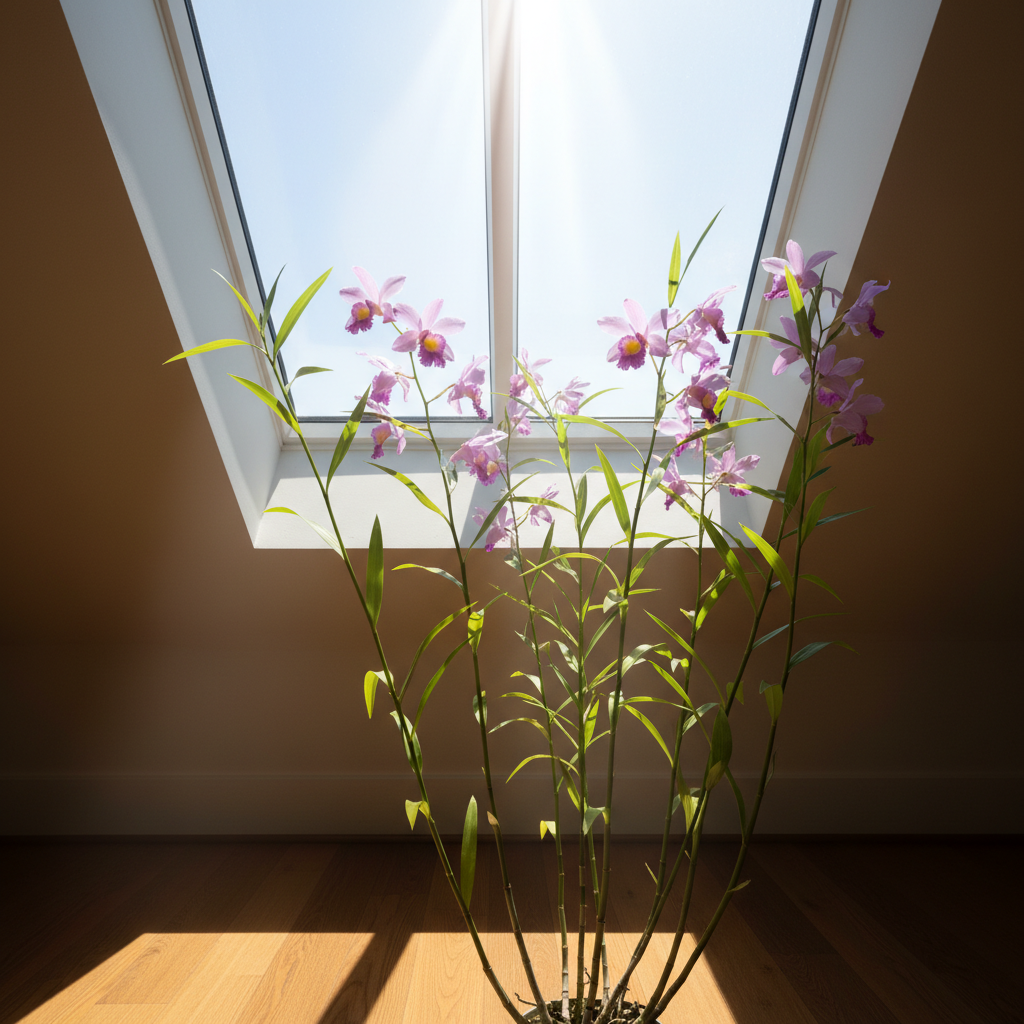
Indoors, the ideal placement is within a metre of a large south-facing or west-facing window, with the plant catching at least three to four hours of direct sun a day through clear glass. An east window works well in warm climates where the morning light is strong, but a north window almost never delivers enough energy to trigger flowering. If the only available bright spot has very harsh midday sun, a sheer curtain or a step back of half a metre is enough to soften the worst of it without dropping the plant into ordinary indirect light.
The plant will tell you quite clearly whether it has enough light. In good conditions the canes stand upright on their own, the leaves are a fresh medium green, and new growth in spring rises quickly with leaves spaced close together. In low light the canes lean towards the brightest window, the spacing between leaves stretches out, and the foliage darkens to a tired blue-green; over a full season the plant will fail to bloom at all and may produce no new canes the following year. If you cannot reasonably reach those levels at a window, a full-spectrum LED grow light running for ten to twelve hours a day at a distance of around 30 cm (12 in) is a reliable substitute and is now how many serious bamboo orchid growers cultivate the species in temperate climates.
Pro Tip — Use the leaves as a light meter: if your bamboo orchid has not produced new canes for an entire growing season, the cause is almost always insufficient light rather than feeding, watering or pot size. Move it brighter before you change anything else.
Outdoors in summer, where conditions allow, the bamboo orchid responds spectacularly to a sheltered patio or balcony with morning sun and afternoon dappling. A few weeks outside in temperatures above 18 °C (64 °F) can do more for an under-performing indoor plant than any fertiliser regime. Acclimatise it gradually over a week or so, increasing exposure each day, to avoid scorching leaves that have spent the winter behind glass.
Watering and Humidity
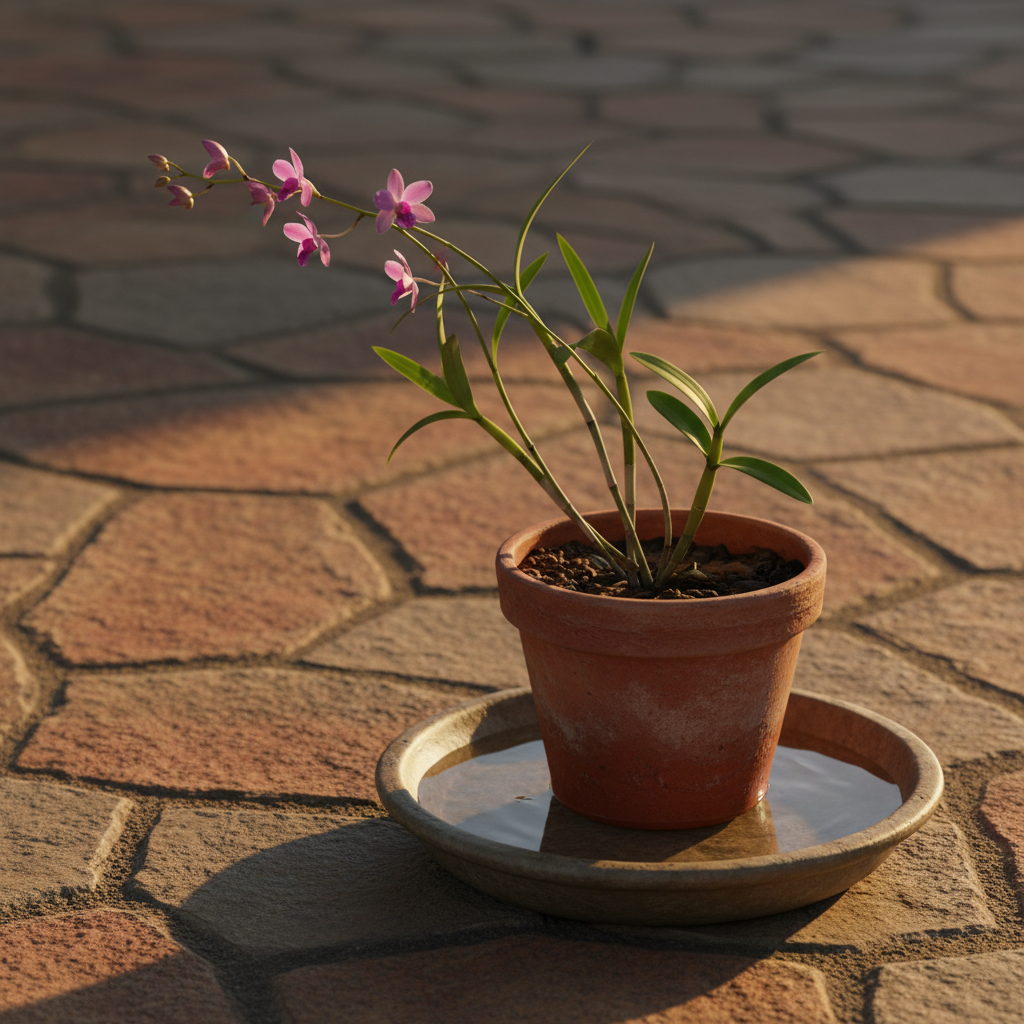
The bamboo orchid behaves more like a moisture-loving tropical perennial than the typical epiphytic orchid kept on a dry-and-then-flood regime. In active growth from spring through early autumn it likes the mix to stay evenly moist, never dust-dry between waterings, but it absolutely will not tolerate water standing around the rhizome or the base of the canes for any length of time. The compromise is a free-draining substrate, watered generously and often enough that water flushes through the pot each time, with any excess in a saucer tipped away within an hour.
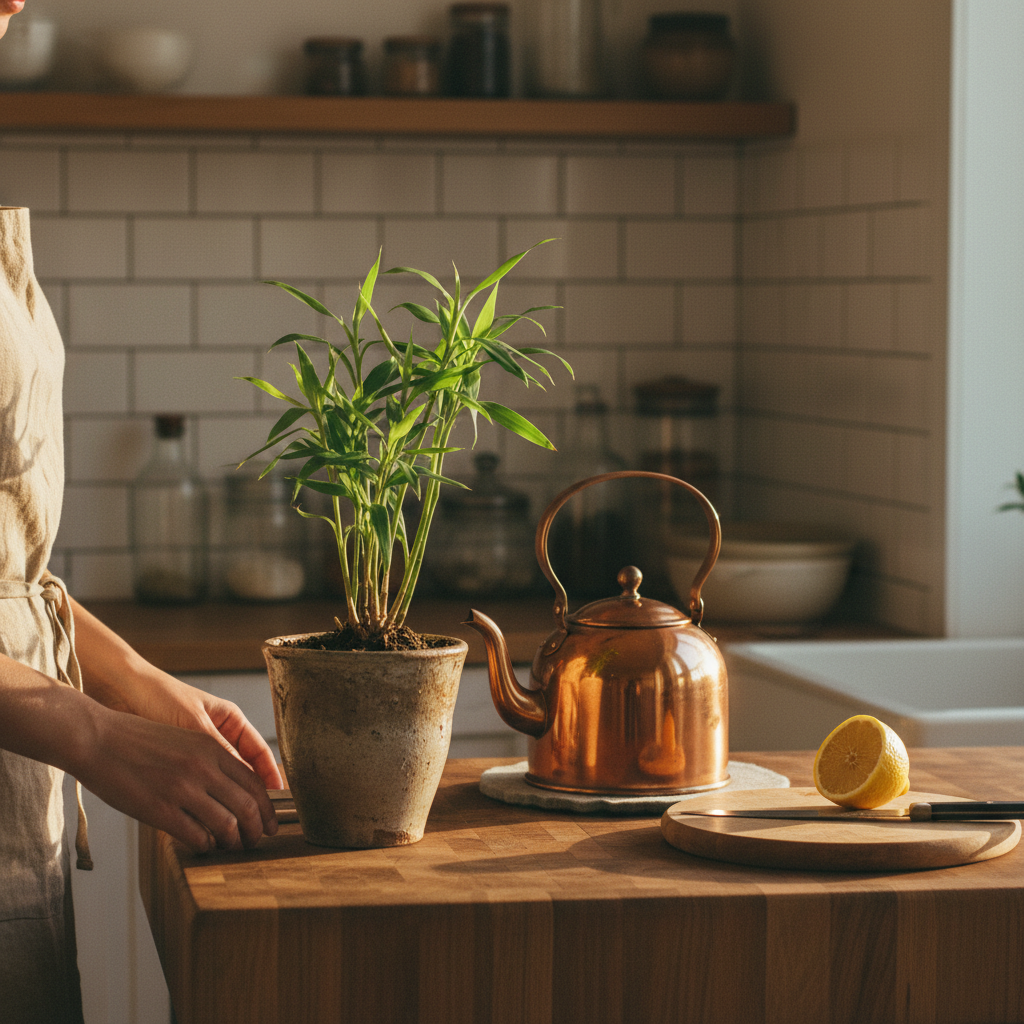
In practice, a healthy bamboo orchid in a 17 to 20 cm (7 to 8 in) pot indoors will want a thorough soaking roughly every three to five days in warm bright weather, falling to every seven to ten days in cooler dim months. Rather than working to a calendar, lift the pot before watering: a pot that feels light and dry-bottomed needs water now, a pot that still has weight to it can wait. Slip a finger or a wooden chopstick a few centimetres into the mix; if it comes out almost dry, water, and if it comes out still cool and slightly damp, leave the plant alone for a day or two more.
Water quality matters more for this species than for many common houseplants. Bamboo orchids are sensitive to the dissolved minerals and chlorine in heavily treated tap water, particularly in hard-water regions, where over time you may see leaf tips browning and a chalky crust forming on the soil surface. Where possible, use rainwater, collected condensate from an air-conditioner or dehumidifier, or filtered water at room temperature. If only tap water is available, let it stand uncovered for 24 hours so the chlorine dissipates, and flush the pot through with a heavy watering once a month to wash accumulated salts out of the substrate.
Warning — Watch the cane bases: water that pools around the rhizome or splashes into the leaf joints can lead to crown rot, which spreads quickly in warm humid conditions. Water at the soil surface, never overhead, and avoid leaving the plant sitting in a wet saucer overnight.
Humidity is the second half of the watering equation and is where indoor culture most often falls short. The bamboo orchid is happiest at 60 to 80 percent relative humidity, levels typical of a tropical garden or a glasshouse but rare in a centrally heated home, where winter humidity can drop below 30 percent. At 50 percent it will tolerate life cheerfully; below that, buds may blast before opening and leaf tips can brown. A pebble tray under the pot, grouping with other plants, a small room humidifier or a position in a steamy bathroom with good light all help to lift the local humidity without resorting to constant misting, which can encourage fungal problems on the foliage.
Through winter, when both temperatures and day length drop, scale watering back by roughly a third. The plant naturally slows its growth and uses less water; sticking to a summer watering schedule in dim cool conditions is one of the fastest routes to a rotted rhizome. The mix should still never dry out completely, but a small margin of dryness between soakings in winter is welcome.
Soil, Potting and Repotting
Despite its terrestrial habit, the bamboo orchid does not enjoy the dense water-retentive soils that suit most houseplants. In the wild it roots into gritty, organic-rich pockets among rocks and grass tussocks, where rain drains through quickly but the substrate stays cool and lightly moist. A good potting mix tries to mimic that environment: open enough that water runs through freely, with enough organic content to hold moisture between waterings without ever becoming sour.
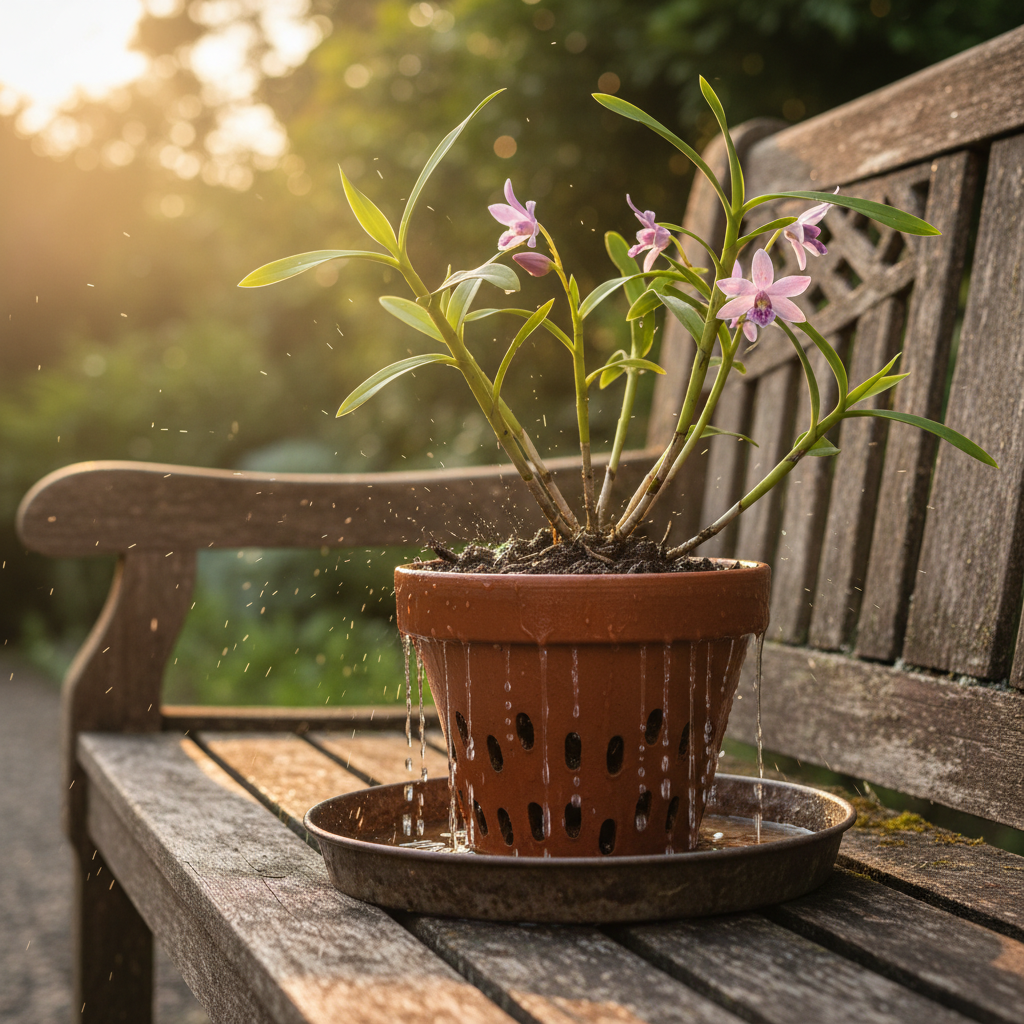
A reliable home-mixed substrate is roughly two parts medium-grade orchid bark, one part coco coir or sphagnum moss, one part perlite or pumice, and a small handful of horticultural charcoal per litre of mix to keep the substrate sweet. If you prefer a single bagged option, a high-quality terrestrial orchid mix or a cymbidium mix is a sensible starting point, often improved with a further handful of perlite to lighten the texture. Avoid standard houseplant compost on its own; it holds too much water for too long and packs down within months, suffocating the rhizome.
Pot choice has more influence on bamboo orchid health than is sometimes appreciated. Terracotta is the traditional and still excellent option, because the porous walls allow excess moisture to evaporate and oxygen to reach the roots from the sides as well as from above. Glazed ceramic and plastic both work too, provided the mix is open enough and there are generous drainage holes; in those pots, err on the slightly drier side between waterings. Whatever the pot, choose one only one size up from the existing rootball when repotting. A bamboo orchid sitting in an over-sized pot full of damp mix is at significant risk of rot.
Repotting is best timed for early spring, just as new canes begin to emerge but before they have grown tall enough to be damaged in handling. A young plant will typically need re-potting every year or two; an established clump can be left for three to four years if the mix still looks open and smells clean. To repot, tip the plant out, gently shake or tease away the old substrate, trim back any blackened or hollow roots with clean secateurs, and settle the rhizome at the same depth in the new pot with the canes rising vertically. Water lightly to settle the mix, then withhold a heavy watering for a week to let any cut surfaces callus over.
Pro Tip — Top-dress instead of full repot: if the plant looks healthy but the surface of the mix has degraded to a fine dark layer, simply scrape off the top 2 to 3 cm and replace it with fresh chunky orchid bark and perlite. This refreshes drainage at the rhizome without disturbing the roots.
Fertilising
Bamboo orchids are surprisingly heavy feeders for an orchid. The combination of fast cane growth in summer and large flowering trusses each year means they pull a substantial amount of nutrition out of the substrate, and without regular feeding the plant tends to coast: it survives, it keeps its leaves, but it produces fewer canes and far fewer flowers. The good news is that they respond well to ordinary balanced houseplant feeds, used at much weaker dilutions than the label suggests but far more often.
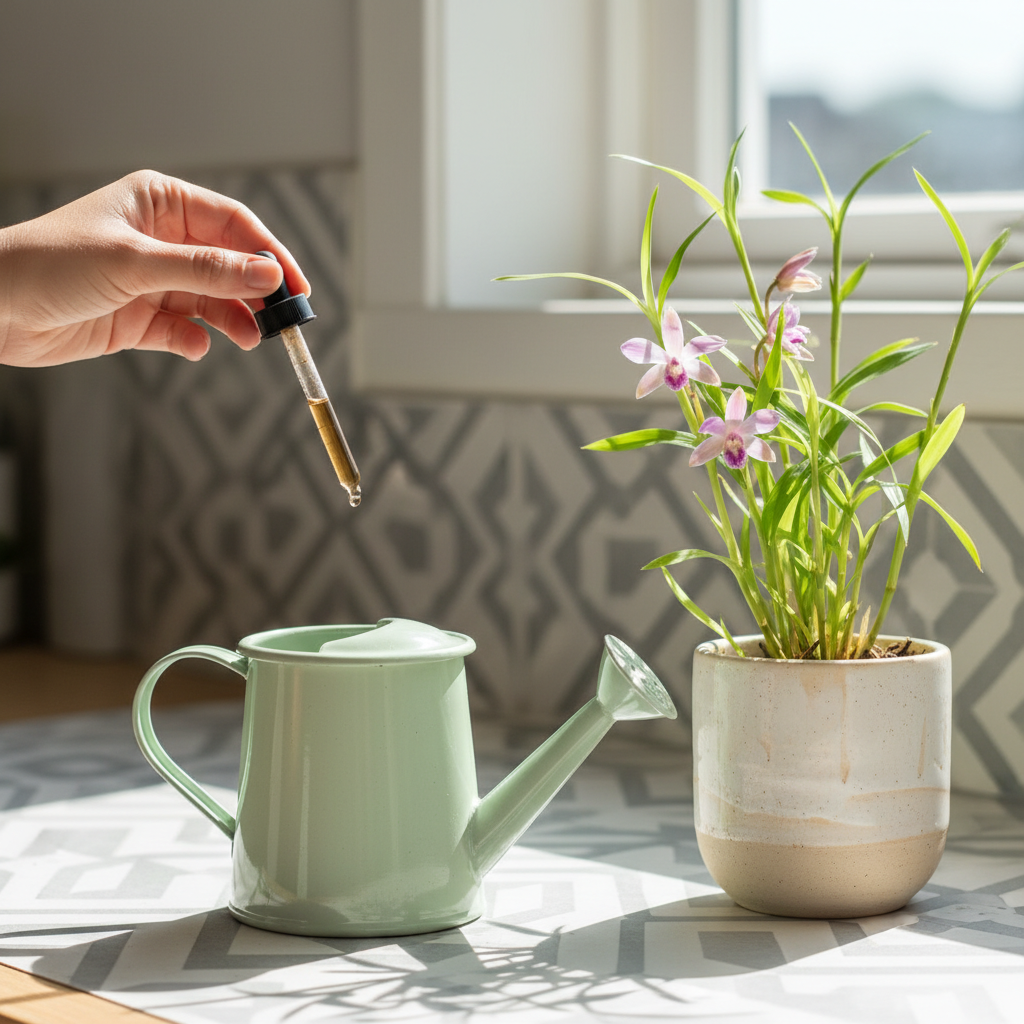
The reliable regime is the orchid grower’s standard of “weakly, weekly”. From early spring through to the end of summer, mix a balanced 20-20-20 water-soluble fertiliser at roughly a quarter of the rate recommended for general houseplants, and apply it with every other watering. From late summer into early autumn, switch to a bloom-booster formulation with a higher middle number, such as a 10-30-20, to encourage flower bud initiation for the following season. Through winter, reduce feeding to once a month or stop altogether if the plant is clearly resting in cool dim conditions.
Slow-release fertiliser pellets are convenient but can be unreliable on a chunky orchid mix, because they release unevenly as water flushes past them. If you prefer the convenience, choose a coated terrestrial-orchid-formulated pellet, scatter only a small pinch on the surface in spring, and treat it as a supplement to occasional liquid feeding rather than a complete programme. Organic options like dilute fish emulsion or seaweed extract are valued by experienced growers, particularly outdoors in summer, and can be alternated with the synthetic feed for variety; just keep an eye on any odour and rinse the foliage if it splashes.
Two warning signs tell you that feeding has gone wrong. White or grey crusting on the soil surface and along the inside of the pot rim indicates a build-up of fertiliser salts, which the plant cannot use and which will eventually scorch root tips; flush the substrate thoroughly with plain water two or three times in a row to wash them out, and reduce the strength of your feed. Conversely, very pale washed-out new leaves, smaller flowers and slower cane production in a plant that is otherwise sited correctly suggest the opposite problem of under-feeding, and the answer is usually to lift the strength back up to a quarter of label rate and apply it more consistently rather than to switch product.
Propagation
The bamboo orchid is one of the more forgiving orchids to propagate at home, because it offers two reliable routes that do not depend on flask culture or sterile labs: clump division and the rooting of keikis. Both work well for the home grower and produce a genetically identical copy of the parent, which is the only way to guarantee that the new plant will carry the same flower colour and form.
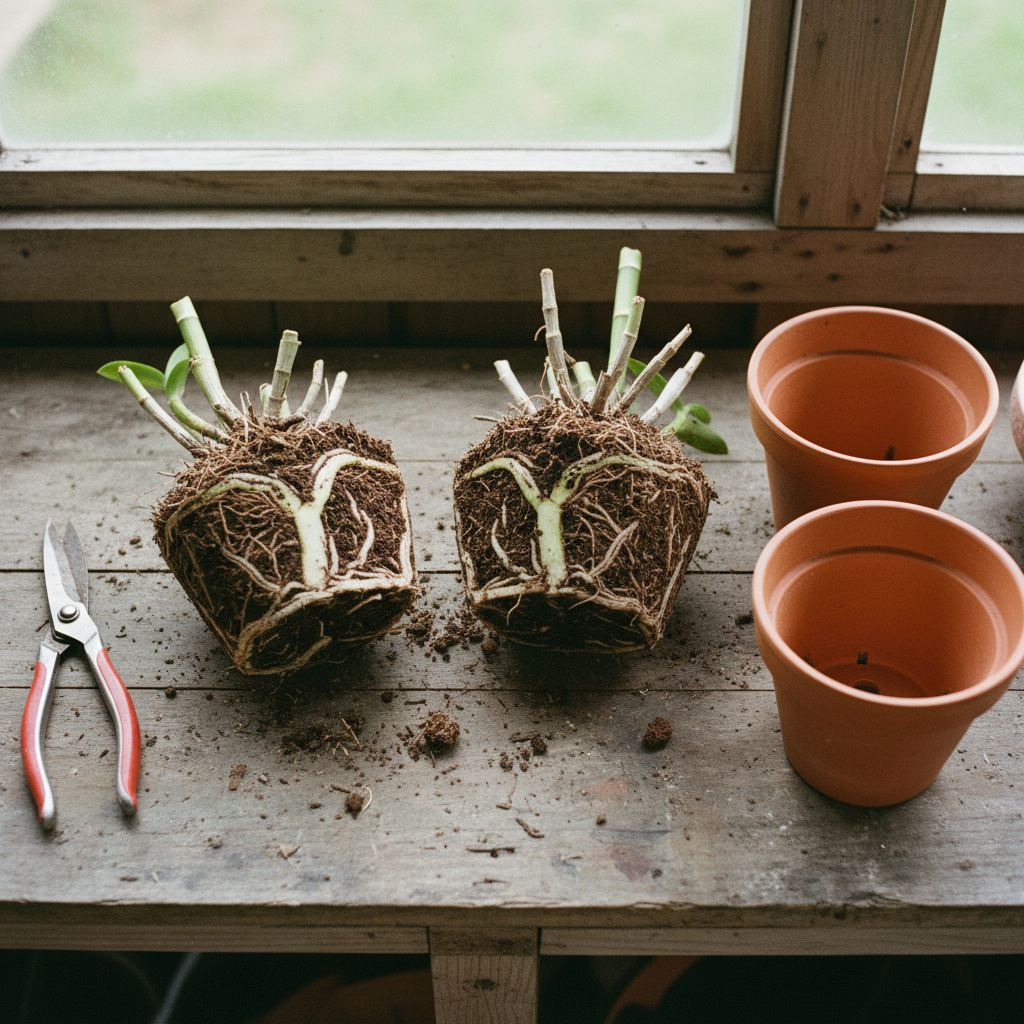
Division (the most reliable method)
Division is best done in early spring just as new canes are emerging, when the plant has plenty of growing season ahead to settle in. The process is similar to dividing any clump-forming perennial.
- Water the plant the day before so the roots are pliable but the surface mix is not sticky.
- Tip the plant out of its pot and gently shake or tease away enough substrate to see the rhizome and the bases of the canes.
- Identify natural divisions where the rhizome narrows between cane clusters. Each division should keep at least three to four mature canes and a healthy section of root.
- Cut cleanly through the rhizome with sterilised secateurs or a sharp knife, dust the cut surfaces with cinnamon or a sulphur powder to discourage rot.
- Pot each division into a snug pot of fresh free-draining orchid mix, with the rhizome sitting at the same depth as before, and water lightly.
- Keep the new divisions in bright but slightly softer light for two to three weeks, with consistent warmth and humidity, before returning them to their normal position.
Keikis (cane offsets)
Bamboo orchids are also notable for producing keikis, small plantlets that appear at nodes along an older cane, particularly after the cane has finished its main flowering. Each keiki begins as a tuft of leaves at a node, then sends out its own air roots over the course of weeks or months. Once a keiki has two or three roots at least 3 cm (1 in) long, it can be separated and grown as a new plant.
- Wait until the keiki has its own visible roots; removing it too early greatly reduces survival.
- With sterilised secateurs, cut the parent cane a few millimetres above and below the keiki, leaving a short stub on either side.
- Pot the keiki into a small pot of fine orchid mix or a 50:50 perlite-and-sphagnum mix, with its roots covered and the leaves above the surface.
- Keep the new plant under a clear plastic dome or in a humid corner for the first month to maintain high humidity around the leaves while the roots establish.
- Once new leaf growth appears, treat the keiki as a small but ordinary bamboo orchid and resume normal feeding.
Seed propagation is technically possible and is how botanic gardens and commercial nurseries produce stock at scale, but it requires sterile flasking and a specific symbiotic fungus or a synthetic medium to germinate the dust-fine seed. It is not realistic for the home grower and is rarely worth the trouble for a species that divides and produces keikis as readily as this one does.
Pests and Diseases
The bamboo orchid is not a pest magnet in the way some thin-leaved tropicals are, but the warm humid conditions that suit it also suit several of the usual indoor culprits, and the long narrow leaves provide plenty of surface area to hide on. Inspect the plant every couple of weeks, particularly along the undersides of the lower leaves and around the leaf joints where pests like to gather.
Common pests
Mealybugs appear as small cottony white clusters tucked into the leaf joints and along the cane bases. They are slow-moving but reproduce quickly and will eventually weaken the plant. Wipe off small infestations with a cotton bud dipped in 70 percent isopropyl alcohol, and follow up with a horticultural soap spray or neem oil application weekly until two or three weeks pass with no sign of return.
Scale insects show up as small brown or tan bumps stuck to the undersides of leaves and along the canes, sometimes with a sticky honeydew residue and the sooty mould that grows on it. Treatment is the same as for mealybugs: alcohol-on-a-bud for individuals, horticultural oil for wider infestations, and patience because scale takes several treatment cycles to clear fully.
Spider mites arrive in hot dry conditions, particularly when central heating is running and humidity has crashed. The first sign is fine pale stippling on the upper leaf surface, followed by very fine webbing in the leaf joints. Raise the humidity sharply, shower the foliage in lukewarm water, and treat with a miticide or neem oil spray weekly for three to four weeks. Improving humidity is what stops them coming back.
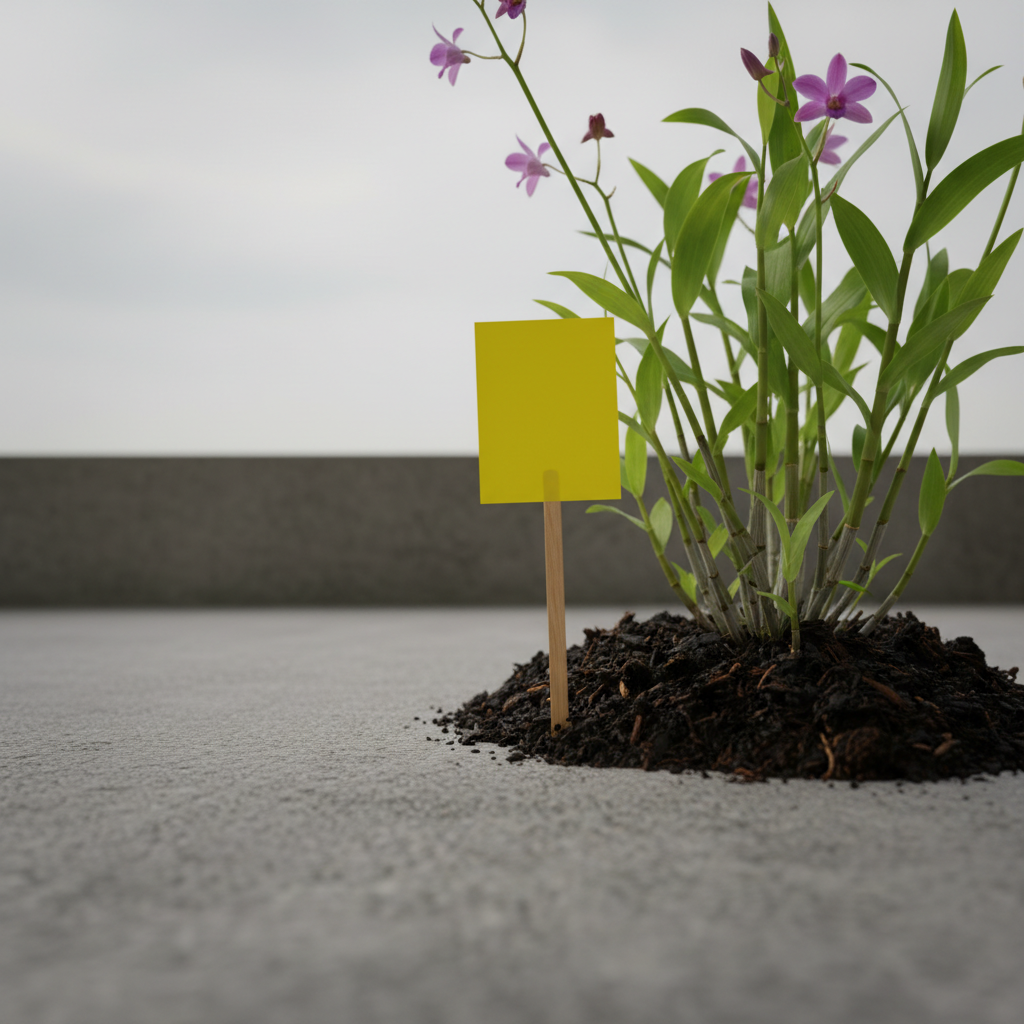
Fungus gnats are usually a symptom rather than a cause; their larvae thrive in mix that stays too wet for too long. A yellow sticky trap at soil level catches the adults and indicates whether the population is building, but the real solution is to let the surface 2 to 3 cm of mix dry between waterings and to top-dress with a thin layer of horticultural sand or grit, which the adults dislike laying eggs on.
Common diseases
Crown and rhizome rot is the most serious problem the bamboo orchid faces indoors. It begins as a soft yellow or brown discoloration at the base of a cane, often accompanied by a slightly sour smell, and can travel through the rhizome to neighbouring canes in days. Cut away any affected tissue with sterilised secateurs back to clean white firm material, dust the wound with cinnamon or sulphur powder, and repot into fresh dry mix in a smaller pot. Reduce watering markedly while the plant recovers.
Leaf spot appears as small water-soaked patches that dry to brown lesions, often on lower leaves in still humid air. Remove affected leaves, improve air movement around the plant with a small fan running on low, and avoid overhead watering. Persistent leaf spot may need a copper-based fungicide, used according to the label.
Warning — Quarantine new arrivals: bamboo orchids brought home from a nursery are a common entry point for scale and mealybugs into a wider collection. Keep any new plant on its own for at least three weeks and check it carefully before placing it alongside others.
Popular Varieties
Arundina graminifolia is the only widely cultivated species in its genus, and most plants in the trade are very close to the wild form. There is, however, real variation in flower colour, plant size and leaf habit across its enormous natural range, and a handful of named selections and forms are now offered by specialist orchid nurseries.
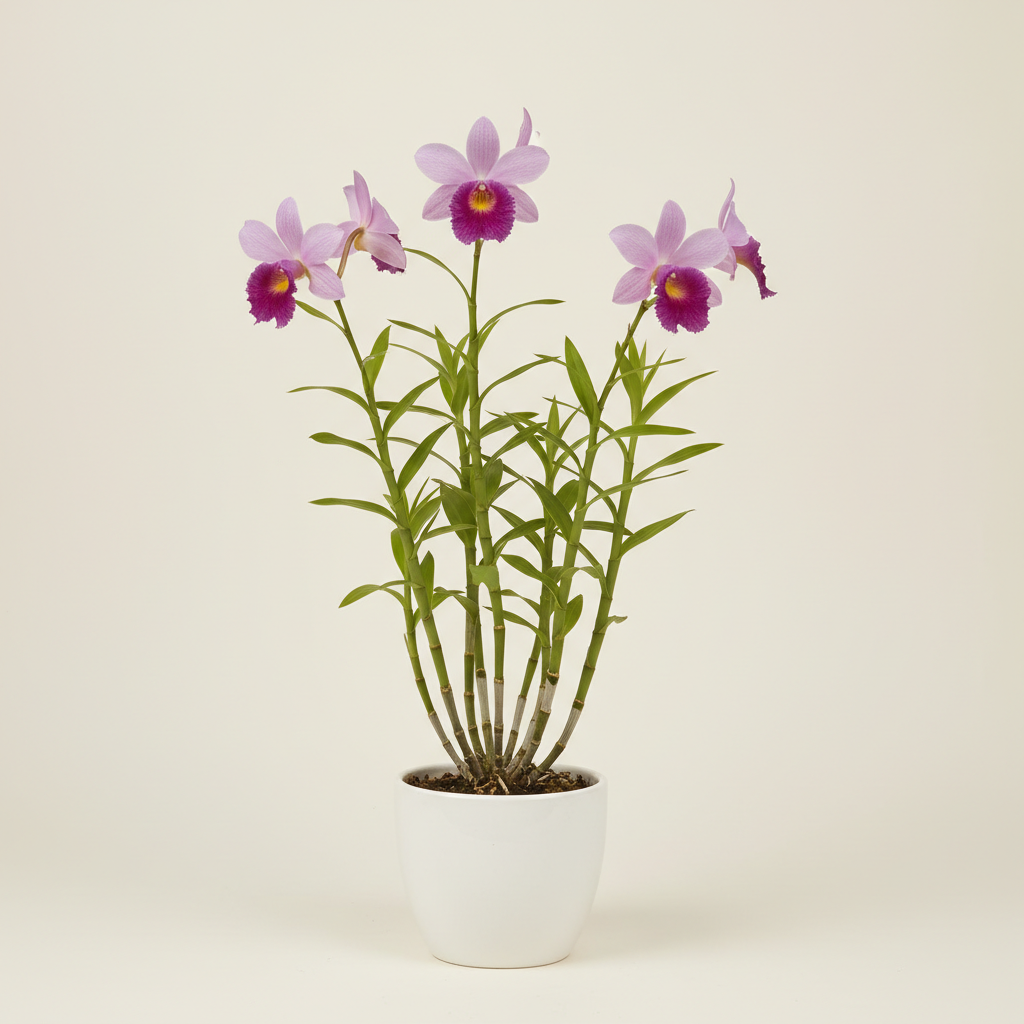
Typical Form (var. graminifolia)
The plant most often sold simply as “bamboo orchid”, carrying flowers around 6 to 8 cm (2.5 to 3 in) across with lavender-pink outer segments and a strongly frilled magenta lip marked with a warm yellow throat. Canes typically reach 1 to 1.5 m (3 to 5 ft) in cultivation. The most forgiving and free-flowering of the named forms, and the best starting point for a first plant.
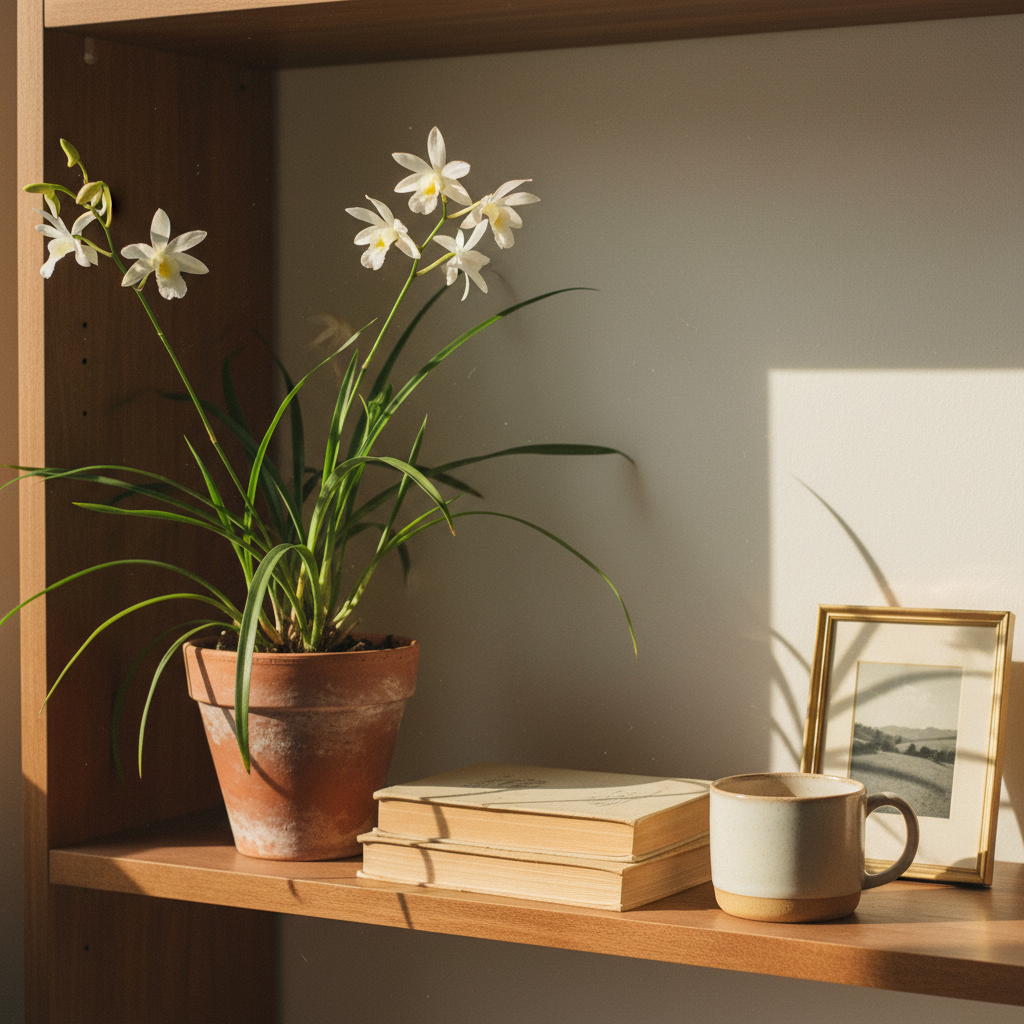
Alba (forma alba)
A scarce and much-sought white-flowered form, with pure white outer segments, a creamy lip and a pale lemon-yellow throat in place of the typical magenta. The plant is slightly less vigorous than the typical form and a touch fussier about consistent warmth and humidity, but in good conditions it carries the same prolific summer-into-autumn flowering. Best treated as a slightly more delicate version of the species.
Other forms occasionally offered
Arundina graminifolia var. revoluta is a regional form from Sri Lanka and the southern Western Ghats with slightly narrower revolute-edged leaves and richer pink flowers, sometimes listed separately by specialist growers. Arundina bambusifolia, a related species often confused with A. graminifolia, is shorter and more bamboo-like in habit but carries similar pink flowers; its cultural requirements are essentially the same as those covered in this guide.
Frequently Asked Questions
Why won’t my bamboo orchid flower?
The overwhelming cause is insufficient light. The plant needs several hours of direct or very bright indirect light a day, ideally close to a south or west window, to initiate flower buds. Other factors include a pot that is too large with damp mix the plant cannot use, a winter that never quite dropped to a true cool rest, or simply a young plant whose canes have not yet matured. If the plant looks otherwise healthy, move it brighter and wait one full growing season before changing anything else.
Is bamboo orchid toxic to cats and dogs?
True orchids in the family Orchidaceae are generally regarded as non-toxic to cats, dogs and humans, and Arundina graminifolia is not listed by the major pet poison advisory bodies as a known hazard. As with any plant, a curious pet eating large quantities of leaves may experience mild digestive upset, and the chunky bark substrate is a more realistic worry if a dog enjoys chewing it. Place the pot out of easy reach and tidy any fallen leaves.
How tall does a bamboo orchid get indoors?
Indoors, the canes usually reach 80 to 150 cm (32 to 60 in), depending on light, feeding and pot size. In bright conservatories or under strong grow lights, mature clumps can push up to 2 m (6 ft), close to the upper end of the species’ natural range. A plant that stays under 60 cm year after year is almost always being kept in conditions that are too dim or too cool.
Can I grow bamboo orchid outdoors year-round?
Only in tropical and warm subtropical climates, broadly USDA zones 10 and 11 or equivalent, where winter night minimums stay above 10 °C (50 °F) and frosts never occur. In cooler regions it can spend late spring through early autumn outside in a sheltered semi-shaded spot but must come indoors before the first cold nights of autumn. Sustained temperatures below 10 °C (50 °F) will damage the foliage and may set the plant back for a full year.
How long do the flowers last?
Each individual flower opens for about a week to ten days, but a healthy plant carries flowers in successive flushes through the warmer half of the year rather than all at once. From late spring well into autumn, there is usually at least one open flower somewhere on the plant, with peak displays of three to five blooms at once on a mature cane.
Should I cut back old canes after flowering?
Not immediately. An old cane will often produce a second flush of flowers, or develop a keiki, in the season after its first bloom. Wait until a cane has clearly turned yellow and dry, with no green tissue left, before cutting it back to the rhizome with sterilised secateurs. This both keeps the plant looking tidy and reduces the risk of fungal entry through dead tissue.
Why are the leaf tips turning brown?
Brown leaf tips are usually a humidity or water-quality issue rather than a feeding problem. Persistently low humidity, fluoridated or chlorinated tap water and a build-up of fertiliser salts in the mix are the three most common culprits. Raise local humidity, switch to rainwater or filtered water where possible, and flush the pot with plain water once a month to prevent salt build-up.
Does the bamboo orchid need a winter rest?
A mild cool rest helps but is not essential. In its native range the species experiences a slightly cooler, drier season in winter, and replicating that indoors by reducing water by about a third, stopping feed, and accepting cooler night temperatures around 13 to 16 °C (55 to 60 °F) can encourage stronger flowering the following year. In a warm centrally heated room without that rest the plant will still grow and flower, just slightly less freely.






