
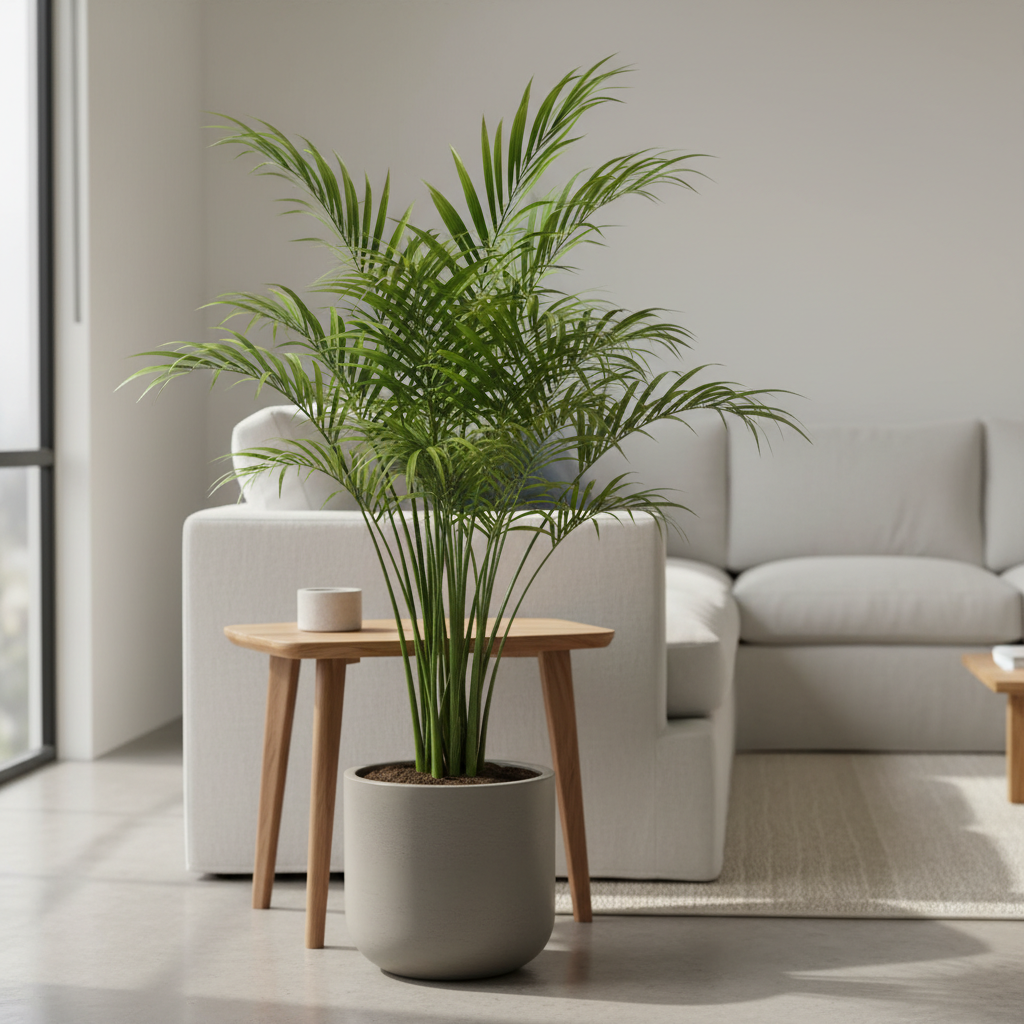
The parlor palm (Chamaedorea elegans), also widely sold under the name Neanthe Bella palm, is one of the oldest and most enduring houseplants in cultivation. Native to the dim, humid understorey of rainforests in southern Mexico and Guatemala, this slender, clumping palm rose to fame in Victorian-era parlors because it tolerated the gloomy interiors, coal smoke and erratic warmth of nineteenth-century drawing rooms better than almost any other tropical plant. More than a century later, it remains a benchmark for low-light indoor greenery, prized for its delicate arching fronds, fine-textured foliage and surprisingly forgiving constitution.
The reputation that the parlor palm is “easy” is largely accurate, but there is still a meaningful gap between a plant that merely survives in a corner and one that fills out into the lush, multi-stemmed cluster shown on plant-shop tags. The difference comes down to attentive watering, sensible light placement, gentle feeding and a watchful eye for the few pests that genuinely trouble this species. This guide walks through every aspect of parlor palm care in depth, from light and humidity to repotting, propagation by division and dealing with the spider mites that haunt most indoor palms in dry winter air.
Contents
- Quick Reference
- Why Parlor Palm Makes a Reliable Houseplant
- Light Requirements
- Watering & Humidity
- Soil, Potting & Repotting
- Fertilising
- Propagation
- Pests & Diseases
- Popular Varieties
- Frequently Asked Questions
Quick Reference: Parlor Palm at a Glance
| Light | Medium to bright indirect; tolerates low light better than most palms; never direct sun through glass. |
| Watering | Keep evenly moist; allow the top 2 to 3 cm (1 in) of soil to dry between waterings. Roughly once a week in summer, every 10 to 14 days in winter. |
| Temperature | 18 to 27 degrees C (65 to 80 degrees F). Avoid sustained exposure below 10 degrees C (50 degrees F). |
| Humidity | Prefers 50 percent or higher; tolerates average household humidity but leaf tips brown in very dry air. |
| Fertiliser | Balanced liquid feed at half strength every 4 to 6 weeks during spring and summer; none in winter. |
| Toxicity | Non-toxic and pet-safe. Listed by the ASPCA as safe for cats, dogs and horses. |
Why Parlor Palm Makes a Reliable Houseplant
Almost every quality that makes a plant easy to live with indoors is built into the parlor palm. It is naturally adapted to the dim, still air of a rainforest understorey, where mature trees filter most of the sunlight long before it reaches the forest floor. Translated into a typical living room, this means a parlor palm thrives in positions that would yellow or scorch most tropical plants, and it forgives the patchy, indirect light cast deep inside a home. Crucially, it also grows slowly, which keeps the plant in scale with its container for years and removes much of the routine pressure to repot.
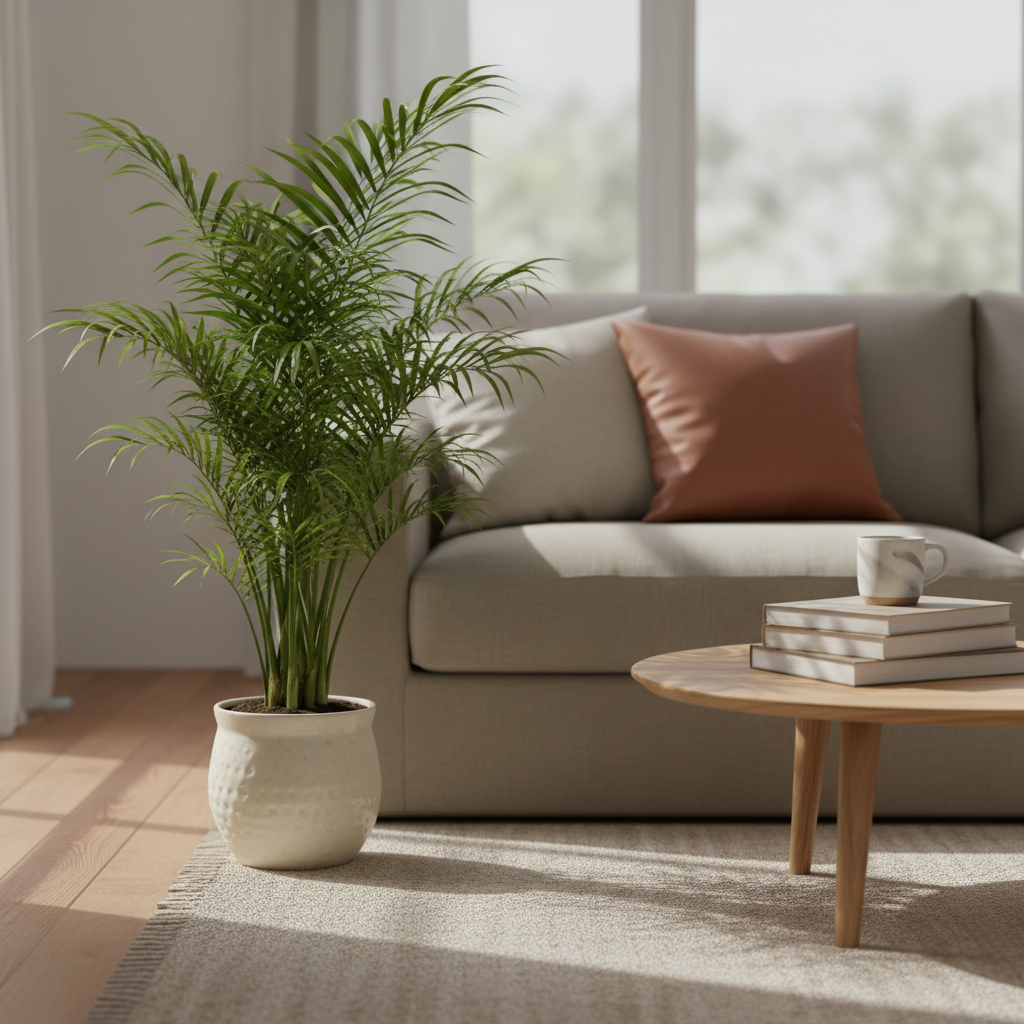
Beyond tolerance, the parlor palm earns its place visually. Its slender, bamboo-like green stems carry layered, finely divided pinnate fronds that arch in soft curves rather than rigid rosettes, giving a softer silhouette than most other indoor palms. Plants are almost always sold as multi-stemmed clumps grown from many seedlings in one pot, so even a young specimen looks bushy and full. Mature plants in good conditions can produce small sprays of yellow, bead-like flowers on tall inflorescences, a quiet bonus that even dedicated keepers sometimes miss. For households with curious pets or young children, the species also has the practical advantage of being entirely non-toxic.
Important — Toxicity: Parlor palm is listed by the ASPCA as non-toxic to cats, dogs and horses. Foliage and stems contain no known irritants or harmful compounds, which makes it one of the safest mid-sized houseplants for homes with pets. The fruits are not edible for people, however, and chewed leaves can still cause mild stomach upset in any animal that eats too much.
Light Requirements
Few houseplants have a more flexible relationship with light than the parlor palm. In its native cloud-forest understorey, mature canopy trees intercept the harsh tropical sun and what reaches a young palm is mostly soft, dappled or scattered light, often for only a few hours each day. Indoors, this translates into a plant that does perfectly well in medium indirect light and continues to produce new fronds even in distinctly low-light positions where most tropicals would stall.
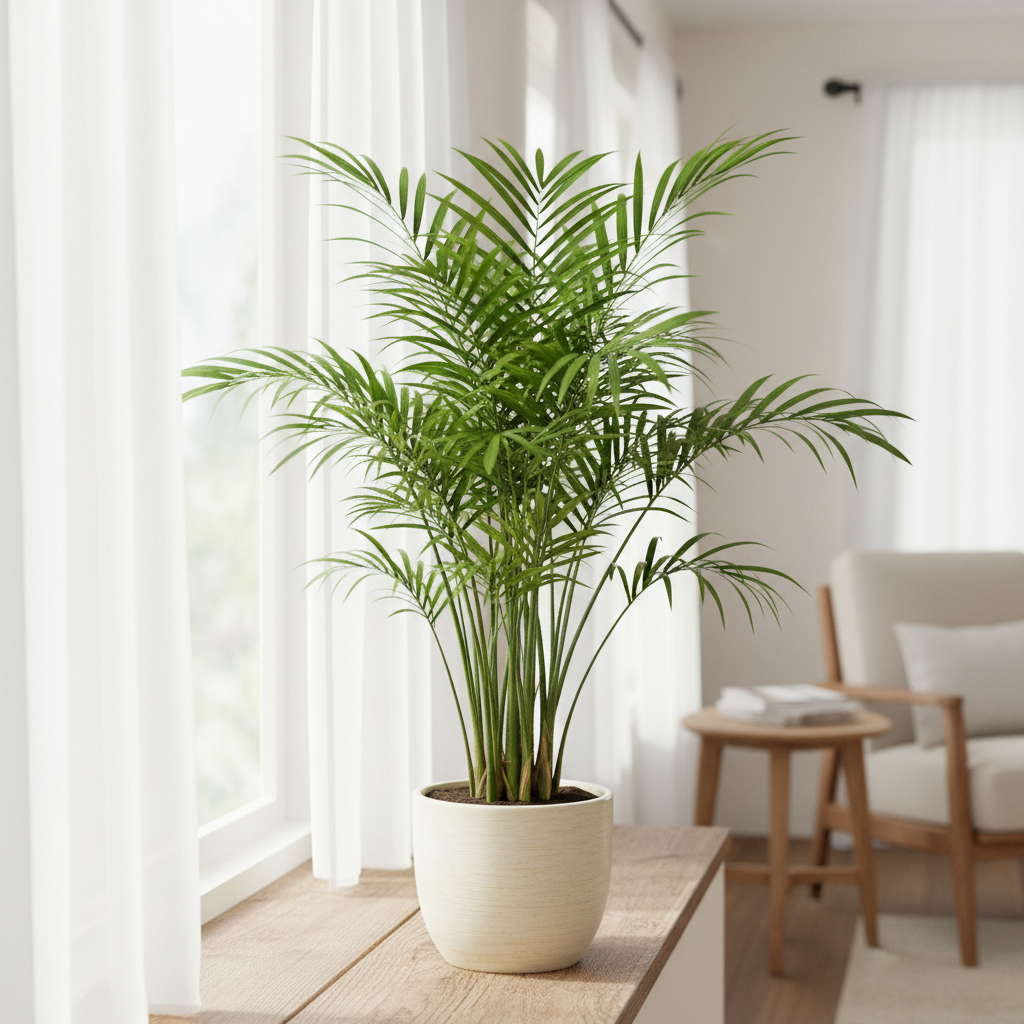
The ideal placement is a bright spot a metre or two back from a window that does not receive long stretches of direct midday sun. Filtered light through a sheer curtain is excellent; so is the area just to the side of an east- or north-facing window. A parlor palm given this level of light will grow steadily, push out new fronds two or three times a year, and keep a deep, uniform green throughout the canopy. The same plant placed in a windowless interior room with only artificial light will slow markedly but rarely show distress.
Light Levels Explained
Plant care advice often refers loosely to “low” or “bright indirect” light without anchoring those terms in measurable values. The table below maps the standard categories used in this guide to approximate illuminance levels measured in lux, the typical location in a typical home, and the practical outcome for a parlor palm.
| Light Category | Approx. Level | Typical Location | Outcome |
|---|---|---|---|
| Direct sun | 20,000+ lux | Right against an unshaded south- or west-facing window | Frond scorch within days, especially through glass |
| Bright indirect | 5,000 to 10,000 lux | Within 1 m of a sheer-curtained east or south window | Best growth; full, dark-green canopy |
| Medium indirect | 1,500 to 5,000 lux | 2 to 3 m back from a bright window | Steady, slow growth; rich colour maintained |
| Low | 500 to 1,500 lux | Interior corners, hallways with one small window | Survival with minimal new growth; existing fronds stable |
| Very low | Under 500 lux | Windowless rooms, basements with only ambient light | Decline over months; lower fronds yellow and drop |
Window Orientation and Placement
South-facing window: Acceptable only with diffusion. Place the palm at least 1.5 to 2 metres from the glass, or use a sheer curtain to soften midday sun. Unfiltered south light in summer will scorch fronds and bleach colour rapidly.
East-facing window: The ideal aspect. Gentle morning sun followed by bright indirect light for the rest of the day produces the densest, most evenly coloured canopy.
West-facing window: Workable but warmer. Position slightly back from the glass to avoid the strongest afternoon rays, particularly in summer.
North-facing window: A reliable home for a parlor palm in any season. The cool, even light is gentle on foliage and growth simply slows rather than stops. This is also the safest aspect during long, hot summers.
Pro Tip — Reading the Fronds: A healthy parlor palm holds its newest fronds proud and slightly upright before they relax into the arching mature shape. Pale, thin new fronds with limp posture usually point to too little light; a flattened, washed-out canopy on older leaves often means the opposite. Rotate the pot a quarter turn each week so all stems share the brighter side.
How Light Affects Frond Colour and Density
Although the parlor palm is not variegated, its appearance still changes with light. In bright indirect conditions the leaflets remain a deep, saturated green and stems stay closely spaced, producing the dense look most gardeners associate with the species. In sustained low light the same plant stretches noticeably between fronds, leaflets thin out and the overall canopy becomes more open and ferny. Neither pattern is unhealthy by itself, but a stretched plant rarely refills its lost density without moving to brighter conditions and time.
Warning — Direct Sunlight: Despite tolerating low light beautifully, parlor palm is highly intolerant of direct sun through glass. Even an hour or two of midday rays in summer can leave permanent yellow-brown blotches on exposed fronds. Damaged leaflets do not recover and should be trimmed once the rest of the frond is clearly stable.
Artificial Lighting
Parlor palm responds well to supplemental lighting in offices and windowless rooms. A full-spectrum LED grow light delivering roughly 2,000 to 3,000 lux at canopy level for 10 to 12 hours a day is enough to maintain colour and produce occasional new fronds. Standard living-room ceiling lights produce far less usable plant light than they appear to, so the plant should not be expected to rely on those alone for long-term health.
Seasonal Adjustments
From late autumn into early spring, light levels in many temperate homes drop sharply and a position that was perfect in summer becomes too dim. Move the palm slightly closer to its window for the dark months, then back to its summer position once daylight strengthens again in March or April. Clean the glass and wipe the fronds with a damp cloth every few weeks during winter, as a build-up of dust on either surface measurably reduces the already low available light.
Watering & Humidity
Watering is by far the most common cause of trouble with parlor palms. Unlike succulent-leaved houseplants, this species comes from consistently moist rainforest soils and does not appreciate prolonged dry spells. At the same time, its fine root system rots quickly when kept saturated. The goal is a steady rhythm of thorough soakings followed by partial drying of the top few centimetres of soil, rather than either constant moisture or shrivelling dryness.
When to Water
The most reliable cue is the soil itself. Press a finger about 2 to 3 cm (1 in) into the mix; if it feels dry at that depth but still cool and faintly moist below, it is time to water. Watering by the calendar tends to fail because the same plant in the same pot can use water two or three times faster in midsummer than in midwinter. As a rough starting point, established parlor palms in a typical living room need a thorough soaking once every 7 to 10 days during spring and summer and once every 10 to 14 days through autumn and winter.
Pot size and material also shift the rhythm. A heavy terracotta pot dries faster than a glazed ceramic one of the same size, and a plant in a tight, well-rooted pot will use water more quickly than a freshly repotted plant in a larger container. Newly purchased plants from a nursery are often grown in dense peat-based mixes that hold water for a long time, so they may need a noticeably lighter touch in the first few months at home.
Pro Tip — The Lift Test: Pick up the whole pot just before watering and again immediately after. Over a few weeks you will learn the difference between the weight of a freshly watered palm and a dry one. Once that contrast is in your hands, the lift test becomes more accurate than any moisture meter, especially for clumping plants whose surface soil dries unevenly.
How to Water Correctly
- Carry the pot to the sink or move it onto a tray to catch overflow.
- Pour room-temperature water slowly around the soil surface, avoiding the crowns where the stems emerge, until water runs freely from the drainage holes.
- Let the pot drain for at least 15 to 20 minutes so excess water leaves the rootball completely.
- Tip away any water that collects in the saucer or cachepot; do not let the pot sit in standing water.
- Return the palm to its usual spot and wait until the top 2 to 3 cm (1 in) of soil dries again before repeating.
Signs of Overwatering vs. Underwatering
| Symptom | Overwatering | Underwatering |
|---|---|---|
| Frond colour | Lower fronds turn uniformly yellow, often quickly | Fronds slowly fade to a paler, dusty green |
| Leaf texture | Soft, limp leaflets that feel cool and damp | Crisp, papery tips and edges, sometimes curling |
| Soil | Wet and sour-smelling, sometimes with surface mould | Pulls away from the pot edges, very light when lifted |
| Roots | Brown, mushy roots that fall apart when touched | Pale, dry but still firm roots |
| Stem base | Soft, dark patches at the crown where stems meet soil | Stems remain firm; sometimes a slight inward shrivel |
Warning — Root Rot: Parlor palm has a dense, fibrous root mass that suffocates quickly in waterlogged soil. Once root rot is established, recovery is difficult because the plant cannot regrow roots while the crown is also failing. If you suspect rot, unpot immediately, cut away all soft brown roots with sterilised scissors, and repot the salvaged crowns into fresh, fast-draining mix in a slightly smaller pot.
Humidity Requirements
As an understorey species from humid forests, parlor palm prefers relative humidity of around 50 percent or higher. In modern homes with central heating or air conditioning, indoor humidity often drops to 20 to 30 percent in winter, which is the most common reason for the crisp brown leaflet tips that plague even otherwise healthy specimens.
The plant will still survive in average household humidity, but cosmetic damage accumulates. Fine brown tips along the leaflet edges, especially on older fronds, almost always indicate dry air rather than thirst or fertiliser problems. New fronds that emerge stuck together or that brown along the rachis before fully unfurling are another clear signal that humidity is too low at the point of expansion.
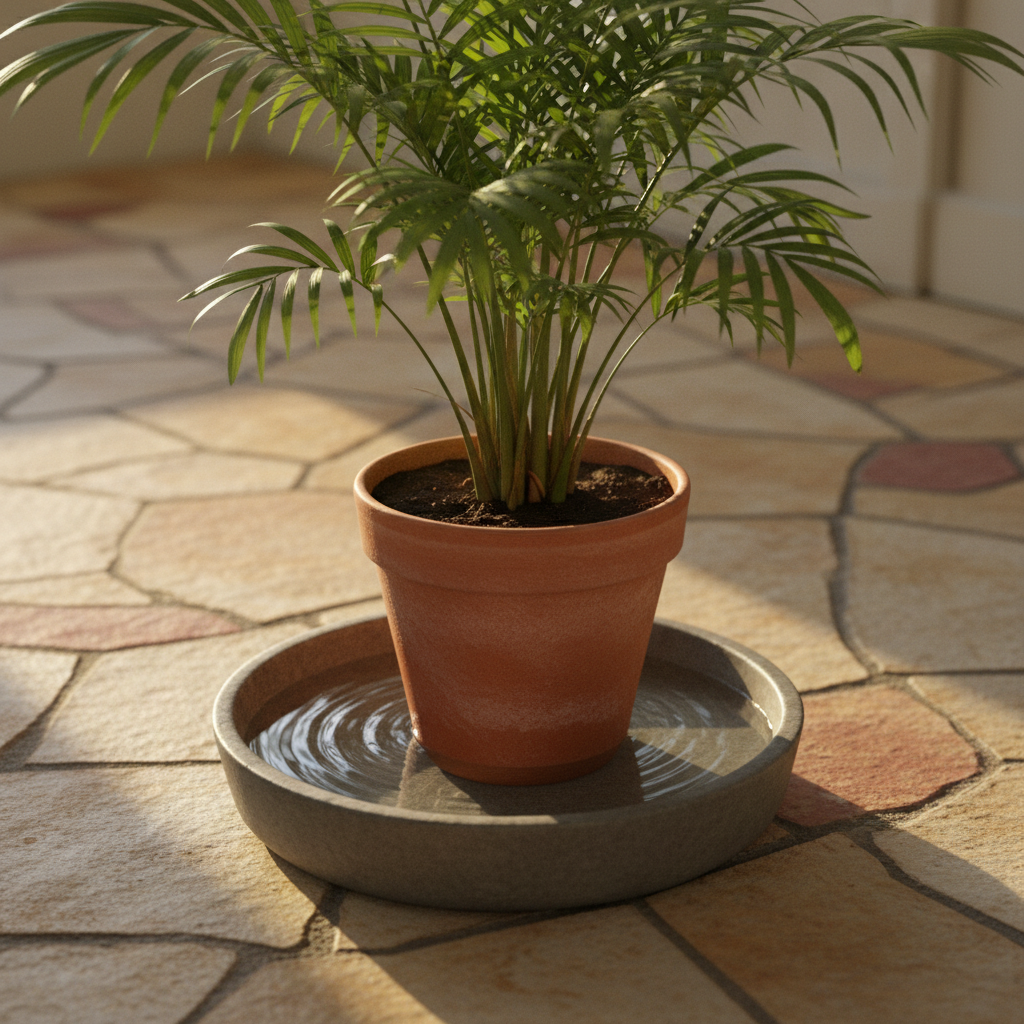
Useful ways to raise humidity around the plant include grouping it with other tropicals so that combined transpiration creates a moister microclimate, standing the pot on a wide tray of pebbles and water (with the pot sitting above the water line, not in it), and running a small cool-mist humidifier in the room during the heating season. Daily misting is pleasant but short-lived, and does little for chronic dryness on its own.
Water Quality
Parlor palm is mildly sensitive to fluoride, chlorine and dissolved salts. In areas with heavily treated or hard tap water, leaflet tips will brown more quickly even at otherwise adequate humidity. The simplest mitigations are to fill the watering can the evening before, leaving the lid off so chlorine can dissipate overnight, or to use rainwater, distilled water or filtered water for the regular routine. Avoid water that has passed through a domestic softener, since the added sodium accumulates in soil and damages roots over time.
Soil, Potting & Repotting
The right substrate gives parlor palm consistent moisture without becoming compacted or sour. In the wild it roots into a loose, leaf-rich forest floor that drains rapidly after heavy rain. The closest indoor analogue is a peat- or coir-based potting mix lightened with grit and bark for structure and aeration.
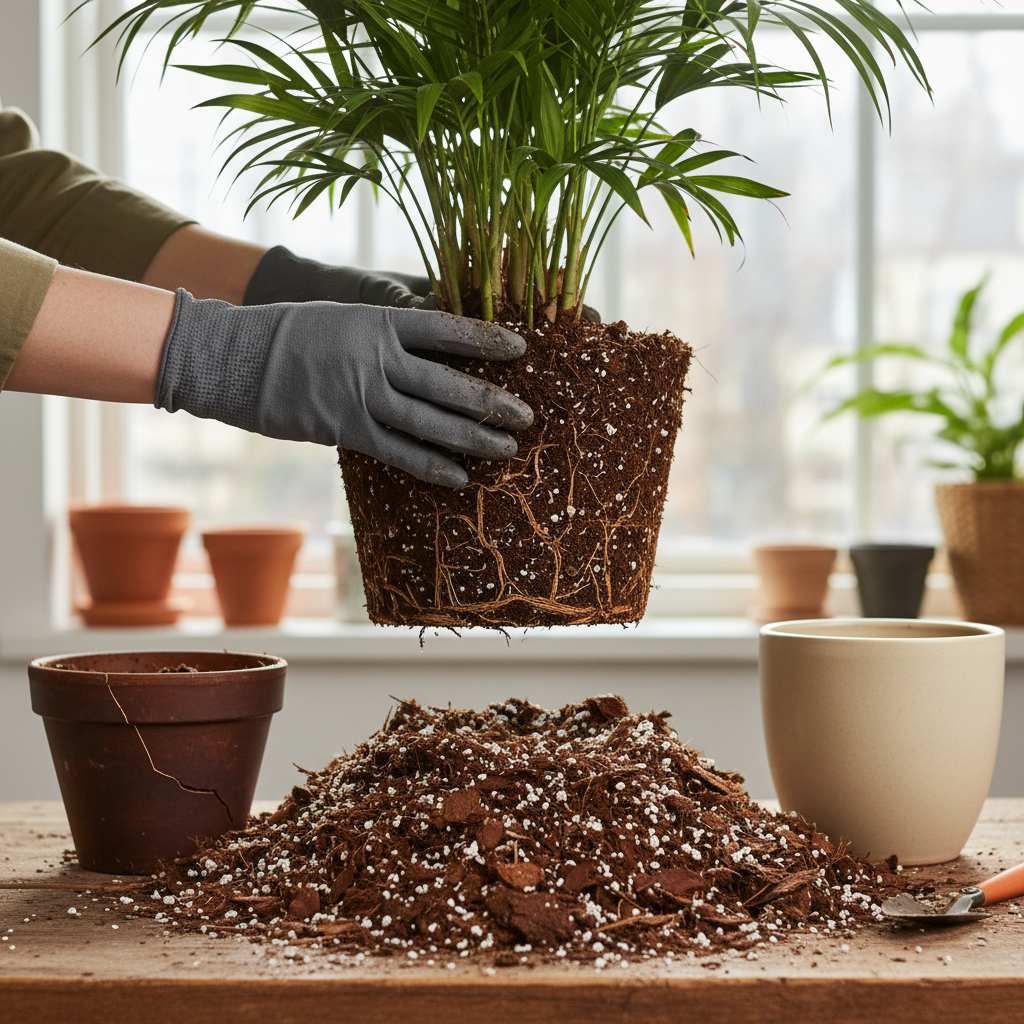
Ideal Soil Composition
A good parlor palm mix is moisture-retentive enough to never bone-dry, yet open enough that water passes through within seconds rather than pooling on the surface. Generic houseplant compost tends to compact and stay too wet, while pure cactus mix dries out far too quickly. A blended substrate built around three or four components performs best.
| Component | Proportion | Function |
|---|---|---|
| Quality peat- or coir-based houseplant compost | 50 to 60 percent | Holds moisture and provides baseline nutrients |
| Perlite or pumice | 20 to 25 percent | Opens up the mix and prevents compaction |
| Fine orchid or pine bark | 15 to 20 percent | Creates air pockets and slow-releases organic matter |
| Worm castings or fine compost | 5 to 10 percent | Supplies gentle, sustained background nutrition |
The pH of this blend sits comfortably between 6.0 and 6.5, slightly acidic, which suits parlor palm well. Avoid mixes heavy in dolomite lime or those formulated for alkaline-loving plants, as the species develops nutrient lock-out symptoms (yellow new fronds with green veins) in soils above pH 7.
Pro Tip — Quick Mix Recipe: For a fast, reliable parlor palm mix, combine two parts peat- or coir-based houseplant compost, one part perlite and one part fine orchid bark, then sprinkle a generous handful of worm castings on top of every 5 litres of finished mix and fold through. This holds enough moisture for steady growth but drains within ten seconds of a thorough watering.
Choosing the Right Pot
The pot a parlor palm sits in influences moisture, root health and stability far more than its appearance suggests. Choose the container before the decorative cachepot and prioritise function over finish.
Drainage holes are non-negotiable. Without somewhere for excess water to leave, even the most carefully measured watering routine will eventually drown the roots. If you want to display the plant in a decorative pot without drainage, slip the nursery pot inside as a removable liner and always lift it out to water.
Pot material: Terracotta breathes and dries fastest, which suits gardeners who tend to overwater. Glazed ceramic or plastic holds moisture longer, which suits drier homes and busier schedules. The species does well in any of these, provided the watering rhythm is adjusted to the pot’s drying speed.
Pot size: Parlor palms prefer to be slightly snug at the roots. Choose a pot only 2 to 3 cm (1 in) wider than the existing rootball when stepping up, never more. Oversized pots hold large reserves of damp soil around a small root mass and are a leading cause of slow decline.
When to Repot
Parlor palm dislikes frequent disturbance. In good conditions it only needs repotting every two to three years, and many specimens are happiest left in the same pot for longer. Reliable signs that a repot is due include roots circling the bottom of the pot or escaping through drainage holes, water rushing straight through with no absorption, slowed growth despite good light and feeding, and the plant tipping over because the canopy has outgrown the container. Spring or early summer, just before the strongest growth period, is the best time to repot.
How to Repot: Step-by-Step
- Water the plant thoroughly a day or two before repotting; a moist rootball is less brittle and slides out more cleanly.
- Squeeze or tap the sides of the old pot to loosen the soil, then lift the palm out by gripping the base of the stem cluster rather than pulling on individual fronds.
- Tease away the outer 1 to 2 cm of old soil with your fingers, and trim any soft, dark or clearly dead roots back to healthy white tissue with sterilised scissors.
- Add a 3 to 5 cm layer of fresh mix to the bottom of the new pot, then position the palm at the same depth it was growing before, never burying the crown.
- Backfill around the rootball with fresh mix, tapping the pot on the bench to settle air pockets without compacting the substrate.
- Water gently until moisture runs from the drainage holes, then let the pot drain fully before returning it to its usual position.
- Hold off on fertiliser for at least 4 to 6 weeks to give freshly cut roots time to seal and recover.
Warning — Transplant Shock: Some leaflet drop or a slight dulling of the canopy is normal in the weeks after repotting. Keep the plant out of direct sun, maintain its usual watering rhythm without overcompensating, and avoid the temptation to push recovery with fertiliser. Stable conditions and patience repair shock far more reliably than any intervention.
Fertilising
Parlor palm is a slow grower with a correspondingly modest appetite. In its native forest floor it draws nutrients mainly from decomposing leaf litter and the slow trickle of organic matter that filters down from the canopy. Indoors, the equivalent is a light, regular feed during the growing season rather than the heavy, frequent doses that suit faster tropicals.
Erring on the side of underfeeding is far safer than overfeeding. Parlor palm is unusually sensitive to fertiliser salt build-up and shows the classic symptoms (crisp brown leaflet tips, fine scorched edges and a slightly bluish cast to the older fronds) before most owners realise their routine is too aggressive. Half-strength feeds at moderate intervals, combined with periodic flushing of the rootball, produce the steadiest results.
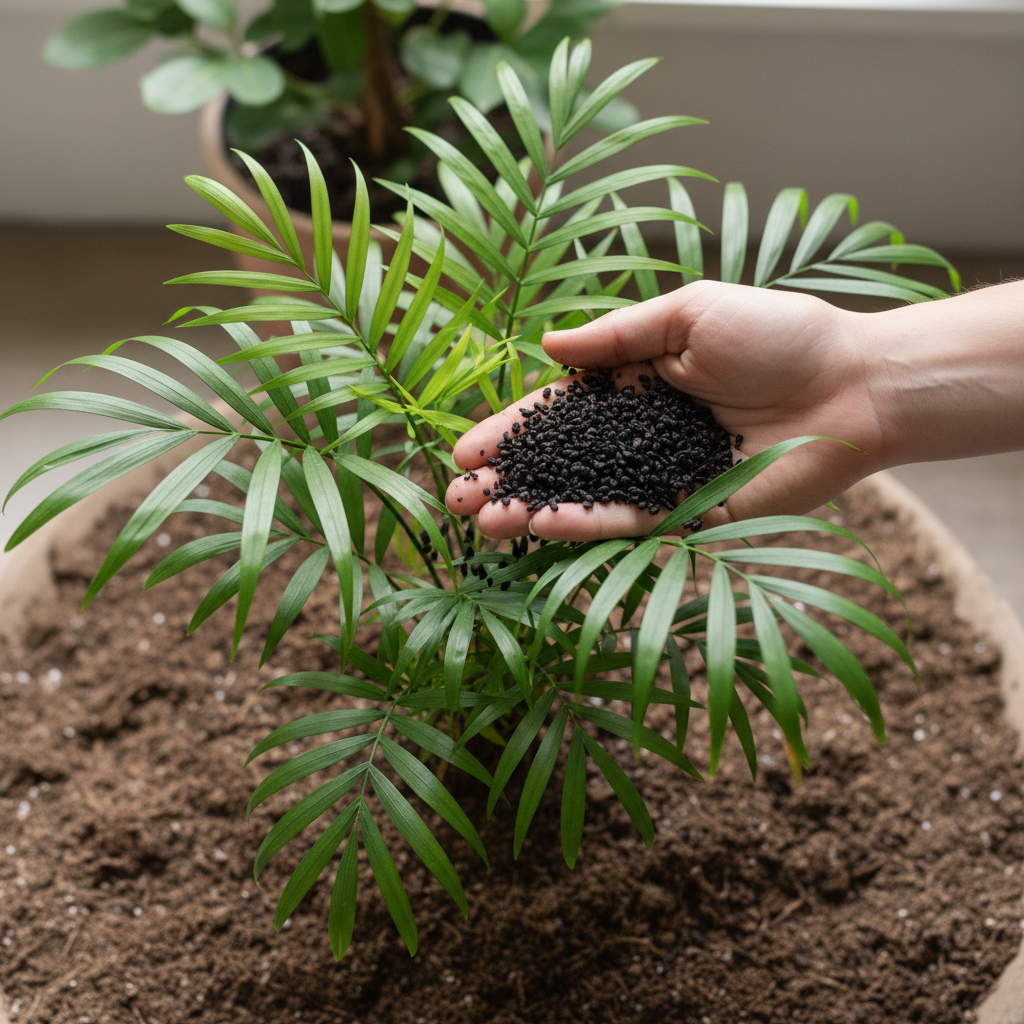
Understanding Plant Nutrients
The three primary nutrients (nitrogen, phosphorus and potassium) are usually supplied in any balanced houseplant fertiliser. For parlor palm, three secondary or trace elements (magnesium, iron and manganese) are at least as important, since deficiencies in these are far more common indoors than a shortage of NPK and produce the most visible symptoms on the foliage.
| Nutrient | Symbol | Primary Function | Deficiency Symptoms |
|---|---|---|---|
| Nitrogen | N | Drives leaf growth and canopy density | Older fronds pale, even yellow; growth stalls |
| Phosphorus | P | Supports roots, flowering and new growth points | Weak new fronds, sparse roots |
| Potassium | K | Overall vigour, drought and disease resistance | Brown, scorched leaflet tips on older fronds |
| Magnesium | Mg | Chlorophyll backbone, photosynthesis | Yellow bands between green veins on older leaflets |
| Iron | Fe | Chlorophyll formation in new tissue | Newest fronds pale yellow-green with green veins |
| Manganese | Mn | Enzyme activation, leaflet expansion | Stunted, distorted new fronds, sometimes called frizzle top in palms |
Types of Fertiliser
Liquid fertilisers: The default and most controllable choice. Look for a balanced formula such as 10-10-10 or 7-9-5, ideally one labelled for palms or general houseplants and containing trace elements. Always dilute to half the recommended strength for parlor palm.
Slow-release granular: Useful for keepers who travel or struggle to maintain a regular schedule. Sprinkle a measured dose on the soil surface in spring and the prills will release nutrients gradually over three to four months. Choose a palm-specific or low-strength general formula and never double up with liquid feeds at the same time.
Organic fertilisers: Worm castings, well-rotted compost, fish emulsion and seaweed extracts all suit parlor palm. They release nutrients slowly, almost never cause salt build-up and gently improve soil structure over time. Liquid seaweed in particular is a forgiving, broad-spectrum feed that pairs well with the species.
Feeding Schedule
From mid-spring through early autumn, feed a parlor palm with a balanced liquid fertiliser diluted to half strength every four to six weeks. In late autumn and winter, stop feeding altogether; growth slows so far in low light that any nutrients applied during this period simply accumulate in the soil as harmful salts. Resume only when you see clear signs of new growth (typically a fresh frond beginning to push from the centre of a stem) in spring.
Pro Tip — Flush Every Quarter: Once every three months during the growing season, water the plant through with plain, unfertilised water until at least double the pot’s volume has run from the drainage holes. This flushes accumulated fertiliser salts from the rootball and is one of the simplest, most underused practices for keeping parlor palm leaflet tips green.
How to Fertilise
- Water the plant lightly first with plain water if the soil is bone dry; never apply fertiliser to a parched rootball.
- Mix the liquid fertiliser in clean room-temperature water at half the recommended strength.
- Pour the diluted feed evenly around the soil surface, avoiding the stems and the leaflet crowns.
- Let any excess drain from the pot, then tip away whatever collects in the saucer.
- Mark the date so the next feed falls four to six weeks later, not sooner.
Warning — Salt Build-Up: A white or yellowish crust on the soil surface or around the pot rim is mineral residue from fertiliser and hard water. Left unchecked, these salts burn the fine roots and produce the brown leaflet tips that gardeners often misdiagnose as low humidity. Scrape off the crust gently, flush the pot thoroughly with plain water, and reduce feeding frequency for the next two cycles.
Propagation
Parlor palm propagation is more limited than most popular houseplants. Single stems cannot be rooted from cuttings, because each cane is a self-contained palm that grows only from a single apical meristem at its tip. There are no nodes that can produce roots, no axillary buds that develop into new plantlets and no easy way to start a new plant from a piece of foliage. In practice, two methods are available to home gardeners: division of an existing clumped specimen, and growing from seed.
Division is the more accessible option, because almost every parlor palm sold commercially is grown from many seedlings pricked into the same pot. Over time these seedlings can sometimes be teased apart into smaller clumps and re-established as independent plants. Seed-grown propagation, while exactly how nurseries produce stock, takes months to germinate and several years to produce a saleable plant, so it is rarely worthwhile at home.
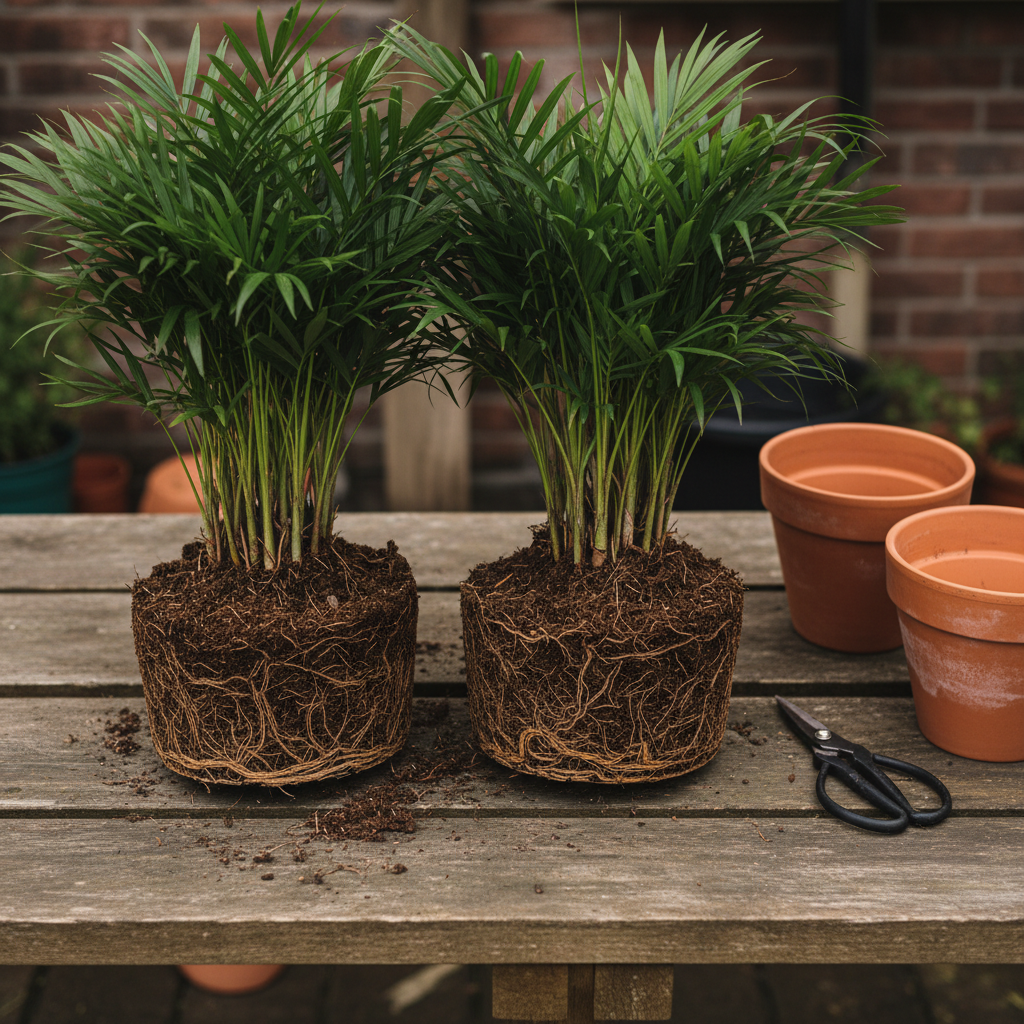
Understanding the Clumping Habit
What looks like a multi-stemmed parlor palm is usually many seedlings sharing a single rootball, not one plant with branched stems. Each cane has its own root system tangled together with its neighbours, and in a healthy mature pot these systems become so intertwined that they appear as a single mass. Successful division depends on locating natural seams between groups of stems and separating them with as little damage as possible.
Division: Step-by-Step
Division works best in spring or early summer, on a mature, well-established clump with at least six or eight stems. Younger plants rarely have enough independent root mass on each section to recover well from separation. Plan for the parent plant to look thinner for a season afterwards while the divisions establish.
- Water the parent plant thoroughly two days before dividing so the rootball is soft and pliable.
- Slide the whole clump out of its pot and lay it on a clean surface; tease away excess soil to expose the root mass.
- Identify natural groupings of three to six stems whose roots can be followed back as a distinct cluster within the larger rootball.
- Work your fingers gently between the groups, pulling them apart, and use sterilised scissors or secateurs only where roots refuse to separate by hand.
- Trim any obviously damaged or torn roots back to clean tissue, but keep root pruning to a minimum overall.
- Pot each division into a container only slightly larger than its rootball using the standard parlor palm mix.
- Water thoroughly to settle the soil and place the new pots in bright, indirect light at normal room temperature; do not feed for at least six weeks.
Pro Tip — Fewer, Larger Divisions: The temptation when dividing a full pot is to make many small divisions of one or two stems each. Resist it. Divisions of five to eight stems with substantial roots establish quickly and look like real plants within weeks, whereas single stems often languish for months or fail to recover at all.
Growing from Seed
Mature parlor palms occasionally flower and set seed indoors, producing tall sprays of small yellow blooms that develop into pea-sized black fruits if both male and female plants are present. Fresh seed sown into a warm propagator at around 25 degrees C (77 degrees F) germinates erratically over two to four months. Seedlings then need two to three years of patient care before they look anything like a finished houseplant, which is why nurseries rather than home growers handle almost all seed propagation in this species.
- Soak fresh seed in lukewarm water for 24 to 48 hours, changing the water once.
- Sow seeds just below the surface of a moist 50:50 peat-and-perlite mix in a covered seed tray.
- Maintain a steady temperature of 24 to 28 degrees C (75 to 82 degrees F) and bright, indirect light.
- Keep the substrate evenly moist but never sodden; vent the cover briefly each day to prevent fungal issues.
- Pot seedlings on individually once they have two true fronds and a clear root system, and grow on under standard parlor palm conditions.
Troubleshooting Propagation
| Problem | Likely Cause | Solution |
|---|---|---|
| Divisions wilt badly within days | Too much top growth for the reduced root system | Move into deep shade for two weeks; raise humidity; do not feed |
| Lower fronds yellow on a fresh division | Transplant shock, normal in the first month | Keep conditions stable; trim only when leaflets are fully crisp |
| Division never recovers and softens at the base | Rot from torn or overworked roots | Discard the affected crown; sterilise tools before reuse |
| Seeds fail to germinate | Old seed or temperatures too low | Use fresh seed; maintain 25 degrees C and patience for up to 4 months |
Pests & Diseases
Parlor palm is largely untroubled by pests when its growing conditions are right. The plants that suffer most are those kept in dry, still indoor air, especially near radiators and air-conditioning vents, where humidity-loving fronds become a prime target for spider mites and scale. Routine inspection (running a hand gently down the canes once a week and lifting a few leaflets to look at the undersides) catches almost every problem early enough to treat without significant damage.
Diseases are even less common but follow predictable patterns when they appear. Almost all of them trace back to overwatering, poor air circulation or contaminated tools. Good cultural practices (correct watering, sensible humidity, sterile pruning equipment and adequate light) prevent the vast majority of disease outbreaks before they begin.
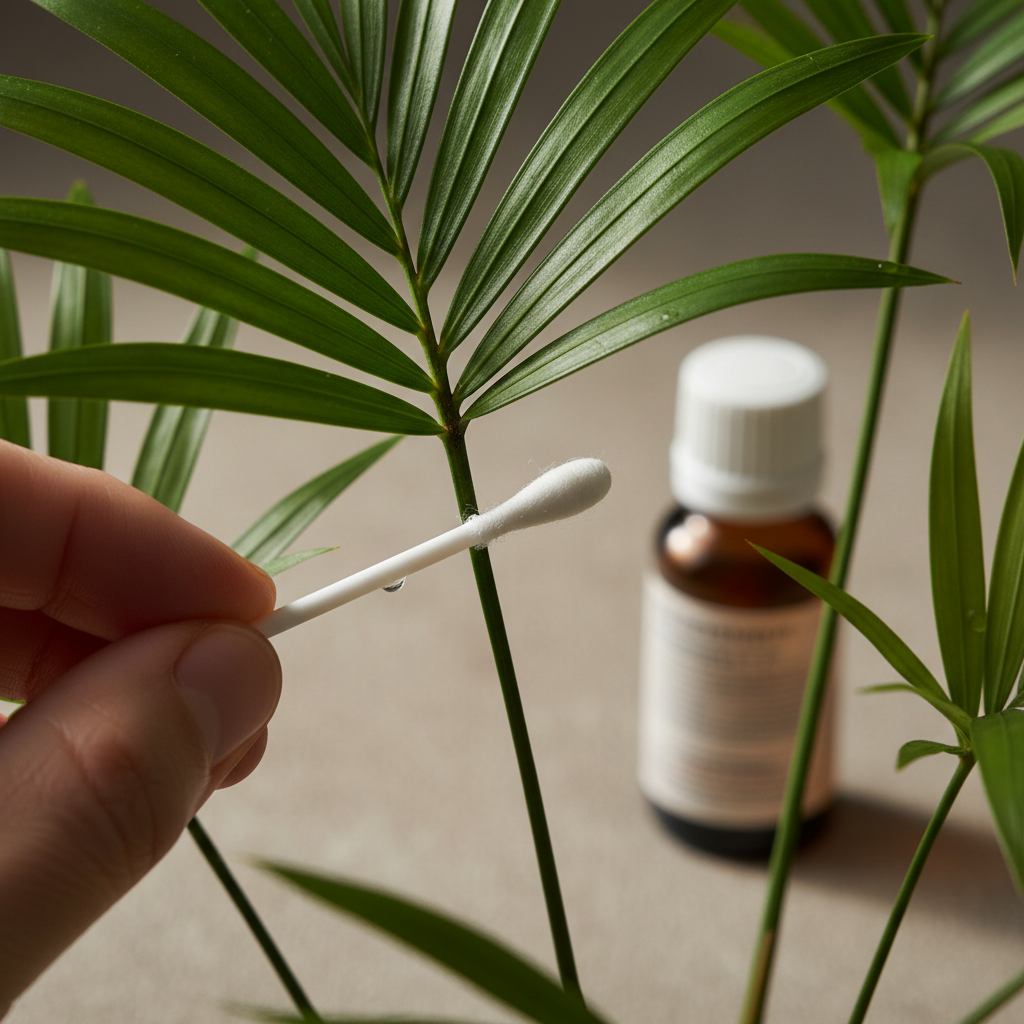
Common Pests
Spider Mites (Tetranychus urticae)
Spider mites are by far the most damaging pest on indoor palms. They are tiny pale arachnids, usually less than half a millimetre across, that feed on the underside of leaflets and reproduce quickly in warm, dry air. Early signs include fine yellow stippling on the upper leaflet surface, a dull, dusty appearance to the canopy as a whole, and in advanced cases delicate webbing strung between leaflets and along the rachis.
Treatment: Rinse the entire plant in the shower or under a strong handheld spray to dislodge mites mechanically. Follow up with weekly sprays of insecticidal soap or 1 percent neem oil solution, taking care to wet the undersides of every frond. Raise ambient humidity above 50 percent during treatment, as mite populations crash quickly in moister air. Continue weekly applications for at least three cycles to break the life cycle.
Scale (Coccoidea spp.)
Brown, oval or domed bumps clinging to the canes and along the rachis of older fronds are almost always armoured scale insects. Each bump is the protective shell of a sap-sucking insect feeding underneath, and over time scale causes yellowing, sticky honeydew on lower fronds, and patches of sooty mould where that honeydew lands.
Treatment: Dab each visible scale with a cotton bud soaked in 70 percent isopropyl alcohol to dissolve its protective coating and kill the insect underneath. For larger infestations, follow up with weekly neem oil or horticultural oil sprays to suffocate the next generation of crawlers that hatch from beneath the older shells. Inspect newly purchased plants carefully for hidden scale before introducing them to an existing collection.
Mealybugs (Pseudococcidae)
Mealybugs appear as small, soft white cottony tufts wedged into leaflet axils, along the rachis, and in the crowns where the canes meet the soil. They suck sap, distort new growth and excrete sticky honeydew similar to scale.
Treatment: Spot-treat each cluster with a cotton bud dipped in 70 percent isopropyl alcohol, then follow up with weekly sprays of insecticidal soap or neem oil for three to four weeks. Mealybugs hide deep inside crowns and behind frond bases, so be thorough during inspection and check again two weeks after the visible infestation seems gone.
Fungus Gnats (Bradysia spp.)
Small dark flies that swarm around the pot when you water are fungus gnats. Adults are mostly a nuisance, but their larvae feed on organic matter and very fine roots in damp soil, which can weaken seedlings and recently divided plants.
Treatment: Allow the top 2 to 3 cm of soil to dry between waterings so larvae cannot survive in the surface layer. Cover the soil with a thin layer of horticultural grit or sand to break the breeding cycle, and use yellow sticky cards to monitor and reduce adult populations. Biological controls such as Steinernema feltiae nematodes or Bti drenches are very effective for persistent infestations.
Common Diseases
Root Rot (Pythium and Phytophthora spp.)
Root rot caused by waterborne pathogens is the most serious disease affecting indoor parlor palms. Symptoms include yellowing of lower fronds, a sour smell from the soil, mushy brown roots and, in advanced cases, sudden collapse of one or more canes at the soil line.
Treatment: Unpot the plant immediately, wash the roots clean under running water and cut away all soft, dark tissue with sterilised scissors. Repot the healthy remainder into a slightly smaller pot of fresh, well-drained mix, water sparingly until new growth appears, and address the underlying cause (typically a pot too large, soil too dense or watering too frequent) so the rot does not return.
Leaf Spot (Helminthosporium and Cylindrocladium spp.)
Small dark spots that spread into larger irregular blotches on leaflets, often with a yellow halo, are usually fungal leaf spot. These pathogens take hold when fronds stay wet for long periods, particularly in cool, still air.
Treatment: Cut off the worst-affected fronds and dispose of them away from the rest of the plant collection. Improve air circulation around the palm, avoid overhead watering and let the canopy dry quickly between waterings. Copper- or sulphur-based fungicides applied weekly help control spread on valuable plants, but cultural changes alone usually solve the problem.
Pink Rot (Nalanthamala vermoeseni)
Pink rot is a serious palm-specific disease that attacks the bud and stem tissues of stressed plants, producing sunken brown lesions sometimes ringed with a salmon-pink fungal mass. It is uncommon on healthy indoor parlor palms but can appear after severe overwatering, cold drafts or repotting injuries.
Treatment: Remove and discard affected canes back to clean tissue with sterilised tools. Treat the remainder with a labelled palm fungicide and correct the underlying stress: improve drainage, move the plant away from cold drafts and avoid repotting injuries in future. Severe cases on individual stems usually cannot be saved, but the rest of the clump can often be preserved.
Pest and Disease Summary
| Pest / Disease | Identification | Treatment |
|---|---|---|
| Spider mites | Yellow stippling, fine webbing, dusty canopy | Rinse foliage, weekly insecticidal soap or neem oil, raise humidity |
| Scale | Brown bumps along canes and frond stems | Alcohol on cotton buds; follow up with horticultural oil |
| Mealybugs | White cottony tufts in leaflet axils and crowns | Spot treat with alcohol, weekly soap or neem for 3 to 4 weeks |
| Fungus gnats | Small flies around pot, larvae in damp soil | Dry top soil, grit mulch, sticky cards, Bti or nematodes |
| Root rot | Yellow lower fronds, mushy roots, sour soil | Unpot, trim rotten roots, repot in drier mix; reduce watering |
| Leaf spot | Dark spots with yellow halos on leaflets | Remove affected fronds; improve airflow; avoid wet foliage |
| Pink rot | Sunken brown lesions, sometimes pink fungal mass | Trim affected canes; palm fungicide; address underlying stress |
Prevention Strategies
Healthy growing conditions remain the single most effective form of pest and disease control. A parlor palm kept in adequate light, with the right watering rhythm and humidity above 40 percent, simply does not present the kind of stressed surface area that pests and pathogens exploit. Quarantine new plants for two to three weeks before placing them near an existing collection, and clean tools with isopropyl alcohol between every plant when pruning or dividing.
Regular inspection makes the difference between a five-minute spot treatment and a months-long infestation. Once a week, take the plant in hand, gently part the canopy and look at the undersides of three or four fronds, the rachis and the points where canes emerge from the soil. Most pests betray themselves before they have spread far, and even early scale or mealybug populations can be removed by hand without any chemical treatment at all.
Pro Tip — Shower Day: Once a month, take the parlor palm into the bathroom and give it a thorough lukewarm shower from a handheld head, paying particular attention to the undersides of fronds. This simple ritual removes dust, knocks down emerging mite and scale populations, and lets you inspect the whole plant in good light. Allow the pot to drain fully before returning it to its usual spot.
Popular Varieties
Compared with cultivar-rich groups such as Philodendron or Begonia, parlor palm has only a small number of named forms. The species itself is genetically stable and so consistent in appearance that most growers sell it simply as Chamaedorea elegans, with the popular trade name “Bella” used loosely for the compact bushy plants familiar from garden centres. What home growers usually call “parlor palm varieties” therefore tend to be related species in the same genus rather than true cultivars of elegans.
The most useful way to think about parlor palm “varieties” is to compare Chamaedorea elegans with its closest indoor relatives. Each species in the table below shares the same general culture (medium light, even moisture, moderate humidity) but offers a distinct look and habit, so a single grower can build a small collection of related palms with very little additional learning curve.
| Variety | Leaf Appearance | Light Needs | Growth Rate | Availability |
|---|---|---|---|---|
| Chamaedorea elegans ‘Bella’ | Compact, bushy clusters of fine arching pinnate fronds | Medium to bright indirect | Slow | Very common |
| Chamaedorea metallica | Stiff, broad, dark blue-green leathery leaves with a metallic sheen | Low to medium indirect | Very slow | Specialist nurseries |
| Chamaedorea seifrizii (Bamboo Palm) | Tall, slender bamboo-like canes with airy pinnate fronds | Medium to bright indirect | Moderate | Common |
| Chamaedorea cataractarum (Cat Palm) | Dense clumping habit with broader, drooping pinnate fronds | Bright indirect; tolerates higher light than elegans | Moderate | Common |
| Chamaedorea radicalis | Single-trunked with broad, slightly rippled pinnate fronds | Medium to low indirect | Slow | Specialist nurseries |
| Chamaedorea hooperiana | Larger leaflets and a taller, more upright posture than elegans | Medium to bright indirect | Moderate | Less common |
| Chamaedorea ernesti-augusti | Unusual bifid (fishtail-shaped) undivided leaves | Medium indirect | Slow | Specialist nurseries |
Featured Varieties
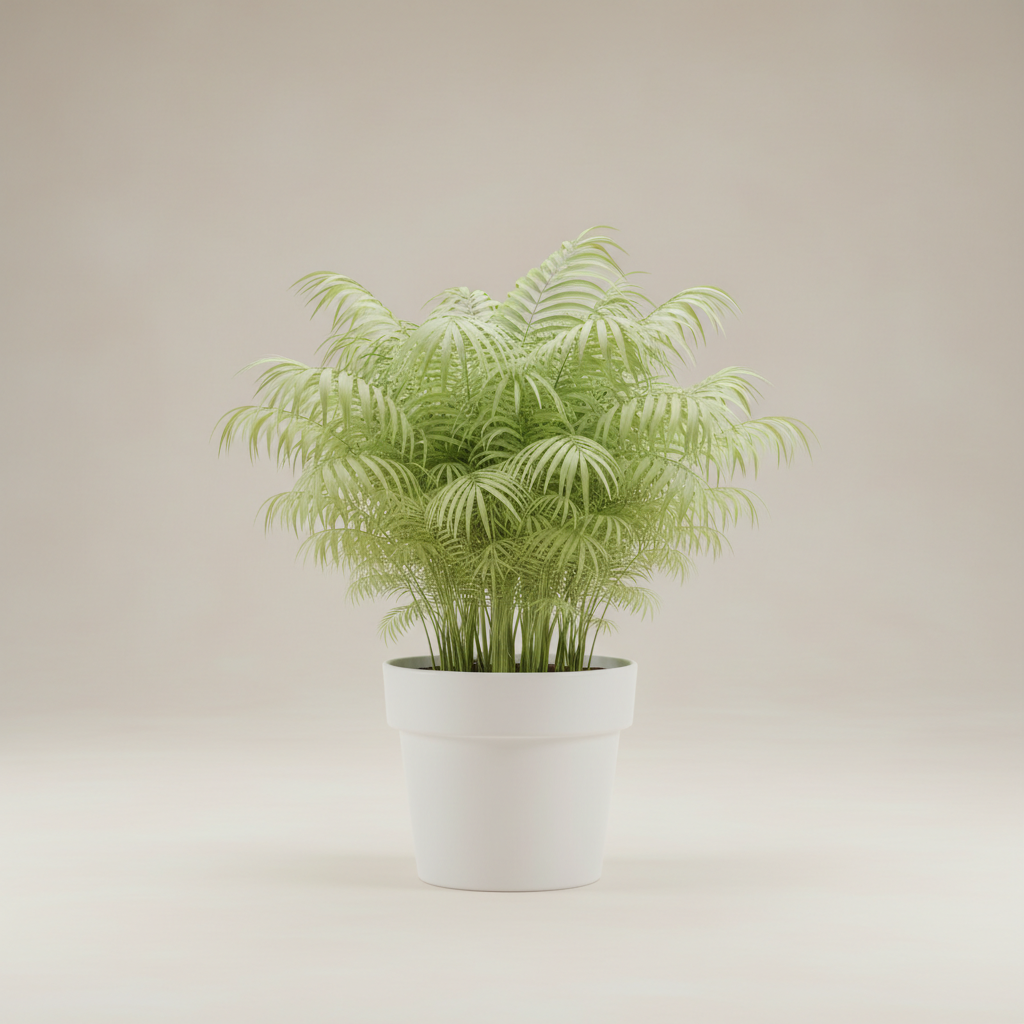
Chamaedorea elegans ‘Bella’
The form sold in nearly every garden centre as the classic “parlor palm”. Compact, multi-stemmed and fine-textured, it rarely exceeds 1 metre indoors and looks full from day one because it is grown as a tight cluster of many seedlings in a single pot. The default choice for almost any indoor situation.
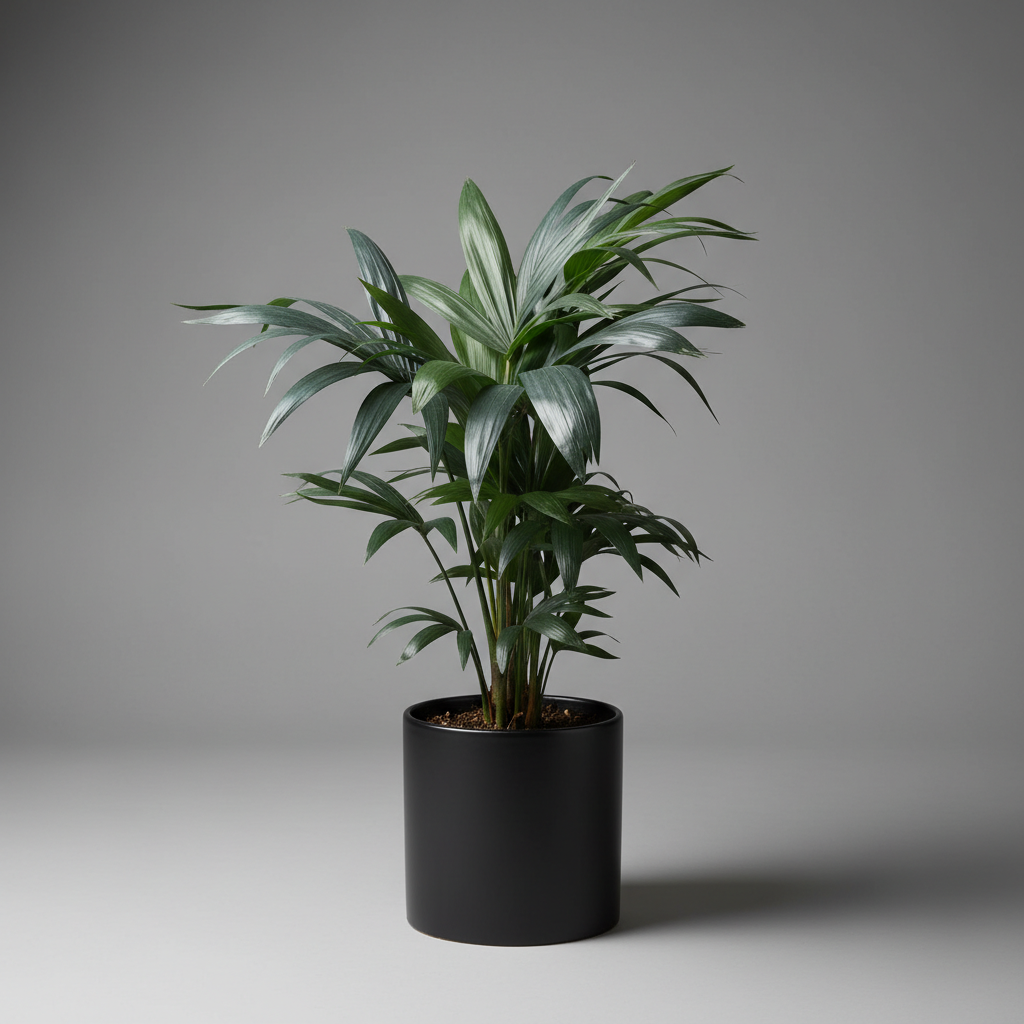
Chamaedorea metallica
A striking, sculptural relative often sold as a parlor palm “variety” by specialist nurseries. Instead of the airy pinnate fronds of elegans, it produces stiff, broad, blue-green leaves divided into only two or three lobes, each with a distinctive metallic sheen. Tolerates lower light than almost any other small palm.
Variety Profiles in Detail
Chamaedorea elegans ‘Bella’ (Chamaedorea elegans)
‘Bella’ is less a true cultivar than a horticultural shorthand for the compact, mass-produced parlor palm familiar from supermarkets and high-street florists. Mature height indoors typically tops out at around 90 cm to 1.2 m (3 to 4 ft), and the multi-stemmed clump habit means a pot rarely looks sparse even when its individual canes are young. Care is identical to the species described throughout this guide.
Bamboo Palm (Chamaedorea seifrizii)
Bamboo palm is taller and more upright than parlor palm, with slender green canes that genuinely resemble bamboo culms when grown in clusters. Mature plants reach 2 to 3 metres (6 to 10 ft) indoors and create excellent vertical accents in tall rooms. It tolerates the same light range as elegans but appreciates slightly higher humidity and is more prone to spider mites in dry air.
Cat Palm (Chamaedorea cataractarum)
Cat palm forms denser, lower-spreading clumps than parlor palm, with broader, slightly drooping leaflets. Often sold as a “bushy parlor palm”, it is in fact a stream-bank species in the wild and prefers brighter light and noticeably more consistent moisture than elegans. A useful choice for a bright bathroom or a humid corner near a kitchen window.
Metallic Palm (Chamaedorea metallica)
Metallic palm is a small, single-stemmed species rarely exceeding 1.2 m (4 ft) indoors. Its broad, almost undivided leaves are leathery and dark blue-green with an unmistakable metallic sheen. Famously tolerant of low light, it is one of the few small palms that genuinely thrives several metres back from a window. Treat as parlor palm but expect even slower growth and a slightly stiffer watering schedule, since the broader leaves transpire less.
Choosing the Right Variety for Your Space
For most rooms, plain Chamaedorea elegans ‘Bella’ remains the safest and most rewarding choice. Reach for cat palm if the spot is brighter and more humid than average, bamboo palm if vertical height is wanted in a corner, and metallic palm if the space is genuinely dim and a sculptural rather than airy silhouette is preferred. All four share the same gentle care philosophy described in this guide, which makes them an unusually coherent group to collect.
Frequently Asked Questions
Is the parlor palm safe for cats and dogs?
Yes. The ASPCA lists Chamaedorea elegans as non-toxic to cats, dogs and horses. Foliage, stems and fruits are free of the irritant compounds found in many popular houseplants, which makes it one of the safer mid-sized choices for homes with curious pets. Chewing large quantities of any plant material can still cause mild stomach upset, so it is sensible to keep nibbling to a minimum.
Why are the tips of my parlor palm leaves turning brown?
Brown leaflet tips are almost always caused by low humidity, fluoride or chlorine in tap water, or accumulated fertiliser salts in the soil. Raise humidity around the plant to 40 to 50 percent, switch to rainwater or filtered water, and flush the pot through with plain water once a quarter to clear out mineral residues. Trim only the brown portion of each leaflet with sharp scissors, following the natural taper to avoid an obvious blunt cut.
Why are the lower fronds turning yellow?
Occasional yellowing of the very oldest fronds is normal as the plant sheds tired growth. Rapid, uniform yellowing across several lower fronds at once usually points to overwatering and possibly the beginnings of root rot. Check the soil moisture, unpot if the substrate smells sour, and inspect the roots for soft brown sections. Slower, more gradual yellowing across the canopy often indicates low light or, less commonly, a sustained shortage of nitrogen.
How big does a parlor palm get indoors?
Most parlor palms top out between 90 cm and 1.5 metres (3 to 5 ft) tall as houseplants, though very old specimens in ideal conditions can reach 2 metres (6 ft). Growth is slow and steady; a typical clump pushes out two or three new fronds per cane each year, so a small plant from a garden centre often takes a decade to mature into a substantial floor specimen.
Can I keep a parlor palm in a bathroom or office?
Both work well. A bright bathroom suits the species especially well because of higher ambient humidity, provided the room has at least some natural daylight. Offices with steady fluorescent or LED overhead lighting also support healthy growth as long as the plant is within a couple of metres of a window or supplemented by a small grow light during darker months.
Should I prune my parlor palm?
Only minimal cosmetic pruning is needed. Remove entire fronds at the base of the cane once they are fully brown or yellow, using sterilised scissors. Never cut a green frond back partway or top a stem, because each cane has only a single growing point and a topped cane will not regrow. Pulling away dead, papery sheaths around the lower canes once they loosen is also a useful tidying step.
Why is my parlor palm flowering, and what should I do about it?
Mature parlor palms occasionally produce tall sprays of tiny yellow bead-like flowers, especially when they are healthy and have been in the same pot for several years. The blooms are harmless and faintly attractive, although they shed small dry petals. You can leave them in place to admire or cut the spent inflorescence at its base once flowering finishes. Indoor plants rarely set viable seed unless they have both male and female specimens and good air movement.
My new parlor palm is dropping leaflets after coming home. Is something wrong?
Some leaflet drop and minor browning is normal in the first month after purchase as the plant adjusts from nursery conditions to a typical home. Keep watering on the same rhythm as before, hold off on repotting for at least 6 to 8 weeks, and do not feed during this period. If new fronds appear within two to three months and the rate of leaflet drop slows, the plant is acclimatising successfully and no further intervention is needed.
Can I move my parlor palm outdoors in summer?
It is possible in mild climates, but most home gardeners get better results leaving the plant where it is. If you do move it outside, choose a deeply shaded, sheltered position out of direct sun and bring it back indoors as soon as nighttime temperatures fall below 13 degrees C (55 degrees F). Even brief exposure to direct midday sun will scorch fronds badly, and an outdoor stay almost always means more rigorous quarantine and pest inspection on return.
How long do parlor palms live?
Well-cared-for parlor palms routinely live for several decades indoors, with documented specimens passing 40 years in attentive collections. The slow growth rate that makes them seem unchanging year to year is the same characteristic that lets them serve as long-term living furniture in a way few other tropical houseplants can match.






