
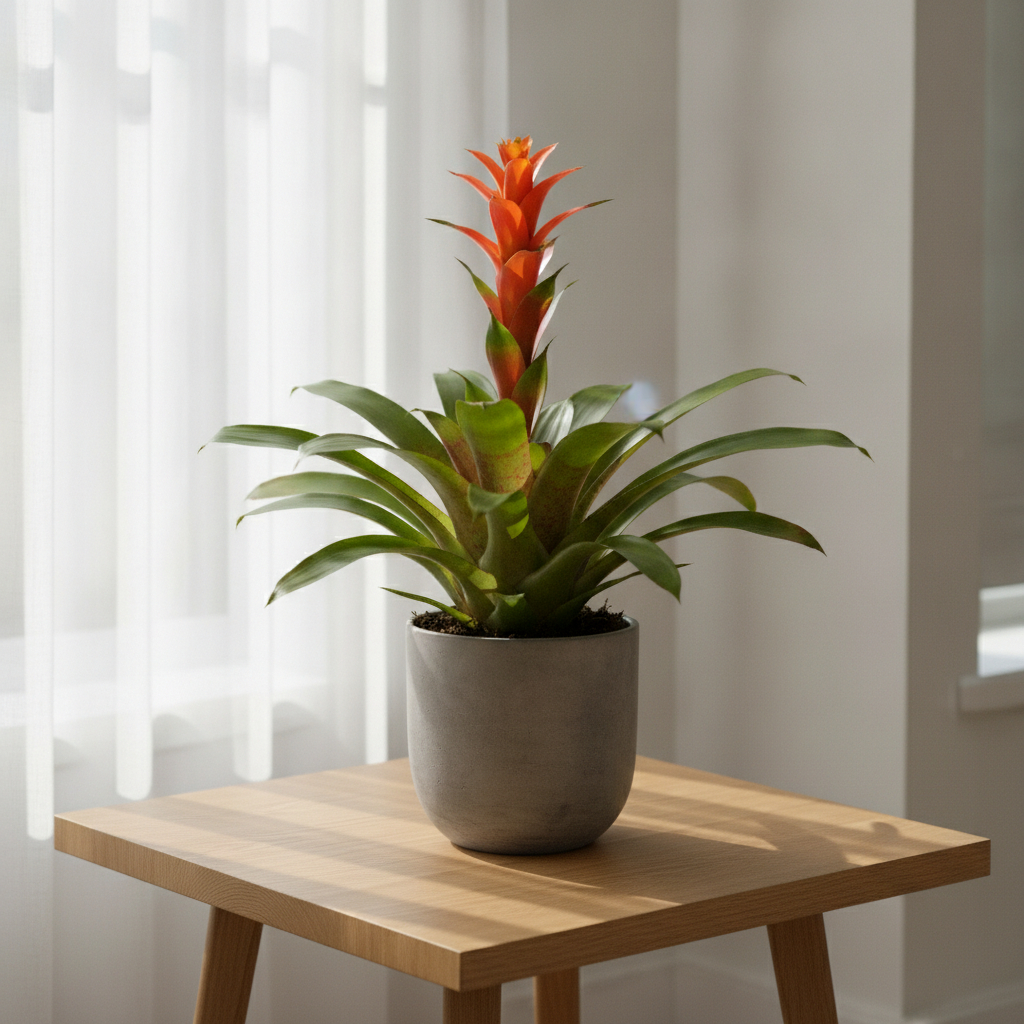
Few houseplants deliver a splash of colour as boldly, or for as long, as the orange guzmania (Guzmania zahnii). A member of the bromeliad family, it grows as a neat rosette of soft, glossy strap-shaped leaves veined in translucent copper and red, from the centre of which rises a torch of flame-orange bracts that can hold their colour for three to four months. The genus is named after the eighteenth-century Spanish naturalist Anastasio Guzman, and this particular species hails from the humid cloud forests of Costa Rica, Panama and northern Colombia, where it grows perched on tree branches rather than in the ground.
That epiphytic, tree-dwelling background is the single most useful thing to understand about the plant, because it explains almost every quirk of its care. Guzmanias have earned a slightly unfair reputation as tricky, when in truth they are simply misunderstood: people water the soil and ignore the central cup, or set them in a dim corner and wonder why the colour fades. Get a handful of fundamentals right and the orange guzmania is one of the most forgiving and rewarding plants you can grow. This guide walks through the full picture, from the light that keeps the bract vivid to the pups that carry the plant on after it finishes flowering, so you can tell the difference between a guzmania that is merely surviving and one that is genuinely thriving.
Contents
- Quick Reference
- Why Orange Guzmania Makes a Rewarding Houseplant
- Light Requirements
- Watering & Humidity
- Soil, Potting & Repotting
- Fertilising
- Propagation
- Pests & Diseases
- Popular Varieties
- Frequently Asked Questions
Quick Reference: Orange Guzmania at a Glance
| Light | Bright, indirect light. No direct midday sun, which scorches the leaves and bleaches the bract. |
| Watering | Keep the central cup topped up with 2 to 3 cm of clean water; keep the mix barely moist. Flush the cup weekly. |
| Temperature | 18 to 27 degrees Celsius (64 to 81 Fahrenheit). Avoid anything below 12 degrees Celsius (54 Fahrenheit). |
| Humidity | High, ideally 60 percent or above. Tolerates 50 percent but colours and leaf tips suffer when the air is dry. |
| Fertiliser | Quarter-strength balanced feed added to the cup or misted on the leaves, roughly once a month in spring and summer. |
| Toxicity | Non-toxic to cats, dogs and humans, making it a safe choice for pet and family homes. |
Why Orange Guzmania Makes a Rewarding Houseplant
The obvious draw is the colour. The vivid orange structure at the heart of the plant is not a flower in the strict sense but a cluster of modified leaves called bracts, which surround the small, short-lived true flowers of white or pale yellow. Because the bract is a leaf structure rather than a bloom, it lasts far longer than a conventional flower, holding its saturated colour for anywhere from two to four months and slowly fading rather than dropping. For a plant that asks very little in return, that is an extraordinary run of display, and it explains why guzmanias are such a fixture of garden centres and gift shops.
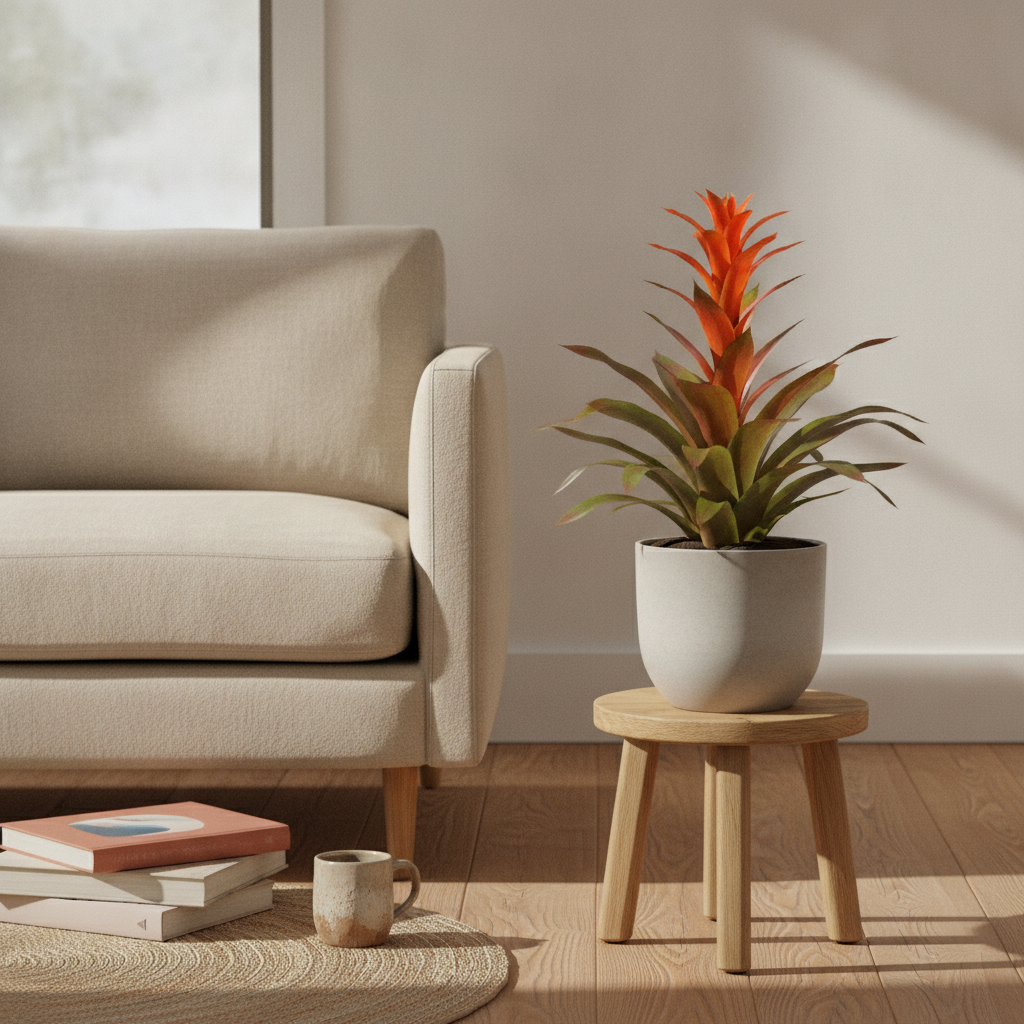
Beyond looks, the orange guzmania suits indoor life for practical reasons. It stays compact, typically reaching 30 to 45 cm (12 to 18 inches) tall and roughly as wide, so it fits on a shelf, a side table or a bright bathroom windowsill without ever demanding a repot into a monstrous pot. Its epiphytic roots are modest, which means it is happy in a small container and rarely becomes root-bound. It is also genuinely safe: unlike many popular foliage plants, bromeliads contain none of the calcium oxalate crystals that make aroids a hazard to curious pets and children. That combination of long colour, small footprint and non-toxicity is hard to beat.
Important — Toxicity: The orange guzmania is listed as non-toxic to cats and dogs by the ASPCA and poses no poisoning risk to people. The stiff leaf tips can give a small scratch, but there are no harmful compounds, so it is one of the safest flowering-effect plants for a household with animals or young children.
Light Requirements
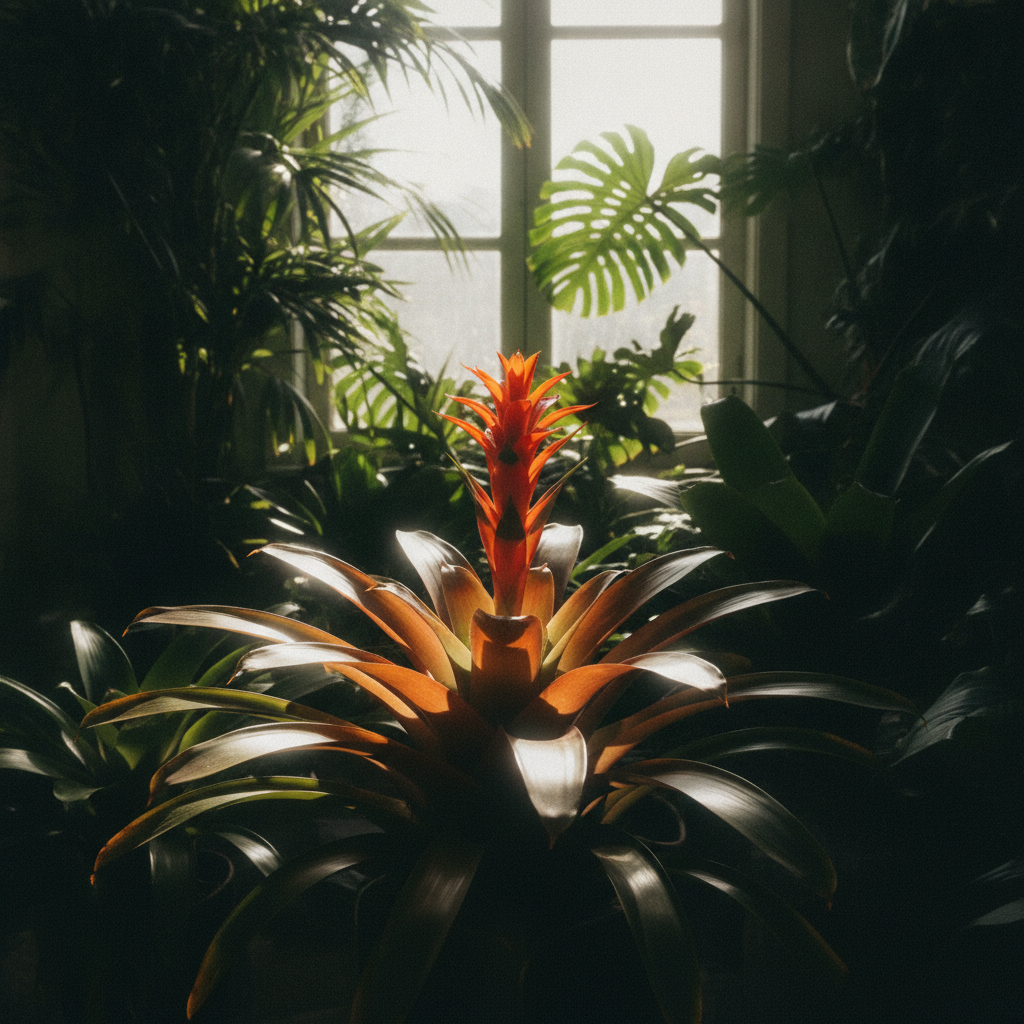
In the wild the orange guzmania lives as an understorey epiphyte, clinging to trunks and branches where it receives the bright but broken light that filters down through the forest canopy. It almost never sees direct, unfiltered sun. Recreating that dappled brightness indoors is the key to keeping both the leaves lush and the bract richly coloured, and it is the single factor that most often separates a healthy plant from a disappointing one.
The ideal is bright, indirect light for most of the day: a spot near a window where the plant is bathed in luminous light but the sun’s rays do not fall directly on the foliage. In this position the leaves stay a deep glossy green with their characteristic red veining, and the orange bract keeps its intensity. Too little light and the plant does not die outright, but the bract fades faster, new growth becomes pale and stretched, and any pups it produces will be weak. Too much direct sun and the leaves develop bleached, straw-coloured patches that never recover.
Light Levels Explained
Understanding how different light intensities map to indoor positions makes placement far easier. The table below outlines the practical categories and what each one means for an orange guzmania.
| Light Category | Approx. Level | Typical Location | Outcome |
|---|---|---|---|
| Direct sun | Over 50,000 lux | On a south windowsill, unshaded | Leaf scorch and a bleached bract; avoid |
| Bright indirect | 15,000 to 30,000 lux | Near an east or filtered south window | Ideal; strong colour and healthy growth |
| Medium | 7,000 to 15,000 lux | A metre or two back from a bright window | Acceptable; colour slightly softer |
| Low | 2,000 to 7,000 lux | North-facing room, interior wall | Bract fades quickly, growth stalls |
| Very low | Under 2,000 lux | Hallway, far from any window | Slow decline; not sustainable |
Window Orientation and Placement
South-facing window: The brightest option and workable, but only if you diffuse the light. Set the plant back from the glass or use a sheer curtain so the midday sun is broken up. Placed directly on a south sill in summer, the leaves will scorch within days.
East-facing window: Often the sweet spot. Gentle morning sun followed by bright ambient light for the rest of the day suits the guzmania perfectly and rarely causes burn.
West-facing window: Good, with the same caution as a south window regarding the strong late-afternoon sun. A short distance back from the glass usually solves it.
North-facing window: Provides soft, even light that will keep an established plant alive, though the bract may fade sooner and growth will be slower. A north room is the one situation where a supplementary grow light genuinely helps.
Pro Tip — Read the Leaves: The plant tells you whether the light is right. Deep green leaves with visible red veining and a compact rosette mean you have it correct. Pale, elongated leaves reaching toward the window mean too little light, while dry beige patches on the upper leaf surfaces mean too much direct sun.
How Light Affects Bract Colour
The orange of the bract is at its most intense under bright indirect light, because the pigments that produce the colour develop most strongly when the plant is well lit but not stressed. In dim conditions the same bract emerges a duller, more muted orange and fades to a papery beige much sooner. Once a guzmania has flowered it will not produce a second bract from the same rosette, so giving it good light is really about preserving the display you already have and ensuring the next generation of pups inherits the vigour to colour up well in turn.
Warning — Direct Sunlight: Guzmania leaves have no waxy protection against harsh sun. A few hours of direct summer light through unshaded glass can leave permanent bleached scars, and because the plant only has one rosette of leaves, that damage stays visible for the life of the plant. When in doubt, err toward slightly less light rather than more.
Artificial Lighting
Guzmanias respond well to supplementary lighting, which makes them a good candidate for offices and darker rooms. A full-spectrum LED grow light positioned 30 to 45 cm (12 to 18 inches) above the plant and run for 10 to 12 hours a day comfortably replaces a bright window. Because the plant is low and compact, a single modest panel or bulb is enough, and unlike tall foliage plants there is no awkward reaching to manage.
Seasonal Adjustments
Light levels indoors fall dramatically in winter, often to a quarter of their summer value. Move the plant closer to its window as the days shorten, and consider a grow light through the darkest months if the bract is still colourful and you want to preserve it. In high summer, do the opposite: pull the plant back from any south or west glass, or add a sheer, to prevent the stronger sun from scorching the leaves.
Watering & Humidity
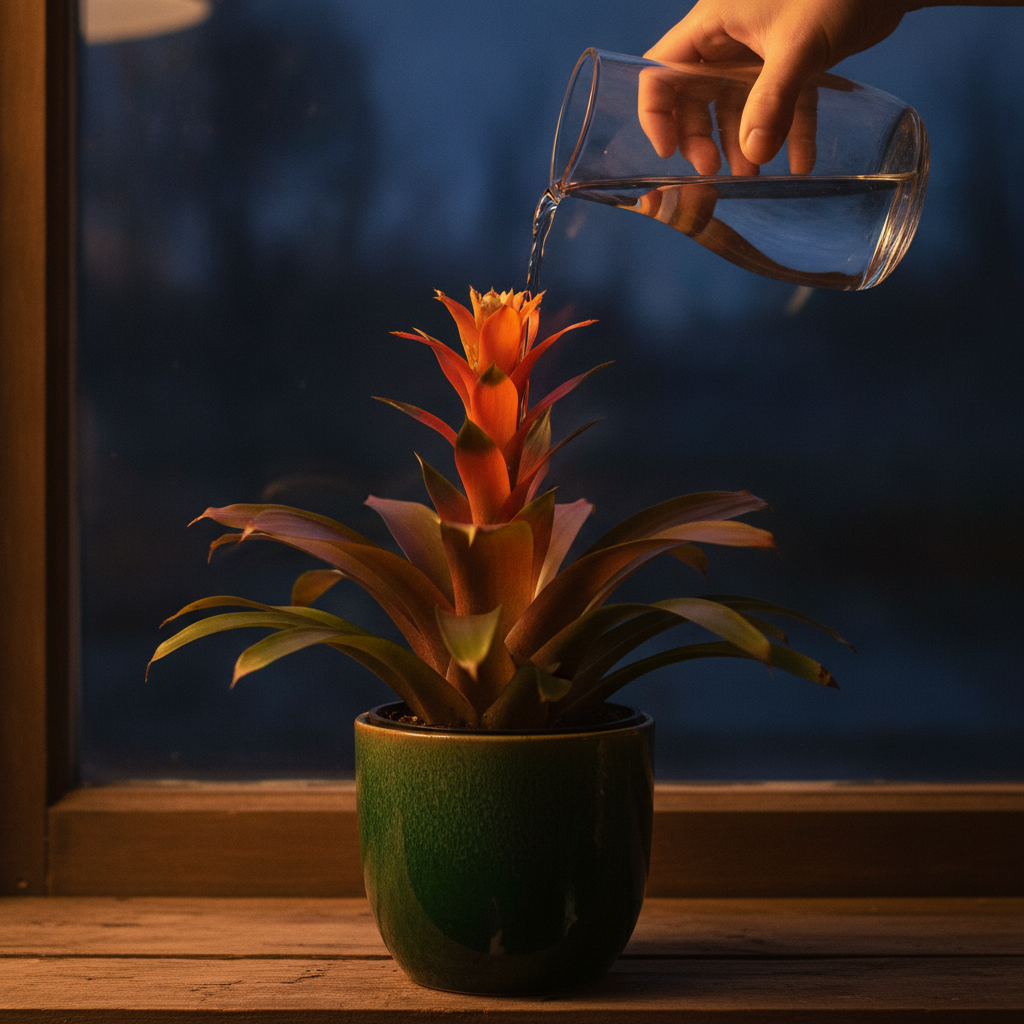
Watering is where the orange guzmania differs most from an ordinary houseplant, and where most problems begin. As an epiphyte it does not rely on its roots to drink. Instead, the overlapping bases of its leaves form a watertight reservoir at the centre of the rosette, known as the tank or cup, and it is through this cup that the plant absorbs most of its water. Watering the soil while ignoring the cup is the classic mistake, and it leaves the plant chronically thirsty even in damp potting mix.
When to Water
The rule of thumb is to keep the central cup filled with 2 to 3 cm of water at all times, and to keep the potting mix lightly moist but never soggy. Check the cup every few days; in warm, dry rooms it can empty through evaporation and uptake within two or three days, while in cool, humid conditions it lasts longer. The soil itself should be allowed to approach dryness in the top layer between waterings, since the roots are far more prone to rot than a conventional plant’s.
The most important discipline is to refresh the cup rather than simply topping it up. Water sitting in the rosette for weeks turns stagnant, and stagnant water invites rot and unpleasant smells. Roughly once a week, tip the plant gently to empty the old water out, then refill with fresh, so the cup stays clean and oxygenated. This single habit prevents the majority of guzmania failures.
Pro Tip — Flush the Cup: Once a week, empty and refill the central cup with clean water. If your home is warm, do it more often. A cup of fresh water is like a small, clean pond; a cup of neglected water is a breeding ground for rot at the very heart of the plant.
How to Water Correctly
- Check the central cup. If it holds less than about 2 cm of water, it needs refreshing.
- Tip the plant carefully over a sink and pour out the old water to clear any debris and stagnation.
- Refill the cup with clean, room-temperature rainwater or distilled water until it holds 2 to 3 cm.
- Pour a little water over the potting mix as well, just enough to keep it lightly moist, and let any excess drain away completely.
- Never let the pot stand in a saucer of water; empty the saucer after a few minutes so the roots are not left sitting wet.
- Every week or two, mist the leaves to supplement humidity and keep the foliage fresh, especially in dry indoor air.
Signs of Overwatering vs. Underwatering
| Symptom | Overwatering | Underwatering |
|---|---|---|
| Leaf colour | Yellowing near the base, soft translucent patches | Dull green fading to brown at the tips |
| Leaf texture | Mushy, limp leaf bases that pull away easily | Thin, curling, papery leaves |
| Central cup | Foul-smelling stagnant water, slimy residue | Persistently empty and dry |
| Roots | Blackened, soft, giving off a sour smell | Dry and brittle but otherwise intact |
| Base of plant | Soft, brown, collapsing at the crown | Firm but the whole rosette looks tired |
Warning — Root and Crown Rot: Because the guzmania holds water at its core, crown rot is the most serious risk it faces. If the base of the rosette turns soft and brown and the leaves loosen, rot has usually taken hold and the plant rarely recovers. Prevent it by keeping the mix on the dry side, flushing the cup regularly, and never letting the pot sit in standing water.
Humidity Requirements
Coming from cloud forests, the orange guzmania loves humidity and does best when the surrounding air sits at 60 percent or above. It will tolerate the 50 percent found in many homes, but drops much below that, especially the parched air of a centrally heated room in winter, and the leaf tips begin to brown and the whole plant loses its fresh, glossy look.
The first symptoms of air that is too dry are crisp brown tips on the leaves and a general dullness to the foliage, along with a bract that fades faster than it should. These are cosmetic rather than fatal, but they signal that the plant is under stress and that its display will be shorter-lived.
Raising humidity is straightforward. Grouping the guzmania with other plants creates a naturally moister pocket of air, and a pebble tray filled with water beneath the pot lifts local humidity as it evaporates. In very dry rooms a small humidifier is the most reliable answer. A bright bathroom or kitchen, where humidity is naturally higher, is an excellent home for one.
Water Quality
Guzmanias are noticeably sensitive to the minerals and chemicals in tap water. Because water sits in the cup and against the delicate leaf bases for days, the salts, chlorine and especially fluoride in hard or treated water can accumulate and burn the tissue, showing up as brown leaf tips. Wherever possible use rainwater, distilled water or filtered water. If only tap water is available, let it stand uncovered overnight so some of the chlorine dissipates, and flush the cup more often to stop mineral build-up.
Soil, Potting & Repotting
Because the roots of an orange guzmania exist mainly to anchor the plant rather than to feed it, they need air far more than they need moisture. A dense, water-retentive potting soil is the enemy here; it stays wet, starves the roots of oxygen and quickly leads to rot. The goal instead is an open, fast-draining medium that mimics the loose debris and bark the plant would root into on a forest branch.
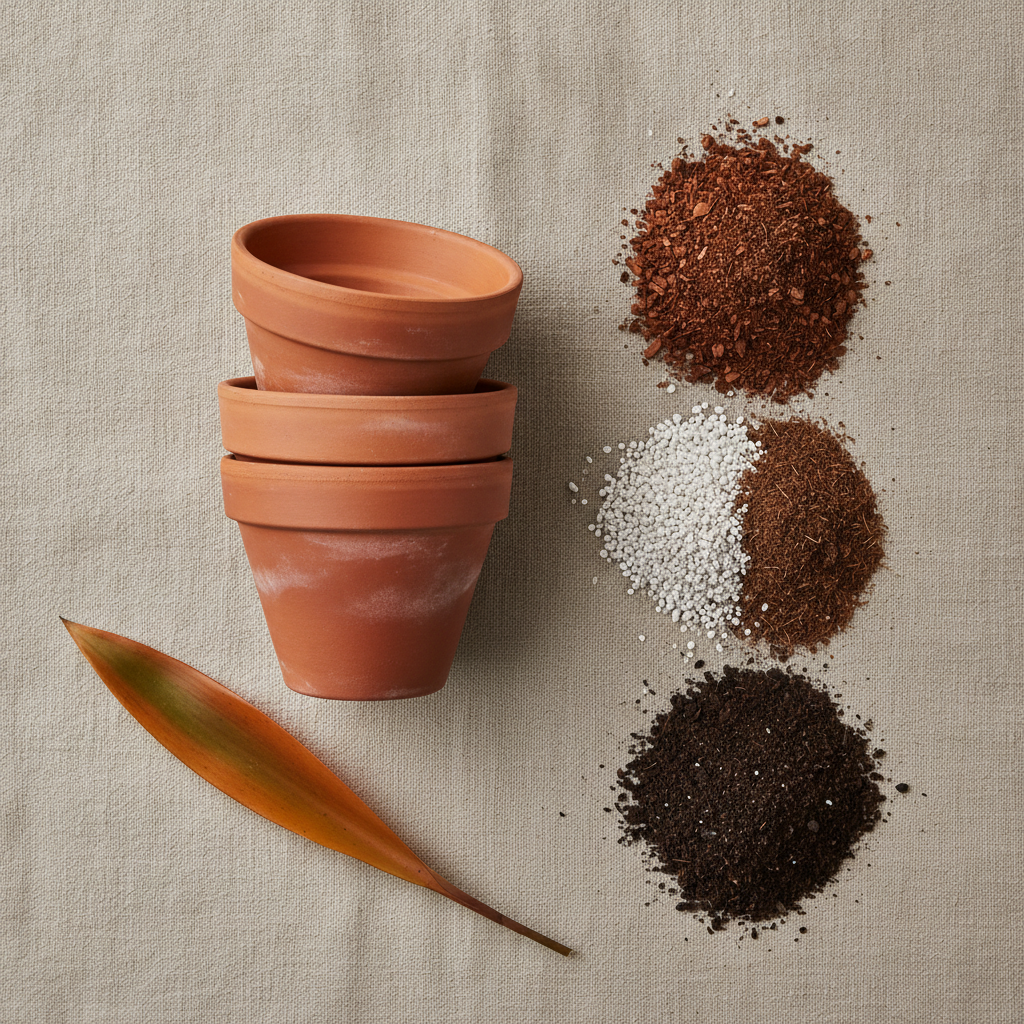
Ideal Soil Composition
The best medium for a guzmania is essentially an orchid or bromeliad mix: chunky, bark-heavy and free-draining. A blend built around orchid bark, with perlite for aeration and a little coco coir or peat to hold a touch of moisture, gives the roots the airy footing they want while still keeping the plant upright and steady in its pot.
| Component | Proportion | Function |
|---|---|---|
| Fine orchid bark | 50 percent | Provides structure and large air pockets, drains freely |
| Perlite or pumice | 25 percent | Keeps the mix open and prevents compaction |
| Coco coir or peat | 15 percent | Holds a little moisture without becoming soggy |
| Sphagnum moss | 10 percent | Retains gentle humidity around the anchoring roots |
Guzmanias prefer a slightly acidic root environment, around pH 5.0 to 6.0, which a bark and coir based mix naturally provides. There is no need to test or adjust it in practice; simply avoiding heavy, alkaline garden soils keeps the plant in the right range.
Pro Tip — Quick Mix Recipe: If you want a simple, reliable blend, combine two parts orchid bark, one part perlite and one part coco coir. That ratio drains fast, stays airy and suits every guzmania and most other tank bromeliads without further tinkering.
Choosing the Right Pot
Guzmanias have small root systems and are top-heavy once the bract is up, so pot choice is about stability and drainage rather than volume. A pot only slightly larger than the root ball is all the plant ever needs, and an oversized container simply holds excess damp mix that invites rot.
Drainage holes are non-negotiable. Whatever pot you choose must have holes so water can escape freely. Given that the plant is watered through its cup, the mix should never be allowed to sit in trapped water at the bottom of the container.
Pot material: A heavier pot such as glazed ceramic or terracotta helps counterbalance the tall bract and stops the plant tipping over. Terracotta has the added benefit of breathing, wicking away excess moisture from the mix, which suits a rot-prone plant well.
Pot size: Choose a pot 10 to 13 cm (4 to 5 inches) across for most specimens. Because a guzmania flowers only once and is then replaced by its pups, you will rarely need to move a mature plant up a size at all.
When to Repot
Repotting a mature, flowering guzmania is usually unnecessary and can even be counterproductive, since the plant is nearing the end of its own life cycle once the bract appears. The main reasons to repot are to move a freshly bought plant out of a waterlogged nursery mix into something airier, or to pot up the pups once they are large enough to separate. When you do repot, spring is the best time, giving the plant the growing season ahead to settle in.
How to Repot: Step-by-Step
- Water the plant lightly a day beforehand so the root ball holds together and the leaves are turgid.
- Ease the plant out of its pot by supporting the base of the rosette, not by pulling on the leaves.
- Gently tease away the old, spent nursery mix from the roots, discarding any that is soggy or foul-smelling.
- Inspect the roots and trim off any that are blackened or mushy with clean, sterilised scissors.
- Settle the plant into fresh bark-based mix at the same depth it grew before, never burying the base of the rosette.
- Firm the mix lightly so the plant is stable, then fill the central cup with clean water rather than soaking the soil.
- Keep the newly potted plant in bright indirect light and slightly higher humidity for a couple of weeks while it re-establishes.
Warning — Planting Depth: Never bury the base of the rosette when repotting. If the crown, where the leaves meet, is set below the surface of the mix, it will stay wet and rot. The plant should sit with its rosette clearly above the potting medium.
Fertilising
Guzmanias are light feeders by nature. In the forest they scavenge nutrients from the dust, decaying leaves and insect debris that wash into their cups, so they are adapted to a very lean diet. Overfeeding does far more harm than underfeeding, and a plant that is never fertilised at all will generally do perfectly well.
That said, a very dilute feed during the growing season can support a healthier rosette and, more importantly, stronger pups to carry the plant forward. The trick is to keep the concentration low and the frequency modest, and to remember that the leaves and cup, not the roots, are the plant’s main route for taking up nutrients.
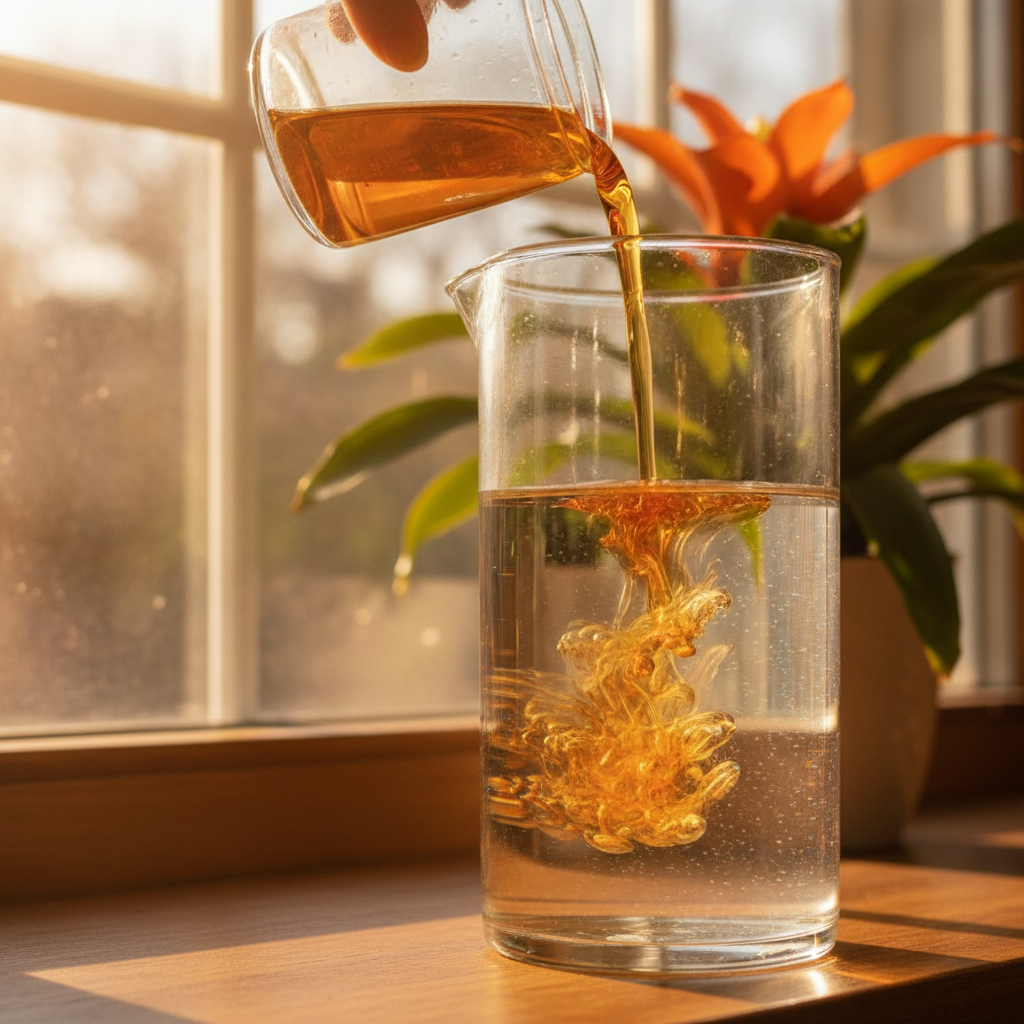
Understanding Plant Nutrients
Plant fertilisers are described by their ratio of nitrogen, phosphorus and potassium, the three macronutrients printed on the label as N-P-K. For a foliage-and-bract plant like the guzmania a balanced, low-strength blend is ideal. A handful of secondary nutrients and trace elements matter too, and their absence shows up in specific ways on the leaves.
| Nutrient | Symbol | Primary Function | Deficiency Symptoms |
|---|---|---|---|
| Nitrogen | N | Leaf growth and rich green colour | Pale, yellowing older leaves; slow growth |
| Phosphorus | P | Root development and flowering | Weak roots, dull foliage, poor pup formation |
| Potassium | K | Overall vigour and water regulation | Browning leaf edges, general weakness |
| Calcium | Ca | Cell wall strength | Distorted or weak new growth |
| Magnesium | Mg | Core of the chlorophyll molecule | Yellowing between leaf veins |
| Iron | Fe | Chlorophyll production | Pale, yellowing youngest leaves |
Types of Fertiliser
Liquid fertilisers: The best choice for guzmanias because they can be diluted precisely and applied to the leaves or cup. A balanced houseplant feed at a quarter of its recommended strength is ideal.
Slow-release granular: Generally best avoided. Prills dropped into the cup or mix can release too much fertiliser too close to the sensitive tissue and cause burning; they are hard to control on so lean a plant.
Organic fertilisers: Very dilute seaweed or fish emulsion works well and mirrors the natural debris-fed diet, but keep the concentration low and rinse the cup afterward to prevent residue building up in the rosette.
Feeding Schedule
Feed only during the active growing months of spring and summer, roughly once a month, and stop entirely in autumn and winter when growth slows. A mature plant already in full bract needs no feeding at all; concentrate any feeding on young plants and developing pups, which benefit most from the extra nutrition.
Pro Tip — Feed the Leaves, Not Just the Roots: Because guzmanias absorb nutrients through their foliage, a very dilute feed misted over the leaves or added to the cup is taken up more efficiently than one poured into the mix. Always flush the cup with clean water a day or two after feeding to prevent salt build-up at the crown.
How to Fertilise
- Mix a balanced liquid houseplant fertiliser to a quarter of the strength stated on the bottle.
- Apply it either as a fine mist over the leaves or by adding a small amount to the central cup.
- Optionally moisten the potting mix lightly with the same dilute solution.
- One or two days later, empty and refresh the cup with clean water to wash away any residue.
- Repeat no more than once a month through spring and summer, and never feed a plant that is dry or stressed.
Warning — Salt Build-Up: Fertiliser salts concentrating in the cup are a common cause of brown, burnt leaf bases in guzmanias. If you feed, always follow up by flushing the rosette, and if you ever see a crusty residue forming, stop feeding and rinse the plant thoroughly.
Propagation
Propagation is not an optional extra with a guzmania; it is how the plant continues. Like all bromeliads, the orange guzmania is monocarpic, meaning each rosette flowers only once in its life. After the bract has coloured up and slowly faded, the parent rosette gradually declines over the following months. But before it goes, it produces offsets known as pups around its base, and these pups are the plant’s future.
Understanding this cycle changes how you view a fading plant. A guzmania that is browning at the centre after months of display is not failing through poor care; it is completing a natural process, and your job is simply to nurture the pups it leaves behind. Grown on, each pup becomes a full-sized plant that will in turn produce its own orange bract in a year or two.
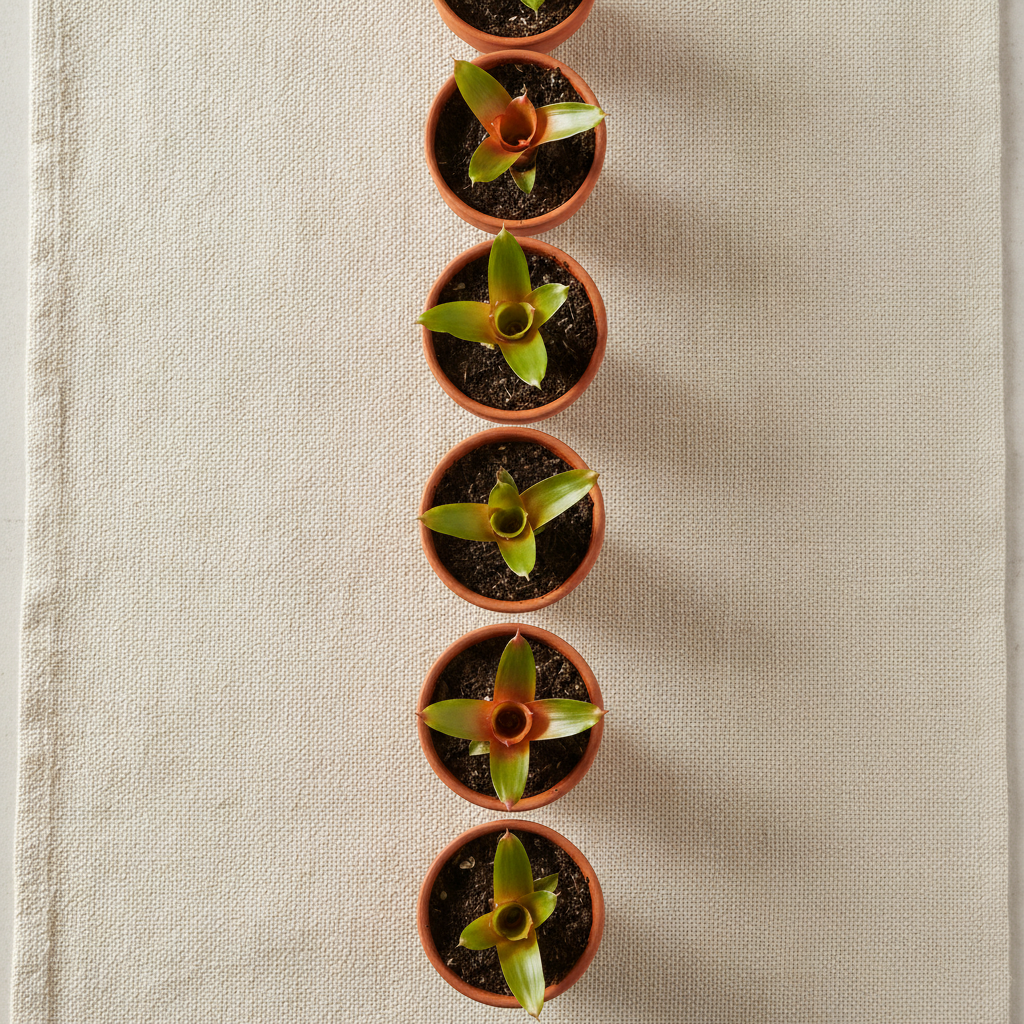
Understanding Pups and Offsets
Pups emerge from the base of the mother plant, usually a few weeks to a few months after flowering, as small versions of the parent. The single most important principle of guzmania propagation is patience: a pup should not be separated until it has reached roughly one third to one half the size of the mother and, ideally, has begun forming its own small roots. Detached too early, a pup has neither the size nor the root system to survive on its own. Left on the mother until it is well developed, it establishes quickly and reliably.
Separating Pups: Step-by-Step
This is the primary and most dependable method of propagation, and the only one most growers ever need. Wait until the pup is large enough and the mother has clearly begun to decline before you divide.
- Wait until the pup is at least a third of the size of the parent and has ideally begun to form its own roots.
- Ease the whole plant out of its pot so you can see clearly where the pup joins the mother.
- Using a clean, sterilised knife, cut the pup away from the parent as close to the base as possible, keeping any roots it has already made.
- Allow the cut surface to dry and callus for a few hours to reduce the risk of rot.
- Pot the pup into a small container of fresh, airy bark-based mix, setting it just deep enough to stand upright.
- Support the pup with a small stake if it is unsteady, and keep the mix barely moist while filling its little cup with clean water.
- Place it in bright indirect light with good humidity and it will root and establish over the following weeks.
Pro Tip — Patience Pays: The single biggest cause of failed guzmania propagation is impatience. A pup left on the mother until it is half her size and has started rooting will establish almost every time, whereas one removed too soon often simply rots. Resist the urge to divide early.
Growing Pups On Without Separating: Step-by-Step
If you prefer not to cut, you can simply let the pups grow on in place. As the mother rosette dies back you gradually remove her spent leaves, leaving a naturally forming cluster of young plants in the same pot. This is the lowest-effort route and mimics how the plant would spread on a forest branch.
- Leave the pups attached to the mother and continue normal care as her bract fades.
- As the mother’s outer leaves brown and die, trim them away carefully with sterile scissors.
- Keep the central cups of the developing pups filled with clean water as they take over.
- Once the mother has fully spent herself, either leave the cluster to grow as a group or lift and divide the now well-rooted pups.
- Top up the mix if the roots become exposed, and maintain bright indirect light throughout.
Troubleshooting Propagation
| Problem | Likely Cause | Solution |
|---|---|---|
| Pup rots after separation | Removed too early or potted into wet mix | Wait until larger and rooted; use airy mix and let the cut callus |
| Mother produces no pups | Plant too young, stressed or in poor light | Improve light and humidity; be patient, pups follow flowering |
| Pup grows very slowly | Too little light or warmth | Move to a brighter, warmer spot with steady humidity |
| Pup topples over | Undersized root system for its height | Stake it lightly until the roots anchor it firmly |
Pests & Diseases
The orange guzmania is a robust plant that suffers few pest problems, and most of the trouble it does encounter stems from watering and air rather than insects. Still, a handful of common houseplant pests can find their way onto it, usually hiding in the sheltered leaf axils where the leaves overlap.
Regular inspection is the best defence. Because the plant is small and its leaves are broad and glossy, a quick look over the rosette every week or two will catch anything early, when it is simple to deal with. Pay particular attention to the leaf axils and the undersides of the leaves, the two spots pests most like to colonise.
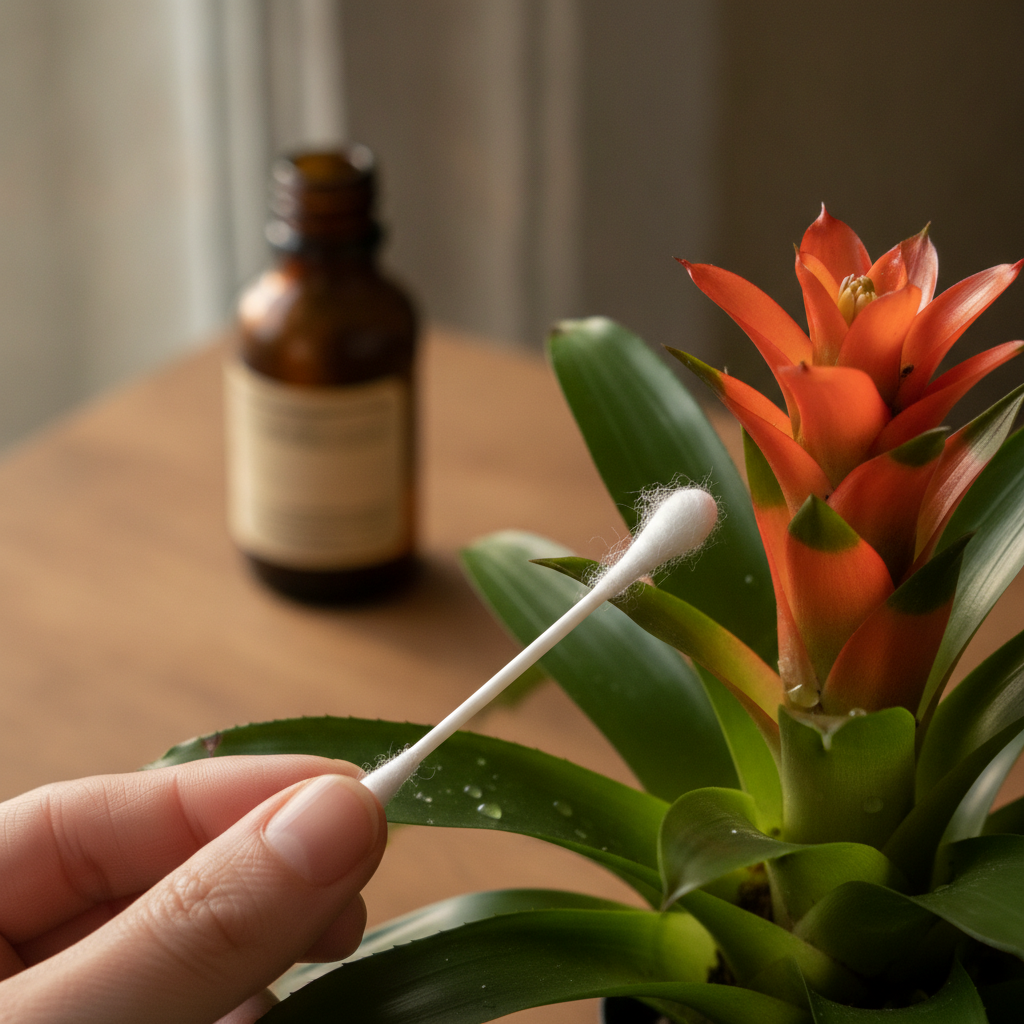
Common Pests
Scale (Coccidae)
Scale are the most frequent guzmania pest, appearing as small, flat brown discs stuck fast to the leaves, often along the midrib or in the axils. They feed on sap and can slowly weaken the plant, leaving sticky honeydew behind.
Treatment: Scrape or wipe them off with a cotton bud dipped in diluted isopropyl alcohol, then follow up with a horticultural oil spray if the infestation is widespread. Check weekly until no new scale appear.
Mealybugs (Pseudococcidae)
Mealybugs show up as small, white, cottony tufts tucked into the sheltered leaf axils. Like scale, they suck sap and excrete honeydew, and they breed quickly in the warm, humid conditions a guzmania enjoys.
Treatment: Dab each one directly with an alcohol-dipped cotton bud, which kills them on contact, and repeat every few days until the plant is clear. A neem oil spray helps prevent a return.
Spider Mites (Tetranychus urticae)
Spider mites are a risk mainly when the air is too dry. They are tiny, hard to see, and betray themselves through fine webbing and a stippled, dull appearance on the leaves. Raising humidity is both prevention and part of the cure.
Treatment: Rinse the plant thoroughly, increase humidity, and treat with insecticidal soap or neem oil, repeating at weekly intervals to break the breeding cycle.
Common Diseases
Crown and Root Rot (Pythium and Phytophthora)
By far the most serious disease of guzmanias, crown rot sets in when water stagnates at the base of the rosette or when the mix is kept too wet. The crown turns brown and soft, the leaves loosen, and the plant collapses from the centre outward.
Treatment: Prevention is the only reliable cure. Keep the mix on the dry side, flush the cup regularly, and never bury the crown. Once rot is advanced the mother plant is usually lost, so salvage any healthy pups and start again.
Fungal Leaf Spot (Various fungi)
Leaf spot appears as brown or black blotches, sometimes with a yellow halo, and is encouraged by water sitting on the leaves in poorly ventilated, overly humid conditions.
Treatment: Remove affected leaves, improve air circulation, and avoid wetting the foliage late in the day. A copper-based fungicide can help if spots continue to spread.
Pest and Disease Summary
| Pest / Disease | Identification | Treatment |
|---|---|---|
| Scale | Flat brown discs on leaves and axils, sticky residue | Alcohol swab, then horticultural oil |
| Mealybugs | White cottony tufts in leaf axils | Alcohol swab and neem oil, repeated |
| Spider mites | Fine webbing, stippled dull leaves | Raise humidity, insecticidal soap or neem |
| Crown and root rot | Soft brown crown, loosening leaves | Prevent by keeping dry; salvage pups if advanced |
| Fungal leaf spot | Brown or black blotches with yellow halos | Remove leaves, improve airflow, copper fungicide |
Prevention Strategies
Almost every problem a guzmania faces can be prevented with the same handful of habits: keep the cup fresh, keep the mix airy and on the dry side, give the plant bright indirect light and maintain good humidity and air movement. A plant kept in these conditions is rarely troubled by anything.
Quarantine is worth a mention too. Whenever you bring home a new plant, keep it apart from your others for a fortnight and inspect it closely, since scale and mealybugs most often arrive as hitchhikers on new purchases. Catching them before they spread saves a great deal of trouble later.
Pro Tip — Inspect the Axils: The overlapping leaf axils are both the guzmania’s watering reservoir and the favourite hiding place of its pests. Make a habit of parting the leaves gently and checking these sheltered pockets whenever you refresh the cup, and you will catch trouble long before it takes hold.
Popular Varieties
The orange guzmania sold in shops is often a hybrid or a selection within a small group of closely related species, chiefly Guzmania zahnii and Guzmania lingulata, bred for the size and colour of their bracts. The genus offers a remarkable spread of colours beyond orange, from scarlet and crimson to yellow, purple and pure white, and the same care applies across the board.
Below is a selection of the most widely available guzmanias and near relatives, giving a sense of the range you can collect once the bug bites. All share the tank-forming habit and identical needs, so a mixed group makes a low-effort, high-colour display.
| Variety | Leaf Appearance | Light Needs | Growth Rate | Availability |
|---|---|---|---|---|
| Guzmania ‘Empire’ | Glossy green with a broad flame-orange bract | Bright indirect | Moderate | Common |
| Guzmania zahnii ‘Variegata’ | Cream and green stripes flushed red | Bright indirect | Slow | Uncommon |
| Guzmania lingulata ‘Orange Star’ | Deep green, vivid orange star-shaped bract | Bright indirect | Moderate | Very common |
| Guzmania ‘Rana’ | Green leaves, bright yellow bract | Bright indirect | Moderate | Common |
| Guzmania ‘Cherry’ | Green leaves, deep red bract | Bright indirect | Moderate | Common |
| Guzmania ‘Ostara’ | Green leaves, tall red-orange bract | Bright indirect | Moderate | Common |
| Guzmania ‘Hope’ | Green leaves, pinkish-red bract | Bright indirect | Moderate | Occasional |
| Guzmania sanguinea | Leaves flush red at the centre, low bract | Bright indirect | Slow | Uncommon |
Featured Varieties
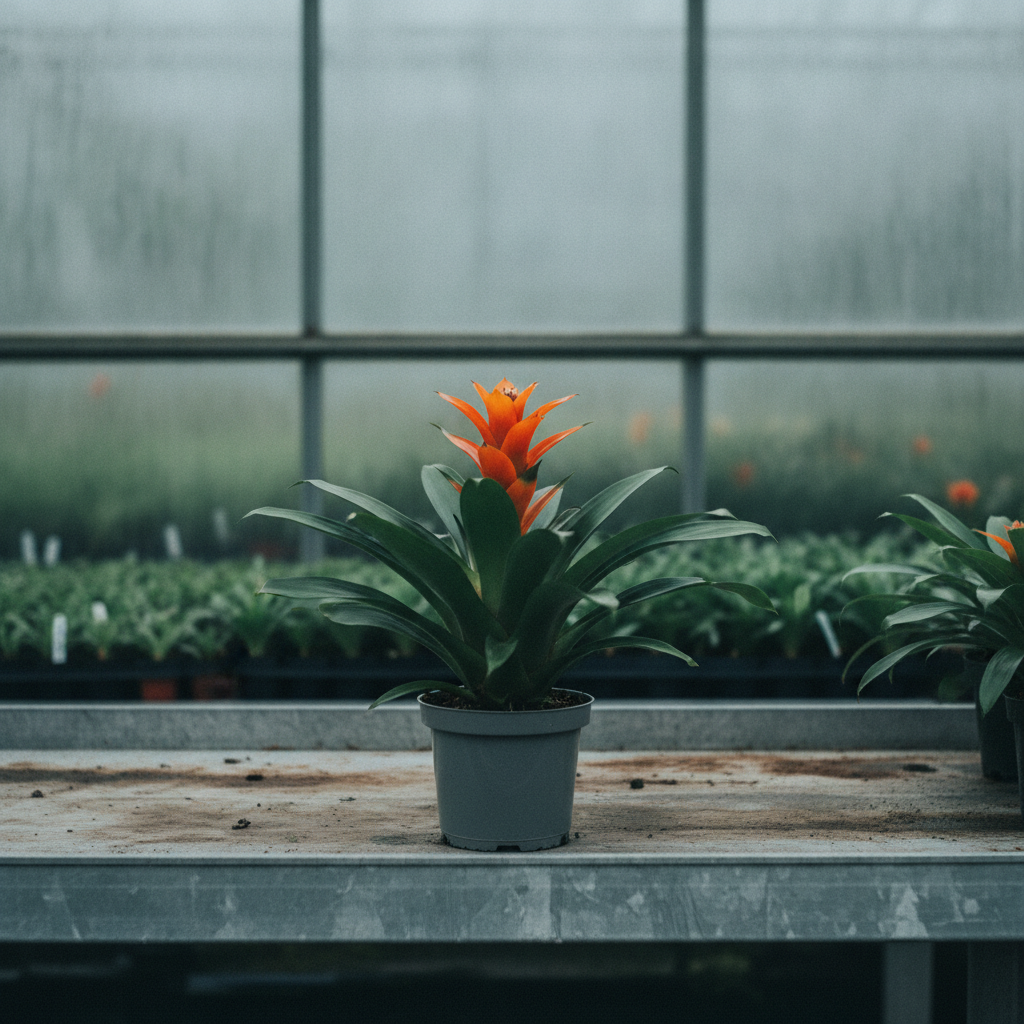
Guzmania ‘Empire’
A compact, reliable hybrid with a broad, flame-orange central bract sitting above deep, glossy green strap leaves. It is one of the boldest orange forms and holds its colour especially well, making it a favourite for a bright shelf or table.
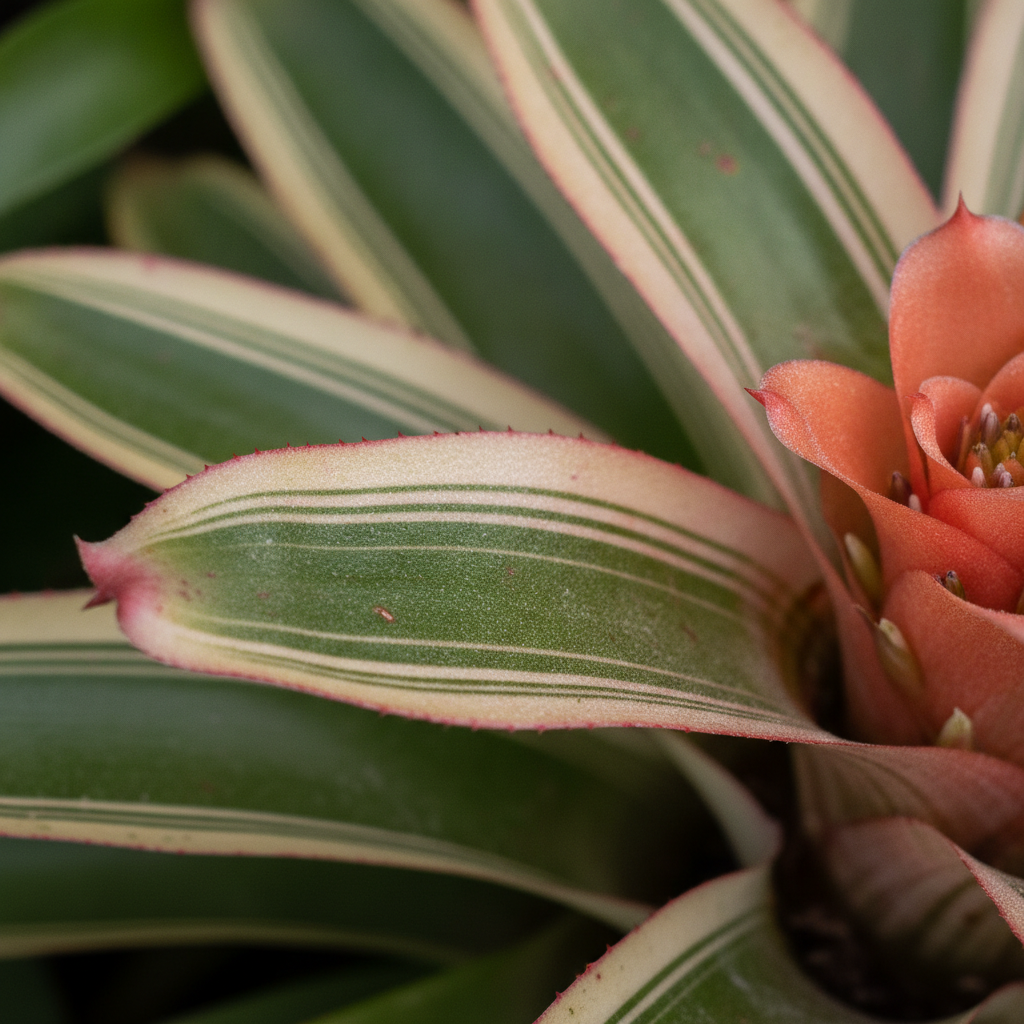
Guzmania zahnii ‘Variegata’
The most decorative form for foliage, with leaves striped longitudinally in cream and green and flushed a rosy red, topped by a coral-orange inflorescence. It grows more slowly than the plain species and is prized as much for its foliage as its bract.
Variety Profiles in Detail
Guzmania ‘Empire’ (Guzmania hybrid)
‘Empire’ is among the most commonly sold orange guzmanias and a superb introduction to the genus. Its broad bract opens a saturated flame-orange and can hold that colour for three months or more, while the underlying rosette stays tidy and glossy. It asks for nothing beyond the standard care and pups readily once it finishes flowering.
Guzmania lingulata ‘Orange Star’ (Guzmania lingulata)
Perhaps the single most familiar guzmania in cultivation, ‘Orange Star’ produces a striking star-shaped bract of glowing orange above a rosette of deep green leaves. It is widely available, inexpensive and utterly dependable, and it shares its care needs exactly with Guzmania zahnii, so the two make easy companions.
Guzmania sanguinea (Guzmania sanguinea)
An unusual species in which the display comes not from a tall bract but from the leaves themselves, which flush brilliant red toward the centre at flowering time while the true flowers sit almost hidden in the cup. Slower growing and a little harder to find, it rewards a collector looking for something beyond the standard orange torch.
Choosing the Right Variety for Your Space
Because every guzmania shares the same compact size and identical care, choosing between them is purely a question of colour and, occasionally, foliage. For maximum impact in a bright room, the bold orange of ‘Empire’ or ‘Orange Star’ is hard to beat. If you want variety in a grouped display, mixing an orange form with the yellow of ‘Rana’ or the red of ‘Cherry’ creates a vivid, low-maintenance cluster. And if foliage interest matters as much as the bract, the variegated forms earn their place all year round rather than only while in colour.
Frequently Asked Questions
Why is my orange guzmania dying after it flowered?
This is entirely normal and not a sign of poor care. Guzmanias are monocarpic, so each rosette flowers only once and then slowly dies over the following months. Before it does, it produces pups at its base. Nurture those pups and the plant effectively renews itself; the fading parent is simply completing its natural life cycle.
Should I water the cup or the soil?
Primarily the cup. Keep 2 to 3 cm of clean water in the central rosette at all times and flush it weekly to keep it fresh. Water the soil only lightly, just enough to keep the mix barely moist, since the roots are prone to rot and the plant drinks mainly through its cup.
Is the orange guzmania safe for cats and dogs?
Yes. Guzmanias are listed as non-toxic to both cats and dogs and pose no poisoning risk to people either. The only minor hazard is the firm leaf tips, which can give a small scratch, so it is one of the safest colourful plants for a household with pets or children.
How long does the orange bract last?
Typically two to four months, and sometimes longer in good conditions. Because the bract is a modified leaf structure rather than a true flower, it holds its colour far longer than a conventional bloom before slowly fading to a papery beige. Bright indirect light keeps it vivid for as long as possible.
Why are the leaf tips turning brown?
Brown leaf tips usually point to dry air or mineral build-up from tap water. Raise the humidity around the plant to 60 percent or so, and switch to rainwater, distilled or filtered water for both the cup and the soil. Flushing the cup regularly also helps prevent salts accumulating against the sensitive leaf bases.
Can I get my guzmania to flower again?
The same rosette will not flower twice, but its pups will. Once a pup is well grown, mature and given good light, it can be encouraged to bloom. A traditional trick is to enclose a mature pup in a clear bag with a ripe apple for a week or two; the ethylene gas the apple releases can trigger the plant to produce its bract.
How often should I fertilise?
Sparingly, if at all. A quarter-strength balanced feed applied to the leaves or cup once a month through spring and summer is plenty, and mature flowering plants need none. Overfeeding causes far more harm than skipping it entirely, so when in doubt, feed less.
Does it need a lot of light?
It needs bright but indirect light. An east-facing window or a spot near, but not directly in, a south or west window is ideal. Direct midday sun scorches the leaves, while a dim corner causes the bract to fade quickly and growth to stall, so aim for luminous, filtered brightness.
Can I grow an orange guzmania mounted rather than potted?
Yes. As a natural epiphyte it grows happily mounted on a piece of bark or driftwood, with its roots wrapped in a little sphagnum moss. Mounted plants dry out faster and need more frequent misting and cup filling, but the arrangement is authentic to how the plant grows in the wild and can look spectacular.
What temperature does it prefer?
Warmth suits it best, ideally between 18 and 27 degrees Celsius (64 to 81 Fahrenheit). It dislikes the cold and should be kept away from draughts and unheated rooms, never dropping below about 12 degrees Celsius (54 Fahrenheit). Ordinary comfortable room temperature is perfect year-round.






