
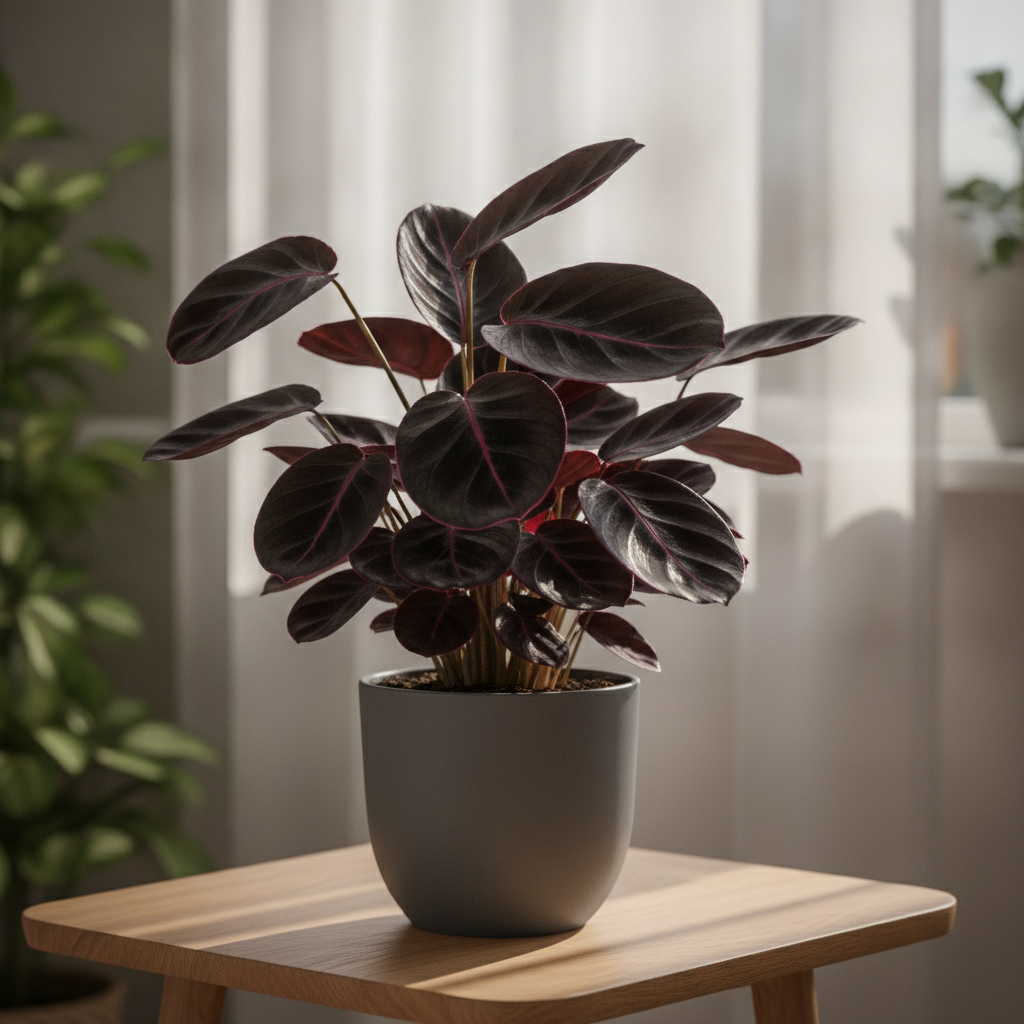
Few houseplants make a first impression quite like the Dottie calathea. Its rounded leaves are so deeply pigmented they read as black in a shaded corner, and each one is finished with a hand-drawn ribbon of electric magenta-pink tracing the margin and running up the midrib. The plant is a named cultivar of Goeppertia roseopicta, sold and loved as ‘Dottie’, and it belongs to the prayer plant family Marantaceae, a group of tropical understorey plants from the rainforests of Brazil. Older labels and nursery tags still use the former name Calathea roseopicta, and you will see both used interchangeably; the plant is the same regardless of which genus name is printed on the pot.
Dottie carries a reputation as a diva, and that reputation is only half deserved. Keeping the plant alive is not especially difficult once you understand what a rainforest understorey feels like, but keeping it flawless, with every leaf unblemished and every magenta rim crisp, asks for genuine attention to humidity, water quality and consistency. This guide draws a clear line between the two. It covers everything you need to help a Dottie simply survive, and then everything that separates a surviving plant from one that thrives, unfurling glossy new leaves in a steady rhythm through the growing season.
Contents
- Quick Reference
- Why Dottie Calathea Makes a Rewarding Houseplant
- Light Requirements
- Watering & Humidity
- Soil, Potting & Repotting
- Fertilising
- Propagation
- Pests & Diseases
- Popular Varieties
- Frequently Asked Questions
Quick Reference: Dottie Calathea at a Glance
| Light | Medium to bright indirect light. No direct sun, which scorches the foliage and fades the colour. |
| Watering | Keep the soil lightly and evenly moist. Water when the top 2 to 3 cm (about 1 inch) begins to dry, roughly weekly. |
| Temperature | 18 to 27 degrees Celsius (64 to 81 degrees Fahrenheit). Avoid anything below 15 degrees Celsius (59 degrees Fahrenheit) and cold draughts. |
| Humidity | High. Aim for 60 percent or more; 50 percent is the practical minimum. |
| Fertiliser | Balanced liquid feed at half strength every 4 to 6 weeks in spring and summer only. |
| Toxicity | Non-toxic and pet-safe. Harmless to cats, dogs and humans. |
Why Dottie Calathea Makes a Rewarding Houseplant
The obvious appeal is the colour. Very few common houseplants offer near-black foliage, and fewer still pair it with a saturated pink that looks almost printed on. In a grouping of green plants, a single Dottie reads as a piece of living decoration, drawing the eye without a flower in sight. The leaves are broad, rounded and slightly cupped, held on upright stems that lift the whole plant into a tidy mound rather than letting it sprawl, which makes it easy to place on a shelf, a plant stand or a side table.
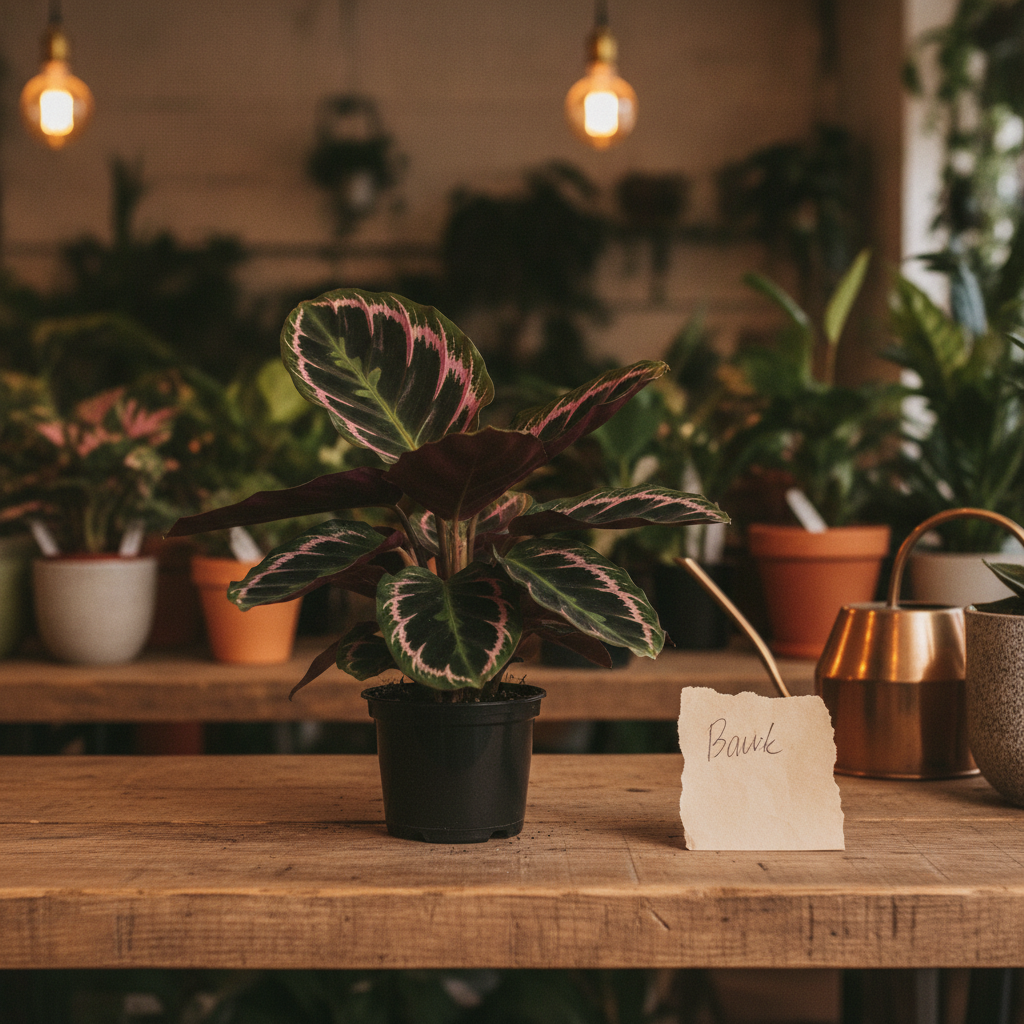
There is also a behaviour that sets prayer plants apart from almost everything else on the windowsill. Each evening the leaves rise and fold together along the midrib, and each morning they relax open again, a daily rhythm known as nyctinasty that is driven by a swollen joint called the pulvinus at the base of every leaf. With a Dottie the effect is dramatic, because as the leaves fold upward they reveal their deep burgundy undersides, so the plant changes character entirely between day and night. Living with one becomes a small daily pleasure, and a plant that closes up cleanly each evening is also a plant that is telling you it is comfortable. A final point in its favour is safety: the entire Marantaceae family is non-toxic, so a Dottie can share a home with cats, dogs and curious children without any of the worry that comes with an aroid or a lily.
Important — Toxicity: The Dottie calathea is listed as non-toxic to cats, dogs and horses by the ASPCA, and it is not poisonous to people. Nibbling is still best discouraged, since any plant material can cause mild stomach upset, but there are no toxic compounds to fear.
Light Requirements
To understand what a Dottie wants from light, picture where it grows in the wild. On the floor of a Brazilian rainforest, only a dappled fraction of the sun ever reaches the understorey, filtered and softened through many layers of canopy above. The plant evolved to make the most of that gentle, indirect light, and its dark leaves are partly an adaptation to gathering as much of it as possible. Bright, harsh sun is not part of its experience, and indoors it responds badly to it.
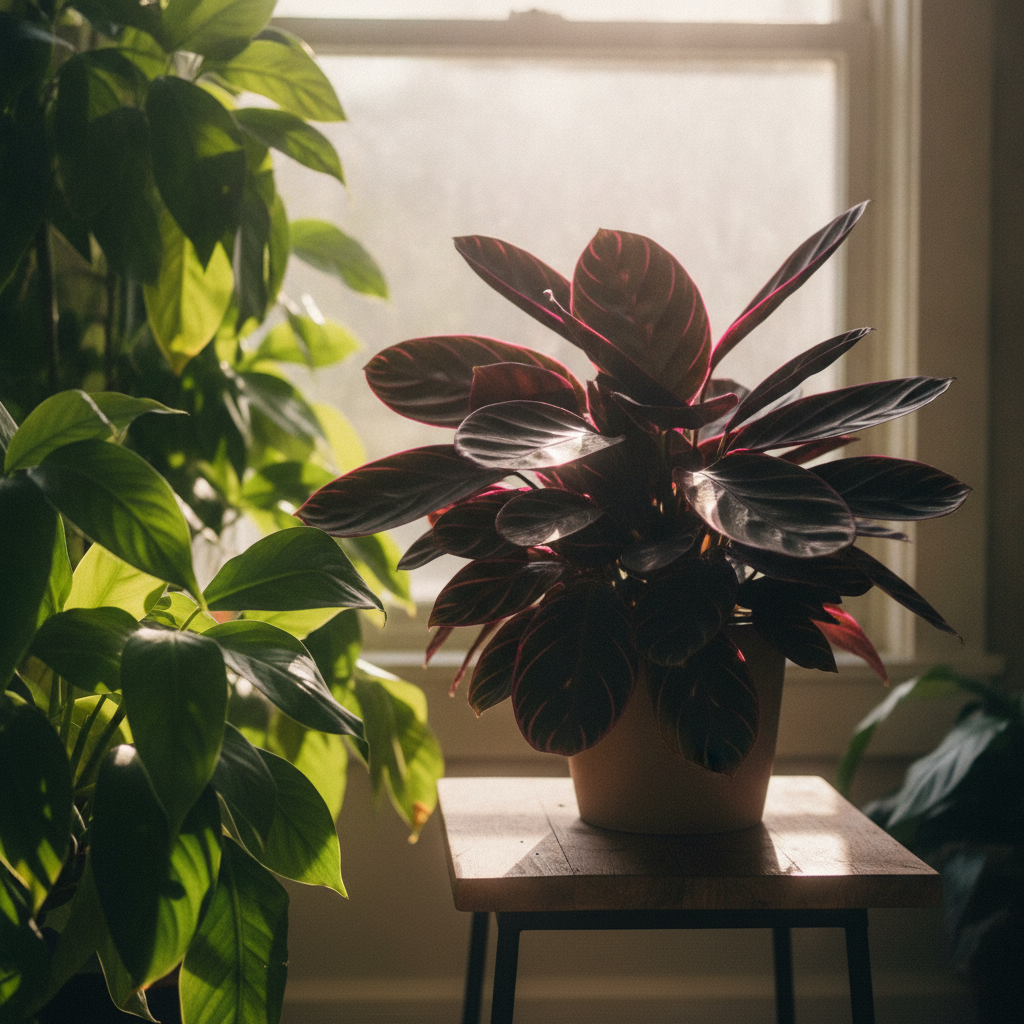
The ideal indoor position is one that receives plenty of bright but indirect light for most of the day without the sun’s rays ever falling directly on the leaves. A spot a metre or two back from a bright window, or right beside a window screened by a sheer curtain, is close to perfect. In that kind of light a healthy Dottie holds its dark colour, keeps its pink margins vivid and produces new leaves at a steady pace. Too little light and growth slows, the newest leaves emerge smaller and the pink can dull; too much and the whole plant suffers quickly.
Light Levels Explained
Houseplant advice throws around terms like “bright indirect” and “medium” light freely, so it helps to anchor them to something measurable. The table below sets out the main tiers, roughly how bright each one is in lux, where you would find it in a typical home and what a Dottie would do there.
| Light Category | Approx. Level | Typical Location | Outcome |
|---|---|---|---|
| Direct sun | 20,000 lux and above | On a south or west sill in summer | Harmful: scorched patches and faded, bleached colour |
| Bright indirect | 10,000 to 20,000 lux | Near an east window or set back from a bright one | Ideal: rich colour and steady new growth |
| Medium | 5,000 to 10,000 lux | A metre or two into a bright room | Good: healthy but slightly slower growth |
| Low | 1,000 to 5,000 lux | A north room or a dim interior corner | Survives but sulks; small leaves and dull colour |
| Very low | Below 1,000 lux | A windowless hallway or bathroom | Decline: leaf loss and no new growth |
Window Orientation and Placement
South-facing window: The brightest and most dangerous aspect for a Dottie. Direct midday sun through a south window will scorch the leaves within days, so keep the plant well back from the glass or diffuse the light with a sheer curtain. Used carefully, a south room can be excellent because of the sheer quantity of ambient light it holds.
East-facing window: Often the sweet spot. The gentle direct sun of early morning is weak enough to be tolerated, and for the rest of the day the plant bathes in bright indirect light. A Dottie placed on or just beside an east sill tends to look its best.
West-facing window: Workable but watch the afternoon. West light arrives late and strong, and a few hours of hot direct sun can be as damaging as a south window. Set the plant back or filter the glass, and a west room provides ample brightness.
North-facing window: The safest aspect for avoiding scorch, but the dimmest. A Dottie right at a north window usually manages, though growth is slower and you may need to supplement with a grow light through the darkest months, especially in northern latitudes.
Pro Tip — Rotate for Symmetry: Prayer plants lean noticeably towards their light source. Give the pot a quarter turn each time you water so that every side receives its share, and the plant will build an even, rounded shape rather than leaning to one side.
How Light Affects Leaf Colour
The dark pigment and pink margin that make Dottie so striking are both influenced by light, though not in the way many people expect. This is not a variegated plant that needs high light to hold a pattern; it is a naturally dark-leaved plant whose colour is driven by pigments called anthocyanins. In good bright indirect light the leaves develop their fullest depth of purple-black and the pink rim sits at its most saturated. In light that is too low the newest leaves tend to emerge greener and less contrasted, and the whole plant looks muted. Paradoxically, light that is too strong bleaches the colour out in the opposite direction, leaving pale, washed-out patches where the sun has struck. The richest colour comes from the middle ground.
Warning — Direct Sunlight: Direct sun is the single fastest way to ruin a Dottie’s appearance. It causes irreversible crispy brown or bleached-white patches, and once a leaf is scorched it will not recover. If you notice pale, dry blotches appearing on the upper surfaces, move the plant out of the sun’s path immediately.
Artificial Lighting
Dottie responds well to supplemental lighting, which makes it a good candidate for rooms that lack a bright window or for keeping colour strong through a dark winter. A standard full-spectrum LED grow light positioned 30 to 45 cm (12 to 18 inches) above the plant and run for 10 to 12 hours a day will comfortably meet its needs. Because the plant does not want intense light, you do not need a powerful horticultural fixture; a modest LED is plenty, and it can either replace daylight entirely or top up a naturally dim spot during the shortest days.
Seasonal Adjustments
Light levels indoors fall dramatically between summer and winter, and a position that was ideal in July can become too dim by December. As the days shorten, move the plant closer to its window to compensate, and reverse the move in spring as the sun climbs higher and stronger. Growth naturally slows in the low-light months, so do not be alarmed if new leaves stop appearing; the plant is simply resting, and it will resume once the light returns.
Watering & Humidity
Watering is where most Dottie problems begin, and it is worth understanding why this plant is more demanding than a pothos or a snake plant. In its native understorey the soil is rich in leaf litter and stays consistently damp but never waterlogged, kept that way by frequent rain and constant shade. A Dottie expects that same steady moisture indoors. It does not want to dry out completely, and it does not want to sit in a swamp; the target is an evenly moist root ball at all times.
When to Water
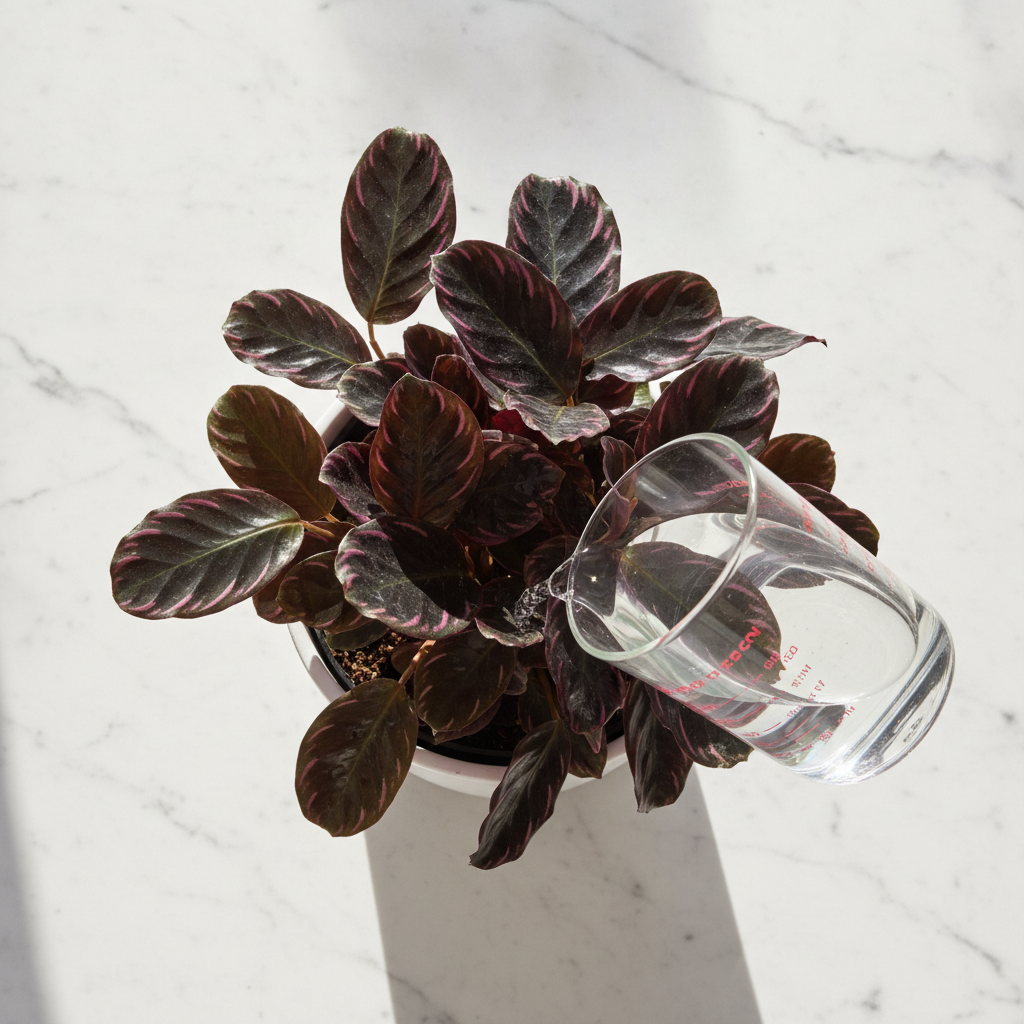
Rather than watering on a fixed schedule, learn to read the soil. Push a finger into the top of the pot: when the top 2 to 3 cm (about 1 inch) has just started to dry while the soil below is still lightly moist, it is time to water again. In a warm, bright home during the growing season this usually works out to roughly once a week, but the interval will lengthen in winter and shorten in the height of summer, so check before every watering rather than assuming.
Consistency matters more to a Dottie than to almost any other common houseplant. Wild swings between bone-dry and sodden are what cause the crispy edges and sudden yellowing that give the plant its fussy name. If you tend to forget, err very slightly on the moist side rather than letting the plant dry out hard, because a Dottie recovers from being a touch too damp far more gracefully than from a complete drought that collapses its leaves.
Pro Tip — Lift the Pot: The most reliable way to judge watering is by weight. Lift the pot just after you have watered and drained it, and again a few days later. You will quickly learn what a freshly watered pot feels like versus one that has dried to the point of needing a drink, and the difference is far more telling than looking at the surface alone.
How to Water Correctly
- Use room-temperature water; cold water straight from the tap can shock the roots of a tropical plant.
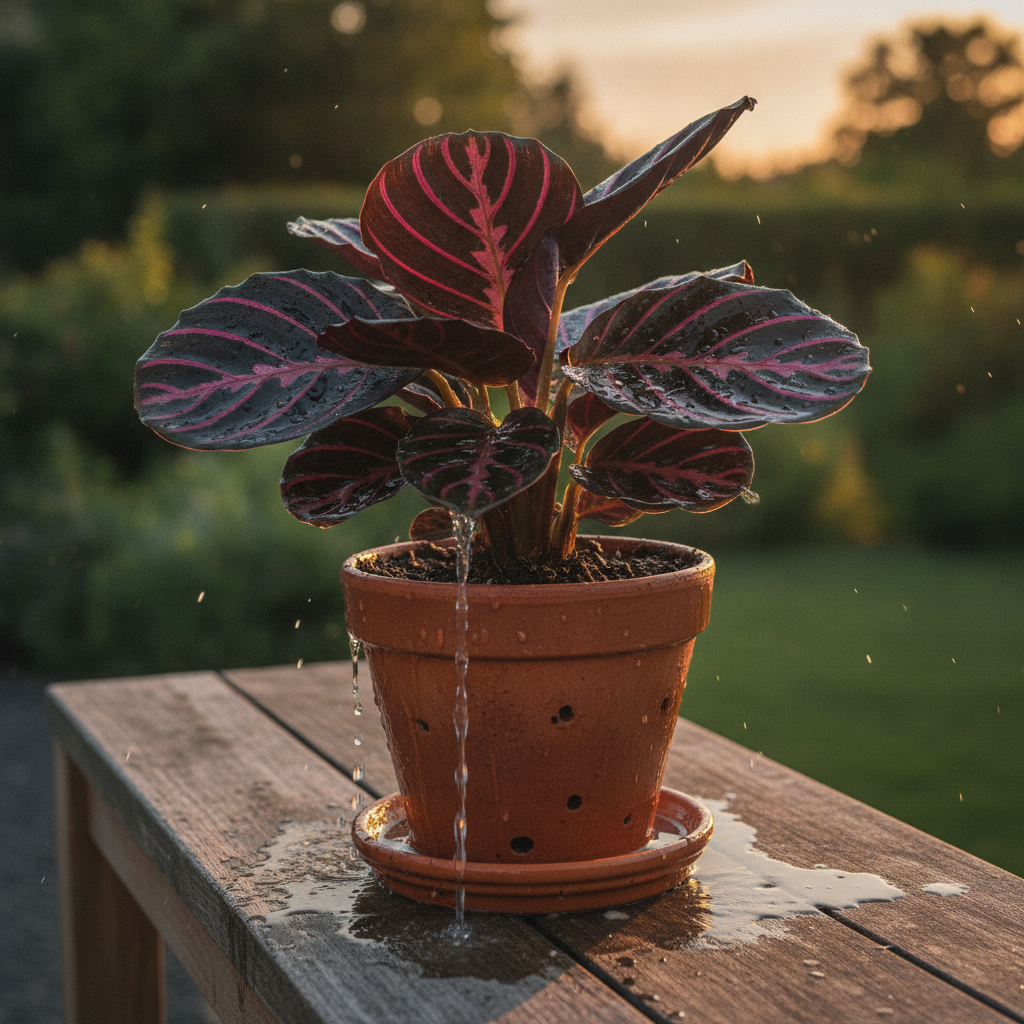
- Pour steadily over the soil surface, working your way around the pot until water flows freely from the drainage holes.
- Let the plant drain completely for several minutes so no water is left standing at the base.
- Empty the saucer or cache pot; never leave the plant sitting in collected run-off.
- Return the plant to its spot and give the pot a quarter turn to keep its growth even.
Signs of Overwatering vs. Underwatering
Because a Dottie protests loudly, it can be hard to tell whether it is too wet or too dry, and the symptoms sometimes overlap. The table below breaks the signals down by category so you can diagnose the real cause before acting.
| Symptom | Overwatering | Underwatering |
|---|---|---|
| Leaf colour | Yellowing, often starting with lower leaves | Browning and curling, worst at the edges |
| Leaf texture | Soft, limp and drooping | Crispy, dry and papery |
| Soil | Stays wet for many days; may smell sour | Pulls away from the pot sides; bone dry |
| Roots | Brown, mushy and foul-smelling | Dry and brittle but still pale |
| Overall habit | Whole plant wilts despite wet soil | Leaves curl inward to conserve moisture |
Warning — Root Rot: A plant left in soggy soil will develop root rot, a fungal collapse of the root system that is often fatal by the time the leaves show it. If a plant wilts even though the soil is wet, tip it out and inspect the roots. Trim away any brown, mushy sections, repot into fresh mix, and water more sparingly from then on.
Humidity Requirements
If watering is where Dottie problems begin, humidity is where they are won or lost. This is a rainforest plant that expects the air around it to be damp, ideally 60 percent relative humidity or more, and the dry air of a centrally heated or air-conditioned home is its greatest enemy. Fifty percent is about the lowest it will tolerate before the leaf edges start to brown, and below that it struggles no matter how carefully you water.
The classic symptom of low humidity is crispy brown edges and tips on otherwise healthy leaves, sometimes with a thin yellow halo just inside the brown. This is the single most common complaint about the plant, and it is almost always an air problem rather than a watering one. Damaged edges never heal, so the goal is to prevent new leaves from developing them by raising the humidity before the plant suffers.
The most effective way to raise humidity reliably is a small room humidifier placed near the plant, which is worth the investment if you are serious about keeping a Dottie flawless. Grouping it with other plants helps too, as they release moisture together and create a more humid microclimate. Standing the pot on a wide tray of pebbles topped up with water adds a little local humidity as it evaporates, provided the pot base sits above the water line. A steamy bathroom or kitchen with good light is often a happy home. Misting is popular but of limited value; it raises humidity only for a few minutes and, if leaves stay wet in still air, it can encourage fungal spotting rather than prevent damage.
Water Quality
Prayer plants are unusually sensitive to the minerals and additives in tap water, and Dottie is no exception. Fluoride, chlorine and dissolved salts can accumulate in the leaf tissue and show up as brown tips and edges, mimicking a humidity problem. If you have already dialled in humidity and watering but the tips keep browning, your water is the likely culprit. Switch to filtered water, distilled water or collected rainwater, or at the very least leave tap water to stand uncovered overnight so some of the chlorine can dissipate before you use it. Many growers find that changing their water source alone transforms how clean their Dottie’s leaves stay.
Soil, Potting & Repotting
The right soil for a Dottie has to perform a delicate balancing act: it must hold enough moisture to keep the roots evenly damp, yet drain freely enough that water never lingers around them. A dense, water-retentive compost stays soggy and invites root rot, while a fast, gritty succulent mix dries out far too quickly for a plant that hates drought. The sweet spot is an open, organic mix that stays moist without turning to mud.
Ideal Soil Composition
A good starting point is a quality peat-free houseplant compost lightened with materials that add air and drainage while still holding water. The aim is a texture that feels moist and springy in the hand rather than heavy and claggy. The table below sets out a proven blend and what each component contributes.
| Component | Proportion | Function |
|---|---|---|
| Peat-free houseplant compost or coco coir | 50 percent | Holds moisture and provides the organic base |
| Perlite or fine bark | 30 percent | Opens the mix for air and free drainage |
| Fine orchid bark or leaf mould | 20 percent | Adds structure and mimics rainforest leaf litter |
Dottie prefers a slightly acidic to neutral soil, roughly pH 6.0 to 6.5, which most peat-free and coir-based mixes fall comfortably within. There is no need to test or adjust pH under normal conditions; simply avoid heavy garden soils and lime-rich composts, which sit too far towards alkaline for a rainforest plant.
Pro Tip — Quick Mix Recipe: For a fast, dependable blend, combine two handfuls of peat-free houseplant compost, one handful of perlite and one handful of fine orchid bark. It holds moisture like a prayer plant wants while draining fast enough to keep the roots healthy.
Choosing the Right Pot
The pot you choose has a direct effect on how the soil holds water, which for a moisture-sensitive plant is more important than it first appears. Get the pot right and consistent watering becomes far easier.
Drainage holes are non-negotiable. Whatever pot you choose, it must have holes in the base so excess water can escape. A decorative cache pot with no drainage will trap run-off around the roots and lead to rot, so if you love a particular container, plant into a plastic nursery pot that fits inside it and lift it out to water.
Pot material: Plastic and glazed ceramic both suit a Dottie well because they hold moisture in the soil for longer, which matches the plant’s dislike of drying out. Unglazed terracotta wicks water out of the mix and can dry the root ball too fast, so if you prefer the look of terracotta be prepared to water more often.
Pot size: Choose a pot only 2 to 3 cm (about 1 inch) wider than the current root ball. An oversized pot holds a large volume of soil that stays wet long after the roots have taken their fill, and that excess moisture is exactly what leads to rot. Dottie is happiest slightly snug.
When to Repot
Dottie is a slow to moderate grower and dislikes being disturbed, so it does not need frequent repotting. Every one to two years is plenty, and the best time is spring, just as the plant is entering its active growing season and can recover quickly. Signs that it is ready include roots creeping out of the drainage holes, the pot drying out unusually fast because it is packed with roots, or a plant that has visibly stopped growing despite good care. If none of these apply, leave it be; an undisturbed Dottie is usually a content one.
How to Repot: Step-by-Step
- Water the plant a day or two beforehand so the root ball is moist and holds together.
- Gently ease the plant out by tipping the pot and supporting the base of the stems; never pull hard on the foliage.
- Tease a little of the old soil from the outer roots and inspect them, trimming away any that are brown or mushy.
- Add a layer of fresh mix to the base of the new pot, then set the plant so it sits at the same depth as before.
- Fill around the sides with fresh mix, firming gently so there are no large air pockets but the soil is not compacted hard.
- Water thoroughly to settle the roots, let it drain fully, and return the plant to its usual spot.
Warning — Transplant Shock: Expect a Dottie to sulk for a week or two after repotting, sometimes drooping or pausing its growth. Resist the urge to fix it by overwatering or feeding; keep conditions steady and warm, hold the humidity high, and let it settle at its own pace.
Fertilising
Dottie is a light feeder, and it is far easier to harm it by overfeeding than by underfeeding. In the wild its nutrients come slowly from decomposing leaf litter, a gentle trickle rather than a flood, and it has no appetite for the concentrated doses that a fast-growing plant might enjoy. A modest, regular feed through the growing season is all it needs to keep producing rich, well-coloured leaves.
The plant’s sensitivity to mineral salts, the same sensitivity that shows in its reaction to hard water, means that excess fertiliser accumulates in the soil and burns the roots and leaf tips. For that reason the guiding principle with a Dottie is always to feed less than you think you need to, and to dilute more than the bottle suggests.
Understanding Plant Nutrients
Most fertilisers list three numbers on the label, the N-P-K ratio, standing for nitrogen, phosphorus and potassium, the three nutrients plants use in the largest quantities. For a foliage plant like Dottie a balanced ratio that supplies all three fairly evenly is ideal, since the goal is healthy leaves rather than flowers or fruit. Beyond the big three, a handful of secondary nutrients and trace elements keep the foliage functioning, and their absence shows up in telltale ways set out below.
| Nutrient | Symbol | Primary Function | Deficiency Symptoms |
|---|---|---|---|
| Nitrogen | N | Drives leafy green growth | Older leaves pale and yellow overall |
| Phosphorus | P | Supports roots and energy transfer | Stunted growth, dull foliage |
| Potassium | K | Regulates water and overall vigour | Yellowing or browning at leaf edges |
| Magnesium | Mg | Central to chlorophyll | Yellowing between the veins of older leaves |
| Calcium | Ca | Builds strong cell walls | Distorted or hooked new growth |
| Iron | Fe | Needed to form chlorophyll | Yellowing between veins of the newest leaves |
Types of Fertiliser
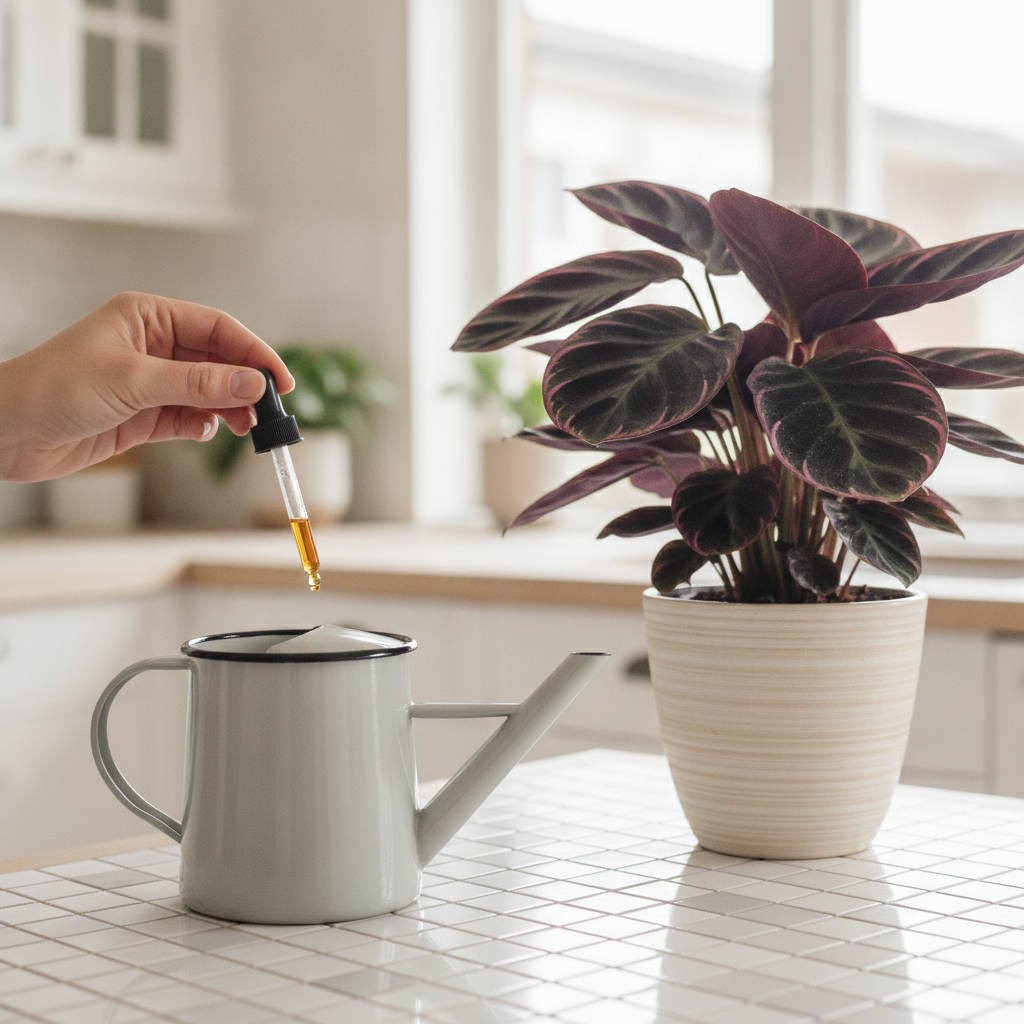
Liquid fertilisers: The best choice for a Dottie because you control the dose precisely. A balanced liquid houseplant feed diluted to half the recommended strength, applied to already-moist soil, gives an even, gentle supply and is easy to flush out if you overdo it.
Slow-release granular: Convenient but harder to control, since the granules keep releasing nutrients regardless of whether the plant wants them. If you use them, apply at half the stated rate and watch for any tip burn, which signals a build-up.
Organic fertilisers: Gentle options such as diluted worm castings or a mild seaweed feed suit the plant’s dislike of harsh salts and release their nutrients slowly. They are forgiving and a good match for anyone nervous about overfeeding.
Feeding Schedule
Feed only during the active growing season, from spring through to the end of summer, at intervals of four to six weeks. Stop entirely in autumn and winter, when the plant is resting and cannot use the nutrients; feeding a dormant Dottie simply leaves salts sitting in the soil to burn the roots. Resume in spring once you see fresh growth beginning.
Pro Tip — Feed on Damp Soil: Always apply liquid feed to soil that is already moist, never to a dry root ball. Fertiliser hitting dry roots is far more likely to scorch them, so water first if in doubt, then feed, and the nutrients will spread evenly and gently.
How to Fertilise
- Dilute a balanced liquid houseplant fertiliser to half the strength stated on the label.
- Make sure the soil is already lightly moist, watering first if it has dried out.
- Apply the diluted feed evenly across the soil until a little drains from the base.
- Every few months, water heavily with plain water alone to flush out any accumulated salts.
Warning — Salt Build-Up: A white or yellow crust on the soil surface or around the pot rim signals a build-up of fertiliser salts. Flush the pot thoroughly with plenty of plain water to wash them out, and cut back on feeding, as continued build-up scorches roots and leaf tips.
Propagation
Propagating a Dottie is a different exercise from propagating a vining plant, and it pays to set expectations correctly from the start. This is not a plant you can grow from a leaf or a stem cutting in a jar of water; it simply will not root that way, because it has no trailing stems with nodes to strike from. The only reliable method is division, separating the clump into smaller plants, each with its own roots and growing points.
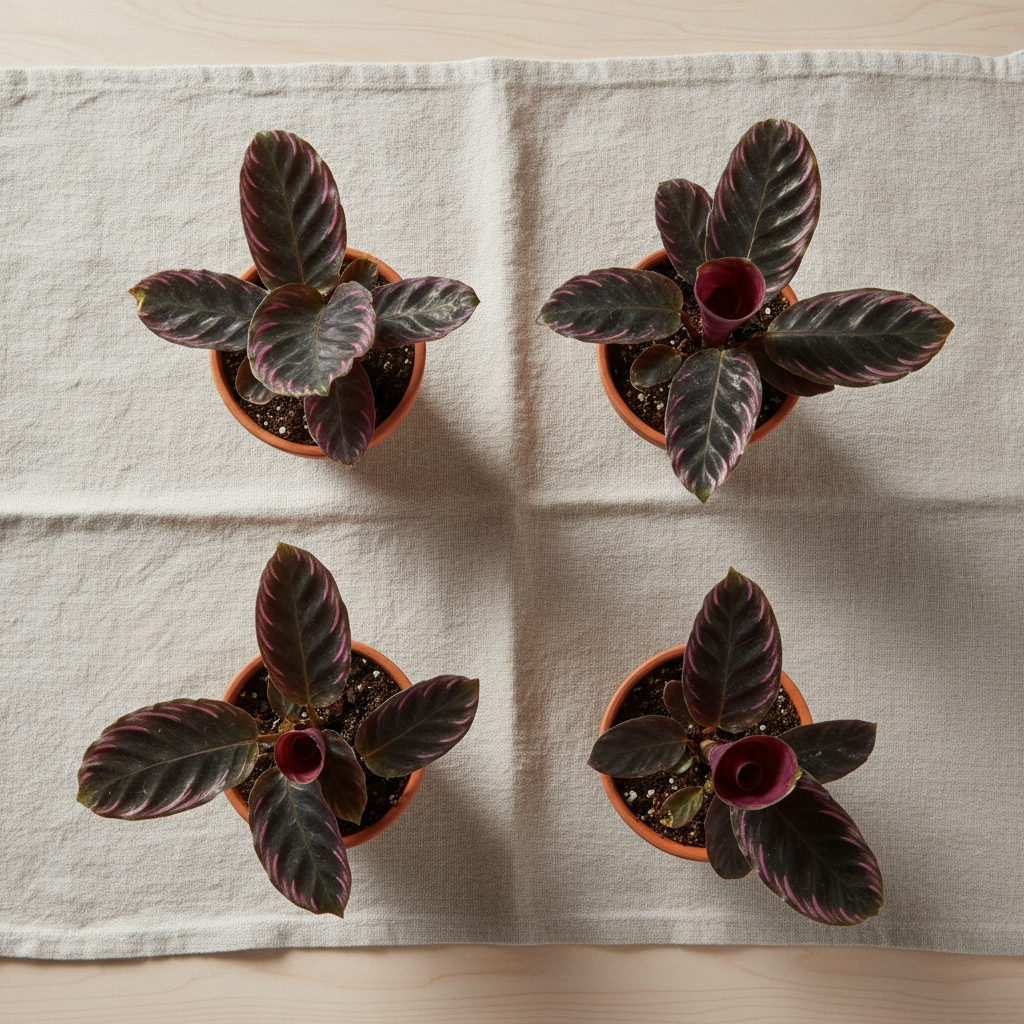
The reason lies in how the plant grows. A Dottie is a clumping plant that spreads by pushing up new shoots from an underground rhizome, so over time a single plant becomes a cluster of several crowns sharing one root mass. Division works by teasing that cluster apart into independent pieces, and because each piece already has roots and leaves, it establishes far faster than any cutting could.
Understanding the Rhizome
The rhizome is a thickened underground stem that stores energy and produces both roots and new shoots. When you tip a mature Dottie out of its pot, you will see the root ball is made up of several natural clusters, each with its own tuft of leaves rising from a shared mass below. These clusters are the units you divide along, and the natural gaps between them are the lines to follow. The best time for the whole operation is spring, when the plant is actively growing and will bounce back quickly, and it is convenient to combine division with a routine repotting.
Division: Step-by-Step
Division is straightforward as long as you are gentle and make sure every new section keeps both roots and leaves. Aim for pieces that are a decent size rather than tiny slivers, since larger divisions establish more reliably.
- Water the plant a day beforehand, then slide it out of its pot and lay it on its side.
- Gently brush and shake away enough soil to reveal the natural clumps and the gaps between them.
- Ease the clumps apart with your fingers, using a clean, sharp knife only where roots are too tangled to separate by hand.
- Make sure each division has a healthy section of root and at least a few leaves; discard any piece with no roots.
- Pot each division into its own small pot of fresh, moist prayer-plant mix, at the same depth it grew before.
- Water in well, then place the new plants somewhere warm and bright but out of direct sun.
Pro Tip — Bag for Humidity: Fresh divisions have a reduced root system and lose water easily, so covering each new pot loosely with a clear plastic bag or placing it in a propagator for the first couple of weeks holds humidity high and helps the roots re-establish before the leaves have to work hard.
Aftercare for New Divisions
The weeks immediately after division are the critical ones. Keep the new plants consistently warm, ideally above 20 degrees Celsius (68 degrees Fahrenheit), maintain high humidity, and keep the soil lightly moist but never wet. Do not feed until you see clear signs of new growth, which tells you fresh roots are working. Expect some drooping or a paused leaf or two at first; as long as the plant does not collapse entirely, it is simply recovering and will resume growing once established.
Troubleshooting Propagation
| Problem | Likely Cause | Solution |
|---|---|---|
| Division wilts badly | Root disturbance and water loss through the leaves | Raise humidity, keep warm and out of sun; be patient |
| New division rots | Soil kept too wet after replanting | Let the surface dry slightly between waterings; improve drainage |
| No new growth for weeks | Too cold, or divided outside the growing season | Move somewhere warmer; divide in spring next time |
| Leaves brown and crisp | Humidity too low for a reduced root system | Cover with a bag or use a propagator until established |
Pests & Diseases
A Dottie kept in the humid, stable conditions it prefers is reasonably resistant to pests, but the plant has one great vulnerability: dry air. The same low humidity that browns its leaf edges also creates the perfect environment for spider mites, its most persistent enemy. Most pest problems on a Dottie trace back, directly or indirectly, to air that is too dry, which is one more reason to take humidity seriously.
The best defence is vigilance. Look over your plant whenever you water, paying particular attention to the undersides of leaves and the crevices where leaf meets stem, since this is where most pests begin before they are obvious. Catching an infestation early, when it is a few insects rather than a colony, makes it far easier to clear.
Common Pests
Spider Mites (Tetranychus urticae)
By far the most common and most feared pest on a Dottie. These tiny arachnids thrive in dry, warm air and cluster on the undersides of leaves, causing fine yellow stippling and, in bad cases, delicate webbing between leaf and stem. They multiply explosively, so early action is essential.
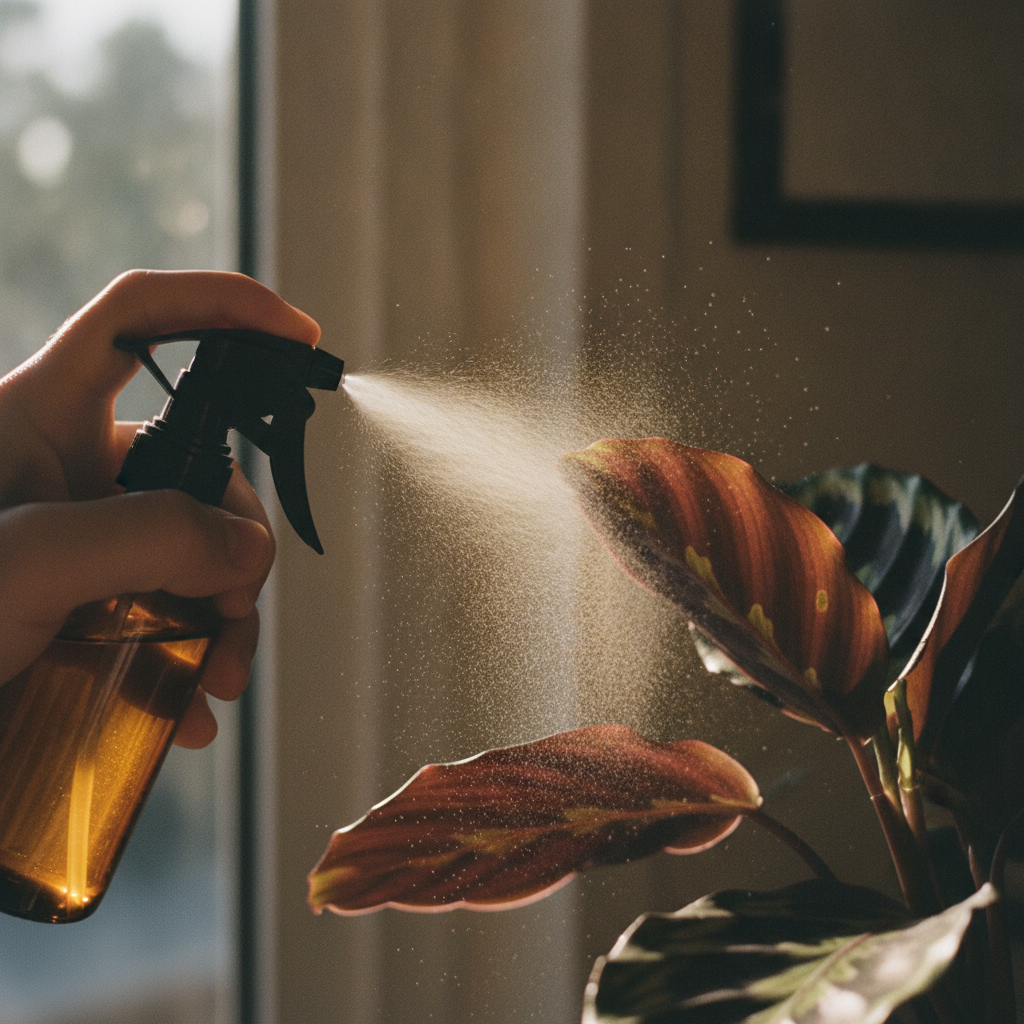
Treatment: Rinse the plant thoroughly under a gentle shower to knock the mites off, then treat with neem oil or an insecticidal soap on the leaf undersides, repeating every five to seven days for a few weeks. Crucially, raise the humidity, since mites cannot establish easily in damp air.
Thrips (Thysanoptera)
Slender, fast-moving insects that rasp at the leaf surface, leaving silvery, scarred patches and tiny black specks of excrement. On a dark-leaved plant like Dottie the silvering can be surprisingly visible, and thrips can also distort new growth as it emerges.
Treatment: Isolate the plant to stop them spreading, then treat with neem oil or insecticidal soap, repeating at weekly intervals. Blue sticky traps help catch the adults and let you monitor whether the treatment is working.
Mealybugs (Pseudococcidae)
Small, soft-bodied insects that look like tiny tufts of white cotton wool, tucked into leaf axils and along the stems. They feed on plant sap and secrete a sticky honeydew that can lead to sooty mould, weakening the plant over time.
Treatment: Dab each insect directly with a cotton bud dipped in isopropyl alcohol, which kills them on contact, then follow up with neem oil to catch any young that hatch afterwards. Inspect regularly, since mealybugs hide well.
Fungus Gnats (Sciaridae)
Small black flies that hover around the soil, more of a nuisance than a serious threat, though their larvae can nibble young roots. Because a Dottie’s soil is kept consistently moist, it is an inviting home for them, so they are a common companion of this plant.
Treatment: Let the very top layer of soil dry a little more between waterings to disrupt their life cycle, use yellow sticky traps to catch the adults, and a top dressing of fine grit or a biological control such as beneficial nematodes will break the cycle in stubborn cases.
Common Diseases
Root Rot (Pythium and Phytophthora)
The most serious disease a Dottie faces, caused by fungal pathogens that flourish in waterlogged soil. The roots turn brown and mushy and can no longer take up water, so the plant wilts and yellows even though the soil is wet, a confusing symptom that catches many people out.
Treatment: Unpot the plant, cut away all soft, brown roots with clean scissors, and repot into fresh, free-draining mix. Water more sparingly afterwards, and correct the underlying cause, which is almost always overwatering or a pot without drainage.
Leaf Spot (various fungi and bacteria)
Brown or black spots, sometimes ringed with a yellow halo, that appear when leaves stay wet for too long in still, humid air. It is most common where water sits on the foliage overnight, for instance after enthusiastic misting in a cool room.
Treatment: Remove affected leaves, improve air circulation around the plant, and avoid wetting the foliage when you water. In severe cases a houseplant fungicide can help, but better airflow usually solves it.
Pest and Disease Summary
| Pest / Disease | Identification | Treatment |
|---|---|---|
| Spider mites | Yellow stippling and fine webbing under leaves | Rinse, neem oil, raise humidity |
| Thrips | Silvery scars and black specks on leaves | Isolate, neem oil, sticky traps |
| Mealybugs | White cottony tufts in leaf axils | Alcohol on a cotton bud, then neem oil |
| Fungus gnats | Small flies around moist soil | Dry the surface, sticky traps, nematodes |
| Root rot | Wilting with wet soil; mushy brown roots | Trim roots, repot, water less |
| Leaf spot | Brown or black haloed spots on leaves | Remove leaves, improve airflow, keep foliage dry |
Prevention Strategies
Almost every problem on this list is easier to prevent than to cure, and the preventive measures overlap neatly with good general care. Keeping the humidity high does double duty, deterring spider mites while also keeping the leaves clean and unblemished. Watering correctly, so the soil is moist but never sodden, heads off both root rot and fungus gnats at once.
Beyond that, quarantine any new plant for a couple of weeks before letting it join your collection, since new arrivals are the most common way pests enter a home. Wipe the leaves gently now and then to remove dust and let you spot trouble early, keep the air moving with a little gentle circulation to discourage fungal spotting, and inspect regularly. A healthy, well-cared-for Dottie is far more resilient than a stressed one.
Pro Tip — Neem as Routine: A light monthly spray of diluted neem oil over the leaves, especially the undersides, works as a preventive rather than only a cure. It makes the foliage inhospitable to mites and thrips before they ever gain a foothold, which is far easier than clearing an established infestation.
Popular Varieties
Dottie itself is one cultivar within the wider world of Goeppertia roseopicta, a species that has given rise to a whole family of strikingly patterned prayer plants. Anyone drawn to Dottie’s dark drama will find plenty of close relatives to collect, each a variation on the same rounded leaf and pink or silver detailing, and all sharing near-identical care.
The varieties below are the ones you are most likely to meet, and because they are all forms of the same species, everything in this guide about their light, water, humidity and feeding applies equally to each of them. Choosing between them is purely a matter of which pattern and colouring you find most beautiful.
| Variety | Leaf Appearance | Light Needs | Growth Rate | Availability |
|---|---|---|---|---|
| ‘Dottie’ | Near-black leaves with a bright magenta-pink rim | Bright indirect | Slow to moderate | Common |
| ‘Rosy’ | Dark leaves with a broad rose-pink central flush | Bright indirect | Slow to moderate | Common |
| ‘Medallion’ | Feathered silver-green and dark green concentric pattern | Bright indirect | Moderate | Very common |
| ‘Corona’ | Pale silvery centre with a dark green scalloped border | Bright indirect | Moderate | Common |
| ‘Princess Jessie’ | Olive leaves with pink feathering and dark margins | Bright indirect | Slow | Occasional |
| ‘Eclipse’ | Very dark leaves with a fine pink outline, similar to Dottie | Bright indirect | Slow to moderate | Occasional |
Featured Varieties
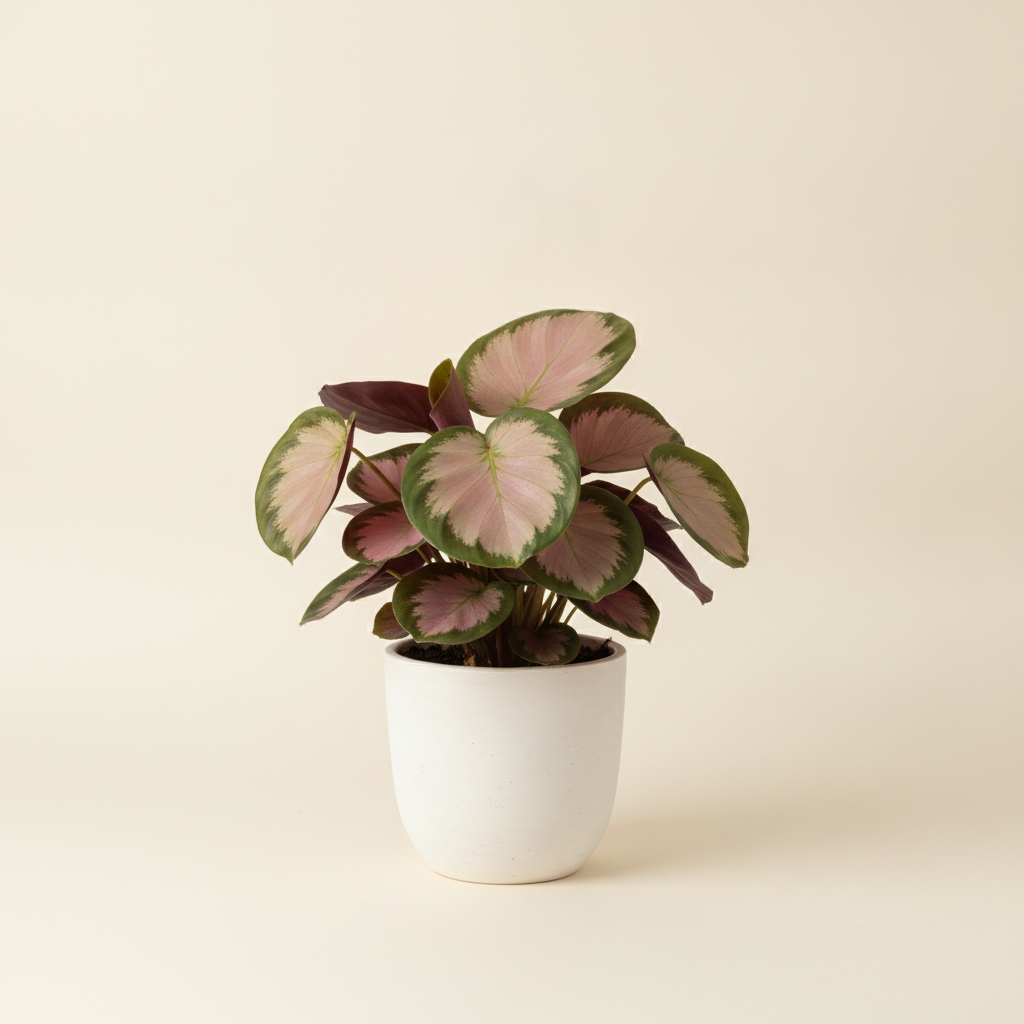
‘Rosy’
Where Dottie confines its pink to a thin outline, ‘Rosy’ floods the whole centre of each leaf with a soft rose-pink flush that fades to dark green at the margins. It is one of the most romantic prayer plants, and its colour is at its most vivid on the newest leaves.
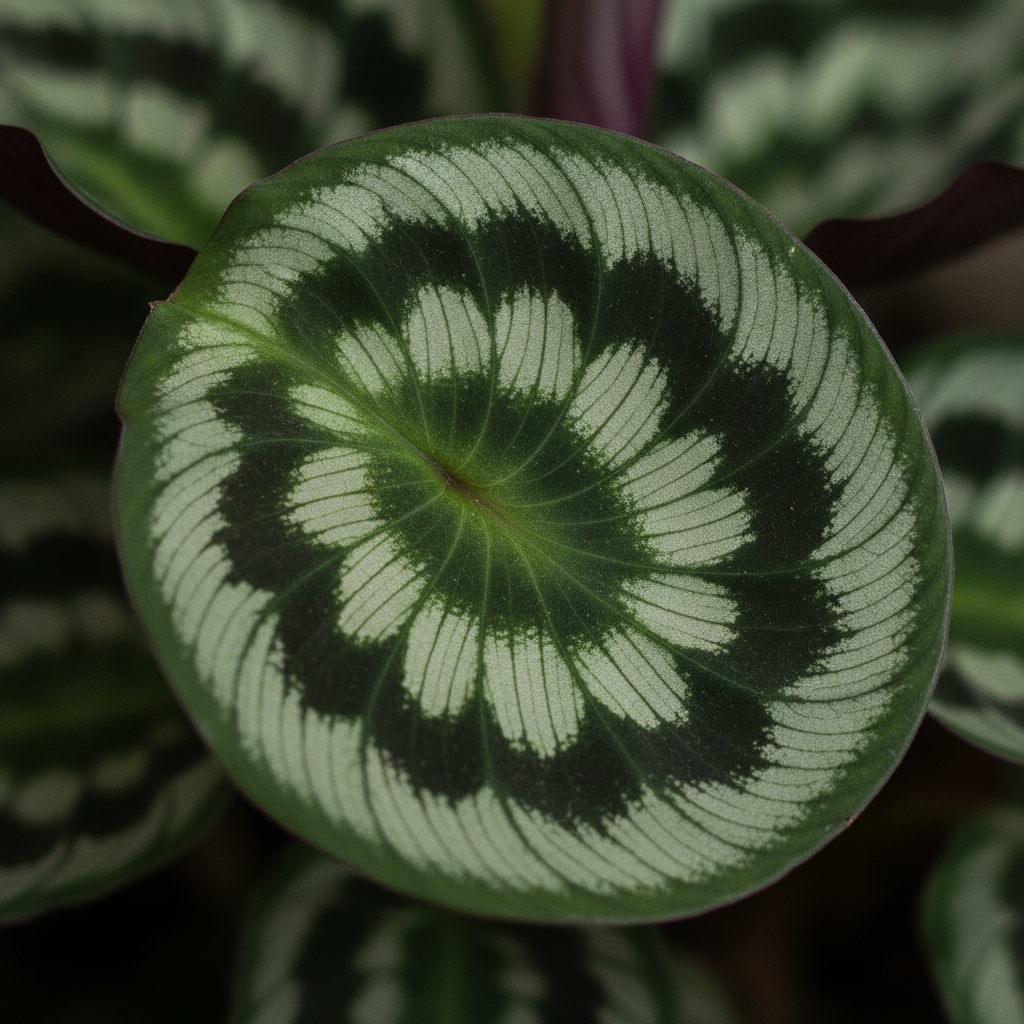
‘Medallion’
Perhaps the most famous roseopicta of all, ‘Medallion’ carries a feathered pattern of silver-green and deep green arranged in concentric rings, with rich purple undersides revealed as the leaves fold at night. It is slightly more forgiving and faster growing than Dottie.
Variety Profiles in Detail
‘Dottie’ (Goeppertia roseopicta ‘Dottie’)
The subject of this guide, prized for the sheer drama of its near-black leaves outlined in glowing magenta-pink. It is the darkest of the widely sold roseopicta cultivars, and its colour deepens with maturity, so an established plant is even more striking than a young one on a shop shelf.
‘Corona’ (Goeppertia roseopicta ‘Corona’)
A gentler, cooler-toned relative with a pale silvery-green centre framed by a dark green scalloped border and no pink at all. It offers the same rounded leaf shape and nightly folding as Dottie in a more restrained palette, and it suits people who prefer silver and green to hot pink.
‘Princess Jessie’ (Goeppertia roseopicta ‘Princess Jessie’)
A collector’s favourite that combines olive-green leaves with delicate pink feathering along the veins and dark, almost black margins. It tends to grow a little more slowly and is less widely stocked, so it is often sought out by enthusiasts building a roseopicta collection.
Choosing the Right Variety for Your Space
Since every roseopicta cultivar shares the same needs, the practical question is simply which look you want and how much attention you can offer. For maximum drama and a plant that reads as almost black, Dottie is unbeatable. For softer, romantic colour choose ‘Rosy’, and for a cool silver-and-green scheme with no pink, ‘Corona’. If you are newer to prayer plants, ‘Medallion’ is the most forgiving starting point and the easiest to find, while ‘Princess Jessie’ and ‘Eclipse’ reward those ready for a slightly more temperamental collector’s piece. Whichever you choose, the care laid out in this guide will keep it looking its best.
Frequently Asked Questions
Why are the edges of my Dottie’s leaves turning brown and crispy?
This is the most common Dottie complaint, and it almost always points to air that is too dry or water that is too hard. Raise the humidity to 60 percent or more with a humidifier, and switch to filtered, distilled or rainwater. Existing brown edges will not heal, but new leaves should emerge clean once the underlying cause is fixed.
Why is my Dottie’s foliage curling?
Leaves that curl inward usually mean the plant is thirsty or the air is too dry, as curling is how it reduces the surface area losing water. Check that the soil has not dried out too far and that humidity is high enough. Remember that some folding is completely normal at night; it is only persistent daytime curling that signals a problem.
Is the Dottie calathea safe for cats and dogs?
Yes. Like all prayer plants in the family Marantaceae, it is non-toxic to cats, dogs and people, which makes it one of the safest showy houseplants to keep in a home with pets or children. Nibbling may still cause a little mild stomach upset, so it is best not encouraged, but there is nothing poisonous to worry about.
Why has my Dottie stopped moving its leaves at night?
The nightly rise and fall of the leaves depends on the plant being comfortable, so a Dottie that no longer folds up is often telling you something is off, usually too little light or stress from inconsistent watering. Improve the light and steady the watering, and the movement usually returns. A plant that folds cleanly each evening is a reassuring sign of good health.
How often should I water my Dottie calathea?
There is no fixed schedule; water when the top 2 to 3 cm (about 1 inch) of soil begins to dry, which tends to be around once a week in the growing season and less often in winter. The key is consistency, keeping the root ball evenly moist rather than letting it swing between soaking wet and bone dry. Always check the soil before watering rather than watering by the calendar.
Can I propagate my Dottie from a leaf or stem cutting?
No. Unlike vining houseplants, a Dottie cannot be grown from a leaf or stem cutting because it has no rooting nodes on trailing stems. The only reliable method is division, separating a mature clump into smaller plants that each keep their own roots. Spring is the best time to do it, ideally while repotting.
Why are my Dottie’s leaves fading or losing their colour?
Faded, washed-out colour usually means the light is wrong. Too much direct sun bleaches the leaves pale and dull, while too little light causes new growth to emerge greener and less contrasted. Move the plant to bright but indirect light, out of any direct sun, and the fullest, darkest colour should return on the newest leaves.
Is the Dottie calathea a good plant for beginners?
It is best described as an intermediate plant. Keeping it alive is not difficult, but keeping it looking flawless demands attention to humidity, water quality and consistency that some beginners find frustrating. If you are new to houseplants and set on a prayer plant, the closely related ‘Medallion’ is a little more forgiving, or you can succeed with a Dottie from the start by investing in a humidifier and using filtered water.
What temperature does a Dottie calathea need?
Aim for a steady 18 to 27 degrees Celsius (64 to 81 degrees Fahrenheit), which matches normal comfortable room temperature. Keep it away from cold draughts, unheated porches and windows in winter, and well clear of radiators and heating vents, since sudden temperature swings and hot dry air both stress the plant. Anything below 15 degrees Celsius (59 degrees Fahrenheit) risks damage.






