
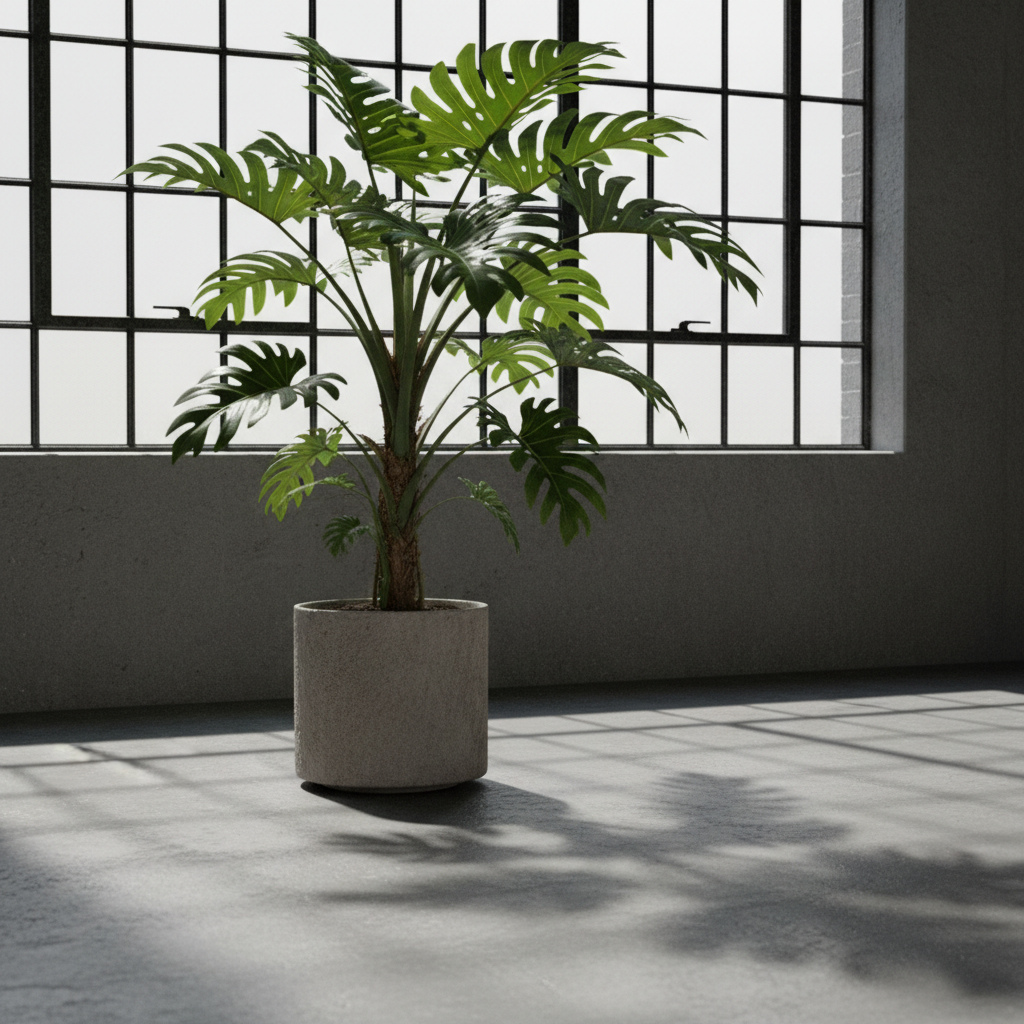
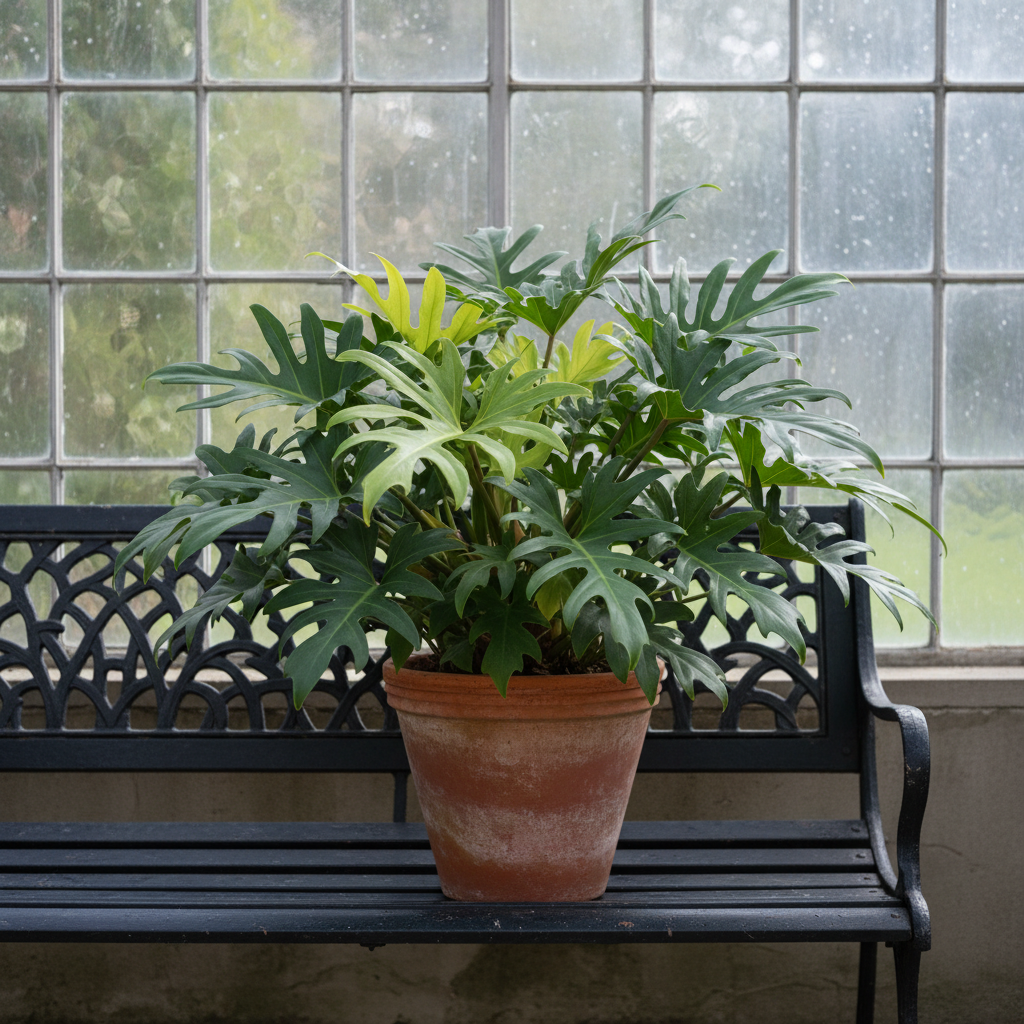
Few houseplants make a room feel like the floor of a Brazilian rainforest the way the split-leaf philodendron does. Known to botanists as Thaumatophyllum bipinnatifidum, and for decades sold under the synonyms Philodendron bipinnatifidum and Philodendron selloum, this tropical aroid grows huge sculptural leaves that may exceed 90 cm (35 in) across when the plant is mature. Each new leaf emerges as a tightly furled spear, unfurls into a smooth heart shape, and then develops the deep finger-like lobes that give the plant its everyday name. It is native to the humid forests of southern Brazil, Paraguay, north-eastern Argentina and Bolivia, where it grows along stream banks and forest margins, sometimes leaning on neighbouring trees and sometimes standing on a thick semi-woody trunk that can reach two to four metres (6 to 13 ft) over many years.
Despite that ambitious wild stature, the split-leaf philodendron has earned a reputation as one of the easiest large-leaf tropicals to grow indoors. It tolerates a wide range of light, forgives the occasional missed watering, and recovers quickly from mistakes. Surviving, though, is not the same as thriving. A plant kept in a dim corner with dusty leaves and tired soil will hang on for years without ever producing the dramatic, deeply incised foliage that drew you to it in the first place. This guide covers every detail that separates a struggling specimen from a showpiece: how to read its light needs, water it without inviting root rot, build a substrate that suits its aroid heritage, feed it in the right rhythm, propagate it from cuttings or air layers, and head off the handful of pests and diseases that bother it. It is also the only philodendron-relative whose taxonomy you may need to discuss with a confident smile at a garden centre, so the variety section explains where the name Thaumatophyllum came from and how the genus relates to true Philodendron.
Contents
- Quick Reference
- Why Split-Leaf Philodendron Makes a Striking Houseplant
- Light Requirements
- Watering & Humidity
- Soil, Potting & Repotting
- Fertilising
- Propagation
- Pests & Diseases
- Popular Varieties
- Frequently Asked Questions
Quick Reference: Split-Leaf Philodendron at a Glance
| Light | Bright indirect light; tolerates a couple of hours of gentle morning sun. Will survive medium light but new leaves will be smaller and less lobed. |
| Watering | Water thoroughly when the top 3 to 4 cm (1 to 1.5 in) of soil feels dry. Roughly every 7 to 10 days in summer, every 14 to 21 days in winter. |
| Temperature | Ideal 18 to 27 °C (65 to 80 °F). Avoid below 13 °C (55 °F) and cold draughts from doors or windows. |
| Humidity | Average household humidity (40 to 50 per cent) is adequate; 60 per cent or more produces larger, glossier leaves. |
| Fertiliser | Balanced liquid feed (20-20-20 or similar) at half strength every 4 weeks from spring through early autumn. |
| Toxicity | Toxic to dogs, cats and humans if chewed or swallowed. Contains calcium oxalate raphides that cause oral irritation, drooling and difficulty swallowing. |
Why Split-Leaf Philodendron Makes a Striking Houseplant
The split-leaf philodendron earns its place in homes for the same reason it dominates the understorey of a Brazilian forest: it is architecturally bold without demanding constant attention. A young nursery plant arriving in a 20 cm (8 in) pot will hold its own on a side table for a year or two, then begin to spread sideways as its trunk thickens. Mature specimens become floor anchors with leaves that you can hide a small child behind, and the plant achieves all of this without flowering in any meaningful way indoors and without dropping leaves messily across the floor. The lobes that give the plant its name do not appear immediately. Juvenile leaves are heart-shaped with smooth edges, and the deep pinnatifid divisions emerge only as the plant accumulates energy and light, usually after the third or fourth year in good conditions. Watching that transformation is one of the slow pleasures of growing it.

There is also a structural quality that sets the plant apart from its climbing relatives. Where the heartleaf and Brazil philodendrons send long vines along walls and trellises, the split-leaf builds a low rosette around a single growing point, then gradually raises that crown on a stout trunk that is studded with the petiole scars of older leaves. Mature plants resemble a slow tropical palm more than a vine. They tolerate the dry air of centrally heated rooms, the variable light of an east or west-facing window, and the long stretches of neglect that come with travel. A reasonably healthy plant in a five to seven litre pot will put out four to six new leaves a year, each larger and more deeply lobed than the last, and a well-fed one in a brighter spot will easily double that rate. The combination of forgiving care and dramatic foliage is what keeps the plant in continuous production at every garden centre in Europe and North America.
Important — Toxicity: All parts of the split-leaf philodendron contain needle-like calcium oxalate crystals called raphides, which release into the mouth and throat on chewing. In pets the typical signs are excessive drooling, pawing at the mouth, vomiting and difficulty swallowing; in humans the same crystals cause intense burning, swelling and rare cases of airway obstruction. Keep the plant out of reach of cats, dogs and small children, and consider a less hazardous alternative such as a parlour palm or a money tree if your household has a serious chewer.
Light Requirements
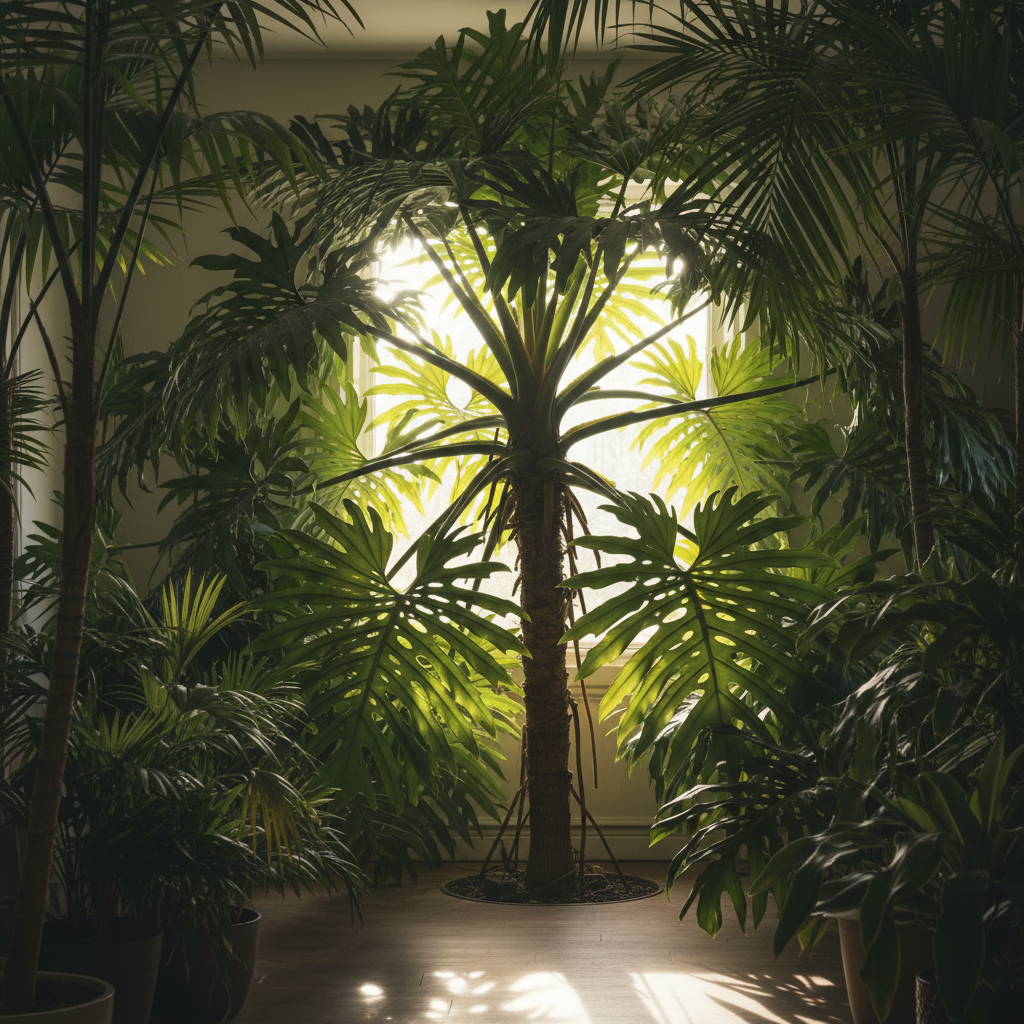
Light is the single variable that decides whether your split-leaf philodendron looks like the magazine version of itself or like a tired understudy. In the wild the plant grows under a partial canopy that filters strong tropical sun into a moving pattern of bright patches and dappled shade, and indoors it wants something similar: lots of indirect brightness, occasional rays of mild direct sun, and no scorching midday glare on the leaves.
The ideal indoor position is roughly two metres (6 ft) back from a large south or west-facing window, or right beside an unobstructed east or north window where the light is softer. New leaves emerging in this position tend to unfurl to their full size and develop deep, well-spaced lobes. In a corner that receives only weak ambient light, the plant will still push out leaves, but they will be smaller, paler and noticeably less divided, sometimes barely lobed at all. If the plant has been pushed deeper into a room over the winter, plan to bring it forward as soon as the days lengthen in spring, otherwise the first leaf or two of the new growing season will set the small-and-shy template for the rest of the year.
Light Levels Explained
Houseplant guides throw around terms like “bright indirect” and “medium light” without ever pinning them to a number, which makes them difficult to apply. The table below ties each category to an approximate illuminance range measured in lux, the unit a phone-based light meter or a horticultural lux meter will report, and to a typical position in a real room.
| Light Category | Approx. Level | Typical Location | Outcome for Split-Leaf Philodendron |
|---|---|---|---|
| Direct sun | 50,000 lux and above | Touching a south or west window from late morning | Leaf scorch and bleaching within days; pale yellow patches that turn crispy brown. |
| Bright indirect | 10,000 to 25,000 lux | One to two metres from a large unshaded window | Optimal. Large leaves, deep lobing, steady production of four to eight new leaves per year. |
| Medium indirect | 2,500 to 10,000 lux | Across a small bright room or near a sheer-curtained window | Adequate. Smaller leaves with shallower lobes; slower growth. |
| Low light | 500 to 2,500 lux | Hallways, corners several metres from a window | Survival mode. Leaves stay small, lobing disappears on new growth, lower leaves yellow and drop. |
| Very low light | Under 500 lux | Interior rooms without windows, basements | Decline. The plant will limp along for months and then collapse; not a viable position. |
Window Orientation and Placement
South-facing window: Excellent for split-leaf philodendrons in winter at northern latitudes, when the sun is low and the light is weaker. In spring and summer move the plant at least one metre back from the glass, or hang a sheer linen curtain, to prevent midday scorch on the broad horizontal leaf surface.
East-facing window: Often the best year-round home. The plant receives one or two hours of gentle morning sun directly on the leaves, which deepens the green colour and encourages strong lobing, and then enjoys soft indirect light through the rest of the day.
West-facing window: A close second to east. The afternoon sun is hotter than morning sun and can scorch leaves pressed against the glass, so keep the plant at least 50 cm (20 in) away from a west window or place a sheer curtain between plant and pane.
North-facing window: Workable but marginal. A split-leaf philodendron will hold its existing leaves but new growth slows noticeably and lobing fades. Consider supplementing with a small grow light if the plant is your only large statement specimen in a north-facing room.
Pro Tip — Rotate Every Watering: The split-leaf philodendron’s leaves all reach for the brightest source in the room, and a plant that is never turned will lean dramatically within a season. Give the pot a quarter turn every time you water. Over the course of a month the entire crown will be exposed evenly, the trunk will stay vertical, and the silhouette will read as balanced from any angle in the room.
How Light Affects Leaf Splitting and Size
The deep lobing that gives the plant its common name is partly a function of age and partly a function of light. A genetically mature plant grown in dim light will produce only shallow indentations along the leaf margins, sometimes barely separated lobes at all, because the plant is conserving energy and building smaller, simpler leaves. Move that same plant into bright indirect light and within two or three new leaves you will see the characteristic finger-like splits return, deeper and more numerous than before. The lobing is also a physiological response to wind and rain in the wild: deeply divided leaves let storms pass through with less mechanical stress and let raindrops reach the soil rather than collecting on the leaf surface. Indoors the wind is absent, but the same gene programme runs in response to bright light and steady moisture.
Warning — Direct Sunlight: Two or three hours of harsh midday sun, particularly on a south or west-facing windowsill in spring and summer, will leave permanent pale or crispy patches on the broad horizontal upper leaf surfaces. Damaged sections never recover, they only fall away when the leaf itself is replaced, which can take a year or more. If you have just brought the plant home from a darker shop, acclimatise it gradually over two weeks before placing it in any spot that catches direct rays.
Artificial Lighting
The split-leaf philodendron responds well to supplementary grow lighting, which makes it a sensible candidate for windowless offices and dim winter rooms. A full-spectrum LED panel of roughly 30 to 50 watts, suspended 60 to 90 cm (24 to 36 in) above the crown and run for 10 to 12 hours a day, will keep the plant producing well-shaped leaves through a long northern winter. Position the light directly overhead rather than to one side, because the broad horizontal leaves naturally orient towards a vertical light source, and a side-mounted lamp will pull the crown sideways within weeks. A simple mechanical timer ensures a consistent photoperiod, which the plant prefers over erratic on-off cycles.
Seasonal Adjustments
Light intensity at a typical European or North American latitude drops by more than half between June and December, even in the same room. To compensate, move the plant a metre closer to its primary window from late October onwards, and clean the glass and the leaves at the same time. In summer the reverse applies: a plant that thrived against a south window in February will need to be pulled back a metre or fitted with a sheer curtain by May. These two seasonal moves take less than five minutes a year and have more effect on long-term leaf quality than any other adjustment in this guide.
Watering & Humidity
The split-leaf philodendron is one of those plants people kill with kindness. It comes from a humid rainforest, the soft leaves look thirsty, and the obvious response is to water often. The roots, however, are sensitive to standing wet, and a relentless schedule of soggy soil kills more specimens every year than every pest combined. The right approach is to give the plant a thorough drink, then let the top of the soil dry before the next one. Done well, this rhythm matches the natural cycle of tropical downpours followed by warm dappled sun in its native habitat.
When to Water
The most reliable signal is a finger test. Push your finger 3 to 4 cm (1 to 1.5 in) into the soil at the side of the pot. If the soil is dry to that depth and feels neutral or cool rather than cold and damp, it is time to water. If you still feel moisture, wait another two or three days and test again. In typical living-room conditions this means watering roughly every 7 to 10 days from April through September, and every 14 to 21 days from October through March. A small plant in a porous terracotta pot dries out twice as fast as a large plant in a glazed ceramic pot, so calibrate by feel rather than by a fixed weekly slot in the calendar.
A moisture meter is a useful second opinion, particularly for deep pots where finger testing reaches only the top layer of soil. Insert the probe to the middle of the rootball and water when the dial reads at the dry end of the moist band. Equally useful is the simple trick of lifting the pot: a freshly watered split-leaf philodendron in a 25 cm (10 in) pot weighs several kilograms more than the same plant after a week of evaporation, and once you have learned the difference, you can judge readiness with one hand under the rim.
Pro Tip — Tepid Water Only: Cold water straight from the tap shocks tropical roots and can cause temporary leaf yellowing within a day or two. Fill the watering can the evening before and let it stand at room temperature overnight. This also gives any dissolved chlorine time to dissipate and brings the water to the same temperature as the soil, which the roots prefer.
How to Water Correctly
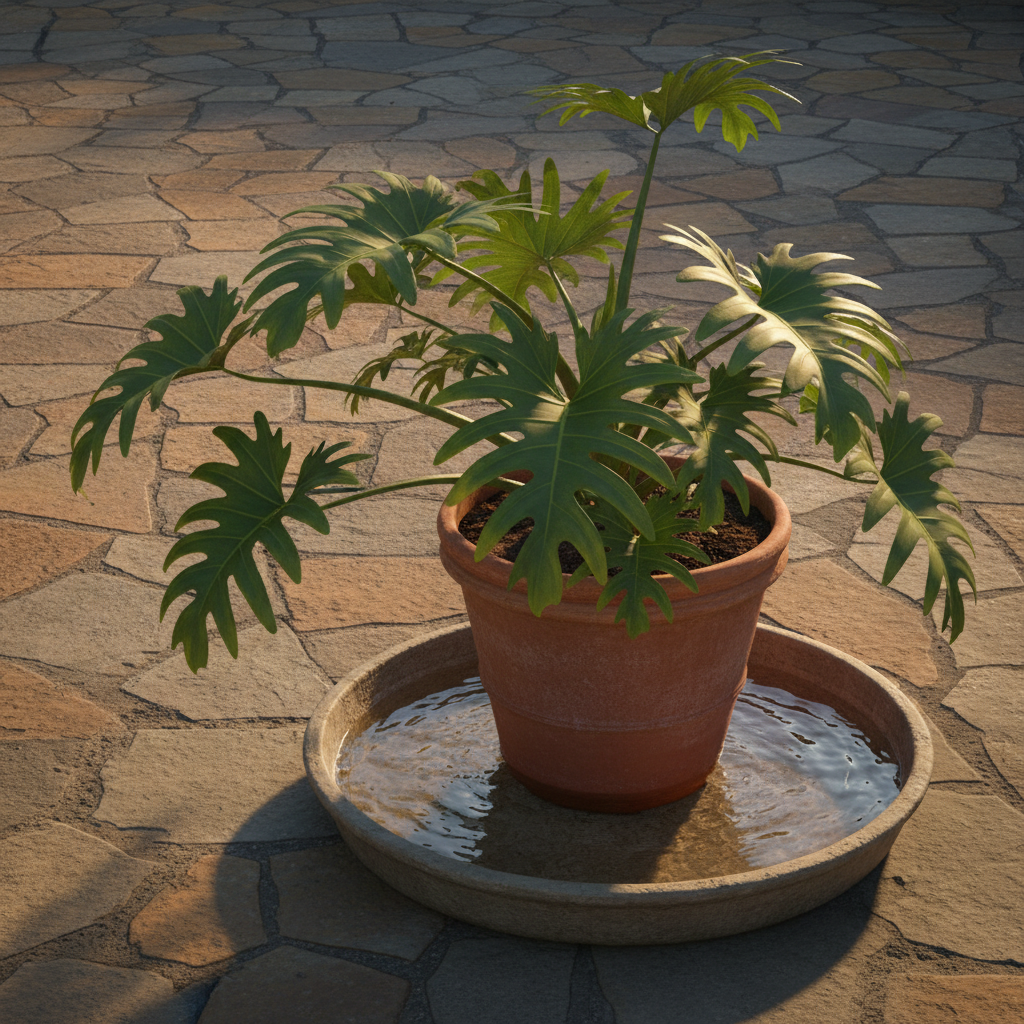
- Move the plant to a sink, bath or other surface where excess water can drain freely. For a heavy floor specimen, slide a deep saucer or tray under the pot instead.
- Pour tepid water slowly around the entire soil surface, working from one side to the other rather than dumping the whole can in one spot.
- Continue until water runs freely from the drainage holes for at least 30 seconds. A full drench rinses accumulated mineral salts from the rootball.
- Wait 15 to 20 minutes, then drain the saucer or empty the tray. The plant should never sit in standing water for more than half an hour.
- Return the pot to its growing position, give the leaves a quick wipe to remove any drips, and reset your mental calendar for the next finger test.
Signs of Overwatering vs. Underwatering
| Symptom | Overwatering | Underwatering |
|---|---|---|
| Leaf colour | Lower leaves yellow uniformly, then go limp and soft. | Leaves develop crispy brown edges and pale yellow patches. |
| Leaf texture | Soft, almost translucent, with dark water-soaked patches. | Stiff, papery, curling inward along the margins. |
| Soil | Wet for many days after watering, smelling sour or musty. | Pulled away from the sides of the pot, dust-dry at the surface. |
| Roots | Black or grey, mushy, slipping off the rootball when touched. | Pale and dry but firm; the rootball is light when lifted. |
| Stem base | Soft, brown or black, sometimes oozing or smelling foul. | Firm but slightly shrunken at the soil line. |
Warning — Root Rot: Soft yellowing of multiple lower leaves combined with a wet, sour-smelling rootball is the classic sign of root rot caused by Pythium or Phytophthora oomycetes. Act within days. Unpot the plant, rinse the rootball clean of old soil, cut away all soft black roots with sterilised scissors back to firm white tissue, dust the cuts with cinnamon powder, and repot into fresh dry aroid mix. Do not water for a week to let the cut surfaces callus over.
Humidity Requirements
Split-leaf philodendrons evolved in air that sits around 75 to 85 per cent relative humidity, but they have an unusual tolerance for the dry conditions of a centrally heated home. Average household humidity in the range of 40 to 50 per cent is sufficient to keep the plant alive and growing slowly. Pushing humidity towards 60 per cent or higher visibly improves leaf size, glossiness and lobe definition, and is well worth doing if you have other tropicals in the same room and a small humidifier is already running.
The signs of stress from dry air are mild and slow rather than dramatic. Leaf edges may turn a thin papery brown, particularly on the youngest leaves, and the very newest emerging spear can dry out before it unfurls. None of this happens overnight; you have weeks of warning. If your home regularly sits at 30 per cent humidity through a long winter, the plant will not die, but it will look noticeably less full and glossy than the same plant in a steamy bathroom.
Practical ways to raise humidity around the plant include grouping it with several other tropicals so their combined transpiration lifts the local microclimate, placing a small evaporative or ultrasonic humidifier within a metre of the foliage, setting the pot on a wide tray of pebbles topped up with water (the pot itself sits on the pebbles above the waterline), and avoiding placing the plant within a metre of a hot radiator or a forced-air heating vent. Misting is sometimes recommended in older guides but it has very little lasting effect on humidity. Mist evaporates within minutes, and on this species the residual water sitting in the leaf axils can encourage bacterial leaf spot.
Water Quality
Tap water suits the split-leaf philodendron well in most parts of Europe and North America. The plant is not as fluoride-sensitive as a calathea or a dracaena, and chlorinated municipal water at typical residual levels does no observable harm. If your local water is very hard, you may notice a slow build-up of pale mineral crust on the leaf edges and on the soil surface; in that case alternate every third or fourth watering with rainwater or filtered water, and the deposits will not become a problem. Avoid distilled water as a constant diet, because it leaches calcium and magnesium from the soil over time and forces you to compensate with extra micronutrient fertiliser.
Soil, Potting & Repotting
The soil under a split-leaf philodendron does two contradictory jobs at once. It must hold enough moisture to feed the broad evaporating leaves through a hot summer week, and it must drain freely enough that the thick fleshy roots never sit in stagnant water. A bag of generic indoor plant compost off the shelf at a supermarket is usually too dense to manage both jobs, which is why so many split-leaf philodendrons brought home in their original nursery substrate decline within a year. The fix is straightforward: use a chunky aroid mix, repot once you have brought the plant home, and resist the urge to step up to a far larger pot than it strictly needs.
Ideal Soil Composition
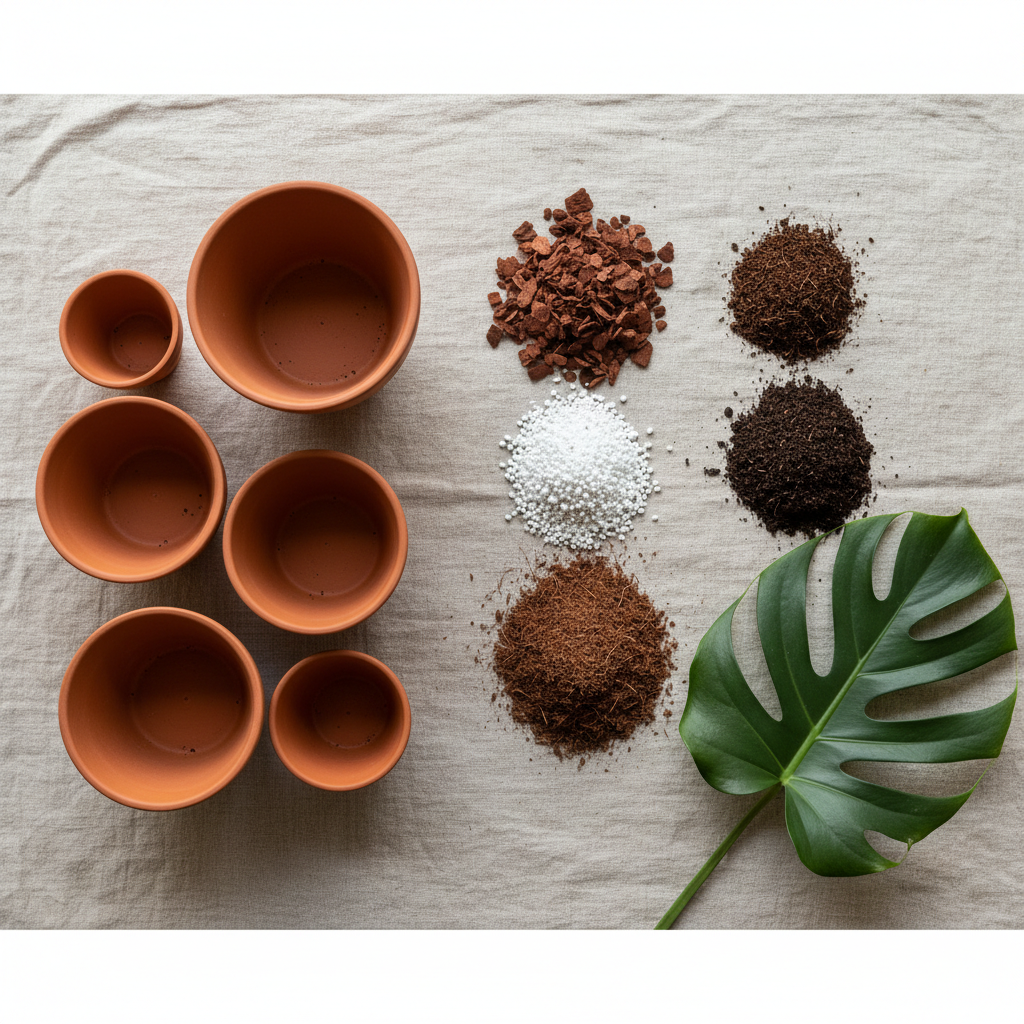
An aroid mix is built around chunky organic material that creates large air pockets, with finer ingredients to hold moisture and nutrients. The proportions matter more than the brand names. The following recipe matches the natural substrate of forest litter, decomposed wood and leaf mould that the species’s roots wrap around in the wild.
| Component | Proportion | Function |
|---|---|---|
| Coco coir or peat-based houseplant compost | 40 per cent | Base substrate; holds moisture and provides a buffered medium for fine feeder roots. |
| Orchid bark (medium grade, 6 to 12 mm chunks) | 25 per cent | Creates large air pockets, mimics the woody debris of the forest floor, prevents compaction. |
| Perlite or pumice | 20 per cent | Improves drainage and aeration; keeps the mix from packing down over time. |
| Worm castings or well-rotted compost | 10 per cent | Slow-release source of nitrogen and trace minerals; encourages beneficial soil microbes. |
| Horticultural charcoal | 5 per cent | Absorbs excess salts and inhibits anaerobic pockets that can lead to root rot. |
The plant tolerates a slightly acidic to neutral pH of about 5.5 to 6.5. Coco coir is naturally close to neutral and works well as a base; if you use a peat-based compost instead, the mix will sit slightly more acidic but still in the comfortable range. There is no need to test pH for a household specimen unless you are seeing persistent nutrient deficiency symptoms in spite of regular feeding.
Pro Tip — Quick Mix Recipe: If you do not want to source individual ingredients, the easiest shortcut is two parts good-quality houseplant compost, one part medium orchid bark, and one part perlite, then a small handful of worm castings stirred through. This gets you to roughly the right proportions in one trip to a garden centre and works for the entire philodendron family.
Choosing the Right Pot
A pot that suits the split-leaf philodendron has three properties: it has at least one generous drainage hole, it is wide enough to support the spreading crown, and it is sized to the existing rootball rather than to the imagined future plant. Of the three, drainage matters most, the second most, and the third surprisingly often turns into the problem that kills the plant.
Drainage holes are non-negotiable. A decorative pot with no hole functions as a bucket, and the soil at the bottom never dries out between waterings. Either buy pots with proper drainage, or treat a sealed cachepot purely as a sleeve and keep the plant in a plastic nursery pot inside it that you can lift out for every watering and drain fully before returning.
Pot material: Terracotta wicks moisture from the soil and dries out faster, which suits the split-leaf philodendron’s preference for a wet-then-dry cycle. Glazed ceramic and plastic hold moisture longer and reduce watering frequency, which can be useful in a hot dry flat where a terracotta pot needs filling twice a week. Either is fine if you adjust your watering rhythm to match. Avoid metal pots without a liner, since the soil can heat dangerously in direct sun and the surfaces can corrode and stain.
Pot size: Choose a new pot that is 2 to 3 cm (about 1 in) wider in diameter than the current one. A wildly oversized pot holds much more soil than the plant’s roots can occupy, and the unused volume stays wet for far too long after each watering, which is the fastest route to root rot. Step up gradually, every two to three years, rather than skipping sizes.
When to Repot
A split-leaf philodendron benefits from repotting every two to three years, ideally in spring as the growing season begins. The telltale signs that a plant is ready include roots circling visibly at the bottom of the pot or pushing out through the drainage holes, water that runs straight through without being absorbed, a noticeable slowdown in new leaf production despite good light and feeding, and a pot that tips over because the crown has outgrown its base. If none of these are obvious, simply replacing the top 5 cm (2 in) of soil with fresh aroid mix once a year is enough to refresh nutrients and texture without disturbing the rootball.
How to Repot: Step-by-Step
- Water the plant the day before repotting. A moist rootball slides cleanly out of the old pot and is less likely to fracture during handling.
- Prepare the new pot. Cover the drainage holes with a piece of mesh or coffee filter to keep soil in, and add a 3 to 5 cm (1 to 2 in) layer of fresh aroid mix at the base.
- Tip the plant out by laying the pot on its side, pressing gently around the rim, and easing the rootball free. Never pull on the trunk or petioles.
- Tease away the outer 1 to 2 cm of old root mass with your fingers, snipping any dark mushy roots with sterilised scissors and leaving the firm white roots intact.
- Centre the plant in the new pot at the same depth as before, never burying the base of the trunk under fresh soil, and fill in with aroid mix around the rootball, tamping gently to remove large air pockets.
- Water thoroughly until water runs from the drainage holes, then let the plant drain completely. Return it to its original spot, since changing light at the same time as repotting compounds the stress.
- Skip fertiliser for the first six to eight weeks. The fresh substrate already contains enough nutrients, and feeding stressed roots invites tip burn.
Warning — Transplant Shock: Expect a brief sulk after repotting. The plant may droop slightly, slow new leaf production, or drop the oldest one or two leaves in the first month. This is normal as the roots re-establish in fresh soil. Resist the urge to compensate with extra water, which is the most common cause of post-repot losses. Keep the watering rhythm the same as before, give the plant good ambient light, and wait.
Fertilising
A split-leaf philodendron is a moderate feeder. It is not greedy in the way a fiddle-leaf fig or a banana plant is, but the broad leaves and steady growth rate do steadily deplete the nutrients in the pot. Without fertiliser, even a healthy specimen in good light slows to a near halt after about a year, and its leaves take on a uniform pale green tint that signals nitrogen running thin. With light but regular feeding through the growing season the same plant produces lush, deeply coloured leaves and adds noticeable bulk every year.
The principle to remember is that more fertiliser is not better. The risk is not so much underfeeding as overfeeding. Excess mineral salts accumulate in the soil and burn the fine root hairs, producing crispy brown leaf tips and a halt in new growth that looks exactly like drought stress and is often misdiagnosed as such. Half-strength feed every four weeks delivers a generous nutrient supply without ever pushing salts to dangerous levels.
Understanding Plant Nutrients
Every fertiliser label shows three big numbers in the format N-P-K, representing the percentage of nitrogen, phosphorus and potassium by weight. These are the macronutrients a plant uses in the largest quantities. Beneath them sit a handful of secondary nutrients and micronutrients, each playing a role in specific tissues and processes. The table below summarises what your plant is actually doing with each one.
| Nutrient | Symbol | Primary Function | Deficiency Symptoms |
|---|---|---|---|
| Nitrogen | N | Building block of chlorophyll and proteins; drives leaf size and green colour. | Uniform pale or yellow-green leaves starting with the oldest growth. |
| Phosphorus | P | Energy transfer in the cell; supports root development and new shoot formation. | Dull greyish leaves, stunted growth, purple tinting on undersides. |
| Potassium | K | Regulates water balance, stomatal opening and overall stress tolerance. | Brown crispy leaf margins on older leaves while veins stay green. |
| Calcium | Ca | Cell wall structure; essential for newly forming leaves. | Deformed or hooked new leaves, brown tips on emerging spears. |
| Magnesium | Mg | Central atom of every chlorophyll molecule. | Yellowing between leaf veins on middle-aged leaves while veins stay dark green. |
| Iron | Fe | Required to produce chlorophyll, particularly in young tissues. | Newest leaves pale yellow or near white while veins remain a thin green tracery. |
Types of Fertiliser
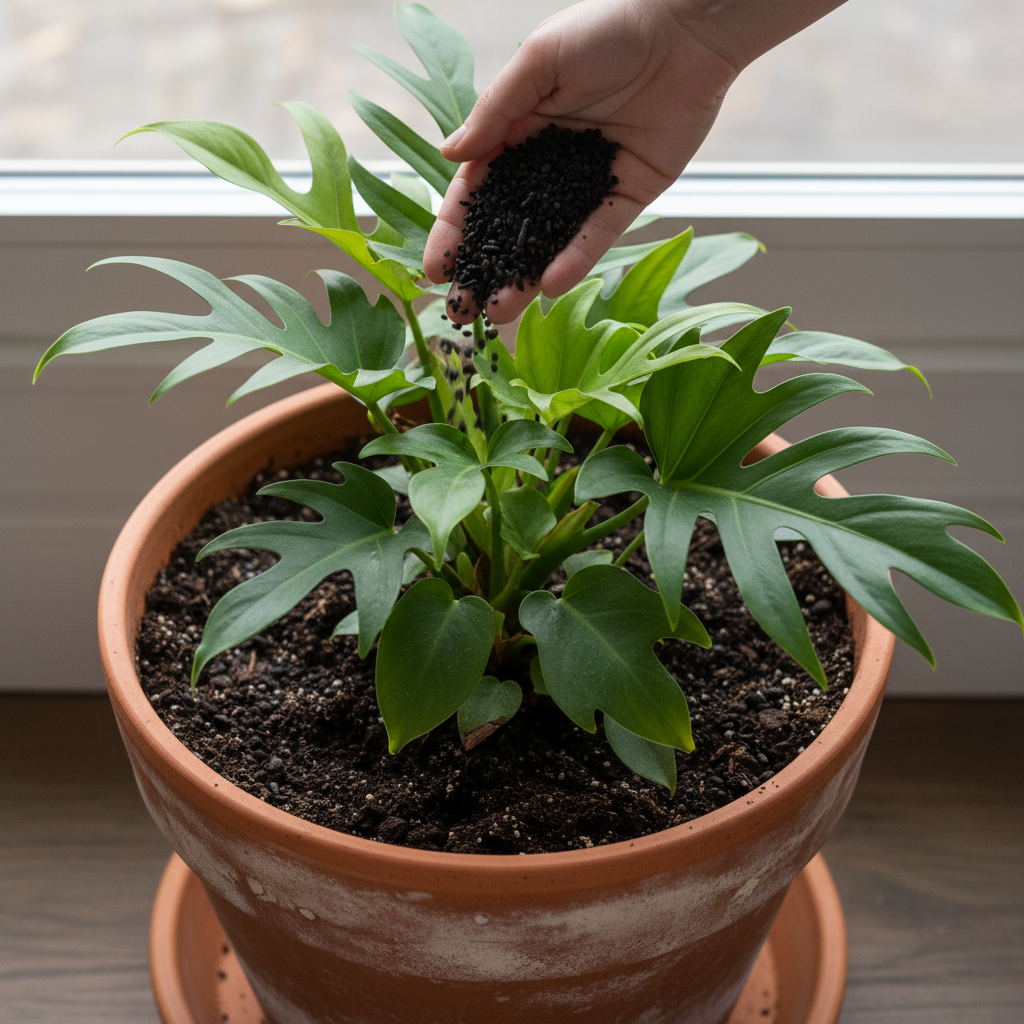
Liquid fertilisers: The most flexible option. Diluted to half the label strength and applied with the regular watering, they deliver nutrients evenly and let you stop instantly if the plant shows distress. A balanced general-purpose houseplant feed at 20-20-20, or a slightly leaf-focused 24-8-16, both work well for the split-leaf philodendron. Always water with plain water first, then follow with the fertiliser solution, to avoid contact between concentrated feed and dry root hairs.
Slow-release granular: Coated prills release nutrients over three to six months as the coating breaks down in moisture. Convenient for people who travel and forget feeding schedules, but slightly less controllable. Sprinkle one teaspoon (about 5 ml) of granular feed evenly across the soil surface in early spring for a pot up to 25 cm (10 in) wide, and water in. Reapply once in early summer if growth is strong.
Organic fertilisers: Worm castings, fish emulsion and seaweed extract feed both the plant and the soil microbiome. They release nutrients slowly and rarely cause salt burn, which makes them an excellent choice for owners who prefer a hands-off approach. A 1 cm (0.4 in) top-dressing of worm castings each spring is sufficient feeding for an established plant in a 30 cm (12 in) pot for the whole growing season.
Feeding Schedule
The split-leaf philodendron has a clear active growing season from roughly mid-March to mid-October at northern temperate latitudes, with the rate slowing markedly in the depths of summer heat and winter darkness. A workable schedule for liquid feed is to dilute a balanced fertiliser to half the recommended strength and apply it once every four weeks from early spring to early autumn, then stop entirely from November through February. The plant is not dormant in winter in the technical sense, but its growth rate is too slow to absorb additional feed, and the unused nutrients build up in the soil as harmful salts.
Pro Tip — Half Strength, Twice as Often: Instead of full-strength feed once a month, dilute the fertiliser to a quarter strength and apply at every other watering through the growing season. The plant receives roughly the same total nutrients but at a much steadier rate, which produces more even leaf colour and avoids the boom-and-fade pattern of monthly feeding.
How to Fertilise
- Water the plant lightly with plain tepid water first, so the soil is just moist when the fertiliser arrives.
- Measure and dilute the fertiliser to half the label strength in a clean watering can.
- Pour evenly around the soil surface until water just begins to seep from the drainage holes, then stop.
- Empty any catch tray after 20 minutes so the plant does not sit in a salt-laden reservoir.
- Note the date so you can space the next feed four weeks later, or apply at every other watering at quarter strength.
Warning — Salt Build-Up: A pale crust of white or yellow crystals appearing on the soil surface, the inside of the pot rim, or the trunk of the plant is mineral salt deposit, the most common consequence of regular fertilising over a couple of years. Once a year, ideally at the start of the growing season, flush the soil thoroughly. Move the plant to a sink, run two to three pot volumes of plain tepid water slowly through the soil over 10 minutes, and let it drain fully before returning the plant to its growing position. This single annual flush resets the chemistry and prevents tip burn for the rest of the year.
Propagation
The split-leaf philodendron propagates more readily than its self-heading rosette habit suggests. The plant produces aerial roots along its thickening trunk, and any segment of trunk that carries a node, a small bump or scar where a leaf once attached, can be encouraged to produce its own roots and become a new plant. The two methods most commonly used by home growers are stem cuttings rooted in damp sphagnum moss or water, and air layering directly on the parent plant. Both have a high success rate when carried out in spring or early summer while the plant is in active growth.
Division of a mature plant into two crowns is occasionally suggested but is rarely practical for a true Thaumatophyllum bipinnatifidum, which grows as a single trunked specimen rather than a clumping cluster. Younger plants do sometimes throw a basal offshoot, and if your plant has produced one, it can be separated cleanly with its own roots. For most owners, however, stem cuttings and air layering are the reliable techniques.
Understanding Nodes and Aerial Roots
Every leaf on a split-leaf philodendron emerges from a node on the trunk. As the plant ages and the lower leaves fall away, those nodes remain visible as raised ringed scars along the woody stem. Many of them also produce stout pale aerial roots, which in the wild anchor the plant to neighbouring trunks and absorb moisture from humid air. For propagation, a node with one or two aerial roots already started is the ideal target, since it has a head start on producing the dense feeder roots a new plant needs to support itself in soil. A node without any aerial root is still viable but takes one or two weeks longer to root and is slightly more likely to rot in the process.
Stem Cuttings: Step-by-Step
The simplest method for an established plant that has grown leggy or developed a long bare trunk. The top of the plant is cut off as a single rooted unit, and the remaining trunk often resprouts from the next node down, giving you two plants from one operation.
- Sterilise a sharp knife or pair of secateurs with isopropyl alcohol. Clean cuts heal faster and are less likely to introduce bacterial infection.
- Identify a healthy crown with at least three leaves and one or two visible aerial roots emerging from the trunk just below the lowest leaf.
- Cut cleanly through the trunk about 2 to 3 cm (1 in) below the chosen node. Leave the parent plant in place; it will often push out a new sprout from the highest remaining node within a few weeks.
- Let the cut surface of the new cutting callus over by sitting on a paper towel in indirect light for 24 hours. This dry callus barrier reduces the risk of rot once the cutting goes into moist substrate.
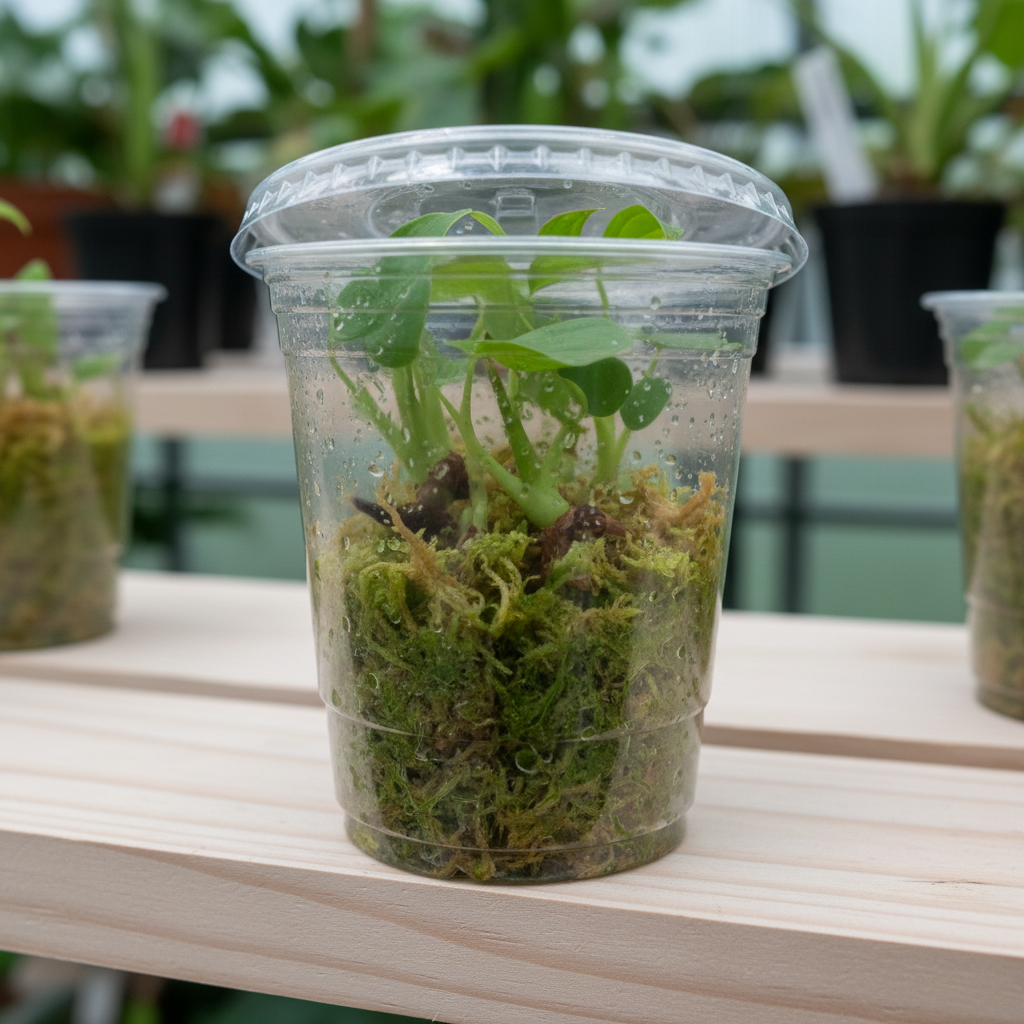
- Push the cutting upright into a deep cup or pot of damp sphagnum moss so that the node and aerial roots are buried but the leaves remain above the moss.
- Place the whole arrangement inside a clear plastic bag or under a clear plastic dome to maintain humidity around 80 to 90 per cent, and keep it in bright indirect light at 21 to 26 °C (70 to 79 °F).
- Check weekly for moisture in the moss, topping up with a fine mist of tepid water if it starts to dry. New roots typically emerge into the moss within four to six weeks.
- Once the roots are 5 to 7 cm (2 to 3 in) long and several have branched, pot the rooted cutting into a small container of aroid mix and water lightly. Reduce humidity gradually over a fortnight by opening the bag a little more each day.
Pro Tip — Cinnamon on Cut Surfaces: A light dusting of ground cinnamon on any cut on the parent plant or the cutting acts as a natural antifungal and dries the surface to encourage clean callusing. It is cheaper than commercial rooting hormones and works just as reliably for philodendron-family plants, which root easily without artificial encouragement.
Air Layering: Step-by-Step
Air layering produces a fully rooted new plant before you ever sever it from the parent. It is the safer choice for a tall specimen where cutting the top off blind feels risky, and it has the highest overall success rate of any propagation method for this species. The technique looks fiddly but is straightforward once you have done it once.
- Choose a healthy node on the trunk, ideally one with an aerial root already starting, 30 to 60 cm (12 to 24 in) below the top of the plant.
- Make a shallow horizontal nick about 3 mm (0.1 in) deep across one side of the trunk just below the node, or simply rough up the bark with a clean blade. Dust the wound with cinnamon.
- Soak a generous handful of long-fibre sphagnum moss in tepid water, squeeze out the excess until it is damp but not dripping, and pack it around the node.
- Wrap the whole moss bundle tightly in clear plastic film, secure both ends with natural twine or stretchy plant tape, and leave a small slit at the top for occasional moisture top-ups.
- Keep the parent plant in its usual position and watered normally. Check the moss every week or two and inject a little water with a syringe through the top opening if it begins to feel dry.
- Roots become visible against the plastic film after six to eight weeks. Once a cluster of stout pale roots fills the moss bundle, cut the trunk cleanly just below the bundle.
- Unwrap the plastic, leave the moss undisturbed around the roots, and pot the new plant into aroid mix at the same depth the roots are sitting in the moss. Water once and treat as a freshly potted small plant.
Troubleshooting Propagation
| Problem | Likely Cause | Solution |
|---|---|---|
| Cutting turns soft and brown at the base | Substrate too wet, no callus formed before potting, or contaminated tools. | Cut back to firm tissue, dust with cinnamon, callus for 48 hours, restart in fresh barely-damp moss. |
| No root growth after eight weeks | Temperature too low, indirect light too dim, or node was inactive. | Move to a warmer spot 22 to 26 °C, brighten the light, or try a different node closer to the active crown. |
| Leaves yellowing while rooting | Cutting is sacrificing older foliage to fund new root growth, a normal short-term response. | Leave the leaves on until they drop naturally; new growth from the apex confirms successful rooting. |
| Air layer moss dries out repeatedly | Plastic wrap fitted too loosely or in a very dry room. | Re-wrap more tightly, leave only a pinhole opening, and consider grouping plants to raise local humidity. |
Pests & Diseases
Indoors the split-leaf philodendron is comparatively pest-resistant, helped by tough thick leaves that few insects can chew through and a natural production of calcium oxalate crystals that discourage most herbivores. The pests it does suffer are the universal handful that bother every glossy tropical: spider mites in dry winter air, mealybugs that ride in on a new plant from a shop, scale insects that hitchhike on neighbouring philodendrons, and occasional thrips that drift in through open windows in summer.
The single most effective defence is regular inspection. Spend two minutes once a week looking at the undersides of leaves, the leaf axils, and the joints where the petioles meet the trunk, and you will catch every pest below before it becomes a real problem. Treatment is rarely complicated; what matters is acting at the first sighting rather than waiting until a colony covers the plant.
Common Pests
Spider Mites (Tetranychus urticae)
Tiny eight-legged arachnids barely visible to the eye, spider mites thrive in the hot dry air of centrally heated homes in winter. The first signs are pale stippling on the upper leaf surface and very fine webbing in the leaf axils. Heavy infestations turn leaves dull, dusty and eventually yellow as the mites suck out cell contents from the underside.
Treatment: Take the plant to a shower or outdoor hose and rinse the foliage thoroughly, paying particular attention to the leaf undersides where the mites gather. Follow with a spray of insecticidal soap or a 1 per cent neem oil solution, covering all leaf surfaces, and repeat every five to seven days for three rounds to break the life cycle. Raise humidity in the room as a long-term preventive measure.
Mealybugs (Pseudococcus longispinus)
Soft oval insects 2 to 4 mm long, covered in a fluffy white wax that makes colonies look like tufts of cotton wool tucked into the leaf axils and along the trunk. They feed by piercing plant tissue and excrete a sticky honeydew that attracts black sooty mould.
Treatment: Dab individual mealybugs with a cotton bud soaked in 70 per cent isopropyl alcohol, which kills them on contact and dissolves the protective wax. For widespread infestations, spray the entire plant with insecticidal soap or a systemic horticultural insecticide, repeating weekly for three to four weeks until no new individuals appear. Isolate the plant from other tropicals during treatment, since mealybugs spread easily on contact.
Scale Insects (Coccus hesperidum)
Brown or yellow oval bumps 2 to 4 mm across, fixed in place along the petioles, leaf veins and the underside of leaves. They look like discoloured tissue rather than insects, which is why infestations often progress unnoticed until honeydew drips onto furniture below.
Treatment: Scrape off visible scales with a fingernail or the back of a knife, then spray the entire plant with horticultural oil to suffocate any crawler-stage juveniles. Repeat after two weeks. For severe infestations, a systemic insecticide drench applied to the soil delivers active ingredient through the sap and reaches scales that surface treatments miss.
Thrips (Frankliniella occidentalis)
Slender black or pale insects under 2 mm long that scrape at leaf surfaces and feed on the sap that bleeds out. The damage shows as silvery streaks and tiny black dots of excrement along the upper leaf surfaces, often on new emerging leaves. Thrips are particularly disruptive because they can carry tospoviruses.
Treatment: Hang yellow or blue sticky traps near the plant to catch winged adults, and spray foliage with insecticidal soap weekly for three weeks. Remove and bin badly damaged leaves to interrupt the breeding cycle. Predatory mites (Neoseiulus cucumeris) are an effective biological option for indoor growers willing to use them.
Common Diseases
Root Rot (Pythium and Phytophthora spp.)
By far the most common disease of the split-leaf philodendron, almost always brought on by chronically waterlogged soil. Affected plants show soft yellow lower leaves that drop quickly, a sour-smelling rootball, and roots that turn brown to black and slide off when pinched.
Treatment: Unpot the plant immediately, rinse all old soil from the roots under tepid running water, and cut every soft black root back to firm white tissue with sterilised scissors. Dust the cuts with cinnamon or a copper-based fungicide, then repot into fresh dry aroid mix. Withhold water for a week to let the trimmed roots callus before resuming a careful, slightly drier watering rhythm.
Bacterial Leaf Spot (Erwinia spp.)
Round or irregular dark brown water-soaked spots on the leaves, often surrounded by a thin yellow halo and most common on the youngest growth or wherever water has pooled in the leaf axils. The lesions enlarge quickly in warm humid conditions.
Treatment: Remove affected leaves with sterilised scissors and bin them rather than composting. Improve airflow around the plant, avoid wetting the foliage when watering, and stop misting until the problem is under control. A copper-based bactericide spray every 10 days for three rounds halts spread; severe cases may need a fresh start from a clean cutting taken well above the affected tissue.
Pest and Disease Summary
| Pest / Disease | Identification | Treatment |
|---|---|---|
| Spider mites | Fine webbing, stippled yellow upper leaves, dusty appearance. | Rinse, insecticidal soap or neem, raise humidity, three weekly rounds. |
| Mealybugs | White cottony tufts in leaf axils, sticky honeydew on lower leaves. | Alcohol-dipped cotton bud, then insecticidal soap weekly for four weeks. |
| Scale insects | Brown or yellow oval bumps on petioles and leaf undersides. | Scrape off, then horticultural oil; systemic drench for severe cases. |
| Thrips | Silvery streaks and black specks on upper leaf surfaces. | Sticky traps, insecticidal soap weekly, remove damaged leaves. |
| Root rot | Yellowing lower leaves, sour-smelling soil, mushy black roots. | Unpot, trim rotten roots, repot in fresh dry mix, withhold water one week. |
| Bacterial leaf spot | Dark water-soaked spots with yellow halos on leaves. | Remove affected leaves, improve airflow, copper bactericide every 10 days. |
Prevention Strategies
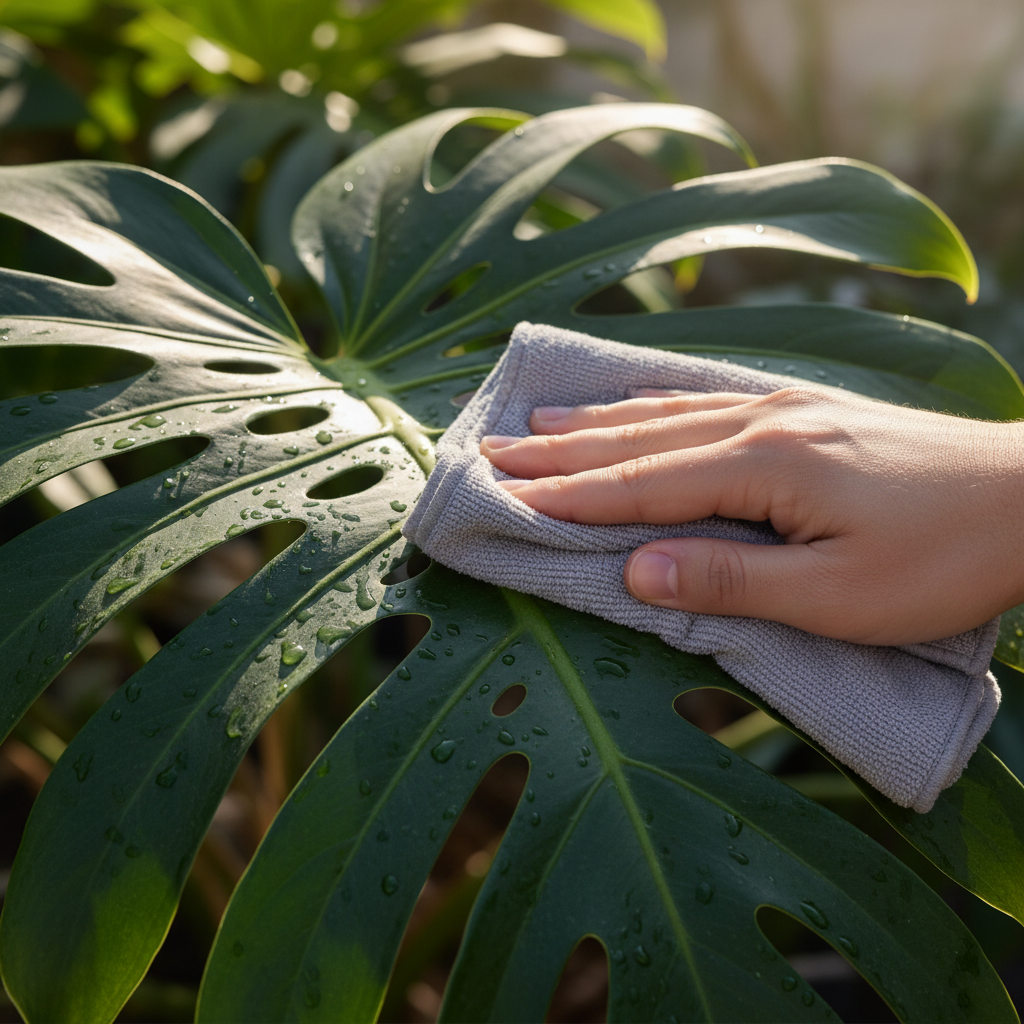
Prevention works far better than cure with houseplant pests, and the practices that protect a split-leaf philodendron are the same that protect any large-leaf tropical. Quarantine every new plant for two to three weeks before placing it near the rest of your collection. Inspect leaf undersides, axils and petiole joints weekly. Wipe upper leaf surfaces with a damp microfibre cloth once a month, both to remove dust that blocks photosynthesis and to spot incoming pests early. Avoid wetting the foliage at evening when watering, because pooled water sitting overnight is what allows bacterial leaf spot to take hold in the leaf axils.
Equally important is to keep the plant in conditions that favour vigour. A well-fed, well-watered split-leaf philodendron in bright indirect light produces tougher leaves and a stronger immune response than a struggling plant in dim light, and pests preferentially settle on the weaker host. If you find yourself battling the same pest repeatedly, ask whether the plant’s environment has slipped: drying air, dropping light, an old depleted potting mix, or a watering rhythm that has become erratic since the last move all create the conditions in which infestations re-establish.
Pro Tip — Neem Oil Maintenance Spray: A 1 per cent neem oil solution mixed with a few drops of mild liquid soap as an emulsifier makes an excellent low-toxicity preventive spray. Apply once a month from spring through autumn, coating the undersides of leaves where most pests settle. Neem disrupts the moulting cycle of soft-bodied insects without harming humans, pets or beneficial garden insects when used indoors.
Popular Varieties
The plant most people call split-leaf philodendron is the wild species Thaumatophyllum bipinnatifidum, but the name covers a handful of cultivars and a closely related species that are routinely sold under the same umbrella label. The genus Thaumatophyllum was created in 2018 to gather the self-heading “Meconostigma” group of philodendrons into their own clade after molecular work showed they were only distantly related to true climbing philodendrons. Botanical labels are slowly catching up; in everyday plant-shop conversation, you will still hear the old name Philodendron bipinnatifidum or even the much older Philodendron selloum, all referring to the same plant.
Among the named selections in regular cultivation, two stand out as widely available and worth seeking: Thaumatophyllum xanadu, sold simply as Xanadu, a compact mounding plant once thought to be a cultivar of bipinnatifidum but now recognised as a distinct species; and the older landscape cultivar Hope Selloum, prized for its dramatically wavy and deeply incised leaves. The table below summarises the most common varieties you will encounter.
| Variety | Leaf Appearance | Light Needs | Growth Rate | Availability |
|---|---|---|---|---|
| Wild Type (T. bipinnatifidum) | Large pinnatifid leaves up to 90 cm, glossy mid green, deeply lobed at maturity. | Bright indirect. | Moderate; 4 to 8 new leaves per year. | Common in larger garden centres. |
| Xanadu (T. xanadu) | Compact glossy lobed leaves on shorter petioles, dense rosette habit. | Bright indirect to medium. | Slow to moderate. | Very common, often as a tabletop plant. |
| Hope Selloum | Heavily wavy and incised leaves with prominent veining and ruffled edges. | Bright indirect. | Moderate. | Common at specialist nurseries. |
| Lemon Lime | Bright chartreuse to neon-green new growth, maturing to mid green. | Bright indirect (loses colour in dim light). | Moderate. | Occasional at specialist sellers. |
| Aureum (Golden Selloum) | Yellow-gold mature leaves with deep lobing. | Bright indirect, away from direct sun. | Slow. | Rare; collector-priced. |
| Atom | Small, tightly ruffled leaves on a very compact plant rarely exceeding 60 cm. | Bright indirect to medium. | Slow. | Common at specialist sellers. |
Featured Varieties
Xanadu
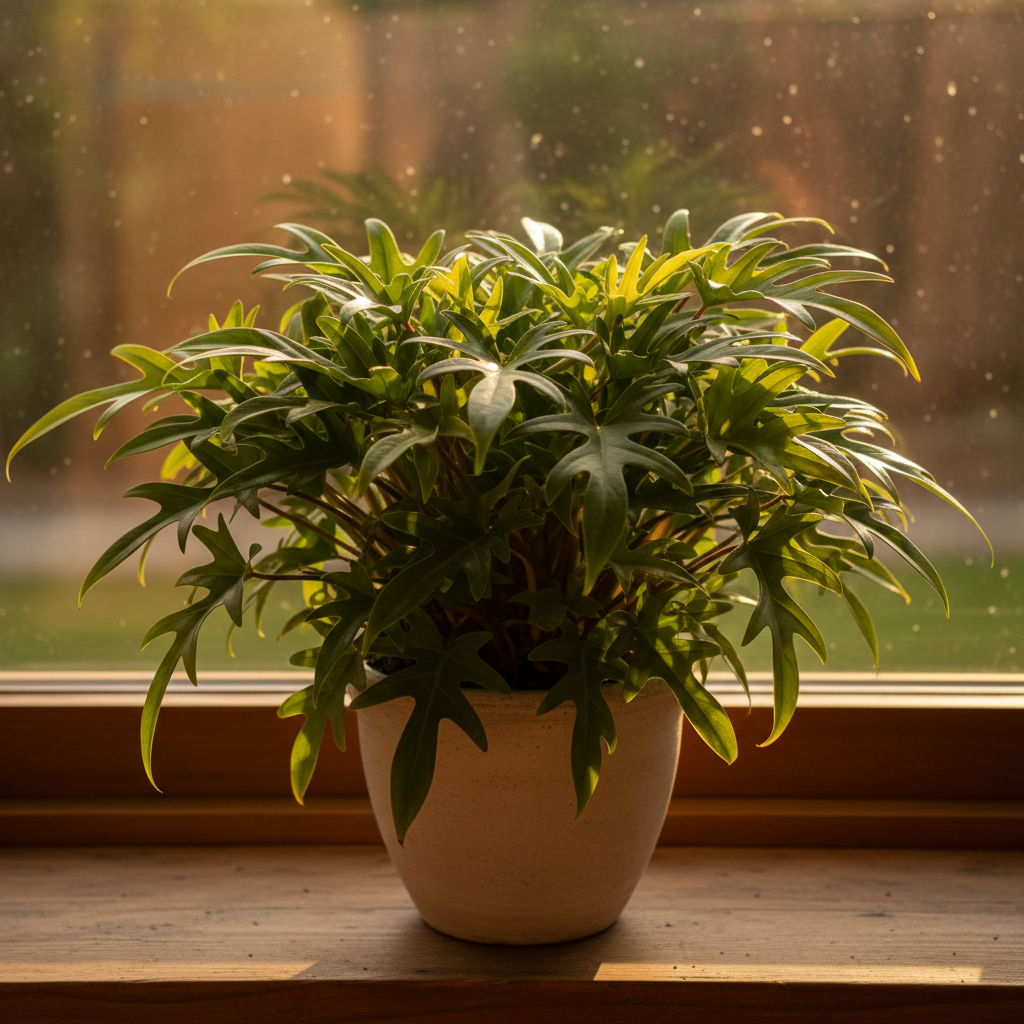
The most popular tabletop split-leaf philodendron, Xanadu forms a dense mounding rosette of glossy deeply lobed leaves on short petioles. It rarely exceeds one metre in height and spread indoors, which makes it the right choice when you want the dramatic foliage without the floor space a wild-type plant demands. Tolerates slightly lower light than the species.
Hope Selloum
An older landscape cultivar that carries the species’s drama with extra panache. Hope Selloum is bushier and slightly more compact than the wild type, but its real signature is the deeply incised and wavy leaves that give it a frothy ruffled silhouette. Excellent as a corner specimen where the light is bright but not direct.
Variety Profiles in Detail
Wild Type Split-Leaf Philodendron (Thaumatophyllum bipinnatifidum)
The species itself, native to a wide swathe of subtropical South America, is the largest of the group and the one that develops the most dramatic trunk over time. A mature indoor specimen carries a thick semi-woody stem 3 to 5 cm (1 to 2 in) in diameter studded with crescent-shaped leaf scars and dangling pale aerial roots, topped by a rosette of leaves that can each span 90 cm (35 in) at full size. Best suited to large rooms with high ceilings and bright indirect light.
Xanadu (Thaumatophyllum xanadu)
Originally introduced in Australia in the 1980s and marketed as a compact philodendron, Xanadu is now recognised as a distinct species rather than a cultivar of bipinnatifidum. It produces shorter petioles and smaller deeply lobed leaves arranged in a low mounding rosette, with the entire plant rarely exceeding 80 cm to 1 m (32 to 39 in) in either dimension indoors. It is the variety most worth choosing for smaller rooms.
Hope Selloum
A long-standing cultivated selection of the wild type, widely used in commercial interior landscaping in the United States and Australia. Hope Selloum is recognisable by its compact bushy habit and its more deeply ruffled and incised leaves, which give the plant a softer, fuller silhouette than the wild type. It also tends to produce slightly thicker, more leathery foliage that handles dry indoor air better than the species.
Lemon Lime
A relatively recent introduction, Lemon Lime carries the same deeply lobed leaf structure as the wild type but in a luminous chartreuse to neon-green shade, particularly on new growth. The colour is light-dependent; in bright indirect light the contrast between fresh and mature leaves is striking, while in dim conditions all foliage fades towards the same dull mid green.
Atom
The smallest of the cultivated split-leaf philodendrons, Atom forms a tight rosette of tightly ruffled lobed leaves on a plant that rarely exceeds 60 cm (24 in) in either dimension. Its small footprint makes it an excellent desk or side-table specimen where the species would quickly become unmanageable.
Choosing the Right Variety for Your Space
Match the plant to the room. The wild type needs floor space, a tall ceiling and bright indirect light; in a smaller flat it quickly becomes a shaggy giant that bumps against the walls. Xanadu is the right answer for a side table or low shelf, where its compact rosette stays in proportion to the surroundings. Hope Selloum sits comfortably between the two, working as a corner specimen in a larger living room without dominating it. Lemon Lime and the variegated selections demand the brightest indirect light you can offer, since their pigmentation depends on strong illumination, while Atom thrives in surprisingly modest light and works as the rare tropical that genuinely belongs on a north-facing desk.
Frequently Asked Questions
Why are my split-leaf philodendron’s new leaves not splitting?
The two usual reasons are insufficient light and youth. The deep finger-like lobing requires both genetic maturity (typically three to four years from a small starter plant) and bright indirect light. A young plant in dim conditions will produce only shallow indentations or smooth heart-shaped leaves. Move the plant into brighter light, keep up regular feeding through the growing season, and within a few new leaves the characteristic lobes should return.
Is split-leaf philodendron the same as monstera deliciosa?
No, although the two are routinely confused in shops and even in older books. Both are aroid family climbers with split or holed leaves, but they belong to different genera. Monstera deliciosa is a climbing vine with fenestrated leaves that have holes (fenestrations) running close to the midrib, and it grows aerial roots that climb on neighbouring trees. Thaumatophyllum bipinnatifidum is a self-supporting plant with deeply lobed but not perforated leaves, and it grows a thick upright trunk rather than a vine.
How big does a split-leaf philodendron get indoors?
In a typical home a mature wild-type specimen reaches 1.5 to 2 m (5 to 7 ft) in height and roughly the same in spread, with individual leaves up to 90 cm (35 in) long. In a conservatory or atrium with high ceilings it can approach 3 m (10 ft). Xanadu and Atom stay much smaller, around 60 to 100 cm in either dimension, which is why they are the practical choice in flats.
Is split-leaf philodendron safe for cats and dogs?
No. All parts of the plant contain calcium oxalate raphides, sharp needle-like crystals that release into the mouth and throat on chewing. Pets typically show drooling, vomiting, pawing at the mouth and difficulty swallowing within hours of ingestion. Keep the plant out of reach of pets, ideally on a tall stand or in a room they cannot access, and call a vet promptly if exposure occurs. A short course of supportive care usually resolves the symptoms within a day or two.
Why is my split-leaf philodendron leaning?
Every leaf in the crown reaches for the brightest source in the room. If the plant has been sitting in the same position for months without being turned, the trunk gradually pulls towards the light and the entire plant leans. Turn the pot a quarter turn each time you water, and the lean will even out within a couple of months. For an already-leaning specimen, support the trunk with a stake while it rebalances, or consider air-layering a new upright top from a higher node.
My split-leaf philodendron is dripping water from the leaf tips. Is that a problem?
That is guttation, a normal physiological process. The plant pushes excess sap and water out through small pores at the leaf tips when the soil is very moist and humidity is high, often overnight. It is harmless, but if it happens repeatedly it suggests the soil is wetter than the roots can absorb. Let the soil dry a little further between waterings and the dripping usually stops within a week.
Should I wipe the leaves, and how often?
Yes. The broad leaves accumulate household dust, which blocks light and slows photosynthesis. A monthly wipe with a damp grey microfibre cloth is enough. Support the leaf with one hand from underneath, run the cloth gently across the upper surface from base to tip, and repeat on the underside if dust is heavy. The same routine doubles as a pest check, since spider mites and scale are easier to spot on a clean leaf than a dusty one.
Can a split-leaf philodendron flower indoors?
It can, but rarely. The plant produces typical aroid inflorescences, a creamy spadix surrounded by a green spathe, on very mature specimens in greenhouse conditions. Indoors, even a well-grown plant may go a decade without flowering, and the flowers are short-lived and not particularly showy. The plant is grown for its leaves, not its blooms, and a non-flowering specimen is no less healthy for it.
Why does my split-leaf philodendron have a trunk that is naked at the bottom?
As the plant ages, the lowest leaves naturally yellow and drop, leaving behind a column of crescent-shaped scars where they once attached. This is a normal part of the species’s growth habit and gives mature plants their tropical palm-like silhouette. If the leggy look bothers you, you can either air-layer the top of the plant into a new pot at a lower height, or place a fuller bushy plant such as a Boston fern or a parlour palm in front of the trunk to mask it.






