
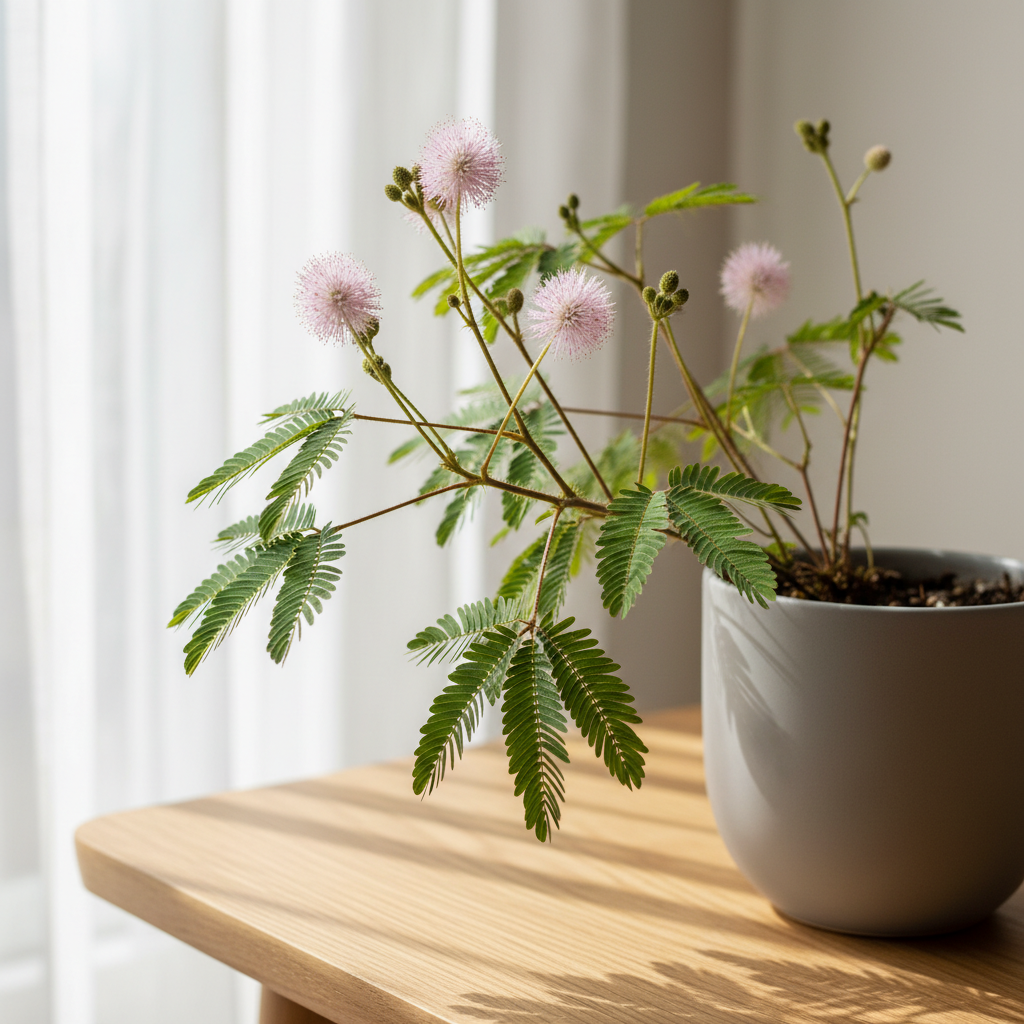
Few houseplants put on a show quite like the sensitive plant. Brush a fingertip across its feathery foliage and, within a second, the tiny leaflets fold together in sequence and the whole frond droops as though the plant has fainted. Leave it alone for a few minutes and it quietly reopens. This theatrical reflex has made Mimosa pudica a windowsill curiosity for centuries, known variously as the touch-me-not, humble plant, shy plant, shameplant and sleeping grass. A low, sprawling member of the legume family (Fabaceae), it is native to the tropics of South and Central America but has since naturalised across warm regions worldwide, from India to the southern United States.
That party trick is only half the story. Behind the movement sits a genuinely tropical plant with firm opinions about light, water and warmth, and the gap between a sensitive plant that merely survives and one that truly thrives is wider than most people expect. Grown well, it builds into a bushy mound of fine, fern-like leaves studded with lilac-pink pom-pom flowers; grown poorly, it stretches, stops responding to touch and fades within a single season. This guide walks through everything from the science of the fold to raising new plants from seed, so you can keep yours vigorous rather than simply alive.
Contents
- Quick Reference
- Why Sensitive Plant Makes a Rewarding Houseplant
- Light Requirements
- Watering & Humidity
- Soil, Potting & Repotting
- Fertilising
- Propagation
- Pests & Diseases
- Popular Varieties
- Frequently Asked Questions
Quick Reference: Sensitive Plant at a Glance
| Light | Bright light with two to four hours of direct sun; one of the few houseplants that genuinely wants a sunny sill. |
| Watering | Keep evenly moist. Water when the top 1 cm (0.4 in) of soil feels dry; never allow the root ball to dry out completely. |
| Temperature | 18 to 30°C (64 to 86°F). Never below 15°C (59°F). |
| Humidity | High, ideally 50 per cent or more. Resents dry indoor air. |
| Fertiliser | Balanced feed at half strength every two to four weeks in spring and summer. |
| Toxicity | Mildly toxic if eaten (contains the alkaloid mimosine), and the stems carry small prickles. Keep away from curious pets and children. |
Why Sensitive Plant Makes a Rewarding Houseplant
The obvious draw is the movement, and it never quite loses its novelty. The folding response, known to botanists as thigmonasty, is rare among plants you can grow on a windowsill, and watching a child or a sceptical adult discover it for the first time is a small reliable pleasure. Unlike most foliage plants, which ask only to be looked at, the sensitive plant invites interaction, which makes it one of the best living introductions to plant biology you can keep at home.
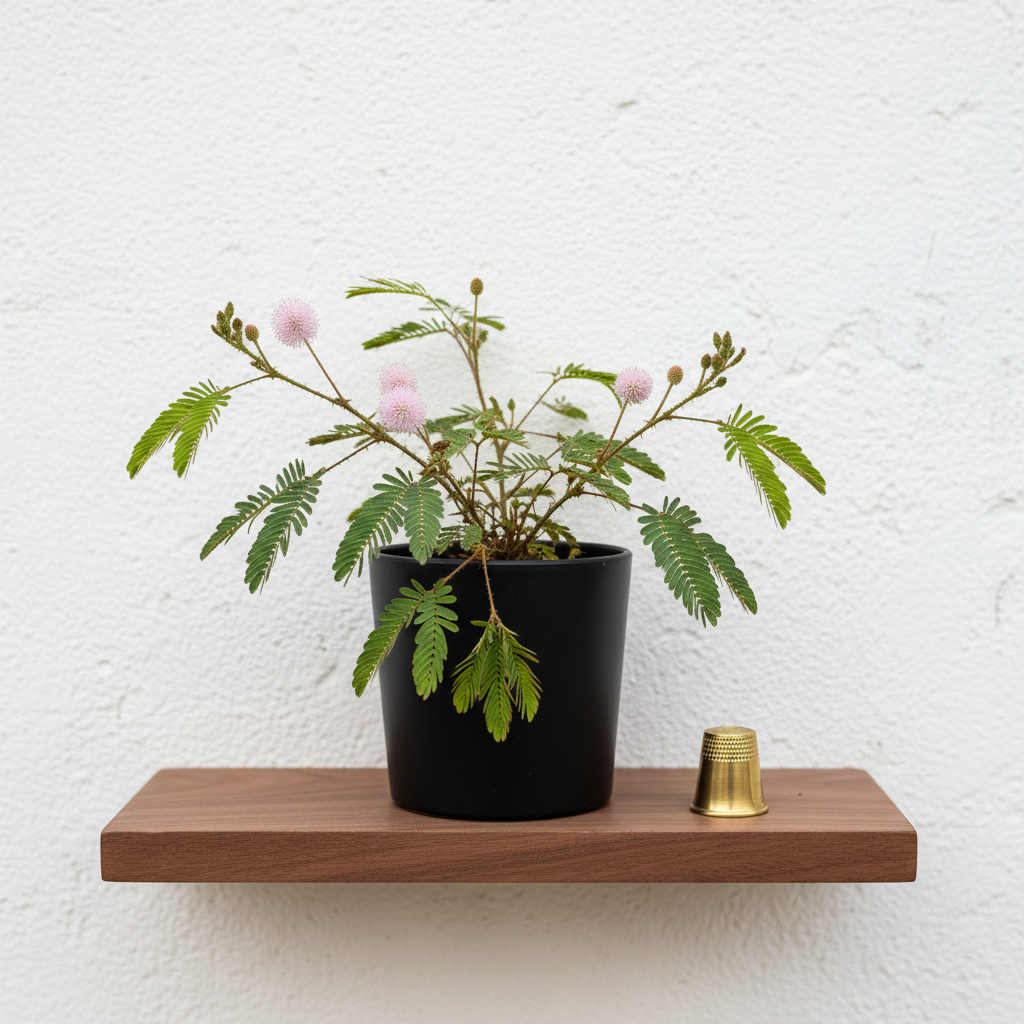
Beyond the spectacle, it is a genuinely attractive small plant. The doubly compound leaves are soft and ferny, the stems flush bronze to red in strong light, and in summer it throws up fluffy spherical flowers in shades of pink and lilac that look like tiny powder puffs. It stays compact, rarely exceeding 30 to 60 cm (12 to 24 in) indoors, so it suits a windowsill, a small shelf or the front edge of a brighter plant grouping. It also grows quickly and flowers young, which means a packet of seeds can give you a blooming plant within a single season, a rare turnaround in the houseplant world.
Important — Toxicity: The foliage contains mimosine, a non-protein amino acid that is mildly toxic if eaten in quantity and can cause digestive upset in pets. The stems also bear small, sharp prickles. Site the plant out of reach of pets and small children, and wear light gloves if you find the prickles uncomfortable when repotting.
Light Requirements
Light is where most sensitive plants are won or lost. This is a sun-loving tropical weed at heart, accustomed to open ground and roadside verges in full glare, and it needs far more light than the average foliage houseplant. Give it the brightest position you have. A plant kept in dim or merely moderate light stretches between leaf nodes, grows pale and floppy, flowers little or not at all, and becomes noticeably slower and weaker in its touch response.
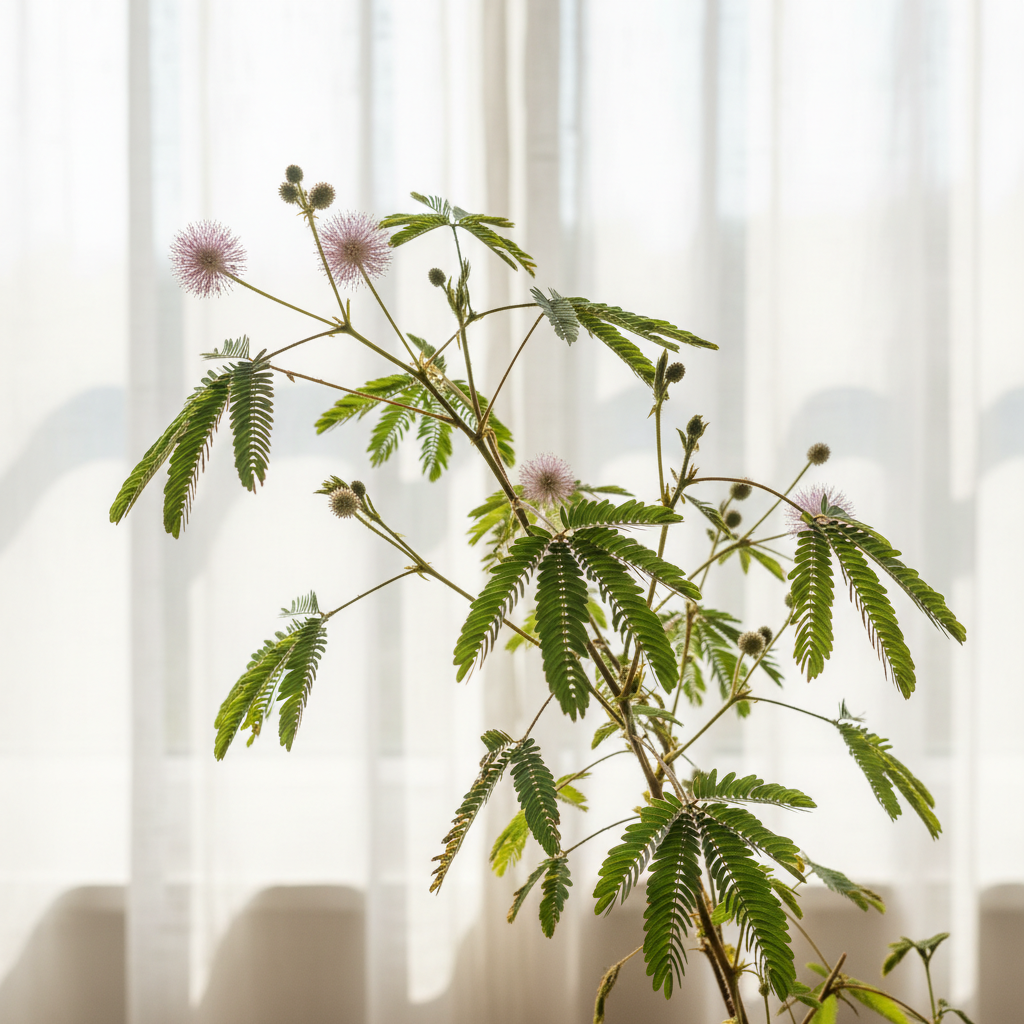
The ideal is a position that receives at least two to four hours of direct sun each day, alongside bright ambient light for the rest of the daylight hours. An unobstructed south-facing or east-facing windowsill is close to perfect. In these conditions the foliage stays dense and deep green, the stems colour up attractively, and the plant blooms freely through the warm months.
Light Levels Explained
Light intensity indoors is often described in vague terms, so the table below translates the usual categories into something practical, with the likely outcome for a sensitive plant in each.
| Light Category | Approx. Level | Typical Location | Outcome |
|---|---|---|---|
| Direct sun | 20,000 lux or more | On a south or east sill, in the sun | Ideal; dense growth and good flowering |
| Bright indirect | 10,000 to 20,000 lux | Just back from a sunny window | Good, though flowering may be lighter |
| Medium | 5,000 to 10,000 lux | A few metres from a bright window | Survives but stretches and weakens |
| Low | 1,000 to 5,000 lux | North window or interior wall | Poor; leggy, pale, sluggish movement |
| Very low | Below 1,000 lux | Hallway or windowless room | Decline and eventual death |
Window Orientation and Placement
South-facing window: In most of the northern hemisphere this is the strongest light a home offers and the sensitive plant relishes it. Place the plant right on the sill. Only in the fiercest midsummer heat behind glass might you need a sheer curtain to take the edge off the hottest midday hours.
East-facing window: An excellent choice. Gentle direct morning sun followed by bright light for the rest of the day suits the plant well and carries less risk of scorch than harsh afternoon glare.
West-facing window: Also good. The plant will take strong afternoon sun, although in a hot climate watch that the soil does not bake dry during the warmest part of the day.
North-facing window: Generally too dim. A sensitive plant on a north sill tends to stretch and sulk, and you will almost certainly need to supplement with a grow light to keep it in good condition.
Pro Tip — Rotate for Even Growth: Because the plant reaches eagerly towards the strongest light, give the pot a quarter turn every few days. This keeps the mound symmetrical and stops it leaning hard against the glass.
How Light Affects Movement and Flowering
Light does more than fuel growth in this plant; it powers the show. The folding response runs on water pressure inside specialised hinge-like cushions at the leaf joints called pulvini, and a well-lit, well-hydrated plant snaps shut faster and more dramatically than a weak one. The same plant also closes its leaves each evening of its own accord, a separate daily rhythm called nyctinasty, reopening them at dawn. Strong light keeps both responses crisp, and it is the single biggest factor in whether the plant flowers, since the pink puffs form only on vigorous, sun-fed growth.
Warning — Direct Sunlight: Although the sensitive plant loves sun, a plant raised in low light and then moved abruptly into full glare can scorch, showing bleached or brown patches. Move plants into stronger light over a week or two rather than all at once.
Artificial Lighting
The sensitive plant responds very well to supplementary lighting, which makes it a good candidate for homes short on natural sun. A full-spectrum LED grow light positioned 20 to 30 cm (8 to 12 in) above the plant, run for twelve to fourteen hours a day, will keep it compact and even encourage flowering through winter. Because the plant folds its leaves at night, there is no need to leave lights on around the clock; matching a normal day length works best and respects its internal clock.
Seasonal Adjustments
As the days shorten through autumn and winter, move the plant to your brightest available window and consider adding a grow light if growth becomes pale and drawn. Many sensitive plants behave as short-lived perennials and naturally decline after flowering and setting seed, so do not be alarmed if a mature plant looks tired by late winter; the usual approach is to collect seed and start fresh in spring rather than nurse an exhausted plant through a second year.
Watering & Humidity
Where many popular houseplants prefer to dry out between drinks, the sensitive plant does not. It comes from moist tropical ground and likes its soil kept consistently damp, never waterlogged and never bone dry. Of the two mistakes, letting it dry out completely is the faster killer; a sensitive plant that wilts hard from drought often does not recover, dropping its leaflets and collapsing within a day.
When to Water
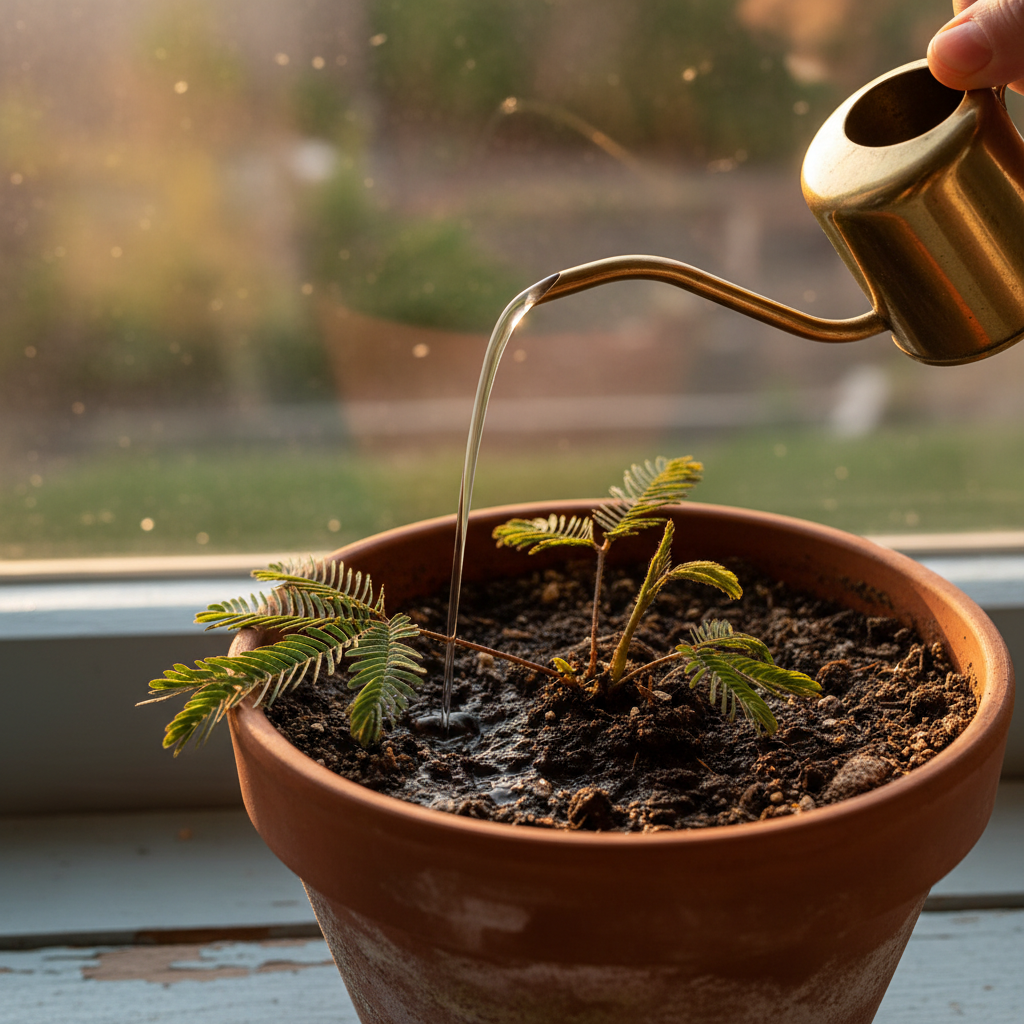
Check the surface daily and water as soon as the top 1 cm (0.4 in) of soil feels dry to the touch. In a bright, warm spot through spring and summer this often means watering every two to three days, and a small plant in a terracotta pot in full sun may need a drink daily during a heatwave. The plant itself is an honest indicator: if the leaves are folding and drooping when nobody has touched them and the soil is dry, it is thirsty.
In winter, when growth slows and light is weaker, the plant uses far less water. Ease off accordingly, still keeping the soil lightly moist but allowing the surface to dry a little more between waterings. The goal across the whole year is steady, even moisture rather than the dramatic wet-then-dry cycle that suits a succulent.
Pro Tip — Use Tepid Water: Cold water from the tap can shock the roots of this warmth-loving plant and may briefly slow its movement. Let water come to room temperature before you use it, and the plant will respond more readily.
How to Water Correctly
- Check the soil surface; water once the top 1 cm (0.4 in) has begun to dry.
- Use room-temperature water, ideally rainwater or filtered water if your tap supply is very hard.
- Pour evenly over the soil surface until water runs freely from the drainage holes.
- Let the pot drain fully for a few minutes so the roots never sit in standing water.
- Empty the saucer or cache pot of any water that collects beneath.
- Return the plant to its bright spot and check again the following day.
Signs of Overwatering vs. Underwatering
| Symptom | Overwatering | Underwatering |
|---|---|---|
| Leaf colour | Yellowing, often from the lower leaves up | Dull green fading to brown and crisp |
| Leaf texture | Soft, limp leaflets that stay folded | Dry, papery leaflets that crumble |
| Soil | Constantly wet, sometimes sour-smelling | Dry, shrunken and pulling from the pot wall |
| Roots | Brown, mushy and foul-smelling | Dry and brittle but pale |
| Stem base | Blackened or soft at soil level | Thin and wiry, whole plant collapsing |
Warning — Root Rot: Consistently soggy soil starves the roots of oxygen and invites rot, which is often fatal once the stem base turns black. If you suspect it, unpot the plant, trim away any soft brown roots with clean scissors, and repot into fresh, free-draining mix in a pot with good drainage.
Humidity Requirements
As a tropical plant, the sensitive plant prefers humidity of 50 per cent or higher and is happiest in a moist atmosphere. In a typical centrally heated home, where winter humidity can fall below 30 per cent, it often shows its displeasure by browning at the leaflet tips and growing more slowly.
The early signs of air that is too dry are crisping leaf edges, increased susceptibility to spider mites, and foliage that looks tired even when the soil is correctly moist. These symptoms are easy to mistake for a watering problem, so check the humidity before you reach for the watering can.
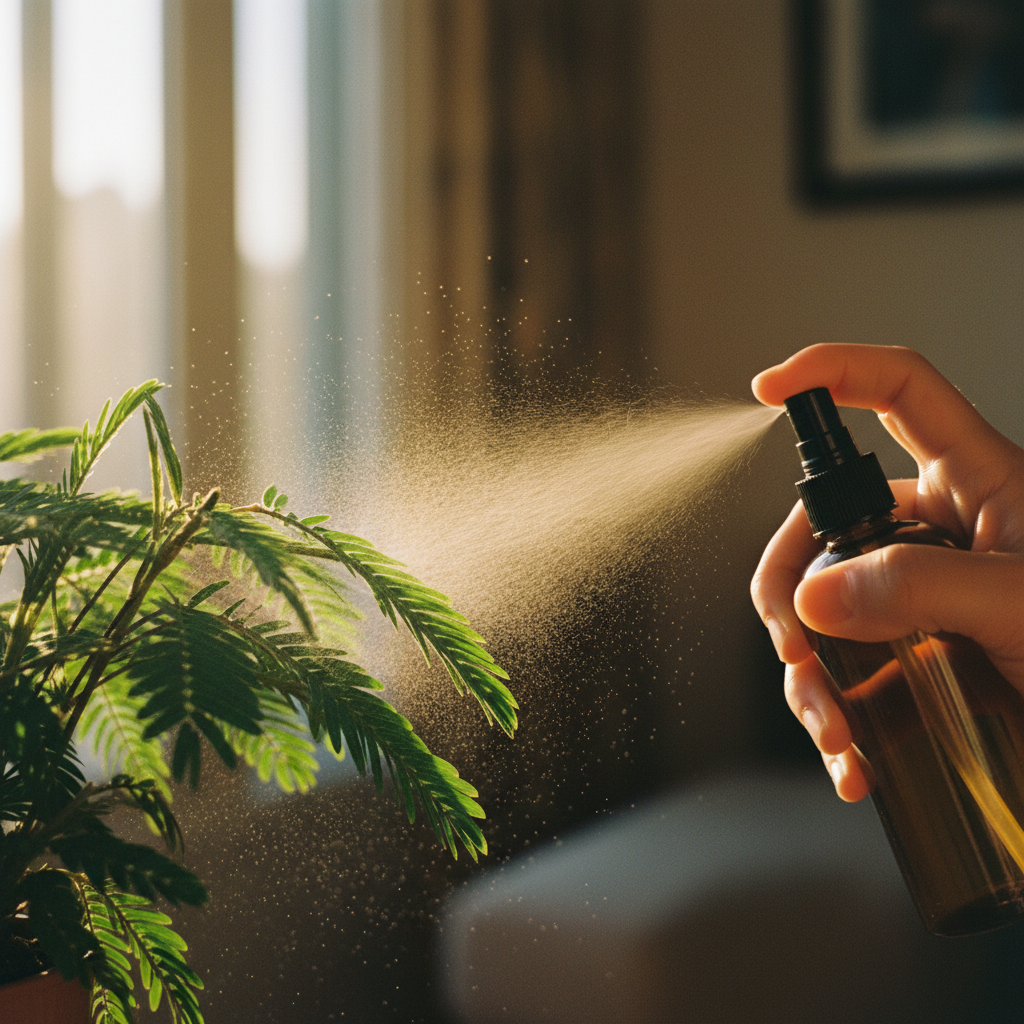
To raise humidity, stand the pot on a tray of damp pebbles, group it with other plants so they share moisture, or run a small humidifier nearby during the heating season. A kitchen or bathroom windowsill with strong light is often the ideal home, combining the brightness the plant demands with the naturally higher humidity of those rooms. Misting helps only briefly and, on a plant prone to fungal trouble, is best kept light.
Water Quality
The sensitive plant is reasonably tolerant of ordinary tap water, but in areas with very hard or heavily chlorinated supplies it appreciates rainwater or filtered water. Mineral build-up over time can show as a pale crust on the soil surface and crisping leaf margins, so if your water is particularly hard, alternating with collected rainwater keeps the plant looking its best.
Soil, Potting & Repotting
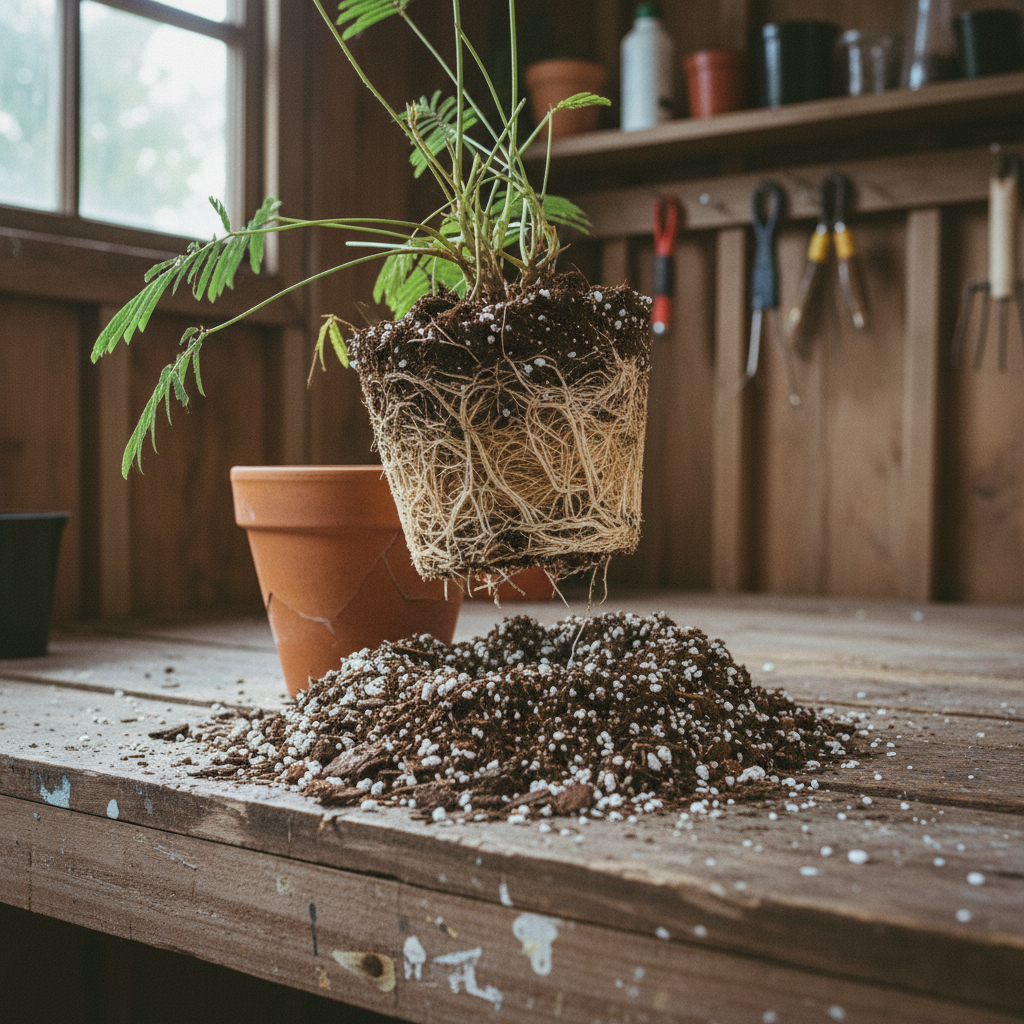
The sensitive plant needs a growing medium that performs a careful balancing act: moisture-retentive enough to stay evenly damp, yet open enough that water drains freely and the roots never suffocate. A standard peat-free houseplant compost lightened with extra drainage material hits this balance nicely.
Ideal Soil Composition
A good working blend is roughly two parts quality potting compost, one part perlite or coarse sand for drainage, and one part coir or fine bark to hold moisture and keep the mix open. The aim is a loamy, slightly springy medium that feels damp but never sodden when you squeeze it.
| Component | Proportion | Function |
|---|---|---|
| Peat-free potting compost | 2 parts | Base nutrition and moisture retention |
| Perlite or coarse sand | 1 part | Drainage and aeration |
| Coir or fine bark | 1 part | Holds moisture while keeping the mix open |
| Worm castings (optional) | A small handful | Gentle slow-release feeding |
The plant prefers a slightly acidic to neutral soil, in the region of pH 6.0 to 6.5. Most general-purpose composts fall comfortably within this range, so there is rarely any need to adjust it deliberately.
Pro Tip — Quick Mix Recipe: If you want a fast, reliable blend, combine two scoops of ordinary houseplant compost with one scoop of perlite and one scoop of coir. It drains well, stays evenly moist and suits the sensitive plant from seedling to flowering.
Choosing the Right Pot
Because the sensitive plant stays small and is often grown for just a season or two, it does not need a large container. A pot of 10 to 15 cm (4 to 6 in) suits most plants, giving the roots room without holding so much soil that it stays wet for too long.
Drainage holes are non-negotiable. Whatever pot you choose, it must have holes in the base. Without them, water collects at the bottom and the roots rot, which on a moisture-loving plant that is watered often is a very real risk.
Pot material: Terracotta is a good choice because its porous walls let excess moisture escape and make overwatering harder, although it does dry out faster and will need more frequent watering in hot weather. Plastic and glazed ceramic hold moisture longer, which can be helpful in a very sunny, dry spot but demands a more careful hand with the watering can.
Pot size: Move up only one size at a time when repotting. An oversized pot holds a reservoir of damp soil that the small root system cannot use, and that lingering moisture is a common route to rot.
When to Repot
Sensitive plants grow fast and a healthy seedling may need potting on within a couple of months of germinating. Signs that it is time include roots emerging from the drainage holes, soil that dries out within a day of watering, and growth that has clearly slowed. Spring and early summer, when the plant is in active growth, are the best times to repot. Because the species is often short-lived, many growers repot only once, moving a seedling into its final pot and then simply maintaining it.
How to Repot: Step-by-Step
- Water the plant lightly a day beforehand so the root ball holds together.
- Prepare the new pot, one size larger, with a layer of fresh, free-draining mix in the base.
- Ease the plant out gently, handling the stems with care to avoid the small prickles and minimise disturbance.
- Tease out any tightly circling roots, but disturb the root ball as little as you can, as this plant dislikes root disruption.
- Set the plant at the same depth it grew before and fill around it with fresh mix, firming lightly.
- Water thoroughly to settle the soil and close any air pockets.
- Return it to bright light and expect the leaves to stay folded and a little sulky for a day or two while it recovers.
Warning — Transplant Shock: The sensitive plant resents root disturbance and may droop dramatically or drop leaflets after repotting. Keep it warm, lightly moist and out of harsh midday sun while it settles, and avoid feeding for two to three weeks until new growth appears.
Fertilising
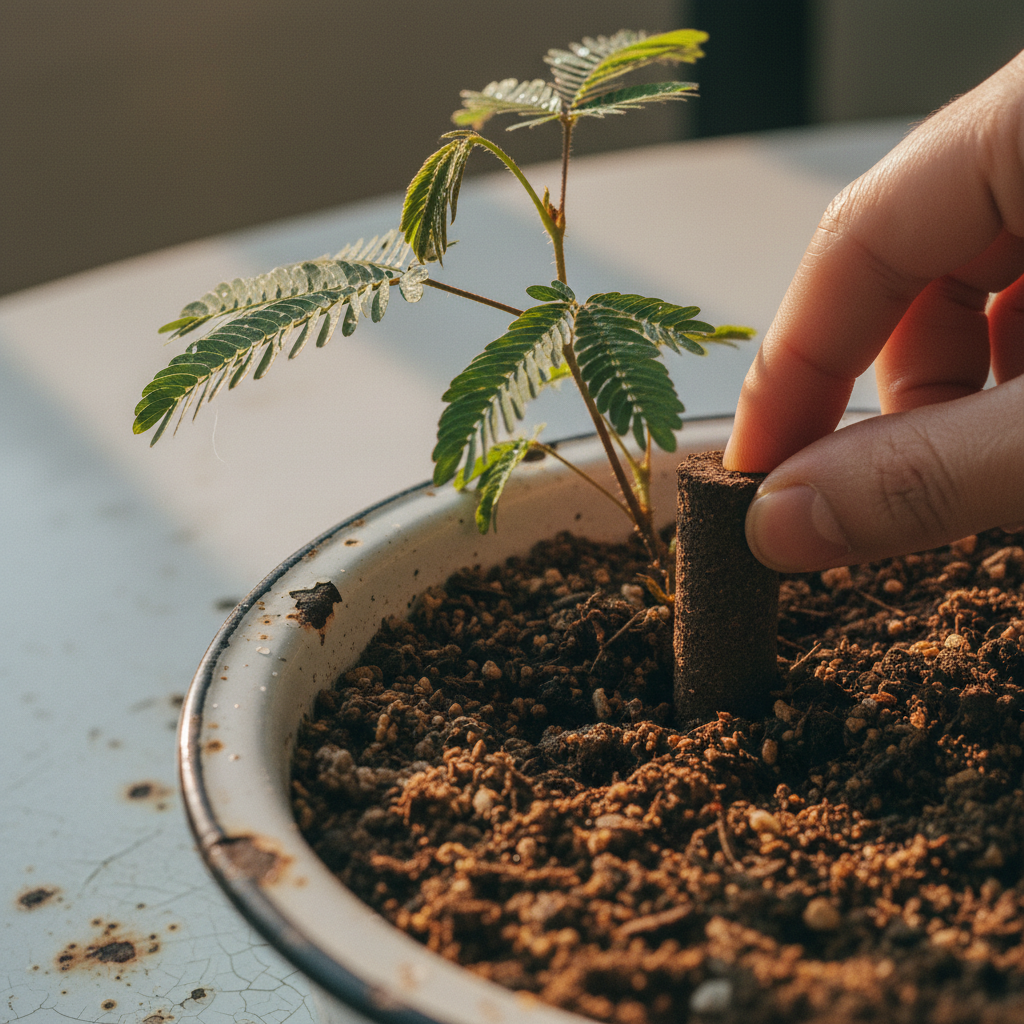
The sensitive plant is a fast grower with a modest appetite, and as a legume it has a useful trick: in partnership with soil bacteria, its roots can fix nitrogen from the air. This means it needs less nitrogen feeding than many houseplants, and a light hand with fertiliser produces better, sturdier growth than a heavy one.
During the active season from spring through late summer, a balanced feed at half the recommended strength every two to four weeks is plenty. Over-feeding, particularly with high-nitrogen products, tends to push soft, leggy growth at the expense of the dense form and the flowers you actually want.
Understanding Plant Nutrients
Most fertilisers list three numbers, the NPK ratio, standing for nitrogen, phosphorus and potassium. For a flowering plant such as this, a balanced or slightly phosphorus-leaning feed supports both healthy foliage and good blooming. The table below summarises the main nutrients and the symptoms that appear when they run short.
| Nutrient | Symbol | Primary Function | Deficiency Symptoms |
|---|---|---|---|
| Nitrogen | N | Leaf and stem growth | Pale, yellowing older leaves |
| Phosphorus | P | Roots and flowering | Poor blooming, dull purplish foliage |
| Potassium | K | Overall vigour and water regulation | Brown, scorched leaf edges |
| Calcium | Ca | Cell walls and new growth | Distorted, weak young leaves |
| Magnesium | Mg | Chlorophyll production | Yellowing between leaf veins |
| Iron | Fe | Chlorophyll and enzyme function | Yellow new leaves with green veins |
Types of Fertiliser
Liquid fertilisers: The easiest option for this plant. Diluted into the watering can at half strength, a balanced liquid feed gives you fine control and is quickly taken up. It is the method most growers reach for.
Slow-release granular: A small dose of slow-release pellets mixed into the soil at potting time feeds gently over several months. Use sparingly given the plant’s modest needs, as it is easy to overdo with granular products.
Organic fertilisers: Worm castings, diluted seaweed feed and similar organic options suit the sensitive plant well, releasing nutrients slowly and improving the soil. They carry little risk of the salt build-up that synthetic feeds can cause.
Feeding Schedule
Feed every two to four weeks from spring to late summer while the plant is growing actively, then stop entirely through autumn and winter when growth slows. A plant that is flowering benefits from steady feeding, but always at the gentle half-strength dose rather than full concentration.
Pro Tip — Less Is More: Because this legume fixes some of its own nitrogen, it thrives on restraint. If in doubt, feed less often and at a weaker dilution; a slightly hungry sensitive plant stays compact and flowers better than a pampered, over-fed one.
How to Fertilise
- Make sure the soil is already moist; never feed a dry, thirsty plant.
- Dilute a balanced liquid fertiliser to half the strength stated on the label.
- Apply the solution evenly to the soil in place of a normal watering.
- Let any excess drain away and empty the saucer beneath.
- Flush the pot with plain water every month or two to clear accumulated salts.
Warning — Salt Build-Up: A white crust on the soil surface or the pot rim signals a build-up of fertiliser salts, which can scorch the roots. Flush the pot through with plenty of plain water to wash the salts out, and ease back on feeding.
Propagation
The most reliable and rewarding way to multiply a sensitive plant is from seed, and because the plant flowers and sets seed readily, you can keep a continuous supply going year after year. This matters more than usual with this species, since individual plants are often short-lived and seed-raising is the natural way to keep a healthy specimen on the windowsill.
Stem cuttings are also possible, though they root less dependably than seed germinates. Between the two methods, most growers favour seed for its high success rate and the simple pleasure of watching the plant complete its full cycle from sprout to flower to fresh seed.
Understanding Seeds and Pods
After the pink flowers fade, the plant produces clusters of small, bristly seed pods, each holding a few flat, hard-coated seeds. Those tough coats are an evolutionary safeguard that delays germination in the wild, but indoors they can keep seeds dormant for weeks. A little preparation before sowing, softening or nicking the coat, dramatically speeds and evens out germination, which is the single most useful thing to know about raising this plant.
Growing from Seed: Step-by-Step
Seed-raising is straightforward and fast, with germination often taking only a week or two once the hard coat has been dealt with. Spring is the ideal time to sow, giving seedlings a full season of strong light to mature and flower.
- Nick each seed coat lightly with a nail file, or soak the seeds in warm water for twenty-four hours to soften them.
- Fill small pots or a tray with moist, free-draining seed compost.
- Sow the seeds about 5 mm (0.2 in) deep and cover lightly with mix.
- Keep the compost warm, ideally 22 to 30°C (72 to 86°F), and evenly moist but not waterlogged.
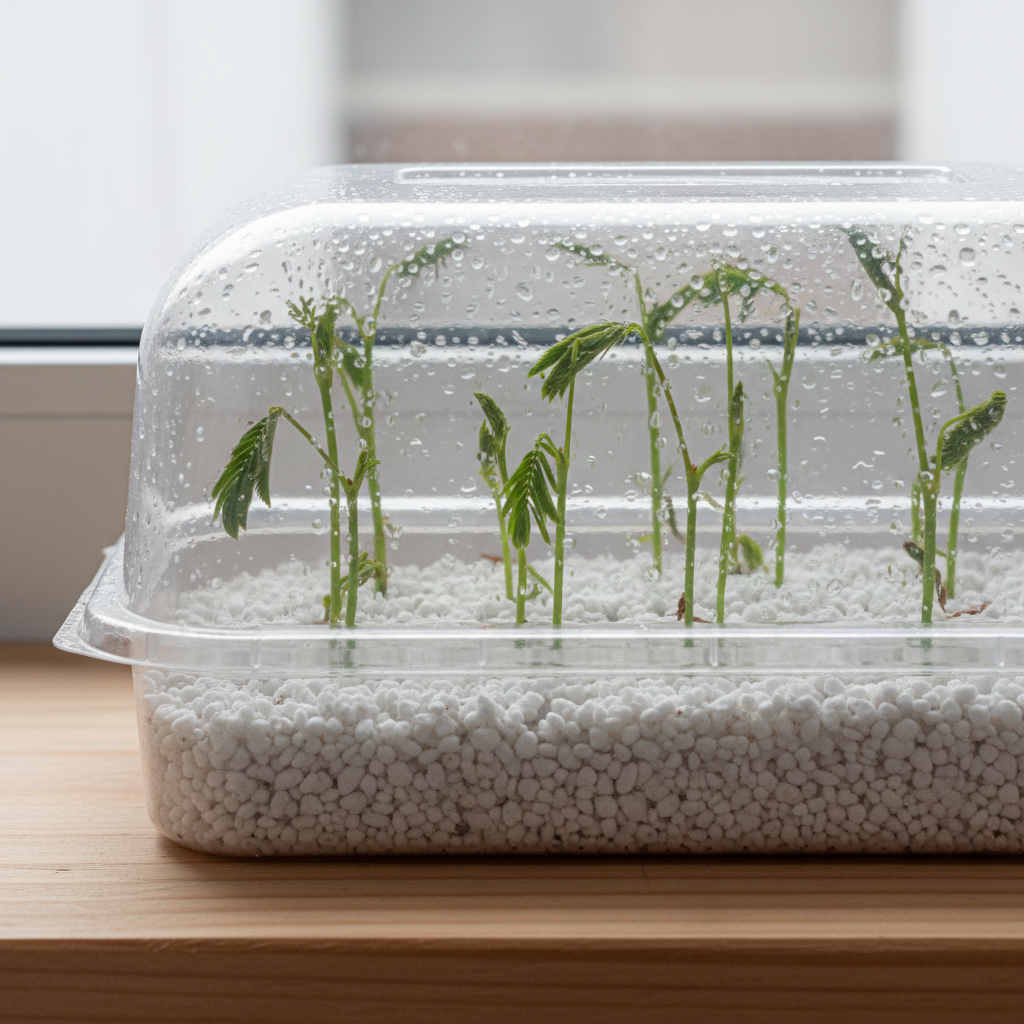
- Cover with a clear lid or bag to hold humidity, and place in bright, indirect light.
- Once seedlings emerge, remove the cover, move them into stronger light and pot on as they grow.
Pro Tip — Bottom Heat Speeds Things Up: A heated propagator or a warm windowsill above a radiator keeps the compost in that 22 to 30°C sweet spot, where germination is fastest and most even. Cool soil is the usual reason seeds are slow to appear.
Stem Cuttings: Step-by-Step
Cuttings are worth trying if you want to clone a particularly good plant, although patience helps as they root unevenly. Take them in late spring or summer from healthy, non-flowering growth.
- Cut a 7 to 10 cm (3 to 4 in) tip just below a leaf node, choosing a healthy stem.
- Remove the lower leaves and, if you have it, dip the cut end in rooting hormone.
- Insert the cutting into moist, free-draining mix or a tray of damp perlite.
- Cover with a clear dome or bag to maintain high humidity and keep it warm.
- Place in bright, indirect light and keep the medium consistently moist.
- Roots usually form within three to four weeks; tug gently to check before potting on.
Troubleshooting Propagation
| Problem | Likely Cause | Solution |
|---|---|---|
| Seeds fail to germinate | Hard coat intact or soil too cold | Scarify or soak seeds and provide bottom heat |
| Seedlings stretch and flop | Insufficient light | Move to a brighter spot or add a grow light |
| Cuttings rot before rooting | Medium too wet or not warm enough | Use a free-draining mix and keep warm and humid |
| Damping off in seedlings | Fungal infection in damp, stagnant air | Improve airflow, water from below, avoid sogginess |
Pests & Diseases
A vigorous sensitive plant grown in good light and adequate humidity shrugs off most problems, but the warm, often dry conditions it lives in indoors can attract a handful of common pests. Spider mites in particular are drawn to the dry air of heated rooms, so they top the watch list.
The key to keeping any of these in check is early detection. Look over the fine foliage and stems once a week, paying attention to the undersides of leaves and the leaf joints where pests like to hide, and act at the first sign rather than waiting for an infestation to build.
Common Pests
Spider Mites (Tetranychus urticae)
The most frequent pest of indoor sensitive plants, thriving in warm, dry air. They are tiny and hard to see, but they leave fine pale stippling on the leaves and, in bad cases, delicate webbing between the leaflets and stems. The fine foliage of this plant makes early infestations easy to miss.
Treatment: Raise the humidity, since mites hate moist air, and rinse the plant under a gentle spray of water. Treat with insecticidal soap or neem oil, repeating every five to seven days until the population is cleared, and isolate the plant from neighbours while you do.
Mealybugs (Pseudococcus species)
Small, soft insects that look like specks of white cotton wool, clustering in leaf joints and along stems where they suck sap and weaken the plant. They also excrete sticky honeydew that can lead to sooty mould.
Treatment: Dab individual mealybugs with a cotton bud dipped in diluted isopropyl alcohol, then treat the whole plant with insecticidal soap or neem oil. Check regularly, as they hide well in the dense foliage.
Aphids (Aphis species)
Soft-bodied green, black or pink insects that gather on tender new shoots and flower buds, draining sap and distorting fresh growth. They reproduce quickly and can build up fast on a plant in active growth.
Treatment: Rinse them off with a firm jet of water, then follow up with insecticidal soap or neem oil if they persist. A few repeat treatments usually clear them entirely.
Whitefly (Trialeurodes vaporariorum)
Tiny white flying insects that lift off in a small cloud when the plant is disturbed. Like aphids and mealybugs they feed on sap and leave honeydew behind, gradually weakening the plant.
Treatment: Hang yellow sticky traps to catch the adults and treat the foliage with insecticidal soap or neem oil, repeating to break the breeding cycle.
Common Diseases
Root Rot (Pythium and Phytophthora species)
The most serious threat to a sensitive plant, caused by soil kept waterlogged for too long. The roots turn brown and mushy, the stem base may blacken, and the plant wilts even though the soil is wet, a confusing symptom that catches many growers out.
Treatment: Unpot the plant, cut away all soft, dark roots with clean scissors, and repot into fresh, free-draining mix in a clean pot with good drainage. Water more sparingly afterwards and improve drainage to prevent a recurrence.
Powdery Mildew (Erysiphe species)
A white, powdery coating on the leaves that appears in stagnant, humid conditions with poor airflow. It is more of a nuisance than a killer but disfigures the foliage and slows growth if left unchecked.
Treatment: Improve air circulation, avoid wetting the leaves, remove affected foliage, and treat with a suitable fungicide or a dilute potassium bicarbonate spray if it spreads.
Pest and Disease Summary
| Pest / Disease | Identification | Treatment |
|---|---|---|
| Spider mites | Pale stippling and fine webbing | Raise humidity, rinse, neem oil or insecticidal soap |
| Mealybugs | White cottony specks in leaf joints | Alcohol on a cotton bud, then neem oil |
| Aphids | Clusters on new shoots and buds | Rinse off, then insecticidal soap |
| Whitefly | Small white flies that rise when disturbed | Yellow sticky traps and neem oil |
| Root rot | Mushy brown roots, wilting in wet soil | Trim roots, repot, water less |
| Powdery mildew | White powdery coating on leaves | Improve airflow, fungicide if needed |
Prevention Strategies
Prevention is far easier than cure. A sensitive plant grown in strong light, watered correctly and given decent humidity is naturally more resistant to both pests and disease, so good general care is your first line of defence. Inspect new plants before bringing them home and keep them apart from your collection for a week or two to make sure they are clean.
Good airflow around the plant discourages fungal problems, while careful watering that never leaves the soil waterlogged keeps root rot at bay. A weekly glance over the foliage, especially the undersides and the leaf joints, lets you catch any trouble while it is still small and easily dealt with.
Pro Tip — Neem as a Routine: A light monthly spray of diluted neem oil, applied in the evening so the leaves are not in direct sun, works as a gentle preventative against the sap-sucking pests that most often trouble this plant. Always test on a single leaf first.
Popular Varieties
Unlike many houseplants with their long lists of named cultivars, the sensitive plant is grown almost entirely as the wild species, Mimosa pudica. What variation exists is mostly botanical, in the form of recognised varieties that differ in subtle ways, such as the number of leaflet pairs or the bristliness of the stems, rather than the showy leaf colours found in, say, a calathea.
It is also worth knowing the plants it is commonly confused with. The giant sensitive plant, Mimosa diplotricha, and the larger Mimosa pigra are close relatives with the same folding habit but a far more vigorous, often weedy nature; they are best avoided as houseplants and are considered invasive in many warm regions.
| Variety | Leaf Appearance | Light Needs | Growth Rate | Availability |
|---|---|---|---|---|
| M. pudica var. pudica | The familiar type, several pairs of fine leaflets | Bright, some direct sun | Fast | Common |
| M. pudica var. unijuga | Fewer pinnae pairs, often one or two | Bright, some direct sun | Fast | Occasional |
| M. pudica var. hispida | Noticeably bristly, hairy reddish stems | Bright, some direct sun | Fast | Uncommon |
| M. pudica var. tetrandra | Subtle floral differences, similar foliage | Bright, some direct sun | Fast | Rare |
| M. diplotricha (relative) | Larger, more vigorous, sharply prickled | Full sun | Very fast | Avoid indoors |
Featured Varieties
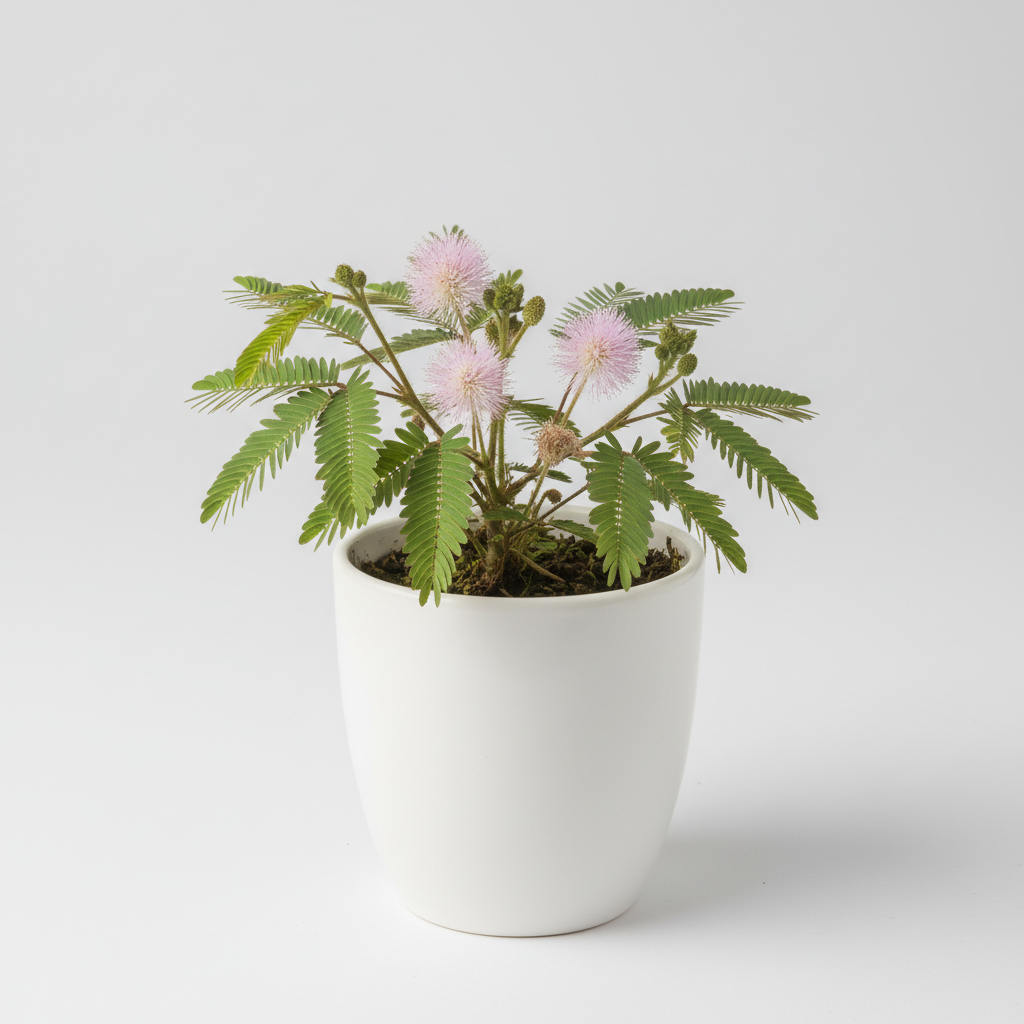
Mimosa pudica var. unijuga
A neat form distinguished by its reduced number of pinnae pairs, often just one or two, giving the foliage a slightly more open, airy look. It folds and flowers exactly like the type plant and makes an elegant, compact specimen for a bright sill.
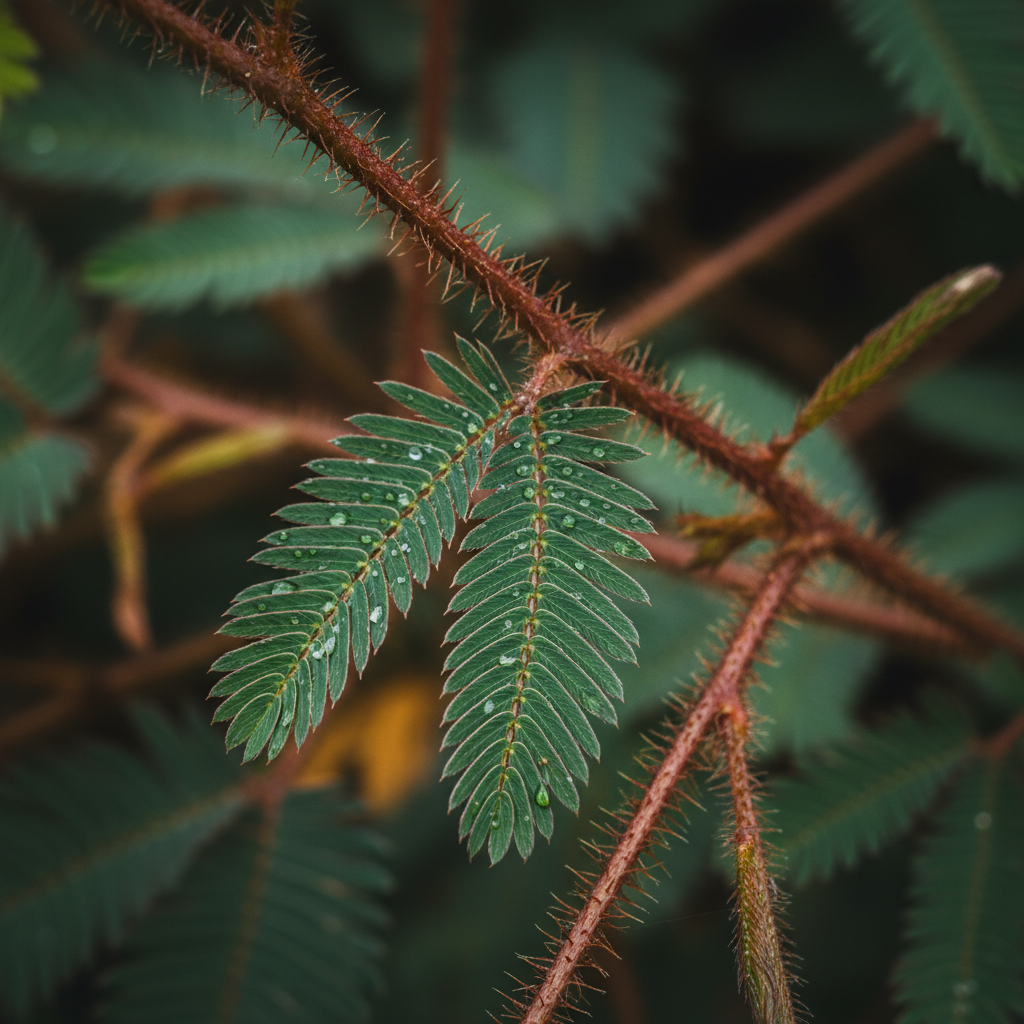
Mimosa pudica var. hispida
Marked out by its densely bristly, hairy stems that often flush a deep red, this variety has the most characterful stems of the group. The foliage is the same fine, touch-sensitive ferny green, making it a striking choice where the prickly stems can be appreciated up close.
Variety Profiles in Detail
The Type Plant (Mimosa pudica var. pudica)
This is the plant nearly everyone grows, the one sold simply as “sensitive plant” or “touch-me-not”. It carries the familiar doubly compound leaves of many small leaflets, the prickly sprawling stems, and the lilac-pink flower puffs in summer. Everything in this guide is written with this plant in mind, and it remains the most rewarding and widely available choice.
The Giant Relative (Mimosa diplotricha)
Sometimes sold by mistake as a sensitive plant, this relative is much larger and faster, scrambling vigorously and arming itself with sharp recurved prickles. It shares the folding habit but is a poor houseplant and an aggressive weed in tropical climates, so it is best left out of an indoor collection.
Choosing the Right Variety for Your Space
For almost everyone, the ordinary species is the right and only sensible choice, and it is what you will find on sale and in seed packets. The named botanical varieties are a pleasant curiosity for collectors who enjoy the small differences, but they need exactly the same care. Whichever you grow, prioritise a bright, warm spot and steady moisture over hunting down a particular form, because conditions matter far more to this plant than variety.
Frequently Asked Questions
Why does the sensitive plant fold its leaves when touched?
The movement, called thigmonasty, is driven by sudden changes in water pressure inside hinge-like cushions at the leaf joints known as pulvini. When the plant is touched, an electrical signal travels through the leaf and triggers these cells to release water, so the leaflets fold and the frond droops in under a second. It is thought to be a defence, startling insects and making the plant look smaller and less appetising to grazers. The leaves reopen as water pressure is restored over the following minutes.
Will touching it too often harm the plant?
Folding and reopening costs the plant energy, so constantly poking it for amusement is not ideal and can leave a plant looking tired if overdone. The occasional demonstration does no lasting harm, but it is kinder to let it perform for genuine curiosity rather than triggering it dozens of times a day. A well-fed plant in strong light recovers from the odd interaction with no trouble.
Why has my sensitive plant stopped responding to touch?
A sluggish or absent response usually points to a stressed plant. The most common causes are too little light, cold temperatures, or dry roots, all of which sap the water pressure the movement depends on. The leaves also naturally respond less when they are already folded for the night or recovering from a recent touch. Improve the light, keep the plant warm and the soil evenly moist, and the crisp folding usually returns.
Is the sensitive plant safe around pets and children?
It is best treated with caution. The foliage contains mimosine, which is mildly toxic if eaten in quantity and can upset a pet’s stomach, and the stems carry small prickles that can scratch. It is not among the most dangerous houseplants, but it is sensible to keep it out of reach of pets and young children who might be tempted to taste or grab it.
How long does a sensitive plant live?
Indoors it is often short-lived, behaving as an annual or short-lived perennial that may decline after a season of growth and flowering. This is normal rather than a failure of care. Because it sets seed so readily, the usual approach is to collect seed from a mature plant and sow a fresh batch each spring, keeping a continuous supply of young, vigorous plants on the go.
Why is my sensitive plant turning yellow?
Yellowing leaves most often signal a watering problem, usually overwatering and soggy soil, though it can also follow a spell of drought, low light, or a nutrient shortage. Check the soil first: if it is constantly wet, ease back and improve drainage; if it has dried out hard, rehydrate gradually. Persistent yellowing in good conditions may call for a gentle half-strength feed.
Does the sensitive plant flower indoors?
Yes, and readily so when given enough light. In a bright, warm position it produces fluffy pink to lilac spherical flowers through the summer, often within a few months of germinating from seed. Weak flowering almost always comes down to insufficient light, so a sunnier spot or a supplementary grow light is the usual remedy.
Why is my sensitive plant leggy and stretched?
Legginess, with long bare stretches between leaves, is the classic sign of too little light. The plant is reaching for a brighter source. Move it to your sunniest window or add a grow light, and you can pinch back the straggly tips to encourage bushier growth. Avoid the temptation to over-feed, which only pushes more soft, weak growth.






