
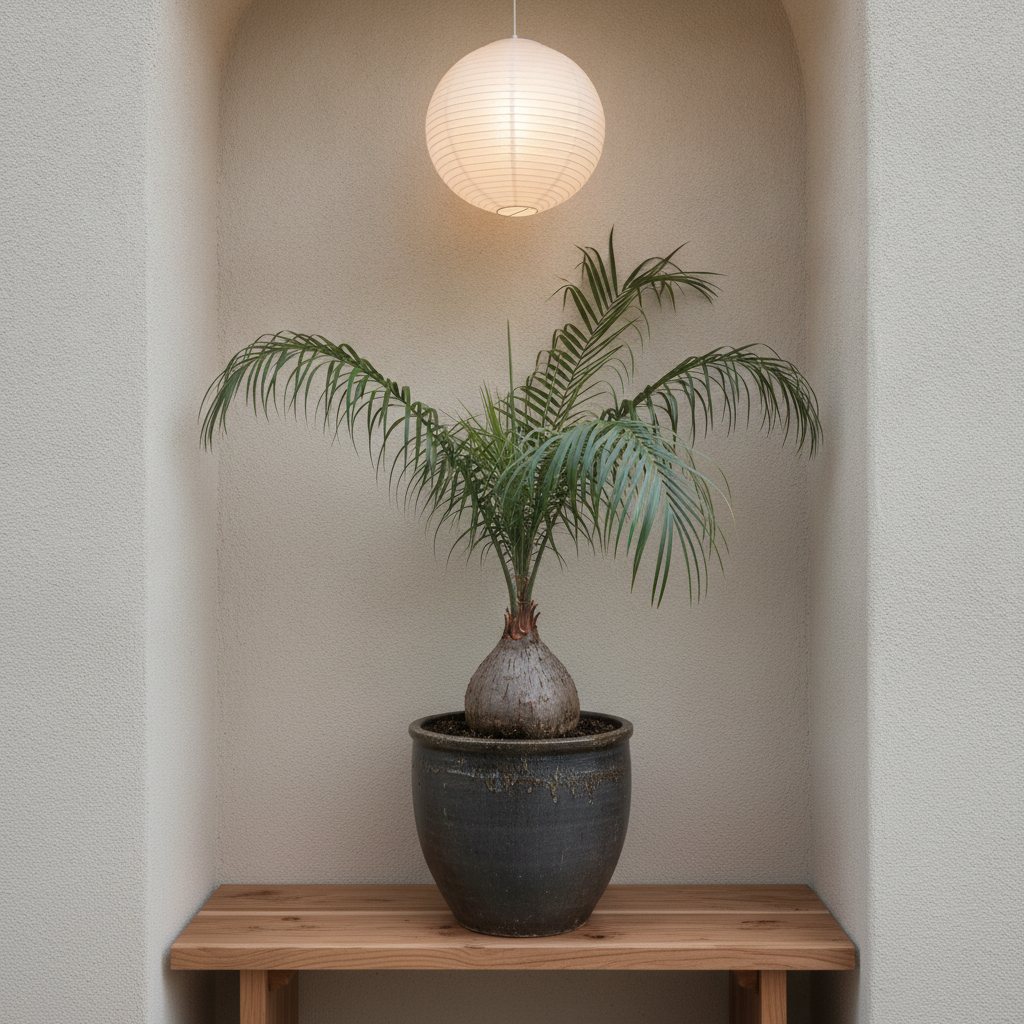
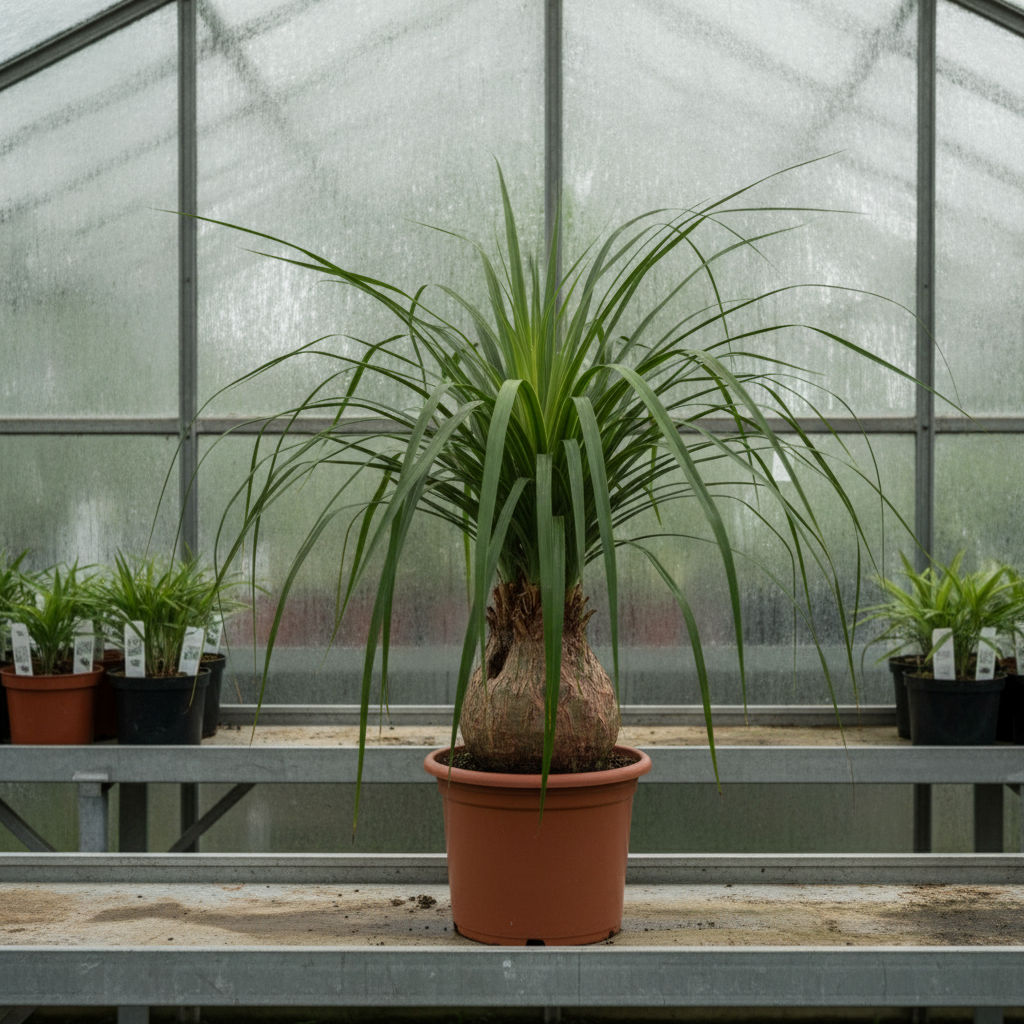
Few houseplants carry their character quite as openly as the nolina palm. Botanically Beaucarnea gracilis, and often sold under the names slim ponytail palm, dwarf ponytail or elephant’s foot, it is not a palm at all but a slow-growing, drought-adapted member of the asparagus family from the dry limestone hills of central Mexico. Everything memorable about the plant comes from its swollen basal caudex, a corky, bottle-shaped trunk that stores water and lets the plant shrug off the neglect that would kill something thirstier. From the top of that reservoir springs a loose fountain of thin, wiry, blue-green leaves that arch and curl like a head of unruly hair.
The nolina palm has earned a reputation as one of the most forgiving plants you can grow indoors, and that reputation is well deserved. It tolerates missed waterings, dry air, bright sun and long periods of being ignored. Yet there is a real difference between a nolina palm that merely survives on a windowsill for years and one that genuinely thrives, thickening its caudex and pushing out fresh flushes of foliage. This guide covers everything you need to close that gap, from reading its light and water needs to potting it in the right gritty mix, feeding it sparingly, propagating its offsets and heading off the handful of pests that ever trouble it.
Contents
- Quick Reference
- Why the Nolina Palm Makes a Rewarding Houseplant
- Light Requirements
- Watering & Humidity
- Soil, Potting & Repotting
- Fertilising
- Propagation
- Pests & Diseases
- Popular Varieties
- Frequently Asked Questions
Quick Reference: Nolina Palm at a Glance
| Light | Bright light, including several hours of direct sun; the more light the better |
| Watering | Sparingly; soak thoroughly then let the mix dry out completely, roughly every 2 to 4 weeks |
| Temperature | 18 to 27 C (64 to 81 F); tolerates brief dips to about 7 C (45 F) |
| Humidity | Low to average; thrives in dry indoor air |
| Fertiliser | Light feeder; dilute balanced feed once a month in spring and summer only |
| Toxicity | Considered non-toxic to cats and dogs; leaf margins are finely toothed and can cut skin |
Why the Nolina Palm Makes a Rewarding Houseplant
The single greatest virtue of Beaucarnea gracilis is its ability to buffer its own care. The bulbous caudex is a living water tank, and a healthy specimen can coast for weeks on the reserves it holds. For anyone who travels, forgets, or simply wants a striking plant that does not demand daily attention, this is close to ideal. Unlike thirsty tropicals that sulk the moment their soil dries, a nolina palm actively prefers to be left alone between waterings, which turns a common houseplant anxiety into a positive habit.
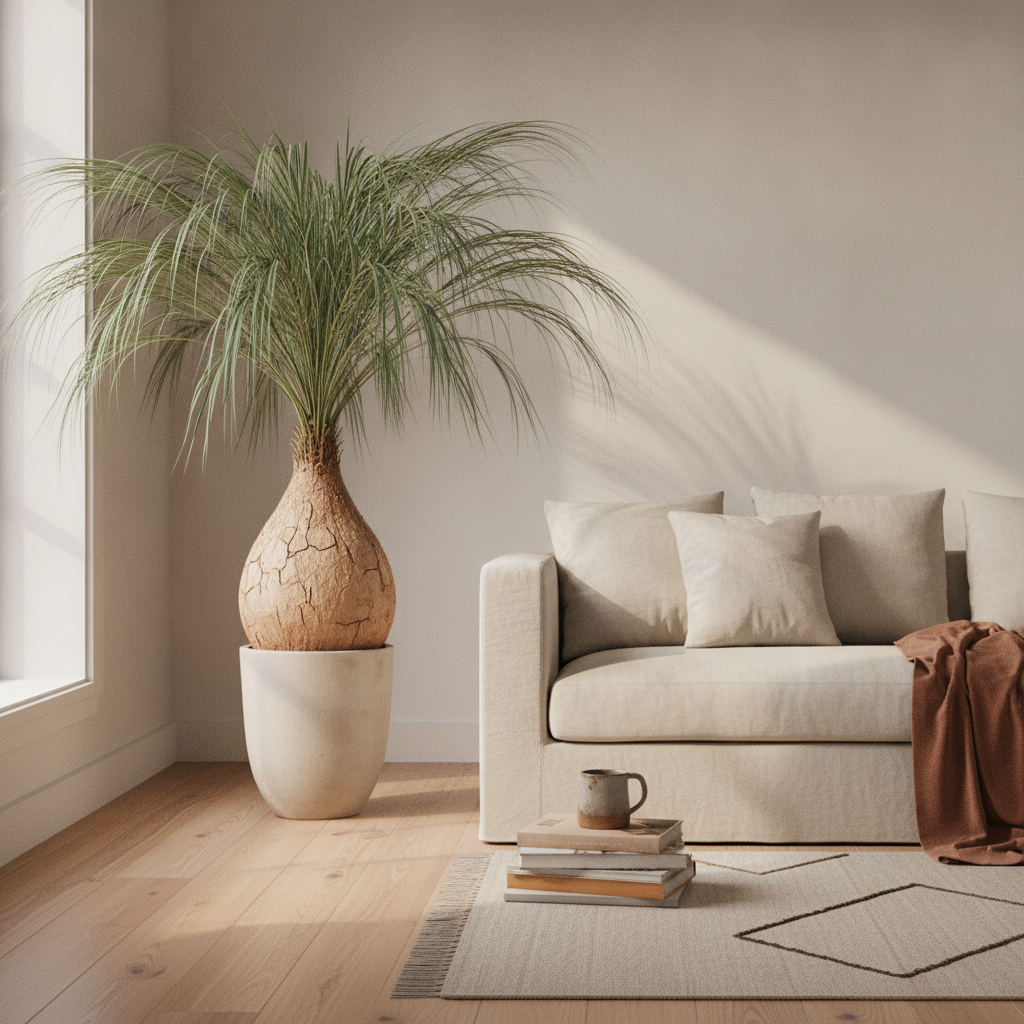
Beyond its low maintenance, the plant offers a form you simply do not find elsewhere on the windowsill. The contrast between the fat, tortoise-skinned caudex and the delicate spray of leaves gives it the presence of a miniature tree, and its glacial growth rate means a well-chosen specimen holds its shape and scale for years without outgrowing its spot. It is exceptionally long-lived, often passed down through decades, and its slow, deliberate development rewards patience rather than punishing inattention. For a beginner it is nearly foolproof, and for an experienced grower it is a satisfying candidate for shaping into a caudiciform bonsai over time.
Important — Toxicity: The nolina palm, like its close relative the ponytail palm, is generally listed as non-toxic to cats and dogs, which makes it a sensible choice for pet households. It is not entirely without hazard, however. The narrow leaves have finely serrated margins that can give a paper-cut style nick to skin, and any plant material may cause mild stomach upset if a pet chews and swallows a large quantity, so it is still wise to discourage nibbling.
Light Requirements
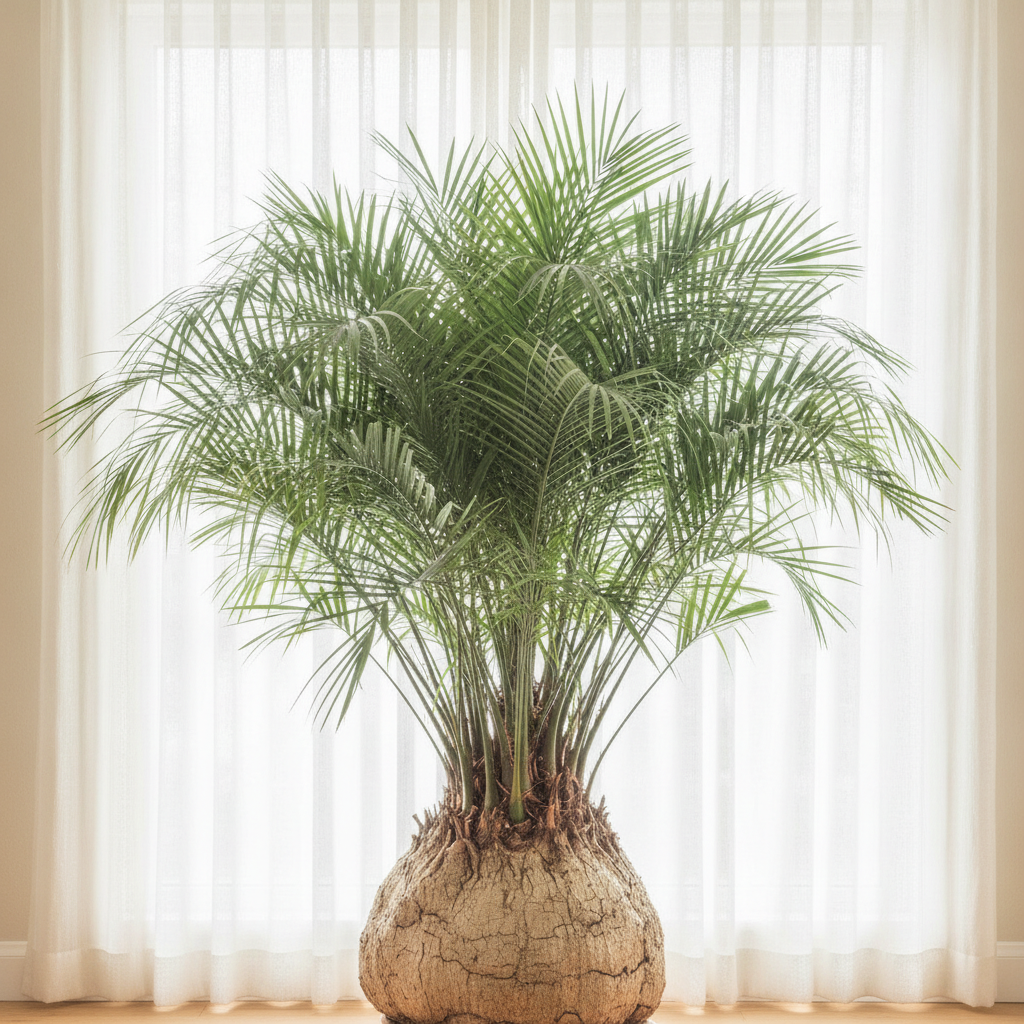
Light is the one area where the nolina palm is genuinely demanding, and it is worth getting right. This is a plant of open, sun-baked Mexican hillsides, and it wants as much light as your home can offer. Given a bright position it grows steadily, keeps its leaves firm and well coloured, and slowly fattens its base. Starved of light it does not die quickly, but it stretches, pales, and produces thin, floppy foliage while its caudex stops thickening.
The ideal spot is directly in front of, or immediately beside, your brightest window, where the plant receives several hours of direct sun each day alongside bright ambient light for the rest. A nolina palm is one of the few houseplants you can place on a hot, south-facing sill without worry once it has acclimatised. Aim to give it the sunniest position you have available and you will rarely go wrong.
Light Levels Explained
Understanding how indoor light is categorised makes it much easier to place the plant correctly. The table below sets out the common tiers and how a nolina palm responds to each, measured roughly in lux to give a sense of intensity.
| Light Category | Approx. Level | Typical Location | Outcome |
|---|---|---|---|
| Direct sun | 20,000 lux and above | On a south or west sill | Excellent; firm leaves, thickening caudex |
| Bright indirect | 10,000 to 20,000 lux | Just beside a sunny window | Very good; steady, healthy growth |
| Medium | 5,000 to 10,000 lux | A few metres from a bright window | Tolerated; slow growth, some stretching |
| Low | 1,000 to 5,000 lux | Interior wall, north room | Survives but declines; pale, weak leaves |
| Very low | Below 1,000 lux | Hallway, far corner | Poor; leggy, etiolated, eventual decline |
Window Orientation and Placement
South-facing window: This is the best position in most homes. The nolina palm relishes the intensity and duration of light a south window provides, and its sun tolerance means scorch is rarely an issue once acclimatised. Place it right on or beside the sill.
West-facing window: An excellent second choice. Strong afternoon sun suits the plant well, delivering the high light levels it needs to stay compact and firm.
East-facing window: Workable, especially if the plant sits right at the glass. Morning sun is gentler, so growth may be a touch slower, but a healthy specimen will do fine here.
North-facing window: The weakest option and best avoided for the long term. A nolina palm will hang on at a north window but will gradually stretch and weaken. If a north aspect is all you have, plan to supplement with a grow light.
Pro Tip — Rotate for Symmetry: Because the leaves all radiate from a single crown, a nolina palm leans noticeably toward its light source over time. Give the pot a quarter turn every week or two so the fountain of foliage stays even and the caudex grows upright rather than tilting.
How Light Affects Leaf Colour and Form
Light does more than fuel growth; it shapes the plant’s whole appearance. In strong light the leaves take on a firmer texture and a cooler, more silvery blue-green tone, and they hold themselves in a tidy arching spray. As light drops, the plant reaches for it: internodes on the crown lengthen, new leaves emerge longer, thinner and floppier, and the overall colour shifts to a duller, flatter green. Perhaps most importantly for the plant’s signature look, poor light stalls the thickening of the caudex, so a specimen kept in the shade for years may still have a spindly base while a sun-grown plant of the same age has a satisfyingly swollen one.
Warning — Direct Sunlight: Although established nolina palms are sun-lovers, a plant that has been grown in low light, or one freshly bought from a dim shop, can still scorch if moved abruptly into fierce direct sun. Introduce it to stronger light gradually over a couple of weeks to let it build up its defences and avoid bleached or crisped leaf tips.
Artificial Lighting
If your home is short on natural light, a nolina palm responds well to supplementary lighting. A full-spectrum LED grow light positioned 30 to 45 cm (12 to 18 in) above the crown, run for 10 to 12 hours a day, will keep the plant firm and compact through the darkest months. Because the plant is so slow-growing, even a modest fixture makes a visible difference over a season, and it is an easy way to rescue a specimen that has begun to stretch in a poorly lit room.
Seasonal Adjustments
Light in temperate homes falls away sharply in winter, and even a sun-loving plant benefits from being nudged closer to the glass as the days shorten. Move the plant to your brightest sill from autumn through early spring, and clean the window and the leaves so nothing filters what little light there is. As spring returns and intensity climbs, you can ease the plant back to its usual spot, reintroducing full summer sun gradually if it has spent months in weaker winter light.
Watering & Humidity
Watering is where most nolina palms are lost, and almost always through kindness rather than neglect. The caudex exists precisely so the plant can store water and ride out drought, which means the roots expect long dry spells between drinks. Treat it like a succulent, not a leafy tropical, and you will avoid the single most common cause of death, which is root rot from a mix that never gets the chance to dry.
When to Water
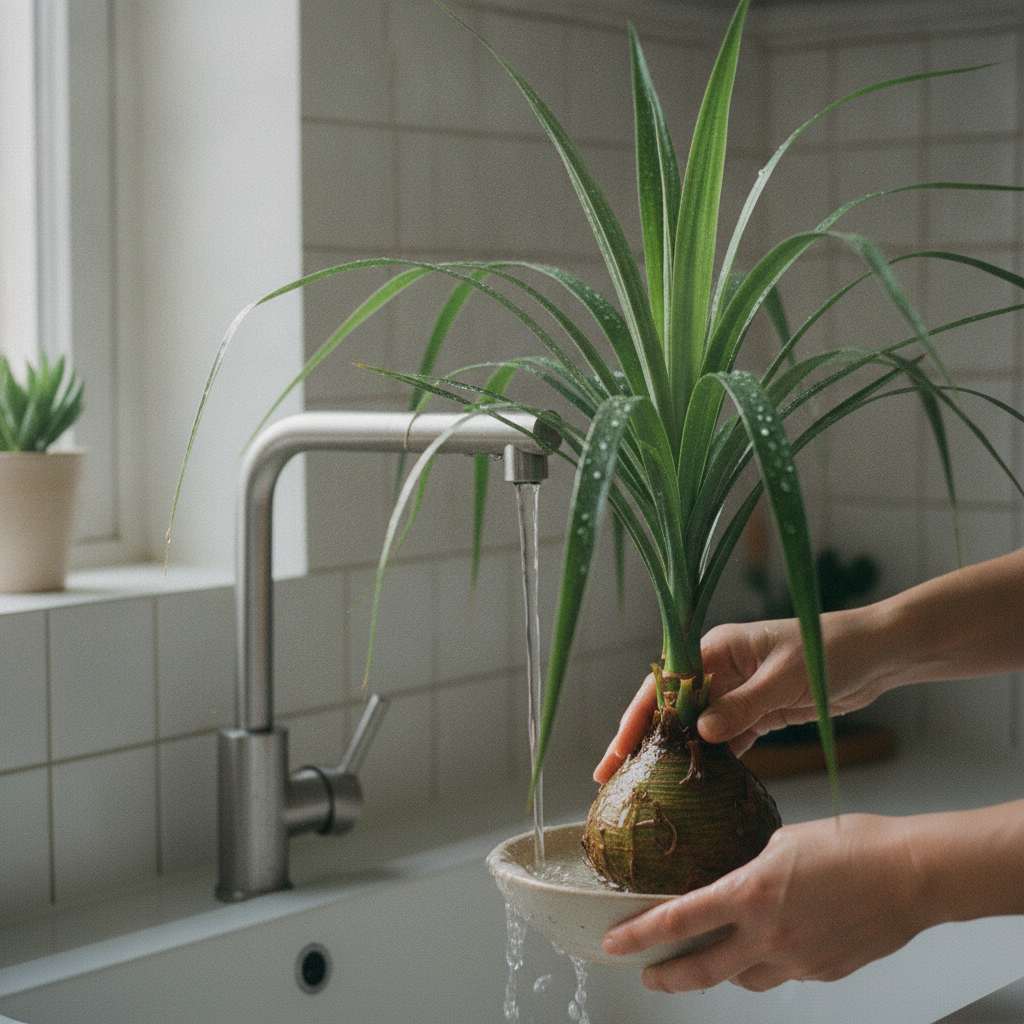
The rule is simple: water only when the potting mix has dried out completely, all the way to the bottom of the pot. In a bright, warm spot during spring and summer this might mean watering every two to three weeks; in the cool, dim months of winter it can stretch to once a month or even less. Rather than following a calendar, check the mix. Push a finger or a wooden skewer deep into the pot, or lift it to judge the weight; a pot that still feels heavy or comes out damp does not need watering.
A firm, plump caudex tells you the plant is well hydrated and has reserves to spare. If the base ever starts to feel soft or looks shrivelled and wrinkled, that is the plant drawing down its store, and a good soak is due. This built-in gauge is one of the nicest things about growing a nolina palm, because it removes almost all of the guesswork that trips people up with fussier plants.
Pro Tip — When in Doubt, Wait: A nolina palm recovers from a missed watering far more easily than from a soggy one. If you are ever unsure whether it is time, leave it another few days. Underwatering is a minor, correctable setback; overwatering rots the caudex from the inside and is often fatal.
How to Water Correctly
- Confirm the mix is dry all the way down before you begin.
- Water thoroughly at the soil surface, avoiding pooling water in the crown of the caudex where it can cause rot.
- Keep going until water runs freely from the drainage holes, which wets the entire root ball and flushes out built-up salts.
- Let the pot drain completely for several minutes.
- Empty the saucer or cache pot; never let the plant stand in collected water.
- Return the plant to its spot and do not water again until the mix is once more completely dry.
Signs of Overwatering vs. Underwatering
| Symptom | Overwatering | Underwatering |
|---|---|---|
| Leaf colour | Yellowing, often at the base, whole leaves turning limp | Tips and edges browning, crisping and drying |
| Leaf texture | Soft, translucent, mushy | Dry, papery, brittle |
| Caudex | Soft, spongy, sometimes weeping or smelly | Wrinkled, shrunken, firm but shrivelled |
| Soil | Stays wet for weeks, may smell sour | Bone dry, pulling away from the pot sides |
| Roots | Blackened, slimy, breaking apart | Dry and intact but sparse |
Warning — Root Rot: A soft, discoloured or foul-smelling caudex is a sign that rot has taken hold, and it spreads fast. Act immediately by unpotting the plant, cutting away all mushy tissue with a sterilised blade, dusting the wounds with sulphur or cinnamon, letting them callus for a day or two, and repotting into fresh, dry, gritty mix. Then withhold water until new growth shows the plant has recovered.
Humidity Requirements
Here the nolina palm is refreshingly undemanding. Coming from an arid climate, it is perfectly happy in the dry air of a centrally heated or air-conditioned home, and it needs no misting, pebble trays or humidifiers. Average household humidity of 30 to 50 per cent suits it well, and it will tolerate considerably lower without complaint.
Because it thrives in dry air, humidity-related problems are rare. The occasional browning of leaf tips is far more likely to stem from underwatering, a build-up of fertiliser salts, or fluoride and chlorine in tap water than from low humidity, so resist the urge to start misting a plant that is quietly telling you something else.
If anything, the greater risk lies at the humid end of the scale. In a consistently damp, poorly ventilated room the plant is more prone to rot and fungal issues, so good airflow matters more than raising humidity ever will.
Water Quality
Nolina palms are moderately sensitive to the fluoride and chlorine found in some tap water, which can accumulate and show up as browned leaf tips over time. If your tap water is heavily treated or very hard, letting it stand overnight before use allows some chlorine to dissipate, and periodically flushing the pot with a generous watering helps carry away accumulated minerals. Rainwater or filtered water is a gentle option if brown tips persist, though most growers find ordinary tap water perfectly adequate for such a tough plant.
Soil, Potting & Repotting
If watering is the habit that keeps a nolina palm alive, the potting mix is the foundation that makes correct watering possible. The plant demands sharp drainage above all else. A mix that holds too much moisture keeps the roots and caudex wet for too long and undoes even the most careful watering routine, so the goal is a gritty, open medium that water rushes through and that dries quickly.
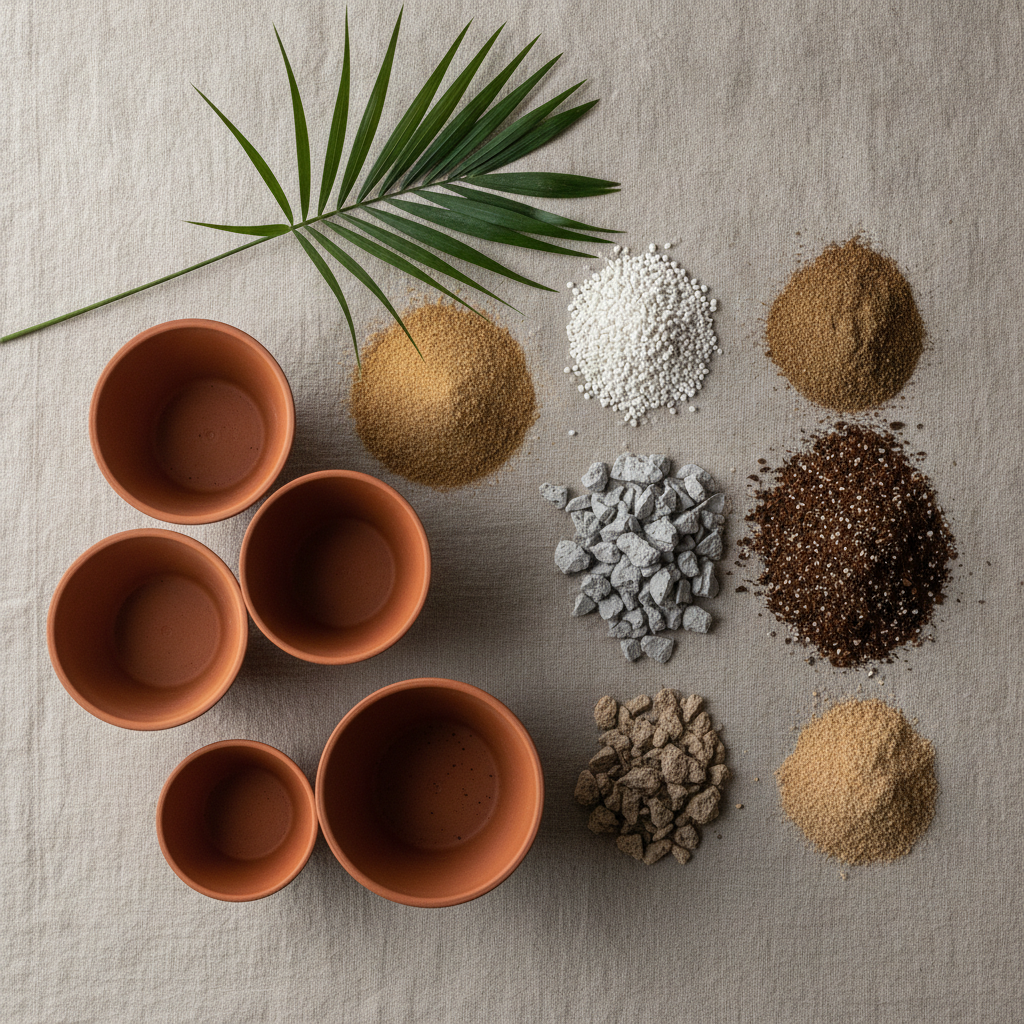
Ideal Soil Composition
The simplest route is a commercial cactus and succulent compost, which is formulated to drain freely. Better still is to open it up further with extra grit, because most bagged mixes still hold more water than a caudiciform ideally wants. A blend built around inorganic, free-draining material with just enough organic matter to hold a little moisture and nutrition is exactly what this plant evolved for.
| Component | Proportion | Function |
|---|---|---|
| Cactus or standard potting compost | Around one third | Holds a little moisture and provides nutrients |
| Coarse horticultural sand or grit | Around one third | Adds weight and sharp, rapid drainage |
| Perlite or pumice | Around one third | Creates air pockets and prevents compaction |
The plant is not fussy about pH and does well in the slightly acidic to neutral range of roughly 6.0 to 7.0 that most potting composts naturally provide. There is no need to test or adjust pH under normal conditions; getting the drainage right matters far more than fine-tuning acidity.
Pro Tip — Quick Mix Recipe: For a reliable blend, combine two parts cactus compost, one part coarse grit or sand, and one part perlite or pumice. If in doubt, err on the grittier side; you can always water a little more often, but you cannot make an overly water-retentive mix drain faster once the plant is potted in it.
Choosing the Right Pot
The right container works with your mix to keep the caudex dry and healthy, so it is worth a moment’s thought rather than grabbing the nearest decorative pot.
Drainage holes are non-negotiable. Whatever else you choose, the pot must have holes in the base. Without them, water collects at the bottom, the mix stays saturated, and the caudex rots. If you love a cache pot with no drainage, plant into a plastic nursery pot that does drain and drop that inside the decorative one, lifting it out to water.
Pot material: Terracotta is the natural partner for a nolina palm. Its porous walls wick moisture out of the mix and let it breathe, which helps the medium dry evenly and quickly. A heavy terracotta or glazed pot also adds ballast, useful because a leafy crown on a slender base can otherwise become top-heavy.
Pot size: Choose a snug pot rather than a generous one. A pot only slightly wider than the caudex is ideal, because a large volume of mix around a small root system stays wet far too long. Nolina palms are naturally slow and actually flower and grow better when somewhat pot-bound, so resist the urge to over-pot.
When to Repot
Because it grows so slowly and prefers tight quarters, a nolina palm needs repotting only rarely, typically every three to four years or when the caudex has swollen to fill the pot and roots are pushing out of the drainage holes. Spring, at the start of the growing season, is the best time. Move up just one pot size, and do not be tempted to give a plant that has finally settled a much larger home; a jump in pot size usually leads to a jump in problems.
How to Repot: Step-by-Step
- Let the mix dry out first, which makes the plant easier to slide free and gentler on the roots.
- Ease the plant out by tipping the pot and supporting the caudex, rather than pulling on the leaves.
- Gently tease away old mix from the roots and inspect them, trimming any that are black, soft or clearly dead.
- Add a layer of fresh gritty mix to the base of the new pot, sizing it so the caudex will sit at the same depth as before.
- Position the plant and backfill around the roots, keeping the top of the caudex above the surface and never buried.
- Firm the mix lightly to remove large air pockets without compacting it.
- Wait about a week before watering to let any disturbed or trimmed roots callus and heal.
Warning — Transplant Shock: Keep the base of the caudex proud of the soil line when repotting. Burying it, even by a centimetre or two, traps moisture against the trunk and is a frequent cause of rot in newly repotted plants. When in doubt, plant a fraction high rather than low.
Fertilising
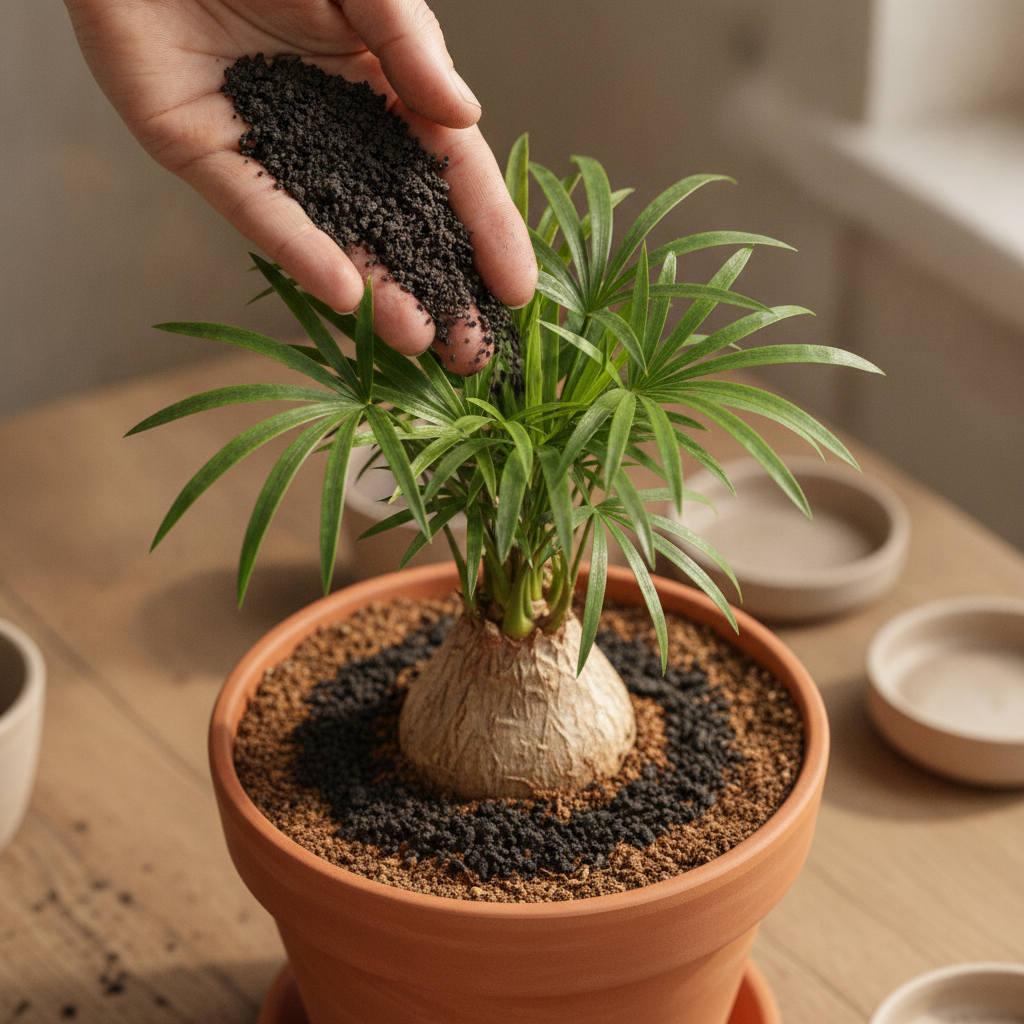
In keeping with its low-maintenance nature, the nolina palm is a very light feeder. In the wild it grows in poor, rocky soils and expects little in the way of nutrients, so a modest, occasional feed during the growing season is all it wants. There is far more danger in overfeeding this plant than in underfeeding it.
Fertiliser is best thought of as a gentle top-up rather than a driver of growth. Light and water do the real work; feeding simply replaces the small amount of nutrients that leaching gradually washes out of the pot. Applied sparingly and only when the plant is actively growing, it keeps the foliage a healthy colour without pushing the weak, sappy growth that excess feeding causes.
Understanding Plant Nutrients
Fertilisers are labelled with an N-P-K ratio giving the percentages of nitrogen, phosphorus and potassium, the three nutrients plants use in the largest quantities. A balanced feed such as 10-10-10, or a slightly nitrogen-leaning one, suits the nolina palm well. The table below outlines what each key nutrient does and how a deficiency tends to show.
| Nutrient | Symbol | Primary Function | Deficiency Symptoms |
|---|---|---|---|
| Nitrogen | N | Leaf and stem growth, green colour | Pale, yellowing older leaves; stalled growth |
| Phosphorus | P | Root development and energy transfer | Weak roots, dull foliage, poor establishment |
| Potassium | K | Overall vigour and water regulation | Browning leaf edges, weak tissue |
| Magnesium | Mg | Core of the chlorophyll molecule | Yellowing between the veins of leaves |
| Iron | Fe | Chlorophyll formation in new growth | Pale or yellow new leaves with green veins |
Types of Fertiliser
Liquid fertilisers: The easiest option for a nolina palm. A general-purpose houseplant feed or a cactus fertiliser, diluted to half the recommended strength, gives you precise control over how much and how often the plant is fed, and it is simple to skip in the dormant season.
Slow-release granular: A convenient set-and-forget choice. A few granules of a balanced controlled-release feed scattered on the surface in spring will meter out nutrients gently over several months, which suits a plant that wants only a trickle of feeding.
Organic fertilisers: Options such as worm castings top-dressed onto the mix, or a dilute seaweed or fish emulsion feed, release nutrients slowly and are very hard to overdo. They also improve the soil biology, though they act more gradually than synthetic feeds.
Feeding Schedule
Feed only during the active growing season of spring and summer, roughly once a month, and always at half strength or less. Stop feeding entirely in autumn and winter, when the plant is resting and cannot use the nutrients; feeding a dormant nolina palm simply builds up salts in the mix. Three or four light feeds across the whole year is plenty for an established specimen.
Pro Tip — Less Is More: When it comes to feeding a nolina palm, the safest mistake is to do too little. A plant that is fed lightly will simply grow at its own slow, healthy pace, whereas an overfed one produces soft, stretched leaves and risks root burn from accumulated salts. Half the strength, half as often as you think.
How to Fertilise
- Water the plant lightly first if the mix is completely dry, so the feed does not scorch dry roots.
- Dilute a balanced liquid feed to half the recommended strength, or measure out a small dose of granular feed.
- Apply the diluted feed evenly to the soil surface, keeping it off the caudex and leaves.
- Water normally next time to help distribute the nutrients through the root zone.
- Flush the pot with plain water every few months to clear any salt build-up.
Warning — Salt Build-Up: A white crust on the soil surface or around the pot rim, along with browning leaf tips, signals a build-up of mineral salts from fertiliser or hard water. Correct it by flushing the pot thoroughly with plain water, letting it run out of the drainage holes several times to wash the salts away, and easing back on the feeding.
Propagation
Propagating a nolina palm calls for patience, because the two reliable methods, offsets and seed, both work on the plant’s own unhurried timescale. Unlike many houseplants, it cannot be grown from a leaf or a stem cutting; there is no node along the leaves to root from, and a severed leaf will simply wither. Understanding that limitation saves a lot of wasted effort.
The good news is that the methods that do work are straightforward, if slow. Mature plants often throw offsets, or pups, around the base of the caudex, and these can be separated to make new plants that are true to the parent. Seed is the other route, most relevant if you have access to fresh seed, and it produces large numbers of plants at the cost of a long wait.
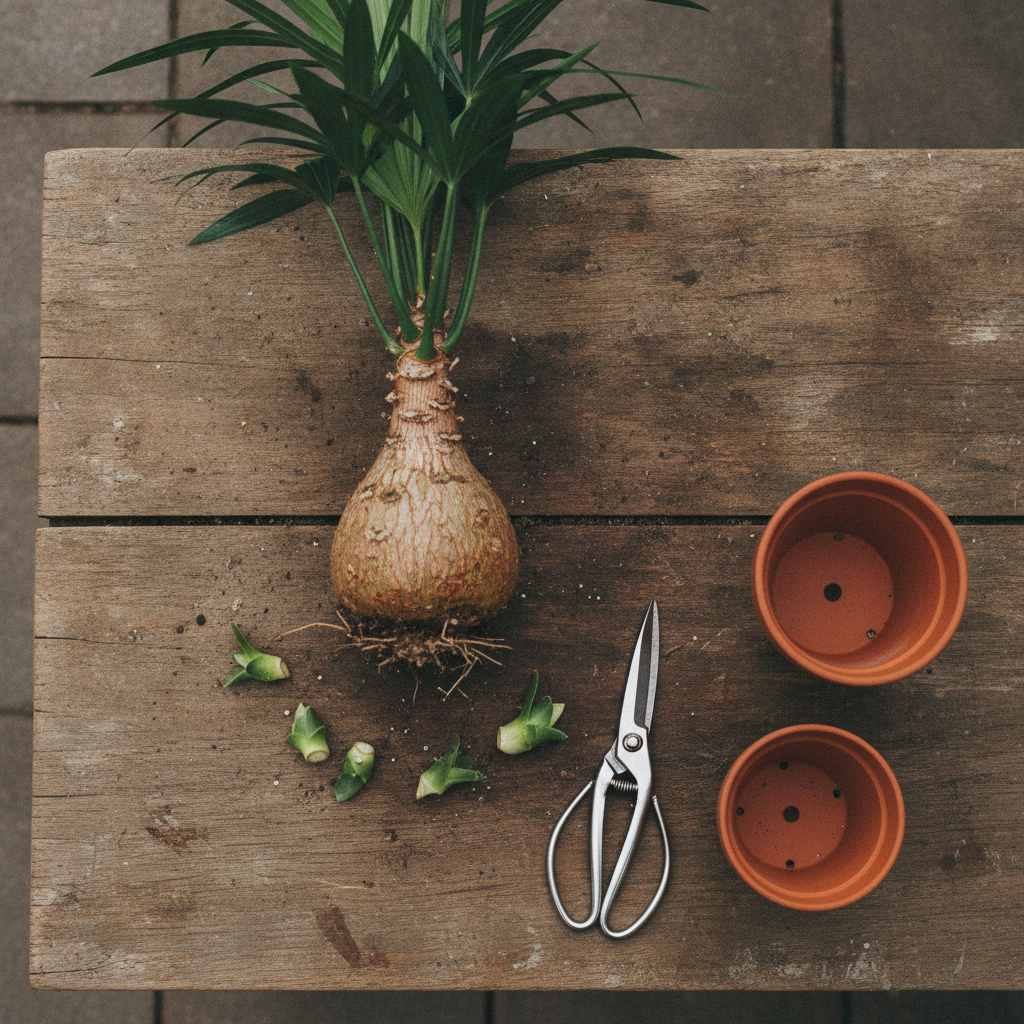
Understanding Offsets and the Caudex
The caudex is not just a water store; it is also where the plant’s reserves of energy sit, and it is from the base of a well-fed, mature caudex that offsets emerge. These pups are small clones of the parent, complete with their own developing roots, and once they have grown a few of their own leaves and some root of their own they can be detached and grown on. Because they arrive with a head start, offsets are far quicker and more certain than starting from seed.
Offset Division: Step-by-Step
The best time to divide offsets is in spring, when the plant is entering active growth and will recover most quickly. Choose pups that are a reasonable size, ideally with a few roots already forming.
- Let the mix dry, then unpot the parent plant so you can see the base of the caudex and the offsets clearly.
- Identify a well-developed offset and locate where it joins the parent.
- With a clean, sharp, sterilised knife, cut the offset away, taking as many of its own roots as you can.
- Let the cut surfaces on both the pup and the parent dry and callus for a day or two in a shaded, airy spot.
- Pot the offset into a small pot of the same gritty mix, just deep enough to hold it steady.
- Keep it warm and bright but out of harsh direct sun, and wait about a week before the first light watering.
- Water sparingly thereafter until new growth confirms the offset has rooted and established.
Pro Tip — Let Wounds Callus: The single most important step in offset division is allowing the cut surfaces to dry and form a callus before potting. Planting a fresh, moist wound straight into damp mix is an open invitation to rot; a day or two of drying dramatically improves your success rate.
Growing from Seed: Step-by-Step
Seed is a rewarding if lengthy project, and the surest way to raise many plants at once. Fresh seed germinates far more reliably than old, so use the freshest you can obtain.
- Soak the seeds in warm water for around 24 hours to soften the coat and hasten germination.
- Sow them onto the surface of a moist, gritty, free-draining seed mix and cover very lightly.
- Place the tray somewhere warm, ideally around 21 to 27 C (70 to 81 F), in bright indirect light.
- Keep the mix lightly moist but never wet, misting the surface rather than soaking it.
- Be patient; germination can take several weeks to a few months and is often uneven.
- Once seedlings have a few leaves and are handling firmly, pot them on individually into gritty mix and begin treating them as small adults.
Troubleshooting Propagation
| Problem | Likely Cause | Solution |
|---|---|---|
| Offset rots after potting | Wound not callused, or mix kept too wet | Allow longer drying, use grittier mix, water less |
| Offset fails to root | Too few roots taken, or too cold | Take larger pups with roots, keep warm and bright |
| Seeds do not germinate | Old seed or insufficient warmth | Use fresh seed and provide steady bottom heat |
| Seedlings damp off | Overwatering and poor airflow | Reduce moisture, improve ventilation, use a sterile mix |
Pests & Diseases
A healthy nolina palm is remarkably trouble-free, and the tough, dry conditions it prefers happen to be conditions most houseplant pests dislike. Problems, when they occur, are usually a symptom of stress or, more often, of overwatering, so the best pest control is simply good culture.
That said, no plant is entirely immune, and a few sap-sucking insects will occasionally find their way to a nolina palm, particularly on a stressed plant or one recently brought home from a crowded shop. Catching them early, while an infestation is small, makes them easy to deal with.
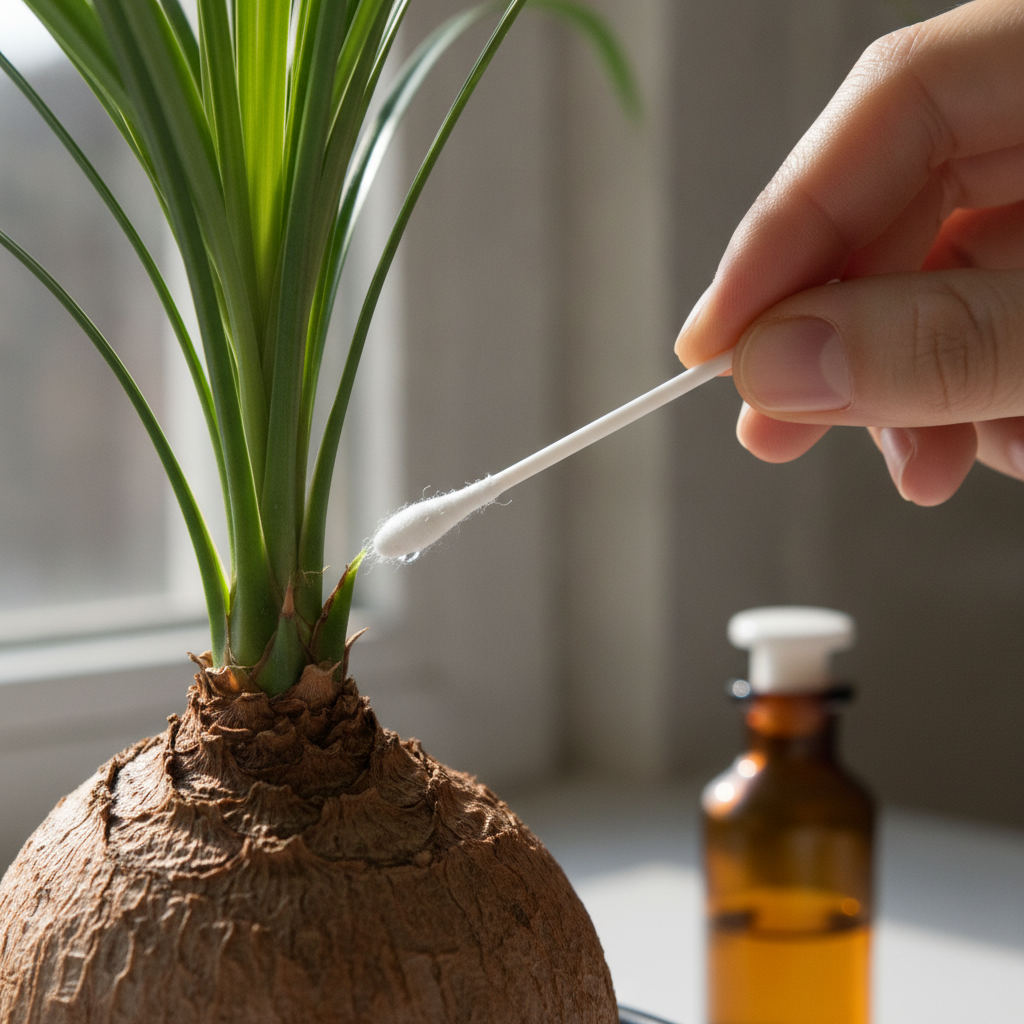
Common Pests
Spider Mites (Tetranychus urticae)
The most likely pest on a nolina palm, spider mites love the same warm, dry air the plant enjoys. They are tiny and hard to see, but their fine webbing between leaves and a dull, stippled, dusty look to the foliage give them away. On a plant with such narrow leaves they can build up quickly if unnoticed.
Treatment: Rinse the foliage under a shower to knock back the population, then treat with insecticidal soap or a diluted neem oil spray, repeating every week or so until the webbing and stippling stop appearing. Improving airflow and occasionally wiping the leaves discourages their return.
Mealybugs (Pseudococcus spp.)
Mealybugs appear as small, white, cottony tufts tucked into the crown of the caudex and at the base of the leaves. They suck sap, weaken the plant and leave behind sticky honeydew that can turn into sooty mould.
Treatment: Dab each insect directly with a cotton bud dipped in isopropyl alcohol, which kills them on contact. For larger outbreaks, follow up with insecticidal soap or neem oil, and inspect the crown regularly since mealybugs like to hide in tight crevices.
Scale (Coccidae)
Scale insects show up as small, hard, brown bumps clinging to the leaves and the caudex. They are easy to mistake for part of the plant, but they too feed on sap and excrete honeydew.
Treatment: Scrape or rub the scales off gently with a fingernail or an alcohol-soaked cotton bud, then treat with neem oil or a systemic insecticide for persistent infestations. Check regularly, as their protective shells make them stubborn.
Fungus Gnats (Bradysia spp.)
Small black flies drifting around the pot are fungus gnats, whose larvae live in and feed on consistently damp soil. They are more a symptom than a serious threat, and their presence on a nolina palm almost always means the mix is being kept too wet.
Treatment: Let the mix dry out fully, which alone breaks their breeding cycle, and use yellow sticky traps to catch the adults. A grittier top layer of mix and a stricter watering routine will keep them from coming back.
Common Diseases
Root and Caudex Rot (Pythium and Phytophthora spp.)
By far the most serious problem a nolina palm faces, rot sets in when the roots or the base of the caudex stay wet for too long. It shows as a softening, darkening and often foul-smelling caudex, yellowing leaves and, once advanced, collapse of the plant.
Treatment: Act fast. Unpot the plant, cut away every trace of soft, discoloured tissue with a sterilised blade, dust the wounds with sulphur or cinnamon, let them callus, and repot into fresh dry gritty mix. Then water only very sparingly until recovery is clear. Prevention through careful watering and sharp drainage is far more reliable than any cure.
Leaf Tip Browning (physiological)
Not strictly a disease, but the most common cosmetic complaint. Brown, crispy leaf tips result from underwatering, a build-up of salts, or fluoride and chlorine in tap water, rather than from any pathogen.
Treatment: Review your watering to ensure thorough soaks, flush the pot to clear salts, and consider filtered or rainwater if tap water is heavily treated. Brown tips can be trimmed off with clean scissors for appearance, cutting just inside the dead tissue.
Pest and Disease Summary
| Pest / Disease | Identification | Treatment |
|---|---|---|
| Spider mites | Fine webbing, dull stippled leaves | Rinse, insecticidal soap or neem, improve airflow |
| Mealybugs | White cottony tufts in the crown | Alcohol on a cotton bud, then neem or soap |
| Scale | Hard brown bumps on leaves and caudex | Scrape off, treat with neem or systemic |
| Fungus gnats | Small flies around damp soil | Dry out the mix, use sticky traps |
| Root and caudex rot | Soft, dark, smelly base; yellow leaves | Cut out rot, callus, repot dry, water sparingly |
| Leaf tip browning | Crispy brown tips | Adjust watering, flush salts, filter water |
Prevention Strategies
Prevention with a nolina palm comes down to a handful of habits. Water only when the mix is fully dry, pot in a sharp, gritty medium in a container with drainage, and give the plant plenty of light and good airflow. A plant grown this way is vigorous, and vigorous plants shrug off pests and diseases that would take hold on a stressed one.
Inspect the plant whenever you water, paying particular attention to the crown and the base of the leaves where pests like to hide, and quarantine any new arrival for a couple of weeks before it joins the rest of your collection. Wiping down the leaves occasionally not only keeps them looking their best but also gives you a chance to spot trouble while it is still small and easily handled.
Pro Tip — Dry Is Your Ally: Nearly every pest and disease that troubles a nolina palm is encouraged by excess moisture. Keeping the plant on the dry side does more to protect it than any spray, turning its natural drought tolerance into a first line of defence.
Popular Varieties
The nolina palm belongs to the small genus Beaucarnea, a group of caudiciform plants from Mexico and Central America that share the swollen base and grassy foliage collectors prize. Beaucarnea gracilis itself has few named cultivars, so most of the variation you will encounter comes from its close relatives, which are grown and sold in much the same way and make excellent companions for the true nolina palm.
Knowing the wider genus helps when shopping, because plants are often labelled loosely and the names ponytail palm, elephant’s foot and nolina palm are used almost interchangeably. The table and profiles below set out the species most often met in cultivation and how they differ.
| Variety | Leaf Appearance | Light Needs | Growth Rate | Availability |
|---|---|---|---|---|
| Beaucarnea gracilis | Fine, wiry, blue-green, arching | Bright, direct sun | Very slow | Uncommon |
| Beaucarnea recurvata (Ponytail Palm) | Longer, softer, cascading | Bright, direct sun | Slow | Very common |
| Beaucarnea stricta | Stiff, upright, bluish-grey | Bright, direct sun | Very slow | Uncommon |
| Beaucarnea guatemalensis | Green, arching, often reddish new growth | Bright, direct sun | Slow | Rare |
| Beaucarnea recurvata ‘Nana’ | Compact, dwarf form of the ponytail | Bright, direct sun | Very slow | Occasional |
Featured Varieties
Ponytail Palm (Beaucarnea recurvata)
The famous cousin and by far the most widely grown Beaucarnea. It has a broader, more dramatically swollen bottle base and longer, softer leaves that cascade like a ponytail, giving it a lusher look than the finer, more upright gracilis.
Beaucarnea stricta
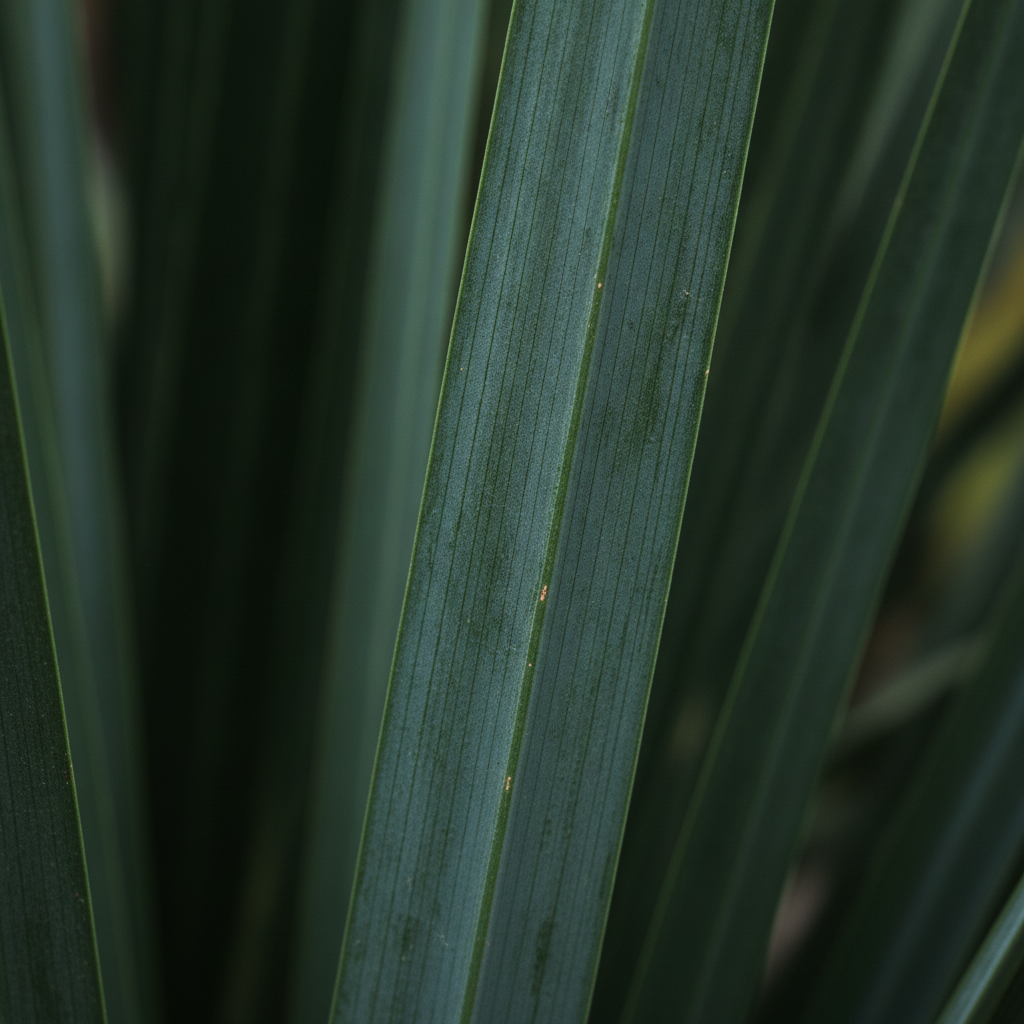
A striking relative with stiffer, more upright, bluish-grey leaves and a rougher, more angular caudex. It reads as more architectural and severe than the soft ponytail palm, and it appeals to collectors who want a sculptural, spiky silhouette.
Variety Profiles in Detail
Ponytail Palm (Beaucarnea recurvata)
If you have seen a Beaucarnea before, it was almost certainly this one. Native to eastern Mexico, the ponytail palm is grown worldwide as a tough, characterful houseplant. Its care is essentially identical to that of the nolina palm, so everything in this guide applies. The main visual differences are its fatter, smoother base and its longer, more relaxed foliage, which make it a good choice where you want a softer, more overtly cascading form.
Beaucarnea stricta
Sometimes confused with gracilis, Beaucarnea stricta is distinguished by its rigid, upright, glaucous leaves that hold themselves stiffly rather than arching softly. It tends toward a taller, branching habit in maturity and carries the same rugged, corky base. For growers who find the ponytail palm too soft in outline, stricta offers a bolder, spikier alternative on identical care.
Beaucarnea guatemalensis
Less common in cultivation, this Central American species is prized for the reddish tint of its emerging foliage, which adds a warm note absent from the blue-toned relatives. It shares the swollen base and grassy leaves of the genus and is grown identically, appealing chiefly to collectors seeking something a little different.
Choosing the Right Variety for Your Space
For most homes and most growers, the widely available ponytail palm is the easiest place to start, with the true nolina palm and the more upright Beaucarnea stricta making rewarding choices for anyone drawn to their finer or spikier forms. Since every member of the genus wants the same thing, plenty of light, sharp drainage and sparing water, you can choose purely on looks and know the care will not change. Whichever you pick, you are getting one of the toughest, longest-lived and most sculptural plants it is possible to grow indoors.
Frequently Asked Questions
Is the nolina palm actually a palm?
No. Despite the common name, Beaucarnea gracilis is not a palm at all. It belongs to the asparagus family, Asparagaceae, and is more closely related to plants like dracaenas and yuccas. The palm-like spray of leaves is what earned it the misleading name.
How often should I water my nolina palm?
Only when the potting mix has dried out completely, which typically means every two to three weeks in spring and summer and as little as once a month in winter. Always check the mix rather than watering on a fixed schedule, and when in doubt, wait a few more days.
Why are the tips of the leaves turning brown?
Brown, crispy tips usually point to underwatering, a build-up of fertiliser salts, or minerals in tap water, rather than low humidity. Make sure you soak the plant thoroughly when you do water, flush the pot occasionally to clear salts, and try filtered or rainwater if your tap water is heavily treated.
Why is the base of my plant going soft?
A soft, spongy caudex is a serious warning sign of rot, almost always caused by overwatering or poor drainage. Unpot the plant, cut away all the soft tissue, let the wounds callus, and repot into fresh dry gritty mix, then water very sparingly. Prevention through careful watering is far more reliable than trying to save a badly rotted plant.
Why is my nolina palm growing so slowly?
Slow growth is completely normal for this plant, which is one of the most unhurried houseplants you can own. Even in ideal conditions it adds only a little each year. You can encourage what growth it is capable of by giving it as much light as possible, but you cannot rush it, and its slowness is part of what makes it so easy to live with.
Is the nolina palm safe for cats and dogs?
Yes, it is generally regarded as non-toxic to cats and dogs, much like its relative the ponytail palm, which makes it a good choice for pet households. Bear in mind that the leaf margins are finely toothed and can nick skin, and that eating any plant may cause mild stomach upset, so it is still best to discourage chewing.
Can I grow a nolina palm from a cutting?
No. Unlike many houseplants, it cannot be propagated from leaf or stem cuttings, because the leaves have no node to root from. The two reliable methods are separating the offsets that form around the base of a mature caudex, and growing from fresh seed, both of which take patience.
Why are the leaves stretching and going floppy?
Long, thin, floppy leaves and a plant that leans are classic signs of too little light. A nolina palm wants the brightest position you can give it, including direct sun. Move it to your sunniest window, or add a grow light, and new growth will emerge firmer and more compact.
How big will my nolina palm get indoors?
Indoors it stays modest for many years thanks to its glacial growth rate, usually reaching around a metre (roughly 3 ft) over a long span of time, though old specimens can eventually become larger. Keeping it slightly pot-bound and feeding lightly naturally limits its size, so it rarely outgrows its welcome.






