
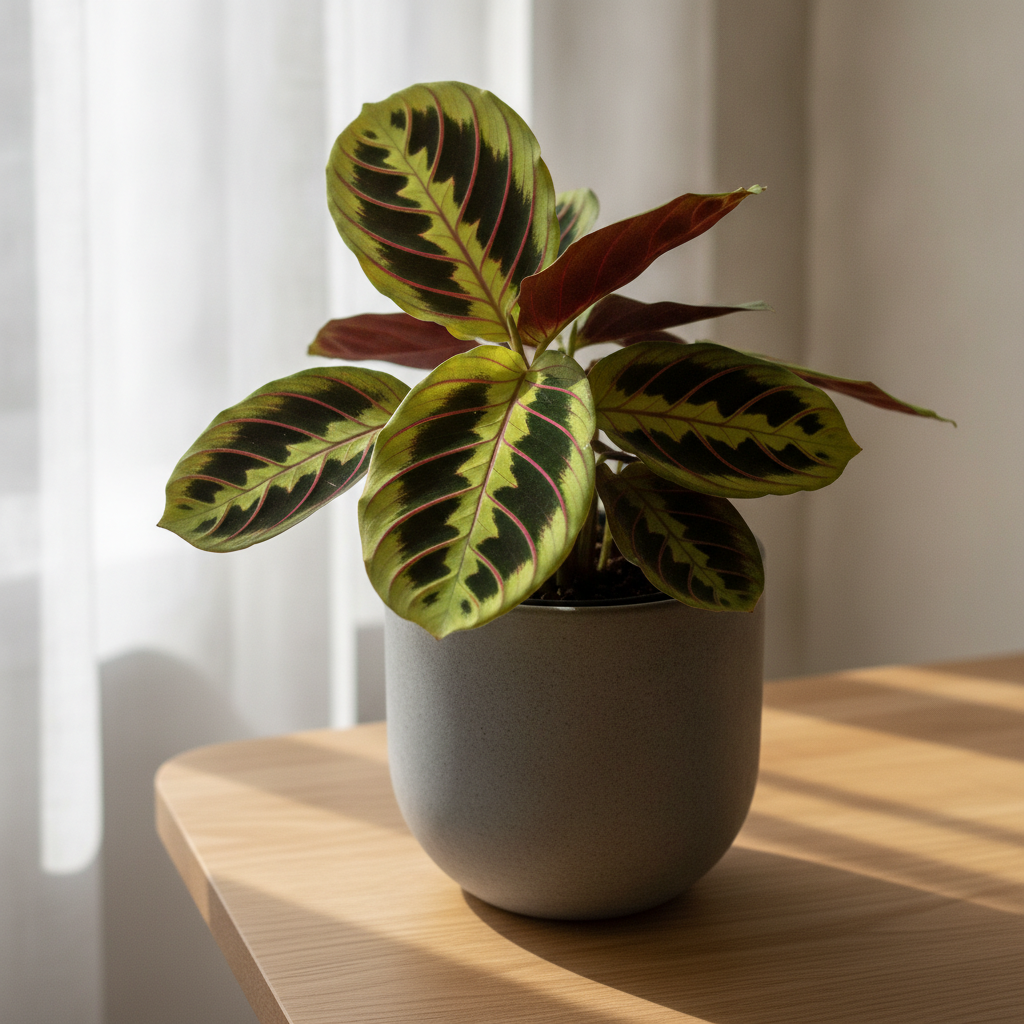
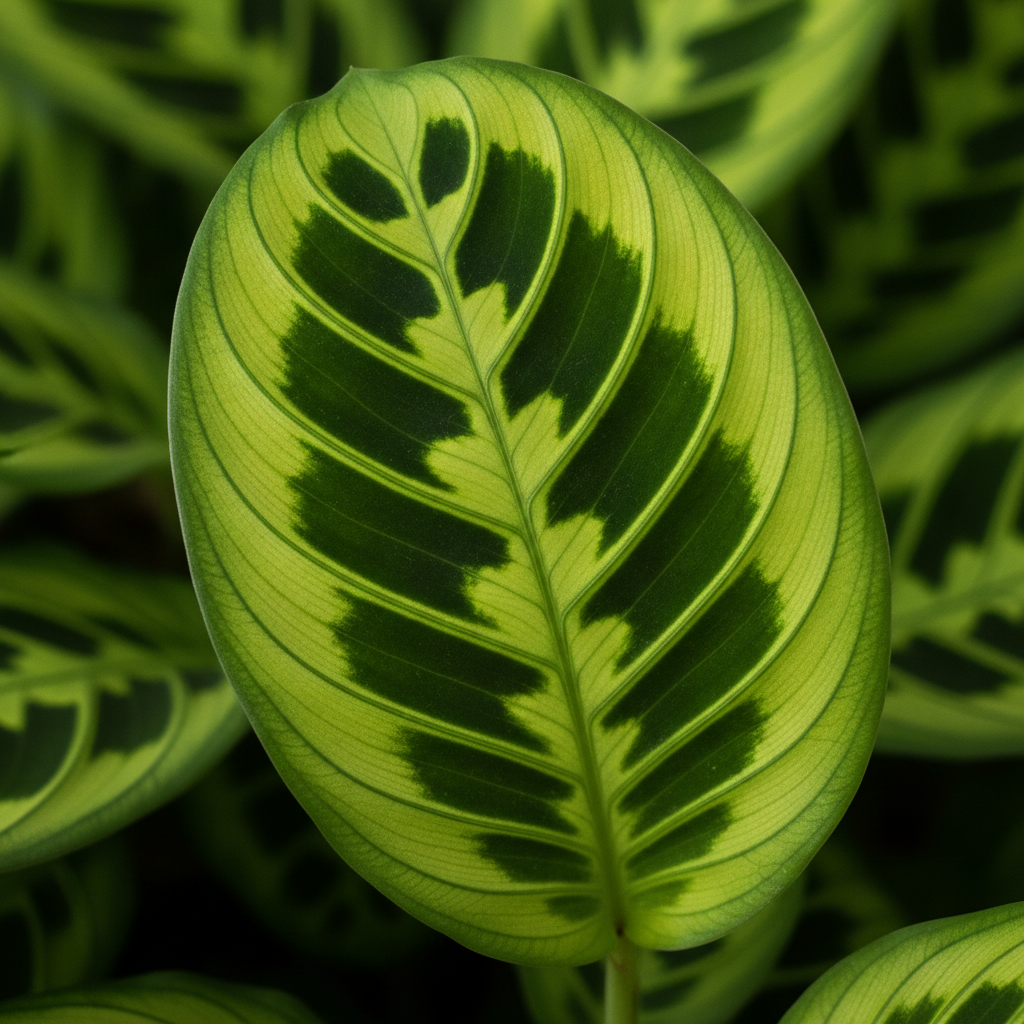
Few houseplants perform their care routine as visibly as the red prayer plant. Each evening the flat, painted leaves lift and fold together like a pair of hands closing in prayer, and each morning they open again to reveal a bright yellow-green herringbone running down the midrib and a web of crimson veins fanning out to the leaf edge. That nightly rhythm, called nyctinasty, is the reason Maranta leuconeura earned its common name, and it is also the quickest way to read the plant’s mood. A red prayer plant that stops praying is usually a red prayer plant that is unhappy about something.
This guide covers the variety known in the trade as the red prayer plant or herringbone plant, botanically Maranta leuconeura var. erythroneura. It is a low, spreading tropical from the rainforest floors of Brazil, and almost everything about its care follows from that origin. It is not a difficult plant so much as a particular one: it survives a wide range of conditions but only thrives when its narrow preferences for humidity, gentle light and consistently moist, soft water are met. The sections below separate mere survival from genuine flourishing so you know which corners can be cut and which cannot.
- Quick Reference
- Why the Red Prayer Plant Makes a Rewarding Houseplant
- Light
- Watering
- Soil
- Fertilising
- Propagation
- Pests and Problems
- Varieties
- Frequently Asked Questions
Quick Reference
The table below is a snapshot of the conditions this plant needs. Treat it as a starting point rather than a rulebook, because a red prayer plant in a dry centrally heated flat will behave very differently from one in a humid bathroom, and the detail in each section that follows explains how to adjust.
| Botanical name | Maranta leuconeura var. erythroneura |
| Common names | Red prayer plant, herringbone plant, red-veined prayer plant |
| Family | Marantaceae |
| Light | Medium, indirect light; no direct midday sun |
| Water | Keep evenly moist; never soggy, never bone dry |
| Humidity | High, ideally above 60 per cent |
| Temperature | 18 to 27 degrees Celsius (65 to 80 degrees Fahrenheit) |
| Soil | Light, peat-free, moisture-retentive but well-draining mix |
| Feeding | Balanced feed at half strength, monthly in the growing season |
| Growth habit | Low and spreading, to around 30 centimetres (12 inches) tall |
| Toxicity | Non-toxic to cats, dogs and humans |
| Difficulty | Intermediate |
Why the Red Prayer Plant Makes a Rewarding Houseplant
The most immediate reason to grow this plant is the foliage. The oval leaves sit low and flat during the day, showing off a base of deep olive to near-black feathering, a jagged band of light lime along the central vein, and the vivid red veins that give the erythroneura variety its name. The undersides are a rich maroon, so even a leaf caught curling reveals another colour. No two leaves are marked identically, and a mature plant layered over the rim of its pot looks less like a single specimen and more like a small patch of rainforest floor.
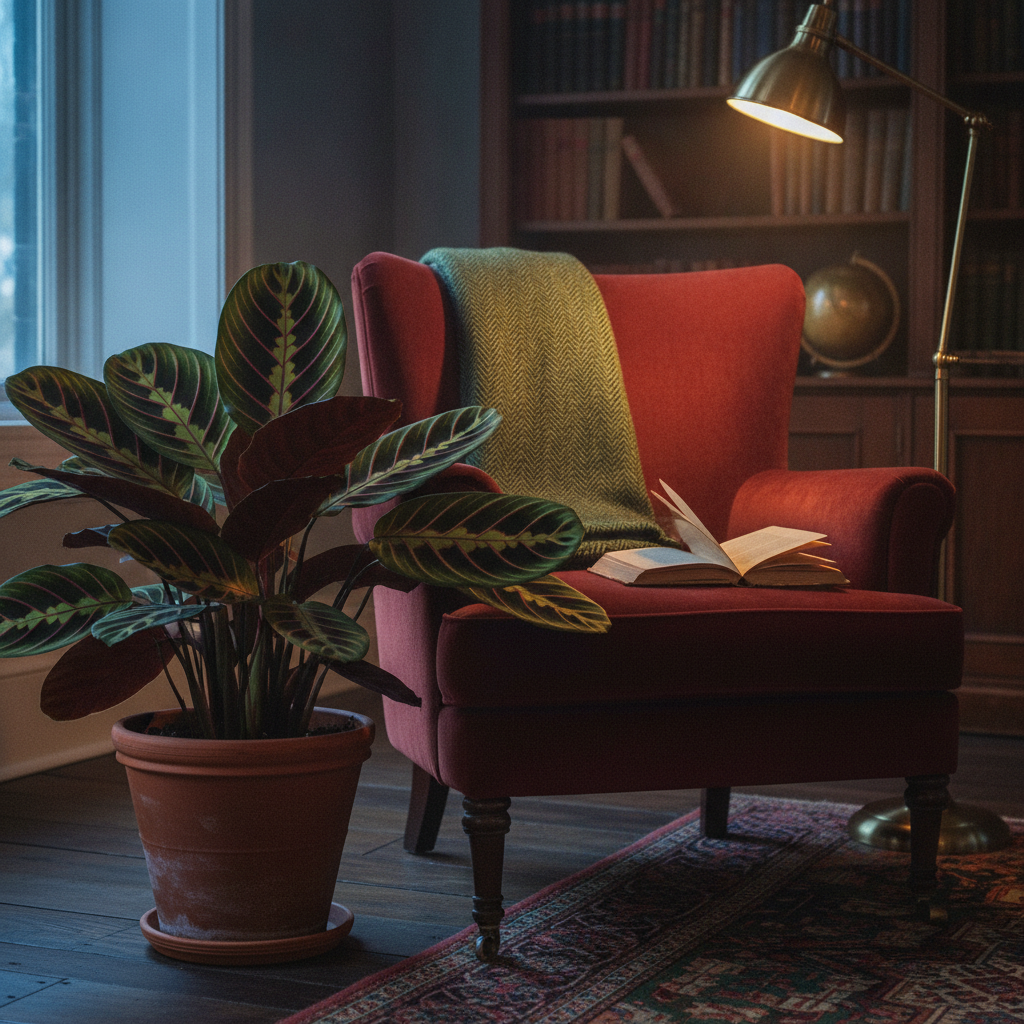
Beyond looks, the plant offers something most houseplants do not: movement. The daily raising and lowering of the leaves is driven by a swelling of cells at the base of each leaf stalk, called the pulvinus, which responds to the shift from light to dark. On a quiet evening you can sometimes hear the papery rustle as the leaves rise. It turns a static shelf into something that changes through the day, and it gives you a live readout of the plant’s wellbeing, since stressed plants often hold their leaves half-raised or flatten them entirely.
It is also a genuinely safe plant to keep. The Marantaceae family is non-toxic to cats, dogs and people, so it can sit within reach of a curious pet or child without the worry that comes with a dieffenbachia or a pothos. Combined with its modest final size, rarely more than 30 centimetres (12 inches) tall and perhaps twice that across, the red prayer plant fits into homes where a large statement plant would not. The honest trade-off is humidity: this is not a plant you can neglect in a dry room and expect to thrive. Give it moisture and steadiness and it rewards you generously; let it dry and crisp and it will tell you, loudly, through browning edges.
Light
On the forest floor where this plant evolved, light arrives already filtered and softened by the canopy above. Recreating that indoors is the single most important thing you can do for leaf colour and pattern. The red prayer plant wants bright but indirect light: enough to read a book by comfortably, but never a shaft of direct sun falling on the leaves. Direct midday sun scorches the delicate foliage within hours, bleaching the reds to a washed pink and leaving crisp brown patches that never recover.
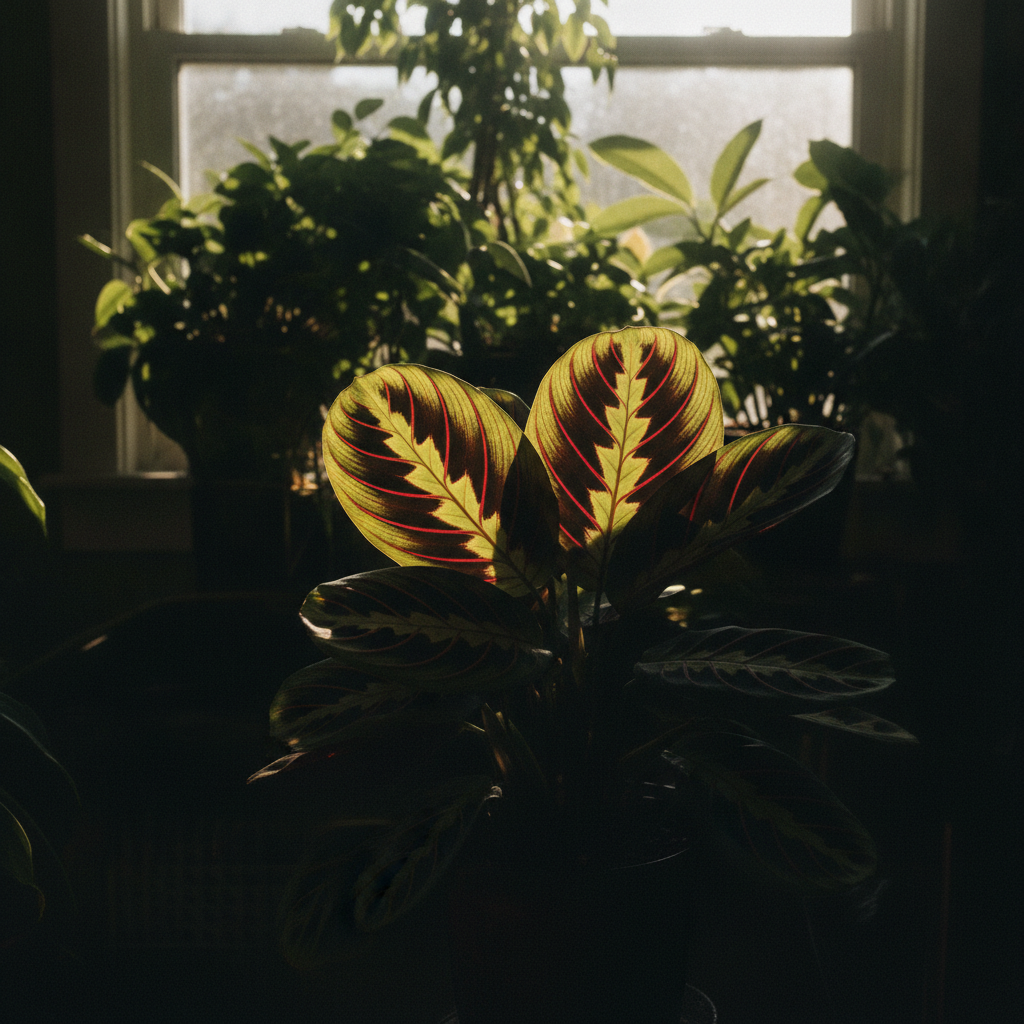
An east-facing window, which delivers gentle morning light and shade for the rest of the day, is close to ideal. A north-facing window suits the plant too, particularly in summer. West and south windows can work provided the plant is set back a metre or two from the glass, or shielded by a sheer curtain or a taller plant in front of it. If you find yourself squinting at the window, so does the prayer plant.
The plant will survive in fairly low light, and this is the corner most easily cut, but survival and thriving diverge here. In dim conditions the growth slows dramatically, the leaves space themselves further apart on longer stalks as they reach for light, and the contrast in the markings fades. You may also notice the nightly folding becomes sluggish or incomplete, because the movement is triggered by the day-to-night light shift the plant can no longer clearly detect. If natural light is limited, a simple full-spectrum LED grow light on a timer for ten to twelve hours a day keeps colour and compactness far better than a dark corner ever will.
Pro Tip — Rotate for even growth: Because the plant leans gently toward its light source, give the pot a quarter turn each week. Over a month this keeps the rosette balanced and stops one side stretching bare while the other crowds.
Watering
Watering is where most red prayer plants are won or lost. The plant likes its soil to stay evenly moist, like a wrung-out sponge, at all times through the growing season. It does not tolerate the soil drying out completely, which is the fastest route to crisp brown edges, but it tolerates waterlogged roots even less, so the target is a steady middle ground rather than a swing between soaked and parched.
In practice, check the top of the soil every few days and water when the very surface begins to feel dry but the layer just beneath is still damp. When you water, do so thoroughly, letting it run from the drainage holes, then empty the saucer so the pot never stands in water. In the brighter, warmer months this may mean watering once or twice a week; in winter, when growth slows and light is weaker, the plant uses far less and the interval stretches, so let the surface dry a little more between drinks to avoid rot.
Water quality matters more for this plant than for most. Marantas are sensitive to the fluoride, chlorine and dissolved salts common in tap water, which accumulate in the leaf tissue and show up as browning tips and margins. If your tap water is hard or heavily treated, switch to rainwater, distilled water or filtered water, or at the very least leave tap water to stand uncovered overnight so some of the chlorine dissipates. Lukewarm water is kinder than cold straight from the tap.
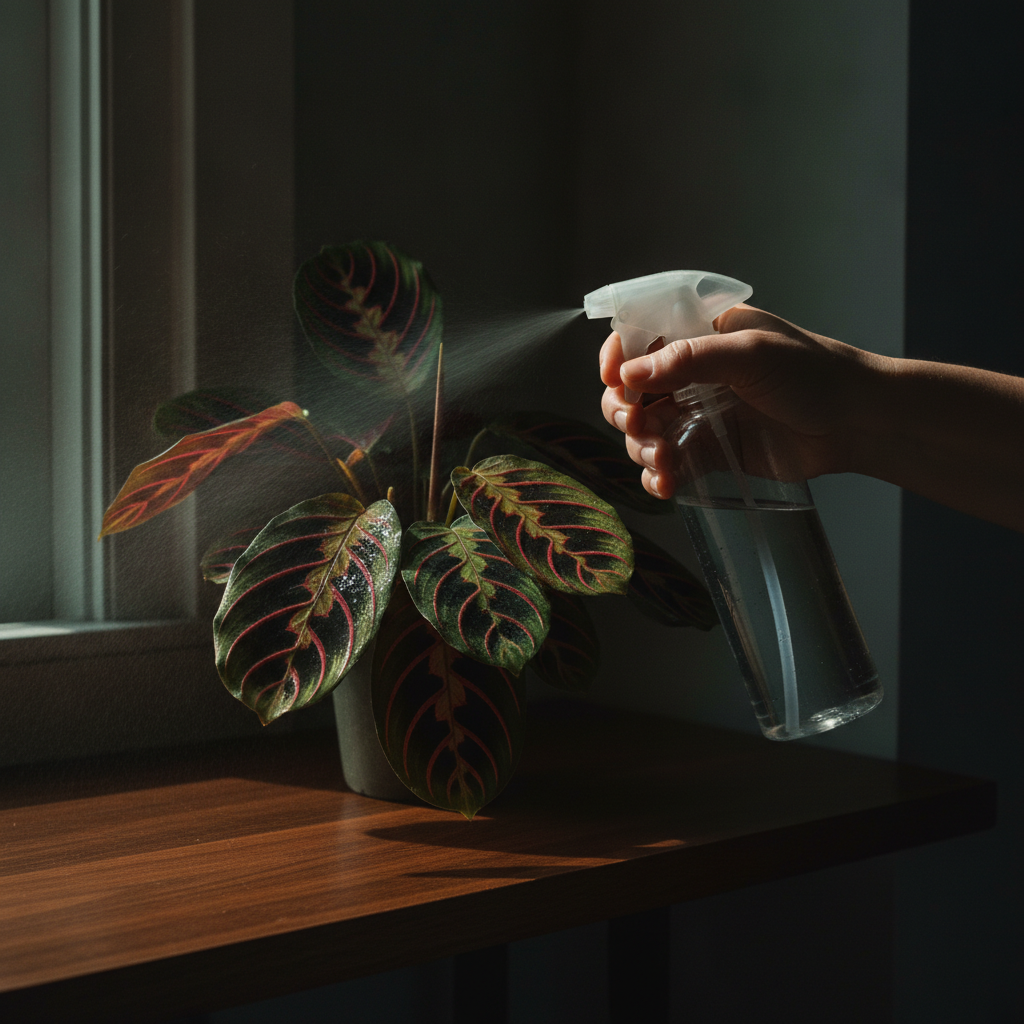
Humidity is the inseparable partner of watering here. Even a perfectly watered plant will brown at the edges in dry air. Aim for humidity above 60 per cent. A room humidifier is the most reliable way to achieve this; grouping plants together, standing the pot on a tray of damp pebbles, or moving the plant to a naturally humid room such as a bathroom all help too. Misting raises humidity only briefly and, if the leaves stay wet into a cool night, can encourage fungal spotting, so lean on the humidifier rather than the mister for lasting results.
Warning — Cold water shock: Watering with cold water can stress the roots and cause the leaves to curl and spot. Always use water at room temperature or slightly warm, and never let the plant sit in a cold draught while its soil is wet.
Soil
The ideal substrate for a red prayer plant walks a fine line: it must hold moisture long enough to keep the roots evenly damp, yet drain freely enough that water never pools around them. A dense, heavy soil stays wet too long and suffocates the fine roots, while a fast-draining cactus mix dries out before the plant can use the water. The compromise is a light, airy mix built to stay moist without going soggy.
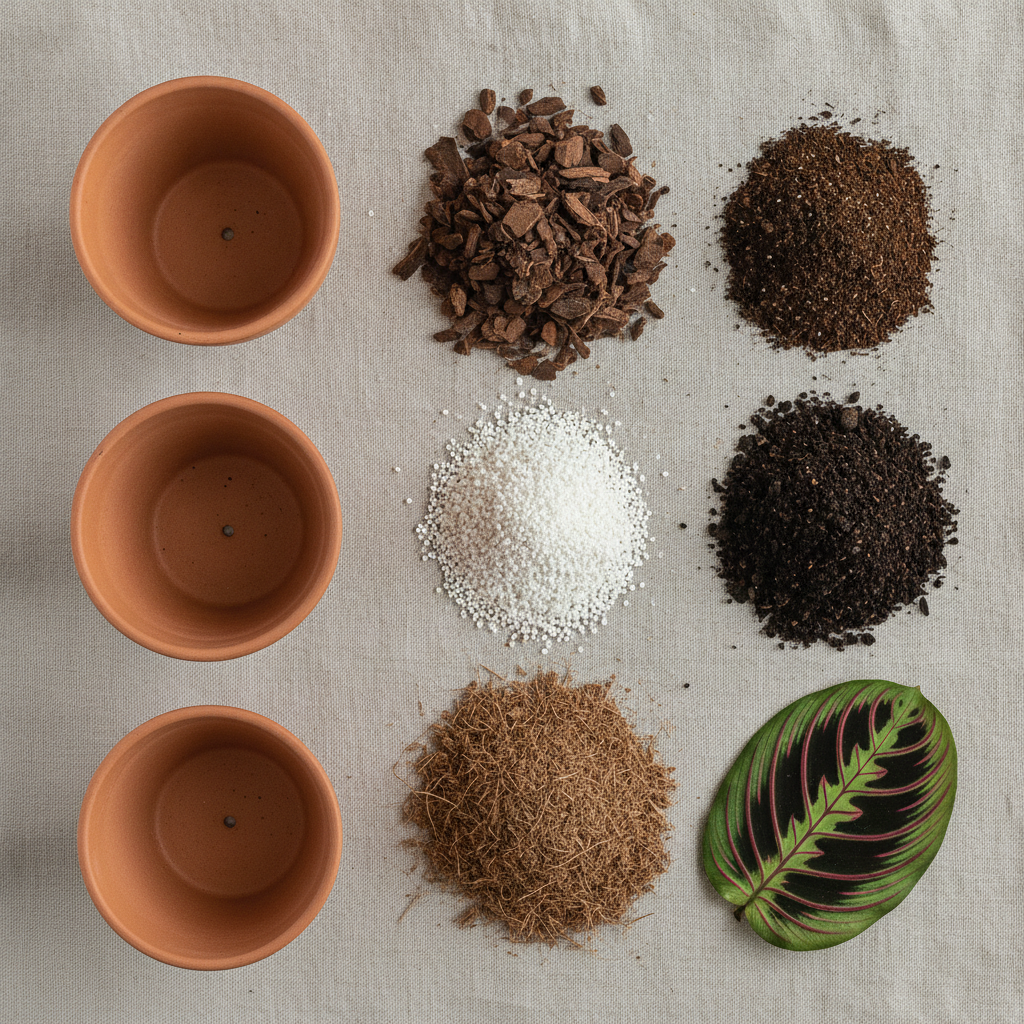
A reliable recipe is roughly two parts coco coir or peat-free potting compost, one part perlite for aeration and drainage, and one part fine orchid bark or a handful of worm castings to add structure and gentle nutrition. Coco coir is preferable to peat both for environmental reasons and because it rehydrates more evenly if it ever dries. The finished mix should feel light in the hand and spring back when squeezed rather than compacting into a solid clod.
Whatever mix you choose, the pot must have drainage holes. A decorative cover pot without holes is fine as an outer sleeve, but the plant itself should sit in an inner pot that can shed excess water. Prayer plants have shallow, spreading root systems, so a wide, shallow pot suits them better than a deep one, and it reduces the volume of wet soil sitting unused beneath the roots. Repot every one to two years in spring, moving up only one pot size at a time, both to refresh the depleted mix and to divide the plant if it has become crowded.
Fertilising
The red prayer plant is a light feeder, and restraint serves it better than generosity. Through the growing season, from spring into early autumn, a balanced liquid houseplant fertiliser diluted to half the recommended strength and applied roughly once a month is plenty. This steady trickle of nutrients supports the near-continuous production of new leaves without overwhelming the sensitive roots.
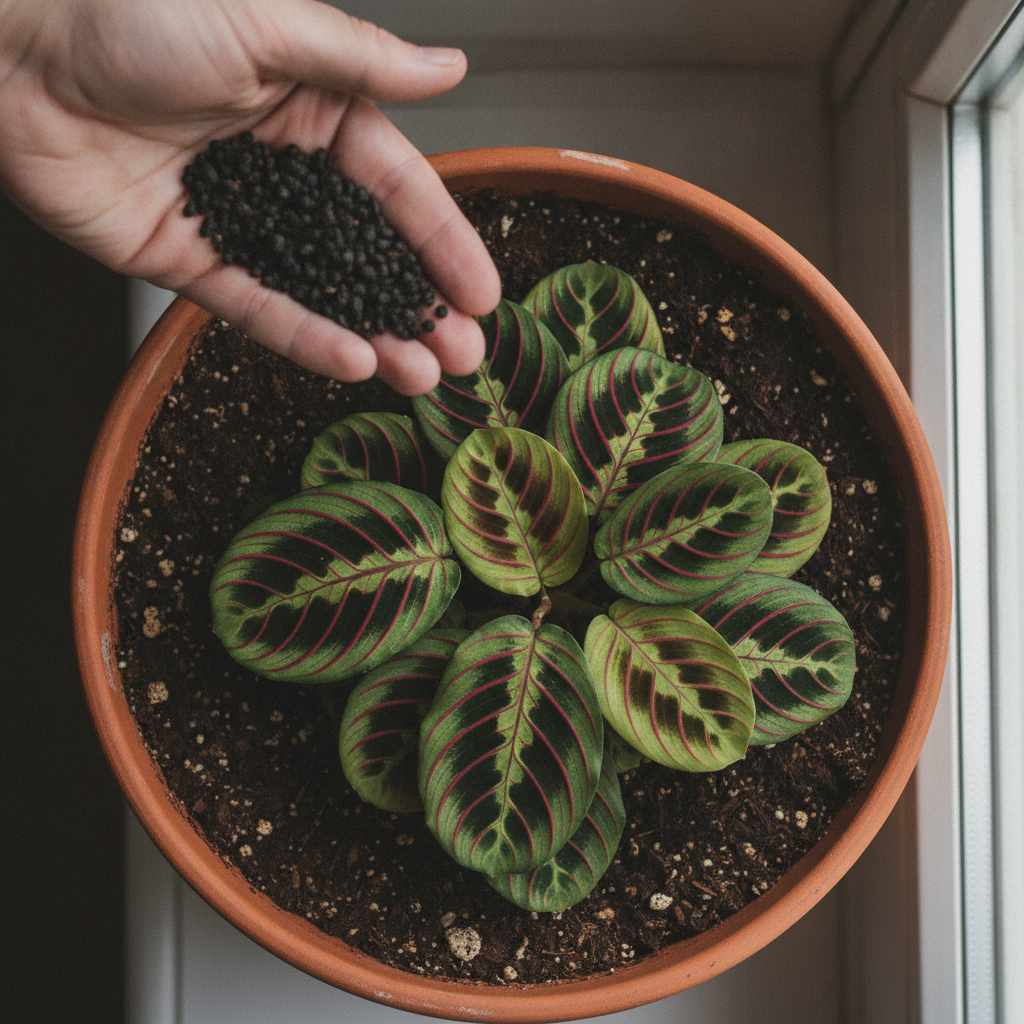
Marantas are more prone to fertiliser burn than most houseplants because the same soluble salts they dislike in tap water also build up from feeding. Over-fertilising shows as scorched, brown leaf edges that look confusingly similar to underwatering or low humidity. To keep salts from accumulating, always water thoroughly rather than sparingly on feeding days, and flush the soil with plain water every couple of months by letting a generous volume run right through the pot and out of the drainage holes.
In late autumn and winter, when light levels fall and the plant’s growth naturally slows, stop feeding altogether. Nutrients the plant cannot use simply pile up in the soil, and a resting plant fed on schedule is far more likely to develop brown margins than one left alone until spring. If you prefer an organic approach, a light top-dressing of worm castings once or twice during the growing season provides gentle, slow-release nutrition and improves the soil structure at the same time.
Propagation
The red prayer plant is happy to be multiplied, and the two dependable methods are division and stem-tip cuttings. Both are best attempted in spring or early summer, when the plant is in active growth and recovers quickly, and both are helped enormously by warmth and high humidity around the new plants.
Division is the simplest and most reliable route, and it doubles neatly as a repotting job. To divide, follow these steps:
- Water the plant a day before, so the roots are hydrated and less brittle when handled.
- Ease the whole plant out of its pot and gently tease the soil away from the root ball to reveal the natural clumps of stems and roots.
- Separate the plant into two or three sections, each with a healthy share of both roots and several leaves. Pull apart by hand where you can, and use a clean, sharp blade only where roots are too tangled to separate.
- Pot each section into its own container of fresh, moist mix at the same depth it grew before.
- Water in well and keep the new divisions warm, humid and out of direct sun for a couple of weeks while they settle.
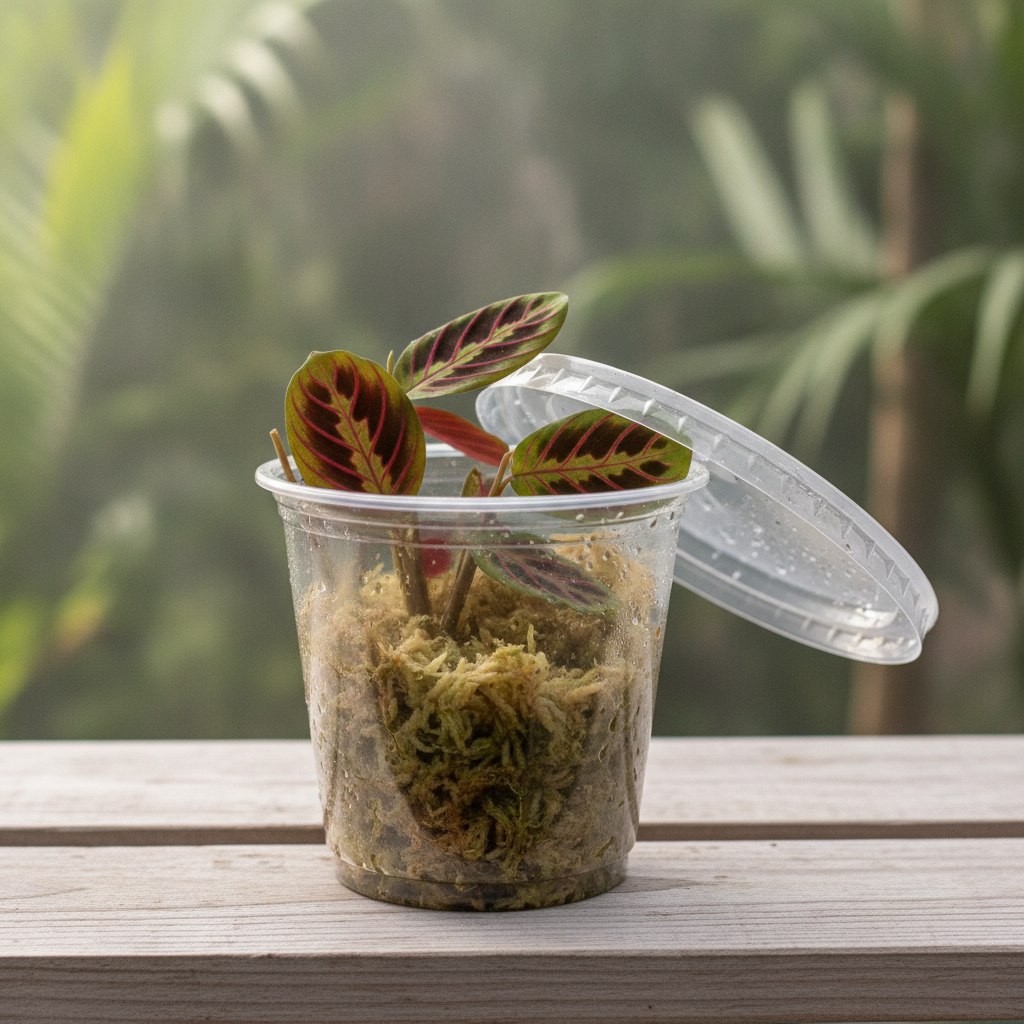
For stem cuttings, take a cutting just below a node, the slightly swollen point where a leaf stalk meets the stem, so that the cutting includes at least one node and one or two leaves. Root it either in a glass of soft water, changing the water every few days and watching for white roots to emerge from the node, or nestled in damp sphagnum moss inside a covered container to hold humidity high. Once the roots reach two or three centimetres, pot the cutting into the standard mix. Whichever method you choose, patience matters: keep conditions warm and humid, resist the urge to tug at the cutting to test it, and give it several weeks before expecting established roots.
Pests and Problems
Most trouble with a red prayer plant is environmental rather than infectious, and the leaves are honest reporters. Learning to read them turns vague worry into a specific fix. The table below links the most common symptoms to their usual causes.
| Symptom | Likely cause and fix |
| Brown, crispy leaf edges | Low humidity, dry soil, or salt build-up from tap water or fertiliser. Raise humidity, keep moisture steady, switch to filtered water. |
| Yellowing leaves | Usually overwatering and soggy roots; sometimes very old leaves dying back naturally. Check drainage and let the surface dry slightly more. |
| Curling leaves that stay curled by day | Underwatering or thirst. Water thoroughly and review your schedule. |
| Faded markings, leggy growth | Too little light. Move to brighter indirect light or add a grow light. |
| Leaves no longer folding at night | Stress from light, water or temperature swings; sometimes simply too little light change day to night. |

When actual pests appear, spider mites are by far the most common, and they are drawn out by exactly the dry air the plant dislikes. Look for fine webbing in the leaf axils and a faint stippling or speckling on the upper leaf surface. Because the same low humidity that stresses the plant also invites mites, raising humidity is both cure and prevention. Treat an infestation by rinsing the foliage, then wiping or spraying the leaves, especially the undersides, with insecticidal soap or a diluted neem oil solution, repeating every week until no new webbing appears.
Less often you may meet mealybugs, small white cottony clusters tucked into leaf joints, or fungus gnats whose larvae thrive in soil kept too wet. Dab mealybugs with a cotton bud dipped in isopropyl alcohol. For fungus gnats, let the soil surface dry a little more between waterings and set out yellow sticky traps to catch the adults. In every case, isolate a newly affected plant from your others until the problem is clearly under control, and check the undersides of leaves whenever you water so that any outbreak is caught while it is still small.
Varieties
The red prayer plant belongs to a small, well-loved group of Maranta leuconeura cultivars, each recognisable by its own leaf pattern. If you enjoy the red-veined form, the two relatives below are the ones you are most likely to meet, and all three share the same care needs, so a collection can be grown side by side on one shelf.
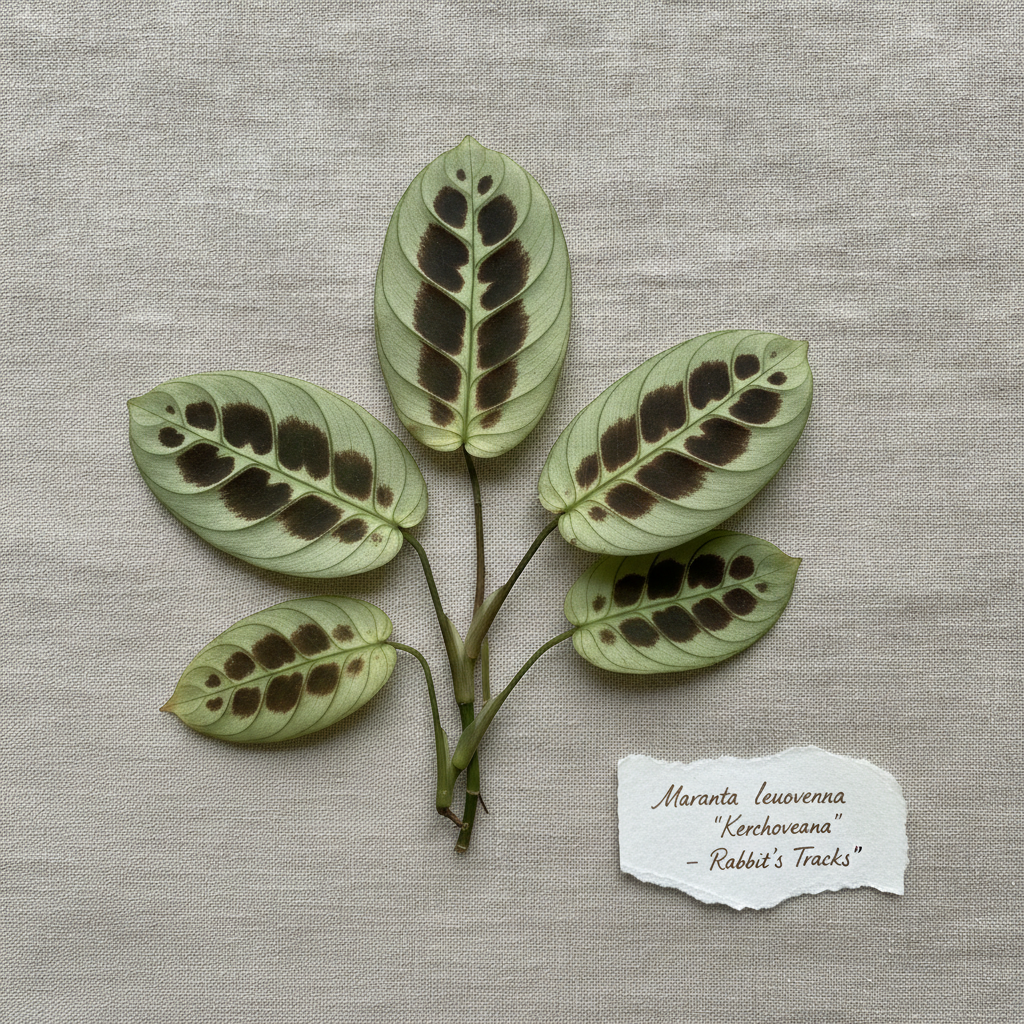
Kerchoveana (Rabbit’s Tracks)
The classic green form, Maranta leuconeura var. kerchoveana, trades red veins for a softer look: pale grey-green oval leaves marked with two neat rows of dark chocolate blotches either side of the midrib. The blotches fade toward green as the leaf ages, which is how the plant earned its nickname of Rabbit’s Tracks. It is often the toughest and most forgiving of the group.
Lemon Lime
The Lemon Lime maranta keeps the familiar herringbone pattern but swaps the crimson veins for bright chartreuse and neon lime-green markings over pale green veins. The effect is fresh and electric rather than moody, and it lifts a shaded corner where the darker red form can look sombre. Its care is identical to the red prayer plant’s, humidity and soft water included.
Frequently Asked Questions
Why is my red prayer plant not folding its leaves at night?
The nightly folding is triggered by the shift from light to dark, so the two usual reasons are a lack of that light change and general stress. If the plant sits in a room with artificial light on late into the evening, it may not register nightfall clearly. Otherwise, sluggish or absent folding points to stress from inconsistent watering, dry air or temperature swings. Restore steady moisture, humidity above 60 per cent and a clear day-night light cycle, and the movement typically returns.
Why are the leaf tips and edges turning brown?
Brown, crispy margins are the plant’s most common complaint and almost always come down to air that is too dry, soil allowed to dry out, or a build-up of minerals from hard tap water and fertiliser. Raise the humidity, keep the soil evenly moist, water with rainwater or filtered water, and flush the soil occasionally to clear accumulated salts.
Is the red prayer plant safe around pets?
Yes. Maranta leuconeura is non-toxic to both cats and dogs, as well as to humans, which makes it one of the safer choices for a home with animals or small children. Nibbling any houseplant can still cause mild stomach upset, so it is best discouraged, but there is no risk of poisoning.
How much light does it really need?
Bright, indirect light gives the best colour and the tightest growth. An east or north window is ideal, while south and west exposures need a sheer curtain or some distance from the glass to soften the sun. The plant survives in low light but grows leggy and loses its markings, so if a room is dark, a modest grow light makes a noticeable difference.
How often should I water it?
Rather than following a fixed schedule, water when the very surface of the soil begins to dry while the layer beneath stays moist. In warm, bright months this often means once or twice a week; in winter it is less frequent. The goal is soil that stays consistently like a wrung-out sponge, never fully dry and never waterlogged.
Do I need a humidifier, or will misting do?
A humidifier is the more effective option. Misting lifts the humidity only for a few minutes and, if leaves stay damp into a cool evening, can encourage fungal spots. A humidifier, a pebble tray, grouping plants together or a naturally humid bathroom all provide the lasting moisture in the air that this plant needs to avoid browning.






