
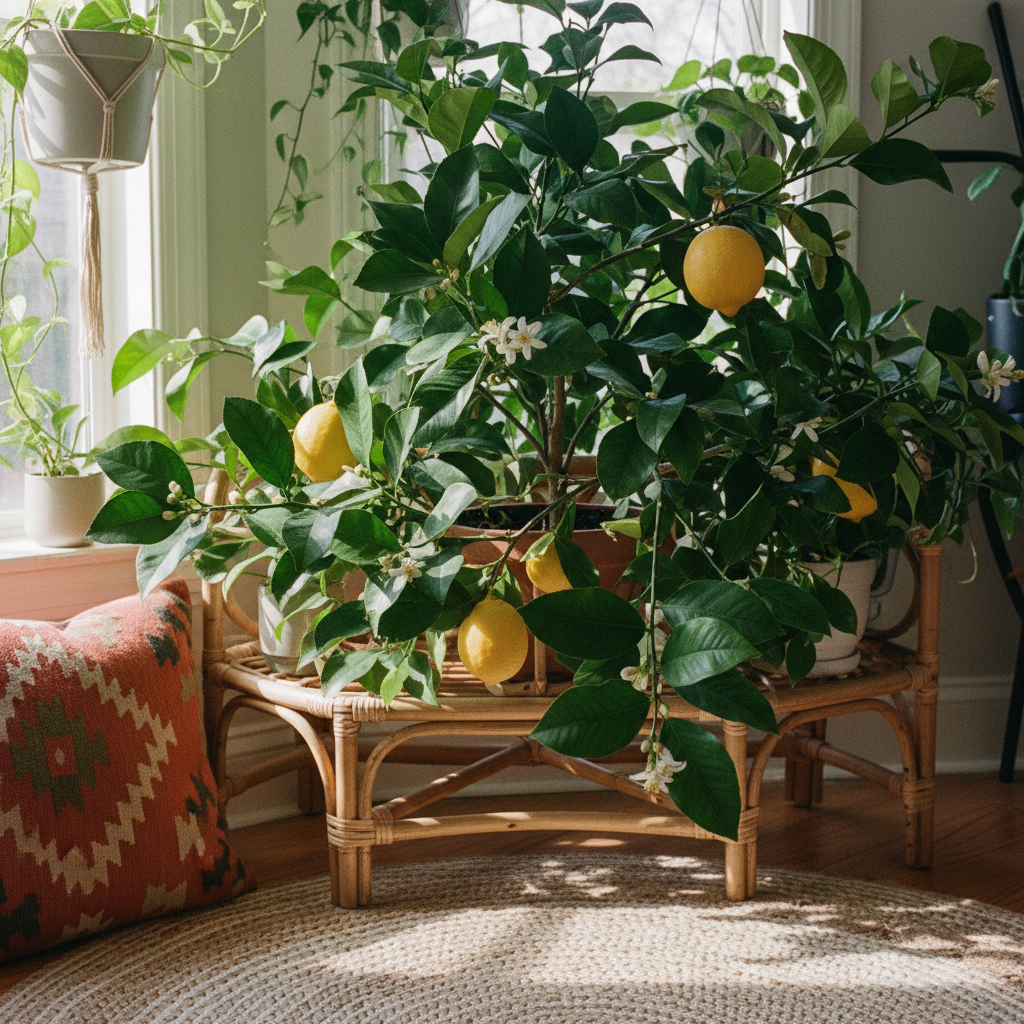
Few houseplants reward attention quite like an indoor citrus tree. The species most often grown indoors in cool-climate homes is the Meyer lemon, Citrus × meyeri, a natural hybrid between the common lemon and either a mandarin or a sweet orange first brought from Beijing to the United States by the agricultural explorer Frank Meyer in 1908. Its compact habit, glossy evergreen leaves, perfumed white blossom and thin-skinned yellow-orange fruit have made it the benchmark for indoor citrus growing, but the broader category of container-grown citrus also includes the bushy Calamondin, the diminutive Kumquat, the Persian and Key limes, the Calamansi and an ever-widening choice of dwarf grapefruit and orange cultivars grafted onto compact rootstocks. Treated well, all of them behave less like ornamental novelties and more like miniature productive trees, throwing out flushes of fragrant flowers and edible fruit on the same branches at the same time.
Citrus has a reputation as a temperamental houseplant, and that reputation is half deserved. The plants are not difficult to keep alive, but they are unforgiving of the two conditions most modern homes provide by default: weak winter light and warm, dry central-heated air. A citrus tree placed in a dim corner and watered on a schedule will gradually drop its leaves, shed any developing fruit and refuse to bloom. The same tree given a bright south-facing window, a deep drink only when the top of the compost has dried, an airy gritty mix and a steady supply of nitrogen will hold its leaves, flower repeatedly and ripen fruit indoors. This guide covers everything that separates a struggling citrus from a thriving one, with the Meyer lemon as the working example and notes on how other indoor citrus differ.
Contents
- Quick Reference
- Why a Citrus Tree Makes a Rewarding Houseplant
- Light Requirements
- Watering and Humidity
- Soil, Potting and Repotting
- Fertilising
- Propagation
- Pests and Diseases
- Popular Varieties
- Frequently Asked Questions
Quick Reference: Indoor Citrus at a Glance
| Light | Direct sun, 6 to 8 hours a day. South or south-west window in winter; a sunny patio outdoors from late spring to early autumn. |
| Watering | Water deeply when the top 3 to 5 cm (1 to 2 in) of compost have dried. Never let the pot sit in standing water. Reduce, but do not stop, in winter. |
| Temperature | Ideal 15 to 24°C (59 to 75°F). Tolerates a short dip to 4°C (39°F). Avoid sustained temperatures above 30°C (86°F) indoors. |
| Humidity | 40 to 60 per cent. Tolerates lower if airflow is good, but flower drop and red spider mite both worsen in dry centrally heated rooms. |
| Fertiliser | A high-nitrogen citrus-specific feed, applied every watering during spring and summer at a quarter to half strength, and monthly during winter at low strength. |
| Soil | An open, free-draining citrus or cactus mix; equal parts loam-based compost, horticultural grit and bark works well. Slightly acidic, pH 5.5 to 6.5. |
| Repotting | Every 2 to 3 years in spring, into a pot one size larger. Refresh the top 5 cm (2 in) of compost annually. |
| Pruning | Light shaping in late winter or after harvest. Remove inward-growing shoots and thin congested growth to let in light. |
| Time to fruit | Grafted nursery plants flower in their first year. Trees grown from seed take 5 to 15 years and may never come true. |
| Toxicity | The leaves and peel contain essential oils that can cause mild gastric upset in cats and dogs if chewed; large quantities are more problematic. Fruit flesh is safe for humans. |
Why a Citrus Tree Makes a Rewarding Houseplant
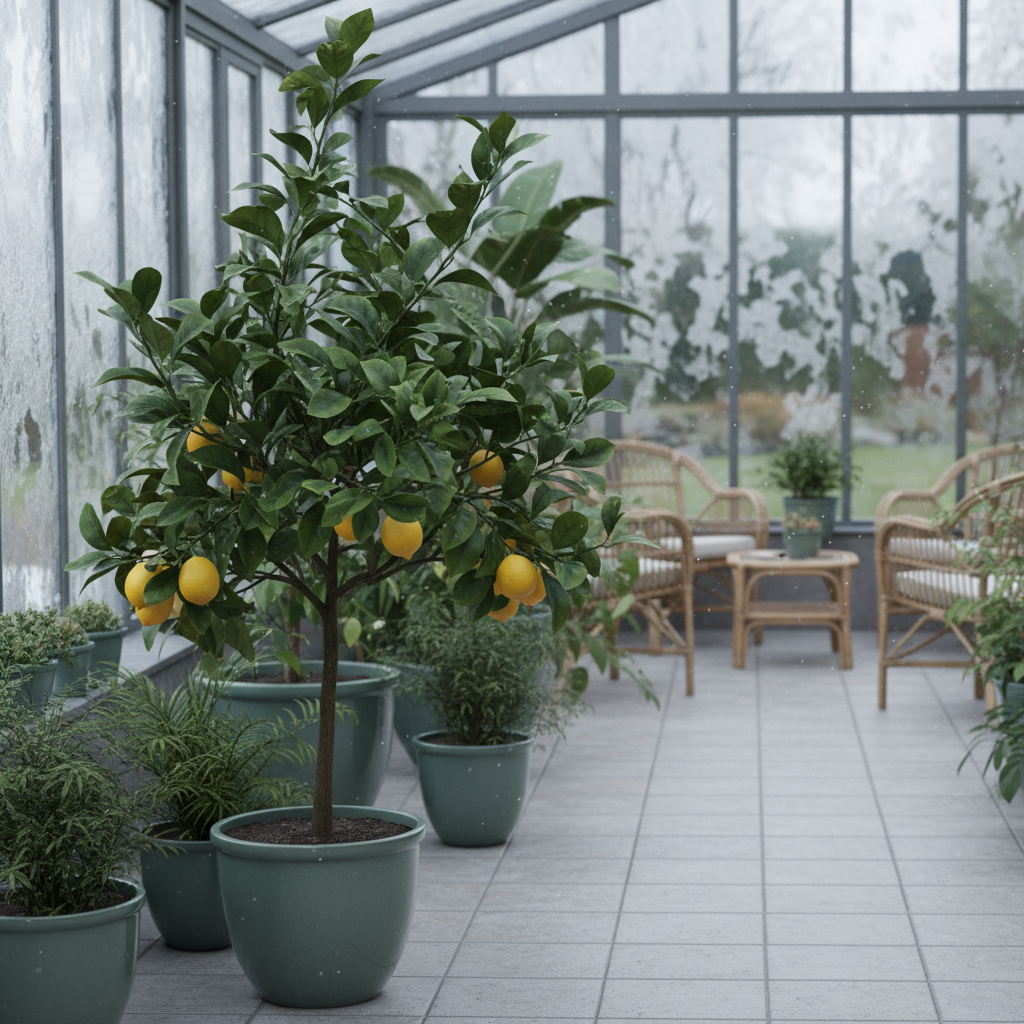
A citrus tree is one of the few houseplants that genuinely pays its rent. The Meyer lemon, Citrus × meyeri, will bear edible fruit on a windowsill in a flat in Copenhagen, in a sunroom in Edinburgh or on a balcony in Marseille, provided it has enough light. It flowers in flushes throughout the year, often with developing fruit, ripe fruit and fresh buds visible on the same branches at the same time. The blossom is intensely fragrant, somewhere between jasmine and orange blossom, and a single tree in full bloom will scent an entire room for two to three weeks. Even out of fruit, the dark glossy evergreen foliage gives a substantial Mediterranean presence that few other indoor plants can match at the same size.
Indoor citrus also bridges the gap between ornamental and edible gardening, which is unusual for a houseplant. The fruit of a well-grown Meyer is genuinely worth using in the kitchen: thinner-skinned, sweeter and less acidic than a supermarket Eureka, with a faint floral note that is hard to find at any greengrocer. Calamondins are too sour to eat raw but make a striking sweet-sour marmalade, and Kumquats can be eaten whole, peel and all. The act of harvesting fruit from a tree you have grown yourself, even a handful of lemons a year, changes how you relate to the plant and to the room it lives in.
The trade-off is that citrus is not a forgiving plant for the inattentive grower. It dislikes being moved repeatedly, will sulk for weeks after a sudden change in light or temperature, and is one of the first houseplants to attract red spider mite when the air is hot and dry. It rewards a settled, sunny position and an owner who is willing to check on it once a week rather than fuss over it daily. For people who already grow tomatoes or herbs on a windowsill and have a feel for the rhythm of a productive plant, citrus is a logical and very satisfying next step.
Pro Tip — Buy grafted, not seed-grown: A citrus grown from a supermarket lemon pip is fun to germinate but will take a decade or more to fruit, may produce something unrecognisable from its parent, and is genetically a juvenile plant with thorny growth. A grafted nursery tree, usually 2 to 3 years old when sold, will flower within its first year in your home.
Light Requirements
Light is the single most important factor in keeping a citrus tree productive indoors, and almost every problem with a houseplant citrus traces back to not enough of it. Citrus evolved in the bright sub-tropical and warm-temperate climates of southern China and South-East Asia, and the modern Meyer lemon, like its relatives, expects between six and eight hours of direct sunlight every day for active growth, flowering and fruiting. In a typical northern-European home in midwinter, even an unobstructed south-facing window delivers only a fraction of the light a citrus would receive outdoors in summer. The plant will survive that drop, but it will not bloom and may stop producing new leaves until the light returns in spring.
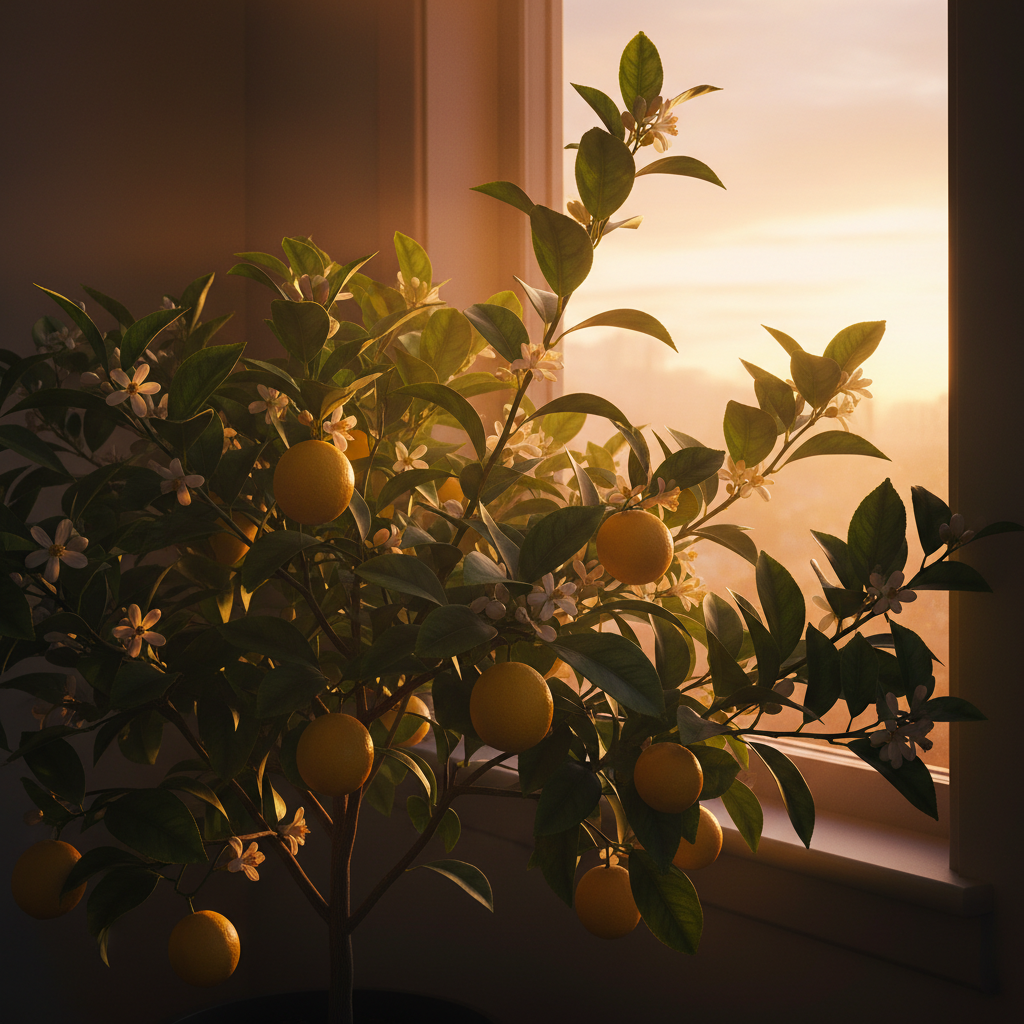
The simplest rule is to give a citrus the brightest spot in the home. A south or south-west window is ideal; an east or west window will hold a plant in good condition but slow its flowering; and a north-facing aspect is unsuitable for anything more than short-term display. Pull the tree as close to the glass as space allows, ideally within 30 cm (12 in), and rotate the pot a quarter turn every two to three weeks so the canopy fills out evenly rather than leaning towards the light. A tree that develops a one-sided shape from a fixed orientation will keep that shape for years.
Outdoor summer holidays make a real difference. From late May to early September in northern Europe, a citrus moved to a sheltered sunny patio or balcony will photosynthesise at several times the rate it could indoors, building up the reserves it needs to flower and fruit through autumn. Acclimatise the plant over a week or two, starting in dappled shade and gradually moving it into full sun, so the leaves do not scorch. Bring it back indoors well before the first frost; for Meyer lemon, a couple of nights at 4°C (39°F) are tolerated but anything colder risks defoliation. Sour orange and Calamondin are slightly hardier, Limes and Kumquats less so.
If the only available window is genuinely too dim, a full-spectrum LED grow light is a reasonable substitute, although it will not replace direct sun outdoors in summer. A single 30 to 50 watt LED panel positioned 30 to 45 cm (12 to 18 in) above the canopy, run on a timer for 12 to 14 hours a day, is enough to maintain a small Meyer lemon through a dark winter and will often trigger flowering on a plant that would otherwise sit dormant.
Warning — Sudden light changes: Citrus is notorious for dropping leaves after an abrupt move from outdoors to indoors or from one window to another. Always transition the plant over 10 to 14 days, easing it from one light level to the next rather than relocating it overnight. Some leaf loss in the first two weeks of any move is normal and the plant will recover.
Watering and Humidity
The cardinal rule for watering a citrus tree is to water deeply but only when the compost has begun to dry. The roots dislike the extremes of either soggy stagnation or bone-dry desiccation, and the plant communicates both clearly: a tree that is overwatered will yellow its older leaves and may drop them en masse with a sour smell from the pot, while a tree that has been left too dry will curl its leaves upward like little canoes and shed buds and small fruit. Both states are recoverable if caught early, but repeated cycles of either will kill a citrus.
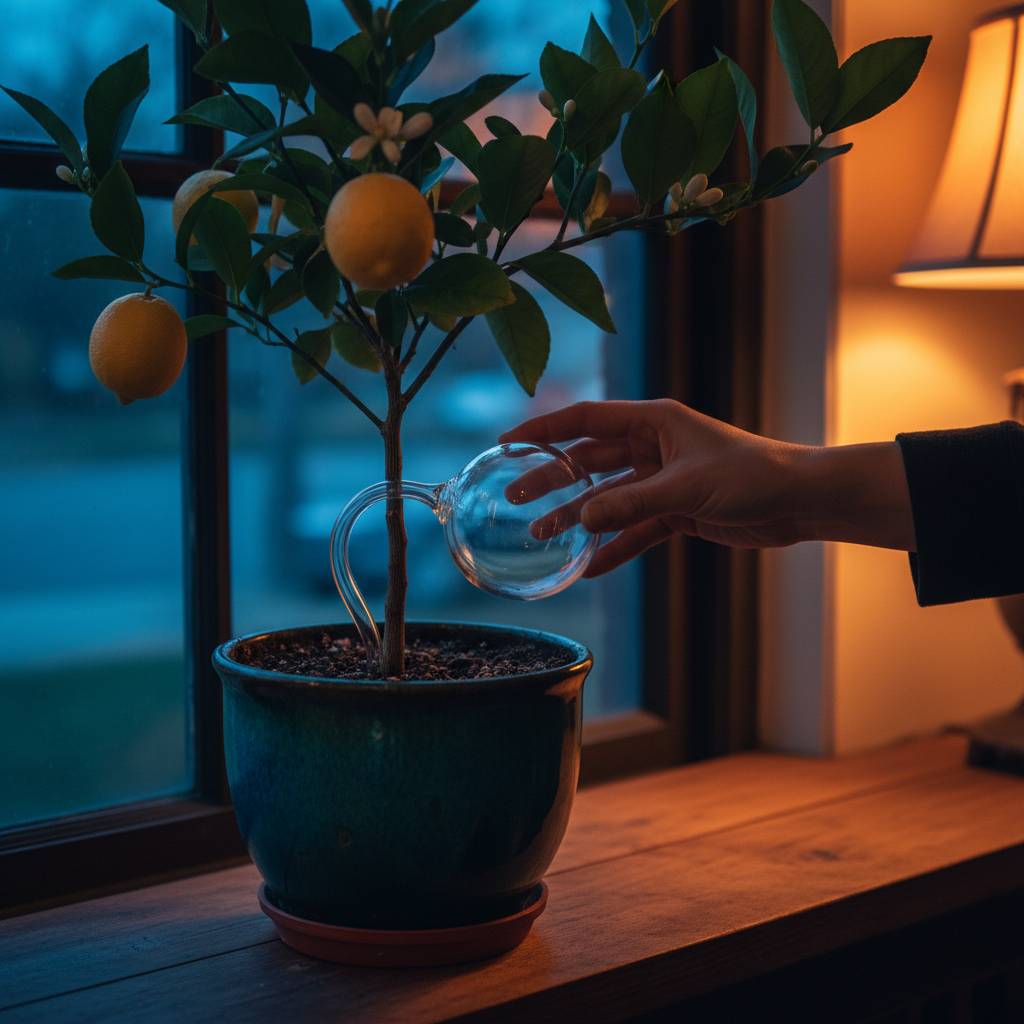
The most reliable check is the finger test. Push a finger 3 to 5 cm (1 to 2 in) into the surface of the compost. If it comes out with damp particles clinging to it, wait another day or two; if it comes out clean and dry, it is time to water. A long-stemmed wooden chopstick pushed to the bottom of the pot and pulled out gives the same information for the deeper root zone, which matters more than the top layer. In spring and summer a healthy Meyer lemon in a 25 cm (10 in) pot in a bright window may need water every four to six days; in winter the same plant in the same pot may only need water every 10 to 14 days. The schedule is meaningless; the moisture level is everything.
When you do water, water thoroughly. Take the pot to the sink and run tepid water through the compost until it streams freely from the drainage holes for several seconds. This flushes accumulated salts, ensures the entire root ball is rehydrated, and prevents the dry pockets that form when a plant is repeatedly given a small splash from the top. Let the pot drain for 15 to 20 minutes before returning it to its saucer, and never let it stand in residual water. If you cannot reach the sink, water in place but tip away anything that collects in the saucer within half an hour.
Water quality matters more for citrus than for most houseplants. Hard tap water in much of northern Europe has a high carbonate content that gradually raises the pH of the compost above the slightly acidic level citrus prefers, locking out iron and magnesium and producing the pale, yellow-veined leaves of induced chlorosis. If your tap water is hard, water with cooled boiled water once a month, with collected rainwater whenever practical, or with filtered water if you already use a kitchen filter. Softened water is not an alternative, because the salt used in domestic softeners is harmful to citrus.
Humidity is the other half of the watering picture. Citrus prefers air that holds 40 to 60 per cent relative humidity, which most homes manage in spring and autumn but lose during the heating season. Dry centrally heated air drives flower drop, accelerates moisture loss from leaves and triggers red spider mite outbreaks. The most effective remedy is good airflow combined with a humidifier or a wide pebble tray of water set near the plant, not misting, which provides only a brief transient bump in humidity and can promote leaf-spot fungi if done in cool, still air.
Pro Tip — Lift to check: A reliable supplement to the finger test is the weight of the pot. Lift it just after a thorough watering and again a week later; learn what a freshly watered pot and a thirsty pot feel like in your hand. Over a few months this becomes second nature and removes most of the guesswork.
Soil, Potting and Repotting
Citrus roots are fine, fibrous and intolerant of stagnation. The compost they sit in must be open enough to drain freely after watering, structured enough to hold air pockets between irrigations, and slightly acidic so that iron and other micronutrients remain available. Standard multipurpose compost on its own is too dense and too peaty, retaining moisture for so long that the roots eventually rot. A purpose-made citrus or Mediterranean compost from a reputable manufacturer is the simplest solution, but a homemade mix of equal parts good loam-based compost (such as a John Innes No. 2 or No. 3), horticultural grit or coarse sand, and composted bark or perlite will produce equally healthy plants.
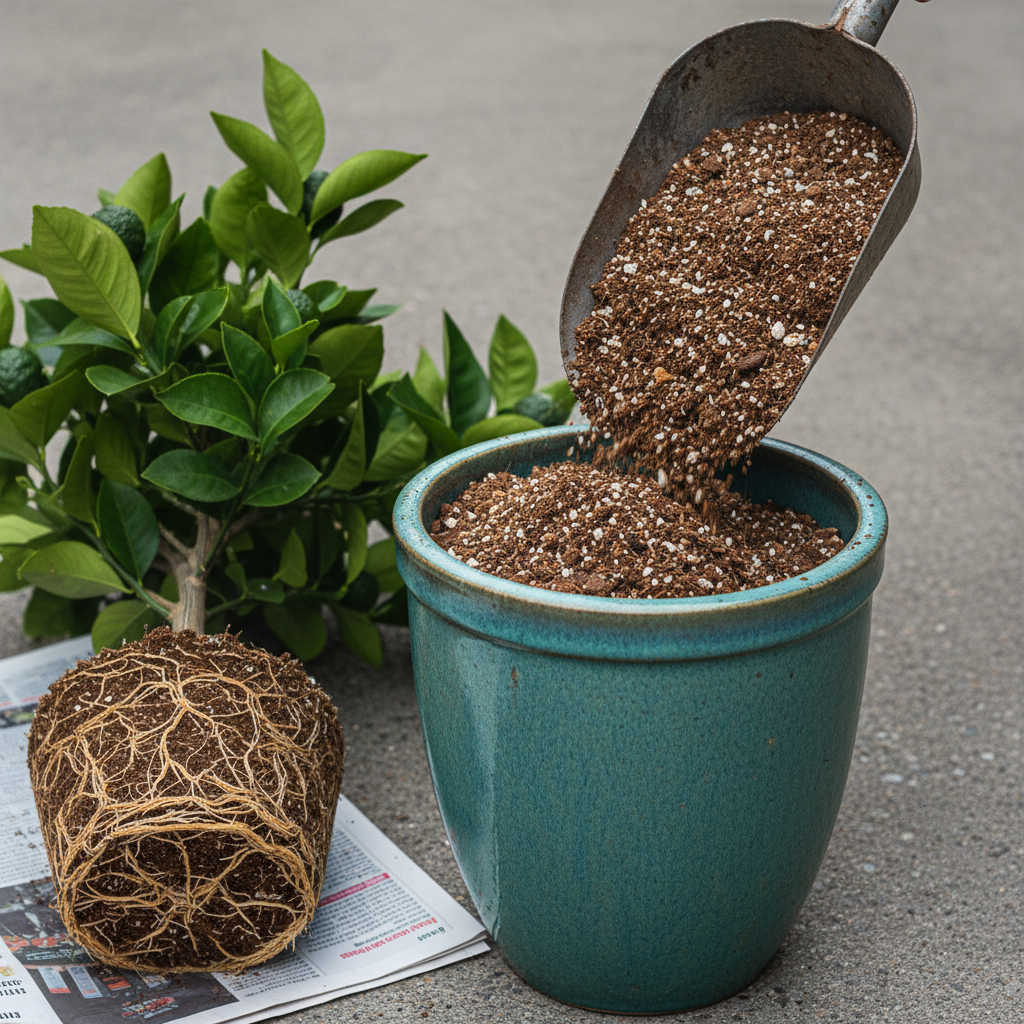
The pot itself is part of the soil system. Terracotta is the traditional choice because it breathes and helps the compost dry evenly between waterings, which suits citrus well, although it will need watering more often in summer than a glazed ceramic or plastic pot of the same size. Whatever material you choose, drainage holes are non-negotiable, and a layer of crocks or gravel at the base is unnecessary and actually shortens the effective soil column; modern advice is to use a well-structured mix throughout and rely on a saucer for any excess water. Size up cautiously: citrus prefers to be slightly snug in its pot, and a tree dropped into a container twice as large as it needs will sit in cold, soggy compost for months and rot.
Repotting is best done in spring, just as new growth begins, every two to three years for a young plant and every three to four years for a mature one. Tip the tree out of its pot and inspect the root ball. If the roots are circling the inside of the container, ease them outward with your fingers and trim any obviously dead or broken roots with sterilised secateurs. Move to a pot one size larger, typically 3 to 5 cm (1 to 2 in) wider in diameter, and replant at the same depth as before; burying the graft union or main stem will encourage rot. Firm the fresh mix gently around the root ball, water in thoroughly, and place the plant out of direct sun for a week to let the roots settle.
In years when you do not repot, refresh the top 5 cm (2 in) of compost in early spring. Scrape away the old surface layer, including any accumulated salt crust, and replace it with the same fresh citrus mix you would use for repotting. This top-dressing introduces new organic matter, lowers the surface pH and gives the feeder roots near the top of the pot a renewed supply of air and nutrients. Final-sized trees in heavy ornamental pots benefit from this every spring for many years before a full repot is necessary.
Fertilising
Citrus is one of the hungriest houseplants you are likely to grow. The combination of evergreen foliage, repeated flushes of growth, recurrent flowering and the energetic process of ripening fruit demands a steady supply of nitrogen, plus generous amounts of potassium and a full spread of micronutrients. A tree that is fed only occasionally will photosynthesise less efficiently, drop flower buds before they open and shed small fruit before it sizes up. A tree on a consistent feeding routine, by contrast, will hold dark green leaves, bloom in flushes and carry fruit to maturity.
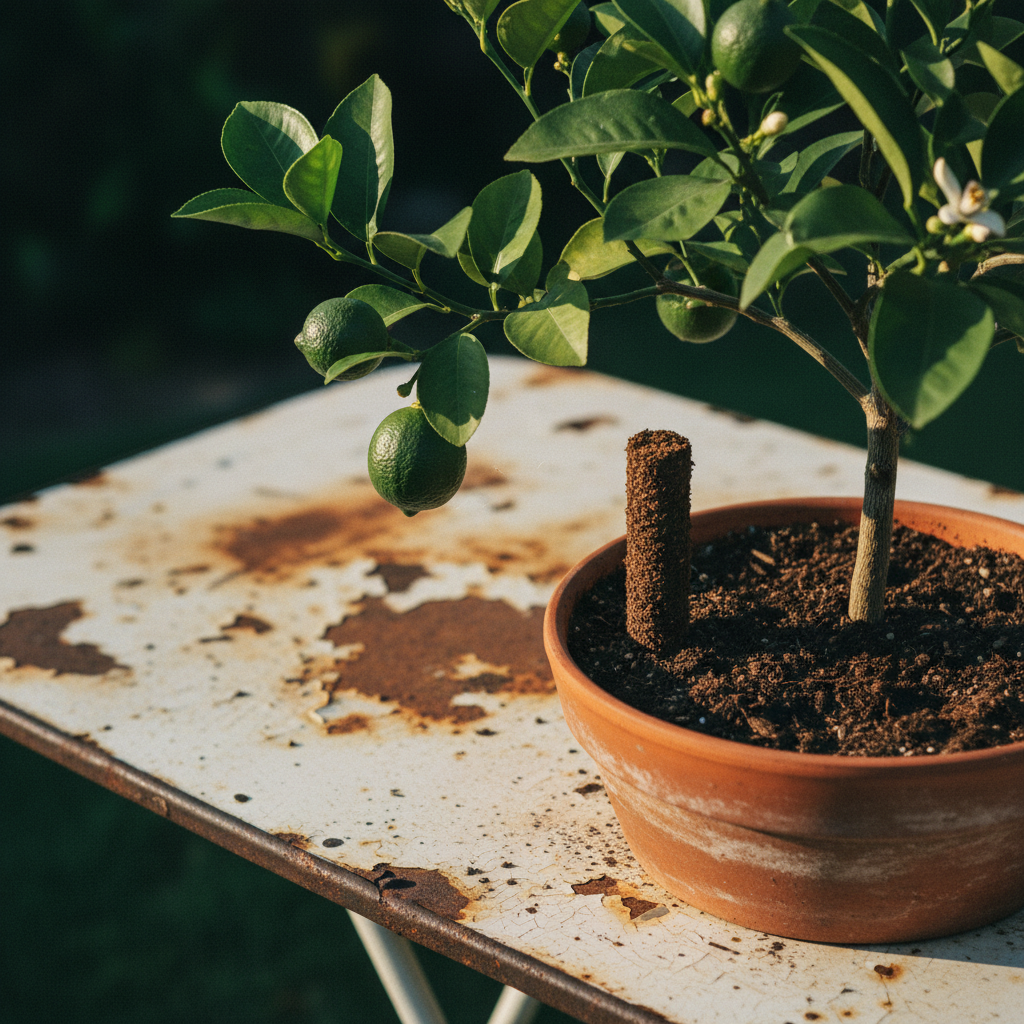
The simplest and most effective approach is to use a purpose-formulated citrus feed and to apply it little and often. Most commercial citrus fertilisers come in two formulations: a summer feed, higher in nitrogen, and a winter feed, slightly lower in nitrogen and higher in potassium, designed to support flower development without pushing soft new growth. From early spring to early autumn, apply the summer feed at a quarter to half the manufacturer’s recommended strength with every watering. From late autumn to late winter, switch to the winter feed and dilute it the same way, applying it perhaps once every two or three weeks. The frequent low-dose approach mimics the steady release of nutrients in mineral-rich soil and prevents the spikes and crashes that a once-monthly full-strength feed produces.
If a dedicated citrus feed is not available, a balanced tomato fertiliser is a workable substitute, although you will need to supplement it with a foliar spray or soil drench of sequestered iron and magnesium two or three times a year to compensate for the lower micronutrient content. Organic options work too; weak compost tea, dilute seaweed feed and a top-dressing of worm castings in spring all help, but they will not on their own provide enough nitrogen for a productive tree, so combine them with a balanced liquid feed.
Watch the plant for guidance. Pale leaves with green veins indicate iron deficiency, usually caused by alkaline tap water or exhausted compost. Uniformly pale or yellow older leaves suggest nitrogen shortage. Brown leaf tips or scorched margins point to over-feeding or accumulated salts and call for a thorough flushing of the pot with several pot-volumes of soft water followed by a return to half-strength feeds. The plant tells you what it needs; the trick is to read the leaves rather than the calendar.
Pro Tip — Feed with every watering: Switching from monthly full-strength feeds to a quarter-strength feed in every watering can transform a tired-looking citrus within a single growing season. Modern hydroponic-style fertigation produces visibly darker leaves and noticeably better flower set.
Propagation
Citrus can be propagated by seed, by cuttings, by air layering or by the professional method of grafting onto a vigorous compatible rootstock. Each route produces a quite different plant, and the choice has practical consequences for how long you will wait for fruit and what that fruit will be like when it finally arrives.
Seed propagation is the most rewarding to watch and the least useful in practice. Pips from a fresh lemon will germinate readily in warm, moist compost within two to three weeks; the seedlings are vigorous and produce a strong taproot. The catch is that most modern citrus varieties are highly heterozygous hybrids, so the seedling almost never reproduces the parent fruit. Worse, a seed-grown tree spends years as a juvenile, throwing out long thorny shoots and refusing to flower until it has matured, which can take 5 to 15 years. Seed-raised trees make handsome foliage plants, but anyone who actually wants fruit should buy a grafted tree or root a cutting from a mature plant.
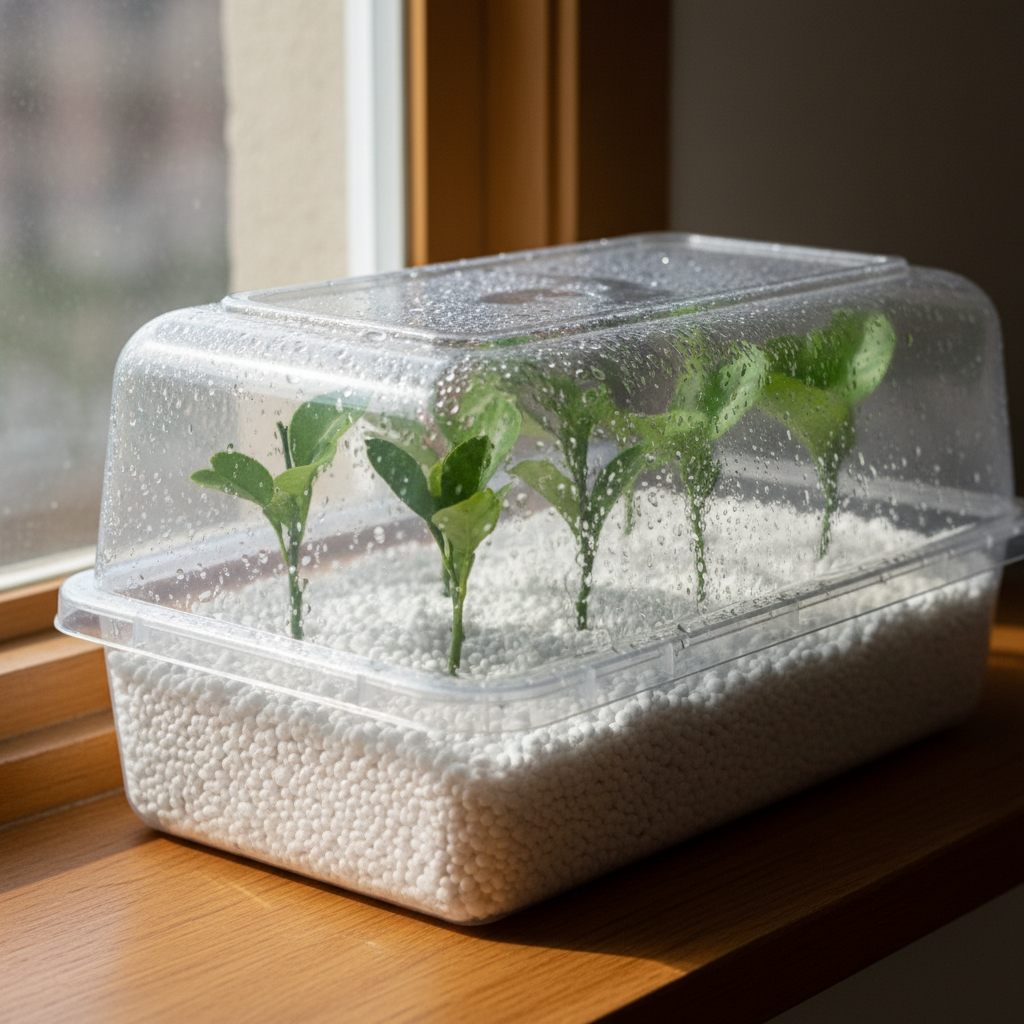
Semi-hardwood cuttings are the most accessible amateur method for producing a true-to-type tree. In late spring or early summer, take 10 to 15 cm (4 to 6 in) lengths of the current season’s growth that have begun to harden at the base but are still pliable at the tip. Strip the lower leaves, dip the cut end in rooting hormone, and insert into a 50:50 mix of damp perlite and seed compost. Cover with a clear plastic humidity dome or a transparent food bag held off the foliage with sticks, place in bright but indirect light at 20 to 24°C (68 to 75°F), and check the cuttings weekly. Most will root within six to ten weeks. Pot up individually once new growth resumes and treat as a young tree thereafter.
Air layering is reliable for citrus and a good option if you have a mature plant and want a sizeable new tree quickly. Choose a healthy stem of pencil thickness, make a shallow upward cut just below a node, wedge the cut open with a sliver of toothpick to keep it from healing shut, dust with rooting hormone, and wrap the area in a generous handful of damp sphagnum moss enclosed in clear plastic film secured at both ends. Keep the moss damp and check after eight to twelve weeks; once a healthy bundle of white roots is visible through the film, sever the stem below the wrapping and pot up the new plant. Air-layered citrus can flower and fruit the following season.
Grafting is the technique that produces the citrus trees sold in nurseries. A bud or short shoot of the desired cultivar is joined to a rootstock chosen for vigour, disease resistance and dwarfing effect; popular rootstocks include trifoliate orange (Poncirus trifoliata) and its hybrid Flying Dragon. The grafted plant inherits the fruiting characteristics of the scion and the root behaviour of the rootstock, which is why a Meyer on Flying Dragon stays small enough for a 30 cm (12 in) pot while a Meyer on its own roots can reach 3 metres (10 ft). T-budding and chip-budding are within the reach of an experienced amateur but take practice; for most growers, buying a grafted tree is by far the simplest route.
Pests and Diseases
Citrus attracts a recognisable cast of indoor pests, almost all of which arrive on the back of two conditions: dry stale air and stressed plants. A vigorous tree in a bright airy window with steady humidity will shrug off the occasional invader; a tired tree in a hot dim corner becomes a banquet. Regular close inspection every week or two, particularly on the undersides of leaves and where the leaf petiole meets the stem, catches most problems early enough to deal with by hand.
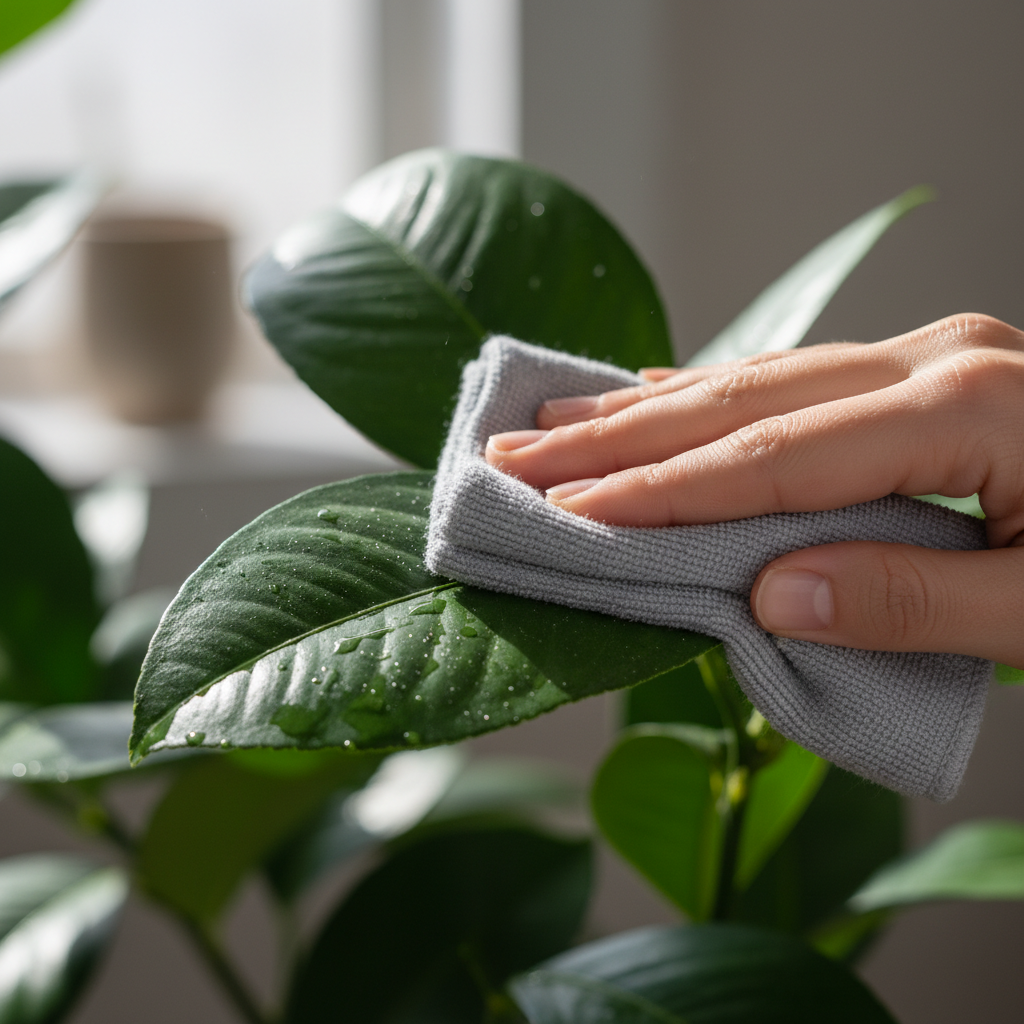
Red spider mite is the most common pest of indoor citrus, particularly in heated rooms in winter. The mites themselves are barely visible, but their feeding produces a fine stippling of pale dots on the upper leaf surface and, in heavy infestations, gossamer webbing in the leaf axils. The single best preventive is raised humidity and good airflow; for an active infestation, take the plant to a shower or outside on a mild day and hose the foliage hard, paying particular attention to the leaf undersides, then follow up with a horticultural soap or neem oil spray every five to seven days for three or four cycles to break the life cycle.
Scale insects appear as small flat or dome-shaped brown or grey lumps along stems and leaf veins. They are protected by their waxy shield from contact sprays once mature, so the most effective method on a houseplant is mechanical: dab each scale with a cotton bud dipped in surgical spirit or isopropyl alcohol, which dissolves the protective coating and kills the insect underneath. Follow with a thorough rinse and a horticultural oil spray to catch the juvenile crawlers, repeating after ten days. Mealybugs, with their distinctive cottony coating, respond to the same treatment.
Aphids cluster on soft new shoots, particularly in spring, and produce sticky honeydew that quickly attracts black sooty mould. A strong jet of water dislodges most of them; persistent colonies can be controlled with an insecticidal soap. Whitefly is less common indoors but can establish on citrus grown alongside tomatoes or fuchsias; yellow sticky traps catch the adults and an insecticidal soap programme over three weeks breaks the life cycle.
Fungal and physiological problems are usually rooted in cultural conditions. Yellow leaves with green veins indicate iron chlorosis from alkaline water or compost. Uniform yellowing followed by leaf drop after a sudden move points to environmental stress. Brown leaf tips suggest over-fertilising or hard water. Premature fruit drop, where small fruits abscise when they reach pea size, is normal up to a point and represents the tree shedding what it cannot ripen; heavy drop coupled with leaf yellowing usually means erratic watering. Citrus also occasionally develops sooty mould secondary to a pest infestation; treat the pest and the mould will weather off on its own as new leaves emerge.
Warning — Quarantine new trees: Citrus is a known carrier of scale and mealybug, and the warm, sheltered conditions of a commercial nursery can mask a low-level infestation. Inspect any new tree carefully and ideally keep it isolated from your other plants for two to three weeks before bringing it into the main collection.
Popular Varieties
The choice of citrus for indoor cultivation has expanded considerably in the last two decades as nurseries have grafted more cultivars onto dwarfing rootstocks. The Meyer lemon remains the default because it tolerates lower light and cooler temperatures than most others, but several alternatives are well suited to containers and rooms with bright windows. The two featured below are the most reliable starting points for a first indoor citrus.
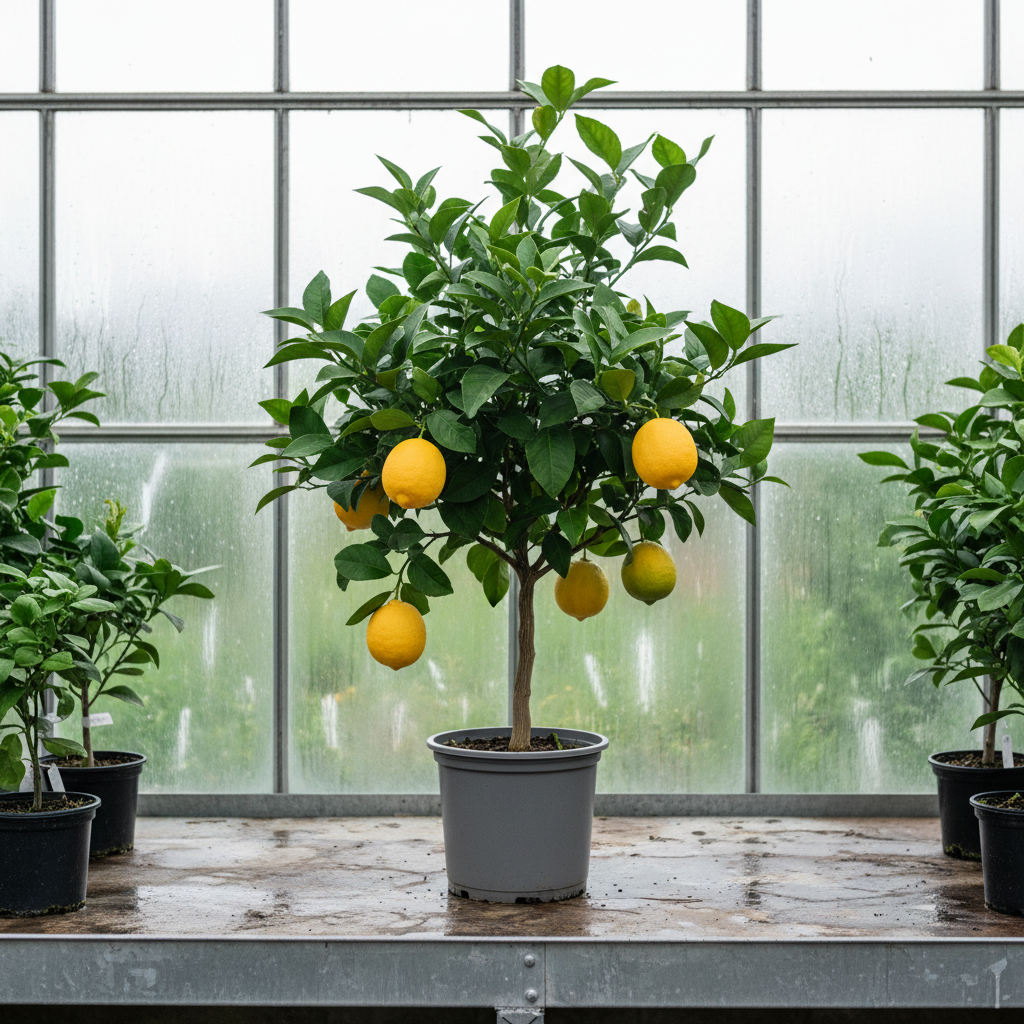
‘Improved Meyer’
The cultivar sold under the name ‘Improved Meyer’ is a virus-cleaned selection developed at the University of California in the 1970s to overcome a serious problem: the original Meyer carried symptomless citrus tristeza virus that devastated commercial groves of other citrus. The improved selection is nearly indistinguishable from the original in fruit and growth habit, producing the same thin-skinned, slightly orange-yellow lemons with their characteristic floral note, but on a vigorous, disease-resistant plant. It flowers repeatedly through the year, sets fruit reliably indoors and stays manageable in a pot.
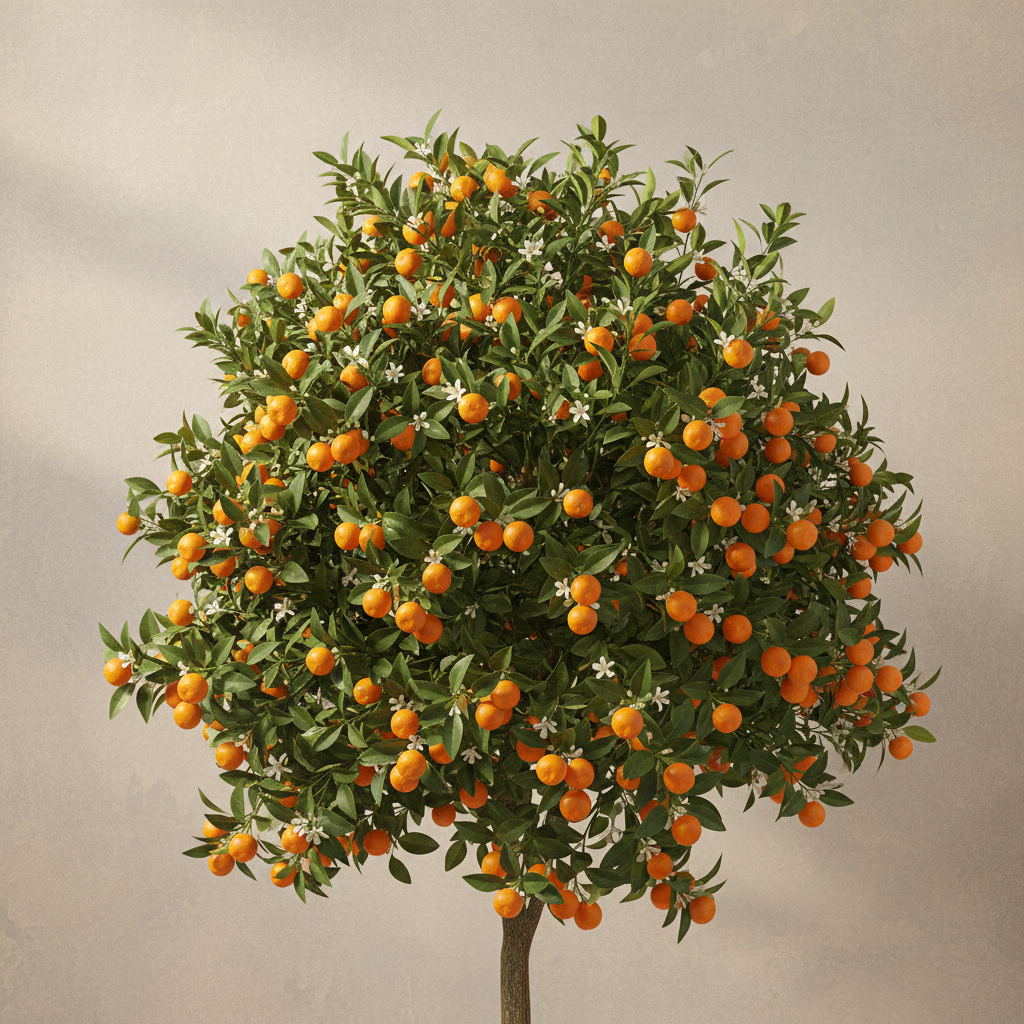
Calamondin
Calamondin, Citrus × microcarpa, is a Philippine hybrid that has become the workhorse of ornamental indoor citrus. The plant is naturally bushy and compact, rarely outgrowing a 30 cm (12 in) pot indoors, and it produces flushes of small fragrant white blossom and clusters of vivid orange fruit almost continuously through the year. The fruit is too sour to eat raw but makes excellent marmalade and a striking garnish, and the tree carries flowers and ripe fruit at the same time, giving year-round display. Calamondin tolerates slightly lower light than the Meyer lemon and is one of the most forgiving indoor citrus for beginners.
Beyond these two, several other cultivars deserve a mention for indoor growers with sufficient light. Kumquats (Citrus japonica) are very compact, hardy down to brief light frost and produce small oval fruit that can be eaten skin and all. Persian limes (Citrus × latifolia) and Key limes (Citrus aurantiifolia) are productive but demand the brightest window and warmest position you can offer. The ‘Variegated Pink’ Eureka lemon is more an ornamental than a kitchen lemon, with green-and-cream striped leaves and immature striped fruit that ripens to pink-fleshed lemons, but it is a striking specimen plant. Dwarf grapefruits, blood oranges and bergamot exist as grafted plants for hobbyists and will fruit in containers, although they need more heat and more light than is realistic in most northern-European homes without supplemental lighting.
Frequently Asked Questions
Why is my citrus dropping all its leaves?
Sudden leaf drop in citrus is almost always a stress response rather than a disease. The four most common triggers are a sharp drop in light (typically a move from summer outdoors to indoor winter, or from a sunny shop window to a dim home), a sudden change in temperature, a watering extreme in either direction, and root rot from prolonged wetness. Identify which has happened, correct the underlying cause, and the tree will usually push a new flush of leaves within four to eight weeks. Some leaf loss after any move is normal and not a sign of failure; persistent loss with yellow leaves is a signal to check the roots and the watering routine.
My tree is flowering but the fruit keeps dropping off when it is the size of a pea. What is wrong?
A degree of fruit drop is normal and represents the tree shedding what it cannot ripen, particularly when it has set far more flowers than it can carry. Persistent heavy drop, however, usually indicates either erratic watering, insufficient light, or a nutrient deficit. Aim for steady moisture levels (avoid drought-flood cycles), give the plant the brightest position you can manage, and feed at every watering during the growing season. Once a tree has been on a settled routine for a few months, fruit retention noticeably improves.
Do I need to hand-pollinate my indoor citrus to get fruit?
No, but it helps. Citrus flowers are self-fertile and will set some fruit on their own, particularly if a window is open enough to admit insects on warm days. Indoors, you can dramatically improve fruit set by gently brushing a small soft paintbrush from flower to flower every couple of days while the tree is in bloom, transferring pollen between blossoms. A clean fingertip works almost as well. Plants summered outdoors generally need no help; plants kept entirely indoors usually benefit.
When and how should I prune a citrus tree?
Citrus tolerates pruning well and can be shaped almost continuously, but the main pruning is best done in late winter or immediately after a major harvest. Use sterilised secateurs to remove any dead or crossing branches, thin the centre of the canopy to admit light and air, and shorten over-long shoots to a healthy outward-facing bud. Tip-pinching during the growing season encourages a denser, bushier habit. Avoid heavy pruning during active flowering as this will sacrifice fruit. Always prune above an outward-pointing leaf, never into bare older wood unless that wood is clearly alive and showing dormant buds.
Can I grow a citrus tree from a supermarket lemon pip?
Yes, easily, but the resulting tree is not what most people are hoping for. Pips germinate within two to three weeks in warm moist compost and grow into vigorous, dark-leaved seedlings that make handsome foliage plants. The problems are time and identity: the seedling typically takes between 5 and 15 years to flower, may produce highly thorny juvenile growth in the meantime, and almost never reproduces the parent fruit because modern lemons are hybrids. For ornament and curiosity, a seed-grown lemon is rewarding; for a productive fruiting tree within a year or two, buy a grafted Meyer.
My citrus has yellow leaves with green veins. What does that mean?
That pattern is interveinal chlorosis and almost always indicates iron deficiency, usually caused by alkaline tap water raising the soil pH and locking out iron from the roots. The remedy is twofold: water with rainwater, filtered water or cooled boiled water for a few weeks, and apply a chelated iron tonic (sequestered iron) as a soil drench according to the manufacturer’s directions. Top-dressing with fresh acidic citrus compost in early spring helps prevent recurrence, as does using a feed that specifically includes iron, magnesium and other micronutrients.
Is my citrus tree safe around cats and dogs?
Citrus leaves and peel contain essential oils, principally limonene and linalool, that can cause mild gastric upset, drooling and skin irritation in cats and dogs if chewed in any quantity. The fruit flesh itself is not particularly toxic to humans but can also unsettle pets. In practice most cats and dogs avoid the bitter foliage on their own, and a citrus on a windowsill out of reach is not a high-risk plant. If you have a determined leaf-chewer, position the tree where they cannot get to it.
How long will an indoor citrus tree live?
A grafted indoor citrus on a dwarfing rootstock will live and fruit for several decades with proper care. Trees in their twenties and thirties are common in conservatories and well-lit homes, and a Meyer lemon kept under good conditions can comfortably outlast its owner’s interest in the project. The slow decline most indoor citrus suffer is rarely about age; it is about repeated transitions between unsuitable conditions, accumulated salt in the compost from years of unflushed feeding, or undetected root rot from a saucer that was never emptied. A tree given the basics consistently is functionally immortal in the lifespan of a home.






