
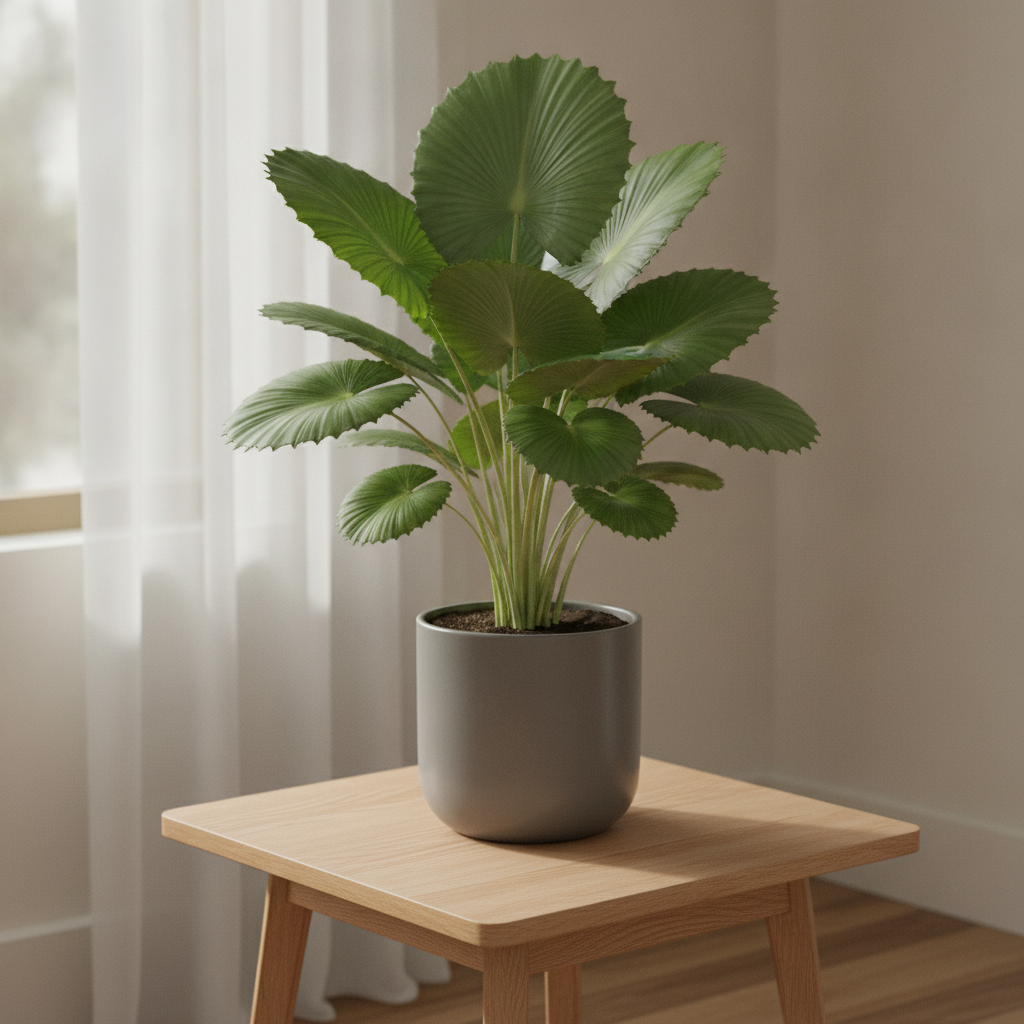
Few houseplants make an entrance quite like the licuala palm. Where most palms split into feathery, divided fronds, Licuala grandis holds each leaf as a single, undivided disc, pleated like a folded paper fan and finished with a finely toothed, scalloped edge. A well-grown specimen looks less like an ordinary pot plant and more like a cluster of glossy green parasols caught mid-open, which is exactly why collectors and interior stylists prize it. It is sometimes sold as the ruffled fan palm or Vanuatu fan palm, and once you have seen those perfect circular leaves in person the common names make immediate sense.
Native to the humid rainforest understorey of Vanuatu and the surrounding islands of the western Pacific, Licuala grandis grows slowly beneath a canopy of taller trees, sheltered from wind and harsh sun. Understanding that origin is the single most useful thing you can do as its keeper, because almost every care decision, from where you place it to how often you reach for the watering can, is really an attempt to recreate that warm, shaded, consistently moist forest floor inside your home. Get close to those conditions and the licuala palm is a calm, long-lived companion. Drift too far from them and it will tell you, politely at first, through browning leaf tips.
In this guide
- Quick reference
- Why the licuala palm is worth growing
- Light
- Watering
- Soil and potting
- Fertilising
- Propagation
- Pests and problems
- Varieties and relatives
- Frequently asked questions
Quick reference
The table below summarises everything the licuala palm needs at a glance. Each point is expanded in the sections that follow, but if you keep only this much in mind you will already be ahead of most first-time keepers.
| Botanical name | Licuala grandis |
| Common names | Ruffled fan palm, Vanuatu fan palm, Palas palm |
| Family | Arecaceae |
| Native range | Vanuatu and the Solomon Islands, western Pacific |
| Light | Bright, indirect light or dappled shade; no harsh direct sun |
| Water | Keep evenly moist; never let the rootball dry out fully |
| Humidity | High, ideally 60 per cent or more |
| Temperature | 18 to 29 degrees Celsius (64 to 84 Fahrenheit) |
| Soil | Rich, moisture-retentive and free-draining, slightly acidic |
| Fertiliser | Balanced palm feed, monthly through the growing season |
| Propagation | Seed only; cannot be divided or taken from cuttings |
| Mature size indoors | Around 1.5 to 2 metres (5 to 6.5 feet) over many years |
| Growth rate | Slow |
| Toxicity | Non-toxic to cats, dogs and people |
Why the licuala palm is worth growing
The obvious answer is the foliage. In a genus of more than a hundred fan palms, Licuala grandis is the one that took the fan idea to its logical extreme and kept the leaf whole, so instead of the segmented, finger-like divisions you see in most fan palms, each blade forms an almost complete circle of pleated tissue that can reach 60 to 100 centimetres across on a settled plant. Held on slim green stalks and layered one above another, those leaves give the plant a sculptural, architectural quality that photographs beautifully and anchors a room without needing anything else beside it.
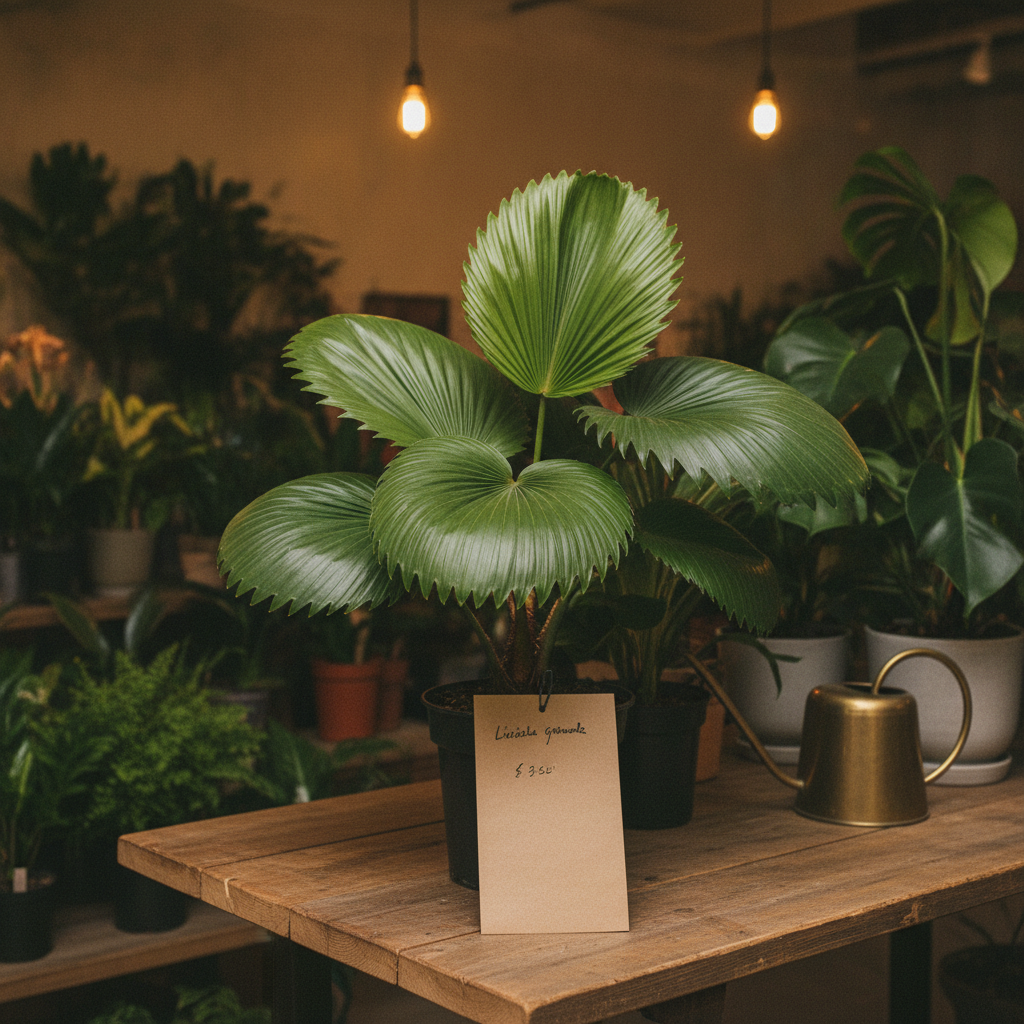
Beyond looks, there are practical reasons to choose one. It is a genuinely slow grower, which means it will not outgrow a well-chosen spot for years, and it stays comfortably in scale with a living room or bright office long after faster palms have hit the ceiling. It is also non-toxic, so unlike the misleadingly named sago palm, which is actually a cycad and highly poisonous, a true licuala palm is safe around cats, dogs and curious children. And because it is an understorey species, it copes with the lower, filtered light of an interior far better than sun-loving palms that sulk away from a window.
The honest counterpoint is that the licuala palm asks for a little more attention than a pothos or a snake plant. The difference between a plant that merely survives and one that truly thrives comes down to humidity and consistent moisture. A neglected specimen will hang on for a long time, slowly accumulating crisp brown edges on its beautiful leaves, while a well-tended one produces one flawless new disc after another. Nothing about that care is difficult, but it does reward routine, and that is the frame to hold onto as you read the sections below.
Light
In the wild, young licuala palms spend their lives on the forest floor, dappled by whatever light filters down through the trees above them. Recreating that at home means giving the plant bright but indirect light, the kind you find a metre or two back from an east or north-facing window, or beside a south or west window screened by a sheer curtain. It will register the difference between good light and poor light in the pace of its growth, producing new leaves more readily and holding a deeper green where light is generous, and stalling into near-dormancy in a dim corner.
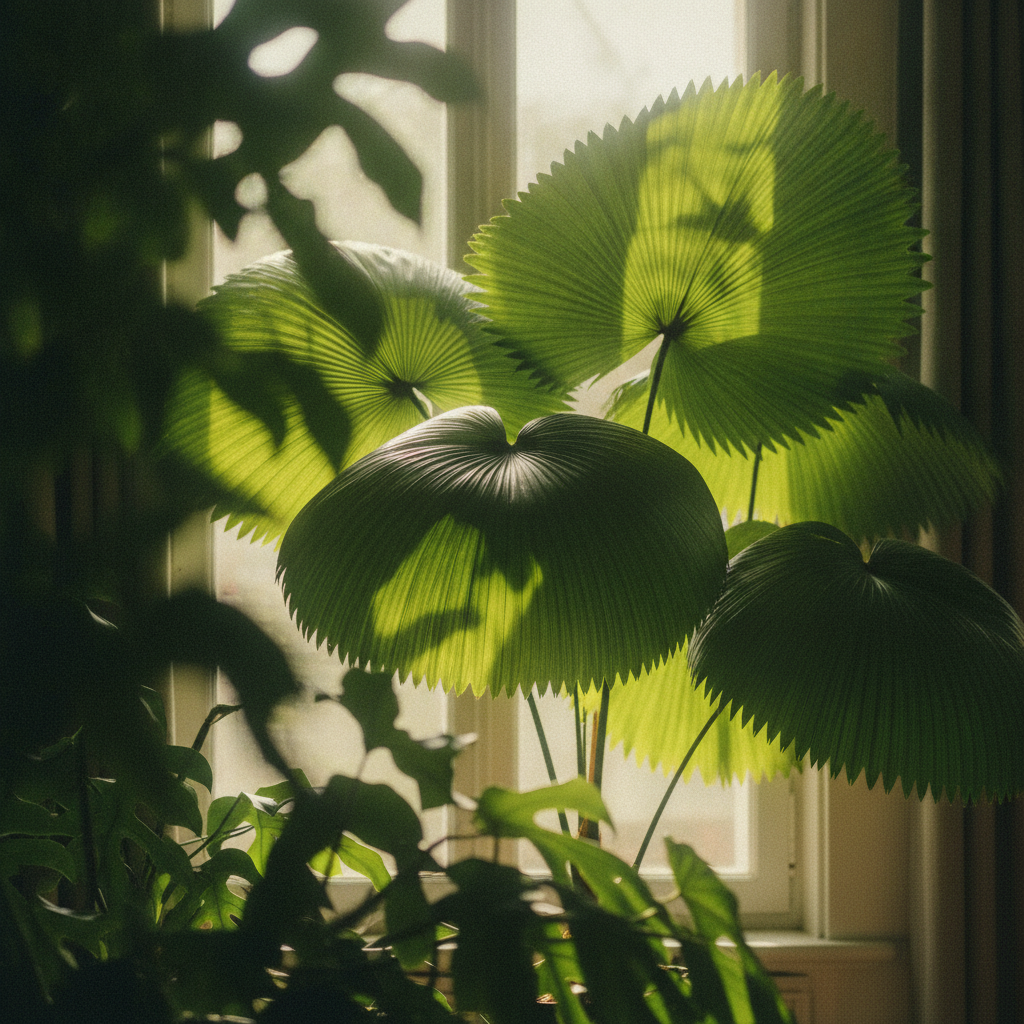
What it will not forgive is prolonged, direct midday sun striking the leaves. Those large, thin blades are built to gather scattered light, not to withstand a full solar beam, and an unshaded south window in summer can bleach and scorch them within days, leaving pale, papery patches that never recover. If your only bright spot is a sunny window, place the palm a little to the side or diffuse the glare, and let it acclimatise gradually rather than moving it from shade into strong light overnight. A few weeks of soft morning sun is fine and often welcome; hours of harsh afternoon light are not.
Pro Tip — Even growth: Rotate the pot a quarter turn each week so every leaf receives its share of light. Because the plant grows so slowly, an untended specimen will lean noticeably toward the window over a season, and gentle regular rotation keeps the crown balanced.
Watering
If light sets the pace of growth, water sets the health of the leaves, and the licuala palm has firm opinions here. Coming from a habitat where the soil rarely dries out completely, it likes to be kept evenly and consistently moist, more so than most houseplant palms. The aim is a rootball that feels like a wrung-out sponge: damp throughout, never waterlogged and never bone dry. Allowing it to dry out fully, even once, tends to show up a week or two later as browning leaf tips and edges, and on a plant grown for its perfect discs that damage is both permanent and conspicuous.
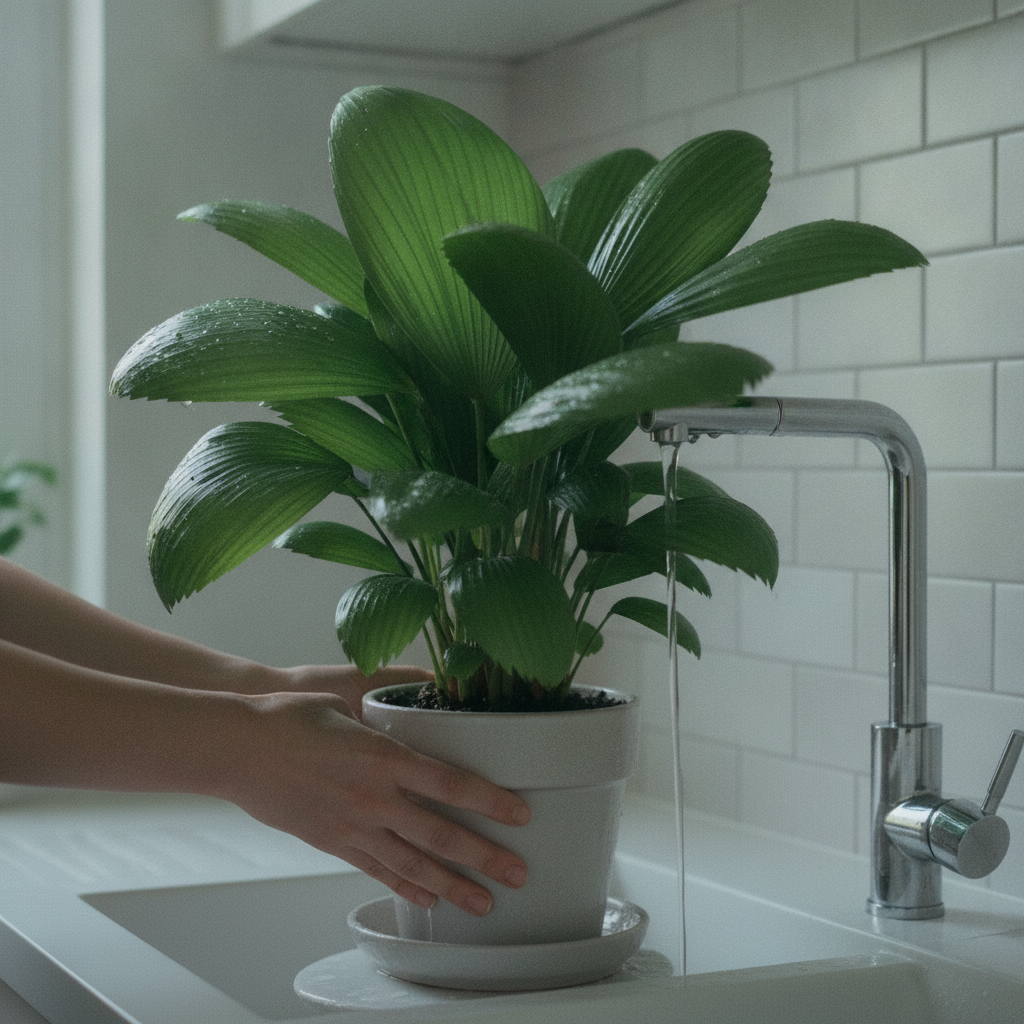
In practice, water thoroughly whenever the top two to three centimetres of the mix begin to feel dry to the touch, letting water run right through the pot until it flows from the drainage holes, then tip away anything that collects in the saucer. In a warm, brightly lit room through spring and summer that might mean watering two or three times a week; in the shorter, cooler days of winter the plant slows and needs noticeably less, so let the surface dry a fraction more between drinks and check by feel rather than by calendar. The one thing to avoid at all costs is a pot standing permanently in water, because constantly saturated roots suffocate and rot as surely as dry ones desiccate.
Water quality matters more for this palm than for tougher plants. Like many members of its family, Licuala grandis can be sensitive to the fluoride and dissolved salts in hard tap water, which accumulate in the leaf margins and contribute to that familiar brown-tip scorch. If your tap water is heavily treated and you notice tip burn despite good watering habits, switch to rainwater, distilled water or filtered water, or at least let tap water stand overnight before using it.
Humidity deserves a mention alongside watering, because the two problems look identical on the leaf. This is a rainforest plant that is happiest above 60 per cent relative humidity, and ordinary heated or air-conditioned rooms are far drier than that. Grouping it with other plants, standing it on a wide tray of damp pebbles, or running a small humidifier nearby all help; a bright bathroom or kitchen is often the easiest home of all. Misting offers only a brief lift and is no substitute for genuinely humid air, so treat it as a pleasant extra rather than a strategy.
Warning — Brown tips: Crisp brown leaf edges are the licuala palm’s universal distress signal, and they can mean low humidity, underwatering or a build-up of salts from hard water or over-feeding. Work through those causes in order before assuming the worst, and trim only the dead tissue, following the natural line of the leaf, since cutting into living green invites further browning.
Soil and potting
The licuala palm needs a growing medium that manages a careful balancing act: it must hold enough moisture to keep the roots evenly damp, yet drain freely enough that water never sits and turns the mix sour. A plain bag of general houseplant compost, used on its own, tends to stay too wet and compacted for comfort, so it pays to open it up. A reliable recipe is roughly two parts good-quality peat-free or coir-based potting mix, one part fine orchid bark or composted pine bark for structure, and one part perlite or coarse horticultural grit to keep air moving around the roots. The result should feel light and springy, dark and moisture-retentive but studded with visible chunky particles.
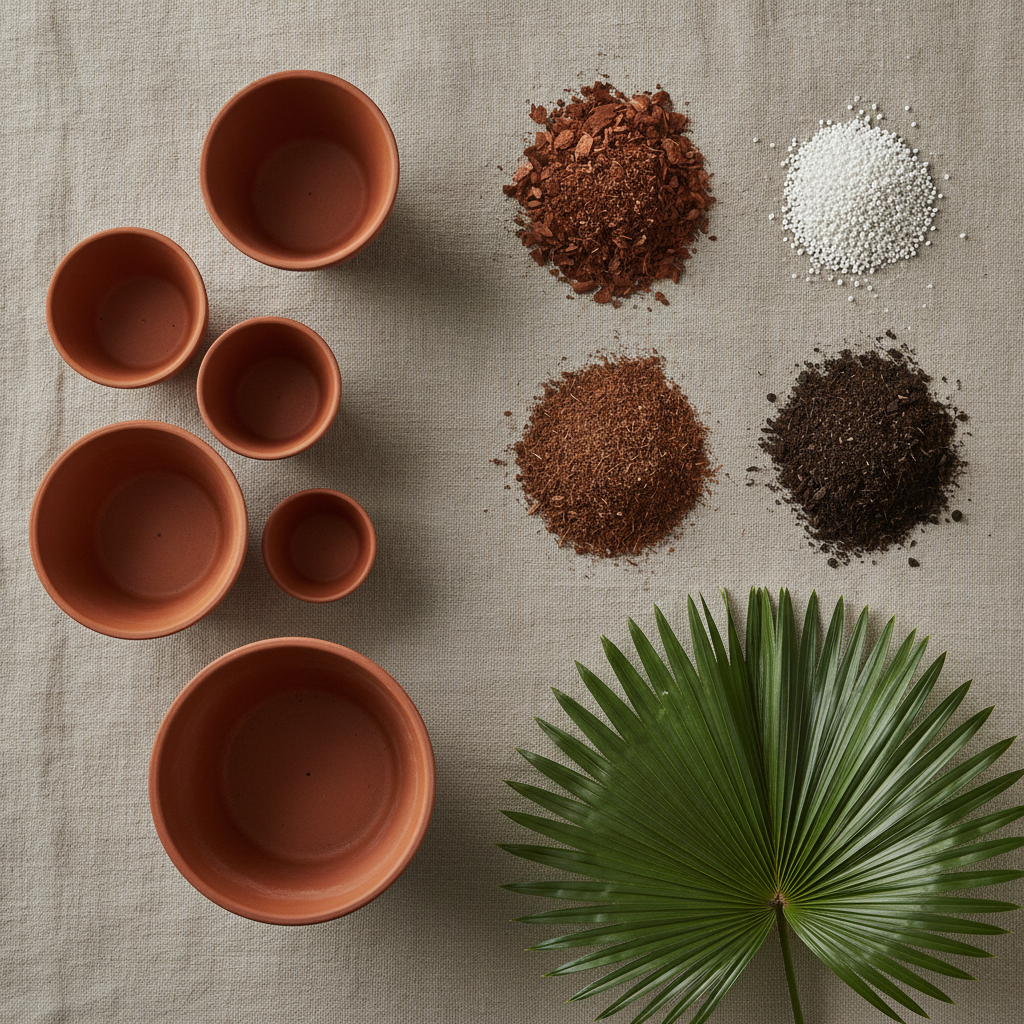
Licuala palms are naturally slightly acidic-soil plants, and a coir or peat-based blend sits comfortably in the mildly acidic range they prefer, so there is no need to fuss over exact figures. What matters more is the pot. Choose one with generous drainage holes, and resist the temptation to over-pot: a container only slightly larger than the rootball keeps the mix from staying wet in unused corners, which is far safer for a moisture-loving palm than a cavernous pot that never dries.
Because the plant grows so slowly, it needs repotting only every two to three years, or when you see roots creeping from the drainage holes or circling tightly at the surface. Spring is the ideal moment, as the plant moves into active growth and recovers fastest. Handle the rootball gently and disturb it as little as you can, since palms resent root damage and can be slow to forgive it, and step up by just one pot size rather than moving to something dramatically bigger. In the years between repottings, refreshing the top few centimetres of mix each spring gives a useful nutritional boost without any disturbance to the roots at all.
Fertilising
The licuala palm is a modest feeder, and its slow metabolism means it neither wants nor can use large amounts of fertiliser. Through the growing season, from spring into early autumn, a balanced liquid feed diluted to half the recommended strength and applied roughly once a month is plenty. A fertiliser formulated specifically for palms is worth seeking out, because palms have a well-documented appetite for magnesium, manganese and potassium, and these blends supply those micronutrients in the right proportions rather than leaving the plant to develop the yellowing and frizzled new growth that signals a deficiency.
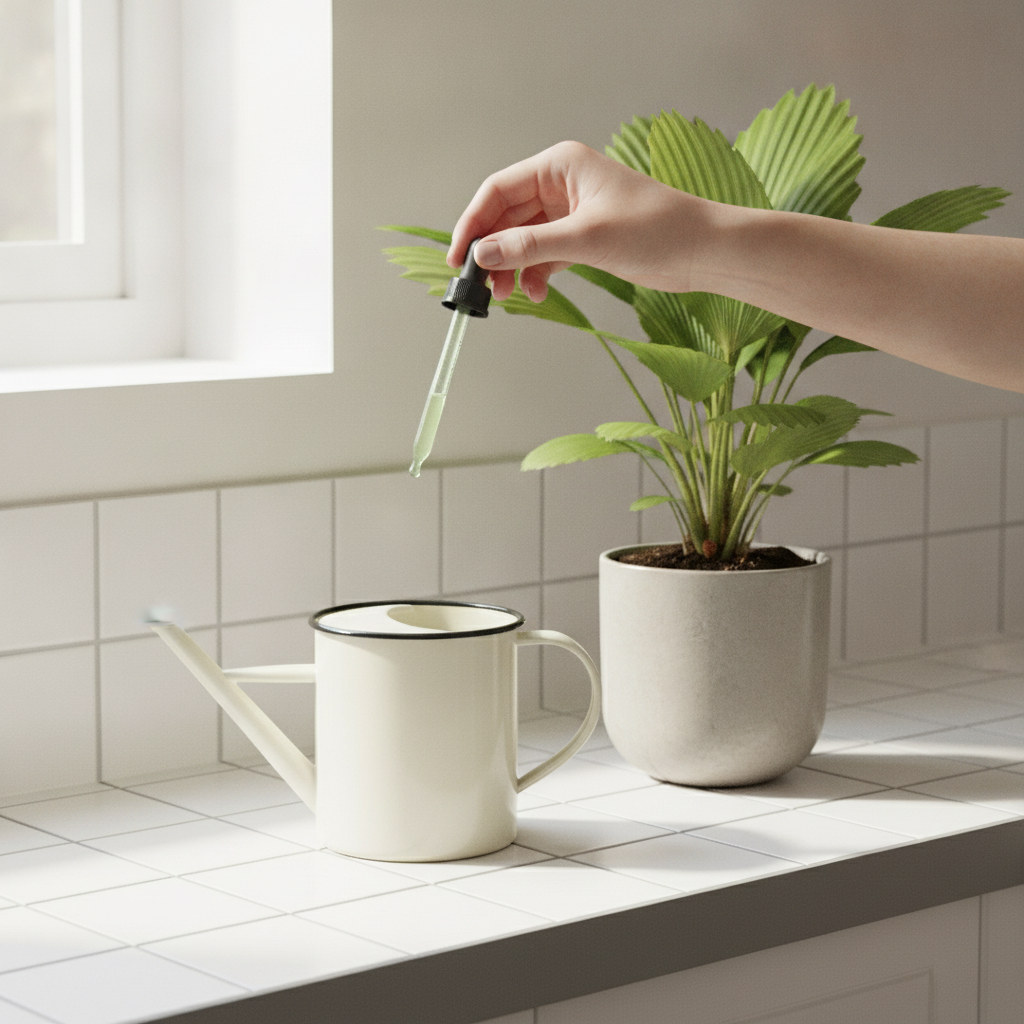
Always feed onto already-moist soil rather than a dry rootball, because concentrated fertiliser drawn into dry roots can scorch them, and never be tempted to compensate for slow growth by feeding more heavily. Over-feeding is one of the commonest ways to damage this palm: the excess salts build up in the mix, draw moisture out of the roots and reappear as, once again, brown leaf tips. When growth naturally slows in late autumn and winter, stop feeding altogether and let the plant rest until the days lengthen. If you ever suspect you have overdone it, flushing the pot with several potfuls of plain water will wash the accumulated salts out through the drainage holes.
Propagation
Here is where the licuala palm parts company with most popular houseplants. It is a solitary, single-stemmed palm that grows from a single central point, which means there is no way to divide it, no offset or pup to detach, and no cutting that will ever take root. Snapping off a leaf or a section of stem simply wounds the plant and gains you nothing. The only route to a new licuala palm is seed, and that is as true for the hobbyist as it is for the commercial nursery, which is part of why healthy specimens carry the price they do.
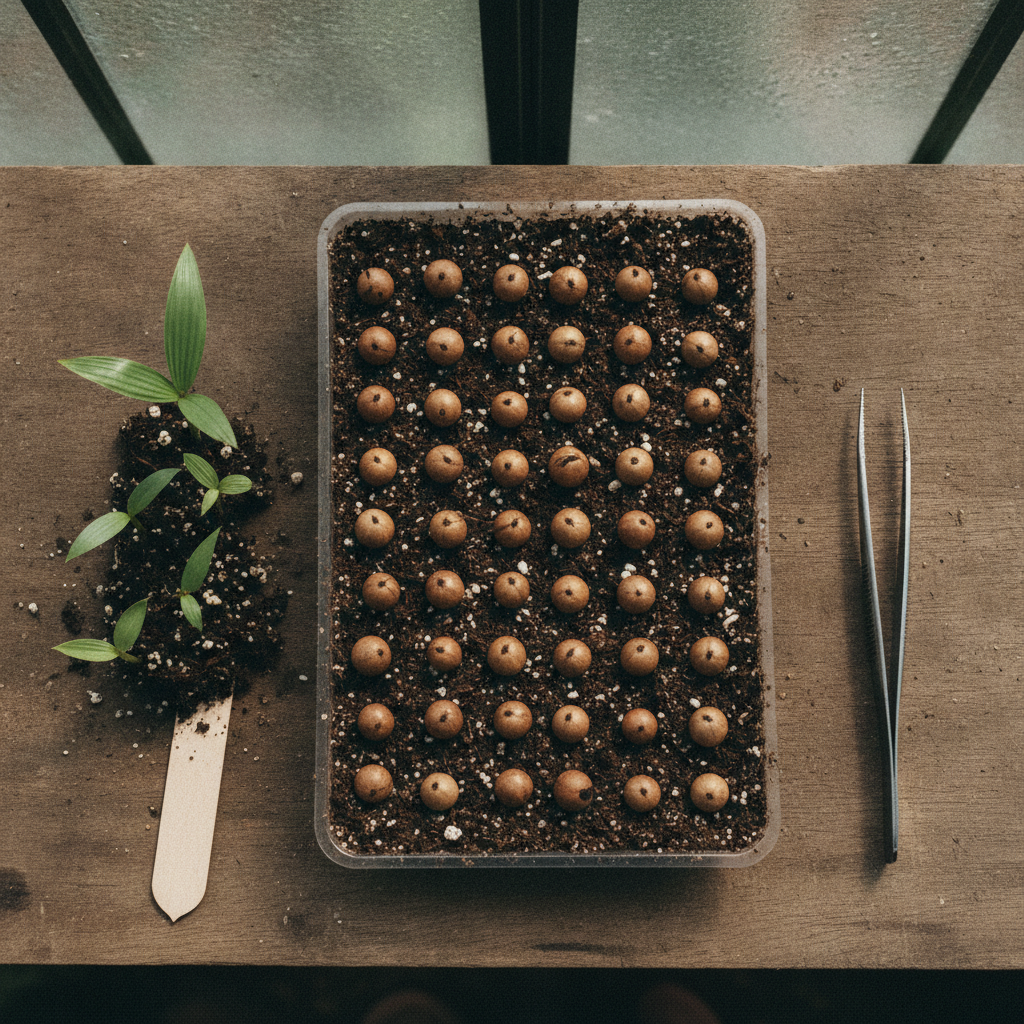
Growing from seed rewards patience above all else. Fresh seed germinates far more reliably than old, so buy from a source with good turnover, and expect the process to unfold over weeks and months rather than days. The steps below outline a workable method for anyone who wants to try.
- Soak the seeds in warm water for one to two days, changing the water once, to soften the seed coat and rehydrate the kernel.
- Sow them just below the surface of a moist, free-draining seed mix, spacing them so each has room to send down a root.
- Keep the tray consistently warm, ideally between 25 and 30 degrees Celsius (77 to 86 Fahrenheit), as bottom heat from a propagation mat dramatically improves both speed and success.
- Maintain high humidity by covering the tray with a clear lid or placing it inside a loose plastic bag, ventilating occasionally to keep mould at bay.
- Keep the mix evenly moist but never soggy, and be prepared to wait, since germination commonly takes two to three months and sometimes longer.
- Once each seedling has produced its first strap-like leaf and a small root system, pot it up individually into the standard mix and grow it on in warm, bright, humid conditions.
The circular adult leaves do not appear straight away. Seedlings begin with simple, undivided strap leaves and only develop the characteristic pleated fan shape as they mature over several years, so raising one from seed is very much a project for the long game rather than a quick win.
Pests and problems
A licuala palm kept in humid, well-lit conditions is rarely troubled by pests, but the dry indoor air that stresses the plant is exactly what its main enemy loves. Spider mites are the pest to watch, and they thrive in the same warm, dry rooms that give the palm brown tips, colonising the undersides of the leaves and spinning fine webbing in the leaf folds. Their damage shows first as a faint yellow stippling across the leaf surface. Mealybugs, appearing as small white cottony tufts in the leaf axils, and scale insects, showing up as flat brown limpets along the stalks, are the other two to keep an eye out for.
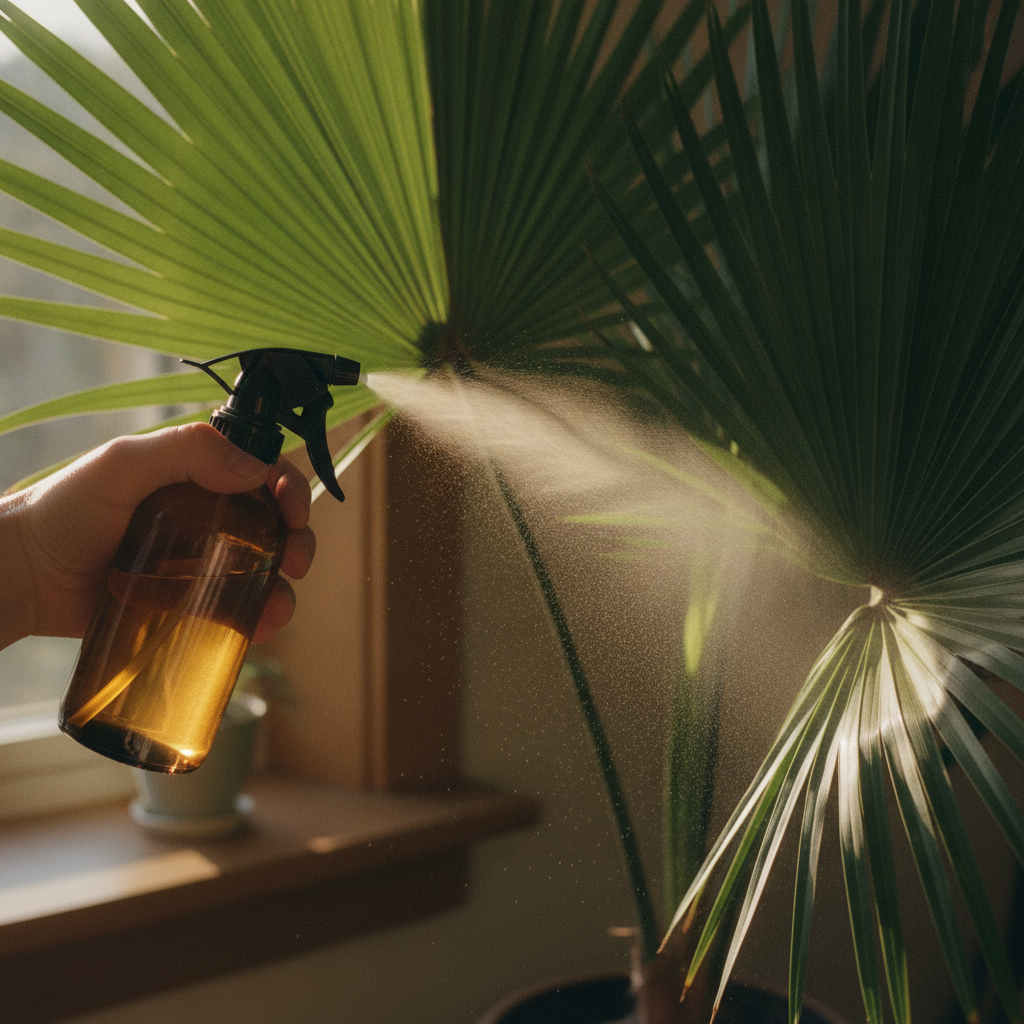
The best defence is regular inspection paired with the humidity the plant wants anyway, since raising the moisture in the air makes life difficult for spider mites while making it comfortable for the palm. When you do find an infestation, wipe the large leaves down on both sides with a damp cloth to remove the bulk of the pests, then treat with a spray of insecticidal soap or diluted neem oil, repeating every week or so until the problem clears. Because those broad leaves offer so much surface area, wiping them periodically as part of normal care both deters pests and lets the plant breathe and photosynthesise more efficiently.
Most complaints about the licuala palm, though, are not pests at all but cultural problems written on the leaves. Brown, crispy tips and edges point to low humidity, inconsistent watering or a salt build-up from hard water or over-feeding. Yellowing of an entire leaf, especially lower down, usually reflects overwatering and soggy roots, though a very old leaf will yellow and die naturally in time. Pale, bleached patches mean the plant has caught too much direct sun. And a plant that simply refuses to grow is almost always telling you it is too dark, too cold or too dry at the roots. Read the leaves as a diagnostic chart, change one thing at a time, and the palm will steadily right itself.
Pro Tip — Torn leaves are normal: Do not panic if an older leaf splits or tears along its pleats. In the wild these large blades naturally fray in the wind, and a little tearing on an indoor plant is cosmetic rather than a sign of ill health. It is the colour and firmness of the leaves, not the odd split, that tell you how the plant is really doing.
Varieties and relatives
Licuala grandis is almost always sold as the true species rather than as named cultivars, and its perfectly entire circular leaf is the reason it stands out from its relatives. The wider Licuala genus, however, contains more than a hundred species, several of which turn up in cultivation and are worth knowing if the ruffled fan palm has caught your interest. Two in particular make instructive companions, one more divided than grandis and one even grander.
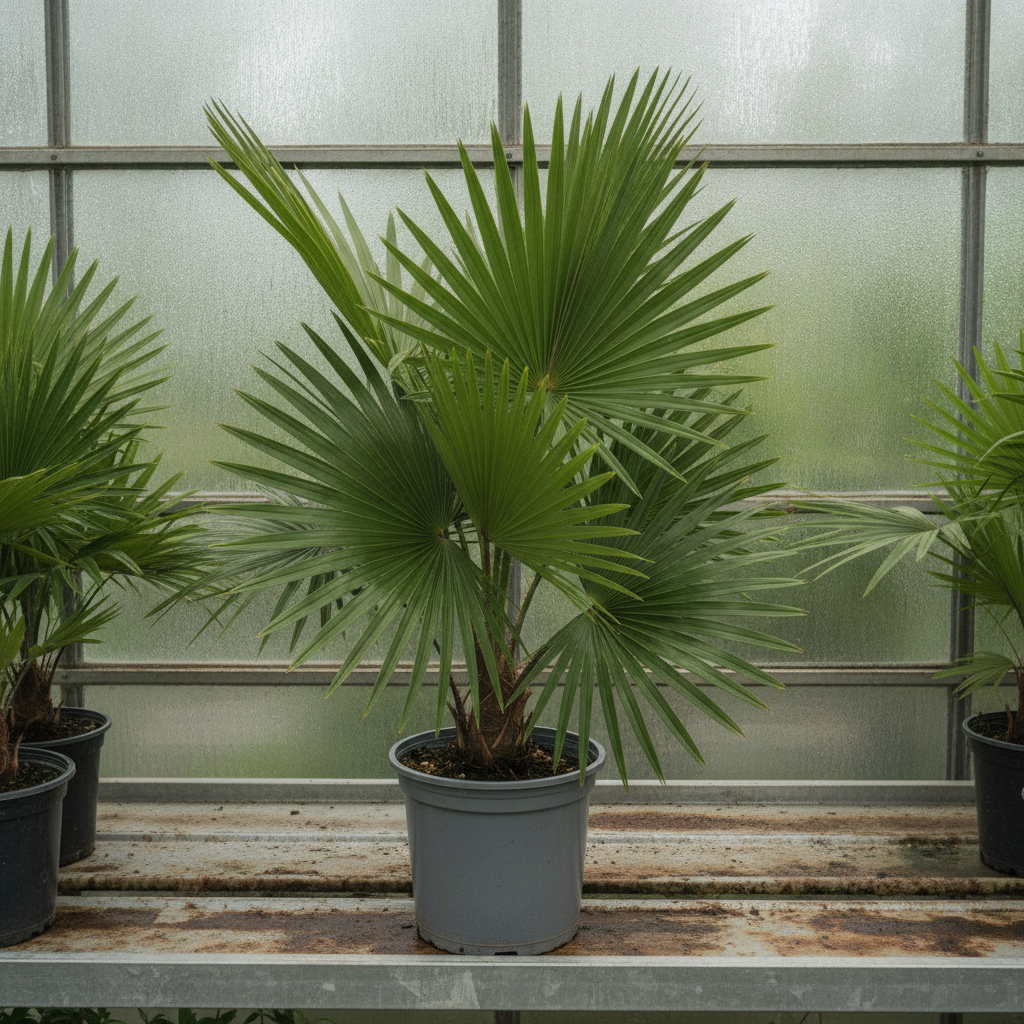
Licuala spinosa
The mangrove or spiny fan palm is a clustering species whose circular fronds are split into many narrow, wedge-shaped segments radiating from the centre, giving a spikier, more divided look than the whole-leaved grandis. Because it suckers freely, it forms a bushy clump over time and is more tolerant of light and open positions, making it a good choice for a bright conservatory where a single-stemmed palm might look sparse.
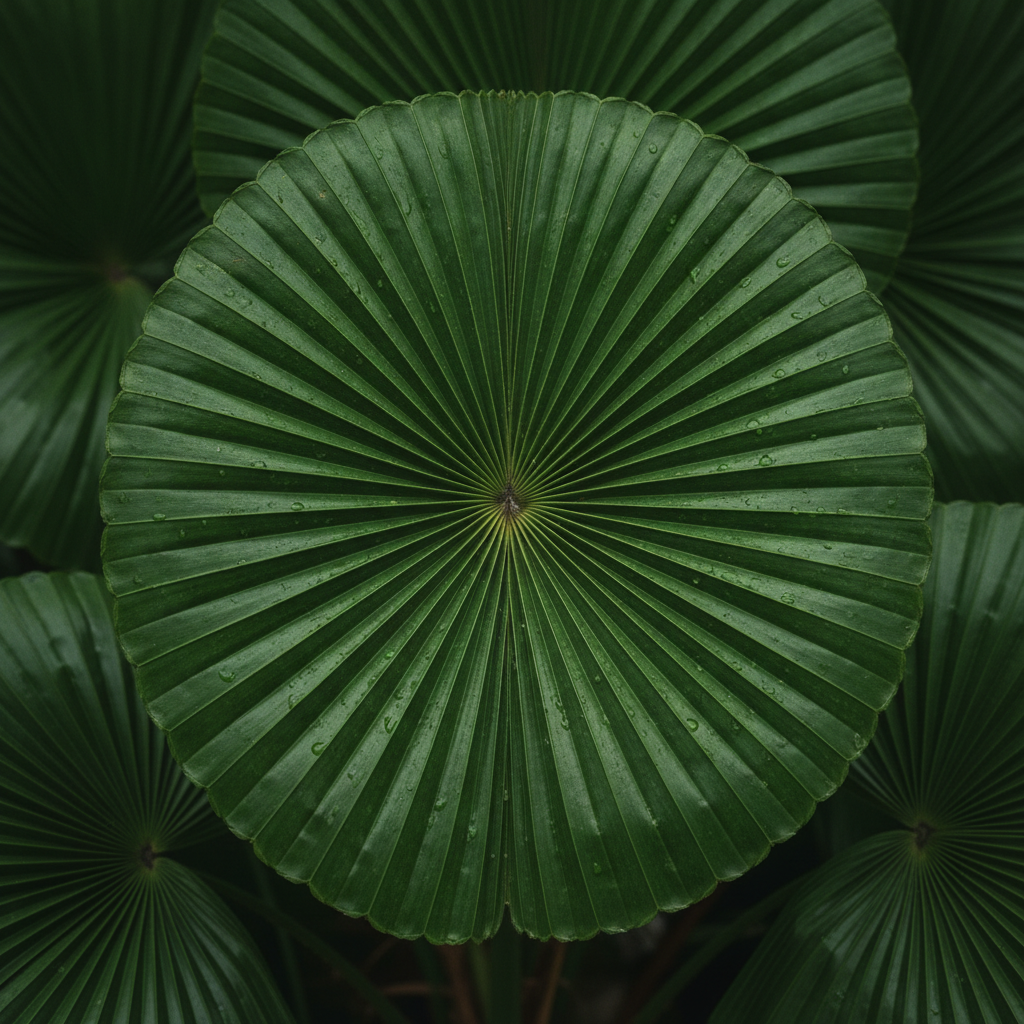
Licuala peltata var. sumawongii
For those who love the entire circular leaf of grandis and simply want more of it, this variety delivers a single, undivided pleated disc that is even larger and more perfectly round, deep glossy green with a smooth margin. It is a bolder, more tropical presence that needs the same warm, humid, shaded conditions, and it makes a spectacular specimen where there is space and humidity enough to grow it well.
Whichever you grow, the care principles remain the same across the genus: warmth, shelter from harsh sun, consistent moisture and generous humidity. Master those for Licuala grandis and you will find its relatives fall comfortably within your reach.
Frequently asked questions
Why does my licuala palm keep getting brown tips?
Brown tips are the plant’s response to dry air, inconsistent watering or a build-up of salts from hard tap water or over-feeding. Raise the humidity around it, keep the rootball evenly moist without letting it dry out, and switch to rainwater or filtered water if your tap water is heavily treated. Trim away only the dead tissue along the natural leaf line, since cutting into living green will simply brown again.
Is the licuala palm safe for cats and dogs?
Yes. Licuala grandis is a true palm and is considered non-toxic to cats, dogs and people. Do not confuse it with the sago palm, which despite its name is a cycad, not a palm, and is highly poisonous to pets. If you specifically want a pet-safe palm, the licuala is a sound choice.
How fast does a licuala palm grow?
Slowly. Even in ideal conditions it may produce only a handful of new leaves in a year, and indoors it takes many years to reach its eventual height of around 1.5 to 2 metres. That leisurely pace is part of its appeal as a houseplant, because it stays in scale with a room for a long time and rarely needs moving on.
Can I propagate a licuala palm from a cutting or by division?
No. It is a solitary, single-stemmed palm with one growing point, so it cannot be divided and will not grow from cuttings. The only way to produce a new plant is from seed, which is slow and needs warmth and patience but is entirely achievable with fresh seed and a heated propagator.
How much light does it need?
Bright, indirect light or dappled shade suits it best, echoing the filtered light of its native forest floor. It tolerates moderately low light better than most palms but grows faster and greener in brighter positions. Keep it out of prolonged direct midday sun, which scorches the thin leaves and leaves permanent pale patches.
Why are the leaves on my licuala palm splitting?
A certain amount of splitting along the pleats is completely natural, since these large blades tear in the wind in the wild and do so indoors too. As long as the leaves are firm and richly green, the odd split is purely cosmetic. Excessive tearing combined with browning or drooping, on the other hand, usually points back to low humidity or dry roots.
Give the licuala palm warmth, shelter, steady moisture and humid air, and it will reward you with one of the most distinctive silhouettes in the houseplant world: a slow, sculptural procession of glossy green fans that few other plants can rival.






