
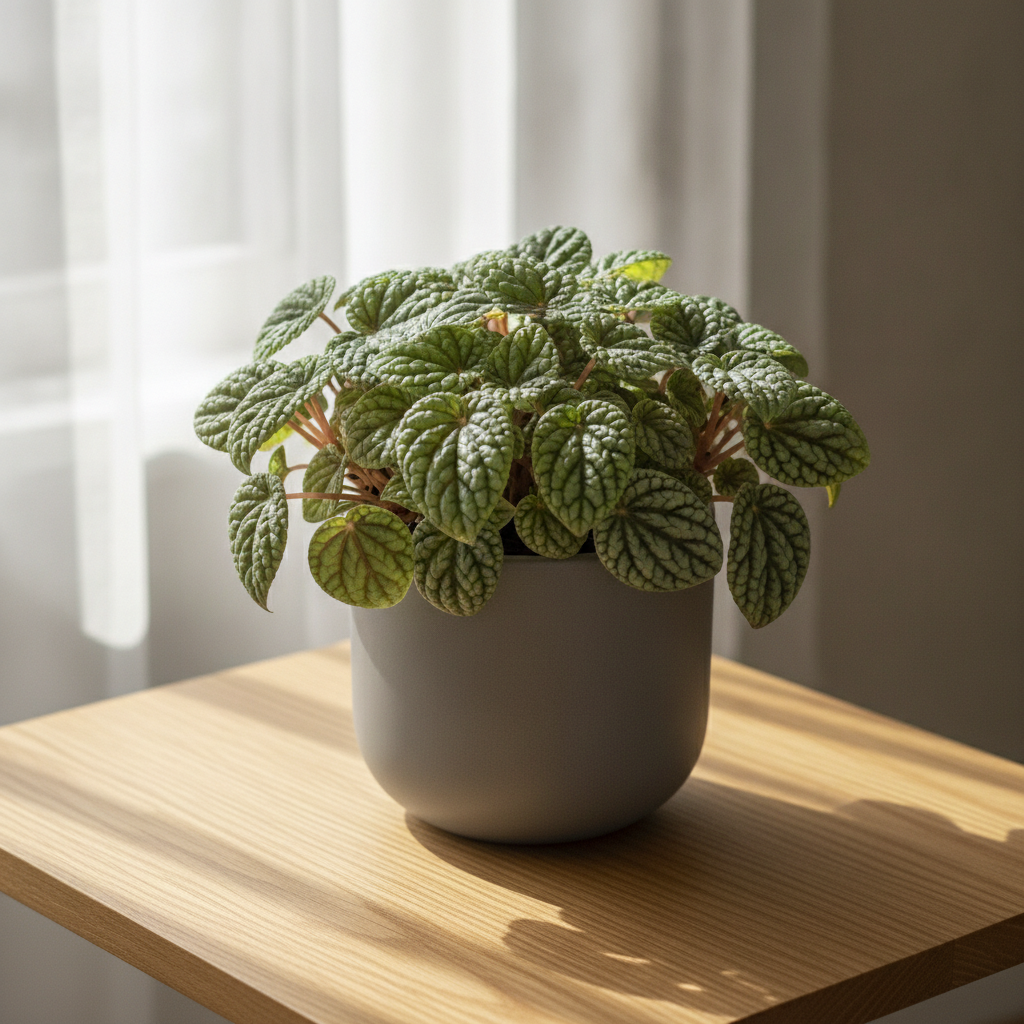
Few small houseplants pack as much textural drama into a windowsill footprint as the silver ripple peperomia. A member of the pepper family, Peperomia caperata is a compact, mound-forming plant from the humid understorey of the Brazilian rainforest, where it grows as a semi-succulent perched among leaf litter and mossy rocks rather than in deep soil. Its heart-shaped leaves are deeply corrugated, folding into a quilted, rippled surface that catches the light in silvery ridges, while short blush-pink petioles hold the rosette in a tidy dome rarely taller than 20 centimetres (8 inches). Gardeners also know it as emerald ripple peperomia, ripple peperomia or simply the caperata peperomia.
Its reputation is that of an easy, forgiving plant, and that is largely deserved. The silver ripple peperomia asks for very little and punishes fuss more than neglect, which makes it a natural choice for beginners, small spaces and anyone who travels. Yet there is a meaningful gap between a plant that merely survives on a shadowy shelf and one that thrives into a full, glossy cushion of foliage that occasionally throws up its curious cream flower spikes. This guide covers everything that closes that gap, from reading its semi-succulent watering needs to choosing the airy compost it secretly craves, propagating new plants from a single leaf, and heading off the handful of pests and diseases that trouble it.
Contents
- Quick Reference
- Why Silver Ripple Peperomia Makes a Great Houseplant
- Light Requirements
- Watering & Humidity
- Soil, Potting & Repotting
- Fertilising
- Propagation
- Pests & Diseases
- Popular Varieties
- Frequently Asked Questions
Quick Reference: Silver Ripple Peperomia at a Glance
| Light | Bright, indirect light; tolerates medium light. No harsh direct sun. |
| Watering | Let the top half of the compost dry out. Roughly every 7 to 10 days in summer, every 2 to 3 weeks in winter. |
| Temperature | 18 to 26°C (65 to 79°F). Keep above 10°C (50°F). |
| Humidity | Moderate, 40 to 60 percent. Tolerates average room humidity. |
| Fertiliser | Balanced feed at half strength, monthly in spring and summer only. |
| Toxicity | Non-toxic to cats, dogs and humans. Safe around pets and children. |
Why Silver Ripple Peperomia Makes a Great Houseplant
The strongest case for the silver ripple peperomia is that it fits almost any home. Its compact size means a mature specimen sits happily on a desk, a bathroom shelf or a crowded plant stand without crowding out its neighbours, and it never demands the floor space or the head height that a fiddle leaf fig or a monstera eventually claims. That small stature also makes it an excellent plant for renters and city dwellers, who can build a varied collection on a single sunny sill.
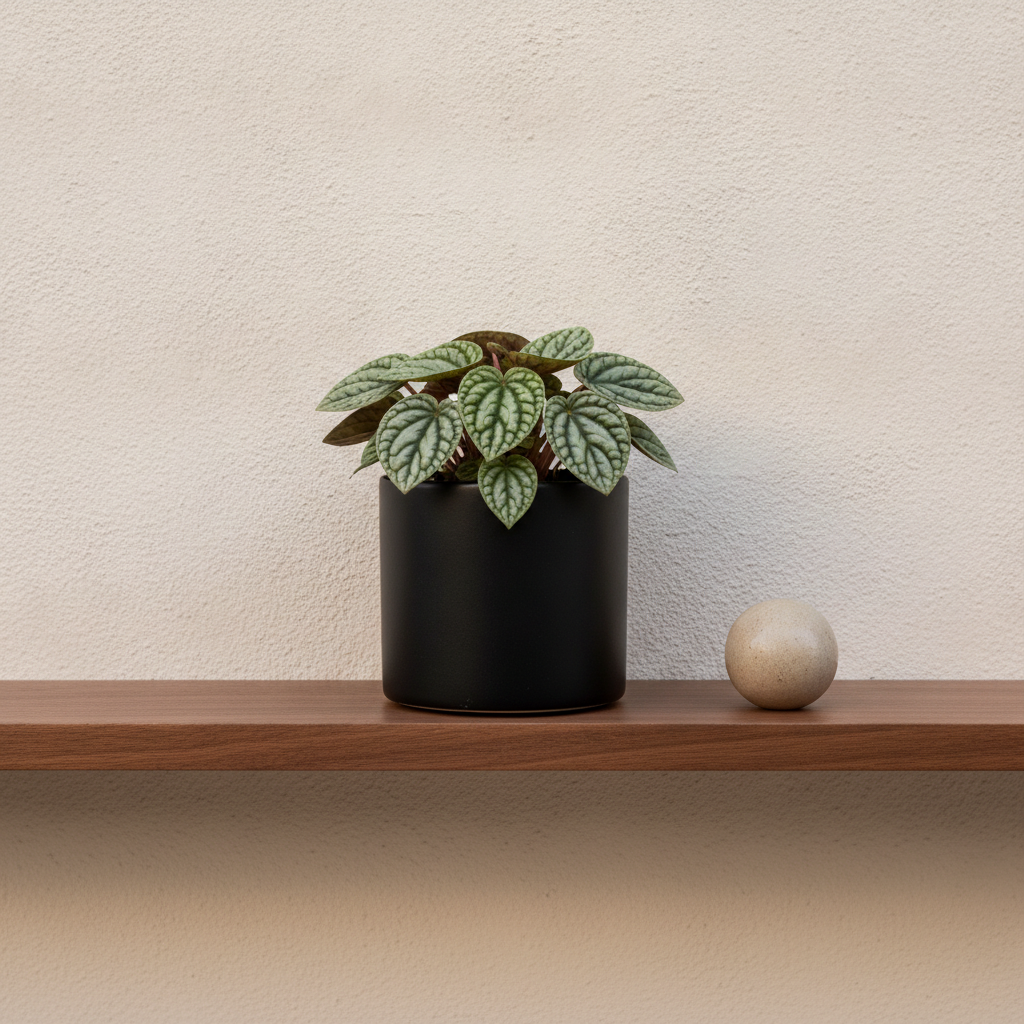
Beyond convenience, the plant earns its place on looks and resilience. The rippled foliage reads as sculptural rather than fussy, and because the leaves are semi-succulent and hold their own water, the plant shrugs off the occasional missed watering that would flatten a fern or a calathea. It is also entirely non-toxic, which sets it apart from many popular foliage plants. According to the ASPCA, peperomias are safe for both cats and dogs, so a curious pet that takes a nibble faces nothing worse than an upset stomach, and there is no need to banish the plant to a high shelf out of reach of children.
Important — Toxicity: Silver ripple peperomia is listed as non-toxic to cats, dogs and horses by the ASPCA, and it is not known to be poisonous to humans. It remains sensible to discourage pets from chewing any houseplant, as the fibrous leaves can still cause mild digestive upset if eaten in quantity.
Light Requirements
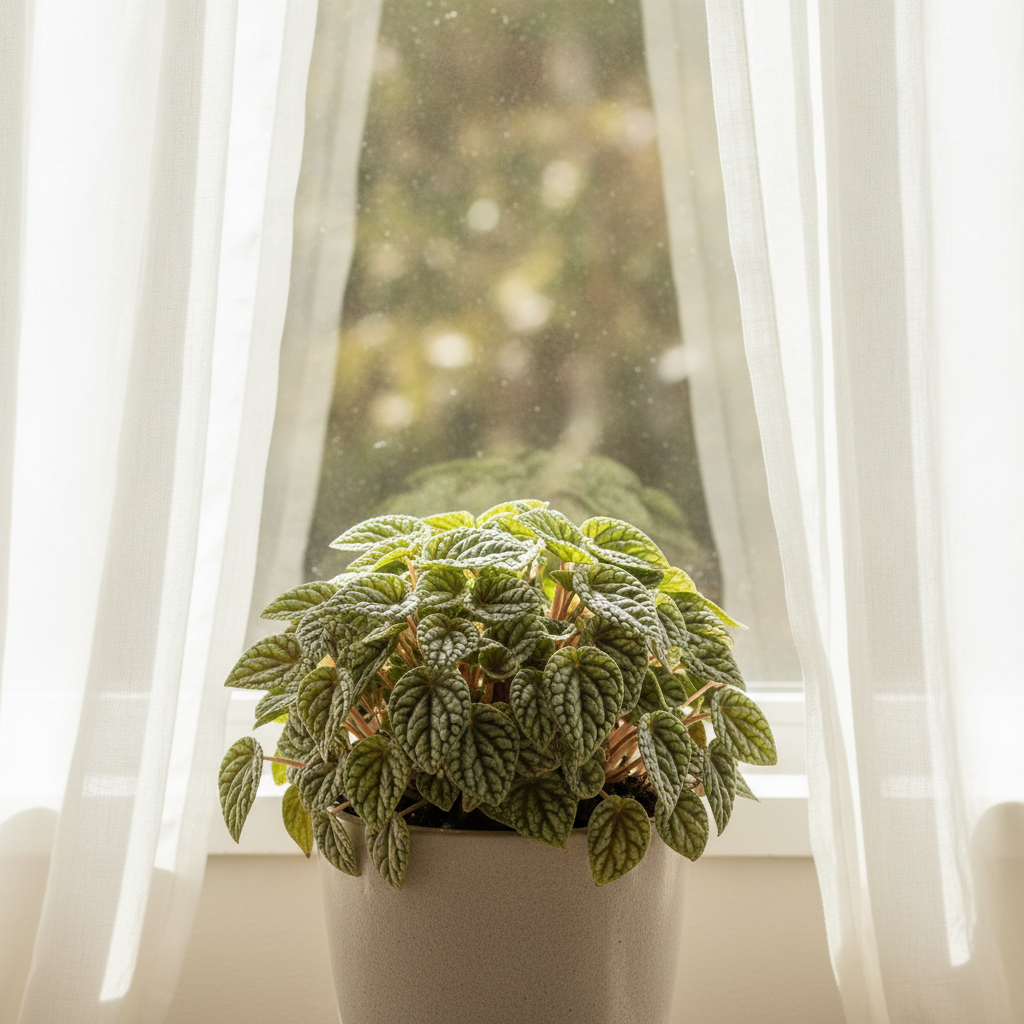
In the wild, Peperomia caperata grows on the shaded forest floor beneath a dense canopy, so it is adapted to dappled, filtered light rather than open sun. Translated to the home, this means bright indirect light is the sweet spot: enough brightness to keep the rosette tight and the silvery ridges well defined, but no scorching midday rays falling directly on the leaves.
A position a metre or two back from a bright window, or directly beside a window screened by a sheer curtain, will keep the plant compact and richly coloured. Give it too little light and the neat mound stretches, the petioles lengthen and lean toward the nearest source, and the whole plant grows loose and pale. Give it too much direct sun and the leaves bleach, develop dry brown patches and can crisp at the edges. The plant genuinely thrives, rather than merely survives, when it sits in steady, gentle brightness for most of the day.
Light Levels Explained
Light in a room falls away far more quickly than the eye suggests, because the human eye adjusts constantly while a plant responds to the actual intensity reaching its leaves. The table below sets out the broad light tiers and where the silver ripple peperomia performs in each.
| Light Category | Approx. Level | Typical Location | Outcome |
|---|---|---|---|
| Direct sun | 20,000 lux and above | On an unscreened south or west sill | Too intense; bleaching and scorch |
| Bright indirect | 10,000 to 20,000 lux | Beside an east window or screened south window | Ideal; tight rosette, strong colour |
| Medium | 5,000 to 10,000 lux | A metre or two into a bright room | Good; slightly slower growth |
| Low | 1,000 to 5,000 lux | North room, away from the window | Tolerated; leggy, muted colour |
| Very low | Below 1,000 lux | Interior corner, hallway | Decline; consider a grow light |
Window Orientation and Placement
South-facing window: The brightest exposure in the northern hemisphere. Excellent for this plant provided the glass is screened by a sheer curtain or the plant is set back a little from the sill, so that the light is bright but never direct at midday.
East-facing window: Arguably the perfect spot. Gentle morning sun followed by bright indirect light for the rest of the day suits the plant’s rainforest origins closely, and the early rays are rarely strong enough to scorch.
West-facing window: Workable, but the afternoon sun can be fierce. Pull the plant back from the glass or diffuse the light, and watch for any bleaching on the side facing the window.
North-facing window: The plant will survive here and keep reasonable colour, but growth slows and the rosette may loosen over time. It is a fair winter home, though a brighter aspect suits the growing season better.
Pro Tip — Even Growth: Peperomias grow toward light and quickly become one-sided on a windowsill. Give the pot a quarter turn every time you water and the rosette will stay symmetrical, filling out evenly on all sides.
How Light Affects Leaf Colour and Texture
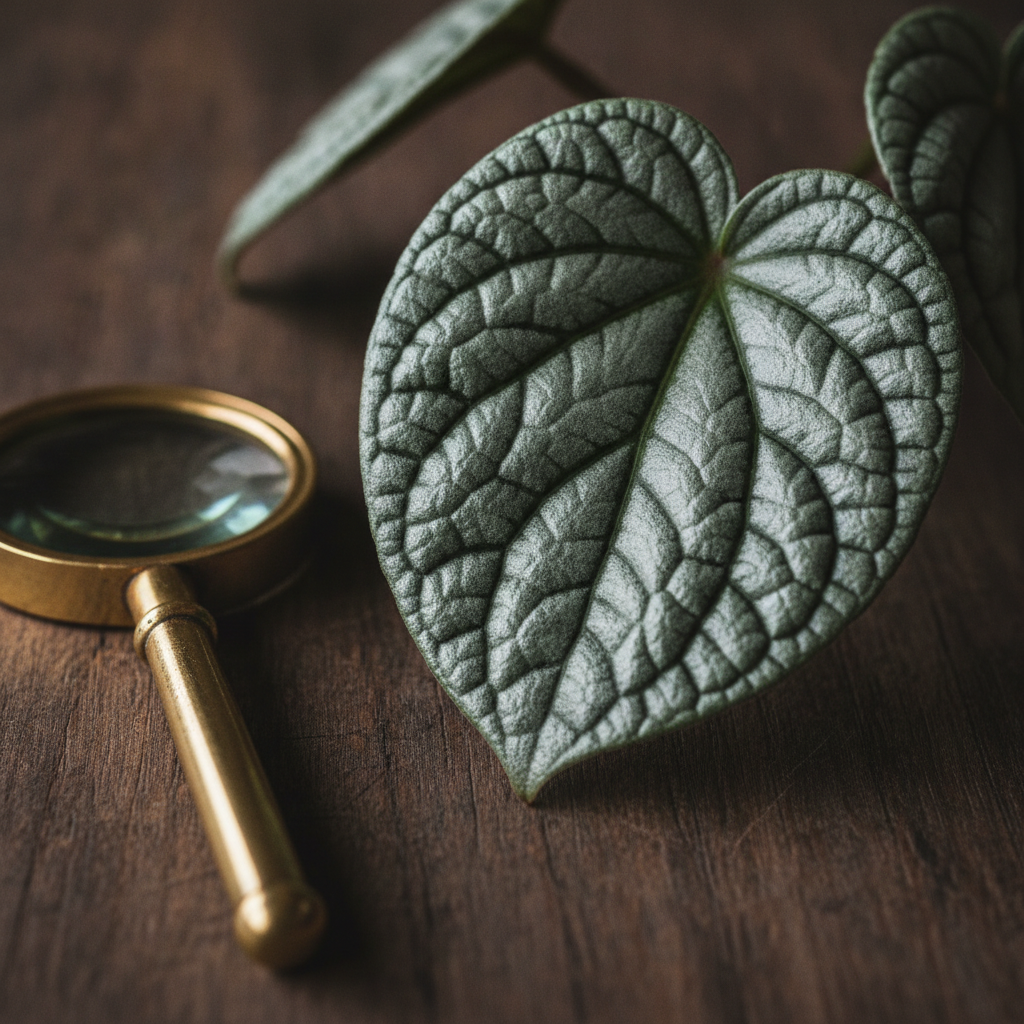
The signature rippling and the silvery cast of the foliage are both light-dependent. In good bright indirect light the leaves stay tightly corrugated and the contrast between the dark green valleys and the pale, reflective ridges is at its sharpest. In dim conditions the same plant produces flatter, larger and thinner leaves on longer petioles, and the metallic sheen fades toward a plain matte green. Variegated and red-flushed cultivars are even more sensitive: their colour is strongest in bright light and washes out in shade, so if you have chosen a plant for its patterning, err toward the brighter end of the range.
Warning — Direct Sunlight: Do not move a plant straight from a shady spot into direct sun. The leaves have no protection built up and will scorch within a day or two, leaving permanent bleached patches. Acclimatise it gradually over a week or more if you want to increase its light.
Artificial Lighting
Because it is compact and content with medium light, the silver ripple peperomia is an ideal candidate for artificial lighting. A modest full-spectrum LED grow light positioned 20 to 40 centimetres (8 to 16 inches) above the plant and run for 10 to 12 hours a day will keep it thriving in a windowless office or a dim corner. This is a practical way to overwinter the plant in northern climates, where natural light drops sharply between November and February.
Seasonal Adjustments
Light intensity indoors can fall by half or more in winter, even on the same windowsill, so a plant that was perfectly placed in July may be starved by January. Move it closer to the glass or to a brighter aspect for the darkest months, then shift it back as the days lengthen. Growth naturally slows in winter regardless, so do not be alarmed by a pause; the plant is simply resting until spring.
Watering & Humidity
Watering is the single most important skill with this plant, and the one that trips up the most owners. The thick, slightly succulent leaves of Peperomia caperata store water, which means the plant is far more tolerant of drought than of soggy roots. The overwhelming majority of silver ripple peperomias that die are killed by kindness, drowned in compost that never gets the chance to dry.
When to Water
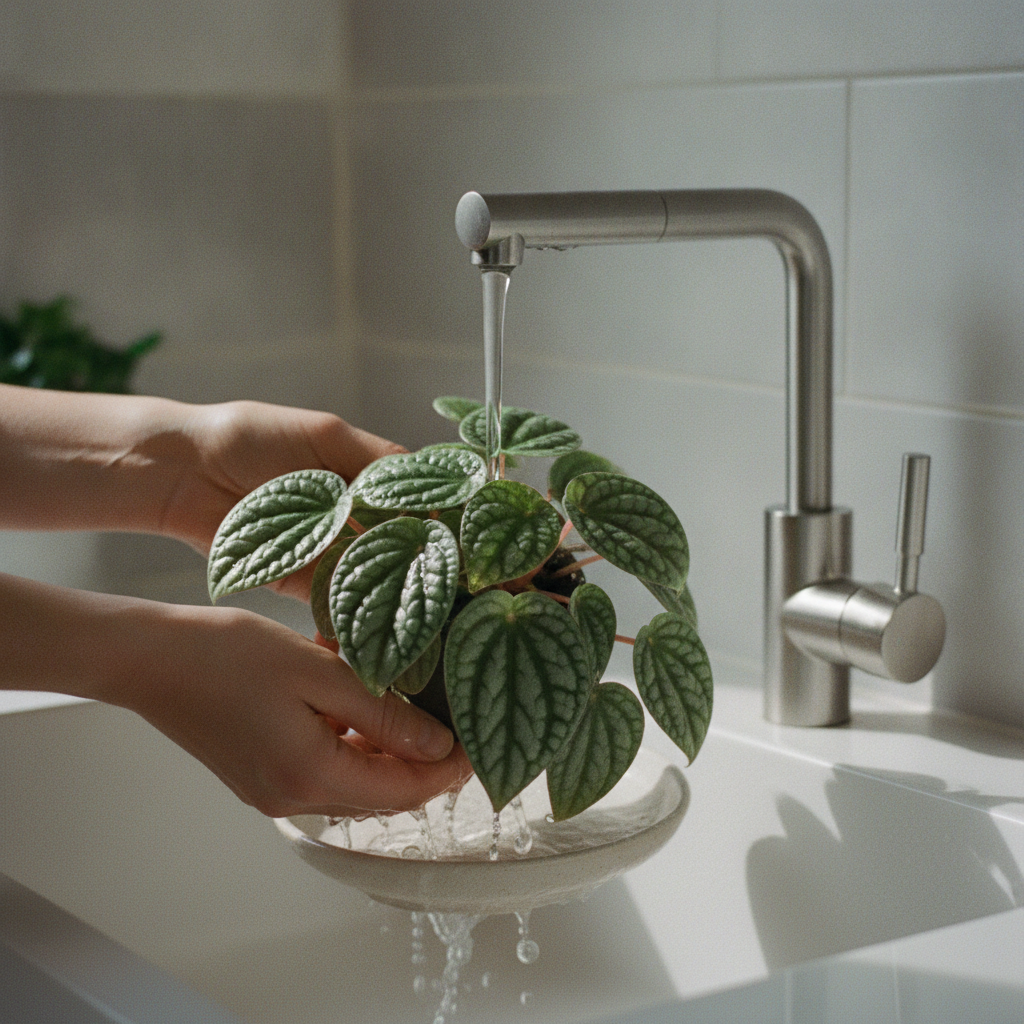
The reliable rule is to water only when the top half of the compost has dried out. Push a finger into the pot to the second knuckle: if it comes out with damp compost clinging to it, wait; if it feels dry to that depth, it is time to water. In a warm, bright room during the growing season this usually works out at roughly once every 7 to 10 days, while in winter the interval often stretches to once every two or three weeks.
Resist the urge to water on a fixed schedule. The correct interval depends on the temperature, the light, the size of the pot and the time of year, all of which shift through the seasons. A plant will always tell you more through the weight of its pot and the feel of its compost than any calendar can. A well-watered pot feels reassuringly heavy; a pot that has dried out feels noticeably light when you lift it, which is a quick and dependable check once you learn the difference.
Pro Tip — Lift the Pot: Learn the weight of your peperomia’s pot right after watering and again once it has dried out. Judging by weight quickly becomes more accurate than any moisture meter, and it costs nothing.
How to Water Correctly
- Check that the top half of the compost is dry before you begin.
- Water at the compost surface, around the base of the plant, taking care to keep water out of the dense crown where it can sit and cause rot.
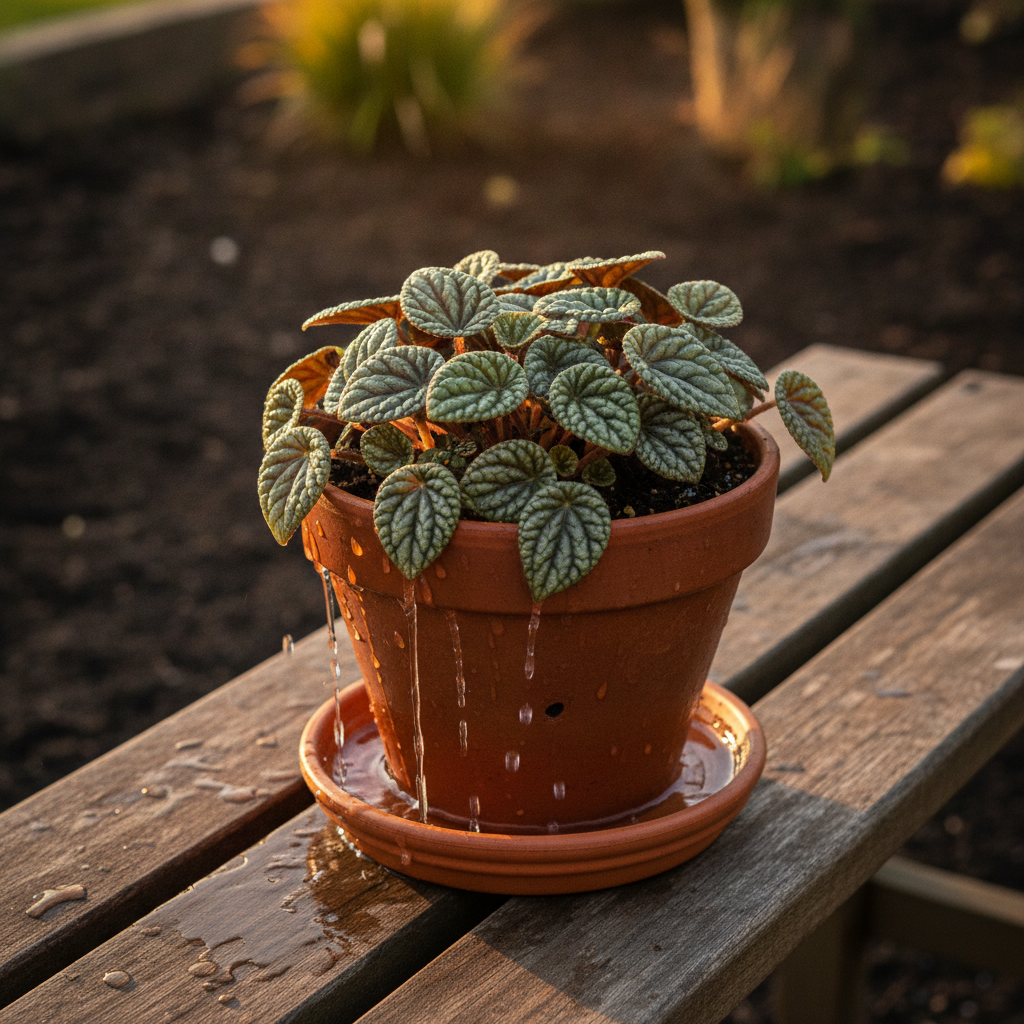
- Add water steadily until it runs freely from the drainage holes, which ensures the entire root ball is moistened.
- Let the pot drain completely for several minutes over a sink or tray.
- Empty the saucer or cover pot so the plant never stands in leftover water.
- Return the plant to its spot and wait until the compost dries to the halfway point before watering again.
Signs of Overwatering vs. Underwatering
| Symptom | Overwatering | Underwatering |
|---|---|---|
| Leaf colour | Yellowing, often several leaves at once | Dulling, with browning tips and edges |
| Leaf texture | Soft, mushy, translucent | Thin, wrinkled, limp and curling |
| Soil | Stays wet for many days, may smell sour | Bone dry, pulling away from the pot sides |
| Roots | Brown, soft and foul-smelling | Dry and papery but generally intact |
| Stem base | Blackened, collapsing at soil level | Firm but shrunken |
The two problems can look similar at a glance because a plant with rotted roots can no longer take up water and so wilts as though it is thirsty. The deciding test is the compost itself: a wilting plant in wet compost is almost always overwatered, while a wilting plant in dust-dry compost simply needs a drink. When in doubt, feel the soil before you reach for the watering can.
Warning — Root Rot: Persistent wet compost is the leading killer of this plant. If the base of the stems turns black and soft, act at once: unpot the plant, cut away all mushy roots and rotten tissue with clean scissors, and repot the healthy remainder into fresh, barely moist, free-draining compost.
Humidity Requirements
As a rainforest plant, the silver ripple peperomia enjoys moderate humidity of around 40 to 60 percent, but its semi-succulent leaves let it cope with the drier air of a typical centrally heated home far better than thin-leaved tropicals such as calatheas. In most rooms it needs no special treatment at all, which is part of its easygoing charm.
The plant will tell you if the air is too dry. Crisping brown leaf edges, slowed growth and a generally lacklustre look can all point to very low humidity, which is most common in winter when heating systems run and the indoor air becomes parched. A kitchen or bathroom, where humidity naturally runs higher, often suits it especially well.
If you do need to raise humidity, the most effective and reliable method is a small electric humidifier running near the plant. Grouping houseplants together also helps, as they release moisture and create a more humid microclimate around one another. A pebble tray filled with water beneath the pot gives a modest lift. Misting, by contrast, does little for humidity and, on a densely packed rosette like this one, can leave water trapped in the crown where it encourages rot, so it is best avoided.
Water Quality
Silver ripple peperomia is not especially fussy about water, and most tap water is perfectly acceptable. In hard-water areas the mineral build-up can, over time, contribute to leaf-tip browning, so if your water is very hard you may prefer to use filtered or collected rainwater. Allowing tap water to stand overnight lets some of the chlorine dissipate and brings it to room temperature, which the roots appreciate more than a cold shock straight from the tap.
Soil, Potting & Repotting
The right compost does more to keep a silver ripple peperomia healthy than almost any other single factor, because it governs how quickly the roots dry between waterings. In the wild the plant roots in a thin, airy layer of decomposing leaf litter and moss with excellent drainage, and the goal indoors is to recreate that: a light, open mix that holds a little moisture but never stays sodden.
Ideal Soil Composition
A plain, dense houseplant compost holds too much water for this plant and invites rot. Instead, start with a peat-free base such as coco coir or a quality general compost and lighten it heavily with drainage material. A roughly two-parts-base to one-part-perlite ratio, with a handful of fine orchid bark added for structure, produces the airy, fast-draining medium the roots need.
| Component | Proportion | Function |
|---|---|---|
| Coco coir or peat-free compost | Two parts | Holds light moisture and nutrients |
| Perlite | One part | Creates air pockets and sharp drainage |
| Fine orchid bark | Half a part | Adds structure and prevents compaction |
| Worm castings | A small handful | Provides gentle, slow-release nutrition |
The plant prefers a slightly acidic to neutral compost, roughly pH 6.0 to 6.6, which most coir and peat-free mixes fall within naturally, so there is rarely any need to adjust it. What matters far more than a precise pH is that the mix drains freely and lets air reach the roots.
Pro Tip — Quick Mix Recipe: For a fast, reliable blend, combine two handfuls of coco coir or peat-free compost, one handful of perlite and a small scoop of orchid bark. A ready-made aroid or “houseplant” mix also works well straight from the bag if you add extra perlite.
Choosing the Right Pot
The silver ripple peperomia has a small, shallow root system and actively prefers to be a little snug in its pot. An oversized container holds a large reservoir of damp compost that the modest roots cannot use, and that excess moisture is exactly what leads to rot.
Drainage holes are non-negotiable. Whatever pot you choose, it must have at least one drainage hole so that excess water can escape. A decorative cover pot without holes is fine as an outer sleeve, but always lift the inner pot out to water and drain it, and never let the plant sit in collected water at the bottom.
Pot material: Terracotta is an excellent choice because its porous walls wick moisture from the compost and let it dry faster, which suits a plant so prone to overwatering. Plastic and glazed ceramic hold moisture longer, so if you use them, be especially disciplined about letting the compost dry between waterings.
Pot size: Choose a pot only slightly larger than the root ball, typically 10 to 14 centimetres (4 to 5.5 inches) across for a mature plant. When you do move up a size, increase by no more than 2 to 3 centimetres (1 inch) in diameter at a time.
When to Repot
This is a slow-growing plant that dislikes disturbance, so it needs repotting only every two to three years, and often less. The usual signals are roots creeping from the drainage holes, water running straight through without wetting the compost, or a plant that has clearly outgrown and destabilised its pot. Spring, at the start of the growing season, is the best time to repot, giving the plant the whole summer to settle in. Often the better move is simply to refresh the top few centimetres of compost each spring rather than repotting at all.
How to Repot: Step-by-Step
- Water the plant lightly a day beforehand so the root ball holds together and slides out cleanly.
- Ease the plant from its pot by squeezing the sides and tipping it out, rather than pulling on the delicate stems.
- Gently tease away the old, spent compost from around the roots and inspect them, trimming any that are brown, soft or rotten.
- Add a layer of fresh, airy mix to the base of a clean pot only slightly larger than the last.
- Set the plant at the same depth it grew before, keeping the crown at the surface, and fill around it with fresh compost.
- Firm the mix gently so there are no large air gaps, but do not compact it.
- Water lightly to settle the compost, then hold off on further watering until the surface has dried.
Warning — Transplant Shock: Peperomias resent root disturbance and may sulk for a week or two after repotting, sometimes drooping slightly. Keep the plant warm and in bright indirect light, resist the urge to overwater it “to help”, and it will recover on its own.
Fertilising
Silver ripple peperomia is a light feeder that grows slowly and naturally, so it needs only modest feeding. In the wild it draws nutrients from a thin layer of decaying organic matter, and indoors it is easily over-fed. A little, given regularly during the growing season, does far more good than a heavy dose.
Feeding is worthwhile because container compost is a closed system: what nutrients it holds are used up or flushed out with watering, and unless they are replaced the plant slowly runs short. The aim is to top up gently rather than to force growth, which on a compact plant like this only produces weak, leggy stems.
Understanding Plant Nutrients
Most balanced houseplant fertilisers list three numbers on the label, the N-P-K ratio, standing for nitrogen, phosphorus and potassium. A balanced feed with roughly equal amounts of each suits foliage plants like this one. The table below outlines the main nutrients and what a shortage of each looks like.
| Nutrient | Symbol | Primary Function | Deficiency Symptoms |
|---|---|---|---|
| Nitrogen | N | Leaf and stem growth | Pale, yellowing older leaves; stunted growth |
| Phosphorus | P | Root development and energy | Weak roots; dull, purplish foliage |
| Potassium | K | Overall vigour and water regulation | Yellow or brown leaf edges |
| Calcium | Ca | Cell wall structure | Distorted new growth |
| Magnesium | Mg | Chlorophyll production | Yellowing between leaf veins |
| Iron | Fe | Green pigment in new leaves | Pale young leaves with green veins |
Types of Fertiliser
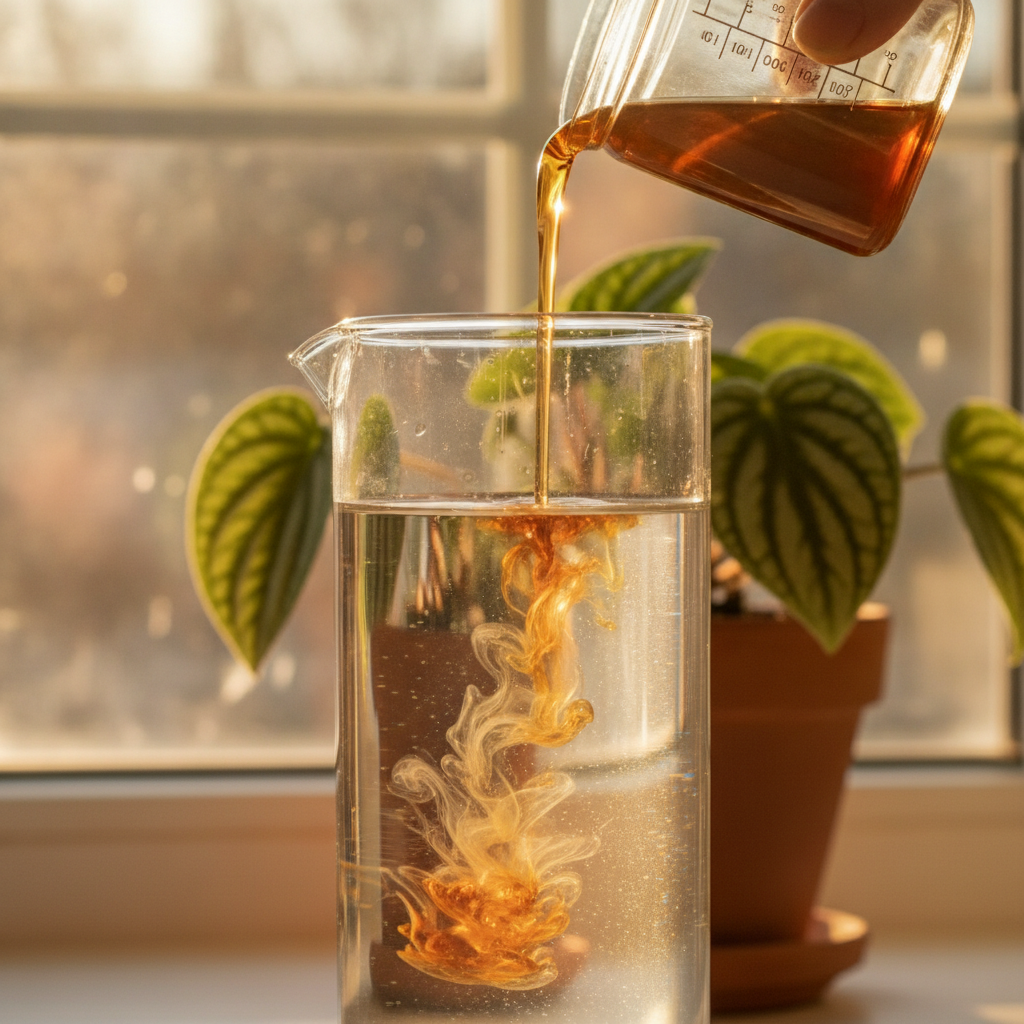
Liquid fertilisers: The most convenient choice for this plant. Diluted into the watering can, they give you precise control over dose and timing, and are easily reduced to the half strength this light feeder prefers. Apply them during the growing season only.
Slow-release granular: Small prills mixed into the compost release nutrients gradually over several months. They are low effort but offer less control, and it is easy to over-supply a plant that wants so little, so use them sparingly if at all.
Organic fertilisers: Worm castings and diluted seaweed or compost-based feeds release nutrients gently and improve the compost, making them well suited to a plant that is easily scorched by strong synthetic feeds. A thin top-dressing of worm castings in spring is often all it needs.
Feeding Schedule
Feed roughly once a month during spring and summer, using a balanced liquid fertiliser diluted to half the strength stated on the label. Stop feeding entirely in autumn and winter, when the plant is resting and cannot use the extra nutrients; feeding a dormant plant simply leaves unused salts to accumulate in the compost. Always apply fertiliser to already-moist compost rather than a dry root ball, which protects the roots from being burned.
Pro Tip — Less Is More: With peperomias, under-feeding is far safer than over-feeding. If you are ever unsure, skip a feed. A slightly hungry plant recovers quickly, while one scorched by excess fertiliser can take months to bounce back.
How to Fertilise
- Choose a balanced liquid houseplant fertiliser and dilute it to half the recommended strength.
- Make sure the compost is already moist; water first with plain water if it is dry.
- Apply the diluted feed to the compost, avoiding splashing it onto the leaves.
- Let any excess drain away and empty the saucer.
- Repeat monthly through spring and summer, then stop for autumn and winter.
Warning — Salt Build-Up: Over time, fertiliser salts accumulate in the compost and can show as a white crust on the surface or brown, burnt leaf tips. Flush the pot thoroughly with plain water two or three times a year, letting it run freely from the drainage holes, to wash the excess away.
Propagation
One of the quiet delights of the silver ripple peperomia is how readily it propagates. Like many members of the pepper family, it can regrow an entire new plant from a single leaf, so one healthy specimen can become a whole windowsill of plants at almost no cost. It is a rewarding project for beginners because the success rate is high and the method is forgiving.
The best time to propagate is spring or early summer, when the plant is actively growing and cuttings root fastest. You will need a healthy parent plant, a clean sharp knife or scissors, and either a jar of water or a small pot of damp, airy propagating mix. Warmth and bright indirect light will speed everything along.
Understanding Leaf and Stem Cuttings
Peperomias can regenerate from the base of a leaf, where dormant cells are able to form both new roots and a new shoot. A whole leaf taken with a short length of its petiole (the leaf stalk) is the most reliable unit to propagate from, because the new plantlet emerges from the cut base of that petiole. Stem cuttings, which include a section of stem with a leaf or two attached, work equally well and often establish a little faster. Either way, the key is a clean cut and patience while the new growth develops.
Leaf Cuttings in Water: Step-by-Step
Water propagation lets you watch the roots develop, which makes it satisfying and easy to monitor, though the roots it produces are slightly more delicate than those grown in a solid medium.
- Choose a healthy, mature leaf and cut it away with a short length of petiole attached, using a clean sharp blade.
- Let the cut end air-dry for an hour or two so it forms a light callus, which reduces the risk of rot.
- Suspend the leaf so the base of the petiole sits in a jar of room-temperature water, keeping the leaf blade itself above the surface.
- Place the jar in bright indirect light and refresh the water every few days to keep it clean and oxygenated.
- Wait for roots to appear over three to six weeks, followed by a tiny new plantlet at the base.
- Once the plantlet has a few small roots of its own, pot it up gently into airy compost.
Pro Tip — Patience Pays: The new plantlet always arrives well after the first roots, so do not give up on a rooted cutting that has not yet sprouted a shoot. It is common to wait two months or more from cutting to a recognisable baby plant.
Leaf Cuttings in Soil: Step-by-Step
Rooting directly in a moist, airy medium produces sturdier roots and skips the shock of moving a cutting from water into compost. It is the method most experienced growers prefer.
- Take a healthy leaf with a short petiole, or cut a large leaf in half across its width, and let the cut edges callus for an hour.
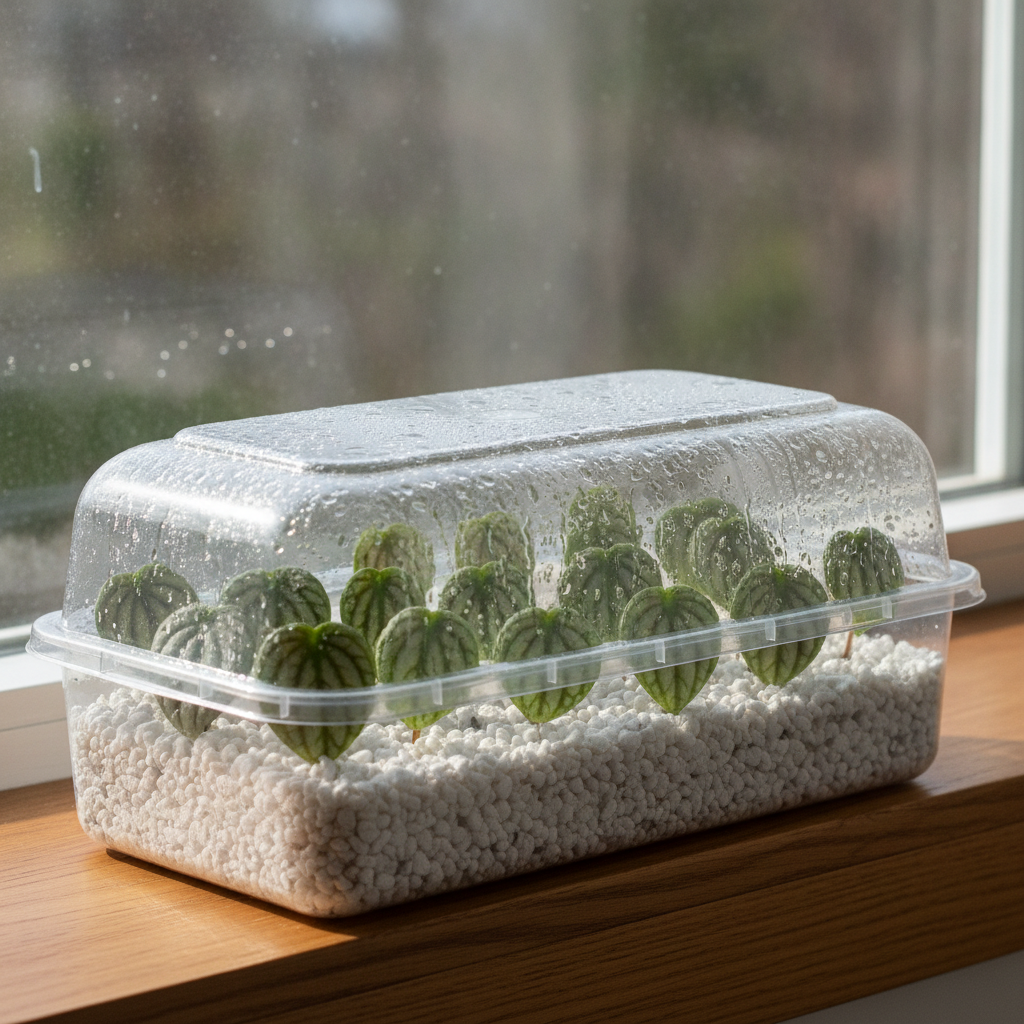
- Fill a small pot or tray with damp perlite or a light mix of coir and perlite.
- Insert the cut base of the petiole, or the cut edge of the leaf half, about a centimetre into the medium so it stands upright.
- Cover with a clear plastic dome, bag or propagator lid to hold humidity, leaving a small gap for airflow.
- Keep the medium barely moist and the setup in warm, bright indirect light.
- After six to ten weeks, tug very gently; resistance means roots have formed and new plantlets are on the way.
Troubleshooting Propagation
| Problem | Likely Cause | Solution |
|---|---|---|
| Cutting rots and turns mushy | Too wet, or cut end not callused | Use a barely damp medium and let cuts dry before planting |
| No roots after two months | Too cold or too dark | Move somewhere warmer and brighter; be patient |
| Leaf shrivels and dries | Air too dry around the cutting | Cover with a humidity dome to hold moisture |
| Roots form but no plantlet | Normal; the shoot always lags the roots | Keep warm and wait several more weeks |
Pests & Diseases
The silver ripple peperomia is largely trouble-free, and a healthy, correctly watered plant rarely attracts serious problems. Most of the issues owners meet are cultural rather than biological, traceable back to overwatering, but a handful of common houseplant pests and a few diseases are worth knowing so you can catch them early.
Prevention beats treatment every time. Inspect new leaves and their undersides whenever you water, isolate any new plant for a couple of weeks before it joins your collection, and keep the foliage clean. Catching a pest when only a leaf or two is affected makes it far easier to control.
Common Pests
Mealybugs (Pseudococcus species)
The most frequent pest of peperomias, mealybugs appear as small, white, cottony blobs tucked into the leaf folds, at the base of petioles and in the dense crown. They suck sap, weakening the plant and leaving a sticky residue behind. The rippled, crevice-rich foliage of this species gives them plenty of places to hide.
Treatment: Dab each insect with a cotton bud dipped in isopropyl alcohol, which kills them on contact. For a wider infestation, spray the whole plant with a diluted insecticidal soap or neem oil solution every week until they are gone, checking the hidden crevices carefully each time.
Spider Mites (Tetranychus urticae)
Tiny sap-sucking mites that thrive in hot, dry air. They are almost too small to see, but the fine webbing they spin between leaves and the pale stippling they leave on the foliage give them away. A badly affected plant looks dull and dusty.
Treatment: Rinse the plant under a gentle shower to knock the mites off, then treat with neem oil or insecticidal soap, repeating every five to seven days for a few weeks to break the breeding cycle. Raising the humidity around the plant discourages their return.
Fungus Gnats (Bradysia species)
Small black flies that hover around the compost surface. The adults are merely a nuisance, but their larvae live in consistently wet compost and can nibble at fine roots. Their presence is often a sign that the plant is being watered too often.
Treatment: Let the top of the compost dry out more thoroughly between waterings, which alone usually breaks their life cycle. Yellow sticky traps catch the adults, and a layer of fine grit or sand over the compost surface stops them laying eggs.
Common Diseases
Root Rot (Pythium and Phytophthora species)
By far the most serious threat to this plant, root rot is a fungal disease that takes hold in waterlogged compost. It rots the roots and works up into the base of the stems, which turn black, soft and collapse. Above ground the plant yellows and wilts even though its compost is wet.
Treatment: Act quickly. Unpot the plant, wash away the old compost, and cut off every soft, brown or blackened root with clean scissors. Repot the surviving healthy tissue into fresh, free-draining compost and water only sparingly until it recovers. Badly affected plants are often best salvaged by taking leaf cuttings from any firm, healthy foliage.
Peperomia Ring Spot (Peperomia ringspot virus)
A viral disease that shows as brown or dark concentric rings and distorted, puckered growth on the leaves. Unlike a pest or a watering fault, there is no cure for a virus, and it can spread through contaminated tools or by taking cuttings from an infected plant.
Treatment: None is available. Isolate any plant showing ring-spot symptoms, avoid propagating from it, and disinfect any tools used on it. If the disease progresses, it is best to dispose of the plant to protect the rest of your collection. Take care not to confuse the virus with harmless natural leaf patterning or with simple sun scorch.
Pest and Disease Summary
| Pest / Disease | Identification | Treatment |
|---|---|---|
| Mealybugs | White cottony clumps in leaf folds | Alcohol swab, then neem or insecticidal soap |
| Spider mites | Fine webbing and pale stippling | Rinse, then neem oil; raise humidity |
| Fungus gnats | Small flies over the compost | Dry out the compost; sticky traps |
| Root rot | Black soft stems, wilting in wet soil | Cut away rot, repot in dry mix |
| Ring spot virus | Concentric rings, distorted leaves | No cure; isolate and dispose |
Prevention Strategies
The single most effective preventive measure is correct watering, because the plant’s worst problems, from root rot to fungus gnats, all stem from compost that stays too wet. Get the watering right and most trouble never begins. Beyond that, good airflow around the plant, clean tools when you prune or propagate, and a regular habit of inspecting the foliage will keep the great majority of issues at bay.
Quarantine is the other habit worth keeping. Any new plant, and especially a bargain from a busy shop, can carry pests that are not yet obvious. Keeping newcomers apart from your established collection for two or three weeks gives any hidden problem time to reveal itself where it can do no wider harm.
Pro Tip — Neem as Routine: A light monthly wipe or spray of dilute neem oil during the growing season works as a gentle deterrent, making the leaves far less appealing to sap-sucking pests before an infestation ever gets going.
Popular Varieties
Peperomia caperata has been bred into a remarkable range of cultivars, differing mainly in leaf colour while sharing the same rippled texture and easy temperament. This means you can assemble a varied and striking collection that all asks for identical care, from deep silver-greens through glossy emeralds to rich wines and reds.
The varieties below are among the most widely grown and the easiest to find. Because they are all forms of the same species, everything in this guide applies equally to each of them, with only the more strongly coloured types needing a touch more light to hold their tones.
| Variety | Leaf Appearance | Light Needs | Growth Rate | Availability |
|---|---|---|---|---|
| Silver Ripple / Frost | Rippled leaves with a silvery sheen | Bright indirect | Slow | Common |
| Emerald Ripple | Deeply furrowed dark emerald green | Bright to medium | Slow | Very common |
| Rosso | Dark green tops, wine-red undersides | Bright indirect | Slow | Common |
| Luna Red | Deep burgundy, almost black | Bright indirect | Slow | Widely available |
| Napoli Nights | Silvery grey-green with dark veins | Bright indirect | Slow | Increasingly common |
| Schumi Red | Extra-deep rippling, reddish-green | Bright indirect | Slow | Specialist |
Featured Varieties
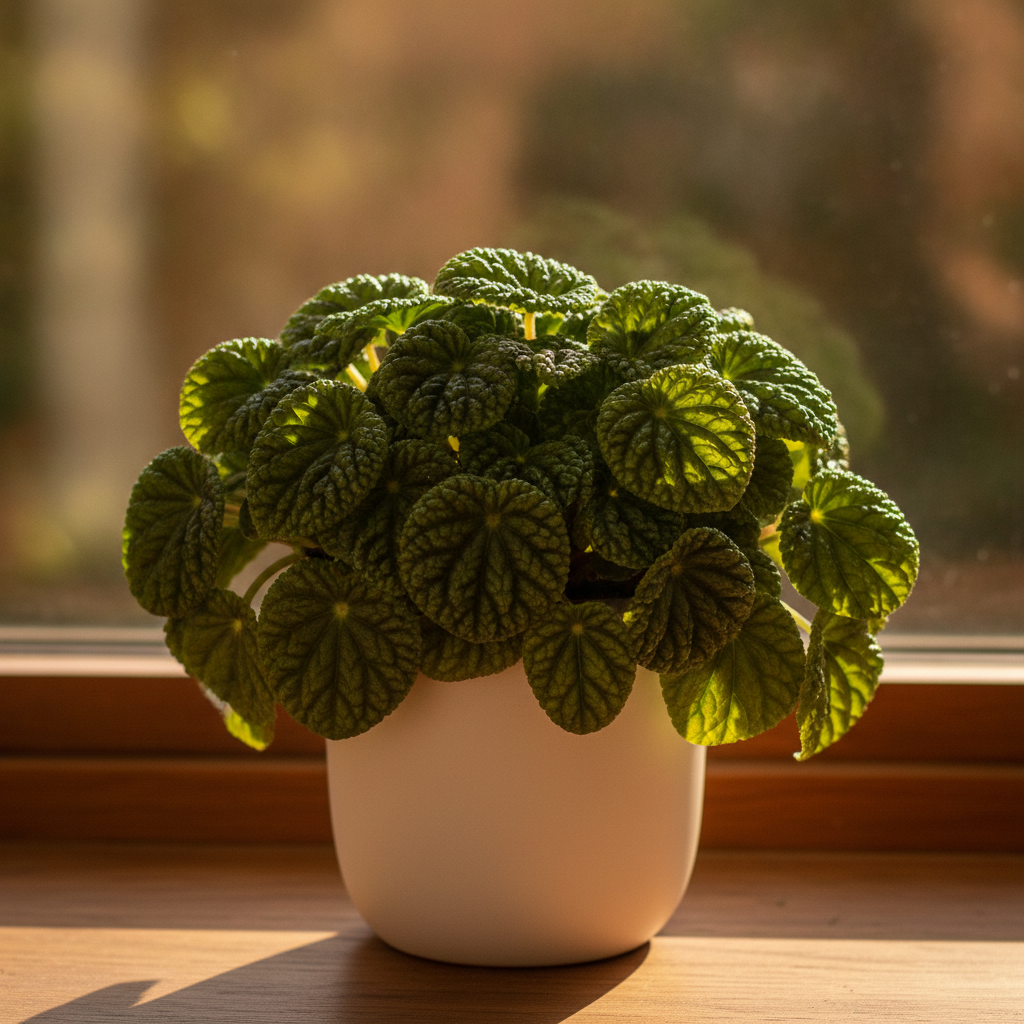
Emerald Ripple
The classic form and the one most often sold simply as ripple peperomia. Its deeply furrowed, glossy dark emerald leaves form a dense, low mound, and it is the most vigorous and forgiving of the group, making it an excellent first peperomia.
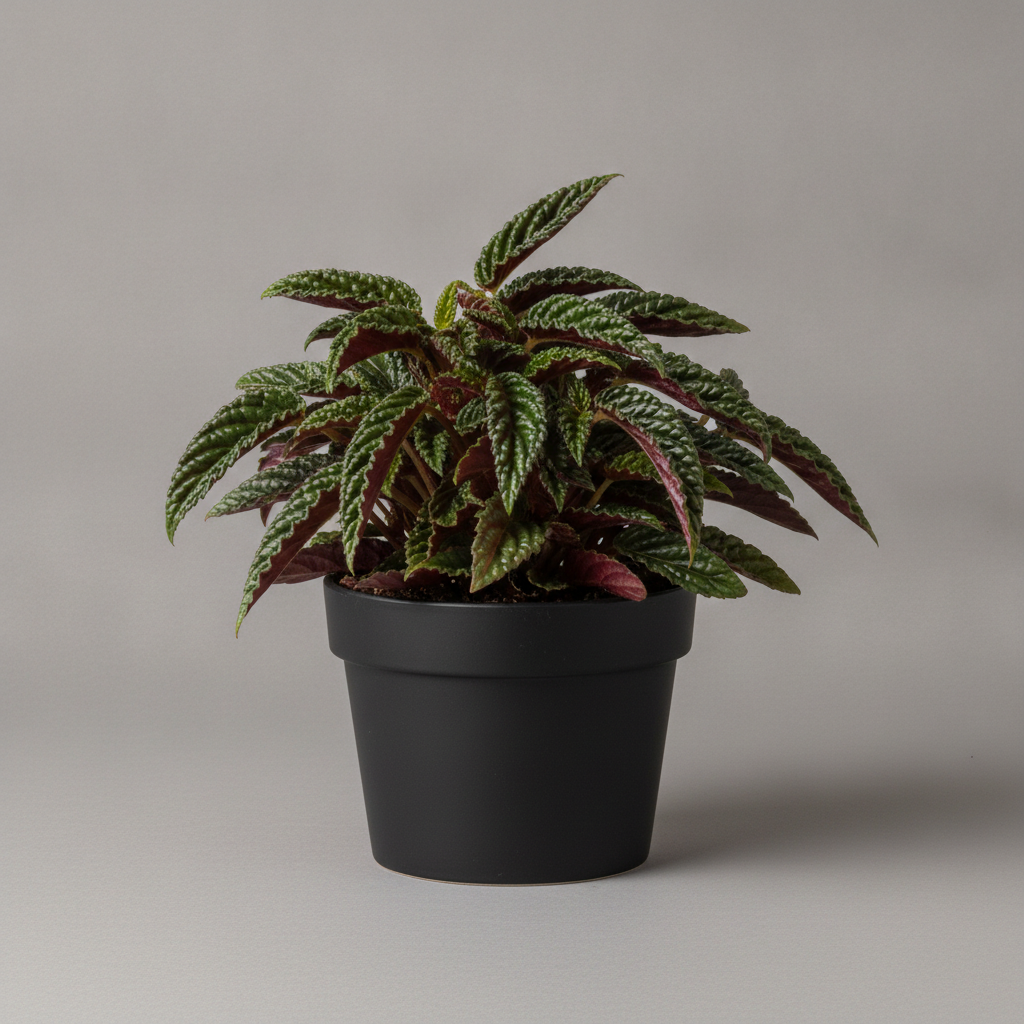
Rosso
A striking bicoloured cultivar with narrow, sharply rippled leaves that are glossy dark green above and a rich wine-red beneath. The two-tone effect is at its most dramatic in good light, and the plant is only marginally fussier than the plain green forms.
Variety Profiles in Detail
Silver Ripple / Frost (Peperomia caperata)
The variety that gives this guide its name, prized for the cool silvery frosting that overlays its rippled green leaves. The metallic sheen is strongest in bright indirect light and softens in shade, so a well-lit position rewards you with the fullest effect. In every other respect its care is identical to its emerald sibling.
Luna Red (Peperomia caperata)
An intensely coloured cultivar whose leaves are so deep a burgundy that they can read as near-black indoors. It makes a bold contrast among greener plants, but its dark tones depend on strong light; grown too dark, the colour dulls toward muddy green. Give it your brightest indirect spot to keep it at its richest.
Choosing the Right Variety for Your Space
For a first peperomia, or for a spot with only medium light, the plain Emerald Ripple is the safest and most rewarding choice, as it keeps its looks in a wider range of conditions. If you have a bright, well-lit position and want more drama, the red and silver cultivars such as Rosso, Luna Red and the frosted Silver Ripple will repay that brightness with far richer colour. Since every variety shares the same compact size and undemanding care, the only real question is which palette suits your room.
Frequently Asked Questions
Is silver ripple peperomia safe for cats and dogs?
Yes. Peperomias, including Peperomia caperata, are listed as non-toxic to cats and dogs by the ASPCA, and they are not known to be poisonous to humans. It is one of the safest choices for a home with curious pets or young children, though it is still sensible to discourage any pet from eating houseplants.
Why are the leaves on my peperomia turning yellow?
Yellowing leaves, especially several at once in soggy compost, almost always point to overwatering. Check the roots for softness and let the compost dry out more between waterings. The occasional yellow older leaf at the base is simply natural ageing and nothing to worry about.
Why is my silver ripple peperomia leggy and stretched?
Legginess, with long bare petioles and a loose, open rosette, is the classic sign of too little light. Move the plant to a brighter spot with plenty of indirect light and the new growth will come in tighter and more compact. You can also trim leggy stems and use them as cuttings.
What are the strange spikes growing on my plant?
Those slender, greenish-white or cream spikes on reddish stalks are the plant’s flowers, sometimes likened to rat tails or mouse tails. They are harmless and a sign of a happy, mature plant. Many growers enjoy them, though you can snip them off if you prefer the plant to focus its energy on foliage.
How big does a silver ripple peperomia get?
It stays pleasingly small, usually reaching only around 15 to 20 centimetres (6 to 8 inches) in both height and spread. This compact, mounding habit is a large part of its appeal, and it means the plant never outgrows a windowsill or a modest shelf.
How often should I water my peperomia?
Rather than following a fixed schedule, water when the top half of the compost has dried out, which tends to be about every 7 to 10 days in summer and every two to three weeks in winter. Because the leaves store water, it is always safer to wait a day too long than to water a day too soon.
Do I need to mist my silver ripple peperomia?
No. Its semi-succulent leaves cope well with average room humidity, and misting does little to raise humidity while risking water pooling in the dense crown, where it can encourage rot. If your air is very dry, a small humidifier or a pebble tray is a far better solution.
Can I grow silver ripple peperomia in low light?
It will tolerate medium and even fairly low light, which makes it useful for less bright rooms, but it truly thrives in bright indirect light. In dim conditions expect slower growth, looser form and less vivid colour. A grow light is an easy way to keep it looking its best in a darker spot.






