
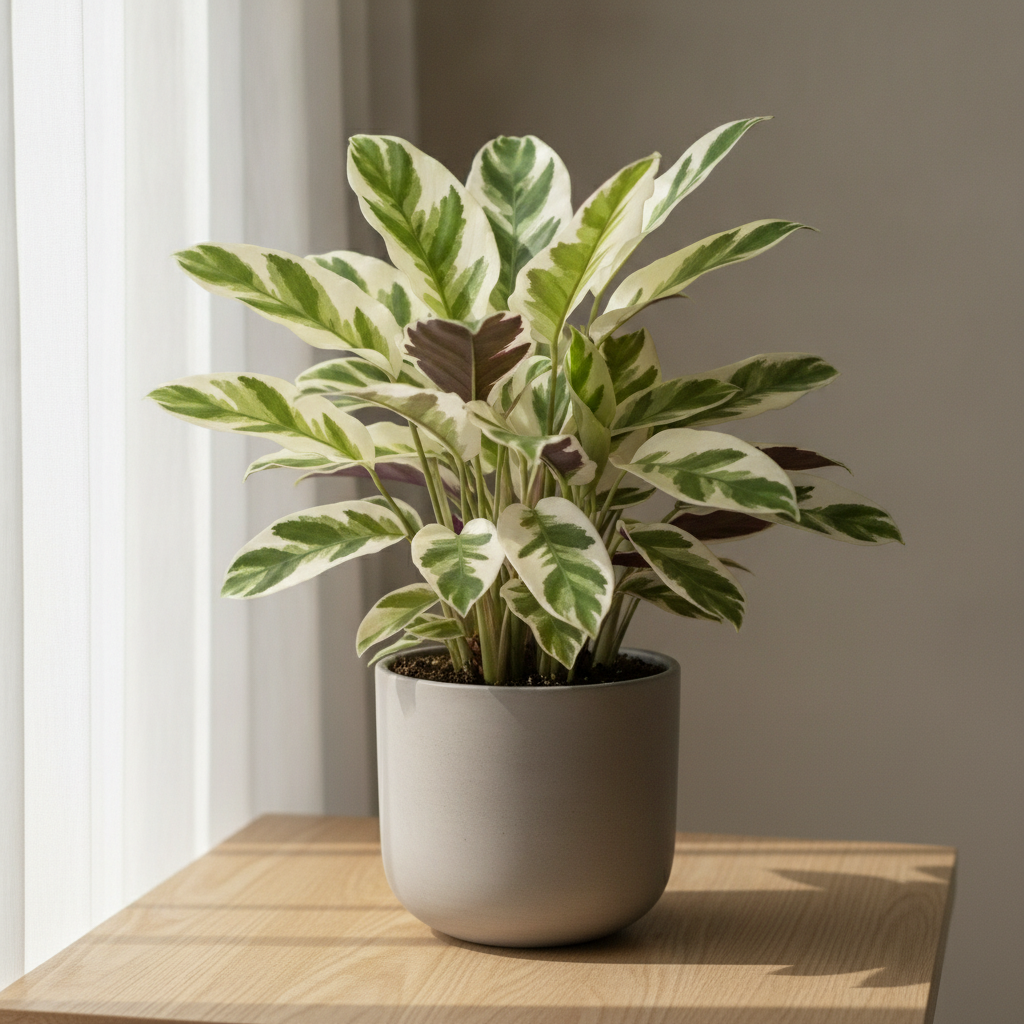
Few houseplants divide a room quite like the White Fusion Calathea. Each leaf is a one-off painting of white, cream, mint and forest green, brushed on in irregular sweeps, and turned over to reveal a wash of soft lilac-purple on the underside. It is the plant that stops visitors mid-sentence, and it is also the plant that humbles growers who assumed a decade of easy pothos and philodendrons had taught them everything. Goeppertia lietzei ‘White Fusion’ is beautiful precisely because it is difficult: the very variegation that makes it desirable is the same trait that makes it fragile. This guide covers everything needed to move it from merely surviving to genuinely thriving on a windowsill or shelf.
- Quick reference
- Why grow the White Fusion Calathea
- Light
- Watering
- Soil and potting
- Fertilising
- Propagation
- Pests and problems
- Varieties and lookalikes
- Frequently asked questions
Quick reference
The table below distils the essentials. Every point is expanded in the sections that follow, but if the plant is already home and looking anxious, start here.
| Botanical name | Goeppertia lietzei ‘White Fusion’ (formerly Calathea lietzei) |
| Common names | White Fusion Calathea, Fusion White, White Fusion prayer plant |
| Family | Marantaceae, the prayer plant family |
| Light | Bright, indirect light; no direct midday sun on the white sectors |
| Water | Keep evenly moist, never soggy; use rainwater, distilled or filtered water |
| Humidity | High, ideally 60 per cent or more |
| Temperature | 18 to 27 degrees Celsius (64 to 81 degrees Fahrenheit) |
| Soil | Light, airy, moisture-retentive mix that still drains freely |
| Feeding | Dilute balanced feed monthly in spring and summer |
| Propagation | Division only; variegation will not come true any other way |
| Toxicity | Non-toxic to cats, dogs and humans |
| Difficulty | Advanced; one of the fussier houseplants in cultivation |
Why grow the White Fusion Calathea

The appeal begins and ends with the foliage. Where most variegated plants settle into a predictable pattern, the White Fusion is chimeric, meaning its variegation arises from genetically distinct layers of tissue growing side by side. The practical result is that every leaf unfurls differently: one may be almost entirely green with a single cream flare, the next may be half snow-white, the one after a fine marbling of both. Turn any of them over and the purple undersides glow when backlit, a detail that photographs beautifully and rewards a spot where morning or late-afternoon light rakes across the plant.
Like all members of the prayer plant family, the White Fusion performs a daily ritual called nyctinasty. As evening falls the leaves lift and fold upward, and by morning they relax open again, occasionally with a faint rustle. It is a small piece of theatre that makes the plant feel alive in a way a static succulent never does. The species behind the cultivar, Goeppertia lietzei, hails from the humid understorey of Brazilian forests, and that origin explains almost every one of its demands: dappled light, warm air, steady moisture and no mineral-laden tap water.
There is also a genuinely practical reason to choose this plant over an equally striking alternative. The White Fusion is non-toxic to cats, dogs and people, which sets it apart from the many variegated aroids, such as pothos and philodendrons, that contain irritating calcium oxalate crystals. For a household with curious pets or small children, a plant this dramatic that carries no toxicity risk is a rare find. The trade-off, and there is always a trade-off, is that the White Fusion asks for attention. Those white sectors contain little or no chlorophyll, so they cannot photosynthesise. The green portions of each leaf have to power the entire plant, which leaves it with a smaller energy budget and far less tolerance for neglect than a plain green cousin.
Pro Tip — Read the plant, not the calendar: The White Fusion communicates constantly through its leaves. Curling signals thirst or dry air, crispy brown edges point to water quality or low humidity, and faded washed-out patches suggest too much light. Learn to respond to these cues rather than watering or feeding on a fixed schedule, and this plant becomes far more manageable.
Light
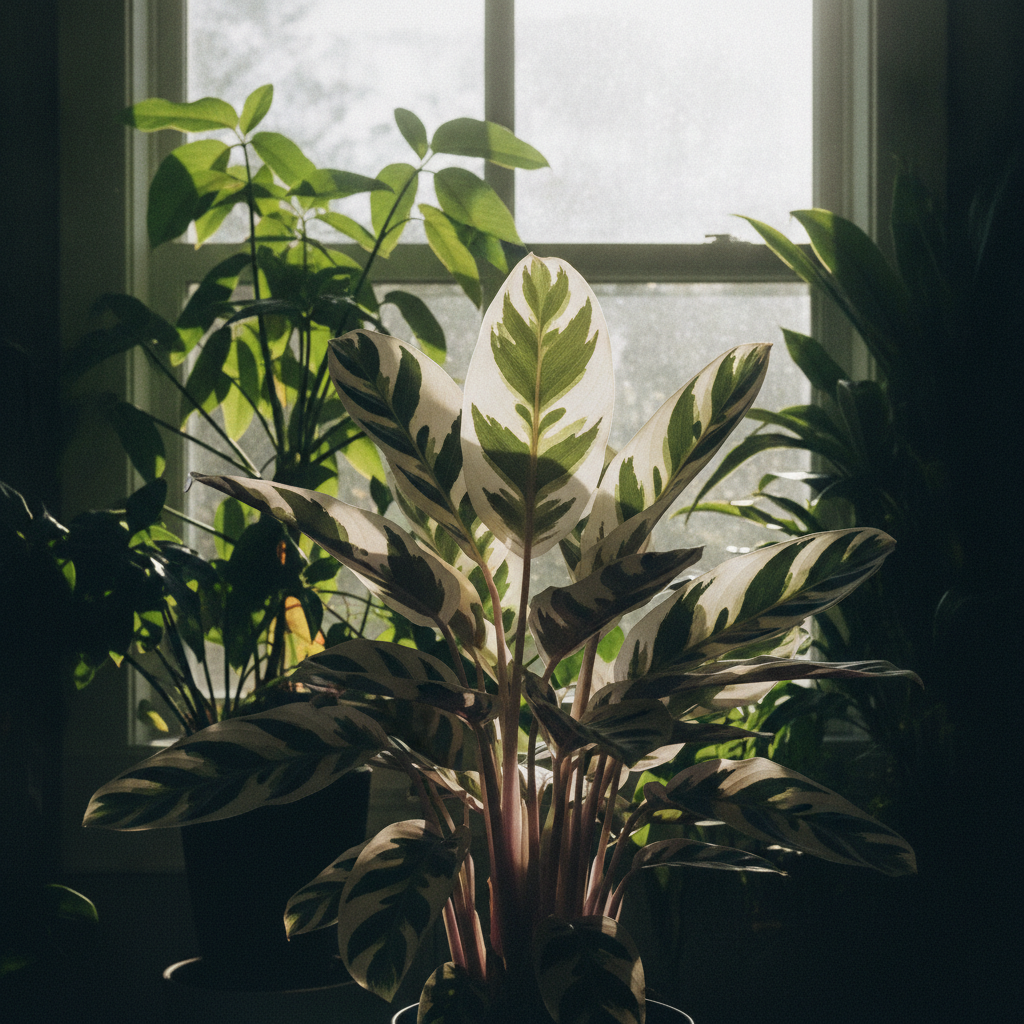
Getting light right is the single most important decision for a White Fusion, because it sits on a narrow ledge between two failures. Too little light and the plant slows to a crawl, produces smaller and greener leaves as it fights to claw back photosynthetic capacity, and eventually declines. Too much direct sun and the delicate white sectors scorch, bleaching to a papery beige before crisping brown, damage that never reverses because those cells cannot regenerate pigment. The target is bright but indirect light for most of the day.
In practice, an east-facing window that catches gentle morning sun and then settles into bright ambient light is close to ideal. A north-facing window works well in summer and through much of the year, though in the depths of winter it may need supplementing. South and west windows can be used, but the plant should sit a metre or two back from the glass, or behind a sheer curtain, so that the harsh direct rays are diffused before they reach the foliage. Filtering light through the leaves of taller plants placed nearer the window is another reliable trick, and it recreates the layered canopy shade of the plant’s native habitat almost exactly.
Because this cultivar carries so much white tissue, it actually needs a touch more light than an ordinary all-green calathea to gather the same amount of energy, yet its tolerance for intensity is lower. That apparent contradiction is best resolved with brightness and duration rather than raw strength: a long day of soft, even, bright light beats a short blast of direct sun. A full-spectrum LED grow light on a timer, positioned well above the plant, is an excellent way to keep growth steady through dark northern winters. Aim for roughly twelve hours a day and keep the fixture far enough back that it never heats the leaves.
Rotate the pot a quarter turn every week or two so that all sides receive similar light and the plant grows evenly rather than leaning toward the window. If the newest leaves are emerging noticeably greener than the older ones, the plant is telling you it wants more light; if the white areas look washed out and translucent, ease it back from the glass.
Watering
Watering is where most White Fusions are lost, and the culprit is rarely how much water they receive but what is in it. Calatheas are notoriously sensitive to the fluoride, chlorine and dissolved mineral salts found in ordinary tap water. Over weeks and months these accumulate in the leaf tissue and show up as the classic crispy brown margins that plague this genus. The fix is straightforward: water with rainwater, distilled water or water that has passed through a good filter. If only tap water is available, letting it stand uncovered overnight allows some chlorine to dissipate, though it does nothing for fluoride or hardness, so filtered or rain water remains far preferable.
The goal is soil that stays evenly moist, like a wrung-out sponge, but never waterlogged. Check the top two to three centimetres of the mix with a finger, and water thoroughly once that layer begins to feel dry, letting the excess drain away completely. Never allow the pot to stand in a saucer of water, because the fine roots rot quickly in stagnant conditions. In the warmth and longer days of spring and summer this may mean watering once or twice a week; in winter, when growth slows, the interval stretches out and overwatering becomes the greater danger. Tepid water is gentler than cold straight from the tap, which can shock these warmth-loving roots.
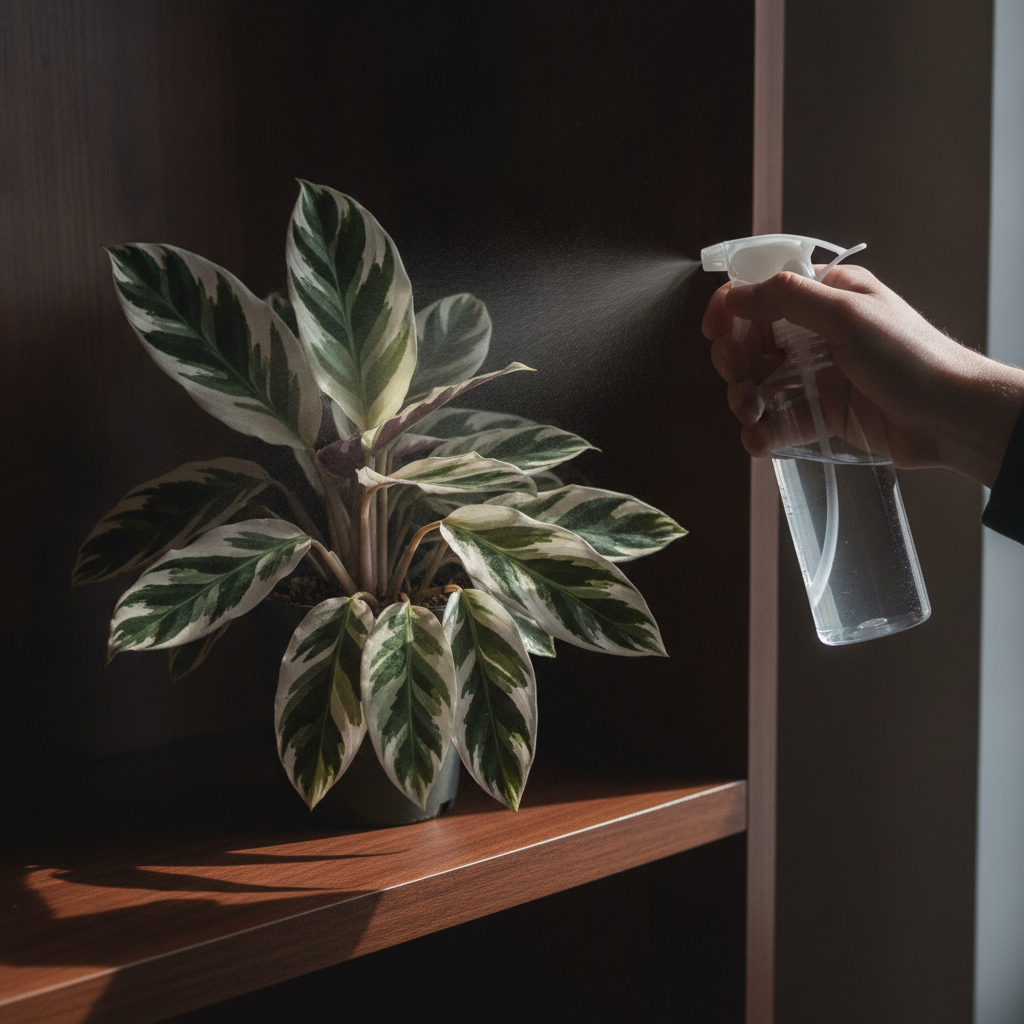
Humidity is the other half of the watering equation, and for the White Fusion it is not optional. This plant wants humidity of sixty per cent or higher, well above the level of most centrally heated or air-conditioned homes. The most effective solutions are a small room humidifier running nearby, or grouping the plant with others to create a shared pocket of moist air. A pebble tray filled with water beneath the pot helps a little. Misting is popular but only marginally useful and, worse, water left sitting on the leaves overnight can invite fungal spotting, so if you mist, do it in the morning so the foliage dries by evening. A bathroom or kitchen with good light and steady warmth often suits this plant better than a dry living room.
Warning — Brown edges are a message: If the leaf margins are browning and crisping despite consistent watering, suspect the water first and the air second. Switch to rainwater or distilled water and raise the humidity before changing anything else. The existing damage will not heal, but new leaves should emerge clean.
Soil and potting
The White Fusion needs a growing medium that pulls off a delicate balancing act, holding enough moisture to keep the roots consistently damp while draining freely enough that they never sit in water. A plain bag of dense general-purpose compost fails on both counts: it compacts, holds too much water at the base and starves the roots of air. A far better approach is to build an airy, chunky blend around a moisture-retentive core.
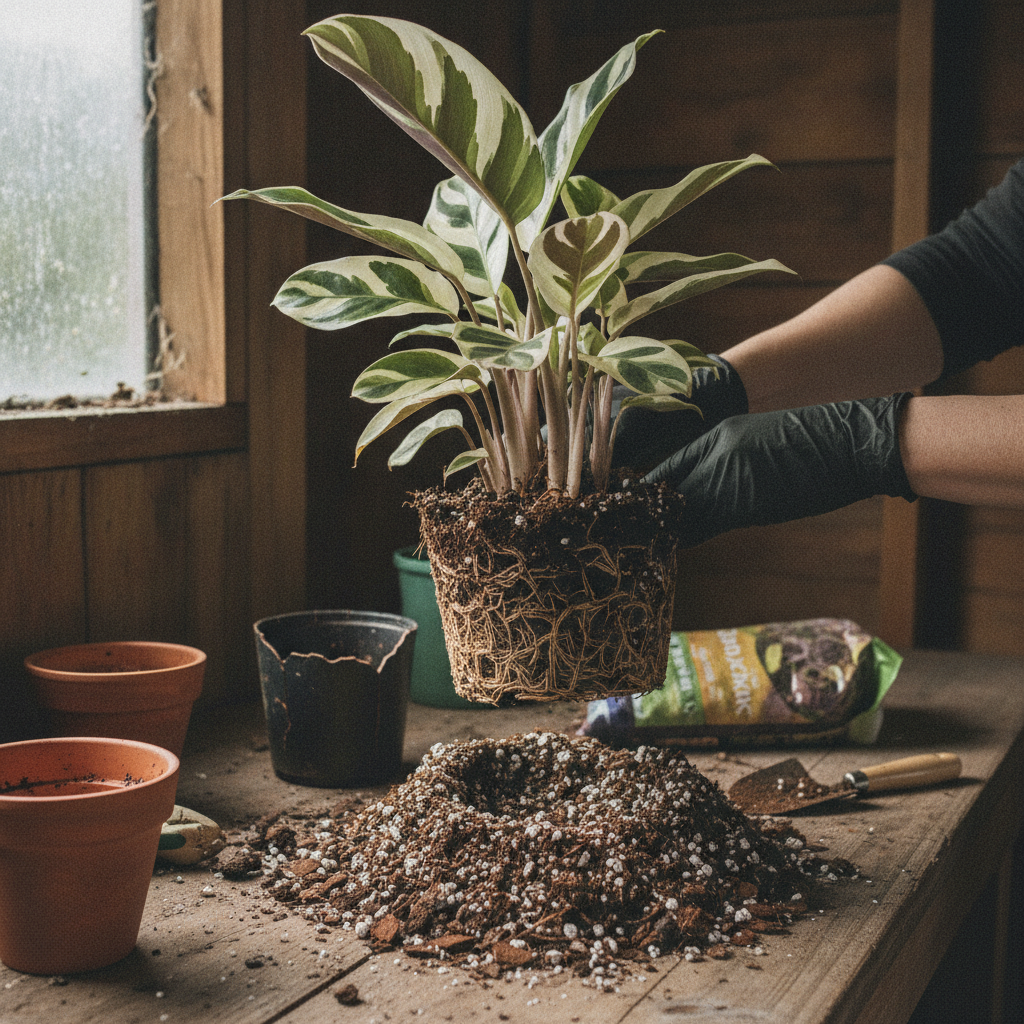
A reliable recipe combines roughly half good-quality peat-free houseplant compost or coco coir for water retention, a quarter perlite or pumice for aeration and drainage, and a quarter fine orchid bark to keep the structure open and prevent compaction. A handful of worm castings folded in adds gentle, slow nutrition. The finished mix should feel light in the hand and spring back rather than clump together when squeezed. This structure lets water flow through while the coir and compost hold a reservoir of moisture that the fine roots can draw on between waterings.
Choose a pot with drainage holes, always. Terracotta breathes and dries faster, which can help a heavy-handed waterer but may prove thirsty work in a dry home; glazed ceramic or plastic holds moisture longer and often suits this plant better, provided the mix itself drains. Size up only modestly when repotting, moving to a pot two to three centimetres wider in diameter, because a pot that is too large holds a mass of wet, unused soil that invites root rot.
Repot in spring, every one to two years, or when roots begin to circle the base or push through the drainage holes. This warmth-loving plant recovers fastest from the disturbance during its active growing season. Handle the root ball gently, tease away only the loosest of the old spent soil, and settle the plant at the same depth it sat before. Water it in with room-temperature filtered water and keep it out of strong light for a week or two while it re-establishes.
Fertilising
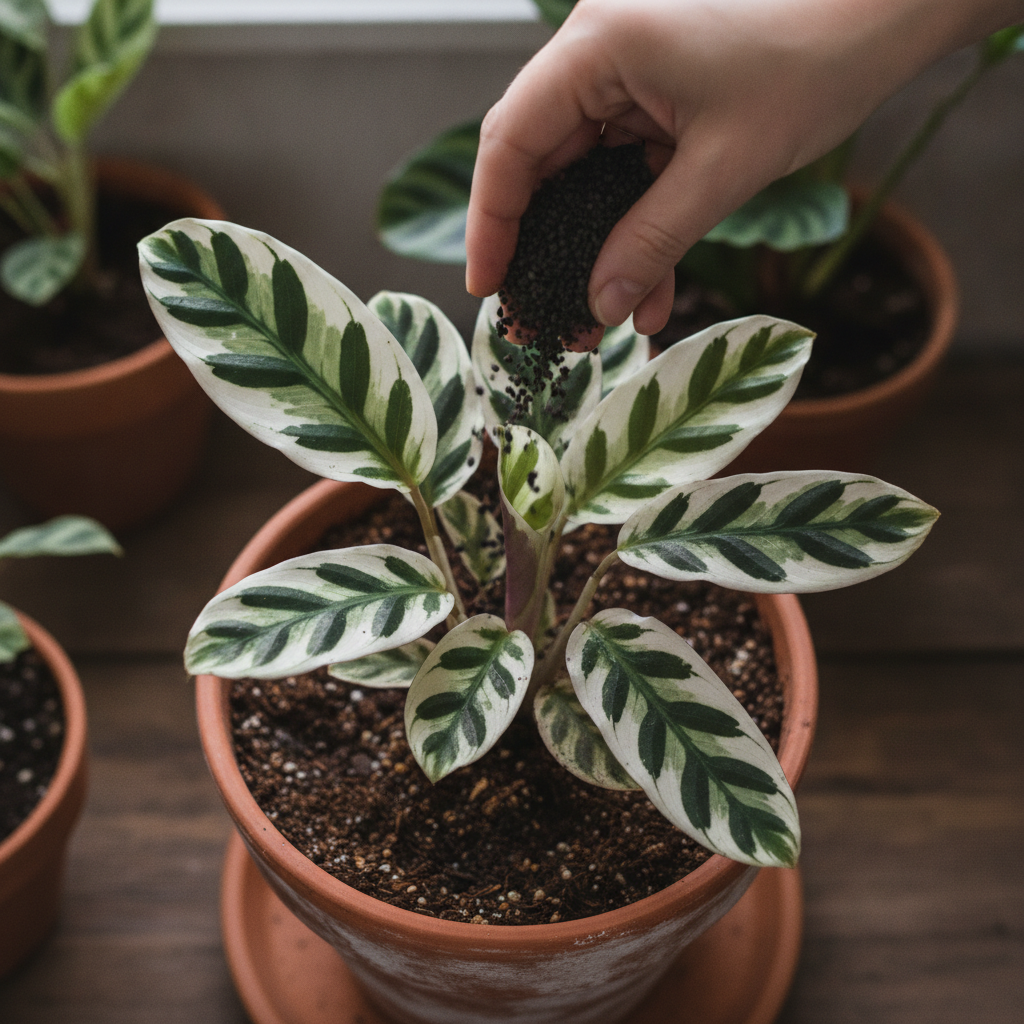
The White Fusion is a light feeder, and restraint pays off. Because so much of each leaf cannot photosynthesise, the plant simply does not process nutrients as fast as a vigorous all-green grower, and excess fertiliser accumulates in the soil as mineral salt. Those salts scorch the sensitive roots and, tellingly, produce exactly the same brown leaf edges that poor water quality causes, so the two problems are easy to confuse.
Through the growing season, from spring into early autumn, feed roughly once a month with a balanced liquid houseplant fertiliser diluted to half, or even a quarter, of the strength recommended on the label. Always apply feed to already-moist soil rather than a dry root ball, which prevents the concentrated solution from burning thirsty roots. A gentler alternative is to top-dress the soil surface with a thin layer of worm castings once or twice in the season, which releases nutrients slowly and carries no risk of salt burn. Stop feeding entirely in late autumn and through winter, when the plant is barely growing and cannot use the nutrients.
If salt does build up, whether from feeding or hard water, flush the pot every couple of months by running a generous volume of rainwater or distilled water slowly through the soil and letting it drain fully away. This washes accumulated minerals out of the root zone and is one of the simplest ways to keep a fussy calathea comfortable over the long term.
Propagation
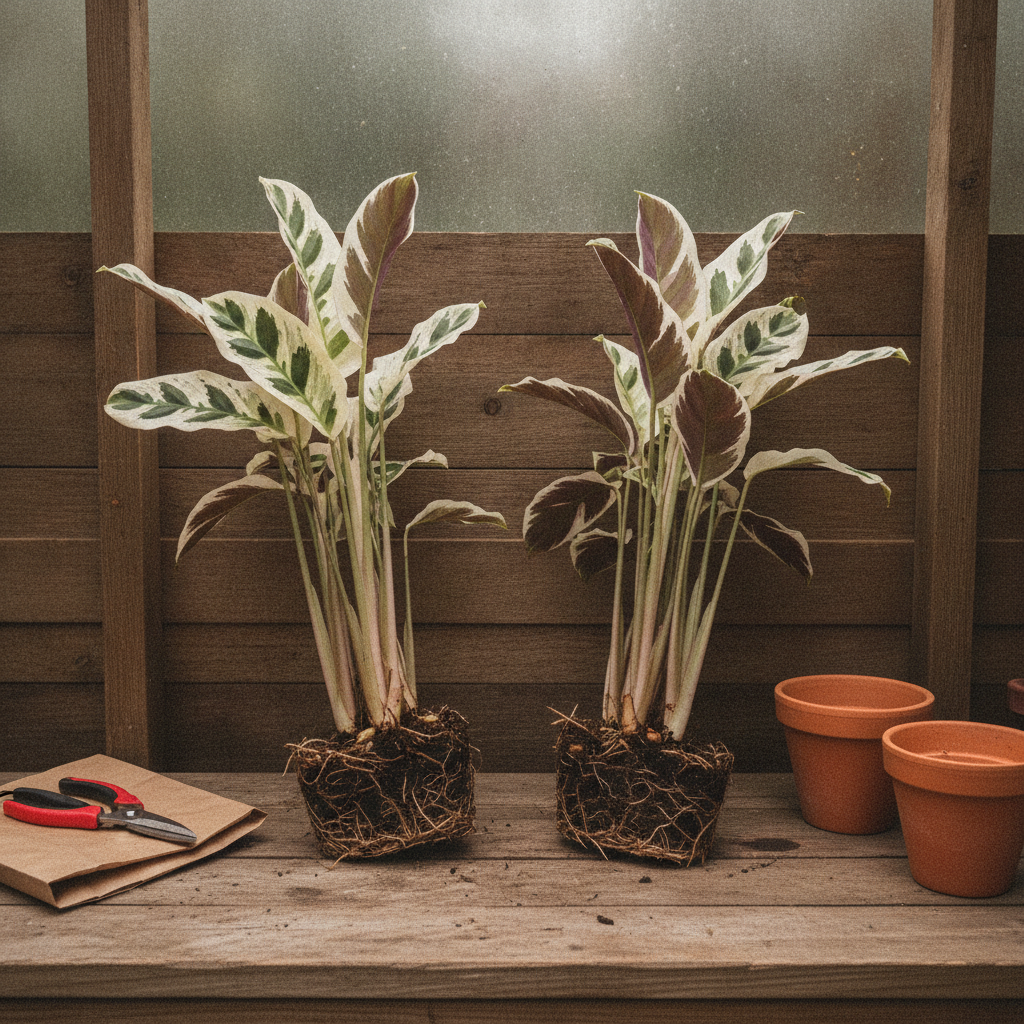
Here the White Fusion allows no shortcuts. Unlike the aroids that root readily from a stem cutting in a glass of water, this plant cannot be propagated from leaf or stem cuttings at all, because it grows from an underground rhizome rather than a vining stem with nodes. Just as importantly, its variegation is chimeric and unstable, which means it will not reproduce true from seed even if flowering and seed were to occur indoors. The only dependable method is division, separating an established clump into smaller plants, each carrying its own roots and growing points.
Division is best done in spring, ideally combined with a scheduled repotting so the plant is disturbed only once. Choose a mature, healthy specimen with several distinct clumps of stems rising from the soil, and follow these steps.
- Water the plant a day or two beforehand so it is fully hydrated and less stressed by the disturbance.
- Ease the whole plant out of its pot and gently brush and tease away enough soil to see where the natural clumps and their roots separate.
- Identify divisions that each have a healthy section of rhizome, their own roots and at least two or three growing stems. Aim for a small number of robust divisions rather than many weak ones.
- Separate the clumps by hand where possible, working the roots apart gently. Where they will not pull free, cut cleanly through the rhizome with a sterilised knife or secateurs.
- Pot each division into its own small container of fresh, airy calathea mix, at the same depth it grew before, and firm the soil lightly around the roots.
- Water in with room-temperature filtered water and place the new plants somewhere warm and bright but out of direct sun.
Newly divided plants sulk for a while, and that is normal. Keep humidity high, even loosely tenting each division with a clear plastic bag or cover for the first couple of weeks to reduce moisture loss while the roots recover. Hold off on any fertiliser for a month or so until fresh growth signals that the plant has settled. Expect a slow start, especially from divisions that carry a high proportion of white tissue, since they have less photosynthetic capacity to fuel their recovery.
Pests and problems
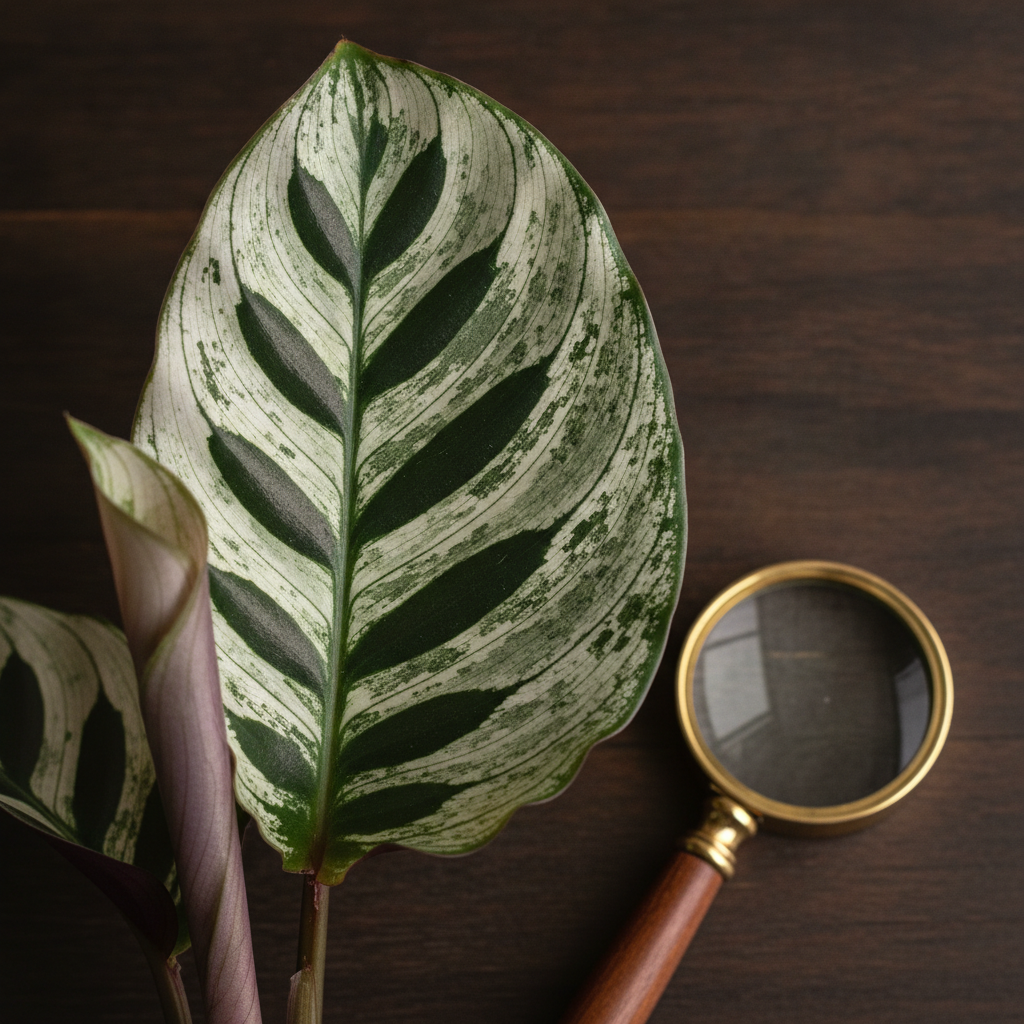
The most common pest on a White Fusion is the spider mite, and the reason is instructive: spider mites thrive in exactly the warm, dry air that stresses this humidity-loving plant, so the conditions that weaken the calathea are the same ones that invite the pest. They are tiny, often first betrayed by fine speckling or stippling on the leaves and, in a bad infestation, delicate webbing in the leaf joints. Keeping humidity high is both good care and the single best deterrent. At the first sign, wipe the leaves, rinse the plant under a gentle shower of tepid water and treat with insecticidal soap or a diluted neem oil solution, repeating every week or so until the mites are gone. Thrips and, less often, mealybugs and scale can also appear, and all respond to the same combination of physical removal and repeated treatment.
Most White Fusion troubles, though, are not pests at all but the plant reacting to its environment, and reading the symptoms correctly saves a great deal of guesswork. The table below maps the most frequent complaints to their usual causes and fixes.
| Symptom | Likely cause | What to do |
| Crispy brown leaf edges | Hard tap water, low humidity or salt build-up | Switch to rainwater or distilled water, raise humidity, flush the soil |
| Curling or rolled leaves | Underwatering or dry air | Check the soil, water if dry and increase humidity |
| Yellowing leaves | Overwatering or waterlogged roots | Let the top layer dry more between waterings, check drainage |
| Faded, washed-out white areas | Too much direct light | Move away from the glass or diffuse the light |
| Newest leaves emerging very green | Not enough light | Move to a brighter spot or add a grow light |
| Drooping stems | Thirst, cold or shock after repotting | Water, keep warm and allow time to recover |
| Brown or mushy stem bases | Root or crown rot from constant wet | Repot into fresh airy mix, trim affected roots, water less |
A degree of leaf loss is normal over time; older outer leaves naturally age, brown and die back while the plant pushes new growth from the centre. Trim tatty leaves at the base with clean scissors. What you want to watch for is a pattern, such as every new leaf arriving with brown edges, which points to an environmental cause worth correcting rather than ordinary ageing.
Pro Tip — Stability beats intervention: The White Fusion hates change more than almost anything. Cold draughts from a door or window, a radiator drying the air, a sudden move to a new room, or wildly swinging watering habits all show up on the leaves within days. Find a warm, humid, brightly lit and draught-free spot, then resist the urge to keep moving and fiddling.
Varieties and lookalikes
The White Fusion is itself a cultivar of Goeppertia lietzei, and because its variegation is chimeric, individual plants vary enormously in how much white they carry. Two extremes of the same cultivar are worth understanding before you buy, because they behave very differently in the home.
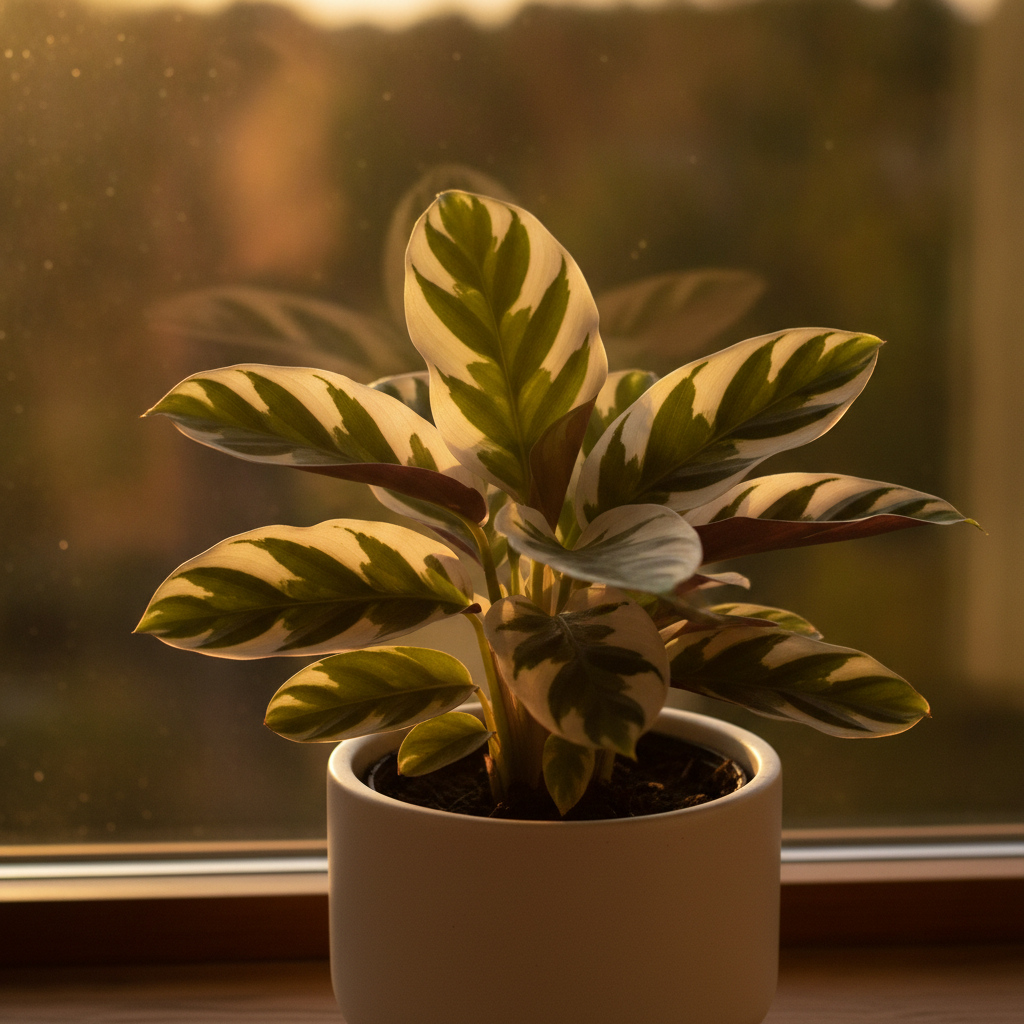
Classic White Fusion
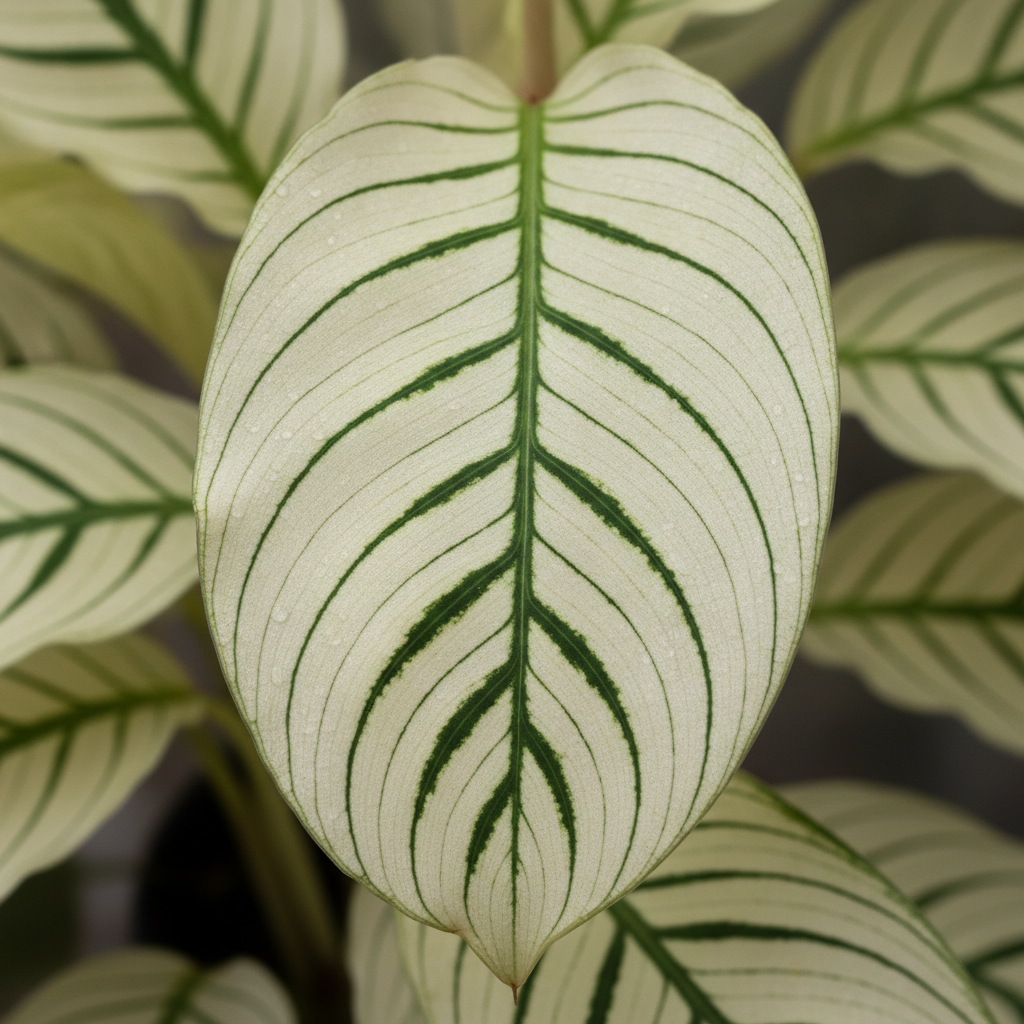
The balanced form most growers hope for, with leaves marbled in roughly even sweeps of cream, white and two tones of green and lilac undersides showing at the edges. Enough green tissue remains to keep the plant reasonably vigorous, making this the most sustainable and beginner-friendly expression of the cultivar. It is the one to look for on a nursery bench.
Highly variegated form
A near-white specimen with large snowy sectors and only thin green feathering along the veins. Spectacular to look at and highly sought after, but the scarcity of green tissue leaves it slow, weak and prone to decline, since it can barely photosynthesise enough to sustain itself. Best left to experienced growers who can provide flawless conditions.
The White Fusion is often confused with other showy members of the prayer plant family. The Rose Painted Calathea, Goeppertia roseopicta, offers pink-flushed variegation with a similar demand for humidity, while the Pinstripe Calathea, Goeppertia ornata, brings fine pink lines on dark leaves. For a comparable painterly look with a far more forgiving temperament, the Triostar Stromanthe, Stromanthe sanguinea, delivers cream, green and pink in a plant that tolerates household conditions much more readily. None, however, matches the pure white drama of a well-grown White Fusion.
Frequently asked questions
Why does my White Fusion Calathea have brown, crispy edges?
This is the most common complaint and almost always comes down to water quality, low humidity or fertiliser salt build-up. Calatheas are highly sensitive to the fluoride, chlorine and minerals in tap water, so switching to rainwater, distilled or filtered water usually solves it. Pair that with humidity above sixty per cent and an occasional flush of the soil, and new leaves should emerge clean. The existing brown areas will not recover, so trim them if they bother you.
Is the White Fusion Calathea safe for cats and dogs?
Yes. Like all calatheas and prayer plants in the family Marantaceae, the White Fusion is non-toxic to cats, dogs and humans. It is one of the few dramatically variegated houseplants that carries no toxicity risk, which makes it a strong choice for homes with pets or young children.
Can I propagate White Fusion from a leaf or stem cutting?
No. The White Fusion grows from an underground rhizome and cannot be rooted from a leaf or stem cutting the way pothos or philodendrons can. Its variegation is also chimeric, so it will not come true from seed. The only reliable method is division, separating an established clump into smaller plants that each keep their own roots and growing points, ideally in spring alongside repotting.
Why are my plant’s new leaves coming in greener than the old ones?
Reduced variegation on new growth is usually a sign the plant wants more light. Because the white sectors cannot photosynthesise, a plant in dim conditions produces greener leaves to gather more energy simply to survive. Move it to a brighter spot with plenty of indirect light, or add a grow light, and the variegation on subsequent leaves should improve. That said, some variation is natural in a chimeric plant, and no two leaves will ever match.
Why does my White Fusion close its leaves at night?
This is a healthy, natural behaviour called nyctinasty, shared by all prayer plants. The leaves lift and fold upward in the evening and relax open again in the morning, driven by daily light cycles. It is a sign the plant is responding normally to its environment, not a symptom of any problem. If the leaves stay curled during the day, however, that usually points to thirst or dry air.
Is the White Fusion Calathea really that hard to grow?
It has a well-earned reputation as one of the fussier houseplants, mainly because of its demand for high humidity, soft water and stable conditions, combined with the reduced vigour that comes from all that white tissue. It is not a good first plant. That said, once it sits in a warm, humid, brightly lit and draught-free spot with a settled watering routine using rainwater or distilled water, it becomes far more predictable. The secret is consistency: find the right conditions and then leave it be.






