
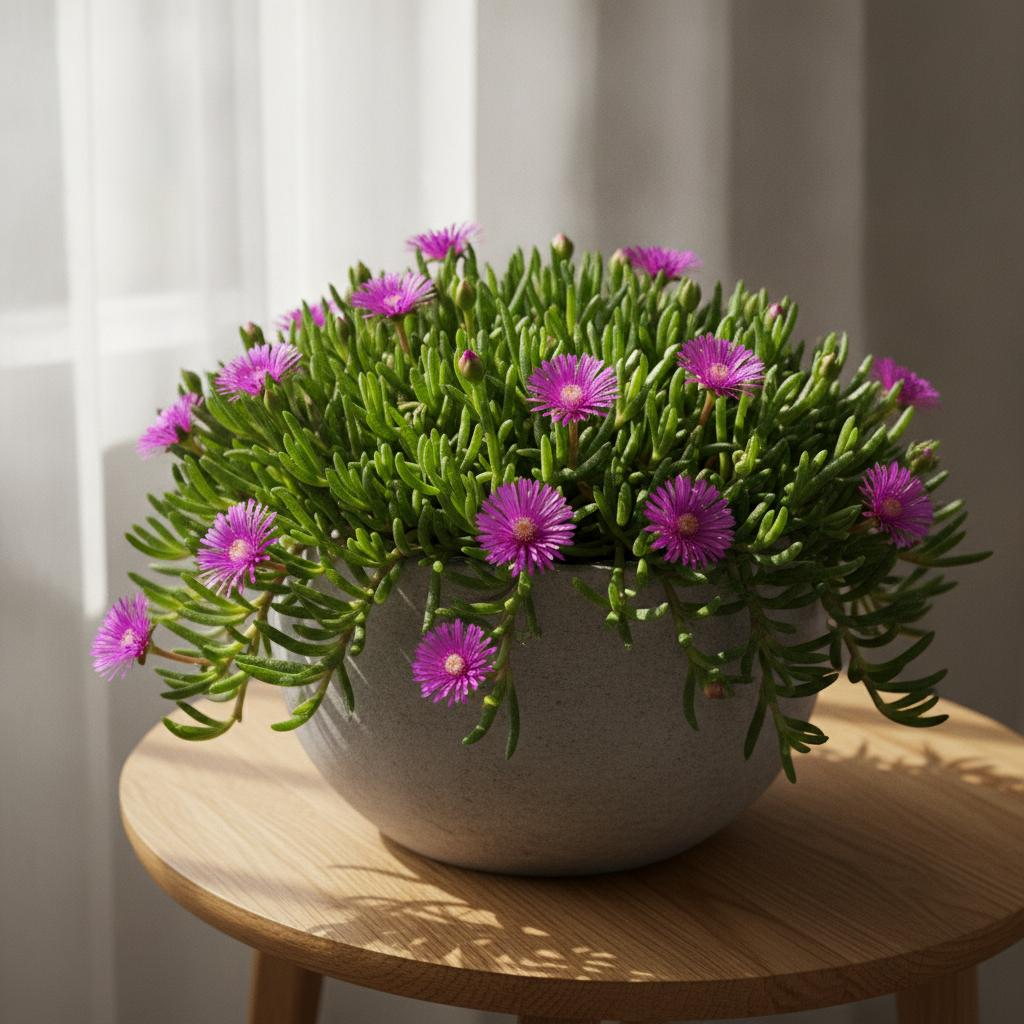
Few succulents earn their common name as literally as the ice plant. Run a finger across the foliage of Delosperma cooperi and the surface glitters, thanks to thousands of tiny, water-filled bladder cells on the epidermis that catch the light like frost or sugar crystals. Native to the high grasslands of the Drakensberg mountains in South Africa, this low, trailing succulent spends its days carpeting rocky slopes in slender green leaves and, when the sun is out, exploding into vivid magenta-purple flowers that look like shimmering daisies. It is sometimes sold as the trailing ice plant, hardy ice plant, Cooper’s ice plant or pink carpet, but whatever the label, the plant beneath it is the same tough, sun-loving mat-former.
The ice plant has a deserved reputation as one of the most forgiving succulents you can grow, provided you give it what it actually wants: as much light as possible and very little water. Most failures with this plant are not failures of attention but failures of restraint, because a kindly meant extra drink in winter does far more harm than a fortnight of neglect ever could. This guide covers everything from the light and watering regime that separates a merely surviving ice plant from a freely flowering one, through soil, feeding, propagation and pests, to the dazzling range of cultivars now available in nurseries and garden centres.
Contents
- Quick Reference
- Why the Ice Plant Makes a Resilient Houseplant
- Light Requirements
- Watering & Humidity
- Soil, Potting & Repotting
- Fertilising
- Propagation
- Pests & Diseases
- Popular Varieties
- Frequently Asked Questions
Quick Reference: Ice Plant at a Glance
| Light | Full, direct sun. The brightest position you can offer, ideally a south-facing window indoors or six or more hours of direct sun outdoors. |
| Watering | Sparing. Soak thoroughly, then let the soil dry out completely. Roughly every 10 to 14 days in summer, monthly or less in winter. |
| Temperature | Happy at 18 to 24 degrees C (64 to 75 degrees F) indoors. In the ground it tolerates frost to around -18 degrees C (0 degrees F) or lower. |
| Humidity | Low. Dry household air suits it perfectly. High humidity is a liability rather than a benefit. |
| Fertiliser | Minimal. A diluted low-nitrogen succulent feed once or twice during spring and summer is ample. |
| Toxicity | Non-toxic. Delosperma cooperi is not listed as poisonous to cats, dogs or humans, making it a safe choice for pet households. |
Why the Ice Plant Makes a Resilient Houseplant
The ice plant evolved in an environment that selects ruthlessly for toughness. The Drakensberg grasslands swing between intense high-altitude sun, sharp drainage on rocky ground, summer thunderstorms and bitterly cold winters. A plant that survives there has learned to store water in its leaves, shrug off drought, and ride out temperatures that would kill most succulents outright. Brought indoors or onto a balcony, that hardiness translates into a plant that asks very little of its keeper and punishes overcare far more than under-care.
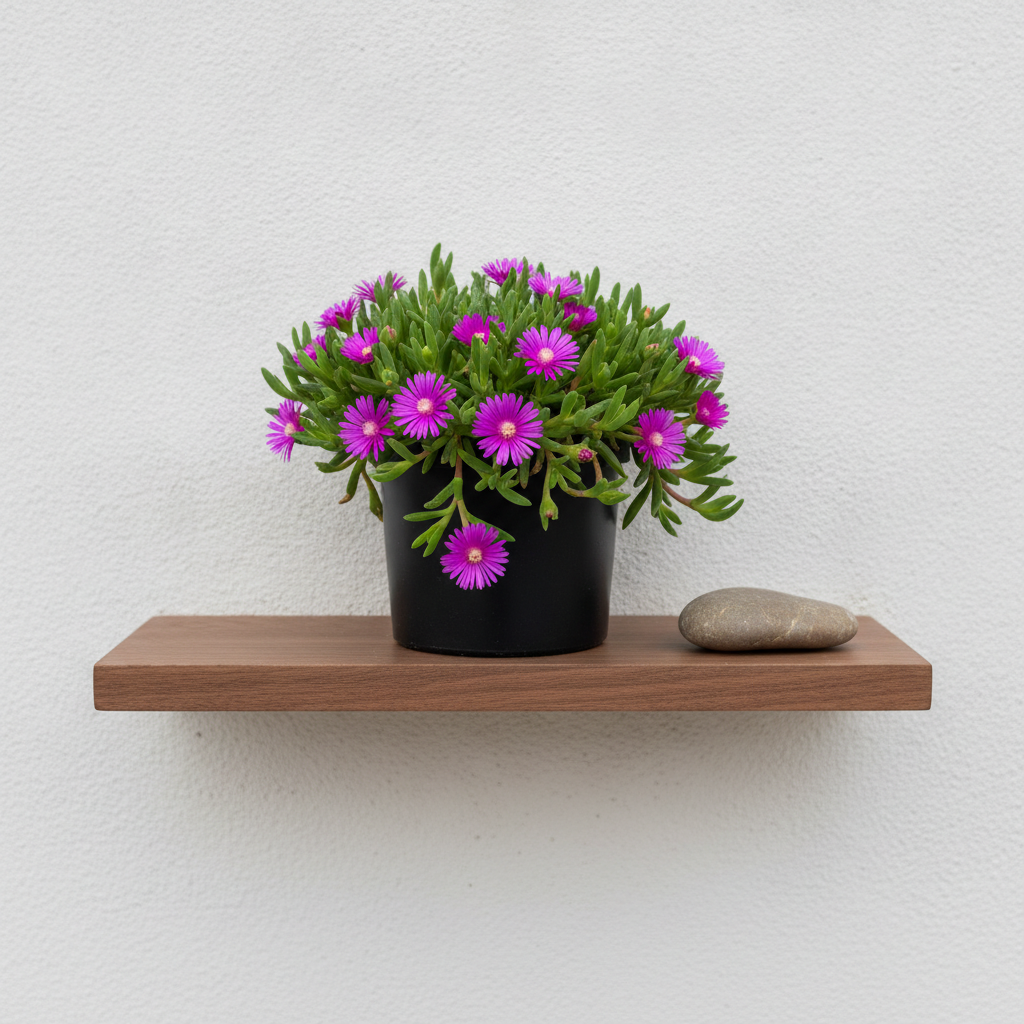
What sets Delosperma cooperi apart from the average windowsill succulent is its willingness to flower. Many easy succulents are grown chiefly for foliage and bloom only grudgingly, but a well-sited ice plant produces a long succession of luminous, satiny flowers from late spring into autumn. Each bloom opens in response to sunlight and closes again in dull weather or at dusk, so a sunny day turns the plant into a small carpet of colour. Add to that its genuine cold hardiness, its tolerance of poor soil and its readiness to root from the smallest scrap of stem, and you have a plant that is as rewarding for a beginner as it is undemanding for the forgetful.
Important — Toxicity: Delosperma cooperi is considered non-toxic and is not listed as harmful to cats, dogs or people. While no plant material should be eaten in quantity, this is a reassuringly safe choice for homes with curious pets or young children.
Light Requirements
If there is one rule that determines success with the ice plant, it is this: give it more light than you think it needs. This is a full-sun plant in every sense, and no amount of careful watering or feeding will compensate for a position that is too dim. In low light the stems stretch, the leaves space out and pale, the glistening surface dulls, and flowering stops altogether. In bright light the plant stays compact, the foliage takes on a healthy plump density, and the flowers come thick and fast.
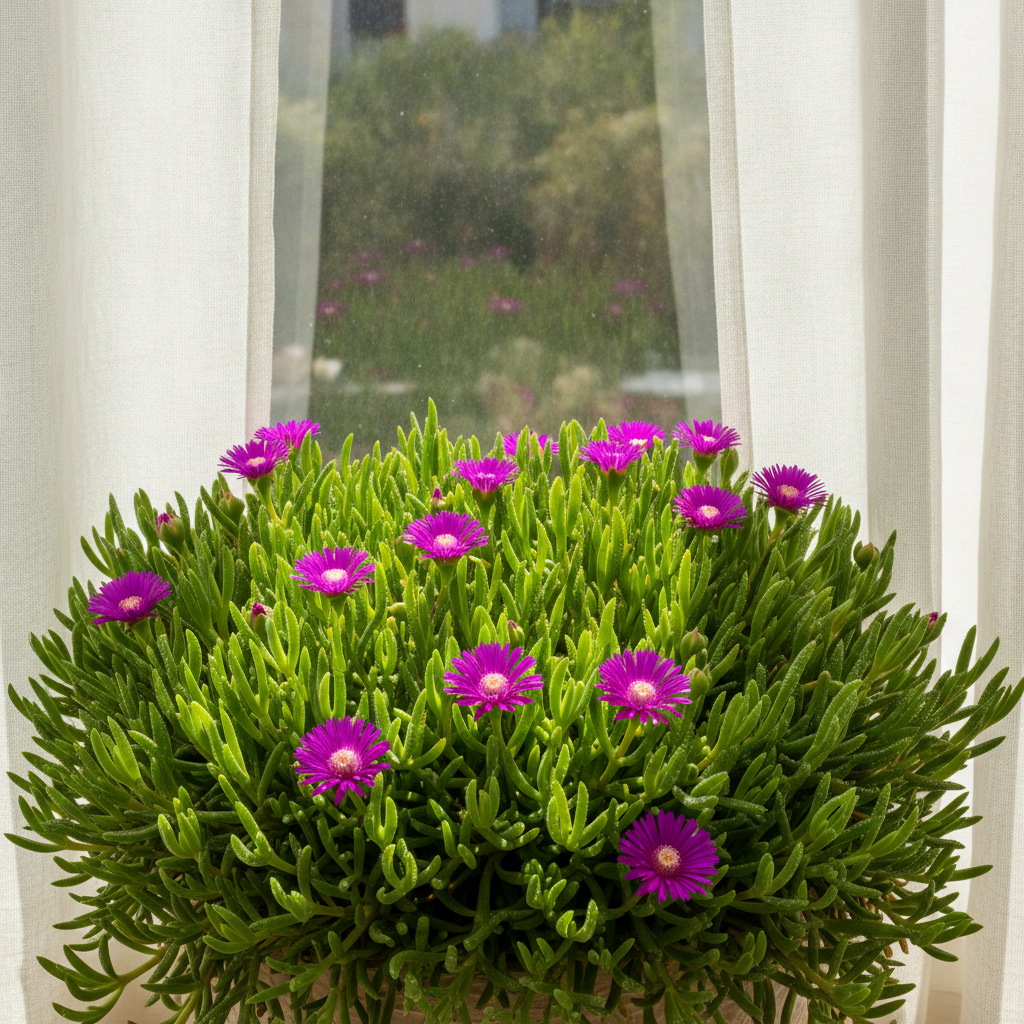
Indoors, the ideal position is directly in front of an unobstructed south-facing window where the plant can bask in several hours of direct sun each day. Outdoors on a balcony or patio it wants the sunniest spot available, with six or more hours of direct light. Unlike many tender houseplants, the ice plant does not need protection from strong midday sun; it actively craves it, and only a plant moved abruptly from deep shade into fierce summer glare is at any real risk of scorching.
Light Levels Explained
Light intensity is often described in lux, a measure of how much visible light falls on a surface. The table below puts the ice plant’s needs in context against the broad categories used for houseplants. The key takeaway is that this plant sits firmly at the top of the range, and anything below bright indirect light will leave it weak and reluctant to flower.
| Light Category | Approx. Level | Typical Location | Outcome |
|---|---|---|---|
| Direct sun | 50,000 lux and above | On a south-facing sill, outdoors in the open | Ideal. Compact growth and abundant flowering. |
| Bright indirect | 10,000 to 20,000 lux | Just back from a sunny window | Acceptable. Healthy foliage but fewer flowers. |
| Medium | 5,000 to 10,000 lux | An east or west window with some shade | Poor. Leggy growth and sparse, sporadic bloom. |
| Low | 1,000 to 2,500 lux | A north window, several metres from glass | Unsuitable. Stretching, pale leaves, no flowers. |
| Very low | Below 1,000 lux | Interior rooms, hallways | The plant will slowly decline and die. |
Window Orientation and Placement
South-facing window: This is the prime location for an ice plant grown indoors in the northern hemisphere. The long hours of direct sun keep growth tight and trigger heavy flowering. Place the pot as close to the glass as possible and rotate it occasionally so all sides receive even light.
East-facing window: A workable second choice. The plant catches several hours of gentler morning sun, which is enough to sustain it but may produce slightly fewer flowers than a southern aspect. Watch for any tendency to lean towards the light and turn the pot regularly.
West-facing window: Also usable, offering warm afternoon sun. The heat of late-day light suits the plant well, though glass can amplify summer temperatures, so ensure good airflow on the hottest days.
North-facing window: Not recommended. A northern aspect simply cannot supply the intensity an ice plant requires. Grown here it will stretch, lose colour and fail to bloom, and is better moved or given supplementary lighting.
Pro Tip — Reading the Flowers: The ice plant tells you whether it has enough light through its blooms. Flowers open only in bright conditions and stay shut on dull days, so if your plant rarely opens even when the sun is out, it is signalling that its position is too dim and needs moving closer to the light.
How Light Affects Flowering and Form
Light governs almost every desirable trait in this plant. Strong sun keeps the internodes short, so the stems stay densely clothed in leaves and form a tight cushion or trailing mat rather than a sparse, straggling tangle. It also drives the production of the pigments that give both the foliage its rich tone and the flowers their saturated magenta, orange or pink. A plant in marginal light not only flowers less but produces paler, smaller blooms when it does manage to open them.
Warning — Sudden Sun Exposure: Although the ice plant loves direct sun, a specimen that has spent months in low indoor light can scorch if moved straight into intense summer sun. Acclimatise it over a week or two, increasing exposure gradually, to let the leaves toughen and avoid pale, sunken burn patches.
Artificial Lighting
Where natural light falls short, particularly through a dim winter, a full-spectrum LED grow light can keep an ice plant healthy. Because the plant’s demands are high, position the light close, within 15 to 30 centimetres (6 to 12 inches) of the foliage, and run it for 12 to 14 hours a day. A grow light strong enough to genuinely substitute for sun will also encourage some out-of-season flowering, though plants grown purely under artificial light rarely bloom as freely as those in real sun.
Seasonal Adjustments
As the sun weakens and its angle drops through autumn and winter, move the plant to the brightest available window and consider supplementary lighting. Growth slows markedly in the cooler months, which is normal and welcome; this rest period helps the plant flower more strongly the following year. In spring, as light returns, ease the plant back towards its summer position and resume more regular watering as new growth appears.
Watering & Humidity
Watering is where most ice plants are loved to death. As a leaf succulent from a dry, sharply drained habitat, Delosperma cooperi stores its own water reserves and is built to endure long dry spells. The single most important principle is to water thoroughly but infrequently, then to wait until the soil has dried out completely before watering again. When in doubt, leave it longer; this plant recovers quickly from drought and very slowly, if at all, from waterlogging.
When to Water
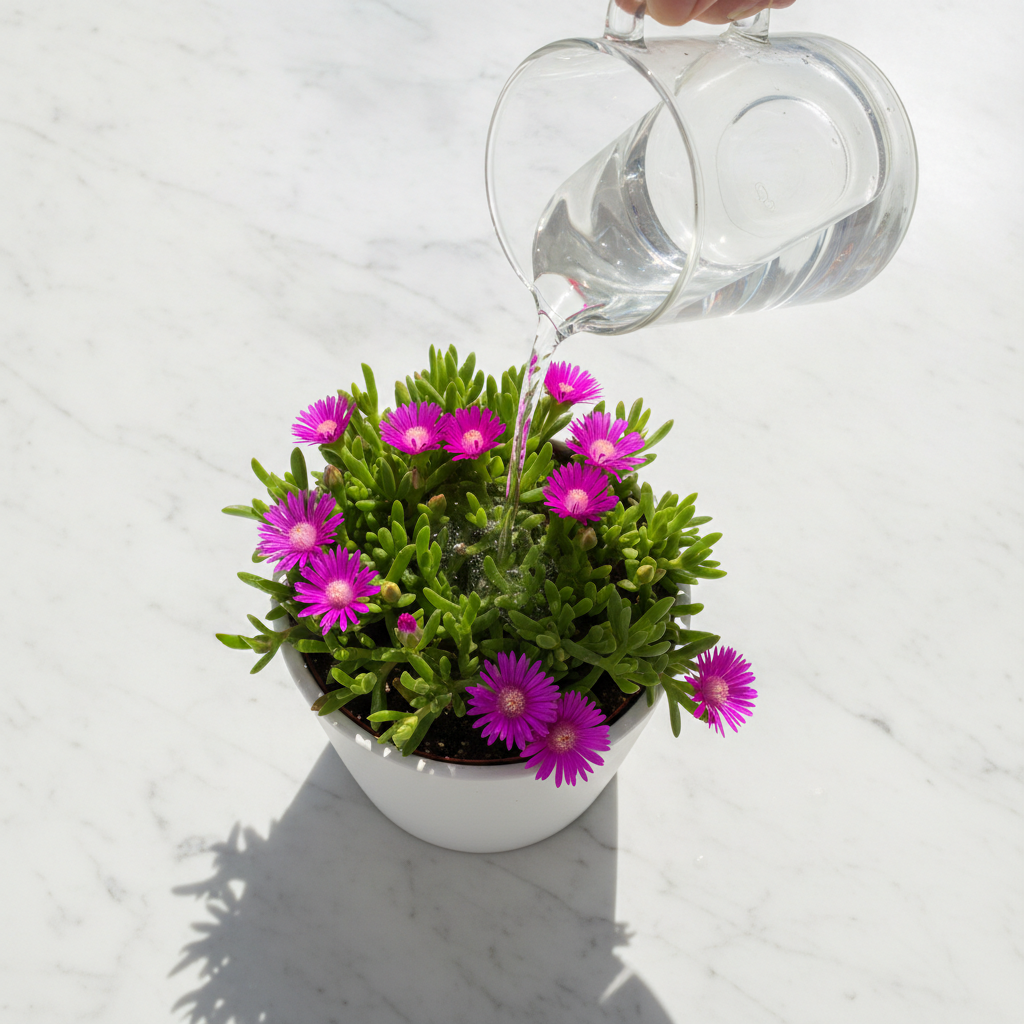
Let the moisture content of the soil, not the calendar, dictate watering. Push a finger several centimetres into the mix, or lift the pot to judge its weight; only water when the soil is dry all the way through and the pot feels light. During the active growing season of late spring and summer this typically means watering roughly every 10 to 14 days, though a small pot in hot, sunny conditions may dry faster.
In autumn and winter, as growth slows and light fades, cut back sharply. Watering once a month or even less is often enough, and a plant kept cool and dormant over winter may need almost no water at all. Cold, damp soil around the roots in low light is the classic recipe for rot, so err firmly on the side of dryness through the dark months.
Pro Tip — The Wrinkle Test: An ice plant that genuinely needs water will show slightly softened, faintly wrinkled leaves. Plump, firm foliage means the plant still has ample reserves and should be left alone. Learning to read the leaves is more reliable than any fixed schedule.
How to Water Correctly
- Check that the soil is completely dry throughout and that the pot has functioning drainage holes.
- Water at the base of the plant, directing the flow onto the soil rather than over the foliage and crown.
- Continue until water runs freely from the drainage holes, ensuring the whole root ball is moistened.
- Allow the pot to drain fully, then tip away any water that collects in the saucer or cachepot.
- Return the plant to its sunny position and do not water again until the soil has dried out completely.
Signs of Overwatering vs. Underwatering
| Symptom | Overwatering | Underwatering |
|---|---|---|
| Leaf colour | Yellowing, translucent or blackened leaves | Dull green fading to reddish or bronzed tones |
| Leaf texture | Soft, mushy, collapsing leaves that fall at a touch | Shrivelled, wrinkled, thin but still firm leaves |
| Soil | Persistently wet, sometimes with a sour smell | Bone dry, often pulling away from the pot sides |
| Roots | Brown, black and slimy, breaking apart easily | Dry and intact, recovering quickly once watered |
| Stem base | Soft, darkened and rotting at soil level | Firm but lean, with stems thinning over time |
Warning — Root Rot: Soft, blackening stems at soil level are a sign of root rot, almost always caused by too much water or poor drainage. Act fast: remove the plant, cut away all mushy tissue, and take healthy cuttings to start again, because a badly rotted ice plant rarely recovers as a whole.
Humidity Requirements
Here the ice plant is refreshingly undemanding. It is adapted to dry, airy conditions and is perfectly content in the low humidity of a centrally heated home, which would distress many tropical houseplants. There is no need to mist it, group it with other plants for humidity, or stand it on a pebble tray.
In fact, excess humidity works against this plant. Stagnant, moist air encourages fungal problems and rot, especially around the dense crown of foliage. The combination of damp air and wet soil is far more dangerous to an ice plant than dryness ever will be.
Good air circulation is the practical priority rather than raising humidity. A position with gentle airflow helps the foliage dry quickly after watering and keeps the conditions around the plant on the dry side it prefers. Avoid crowding it among moisture-loving plants in a humid corner.
Water Quality
The ice plant is not fussy about water quality and tolerates ordinary tap water in most areas. Because it is watered so infrequently, the gradual build-up of minerals that can trouble more sensitive plants is rarely an issue. If your tap water is very hard, an occasional flush with rainwater or distilled water will keep the soil sweet, but for the vast majority of growers, tap water at room temperature is entirely adequate.
Soil, Potting & Repotting
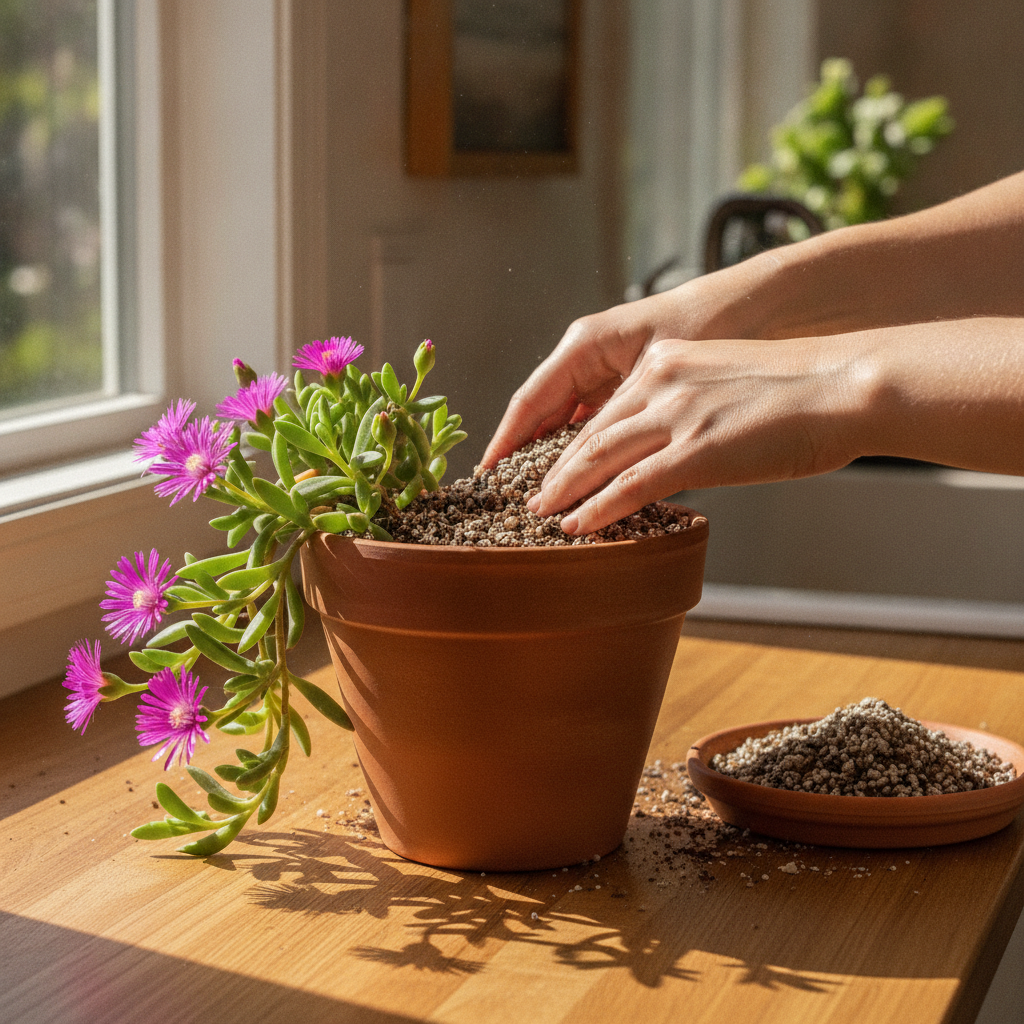
Sharp drainage is the foundation of ice plant care, and it begins with the soil. In its native habitat this plant grows in gritty, fast-draining ground where water rushes away after rain and never sits around the roots. Replicating that free-draining character in a pot is the single most effective thing you can do to keep the plant healthy, because the right soil makes overwatering far harder to achieve by accident.
Ideal Soil Composition
A standard cactus and succulent compost makes a sound starting point, but most bagged mixes still hold more moisture than an ice plant likes. The reliable approach is to take a succulent compost and open it up further with generous additional grit or coarse sand, aiming for a mix that drains within seconds rather than minutes. The leaner and grittier the medium, the safer the plant.
| Component | Proportion | Function |
|---|---|---|
| Cactus or succulent compost | 50 percent | Provides structure, some moisture retention and a little nutrition. |
| Coarse horticultural grit or pumice | 30 percent | Creates large air pockets and drives rapid drainage. |
| Perlite or coarse sand | 20 percent | Lightens the mix and prevents compaction around the roots. |
The ice plant is tolerant of soil pH and grows well in anything from slightly acidic to slightly alkaline conditions, roughly pH 6.0 to 7.5. There is no need to test or adjust pH for this plant; a standard succulent mix will sit comfortably within its preferred range.
Pro Tip — Quick Mix Recipe: For a fuss-free blend, combine two handfuls of cactus compost with one handful of pumice or grit and one handful of perlite. If you can squeeze a moistened handful and it crumbles apart rather than holding together as a ball, the drainage is about right.
Choosing the Right Pot
Pot choice has a direct bearing on how easy the plant is to keep alive, because the container influences how quickly the soil dries. With a low, spreading or trailing plant like the ice plant, a shallow pot or a wider, low bowl often suits the root system better than a tall, deep container that holds a reservoir of damp soil beneath the roots.
Drainage holes are non-negotiable. The ice plant must be grown in a pot with one or more generous drainage holes. A decorative pot with no drainage is an invitation to root rot. If you love a particular cachepot, use it as an outer cover and keep the plant in a plain plastic or terracotta liner that can be lifted out to drain.
Pot material: Terracotta is an excellent choice for this plant. Its porous walls wick moisture from the soil and let it evaporate, helping the mix dry faster between waterings. Glazed ceramic and plastic both work but retain moisture longer, so be especially disciplined with watering if you use them.
Pot size: Choose a pot only slightly larger than the root ball. Ice plants are content in modest containers and an oversized pot holds a large volume of slow-drying soil, raising the risk of rot. As a trailing plant it also looks at its best slightly snug, spilling over the rim.
When to Repot
Ice plants are not in a hurry to be repotted and generally need it only every two to three years, or when roots emerge from the drainage holes and the plant has clearly filled its container. The best time is early spring, just as the plant is moving back into active growth, which gives it the full season ahead to settle into fresh soil. Repotting also offers a useful chance to refresh tired, compacted compost and to inspect the roots for any early signs of rot.
How to Repot: Step-by-Step
- Water lightly a day or two beforehand if the soil is dust dry, or work with dry soil and water afterwards, which many growers prefer for succulents.
- Ease the plant from its pot, supporting the trailing stems, and gently tease away the old soil from around the roots.
- Inspect the roots and trim away any that are brown, black or mushy with clean, sharp scissors.
- Add a layer of fresh gritty mix to the base of the new pot, then position the plant at the same depth it sat before.
- Fill around the root ball with mix, pressing gently to remove large air gaps without compacting the soil hard.
- Wait a few days before watering, allowing any disturbed or trimmed roots to callus and reducing the risk of rot.
Warning — Transplant Shock: Resist the urge to water heavily straight after repotting. Freshly disturbed roots are vulnerable to rot, so give the plant a few dry days to recover before its first proper drink, and keep it out of the most intense sun while it re-establishes.
Fertilising
The ice plant is a light feeder by nature, adapted to lean, nutrient-poor soils where rich feeding simply does not occur. As a result it needs very little fertiliser, and the most common feeding mistake is giving too much rather than too little. A modest amount of the right feed at the right time supports flowering, while heavy feeding produces soft, leggy growth at the expense of both form and bloom.
For a plant grown chiefly for its flowers, the type of feed matters. A fertiliser high in nitrogen pushes lush foliage but few blooms, so a balanced or slightly low-nitrogen formula designed for succulents or flowering plants gives far better results, encouraging the plant to channel its energy into those luminous flowers.

Understanding Plant Nutrients
Fertilisers are described by their N-P-K ratio, the proportions of nitrogen, phosphorus and potassium they contain, alongside smaller amounts of secondary nutrients and trace elements. Understanding what each does helps you choose a feed that suits a flowering succulent rather than a leafy foliage plant.
| Nutrient | Symbol | Primary Function | Deficiency Symptoms |
|---|---|---|---|
| Nitrogen | N | Drives leaf and stem growth | Pale, yellowing older leaves and slow growth |
| Phosphorus | P | Supports roots and flowering | Weak roots, poor bloom, dull or reddish foliage |
| Potassium | K | Aids flowering and overall vigour | Browning leaf edges and reduced flowering |
| Calcium | Ca | Builds strong cell walls | Distorted new growth and weak tissue |
| Magnesium | Mg | Central to chlorophyll production | Yellowing between the veins of older leaves |
| Iron | Fe | Needed for green pigment | Yellowing of young leaves while veins stay green |
Types of Fertiliser
Liquid fertilisers: The easiest option for an ice plant, allowing precise control over dose and timing. Diluted well below the label strength and applied with normal watering during the growing season, a liquid succulent feed delivers a gentle, even supply of nutrients.
Slow-release granular: A small dose of slow-release granules in spring can feed the plant gradually across the season with minimal effort. Use sparingly, as these products release nutrients over months and it is easy to overdose a plant with such modest needs.
Organic fertilisers: Mild organic options such as a dilute worm-casting tea release nutrients slowly and gently, with little risk of scorching the roots. They suit the ice plant’s preference for a lean, steady supply rather than a sudden rich feast.
Feeding Schedule
Feed only during the active growing season of spring and summer, when the plant can actually use the nutrients. For most growers, a diluted feed once a month, or even just two or three times across the whole season, is ample. Stop feeding entirely in autumn and winter, when the plant is resting and any added nutrients will only sit unused in the soil, risking salt build-up.
Pro Tip — Half Strength or Less: Always mix succulent feed weaker than the bottle suggests, often to a quarter or half the stated strength. Ice plants thrive on lean conditions, and a dilute feed given occasionally does far more good than a strong one that pushes soft, flop-prone growth.
How to Fertilise
- Dilute a succulent or flowering-plant fertiliser to a quarter or half of the recommended strength.
- Water the plant lightly first if the soil is completely dry, to avoid feeding directly onto parched roots.
- Apply the diluted feed to the soil at the base of the plant during a normal watering in spring or summer.
- Let the pot drain fully and tip away any feed that collects in the saucer beneath.
- Resume plain water for subsequent waterings until the next scheduled feed.
Warning — Salt Build-Up: Over-feeding leaves a crust of mineral salts on the soil surface and pot rim and can scorch the roots, showing as brown leaf tips. If you see white deposits, stop feeding and flush the soil thoroughly with plain water to wash the excess away.
Propagation
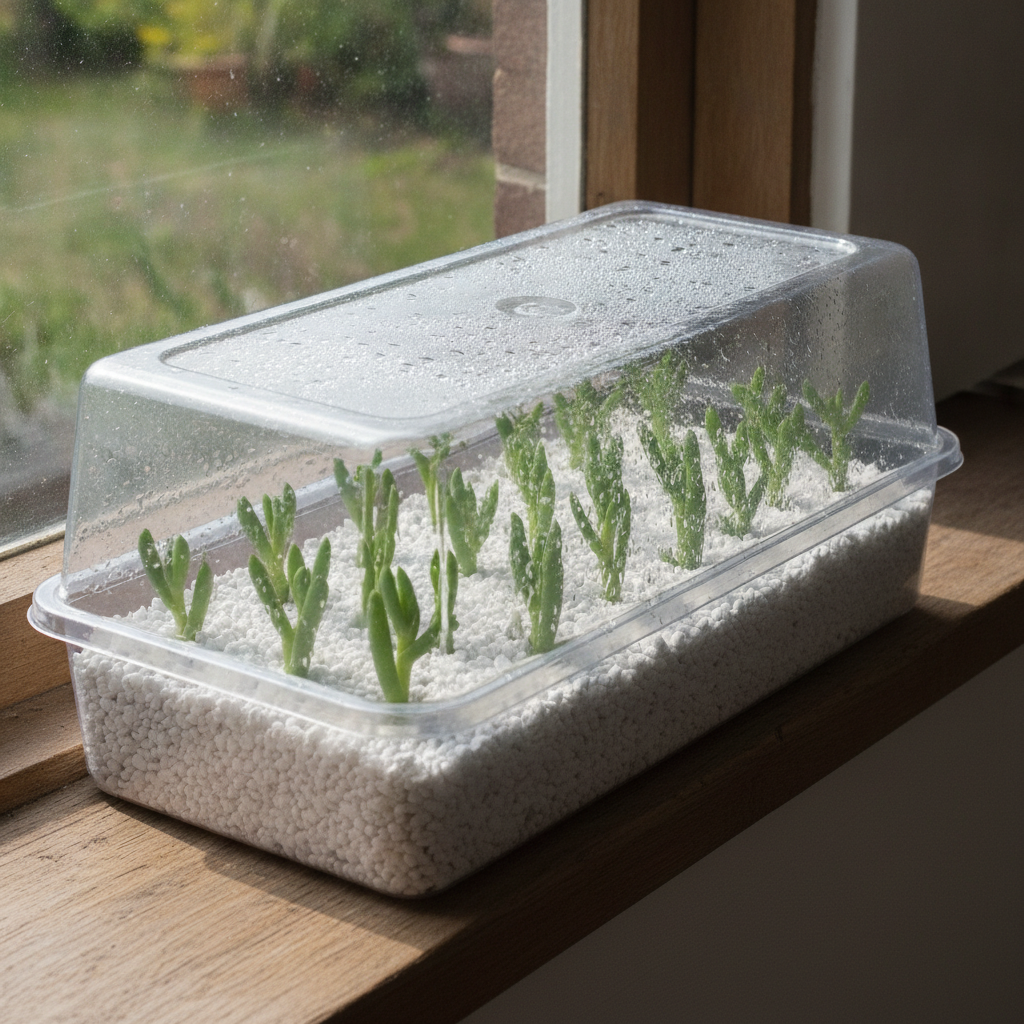
Propagating the ice plant is one of the great pleasures of growing it, because few plants root more willingly. Its trailing stems are programmed to spread and take root wherever they touch suitable ground, so a single plant can be multiplied into many with little more than a pair of scissors and a tray of gritty mix. This generosity makes it ideal for filling out containers, sharing with friends or replacing a tired old specimen.
The two most reliable methods are stem cuttings and division, with stem cuttings being the simplest and most productive. Seed is also possible and is how many of the named hybrids were originally raised, but for the home grower, vegetative propagation is faster and guarantees a plant identical to the parent.
Understanding Rooting Nodes
The key to easy propagation lies in the nodes, the points along each stem where leaves emerge. These nodes contain dormant cells capable of producing new roots, and on a trailing ice plant they will often already show tiny root initials where a stem has rested against the soil. A cutting that includes one or more healthy nodes has everything it needs to form a new root system, which is why pieces of this plant root so readily.
Stem Cuttings: Step-by-Step
Stem cuttings are best taken in spring or summer, when the plant is growing actively and roots form fastest. Choose healthy, non-flowering stems for the strongest results.
- Snip a stem section 5 to 10 centimetres (2 to 4 inches) long, cutting cleanly just below a node.
- Strip the leaves from the lower portion of the cutting to expose one or two bare nodes.
- Leave the cuttings in a dry, shaded spot for a day or two so the cut ends callus over.
- Insert the bare nodes into a tray or pot of moist, gritty succulent mix or damp perlite.
- Place in bright, indirect light and keep the medium barely moist, never wet, while roots form.
- After two to three weeks, tug gently; resistance means roots have taken and the cutting can be potted on.
Pro Tip — Let Them Callus: The single most useful habit when propagating succulents is to let cut ends dry and callus for a day or two before planting. This simple pause seals the wound and dramatically reduces the chance of the cutting rotting before it can root.
Division: Step-by-Step
An established, spreading ice plant can also be divided, which is a quick way to produce a few large, ready-grown plants. This is best done in spring, ideally combined with repotting.
- Lift the whole plant from its pot or the ground and shake away loose soil to reveal the root system.
- Identify natural sections of the mat that have their own roots and stems.
- Tease or cut the clump into divisions, making sure each piece carries a fair share of healthy roots.
- Pot each division into its own container of fresh gritty mix at the same depth as before.
- Wait several days before watering, then resume normal sparing care once the divisions establish.
Troubleshooting Propagation
| Problem | Likely Cause | Solution |
|---|---|---|
| Cuttings rot before rooting | Medium too wet or cuttings planted without callusing | Use a grittier mix, water less, and let cuttings dry first |
| No roots after several weeks | Low light or cool temperatures slowing growth | Move to a warmer, brighter spot and be patient |
| Cuttings shrivel badly | Medium too dry during rooting | Keep the mix barely but consistently moist until roots form |
| Divisions fail to establish | Too few roots on each piece or watered too soon | Divide into larger sections and delay the first watering |
Pests & Diseases
A healthy ice plant grown in plenty of light and sharp soil is remarkably resistant to trouble, and the great majority of problems trace back to conditions rather than infestation. Overwatering and poor drainage cause more ice plant deaths than every pest combined. That said, a few sap-sucking insects do occasionally find their way onto indoor specimens, particularly where air is stagnant or a plant is stressed.
The best defence is vigilance and good culture. Inspect your plant regularly, keep it in bright airy conditions, and isolate any new arrival for a couple of weeks before placing it among your other plants. Catching a small problem early makes it trivial to deal with, whereas an unnoticed infestation can spread quickly.
Common Pests
Mealybugs (Pseudococcus species)
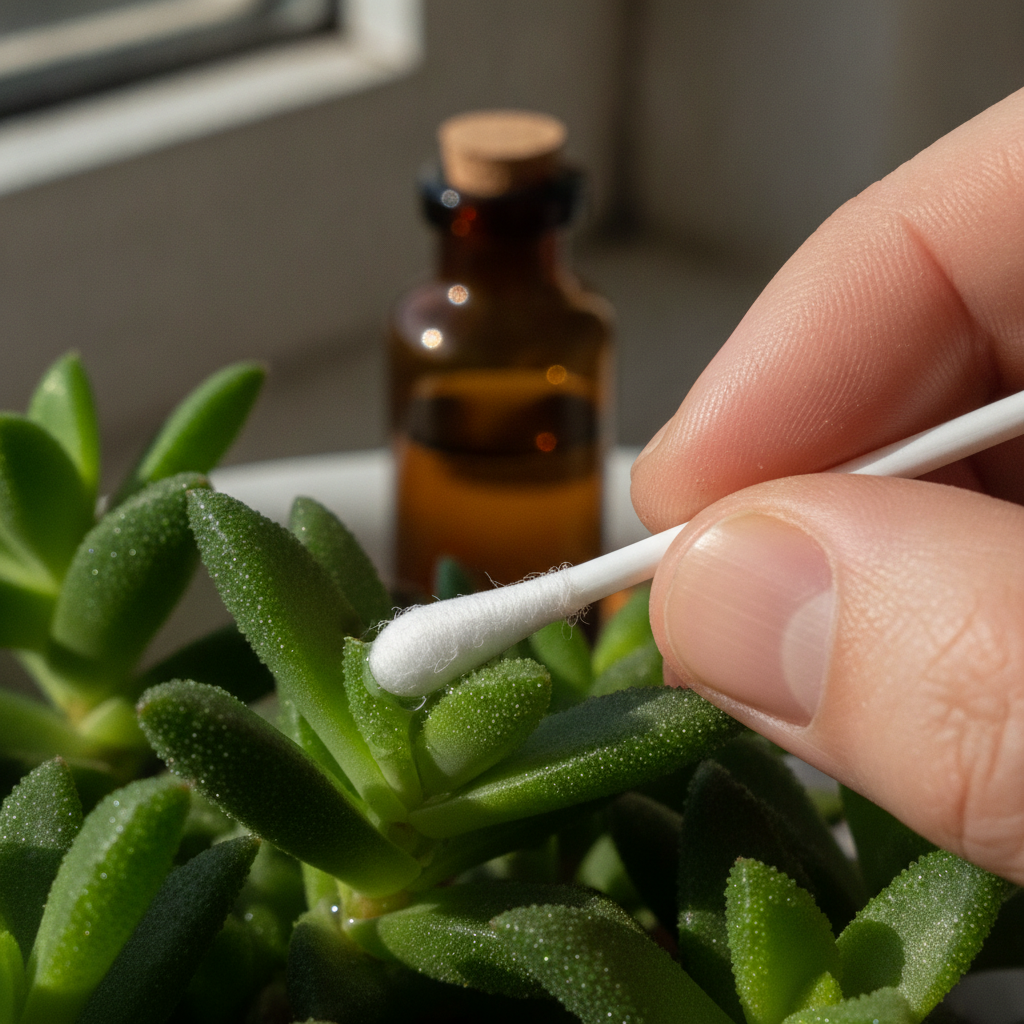
Mealybugs are the most likely pest on an indoor ice plant, appearing as small, white, cottony tufts tucked into leaf axils and the dense centre of the plant. They suck sap, weaken growth and excrete sticky honeydew that can lead to sooty mould.
Treatment: Dab each insect directly with a cotton bud dipped in diluted isopropyl alcohol, then treat the whole plant with insecticidal soap or a neem oil solution. Repeat every few days until no new bugs appear, checking the hidden crevices carefully.
Aphids (Aphidoidea)
Aphids are small green, black or pink insects that cluster on tender new growth and, in particular, on flower buds, where they can distort or spoil the blooms. They multiply rapidly and also produce honeydew.
Treatment: Rinse them off with a firm jet of water, then follow up with insecticidal soap or neem oil if numbers persist. A few applications a few days apart usually clears an outbreak entirely.
Spider Mites (Tetranychus urticae)
Spider mites thrive in hot, dry, stagnant conditions and are tiny enough to be hard to see, though their fine webbing and the resulting stippled, dull foliage give them away. They are an occasional rather than common problem on ice plants.
Treatment: Wipe down the foliage, improve air circulation, and apply neem oil or a miticide. Repeat treatments are essential to break the rapid breeding cycle of these pests.
Common Diseases
Root Rot (Pythium and Phytophthora species)
Root rot is by far the most serious threat to an ice plant and is caused by waterlogged soil suffocating and rotting the roots. The first signs are soft, yellowing or blackening stems and a plant that looks limp despite wet soil.
Treatment: Remove the plant from its soil, cut away all soft, discoloured roots and stems, and let the healthy remainder dry before replanting in fresh, gritty mix. If rot is extensive, salvage clean cuttings and start afresh, then correct the watering habits that caused it.
Fungal Leaf Spot (various fungi)
Persistently damp foliage and poor air movement can lead to fungal leaf spots, seen as dark, sometimes sunken marks on the leaves. This is uncommon in a properly grown, sun-loving ice plant but can appear in crowded, humid conditions.
Treatment: Remove affected leaves, improve airflow, avoid wetting the foliage when watering, and apply a fungicide if the problem spreads. Keeping the plant dry and airy usually prevents any recurrence.
Pest and Disease Summary
| Pest / Disease | Identification | Treatment |
|---|---|---|
| Mealybugs | White cottony tufts in leaf axils and crown | Alcohol on a cotton bud, then insecticidal soap or neem |
| Aphids | Clusters of small insects on buds and new growth | Rinse off, then insecticidal soap or neem oil |
| Spider mites | Fine webbing and stippled, dull leaves | Improve airflow and apply neem oil or a miticide |
| Root rot | Soft, blackening stems and a limp plant in wet soil | Cut away rot, replant in dry gritty mix, water less |
| Fungal leaf spot | Dark spots on damp, poorly ventilated foliage | Remove affected leaves, improve airflow, use fungicide |
Prevention Strategies
Prevention with the ice plant is largely a matter of getting the basics right. A plant in full sun, in fast-draining soil, watered only when dry and given room for air to circulate is a plant that pests and diseases struggle to gain a foothold on. The vigour that comes from correct culture is the most effective protection of all.
Beyond good culture, simple quarantine and routine inspection do the rest. Check the hidden crevices of the crown when you water, deal with any stray insect immediately, and keep newly bought plants apart until you are confident they are clean. These small habits prevent almost every serious outbreak.
Pro Tip — Neem as Routine: A light neem oil spray every few weeks during the growing season acts as a gentle preventive, deterring pests before they establish. Apply it in the evening or out of direct sun to avoid any risk of leaf marking on the foliage.
Popular Varieties
While the species Delosperma cooperi with its classic magenta-purple flowers remains a favourite, the genus has been the subject of intensive breeding, and growers can now choose from an extraordinary palette of colours. Hybridisers have crossed Delosperma cooperi with other species to produce plants in shades of orange, salmon, yellow, red and bicoloured combinations, often with improved hardiness and longer flowering seasons.
Many of the most popular cultivars belong to named series, such as the Jewel of Desert range, which offers a coordinated set of colours on compact, free-flowering plants. Whether you want the traditional purple carpet or a vivid mix of fiery tones, there is a Delosperma to suit, and all share the same easy, sun-loving temperament.
| Variety | Flower Appearance | Light Needs | Growth Rate | Availability |
|---|---|---|---|---|
| Delosperma cooperi (species) | Classic glossy magenta-purple | Full sun | Moderate, spreading | Very common |
| Fire Spinner | Tricolour orange, magenta and white eye | Full sun | Moderate, spreading | Common |
| Mesa Verde | Soft salmon-pink | Full sun | Low, compact | Common |
| Jewel of Desert series | Wide range: garnet, ruby, topaz, peridot | Full sun | Compact, free-flowering | Common |
| Delosperma nubigenum | Bright golden yellow | Full sun | Vigorous, mat-forming | Common |
| Table Mountain | Deep magenta-pink, very hardy | Full sun | Low, dense | Common |
| Lavender Ice | Pale lilac to lavender | Full sun | Compact | Occasional |
Featured Varieties
Fire Spinner
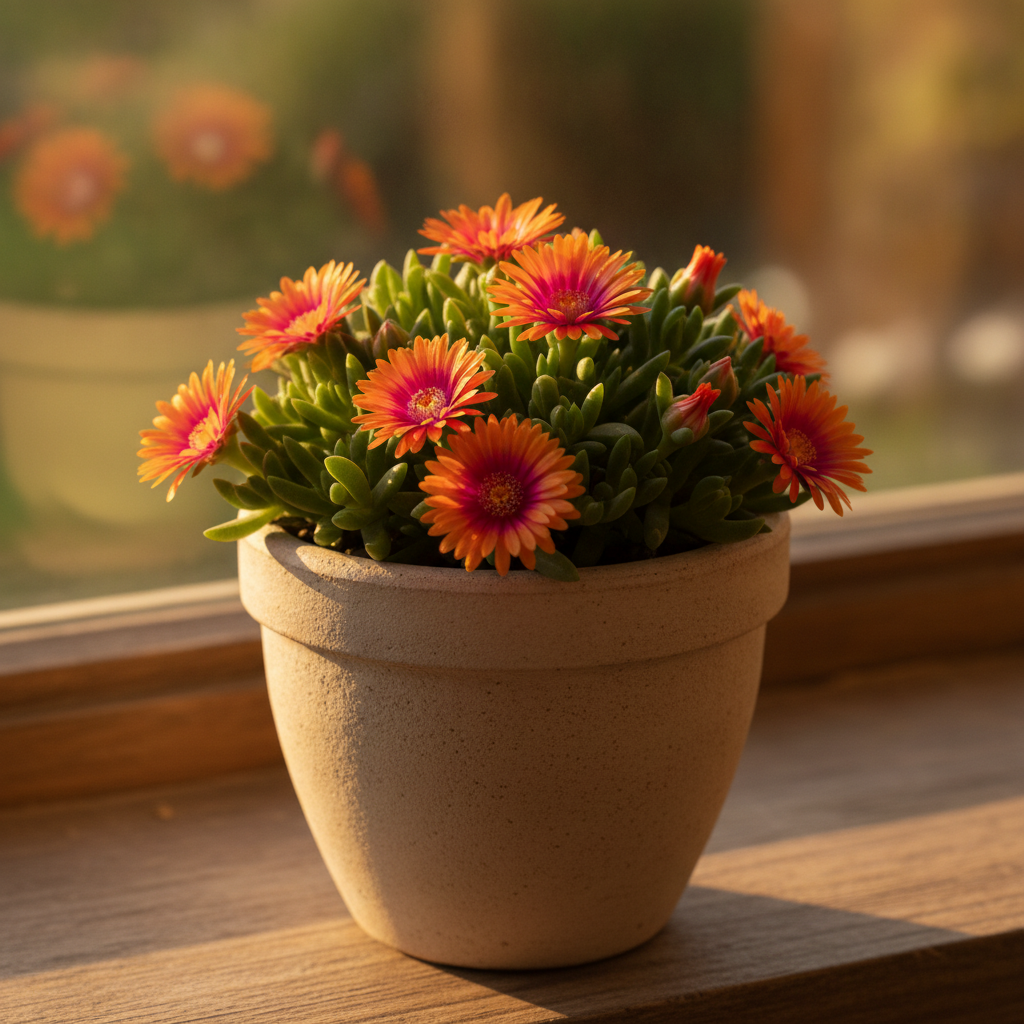
One of the most striking Delosperma hybrids, Fire Spinner bears tricolour blooms that radiate from a small white-and-violet centre into bands of orange and magenta-pink. It is compact, hardy and exceptionally showy, making it a favourite for sunny containers and rock gardens alike.
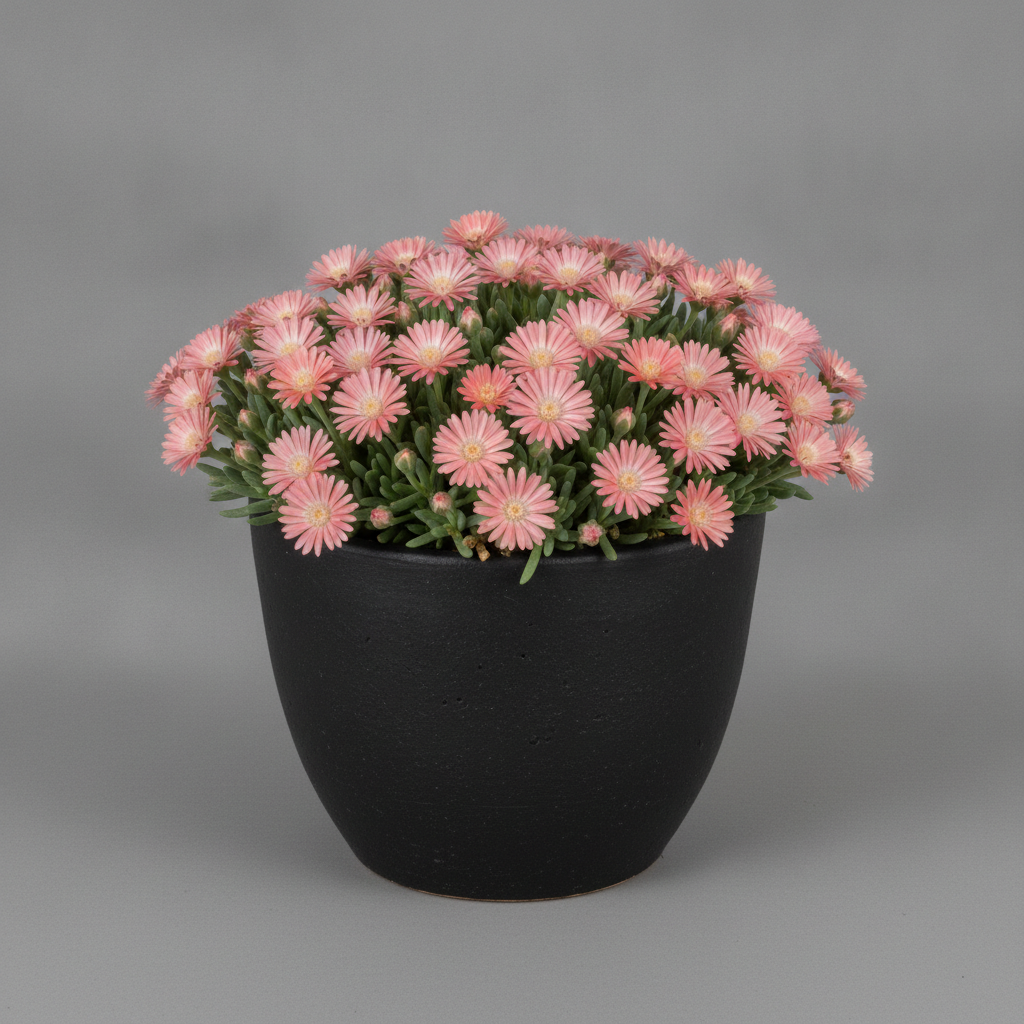
Mesa Verde
Mesa Verde stands out for its unusual soft salmon-pink flowers, a gentler colour than the vivid purples and oranges of most ice plants. It forms a low, tidy mound of fine succulent foliage and blooms generously through the warmer months, bringing a subtle, sophisticated tone to a sunny display.
Variety Profiles in Detail
Fire Spinner (Delosperma ‘Fire Spinner’)
Introduced from breeding work that selected for bold colour and reliable hardiness, Fire Spinner has become one of the best known Delosperma cultivars worldwide. Its dazzling tricolour flowers create a remarkable carpet of colour in full sun, and the plant combines that drama with the same drought tolerance and toughness as the species. It is equally at home spilling over the edge of a pot or threading through gravel in a rockery.
Mesa Verde (Delosperma ‘Kelaidis’)
Sold under the trade name Mesa Verde, this hybrid is prized for its luminous salmon-pink blooms, a colour rarely seen among hardy succulents. It is compact and floriferous, flowering over a long season, and shares the family trait of being remarkably cold tolerant for a plant of such delicate appearance. Its softer colouring makes it a useful counterpoint to the more saturated tones of other varieties.
Jewel of Desert Series (Delosperma hybrids)
The Jewel of Desert series brings together a coordinated collection of colours, each named after a gemstone such as Garnet, Ruby, Topaz, Peridot and Moonstone. Bred for compact habit, large flowers and a long blooming season, these plants are widely available and offer an easy way to assemble a multicoloured display from a single, dependable lineage.
Choosing the Right Variety for Your Space
Because all ice plant varieties share the same fundamental care, the choice comes down largely to colour and habit. For a traditional look, the species and Table Mountain give that classic magenta carpet, while Fire Spinner and the Jewel of Desert series add fiery or jewel-toned drama. For something softer, Mesa Verde and Lavender Ice offer gentler pinks and lilacs, and for a contrasting note, the golden-yellow Delosperma nubigenum is hard to beat. Whichever you choose, give it the sunniest, sharpest-draining spot you have, and it will reward you with months of glittering bloom.
Frequently Asked Questions
Why won’t my ice plant flower?
The almost universal cause of a non-flowering ice plant is insufficient light. This plant needs full, direct sun to bloom, and even bright indirect light usually produces only sparse flowers. Move it to the sunniest position you have, such as a south-facing window or an open outdoor spot, and the flowering should improve dramatically. Remember too that the blooms only open in bright conditions, so a plant may be flowering but simply keeping its petals closed on dull days.
Is the ice plant safe for cats and dogs?
Yes. Delosperma cooperi is not listed as toxic to cats, dogs or humans, which makes it a sensible choice for households with pets. As with any plant, it is wise to discourage pets from chewing on it, but the ice plant carries none of the toxicity concerns associated with many common houseplants.
Can I grow my ice plant outdoors?
Absolutely, and many people do. The ice plant is genuinely cold hardy, surviving in the ground to around -18 degrees C (0 degrees F) or lower where drainage is excellent, which is exceptional for a succulent. It makes a superb groundcover, rockery or container plant for sunny gardens. The crucial requirement outdoors is sharp drainage, as it is far more likely to die from wet winter soil than from cold itself.
Why are my ice plant’s leaves turning yellow and mushy?
Soft, yellowing or translucent leaves are the classic symptom of overwatering and, often, the beginnings of root rot. Stop watering immediately and check the soil; if it is wet and the stems are soft at the base, ease the plant out, remove any rotted tissue, and replant in dry, gritty mix. In future, water only when the soil has dried out completely.
How often should I water my ice plant?
There is no fixed schedule, because watering depends on light, temperature, pot size and season. As a guide, expect to water roughly every 10 to 14 days in summer and as little as once a month or less in winter, but always let the soil dry out completely first. Checking the soil and the firmness of the leaves is far more reliable than watering by the calendar.
Why is my ice plant leggy and stretched out?
Leggy, stretched growth with widely spaced leaves is a condition called etiolation, and it means the plant is reaching for more light. The remedy is simply to give it brighter conditions. You can also pinch back or take cuttings from the stretched stems to encourage a more compact, bushy plant, using the trimmings to propagate new specimens.
Do ice plants go dormant in winter?
Yes, growth slows considerably or stops in the cooler, darker months, which is a natural and beneficial rest period. During this time the plant needs much less water and no feeding at all. A cool, bright, dry winter rest actually helps the plant flower more strongly the following season, so resist the temptation to keep it warm and watered as if it were summer.
Why are my ice plant’s flowers closed during the day?
Ice plant flowers are responsive to light and open only in bright sunshine, closing on overcast days, in shade and at night. If your plant’s flowers stay shut even on sunny days, it is a strong sign the plant is not receiving enough direct light and should be moved to a brighter spot. Closed flowers on a cloudy day, by contrast, are entirely normal.
How do I make my ice plant bushier?
The best ways to encourage a fuller plant are to maximise light and to pinch or trim the stem tips during the growing season. Removing the tips prompts the plant to branch from lower nodes, creating a denser, more compact form, and the pieces you remove will root easily as new plants. Adequate sun keeps the new growth tight rather than stretched.






