
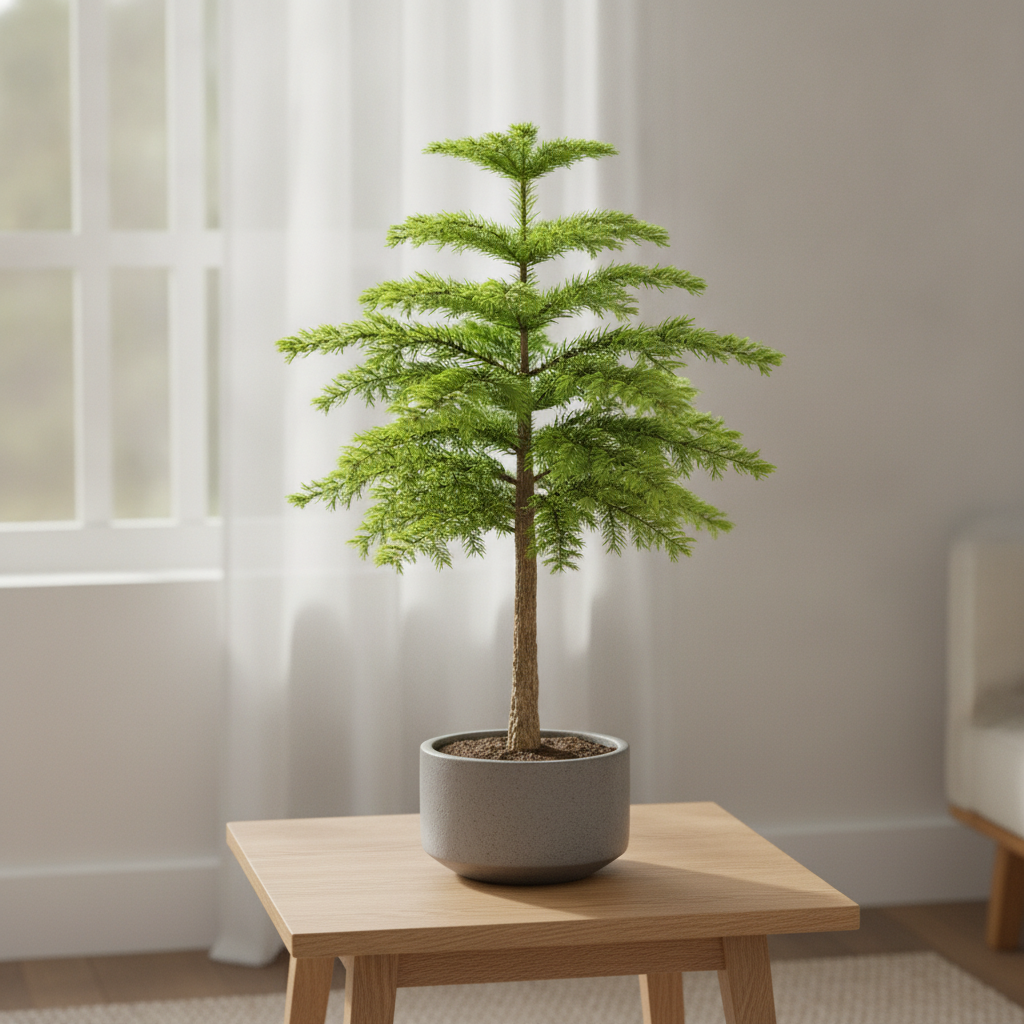
Few houseplants carry as much prehistoric pedigree as the Norfolk pine. Long before it became a tabletop conifer wrapped in fairy lights each December, Araucaria heterophylla belonged to a lineage of trees that shaded the dinosaurs, a survivor from the age when conifers, not flowers, ruled the canopy. Grown indoors as a bonsai, it trades its wild ambition of sixty metres for the quiet discipline of a shallow pot, offering the same symmetrical tiers of feathery green branches in miniature. It is not a difficult plant to keep alive, but the gap between merely surviving and truly thriving is wider here than with most houseplants, and it comes down to light, water and humidity held in steady balance.
This guide walks through everything needed to grow a healthy Norfolk pine bonsai, from the bright position it quietly demands to the watering rhythm that keeps its lower branches from browning and falling. It also explains an honest truth that many sellers skip over: the Norfolk pine is a “bonsai” only in the loosest sense, and understanding why will save a great deal of frustration with the pruners.
Quick Reference
| Botanical name | Araucaria heterophylla (formerly Araucaria excelsa) |
| Common names | Norfolk pine, Norfolk Island pine, indoor pine bonsai, star pine, living Christmas tree |
| Family | Araucariaceae |
| Plant type | Evergreen coniferous tree, grown indoors as a miniature or bonsai |
| Mature size indoors | Kept to 30 to 90 cm (12 to 36 in) as a bonsai; reaches 1.8 to 3 m (6 to 10 ft) as an unrestricted houseplant |
| Light | Bright indirect light, with two to three hours of gentle direct sun ideal |
| Water | Keep evenly moist, never waterlogged and never bone dry |
| Humidity | Moderate to high, ideally above 50 per cent |
| Temperature | 15 to 24 degrees C (59 to 75 degrees F); protect below 10 degrees C (50 degrees F) |
| Soil | Free-draining, slightly acidic; gritty bonsai mix or peat-free compost with bark and perlite |
| Fertiliser | Balanced feed at half strength, monthly through spring and summer |
| Propagation | Seed, terminal-tip cuttings or air layering; all slow and tricky |
| Toxicity | Mildly toxic to cats and dogs if eaten; sap may irritate skin |
| Difficulty | Moderate |
Why the Norfolk Pine Bonsai Makes a Striking Houseplant
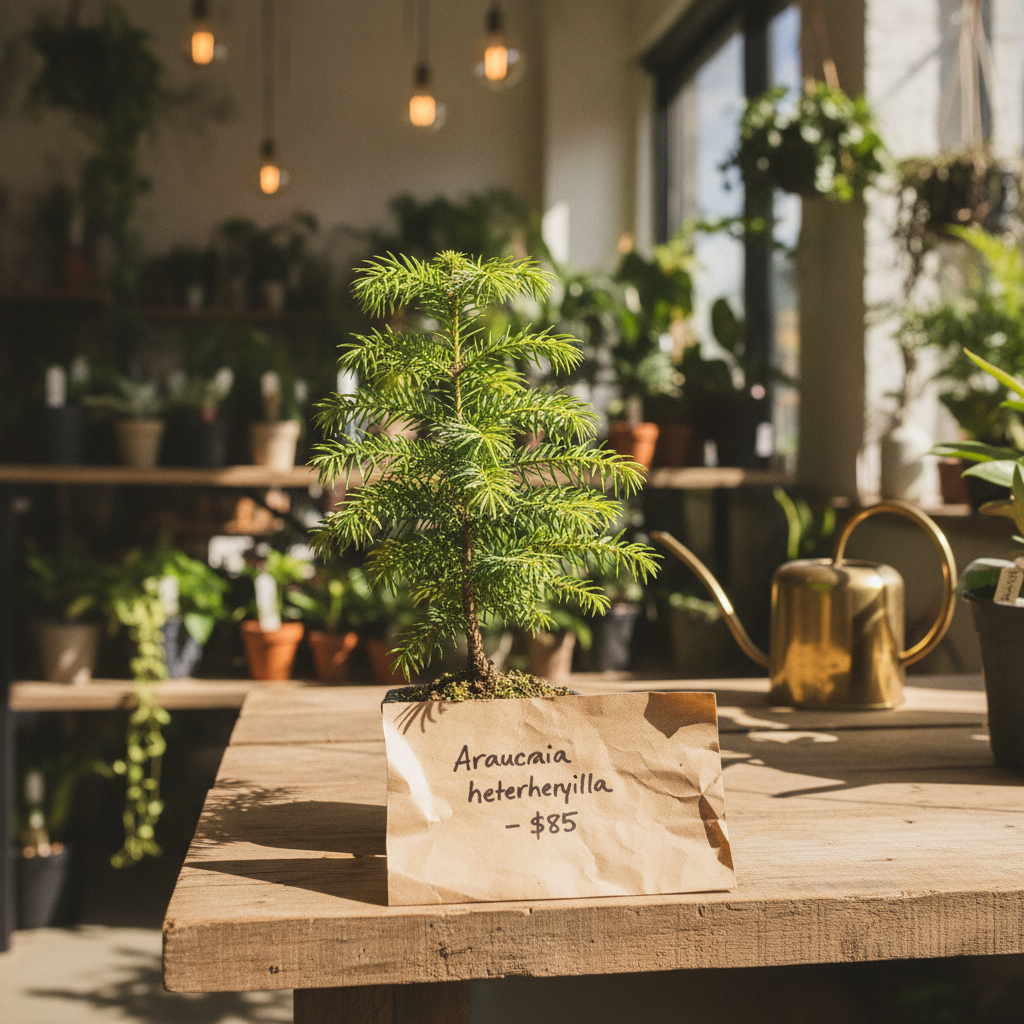
The appeal of the Norfolk pine begins with its architecture. Unlike the loose, sprawling habit of most foliage houseplants, this is a tree that grows with almost geometric precision. A single straight trunk rises through the centre, and from it branches radiate in regular whorls, each tier sitting a neat step above the last and a little shorter than the one below, so the whole plant tapers into the soft pyramid we associate with a classic conifer. The needles themselves are nothing like the stiff spines of a true pine. They are short, soft and slightly incurved, almost feathery to the touch, and they clothe the branches in a fresh, bright green that reads as cheerful rather than sombre even in the depths of winter.
Botanically, the Norfolk pine is a fascinating outsider. It is not a pine at all, despite the name, but an araucaria, a member of an ancient conifer family whose ancestors flourished in the Mesozoic alongside the dinosaurs. The species hails from a single speck of land in the South Pacific, Norfolk Island, lying between Australia and New Zealand, where it grows in volcanic soil within sight and salt-spray of the sea. There it becomes a giant, soaring past fifty metres with a trunk straight enough that early European sailors eyed it hopefully as a source of ship masts. The species name heterophylla, meaning “different leaves”, refers to the way its juvenile and adult foliage differ in form, a quiet clue that this is a tree with more than one stage to its life.
Grown as an indoor bonsai, none of that grandeur is lost so much as concentrated. A plant kept to thirty or forty centimetres still shows the same tiered symmetry, the same soft whorls, the same upright dignity, simply rendered at a scale that suits a side table or a bright windowsill. It is worth being clear, though, about what “bonsai” means here. Traditional bonsai relies on a tree’s willingness to bud back along old wood, to be wired into sinuous shapes and pruned hard to force ramification. The Norfolk pine does almost none of this. Its growth is strongly apical, meaning energy is funnelled into the single leading shoot at the top, and its side branches grow outward rather than upward and rarely sprout new growth once cut. A Norfolk pine bonsai is therefore really a young specimen kept deliberately small through root restriction and a shallow container, prized for its natural elegance rather than for any sculpted artifice. Accepting that from the start changes how you care for it, and almost always for the better.
Light
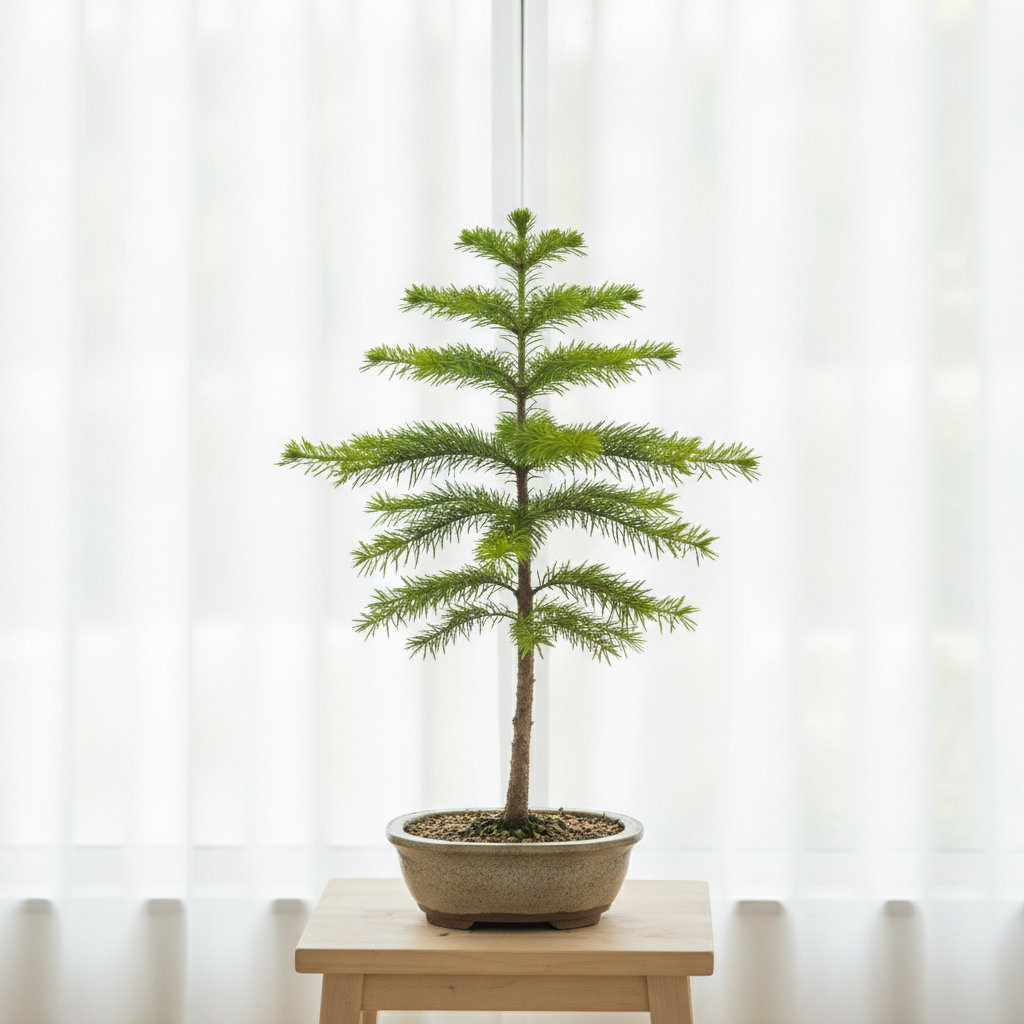
If there is one factor that separates a full, handsome Norfolk pine from a thin and disappointing one, it is light. In its native habitat this is a tree of open coastal slopes, accustomed to long days of strong, unobstructed sun, and although it adapts to indoor conditions it never stops wanting more brightness than the average living-room corner can offer. Give it the brightest position you reasonably can. A spot directly in front of an east or west window suits it well, and a south-facing window with the harshest midday rays softened by a sheer curtain is better still. A few hours of gentle direct sun each day will not scorch it and will do a great deal to keep the growth compact.
The warning signs of insufficient light are easy to read once you know them. The space between each tier of branches, the internode, stretches longer and longer, so the plant looks gangly and sparse rather than densely layered. New needles emerge a paler, weaker green. Worst of all, the lowest branches begin to yellow and drop, and this is the cruellest symptom of all because a Norfolk pine does not replace a lost branch. Once a tier is gone, the bare patch of trunk it leaves behind stays bare for life. Many a leggy, lopsided Norfolk pine is simply a plant that spent a year too far from a window.
Because the plant grows so determinedly toward the strongest light source, it will lean and develop a one-sided silhouette if left in a fixed position. The simple remedy is to give the pot a quarter turn every week or two, so that each face takes its turn toward the glass and the tiers fill out evenly all the way around. Through the dim months of winter, when daylight in northern latitudes shrinks to a few weak hours, a Norfolk pine genuinely benefits from a full-spectrum LED grow light run for ten to twelve hours a day, which keeps it growing tightly rather than reaching and thinning until spring.
Pro Tip – Rotate on a schedule: Tie the quarter turn to something you already do weekly, such as watering or rubbish day, so the plant rotates without you having to remember. Even growth all the way around is far easier to maintain than it is to correct after the fact.
Watering
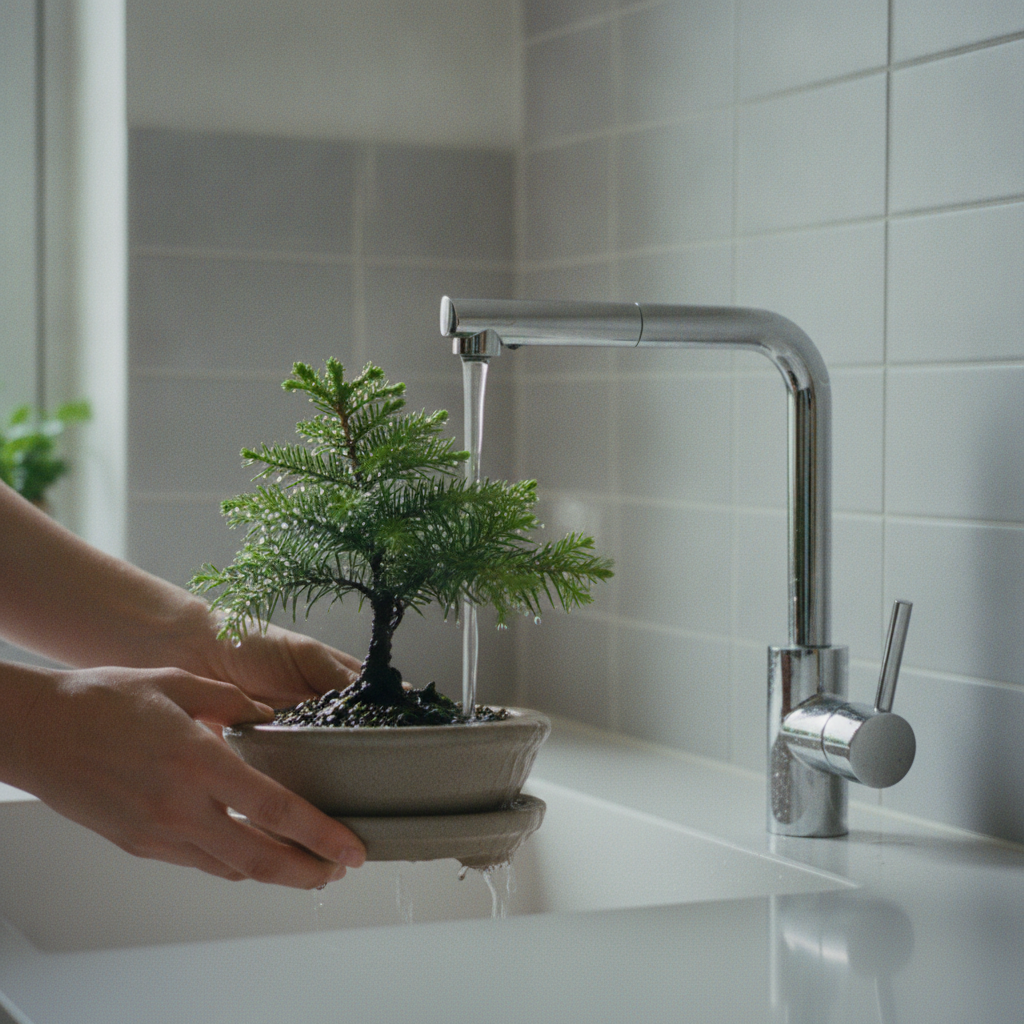
Watering a Norfolk pine is an exercise in the middle ground. The plant resents both extremes, and the art lies in keeping the rootball evenly moist without ever letting it tip into either soggy stagnation or complete drought. In practice the most reliable approach is to water thoroughly whenever the top two to three centimetres of the mix have dried, soaking the pot until water flows freely from the drainage holes, then allowing any excess to drain away completely so the roots never sit in a saucer of standing water. Sitting in water is the surest route to root rot, which a Norfolk pine, with its preference for the free-draining volcanic soils of its homeland, is poorly equipped to survive.
The opposite mistake is just as damaging and far more common in a small bonsai pot, where the limited volume of soil dries quickly. Letting the rootball dry out entirely causes the needles to brown and the branches, beginning with the lowest, to crisp and fall. As with light damage, these losses are permanent, so a Norfolk pine punishes a forgotten watering more harshly than most houseplants. The shallow container of a bonsai needs checking more often than a deep pot would, perhaps twice a week in summer and weekly in winter, though finger-testing the soil is always more reliable than any fixed schedule.
Humidity deserves a mention here because it works hand in hand with watering. Coming from a mild, moist, ocean-fringed climate, the Norfolk pine struggles in the parched air of a centrally heated room, where the needle tips brown and the foliage loses its lush quality however carefully you water the roots. Aim for humidity above fifty per cent. Grouping it with other plants, standing the pot on a tray of damp pebbles, or running a small humidifier nearby through the dry winter months all help. Tepid, room-temperature water is kinder to the roots than cold water straight from the tap, and if your tap water is very hard, rainwater or filtered water will keep the slightly acid-loving foliage at its best.
Warning – Browning from below: If the lowest tier starts to brown and shed, look first at watering and humidity rather than reaching for fertiliser. Dry soil and dry air are the usual culprits, and because lost branches never regrow, catching the pattern early is the only real cure.
Soil and Potting
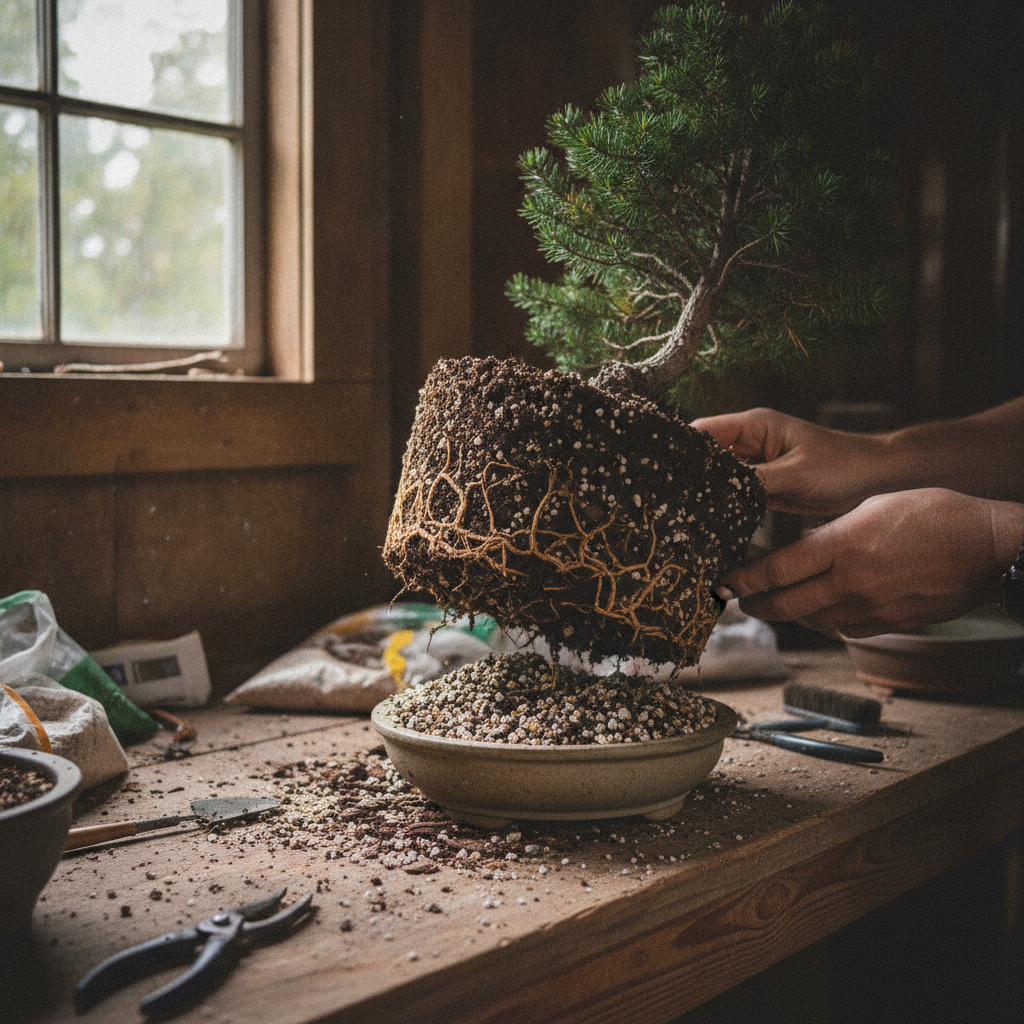
The Norfolk pine asks for a growing medium that does two slightly contradictory things at once: it must drain freely so the roots never sit wet, yet it must hold enough moisture that the small volume of a bonsai pot does not dry out within hours. The way to reconcile these demands is structure rather than quantity, an open, chunky mix full of air pockets that sheds excess water quickly while the individual particles each hold a reserve of moisture. A peat-free houseplant compost loosened with roughly a third extra perlite and a handful of fine orchid or pine bark makes an excellent everyday medium. For a more authentically bonsai approach, a gritty blend of components such as akadama, pumice and bark gives superb drainage and aeration, at the cost of needing slightly more frequent watering.
The plant prefers its soil slightly on the acidic side, which most bark-rich, peat-free mixes provide naturally, so there is rarely any need to adjust pH deliberately. What matters far more is that the pot, whatever its style, has generous drainage holes. A handsome glazed bonsai dish with no drainage is a death trap, however attractive, and is worth either drilling or relegating to use as a cache-pot around a plain inner container.
Norfolk pines are slow growers and dislike being disturbed, so they need repotting only every two to three years, and a bonsai kept deliberately small needs it less often still. Spring, as growth resumes, is the moment to do it. Ease the plant out, tease away a little of the old soil and trim away any circling or dead roots, but resist the urge to bare-root or heavily reduce the root system in one go, because the Norfolk pine recovers slowly from rough handling. In bonsai culture, modest root pruning at repotting is in fact one of the main tools for keeping the plant compact, restricting the roots to restrain the top. Settle the plant back at the same depth it grew before, never burying the trunk deeper, firm the fresh mix gently around the roots, water it in and keep it out of harsh sun for a week or two while it re-establishes.
Fertilising
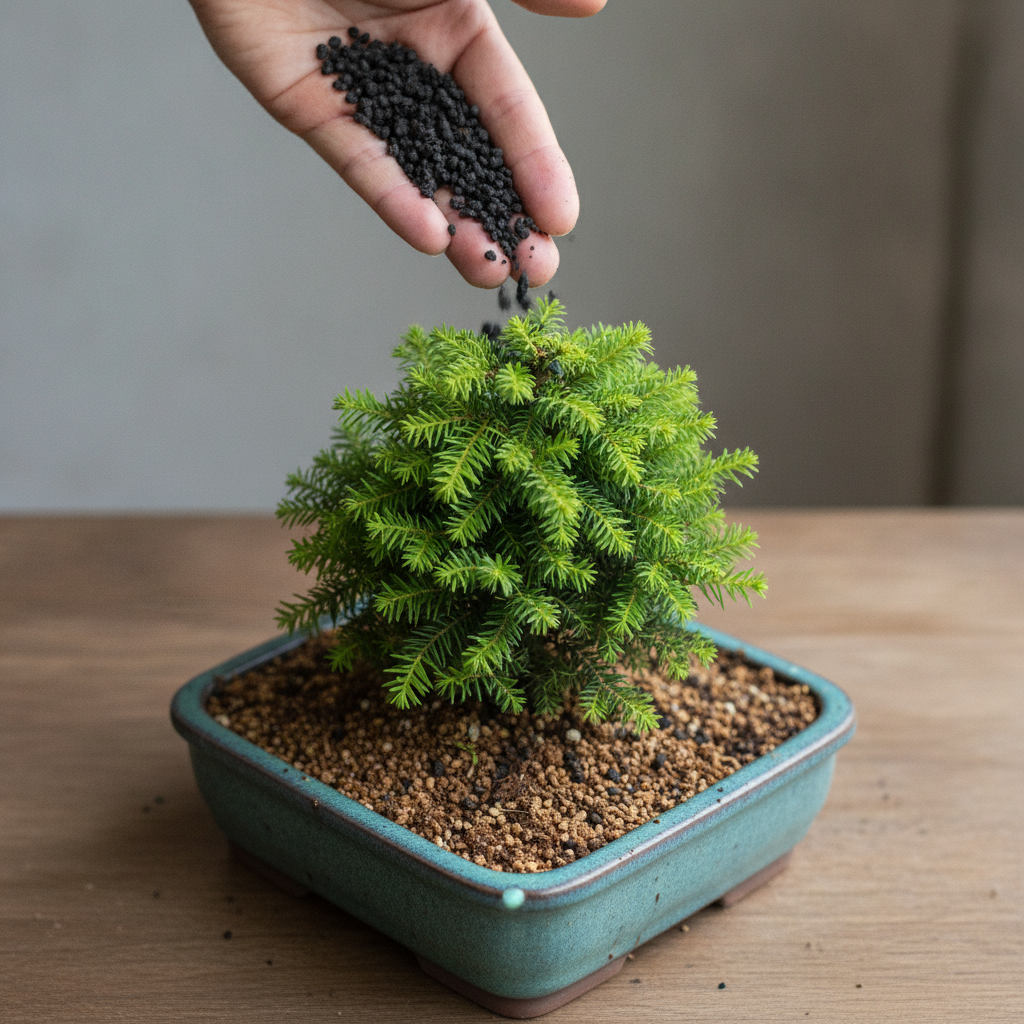
Norfolk pines are restrained feeders, and the small soil volume of a bonsai makes a light hand all the more important. During the active growing season, from spring through to the end of summer, a balanced liquid houseplant fertiliser diluted to roughly half the recommended strength and applied about once a month is ample. There is no advantage in feeding more heavily; a Norfolk pine grows at its own deliberate pace regardless, and excess fertiliser simply accumulates as mineral salts in the mix, scorching the fine roots and browning the needle tips, the very symptoms an anxious owner often tries to fix with yet more feed.
Always feed onto already-moist soil rather than a dry rootball, since fertiliser delivered into dry soil concentrates around the roots and can burn them. Through autumn and winter, when growth naturally slows almost to a standstill, stop feeding altogether and let the plant rest; resuming in spring as the new tier of growth begins to push is far better than coaxing it through the dark months. Those who prefer a gentler, more forgiving approach can top-dress with a thin layer of worm castings once or twice in the growing season, which releases nutrients slowly and is almost impossible to overdo, or use a dilute slow-release feed at the lowest end of its recommended rate.
Pro Tip – Flush the salts: Once or twice a year, water very generously and let it pour through the pot for a minute or two to flush accumulated fertiliser salts out of the mix. This simple rinse prevents the slow tip-browning that a build-up of minerals causes in a small bonsai container.
Propagation
Propagation is the one area where the Norfolk pine humbles even experienced growers, and the reason is rooted in the way the tree is built. Its branches are what botanists call plagiotropic, meaning they are genetically programmed to grow sideways rather than upward. Take a cutting from one of those horizontal side branches and, even if you persuade it to root, it will spend its whole life growing sideways, never forming a proper upright trunk or the tiered symmetry that makes the plant worth growing. Only the single vertical leader at the very top of the tree carries the upright, orthotropic growth habit, which is why the few cuttings that succeed must be taken from that terminal shoot, and why doing so sacrifices the parent plant’s leader and ruins its form. This quiet biological fact is the main reason almost every Norfolk pine you will ever buy was raised from seed in a nursery rather than from a cutting.
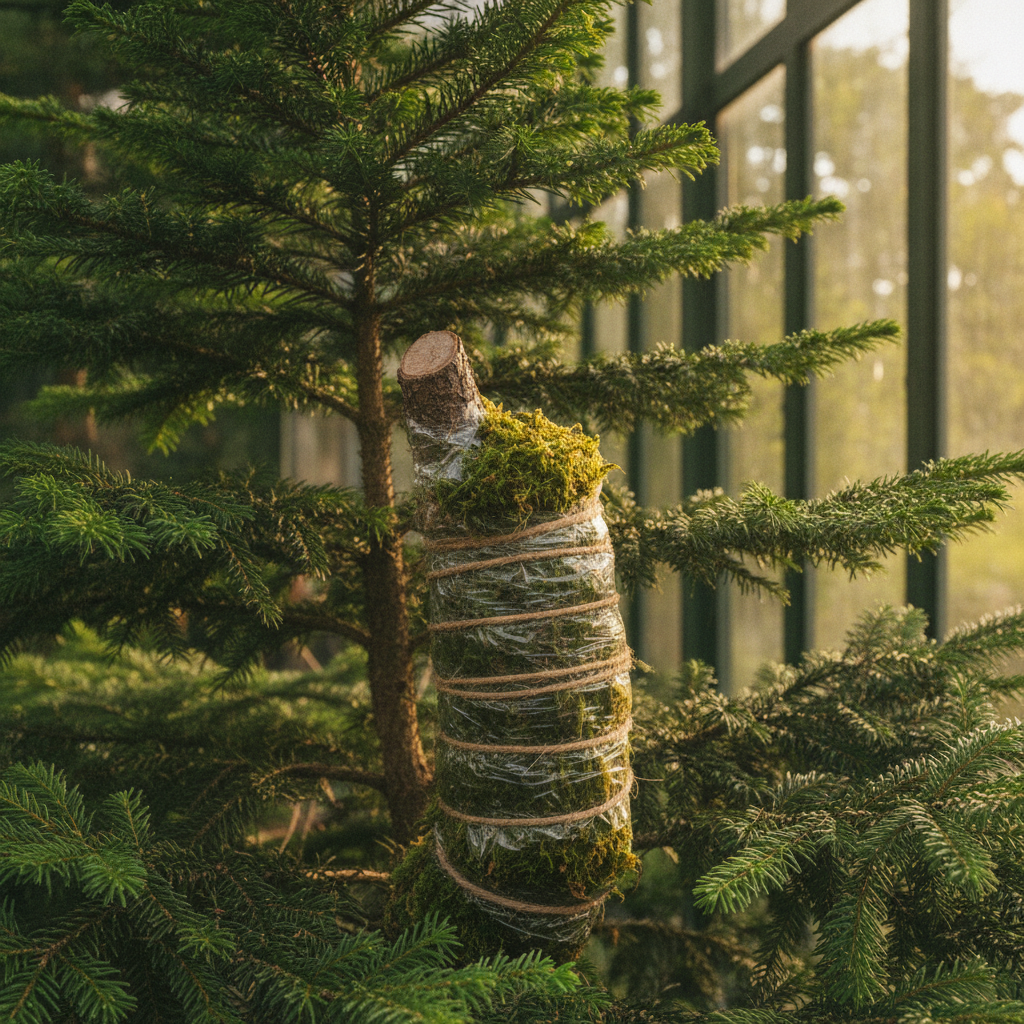
For the home grower, three routes exist, none of them quick. Growing from seed is the method commercial nurseries rely on, and it gives the truest plants, but fresh Norfolk pine seed loses viability rapidly and can be hard to source, and seedlings take years to reach a presentable size. Air layering offers the most dependable home approach for those determined to make a new plant. The technique involves wounding a section of the upright stem, wrapping the wound in a ball of damp sphagnum moss enclosed in clear film, and waiting, often for several months, for roots to form within the moss before the rooted section is cut away and potted up. The clear film lets you watch for the white roots that signal success. Terminal-tip cuttings are the third option, taken only from that vertical leading shoot, dipped in rooting hormone and kept in a warm, humid propagator, but the success rate is modest and the loss to the donor plant is real.
The honest conclusion for most owners is that the Norfolk pine is a plant to buy rather than to multiply. Where many houseplants reward you with a windowsill full of free offspring, this one repays patience and steady care of the single specimen you already have, and there is no shame in simply enjoying it as the slow, dignified tree it is.
Pests and Problems
A well-grown Norfolk pine in bright, humid conditions is fairly resilient, but a plant weakened by dry air or poor light becomes an easy target for the usual indoor pests. Mealybugs are the most frequent visitors, appearing as small tufts of white cottony wax tucked into the branch axils where needle meets stem, and their sheltered hiding places make them awkward to dislodge. Scale insects, looking like tiny brown limpets clamped onto the stems, and spider mites, which thrive in exactly the dry warmth a Norfolk pine dislikes and betray themselves through fine webbing and a dull, stippled look to the foliage, round out the likely suspects, with the occasional cluster of aphids on tender new growth.
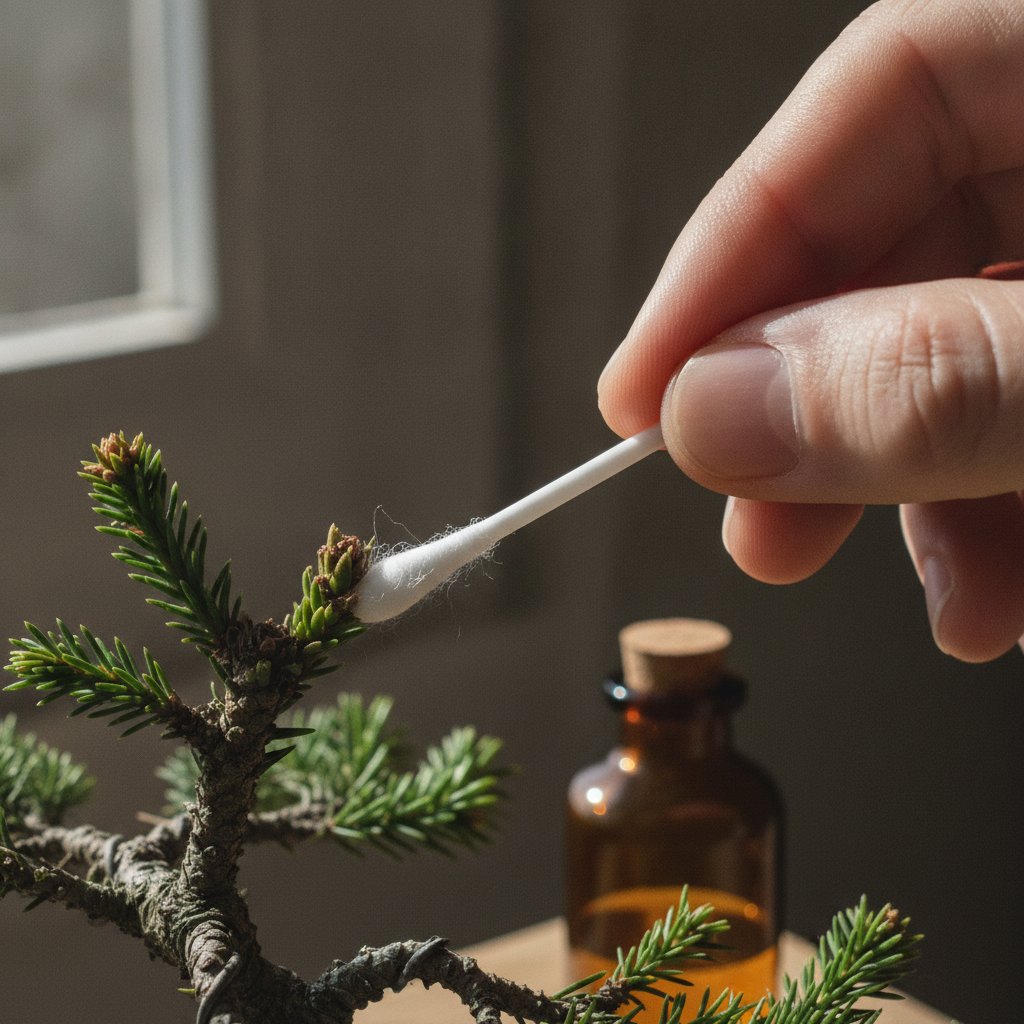
Catching an infestation early makes all the difference, so it is worth inspecting the plant, undersides and axils included, whenever you water. For a light outbreak, a cotton bud dipped in diluted isopropyl alcohol dabbed directly onto mealybugs and scale lifts them away cleanly, while a firm rinse under a tepid shower knocks back spider mites and aphids. A more established problem calls for a thorough spray of insecticidal soap or a neem oil solution, repeated every week or so until the pest is gone, taking care to coat the hidden axils where mealybugs gather. Because the soft needles can mark, treat in the cool of the morning or evening rather than in strong sun.
Most of the trouble that befalls a Norfolk pine, though, is not a pest at all but a cultural problem wearing a pest’s disguise. Browning needle tips usually mean the air is too dry or fertiliser salts have built up in the mix. Lower branches yellowing and dropping point almost always to too little light or a rootball that was allowed to dry out. A thin, stretched, leggy habit is the signature of a plant starved of brightness. A sudden, dramatic collapse of foliage, by contrast, tends to follow a cold draught or a chilling, since the Norfolk pine resents temperatures near freezing and dislikes the icy blast of an open winter door as much as the hot, drying gusts of a radiator or heating vent. Read these signs as feedback about the plant’s position and routine rather than reaching first for a spray bottle, and most of them resolve themselves.
Warning – Mildly toxic to pets: Norfolk pine foliage is considered mildly toxic to cats and dogs and can cause vomiting or stomach upset if chewed, while the sap may irritate sensitive skin. It is sensible to keep the plant out of reach of curious pets and to wash your hands after pruning.
Varieties
The Norfolk pine sold in shops is usually the straight species, but a handful of selected cultivars exist for those who hunt them out, chosen mainly for differences in needle colour and the density of the tiers. Two of the most distinctive are worth knowing.
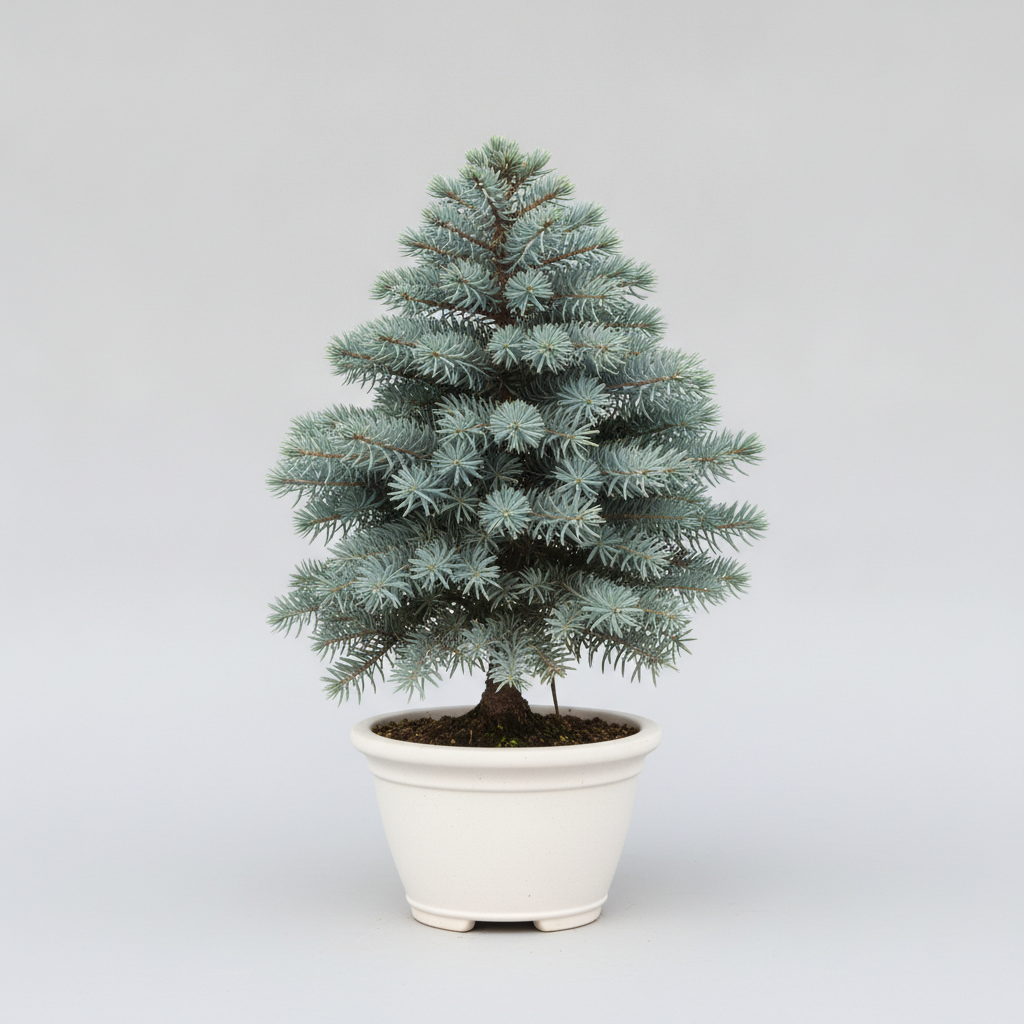
‘Glauca’ is prized for the cool, bluish-grey cast of its needles, a frosted tone quite distinct from the bright spring green of the species. Its tiers tend to be densely whorled, giving the little tree a fuller, more sculptural presence, and the silvery colouring sits beautifully against a pale pot. It asks for no special treatment beyond the usual bright light and steady moisture, though the blue tones show best when the plant is grown hard in good light rather than stretched in shade.
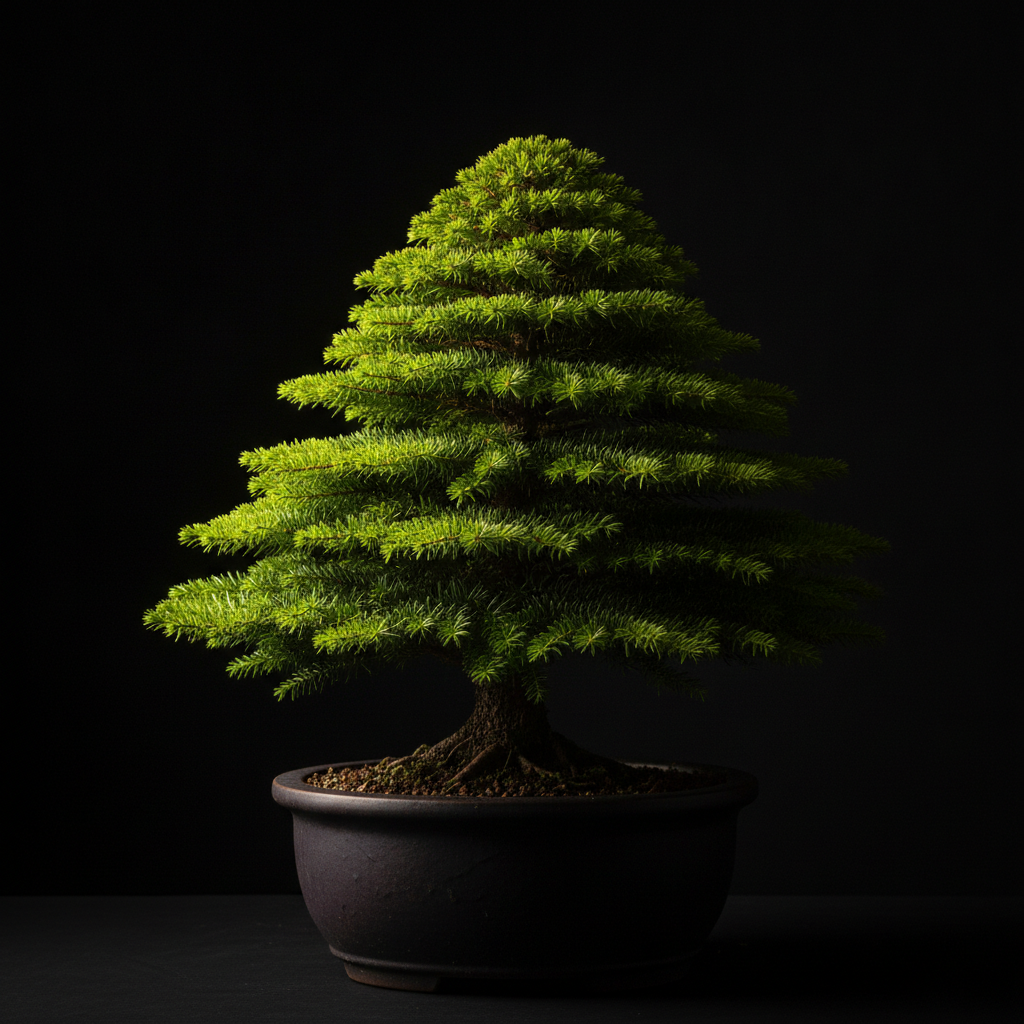
‘Gold Coast’ is an improved compact selection grown for its especially dense, evenly symmetrical tiers and bright, fresh-green soft needles. The shorter spacing between branches makes it look lush and full even as a small plant, which suits it particularly well to bonsai culture and to use as a tabletop tree. Like the species it wants high light to keep that density, and it rewards a bright position with the kind of plump, layered shape that the Norfolk pine is loved for.
Other named forms occasionally appear in specialist collections, including white-tipped selections such as ‘Albospica’, whose new growth emerges pale before greening, and various dwarf and extra-compact strains. For most growers, however, the choice is academic; the unimproved species, grown well, is every bit as elegant as its cultivars and far easier to find.
Frequently Asked Questions
Is a Norfolk pine really a bonsai?
Only in a loose sense. True bonsai depends on a tree that buds back along old wood and tolerates wiring and hard pruning, none of which the Norfolk pine does well because its growth is strongly apical and its cut branches rarely resprout. A Norfolk pine bonsai is better understood as a young plant kept small through root restriction and a shallow pot, valued for its natural tiered symmetry rather than for any shaped or sculpted form.
Why are the lower branches turning brown and falling off?
The two usual causes are too little light and a rootball that has been allowed to dry out, often working together, and dry indoor air makes both worse. Move the plant to the brightest spot you can offer, keep the soil evenly moist, and raise the humidity. Crucially, a Norfolk pine does not regrow a lost branch, so the goal is to halt the loss rather than to recover what has already gone.
Can I prune a Norfolk pine to keep it small or bushy?
Not in the way you might prune most plants. Cutting the central leader stops the upward growth permanently and ruins the symmetrical shape, since the plant will not reliably grow a replacement leader, and trimming side branches does not make them branch out more thickly. Size is best controlled through root pruning at repotting and the restriction of a small container rather than by cutting the top.
How often should I water a Norfolk pine bonsai?
Water whenever the top two to three centimetres of mix have dried, which in a shallow bonsai pot often means around twice a week in summer and once a week in winter, though you should always test the soil rather than rely on a fixed schedule. Soak thoroughly until water runs from the drainage holes, then let it drain completely so the roots never sit in standing water.
Is the Norfolk pine safe around cats and dogs?
It is considered mildly toxic. Chewing the foliage can cause vomiting or stomach upset in cats and dogs, and the sap may irritate sensitive skin, so it is wise to position the plant out of a pet’s reach and to wash your hands after handling cut stems.
Can I keep my Norfolk pine outdoors?
Only in a frost-free climate. The Norfolk pine is not cold hardy and suffers below about 10 degrees C (50 degrees F), with serious damage as temperatures approach freezing. In mild regions it can spend the warm months outdoors in a bright, sheltered spot, but in cooler climates it must come back inside well before the first cold nights of autumn.
My Norfolk pine looks thin and stretched. What went wrong?
A leggy, sparse habit with long gaps between the tiers is the classic sign of too little light. Move the plant to the brightest available window, turn it regularly so it fills out evenly, and consider a grow light through winter. The existing stretched growth will not tighten up, but new growth made in better light will come in denser, gradually improving the plant’s shape over time.






