
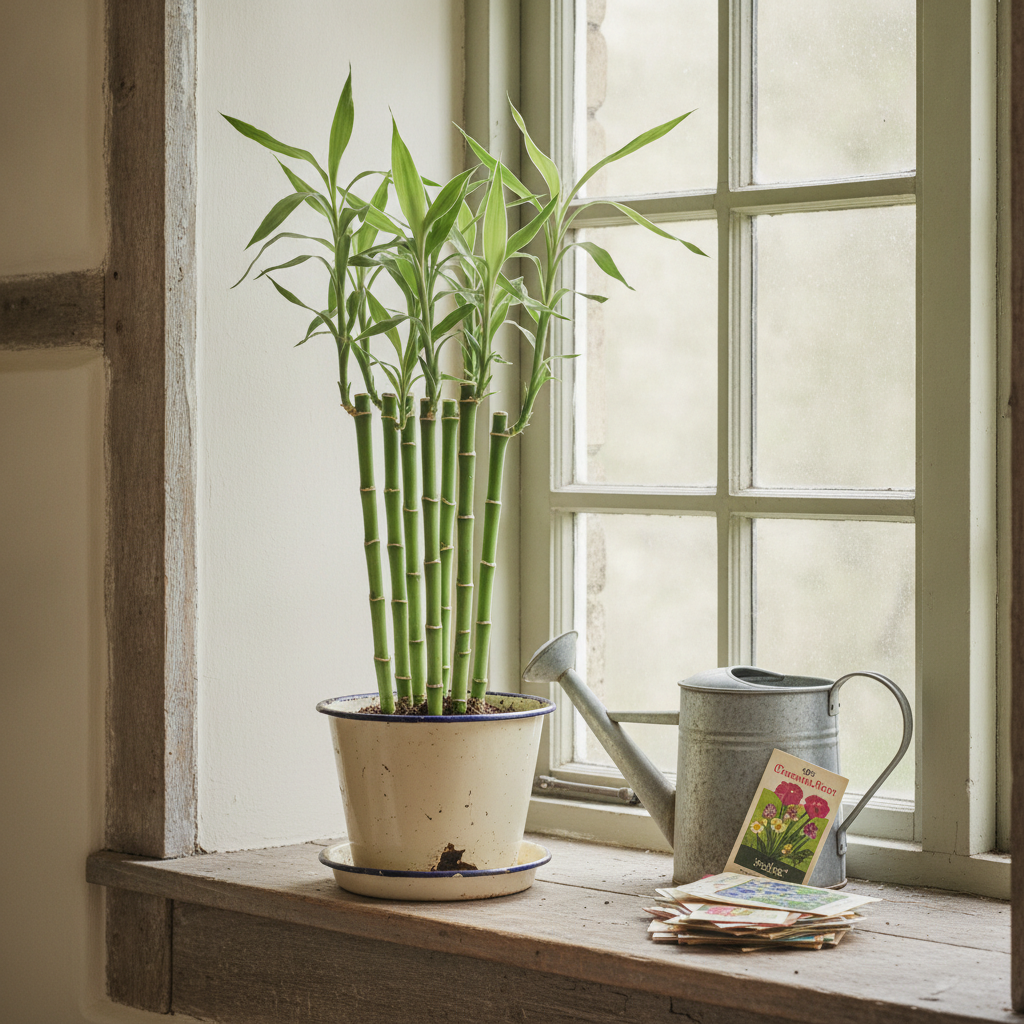
Few houseplants carry as much symbolic weight on so few demands as friendship bamboo, the upright, jointed green stalks sold in pebble-filled vases on shop counters the world over. Despite the name and the unmistakably cane-like stems, this is not a bamboo at all but a member of the genus Dracaena, botanically Dracaena braunii (long traded under the synonym Dracaena sanderiana). Native to the shaded forest floors and stream margins of Central Africa, it earned its everyday names, friendship bamboo and lucky bamboo, through its association with good fortune in feng shui rather than any botanical link to true bamboos in the grass family.
What makes this plant so widely kept is its near-legendary tolerance: it will grow in a plain vase of water, in a bowl of pebbles, or in a conventional pot of soil, and it shrugs off the low light and irregular attention that would finish off fussier species. Yet there is a clear gap between a friendship bamboo that merely survives, holding on with a few pale, leaning stalks, and one that genuinely thrives, pushing out glossy new leaves and thickening steadily over the years. This guide covers everything that separates the two, from water quality and light to feeding, repotting, propagation and the pests and disorders most likely to trouble it.
Contents
- Quick Reference
- Why Friendship Bamboo Makes a Rewarding Houseplant
- Light Requirements
- Watering & Humidity
- Soil, Potting & Repotting
- Fertilising
- Propagation
- Pests & Diseases
- Popular Varieties
- Frequently Asked Questions
Quick Reference: Friendship Bamboo at a Glance
| Light | Bright, indirect light; tolerates medium to low light, dislikes direct sun |
| Watering | In water: change every 1 to 2 weeks. In soil: keep lightly, evenly moist |
| Temperature | 18 to 29°C (65 to 85°F); avoid below 13°C (55°F) |
| Humidity | Average household humidity is fine; appreciates 40 to 50% |
| Fertiliser | Very light feeding; a drop of diluted liquid feed every 1 to 2 months in growth |
| Toxicity | Toxic to cats and dogs if ingested; mildly irritating to people |
Why Friendship Bamboo Makes a Rewarding Houseplant
The appeal of friendship bamboo begins with its sheer adaptability. Here is a plant that can be grown hydroponically in nothing more than a glass of water, making it one of the very few houseplants that asks for no soil, no repotting and no drainage at all if you choose to keep it that way. That single quality makes it a natural fit for offices, bathrooms, kitchen windowsills and the desks of people who would never describe themselves as gardeners. The plant also lends itself to shaping: growers train the pliable young stalks into spirals, curls, woven lattices and tiered arrangements by rotating them slowly towards a light source, and these living sculptures are what most people picture when they hear the name.

Beyond its flexibility, friendship bamboo rewards owners with steady, low-drama growth and a genuinely long life. A well-kept plant can persist for many years, gradually gaining height and producing fresh strappy leaves from the growing tips. It carries strong cultural significance too: in feng shui the number of stalks is held to attract different blessings, with three stalks said to bring happiness, five to support wealth and health, and arrangements often given as gifts to mark new homes, businesses or friendships, which is precisely how the plant earned its warmer common name. For the practical houseplant keeper, the takeaway is simpler still: this is a forgiving, attractive, endlessly giftable plant that asks little and tolerates much.
Important — Toxicity: Friendship bamboo is toxic to cats and dogs, containing saponins that can cause drooling, vomiting, loss of appetite and weakness if the stalks or leaves are chewed. It is also mildly irritating to people. Keep it out of reach of curious pets and children, and wash your hands after handling cut stems.
Light Requirements
In the wild, friendship bamboo grows in the dappled understorey of Central African forests, where sunlight reaches it filtered and softened by the canopy above. That origin explains almost everything about its indoor light preferences: it wants brightness without harshness, and it will accept far dimmer conditions than most houseplants before showing real distress.
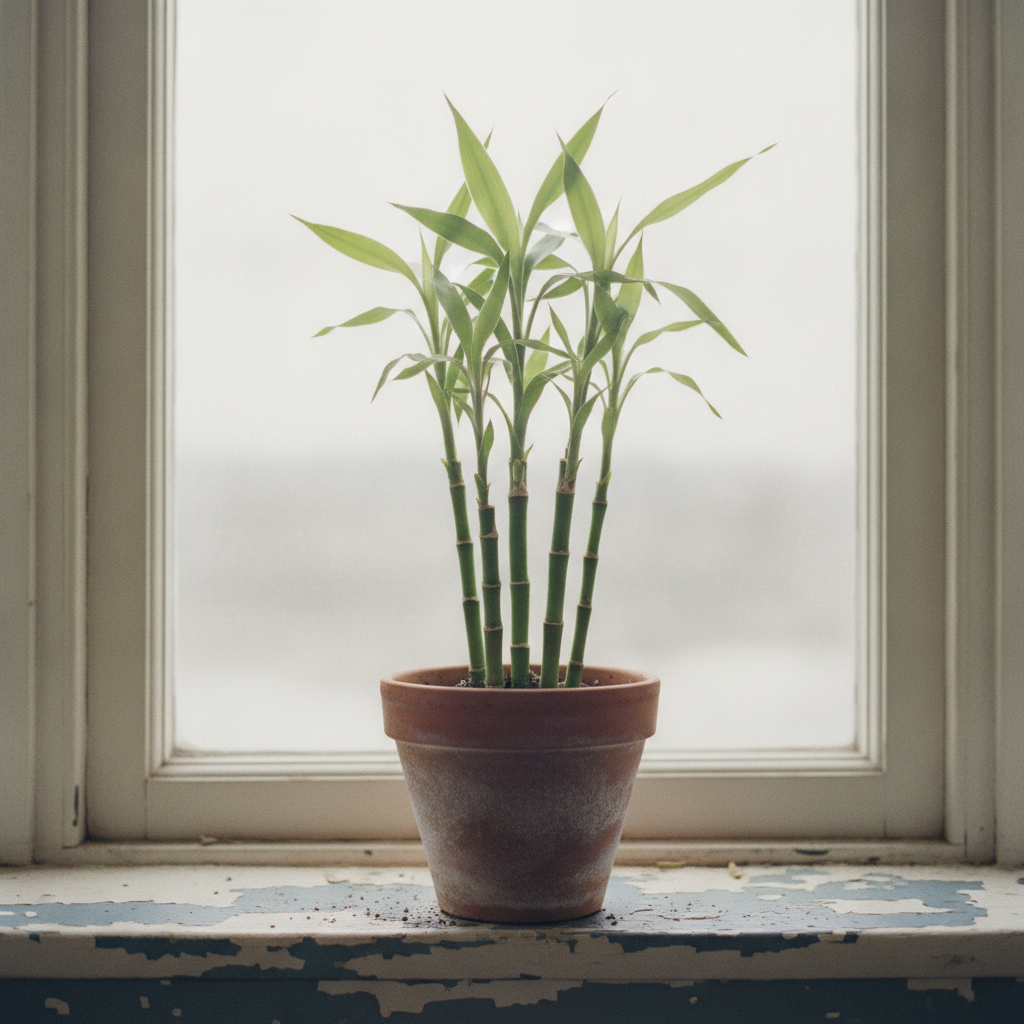
The ideal position is one of bright, indirect light, a metre or two back from a window where the leaves are well lit but never struck by the full midday sun. In this sweet spot the plant produces deep green, evenly coloured foliage and grows at a satisfying, if unhurried, pace. It is the difference between a plant that simply holds its ground and one that actively fills out.
Light Levels Explained
Understanding how friendship bamboo responds across the spectrum of indoor light makes placement far easier. The table below summarises what to expect in each broad category, from full sun to the dimmest corners.
| Light Category | Approx. Level | Typical Location | Outcome |
|---|---|---|---|
| Direct sun | 20,000+ lux | On an unshaded south or west sill | Risk of scorched, yellowed leaves; avoid |
| Bright indirect | 10,000 to 20,000 lux | Near an east window or set back from a bright one | Ideal; rich colour and steady growth |
| Medium | 5,000 to 10,000 lux | Centre of a well-lit room | Good; growth a little slower |
| Low | 1,000 to 5,000 lux | Hallway, bathroom, north corner | Tolerated; minimal growth, leaning towards light |
| Very low | Below 1,000 lux | Interior office without windows | Survives short term; weakens over months |
Window Orientation and Placement
South-facing window: The brightest exposure in the northern hemisphere and generally too intense if the plant sits directly on the sill. Place it well back into the room, or filter the light with a sheer curtain, to prevent the leaves from bleaching and scorching.
East-facing window: Often the best of all. Gentle morning sun followed by bright, indirect light for the rest of the day matches the plant’s preferences closely and rarely causes any leaf damage.
West-facing window: Workable, but the strong afternoon sun can be harsh in summer. Set the plant back from the glass or diffuse the light so it receives brightness without the heat of direct rays.
North-facing window: Provides soft, even light all day and suits friendship bamboo comfortably, though growth will be slower than in a brighter spot. This is a reliable choice for a tidy, slow-growing specimen.
Pro Tip — Rotate for Even Growth: Friendship bamboo bends noticeably towards its light source, which is exactly how growers create the famous spirals. If you want straight, upright stalks instead, give the vase or pot a quarter turn every week so the stems grow evenly rather than leaning.
How Light Affects Leaf Colour
Light has a direct effect on the colour and vigour of the foliage. In good indirect light the leaves are a deep, saturated green, and on variegated forms such as the gold-striped cultivars the contrast between green and creamy yellow stays crisp and well defined. In light that is too low, growth pales and slows, new leaves emerge smaller, and variegation can fade towards plain green as the plant prioritises chlorophyll. In light that is too strong, the opposite happens: leaves bleach to a washed-out yellow and develop dry, scorched patches that do not recover.
Warning — Direct Sunlight: Friendship bamboo has no tolerance for prolonged direct sun. A few hours on a hot, unshaded windowsill can yellow and crisp the leaves within days. If you notice bleaching or brown, papery patches, move the plant out of the sun immediately and into bright, indirect light.
Artificial Lighting
Because it copes so well with modest light, friendship bamboo is one of the easiest houseplants to grow under artificial lighting alone, which is partly why it thrives in windowless offices. A standard LED or fluorescent fixture running for ten to twelve hours a day is enough to keep a plant healthy, and a dedicated full-spectrum grow light positioned 30 to 45cm (12 to 18in) above the foliage will support active growth in a room with no natural light at all.
Seasonal Adjustments
Light levels indoors drop considerably between summer and the short days of winter. As autumn sets in, consider moving the plant a little closer to its window to make up for the weaker, lower sun, and clean the glass and the leaves so nothing blocks what light there is. In the brightest part of summer, watch a south or west exposure for any sign of scorching and pull the plant back if the sun starts to fall directly on it.
Watering & Humidity
Watering is where friendship bamboo differs most from the average houseplant, because it can be grown in two completely different ways: submerged in water like a hydroponic plant, or potted conventionally in soil. The approach you choose changes the watering routine entirely, but the underlying principle stays the same in both cases, namely that this plant is acutely sensitive to the chemicals commonly found in tap water.
When to Water
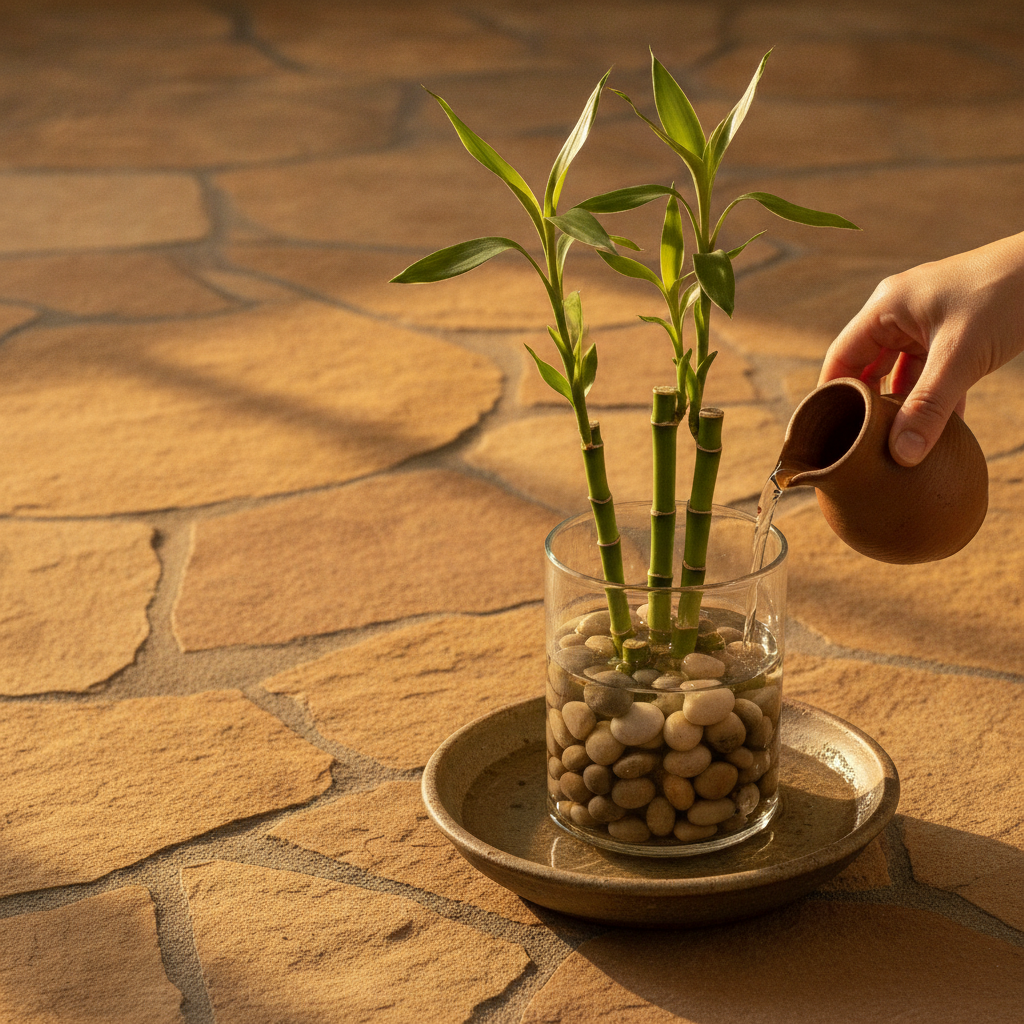
If you grow friendship bamboo in water, keep the roots covered by about 3 to 5cm (1 to 2in) at all times, topping up as the level drops. Change the water completely every one to two weeks to keep it fresh and oxygenated and to discourage algae and odour. Letting the water stagnate is the single most common reason these plants decline in a vase, so a regular refresh matters more than the exact volume.
If you grow it in soil, aim for a substrate that stays lightly and evenly moist, never bone dry and never waterlogged. Water when the top centimetre or two of soil begins to feel dry to the touch, which in average indoor conditions usually means roughly once a week, easing off in winter when growth slows. The plant likes consistent moisture far more than it likes the dramatic wet-and-dry swings that suit a cactus.
Pro Tip — Beat the Chlorine and Fluoride: Friendship bamboo is notoriously sensitive to the fluoride and chlorine in many municipal water supplies, which show up as brown leaf tips and edges. Use filtered, distilled or rainwater where you can, or leave tap water to stand uncovered for 24 hours before use so the chlorine can dissipate.
How to Water Correctly
- For water-grown plants, lift the stalks out and tip the old water away rather than simply topping up dirty water.
- Rinse the vase and the pebbles thoroughly to remove any film, algae or mineral residue.
- Refill with filtered, distilled or stood tap water at room temperature, never straight from a cold tap.
- Return the stalks and arrange the pebbles so the roots are covered but the stems sit clear of long-term submersion.
- For soil-grown plants, water slowly and evenly until moisture runs from the drainage holes, then discard whatever collects in the saucer.
- Never leave either form of the plant standing in stale, stagnant water for days on end.
Signs of Overwatering vs. Underwatering
| Symptom | Overwatering | Underwatering |
|---|---|---|
| Leaf colour | Yellowing, often from the lower leaves up | Pale, dull, with browning tips |
| Leaf texture | Soft, limp, sometimes translucent | Dry, crisp and curling at the edges |
| Soil or water | Soggy soil or murky, smelly vase water | Bone-dry soil or a vase run too low |
| Roots | Brown, mushy and foul-smelling | Dry, shrivelled and brittle |
| Stalk base | Soft, yellowing and rotting at the bottom | Wrinkled and slightly shrunken |
Warning — Root and Stalk Rot: A friendship bamboo stalk that turns soft and yellow from the base upwards is rotting, usually from stale water or waterlogged soil. Rot spreads quickly, so remove affected stalks at once, refresh the water or repot into fresh substrate, and cut any salvageable green sections above the damage to re-root separately.
Humidity Requirements
Friendship bamboo is far less demanding about humidity than many tropical houseplants, and average household levels of around 40 to 50% suit it perfectly well. It will not collapse in the drier air of a centrally heated room, which is another reason it travels so easily from greenhouse to office.
That said, very dry air, particularly the parched conditions near a radiator in winter, can contribute to brown, crisping leaf tips. When this coincides with hard tap water, the two problems compound one another and the tips brown faster than either cause would manage alone.
If your home runs especially dry, an occasional light misting or a nearby pebble tray of water will lift the humidity around the plant a little. Grouping it with other houseplants also creates a gently more humid microclimate, but none of this is essential; for most homes, friendship bamboo is content with the air it is given.
Water Quality
It is worth restating how central water quality is to this particular plant, because it explains the majority of unhappy specimens. The fluoride added to many drinking-water supplies and the chlorine used to disinfect it are both toxic to friendship bamboo in the quantities it absorbs over time, accumulating in the leaf tips and turning them brown and dead. Filtered, distilled, de-ionised or collected rainwater sidesteps the problem entirely, and stood tap water is a reasonable compromise for chlorine, though it does little for fluoride. If your tap water is heavily treated, switching to a cleaner source is the most effective single change you can make.
Soil, Potting & Repotting
While friendship bamboo is famous for growing in water, it generally lives longer and grows more robustly when eventually moved into soil, where its roots have access to a steadier supply of nutrients. Whether you keep it in pebbles and water or in a pot of compost, the goal is the same: support the roots, allow excess moisture to escape, and avoid the stagnant, airless conditions that invite rot.
Ideal Soil Composition
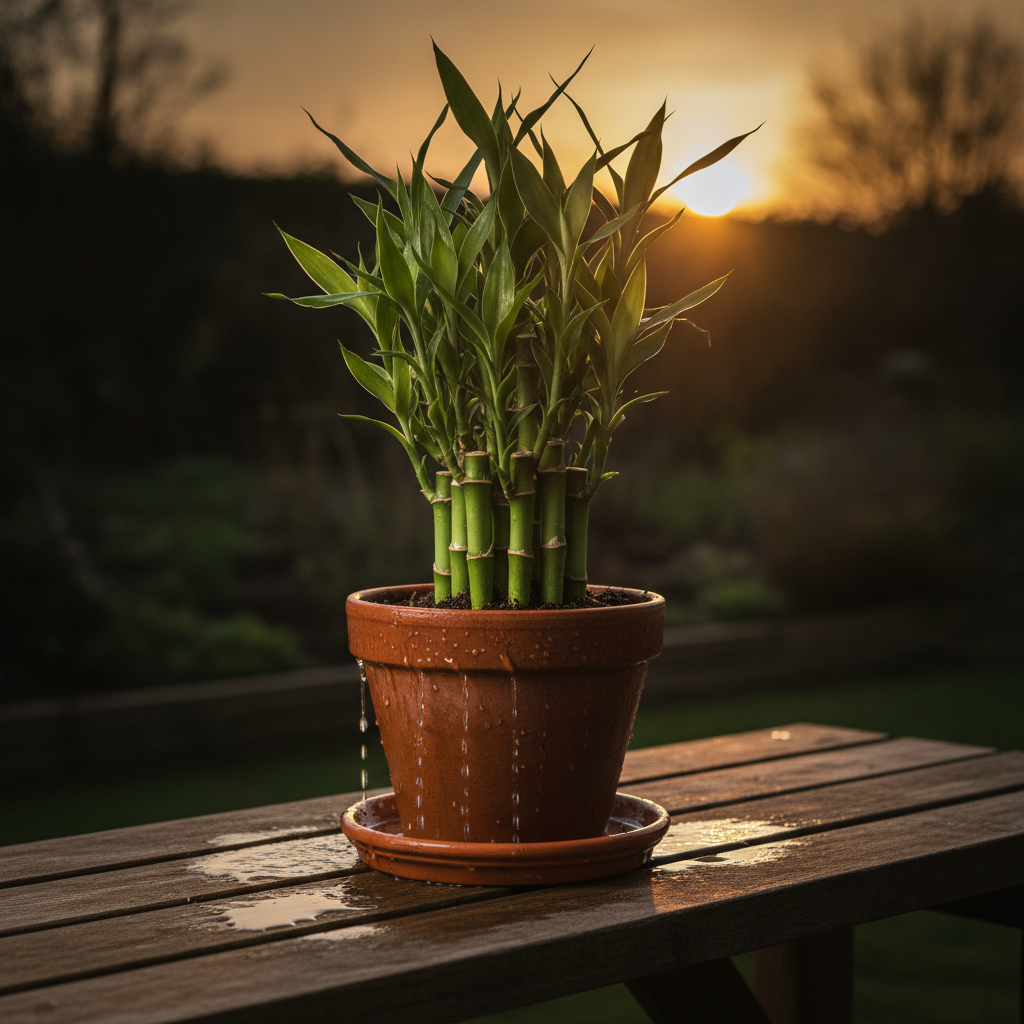
When grown in soil, friendship bamboo wants a mix that holds enough moisture to stay evenly damp yet drains freely enough that water never sits around the roots. A good general-purpose houseplant compost lightened with extra drainage material achieves this balance without any fuss.
| Component | Proportion | Function |
|---|---|---|
| Peat-free potting compost | 60% | Holds moisture and nutrients; the bulk of the mix |
| Perlite or coarse sand | 25% | Opens the structure and improves drainage |
| Coco coir | 15% | Retains even moisture without becoming waterlogged |
Friendship bamboo prefers a slightly acidic to neutral soil, roughly pH 6.0 to 6.5, which most standard houseplant composts fall within naturally. There is rarely any need to adjust pH deliberately; far more important is the physical structure of the mix and the quality of the water you apply.
Pro Tip — Quick Mix Recipe: For a reliable blend, combine four handfuls of peat-free houseplant compost with two handfuls of perlite and one of coco coir. The result drains quickly, holds gentle moisture and gives the roots the air they need to stay healthy.
Choosing the Right Pot
The container you choose shapes the plant’s health as much as the mix inside it, and the rules differ slightly depending on whether you grow in water or soil.
Drainage holes are non-negotiable. For soil-grown plants, the pot must have drainage holes so excess water can escape; without them, water collects at the base and rots the roots. For water-grown plants in a sealed vase, the equivalent discipline is changing the water regularly, since the vessel itself cannot drain.
Pot material: A tall, narrow glass vase shows off water-grown stalks and keeps them upright, while terracotta suits soil-grown plants because its porous walls let the rootball breathe and dry a little between waterings. Glazed ceramic and plastic both work too, provided they drain.
Pot size: Choose a container only slightly larger than the current root mass. An oversized pot holds more moisture than the roots can use, which raises the risk of rot, so step up gradually rather than over-potting in one jump.
When to Repot
Friendship bamboo grows slowly and does not need frequent repotting; once every two to three years is usually plenty for a soil-grown plant. Tell-tale signs that it is time include roots circling the base or emerging through the drainage holes, water running straight through without wetting the mix, and a plant that has clearly outgrown its container and become top-heavy. Water-grown plants benefit from being moved into a larger vase, or into soil, once their roots become congested in the vessel.
How to Repot: Step-by-Step
- Water the plant lightly a day ahead if it is in soil, so the rootball slides out cleanly and intact.
- Ease the plant from its pot or lift the stalks from the vase, supporting the base of the stems rather than pulling on the leaves.
- Gently tease apart circling roots and rinse away old, depleted soil or any algae clinging to water-grown roots.
- Inspect the roots and trim away anything brown, soft or rotten with clean, sharp scissors.
- Set the plant in its new container at the same depth as before, filling around the roots with fresh mix or clean pebbles.
- Firm the substrate gently to remove air pockets, keeping the stalks upright and evenly spaced.
- Water in with filtered or stood water, or fill the vase, and return the plant to its usual bright, indirect spot.
Warning — Transplant Shock: Moving a friendship bamboo from water to soil, or vice versa, can briefly stress it, and some lower-leaf yellowing afterwards is normal. Ease the transition by keeping the freshly moved plant out of direct sun, maintaining steady moisture, and holding off on fertiliser for a month while new roots establish.
Fertilising
Friendship bamboo is a famously light feeder, and far more plants are harmed by too much fertiliser than by too little. In water culture especially, the plant draws on very small reserves, and a heavy dose of feed quickly turns the water murky, burns the roots and yellows the leaves.
The guiding principle is restraint. A tiny amount of dilute nutrient, given occasionally during the active growing months, is all this plant needs to keep its colour and push out new leaves. When in doubt, feed less.
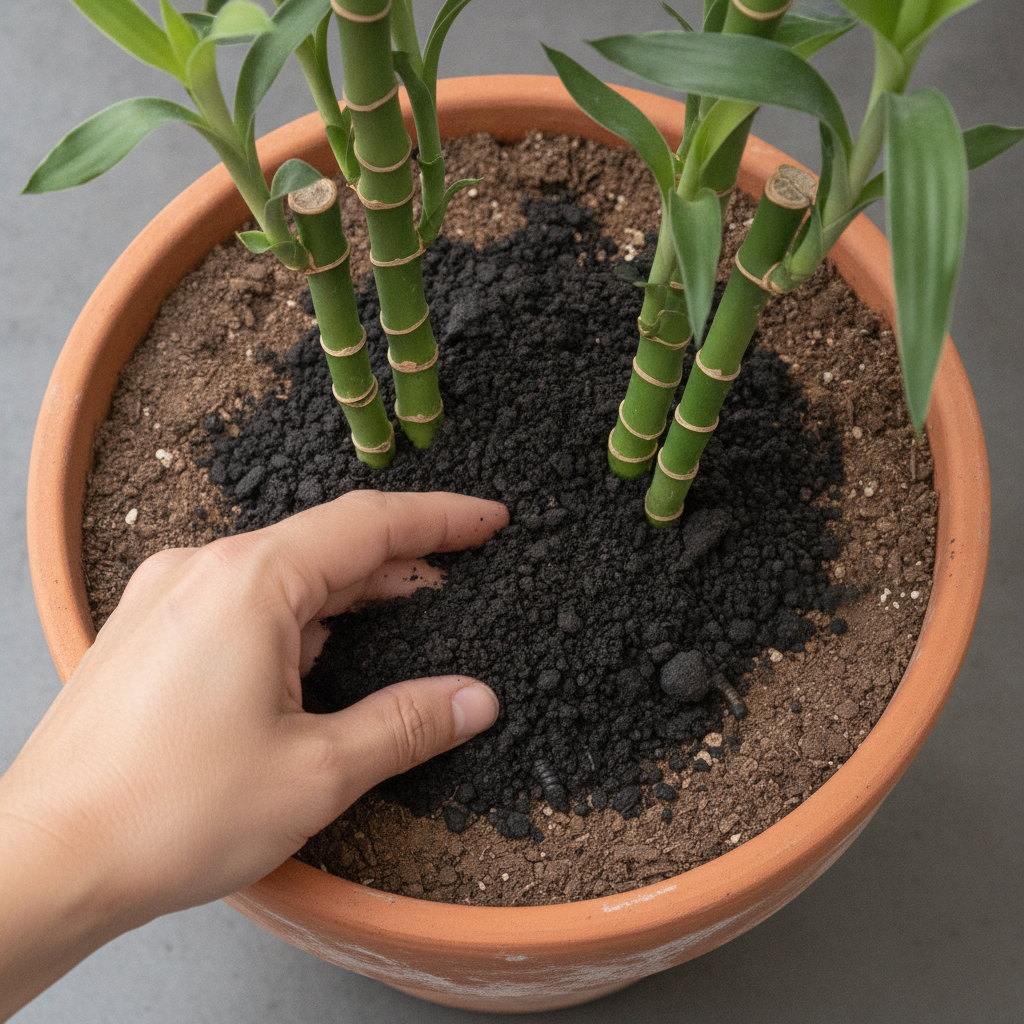
Understanding Plant Nutrients
Plant fertilisers are described by their N-P-K ratio, the proportions of nitrogen, phosphorus and potassium they contain, alongside smaller amounts of secondary nutrients and trace elements. Knowing what each does helps you read the signs of deficiency and choose a balanced feed rather than over-applying any one element.
| Nutrient | Symbol | Primary Function | Deficiency Symptoms |
|---|---|---|---|
| Nitrogen | N | Drives leaf and stem growth and green colour | Older leaves yellow; growth stalls |
| Phosphorus | P | Supports root development and energy transfer | Weak roots; dull, stunted growth |
| Potassium | K | Regulates water use and overall vigour | Yellow or browning leaf margins |
| Calcium | Ca | Builds strong cell walls | Distorted, weak new growth |
| Magnesium | Mg | Central to chlorophyll and photosynthesis | Yellowing between leaf veins |
| Iron | Fe | Aids chlorophyll formation in new leaves | Pale, yellowing youngest leaves |
Types of Fertiliser
Liquid fertilisers: The most practical choice for friendship bamboo, especially in water culture, because the dose is easy to control. Use a balanced houseplant feed diluted to a fraction of the recommended strength, or a fertiliser sold specifically for lucky bamboo.
Slow-release granular: Suitable only for soil-grown plants, where a small number of prills worked into the surface releases nutrients gradually. Avoid it entirely in water culture, where it cannot be controlled and will overload the vase.
Organic fertilisers: For potted plants, a light top-dressing of worm castings or a very dilute organic liquid feed provides gentle, slow nutrition that is hard to overdo and improves the soil as it breaks down.
Feeding Schedule
Feed only during the active growing season of spring and summer, and only sparingly. A single drop of diluted liquid feed added to the water every one to two months is ample for a water-grown plant, while a soil-grown specimen can take a half-strength feed roughly every six to eight weeks. Stop feeding altogether in autumn and winter, when growth naturally slows and the plant has little use for extra nutrients.
Pro Tip — Dilute, Then Dilute Again: The most common feeding mistake with friendship bamboo is using too much. Mix your fertiliser to a quarter or less of the label strength; a faint tint in the water is plenty. You can always add a little more next time, but you cannot easily undo a chemical burn.
How to Fertilise
- Wait until you are due to change the water or until the soil has been watered, never feed a thirsty plant.
- Dilute a balanced liquid feed to a quarter or less of its recommended strength.
- For water culture, add just a drop or two to the fresh water at a water change; for soil, apply the dilute feed evenly.
- Watch the plant over the following weeks for richer colour, and scale back at once if you see any leaf burn.
Warning — Salt Build-Up: Excess fertiliser leaves mineral salts behind that scorch roots and brown leaf tips. In water culture this shows as cloudy, fast-souring water; in soil, as a pale crust on the surface. Flush soil-grown plants with clean water occasionally, and always change vase water fully rather than topping up a fed solution.
Propagation
Propagating friendship bamboo is straightforward and deeply satisfying, which is part of why a single gifted stalk so often multiplies into a whole windowsill collection over the years. The plant is grown almost entirely from stem cuttings, and because it roots so willingly in plain water, even complete beginners can expect a good success rate.
The best time to take cuttings is in spring or early summer, when the plant is in active growth and wounds heal quickly. A healthy parent with several stalks gives you plenty of material to work with, and taking cuttings also offers a tidy way to use the top sections trimmed from a plant that has grown leggy.
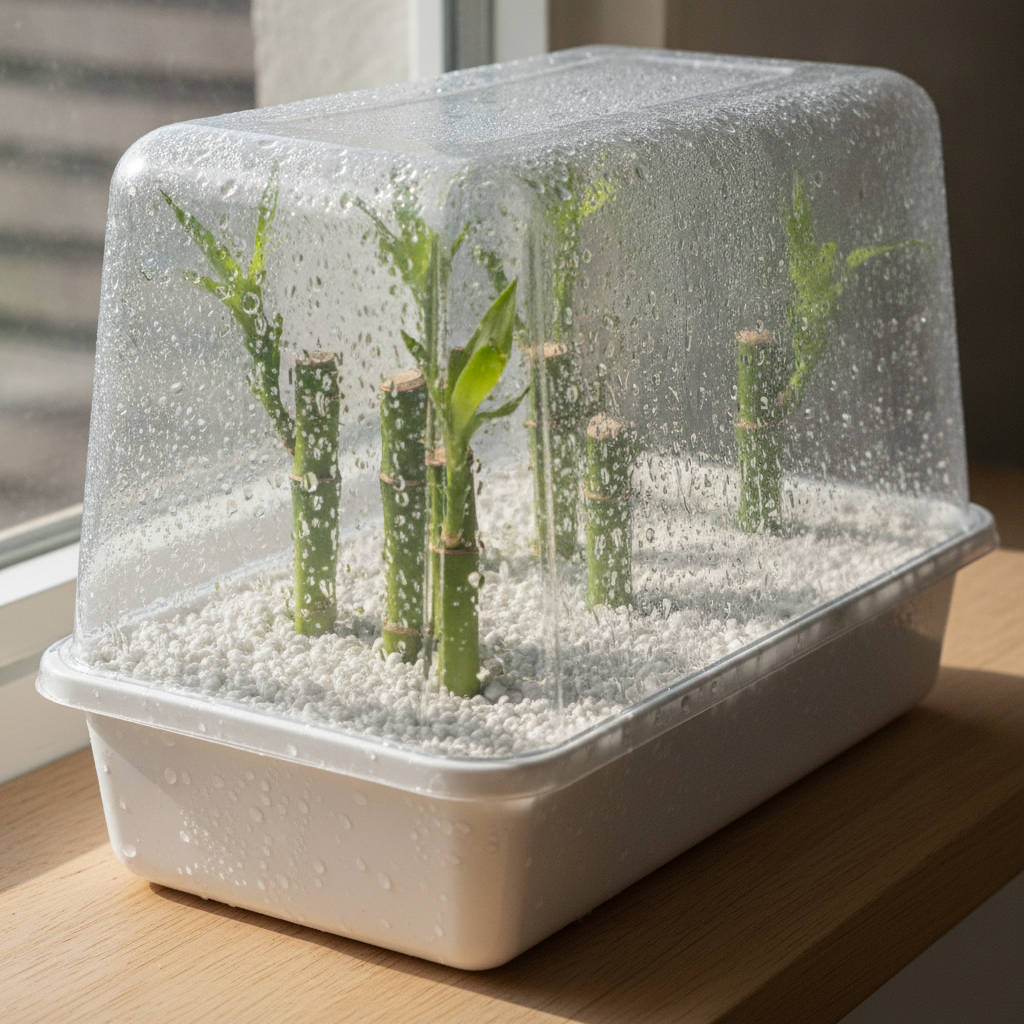
Understanding Nodes and Offshoots
The key to successful propagation is the node, the slightly raised ring that marks each joint along a stalk. Nodes are where new roots, leaves and side shoots emerge, so every cutting must include at least one. Mature plants also throw out small side offshoots from these nodes, and these young shoots, once they have a node or two of their own, can themselves be removed and rooted as fresh plants.
Water Propagation: Step-by-Step
Rooting in water is the classic method and the one most suited to a plant that already loves to grow that way. It is also the easiest to monitor, since you can watch the roots form through the glass.
- Choose a healthy stalk and cut a section 10 to 15cm (4 to 6in) long that includes at least one node, using clean, sharp scissors.
- Trim away the lowest leaves so no foliage will sit below the waterline and rot.
- Stand the cutting upright in a glass of filtered or stood water, keeping the node submerged.
- Place it in bright, indirect light and change the water every few days to keep it fresh.
- Watch for white roots emerging from the node within two to four weeks.
- Once the roots reach 5cm (2in) or so, leave the cutting in water or pot it into soil as you prefer.
Pro Tip — Seal the Cut on the Parent: To protect the stalk you cut from, many growers dip or paint the cut top of the remaining parent stem with a little melted candle wax. This seals the wound against rot and moisture loss while the plant heals, and the stalk will usually sprout new shoots just below the sealed tip.
Perlite and Humidity Dome: Step-by-Step
If you would rather establish cuttings directly into a growing medium, rooting them in damp perlite under cover gives strong, soil-ready roots and avoids the brief shock of moving a water-rooted cutting into compost.
- Take node-bearing cuttings as above and let the cut ends air-dry for an hour.
- Fill a shallow tray with moistened perlite and insert the cuttings upright, node down.
- Cover with a clear humidity dome or loose plastic to hold moisture around the cuttings.
- Keep the tray in bright, indirect light and the perlite lightly damp but never sodden.
- Air the dome briefly every few days to prevent mould and refresh the air.
- After three to five weeks, tug gently; resistance means roots have formed and the cutting can be potted on.
Troubleshooting Propagation
| Problem | Likely Cause | Solution |
|---|---|---|
| Cutting rots in water | Stale water or leaves submerged | Change water often; strip lower leaves |
| No roots after a month | No node included, or light too low | Recut below a node; move to brighter light |
| Cutting yellows | Stress, cold or chlorinated water | Use filtered water; keep warm and stable |
| Mould in the dome | Too much moisture, poor airflow | Ventilate daily; reduce dampness |
Pests & Diseases
Friendship bamboo is relatively untroubled by pests, and the majority of problems owners encounter are disorders caused by water quality, light or care rather than infestations. Even so, a few familiar houseplant pests can take hold, particularly on plants weakened by poor conditions or grown alongside an already infested collection.
The best defence is regular observation. Look over the stalks, leaf joints and the undersides of leaves whenever you change the water or water the soil, because catching a problem in its first days makes it far easier to clear.

Common Pests
Spider Mites (Tetranychus urticae)
These tiny sap-suckers thrive in dry air and show up as fine stippling on the leaves, faint webbing in the leaf joints and an overall dull, dusty look to the foliage. They are easy to miss until numbers build.
Treatment: Rinse the plant under a gentle stream of water, raise the humidity around it, and treat repeatedly with insecticidal soap or neem oil until the mites are gone.
Mealybugs (Pseudococcus spp.)
Mealybugs appear as small, white, cottony tufts tucked into the leaf axils and along the stalks. They feed on sap, weakening the plant and leaving behind sticky honeydew that can turn sooty.
Treatment: Dab each insect directly with a cotton bud soaked in isopropyl alcohol, then follow up with neem oil or insecticidal soap and re-check weekly.
Fungus Gnats (Bradysia spp.)
More a nuisance than a serious threat, these small black flies hover around soil-grown plants and breed in consistently damp compost, their larvae feeding on organic matter and fine roots.
Treatment: Let the soil surface dry between waterings, use yellow sticky traps to catch the adults, and a top layer of grit will discourage egg-laying.
Common Diseases
Root and Stem Rot (Pythium and Fusarium spp.)
The most serious threat to friendship bamboo, rot sets in when water stagnates or soil stays waterlogged, turning stalks and roots soft, brown and foul-smelling from the base upwards.
Treatment: Remove affected stalks immediately, cut any healthy green sections above the damage to re-root, refresh the water or repot into fresh mix, and tighten up your watering routine.
Algae Growth (various)
Not a disease of the plant itself but a frequent issue in water culture, algae forms a green film on the vase, pebbles and roots when light and stagnant water combine, competing for oxygen and looking unsightly.
Treatment: Scrub the vase and pebbles clean, change the water more often, and use an opaque or tinted container to cut the light reaching the water.
Pest and Disease Summary
| Pest / Disease | Identification | Treatment |
|---|---|---|
| Spider mites | Fine stippling and webbing; dusty leaves | Rinse, raise humidity, neem oil |
| Mealybugs | White cottony tufts in leaf joints | Alcohol swab, then insecticidal soap |
| Fungus gnats | Small flies around damp soil | Dry the surface; sticky traps |
| Root and stem rot | Soft, brown, smelly stalks and roots | Remove affected parts; refresh water or soil |
| Algae | Green film on vase, pebbles and roots | Clean often; use an opaque container |
Prevention Strategies
Prevention with friendship bamboo comes down to clean water and good airflow. Changing the water regularly, keeping vases and pebbles free of algae, and never letting roots sit in stagnant liquid heads off the rot and algae that account for most failures. For soil-grown plants, watering only when the surface begins to dry and ensuring the pot drains freely does the same job.
Quarantine any new plant for a couple of weeks before placing it near your existing collection, inspect regularly, and keep the foliage clean and dust-free so minor pest outbreaks are spotted and dealt with before they spread.
Pro Tip — Neem as a Routine: A monthly wipe-down with a weak neem oil solution deters spider mites and mealybugs before they ever gain a foothold, while also cleaning dust from the leaves so the plant photosynthesises efficiently. Apply it out of direct sun to avoid marking the foliage.
Popular Varieties
Although friendship bamboo is a single species, growers have developed a handful of distinct cultivars and, more importantly, a range of trained forms that give the plant much of its visual variety. The differences fall into two camps: leaf colour, where variegated selections add cream and gold to the standard green, and shape, where flexible young stalks are coaxed into spirals, weaves and lattices.
Most of what you see for sale is the ordinary green species trained into a decorative arrangement, but the named variegated forms are well worth seeking out for the extra colour they bring to a windowsill.
| Variety | Leaf Appearance | Light Needs | Growth Rate | Availability |
|---|---|---|---|---|
| Green (species) | Plain, glossy mid-green | Bright indirect to low | Slow | Very common |
| Gold Lucky Bamboo | Green streaked with golden yellow | Bright indirect | Slow | Common |
| White Stripe Victory | Green edged with creamy white | Bright indirect | Slow | Occasional |
| Spiral (trained) | Green leaves on coiled stalks | Bright indirect | Slow | Very common |
| Lotus (trained) | Green, woven into a tiered shape | Bright indirect | Slow | Occasional |
| Trellis / woven | Plain green in a lattice form | Bright indirect | Slow | Common |
Featured Varieties
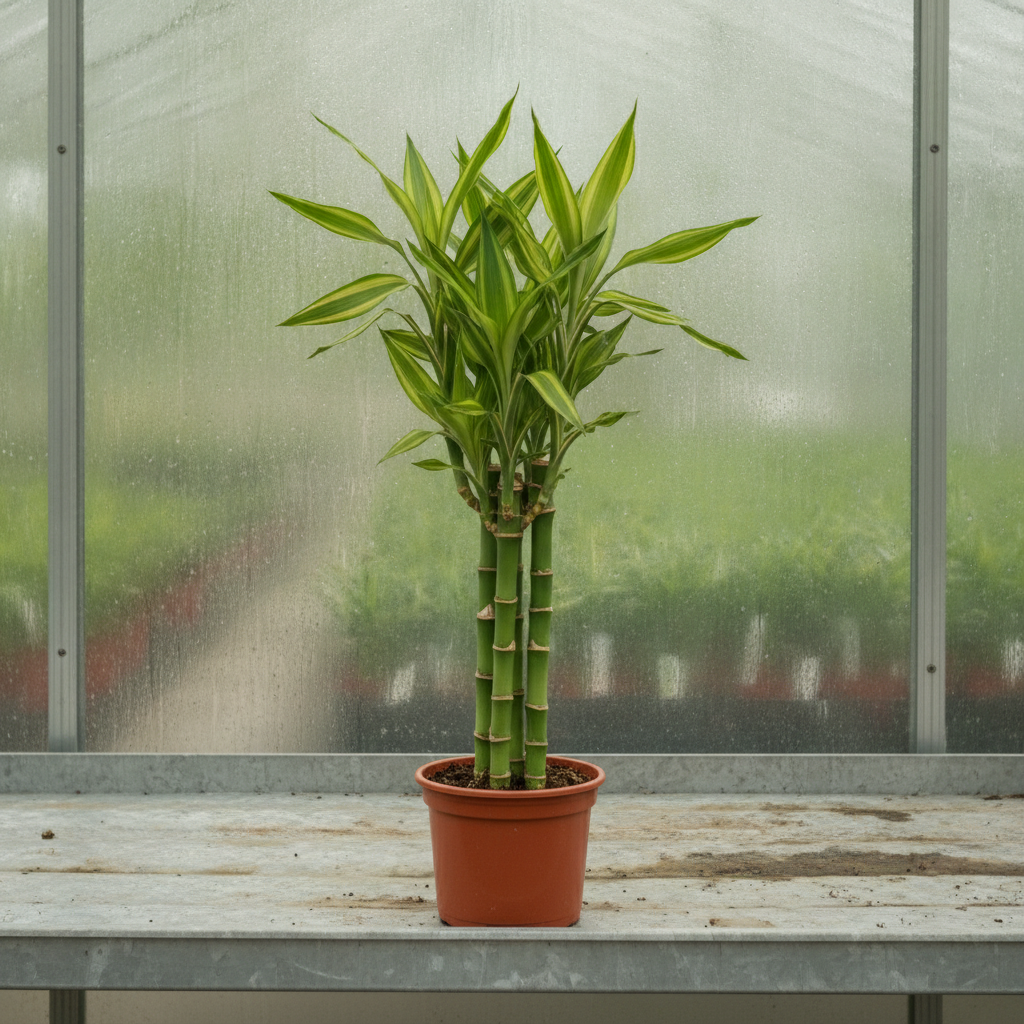
Gold Lucky Bamboo
A variegated selection whose strappy leaves carry soft golden-yellow streaks against the usual green. The colour is brightest in good indirect light and fades towards plain green if the plant is kept too dim.
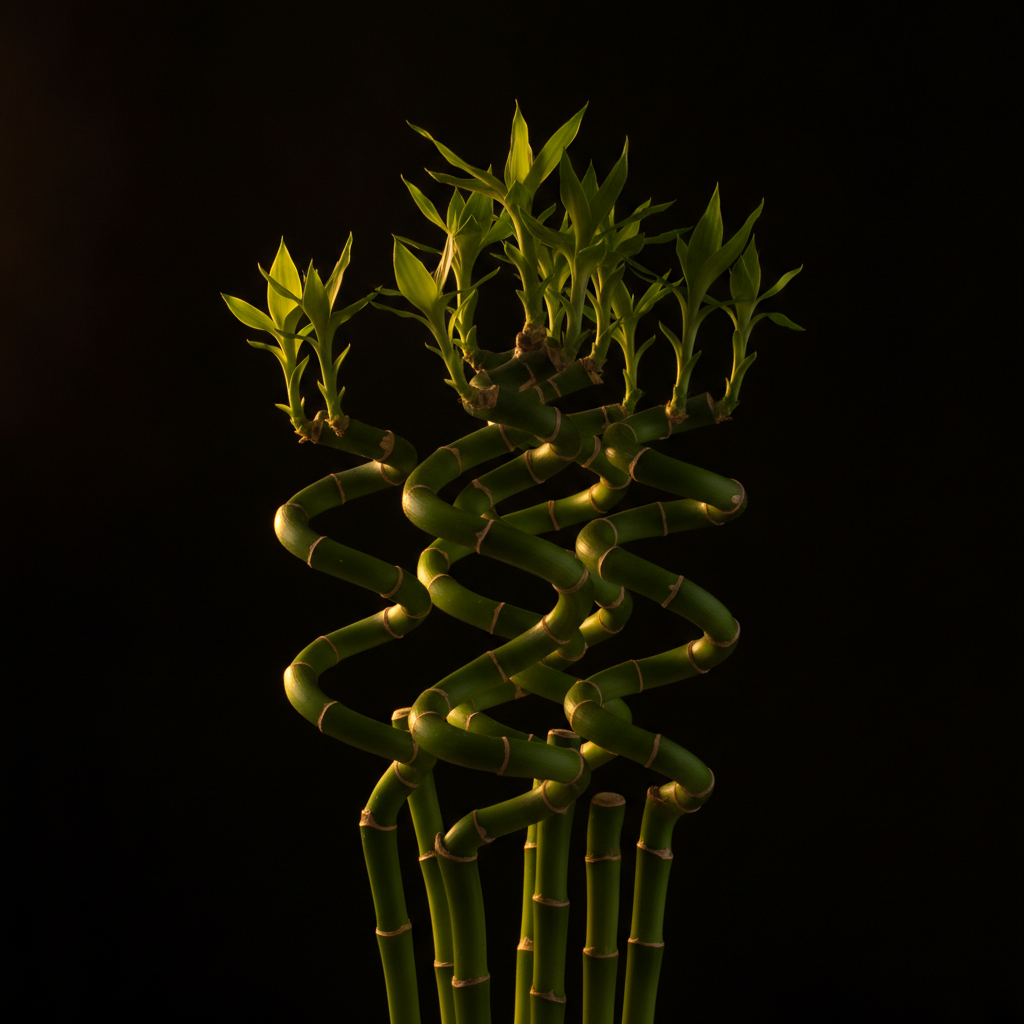
Spiral Lucky Bamboo
Not a separate cultivar but the standard green plant trained into tight coils by rotating the young stalks towards the light over many months. The result is the sculptural, curled form most associated with the plant.
Variety Profiles in Detail
Gold Lucky Bamboo (Dracaena braunii)
The gold-variegated form is grown for the warm yellow striping that runs along its leaves, lending a brighter, more ornamental feel than the plain species. Care is identical to the green type, but bright, indirect light is more important here, since the variegation depends on good light to stay distinct and will gradually revert to green in dim conditions.
White Stripe Victory (Dracaena braunii)
This selection edges its green leaves with a clean band of creamy white, giving a crisp, two-tone effect. It is a little less common in shops but prized by collectors for its sharper contrast, and like the gold form it holds its colour best in steady, bright indirect light.
Spiral and Woven Forms (Dracaena braunii)
The spirals, lattices and tiered lotus shapes sold everywhere are not genetic varieties at all but the work of patient growers who manipulate the direction of light to bend the soft young stalks. Once set, the shape is permanent in the existing stems, though any fresh growth from the tips will grow straight up towards the light unless trained in turn.
Choosing the Right Variety for Your Space
For a low-light spot or a first plant, the plain green species in a simple vase is hard to beat for resilience and ease. If you have good indirect light and want extra colour, the gold or white-striped forms reward the brighter position with their variegation. And if it is sculptural impact you are after, a trained spiral or woven arrangement makes a striking centrepiece, just remember that the shape is fixed and any new growth will run straight unless you train it yourself.
Frequently Asked Questions
Is friendship bamboo really a bamboo?
No. Despite the jointed, cane-like stalks, friendship bamboo is Dracaena braunii, a member of the asparagus family, and is not related to the true bamboos in the grass family at all. The resemblance is purely visual, and the names friendship bamboo and lucky bamboo come from its decorative form and its role in feng shui.
Why are the leaf tips turning brown?
Brown leaf tips are almost always a reaction to the chlorine and especially the fluoride in tap water, which build up in the foliage over time. Switching to filtered, distilled or rainwater usually solves it. Very dry air and over-fertilising can make the browning worse, so check those too.
Can I grow friendship bamboo in water forever?
Yes, it will live for years in water alone, which is how most plants are sold and kept. To keep it healthy, change the water every one to two weeks, keep the roots covered, and feed only a tiny amount of dilute fertiliser occasionally. That said, moving it into soil eventually tends to produce a larger, longer-lived plant.
Why is a stalk turning yellow?
A yellowing stalk is a warning sign, usually of too much sun, over-fertilising, poor water quality or rot. If the yellowing starts soft and mushy at the base, it is rot and the stalk should be removed promptly so it does not spread. If a yellow stalk is otherwise firm, review the plant’s light, water and feeding.
How do I make my friendship bamboo grow into a spiral?
The spirals are made by exploiting the plant’s habit of bending towards light. Growers lay a young stalk on its side and rotate it slowly over weeks and months so it curls as it grows towards a single light source, often inside a partial box. It is a slow, patient process, which is why pre-trained plants command a premium.
Is friendship bamboo safe around pets?
No. It is toxic to cats and dogs, containing saponins that can cause drooling, vomiting, loss of appetite and weakness if the plant is chewed or eaten. Keep it well out of reach of pets, and contact a vet if you suspect your animal has ingested any part of it.
How often should I change the water?
Change it completely every one to two weeks, and top up the level in between so the roots stay covered. Fully refreshing the water, rather than just adding more, keeps it oxygenated and prevents the algae, odour and rot that come from stagnation. Rinse the vase and pebbles at each change.
Why isn’t my friendship bamboo growing?
Friendship bamboo is naturally slow, so a degree of patience is normal, but stalled growth usually points to light that is too low or a complete absence of nutrients. Move the plant somewhere brighter but still out of direct sun, and give it a very dilute feed during spring and summer to encourage fresh leaves.
My friendship bamboo has grown tall and leggy. What can I do?
Simply cut it back. Trim the tall stalk above a node, seal the cut on the parent with a little wax, and the stalk will sprout new shoots below the cut. Better still, root the removed top section as a cutting, so a leggy plant becomes two tidy ones.
What does the number of stalks mean?
In feng shui tradition, different stalk counts are said to attract different blessings: three for happiness, five for wealth and health, and so on. This symbolism is the source of the plant’s popularity as a gift and of the lucky bamboo name; it has no effect on how the plant actually grows.






