
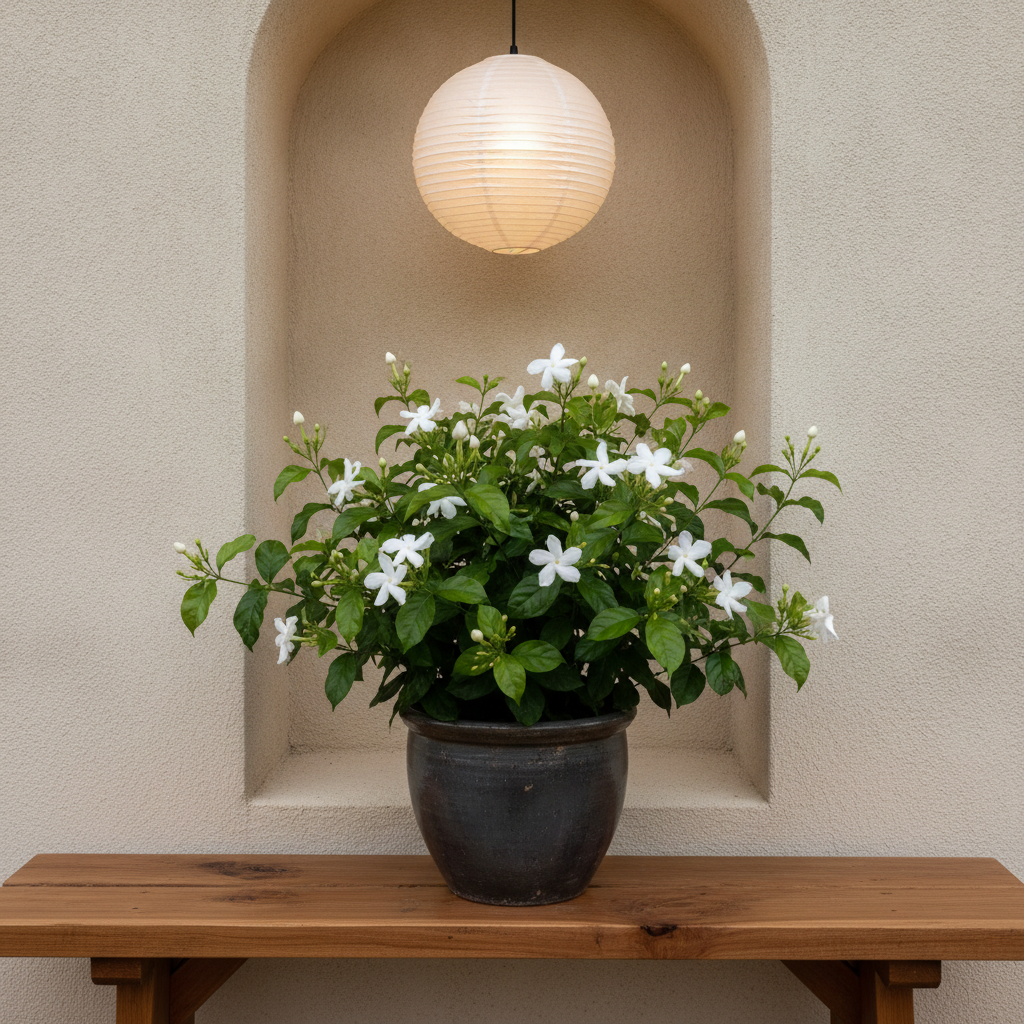
Few houseplants announce themselves the way Arabian jasmine does. Long before you see the small, waxy white pinwheels tucked among its glossy leaves, you catch the perfume, a sweet, heady fragrance that intensifies after dark and can fill an entire room from a single flowering stem. Known botanically as Jasminum sambac, this evergreen twining shrub belongs to the olive family, Oleaceae, and has been cultivated across tropical Asia for centuries. It is the source of the flowers strung into sampaguita garlands in the Philippines, the melati putih revered in Indonesia, and the blossoms that scent traditional jasmine tea.
Despite its exotic reputation, Arabian jasmine is a rewarding container plant that adapts well to a bright windowsill or a sunny conservatory. It is not the most forgiving plant on the shelf, it wants light, warmth and steady moisture, but it is far from temperamental once those needs are met. The gap between merely keeping it alive and coaxing it into repeated flushes of scented bloom comes down to a handful of details, and this guide walks through every one of them, from reading its light and water cues to feeding for flowers, propagating new plants and heading off the pests that occasionally find it.
Contents
- Quick Reference
- Why Arabian Jasmine Makes a Rewarding Houseplant
- Light Requirements
- Watering & Humidity
- Soil, Potting & Repotting
- Fertilising
- Propagation
- Pests & Diseases
- Popular Varieties
- Frequently Asked Questions
Quick Reference: Arabian Jasmine at a Glance
| Light | Bright light with at least four to six hours of direct sun daily; a south or west window indoors |
| Watering | Keep the soil evenly moist in growth; let the top 2 to 3 cm (about 1 in) dry between waterings |
| Temperature | 18 to 30 degrees C (64 to 86 F); protect from anything below 10 degrees C (50 F) |
| Humidity | Moderate to high, ideally 50 to 60 percent or more |
| Fertiliser | A phosphorus-rich bloom feed every two to three weeks through spring and summer |
| Toxicity | Generally regarded as non-toxic to cats, dogs and people, though not intended for eating |
Why Arabian Jasmine Makes a Rewarding Houseplant
The obvious draw is the scent. A well-grown Jasminum sambac produces waves of small white flowers from late spring into autumn, and each one carries a perfume out of all proportion to its size. The blooms open mainly in the evening and are at their most fragrant overnight, which makes the plant a natural fit for a bedroom or a living room where you spend your evenings. Beyond the fragrance, the plant offers year-round structure: dense, glossy, deep-green foliage on twining stems that can be left to bush out in a pot or trained up a small hoop or trellis for a more sculptural shape.
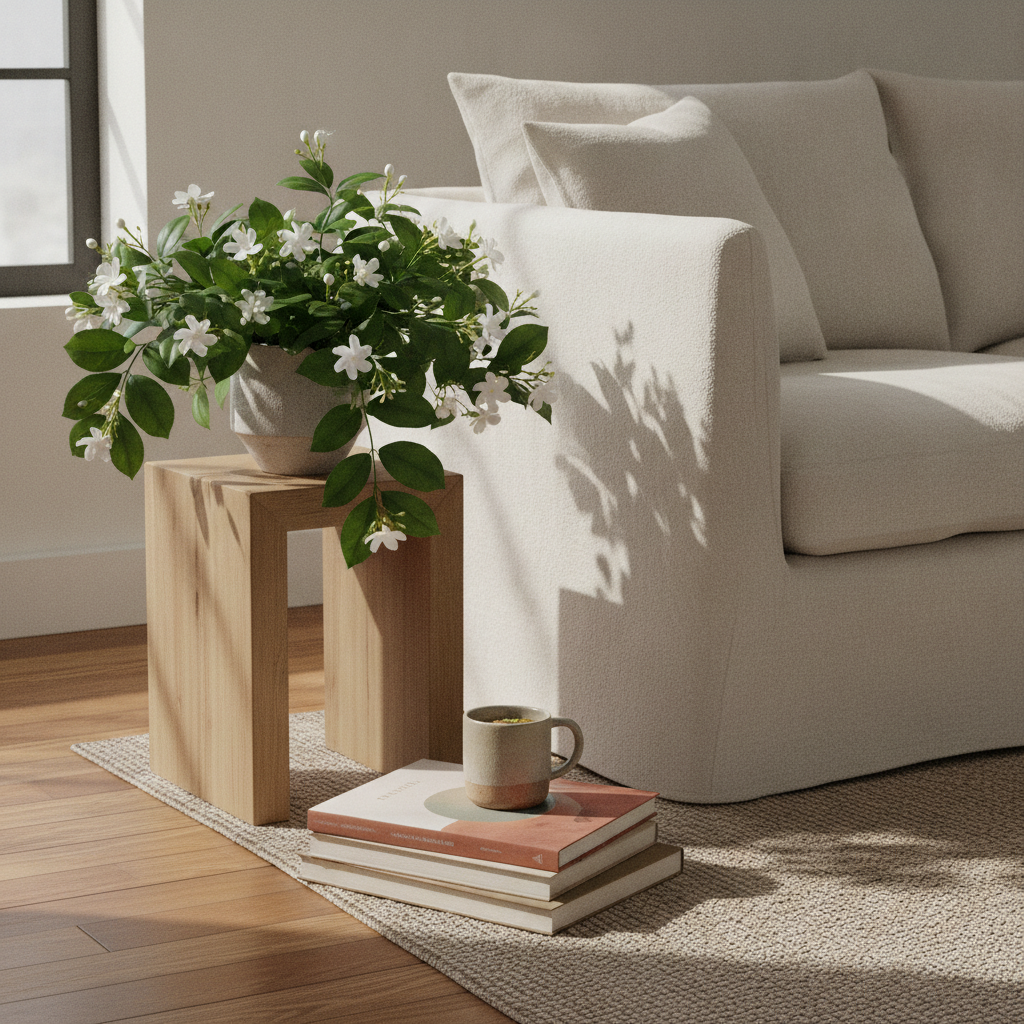
It is also a plant with genuine cultural weight, which adds to its appeal on a windowsill. Arabian jasmine is the national flower of both the Philippines, where it is called sampaguita, and Indonesia, where it is known as melati putih, and its flowers feature in weddings, temple offerings and the flavouring of tea across South and Southeast Asia. For an indoor grower, the practical payoff of all that history is a plant that has been selected over generations for heavy, reliable flowering, so the effort you put into light and feeding is repaid generously.
Important — Toxicity: True jasmines in the genus Jasminum, including Jasminum sambac, are not listed as toxic to cats, dogs or people by major poison-control references, so a curious pet or child is unlikely to come to harm from a nibble. Do not confuse it with unrelated plants sold as jasmine, such as Carolina jasmine (Gelsemium sempervirens) or star jasmine (Trachelospermum jasminoides), which are genuinely poisonous. As with any houseplant, discourage pets from eating the foliage, since even non-toxic plant matter can cause mild stomach upset.
Light Requirements
Light is the single biggest lever on whether Arabian jasmine flowers, and it is where most disappointed growers go wrong. This is a full-sun plant in its native climate, and indoors it needs the brightest position you can offer. A plant kept in gentle, indirect light will usually stay alive and even put on leafy growth, but it will produce few flowers or none at all. If you buy an Arabian jasmine for its scent, treat generous light as non-negotiable rather than optional.
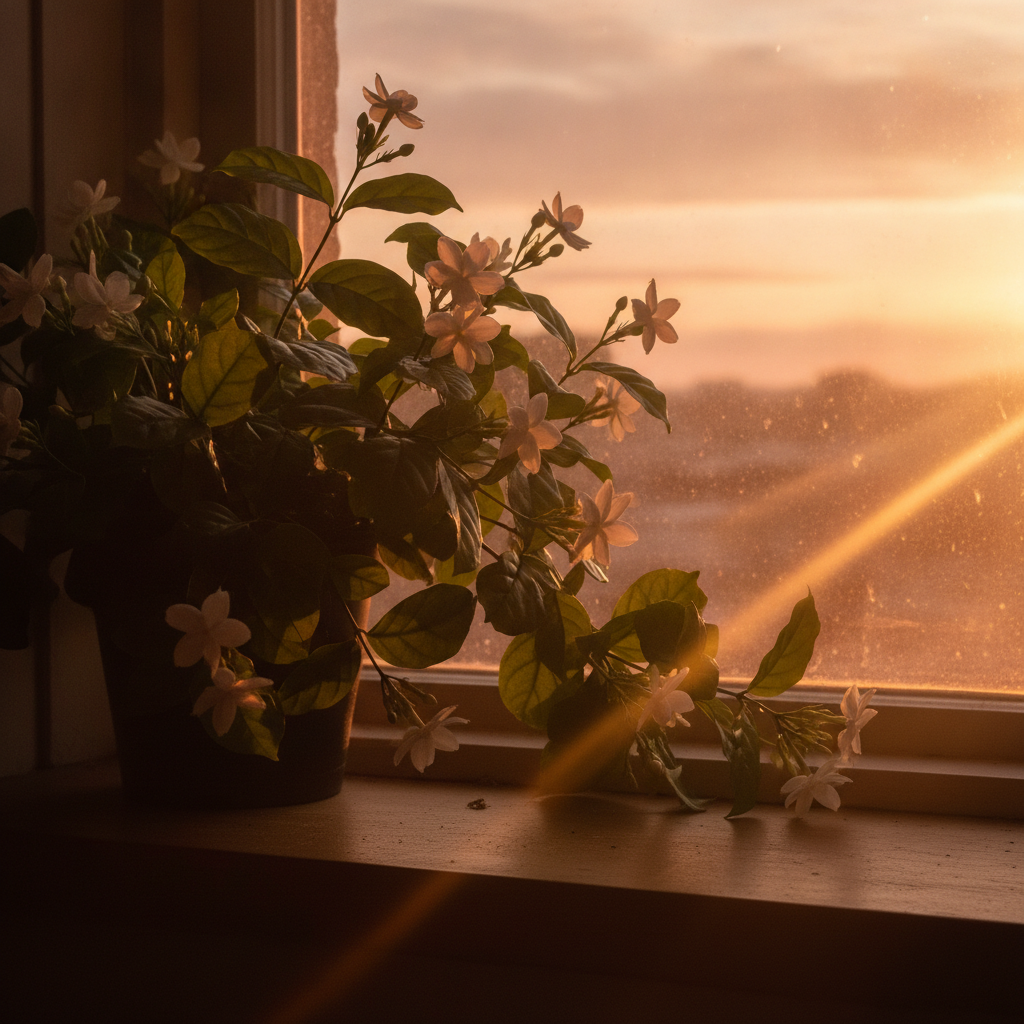
The ideal indoor spot delivers at least four to six hours of direct sunlight each day, along with bright ambient light for the rest of it. A windowsill that catches midday and afternoon sun is close to perfect. In summer the plant is happy to spend time outdoors on a balcony or patio, where the extra light and air movement often trigger the heaviest flowering of the year, provided you bring it back inside before temperatures drop in autumn.
Light Levels Explained
Gardeners talk about light in loose terms like “bright” and “shady”, but it helps to attach rough figures to those words. The table below sets out the common indoor light tiers and what each one means for a flowering plant like Arabian jasmine, which sits firmly at the brighter end of the scale.
| Light Category | Approx. Level | Typical Location | Outcome |
|---|---|---|---|
| Direct sun | Over 20,000 lux | On a south or west sill, unobstructed | Ideal; drives strong flowering |
| Bright indirect | 10,000 to 20,000 lux | Just back from a sunny window | Healthy growth, moderate bloom |
| Medium | 5,000 to 10,000 lux | A few metres from a bright window | Leafy but sparse flowering |
| Low | 1,000 to 5,000 lux | North room, interior wall | Weak, leggy, rarely blooms |
| Very low | Under 1,000 lux | Hallway, far corner | Slow decline over time |
Window Orientation and Placement
South-facing window: In the northern hemisphere this is the best position of all, delivering long hours of strong light. Set the plant right on or beside the sill and it will reward you with the fullest flowering. In high summer, watch that the glass does not overheat the foliage on the very hottest afternoons.
East-facing window: A good second choice, offering several hours of gentler morning sun. The plant will grow well and flower moderately, though perhaps less heavily than in a south window. Morning light is rarely strong enough to scorch, so this is a safe, low-risk spot.
West-facing window: Also very suitable, providing warm, intense afternoon sun. Flowering can be excellent here. Because afternoon sun carries the most heat, keep the soil from drying out completely and give the plant a little air movement in summer.
North-facing window: The weakest option and generally not enough on its own. A plant here will survive but is unlikely to flower well. If a north window is all you have, plan to supplement with a grow light or move the plant outdoors for the warm months.
Pro Tip — Rotate for Even Growth: Because jasmine leans strongly toward its light source, give the pot a quarter turn every week or so. This keeps the plant balanced and stops it developing a lopsided, one-sided shape as it reaches for the window.
How Light Affects Flowering
With most foliage houseplants, light chiefly governs leaf size and colour. With Arabian jasmine, light governs whether you get flowers at all. Flower buds form on new growth, and the plant only produces vigorous, flower-bearing new growth when it receives enough light energy to fund it. A jasmine in marginal light will spend what little it has on maintaining existing leaves, leaving nothing over for bloom. Move the same plant into strong sun and, within a few weeks, you typically see fresh shoots tipped with buds. If your plant is all leaf and no flower, more light is almost always the answer before you reach for fertiliser.
Warning — Direct Sunlight: Although Arabian jasmine loves sun, a plant that has spent months indoors or been grown in shade can scorch if moved abruptly into intense direct light. Acclimatise it over a week or two, increasing exposure gradually, to avoid pale, bleached patches or crisp brown scorch marks on the leaves.
Artificial Lighting
If natural light falls short, especially through a dim winter, a full-spectrum LED grow light can make the difference between a sulking plant and a blooming one. Position the light 20 to 40 cm (8 to 16 in) above the canopy and run it for 12 to 14 hours a day to mimic a long, bright day. Grow lights are particularly useful for keeping the plant in active growth over winter in cooler climates, though most growers find flowering is still best during the natural high-light months.
Seasonal Adjustments
Light levels indoors fall sharply from autumn to midwinter, and jasmine responds by slowing down. Move the plant to your brightest window for the darker months and clean the glass, since a surprising amount of light is lost through a dusty pane. As days lengthen again in spring, watch for new shoots as the signal to resume more frequent watering and feeding. Rotating the plant to the sunniest available spot as the sun’s angle changes through the year keeps growth steady and flowering reliable.
Watering & Humidity
Arabian jasmine likes to stay consistently moist during its growing season, more so than many houseplants, but it will not tolerate standing in waterlogged soil. The goal is even, reliable moisture with brief, gentle drying at the surface between waterings. Get that balance right and the plant grows steadily and flowers freely; get it wrong in either direction and you will see stress quickly, since jasmine is not shy about signalling thirst or drowning.
When to Water
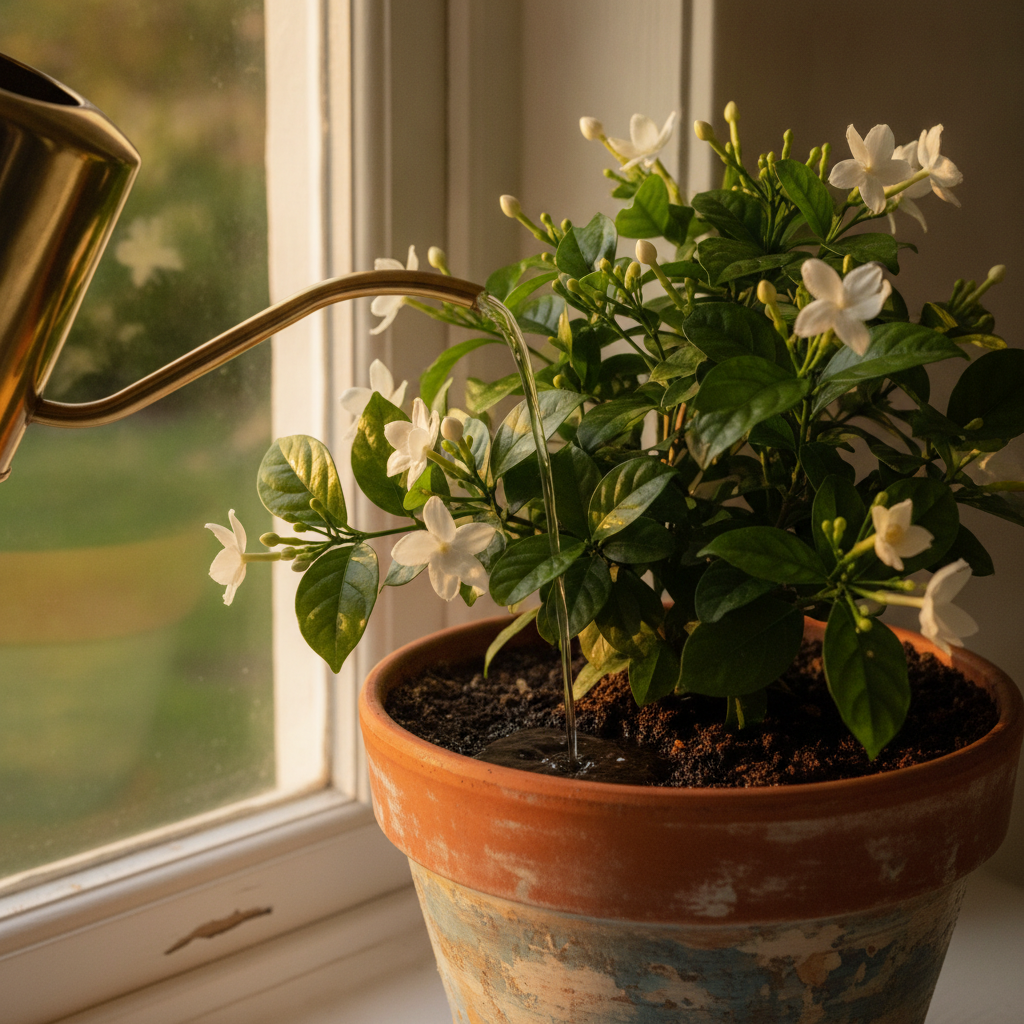
Rather than watering on a fixed calendar, water by feel. Push a finger into the soil: when the top 2 to 3 cm (about 1 in) feels dry but the soil below is still cool and slightly moist, it is time to water again. Through the warm, high-growth months this often means watering two to three times a week, while a plant in a plastic pot or a cool room will need it less often. The plant’s own appetite is the best guide, so check the soil regularly rather than assuming.
In autumn and winter, when growth slows and light is weaker, cut back noticeably. The plant uses far less water when it is not actively growing, and the same watering routine that suited high summer will keep the roots too wet and cold in December. Let the soil dry a little further between drinks in the off-season, while never allowing it to become bone dry for long, since jasmine dislikes prolonged drought even in its rest period.
Pro Tip — Consistency Protects Buds: Sudden swings between soaking and drought are a common cause of bud drop, where a plant full of promising flower buds sheds them before they open. Keeping moisture steady during the budding period is one of the simplest ways to make sure those buds actually become flowers.
How to Water Correctly
- Check the top 2 to 3 cm (about 1 in) of soil and water only when it has begun to dry.
- Use room-temperature water, since cold water can shock warm-loving roots.
- Pour slowly and evenly across the whole surface until water runs freely from the drainage holes.
- Let the pot drain fully for several minutes so no excess sits at the base.
- Empty the saucer or cache pot; never leave the plant standing in collected water.
- Wait until the surface dries again before repeating, adjusting frequency with the season.
Signs of Overwatering vs. Underwatering
| Symptom | Overwatering | Underwatering |
|---|---|---|
| Leaf colour | Yellowing, often across whole leaves | Dull green fading to brown at edges |
| Leaf texture | Soft, limp, sometimes translucent | Dry, crisp, curling inward |
| Soil | Stays wet for days, may smell sour | Dry, pulling away from the pot sides |
| Roots | Brown, mushy, foul-smelling | Dry and brittle but pale and firm |
| Buds and flowers | Buds blacken and drop | Buds shrivel and fall unopened |
Warning — Root Rot: Persistently soggy soil starves the roots of oxygen and invites the fungal and bacterial rots that kill jasmine faster than almost anything else. If you notice a sour smell, blackened roots or a plant that wilts despite wet soil, remove it from the pot, cut away all mushy roots with clean scissors, and repot into fresh, well-draining mix. Water sparingly until new growth confirms recovery.
Humidity Requirements
As a plant of warm, humid Asian climates, Arabian jasmine appreciates moisture in the air as well as in the soil. It does best when relative humidity sits at around 50 to 60 percent or higher. Average household air, particularly in winter when central heating dries it out, often falls well below that, and while jasmine will cope with moderate dryness, very dry air can leave leaf tips brown and make the plant more attractive to spider mites.
Watch for the tell-tale signs of air that is too dry: crisp brown leaf edges, buds that fail to develop, and fine webbing between the leaves that betrays a mite infestation taking hold. These symptoms often appear together in a heated room in midwinter, and they are your cue to raise humidity around the plant.
Raising humidity is straightforward. Stand the pot on a tray of pebbles topped up with water so the base sits above the waterline, group the jasmine with other plants so they share the moisture they transpire, or run a small humidifier nearby during the driest months. Misting gives only a brief lift and, done heavily on the flowers, can mark the petals, so a pebble tray or humidifier is the more dependable choice.
Water Quality
Arabian jasmine is not especially fussy about water, but it does best with water that is not heavily chlorinated or very hard. If your tap water is strongly treated, letting it stand uncovered overnight allows some chlorine to dissipate, while collected rainwater or filtered water suits the plant well and helps keep the soil slightly on the acidic side that jasmine prefers. Over time, mineral-heavy water can leave a chalky crust on the soil and raise the pH, so an occasional flush with softer water is worthwhile.
Soil, Potting & Repotting
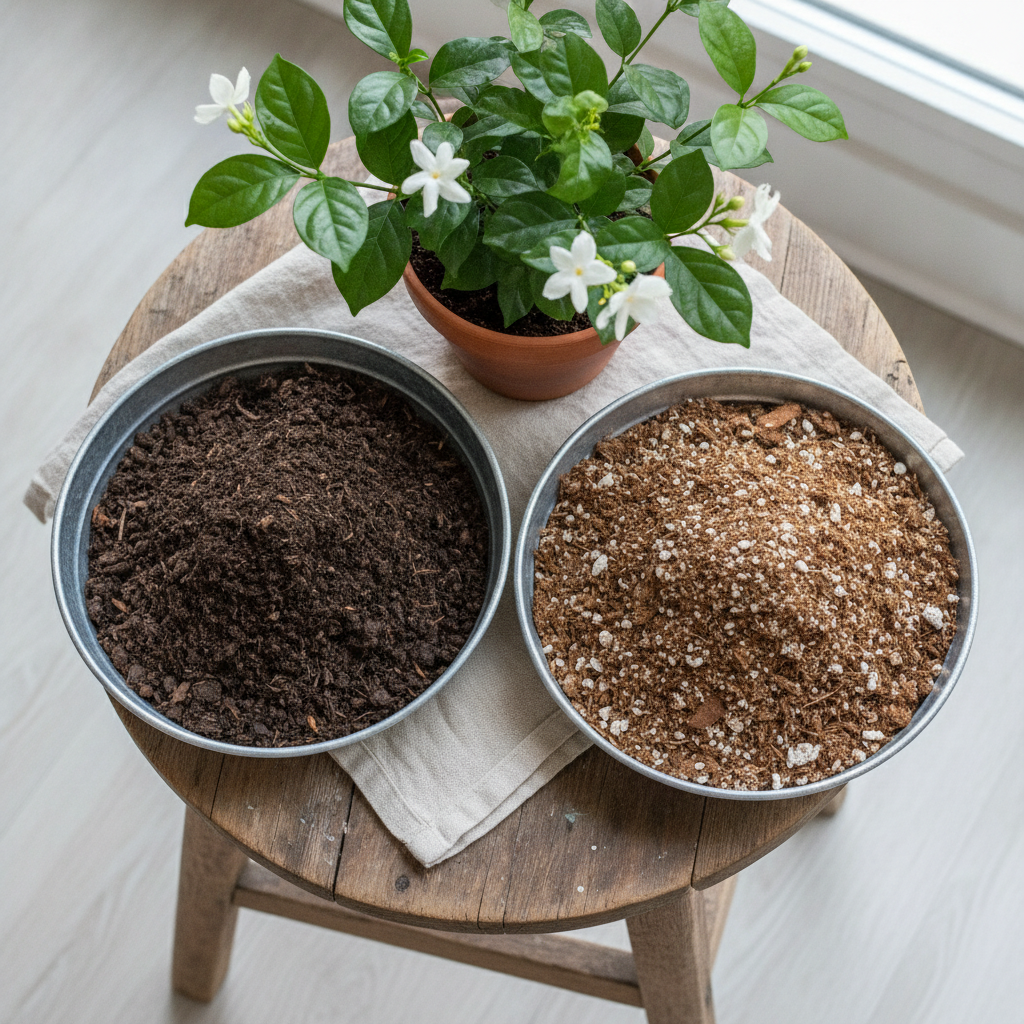
The right growing medium lets Arabian jasmine have the two things it seems to want in contradiction: steady moisture and free drainage. The solution is a rich but open mix that holds water without ever becoming a sodden mass. A dense, water-retentive compost used straight from the bag is a common cause of the root problems that plague jasmine, so it pays to blend your own or amend a shop-bought mix before planting.
Ideal Soil Composition
A good jasmine mix starts with a quality peat-free or peat-based potting compost as its base and then opens it up with drainage material and enriches it with organic matter for the nutrients this hungry flowering plant needs. The aim is a medium that feels moist and springy after watering but never claggy, and that drains within a minute or two of a thorough soak.
| Component | Proportion | Function |
|---|---|---|
| Quality potting compost | 50 percent | Base structure and moisture retention |
| Perlite or coarse grit | 20 percent | Opens the mix and improves drainage |
| Composted bark or coco coir | 20 percent | Adds air pockets and lasting structure |
| Worm castings or compost | 10 percent | Slow-release nutrients for flowering |
Arabian jasmine prefers a soil that is neutral to slightly acidic, roughly pH 6.0 to 7.0. Most general composts sit comfortably in this range, so you rarely need to adjust it deliberately. If your water is very hard and alkaline, however, the pH can creep upward over time, which is one more reason to use softer water and to refresh the top layer of soil each year.
Pro Tip — Quick Mix Recipe: For a fast, reliable blend, combine roughly two parts good potting compost, one part perlite and one part composted bark, then stir through a generous handful of worm castings. This gives the moisture-holding, free-draining, nutrient-rich medium jasmine thrives in, using ingredients most growers already keep to hand.
Choosing the Right Pot
The container matters as much as what goes in it. Arabian jasmine flowers more freely when its roots are comfortably, though not severely, confined, so resist the urge to plant it in an oversized pot in the hope of encouraging growth. A pot only slightly larger than the root ball keeps the soil from staying wet in unoccupied corners and nudges the plant toward blooming.
Drainage holes are non-negotiable. Whatever pot you choose, it must have holes in the base for excess water to escape. Given how prone jasmine is to root rot, a decorative pot with no drainage is a genuine risk. If you love a particular cache pot, use it as an outer sleeve and keep the plant in a plain nursery pot that you lift out to water.
Pot material: Terracotta is an excellent match for jasmine because its porous walls let the soil breathe and dry more evenly, reducing the chance of waterlogging. Glazed ceramic and plastic hold moisture longer, which can be useful in a hot, dry spot but demands more careful watering. Choose the material to suit your climate and watering habits.
Pot size: When potting up, move to a container just 2 to 4 cm (about 1 to 2 in) wider in diameter than the current one. This modest step keeps the root-to-soil balance right and avoids the reservoir of permanently damp soil that a big jump in pot size creates.
When to Repot
Most Arabian jasmines need repotting every one to two years, ideally in early spring just as new growth begins. Signs that it is time include roots emerging from the drainage holes or circling the surface, water running straight through without wetting the soil, and a plant that dries out much faster than it used to. Spring repotting gives the plant a full growing season to settle in and resume flowering, whereas disturbing the roots in autumn leaves it vulnerable through the low-light months.
How to Repot: Step-by-Step
- Water the plant a day beforehand so the root ball is moist and holds together.
- Slide the plant out gently, supporting the base of the stems, and tease apart any tightly circling roots.
- Trim away any dark, soft or rotten roots with clean, sharp scissors.
- Add a layer of fresh mix to the new pot so the plant will sit at its previous depth.
- Centre the plant, then fill around it with fresh mix, firming gently to remove large air gaps.
- Water thoroughly to settle the soil and top up any that sinks.
- Return the plant to bright light and hold off feeding for a few weeks while it recovers.
Warning — Transplant Shock: Jasmine can sulk for a week or two after repotting, sometimes dropping a few leaves or buds. This is normal. Keep it warm, brightly lit and evenly watered, and resist the temptation to fertilise straight away, since feeding freshly disturbed roots can scorch them and deepen the setback.
Fertilising
Arabian jasmine is a heavy feeder when it is flowering, and regular fertilising is the second great lever, after light, on how many blooms you get. A plant given plenty of sun but no nutrients will run out of the raw materials it needs to build flowers, so the two go hand in hand. During the growing season, a steady supply of a balanced-to-bloom-focused feed keeps the plant producing fresh, bud-bearing growth.
The key is to match feeding to the plant’s rhythm. Feed generously through spring and summer while it is actively growing and flowering, then taper off almost entirely in autumn and winter when growth naturally slows. Feeding a resting plant simply loads the soil with salts it cannot use, which can damage the roots.
Understanding Plant Nutrients
Fertiliser labels carry three prominent numbers, the N-P-K ratio, showing the percentages of nitrogen, phosphorus and potassium. Nitrogen drives leafy growth, phosphorus supports roots and flowering, and potassium underpins overall vigour and bloom quality. For a flowering plant like jasmine, a feed that is not overloaded with nitrogen, and that offers ample phosphorus and potassium, encourages the plant to put its energy into flowers rather than only leaves.
| Nutrient | Symbol | Primary Function | Deficiency Symptoms |
|---|---|---|---|
| Nitrogen | N | Leafy growth and green colour | Pale, yellowing older leaves |
| Phosphorus | P | Roots, buds and flowering | Poor bloom, dull purplish tint |
| Potassium | K | Overall vigour and flower quality | Brown leaf edges, weak flowers |
| Calcium | Ca | Cell walls and new growth | Distorted, hooked new leaves |
| Magnesium | Mg | Chlorophyll production | Yellowing between leaf veins |
| Iron | Fe | Green pigment in new leaves | Pale young leaves, green veins |
Types of Fertiliser
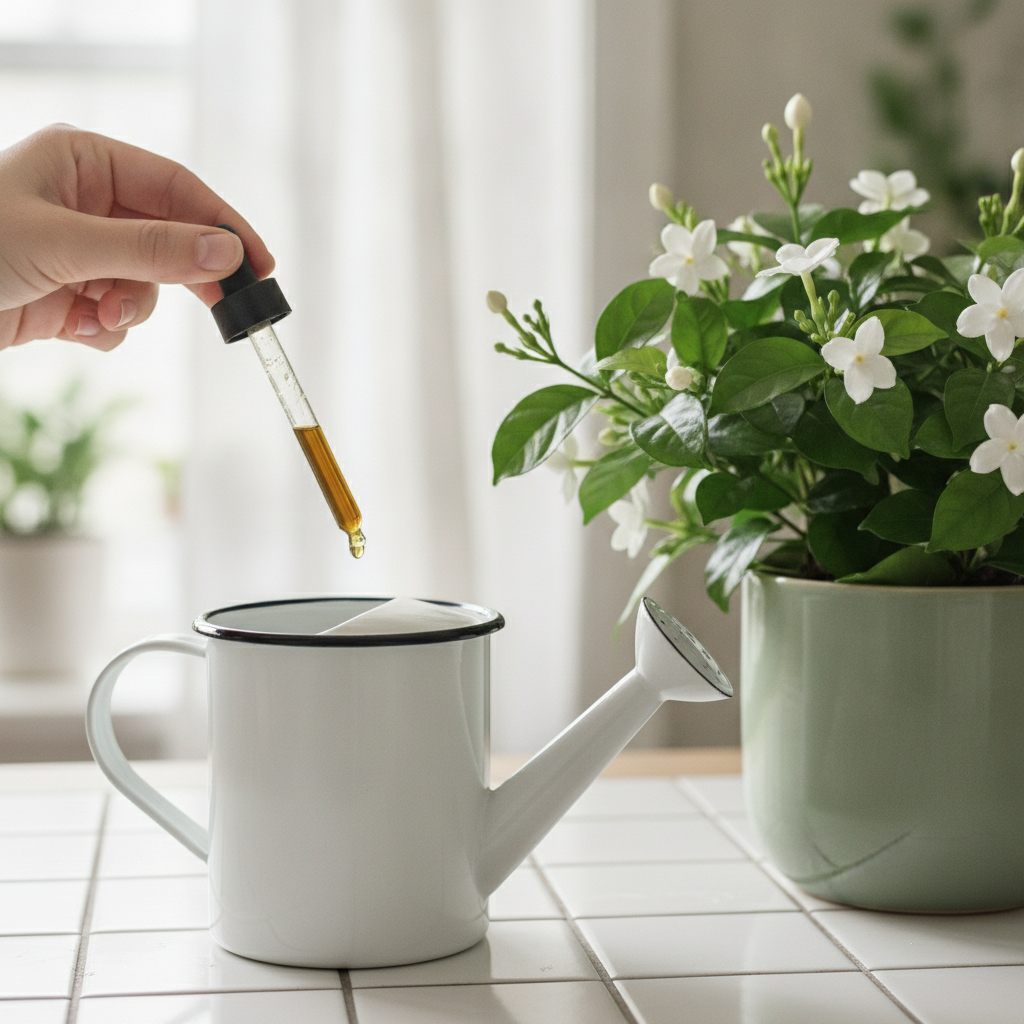
Liquid fertilisers: The most convenient choice for jasmine, since they act fast and let you control the dose precisely. Dilute a balanced or bloom-focused liquid feed and apply it with your normal watering every two to three weeks in the growing season. Because it is easy to adjust, a liquid feed is ideal for matching the plant’s changing appetite through the year.
Slow-release granular: Coated granules release nutrients gradually over several months, which suits growers who prefer not to feed frequently. Mix them into the top layer of soil in spring and they will feed steadily through the season. The trade-off is less control, so pair them with a lighter hand on any additional liquid feed to avoid over-fertilising.
Organic fertilisers: Worm castings, well-rotted compost, seaweed extracts and similar organic feeds release nutrients slowly and improve the soil life at the same time. They are gentle and forgiving, making them hard to overdo, and many growers use them alongside an occasional liquid feed for a balanced approach that supports both flowers and long-term soil health.
Feeding Schedule
Through spring and summer, feed every two to three weeks with a diluted liquid fertiliser, favouring one richer in phosphorus and potassium as the plant comes into bud. In early autumn, stretch the interval and reduce the strength, then stop feeding altogether through late autumn and winter while the plant rests. Resume in spring only when you see fresh growth, which is the plant’s own signal that it is ready to use the nutrients again.
Pro Tip — Feed at Half Strength: It is far safer to underfeed than overfeed. Mixing liquid fertiliser to half the recommended concentration and applying it a little more often gives steady nutrition without risking the salt build-up and root burn that a full-strength dose can cause on a container plant.
How to Fertilise
- Water the plant lightly first if the soil is very dry, so the feed does not hit parched roots.
- Dilute the liquid fertiliser to half the label strength in your watering can.
- Apply evenly across the soil until it is moist, avoiding splashing the feed onto the flowers.
- Let any excess drain away and empty the saucer.
- Every month or two, water with plain water only to flush out accumulated salts.
Warning — Salt Build-Up: A white or yellowish crust on the soil surface or around the pot rim signals a build-up of fertiliser salts, which can burn roots and brown leaf edges. Flush the pot thoroughly with plain water two or three times to leach the salts out, and ease back on the feeding strength or frequency going forward.
Propagation
Propagating Arabian jasmine is a satisfying way to multiply a favourite plant or share its scent with friends. Unlike some houseplants that divide neatly at the root, jasmine is a woody climbing shrub, so it is increased chiefly from stem cuttings and by layering, where a stem is encouraged to root while still attached to the parent. Both methods are reliable given warmth and patience, though jasmine cuttings root more slowly than soft, sappy houseplants and reward a gentle, unhurried approach.
The best time to propagate is late spring through summer, when the plant is in active growth and warmth is on your side. Semi-ripe stems, those that have started to firm up but are not yet fully woody, root most readily. Take material from healthy, pest-free growth, and be prepared to wait several weeks to a couple of months for roots to form.
Understanding Nodes and Semi-Ripe Wood
Success with jasmine cuttings hinges on the node, the slightly swollen point on a stem where leaves emerge and where the plant concentrates the cells capable of forming roots. Every cutting should include at least one or two nodes, since a length of stem with no node will rarely root. Semi-ripe wood, taken from the current season’s growth once it has begun to firm, strikes the best balance between the rooting vigour of young tissue and the resilience of mature stem, which is why it is the material of choice.
Stem Cuttings: Step-by-Step
Stem cuttings are the most common way to propagate Arabian jasmine and the easiest to attempt at home. Take them in the warm months and give them bright, indirect light and steady humidity while they root.
- Choose a healthy semi-ripe stem and cut a 10 to 15 cm (4 to 6 in) length just below a node with clean, sharp secateurs.
- Remove the leaves from the lower half, leaving two or three at the tip.
- Dip the cut end in rooting hormone to improve your odds, since jasmine can be slow to root.
- Insert the cutting into a moist, free-draining mix of compost and perlite, burying at least one node.
- Cover with a clear plastic bag or propagator to hold humidity, keeping it off the leaves.
- Place in bright, indirect light at around 21 to 27 degrees C (70 to 80 F) and keep the medium lightly moist.
- After several weeks, a gentle tug that meets resistance shows roots have formed; then pot on and acclimatise gradually.
Pro Tip — Bottom Heat Speeds Rooting: Jasmine cuttings root far more reliably with warmth at their base. A heated propagation mat set to around 24 degrees C (75 F) can cut rooting time and raise your success rate noticeably, especially if you are propagating in a cool room or early in the season.
Air Layering: Step-by-Step
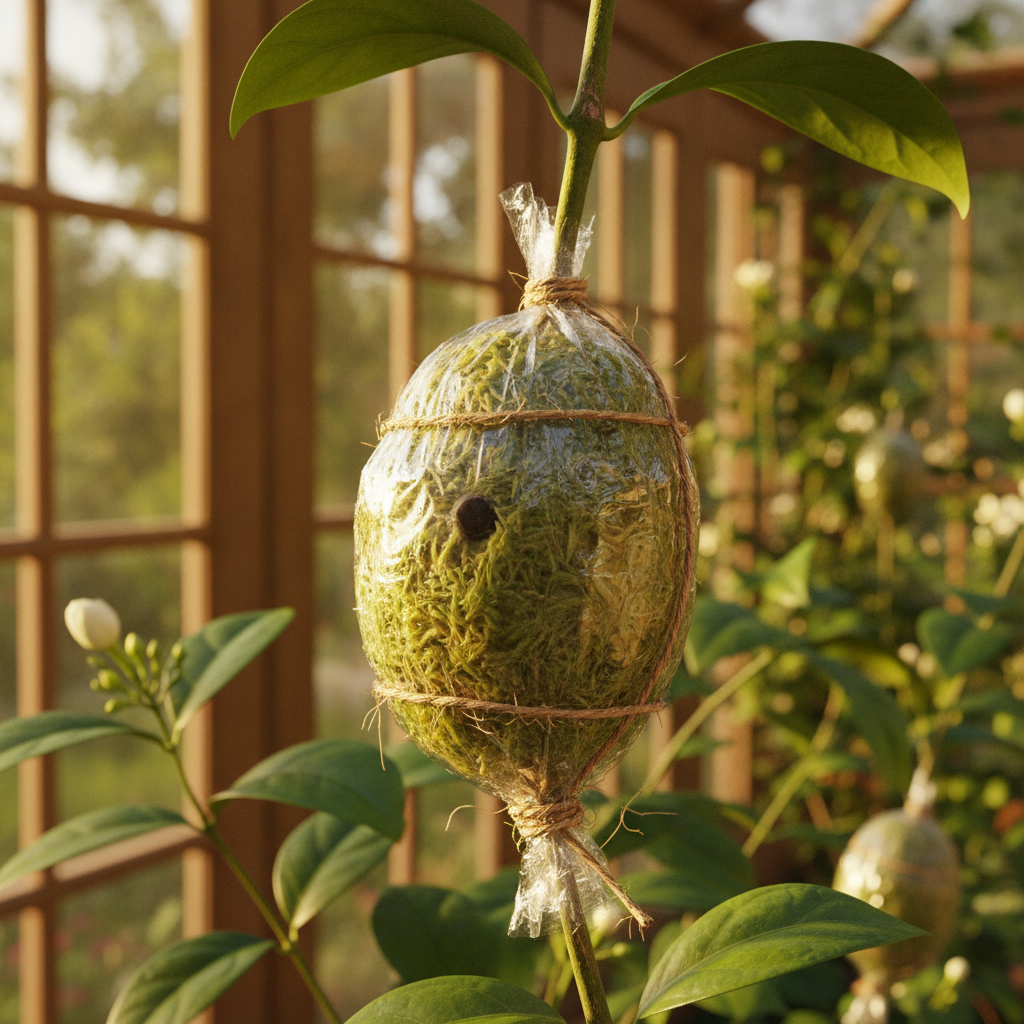
Air layering is a dependable, if slower, method that lets a stem grow roots while it is still nourished by the parent plant, which sidesteps the risk of a cutting drying out before it roots. It is ideal for a longer, semi-woody stem and for growers who want a near-guaranteed result.
- Select a healthy stem and choose a point just below a node about 30 cm (12 in) from the tip.
- Make a shallow upward cut or remove a thin ring of bark to expose the tissue beneath.
- Dust the wound with a little rooting hormone to encourage root initiation.
- Wrap the area in a handful of damp sphagnum moss, pressing it snugly around the stem.
- Enclose the moss in clear plastic film and tie both ends with twine to seal in moisture.
- Keep the moss damp and wait; roots usually appear inside the wrap within a few weeks to a couple of months.
- Once roots are visible through the moss, cut the stem below the new roots and pot it up as a young plant.
Troubleshooting Propagation
| Problem | Likely Cause | Solution |
|---|---|---|
| Cutting rots at the base | Medium too wet or not sterile | Use fresh, free-draining mix and water more sparingly |
| Cutting shrivels and dries | Humidity too low, roots not yet formed | Cover to hold humidity and keep out of direct sun |
| No roots after many weeks | Too cold or wood too old | Add bottom heat and use semi-ripe, not woody, stems |
| Leaves drop from cutting | Stress or fluctuating conditions | Keep warmth, light and moisture steady and be patient |
Pests & Diseases
A healthy, well-lit Arabian jasmine is reasonably resistant to trouble, but no houseplant is immune, and jasmine’s dense foliage and love of humidity can shelter sap-sucking pests if you are not watching. The great majority of problems are far easier to solve when caught early, so make a habit of inspecting the plant, especially the undersides of leaves and the leaf axils, whenever you water.
Most pests and diseases that affect jasmine take hold when the plant is already under some stress, whether from dry air, overwatering or poor light. Keeping the growing conditions right is therefore your best defence, with direct treatment reserved for infestations that appear despite good care.

Common Pests
Mealybugs (Pseudococcus species)
These small, soft-bodied insects look like tiny tufts of white cotton wool and gather in leaf axils and along stems, where they suck sap and weaken the plant. A heavy infestation leaves sticky honeydew and stunted, distorted growth.
Treatment: Dab each insect with a cotton bud dipped in isopropyl alcohol, then treat the whole plant with insecticidal soap or diluted neem oil, repeating weekly until they are gone. Isolate the plant from others while you deal with them.
Spider Mites (Tetranychus urticae)
Almost too small to see, spider mites thrive in warm, dry air and reveal themselves through fine webbing between leaves and a stippled, dusty yellowing of the foliage. They multiply fast, so dry-air months are the danger period.
Treatment: Rinse the plant under a gentle shower to knock the mites back, raise humidity to make conditions less favourable, and apply neem oil or a miticide to the undersides of the leaves, repeating every few days until clear.
Aphids (Aphis species)
Clusters of small green, black or brown insects gather on tender new shoots and flower buds, sucking sap and often disfiguring the very growth that would have carried flowers. Like mealybugs, they excrete sticky honeydew that can turn sooty and black.
Treatment: Blast them off with a jet of water, wipe soft growth with insecticidal soap, and repeat until the population collapses. Check nearby plants, since aphids spread quickly.
Whiteflies (Trialeurodes vaporariorum)
Tiny white moth-like insects that flutter up in a cloud when the plant is disturbed, whiteflies feed on the undersides of leaves and, like other sap-suckers, leave honeydew behind. They are more common on plants summered outdoors.
Treatment: Hang yellow sticky traps to catch the adults, and treat the foliage with insecticidal soap or neem oil, focusing on the leaf undersides where the young stages feed.
Common Diseases
Root Rot (Pythium and Phytophthora species)
The most serious threat to container jasmine, root rot sets in when soil stays waterlogged and airless. The first signs above ground are yellowing, wilting foliage on a plant whose soil is clearly wet, while below ground the roots turn brown, soft and foul-smelling.
Treatment: Unpot the plant, cut away all affected roots with clean scissors, and repot into fresh, free-draining mix in a clean pot. Water sparingly afterwards and correct the drainage and watering habits that caused it.
Leaf Spot (various fungi)
Fungal leaf spots show as brown or black blotches, sometimes ringed with yellow, that spread in damp, stagnant conditions or when water sits on the foliage overnight. Left unchecked they can cause leaves to drop.
Treatment: Remove and bin affected leaves, improve air circulation around the plant, and avoid wetting the foliage when watering. A copper-based or general fungicide can help stop a stubborn outbreak.
Pest and Disease Summary
| Pest / Disease | Identification | Treatment |
|---|---|---|
| Mealybugs | White cottony tufts in leaf axils | Alcohol swabs then insecticidal soap or neem |
| Spider mites | Fine webbing, stippled yellow leaves | Rinse, raise humidity, apply neem or miticide |
| Aphids | Clusters on buds and new shoots | Water jet then insecticidal soap |
| Whiteflies | Tiny white flies rising when disturbed | Yellow sticky traps and neem oil |
| Root rot | Wilting in wet soil, brown mushy roots | Trim roots, repot dry, fix drainage |
| Leaf spot | Brown or black blotches on leaves | Remove leaves, improve airflow, fungicide |
Prevention Strategies
Prevention rests on a few habits. Inspect the plant regularly, quarantine any new arrival for a couple of weeks before it joins your collection, and wipe or rinse the leaves occasionally to remove dust and dislodge early pests. Good air movement, correct watering and bright light together keep the plant vigorous enough to shrug off most problems before they take hold.
Just as important is avoiding the stresses that invite trouble. Do not let the plant sit in soggy soil, do not let the air around it become bone dry in winter, and do not starve it of light, since a weakened jasmine is the one that pests and diseases find first. A plant grown in the right conditions is remarkably self-sufficient.
Pro Tip — Neem Oil as a Routine: A light monthly spray of diluted neem oil, applied in the evening when the sun is off the leaves, works as both a preventative and a gentle treatment for the common sap-sucking pests. Coat the undersides of the leaves thoroughly, where most pests feed, and avoid spraying open flowers.
Popular Varieties
Although all Arabian jasmines share the same species, Jasminum sambac, growers have selected a handful of distinct cultivars that differ mainly in the form of their flowers, from simple single pinwheels to fully double rosettes that look like miniature white roses. All carry the trademark fragrance, so choosing between them is largely a matter of the look you prefer and how heavily each tends to bloom.
The two most widely grown forms are ‘Maid of Orleans’, prized for its abundant single flowers, and ‘Grand Duke of Tuscany’, valued for its showy double blooms. Beyond these, cultivars such as ‘Belle of India’ and ‘Mysore Mulli’ offer variations on flower shape and petal count for collectors who want something less common.
| Variety | Flower Appearance | Light Needs | Growth Rate | Availability |
|---|---|---|---|---|
| Maid of Orleans | Single, flat white pinwheels | Full sun | Vigorous | Very common |
| Grand Duke of Tuscany | Fully double, rose-like | Full sun | Slower | Common |
| Belle of India | Elongated double petals | Full sun | Moderate | Specialist |
| Mysore Mulli | Semi-double, many petals | Full sun | Moderate | Specialist |
| Arabian Nights | Double, compact habit | Full sun | Compact | Less common |
Featured Varieties
Maid of Orleans
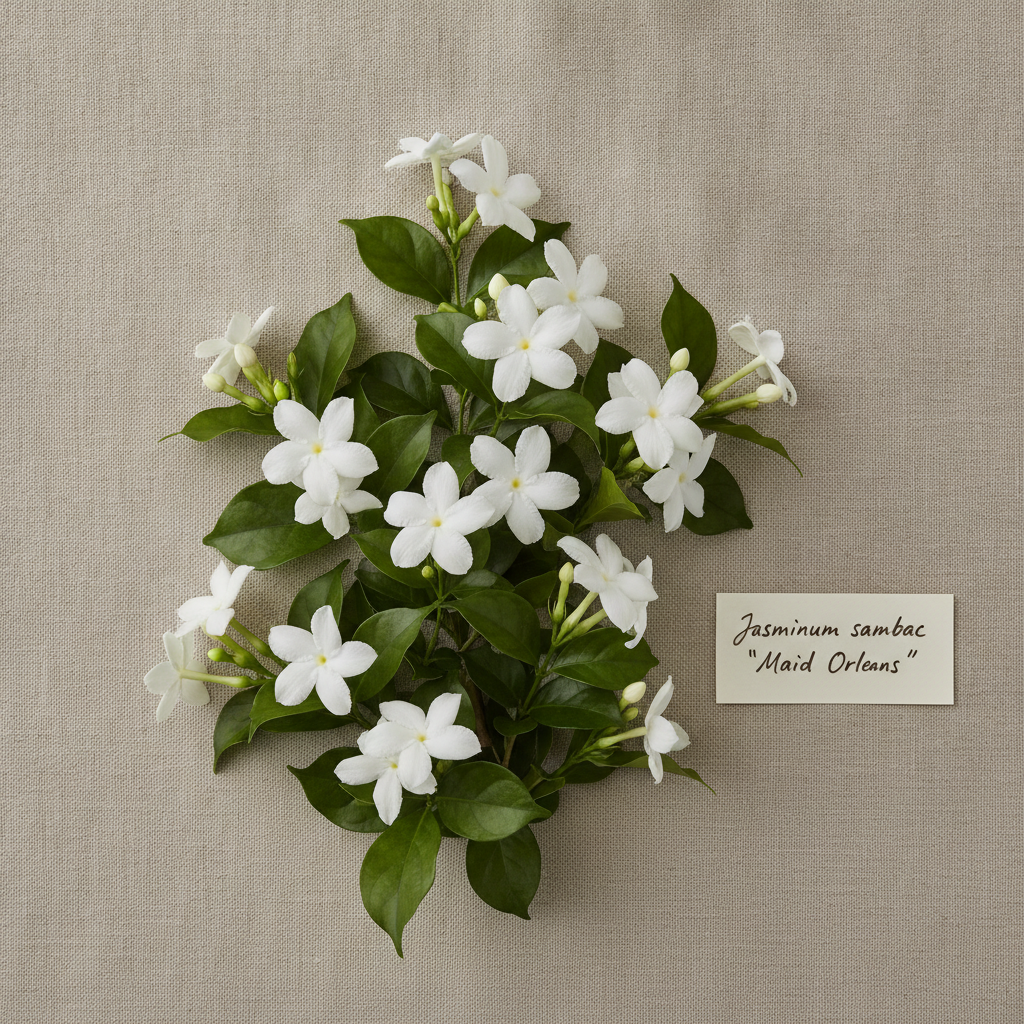
The classic and most free-flowering form, with simple single blooms of five to nine rounded, waxy white petals arranged in a flat pinwheel. It blooms heavily and often, making it the natural first choice for anyone growing jasmine mainly for scent.
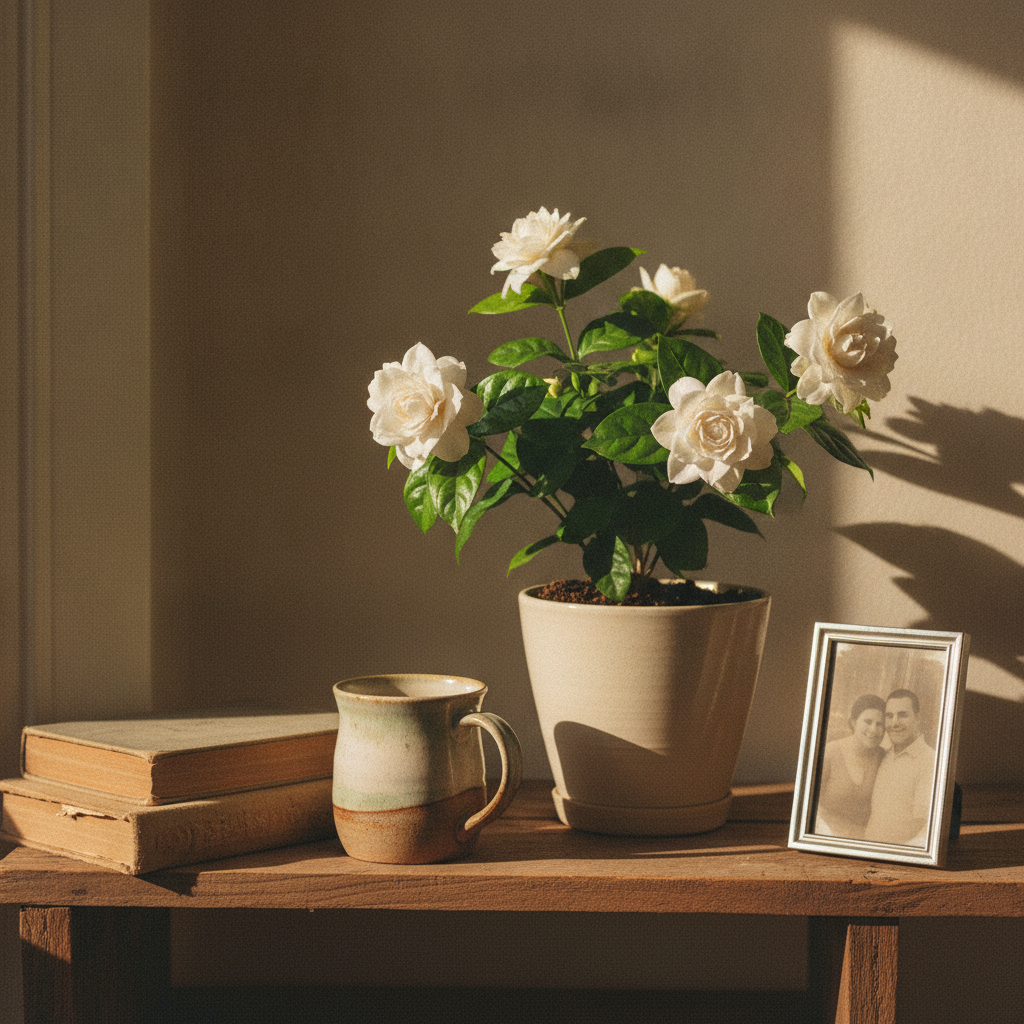
Grand Duke of Tuscany
A striking double form whose flowers resemble tiny white roses or gardenias, packed with thick, overlapping petals. It blooms more sparingly and opens more slowly than the single types, but each long-lasting flower is a showpiece in its own right.
Variety Profiles in Detail
Maid of Orleans (Jasminum sambac ‘Maid of Orleans’)
This is the workhorse of the group and the form most people picture when they think of sampaguita. Its single flowers open in quick succession from spring to autumn, each lasting a day or so but replaced by a steady stream of new buds, so a well-grown plant is rarely without bloom in the warm months. Its vigour also makes it the easiest cultivar to propagate and train, and it is the variety most commonly grown for garlands and jasmine tea.
Grand Duke of Tuscany (Jasminum sambac ‘Grand Duke of Tuscany’)
The most ornamental of the sambacs, the Grand Duke trades quantity for drama. Its dense, double flowers can each last several days, and their rose-like form makes them a favourite for close-up display. In return for that beauty it demands the very best light and feeding to bloom at all, and even then it flowers less freely than the single types, so it best suits a grower who can give it a truly sunny spot.
Choosing the Right Variety for Your Space
If your priority is the fullest flush of fragrance from a plant that blooms early and often, ‘Maid of Orleans’ is the safe and generous choice, and it copes with slightly less than perfect light better than the doubles. If you have a bright, sunny window and want a smaller number of spectacular, long-lasting flowers to admire up close, ‘Grand Duke of Tuscany’ rewards the extra care. For most indoor growers, starting with a single-flowered form and adding a double once you have the plant’s rhythm figured out is the surest route to success.
Frequently Asked Questions
Why is my Arabian jasmine not flowering?
Insufficient light is by far the most common reason. Arabian jasmine needs several hours of direct sun each day to fund flower production, so a plant in gentle indirect light will stay green but rarely bloom. Move it to your sunniest window or summer it outdoors, and pair the brighter position with regular feeding, and you should see buds within a few weeks of active growth.
When does Arabian jasmine bloom?
In good conditions it flowers repeatedly from late spring through autumn, with the heaviest flushes in the warmth of summer. Individual flowers open mainly in the evening and are most fragrant overnight. Given enough warmth and light, a happy plant can even produce the odd flower through winter, though the main show belongs to the warm months.
Why are the flower buds falling off before they open?
Bud drop usually reflects a sudden change the plant found stressful: a swing between wet and dry soil, a move to a new position, a draught, or a spell of very dry air. Keep watering, temperature and light as steady as you can while the plant is in bud, and avoid moving it around, and far more buds will make it through to open flowers.
Can I grow Arabian jasmine indoors year-round?
Yes, provided you can give it a very bright, sunny window and warmth. Many growers keep it indoors all year, moving it to the brightest available spot in winter and supplementing with a grow light if needed. Others give it a summer holiday outdoors for the extra light and then bring it back inside before the cold arrives, which often produces the strongest flowering.
How big does Arabian jasmine get in a pot?
In the ground in a warm climate it can scramble to two or three metres, but confined to a container and pruned, an indoor plant is easily kept to a manageable 60 cm to 1.5 metres (2 to 5 ft). Regular pinching and pruning after flowering keeps it bushy and compact, and you can train it up a small hoop or trellis to control its shape.
Should I prune my jasmine, and when?
Pruning keeps the plant tidy and encourages the new growth that carries flowers, so it is well worth doing. Prune after a flush of bloom, cutting back leggy stems and pinching growing tips to promote branching. Avoid heavy pruning in late autumn, since you would remove the wood that will bear the next season’s flowers; light shaping is fine, but save the bigger cuts for spring and summer.
Is Arabian jasmine safe for cats and dogs?
True jasmines in the genus Jasminum, including Jasminum sambac, are not listed as toxic to cats and dogs, so they are among the safer flowering plants to keep around pets. Do be sure you have a genuine Jasminum and not an unrelated plant sold under the jasmine name, some of which are poisonous, and discourage pets from chewing any houseplant to avoid mild digestive upset.
Why are the leaves turning yellow?
Yellow leaves have several possible causes. The most common is overwatering, where soggy soil suffocates the roots, so check that the pot drains freely and let the surface dry between waterings. Yellowing can also point to a nutrient shortfall during the growing season, to very hard or alkaline water raising the soil pH, or simply to the natural loss of a few old leaves. Rule out overwatering first, then consider feeding and water quality.
Can I use the flowers for tea?
Arabian jasmine is the very flower traditionally used to scent jasmine tea, so yes, home-grown blooms can be used the same way. Pick freshly opened, fragrant flowers in the evening and layer them with dry tea leaves in a sealed container overnight so the tea absorbs the scent, then remove the spent flowers. Only use flowers from a plant you have not treated with pesticides.






