
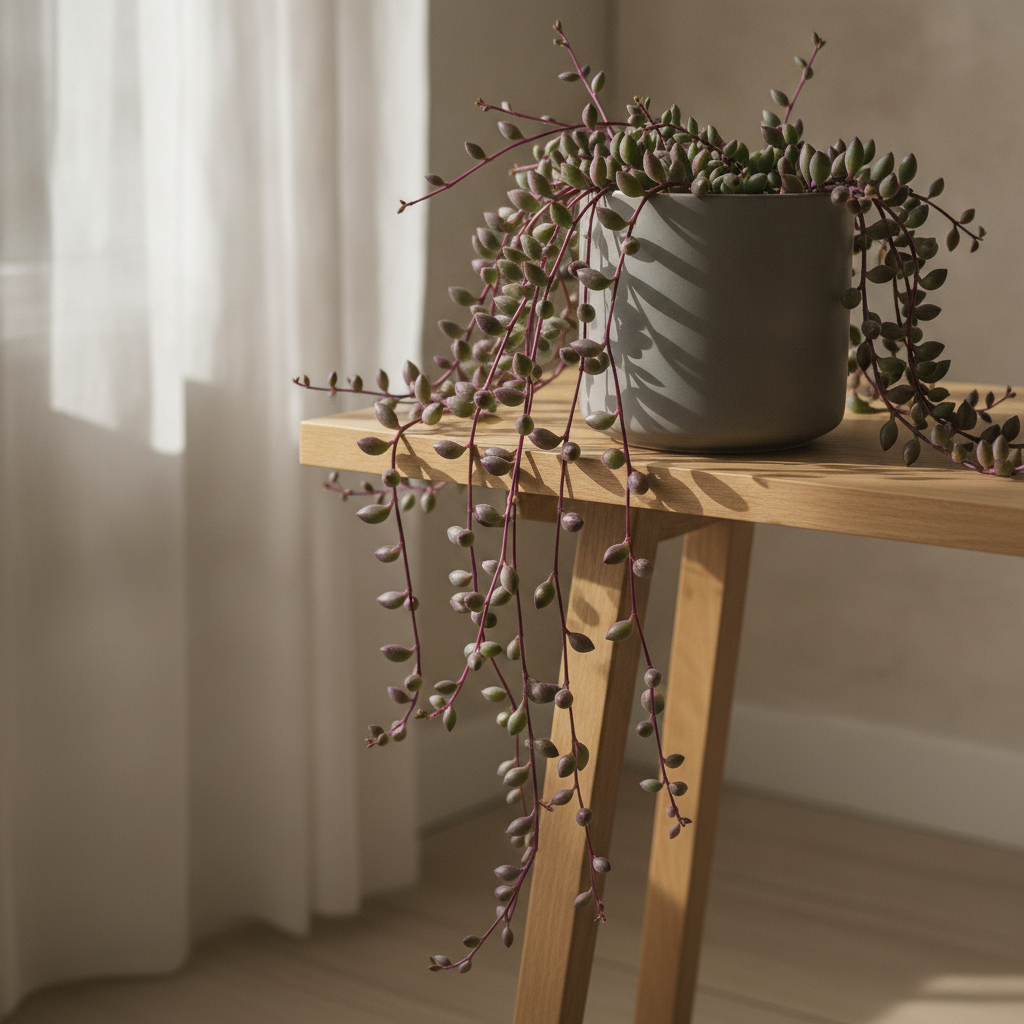
Few trailing succulents earn their name as literally as the string of rubies. Give Othonna capensis a sunny windowsill and its slim, bean-shaped leaves and threadlike stems blush from cool blue-green to a deep wine-purple, so that a mature plant cascading from a shelf really does look like a handful of scattered gemstones strung on wire. Native to the dry, rocky slopes of the Eastern Cape in South Africa, it belongs to the daisy family (Asteraceae) and rewards a season of good light with a near-constant scatter of small, bright yellow flowers.
This guide covers everything you need to take a string of rubies from merely alive to genuinely thriving. The plant is famously easy, which is exactly why so many specimens end up pale, stretched and flowerless: easy does not mean indifferent to its conditions. The difference between a plant that survives in a dim corner and one that drips with ruby colour comes down to a handful of choices about light, water and soil, and once you understand the logic behind each one the plant more or less looks after itself.
Contents
- Quick Reference
- Why String of Rubies Makes a Rewarding Houseplant
- Light Requirements
- Watering & Humidity
- Soil, Potting & Repotting
- Fertilising
- Propagation
- Pests & Diseases
- Popular Varieties
- Frequently Asked Questions
Quick Reference: String of Rubies at a Glance
| Light | Very bright light, including 3 to 6 hours of direct sun. This is what produces the ruby colour. |
| Watering | Soak thoroughly, then let the mix dry out completely. Roughly every 10 to 14 days in summer, far less in winter. |
| Temperature | 18 to 27 degrees Celsius (64 to 81 Fahrenheit). Protect from frost; keep above 5 degrees Celsius (41 Fahrenheit). |
| Humidity | Low. Ordinary, dry household air suits it perfectly. |
| Fertiliser | Light feeder. A diluted low-nitrogen succulent feed two or three times across spring and summer. |
| Toxicity | Generally regarded as non-toxic to cats, dogs and people, unlike its toxic “string of” lookalikes. Still best kept out of reach. |
Why String of Rubies Makes a Rewarding Houseplant
The string of rubies sits in a sweet spot that few houseplants occupy: it is fast, forgiving and genuinely spectacular when grown well. Many trailing succulents are slow to fill a pot, but a happy Othonna capensis can push out new growth at a remarkable rate during the warm months, lengthening its strands by several centimetres a week and quickly draping over the edge of a hanging basket. That speed means you see the results of good care within a single season rather than waiting years, which makes it an unusually satisfying plant for newer growers.
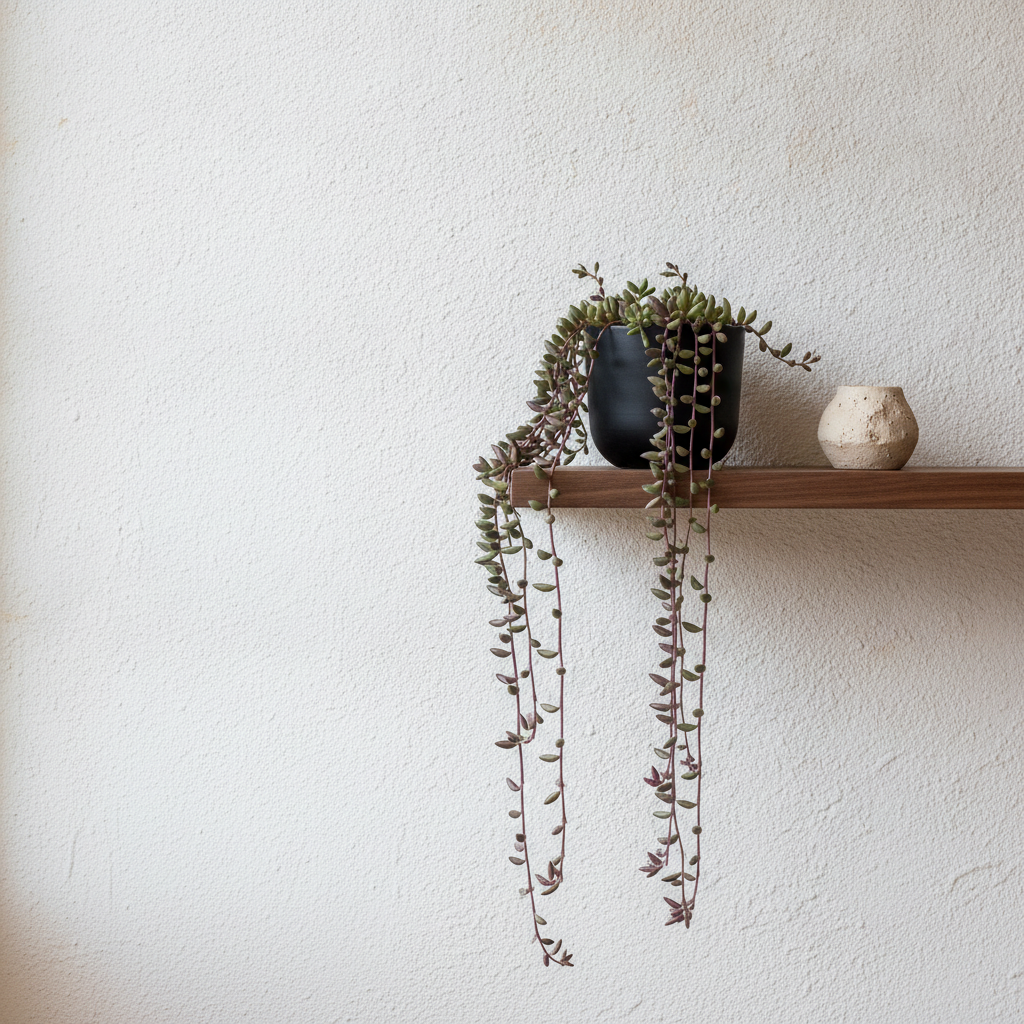
Its other great advantage is the colour, which is something the plant actively does rather than simply having. The leaves are packed with anthocyanin pigments that intensify when the plant is exposed to strong light, cooler nights or mild drought stress, so the grower has direct control over how ruby their plant becomes. Tuck it in shade and it relaxes into a pleasant blue-green; move it into the sun and within a few weeks the stems and leaf tips deepen to purple and wine-red. There are not many houseplants that let you tune their appearance simply by changing where they sit. Add to this the cheerful yellow daisy flowers it produces in good light, and the string of rubies offers a level of seasonal interest that most foliage trailers cannot match.
Important — Toxicity: Unlike the toxic Curio and Senecio “string of” plants it is so often confused with, Othonna capensis is widely reported as non-toxic to cats, dogs and humans. That said, no plant material is meant to be eaten, and ingestion can still cause mild stomach upset, so position it where curious pets and children are unlikely to nibble the trailing strands.
Light Requirements
Light is the single most important factor in growing a beautiful string of rubies, and it is where most disappointing plants go wrong. This is a sun-loving succulent from an open, exposed habitat, and it needs far more light indoors than people expect. A plant kept in modest light will stay alive for a long time, but it will be green rather than ruby, its leaves will sit further apart on the stem, and it will rarely if ever flower. Light is not just about survival here; it is the lever that controls the plant’s entire character.
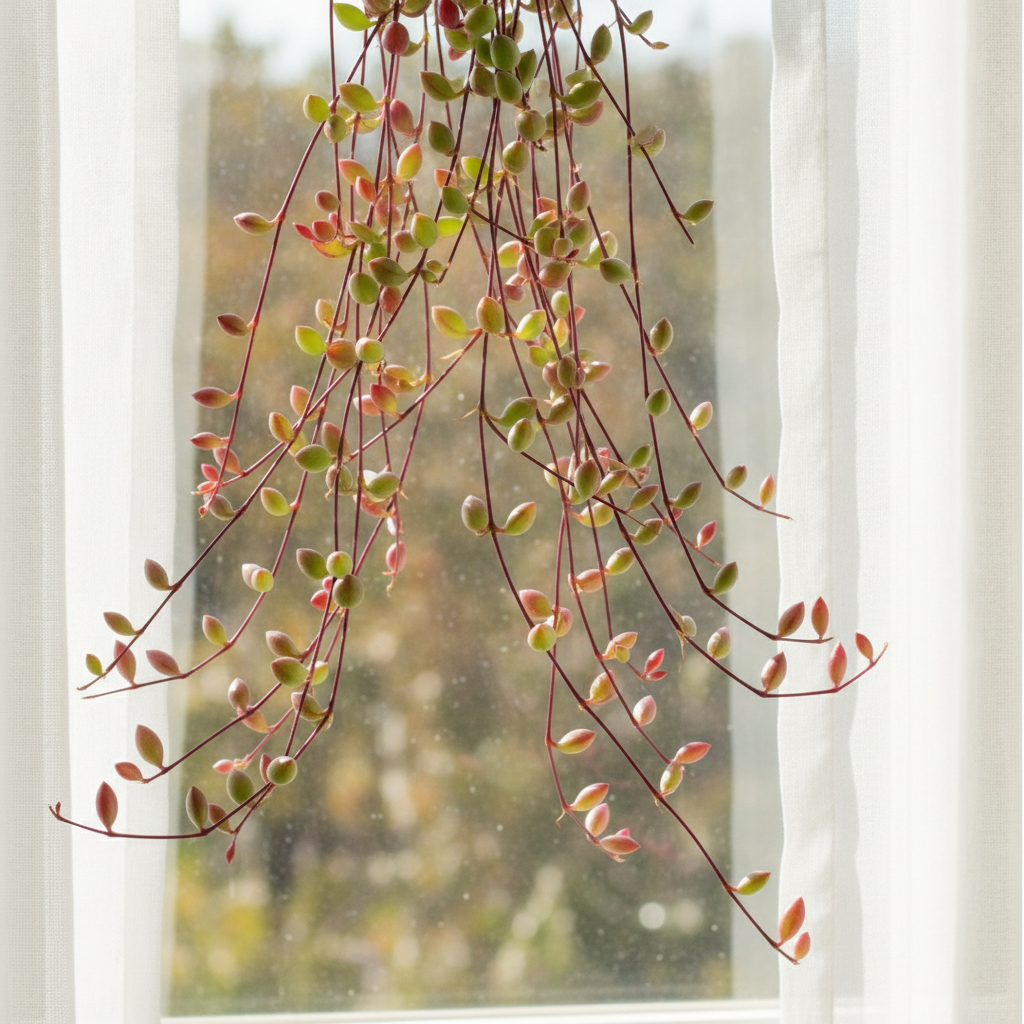
The ideal is very bright light with at least three to six hours of direct sun each day. An unobstructed windowsill, a sunroom or a spot right against the glass of a bright window all work well. The more direct light the plant receives, within reason, the more compact, colourful and floriferous it becomes. If you can comfortably read by the light at the plant’s position at midday without a lamp on, and a hand held above it casts a sharp shadow, you are in roughly the right range.
Light Levels Explained
It helps to think of light in tiers, because the same plant behaves very differently across them. The table below sets out what to expect at each level, from full sun down to the dim conditions where this species simply will not perform.
| Light Category | Approx. Level | Typical Location | Outcome |
|---|---|---|---|
| Direct sun | 20,000 lux and above | South or west windowsill, sunroom, balcony | Best colour, tight growth, flowering. Ease in gradually to avoid scorch. |
| Bright indirect | 10,000 to 20,000 lux | Right beside a bright window | Healthy and full, but colour stays mostly green with only a purple blush. |
| Medium | 5,000 to 10,000 lux | A metre or two back from a window | Survives but stretches; long gaps between leaves, no flowers. |
| Low | 1,000 to 5,000 lux | North aspect, interior wall | Slow decline, very leggy, prone to rot from slow drying. |
| Very low | Below 1,000 lux | Dim hallway, far corner | Unsuitable. The plant etiolates badly and weakens. |
Window Orientation and Placement
South-facing window: In the northern hemisphere this is the prime position, delivering the long hours of direct light the plant craves. A string of rubies pressed up against a south window will colour up beautifully. In high summer, watch for scorch on a plant that has not been acclimatised, and a sheer curtain at the hottest part of the day is a sensible precaution for a newly moved plant.
East-facing window: A good option that offers several hours of gentle morning sun. You will get healthy growth and a reasonable flush of colour, though perhaps not the deepest ruby tones that a southern aspect produces. Morning light is rarely strong enough to scorch, so this is a low-risk choice.
West-facing window: Strong afternoon sun makes this nearly as good as a south aspect for colour and flowering. The main caution is heat, as west light arrives when the day is already warm, so ensure air can move around the plant and that it is not pressed against glass that becomes hot to the touch.
North-facing window: The weakest aspect and generally not enough on its own. A string of rubies here will hang on but stretch, stay green and refuse to flower. If a north window is your only option, plan to supplement with a grow light.
Pro Tip — Reading the Colour: Treat the leaf colour as a built-in light meter. Deep ruby and tight spacing mean the plant is getting plenty of light. Plump but green leaves with widening gaps between them are a clear signal to move it somewhere brighter before it stretches further.
How Light Affects Leaf Colour
The ruby colouring is a stress response, in the most benign sense of the word. Under strong light the plant produces anthocyanins, red and purple pigments that act partly as a natural sunscreen for the foliage. Cooler temperatures and a degree of drought push the same process further, which is why specimens grown hard on a bright, cool windowsill in autumn often show the most dramatic colour of the year. If your plant has faded to green over a dim winter, do not worry; the colour returns within a few weeks of brighter spring light, no intervention required beyond moving it back into the sun.
Warning — Direct Sunlight: A plant grown in lower light has soft, unhardened foliage that can scorch if moved abruptly into fierce summer sun. Acclimatise over a week to ten days, increasing direct exposure gradually, rather than relocating it to a blazing windowsill in one move. Sun-scorched leaves develop dry, bleached or brown patches that do not recover.
Artificial Lighting
The string of rubies responds very well to supplementary lighting, which makes it viable in homes that lack a bright enough window. A full-spectrum LED grow light positioned 20 to 30 centimetres (8 to 12 inches) above the plant for 12 to 14 hours a day will keep growth compact and can even drive colouring, particularly if the room runs cool at night. Grow lights are also the simplest way to carry good colour through a dark northern winter, when natural light is weak and short.
Seasonal Adjustments
Light shifts markedly through the year, and the plant’s needs shift with it. Through autumn and winter, move the string of rubies to your brightest possible position and do not be afraid of direct winter sun, which is far gentler than its summer equivalent and rarely causes harm. In spring and summer the same windowsill may become too intense for a plant that softened over winter, so reintroduce strong light gradually as the days lengthen. Rotating the pot a quarter turn each week keeps the strands growing evenly rather than all leaning toward the glass.
Watering & Humidity
Watering is where good intentions most often kill a string of rubies. Those plump, bean-shaped leaves are water-storage organs, designed to carry the plant through long dry spells in its native habitat, which means the plant is built to tolerate drought far better than it tolerates a constantly damp root ball. The guiding principle is simple: water generously, then leave the plant alone until the soil is bone dry again. Frequent little sips are precisely the wrong approach.
When to Water
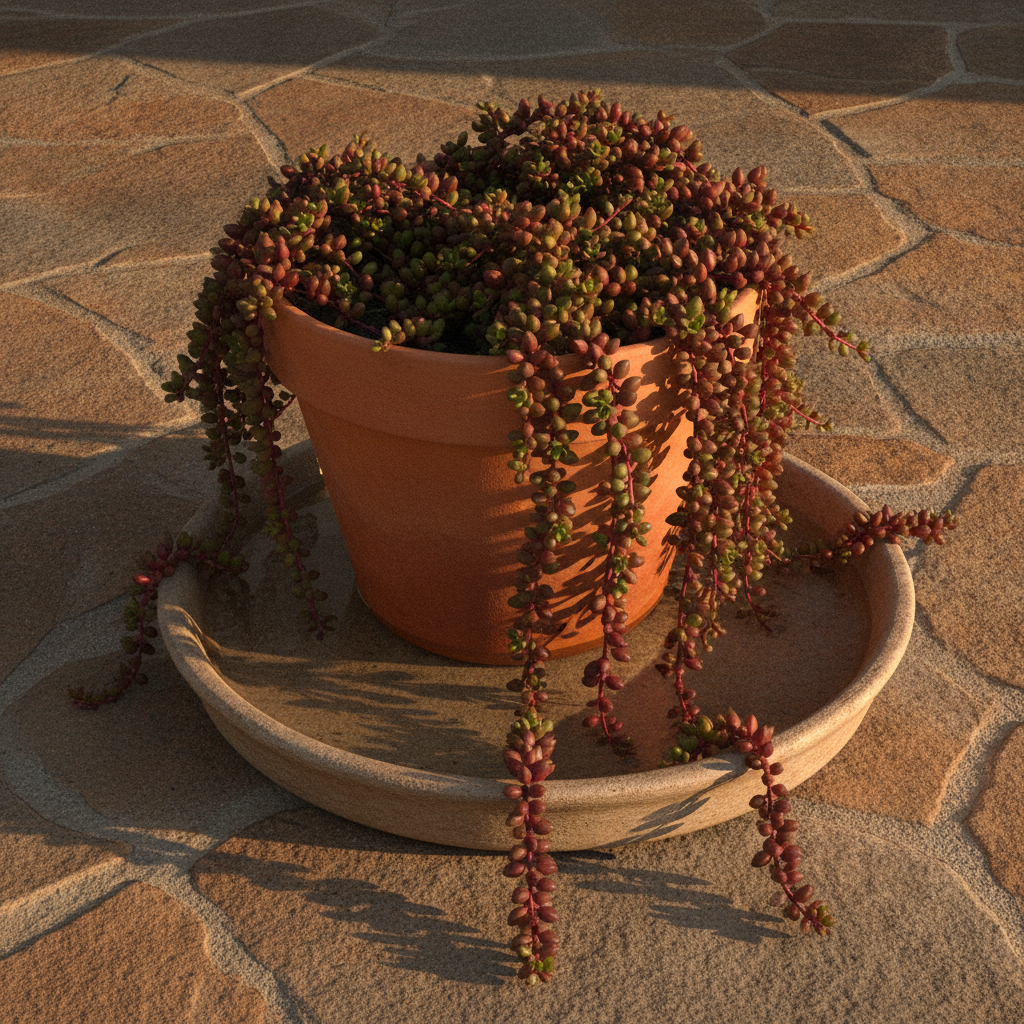
The most reliable cue is the soil rather than the calendar. Wait until the potting mix has dried out completely, all the way to the bottom of the pot, and then water. In a bright, warm spot during summer this often falls roughly every ten to fourteen days, but the interval depends entirely on your light, temperature, pot size and mix, so check rather than assume. Pushing a finger or a wooden skewer into the soil tells you far more than any fixed schedule.
The leaves themselves are a second gauge. A well-hydrated string of rubies has firm, rounded leaves, while a thirsty one shows leaves that look slightly softer, flatter or wrinkled. A little wrinkling is a normal, healthy signal that the plant is ready for a drink and is far safer than the alternative. In winter, when growth slows or stops, cut watering right back to perhaps once every three or four weeks, just enough to stop the leaves shrivelling completely.
Pro Tip — When in Doubt, Wait: A string of rubies recovers quickly from being too dry but struggles to recover from being too wet. If you are ever unsure whether to water, wait a few more days. Underwatering is an easy fix; root rot often is not.
How to Water Correctly
- Confirm the mix is dry all the way down before you begin, checking with a finger or skewer rather than going by the surface alone.
- Water thoroughly, either from above until it runs freely from the drainage holes, or by standing the pot in a shallow tray of water for 10 to 15 minutes to soak up from below.
- If watering from above, aim at the soil and try to keep water off the leaves and stems to reduce the risk of rot.
- Let the pot drain completely and tip away any water left standing in the saucer or cache pot.
- Return the plant to its bright spot and do not water again until the mix is completely dry.
Signs of Overwatering vs. Underwatering
| Symptom | Overwatering | Underwatering |
|---|---|---|
| Leaf colour | Yellowing, translucent or blackening leaves | Duller colour, slight fading |
| Leaf texture | Soft, mushy, squashy to the touch | Wrinkled, shrivelled but still firm at the core |
| Leaf drop | Leaves fall at the lightest touch, often from healthy-looking stems | Oldest leaves dry up and drop gradually |
| Stems | Stems turn brown or black and collapse, sometimes slimy | Stems thin and slightly limp but intact |
| Roots | Brown, soft, foul-smelling | Pale, dry but firm |
Warning — Root Rot: Mushy, blackening stems and leaves that drop at a touch are the classic signs of root rot, usually from a mix that stays wet too long. Act fast: unpot the plant, cut away every soft root and stem, and take healthy cuttings from the firm growth to start again. Once rot reaches the crown, the original plant rarely survives, but cuttings root so readily that you seldom lose the plant entirely.
Humidity Requirements
Here the string of rubies is wonderfully undemanding. As a plant of dry, sunny slopes it is perfectly happy in ordinary household air and has no need for the raised humidity that tropical foliage plants crave. Average indoor levels of 30 to 50 percent suit it well.
In fact, high humidity works against this plant rather than for it. Damp, still air slows the rate at which the soil and foliage dry out and raises the risk of fungal problems and rot, exactly the conditions a succulent dislikes. You are far more likely to harm a string of rubies by trying to pamper it with extra moisture than by leaving it in dry air.
For that reason, skip the misting, pebble trays and humidifiers entirely. What this plant wants instead is good air circulation, which helps the mix dry evenly and keeps fungal spores from settling. A position with gentle airflow, away from a stuffy enclosed corner, does more good than any humidity-raising measure.
Water Quality
The string of rubies is not fussy about water quality, and ordinary tap water is fine for the great majority of growers. If your supply is very hard you may notice a pale mineral crust forming on the soil surface over time, which is cosmetic rather than harmful. Should you wish to avoid it, letting tap water stand overnight or using filtered or rainwater sidesteps the issue. Tepid water is gentler on the roots than water straight from a cold tap.
Soil, Potting & Repotting
If light controls how beautiful your string of rubies looks, the soil controls how long it lives. The right mix is the single best insurance against the overwatering problems described above, because a fast-draining, airy medium simply cannot stay wet long enough to rot the roots. Get the soil right and you give yourself a generous margin for error with the watering can.
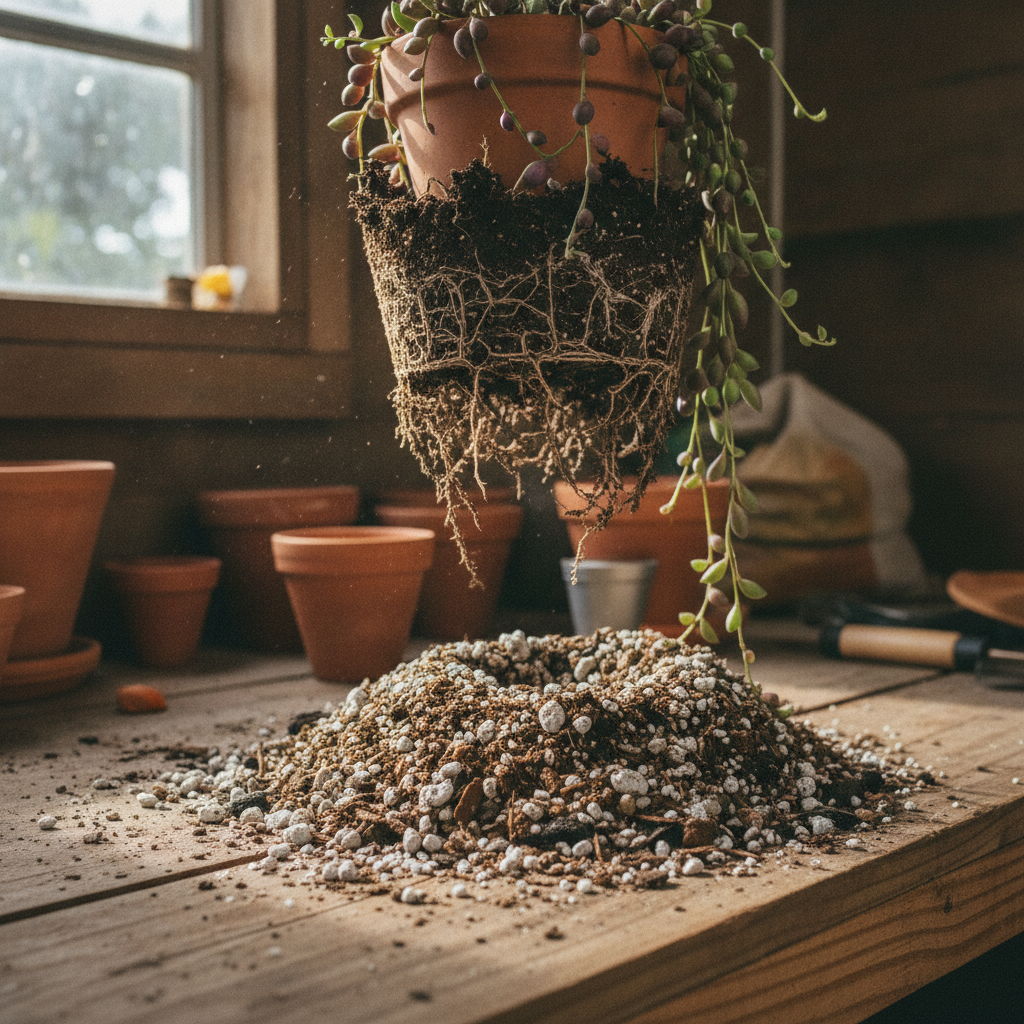
Ideal Soil Composition
Aim for a gritty, open mix that drains within seconds rather than minutes. A standard cactus and succulent compost is a good base, but most bagged mixes still hold too much moisture for a trailing succulent on the dry side, so improving them with extra grit pays off. The goal is a medium that holds just enough moisture to wet the roots and then releases the rest, leaving plenty of air around the roots between waterings.
| Component | Proportion | Function |
|---|---|---|
| Cactus and succulent compost | About one half | Provides body, some moisture retention and a little nutrition |
| Perlite or pumice | About one third | Opens up the mix for drainage and air around the roots |
| Coarse grit or fine gravel | The remainder | Adds weight and sharp drainage, mimicking the rocky native soil |
The plant is relaxed about pH and grows well in anything from slightly acidic to slightly alkaline, roughly 6.0 to 7.5, so there is no need to test or adjust it. Far more important than the exact chemistry is the physical structure of the mix, which should feel coarse and gritty in the hand rather than fine and spongy.
Pro Tip — Quick Mix Recipe: For a reliable blend, combine two parts ordinary cactus compost, one part perlite or pumice and one part coarse grit. If you can squeeze a handful of the moistened mix and it falls apart immediately rather than holding together in a ball, the drainage is about right.
Choosing the Right Pot
Because the string of rubies trails, it is most often grown in a hanging pot or set high on a shelf where its strands can fall freely. Whatever the style, the pot must put drainage and a modest size ahead of looks.
Drainage holes are non-negotiable. This plant will not tolerate sitting in water, so the pot must have one or more drainage holes. A decorative cache pot is fine as an outer layer, but the plant should grow in an inner pot that drains freely, and you must empty any water that collects in the cache pot after watering.
Pot material: Terracotta is an excellent choice because the porous clay wicks moisture from the mix and helps it dry quickly, which suits a plant so prone to overwatering. Glazed ceramic and plastic both work too, but they hold moisture longer, so you will need to be more disciplined about letting the mix dry between waterings.
Pot size: Choose a pot only slightly larger than the root ball. The roots are relatively shallow and a string of rubies actually flowers and colours better when a little snug, while an oversized pot holds a large volume of slow-drying soil that invites rot. When you do pot up, increase by just one size.
When to Repot
This is not a plant that needs frequent repotting. Once every two to three years is plenty, and the best time is early spring as growth resumes. Signs that it is ready include roots emerging from the drainage holes, water running straight through a root-bound mass, or soil that has broken down and no longer drains as it should. If the plant is healthy and the mix still drains well, leave it be; the string of rubies prefers stability to disturbance.
How to Repot: Step-by-Step
- Water lightly a day or two beforehand if the plant is very dry, which makes the root ball easier to handle without shattering.
- Gather the trailing strands gently and coil them loosely over the top of the pot so they are not crushed or snapped during the move.
- Ease the plant out by tipping the pot and supporting the base, rather than pulling on the stems.
- Tease away the old, spent soil from the roots and inspect them, trimming off any that are brown, soft or rotten with clean scissors.
- Settle the plant into its new pot at the same depth as before, filling around the roots with fresh gritty mix and firming gently.
- Wait about a week before watering, giving any disturbed or trimmed roots time to callus and reducing the risk of rot.
Warning — Transplant Shock: Resist the urge to water a freshly repotted string of rubies straight away. Damaged roots sitting in moist soil are an open invitation to rot. The dry week after repotting feels counterintuitive but is one of the most important steps in keeping the plant healthy.
Fertilising
The string of rubies is a light feeder, adapted to lean, mineral soils where nutrients are scarce. It does not need much fertiliser to do well, and overfeeding causes more problems than it solves, producing soft, weak, oversized growth that loses the tight, jewel-like character the plant is grown for. A modest, occasional feed is all it asks.
A little feeding during the growing season does pay off, though, supporting the fast spring and summer growth and the production of flowers. The trick is to think of fertiliser as a gentle top-up rather than a regular meal, applied weakly and only while the plant is actively growing.
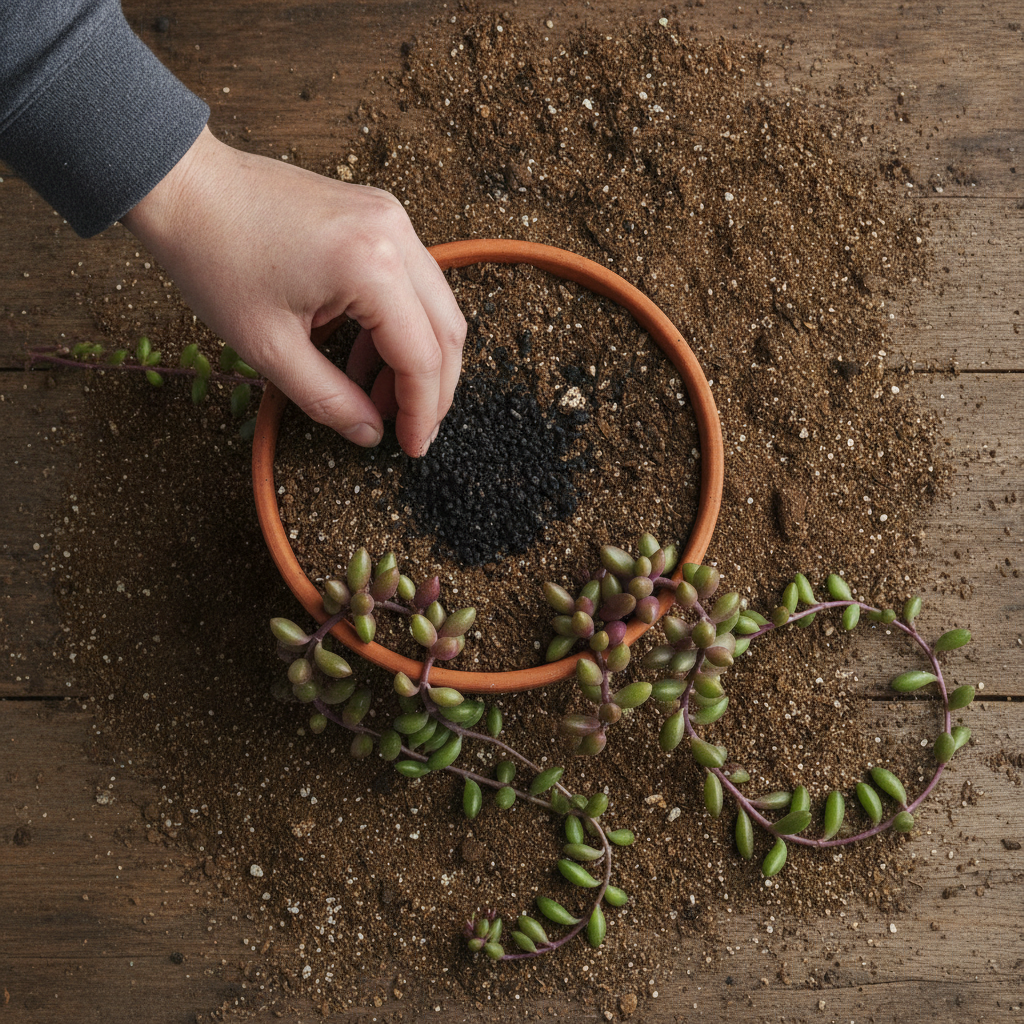
Understanding Plant Nutrients
Fertilisers are labelled with three numbers, the NPK ratio, standing for nitrogen, phosphorus and potassium. For a succulent like this, a balanced or slightly low-nitrogen feed is best, because too much nitrogen drives lush leafy growth at the expense of compactness and colour. The table below summarises the main nutrients and what a shortage of each looks like.
| Nutrient | Symbol | Primary Function | Deficiency Symptoms |
|---|---|---|---|
| Nitrogen | N | Leaf and stem growth | Pale, slow, weak growth overall |
| Phosphorus | P | Root development and flowering | Poor rooting, few or no flowers |
| Potassium | K | Overall vigour and stress tolerance | Yellow or browning leaf edges, weak stems |
| Calcium | Ca | Cell wall strength | Distorted or stunted new growth |
| Magnesium | Mg | Core of the chlorophyll molecule | Yellowing between the veins of older leaves |
| Iron | Fe | Chlorophyll production | Yellowing of the youngest leaves |
Types of Fertiliser
Liquid fertilisers: The easiest option for this plant. A liquid succulent or cactus feed, diluted to half the recommended strength, gives you precise control over how much the plant receives and is simply added to the watering can a few times across the growing season.
Slow-release granular: A small amount of slow-release fertiliser worked into the mix at potting time will feed gently over several months. Use these sparingly, as it is easy to overdo the dose for a plant that wants so little.
Organic fertilisers: Gentle organic options such as worm castings or a dilute seaweed feed suit the string of rubies well because they release nutrients slowly and are hard to overdo. A light top-dressing of worm castings in spring is a low-risk way to feed.
Feeding Schedule
Keep it minimal. Feeding two or three times across spring and summer, spaced four to six weeks apart, is ample for a plant this frugal. Stop feeding entirely in autumn and winter, when growth slows and the plant cannot use the extra nutrients, so they simply accumulate as harmful salts in the soil. Always feed onto already-moist soil rather than dry mix, to avoid scorching the roots.
Pro Tip — Less is More: If you are unsure whether to feed, do not. A string of rubies grown lean and hard, with little fertiliser and plenty of light, is far more colourful and compact than one pushed with rich feeding, which tends to grow loose, green and floppy.
How to Fertilise
- Choose a balanced or low-nitrogen feed and dilute it to half the strength stated on the label.
- Water the plant normally first, or feed onto soil that is already moist, never bone dry.
- Apply the diluted feed to the soil, keeping it off the leaves and stems.
- Let the pot drain fully and tip away any excess that collects beneath it.
- Resume your normal dry-then-water cycle and do not feed again for at least four weeks.
Warning — Salt Build-Up: Over time, fertiliser salts can accumulate in the mix and show up as a white crust on the soil or pot, and as scorched, browning leaf tips. If you see this, flush the pot thoroughly with plain water two or three times to leach the salts out, and ease off the feeding.
Propagation
If there is one thing the string of rubies does even more enthusiastically than trail, it is propagate. This is one of the easiest of all houseplants to multiply, rooting from the simplest stem cuttings with almost no effort, which is fortunate given how readily a long strand can snap off during handling. Every accidental break is a free new plant in waiting.
Propagation is also the best way to keep your plant looking full. Older specimens can grow bare and straggly at the crown, so taking cuttings to start fresh plants, or to tuck back into the parent pot, is the standard way to keep a string of rubies lush rather than leggy. Spring and summer, during active growth, are the ideal times.
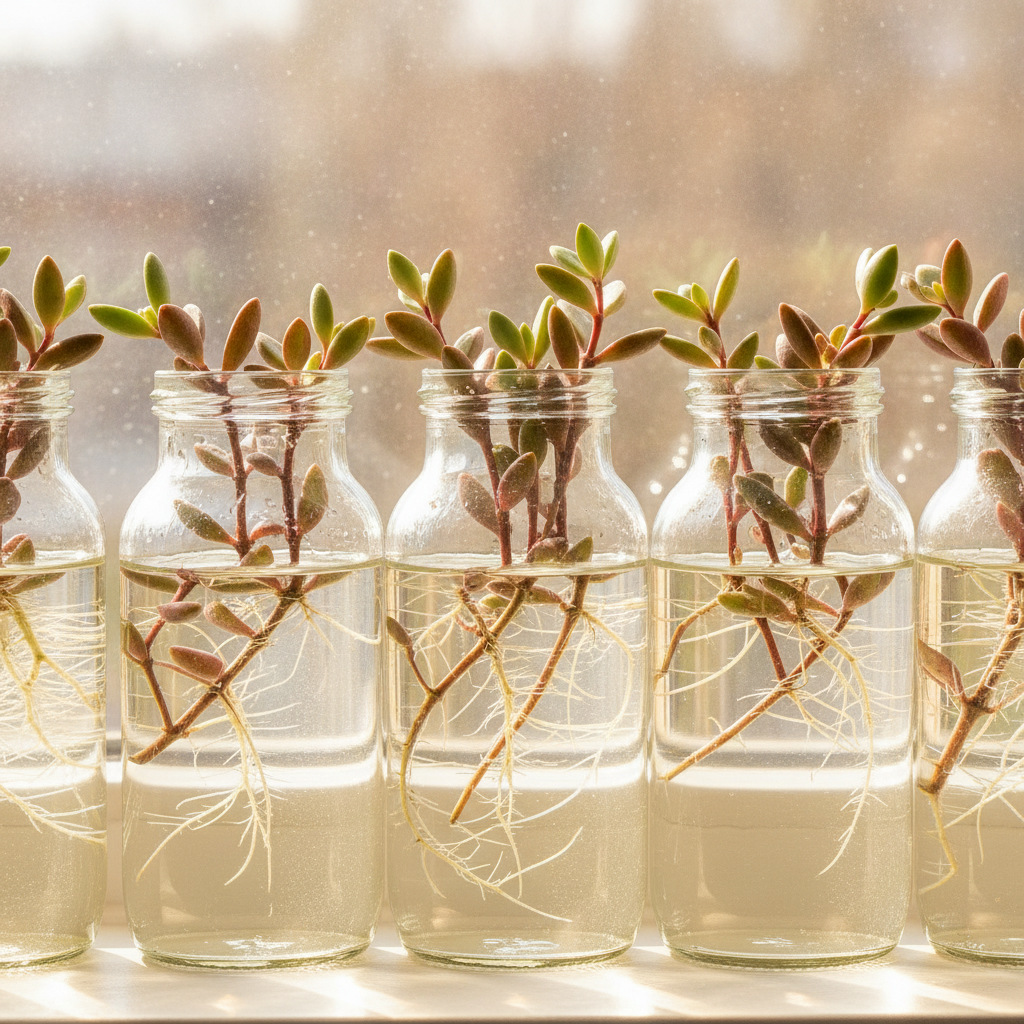
Understanding Nodes
The key to propagating any string plant is the node, the point on the stem where a leaf joins it. Nodes contain the dormant cells that produce new roots, so every cutting needs at least a few of them. Where a stem touches damp soil it will often root from these nodes on its own, which is why long strands sometimes anchor themselves back into the pot. Understanding this makes every method below straightforward: you are simply giving nodes a reason and a place to root.
Water Propagation: Step-by-Step
Rooting cuttings in water is the most visual and beginner-friendly method, letting you watch the roots develop before potting up.
- Cut a healthy strand 8 to 15 centimetres (3 to 6 inches) long with clean scissors, just below a node.
- Strip the leaves from the lowest two or three centimetres so that bare nodes will sit in the water.
- Place the cutting in a small jar of water with only the bare nodes submerged and the leaves held above the surface.
- Set the jar in bright, indirect light and top up or change the water every few days to keep it fresh.
- Once roots reach two to three centimetres long, usually within one to three weeks, pot the cutting into gritty succulent mix and care for it as normal.
Pro Tip — Plant in Clusters: Pot several rooted cuttings together in one container rather than singly. A cluster of cuttings fills out into a dense, full plant far faster than a single strand ever will, giving you that lush, draping look in a fraction of the time.
Soil Propagation: Step-by-Step
Rooting directly in soil skips the transplant step and tends to produce sturdier roots, well suited to a succulent that dislikes a sudden change from water to mix.
- Take cuttings as above and let the cut ends callus over in the air for a day or two, which guards against rot.
- Lay or insert the cuttings onto the surface of barely moist gritty mix, pressing the bare nodes into gentle contact with the soil.
- Position the pot in bright, indirect light and keep the mix only very lightly moist, never wet.
- Mist the surface or water very lightly every few days to encourage rooting without saturating the cuttings.
- After two to three weeks, give a cutting the lightest tug; resistance means roots have formed and you can resume normal succulent watering.
Troubleshooting Propagation
| Problem | Likely Cause | Solution |
|---|---|---|
| Cuttings rot or turn mushy | Too much moisture, or no callus before planting | Let cuttings callus first and keep the mix barely moist |
| No roots after several weeks | Too cold, too dark, or no node in contact | Move somewhere warmer and brighter and ensure bare nodes touch water or soil |
| Cuttings shrivel completely | Too dry while rooting, with no roots yet to take up water | Lightly mist or raise humidity briefly until roots establish |
| Leaves drop off the cutting | Handling stress or shock | Often normal; if the stem stays firm the cutting will usually still root |
Pests & Diseases
A healthy string of rubies grown in bright light and a gritty mix is fairly resistant to trouble, and most of the problems it does face are tied directly to overwatering. Still, a few common houseplant pests will take an interest if given the chance, and catching them early makes all the difference, so a quick inspection whenever you water is a worthwhile habit.
Because the plant grows as a dense tangle of fine strands, pests can hide among the leaves and stems where they are easy to miss. Lifting and parting the strands occasionally to look at the inner growth and the leaf joints will help you spot an infestation before it spreads through the whole plant.
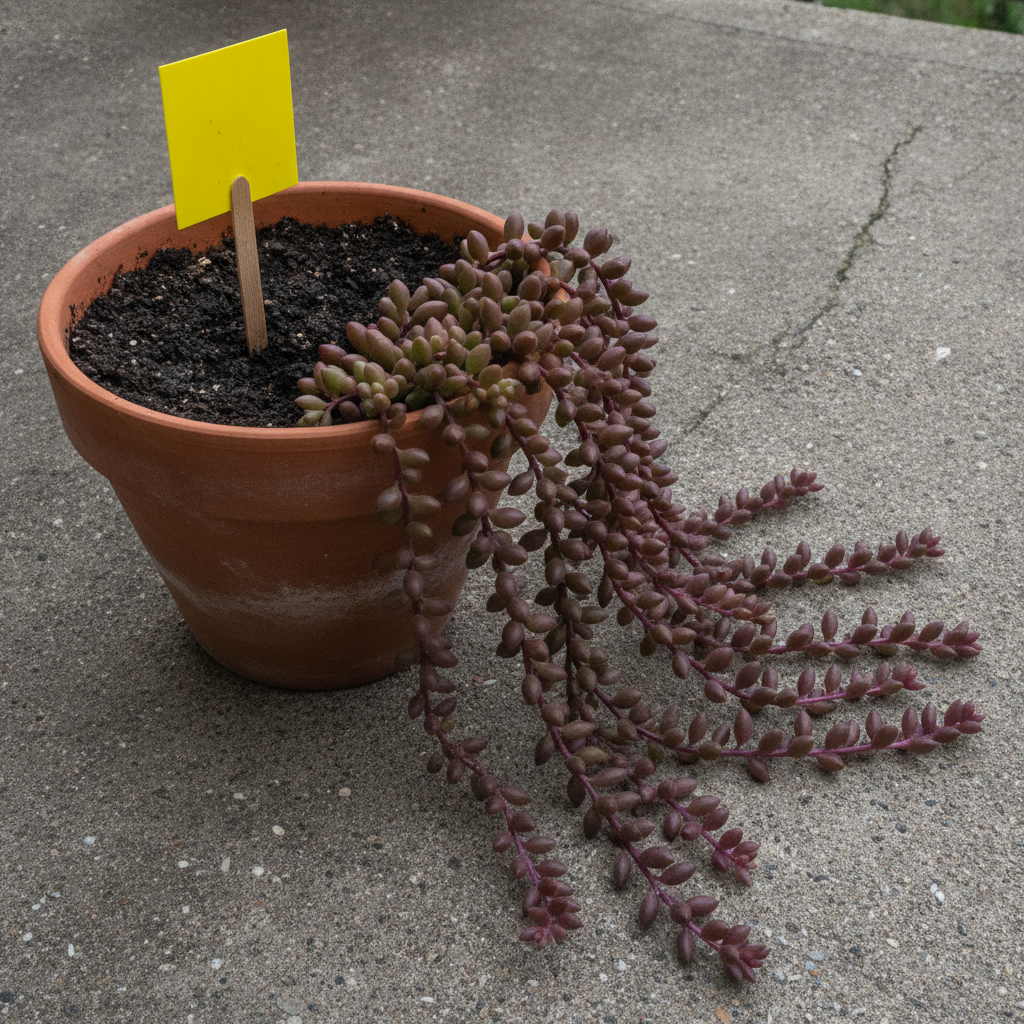
Common Pests
Mealybugs (Pseudococcus species)
The most likely pest on a string of rubies, mealybugs appear as small, white, cottony tufts tucked into leaf joints and along the stems. They suck sap, weakening the plant and leaving behind a sticky residue that can encourage sooty mould.
Treatment: Dab each insect directly with a cotton bud dipped in isopropyl alcohol, which kills them on contact. For larger infestations, treat the whole plant with an insecticidal soap or a diluted neem oil solution, repeating weekly until clear.
Aphids (Aphidoidea)
Small green, black or pink soft-bodied insects that cluster on tender new growth and flower buds, aphids are especially drawn to the plant when it is flowering. They distort new growth and, like mealybugs, leave a sticky honeydew behind.
Treatment: Rinse them off with a firm jet of water, then follow up with insecticidal soap or neem oil if they return. Removing affected flower stalks can also reduce their numbers quickly.
Fungus Gnats (Sciaridae)
Small black flies that hover around the pot, fungus gnats are a symptom as much as a pest: their larvae live in soil that is kept too wet, so their presence is a clear sign you are watering too often. The adults are a nuisance, while the larvae can nibble fine roots.
Treatment: Let the soil dry out fully, which breaks their breeding cycle, and use yellow sticky traps to catch the adults. Correcting the watering habit usually solves the problem on its own.
Common Diseases
Root Rot (Pythium and Phytophthora)
By far the most serious threat to a string of rubies, root rot is caused by soil-borne fungi that thrive in waterlogged conditions. It shows as yellowing, mushy leaves and blackening stems, with roots that are brown, soft and foul-smelling when you unpot the plant.
Treatment: Act immediately. Unpot the plant, cut away all soft, discoloured roots and stems, and let healthy cuttings callus before replanting in fresh, dry, gritty mix. Prevention through careful watering and good drainage is far easier than any cure.
Powdery Mildew (Erysiphales)
Less common but possible in damp, stagnant conditions, powdery mildew appears as a dusty white coating on leaves and stems. It is favoured by high humidity and poor air movement, the very conditions this plant dislikes.
Treatment: Improve air circulation, reduce humidity, and remove badly affected growth. A fungicide or a dilute potassium bicarbonate spray can clear stubborn cases.
Pest and Disease Summary
| Pest / Disease | Identification | Treatment |
|---|---|---|
| Mealybugs | White cottony tufts in leaf joints | Alcohol on a cotton bud, then insecticidal soap or neem |
| Aphids | Clusters on new growth and buds | Rinse off, then insecticidal soap or neem |
| Fungus gnats | Small flies around wet soil | Let soil dry, use sticky traps, water less |
| Root rot | Mushy stems, blackening, bad smell | Cut away rot, replant healthy cuttings in dry mix |
| Powdery mildew | Dusty white coating on foliage | Improve airflow, lower humidity, fungicide if needed |
Prevention Strategies
Prevention with this plant comes down to getting the basics right, because nearly every problem traces back to the same root causes. Bright light, a gritty fast-draining mix, careful watering and good air movement together head off the great majority of pests and diseases before they start. A plant grown in these conditions is vigorous and far better able to shrug off the occasional invader.
It also pays to quarantine any new plant for a couple of weeks before it joins your collection, and to inspect your string of rubies each time you water. Catching a few mealybugs or aphids early, when they can be wiped away by hand, is infinitely easier than tackling an infestation that has spread through every strand.
Pro Tip — Neem as Routine: A light, occasional spray of diluted neem oil during the growing season, applied in the evening to avoid leaf scorch, works as a gentle preventative against the soft-bodied pests this plant attracts, without resorting to harsher chemicals.
Popular Varieties
The string of rubies is a species rather than a heavily hybridised plant, so it has few named cultivars. Most of the variation you will see is not between varieties at all but between the same plant grown in different conditions, since light and temperature change its colour so dramatically. Understanding this is more useful than chasing rare names, because it means any string of rubies can be coaxed toward either look.
It is also worth knowing the plant’s close lookalikes, because Othonna capensis is frequently confused with several other trailing “string of” succulents at the garden centre. The table below sets out the forms of string of rubies you are likely to encounter alongside the relatives it is most often mistaken for, several of which differ importantly in toxicity.
| Variety | Leaf Appearance | Light Needs | Growth Rate | Availability |
|---|---|---|---|---|
| Ruby Necklace (sun-grown form) | Deep purple stems, blue-green leaves tipped wine-red | Very high, direct sun | Fast | Common |
| Green shade form | Greener stems, plump uniformly blue-green leaves | Bright, less direct | Fast | Common |
| Othonna ‘Little Pickles’ | Trade name for the same species, often greener | High | Fast | Common |
| String of Pearls (Curio rowleyanus) | Round pea-like leaves, lookalike but toxic | Bright indirect | Moderate | Very common |
| String of Bananas (Curio radicans) | Curved banana-shaped leaves, toxic | Bright indirect | Fast | Common |
| String of Dolphins (Curio hybrid) | Leaves shaped like leaping dolphins, toxic | Bright indirect | Moderate | Occasional |
Featured Varieties
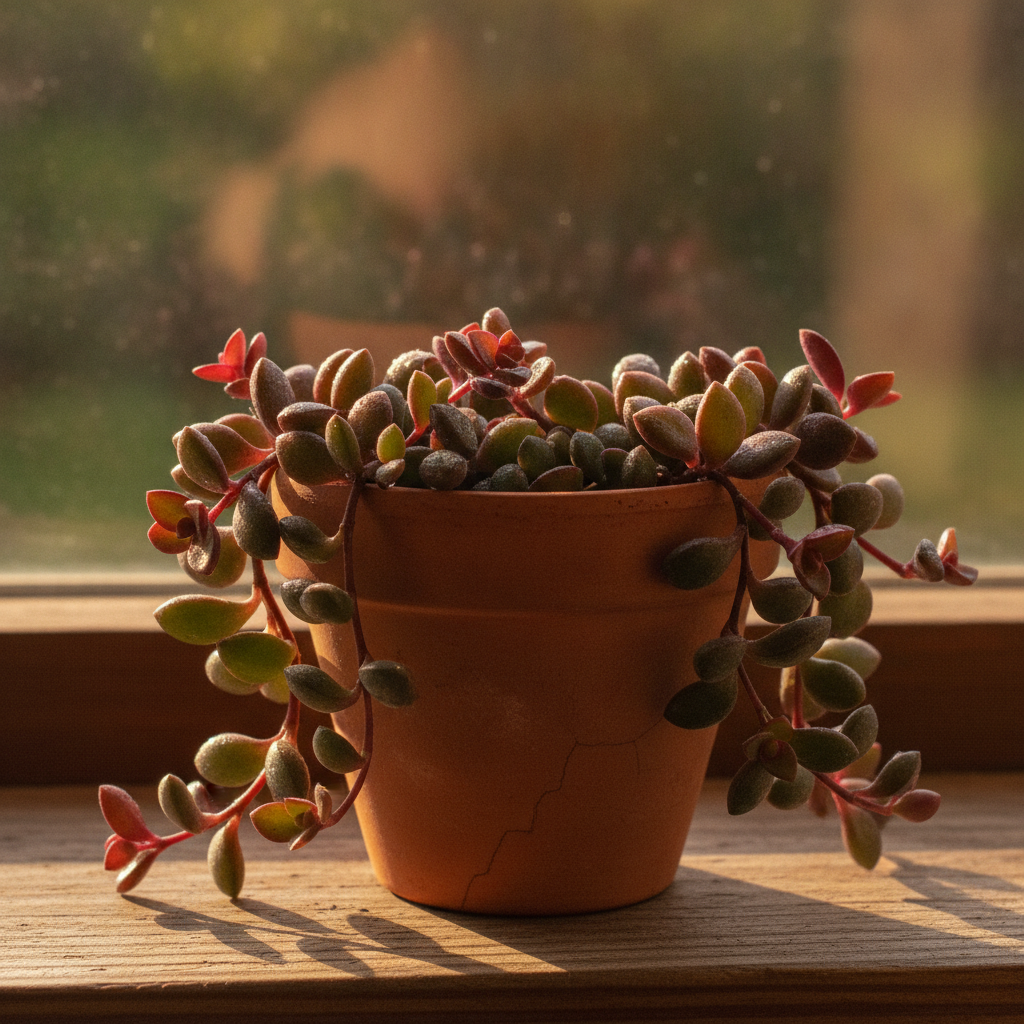
Ruby Necklace, Sun-Grown
This is the look that sells the plant: stems flushed deep ruby-purple, leaf tips shading to wine-red, and tight, jewel-like spacing along the strands. It is not a separate cultivar but simply Othonna capensis grown in strong light and cooler temperatures. Anyone can produce it by moving an ordinary plant into more sun.
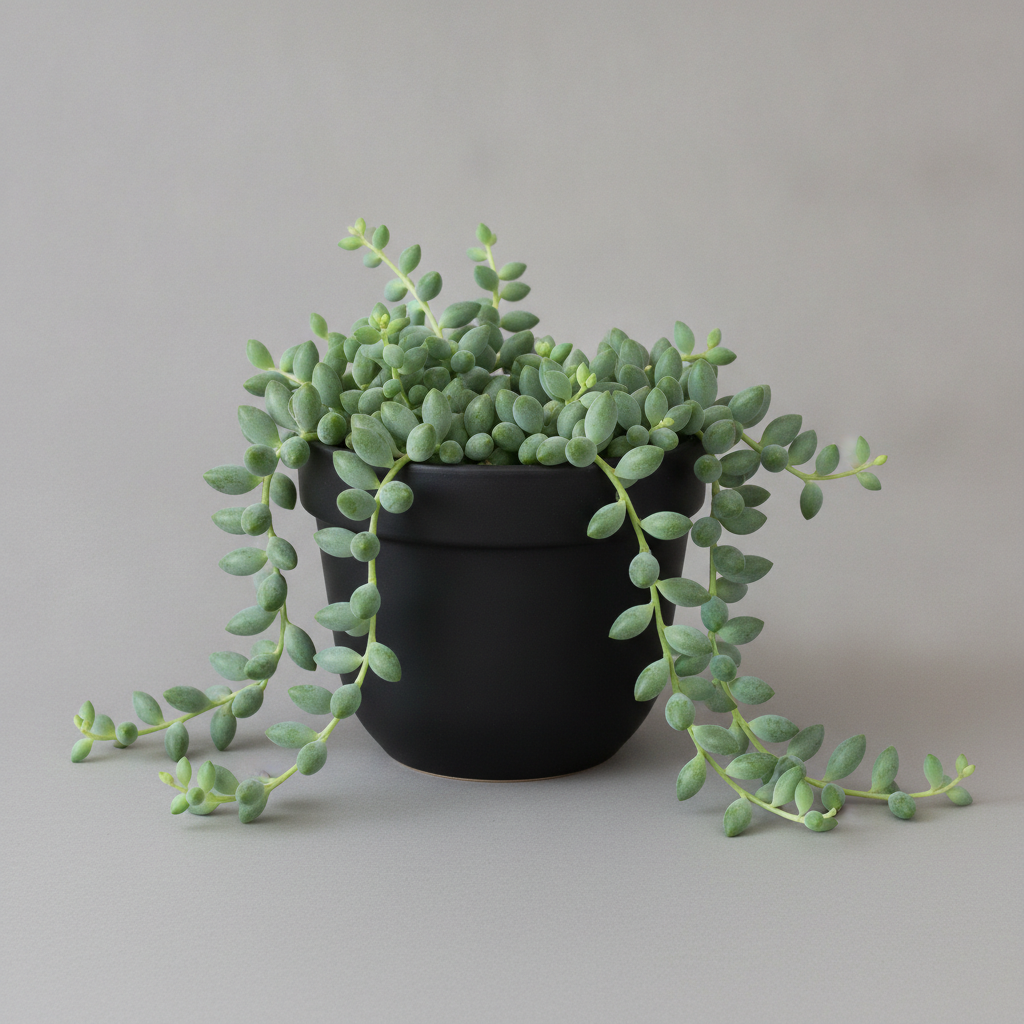
Green Shade Form
Grown in gentler light, the same plant relaxes into plumper, more uniformly blue-green leaves on greener stems, with only a faint purple blush. Some growers prefer this cooler, calmer look, and it is the form you will often see on plants fresh from a shaded nursery before they have coloured up at home.
Variety Profiles in Detail
Othonna ‘Little Pickles’ (Othonna capensis)
‘Little Pickles’ is a popular trade name applied to the very same species, usually to plants sold in a greener, plumper state. There is no meaningful botanical difference, so a plant labelled ‘Little Pickles’ will colour up into a ruby necklace under the same bright conditions. The name simply reflects how the plant looked when it was potted and tagged at the nursery.
Distinguishing it from the Toxic Lookalikes (Curio and Senecio)
This matters for households with pets. The string of pearls, string of bananas and string of dolphins all belong to Curio (formerly Senecio) and are toxic if eaten, whereas Othonna capensis is generally regarded as non-toxic. The quickest tell is the leaf and stem colour: the string of rubies has those distinctive purple-red stems and small sausage-shaped leaves, while the Curio relatives keep green stems and either round or banana-shaped leaves. When in doubt, check the botanical name on the label.
Choosing the Right Variety for Your Space
Since the colour is yours to control, the real decision is about the look you want and the light you can offer. If you have a bright, sunny window and want that dramatic ruby cascade, you already have everything you need; any string of rubies will get there. If your light is more modest, you can still grow a lovely, healthy green form, simply with less of the purple drama. Either way you are buying the same plant, so choose the fullest, healthiest specimen you can find rather than worrying about names on the label.
Frequently Asked Questions
Why has my string of rubies turned green instead of red?
Almost always a lack of light. The ruby colour is a response to bright light, cooler temperatures and mild drought, so a plant kept in modest light simply stays green. Move it to your sunniest window, ease off slightly on watering, and the colour will usually return within a few weeks as the days brighten.
Is string of rubies safe for cats and dogs?
Othonna capensis is widely reported as non-toxic to cats, dogs and people, which sets it apart from its toxic lookalikes in the Curio and Senecio genera. Even so, it is wise to keep any houseplant out of reach, since nibbling on the strands can still cause mild stomach upset and the plant is easily damaged by curious pets.
How often should I water my string of rubies?
Water only when the mix has dried out completely, which in a bright, warm spot often means roughly every ten to fourteen days in summer and far less in winter. Rather than following a fixed schedule, check the soil and the leaves each time; firm leaves and dry soil mean wait, while slightly soft or wrinkled leaves mean it is ready for a thorough soak.
Why is my string of rubies leggy with gaps between the leaves?
Long, bare stretches of stem with widely spaced leaves are a sign of too little light, a condition called etiolation. The plant stretches toward the brightest source it can find. Move it somewhere much brighter to tighten new growth, and trim back the leggy strands, using the cuttings to fill out the pot.
Does string of rubies flower indoors?
Yes, readily, given enough light. In a sunny position it produces small, bright yellow daisy-like flowers that open during the day and close in the evening or in dull weather, often through autumn and winter. A plant that never flowers is almost always one that needs more light.
My string of rubies leaves are shrivelling. What is wrong?
It depends on how the leaves feel. Wrinkled but still firm leaves usually mean the plant is thirsty, so give it a thorough soak. Leaves that are soft, mushy or translucent point instead to overwatering and possible root rot, which calls for the opposite response: let the soil dry out and check the roots for damage.
How do I make my string of rubies fuller?
The simplest route is to propagate and replant into the same pot. Take healthy cuttings, root them, and tuck them back among the existing strands, or pot several cuttings together from the start. Combined with bright light to keep growth compact, this fills out a sparse plant far faster than waiting for a single strand to branch.
Can string of rubies grow outdoors?
In a warm, frost-free climate it makes an excellent outdoor trailing plant in containers or rockeries, relishing the strong light. It is not frost hardy, though, so where winters drop near or below freezing it should be grown as a houseplant or brought indoors before the cold arrives, keeping it above about 5 degrees Celsius (41 Fahrenheit).






