
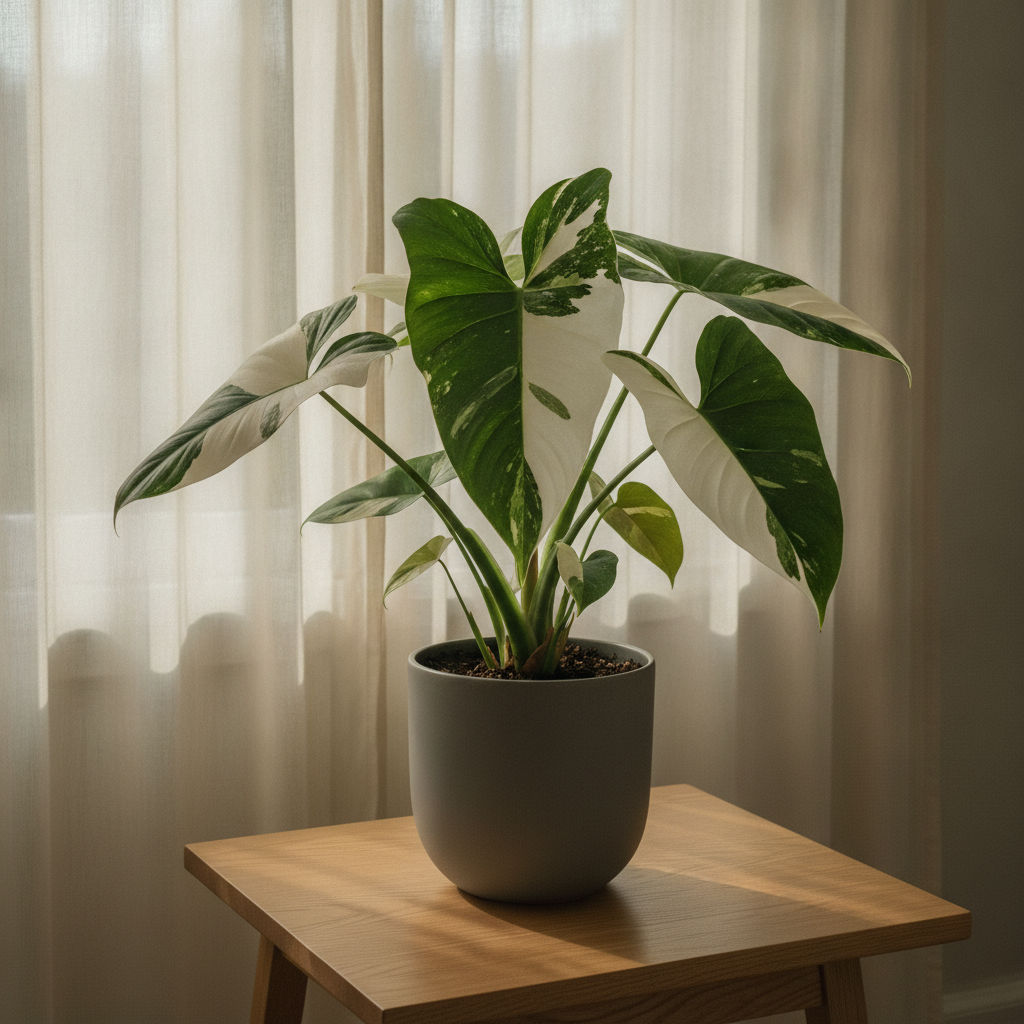
Few houseplants generate quite as much quiet longing among collectors as the White Wizard Philodendron, a self-heading climbing aroid whose deep green leaves arrive painted with sweeping bands, half-moons and marbled patches of pure white. Sold under the botanical name Philodendron erubescens ‘White Wizard’, it belongs to the same variable species that gave us the Pink Princess and the Red Emerald, and it traces its wild parentage to the humid understorey forests of Colombia and neighbouring tropical South America. The easiest way to recognise a true White Wizard is to look past the leaves and study the stems: they are solid green, a detail that separates it at a glance from its near-twin the White Knight, which carries the same white variegation on dramatic dark maroon petioles.
The White Wizard has a reputation for being temperamental, but that reputation is only half deserved. It is not a difficult plant so much as an unforgiving one: it will survive a surprising amount of neglect, yet it will only produce those coveted high-contrast variegated leaves when its light, water and humidity are all pulling in the same direction. This guide walks through every aspect of its care, from reading the exact quality of light it wants to diagnosing the pests that target soft variegated tissue, so that you can move your plant from merely staying alive to genuinely flourishing.
Contents
- Quick Reference
- Why the White Wizard Philodendron Makes a Rewarding Houseplant
- Light Requirements
- Watering & Humidity
- Soil, Potting & Repotting
- Fertilising
- Propagation
- Pests & Diseases
- Popular Varieties
- Frequently Asked Questions
Quick Reference: White Wizard Philodendron at a Glance
| Light | Bright indirect light; more than plain green philodendrons need, but never harsh direct midday sun |
| Watering | When the top 3 to 5 cm (1 to 2 in) of mix has dried; roughly weekly in growth, less in winter |
| Temperature | 18 to 27 degrees C (65 to 81 degrees F); avoid anything below 13 degrees C (55 degrees F) |
| Humidity | Prefers 60 percent or higher; tolerates 40 to 50 percent with slower growth |
| Fertiliser | Balanced liquid feed at half strength every 4 to 6 weeks in spring and summer |
| Toxicity | Toxic to cats, dogs and humans if chewed or swallowed (insoluble calcium oxalate crystals) |
Why the White Wizard Philodendron Makes a Rewarding Houseplant
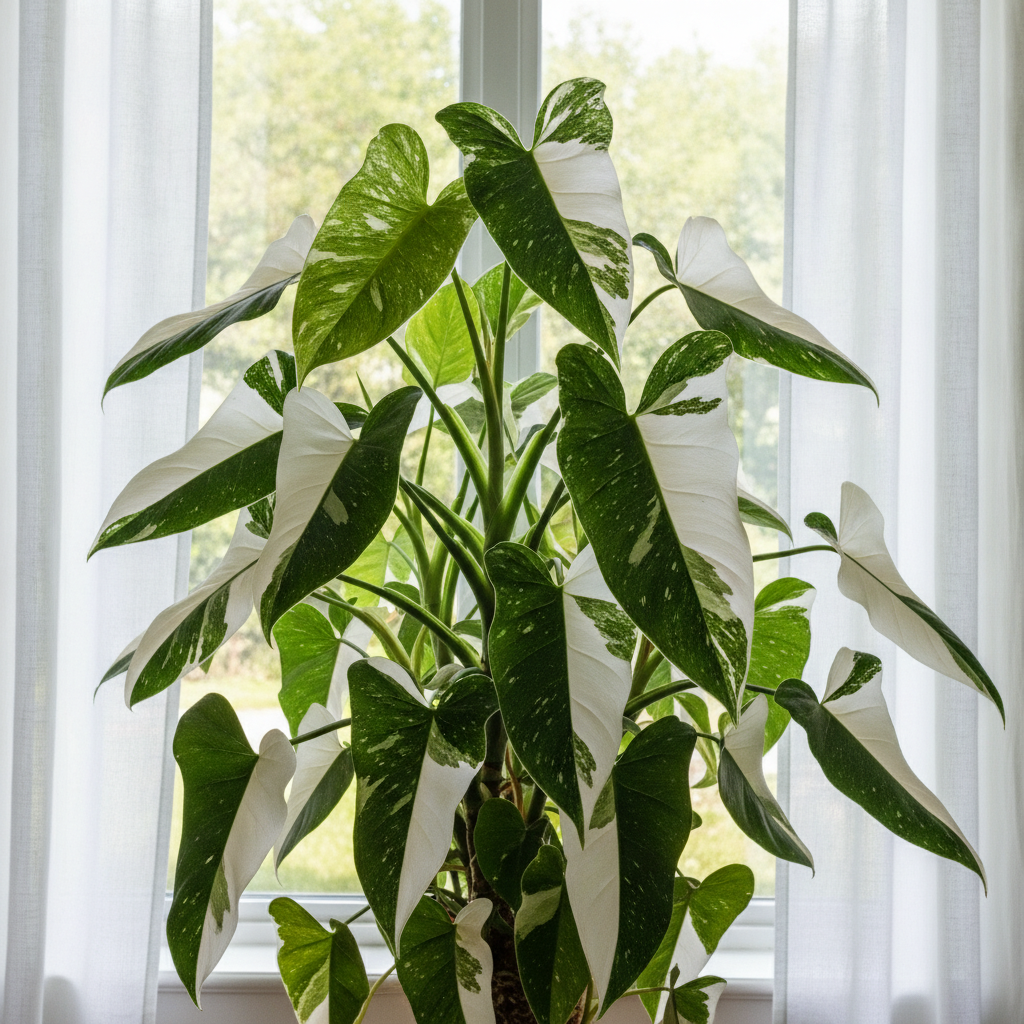
The appeal of the White Wizard begins with the sheer drama of its foliage. Each leaf is a one-off. Some emerge almost entirely green, others carry a crisp half-moon of white across one side, and the most prized push out with broad marbled sectors where cream and forest green swirl together. Because the variegation is unstable rather than fixed, no two plants look alike and no single plant looks the same from one month to the next, which gives the White Wizard an addictive, collectible quality that a uniform green plant simply cannot match.
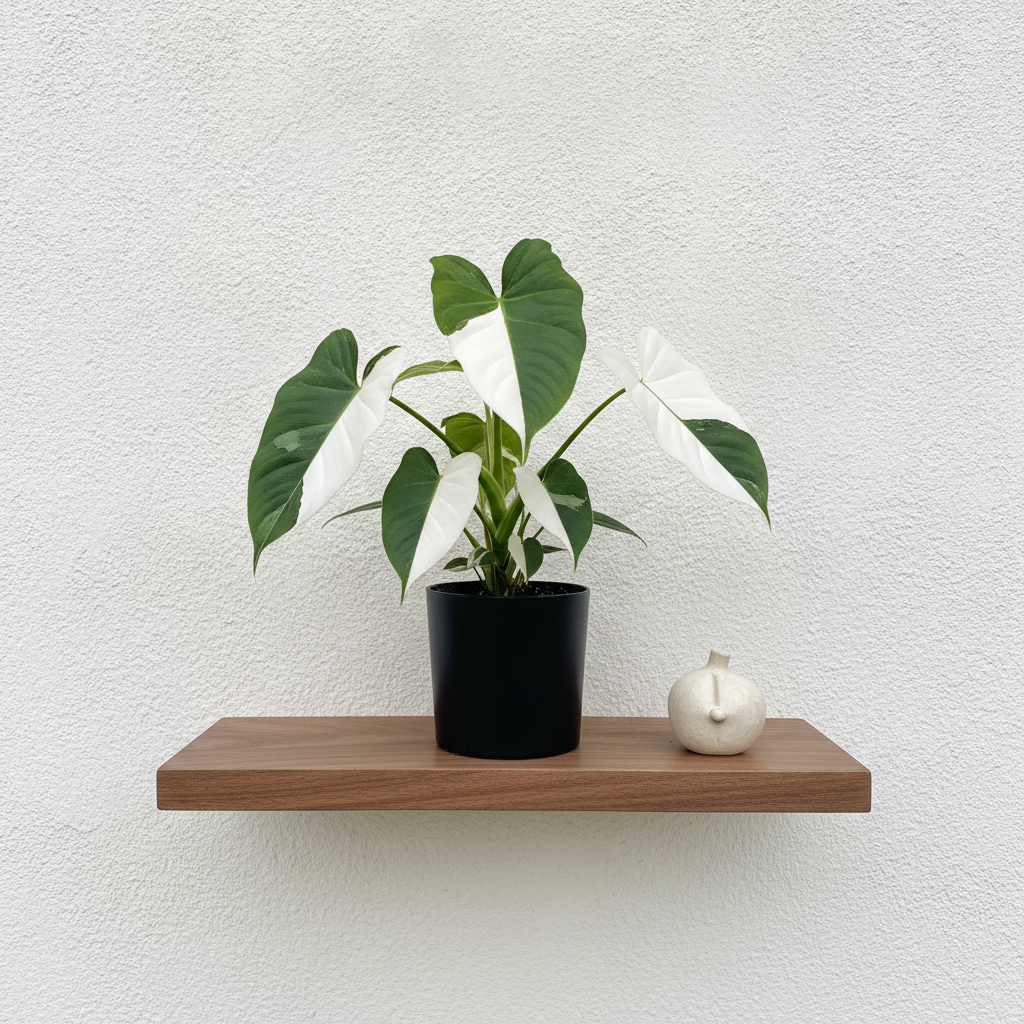
Beyond looks, the White Wizard is a forgiving grower for anyone who already keeps a Monstera or a heartleaf philodendron happy. It is a climbing aroid at heart, so given a moss pole it will produce steadily larger leaves and a strong upright habit, yet it is equally content trailing from a shelf while it is young. It grows at a moderate pace, is not prone to sudden collapse, and recovers well from mistakes. The main thing that stands between an owner and success is understanding that variegated tissue contains less chlorophyll than green tissue, so the plant is working harder to feed itself and has slightly less margin for error than an all-green cousin.
Important — Toxicity: Like all philodendrons, the White Wizard contains insoluble calcium oxalate crystals in its sap. Chewing or swallowing leaves or stems can cause intense burning of the mouth and throat, drooling, and swelling in cats, dogs and people. Keep it out of reach of pets and children, and wash your hands after taking cuttings.
Light Requirements
Light is the single most important factor in White Wizard care, and it matters far more here than for an ordinary green philodendron. The white portions of each leaf carry no chlorophyll, which means they contribute nothing to photosynthesis. The plant therefore depends entirely on its remaining green tissue to power the whole organism, and it can only do that with a generous supply of bright, indirect light.
The ideal spot is directly beside a bright window where the plant receives plenty of ambient light all day but is shielded from the scorching rays of unfiltered midday sun. A position within a metre (about 3 ft) of an east or a lightly curtained south window is close to perfect. Too little light and the plant compensates by producing leaves with far more green and far less white, gradually erasing the variegation you bought it for.
Light Levels Explained
Understanding what “bright indirect” actually means in measurable terms makes it much easier to choose the right spot in your home. The table below sets out the main categories and how the White Wizard responds to each.
| Light Category | Approx. Level | Typical Location | Outcome |
|---|---|---|---|
| Direct sun | Over 50,000 lux | On a south windowsill, unshaded | Risk of bleaching and scorch on white areas |
| Bright indirect | 10,000 to 20,000 lux | Beside an east or curtained south window | Ideal; strong growth and stable variegation |
| Medium | 5,000 to 10,000 lux | A metre or two back from a bright window | Acceptable; slower, slightly greener growth |
| Low | 1,000 to 2,500 lux | North window or interior room | Poor; variegation fades and growth stalls |
| Very low | Under 1,000 lux | Hallways, far from any window | Decline; leaf drop and eventual loss |
Window Orientation and Placement
South-facing window: The brightest option and an excellent choice, provided you diffuse the harshest sun with a sheer curtain or set the plant a step back from the glass. Direct summer sun falling on white leaf sections will bleach and crisp them within days.
East-facing window: Arguably the best position of all. Gentle direct morning sun is soft enough to be harmless, and the bright indirect light for the rest of the day suits the plant’s variegation perfectly.
West-facing window: A good option, though the stronger afternoon sun can be intense in summer. Filter it or place the plant just to the side of the direct beam.
North-facing window: Usually too dim for a variegated philodendron to hold its pattern. The plant will lean, produce greener leaves, and grow slowly. If a north window is your only choice, plan to supplement with a grow light.
Pro Tip — Rotate for Even Growth: Turn the pot a quarter turn every time you water. A White Wizard reaches enthusiastically toward its light source, and regular rotation keeps the stem upright and the leaves evenly distributed rather than all crowding one side.
How Light Affects Variegation
Variegation in the White Wizard is a balancing act that you influence directly through light. In strong, bright indirect conditions the plant can afford to keep large white sectors because its green tissue is photosynthesising efficiently. In dim conditions the plant protects itself by producing leaves with progressively more green, since green cells are the only ones earning their keep. If your new leaves are emerging noticeably greener than the ones you bought, the message is almost always the same: move it closer to the light.
Warning — Direct Sunlight: White leaf tissue has no protective pigment and burns far faster than green tissue. A White Wizard that would tolerate a little direct sun if it were all green can lose its most beautiful variegated leaves to scorch in a single afternoon. Introduce any increase in light gradually.
Artificial Lighting
The White Wizard responds very well to full-spectrum LED grow lights, which makes it possible to keep one thriving in a room with no suitable window. A 20 to 40 watt full-spectrum LED positioned 30 to 45 cm (12 to 18 in) above the plant, running for 10 to 12 hours a day on a timer, will maintain both growth and variegation. Growers who rely on artificial light often report better colour stability than those with marginal natural light, because the output is consistent day after day.
Seasonal Adjustments
Light levels indoors can drop by more than half between summer and midwinter. As the days shorten, move your White Wizard closer to its window or add supplementary lighting to hold its position through the darkest months. In high summer, watch that the intensifying sun does not begin to reach the leaves directly; a curtain that was unnecessary in winter may become essential in July.
Watering & Humidity
Watering is where most White Wizards are lost, almost always to too much rather than too little. As an aroid adapted to fast-draining forest floors, it wants its roots to breathe between drinks. The goal is a mix that is kept lightly moist during active growth but is never allowed to sit soggy, because waterlogged roots suffocate and rot with alarming speed in variegated plants that already have a slimmer energy reserve.
When to Water
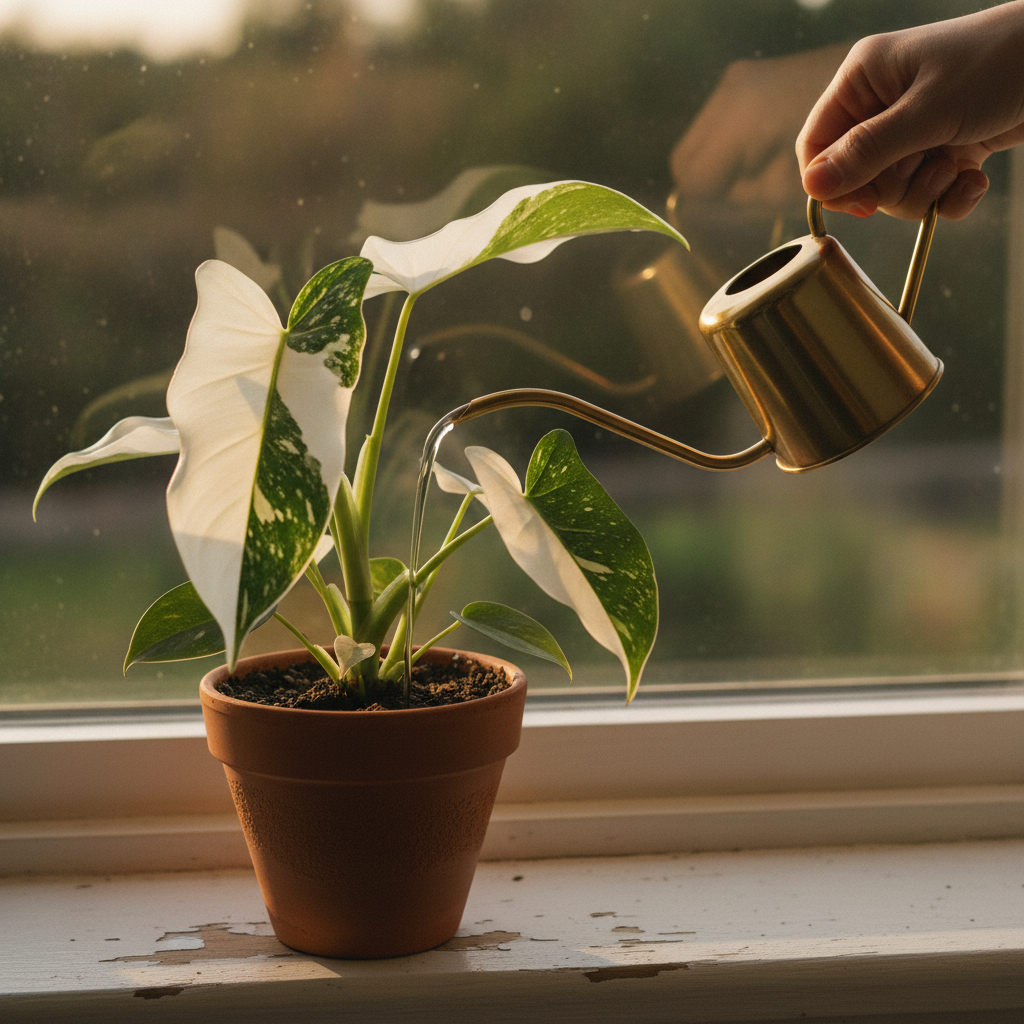
Rather than watering on a fixed calendar, water by feel. Push a finger into the mix and water only when the top 3 to 5 cm (1 to 2 in) has dried out. In a bright, warm room during spring and summer this typically works out to about once a week, but pot size, light and the season all shift the interval, so the finger test always beats the diary.
In autumn and winter, when growth slows and evaporation drops, the mix stays wet for much longer. Extend the interval accordingly, sometimes to every 10 to 14 days, and never top up simply because a week has passed. A White Wizard sitting cool and damp through winter is the classic recipe for root rot.
Pro Tip — Weigh the Pot: Lift the pot right after watering to learn its heavy weight, then again a few days later. A freshly watered plant is noticeably heavier than a thirsty one, and this quick heft check is often more reliable than the finger test once you are used to it.
How to Water Correctly
- Check that the top 3 to 5 cm (1 to 2 in) of mix is dry before you begin.
- Water slowly and evenly across the surface until liquid runs freely from the drainage holes.
- Let the pot drain completely for several minutes so no water is trapped at the base.
- Empty the saucer or cachepot; never leave the roots standing in collected water.
- Use room-temperature water, as cold water can shock tropical roots.
Signs of Overwatering vs. Underwatering
| Symptom | Overwatering | Underwatering |
|---|---|---|
| Leaf colour | Yellowing, often several leaves at once | Browning, starting at leaf edges and tips |
| Leaf texture | Soft, limp and mushy | Dry, crisp and curling |
| Soil | Constantly wet, may smell sour | Bone dry, pulling away from the pot sides |
| Roots | Brown, black and mushy | Dry, brittle and pale |
| Stem base | Soft, darkened, may collapse | Firm but slightly shrivelled |
Warning — Root Rot: If the stem base turns soft and dark and lower leaves yellow in quick succession, suspect root rot. Unpot immediately, trim away every brown mushy root with sterilised scissors, and repot into fresh dry mix. Taking a healthy stem cutting as insurance is wise, because a badly rotted White Wizard may not recover.
Humidity Requirements
Coming from humid tropical forests, the White Wizard is happiest at 60 percent relative humidity or above. It will tolerate the 40 to 50 percent typical of many homes, but at the lower end you will see slower growth, smaller leaves and a greater risk of crisp brown edges on the delicate white sections.
The most common sign of insufficient humidity is browning along leaf margins and at the tips, particularly on the pale variegated areas which lose moisture faster and have less resilience than green tissue. New leaves that struggle to unfurl cleanly are another clue that the surrounding air is too dry.
To raise humidity, group the plant with other tropicals, stand the pot on a wide tray of pebbles topped up with water, or run a small room humidifier nearby, which is by far the most effective method. Bathrooms and kitchens with good light also make naturally humid homes for a White Wizard. Occasional misting looks appealing but does little for ambient humidity and can encourage fungal spotting if leaves stay wet.
Water Quality
The White Wizard is moderately sensitive to the mineral and chlorine content of tap water, and salt build-up can scorch the vulnerable white leaf tissue over time. If your tap water is hard or heavily chlorinated, let it stand overnight before use, or switch to filtered or collected rainwater. Flushing the pot thoroughly every couple of months also helps prevent mineral accumulation in the mix.
Soil, Potting & Repotting
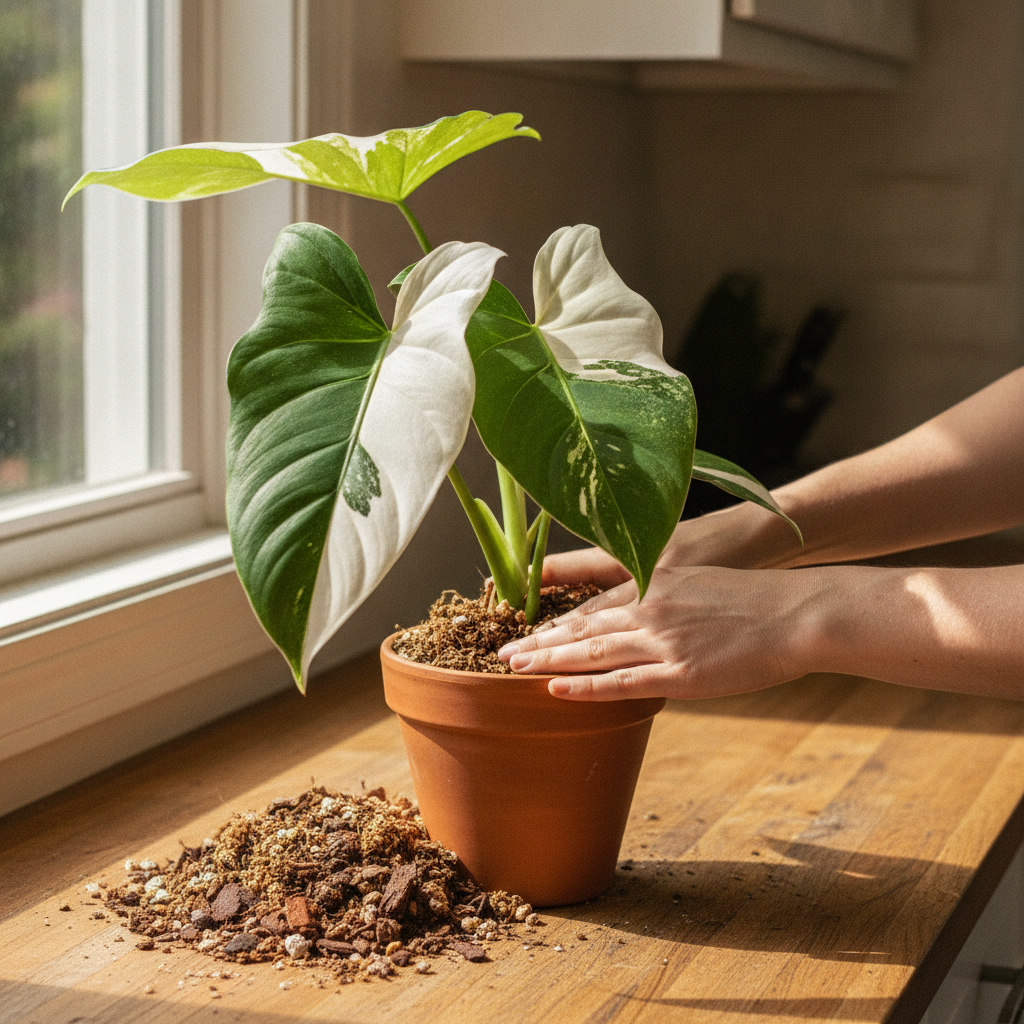
The right growing medium is the foundation of a healthy White Wizard, and ordinary bagged houseplant compost used straight from the sack is not it. As an epiphytic climber, this philodendron wants a chunky, airy, fast-draining aroid mix that holds a little moisture while letting plenty of oxygen reach the roots.
Ideal Soil Composition
The aim is a blend that behaves more like a forest floor than a plant pot: open, spongy and quick to drain. Combining a quality peat-free or coir base with generous chunky amendments creates exactly the structure the roots crave. The table below sets out a reliable recipe.
| Component | Proportion | Function |
|---|---|---|
| Coco coir or peat-free compost | 40 percent | Holds moisture and nutrients |
| Orchid bark | 30 percent | Creates air pockets and mimics epiphytic roots |
| Perlite or pumice | 20 percent | Sharpens drainage and prevents compaction |
| Worm castings | 10 percent | Adds gentle, slow-release nutrition |
The White Wizard prefers a slightly acidic root zone, roughly pH 5.5 to 6.5, which suits most aroid mixes without any special adjustment. If you add a small handful of horticultural charcoal, it helps keep the mix sweet and improves drainage further.
Pro Tip — Quick Mix Recipe: No time to measure? Combine two big handfuls of standard houseplant compost with one handful of orchid bark and one handful of perlite. That simple 2 to 1 to 1 ratio drains well enough to keep a White Wizard happy while you refine your blend.
Choosing the Right Pot
Pot choice has a direct effect on how often you can safely water and how well the roots breathe, so it deserves more thought than it usually gets.
Drainage holes are non-negotiable. Whatever pot you choose, it must have holes at the base. Without them, water collects in the bottom of the pot and the roots sit drowning out of sight, which is the fastest route to losing a White Wizard.
Pot material: Terracotta breathes and wicks away excess moisture, making it very forgiving for anyone inclined to overwater. Plastic and glazed ceramic retain moisture longer, which suits drier homes but demands a more careful hand. Many growers like a plastic nursery pot dropped inside a decorative cachepot for the best of both.
Pot size: Choose a pot only 2 to 3 cm (about 1 in) wider than the current root ball. An oversized pot holds a large volume of wet mix that the roots cannot use, and that lingering moisture invites rot.
When to Repot
The White Wizard is a moderate grower and generally needs repotting every 18 months to two years, or when you see roots emerging from the drainage holes, the plant drying out unusually fast, or growth slowing despite good care. Spring, at the start of the active season, is the ideal time so the plant can settle in while it is growing vigorously. Refreshing the top few centimetres of mix each year is a gentler alternative in the years between full repots.
How to Repot: Step-by-Step
- Water the plant a day beforehand so the root ball is hydrated and slides out cleanly.
- Ease the plant from its pot and gently loosen the outer roots with your fingers.
- Inspect the roots, trimming away any that are brown, soft or mushy with sterilised scissors.
- Add a layer of fresh aroid mix to the base of a pot one size up.
- Position the plant at its previous depth and fill around the roots with fresh mix, firming gently.
- If the plant is climbing, insert a moss pole now, before the roots fully re-establish.
- Water thoroughly and return the plant to bright indirect light, out of direct sun.
Warning — Transplant Shock: Expect a short sulk after repotting, with perhaps a drooping leaf or two. Do not overcompensate by watering heavily or feeding straight away, which only stresses disturbed roots further. Keep conditions stable and the plant will recover within a week or two.
Fertilising
Because a variegated plant carries less chlorophyll and grows more slowly than an all-green one, the White Wizard is a light feeder that is easily overfed. A modest, regular supply of balanced nutrition during the growing season keeps the leaves large and the colour strong without pushing the plant beyond what its reduced photosynthetic capacity can support.
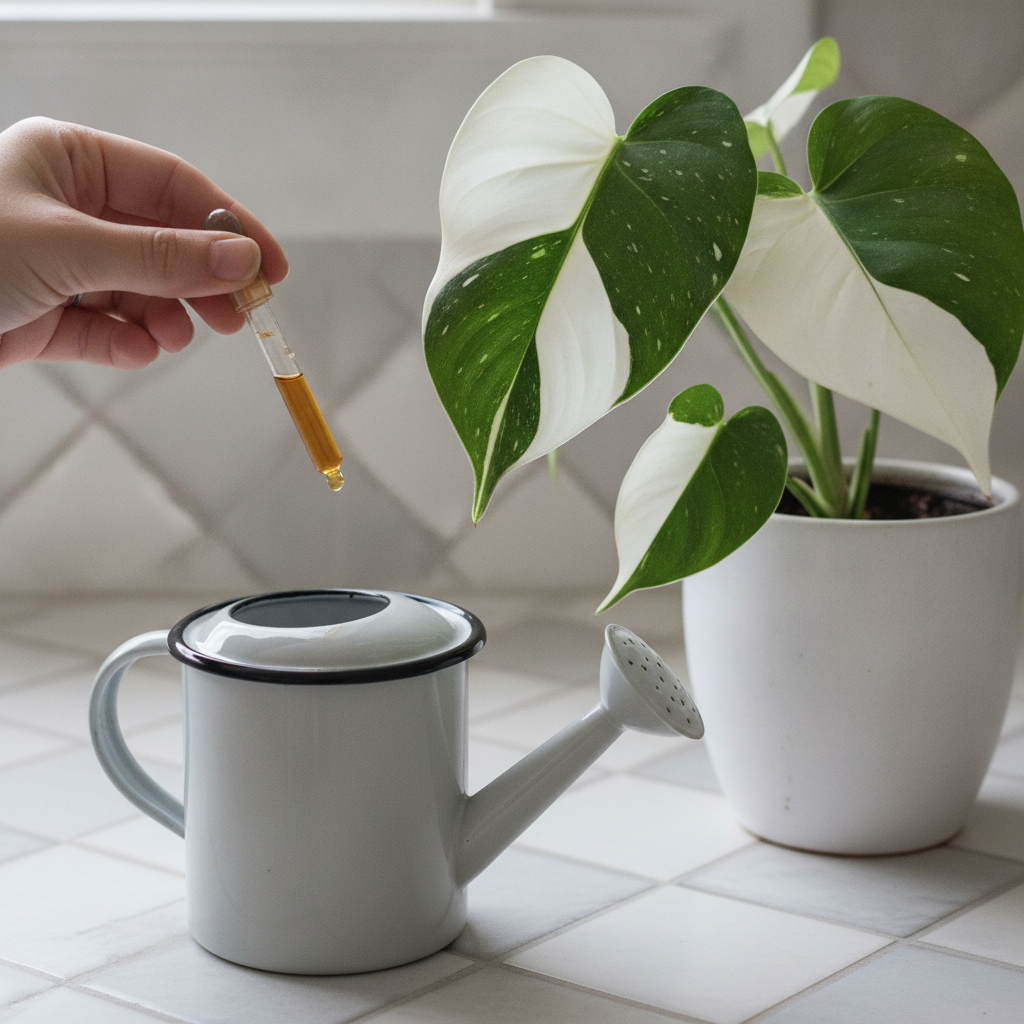
The single most useful rule is to feed at half the strength recommended on the bottle. Variegated aroids are markedly more prone to fertiliser burn than their green counterparts, and their delicate white tissue shows salt damage first, so restraint always beats generosity here.
Understanding Plant Nutrients
Most houseplant fertilisers are labelled with an NPK ratio, the three numbers describing the proportion of nitrogen, phosphorus and potassium. A balanced feed with roughly equal numbers suits the White Wizard well, supporting healthy foliage without forcing weak, leggy growth. The table below explains what each key nutrient does and how a shortage shows up.
| Nutrient | Symbol | Primary Function | Deficiency Symptoms |
|---|---|---|---|
| Nitrogen | N | Leaf and stem growth | Pale, yellowing older leaves |
| Phosphorus | P | Root and overall vigour | Weak roots, stunted growth |
| Potassium | K | Cell health and resilience | Brown, scorched leaf edges |
| Calcium | Ca | Cell wall structure | Distorted, weak new growth |
| Magnesium | Mg | Core of the chlorophyll molecule | Yellowing between leaf veins |
| Iron | Fe | Chlorophyll production | Yellow new leaves with green veins |
Types of Fertiliser
Liquid fertilisers: The easiest option for a White Wizard, giving you precise control over dose and timing. Dilute to half strength and apply with your normal watering during the growing season.
Slow-release granular: Convenient prills that release nutrients gradually over months. Effective, but harder to dial back if the plant shows signs of overfeeding, so use them sparingly with variegated plants.
Organic fertilisers: Worm castings, diluted seaweed and compost teas feed gently and improve the soil life, with very little risk of burn. They are a forgiving and sustainable choice for cautious growers.
Feeding Schedule
Feed every 4 to 6 weeks through spring and summer while the plant is actively growing. Stop or greatly reduce feeding in autumn and winter, when growth naturally slows and unused fertiliser simply accumulates as harmful salt in the mix. Resume in spring as new leaves begin to appear.
Pro Tip — Less Is More: When in doubt, underfeed. A slightly hungry White Wizard is easy to fix with a diluted feed, but an overfed one with scorched roots and crisped white margins is a slow and frustrating recovery. Err on the side of caution every time.
How to Fertilise
- Dilute a balanced liquid fertiliser to half the recommended strength.
- Water the plant with plain water first if the mix is very dry, to protect the roots.
- Apply the diluted feed evenly across the surface until it drains through.
- Flush the pot with plain water every couple of months to wash out accumulated salts.
Warning — Salt Build-Up: A white crust on the soil surface or around the pot rim signals a build-up of fertiliser salts. Flush the pot thoroughly with several changes of plain water, and scale back your feeding, before the salts scorch the roots and delicate variegated leaves.
Propagation
Propagating a White Wizard is both practical and, given the plant’s price tag, genuinely rewarding. Stem cuttings root readily, and because the variegation is unstable, taking cuttings from your best-marked stems is the only way to steer future plants toward the balance of white and green you want.
The most important principle in propagating any variegated plant is to select cuttings that carry both white and green. A cutting that is all white has no chlorophyll and will eventually starve, while a cutting that is all green will only ever produce plain green leaves. The sweet spot is a stem section with healthy green tissue and attractive variegation together.
Understanding Nodes and Aerial Roots
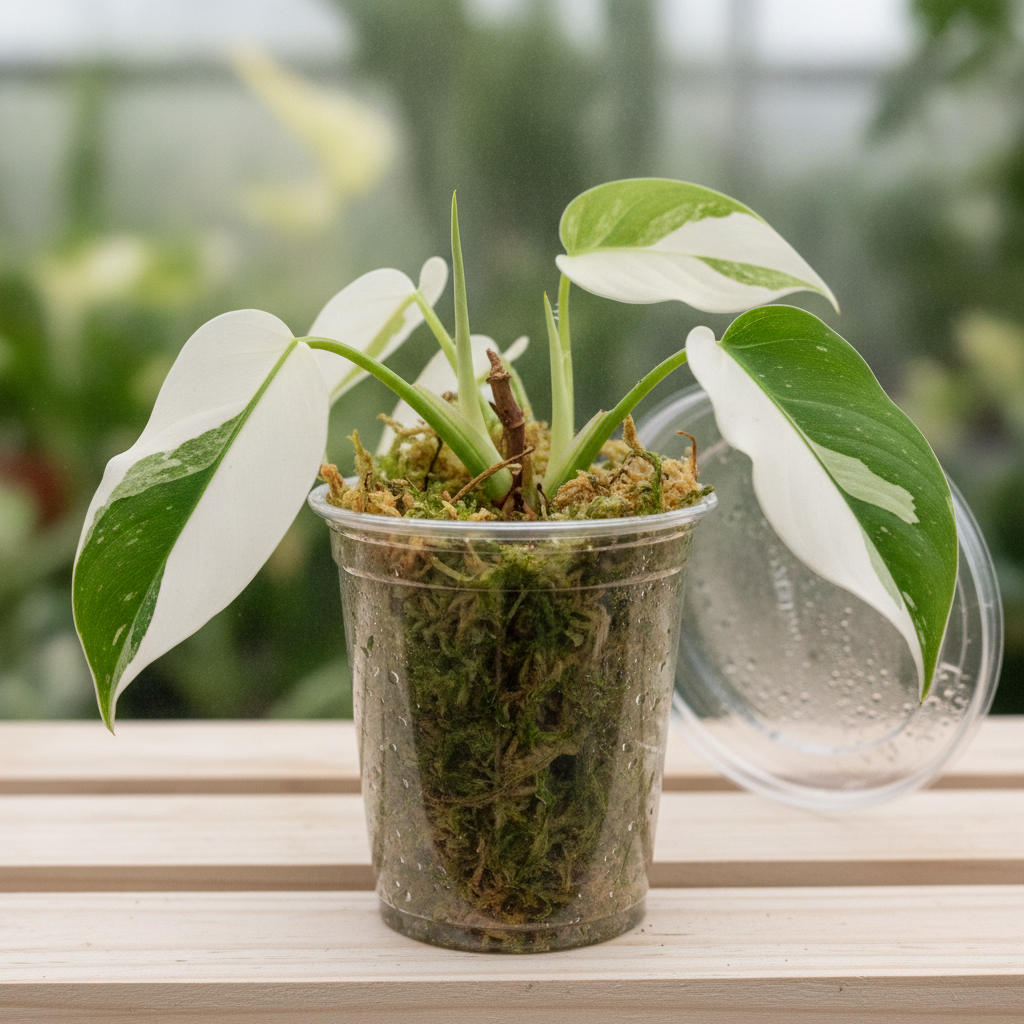
Every viable cutting must include at least one node, the slightly swollen point on the stem where a leaf meets it and where new roots emerge. Many White Wizard nodes already carry small nub-like aerial roots, and these give a cutting a real head start. A leaf alone, with no node, will never root into a new plant, so identifying the node correctly is the key to success.
Sphagnum Moss Propagation: Step-by-Step
Rooting in damp sphagnum moss is the most reliable method for a White Wizard, giving strong roots that transition easily to soil.
- Using a sterilised blade, cut just below a node on a well-variegated stem, keeping one or two leaves attached.
- Let the cut end callus over in the air for 30 to 60 minutes.
- Soak sphagnum moss, then wring it out so it is damp but not dripping.
- Nestle the node into the moss inside a clear container, leaving the leaves exposed.
- Cover loosely to trap humidity, and place in bright indirect light.
- Keep the moss lightly moist; roots usually appear within 3 to 5 weeks.
- Pot into aroid mix once roots reach 3 to 5 cm (1 to 2 in) long.
Pro Tip — Keep It Humid: The single biggest boost to White Wizard cuttings is stable, high humidity. A clear cover, a propagation box or a zip bag keeps the air around the cutting moist and dramatically speeds rooting. Open it briefly every few days to refresh the air and prevent mould.
Water Propagation: Step-by-Step
Rooting in water lets you watch progress and is very beginner-friendly, though water roots are a little more fragile when moved to soil.
- Take a node cutting with one or two leaves and let the cut end callus briefly.
- Place it in a jar of room-temperature water with the node submerged and the leaves above the surface.
- Set the jar in bright indirect light and refresh the water every 3 to 4 days.
- When roots reach 3 to 5 cm (1 to 2 in), pot up into a chunky aroid mix.
- Keep the newly potted cutting extra humid for its first two weeks to ease the transition.
Troubleshooting Propagation
| Problem | Likely Cause | Solution |
|---|---|---|
| Cutting rots | Water too warm or stale, or no node callus | Refresh water often; let cuttings callus first |
| No roots after weeks | Low warmth or humidity, or no node included | Warm it up, raise humidity, check for a node |
| All-white cutting fades | No chlorophyll to sustain it | Only propagate stems with some green tissue |
| Leaves yellow in water | Nutrient depletion or transition stress | Pot into soil once roots are a few cm long |
Pests & Diseases
A healthy White Wizard grown in good conditions is reasonably resistant to trouble, but its soft, variegated leaves are attractive to sap-sucking pests, and its dislike of soggy roots means fungal disease is never far away when watering goes wrong. The best defence is vigilance: inspect your plant regularly, especially the undersides of leaves and the tender new growth where problems begin.
Catching an infestation early makes all the difference. A single mealybug or a few spider mites are quick to deal with, but left unchecked on a slow-growing variegated plant they can weaken it faster than it can recover. Quarantine any new arrivals for a couple of weeks before letting them join your collection.
Common Pests
Spider Mites (Tetranychus urticae)
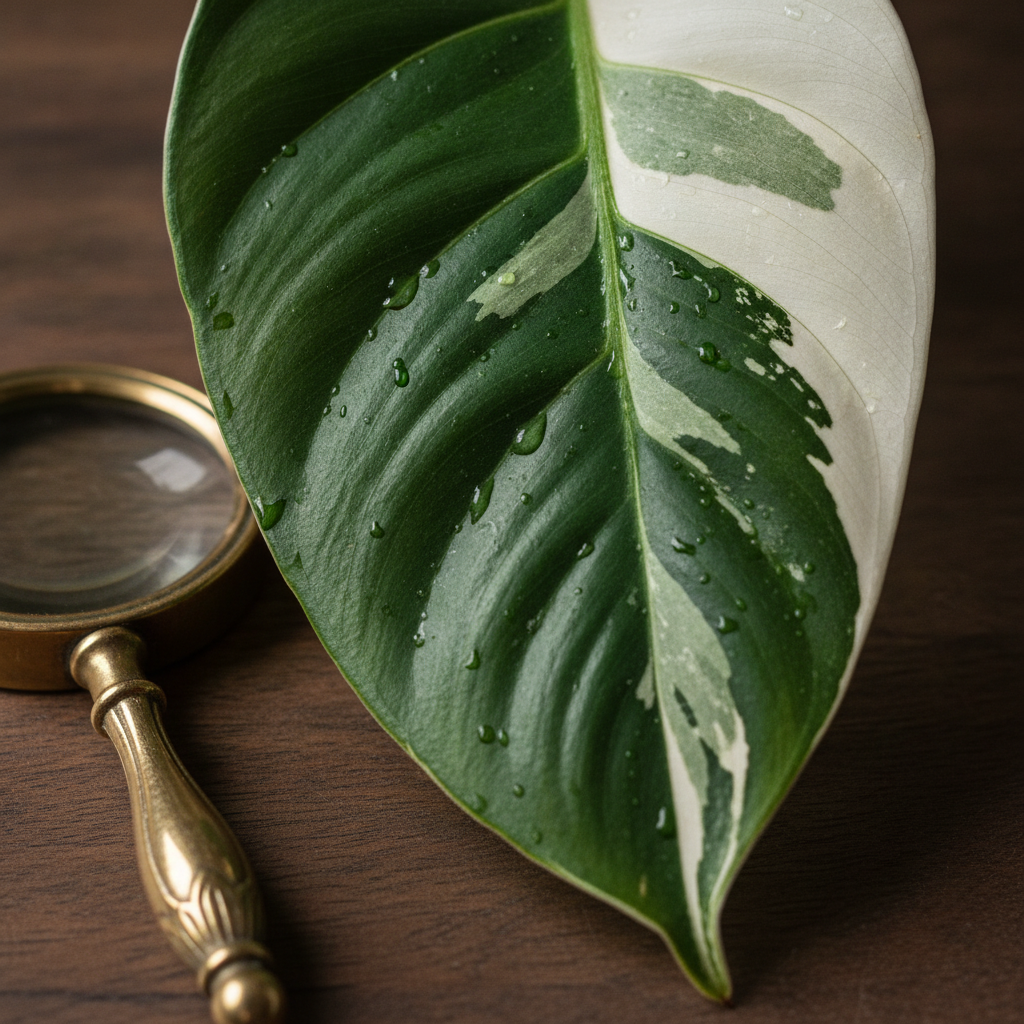
Tiny sap-suckers that thrive in warm, dry air, spider mites cause fine yellow stippling on the leaves and spin delicate webbing in the leaf axils. They are hard to see with the naked eye, so a magnifier helps confirm them.
Treatment: Rinse the foliage, raise the humidity, and treat every 5 to 7 days with insecticidal soap or diluted neem oil until the stippling stops spreading.
Mealybugs (Pseudococcus species)
Small, soft-bodied insects that look like specks of white cotton wool, mealybugs tuck into leaf axils and the undersides of leaves, sucking sap and leaving a sticky residue behind.
Treatment: Dab each insect with a cotton bud dipped in isopropyl alcohol, then follow up with neem oil. Repeat weekly, as their waxy coating protects eggs from a single treatment.
Thrips (Thrips species)
Slender, fast-moving insects that rasp at leaf surfaces, thrips leave silvery scarring and dark specks of frass. They especially favour tender new growth, where they can distort emerging variegated leaves.
Treatment: Isolate the plant, prune the worst-affected leaves, and treat repeatedly with neem oil or a suitable insecticide. Yellow or blue sticky traps help catch the winged adults.
Fungus Gnats (Bradysia species)
Small black flies that hover around the pot, fungus gnats are more a nuisance than a serious threat, but their larvae nibble tender roots and their presence usually signals soil that is being kept too wet.
Treatment: Let the top of the mix dry out more between waterings, use yellow sticky traps for the adults, and water with a diluted Bacillus thuringiensis solution to break the larval cycle.
Common Diseases
Root Rot (Pythium and Phytophthora)
The most serious threat to the White Wizard, root rot sets in when the mix stays waterlogged and roots suffocate. Yellowing lower leaves, a soft darkened stem base and a sour smell from the soil are the tell-tale signs.
Treatment: Unpot immediately, cut away all brown mushy roots with sterilised scissors, and repot into fresh, barely moist mix. Take a healthy cutting as insurance against total loss.
Bacterial Leaf Spot (Xanthomonas species)
Dark, water-soaked spots that often carry a yellow halo and can spread quickly in warm, humid, poorly ventilated conditions. The soft white leaf tissue is particularly vulnerable to infection.
Treatment: Remove affected leaves promptly, avoid wetting the foliage, improve air circulation, and keep the plant isolated until no new spots appear.
Pest and Disease Summary
| Pest / Disease | Identification | Treatment |
|---|---|---|
| Spider mites | Fine yellow stippling and webbing | Neem oil or insecticidal soap; raise humidity |
| Mealybugs | White cottony specks in leaf axils | Alcohol swab then neem oil, weekly |
| Thrips | Silvery scarring and dark frass | Prune, isolate, repeat neem treatments |
| Fungus gnats | Small black flies over the soil | Dry out soil; sticky traps; Bt drench |
| Root rot | Yellow leaves, mushy dark stem base | Trim rotten roots, repot in fresh mix |
| Bacterial leaf spot | Dark spots with yellow halos | Remove leaves, improve airflow, keep dry |
Prevention Strategies
Prevention is far easier than cure. Give the White Wizard bright indirect light, a fast-draining mix and careful watering, and you remove the conditions that most pests and diseases exploit. Good air circulation keeps fungal problems at bay, while wiping the leaves occasionally both removes dust and gives you a regular chance to spot early trouble.
Quarantine every new plant for two to three weeks before it joins the rest of your collection, and check the undersides of leaves and the leaf axils whenever you water. A few minutes of routine inspection catches the vast majority of problems while they are still trivial to fix.
Pro Tip — Neem as Routine: A light monthly spray of diluted neem oil, applied in the evening away from direct sun, works as an effective preventative against the common sap-sucking pests. Always test on one leaf first, and never apply it to a plant sitting in bright sun, which can cause burning.
Popular Varieties
The White Wizard sits within a small, much-coveted family of white-variegated Philodendron erubescens cultivars that are easy to confuse and endlessly compared by collectors. Knowing how each differs helps you identify what you actually own and choose your next plant with confidence.
The defining feature of the White Wizard itself is its green stem paired with large, rounded, boldly variegated leaves. Its closest relatives swap out one of those traits, whether the stem colour, the leaf shape or the tint of the variegation, and the table below lays out the key contrasts at a glance.
| Variety | Leaf Appearance | Light Needs | Growth Rate | Availability |
|---|---|---|---|---|
| White Wizard | Large rounded green leaves, white sectors, green stem | Bright indirect | Moderate | Rare |
| White Knight | White variegation on dark maroon stems | Bright indirect | Moderate | Rare |
| White Princess | Narrower leaves, white and pink flecks, green stem | Bright indirect | Moderate | Rare |
| Pink Princess | Dark leaves with pink variegation | Bright indirect | Moderate | Uncommon |
| Red Emerald | Glossy green leaves, deep red stems | Bright indirect | Fast | Common |
| Green Emerald | Plain glossy green, no variegation | Medium to bright | Fast | Common |
Featured Varieties
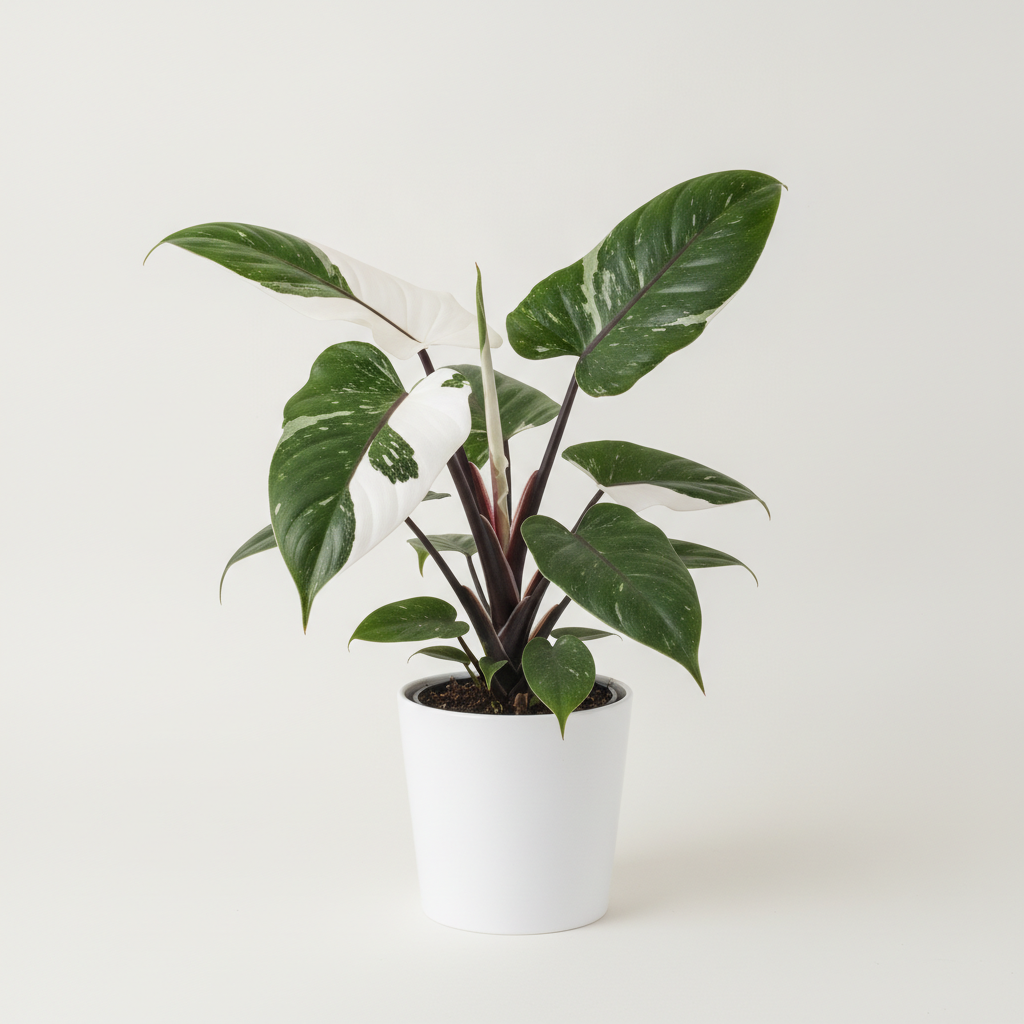
White Knight
The White Wizard’s near-twin, distinguished by dramatic dark maroon to near-black petioles and stems carrying the same crisp white-on-green leaves. The contrast of pale foliage against dark stems makes it a striking collector’s piece.
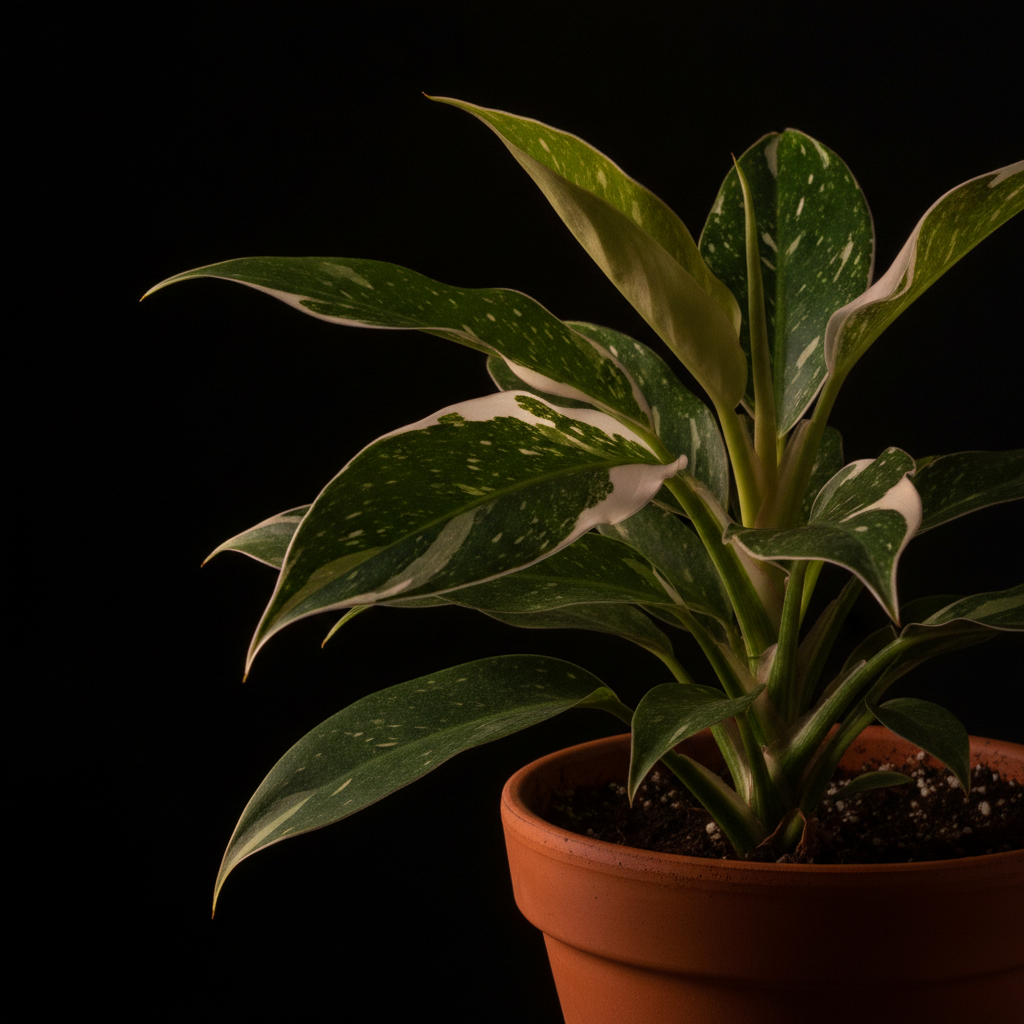
White Princess
More slender and upright than the Wizard, with narrower elongated leaves flecked in white and often carrying delicate pink accents on green stems that are speckled pink. A refined, elegant alternative for tighter spaces.
Variety Profiles in Detail
White Knight (Philodendron erubescens ‘White Knight’)
The White Knight is the variety most often mistaken for the White Wizard, and the surest way to tell them apart is the stem. Where the Wizard’s petioles and stems are green, the Knight’s are a rich dark maroon that fades to near-black, giving the plant a moodier, more architectural look. Care is essentially identical, with the same need for bright indirect light and a chunky, fast-draining mix.
White Princess (Philodendron erubescens ‘White Princess’)
The White Princess is generally more compact and upright, with narrower, more pointed leaves than the broad rounded foliage of the Wizard. Its variegation tends toward fine flecks and speckles rather than bold sectors, frequently touched with pink, and its green stems carry small pink flecks of their own. It suits growers who want the collector’s cachet of a white philodendron in a slightly smaller, tidier package.
Choosing the Right Variety for Your Space
If you love the bold, painterly look of large white-splashed leaves and can offer consistently bright light, the White Wizard is the flagship choice. Prefer the drama of dark stems? The White Knight delivers it. Short on space or drawn to a hint of pink? The White Princess is the elegant answer. All three share the same fundamental needs, so once you can keep one happy, you can keep any of them, and many collectors end up growing the whole set side by side to enjoy the contrasts.
Frequently Asked Questions
How do I tell a White Wizard from a White Knight?
Look at the stems and petioles. The White Wizard has solid green stems, while the White Knight has dark maroon to near-black stems. Both carry very similar white-on-green leaves, so the stem colour is the most reliable way to tell them apart.
Why are my White Wizard’s new leaves turning all green?
This is almost always a light problem. When light is too low, the plant favours green tissue that can photosynthesise, reducing the white variegation. Move it to a brighter spot with more bright indirect light, and later leaves should regain their variegation.
Why are the white parts of the leaves turning brown?
White tissue is delicate and browns easily from low humidity, direct sun scorch, or salt build-up from hard water or overfeeding. Raise humidity, keep the plant out of harsh direct sun, and flush the pot with plain water to clear excess salts.
Is the White Wizard Philodendron toxic to pets?
Yes. Like all philodendrons it contains insoluble calcium oxalate crystals, which are toxic to cats, dogs and humans if chewed or swallowed, causing painful mouth and throat irritation. Keep it well out of reach of curious pets and children.
How fast does a White Wizard grow?
It grows at a moderate pace, slower than an all-green philodendron because its variegated leaves photosynthesise less. In bright light with a moss pole to climb, expect steady growth through spring and summer and little movement over winter.
Does the White Wizard need a moss pole?
It is not essential, but a moss pole is highly beneficial. As a climbing aroid, the White Wizard produces larger, better-shaped leaves when it can attach its aerial roots to a support and grow upward rather than trailing.
Can I propagate a White Wizard from a leaf?
No. A leaf without a node cannot grow into a new plant. You need a stem cutting that includes at least one node, ideally with some visible variegation and green tissue together, to root a viable new White Wizard.
Why is the White Wizard so expensive?
Its unstable variegation cannot be reproduced from seed and must be propagated by cuttings, its growth is slow, and demand from collectors is high. Together these keep supply limited and prices well above those of common green philodendrons, though prices have eased as propagation has spread.






