
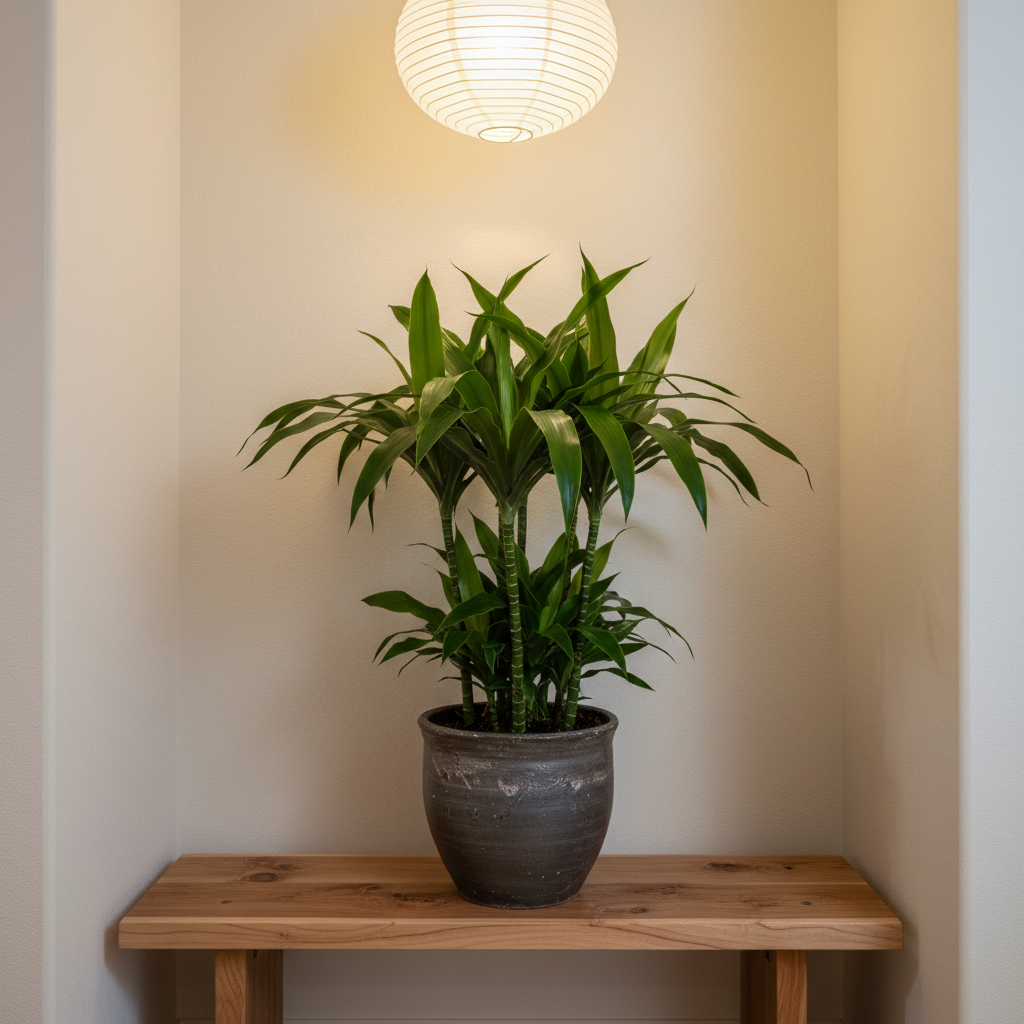
Few houseplants make a strong architectural statement with so little fuss as the Janet Craig dracaena (Dracaena fragrans ‘Janet Craig’). A selected cultivar of the African corn plant, it trades the species’ yellow-striped foliage for broad, glossy, uniformly deep-green leaves that arch outward from upright woody canes. Native ultimately to the tropical forests of West Africa, where its parent species grows as an understorey shrub beneath a dense canopy, this cultivar earned its name from the daughter of a Florida nurseryman in the mid-twentieth century and has been a fixture of homes and offices ever since.
Its reputation as one of the most forgiving plants you can grow is well deserved, but there is a meaningful gap between a Janet Craig that merely survives in a dim corner and one that thrives into a lush, multi-caned specimen well over two metres tall. This guide covers everything that closes that gap: how much light it really wants, the watering rhythm that keeps its roots healthy, the soil and pot choices that prevent rot, a feeding schedule scaled to its slow growth, two reliable propagation methods, and the handful of pests and quirks (fluoride sensitivity chief among them) that account for almost every problem owners encounter.
Contents
- Quick Reference
- Why Janet Craig Dracaena Makes a Reliable Houseplant
- Light Requirements
- Watering & Humidity
- Soil, Potting & Repotting
- Fertilising
- Propagation
- Pests & Diseases
- Popular Varieties
- Frequently Asked Questions
Quick Reference: Janet Craig Dracaena at a Glance
| Light | Medium to bright indirect; tolerates low light, dislikes direct sun |
| Watering | When the top 5 to 7 cm (2 to 3 in) of soil is dry, roughly every 10 to 14 days |
| Temperature | 18 to 24 degrees C (65 to 75 degrees F); keep above 13 degrees C (55 degrees F) |
| Humidity | Average household humidity is fine; prefers 40 to 50 percent |
| Fertiliser | Balanced liquid feed at half strength, monthly in spring and summer only |
| Toxicity | Toxic to cats and dogs (saponins); mildly harmful if eaten by people |
Why Janet Craig Dracaena Makes a Reliable Houseplant
The case for the Janet Craig rests on a rare combination of toughness and good looks. Because its parent species evolved on the shaded forest floor, the plant is genuinely adapted to the low, indirect light most interiors offer, and it shrugs off the dry air, irregular watering and root confinement that defeat fussier tropicals. It is one of the few large-statured foliage plants that will hold its shape and colour in a north-facing room or a windowless office lit only by overhead fluorescents, which is precisely why it has been a commercial interior-landscaping staple for decades.

Aesthetically it offers something many easy plants do not: vertical drama. A young plant reads as a tidy rosette of strappy leaves, but with age it develops bare, characterful canes topped with leafy crowns, lending the mature specimen the silhouette of a small indoor tree. It is slow growing, so it holds a chosen shape for a long time, and it responds well to being cut back, which lets you control its height and encourage a fuller, multi-headed habit. For anyone wanting a substantial green presence without a substantial care commitment, it is hard to better.
Important — Toxicity: All parts of the Janet Craig contain saponins that are toxic to cats and dogs. Ingestion commonly causes vomiting (sometimes with blood), drooling, loss of appetite and depression, and in cats may bring on dilated pupils. Keep the plant out of reach of pets and curious children, and contact a vet or poison line if a significant amount is eaten.
Light Requirements
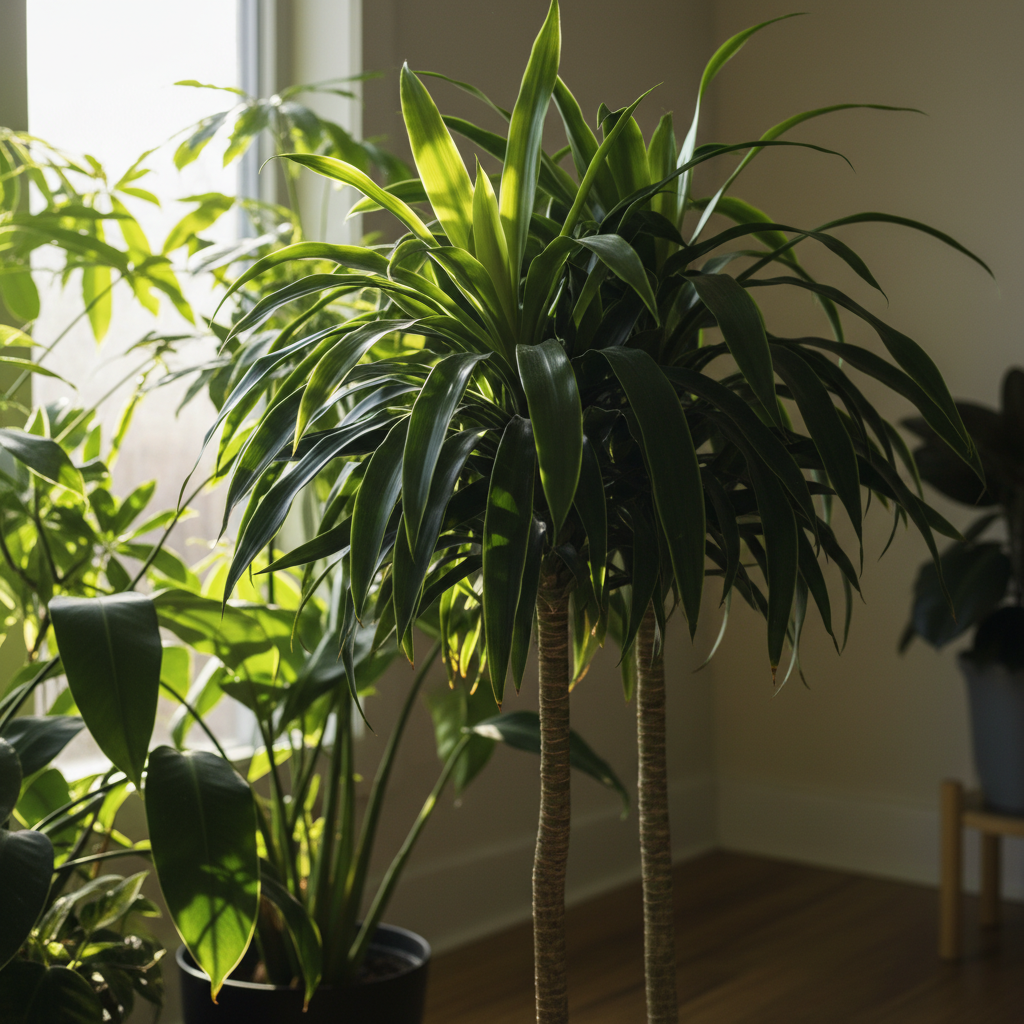
Light is the single biggest lever you can pull to move a Janet Craig from surviving to thriving. The plant tolerates a remarkable range, but tolerance is not preference. In deep shade it will stay alive for years while producing little new growth, holding smaller and more widely spaced leaves; in its happy zone it pushes out fuller crowns of larger, glossier foliage and gains height noticeably faster.
The ideal is bright but indirect light: a position a metre or two back from an east or west window, or close to a north window, where the foliage is bathed in steady ambient brightness but never struck by the midday sun. In these conditions the leaves take on their characteristic dark, almost lacquered green, and the canes stay sturdy and upright rather than stretching toward the nearest light source.
Light Levels Explained
Indoor light is far dimmer than we perceive, because our eyes adjust constantly. The table below translates the usual descriptive categories into approximate illuminance and tells you what to expect from a Janet Craig in each.
| Light Category | Approx. Level | Typical Location | Outcome |
|---|---|---|---|
| Direct sun | 20,000 lux and up | On a south windowsill | Leaf scorch and bleaching; avoid |
| Bright indirect | 10,000 to 20,000 lux | Near an east or west window | Best growth and colour |
| Medium | 2,500 to 10,000 lux | A few metres from a bright window | Steady, healthy growth |
| Low | 500 to 2,500 lux | North room, interior wall | Survives well, slow growth |
| Very low | Below 500 lux | Windowless office, hallway | Persists, little to no new growth |
Window Orientation and Placement
South-facing window: The brightest exposure, and the only one that poses a real risk. Direct, unfiltered southern sun will scorch and bleach the leaves, so set the plant well back from the glass or filter the light through a sheer curtain.
East-facing window: An excellent choice. Gentle morning sun followed by bright indirect light for the rest of the day gives ideal conditions, and the plant can sit close to the glass without harm.
West-facing window: Also very good, though the stronger afternoon sun means it is wise to keep the plant a short distance back to avoid the hottest direct rays in summer.
North-facing window: Reliable and safe. The soft, consistent light here is exactly what a Janet Craig is built for, and it can sit right beside the window without any risk of scorch.
Pro Tip — Even Growth: Because the plant grows toward its light source, rotate the pot a quarter turn every couple of weeks. This keeps the crown symmetrical and stops the canes from leaning, which matters a great deal once the plant is tall and top-heavy.
How Light Affects Leaf Colour and Form
Unlike variegated dracaenas, the Janet Craig has no pattern to lose, but light still shapes its appearance. In good light the leaves are broad, closely spaced and a rich saturated green; in too little light they emerge narrower, paler and further apart, and the plant takes on a leggy, sparse look as it reaches for brightness. If you notice the new growth thinning out or the crown stretching, more light is the remedy.
Warning — Direct Sunlight: Do not move a plant that has lived in low light straight into strong sun. The leaves will burn within a day or two, leaving permanent pale or brown patches. Any increase in light should be made gradually over two to three weeks so the foliage can acclimatise.
Artificial Lighting
The Janet Craig is one of the best candidates for growing under artificial light, which is why it persists in so many windowless offices. It does well under standard fluorescent or LED office lighting run for ten to twelve hours a day, and a modest full-spectrum LED grow light positioned 30 to 60 cm (12 to 24 in) above the crown will keep it growing steadily in a room with no natural light at all.
Seasonal Adjustments
As daylight weakens through autumn and winter, consider moving the plant a little closer to its window to compensate, then easing it back in spring. Growth naturally slows in the darker months regardless, so expect little new foliage between late autumn and early spring and adjust watering and feeding accordingly.
Watering & Humidity
More Janet Craig dracaenas are killed by watering mistakes than by anything else, and almost always by too much rather than too little. The plant stores moisture in its fleshy canes and thick roots, so it copes easily with the occasional missed watering but rots quickly when it sits in constantly soggy soil. The guiding principle is simple: water thoroughly, then let the soil dry out substantially before you water again.
When to Water
Forget the calendar and check the soil instead. Push a finger into the top of the pot, and water only when the top 5 to 7 cm (2 to 3 in) feels dry. In a typical warm, moderately lit room this works out to roughly every ten to fourteen days, but the true interval depends on light, temperature, pot size and the season, so the finger test always beats a fixed routine.
Expect to water noticeably less in autumn and winter, when growth slows and the soil stays damp for longer. During this resting period the plant may go three weeks or more between drinks, and watering on your summer schedule through the winter is a common route to root rot. A cheap moisture meter or simply lifting the pot to feel its weight can both help you judge when the rootball has genuinely dried.
Pro Tip — Read the Leaves: Drooping or soft, downturned leaves usually mean thirst and recover within hours of watering. Yellowing lower leaves combined with damp soil point the other way, toward overwatering. Learning to tell these two apart is the most useful watering skill you can develop.
How to Water Correctly
- Check that the top few centimetres of soil are dry before you begin.
- Water slowly and evenly over the whole surface using room-temperature water.
- Continue until water flows freely from the drainage holes, which ensures the entire rootball is moistened.
- Let the pot drain completely for several minutes.
- Empty the saucer or cover pot so the plant never stands in collected water.
- Wait until the soil dries to the correct depth again before repeating.
Signs of Overwatering vs. Underwatering
| Symptom | Overwatering | Underwatering |
|---|---|---|
| Leaf colour | Yellowing, often starting low on the plant | Browning, dry tips and edges |
| Leaf texture | Soft, limp, sometimes translucent | Crisp, dry, curling inward |
| Soil | Stays wet for days, may smell sour | Bone dry, pulling away from the pot edge |
| Roots | Brown, mushy, foul-smelling | Dry but firm and pale |
| Cane base | Soft or spongy, a serious warning sign | Firm but may shrivel slightly |
Warning — Root Rot: A soft, mushy base to the cane or a sour smell from the soil means root rot has set in. Unpot the plant immediately, cut away every brown and mushy root with sterilised scissors, and repot into fresh, fast-draining mix in a clean pot. Caught early it is survivable; left unchecked it will collapse the whole cane.
Humidity Requirements
The Janet Craig is far less humidity-hungry than many tropical foliage plants and is perfectly content in ordinary household air of 40 to 50 percent. It will not throw a tantrum in the drier conditions of a centrally heated or air-conditioned room, which is another reason it suits offices so well.
That said, very dry air can contribute to brown leaf tips, especially in winter when heating strips moisture from the room. If the air in your home is noticeably arid, the plant will look a little crisper at the leaf tips, though as we will see, water quality is often a bigger culprit than humidity for this particular symptom.
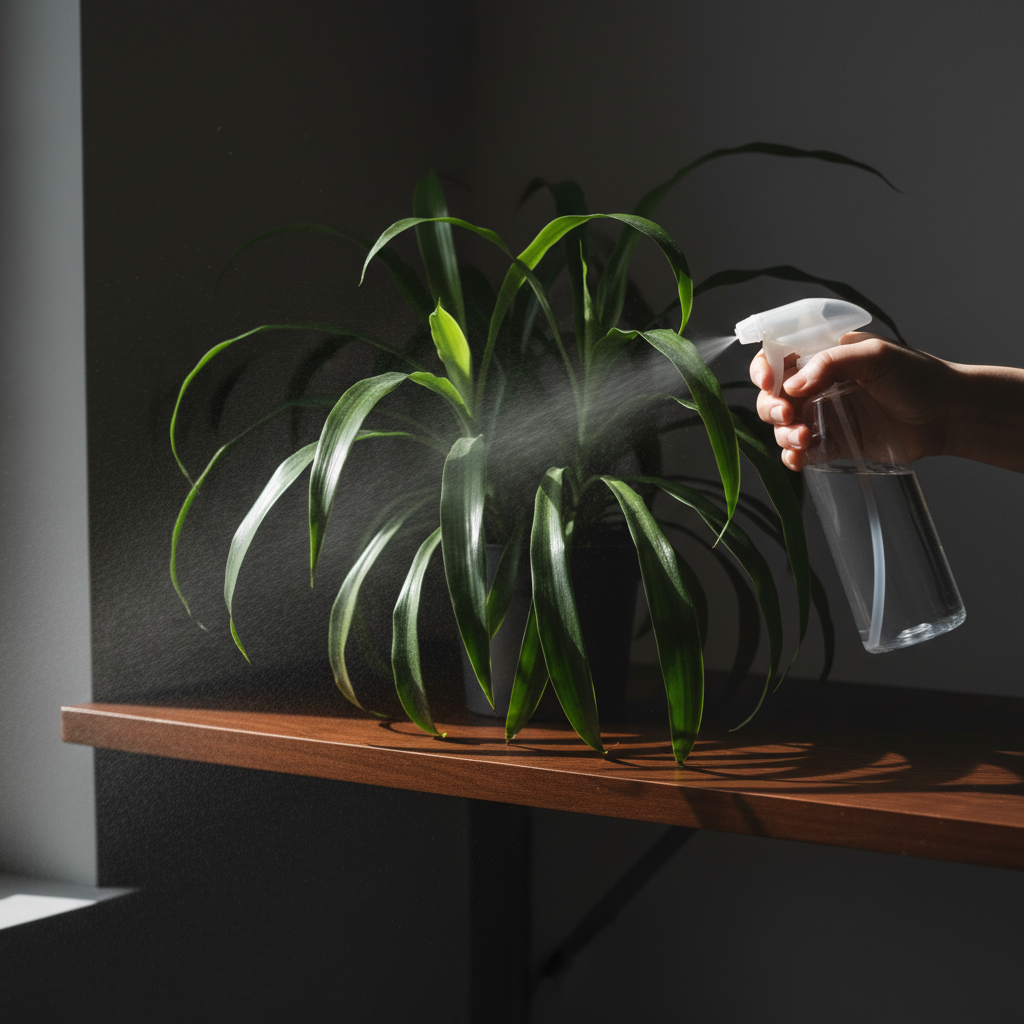
If you want to raise humidity, the most effective options are grouping plants together to create a shared moist microclimate, or running a small room humidifier nearby during the heating season. Occasional misting does little for ambient humidity and is better thought of as a way to keep the broad leaves clean and dust-free.
Water Quality
This is the one area where the Janet Craig is genuinely fussy. Like all Dracaena, it is highly sensitive to fluoride and to a lesser extent to chlorine and dissolved salts, all of which are common in treated tap water. Fluoride accumulates in the leaf tips and causes the dead brown or yellow margins that are the single most frequent complaint among owners. To avoid it, water with rainwater, distilled water or filtered water where possible, or at minimum leave tap water to stand uncovered overnight so some chlorine can dissipate. Avoid perlite in the mix if your water is hard, since it can hold fluoride, and steer clear of superphosphate fertilisers for the same reason.
Soil, Potting & Repotting
The right growing medium does much of the work of keeping a Janet Craig healthy, because it governs how quickly water drains away from the roots. The plant wants a soil that holds enough moisture to stay lightly damp after watering but drains freely enough that it never turns to mud. Dense, water-retentive potting soil used straight from the bag is the enemy here.

Ideal Soil Composition
A good base is a quality peat-free houseplant compost lightened with chunky material to open up the structure. The aim is a mix that crumbles rather than clumps, with plenty of air pockets around the roots. The table below gives a dependable recipe.
| Component | Proportion | Function |
|---|---|---|
| Peat-free potting compost | 2 parts | Holds moisture and nutrients, forms the body of the mix |
| Orchid bark or coco coir | 1 part | Opens structure, improves aeration and drainage |
| Coarse grit or pumice | 1 part | Guarantees fast drainage around the roots |
| Worm castings | A handful | Gentle, slow-release nutrition |
The Janet Craig prefers a slightly acidic to neutral soil, somewhere around pH 6.0 to 6.5, which most general houseplant composts naturally provide. There is no need to test or adjust pH unless you are using unusual ingredients or very hard water over a long period.
Pro Tip — Quick Mix Recipe: If you want a no-fuss blend, combine two large scoops of peat-free houseplant compost with one scoop of orchid bark and one scoop of pumice or coarse perlite. Note that where tap water is hard and fluoride-rich, swap perlite for pumice, as perlite can hold fluoride against the roots.
Choosing the Right Pot
Pot choice influences watering more than most people expect, and a sensible pot makes the whole plant easier to keep alive.
Drainage holes are non-negotiable. Whatever the material or style, the pot must have holes in the base so excess water can escape. A decorative cover pot is fine, but only if you remove the inner pot to water or empty any water that collects underneath.
Pot material: Terracotta is forgiving because it breathes and wicks away excess moisture, which suits a plant prone to rot. Glazed ceramic and plastic hold water longer, so if you use them, lean toward a grittier mix and water a touch more cautiously. A heavy material such as terracotta or stoneware also helps anchor tall, top-heavy specimens.
Pot size: Choose a pot only 2 to 4 cm (1 to 2 in) wider than the rootball. The Janet Craig is happy somewhat root-bound, and an oversized pot holds a reservoir of wet soil the roots cannot reach, which invites rot.
When to Repot
Because it grows slowly and tolerates crowded roots, the Janet Craig needs repotting only every two to three years. Tell-tale signs that it is time include roots emerging from the drainage holes or circling the surface, water running straight through without wetting the soil, or the plant becoming so top-heavy it tips over. The best time to repot is spring, at the start of the active growing season, so the plant can recover quickly.
How to Repot: Step-by-Step
- Water the plant a day beforehand so the rootball holds together and the roots are hydrated.
- Slide the plant out by tipping the pot and supporting the canes, rather than pulling on the stems.
- Gently tease away the old soil and inspect the roots, trimming any that are brown, soft or rotten.
- Add a layer of fresh mix to the new pot, then position the plant at the same depth it grew before.
- Fill around the rootball with fresh mix, firming lightly to remove large air gaps.
- Water thoroughly and let it drain, topping up the soil if it settles.
- Return the plant to its usual spot and hold off feeding for six to eight weeks.
Warning — Transplant Shock: Some leaf drop or temporary drooping after repotting is normal. Resist the urge to compensate by watering heavily or feeding straight away, as freshly disturbed roots are especially vulnerable to rot. Keep the plant in stable, bright indirect light and let it settle for a few weeks.
Fertilising
The Janet Craig is a light feeder, in keeping with its slow growth and its origins on nutrient-modest forest soils. It needs far less fertiliser than fast-growing tropicals, and overfeeding does more harm than underfeeding by building up damaging salts in the soil.
A small, regular dose during the growing season is all it asks. Think of feeding as a gentle top-up rather than a growth accelerator, and always err on the side of less.
Understanding Plant Nutrients
Fertiliser labels show three numbers, the N-P-K ratio, representing nitrogen, phosphorus and potassium. For a foliage plant like the Janet Craig, a balanced ratio or one slightly higher in nitrogen suits its leafy growth. The table below summarises the nutrients that matter most and how deficiencies show up.
| Nutrient | Symbol | Primary Function | Deficiency Symptoms |
|---|---|---|---|
| Nitrogen | N | Drives leaf and stem growth | Pale, yellowing older leaves; weak growth |
| Phosphorus | P | Root development and energy transfer | Stunted growth, dull foliage |
| Potassium | K | Overall vigour and water regulation | Yellow or browning leaf edges |
| Magnesium | Mg | Central to chlorophyll | Yellowing between leaf veins |
| Iron | Fe | Chlorophyll production in new growth | Pale new leaves with green veins |
Types of Fertiliser
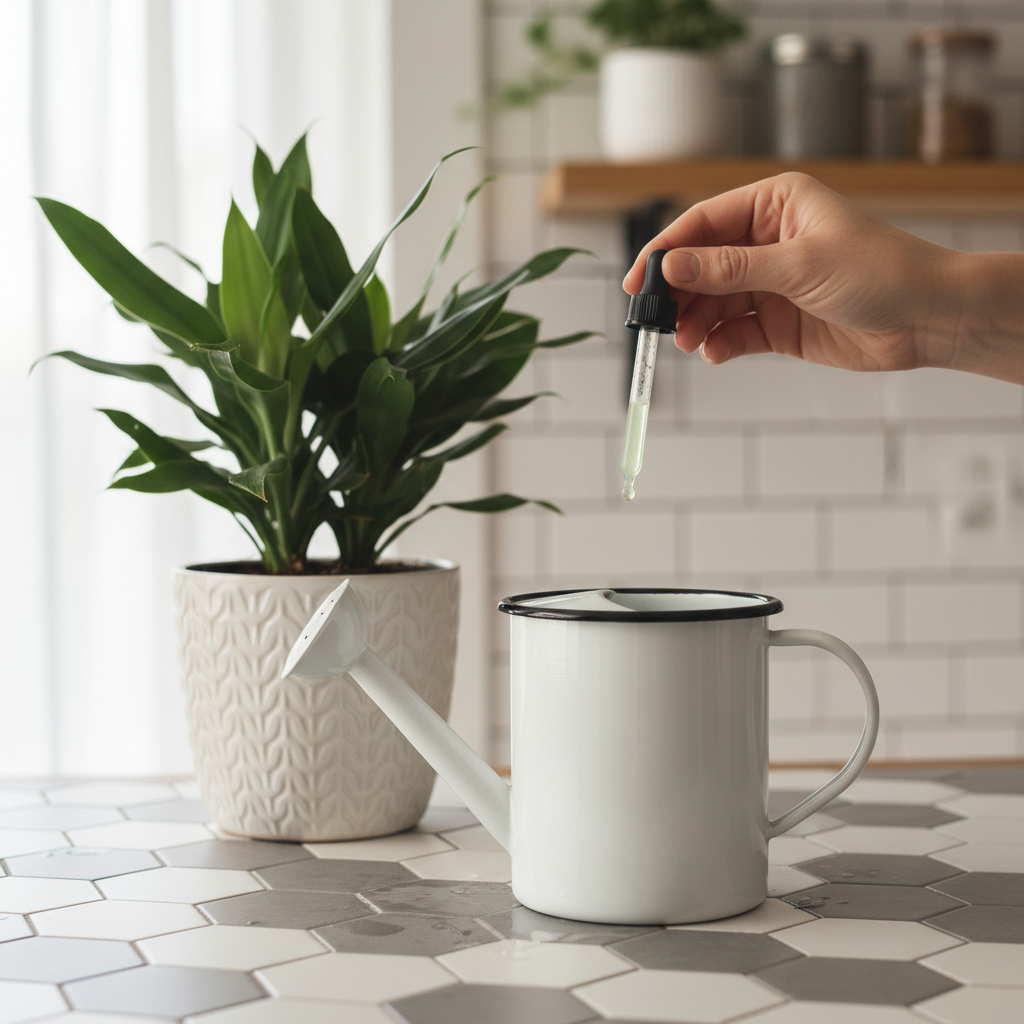
Liquid fertilisers: The easiest and most controllable option. Diluted into your watering can, they let you scale the dose precisely and flush out easily if you overdo it, which makes them ideal for a salt-sensitive plant.
Slow-release granular: Convenient for hands-off care, releasing nutrients gradually over months. The trade-off is less control, so use the lowest recommended rate and watch for any tip burn that suggests salt build-up.
Organic fertilisers: Worm castings, diluted seaweed and similar feeds release nutrients slowly and gently, and are very hard to overdo. They are a good match for the Janet Craig’s modest appetite and also support healthy soil life.
Feeding Schedule
Feed only during the active growing season, from spring through to late summer. A balanced liquid feed at half the recommended strength, applied roughly once a month, is plenty. Stop feeding entirely in autumn and winter, when the plant is resting and unused nutrients simply accumulate as harmful salts in the soil.
Pro Tip — Less Is More: When in doubt, underfeed. A Janet Craig will sit happily for months on lean rations, but a single heavy dose can scorch the roots and brown the leaf tips. Half strength, once a month, in the growing season only, is a safe rhythm for almost every home.
How to Fertilise
- Water the plant lightly first, since feeding dry roots can burn them.
- Dilute a balanced liquid fertiliser to half the label strength.
- Apply evenly to the soil, never onto the leaves.
- Let any excess drain away and empty the saucer.
- Every few months, flush the pot with plain water to wash out accumulated salts.
Warning — Salt Build-Up: A white crust on the soil surface or pot rim, paired with browning leaf tips, signals fertiliser salts accumulating in the soil. Flush the pot by running plenty of plain water through it until it drains freely, and scale back your feeding. Remember that these salts compound the plant’s fluoride sensitivity.
Propagation
Propagating a Janet Craig is one of the great satisfactions of growing it, partly because the same cuts that multiply the plant also let you control its height and rejuvenate a leggy specimen. The plant propagates readily from stem cuttings, and the canes are forgiving enough that beginners succeed reliably.
The key fact to understand is that new shoots emerge from dormant buds along the woody cane. When you cut a cane, the parent stub will usually sprout one or more new crowns just below the cut, while the removed top section can be rooted as a whole new plant. A single tall, bare plant can therefore become two or three bushier ones.
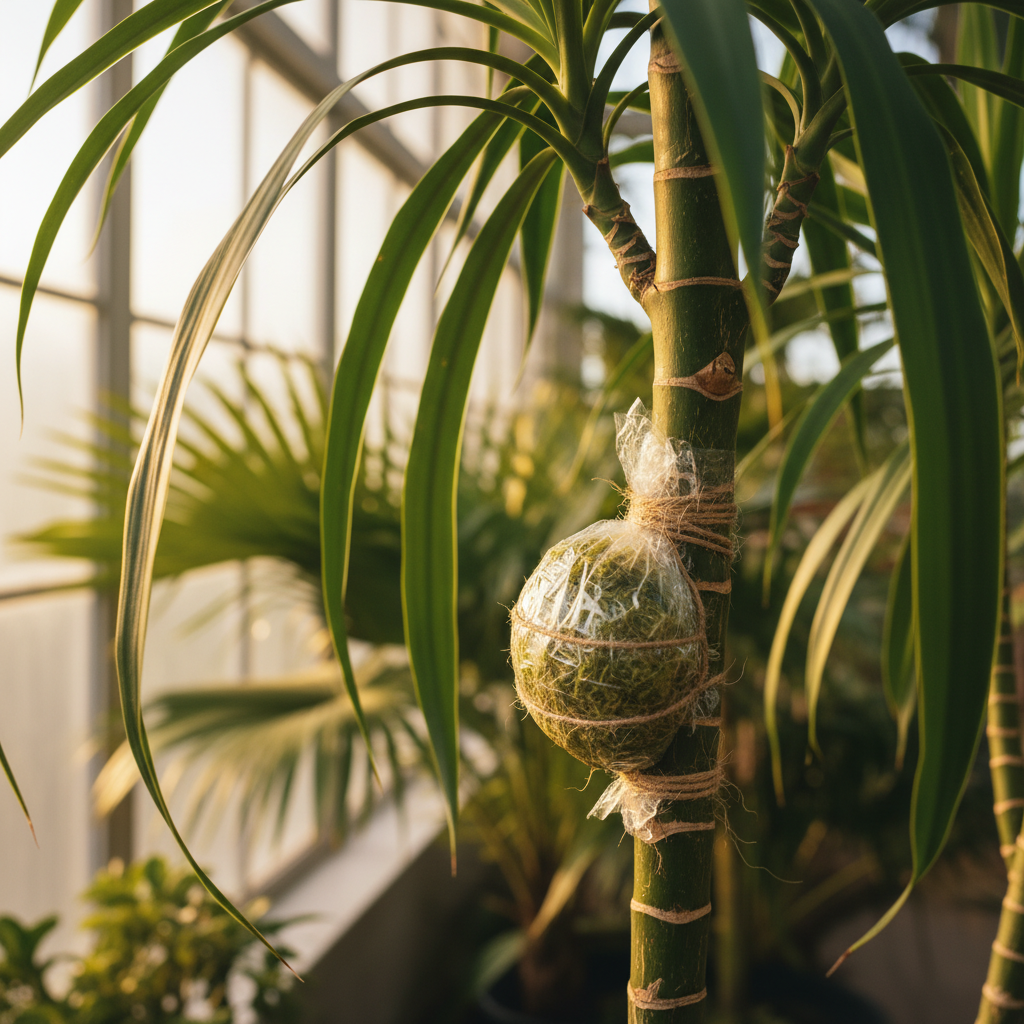
Understanding Cane Cuttings and Dormant Buds
Each Janet Craig cane carries rings where old leaves once attached, and beneath these rings sit dormant growth buds. Given light, warmth and moisture, those buds awaken: on a rooted cane they push out fresh crowns, and on a cut section placed in water or soil they drive new roots. Knowing this lets you cut with confidence, because you can predict where new growth will appear.
Stem Cuttings: Step-by-Step
The most common method, ideal for shortening a tall plant. Spring or early summer gives the fastest rooting.
- With clean, sharp secateurs, cut a healthy section of cane 15 to 20 cm (6 to 8 in) long, noting which end was uppermost.
- For a leafy tip cutting, keep the crown of leaves; for a bare cane cutting, you can take a leafless mid-section too.
- Let the cut ends air-dry and callus for a few hours to reduce the chance of rot.
- Place the cutting the right way up in a glass of clean water, or insert the base a few centimetres into moist, free-draining mix.
- Keep it warm and in bright indirect light, changing the water every few days if rooting in water.
- Roots typically appear within three to four weeks; pot up water-rooted cuttings once roots reach 3 to 5 cm (1 to 2 in).
Pro Tip — Mark the Top: Cane sections only root and sprout correctly when planted with their original orientation. As soon as you cut, dab the upper end or make an angled cut on the base so you never plant a section upside down, which is the most common reason cane cuttings fail.
Air Layering: Step-by-Step
A near-foolproof method for thick canes, air layering roots the new section while it is still attached to the parent, so it never wilts during rooting.
- Choose a point on the cane below the leafy crown and make a shallow upward nick or remove a thin ring of bark.
- Optionally dust the wound with rooting hormone to speed things along.
- Wrap the area in a generous handful of damp sphagnum moss.
- Enclose the moss in clear plastic film and tie it firmly above and below, keeping the moss moist throughout.
- After several weeks, roots will be visible through the film growing into the moss.
- Cut the cane just below the new root mass and pot up the rooted section, leaving the parent stub to resprout.
Troubleshooting Propagation
| Problem | Likely Cause | Solution |
|---|---|---|
| Cutting rots in water | Stagnant water or no callusing | Change water often; let cuts dry before rooting |
| No roots after many weeks | Too cold or too dark | Move somewhere warm with bright indirect light |
| Cane shrivels | Section planted upside down | Replant the right way up; mark the top next time |
| Parent cane does not resprout | Cut too low or plant stressed | Be patient and keep it warm; new buds can take weeks |
Pests & Diseases
A healthy Janet Craig is relatively pest-resistant, and most problems trace back to the growing conditions rather than to infestations. Even so, a few sap-feeding insects find their way onto indoor specimens, and a handful of diseases follow from overwatering, so it pays to know what to look for.
The best defence is routine observation. Glance over the leaves, especially their undersides and the points where they meet the cane, whenever you water, and you will catch nearly any issue while it is still easy to deal with.
Common Pests
Spider Mites (Tetranychus urticae)
The most likely pest, thriving in the warm, dry air that suits the plant. They are tiny and hard to see, but the fine pale stippling on the leaves and the delicate webbing in the leaf axils give them away. A heavy infestation leaves foliage dull and bronzed.
Treatment: Rinse the plant thoroughly in the shower, then treat with insecticidal soap or neem oil, covering the leaf undersides. Repeat every five to seven days for several cycles, and raise humidity to discourage their return.
Mealybugs (Pseudococcus species)
Small, soft insects coated in white, cottony wax, clustering in the protected crevices where leaves meet the cane. They feed on sap, weakening the plant and leaving behind sticky honeydew that can turn into sooty mould.
Treatment: Dab each insect with a cotton bud dipped in isopropyl alcohol, then follow up with insecticidal soap or neem oil. Inspect weekly, as mealybugs hide well and often stage a comeback.
Scale (Coccidae family)
Appearing as small brown or tan bumps along the canes and leaf undersides, scale insects are easy to mistake for part of the plant. They too excrete honeydew and slowly sap the plant’s vigour.
Treatment: Scrape off the bumps with a fingernail or an alcohol-dipped cotton bud, then treat with horticultural oil to smother any survivors. Persistent cases may need several rounds a week apart.
Common Diseases
Root Rot (Fusarium and Pythium species)
By far the most serious threat, caused by soil kept too wet for too long. Fungal pathogens attack the suffocated roots, which turn brown and mushy, and the damage shows above ground as yellowing leaves and a softening cane base.
Treatment: Unpot the plant, cut away all affected roots with sterilised tools, and repot into fresh, fast-draining mix in a clean pot. Then correct the watering habits that caused it, as prevention is the only reliable cure.
Leaf Spot (Fusarium and bacterial pathogens)
Shows as tan or brown spots, sometimes with a yellow halo, usually after water has been left sitting on the foliage or in conditions of poor air circulation. It is rarely fatal but disfigures the leaves.
Treatment: Remove affected leaves, avoid wetting the foliage when watering, and improve airflow around the plant. A copper-based fungicide can help in stubborn cases.
Pest and Disease Summary
| Pest / Disease | Identification | Treatment |
|---|---|---|
| Spider mites | Fine stippling and webbing | Rinse, then neem oil or insecticidal soap |
| Mealybugs | White cottony clusters in axils | Alcohol swab, then insecticidal soap |
| Scale | Brown bumps on canes and leaves | Scrape off, then horticultural oil |
| Root rot | Yellow leaves, mushy roots and cane base | Trim roots, repot, fix watering |
| Leaf spot | Brown spots, often with yellow halo | Remove leaves, keep foliage dry |
Prevention Strategies
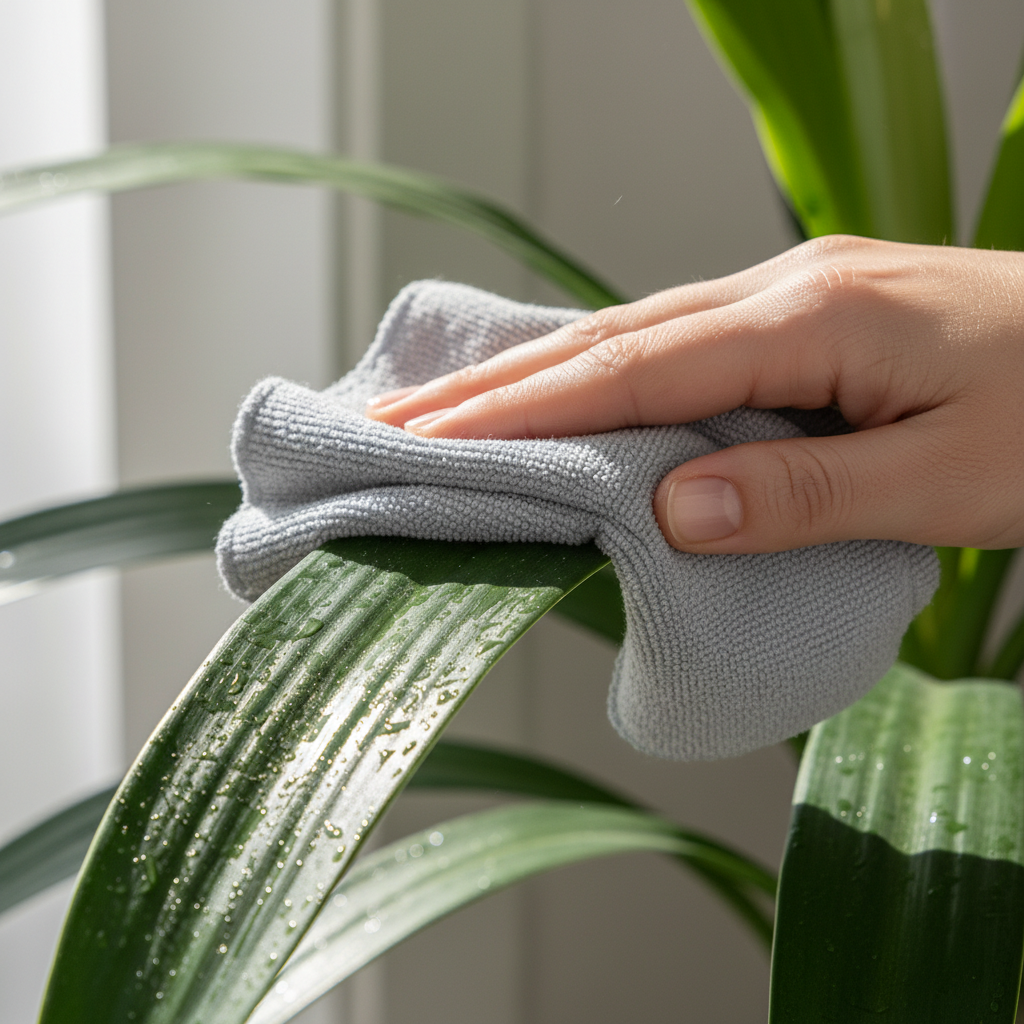
Prevention is overwhelmingly a matter of good husbandry. Keep the watering correct so the roots never suffocate, give the plant decent light and airflow, and wipe the broad leaves now and then to remove dust and to give yourself a regular chance to inspect them. A clean, unstressed plant rarely attracts trouble.
Quarantine any new plant for a couple of weeks before placing it near your Janet Craig, since most infestations arrive on a recent purchase. If you do find a pest, act early and isolate the plant while you treat it, which stops a minor problem spreading through your collection.
Pro Tip — Neem as Routine: A light monthly wipe or spray of diluted neem oil during the growing season works as a gentle preventative, deterring sap-feeders before they establish. Apply it out of direct sun so the treated leaves do not scorch, and always cover the undersides where pests hide.
Popular Varieties
The Janet Craig is itself a cultivar of Dracaena fragrans, the corn plant, and sits within a broad and confusingly named group of related selections. Some are close cousins distinguished by size, others by variegation, and a few are commonly sold under the Janet Craig banner despite belonging to the wider fragrans complex.
Knowing the main players helps you choose the right form for your space and avoid the muddle of overlapping trade names. The table and profiles below cover the cultivars you are most likely to meet.
| Variety | Leaf Appearance | Light Needs | Growth Rate | Availability |
|---|---|---|---|---|
| ‘Janet Craig’ | Broad, glossy, solid deep green | Low to bright indirect | Slow | Common |
| ‘Janet Craig Compacta’ | Short, stiff, tightly packed dark green | Low to medium | Very slow | Common |
| ‘Warneckii’ | Grey-green with white and green stripes | Medium to bright indirect | Slow | Common |
| ‘Lemon Lime’ | Bright chartreuse edges, green centre | Medium to bright indirect | Slow | Common |
| ‘Massangeana’ (corn plant) | Wide, arching, yellow central stripe | Medium to bright indirect | Slow | Very common |
| ‘Lisa’ | Dark green, very upright, narrow | Low to medium | Slow | Common |
Featured Varieties
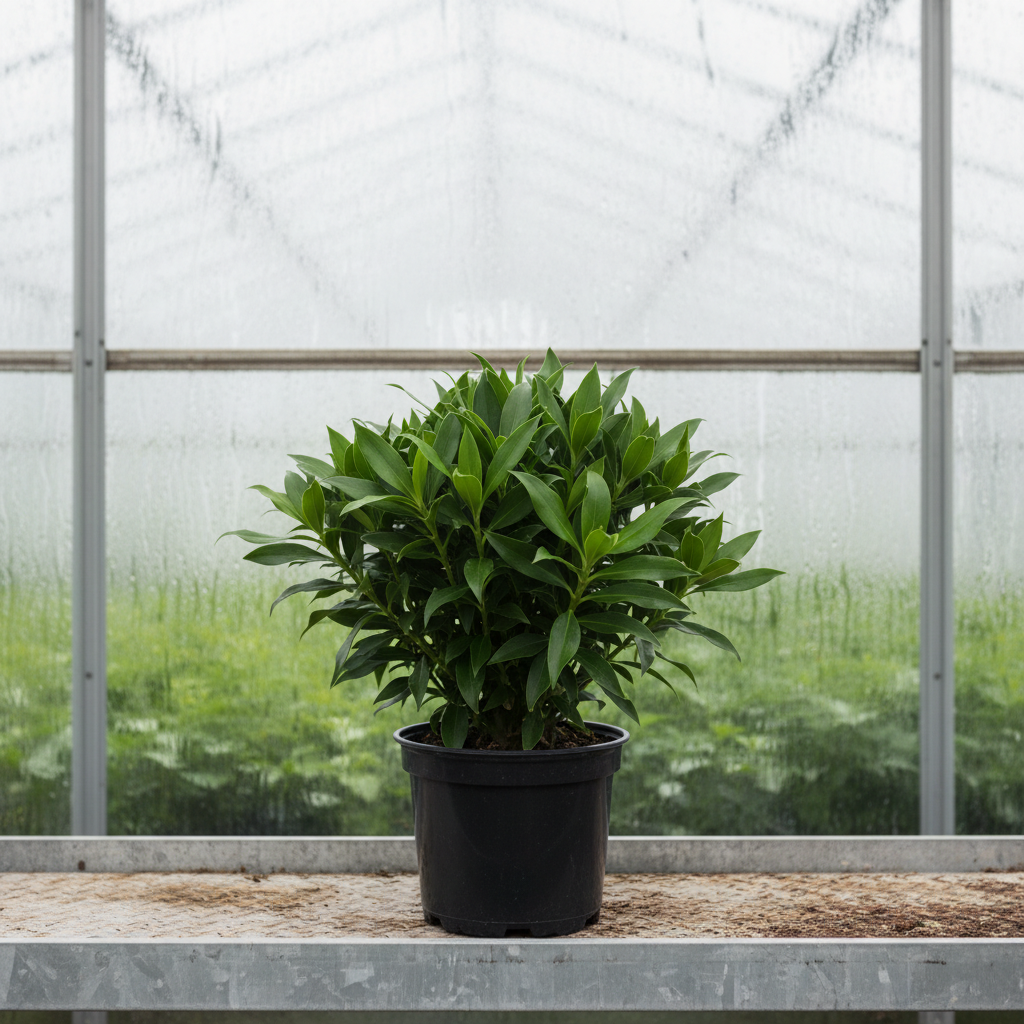
‘Janet Craig Compacta’
A dwarf form with short, stiff, tightly packed dark green leaves clustered around a stubby central stem. Exceptionally slow and tidy, it suits desks and shelves where the full-size plant would be too large.
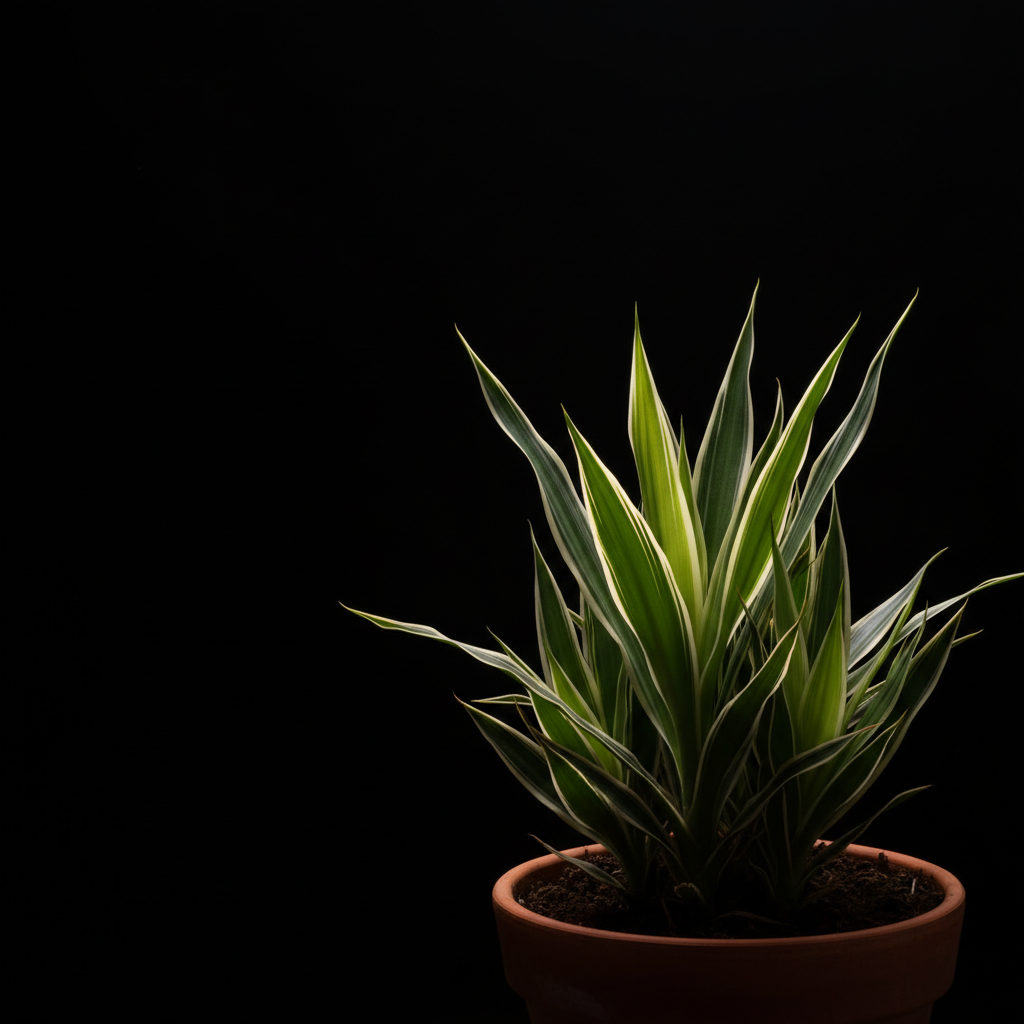
‘Warneckii’
An upright relative with sword-shaped leaves whose grey-green centres are edged by crisp vertical white and green pinstripes. It wants a touch more light than the plain Janet Craig to keep its striping sharp.
Variety Profiles in Detail
‘Janet Craig Compacta’ (Dracaena fragrans ‘Compacta’)
Often sold simply as ‘Compacta’, this is the dwarf expression of the Janet Craig, with the same glossy deep-green colouring condensed into a dense rosette of short, rigid leaves. Its painfully slow growth is part of the appeal, since it holds its compact shape for years and needs even less attention than its larger parent. It is an excellent choice for smaller rooms, bookshelves and low-light desks.
‘Warneckii’ (Dracaena fragrans ‘Warneckii’)
A long-cultivated striped form of Dracaena fragrans, ‘Warneckii’ carries the same upright, cane-forming habit but adds bold longitudinal stripes in white, grey-green and deep green. The variegation lifts a dim corner without the maintenance of a true variegate, though it does appreciate slightly brighter indirect light than the all-green Janet Craig to keep the contrast strong.
‘Lemon Lime’ (Dracaena fragrans ‘Lemon Lime’)
A vivid cousin in the same group, ‘Lemon Lime’ edges each leaf with bright chartreuse against a green centre, for a far more luminous effect than any of the green forms. It shares the same easy care but, like other variegated dracaenas, holds its colour best in good medium to bright indirect light.
Choosing the Right Variety for Your Space
For the darkest corners and the lowest-effort care, the plain Janet Craig or its Compacta form are unbeatable, since neither has variegation to maintain. If you want colour and can offer a brighter spot, ‘Warneckii’ and ‘Lemon Lime’ bring pattern and zing at the cost of a little more light. And where you want the classic tree-like silhouette with a soft arching crown, the yellow-striped corn plant ‘Massangeana’ remains the archetype. All share the same forgiving constitution, so the choice comes down to size, light and the look you are after.
Frequently Asked Questions
Why are the tips of my Janet Craig turning brown?
Brown leaf tips are usually a sign of fluoride or salt in the water rather than a humidity problem. Dracaena are unusually sensitive to fluoride, which collects in the leaf tips and kills the tissue. Switch to rainwater, distilled or filtered water, flush the pot occasionally to clear built-up salts, and ease off the fertiliser.
How big does a Janet Craig dracaena get indoors?
Given time and reasonable light, a Janet Craig can reach 2 to 3 metres (about 6 to 10 ft) indoors, growing as an upright, multi-caned plant. It is slow, though, often gaining only a few centimetres a year, and you can keep it shorter by cutting back the canes, which also encourages a fuller habit.
Is the Janet Craig dracaena safe for cats and dogs?
No. Like all dracaenas it contains saponins that are toxic to cats and dogs, causing vomiting, drooling, loss of appetite and lethargy if eaten, with dilated pupils sometimes seen in cats. Keep it out of reach of pets, and contact a vet if your animal has chewed a significant amount.
Why are the lower leaves yellowing and dropping?
Some shedding of the oldest, lowest leaves is entirely normal as the plant grows taller and develops bare canes. If many leaves yellow at once and the soil is wet, however, suspect overwatering and check the roots. Steady loss of the lowest leaves over time is just the plant’s natural habit.
Can a Janet Craig really grow in a windowless office?
Yes, which is exactly why it is an interior-landscaping favourite. It survives and even grows slowly under nothing but overhead office lighting run for ten to twelve hours a day. Growth will be minimal in such conditions, but the plant will stay green and healthy for years.
How often should I water my Janet Craig?
Water only when the top 5 to 7 cm (2 to 3 in) of soil has dried out, which tends to be every ten to fourteen days in summer and considerably less in winter. Always go by the feel of the soil rather than a fixed schedule, since light, warmth and pot size all change how fast it dries.
My plant has become tall and leggy. What can I do?
Legginess usually means too little light, so move the plant somewhere brighter first. To fix the shape, cut the cane back to the height you want with clean secateurs; the stub will sprout new crowns below the cut, and you can root the removed top as a brand-new plant.
Does the Janet Craig flower indoors?
It can, but rarely, and only on mature, well-established plants. The species is famously fragrant in bloom, producing sprays of small, intensely scented flowers, but indoor specimens grown chiefly for foliage seldom reach the conditions needed to flower, so it is best treated as a leafy plant.






