
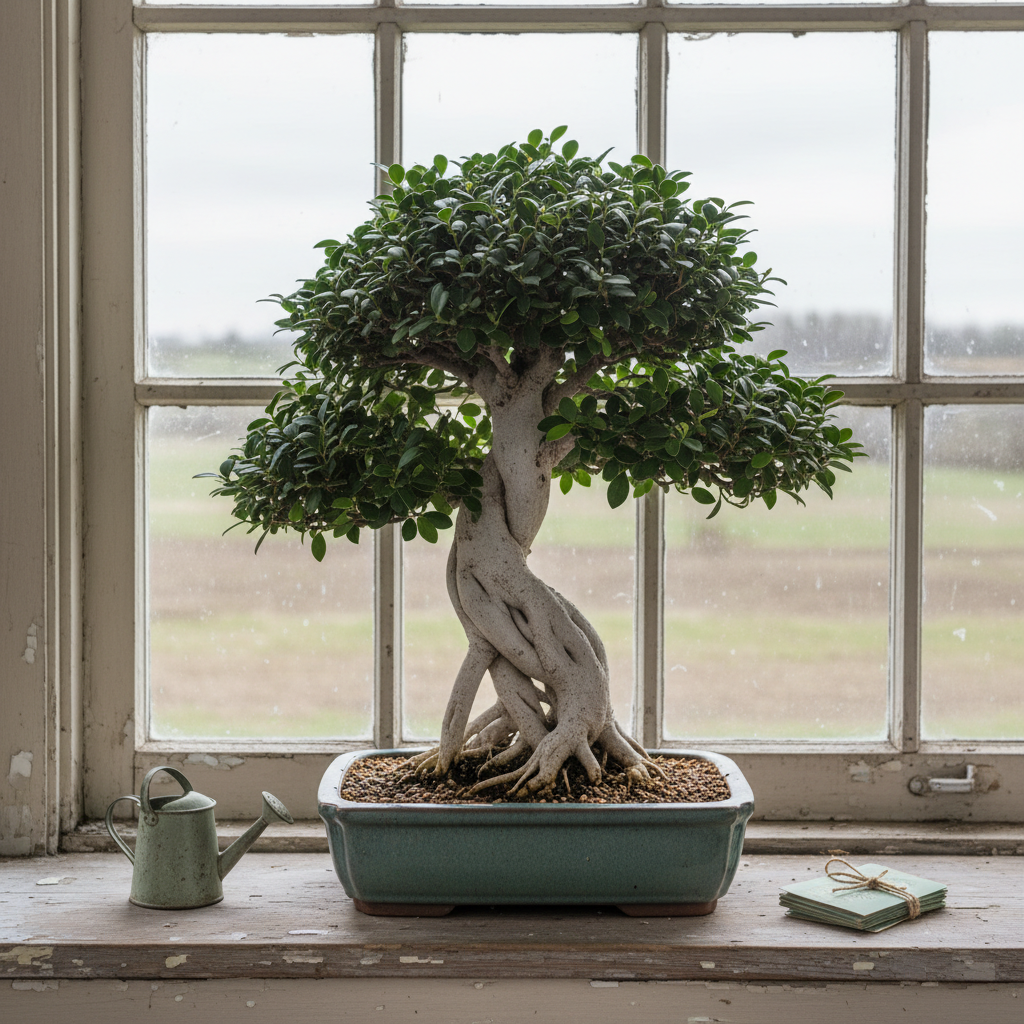
The bonsai ficus is the tree that has introduced more people to bonsai than almost any other, and for good reason. Grown from Ficus retusa, a subtropical fig native to the warm forests of southern China, Southeast Asia and northern Australia, it carries all the romance of a centuries-old banyan in a form small enough to sit on a windowsill. In the wild this species swells into a vast strangler fig draped in aerial roots, but trained as a miniature tree it offers a thick, characterful trunk, a fine network of branches and a glossy green canopy that responds eagerly to pruning. It is sometimes sold under the name Ficus microcarpa, and the two are so often confused in the trade that the labels are effectively interchangeable on shop shelves.
What makes this tree special is not just its looks but its temperament. Where many bonsai demand cool dormancy, careful humidity and an experienced hand, the bonsai ficus shrugs off dry indoor air, recovers quickly from mistakes and grows fast enough that beginners can actually see the results of their pruning within a season. That forgiving nature is exactly why it earns a place as a houseplant rather than a specialist’s obsession. This guide covers everything you need to take a bonsai ficus from merely surviving on a shelf to genuinely thriving: how to read its light, water and feed it correctly, choose the right soil and pot, propagate new trees, handle pests and diseases, and recognise the popular varieties you are most likely to encounter.
Contents
- Quick Reference
- Why Bonsai Ficus Makes a Forgiving Houseplant
- Light Requirements
- Watering & Humidity
- Soil, Potting & Repotting
- Fertilising
- Propagation
- Pests & Diseases
- Popular Varieties
- Frequently Asked Questions
Quick Reference: Bonsai Ficus at a Glance
| Light | Bright light with several hours of direct sun; tolerates medium light but growth and ramification suffer. |
| Watering | Water thoroughly once the surface of the soil starts to dry; shallow bonsai pots dry quickly, so check often. |
| Temperature | 15 to 24 degrees Celsius (59 to 75 degrees Fahrenheit); keep above 12 degrees Celsius (54 degrees Fahrenheit) and away from cold draughts. |
| Humidity | Tolerates average household humidity; 50 percent or higher encourages lush growth and aerial roots. |
| Fertiliser | Balanced feed every two to four weeks in spring and summer, reduced through autumn and winter. |
| Toxicity | Mildly toxic to cats, dogs and humans; the milky latex sap irritates skin, mouth and stomach. |
Why Bonsai Ficus Makes a Forgiving Houseplant
Most bonsai species are really outdoor trees that have been miniaturised, which means they need a cold winter rest and resent life indoors. The bonsai ficus is the great exception. As a tropical and subtropical plant it is perfectly happy in the warm, stable conditions of a living room all year round, with no dormancy requirement to manage. This single difference removes the biggest hurdle that defeats most newcomers to bonsai and is why nurseries reach for the ficus when someone asks for their very first tree.
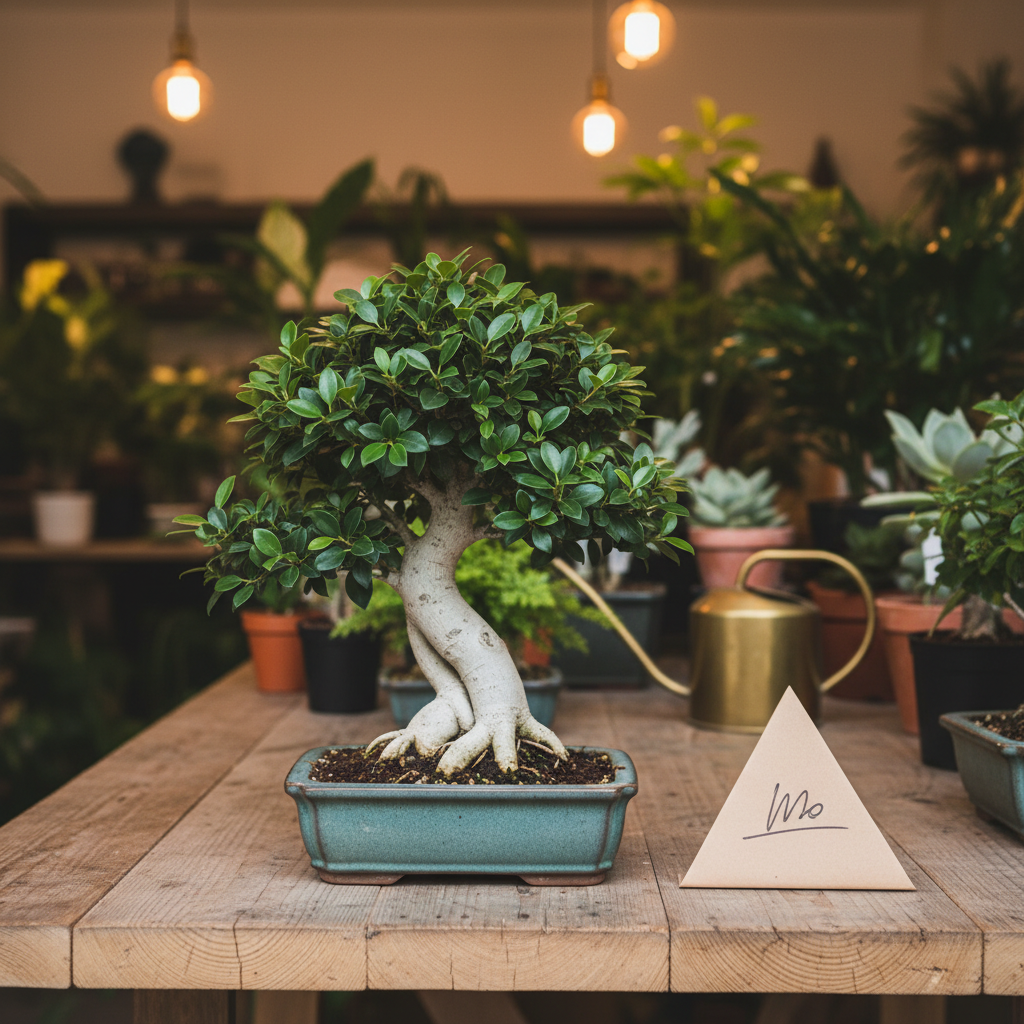
Beyond its tolerance, the bonsai ficus has a vigour that flatters the grower. It back-buds readily, meaning new shoots break from old wood after pruning, so an overgrown or leggy tree can be cut hard and will quickly refurnish itself with foliage. It thickens its trunk faster than most bonsai subjects, develops a handsome grey bark with pale flecking, and freely produces aerial roots that can be trained down into the soil to create the dramatic buttressed look of a mature banyan. For a beginner, watching a tree respond so willingly to each intervention is enormously encouraging, and it shortens the long apprenticeship that other species demand.
Important — Toxicity: Every part of the bonsai ficus contains a milky white latex that seeps from cut stems and broken leaves. This sap is mildly toxic to cats and dogs and can cause drooling, mouth irritation, vomiting and loss of appetite if chewed. In people it is a known skin irritant and allergen, so wear gloves when pruning if you have sensitive skin, and keep the tree out of reach of pets that like to nibble.
Light Requirements
Light is the single biggest factor separating a bonsai ficus that merely clings to life from one that grows densely and develops fine branching. As a tree adapted to bright tropical clearings, it wants as much light as you can give it indoors, and the more it receives the shorter its internodes become, which is exactly what you want when training a miniature tree with a believable sense of scale.
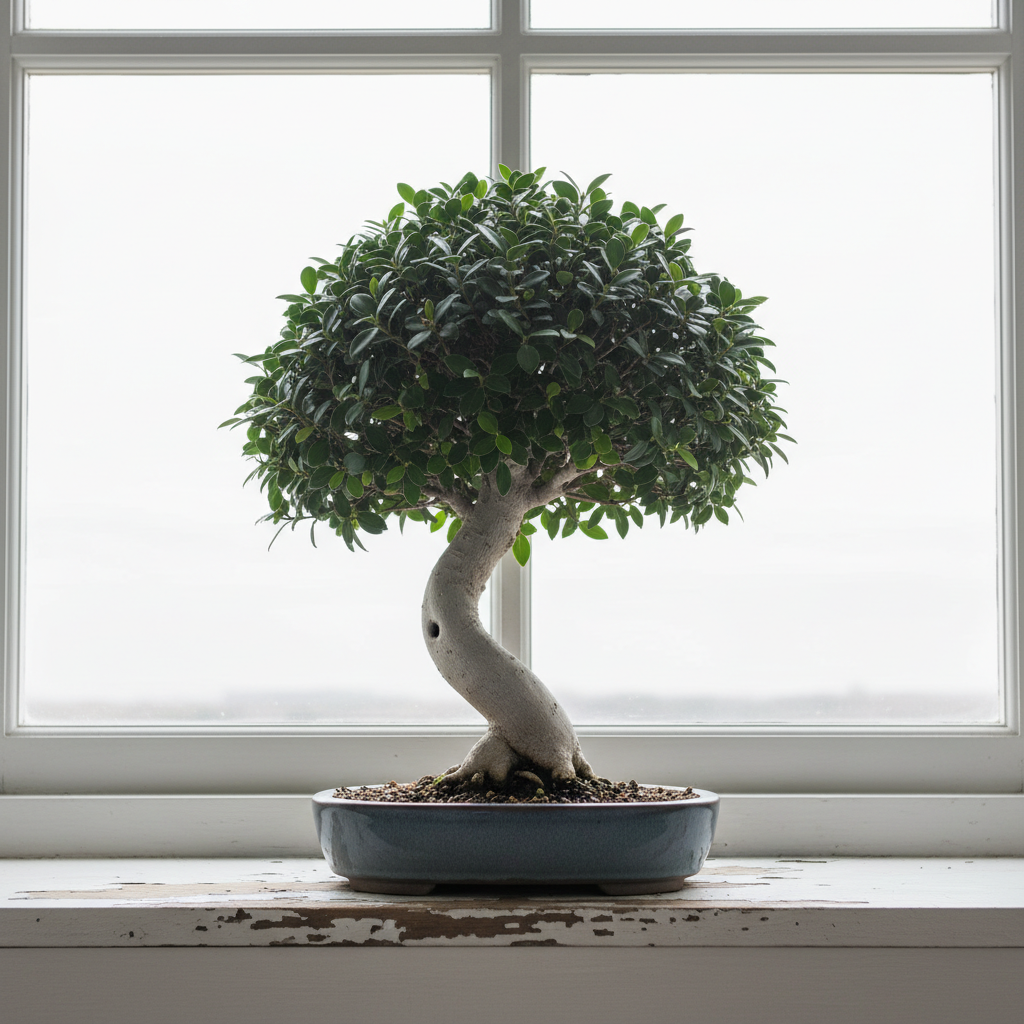
The ideal position is directly in front of a bright window where the tree catches several hours of gentle direct sun each day, supplemented by strong indirect light for the rest of the daylight hours. In summer a ficus bonsai thrives if moved outdoors to a sheltered, sunny spot, where the increased light and air movement produce the strongest growth of the year. Indoors all year, aim to give it the brightest sill in the house.
Light Levels Explained
Understanding how different light intensities translate into real positions in your home makes it much easier to place the tree well. The figures below are approximate but give a useful sense of where a bonsai ficus belongs.
| Light Category | Approx. Level | Typical Location | Outcome |
|---|---|---|---|
| Direct sun | 20,000 lux and above | On a south or east sill, or outdoors in summer | Dense growth, short internodes, strongest ramification |
| Bright indirect | 10,000 to 20,000 lux | Just back from a sunny window | Healthy, steady growth; the reliable everyday position |
| Medium | 5,000 to 10,000 lux | A few metres into a bright room | Survives, but leggier shoots and slower thickening |
| Low | 1,000 to 5,000 lux | North-facing room or interior wall | Leaf drop, weak growth, gradual decline over months |
| Very low | Below 1,000 lux | Hallway or windowless corner | Unsustainable; the tree will defoliate and fail |
Window Orientation and Placement
South-facing window: The best position in most homes. A south sill delivers the long hours of bright light and direct sun that drive compact, vigorous growth. In the height of summer, a sheer curtain can soften the most intense midday rays if the foliage shows any sign of scorching.
East-facing window: An excellent choice. The tree receives gentle direct morning sun followed by bright indirect light through the afternoon, which suits a ficus beautifully and rarely risks leaf scorch.
West-facing window: Also very good. Afternoon sun is stronger and warmer than morning sun, so watch for drying soil and the occasional scorched leaf during a summer heatwave, but in general a west sill keeps a ficus growing well.
North-facing window: The weakest option. A ficus will hang on at a north window but growth will be sparse and elongated, and through the dark months it may shed leaves. If a north aspect is all you have, plan to supplement with a grow light.
Pro Tip — Rotate for Symmetry: A bonsai ficus grows towards its light source, so turn the pot a quarter turn each week. This keeps the canopy balanced on all sides and stops the tree from leaning awkwardly towards the glass, which matters far more on a styled bonsai than on an ordinary houseplant.
How Light Affects Leaf Size and Ramification
One of the quiet rewards of growing a ficus in strong light is that its leaves stay small and its branching grows fine. In bright conditions the tree produces short gaps between leaves and many small twigs, the qualities that make a miniature tree convincing. In dim light the opposite happens: leaves enlarge, stems stretch and the whole tree loses the delicacy that defines good bonsai. Many growers use a summer outdoors in full light specifically to reduce leaf size and tighten the structure before bringing the tree back in.
Warning — Sudden Light Changes: A bonsai ficus dislikes abrupt changes more than it dislikes any particular light level. Moving a tree straight from a dim room into blazing summer sun, or from outdoors back into a dark interior, often triggers a wave of leaf drop. Make any change in position gradual over a week or two so the tree can acclimatise.
Artificial Lighting
Because the bonsai ficus is grown indoors so often, it responds very well to supplementary lighting. A full-spectrum LED grow light positioned 20 to 30 centimetres (8 to 12 inches) above the canopy and run for ten to twelve hours a day will keep a tree thriving even in a room with poor natural light. Growers in northern climates frequently rely on grow lights through the short winter days to prevent the seasonal leaf drop that dim conditions otherwise cause.
Seasonal Adjustments
Light intensity indoors falls dramatically between summer and winter, both because the sun sits lower and because we tend to keep trees further from cold glass. Move your ficus to the brightest available window as autumn arrives, consider adding a grow light from late autumn through early spring, and expect slower growth during the darkest weeks. As days lengthen again in spring, the tree will wake up and resume the strong growth that makes summer the main season for pruning and shaping.
Watering & Humidity
Watering a bonsai ficus is different from watering an ordinary potted plant, because the shallow bonsai tray holds little soil and dries out far faster than a deep nursery pot. The goal is to keep the rootball evenly moist during active growth without ever letting it sit waterlogged, and the only reliable way to manage that is to check the soil by hand rather than watering on a fixed schedule.
When to Water
Feel the soil surface with a fingertip each day. When the top centimetre (around half an inch) has begun to dry but the layer beneath is still slightly damp, it is time to water. In a warm, bright spot during summer this can mean watering every day or even twice a day, while in the cool, dim weeks of winter the same tree may need water only every few days.
A ficus is more tolerant of brief dryness than of constant sogginess, but do not push it to the point of wilting, because a bonsai in a tiny volume of soil has no reserve to fall back on. The texture of free-draining bonsai soil makes overwatering hard to achieve as long as the pot has open drainage holes, so the more common mistake by far is simply forgetting to water often enough in hot weather.
Pro Tip — The Weight Test: Lift the pot just after a thorough watering and again when the soil has dried out, and commit the two weights to memory. A well-watered bonsai feels noticeably heavier than a dry one, and within a week this simple heft test becomes more reliable than any moisture meter for judging when to water.
How to Water Correctly
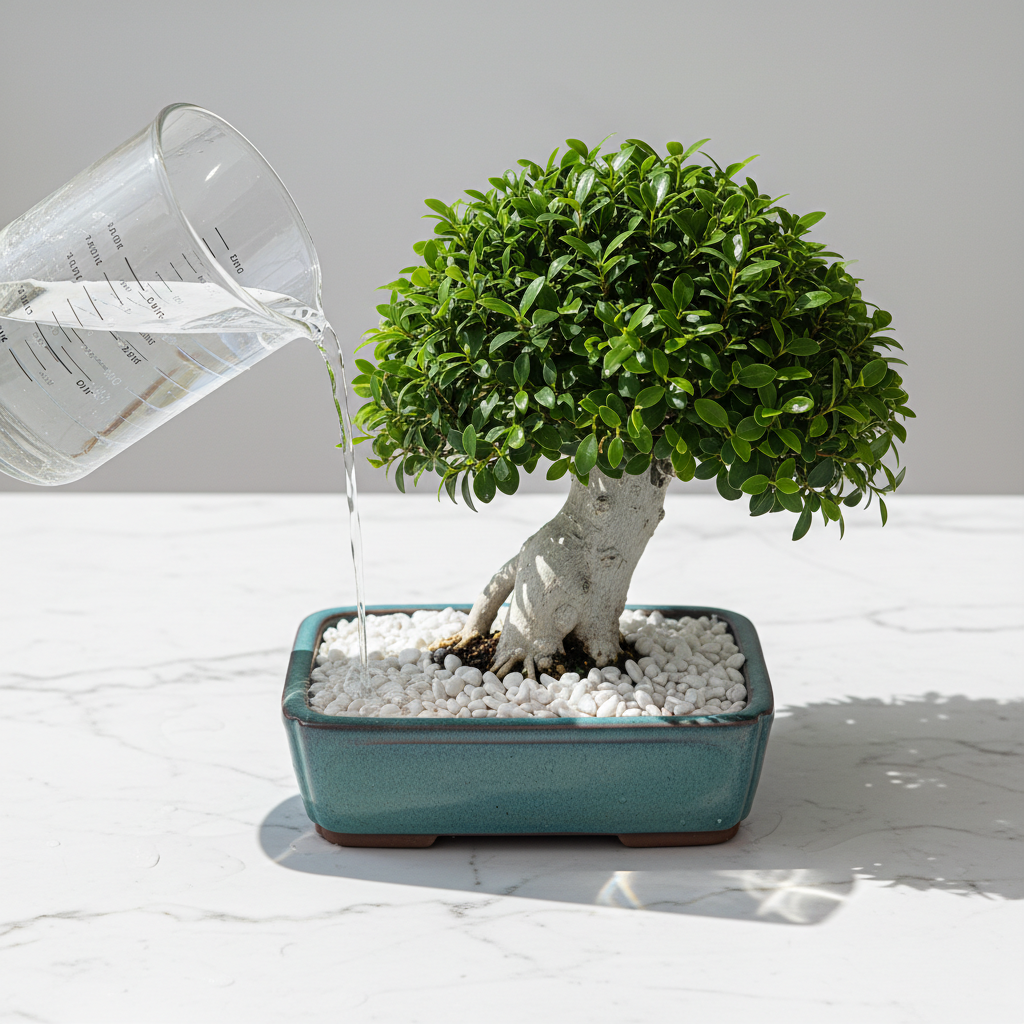
- Use a watering can with a fine rose or a gentle stream so you do not wash the loose bonsai soil out of the shallow tray.
- Water the entire surface evenly, letting it soak in, then water again until water flows freely from the drainage holes beneath.
- If the soil is very dry and water runs straight through without wetting the core, stand the whole pot in a shallow basin of water for ten minutes to rehydrate the rootball from below.
- Allow the pot to drain completely and never leave it standing in a saucer of water, which suffocates the roots.
- Tip away any water that collects in the display tray once the pot has finished draining.
Signs of Overwatering vs. Underwatering
| Symptom | Overwatering | Underwatering |
|---|---|---|
| Leaf colour | Yellowing of many leaves, often from the inside of the canopy outward | Leaves dull, then yellow and brown at the tips and edges |
| Leaf texture | Soft, limp leaves that drop while still green | Dry, crisp leaves that curl before falling |
| Soil | Stays wet for days, may smell sour or grow algae on the surface | Bone dry, pulling away from the sides of the pot |
| Roots | Dark, soft and foul-smelling when inspected | Pale and intact but dry and brittle at the tips |
| Overall vigour | General decline despite frequent watering | Sudden wilting that perks up after a thorough soak |
Warning — Root Rot: Soil that never dries, a sour smell from the pot and leaves dropping while still green together point to root rot. Lift the tree, trim away any blackened mushy roots with sterile scissors, repot into fresh free-draining bonsai soil, and water sparingly until new growth signals that the surviving roots have recovered.
Humidity Requirements
The bonsai ficus is unusually tolerant of dry indoor air for a tropical tree, which is another reason it succeeds where fussier species fail. It will grow perfectly well at the 40 to 50 percent humidity typical of a heated home. That said, higher humidity of 50 percent and above brings out the best in the species, encouraging glossier foliage and, importantly for bonsai, the development of aerial roots that can be trained into dramatic trunk and root features.
Very dry air, such as the parched conditions beside a radiator in winter, can cause some leaf drop and slower growth. The tree rarely suffers the brown leaf tips that afflict more delicate plants, but if you want lush growth and aerial roots it is worth raising the local humidity around the tree.
The easiest ways to lift humidity are to stand the pot on a tray of damp gravel, group it with other plants, or run a small humidifier nearby during the dry winter months. Serious growers sometimes build a humid enclosure to fatten aerial roots quickly, but for everyday indoor culture none of this is essential to keep a ficus healthy.
Water Quality
A bonsai ficus is not fussy about water quality and copes well with ordinary tap water in most areas. In regions with very hard water, mineral salts can build up in the small volume of bonsai soil over time, so periodic flushing with a generous watering, or the occasional use of rainwater, helps keep the substrate sweet. Room-temperature water is always kinder than cold water straight from the tap, which can shock warm tropical roots.
Soil, Potting & Repotting
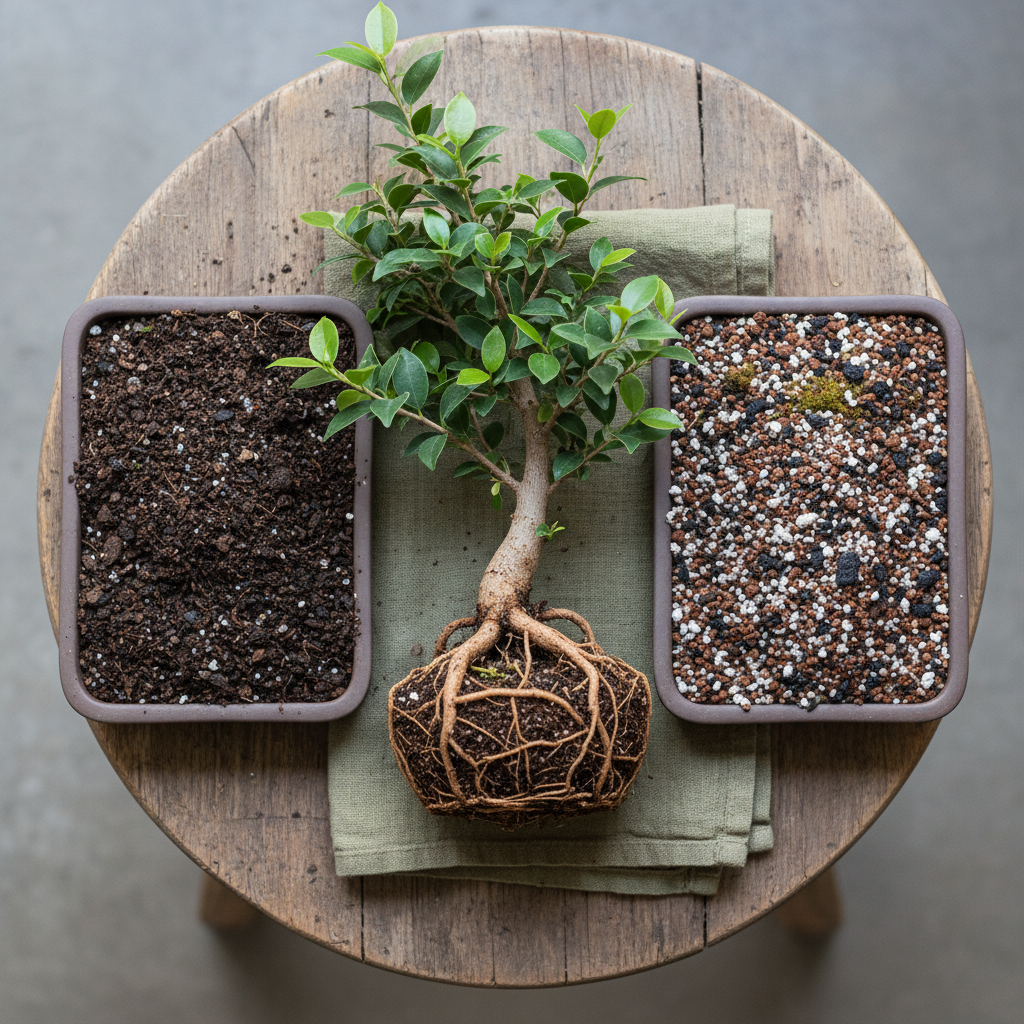
Soil matters more for bonsai than for any ordinary houseplant, because the tree must live for years in a shallow tray holding only a handful of substrate. That soil has to drain fast enough to prevent rot, yet retain enough moisture and nutrients to sustain a vigorous tree between waterings. Ordinary potting compost is too dense and water-retentive for the job and will eventually drown the roots.
Ideal Soil Composition
A good bonsai ficus mix is built from coarse inorganic granules that hold their structure for years, combined with a smaller proportion of organic matter for moisture and nutrient retention. The classic blend uses akadama, a fired Japanese clay, alongside pumice and lava rock, with a little composted bark. Many growers find a simpler mix of equal parts inorganic grit and quality bonsai compost works perfectly well for an indoor ficus.
| Component | Proportion | Function |
|---|---|---|
| Akadama | 40 percent | Retains moisture and nutrients while staying open; the backbone of most bonsai mixes |
| Pumice | 30 percent | Adds drainage and air to the rootzone and encourages fine root growth |
| Lava rock | 15 percent | Provides structure and sharp drainage that resists compaction |
| Composted bark or fine compost | 15 percent | Holds moisture and supplies organic nutrients between feeds |
The bonsai ficus prefers a slightly acidic to neutral soil, roughly pH 6.0 to 7.0, which the ingredients above naturally provide. It is far more sensitive to drainage and aeration than to small swings in pH, so concentrate on getting an open, free-draining structure rather than fine-tuning acidity.
Pro Tip — Quick Mix Recipe: If you cannot source individual bonsai components, mix two parts of a ready-made bonsai soil with one part horticultural grit or perlite. This simple blend drains freely, resists compaction and will keep a ficus healthy for the two to three years between repottings.
Choosing the Right Pot
The bonsai pot is part of the composition, not just a container, and its shallow proportions are what force the tree to stay miniature. For a ficus, a pot that complements the heavy trunk, often a slightly deeper rectangular or oval glazed container, balances the visual weight of the tree, but the practical requirements matter just as much as the aesthetics.
Drainage holes are non-negotiable. A bonsai pot must have one or more generous drainage holes, and ideally smaller wiring holes too. Without free drainage the limited soil stays saturated and root rot is almost guaranteed. The drainage holes also let you pass an anchoring wire up to hold the tree firmly while its roots establish.
Pot material: Glazed and unglazed ceramic bonsai pots are the traditional and best choice, being frost resistant, stable and attractive. Glazed pots suit the lush green ficus particularly well. Plastic training pots are fine and cheaper while a tree is being developed, but a finished ficus deserves a proper ceramic container.
Pot size: Bonsai pots are deliberately small to restrict growth, but a ficus in development can be grown in a larger training pot to thicken its trunk faster before it is moved into a shallow display pot. As a rule the pot length is roughly two thirds the height of the tree, with a depth close to the diameter of the trunk base.
When to Repot
A bonsai ficus typically needs repotting every two to three years, while a young tree in active development may need it annually. The clearest signal is roots circling the bottom of the pot or emerging from the drainage holes, along with water that sits on the surface and drains slowly because the rootball has filled the container. The best time to repot is early spring, just as the tree wakes into growth and can heal cut roots quickly, though the ever-tolerant ficus can in practice be repotted at almost any time in the warm growing season.
How to Repot: Step-by-Step
- Water the tree the day before so the rootball is moist but not soggy, which makes the roots easier to work.
- Ease the tree out of its pot and gently rake away the outer layer of old soil to expose the roots, working from the edges inward.
- Using sharp, clean scissors, trim back up to a third of the root mass, removing the thickest old roots and any dead or rotten material to encourage fine feeder roots.
- Cover the drainage holes with mesh, add a layer of fresh bonsai soil, and position the tree, passing an anchoring wire up through the holes to hold it firm.
- Work fresh soil in around and beneath the roots with a chopstick, leaving no air pockets, then firm it gently.
- Water thoroughly until it runs clear from the holes, and keep the freshly repotted tree out of strong sun and wind for two to three weeks while it recovers.
Warning — Transplant Shock: Even a tough ficus can sulk after a hard root prune, dropping some leaves as it rebalances roots and canopy. Keep it warm, shaded and only lightly watered until new growth appears, and resist the urge to fertilise for a month, because feeding damaged roots can scorch them rather than help.
Fertilising
Because a bonsai ficus lives in such a small volume of soil, the modest reserve of nutrients in that substrate is quickly exhausted, and regular feeding is what keeps the tree growing strongly enough to develop fine branching. Fertiliser does not make a bonsai grow larger, since pruning controls size, but it fuels the vigorous response to pruning that lets you refine the tree year on year.
The principle is to feed regularly but at modest strength through the growing season, and to ease off as growth slows in autumn and winter. A ficus that is fed well in spring and summer will reward you with the dense flush of new shoots that bonsai work depends on.
Understanding Plant Nutrients
Fertilisers are labelled with their ratio of the three major nutrients, nitrogen, phosphorus and potassium, shown as NPK. A balanced feed suits a ficus for most of the year, though a slightly higher nitrogen content in spring supports the strong leafy growth that gives you material to prune and shape.
| Nutrient | Symbol | Primary Function | Deficiency Symptoms |
|---|---|---|---|
| Nitrogen | N | Drives leaf and shoot growth and rich green colour | Pale, yellowing older leaves and weak, slow growth |
| Phosphorus | P | Supports root development and overall vigour | Stunted growth and dull, sometimes purplish foliage |
| Potassium | K | Strengthens cell walls and improves stress resistance | Yellow or scorched leaf margins and weak stems |
| Calcium | Ca | Builds strong cell structure and healthy new growth | Deformed or hooked new leaves and shoot dieback |
| Magnesium | Mg | Central to chlorophyll and photosynthesis | Yellowing between the veins of older leaves |
| Iron | Fe | Essential for chlorophyll formation in new leaves | Yellowing between the veins of the youngest leaves |
Types of Fertiliser
Liquid fertilisers: Diluted liquid feeds are the easiest way to fertilise a bonsai ficus, mixing into the watering can and reaching the roots immediately. Use them at half the recommended strength every two weeks during the growing season for steady, controllable nutrition.
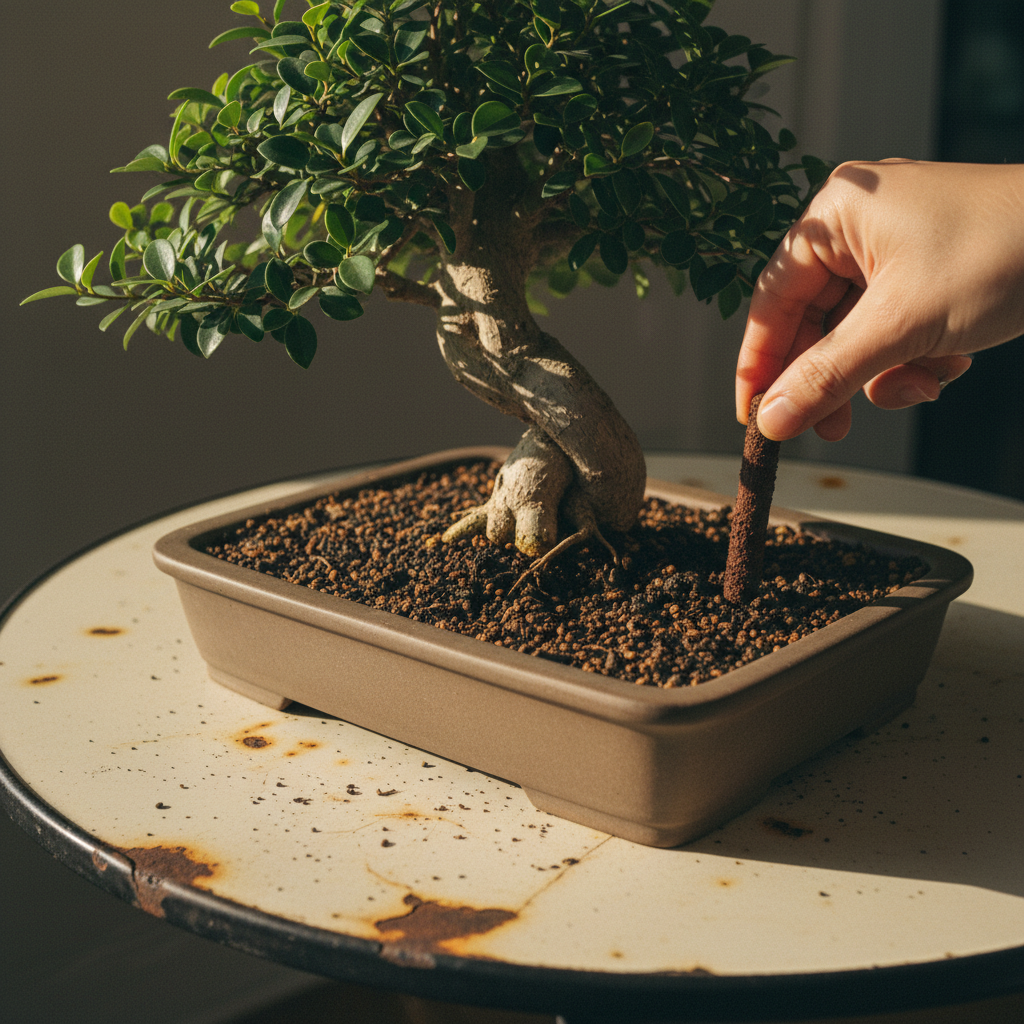
Slow-release granular: Slow-release pellets or sticks pressed into the soil surface release nutrients gradually over several weeks, making them convenient for growers who would rather not feed so often. They pair well with the occasional liquid feed during peak summer growth.
Organic fertilisers: Organic options such as rapeseed cake pellets, seaweed extract and worm castings feed the soil life as well as the tree and are gentle and forgiving. Traditional bonsai practice often favours solid organic cakes placed on the soil surface, though they can carry a faint smell indoors.
Feeding Schedule
From spring through to early autumn, feed every two to four weeks while the tree is in active growth. As light levels and temperatures fall in late autumn, reduce feeding to roughly monthly, and through the depths of winter a ficus grown in average indoor conditions needs little or no fertiliser. If you keep a tree under grow lights and it continues growing through winter, maintain a light feed at extended intervals to match its slower pace.
Pro Tip — Feed Weakly, Weekly: Rather than a heavy dose once a month, many bonsai growers prefer a very dilute liquid feed at a quarter to half strength every week through summer. This keeps nutrient levels steady, avoids the salt spikes that stress roots in a small pot, and produces more even growth than occasional strong feeds.
How to Fertilise
- Always water the tree first if the soil is dry, because feeding a parched rootball can burn the fine roots.
- Dilute liquid feed to half the strength stated on the bottle, or push slow-release granules gently into the soil surface.
- Apply the diluted feed evenly across the soil until it begins to drain from the holes, ensuring all the roots are reached.
- Wipe any fertiliser splashes from the foliage and the rim of the pot to avoid leaf marking and salt crusting.
- Once or twice a season, flush the pot with plain water to wash out any accumulated salts.
Warning — Salt Build-Up: Over-fertilising a bonsai in its tiny soil volume causes mineral salts to accumulate, scorching the leaf margins and damaging roots. A white crust on the soil or pot rim is the warning sign. Flush the pot thoroughly with plain water and pause feeding for a few weeks to let the tree recover.
Propagation
The bonsai ficus is one of the easiest of all bonsai species to propagate, which is part of its appeal to beginners who want to grow on their own trees from cuttings. Its strong urge to root means a piece of stem will often strike with very little fuss, giving you spare material to experiment with styling and grafting.
The two most reliable methods are stem cuttings, which is the simplest and quickest, and air layering, which lets you produce a sizeable tree with an established trunk in a single season. Both take advantage of the ficus habit of rooting readily from stems and even from aerial roots.
Understanding Nodes and the Latex Sap
New roots and shoots emerge from nodes, the points on a stem where leaves attach, so every successful cutting must include at least one or two nodes below the soil or moss. When you cut a ficus, the wound bleeds milky latex; rinsing the cut end or dipping it briefly in water stops the flow and helps the cutting take. Allowing the cut to seal for an hour before potting also reduces sap loss and the risk of rot.
Stem Cuttings: Step-by-Step
The best time to take cuttings is late spring or early summer, when the tree is growing strongly and warmth speeds rooting. Semi-ripe shoots that are firm but not yet woody root most reliably.
- Choose a healthy shoot 10 to 15 centimetres (4 to 6 inches) long and cut it cleanly just below a node with sterile scissors.
- Remove the lower leaves so that one or two bare nodes will sit below the surface, and rinse the milky sap from the cut end.
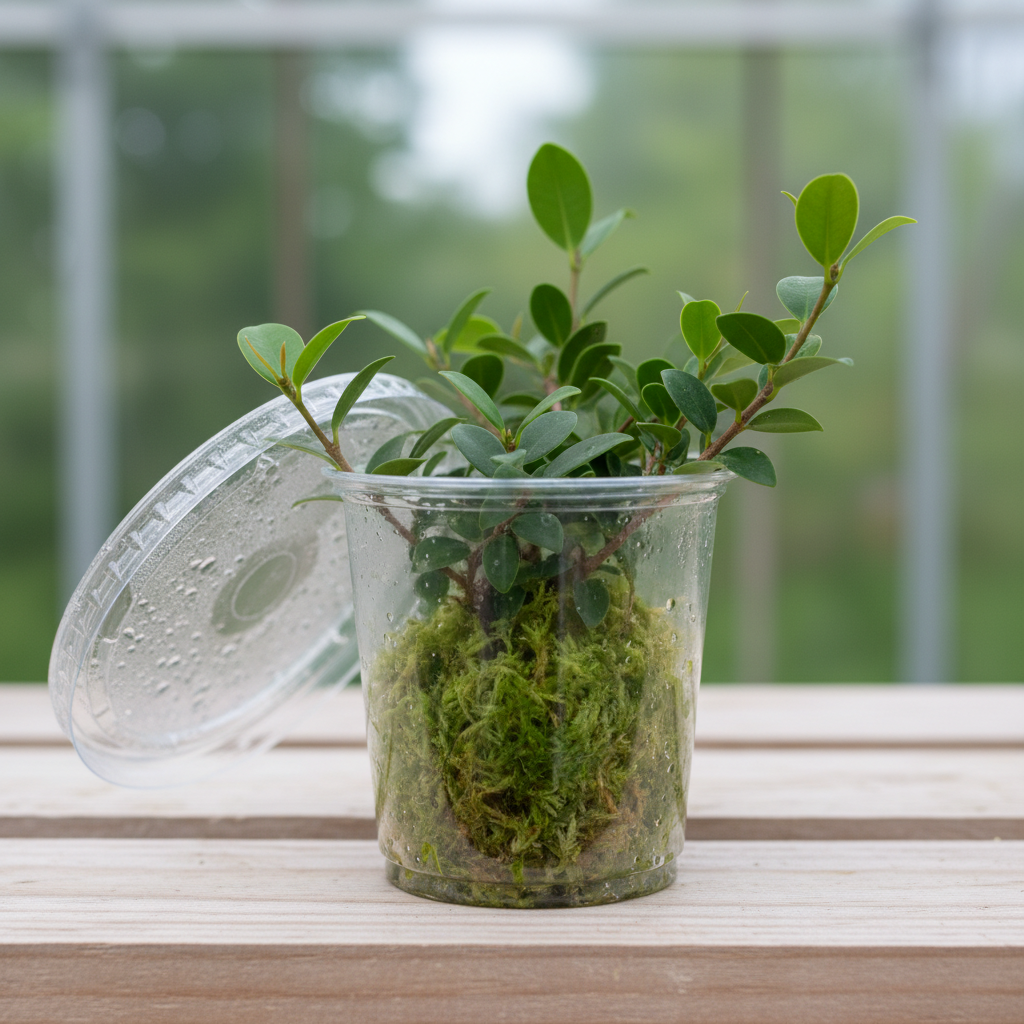
- Dip the base in rooting hormone if you wish, then insert it into damp sphagnum moss or a free-draining cutting mix.
- Cover with a clear bag or place the pot in a humid propagator to hold moisture and warmth, keeping it bright but out of direct sun.
- Keep the medium lightly moist and warm at around 22 to 25 degrees Celsius (72 to 77 degrees Fahrenheit); roots usually form within three to six weeks.
- Once new growth appears and roots have developed, pot the young tree into bonsai soil and grow it on before any styling.
Pro Tip — Thicker Cuttings, Faster Trees: Unlike most plants, the ficus roots happily from surprisingly thick cuttings, even a finger-thick branch. Starting with a chunky cutting gives you a tree with a substantial trunk in a fraction of the time it takes to thicken a thin one, a favourite shortcut among ficus bonsai growers.
Air Layering: Step-by-Step
Air layering produces a much larger finished tree than a cutting because it roots a whole established branch while it is still attached to the parent. It is the ideal method for turning a long, awkward branch into a well-proportioned new bonsai.
- Choose a healthy branch of the thickness you want for your new trunk and select the point where you want roots to form.
- Remove a ring of bark around the stem about as wide as the stem is thick, scraping away the green layer beneath so it cannot rejoin.
- Dust the upper edge of the wound with rooting hormone, then wrap the area in a ball of damp sphagnum moss.
- Enclose the moss in clear plastic film, tying it firmly above and below so it holds moisture and you can see the roots forming.
- Keep the moss moist and warm; over six to ten weeks roots will fill the ball, after which you can cut below the new roots and pot up the layer as an independent tree.
Troubleshooting Propagation
| Problem | Likely Cause | Solution |
|---|---|---|
| Cutting rots before rooting | Medium too wet or sap not rinsed away | Use a free-draining mix, rinse the cut end and let it seal before inserting |
| Cutting wilts and dries out | Humidity too low or too many leaves left on | Cover with a humidity dome and remove some foliage to cut water loss |
| No roots after many weeks | Temperature too cold or wrong season | Provide bottom heat and warmth, and take cuttings in late spring or summer |
| Air layer fails to root | Bark not fully removed so the wound healed over | Scrape the cambium away completely so the stem cannot bridge the gap |
Pests & Diseases
A healthy bonsai ficus grown in good light is robust and not especially prone to trouble, but the warm, sheltered indoor conditions it enjoys are also ideal for sap-sucking pests. Most problems are caught early and dealt with easily if you make a habit of inspecting the tree, particularly the undersides of leaves and the leaf axils, whenever you water.
The most distinctive issue with a ficus is not a pest at all but its dramatic response to stress: sudden leaf drop. A ficus that is moved, chilled, over or underwatered, or plunged into low light will often shed a flush of leaves. This alarms new owners, but a tree kept in stable conditions almost always recovers and re-leafs within weeks.
Common Pests
Scale Insects (Coccoidea)
Scale are the most common pest of indoor ficus, appearing as small brown or tan bumps clamped to stems and the undersides of leaves, often with sticky honeydew below them. They suck sap and weaken the tree, and their waxy shells protect them from many sprays.
Treatment: Scrape off the scales with a fingernail or a cotton bud dipped in diluted isopropyl alcohol, then treat the whole tree with horticultural oil or neem to smother any crawlers. Repeat every week for a month to catch successive generations.
Mealybugs (Pseudococcidae)
Mealybugs look like small tufts of white cotton wool tucked into leaf axils and along stems. Like scale they feed on sap and excrete honeydew, and they breed quickly in warm indoor conditions.
Treatment: Dab each insect directly with a cotton bud soaked in diluted alcohol, then follow up with neem oil or insecticidal soap. Check hidden crevices carefully, because a few survivors will quickly rebuild the colony.
Spider Mites (Tetranychus urticae)
Spider mites thrive in hot, dry air and are most likely in winter near a radiator. They are almost too small to see, but fine webbing between leaves and a dull, stippled, yellowing look to the foliage give them away.
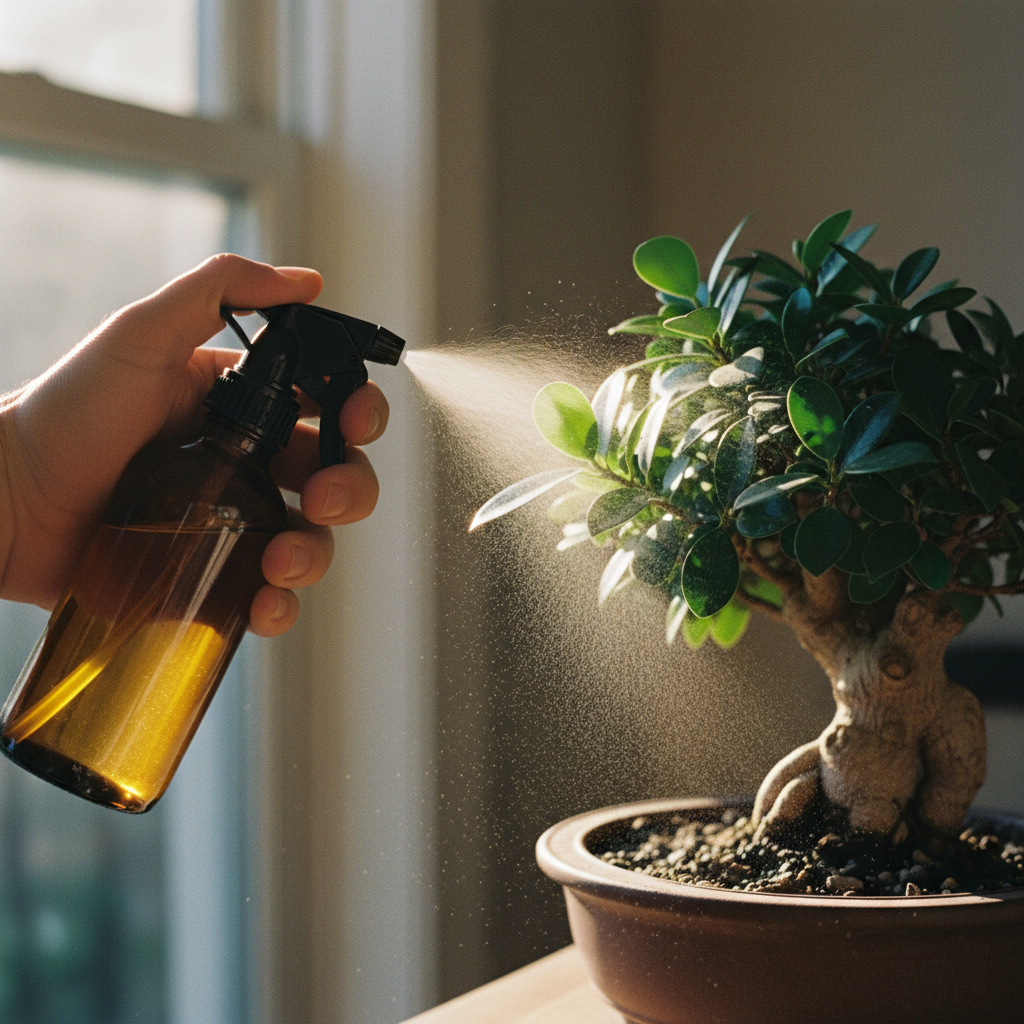
Treatment: Rinse the foliage under a tepid shower to knock the mites off, raise the humidity around the tree, and apply neem oil or a miticide to the leaf undersides. Because mites dislike moisture, better humidity alone often prevents their return.
Common Diseases
Root Rot (Phytophthora and Pythium)
Root rot is the most serious disease of bonsai ficus and is caused by waterlogged soil starving the roots of oxygen and inviting fungal infection. The symptoms are yellowing leaves dropping while still green, a sour smell from the pot and dark, mushy roots.
Treatment: Remove the tree, cut away all blackened roots with sterile scissors, and repot into fresh free-draining bonsai soil. Water sparingly until recovery, and correct the watering and drainage that caused the problem in the first place.
Anthracnose (Colletotrichum)
Anthracnose is a fungal disease that shows as dark brown or black spots and blotches on the leaves, sometimes with yellowing around them, and is encouraged by wet foliage and poor air circulation.
Treatment: Remove and dispose of affected leaves, improve airflow around the tree, and avoid wetting the foliage when watering. A copper-based or general fungicide can be applied if the infection persists.
Pest and Disease Summary
| Pest / Disease | Identification | Treatment |
|---|---|---|
| Scale insects | Brown bumps on stems and leaf undersides with sticky honeydew | Scrape off, then treat with horticultural oil or neem weekly |
| Mealybugs | White cottony tufts in leaf axils and along stems | Dab with alcohol, follow with neem or insecticidal soap |
| Spider mites | Fine webbing and dull, stippled, yellowing leaves | Rinse foliage, raise humidity, apply neem or a miticide |
| Root rot | Green leaves dropping, sour soil, dark mushy roots | Trim rotten roots, repot in fresh soil, water sparingly |
| Anthracnose | Dark spots and blotches on the leaves | Remove affected leaves, improve airflow, apply fungicide |
Prevention Strategies
Prevention with a bonsai ficus comes down to stable conditions and routine observation. A tree kept in good light, watered correctly and not shuffled around the house stays strong enough to resist most pests and shrugs off the leaf drop that startles new owners. Quarantine any new plant for a couple of weeks before placing it near your ficus, since most infestations arrive on a newcomer.
Make inspection part of every watering. Turn over a few leaves, check the leaf axils and run an eye over the stems, and you will spot scale or mealybugs while they are still a handful of insects rather than a colony. Keeping the foliage clean and the air gently moving also denies pests the still, dusty conditions they favour.
Pro Tip — Neem as Routine: A light neem oil spray over the whole tree once a month through the growing season works as a gentle preventative, deterring scale, mealybugs and mites before they establish. Apply it in the evening or out of direct sun to avoid leaf marking, and always treat the undersides of the leaves where pests hide.
Popular Varieties
The bonsai ficus you buy is usually Ficus retusa or its very close relative Ficus microcarpa, but the wider world of fig bonsai includes a number of cultivars and related species, each with its own leaf size, bark and habit. Knowing them helps you recognise what you are buying and choose a form that suits your taste and conditions.
Some are prized for a dramatic swollen trunk, others for unusually small leaves that suit tiny trees, and a few for striking patterned bark. All share the easy, forgiving nature that makes the ficus such a good first bonsai.
| Variety | Leaf Appearance | Light Needs | Growth Rate | Availability |
|---|---|---|---|---|
| Ginseng Ficus | Small glossy oval leaves over a bulbous root trunk | Bright | Fast | Very common |
| Tiger Bark Ficus | Small pointed leaves, mottled striped bark | Bright | Moderate to fast | Common |
| Ficus retusa (Banyan) | Glossy dark green ovals, classic banyan habit | Bright | Fast | Very common |
| Willow Leaf Fig | Long narrow willow-like leaves | Bright | Fast | Moderate |
| Weeping Fig (Ficus benjamina) | Slender pointed leaves on drooping shoots | Bright | Fast | Common |
| Ficus ‘Too Little’ | Tiny dense leaves on compact growth | Bright | Moderate | Specialist |
Featured Varieties
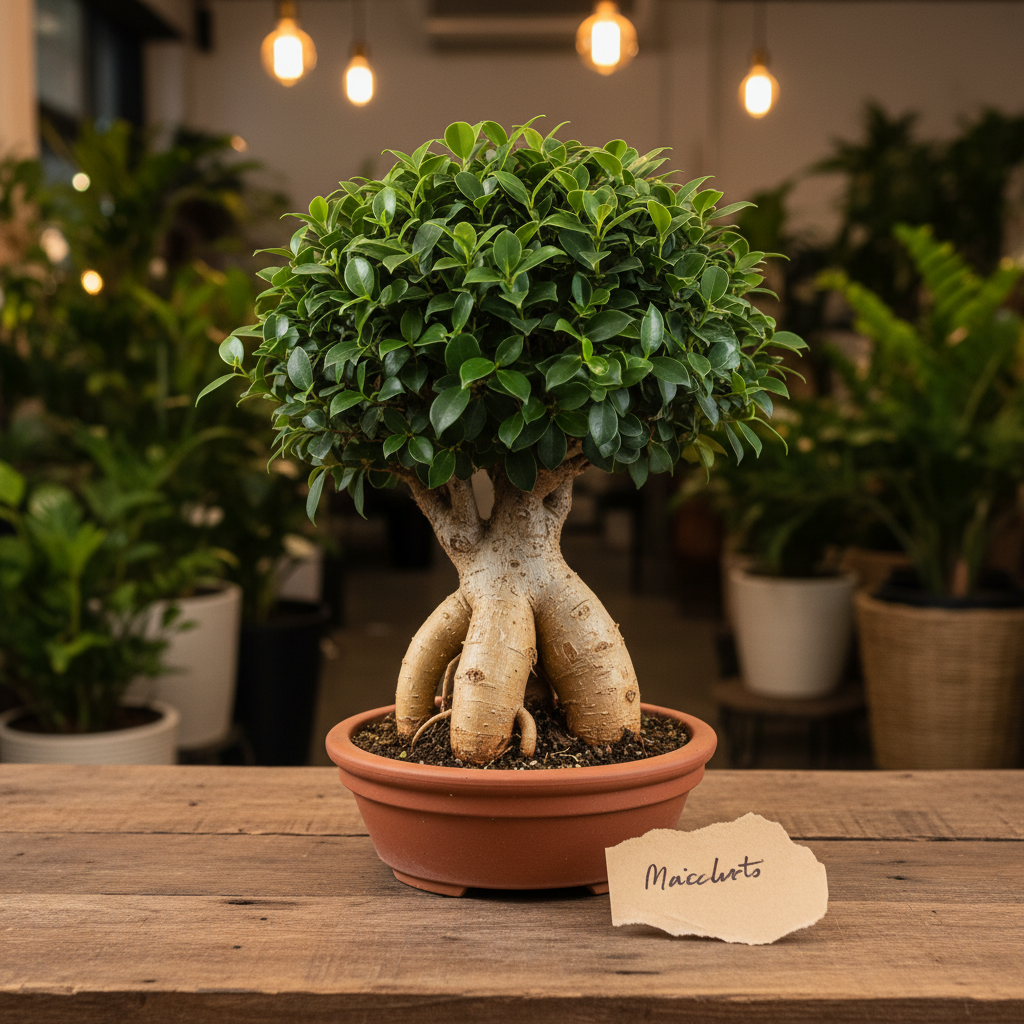
Ginseng Ficus
The most widely sold of all bonsai ficus, the ginseng form is grown for its extraordinary swollen, bulbous trunk of fused aerial roots that resembles a ginseng root or a pot-bellied figure. Mass produced and inexpensive, it makes an easy, eye-catching first tree.
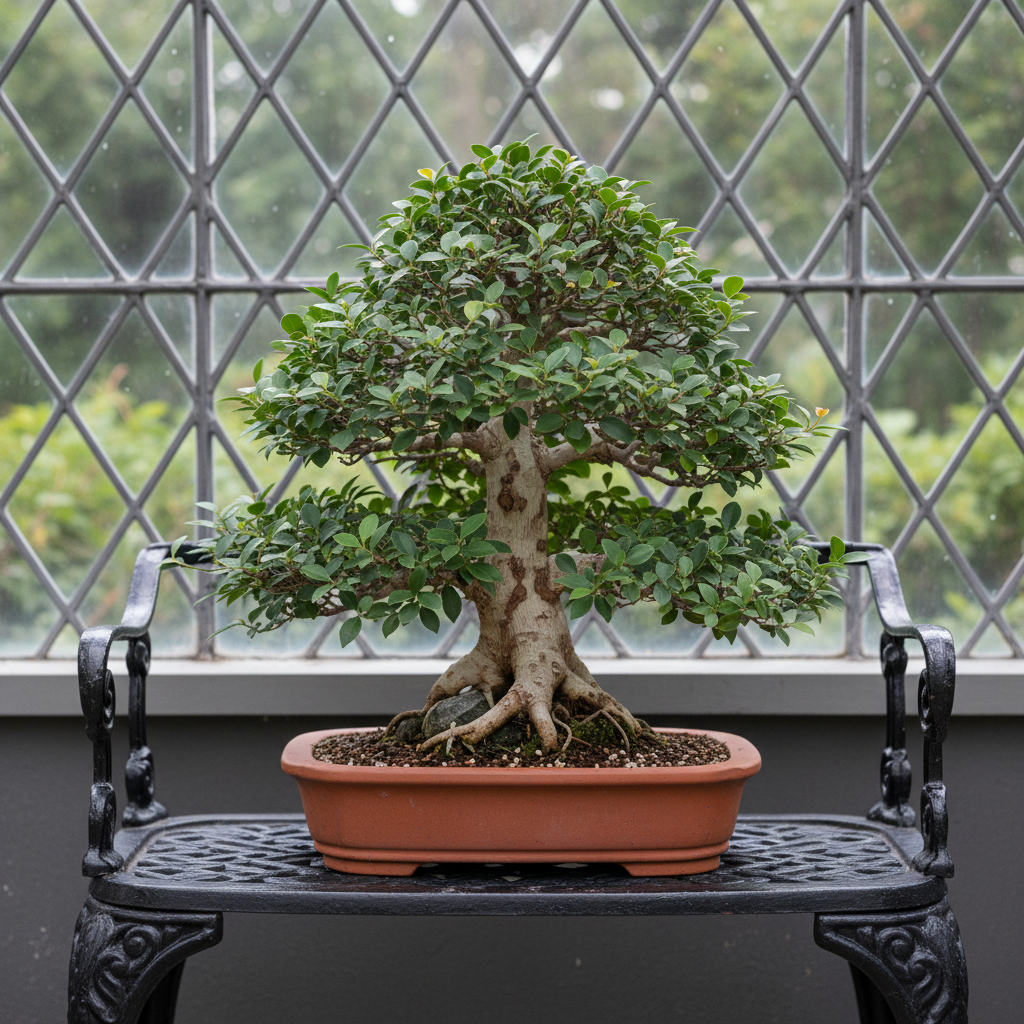
Tiger Bark Ficus
A refined cultivar prized for its pale, mottled, tiger-striped bark and smaller pointed leaves that ramify into fine twigs. It develops a more believable aged appearance than the ginseng form and is a favourite of growers who want a serious, traditional ficus bonsai.
Variety Profiles in Detail
Ficus retusa (Ficus retusa)
The classic banyan-style bonsai ficus, with glossy dark green oval leaves, smooth pale grey bark and a strong tendency to throw aerial roots. It grows fast, back-buds freely and tolerates indoor life better than almost any other bonsai, which is why it remains the benchmark beginner’s tree.
Willow Leaf Fig (Ficus salicaria)
Named for its long, narrow, willow-like leaves, this species develops fine twigs and an elegant, weeping silhouette. It is vigorous and rewarding, and the slender foliage suits taller, more graceful styles than the rounder-leaved forms.
Weeping Fig (Ficus benjamina)
The familiar weeping fig houseplant also makes a fine bonsai, with slender pointed leaves on gracefully drooping shoots. It is a little more prone to leaf drop when disturbed than Ficus retusa, but rewards stable conditions with dense, delicate growth.
Choosing the Right Variety for Your Space
For a first tree on a bright windowsill, the ginseng ficus or a plain Ficus retusa is hard to beat: cheap, tough and quick to respond. If you want to develop a more refined bonsai over the years, seek out a tiger bark or willow leaf form, which reward patient training with finer branching and more character. Whichever you choose, give it the brightest spot you have and stable conditions, and the forgiving nature shared by all the fig bonsai will do the rest.
Frequently Asked Questions
Why is my bonsai ficus dropping its leaves?
Leaf drop is the ficus signature response to stress, most often a change in conditions such as a move to a darker spot, a cold draught, or a swing in watering. It looks alarming but is rarely fatal. Settle the tree in a bright, stable position, water correctly, and it will almost always re-leaf within a few weeks.
How often should I water a bonsai ficus?
There is no fixed schedule. Check the soil daily and water thoroughly when the surface begins to dry. In warm, bright summer conditions this may be every day, while in cool winter weeks it might be every few days. Always water until it drains from the holes, and never leave the pot standing in water.
Can a bonsai ficus live indoors permanently?
Yes. Unlike most bonsai, the tropical ficus needs no winter dormancy and thrives indoors all year, provided it has bright light. Many growers move theirs outdoors for the summer to boost growth, but a ficus kept on a sunny windowsill or under a grow light will remain healthy indoors indefinitely.
How do I keep the leaves small?
Strong light is the main factor, since bright conditions naturally produce smaller leaves and shorter internodes. Regular pruning encourages fine twigs and smaller foliage, and experienced growers sometimes defoliate a healthy tree in early summer so that the new flush comes in smaller and denser.
Is the bonsai ficus safe around pets?
Not entirely. The milky latex sap is mildly toxic to cats and dogs and can cause drooling, mouth irritation and digestive upset if chewed, and it irritates skin too. Keep the tree out of reach of pets that nibble plants, and wear gloves when pruning if your skin is sensitive.
When and how should I prune my bonsai ficus?
Prune during the growing season, when the tree responds quickly by back-budding. Trim new shoots back to one or two leaves once they have extended several leaves beyond the silhouette you want, and remove any growth that spoils the shape. The ficus tolerates hard structural pruning well, so do not be afraid to cut back boldly when reshaping.
What are the dangling roots on my ficus?
Those are aerial roots, a natural feature of banyan figs that the ficus produces in warm, humid conditions. Far from being a problem, they are prized in bonsai: you can train them down into the soil to thicken the trunk or create the dramatic buttressed, multi-stemmed look of an ancient banyan tree.
Why has my ficus stopped growing?
Slow or stalled growth usually points to insufficient light, the cool short days of winter, or a tree that has exhausted the nutrients in its pot. Move it to the brightest available position, resume regular feeding once active growth returns in spring, and consider repotting if it has not had fresh soil in two or three years.






