
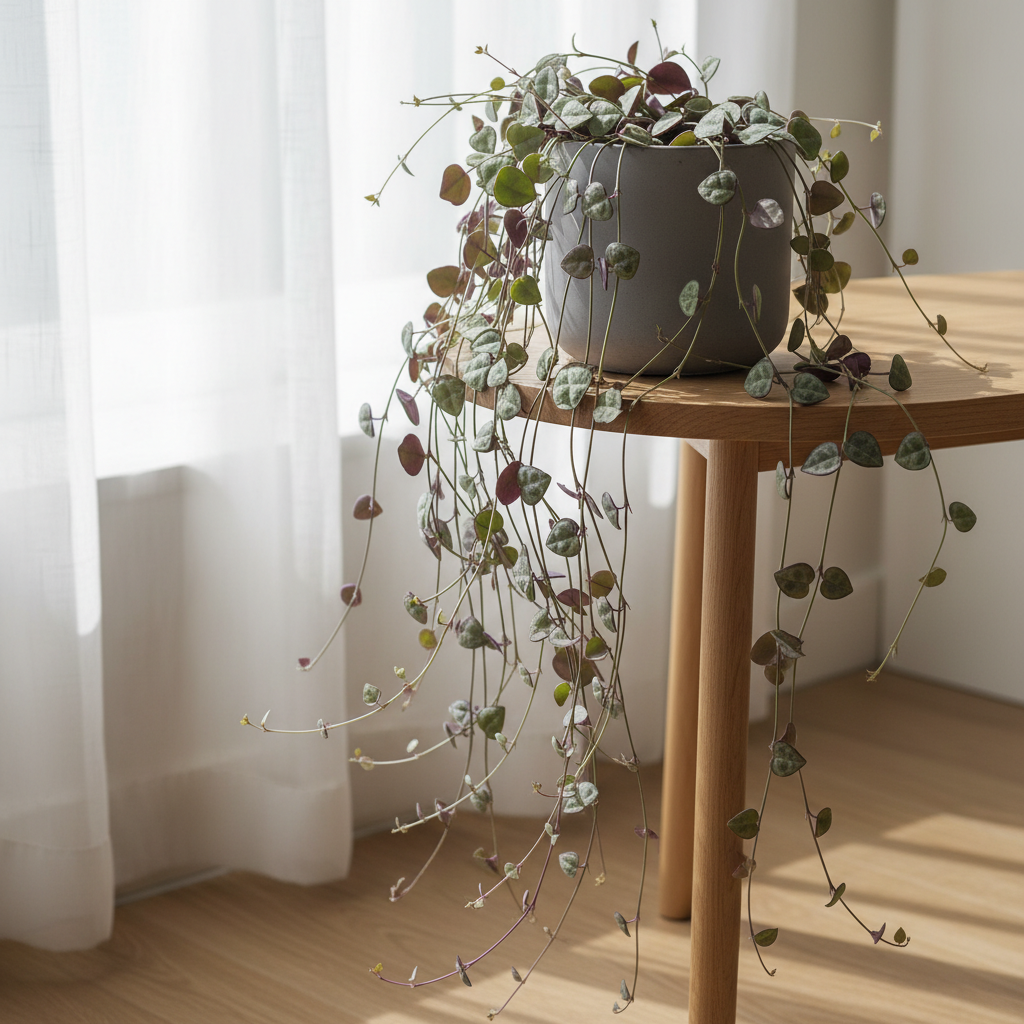
The string of hearts (Ceropegia woodii) is a trailing succulent from the forest edges and rocky outcrops of southern Africa whose paired, marbled heart-shaped leaves and wiry purple stems have made it one of the most photographed houseplants of the past decade. Also known as rosary vine, chain of hearts, sweetheart vine and hearts on a string, the species was first collected in 1881 by John Medley Wood, then curator of the Durban Botanic Gardens, who spotted it dangling from a rocky ledge on Groenberg mountain in KwaZulu-Natal. The botanist Joseph Hooker formally described it in the Botanical Magazine in 1894 and named it after Wood. More than a century later, those same long purple vines, thumbnail-sized silver hearts and tiny lantern-shaped flowers turn up in plant shops on every continent.
Despite its delicate appearance, string of hearts is a quietly tough plant. Its succulent leaves and aerial tubers act as water reserves, allowing it to weather long dry spells in its native habitat and equally erratic watering in a modern living room. The reputation is well earned: this is a plant that asks for very little, but the difference between a string of hearts that merely survives and one that produces three-metre curtains of densely packed silver hearts comes down to a few specific conditions, primarily light. This guide covers everything you need to know to move yours firmly into the second category, from setting up the right exposure and watering rhythm to propagating those nostalgic strands and identifying the cultivars worth hunting down.
Contents
- Quick Reference
- Why String of Hearts Makes a Rewarding Houseplant
- Light Requirements
- Watering and Humidity
- Soil, Potting and Repotting
- Fertilising
- Propagation
- Pests and Diseases
- Popular Varieties
- Frequently Asked Questions
Quick Reference: String of Hearts at a Glance
| Light | Bright, indirect light; tolerates a few hours of gentle morning sun |
| Watering | Thoroughly when the soil is dry from top to bottom; far less in winter |
| Temperature | 16 to 24°C (60 to 75°F); tolerates brief dips to 10°C (50°F) |
| Humidity | Average household humidity (40 to 50%) is plenty |
| Fertiliser | Half-strength balanced or cactus fertiliser monthly in spring and summer |
| Toxicity | Generally considered non-toxic to cats, dogs and humans, although ingestion may cause mild stomach upset |
Why String of Hearts Makes a Rewarding Houseplant
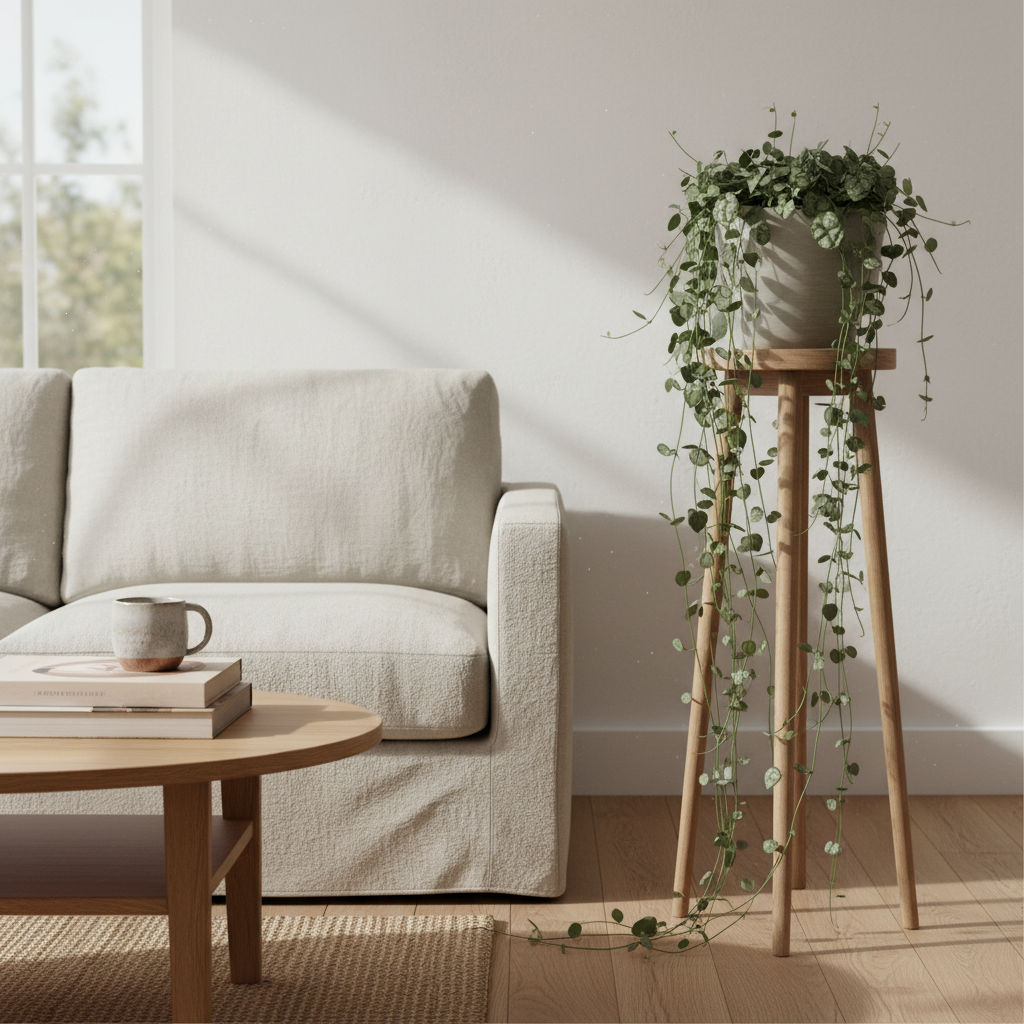
Few houseplants offer the same length-to-effort ratio as a well-grown string of hearts. A small starter pot bought in a single growing season can extend to a metre or more of densely leaved vine, and mature specimens in plant collections routinely trail two to four metres if left undisturbed. That growth comes from a tiny footprint, typically a 10 to 14 centimetre (4 to 5.5 inch) pot, which makes it ideal for shelves, hanging planters, plant stands and the tops of bookcases, where the cascade can do its work without taking floor space.
The plant rewards quiet attentiveness rather than constant fussing. Like many succulents, it stores water in its leaves and along its wiry stems, and it produces small round aerial tubers at intervals along the vines. These tubers, which resemble pinkish-brown beads (hence the name rosary vine), allow the plant to recover from drought, drop new growth from internal reserves and propagate itself anywhere a stem touches soil. They also mean that occasional missed waterings, the odd holiday absence and slight neglect are all forgiven, while overzealous care is not. The most common cause of death in cultivated string of hearts is, by a wide margin, overwatering. Once you understand that the plant essentially wants to be left alone between thorough soakings, the rest of its care almost takes care of itself.
Important — Toxicity: The American Society for the Prevention of Cruelty to Animals (ASPCA) lists Ceropegia woodii as non-toxic to cats and dogs, and there are no recorded cases of serious human toxicity. That said, the genus belongs to the dogbane family (Apocynaceae), several relatives of which contain cardiac glycosides, so it is sensible to keep curious pets and small children from chewing on the vines and to wash hands after handling cut stems.
Light Requirements
Light is the single most important variable in string of hearts care, and the visual difference between a plant grown in the right light and one grown in too little is dramatic. In its native South African habitat, Ceropegia woodii grows on rocky outcrops and tree-shaded slopes where it receives long hours of bright, filtered light, often with brief windows of direct early or late sun. Indoors, the closest equivalent is a position within roughly half a metre (18 inches) of a bright window where the foliage is bathed in light for most of the day.
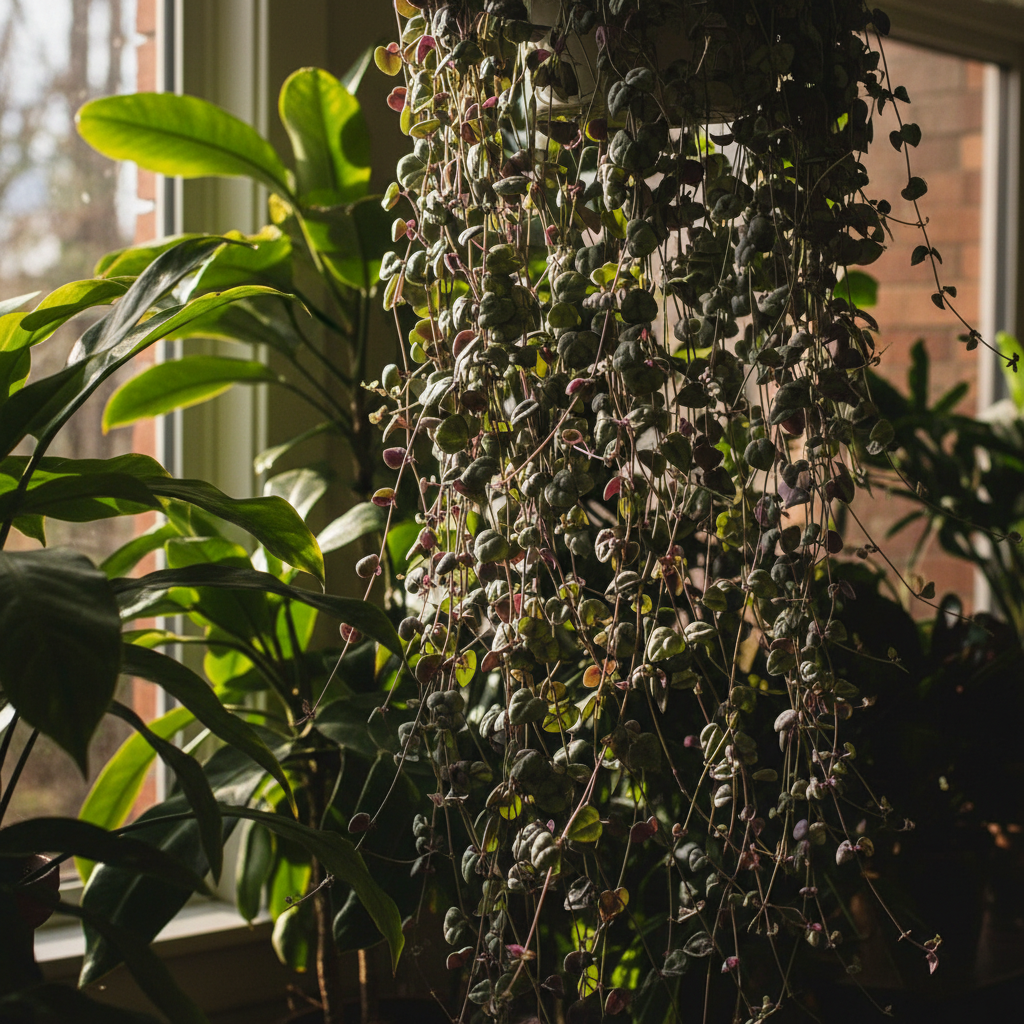
A well-lit string of hearts produces tightly spaced pairs of leaves along the stem, with strong silver marbling, vivid purple undersides and frequent branching. The same plant moved into low light will rapidly elongate, with leaf pairs strung wider and wider apart in a phenomenon called etiolation, and the silver patterning will fade as the plant produces more chlorophyll to compensate. Long bare stretches of vine between sparse leaves are almost always a light-related complaint.
Light Levels Explained
Plant care articles tend to throw around terms like “bright indirect” without ever defining them, which is a problem because most rooms feel brighter to humans than they are to plants. Eyes adapt automatically to low light, but leaves do not. A rough sense of measured light helps.
| Light Category | Approx. Level | Typical Location | Outcome |
|---|---|---|---|
| Direct sun | 30,000 to 100,000 lux | Inside a south-facing window without curtains | Will bleach and scorch foliage in summer; tolerable only in winter |
| Bright indirect | 10,000 to 25,000 lux | Within a metre of a bright window with sheer curtains; close to an east window | Ideal for string of hearts |
| Medium indirect | 2,500 to 10,000 lux | Two to three metres from a bright window; close to a north window | Plant survives but vines stretch and silver fades |
| Low | 500 to 2,500 lux | Across the room from a window, hallways | Etiolation and silver loss within weeks; eventual decline |
| Very low | Under 500 lux | Interior rooms with no window | String of hearts will fail |
Window Orientation and Placement
South-facing window: In the Northern Hemisphere, the brightest exposure of the day. String of hearts will thrive on a south-facing window provided the harshest hours of summer sun are filtered by a sheer curtain or by positioning the plant just to the side of the window rather than pressed against the glass. In winter, when the sun is weaker and lower, direct south light is welcome and even encouraged.
East-facing window: Possibly the perfect exposure. Gentle morning sun for two or three hours followed by bright indirect light for the rest of the day produces strong colour and tight leaf spacing without any risk of scorching. If you can only offer one window orientation, choose east.
West-facing window: Bright afternoon light, often warmer and stronger than morning east light. String of hearts grows well here but may need some protection from intense midsummer afternoon rays, particularly behind glass that magnifies heat.
North-facing window: Generally too dim for thriving growth. A north window with no obstruction may be acceptable, but expect slower growth, leggier vines and noticeably duller silver patterning. Consider supplementing with a grow light.
Pro Tip — Rotate Regularly: String of hearts grows directionally toward its light source, and a vine left untouched for months will end up bare on the window-facing side and lush only on the side facing the room (or vice versa). Give the pot a quarter turn each time you water, so that by the time you complete a full rotation, every part of the canopy has had a fair share of the brightest light.
How Light Affects Leaf Colour and Marbling
The silvery patterning on a string of hearts leaf is not pigment in the usual sense; it is the result of air spaces in the upper leaf tissue that scatter light and read as pale silver. The deep purple undersides come from anthocyanin pigments. Both effects intensify with light: the more photons hitting the leaf, the more contrast you see between silver and dark olive green above, and the more purple develops beneath. In low light, the leaves take on a flat sage green and the undersides fade to a muted lilac or near-green.
Variegated cultivars are even more dependent on adequate light. The pink and cream sectors of Ceropegia woodii ‘Variegata’ produce no chlorophyll, so the plant relies entirely on its green portions to photosynthesise. In dim conditions, a variegated string of hearts will sometimes revert, producing all-green stems that grow faster than the variegated ones and eventually overtake the plant.
Warning — Direct Sunlight: Despite being a succulent, string of hearts has thin leaves and is more prone to sunscald than chunkier desert succulents like jade or aloe. Bleached white patches that turn to brown crisp spots within days are a sure sign of too much direct sun. Move the plant a metre back from the window or diffuse the light with a sheer curtain.
Artificial Lighting
String of hearts responds well to supplementary or full-replacement grow-light culture. A modest full-spectrum LED panel (around 20 to 40 watts of true LED, not packaging-claim wattage) hung 30 to 50 centimetres (12 to 20 inches) above the canopy and run for 12 to 14 hours a day will keep a plant in tight, well-coloured growth even in a room with no natural light. Clip-on bar lights work well for shelf-grown specimens.
Seasonal Adjustments
In temperate climates, daylight hours and intensity drop sharply between October and February. Even south-facing windows that gave you tight, vivid growth in summer can become marginal in midwinter. Move plants closer to the glass during the dim months, consider adding a small supplemental grow light, and reduce watering and feeding to match the slower growth.
Watering and Humidity
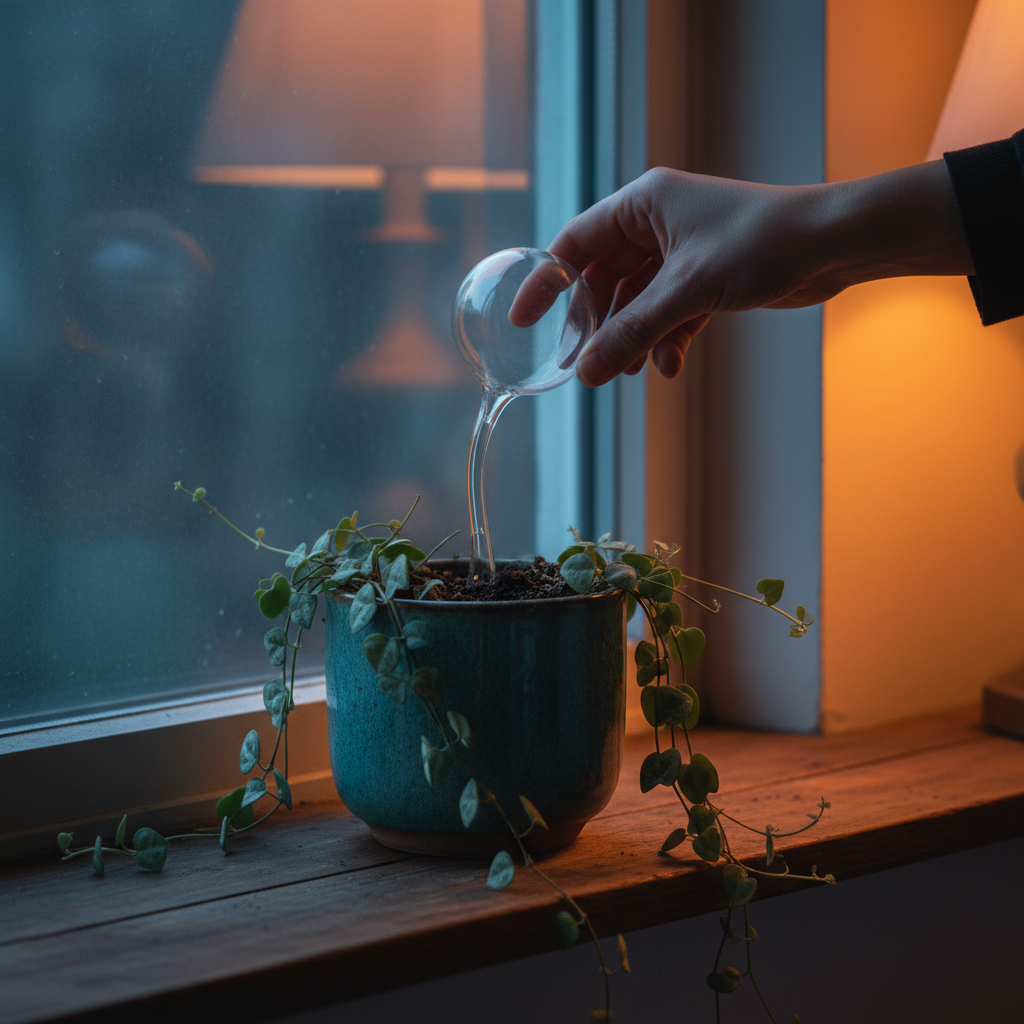
String of hearts is a true succulent, with water stored in its leaves, stems and aerial tubers, and its watering needs reflect this. The aim is to soak the rootball thoroughly and then allow the soil to dry out almost completely before watering again. This wet-dry rhythm mimics conditions in its native habitat, where heavy summer rains alternate with extended dry periods.
When to Water
Rather than watering on a fixed schedule, watch the plant and the soil. The most reliable cue is the soil itself: lift the pot to gauge its weight, push a finger or wooden chopstick into the soil to feel for moisture, or use a moisture meter inserted to about half the pot depth. Water only when the soil is dry from top to bottom; if there is any cool, damp feel in the lower half of the pot, wait.
A secondary cue comes from the leaves themselves. A well-hydrated string of hearts has plump, firm hearts with smooth surfaces. As the plant approaches dryness, leaves begin to feel slightly soft and may develop fine wrinkles, particularly on older leaves further down the vine. This is the latest point at which to water, and a thorough soaking will rehydrate the leaves within 24 to 48 hours.
In the active growing months, roughly April to September in the Northern Hemisphere, a healthy mature plant in a 12 centimetre (5 inch) pot in bright light might want water every 10 to 14 days. In winter, when growth slows, the same plant may go three to four weeks between waterings. Smaller pots and brighter, warmer positions dry faster; larger pots, cooler rooms and lower light dry slower. There is no universal interval.
Pro Tip — The Lift Test: A pot full of dry soil weighs noticeably less than the same pot saturated with water. After watering, lift the pot to feel its full weight, then lift it again every few days. Once it feels distinctly light, water; if it still feels heavy, wait. With a few weeks of practice, this becomes the fastest and most reliable check you can do.
How to Water Correctly
The technique matters as much as the timing. Light, surface-only sprinkles encourage shallow roots and leave the lower soil mass perpetually dry; the goal is a deep, thorough soaking.
- Take the plant to a sink or move a saucer underneath it. Make sure the pot has at least one drainage hole.
- Pour room-temperature water slowly over the soil surface, working around the plant rather than directly on the crown, until water flows freely from the drainage holes.
- Wait two or three minutes, then water again until water runs out the bottom. This second pass ensures the entire rootball is wetted, not just the top inch.
- Allow the pot to drain fully for 10 to 15 minutes; do not leave it sitting in a saucer of water.
- Tip away any standing water and return the plant to its position.
- Note the date or simply lift the pot to log its saturated weight for future reference.
Signs of Overwatering vs. Underwatering
The symptoms of too much and too little water can look superficially similar, both producing soft, drooping leaves, which is exactly why so many plants are accidentally killed by attempts to fix overwatering with more water. The cues below help distinguish the two.
| Symptom | Overwatering | Underwatering |
|---|---|---|
| Leaf colour | Yellowing, often whole leaves at once | Stays green but dull and slightly grey |
| Leaf texture | Soft, mushy, sometimes translucent or water-soaked | Firm but wrinkled, deflated, papery |
| Soil condition | Wet for days, sour smell, sometimes mould | Bone-dry top to bottom, often pulling away from pot edges |
| Roots | Black, brown, mushy, smelling rotten | Pale white, dry, intact but possibly brittle |
| Stem base | Soft, sometimes black, may topple at the crown | Firm, may show some shrivelling |
Warning — Root Rot: Overwatered string of hearts is the most frequent cause of death in cultivation, and once root rot has taken hold the plant can collapse in days. If you notice mushy black stems at the crown or a sour smell from the pot, unpot immediately, cut away every soft root and any blackened stem section back to clean tissue, dust the cuts with cinnamon or a fungicide, repot into completely fresh, dry succulent mix and withhold water for at least a week. Healthy stems above the affected area can be propagated separately as insurance.
Humidity Requirements
String of hearts is one of the few popular trailing houseplants that does not need elevated humidity. Coming from open, well-ventilated South African slopes, it is perfectly comfortable in the 40 to 50 percent humidity typical of a centrally heated home. There is no need for humidifiers, misters or pebble trays, and prolonged high humidity around the leaves can actually encourage fungal problems.
Very dry air (below about 30 percent, common in heated rooms in winter) is not damaging in itself, but it does accelerate water loss from the leaves and may make the plant want water slightly more often. If you notice persistent leaf wrinkling within days of a thorough watering, dry air rather than insufficient watering may be the cause.
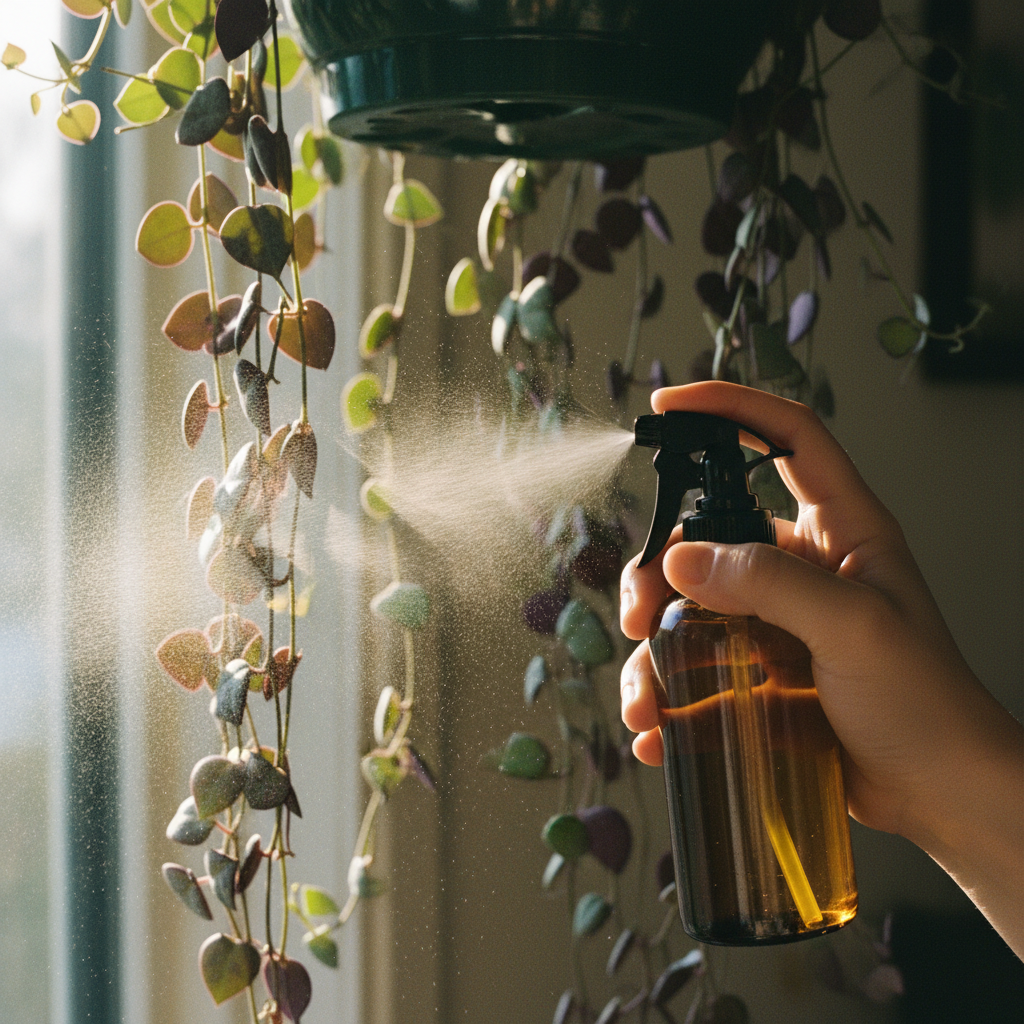
Misting is generally unnecessary and, on cool days, can encourage rot in the leaf axils. The plant has no foliar pores configured to absorb significant water, so misting offers no real hydration benefit.
Water Quality
String of hearts is moderately sensitive to the minerals and salts in tap water. Hard water and softened water (which is high in sodium) can both contribute to the slow accumulation of salts in the soil, eventually causing leaf-tip browning and stunted growth. If your tap water is heavily mineralised, consider using rainwater, distilled water or filtered water at least every other watering, and flush the pot thoroughly every few months by running plain water through the soil for a minute or two to leach out built-up salts.
Cold water straight from the tap can shock the roots, so let it stand at room temperature for an hour before use, or mix with a little warm water.
Soil, Potting and Repotting
The soil mix for a string of hearts has one overriding job: drain fast. The most expensive grow lights, the best window and the most disciplined watering schedule will not save a plant whose roots sit in a sponge of dense, moisture-retentive soil. Standard bagged houseplant potting mix is too rich, too dense and too water-retentive for Ceropegia woodii on its own, and is the second most common contributor to root rot after over-enthusiastic watering.
Ideal Soil Composition
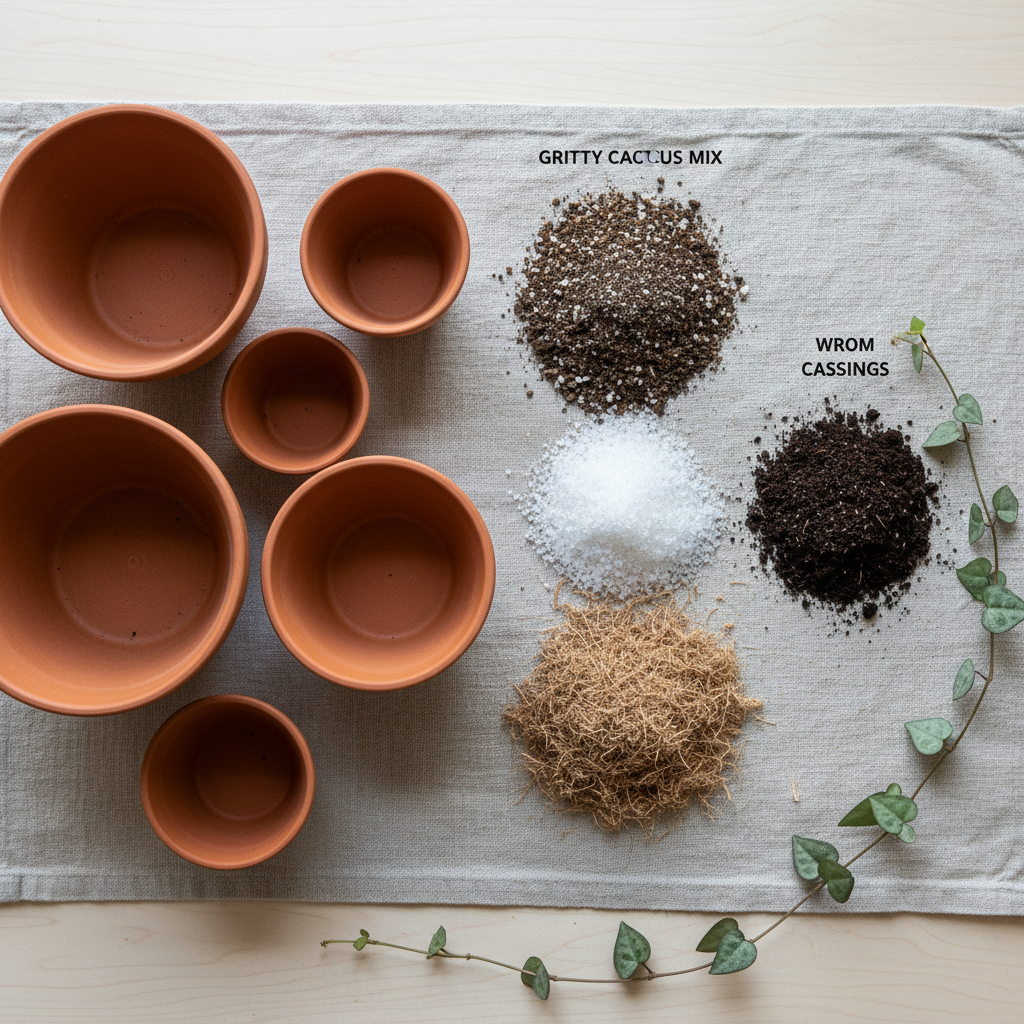
The mix should be loose enough that water flows through within seconds, with significant air space around the roots and enough organic content to hold a modest reserve of moisture and nutrients. A simple, reliable home blend uses two parts cactus and succulent mix to one part coarse perlite or pumice. For growers who like to mix from scratch:
| Component | Proportion | Function |
|---|---|---|
| Cactus and succulent potting mix, or sieved general houseplant mix | 50% | Provides organic matter, modest water and nutrient retention |
| Coarse perlite or pumice (3 to 6 mm) | 30% | Creates large air pockets, drains free water, prevents compaction |
| Coarse horticultural sand or fine grit | 10% | Adds weight and stable drainage; helps the pot resist tipping under long vines |
| Coco coir or fine bark fines | 10% | Improves structure and rewetting after the soil has dried out |
Aim for a slightly acidic to neutral pH between 6.0 and 7.0; commercial cactus mixes generally fall in this range without adjustment. The mix should feel gritty, not silky, when rubbed between fingers, and a handful should crumble apart rather than form a ball.
Pro Tip — Quick Mix Recipe: If you do not want to buy multiple bags, the simplest functional recipe is two parts cactus mix to one part perlite, with a small handful of orchid bark per litre for extra structure. This mix works for almost every succulent and trailing semi-succulent in a typical collection, including string of pearls, burro’s tail and string of bananas alongside string of hearts.
Choosing the Right Pot
String of hearts is happiest in shallow rather than deep pots, partly because its root system is fibrous and relatively shallow, and partly because excess soil volume holds excess water for longer.
Drainage holes are non-negotiable. A pot without drainage will eventually kill a string of hearts no matter how careful the watering. Decorative pots without holes can be used as outer cache pots, with the plant in a plastic nursery pot that is lifted out for watering, but a string of hearts should never be planted directly into a closed vessel.
Pot material: Terracotta is excellent because it wicks moisture from the soil through the porous walls, speeding up drying and making overwatering harder. Glazed ceramic and plastic both work but hold moisture longer, so adjust watering frequency downward by a noticeable margin if you switch from terracotta to glazed. Hanging baskets, common for this plant, are typically plastic or coir-lined; coir liners dry very fast and may need more frequent watering than plastic equivalents.
Pot size: Increase pot diameter by no more than two to three centimetres (about an inch) at each repotting. An oversized pot holds wet soil far from the small rootball, slowing drying and inviting rot. A 10 to 14 centimetre (4 to 5.5 inch) pot is the maximum many mature plants ever need, even with several metres of cascading vine.
When to Repot
String of hearts is slow to outgrow its container and actively tolerates being slightly potbound. Most plants need repotting only every two to three years. Signs that it is time include roots circling the bottom of the pot and emerging through the drainage holes, soil that dries out within a day or two of watering (indicating roots have replaced most of the soil mass), and a noticeable slowdown in new growth despite good light and feeding.
The best time to repot is in early spring, just as the plant is moving back into active growth and can recover quickly. Avoid repotting in autumn or winter, when slow growth means a longer recovery period.
How to Repot: Step-by-Step
- Water the plant lightly a day or two before repotting; slightly moist soil holds the rootball together and is gentler on the roots than bone-dry soil.
- Choose a clean pot one size larger, with drainage holes. Cover the holes with a small piece of mesh or a coffee filter to stop soil escaping while still allowing free drainage.
- Add a layer of fresh succulent mix to the bottom of the new pot, deep enough that the rootball will sit with its top about a centimetre below the pot rim.
- Gently squeeze the sides of the old pot to release the rootball and slide the plant out, supporting the crown rather than pulling on the vines. Tease away loose old soil from the outer roots without breaking the inner rootball.
- Inspect the roots and trim any black, mushy or clearly dead sections with sterilised scissors. Healthy roots are firm and pale.
- Centre the plant in the new pot and add fresh mix around the sides, tamping gently with a finger or pencil to fill air pockets. Do not bury the crown.
- Hold off on watering for three to seven days to allow any minor root damage to callus, then water thoroughly and let drain.
Warning — Transplant Shock: String of hearts can sulk for a few weeks after repotting, particularly if the rootball was significantly disturbed. Expect slowed growth and possibly the loss of a few of the oldest leaves. Resist the urge to water more often or to feed during this recovery period; both will make things worse rather than better. Keep the plant in its usual position, water only when truly dry, and growth will resume on its own.
Fertilising
Ceropegia woodii is a light feeder by houseplant standards. Its native habitat is nutrient-poor rocky terrain, and the plant evolved to make do with minimal mineral input. A modest, regular feed during the growing season noticeably improves leaf density, colour and vine extension, but heavy feeding rapidly causes problems: soft, leggy growth, salt accumulation in the soil and chemical burn at the root tips.
The general principle is “little and often, well diluted”. A balanced liquid fertiliser diluted to half the manufacturer’s recommended strength, applied roughly monthly from early spring to early autumn, gives excellent results. Skip feeding entirely from late autumn through winter, when growth is minimal and unused nutrients will simply accumulate as salts in the soil.
Understanding Plant Nutrients
Fertilisers are described by their NPK ratio: the percentages of nitrogen, phosphorus and potassium they contain. Each macronutrient drives different aspects of plant growth, and balanced indoor plant fertilisers contain all three plus a range of secondary and trace minerals.
| Nutrient | Symbol | Primary Function | Deficiency Symptoms |
|---|---|---|---|
| Nitrogen | N | Leaf and stem growth, chlorophyll production | Pale, yellowing older leaves; slow growth |
| Phosphorus | P | Root development, flowering, energy transfer | Purple-tinged leaves, weak roots, poor flowering |
| Potassium | K | Water regulation, disease resistance, overall vigour | Brown leaf margins, weak stems, susceptibility to rot |
| Calcium | Ca | Cell wall structure, new growth quality | Distorted new leaves, weak cell structure |
| Magnesium | Mg | Chlorophyll molecule core | Interveinal yellowing on older leaves, dull colour |
| Iron | Fe | Chlorophyll synthesis, enzyme reactions | Pale yellow new growth with green veins |
For a healthy string of hearts, a balanced N-P-K such as 10-10-10 or a slightly lower-nitrogen succulent formula like 5-10-10 both work well. Avoid high-nitrogen lawn or foliage feeds, which encourage stretchy, overgrown vines with weaker stems.
Types of Fertiliser
Liquid fertilisers: The most controllable option for string of hearts. Mix at half strength in water and apply when watering, replacing one ordinary watering per month during the growing season. Synthetic liquid feeds work immediately; organic liquids such as seaweed extract release nutrients more slowly.
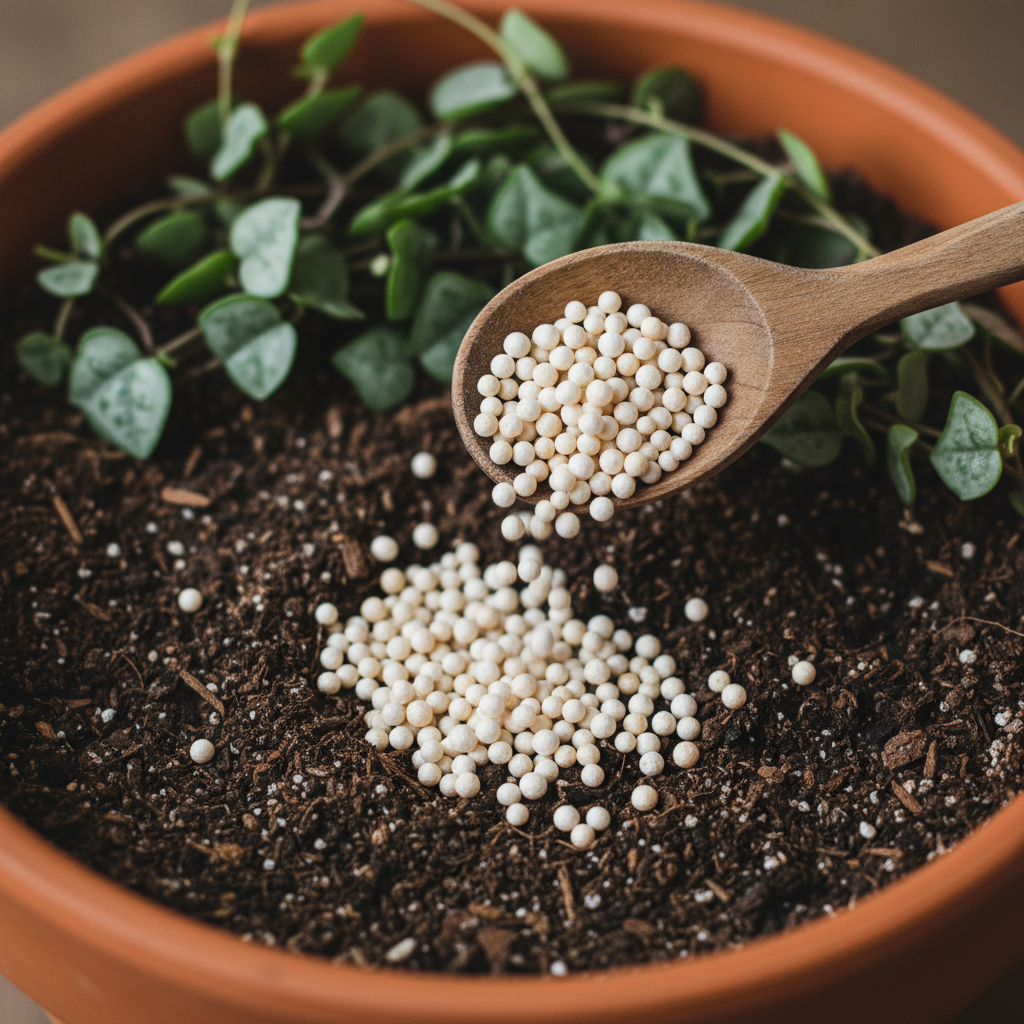
Slow-release granular: Small prills mixed into or sprinkled on top of the soil release nutrients gradually with each watering. Convenient for the once-and-forget gardener, but harder to fine-tune. Use about half the rate recommended for general houseplants, and replenish in early spring and midsummer.
Organic fertilisers: Worm castings as a thin top-dressing in spring, or diluted seaweed extract every few weeks, both feed gently without risk of overdose. They also improve soil biology over time, which suits a plant that benefits from a living soil ecology.
Feeding Schedule
A simple year-round schedule for an average indoor plant: in spring (March to May), feed every fourth watering with half-strength balanced liquid fertiliser. In summer (June to August), continue feeding every fourth watering. In autumn (September to October), reduce to one feeding per month, then stop. In winter (November to February), no feeding at all, as the plant is in slow growth and any nutrient input will mostly accumulate as salts.
Pro Tip — Always Feed Damp Soil: Never apply liquid fertiliser to dry soil. The concentrated solution can chemically burn root tips on contact, particularly the fine new roots a string of hearts uses to take up nutrients. Water lightly with plain water first, wait an hour, then apply the diluted fertiliser. Better still, dilute the fertiliser into the second-pass watering described in the watering section.
How to Fertilise
- Mix your chosen liquid fertiliser at half the package-recommended strength using room-temperature water.
- Water the plant lightly with plain water if the soil is bone dry; otherwise apply the fertiliser solution directly.
- Pour the solution slowly over the soil surface until it begins to drain from the bottom of the pot.
- Discard any runoff in the saucer rather than allowing the plant to reabsorb it; reabsorbed runoff is more concentrated in salts.
Warning — Salt Build-Up: Over months of feeding, mineral salts accumulate in the soil as a fine white or yellowish crust on the soil surface and around the pot rim. Excess salts pull moisture out of root tissue, causing brown crispy leaf tips and stunted growth. To prevent build-up, flush the pot thoroughly with plain water every three to four months: take the plant to the sink, run lukewarm water through the soil until roughly four times the pot’s volume has drained out the bottom, then allow to drain fully before returning to its position.
Propagation
String of hearts is one of the most generous houseplants you can own when it comes to propagation. Almost any piece of vine with a node can be coaxed into producing roots, and the plant has evolved several distinct propagation strategies, including stem cuttings in water or soil, layering at the nodes, and growing on the aerial tubers, all of which work reliably in cultivation.
A single mature plant easily yields dozens of new plants per year, which is one of the reasons it appears at houseplant swaps so often. Propagated plants establish quickly and tend to be visually identical to the parent, retaining the silver patterning, purple undersides and, in cultivar plants, variegation, with one important caveat described below.
Understanding the Node and the Tuber
The key anatomical features for propagation are the node and the aerial tuber. A node is the swollen point along a stem where a pair of leaves emerges; this is where the plant has dormant cells capable of producing both new roots and new shoots. Aerial tubers, the small round beads that form at some nodes along older vines, are essentially water- and starch-storage organs that double as propagation packages. Each tuber sits attached to a node and, given moisture and contact with soil, will quickly produce roots and a new stem. For successful propagation, every cutting or layer should include at least one node, and preferably one with a tuber attached.
Water Propagation: Step-by-Step
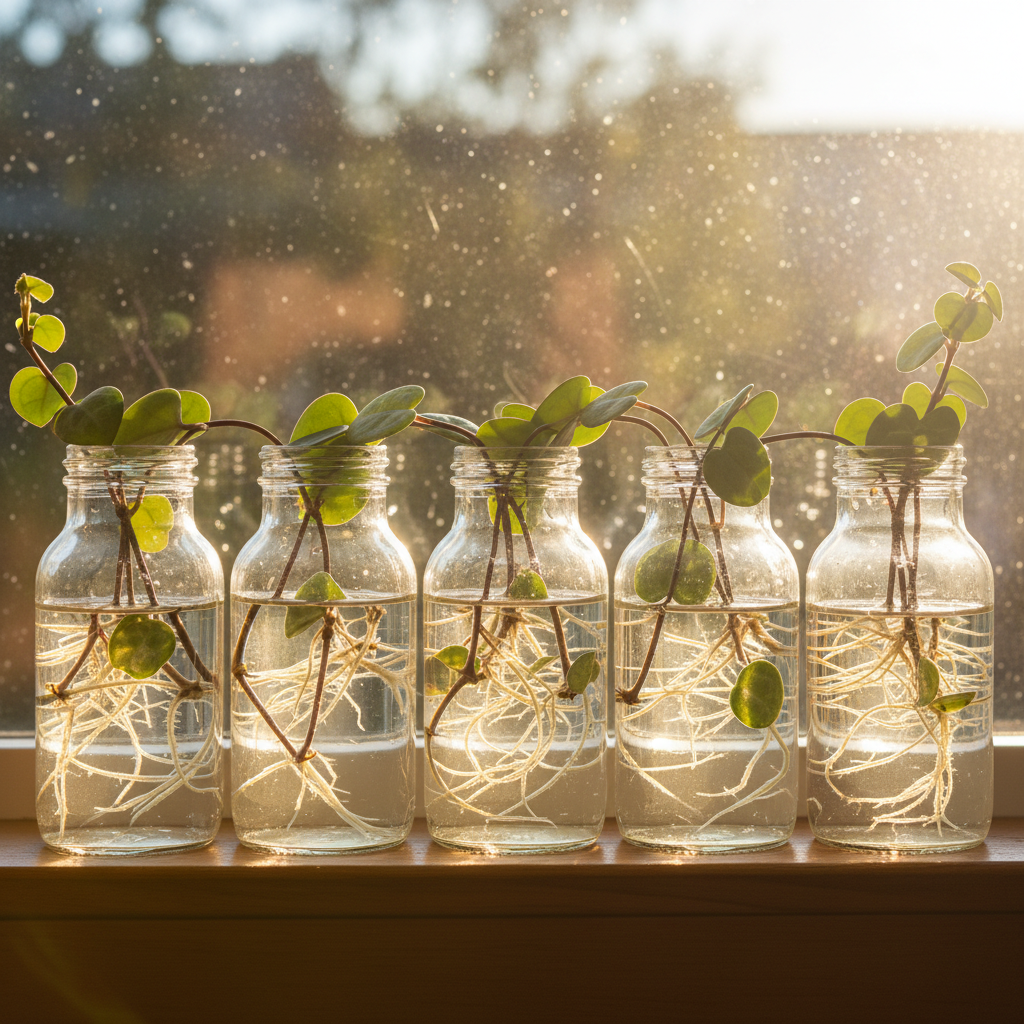
Water propagation is the easiest and most visually rewarding method, particularly for new propagators who want to watch roots develop.
- Select a healthy vine and cut a 10 to 15 centimetre (4 to 6 inch) section, ideally one that includes a tuber. Sterilised scissors or a sharp blade make a clean cut just below a node.
- Strip the lower pair of leaves from the cutting so the bottom two nodes are bare and will sit submerged.
- Place the cutting in a small clear glass or jar of room-temperature water deep enough to cover at least one node, with the remaining leaves above the waterline.
- Set the jar in bright, indirect light. Direct sun encourages algal growth and overheats the cutting; deep shade slows rooting.
- Refresh the water every three to five days, or whenever it begins to cloud. Use fresh room-temperature water.
- Roots typically appear within 7 to 14 days as small white shoots from the submerged nodes. Wait until they reach about 3 to 5 centimetres (1 to 2 inches) long before potting up.
- Pot the rooted cutting into a small pot of slightly damp succulent mix, planted shallowly so just the roots are buried, and keep slightly moister than usual for the first two weeks until the roots adjust to soil.
Pro Tip — Plant Multiple Cuttings Together: A single rooted cutting will eventually produce a full plant, but it can take a year or more to look established. For a quick, dense, instant-impact plant, root five to eight cuttings simultaneously and pot them into the same container, spaced evenly around the pot. The resulting plant looks mature within a season and trails as if it had been growing for years.
Soil Layering: Step-by-Step
Layering is the technique closest to how the plant propagates itself in the wild, where trailing vines touch the ground, root at nodes and form new clumps. Indoors it works equally well in any pot adjacent to the parent.
- Identify a healthy vine on the parent plant, ideally one with several tubers along its length.
- Set a small pot of fresh succulent mix beside the parent at the same height as the parent pot rim.
- Lay the chosen vine across the surface of the new pot so that one or more nodes (with tubers if possible) are in direct contact with the soil. Leave the vine attached to the parent.
- Pin the nodes down with a bent paperclip, a small wire hoop or a small stone to maintain firm soil contact.
- Keep the soil in the new pot lightly damp, not wet, for the next four to six weeks.
- Once new growth appears from the pinned nodes, the layer has rooted. Cut the vine between the parent and the new pot, and the new plant is independent.
This method is slower but produces a young plant with no transplant shock, since the parent supports the cutting until it has its own root system.
Troubleshooting Propagation
| Problem | Likely Cause | Solution |
|---|---|---|
| Cuttings rotting in water | Water too warm, jar in direct sun, or stale water | Move to bright indirect light, change water more often, use cooler water |
| Roots appear but do not grow longer | Too little light or extreme temperatures | Move to brighter indirect light; ensure room is 18 to 24°C |
| Rooted cutting wilts after potting | Sudden switch from water to dry soil | Keep new pots slightly damp for the first two weeks and increase humidity briefly with a loose plastic bag |
| Variegated cutting reverts to green | Insufficient light, or cutting taken from a green-only section | Take cuttings only from clearly variegated stems and root in bright indirect light |
Pests and Diseases
For a plant grown indoors, string of hearts is remarkably trouble-free. Its succulent, slightly waxy leaves are not especially attractive to most chewing pests, and the open, airy growth habit discourages the kind of moist, stagnant conditions that breed fungal disease. The problems that do occur are mostly opportunistic, taking advantage of either weakened plants or husbandry mistakes such as overwatering.
Healthy plants in good light, with a sensible watering regime and reasonable air movement, will rarely suffer serious infestations. Most issues are caught and dealt with easily if you look at your plants closely every week or two.
Common Pests
Mealybugs (Pseudococcus longispinus and related species)
The most frequent pest of string of hearts by a wide margin. Mealybugs are small, soft-bodied sucking insects, typically 2 to 4 millimetres long, coated in a white waxy fluff that makes them look like tiny scraps of cotton wool. They cluster in the most protected parts of the plant, including the leaf axils where leaves meet stems, the underside of tubers, and dense tangles of vine where the silver foliage hides them well. Heavy infestations cause leaf yellowing, sticky honeydew on lower vines and a general loss of vigour.
Treatment: Catch infestations early by inspecting the leaf axils every couple of weeks. Dab visible mealybugs with a cotton bud dipped in 70% isopropyl alcohol, which dissolves their waxy coating and kills them on contact. For larger infestations, dilute neem oil at the label rate and spray thoroughly over and under the foliage, repeating every 7 to 10 days for three or four applications to catch newly hatched generations. Isolate the affected plant from your other plants throughout treatment.
Spider Mites (Tetranychus urticae)
Microscopic relatives of spiders that thrive in hot, dry, dusty conditions. They appear as tiny moving specks on the undersides of leaves, often with fine silken webbing in the leaf axils. Affected leaves show a characteristic pale stippling pattern as the mites suck cell contents, eventually turning yellow and dropping. Spider mites multiply rapidly in dry indoor air in winter.
Treatment: Increase humidity around the plant briefly (a few minutes under a gentle shower of room-temperature water does the trick), then spray weekly with neem oil or insecticidal soap for three weeks to break the breeding cycle. Wipe leaves with a damp cloth to remove webbing and adult mites.
Aphids (Aphidoidea spp.)
Small soft-bodied insects, usually green, black or pink, that cluster on new growth and the youngest tubers. They suck sap and produce honeydew, which can attract sooty mould.
Treatment: A strong stream of lukewarm water in the sink or shower dislodges most aphids on contact. Follow up with insecticidal soap or neem oil if any return.
Fungus Gnats (Bradysia spp.)
Small dark flies that hover around the soil surface. The adults are mostly a nuisance, but their larvae feed on roots and organic matter in the soil and can damage young plants. Fungus gnats appear almost exclusively when soil is kept too wet.
Treatment: Allow the soil to dry out completely between waterings, as the larvae die in dry soil. Yellow sticky traps catch adults and break the breeding cycle. For persistent problems, water with a Bacillus thuringiensis subspecies israelensis (Bti) solution, which kills the larvae without harming the plant.
Common Diseases
Root Rot (Pythium, Phytophthora and Rhizoctonia spp.)
Far and away the most common cause of death in cultivated string of hearts. Root rot is caused by a range of opportunistic soil pathogens that take hold when roots sit in waterlogged or compacted soil. The plant collapses from the crown, with soft, mushy stem bases and a sour smell from the pot.
Treatment: Once severe, root rot is usually fatal for the original plant. At the first sign, unpot, cut away every affected root and stem back to firm clean tissue, dust the cuts with cinnamon (a mild natural antifungal) or a horticultural fungicide, and repot into fresh, dry succulent mix in a clean pot. Withhold water for at least a week and resume watering very sparingly. Take cuttings from any healthy upper vine as insurance.
Leaf Spot (Botrytis and related fungi)
A relatively rare problem for string of hearts, usually triggered by water sitting in leaf axils combined with cool, still, humid air. Symptoms include brown or black patches that begin small and spread, often with a slightly soft texture.
Treatment: Remove all affected leaves and dispose of them (not on a compost heap). Improve air circulation with a small fan or by moving the plant to a more open position, and avoid getting water on the leaves during watering.
Pest and Disease Summary
| Pest / Disease | Identification | Treatment |
|---|---|---|
| Mealybugs | White cottony clumps in leaf axils and around tubers | Cotton bud and alcohol on individuals; neem oil sprays for infestations |
| Spider mites | Fine stippling, webbing on leaf undersides | Rinse, raise humidity briefly, weekly neem or soap sprays |
| Aphids | Clusters of soft insects on new growth | Water rinse; insecticidal soap follow-up |
| Fungus gnats | Small flies around soil, larvae in wet soil | Dry the soil; yellow sticky traps; Bti drench |
| Root rot | Mushy black stem base, sour soil smell | Cut back to clean tissue, repot in dry succulent mix, withhold water |
Prevention Strategies
The single most effective preventive measure for string of hearts is correct watering: a true wet-dry cycle, fast-draining soil and a pot with drainage holes will rule out the vast majority of problems by themselves. Beyond that, a quarterly inspection routine catches pest infestations while they are still small and easy to deal with. Lift the canopy gently, examine the leaf axils with a small magnifier or phone macro lens, and check the soil surface for anything moving.
Newly arrived plants, whether from a shop, a swap or a generous friend, should be quarantined for two to three weeks away from the rest of the collection, and inspected closely before joining the others. Most pest outbreaks are imported on a single new plant.
Pro Tip — Preventive Neem Rinse: Once a month during the growing season, take string of hearts and any other susceptible plants to the sink and give the foliage a thorough rinse with lukewarm water, followed by a light spray of dilute neem oil over and under the leaves. This combination removes dust, dislodges any colonising pests before they establish, and creates a mildly hostile environment for new arrivals.
Popular Varieties
Although the species Ceropegia woodii is itself the most widely grown form, a number of selected cultivars and closely related species expand the collector’s options considerably, ranging from boldly variegated foliage to leaves so silver they look almost frosted. All are grown in essentially the same conditions as the standard species, with cultivars carrying significant white or cream variegation needing somewhat brighter light to perform at their best.
The number of named selections has grown rapidly in recent years as houseplant breeding and tissue culture have expanded. The following are the most reliably available and the most visually distinct from the standard species.
| Variety | Leaf Appearance | Light Needs | Growth Rate | Availability |
|---|---|---|---|---|
| Ceropegia woodii (species) | Heart-shaped, silver marbled over olive, purple underside | Bright indirect | Fast | Very common |
| ‘Variegata’ | Cream, pink and green variegation on smaller hearts | Bright indirect, brighter is better | Moderate | Common |
| ‘Silver Glory’ | Larger, rounder, mostly silver leaves with thin green margins | Bright indirect | Moderate to fast | Increasingly common |
| ‘Durban’ | More compact growth, denser silver patterning | Bright indirect | Moderate | Specialist nurseries |
| ‘Heartless’ | Sport with almost no leaves, just bare wiry stems | Bright indirect | Slow | Rare, collector item |
| Ceropegia linearis | Closely related species; narrower leaves and longer internodes | Bright indirect | Fast | Specialist nurseries |
| Ceropegia sandersonii | Parachute plant; chunky stems and umbrella-shaped flowers | Bright indirect | Moderate | Specialist nurseries |
Featured Varieties
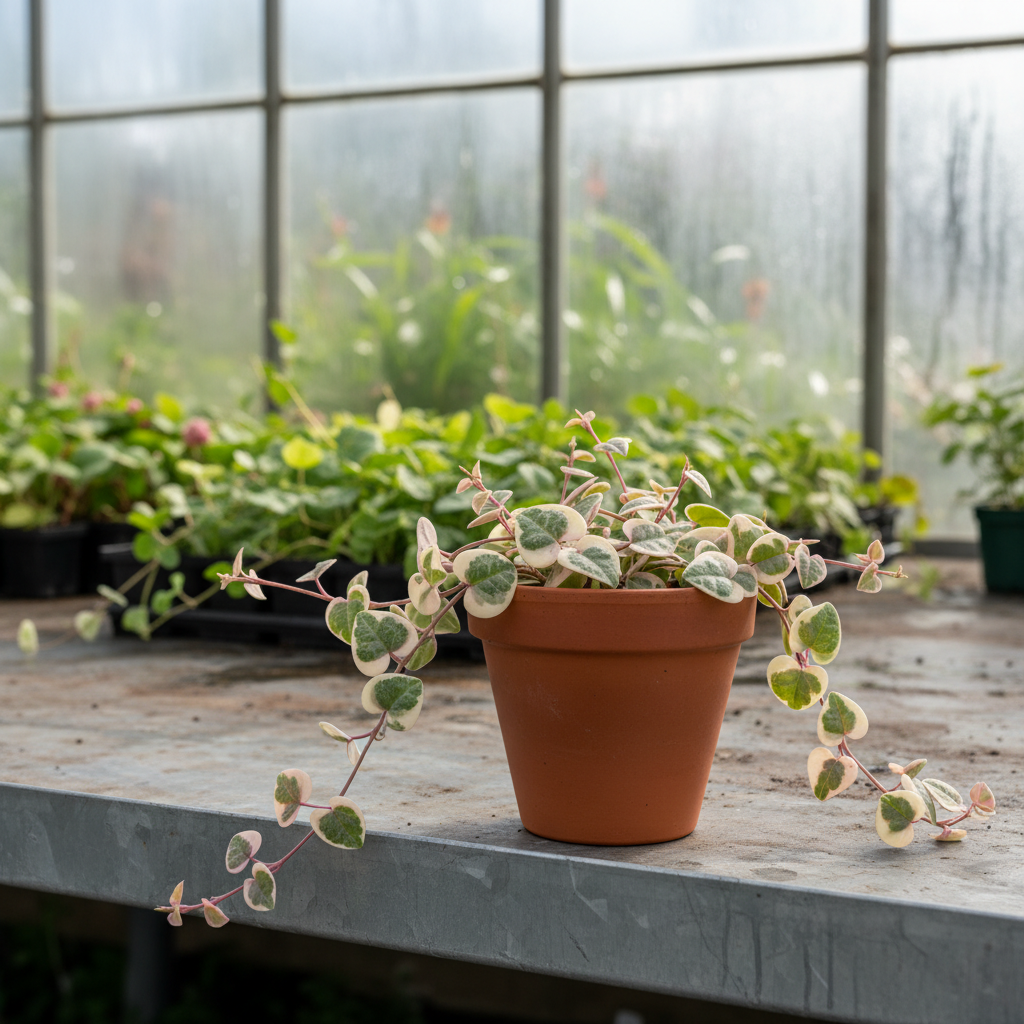
Ceropegia woodii ‘Variegata’
The most popular cultivar by a wide margin, ‘Variegata’ splashes cream, soft green and rose-pink across each heart-shaped leaf, with the pink tones intensifying in bright light and the stems often blushing pink along their length. Slightly slower growing than the species, it benefits from a brighter position to maintain strong variegation and to discourage all-green reversions, which can quickly outcompete the variegated stems if not pruned out.
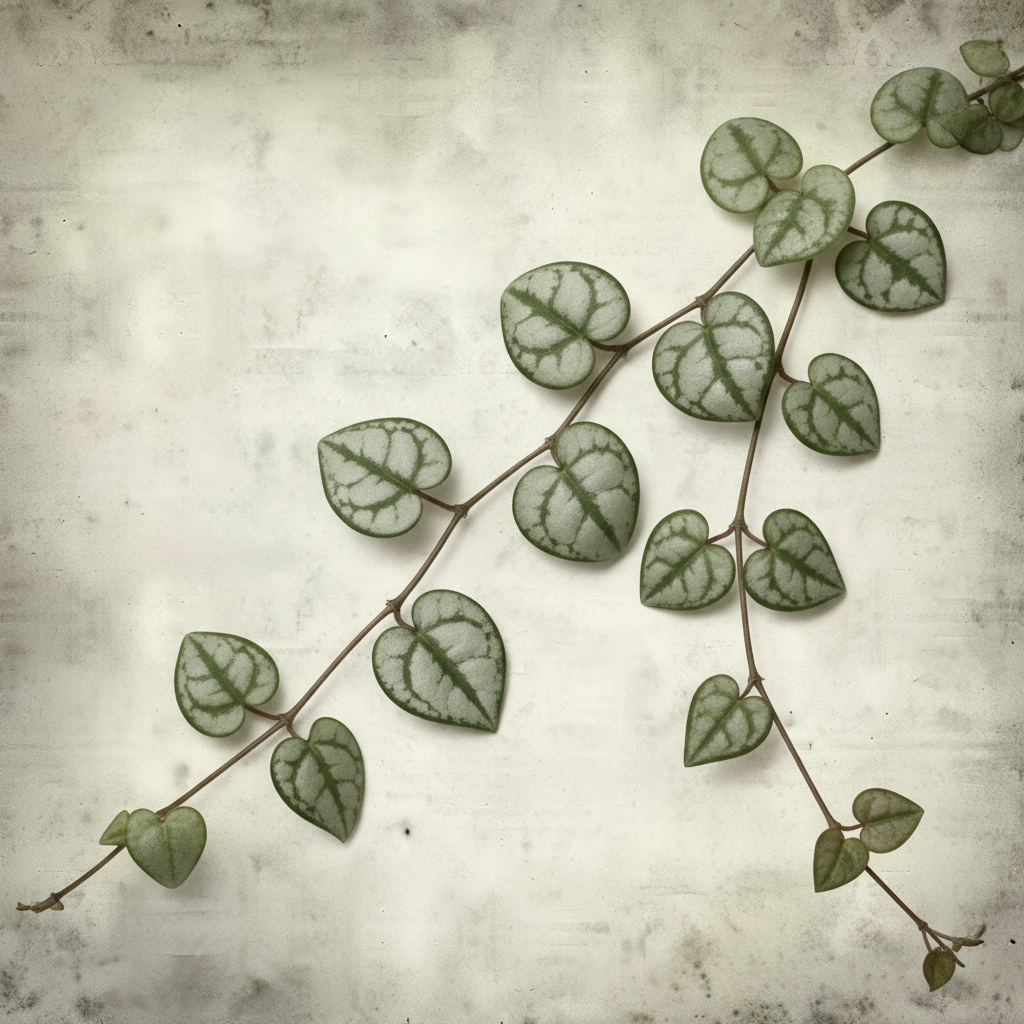
Ceropegia woodii ‘Silver Glory’
‘Silver Glory’ selects for the most strongly silvered foliage in the species, producing leaves that are noticeably larger and rounder than the standard form and almost entirely silver above with only the finest dark green margins. The result reads almost frosted in bright light. Growth rate is comparable to the species and care is identical, making it an ideal first cultivar for growers who want a clear visual upgrade without any change in routine.
Variety Profiles in Detail
Ceropegia woodii var. woodii
The straight species is the form most plant shops sell unlabelled, and remains a superb choice. Wiry purple stems trail metres long if undisturbed, with paired heart-shaped leaves spaced two to four centimetres apart in good light. Leaves are roughly thumbnail-sized, marbled silvery green over a dark olive base, with rich purple undersides that flash whenever the wind or a passing hand turns a vine. In late summer through autumn it produces small upright tubular flowers, two to three centimetres tall, in dusky pink and burgundy, with a swollen base and a fused canopy of five hair-fringed lobes at the top that gives the flower its lantern shape.
Ceropegia woodii ‘Heartless’
A curiosity rather than an ornamental in the usual sense, ‘Heartless’ is a sport in which the heart-shaped leaves are vestigial or absent entirely, leaving long bare wiry stems with the occasional tuber. Collectors prize it for its sculptural strangeness, and it grows in identical conditions to the standard species, although growth rate is slow and it does not propagate as freely as a leaved plant.
Ceropegia woodii ‘Durban’
A more compact selection often described as denser and more silver than the species, with shorter internodes that produce a tighter, fuller plant in the same space. Less widely available than ‘Variegata’ or ‘Silver Glory’ but worth seeking out for growers who want maximum impact in a small pot.
Ceropegia linearis
A closely related species frequently sold under the string of hearts name. Leaves are narrower and slightly longer, with paler silver patterning and noticeably longer internodes, so vines look more open and trailing rather than densely studded with hearts. Care is identical to Ceropegia woodii.
Ceropegia sandersonii (Parachute Plant)
A more architectural cousin from the same genus, sandersonii has chunkier upright-trailing stems with widely spaced fleshy leaves and produces extraordinary 5 to 7 centimetre tubular green flowers shaped like umbrellas or upside-down parachutes. Not a substitute for a string of hearts visually, but a fascinating companion plant for collectors of the genus.
Choosing the Right Variety for Your Space
For a first plant or a position with average bright light, the unimproved species or ‘Silver Glory’ are the most forgiving and the most striking. For a brighter spot with strong morning light, ‘Variegata’ rewards the extra light with intense pink and cream that can fade in dimmer conditions. For the smallest spaces, the more compact ‘Durban’ selection holds its shape well in a 10 centimetre pot, while collectors and conversation-piece hunters will gravitate toward ‘Heartless’ or related species like sandersonii. Whatever the choice, all forms in this group are propagated identically and tolerate the same range of conditions, so once you have one, the rest are easy collection-builders.
Frequently Asked Questions
Why are the leaves on my string of hearts so far apart?
Almost always a light problem. In low light, string of hearts elongates its stems and spaces leaf pairs further and further apart in an attempt to reach brighter conditions. Move the plant to a brighter position within half a metre of a window with bright indirect light, and new growth will return to tightly spaced pairs. The bare stretches of vine already produced will not refill, but you can prune them back to a node and the plant will branch from the cut point with denser, properly spaced new growth.
How fast does string of hearts grow?
In good light during the growing season, a healthy plant can extend its vines by 5 to 10 centimetres (2 to 4 inches) per week. A small plant from a 6 centimetre nursery pot bought in spring will often produce 50 centimetres to a metre of new vine by the end of summer. Growth is much slower in winter and in low-light conditions.
My string of hearts flowered, what are those tiny lantern-shaped flowers?
Those are the characteristic flowers of the Ceropegia genus, called variously lantern flowers or wine glass flowers because of their shape. Each is a small upright tube about two to three centimetres tall, with a swollen burgundy base and a fused parachute of five hairy lobes at the top. The hairs trap small flies inside the flower temporarily, ensuring pollination, after which the flies are released unharmed. Flowering is a sign of a happy, mature plant in good light, typically occurring in late summer and autumn.
What are the little beads forming along the stems?
Those are aerial tubers: water- and starch-storage organs that also serve as propagation packages. Each tuber will produce roots and a new shoot if pressed into damp soil, and the plant uses them in the wild to spread itself wherever a trailing vine touches the ground. They are completely normal and a sign that the plant is mature and growing well.
Is string of hearts safe for cats and dogs?
The American Society for the Prevention of Cruelty to Animals (ASPCA) lists Ceropegia woodii as non-toxic to cats and dogs. There are no recorded cases of serious poisoning in pets or humans. That said, the genus is part of the dogbane family, several relatives of which contain cardiac glycosides, and any plant material can cause mild stomach upset if eaten in quantity. Keeping the trailing vines out of reach of habitual chewers is sensible.
Why are my leaves wrinkled?
Wrinkled, slightly soft leaves indicate the plant is thirsty. The leaves store water, and they deflate slightly as the reserves are used up between waterings. A thorough watering plumps them up again within 24 to 48 hours. If the leaves remain wrinkled despite watering, check that the soil is actually absorbing water rather than running straight through bone-dry compacted soil; you may need to soak the pot in a basin for 20 minutes to fully rehydrate the soil mass.
Why are leaves dropping off in groups?
The most common cause is overwatering, which damages roots and triggers the plant to drop leaves it can no longer support. Check the lower stems and crown for softness, smell the soil for any sour odour, and unpot to inspect the roots if anything seems off. Less commonly, a sudden change in environment, such as a move to a new home, a cold draft, or a position change, can trigger temporary leaf drop that resolves on its own once conditions stabilise.
Can I grow string of hearts outdoors?
In USDA hardiness zones 10 to 12 (roughly the warmest parts of Florida, southern California and frost-free Mediterranean climates), string of hearts can grow outdoors year-round in a sheltered position with bright filtered light. In cooler climates, it can spend summer outdoors in a shaded spot once nights stay reliably above 10°C (50°F), but it must come back indoors well before any frost. Direct sun, particularly midday sun, will scorch the leaves outdoors just as it does indoors.
How do I encourage my string of hearts to flower?
Reliable flowering comes from a combination of mature age, bright indirect light, a slight cool dip in late summer or autumn, and a controlled wet-dry watering cycle. Plants in dim conditions or constantly damp soil rarely flower. Hold off on feeding during late summer to mimic the natural seasonal cycle, then allow a slightly cooler, drier rest as days shorten.
Why is my ‘Variegata’ going green?
Variegated plants occasionally produce all-green sprouts that grow faster and stronger than the variegated portions and, if left alone, gradually overtake the plant, a process called reversion. Cut all-green stems back to a node where the variegation is still visible as soon as you spot them. Keeping the plant in the brightest indirect light it can take without scorching also discourages reversion.






