
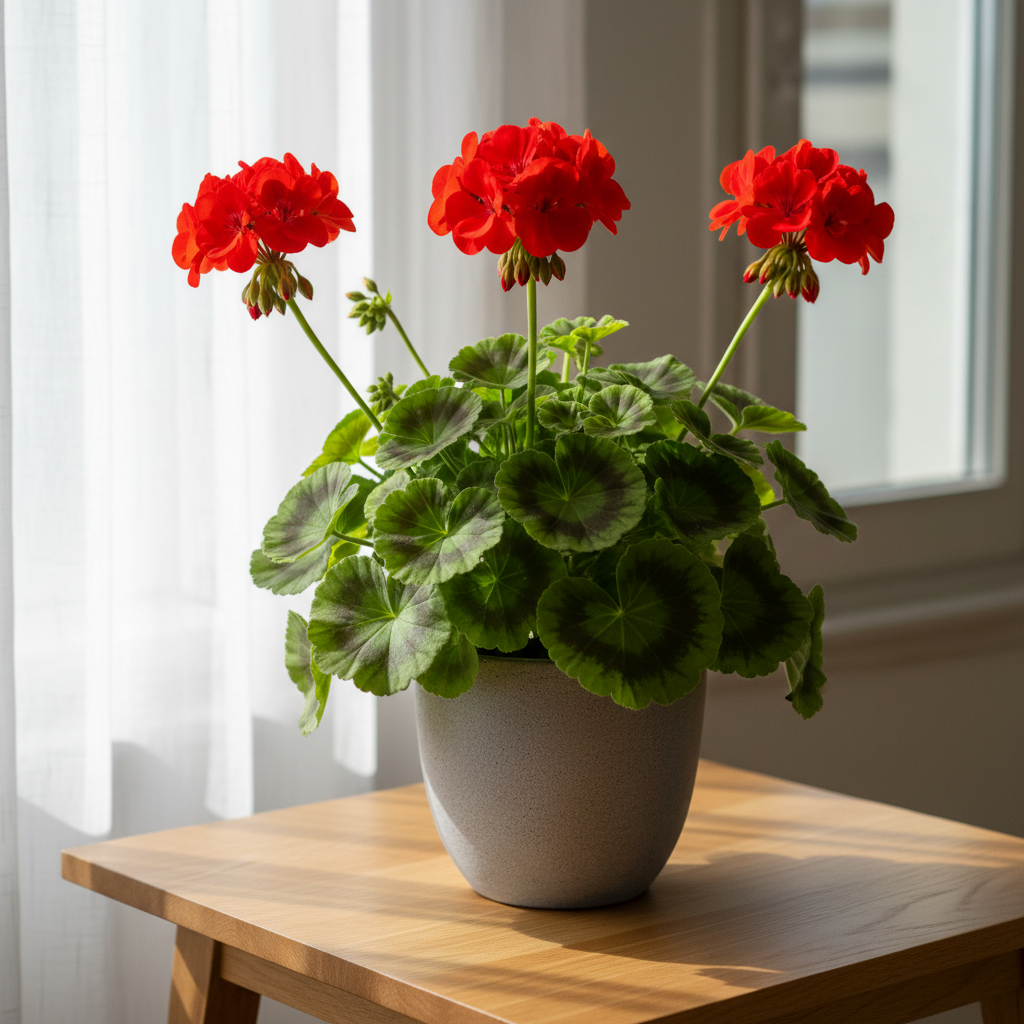
Few plants carry as much summer nostalgia as the geranium, with its mounded heads of scarlet, pink and white blooms spilling from windowboxes, balcony rails and bright sills the world over. The plant almost everyone calls a geranium is in fact a Pelargonium × hortorum, the zonal geranium, a hybrid group descended chiefly from Pelargonium zonale and Pelargonium inquinans, two species native to the Eastern Cape of South Africa. The common name is one of horticulture’s oldest muddles: true geraniums belong to the related genus Geranium (the hardy cranesbills), while the tender, showy, half-shrubby plants sold every spring are pelargoniums. The “zonal” tag refers to the dark horseshoe band of pigment that rings the rounded, softly velvety leaves of most cultivars.
Geraniums earned their place on the windowsill by being generous and forgiving in roughly equal measure. They flower for months given enough sun, shrug off the dry air of a centrally heated room, and recover quickly from the kind of neglect that kills fussier plants. Keeping one alive is genuinely easy; coaxing it into the dense, continuously blooming mound you see in catalogues takes a little more understanding of how much light it really wants, how to water a plant that prefers to run dry, and when to pinch and feed. This guide walks through every part of that picture, from the science of the zonal leaf to the pests most likely to find your plant, so you can move from simply surviving to genuinely thriving.
Contents
- Quick Reference
- Why Geranium Makes a Rewarding Houseplant
- Light Requirements
- Watering & Humidity
- Soil, Potting & Repotting
- Fertilising
- Propagation
- Pests & Diseases
- Popular Varieties
- Frequently Asked Questions
Quick Reference: Geranium at a Glance
| Light | Bright direct light; at least 4 to 6 hours of sun a day for strong flowering |
| Watering | Allow the top 2 to 3 cm (about 1 in) of soil to dry, then water thoroughly; tolerates drought far better than excess |
| Temperature | 18 to 24°C (65 to 75°F) ideal; protect from anything below 7°C (45°F), not frost hardy |
| Humidity | Low to moderate; dislikes still, humid air which invites rot and grey mould |
| Fertiliser | Balanced or bloom-focused feed every 2 weeks through spring and summer |
| Toxicity | Mildly toxic to cats and dogs; foliage can irritate sensitive skin |
Why Geranium Makes a Rewarding Houseplant
The geranium’s enduring popularity rests on a rare combination of toughness and showmanship. Unlike most flowering houseplants, which bloom briefly and then sulk, a well-sited zonal geranium can produce flower after flower from spring until the first cold of autumn, and indoors under good light it may barely pause at all. Each bloom is actually an umbel, a rounded cluster of many individual five-petalled flowers held aloft on a slender stalk above the foliage, so a single plant in full swing reads as a bouquet rather than a single bud. The colour range runs from pure white through every shade of salmon, coral, pink, magenta and crimson, with a handful of bicolours and picotees among the named cultivars.
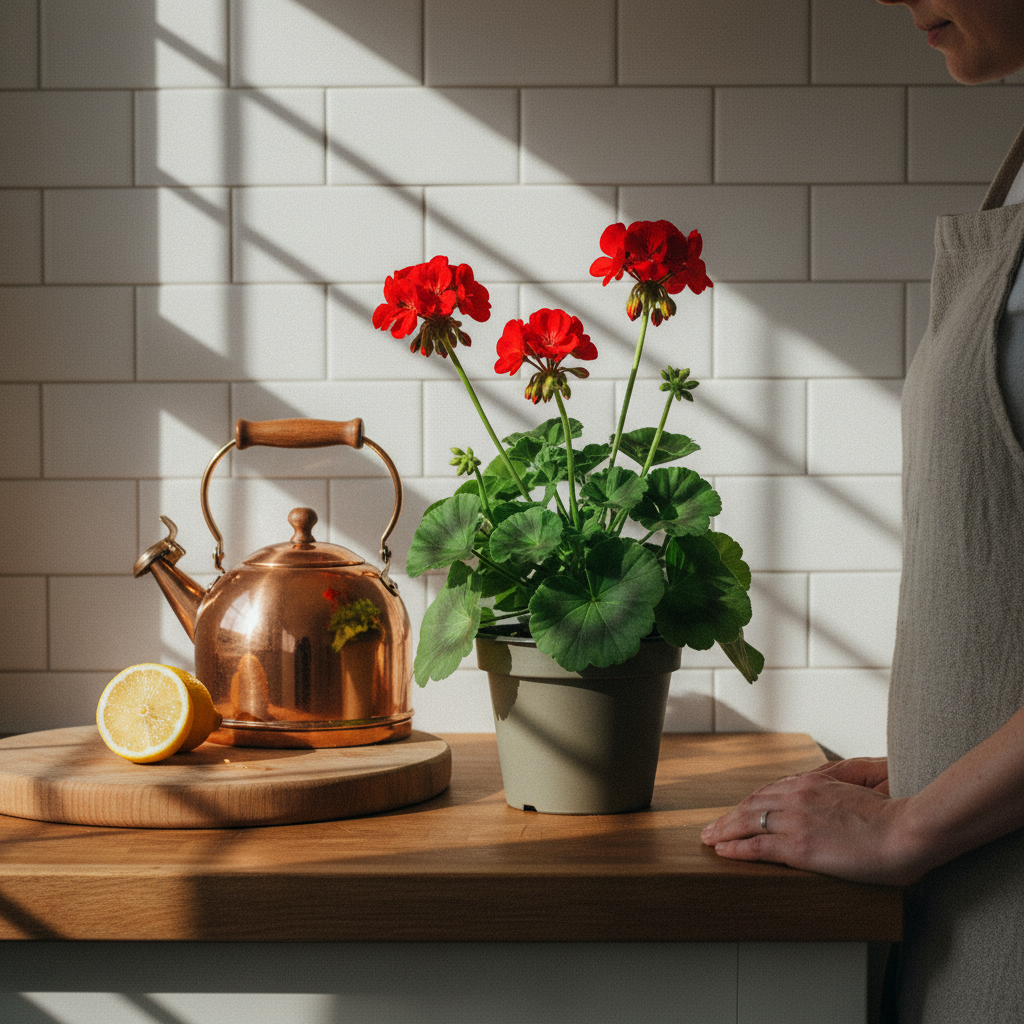
That performance comes wrapped in a constitution built for hardship. As natives of the seasonally dry South African veld, geraniums store moisture in their thick, slightly succulent stems and can endure the warm, arid air of a heated home that would crisp a fern or calathea within days. They ask for little beyond strong light and restrained watering, regrow readily from cuttings, and live for many years if overwintered indoors. The leaves themselves are a quiet pleasure too, softly hairy and aromatic when brushed, often marked with the characteristic dark zone that gives the group its name. For a beginner wanting colour and confidence in one plant, few choices repay the effort so reliably.
Important — Toxicity: Pelargoniums contain the essential-oil compounds geraniol and linalool, which are mildly toxic to cats and dogs. Ingestion can cause vomiting, loss of appetite, lethargy and skin irritation, and the foliage may also irritate sensitive human skin on prolonged contact. The plant is not life-threatening but is best kept out of reach of pets that like to chew.
Light Requirements
Light is the single most important factor in growing a good geranium, and it is where most disappointing plants are let down. These are full-sun plants from a high-light environment, and they convert light directly into flowers. A geranium that receives plenty of bright, direct sun stays compact, well coloured and densely flowered; one kept in dim conditions stretches into a pale, leggy plant that produces leaves but few or no blooms. Indoors, aim to give your plant the brightest position you have, ideally with several hours of sun falling directly on the foliage.
The practical target is a minimum of four to six hours of direct sun each day, and more is generally better as long as the plant does not overheat behind glass in high summer. On a sunny windowsill the plant will tell you it is happy through short internodes (the gaps between leaves stay tight), firm upright growth and a steady supply of flower stalks. If the stems elongate and lean hard toward the window, that is the plant asking for more light, and no amount of feeding or watering will substitute for it.
Light Levels Explained
Indoor light is far dimmer than most people assume, and the difference between a sill and the middle of a room is enormous. The table below gives a rough guide to how a geranium responds across the common indoor light tiers, measured very approximately in lux.
| Light Category | Approx. Level | Typical Location | Outcome |
|---|---|---|---|
| Direct sun | 50,000 lux and above | On a south or west sill, sun on the leaves | Best flowering, compact growth, strong leaf colour |
| Bright indirect | 10,000 to 25,000 lux | Just back from a sunny window | Good foliage, modest flowering at best |
| Medium | 5,000 to 10,000 lux | A few metres from a bright window | Leggy growth, little or no bloom |
| Low | 1,000 to 5,000 lux | North room, interior wall | Slow decline, pale stretched stems |
| Very low | Below 1,000 lux | Hallway, far from any window | Unsustainable; plant fails over weeks |
Window Orientation and Placement
South-facing window: In the northern hemisphere this is the ideal position for a geranium, delivering the long hours of direct sun the plant craves. In the height of summer, watch that the plant does not bake against the glass on the hottest afternoons; a sheer curtain at midday or a small gap from the pane is usually enough.
East-facing window: A good second choice, giving direct morning sun that is gentle and unlikely to scorch, followed by bright light through the afternoon. Flowering will be slightly less profuse than at a south window but the plant stays healthy and well shaped.
West-facing window: Strong afternoon sun makes a west sill nearly as productive as a south one. The main caution is heat build-up late in the day during summer, so keep the soil from drying out completely and provide a little air movement.
North-facing window: The weakest option and rarely enough on its own. A geranium on a north sill will survive for a time but stretch and stop flowering. If a north window is all you have, plan to supplement with a grow light.
Pro Tip — Turn for Even Growth: Geraniums lean strongly toward their light source. Give the pot a quarter turn every few days so the plant develops an even, rounded shape rather than growing lopsided toward the window.
How Light Affects Flowering and Leaf Colour
Light does more than power growth in a geranium; it shapes both the quantity of flowers and the intensity of the leaf markings. Flower production is closely tied to light received, so the gap between a plant in full sun and one in bright shade is most visible in the number of bloom stalks. The dark zonal band on the leaves also deepens in strong light, and in some fancy-leaf cultivars the gold, bronze and red leaf pigments only develop their full richness under generous sun. A plant grown too dim turns uniformly pale green and loses the very markings that make these varieties worth growing.
Warning — Direct Sunlight: Although geraniums love sun, a plant moved abruptly from a dim indoor spot into fierce summer sun can scorch, showing bleached or browned patches on the upper leaves. Acclimatise gradually over a week or two, increasing exposure a little each day, especially before moving a plant outdoors for summer.
Artificial Lighting
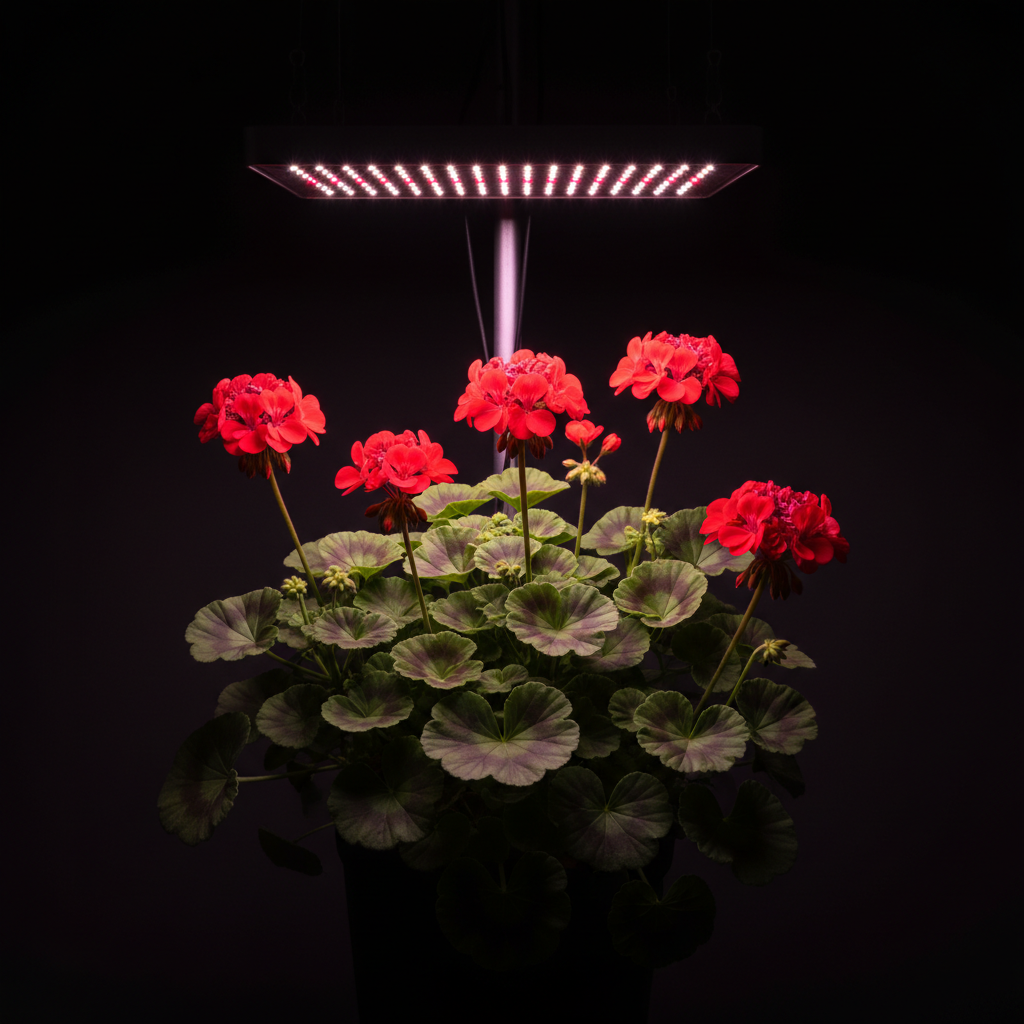
Because geraniums demand so much light, they respond very well to supplementary grow lights, which can carry a plant through the short, grey days of winter and keep it flowering when natural light would let it stall. A full-spectrum LED grow light positioned 20 to 30 cm (8 to 12 in) above the canopy, run for 12 to 14 hours a day, is enough to maintain compact growth and even bloom. Lights are particularly valuable if your only window is north-facing, or for keeping stock plants and cuttings growing strongly over winter for the following season.
Seasonal Adjustments
As daylight shortens through autumn, move your geranium to the brightest available window and expect growth and flowering to slow. Many growers treat winter as a semi-dormant rest, reducing water and stopping feeding, then ramp light, water and food back up as the days lengthen in late winter and early spring. If you want continuous winter bloom, a grow light is the surest way to provide it; without one, accept a quieter season and let the plant build strength for a strong spring flush.
Watering & Humidity
If light is where geraniums are most often starved, water is where they are most often killed with kindness. Their thick, semi-succulent stems store moisture, and the plants evolved to ride out dry spells, so they are built to tolerate drought far more readily than soggy soil. The guiding principle is to water generously but infrequently, letting the surface dry between drinks rather than keeping the compost permanently moist. Get this rhythm right and the rest of geranium care becomes very forgiving.
When to Water
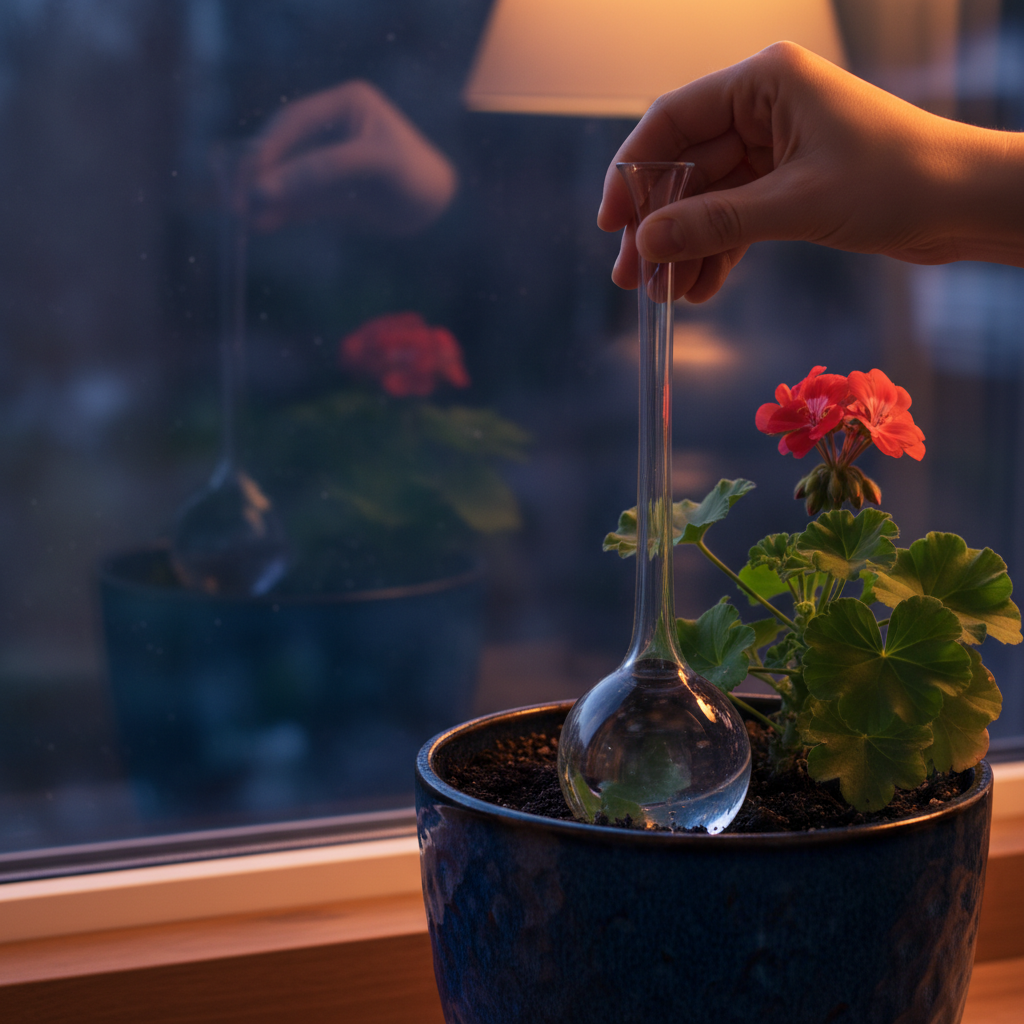
The simplest reliable test is your finger. Push it into the compost to the second knuckle, and water only when the top 2 to 3 cm (about 1 in) feels dry. In a warm, sunny spot in summer this might mean watering every two to four days; in a cooler room or in winter it can stretch to a week or two between waterings. Resist watering on a fixed schedule, since the plant’s needs swing widely with light, temperature and season. The weight of the pot is another good guide once you learn it: a dry pot lifts surprisingly light, a freshly watered one feels heavy.
When you do water, water properly. Apply enough that it runs freely from the drainage holes, which wets the entire root ball and flushes out accumulated salts, then tip away anything left standing in the saucer after a few minutes. A plant that is given frequent small sips develops shallow roots and a permanently damp upper layer, exactly the conditions that lead to rot. A thorough soak followed by a genuine drying period mimics the wet-and-dry cycle the plant is adapted to.
Pro Tip — Read the Stems: A thirsty geranium often shows it in slightly soft, drooping leaves that perk up within hours of watering. Use that as a fail-safe signal rather than a routine; occasional mild wilting does no harm, while chronic overwatering does.
How to Water Correctly
- Check the soil first, watering only when the top 2 to 3 cm (1 in) has dried out.
- Water at the base of the plant, directing the flow onto the soil rather than over the leaves and flowers.
- Add water steadily until it begins to drain freely from the bottom of the pot.
- Let the pot drain for several minutes so excess can escape.
- Empty the saucer or cache pot of any standing water so the roots never sit wet.
- Allow the surface to dry again before the next watering, adjusting frequency to the season.
Signs of Overwatering vs. Underwatering
| Symptom | Overwatering | Underwatering |
|---|---|---|
| Leaf colour | Yellowing, often from the lower leaves upward | Dull, sometimes with dry brown leaf edges |
| Leaf texture | Soft, limp, sometimes translucent | Thin, papery, crisp at the margins |
| Soil | Stays wet for days, may smell sour | Dry to depth, pulls away from the pot wall |
| Roots | Brown, mushy, foul-smelling | Dry but firm and pale |
| Stem base | Blackened and soft, collapsing (stem rot) | Firm but the whole plant droops, reviving on watering |
Warning — Root Rot: The most serious watering fault in geraniums is blackleg, a rot that blackens and softens the stem base and quickly kills the plant. It is driven by cold, wet compost and poor drainage. If you catch it early, take healthy cuttings from the top growth and start again, since an affected stem rarely recovers.
Humidity Requirements
Geraniums are unusual among popular houseplants in actively preferring drier air. They come from a climate of warm days and low humidity, and the ordinary atmosphere of a heated home suits them well. There is no need to mist, group for humidity or stand the pot on a pebble tray, and doing so can be counterproductive.
In fact, the main humidity-related problems come from too much moisture in the air rather than too little. Still, damp conditions encourage grey mould (botrytis) on leaves and spent flowers, and crowding plants together in humid corners makes fungal trouble far more likely. Good airflow is the geranium grower’s friend.
If anything, focus on ventilation rather than raising humidity. Space plants so air can move between them, remove faded flowers and yellowing leaves promptly, and avoid wetting the foliage when you water. A geranium kept in bright, airy, moderately dry conditions stays cleaner and healthier than one cosseted in a humid microclimate.
Water Quality
Geraniums are not fussy about water quality and tolerate ordinary tap water well, including moderately hard water. Over long periods, salts from hard water and fertiliser can accumulate in the compost, so the periodic thorough flushing described above is useful housekeeping. If your water is very heavily chlorinated, leaving it to stand overnight before use does no harm, but most growers find it unnecessary for this robust plant. Room-temperature water is gentler on the roots than very cold water straight from the tap.
Soil, Potting & Repotting
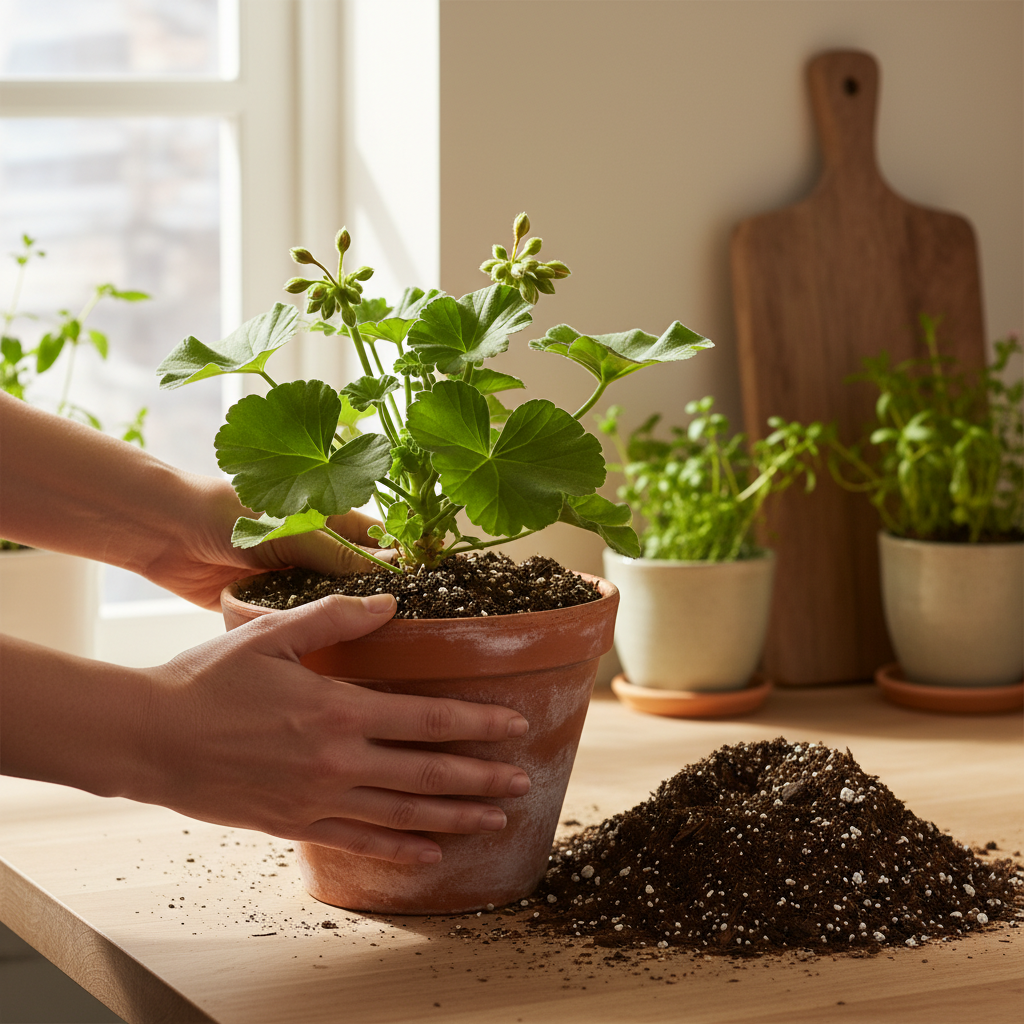
The right soil for a geranium is one that holds enough moisture to feed steady growth while draining fast enough that the roots are never waterlogged. Given the plant’s susceptibility to stem and root rot, sharp drainage matters more than richness. A loose, free-draining, slightly gritty mix is the goal, with enough body to support a vigorous flowering plant but plenty of air around the roots.
Ideal Soil Composition
A good general-purpose potting compost forms the base, opened up with grit or perlite to guarantee drainage. Geraniums do not need the bark-heavy, chunky mixes that aroids prefer; they are happiest in a more conventional loam-based or multipurpose compost with extra drainage material worked in. The table below sets out a reliable blend.
| Component | Proportion | Function |
|---|---|---|
| Multipurpose or loam-based compost | About two thirds | Holds moisture and nutrients, anchors the roots |
| Perlite or horticultural grit | About one quarter | Opens the mix, ensures fast drainage and aeration |
| Coarse sand or fine grit | Small handful | Adds weight and further sharpens drainage |
Geraniums prefer a soil that is neutral to slightly acidic, roughly pH 6.0 to 6.5, which is comfortably within the range of standard potting composts, so there is no need to adjust it for most growers. What matters far more than precise pH is that the mix never becomes a heavy, water-retentive sludge, which is the surest route to root trouble.
Pro Tip — Quick Mix Recipe: For a fast, dependable geranium mix, combine three parts multipurpose compost with one part perlite and a generous handful of grit per pot. It drains freely, holds enough moisture for summer flowering, and suits both windowsill pots and outdoor containers.
Choosing the Right Pot
Pot choice has a real effect on how easy a geranium is to keep healthy, because it governs how quickly the compost dries and how much spare moisture sits around the roots. For a plant that hates wet feet, a smaller, well-drained pot is almost always better than an oversized one.
Drainage holes are non-negotiable. Whatever the material or style, the pot must have one or more open drainage holes. A decorative cache pot with no holes is fine as an outer cover, but the plant should sit in an inner pot that drains freely, and that inner pot must never stand in collected water.
Pot material: Terracotta is the classic choice and an excellent one, because the porous clay wicks moisture from the compost and helps it dry between waterings, exactly what a geranium wants. Plastic and glazed ceramic retain moisture longer, so if you use them, lean toward a grittier mix and more cautious watering.
Pot size: Choose a pot only a little larger than the root ball. Geraniums actually flower better when slightly pot-bound, and a pot that is too big holds a reservoir of wet compost the small root system cannot use, raising the rot risk. Step up by just one size when repotting.
When to Repot
Geraniums are happy in modest pots and need repotting less often than fast-growing foliage plants. Move a plant up a size when roots are visibly circling the bottom or emerging from the drainage holes, when growth and flowering slow despite good care, or when the compost has broken down and stays wet too long. Early spring, as the plant comes back into active growth, is the best time, giving it a full season to settle and fill out. Refreshing the top few centimetres of compost each spring is a useful alternative when you do not want to move up a pot size.
How to Repot: Step-by-Step
- Water the plant lightly a day before, so the root ball holds together and slides out cleanly.
- Choose a pot one size larger with good drainage, and add a layer of fresh, gritty mix to the base.
- Ease the plant out and gently tease apart any tightly circling roots around the outside of the root ball.
- Inspect the roots, trimming away any that are brown, soft or rotten with clean scissors.
- Set the plant at the same depth it grew before, never burying the stem deeper, and fill around it with fresh mix.
- Firm the compost gently to remove air pockets without compacting it hard.
- Water in modestly, then hold off on further water until the surface dries to let any disturbed roots recover.
Warning — Transplant Shock: Geraniums dislike being planted too deep. Burying the stem invites rot at the buried section, so always keep the original soil line level with the new compost. Hold off feeding for a few weeks after repotting while new roots establish.
Fertilising
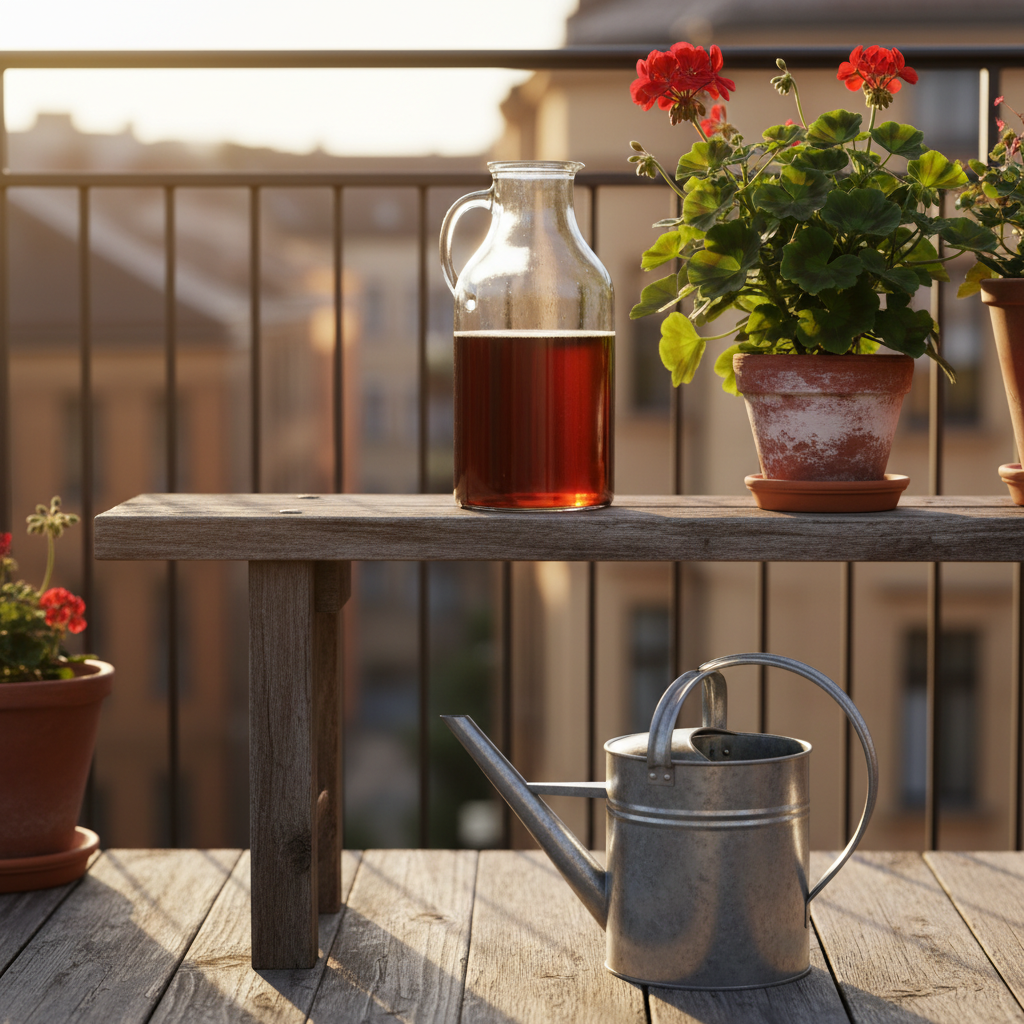
Geraniums are hungry flowering plants, and feeding is the lever that turns a healthy green plant into one smothered in bloom. Because they flower so continuously through the growing season, they draw steadily on nutrients, and a plant in fresh compost will exhaust the built-in feed within a couple of months. Regular, balanced feeding through spring and summer keeps the flowers coming and the foliage rich.
The key is to match feeding to the plant’s activity. Feed actively from spring to late summer when the plant is growing and flowering, then taper off in autumn and stop almost entirely over winter, when a fed-but-idle plant simply accumulates unused salts in the compost. Think of fertiliser as fuel for growth you can see, not a tonic to be applied regardless of season.
Understanding Plant Nutrients
Fertilisers are labelled with an N-P-K ratio describing the proportion of nitrogen, phosphorus and potassium they contain, the three nutrients plants need in the largest amounts. For a flowering plant like the geranium, potassium is especially valuable because it drives flower and fruit production, which is why bloom-boosting feeds are high in it. Nitrogen fuels leafy growth, and an excess of it produces lush foliage at the expense of flowers, so a feed that is balanced or slightly weighted toward potassium gives the best display.
| Nutrient | Symbol | Primary Function | Deficiency Symptoms |
|---|---|---|---|
| Nitrogen | N | Leafy growth and green colour | Pale, yellowing older leaves, weak growth |
| Phosphorus | P | Root development and flowering | Dull foliage, poor roots, reddish tints |
| Potassium | K | Flower production and overall vigour | Few flowers, browning leaf edges |
| Calcium | Ca | Cell walls and new growth | Distorted young leaves, weak stems |
| Magnesium | Mg | Core of the chlorophyll molecule | Yellowing between the veins of older leaves |
| Iron | Fe | Chlorophyll formation | Yellowing between veins of young leaves |
Types of Fertiliser
Liquid fertilisers: The most practical choice for geraniums, mixed into the watering can and applied every one to two weeks in the growing season. A high-potassium tomato or flowering-plant feed is ideal, giving precise control and an immediate response. Always dilute to the recommended strength or weaker.
Slow-release granular: Pellets mixed into the compost or scattered on the surface release nutrients gradually over weeks or months, useful for outdoor containers and for growers who prefer not to feed by hand each week. They give steadier but less responsive feeding than liquids.
Organic fertilisers: Options such as seaweed extract, worm castings and compost teas feed more gently and improve the life of the compost. They tend to be lower and slower in their nutrient release, so they pair well with the occasional high-potassium boost when you want a strong flush of flowers.
Feeding Schedule
A simple and effective routine is a balanced or high-potassium liquid feed at half to full strength every two weeks from early spring through late summer. As growth slows in autumn, reduce to monthly, then stop over winter unless the plant is being kept actively growing and flowering under lights. Always feed onto moist compost rather than dry, since fertiliser applied to a parched root ball can scorch the roots.
Pro Tip — Feed for Flowers, Not Leaves: If your geranium is producing plenty of lush foliage but few flowers, switch from a general feed to a high-potassium one such as tomato fertiliser. The shift in nutrient balance often tips the plant decisively toward blooming.
How to Fertilise
- Dilute the fertiliser to the recommended strength, or weaker if in doubt, in your watering can.
- Make sure the compost is already moist, watering first with plain water if it has dried out.
- Apply the diluted feed evenly to the soil at the base of the plant, avoiding the leaves and flowers.
- Allow any excess to drain away and empty the saucer so roots do not sit in concentrated solution.
- Resume the regular watering rhythm, feeding again at the chosen interval through the growing season.
Warning — Salt Build-Up: Overfeeding leaves a crust of mineral salts on the compost surface and pot rim and can brown the leaf edges. If you see this, flush the pot thoroughly with plain water several times to leach out the excess, and cut back on the strength or frequency of feeding.
Propagation
Geraniums are among the easiest of all houseplants to propagate, and stem cuttings root so readily that gardeners have passed favourite plants down for generations this way. Because named cultivars do not come true from seed, cuttings are also the only way to reproduce a particular colour or leaf form exactly. A single healthy plant can yield many new ones in a season, which makes propagation both practical insurance against losing a plant to rot and a cheap way to fill windowboxes.
The best time to take cuttings is from late spring through late summer, when the plant is growing strongly, though cuttings will root at almost any time given warmth and light. Many growers deliberately take cuttings in late summer to overwinter as young plants, insuring against losses and giving a head start on the following year’s display.
Understanding the Stem Node
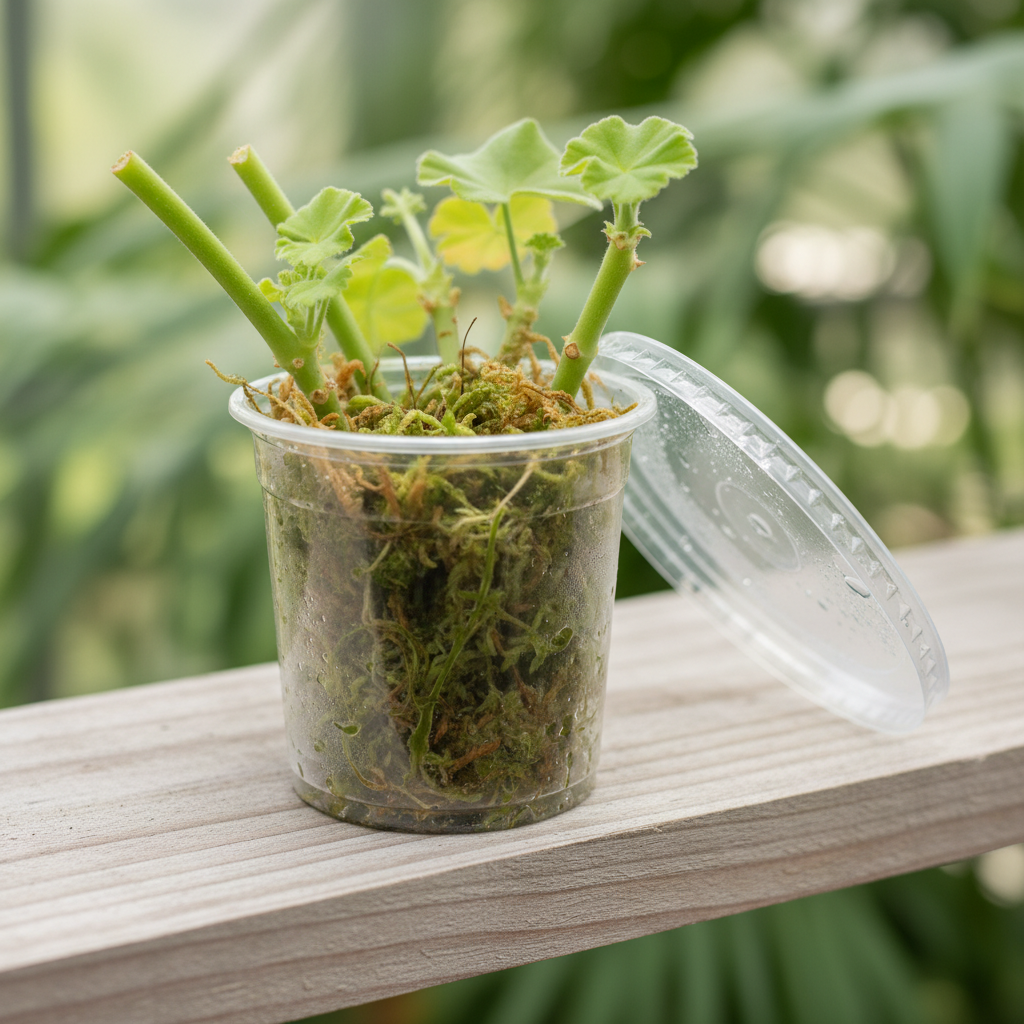
Successful cuttings depend on the node, the slightly swollen point on a stem where a leaf joins and where dormant root cells are concentrated. A cutting trimmed cleanly just below a node has the greatest capacity to form roots, because that is where the plant naturally generates them. Geranium stems are thick and store moisture, so a cutting carries its own reserves and roots without the high humidity that many cuttings need. In fact, letting the cut end dry and callus for a few hours before potting reduces the risk of the cut rotting.
Stem Cuttings in Compost: Step-by-Step
Rooting directly in a gritty compost is the traditional and most reliable method for geraniums, giving sturdy, well-rooted young plants with no transplant check.
- Choose a healthy, non-flowering shoot about 8 to 10 cm (3 to 4 in) long with several leaves.
- Cut cleanly just below a node with sharp, sterilised scissors or a knife.
- Remove the lower leaves and any flower buds, leaving two or three leaves at the top.
- Let the cut end dry and callus for a few hours, which guards against rot.
- Insert the cutting into a small pot of gritty, free-draining compost, firming it gently.
- Water lightly, then place in bright, warm conditions out of harsh direct sun.
- Keep the compost barely moist; roots usually form within two to four weeks, shown by fresh new growth.
Pro Tip — Skip the Plastic Bag: Unlike most cuttings, geraniums root better in open air than under a humidity cover. The thick stems hold their own moisture, and the still, damp air inside a bag or propagator encourages the stem to rot rather than root.
Water Rooting: Step-by-Step
Rooting in water is less traditional but lets you watch the roots develop, which makes it a satisfying method for beginners, though water-formed roots are slightly more delicate when potted on.
- Take a cutting as above, trimming below a node and removing the lower leaves.
- Stand the cutting in a small jar with just the bottom 2 to 3 cm (1 in) of stem in water.
- Place it on a bright windowsill out of fierce midday sun, and change the water every few days to keep it fresh.
- Once roots are 2 to 3 cm (1 in) long, pot the cutting into gritty compost.
- Keep the newly potted cutting lightly moist for a week or two while it adjusts to soil.
Troubleshooting Propagation
| Problem | Likely Cause | Solution |
|---|---|---|
| Cutting rots at the base | Too wet, no callus, airless conditions | Let the cut dry first, use grittier mix, give more air |
| Cutting wilts and shrivels | Too dry or too much sun before rooting | Move to bright but indirect light, keep just moist |
| No roots after many weeks | Cold conditions or too little light | Provide warmth around 18 to 21°C and brighter light |
| Yellowing leaves on the cutting | Normal leaf shed or overwatering | Remove yellow leaves, ease off water, wait for new growth |
Pests & Diseases
Geraniums are relatively trouble-free, and their aromatic foliage even deters some insects, but no plant is immune. Most problems arrive either with new plants brought into the home or in the conditions the grower creates, particularly the damp, still air and overwatering that fungal diseases love. Catching trouble early, when it is a few insects or a single spotted leaf, is far easier than tackling an established infestation.
The best defence is routine observation. Look over your plant whenever you water, turning a few leaves to check their undersides, and quarantine any newly bought plant for a couple of weeks before it joins the rest of your collection. A healthy, well-grown geranium in good light shrugs off minor attacks that would overwhelm a stressed one.
Common Pests
Aphids (Aphidoidea)
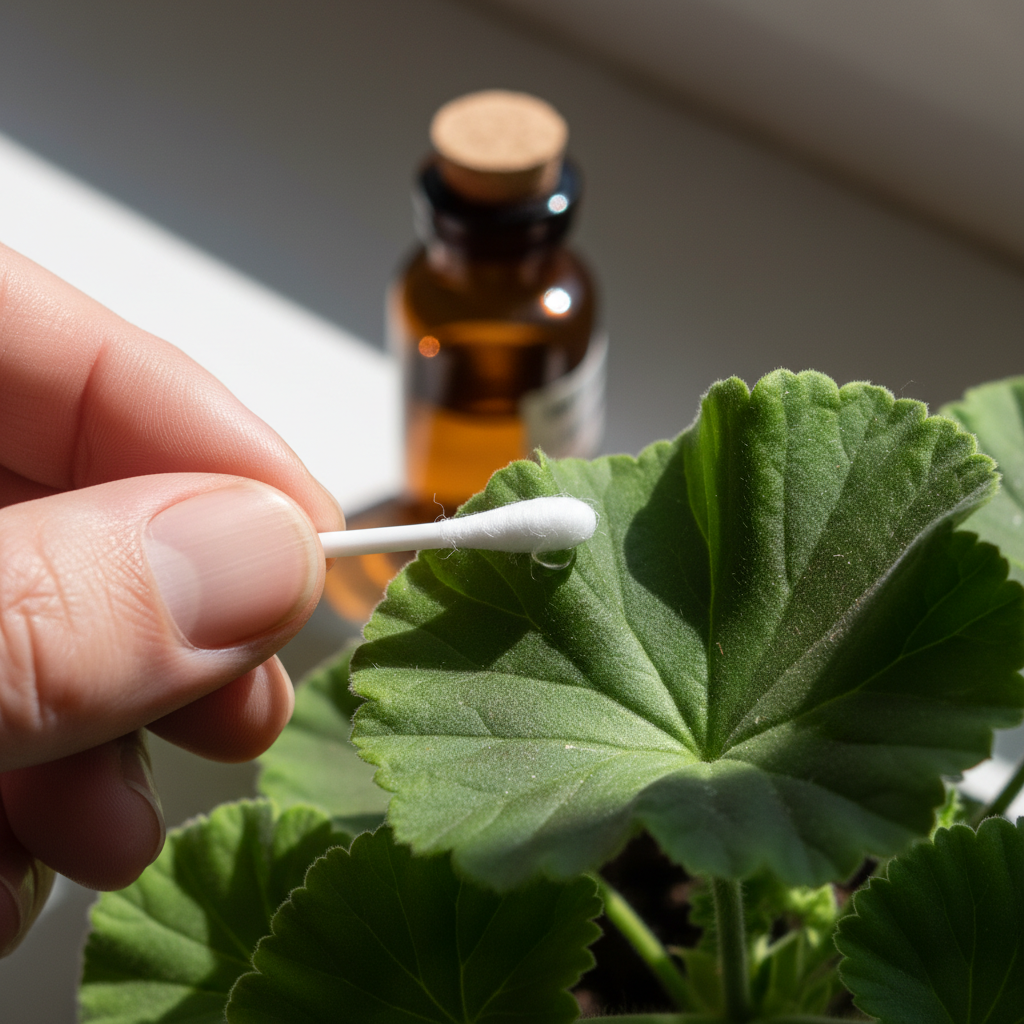
Soft-bodied green, black or pink insects that cluster on new growth and flower buds, sucking sap and leaving a sticky honeydew that can turn the foliage black with sooty mould. They breed quickly and are the most common geranium pest, especially in spring.
Treatment: Wash them off with a firm jet of water or wipe them away by hand, then treat persistent colonies with insecticidal soap or a diluted neem oil spray, repeating every few days until clear.
Whitefly (Trialeurodes vaporariorum)
Tiny white moth-like insects that rise in a cloud when the plant is disturbed and gather on leaf undersides. Like aphids they suck sap and excrete honeydew, weakening the plant and fouling the leaves, and they are a particular nuisance on geraniums under glass.
Treatment: Hang yellow sticky traps to catch the adults, spray leaf undersides with insecticidal soap or neem, and treat regularly, since the life cycle means several applications are usually needed.
Spider Mites (Tetranychus urticae)
Almost microscopic mites that thrive in hot, dry conditions and stipple the leaves with fine pale speckling, sometimes spinning delicate webbing in bad cases. They are easy to miss until the foliage looks dull and dusty and starts to yellow.
Treatment: Rinse the plant thoroughly, including leaf undersides, then treat with neem oil or a miticide. Improving air movement and avoiding heat stress reduces the conditions they favour.
Geranium Budworm (Chloridea virescens)
The caterpillar of a moth that bores into flower buds and eats them from within, so buds fail to open or are riddled with holes, and the foliage may be chewed too. It is a more common problem on plants grown outdoors in summer.
Treatment: Pick off the caterpillars by hand and remove damaged buds. For heavier attacks a biological control based on Bacillus thuringiensis targets the caterpillars without harming beneficial insects.
Common Diseases
Grey Mould (Botrytis cinerea)
A fuzzy grey-brown fungus that attacks spent flowers, ageing leaves and any soft, damaged tissue, spreading fast in cool, damp, still conditions. On geraniums it often takes hold in faded flower heads left on the plant.
Treatment: Remove and bin affected parts immediately, deadhead spent flowers promptly, and improve air circulation. Avoid wetting the foliage and reduce humidity around the plant to halt its spread.
Bacterial Blight (Xanthomonas hortorum)
A serious bacterial disease that causes angular brown leaf spots, wilting wedges of foliage and blackening of the stems, and it can collapse a plant rapidly. It spreads through water splash and on tools, and there is no cure once a plant is infected.
Treatment: Destroy infected plants to protect the rest of your collection, sterilise tools and pots, take cuttings only from clearly healthy stock, and avoid overhead watering that splashes the bacteria about.
Geranium Rust (Puccinia pelargonii-zonalis)
A fungal disease specific to zonal geraniums, showing as concentric rings of powdery reddish-brown pustules on the undersides of the leaves with yellow spots above. Severe infections cause heavy leaf drop and weaken the plant.
Treatment: Remove and destroy affected leaves at the first sign, improve airflow, keep the foliage dry, and apply a suitable fungicide if the infection persists.
Pest and Disease Summary
| Pest / Disease | Identification | Treatment |
|---|---|---|
| Aphids | Clusters of small insects on buds and new growth, sticky honeydew | Rinse off, insecticidal soap or neem, repeat |
| Whitefly | Tiny white flies rising from leaf undersides | Yellow sticky traps, soap or neem sprays |
| Spider mites | Fine pale speckling, dull leaves, faint webbing | Rinse, neem or miticide, raise airflow |
| Geranium budworm | Holed buds and chewed leaves, caterpillars present | Hand-pick, remove damaged buds, Bt control |
| Grey mould | Fuzzy grey growth on flowers and old leaves | Remove affected parts, deadhead, improve air |
| Bacterial blight | Angular spots, wilting wedges, stem blackening | Destroy plant, sterilise, healthy cuttings only |
| Geranium rust | Brown pustule rings under leaves, yellow spots above | Remove leaves, dry foliage, fungicide if needed |
Prevention Strategies
Prevention with geraniums comes down to good growing conditions and good hygiene. Bright light, careful watering and free-draining compost keep a plant vigorous enough to resist most pests, while the fungal and bacterial diseases that cause the worst damage are almost always tied to damp, crowded, poorly ventilated conditions. Space your plants, water at the base rather than over the leaves, and remove fading flowers and yellowing foliage before they become a fungal foothold.
Quarantine is the other pillar. Most infestations enter on a newly acquired plant, so keep any new geranium apart from your others for a couple of weeks and watch it closely before integrating it. Sterilise scissors between plants when taking cuttings or deadheading, and never propagate from a plant showing signs of bacterial blight, since the disease travels silently in cuttings.
Pro Tip — Deadhead Regularly: Pinching off spent flower heads as soon as they fade does double duty: it removes the decaying tissue that grey mould colonises, and it pushes the plant to produce fresh blooms rather than setting seed. A few seconds at each watering keeps a geranium both cleaner and more floriferous.
Popular Varieties
The geraniums sold as houseplants and bedding fall into several distinct groups, and knowing them helps you choose the right plant for a sill, a hanging basket or a fragrant collection. The zonal geraniums (Pelargonium × hortorum) covered by this guide are the upright, free-flowering classics with the dark leaf zone, but the wider world of pelargoniums includes trailing ivy-leaved types, the large-flowered regals, and the scented-leaf kinds grown as much for fragrance as for bloom.
Within the zonal group alone there are hundreds of named cultivars, ranging from compact bedding strains to vigorous interspecific hybrids bred for weather resistance, and from plain green leaves to dazzling tricoloured foliage. The selection below covers the main types you are likely to meet and a few standout named cultivars worth seeking out.
| Variety | Leaf Appearance | Light Needs | Growth Rate | Availability |
|---|---|---|---|---|
| Zonal geranium | Rounded, velvety, dark horseshoe zone | Full sun | Moderate to fast | Very common |
| Ivy-leaved geranium | Glossy, ivy-shaped, trailing | Full sun to part sun | Fast | Common |
| Regal (Martha Washington) | Pleated, toothed, mid-green | Bright, cooler conditions | Moderate | Common |
| Scented-leaf | Variable, deeply cut, aromatic | Full sun | Moderate | Specialist |
| ‘Mrs. Pollock’ | Gold, bronze and green tricolour | Full sun | Slow to moderate | Specialist |
| ‘Calliope Dark Red’ | Dark green, vigorous | Full sun | Fast | Increasingly common |
| ‘Vancouver Centennial’ | Bronze-red star-shaped, gold edged | Full sun | Moderate | Specialist |
Featured Varieties
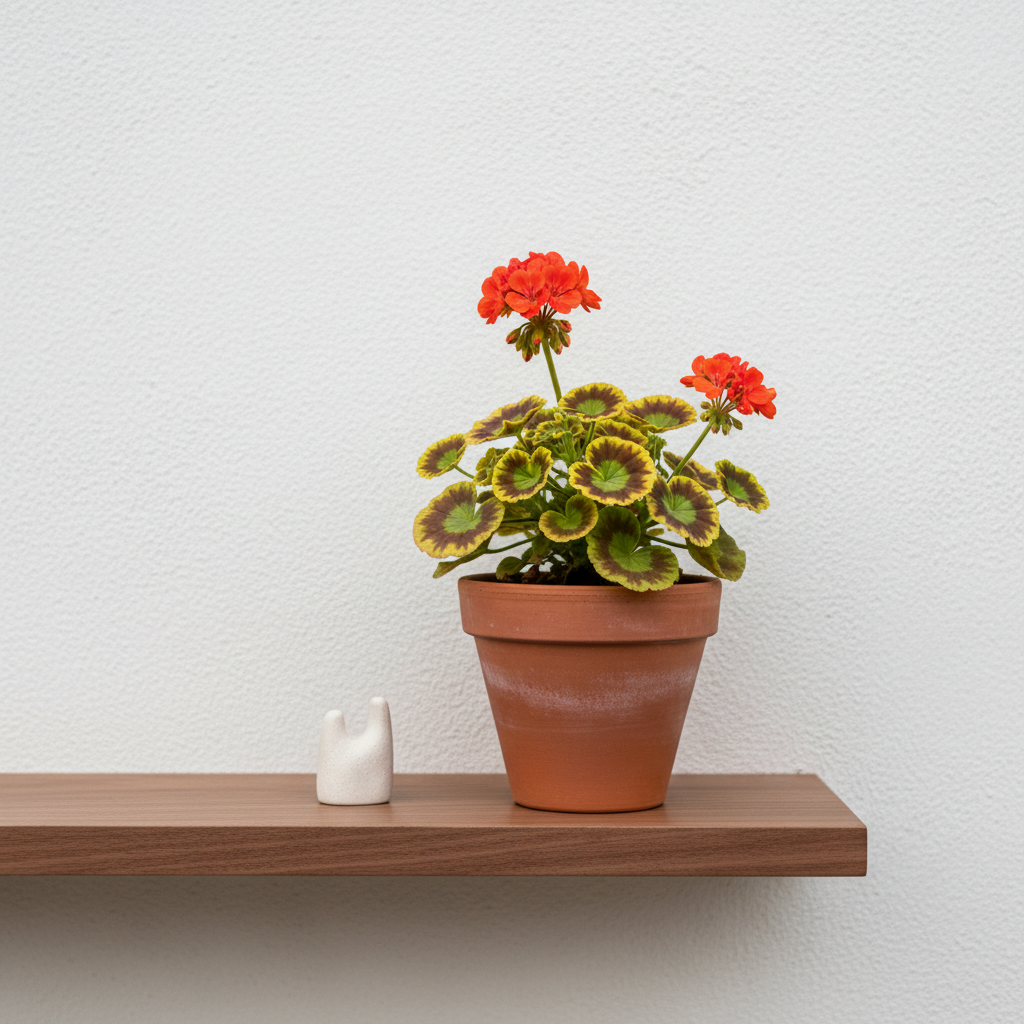
‘Mrs. Pollock’
A celebrated Victorian fancy-leaf zonal grown above all for its foliage: golden-yellow leaves marked with a chestnut-bronze horseshoe zone and a green centre, topped by vermilion-orange single flowers. It is slower and a little more demanding than plain zonals, rewarding strong light with its fullest leaf colour.
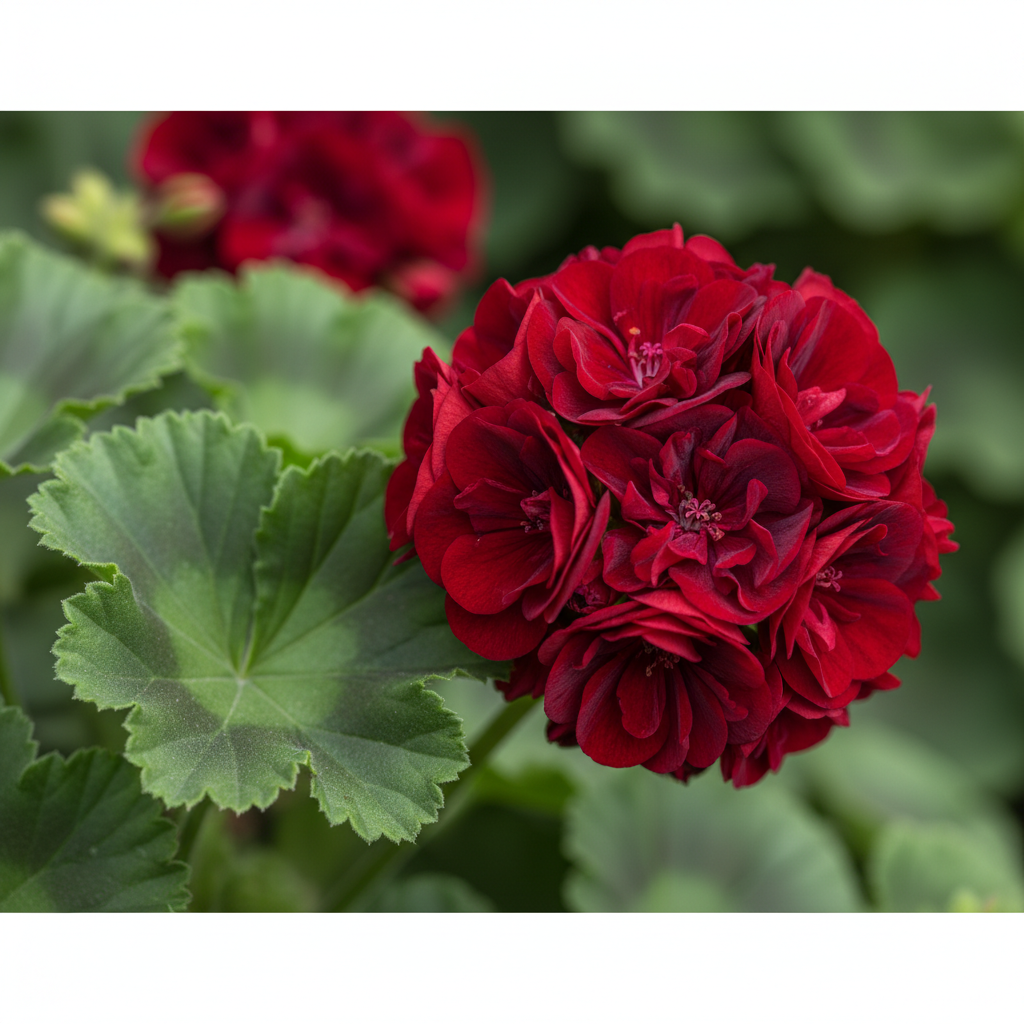
‘Calliope Dark Red’
A modern interspecific hybrid combining the vigour of an ivy-leaved parent with the upright habit of a zonal. It carries large rounded trusses of velvety deep-crimson double flowers over lush dark foliage, blooms tirelessly through heat, and has become a favourite for containers thanks to its weather resistance.
Variety Profiles in Detail
Ivy-Leaved Geranium (Pelargonium peltatum)
Distinguished by its glossy, fleshy, ivy-shaped leaves and trailing stems, this group is the classic choice for hanging baskets and windowboxes, cascading over the edge in sheets of flower. It shares the zonal’s love of sun and dislike of wet feet, and is generally even more heat and drought tolerant.
Regal Geranium (Pelargonium × domesticum)
Also called Martha Washington geraniums, regals bear large, ruffled, often bicoloured flowers in spring and early summer above pleated, toothed leaves. They flower in a shorter season than zonals and prefer slightly cooler, bright conditions, making them a more seasonal but spectacular indoor plant.
Scented-Leaf Pelargoniums (Pelargonium species)
Grown for foliage that releases scents of rose, lemon, mint, chocolate or nutmeg when brushed, these are a diverse group with smaller, often modest flowers. They make wonderful sensory windowsill plants, enjoy the same sun and sharp drainage as zonals, and many are vigorous and easy.
Choosing the Right Variety for Your Space
Let your conditions and your taste guide the choice. For a bright, sunny sill where you want long, reliable colour, an upright zonal or a tough interspecific hybrid like ‘Calliope Dark Red’ is hard to beat. For a hanging basket or a high shelf, an ivy-leaved type will trail and flower beautifully. If you have a cooler, very bright room and want a shorter burst of large, showy blooms, a regal will oblige, while a collection of scented-leaf kinds turns a windowsill into something to touch and smell as well as see. Whichever you choose, the core needs are the same: generous sun, careful watering and a free-draining mix.
Frequently Asked Questions
Why is my geranium not flowering?
The most common cause by far is too little light, since geraniums need several hours of direct sun to bloom well. The next most likely culprits are too much nitrogen-rich feed, which drives leaves at the expense of flowers, and failing to deadhead. Move the plant to your sunniest window, switch to a high-potassium feed, and remove spent flower heads promptly to encourage a fresh flush.
Are geraniums safe around cats and dogs?
Pelargoniums are mildly toxic to cats and dogs because of compounds such as geraniol and linalool. Ingestion can cause vomiting, loss of appetite, lethargy and skin irritation, though it is rarely dangerous. Keep the plant out of reach of pets inclined to chew, and contact a vet if a pet eats a significant amount.
How do I keep a geranium over winter?
Bring the plant indoors before the first frost and keep it in the brightest spot you have, ideally a cool, well-lit room at around 10 to 15°C (50 to 59°F). Water sparingly, only when the soil has dried well, and stop feeding. The plant will rest over winter and can be cut back and revived in spring. Many growers also overwinter young cuttings as insurance.
Should I deadhead my geranium, and how?
Yes. Removing faded flower clusters keeps the plant blooming and prevents grey mould taking hold in the decaying petals. Snap or cut the whole spent flower stalk off at its base where it meets the main stem, rather than just pulling off individual petals, so no stub is left to rot.
Why are my geranium’s lower leaves turning yellow?
Occasional yellowing of the oldest, lowest leaves is normal as the plant ages them out. Widespread yellowing usually points to overwatering, the most common care fault, so check that the soil is drying between waterings and that the pot drains freely. Less often it signals a nutrient shortage, which a balanced feed in the growing season will correct.
Can I grow my geranium outdoors in summer?
Absolutely, and many geraniums flower best outdoors in summer sun. Wait until all danger of frost has passed, then acclimatise the plant gradually to brighter light and outdoor conditions over a week or two to avoid scorch. Bring it back inside before the first autumn frost, as geraniums are not frost hardy.
How often should I water my geranium?
There is no fixed schedule; water by checking the soil rather than the calendar. Wait until the top 2 to 3 cm (1 in) is dry, then water thoroughly until it drains from the bottom. In warm, sunny weather this may be every few days, while in winter it can be every week or two. When in doubt, err on the dry side, as geraniums tolerate drought far better than wet roots.
Is a geranium the same as a pelargonium?
In everyday use the two names are used interchangeably, but botanically they are different. The tender, showy plants sold as geraniums are pelargoniums, native to South Africa, while true geraniums are the hardy cranesbills of the genus Geranium. The confusion dates back to early plant classification, and the common name has simply stuck.






