
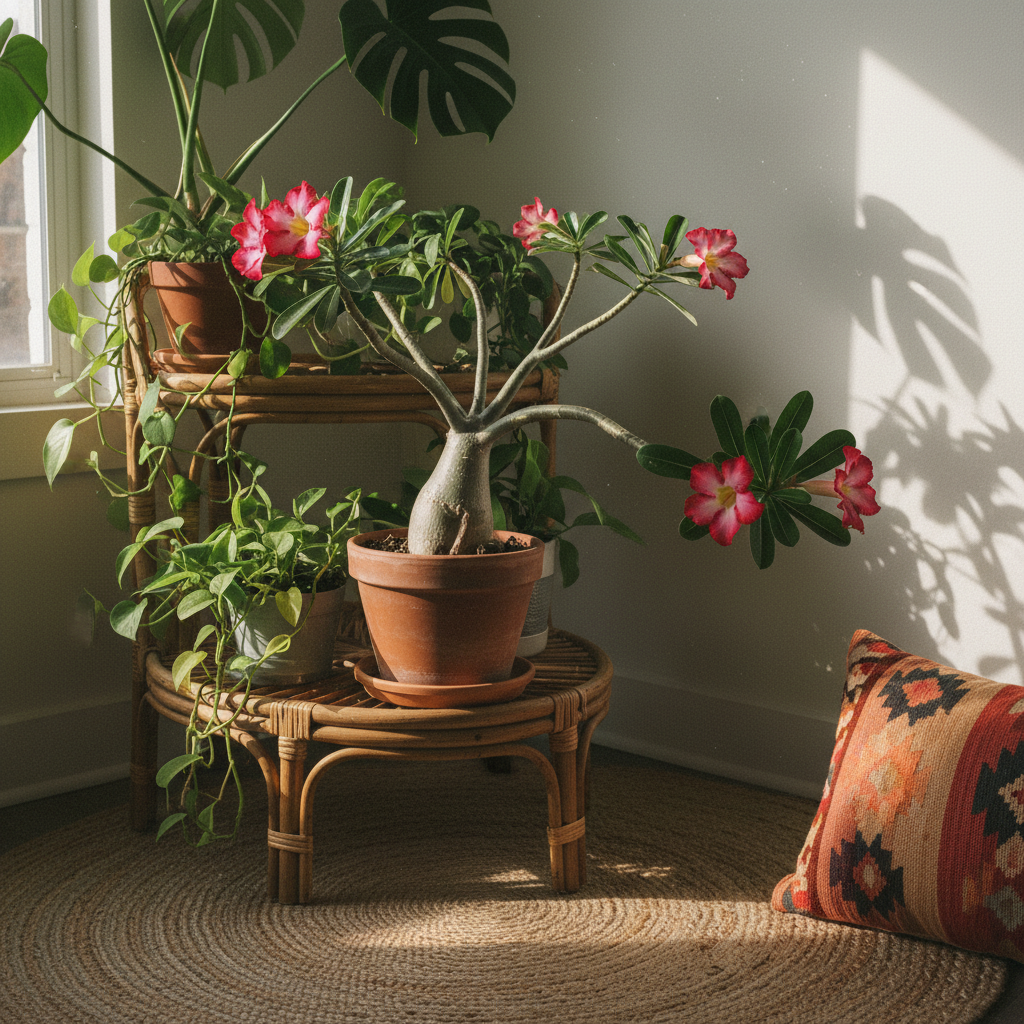
Few houseplants look quite as deliberate as the desert rose. With its swollen, bottle-shaped base tapering into slender branches and crowned by waxy trumpet flowers, Adenium obesum looks less like something you bought at a garden centre and more like a living piece of sculpture. It belongs to the dogbane family, Apocynaceae, alongside frangipani and oleander, and it carries the same air of subtropical drama indoors as it does growing wild across the Sahel, the Arabian Peninsula and the dry savannahs of eastern and southern Africa.
That dramatic base is a caudex, a water-storing trunk the plant has evolved to survive long droughts under a fierce sun. It is the reason the desert rose is so forgiving of neglect and so unforgiving of overwatering. Keeping one alive is genuinely easy once you understand that it wants to be treated like the desert succulent it is. Getting one to thrive, to fatten its caudex and flower in flushes through the warm months, takes a little more attention to light, water and dormancy. This guide walks through every part of that, from the brightest windowsill in your home to the gritty mix at the bottom of the pot.
Contents
- Quick Reference
- Why Desert Rose Makes a Striking Houseplant
- Light Requirements
- Watering & Humidity
- Soil, Potting & Repotting
- Fertilising
- Propagation
- Pests & Diseases
- Popular Varieties
- Frequently Asked Questions
Quick Reference: Desert Rose at a Glance
| Light | As much direct sun as possible, at least 6 hours daily; a south-facing window is ideal |
| Watering | Soak thoroughly, then let the soil dry out completely; far less in winter |
| Temperature | 21 to 32 degrees Celsius (70 to 90 degrees Fahrenheit); keep above 10 degrees Celsius (50 degrees Fahrenheit) |
| Humidity | Low to average; tolerates dry indoor air well |
| Fertiliser | Balanced or bloom feed at half strength, every two to four weeks in spring and summer only |
| Toxicity | Toxic to people and pets; the sap contains cardiac glycosides |
Why Desert Rose Makes a Striking Houseplant
The appeal of the desert rose starts with that caudex. No two are identical, and a well-grown specimen develops a fat, gnarled, almost animal base that gives even a small plant the presence of a miniature bonsai tree. Growers prize this so much that the plant is often raised from seed specifically for its caudex, then trained and pruned over years into elaborate shapes. For a houseplant collector who has worked through the usual leafy aroids, a desert rose offers something completely different: a sculptural, slow, characterful plant that looks good even when it is not in flower.
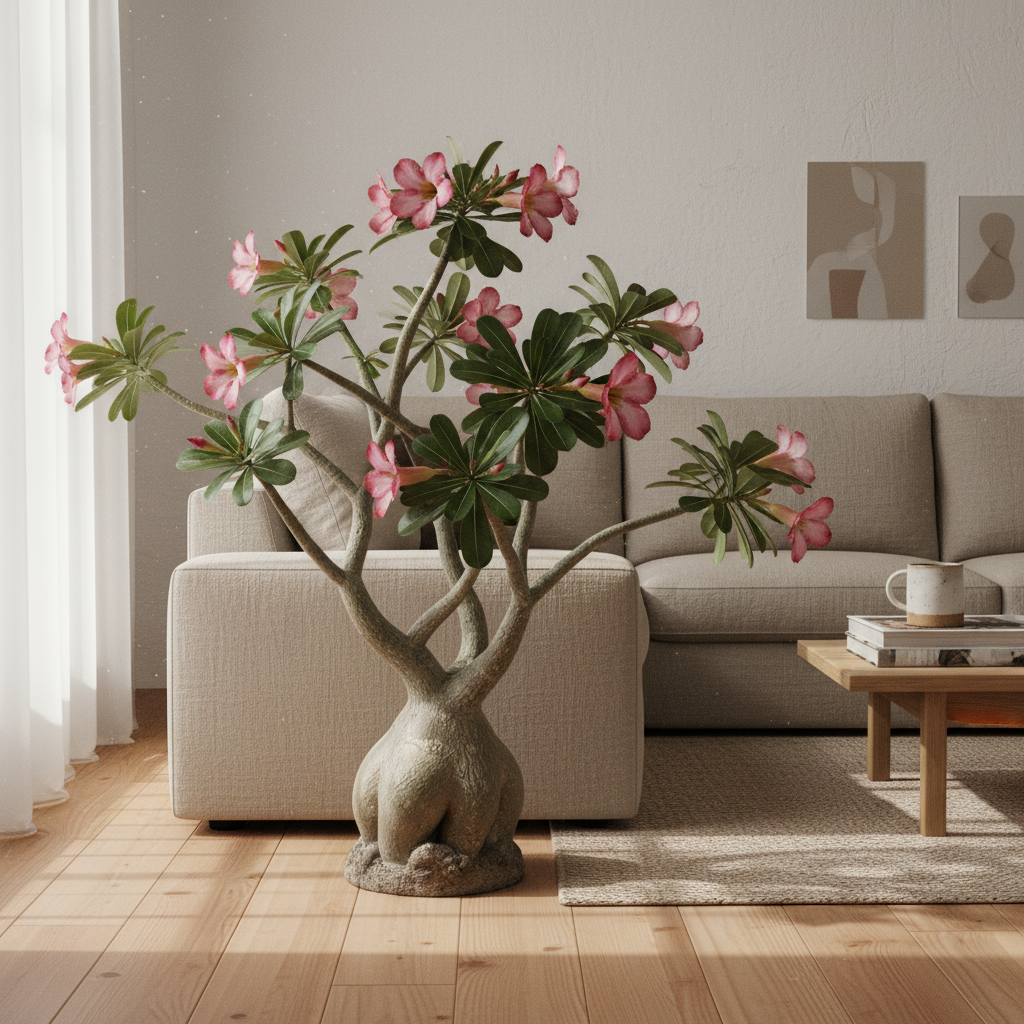
Then there are the flowers. When happy, Adenium obesum produces flushes of five-petalled trumpets in shades of pink, red, white and increasingly, thanks to breeders in Thailand and Taiwan, deep maroon, striped bicolours and full doubles. The blooms can last for weeks and appear most heavily in the warm growing season. Add to this a genuine tolerance for neglect, since the plant would rather you forgot to water it than fussed over it, and you have a houseplant that suits the busy, the forgetful and the sun-blessed windowsill in equal measure. The one real catch is light. This is not a plant for a dim corner, and that single requirement shapes almost everything else about its care.
Important — Toxicity: Every part of the desert rose is toxic. The milky sap contains cardiac glycosides that can affect the heart if ingested, and it can irritate skin and eyes on contact. Keep it well out of reach of children and pets, wash your hands after pruning, and consider wearing gloves when taking cuttings.
Light Requirements
If there is one thing to get right with a desert rose, it is light. This is a full-sun plant in the wild, baking on rocky African hillsides, and it brings that appetite indoors. Insufficient light is the single most common reason a healthy-looking desert rose refuses to flower, stretches into a leggy shape and grows a thin, disappointing caudex. Treat it as a sun-worshipper and most other problems take care of themselves.
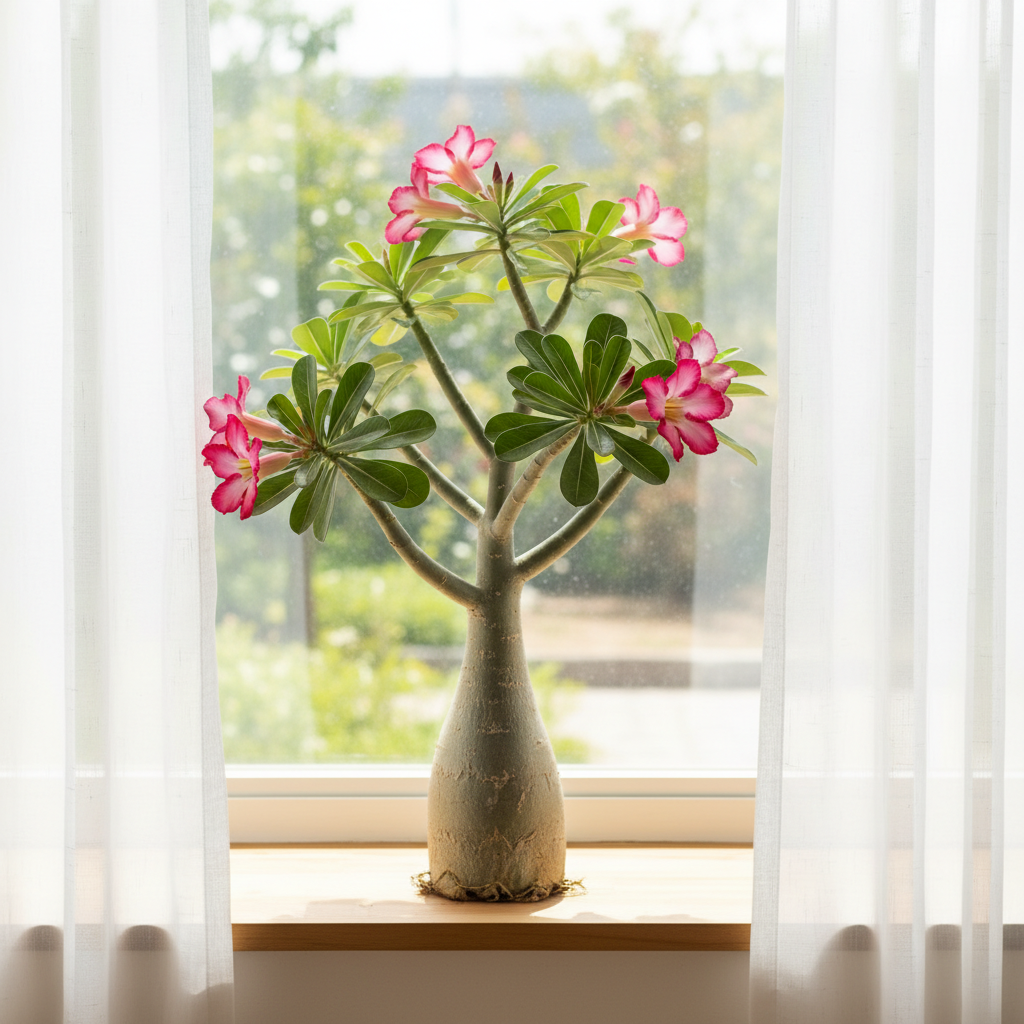
Aim for a minimum of six hours of direct sunlight a day, and more if you can manage it. Unlike most leafy houseplants, which scorch in direct sun, the desert rose actively wants those hot, bright rays on its leaves. The brightest window in your home is the right home for it, and during the warm months a sheltered spot outdoors in full sun will produce the strongest growth and the best flowering you are ever likely to see from one indoors.
Light Levels Explained
Houseplant light is often described loosely, so it helps to anchor those terms to real conditions. The table below sets out the common categories and what each one means for a desert rose specifically.
| Light Category | Approx. Level | Typical Location | Outcome |
|---|---|---|---|
| Direct sun | 20,000 lux and above | On a south-facing sill, or outdoors in summer | Ideal; strong growth, fat caudex and best flowering |
| Bright indirect | 10,000 to 20,000 lux | Near a bright window, just out of the sun’s path | Survives and stays green, but may flower poorly |
| Medium | 5,000 to 10,000 lux | A few metres back from a bright window | Etiolated, stretched growth; rarely flowers |
| Low | 1,000 to 5,000 lux | North-facing room, shaded corner | Decline over time; not suitable long term |
| Very low | Below 1,000 lux | Interior room, far from any window | Unsustainable; the plant will weaken and rot |
Window Orientation and Placement
South-facing window: This is the perfect spot in the northern hemisphere. A desert rose placed directly on or beside a south-facing sill will get the long hours of unobstructed sun it craves. No sheer curtain is needed for an acclimatised plant.
East-facing window: Workable, though second-best. The plant gets bright morning sun but misses the intense afternoon light, so expect leafy growth with less reliable flowering.
West-facing window: A good alternative to south, delivering strong afternoon and evening sun. Many desert roses flower well in a west window, especially in summer.
North-facing window: Not enough light. A desert rose will limp along here for a while but will gradually stretch, weaken and become far more prone to rot as it sits in damp soil it cannot use. Avoid it, or supplement heavily with a grow light.
Pro Tip — Rotate for an Even Shape: Because the plant leans hard toward its light source, give the pot a quarter turn every week or two. This keeps the branches growing evenly around the caudex rather than all reaching for the glass, which matters a great deal for a plant grown as much for its shape as its flowers.
How Light Affects Flowering and Form
Light does more than keep a desert rose alive; it dictates whether the plant performs. In strong sun the branches stay short and stout, the leaves sit close together, and the plant channels its energy into thickening the caudex and setting flower buds. In weak light the opposite happens: internodes lengthen, the plant grows pale and lanky reaching toward the window, and flowering stops almost entirely. If your plant has grown leggy over a dim winter, the cure is more light in spring combined with a hard prune to encourage compact, branching regrowth.
Warning — Sudden Sun Exposure: Although the desert rose loves direct sun, a plant that has spent winter in lower light can scorch if moved abruptly into blazing summer sun outdoors. Acclimatise it over a week or two, increasing exposure gradually, to avoid pale, sunburned patches on the leaves.
Artificial Lighting
In a home that simply lacks a bright enough window, a desert rose can be grown under a strong full-spectrum LED grow light. Because its light demands are so high, choose a powerful fixture and position it close, around 15 to 30 centimetres (6 to 12 inches) above the plant, running it for 12 to 14 hours a day. A weak desk lamp will not do. Even with good artificial light, flowering can be less reliable than under real sun, so think of grow lights as a way to keep the plant healthy through a dark winter rather than a full substitute for a summer windowsill.
Seasonal Adjustments
Light shifts dramatically with the seasons, and the desert rose responds in kind. Through spring and summer it grows actively and wants every hour of sun on offer, which is the time to move it to your brightest spot or outdoors. As days shorten in autumn the plant naturally slows, often dropping some or all of its leaves and entering a semi-dormant rest. During this period its light needs drop along with its water needs, so a winter spot that is merely bright is acceptable, provided you also cut back sharply on watering to match.
Watering & Humidity
Watering is where most desert roses are lost, and almost always through kindness rather than neglect. The caudex is a built-in reservoir, so the plant is engineered to ride out drought and is acutely sensitive to staying wet. The guiding principle is simple: water generously, then wait, and only water again once the soil has dried out completely. Get this rhythm right and the rest of its care is genuinely undemanding.
When to Water
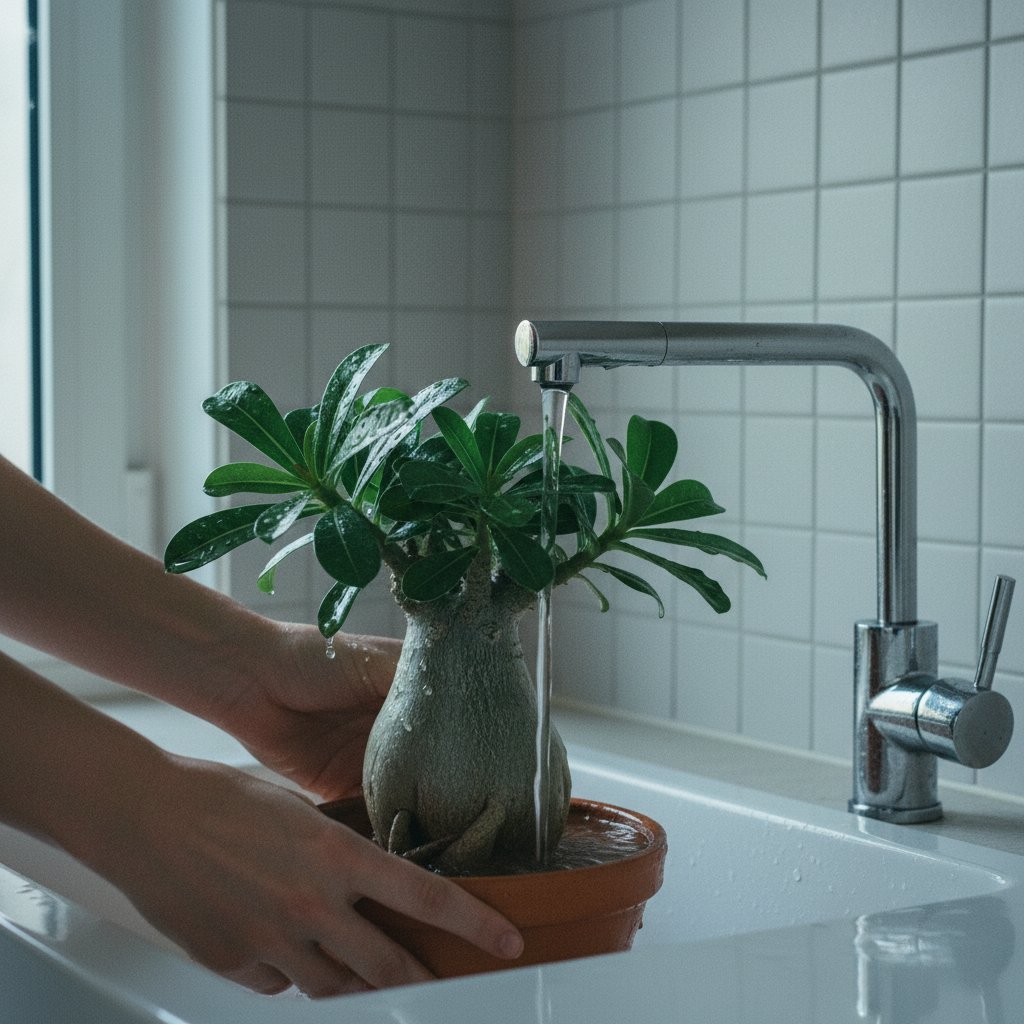
During the active growing season of spring and summer, a desert rose in a bright, warm spot may need watering once or twice a week, but only if the soil has actually dried. Never water on a fixed schedule. Instead, check the mix: push a finger several centimetres into the soil, or lift the pot to feel its weight. Water only when the soil is dry well down and the pot feels light. A moisture meter reading in the dry zone is another reliable cue.
In autumn and winter, everything changes. As the plant slows and rests, its water use plummets, and a dormant desert rose may need watering only once every few weeks, or even less if it has dropped its leaves entirely. Watering a cold, leafless, resting plant on a summer schedule is the fastest route to rot. When in doubt during winter, wait; this plant is far happier slightly too dry than slightly too wet.
Pro Tip — Read the Caudex: The caudex itself is a moisture gauge. When the plant is well-watered the base feels firm and full; when it is genuinely thirsty the caudex softens slightly and may look a touch wrinkled. A little softening tells you it is safe to water. A caudex that feels squishy and stays soft after watering, by contrast, is a warning sign of rot.
How to Water Correctly
- Confirm the soil is dry well below the surface and the pot feels light before you begin.
- Water thoroughly with room-temperature water, soaking the mix until it runs freely from the drainage holes.
- Direct water at the soil rather than over the caudex and branch crown, where standing moisture can encourage rot.
- Let the pot drain completely and tip away any water that collects in the saucer; never let the plant sit in it.
- Wait. Do not water again until the mix has dried out fully, however long that takes.
Signs of Overwatering vs. Underwatering
| Symptom | Overwatering | Underwatering |
|---|---|---|
| Leaf colour | Yellowing, often dropping suddenly | Leaves yellow slowly and shed as a natural drought response |
| Caudex texture | Soft, squishy, sometimes mushy at the base | Firm but slightly wrinkled or shrunken |
| Branches | Soft, blackening tips; collapse from the top down | Slightly shrivelled but firm, plump up after watering |
| Soil | Stays wet for days; may smell sour | Bone dry throughout |
| Recovery | Poor; rot spreads even after drying out | Rapid once watered; bounces back well |
Warning — Root and Caudex Rot: Rot is the desert rose’s great killer, and it moves fast. If the caudex turns soft and mushy or the base smells foul, act immediately: unpot the plant, cut away every trace of rotted tissue with a sterile blade until only firm, pale flesh remains, dust the wounds, let them callous for several days, and repot into fresh, dry, gritty mix. A plant caught early can be saved; one left wet rarely is.
Humidity Requirements
Here the desert rose is refreshingly easy. As a plant of hot, dry climates it has no need for the elevated humidity that tropical aroids and ferns demand, and it thrives in the dry air of a centrally heated home. Average household humidity of around 40 to 50 percent suits it perfectly, and it tolerates much drier conditions without complaint.
If anything, the risk runs the other way. Persistently high humidity combined with poor air movement can encourage fungal problems and rot, particularly around the caudex. There is no need to mist a desert rose, no need for a pebble tray, and no need for a humidifier. In fact, misting is best avoided, as water settling in the branch crown does more harm than good.
Good airflow is more valuable to this plant than added moisture. A spot with gentle air circulation helps the soil surface and foliage dry quickly after watering, which is exactly the dry, breezy environment the desert rose evolved in.
Water Quality
Desert roses are not especially fussy about water quality, and most will grow happily on ordinary tap water. If your supply is very hard, mineral salts can build up in the soil over time, which is one more reason to flush the mix thoroughly each time you water and to repot with fresh substrate periodically. Letting tap water stand overnight, or using collected rainwater where convenient, is a small refinement rather than a requirement for this tough plant.
Soil, Potting & Repotting
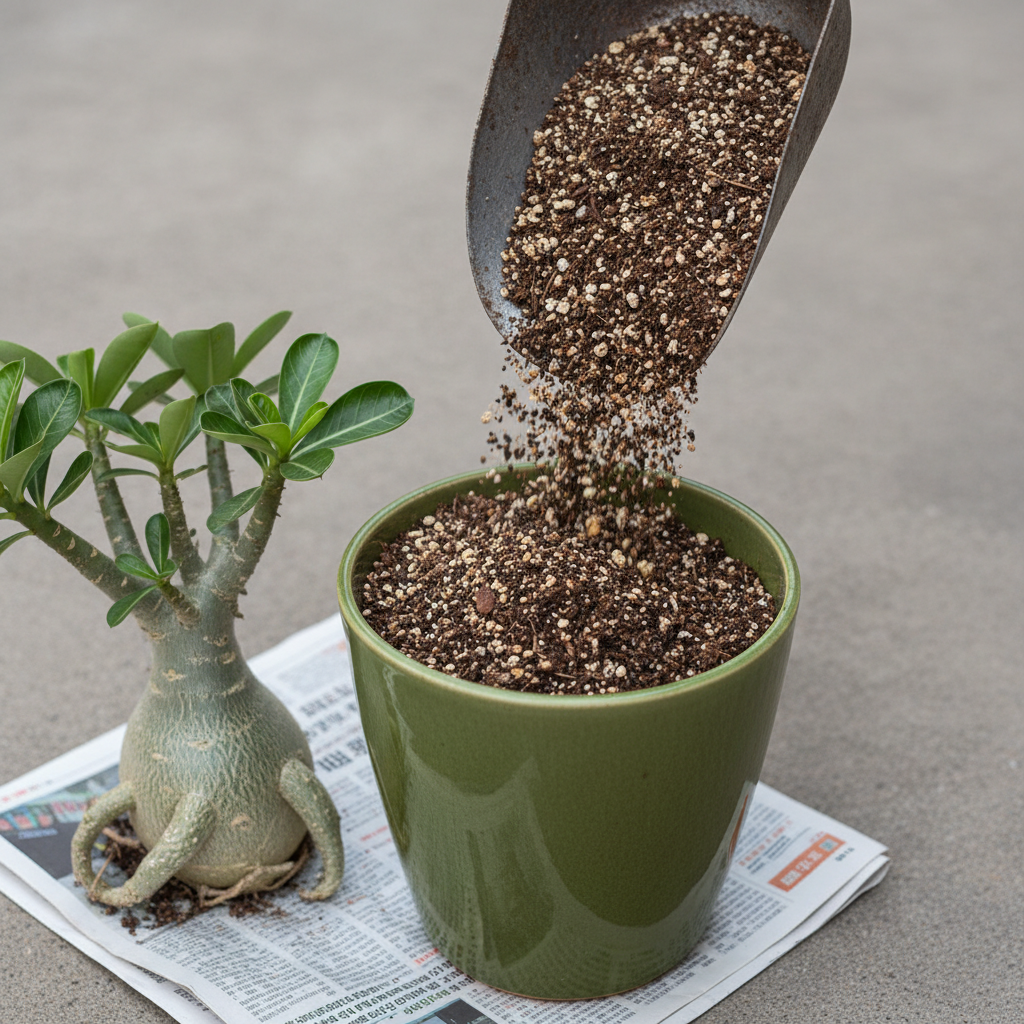
If light is the desert rose’s first priority, drainage is its close second. A plant built to store its own water cannot cope with soil that holds moisture around its roots, so the right mix is gritty, open and fast-draining. Standard houseplant compost on its own is far too water-retentive and is a common cause of slow decline. The goal is a substrate that wets through, then dries out quickly and lets air reach the roots.
Ideal Soil Composition
The simplest reliable approach is to start with a quality cactus and succulent compost and make it even grittier. Roughly half mineral grit to half compost is a good target, producing a mix that drains almost as fast as you pour water through it. The components below each play a distinct role.
| Component | Proportion | Function |
|---|---|---|
| Cactus and succulent compost | About 50 percent | Provides structure and a modest reserve of nutrients and moisture |
| Coarse perlite or pumice | About 25 percent | Opens up the mix, holds air and speeds drainage |
| Horticultural grit or coarse sand | About 20 percent | Adds weight and sharp drainage, mimicking native rocky soils |
| Fine bark or coir | About 5 percent | Gives a little structure without holding excess water |
The desert rose prefers a soil that is neutral to slightly acidic, roughly pH 6.0 to 7.0, which most cactus composts fall within naturally. Precise pH management is rarely necessary; getting the drainage right matters far more than chasing a number.
Pro Tip — Quick Mix Recipe: For a fast, dependable blend, combine two parts cactus compost, one part pumice or perlite, and one part horticultural grit. If your home runs cool or you tend to overwater, push the grit and pumice even higher. You genuinely cannot make this mix too well-drained for a desert rose.
Choosing the Right Pot
Pot choice has a real influence on how easy this plant is to keep, since the wrong container can undo even a perfect soil mix. The aim is a pot that drains freely, dries reasonably quickly and shows off the caudex you are working so hard to grow.
Drainage holes are non-negotiable. A desert rose should never be planted in a pot without drainage. Decorative cover pots are fine as long as you remove the plant to water it, or at the very least empty any water that collects. Standing water at the base means rot.
Pot material: Unglazed terracotta is the classic choice, and a good one. Its porous walls wick moisture out of the soil and let it breathe, which suits a plant that hates staying wet. Glazed ceramic and plastic both work too, but because they hold moisture longer you must be that much more disciplined about letting the mix dry between waterings.
Pot size: Choose a pot only slightly larger than the root system. An oversized pot holds a large volume of slow-drying soil around the roots, which is exactly what you want to avoid. Many growers also pot desert roses slightly high, lifting the top of the caudex above the soil line over successive repottings to display its sculptural base.
When to Repot
Desert roses are slow growers and do not need frequent repotting, typically every two to three years. The best time is late spring or early summer, at the start of active growth, so the plant recovers quickly. Signs it is ready include roots emerging from the drainage holes, a caudex that has filled the pot, or simply a tired old mix that no longer drains as it should. Repotting is also the moment to lift the caudex a little higher if you are training the plant for display.
How to Repot: Step-by-Step
- Water lightly a day or two beforehand so the root ball holds together, then let it drain; do not repot a soaking-wet plant.
- Ease the plant out, supporting the caudex, and gently tease away the old soil from the roots.
- Inspect the roots and caudex closely, trimming away any soft, dark or rotted sections with a sterile blade.
- If you have made fresh cuts, let them dry and callous for a few hours to a day before potting.
- Settle the plant into fresh gritty mix in a pot only slightly larger, positioning the caudex at your chosen height.
- Firm the mix gently and resist watering at first.
- Wait around a week before watering, giving any disturbed or cut roots time to seal and reducing the risk of rot.
Warning — Hold Off on Water: The instinct after repotting is to water in well, but for a desert rose that is risky. Freshly disturbed roots and cut surfaces are vulnerable to rot if they sit in moisture, so keep the plant dry for several days, then resume careful watering once it has settled.
Fertilising
A desert rose growing in lean, gritty mix appreciates regular feeding through its active season to fuel both caudex growth and flowering. It is not a heavy feeder by the standards of fast-growing leafy plants, but a little balanced nutrition during spring and summer makes a visible difference to vigour and bloom.
The key is to feed only while the plant is actively growing and to keep the dose modest. Overfeeding a succulent does more harm than good, encouraging weak, sappy growth and leaving a build-up of salts in the soil that the plant cannot use.
Understanding Plant Nutrients
Fertilisers are labelled with an NPK ratio: the proportions of nitrogen, phosphorus and potassium they contain. Nitrogen drives leafy growth, phosphorus supports roots and flowers, and potassium underpins overall health and blooming. For a desert rose, a balanced feed works well for general growth, while a formula slightly higher in phosphorus and potassium can encourage flowering. The table below covers the main nutrients and what their shortage looks like.
| Nutrient | Symbol | Primary Function | Deficiency Symptoms |
|---|---|---|---|
| Nitrogen | N | Leaf and stem growth | Pale, yellowing older leaves and weak growth |
| Phosphorus | P | Roots, caudex and flower development | Poor flowering and sluggish root growth |
| Potassium | K | Overall vigour and bloom quality | Yellowing leaf margins and few flowers |
| Calcium | Ca | Cell wall strength | Distorted new growth and weak tips |
| Magnesium | Mg | Chlorophyll production | Yellowing between leaf veins |
| Iron | Fe | Green pigment in new leaves | Yellowing of the youngest leaves |
Types of Fertiliser
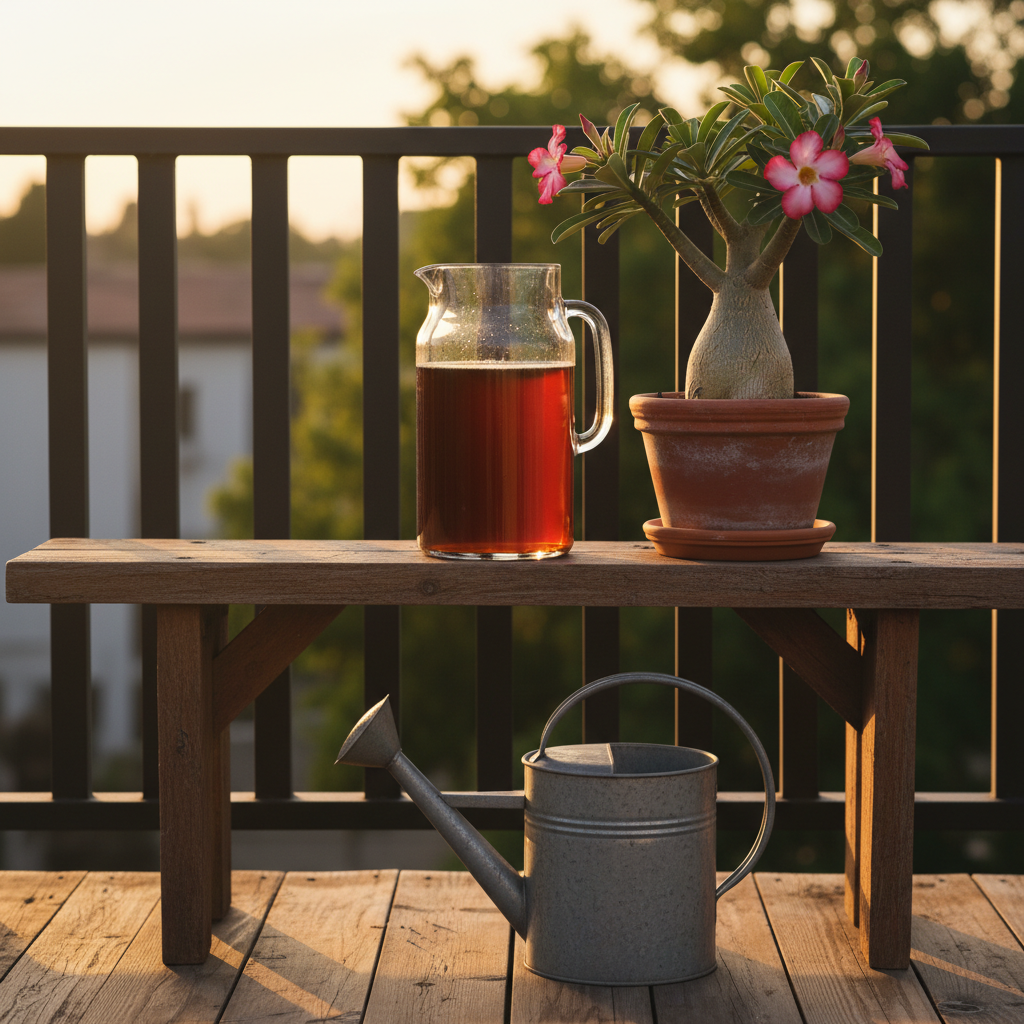
Liquid fertilisers: The easiest option for most growers. Diluted into your watering can, a liquid feed delivers nutrients quickly and lets you control the dose precisely, which is exactly what a succulent wants. Use a balanced houseplant or cactus feed, or a bloom formula when flowering.
Slow-release granular: Pellets mixed into the soil or scattered on the surface release nutrients gradually over months. Convenient, but they offer less control, so use them at a conservative rate and remember they continue feeding even when you would rather the plant was resting.
Organic fertilisers: Options such as dilute worm-casting tea or a gentle organic feed work well and are forgiving of slight over-application. They release nutrients slowly and help support healthy soil life, though they act more gradually than synthetic liquids.
Feeding Schedule
Feed every two to four weeks through spring and summer while the plant is in active growth, always applying fertiliser to already-moist soil rather than a bone-dry root ball. Stop feeding entirely in autumn and winter when the plant rests; nutrients applied to a dormant desert rose simply accumulate unused in the soil. Resume only when you see fresh growth signalling the start of a new season.
Pro Tip — Half Strength Wins: Always dilute to half the strength recommended on the label, or even less. A desert rose responds far better to a light, frequent feed than to an occasional strong dose, and weak solutions sharply reduce the risk of fertiliser burn and salt build-up in your fast-draining mix.
How to Fertilise
- Water the plant first, or feed on soil that is already moist, to protect the roots.
- Dilute a balanced or bloom fertiliser to half the labelled strength.
- Apply the solution evenly to the soil, avoiding the caudex and foliage.
- Let any excess drain away freely and empty the saucer.
- Every month or two, flush the pot with plain water to wash out accumulated salts.
Warning — Salt Build-Up: In a gritty, fast-draining mix, fertiliser salts can concentrate over time and scorch the roots, showing up as crusty white deposits on the soil or pot and as browning leaf edges. Periodically flushing the pot with plenty of plain water clears these salts and keeps the root zone healthy.
Propagation
Desert roses can be propagated in two main ways, and the method you choose has real consequences for the plant you end up with. Seed-grown plants develop the fat, characterful caudex the species is famous for, while cuttings root readily and bloom sooner but never form a true swollen base. Knowing this difference up front saves disappointment later.
Both methods are best attempted in late spring or summer, when warmth and light give the plant the energy to root or germinate quickly. Whichever route you take, remember that the sap is toxic and an irritant, so work with clean tools and wash your hands afterwards.
Understanding Caudex vs. Cutting
The caudex is the single most prized feature of a desert rose, and it forms only in seed-grown plants, where the developing seedling thickens its base over time. A cutting, by contrast, is a piece of stem with no genetic instruction to swell at the base, so it grows into a normal-stemmed shrub that flowers well but lacks the sculptural trunk. If the caudex is what drew you to the plant, grow from seed; if you simply want more flowering plants quickly and faithfully matching the parent, take cuttings.
Stem Cuttings: Step-by-Step
Cuttings are the faster and more reliable method, and they reproduce the exact flower colour of the parent plant. The main hurdle is rot, so the trick is to let the cut callous well and keep the rooting medium barely moist.
- Using a sterile, sharp blade, take a firm stem cutting around 10 to 15 centimetres (4 to 6 inches) long.
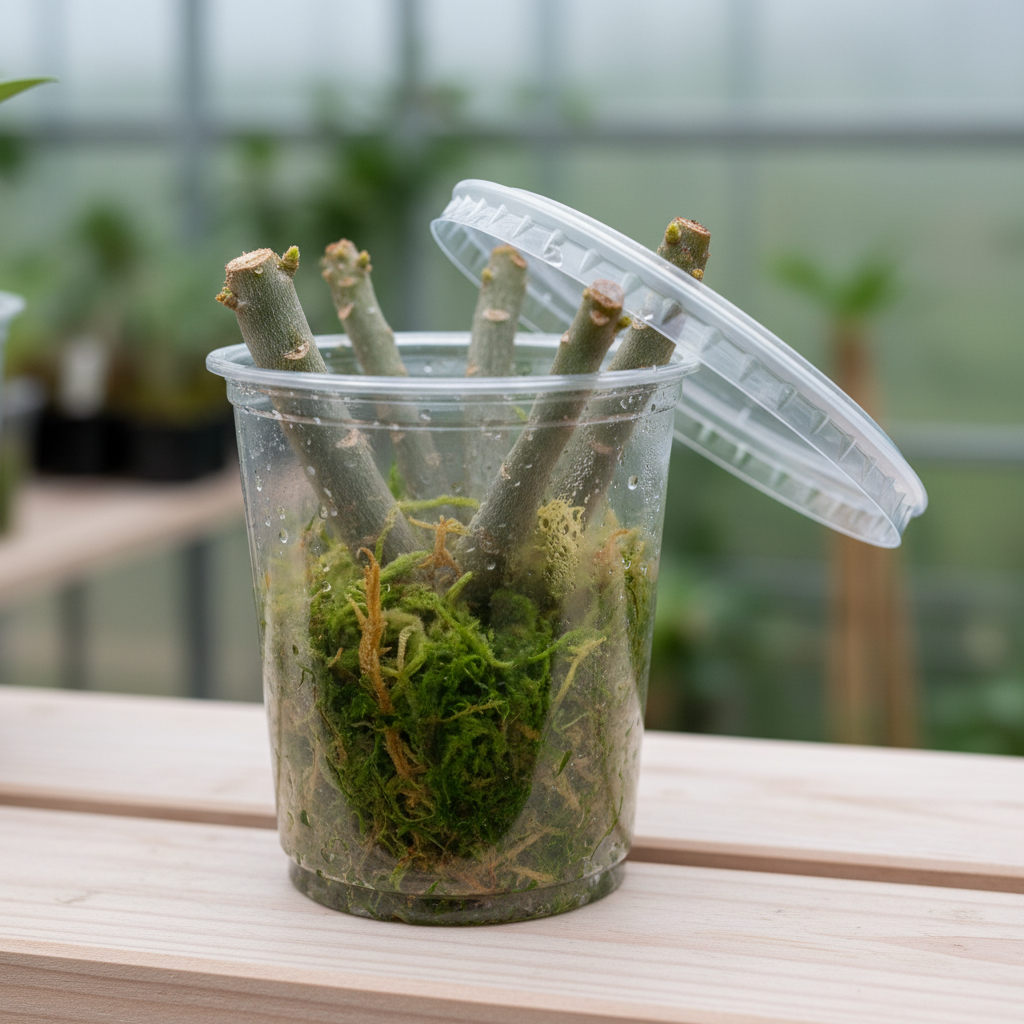
- Rinse or blot away the milky sap, then set the cutting aside in a dry, shaded spot for several days until the cut end forms a firm callous.
- Optionally dip the calloused end in rooting hormone to encourage faster rooting.
- Insert the cutting into barely-damp gritty mix or sphagnum moss, burying just enough to hold it upright.
- Place it somewhere warm and bright but out of harsh direct sun, and keep the medium only slightly moist.
- Wait. Roots usually form over several weeks; resist the urge to tug the cutting or to overwater while it establishes.
Pro Tip — Callous Before You Plant: The most common reason desert rose cuttings fail is rot from being planted while the cut is still fresh and wet. Giving the cut end several days to dry and seal over before it touches any moist medium dramatically improves your success rate.
Growing from Seed: Step-by-Step
Seed is the route to that coveted caudex, and germination is surprisingly quick when the seed is fresh. The catch is that desert rose seed loses viability fast, so source it recently harvested and sow it without delay.
- Sow fresh seed flat on the surface of a moist, well-draining seed mix, barely covering it with a fine layer of grit.
- Keep the medium warm, ideally around 27 to 32 degrees Celsius (80 to 90 degrees Fahrenheit), and lightly moist but never waterlogged.
- Provide bright light and good airflow; germination often begins within a week.
- Once seedlings have a few true leaves, ease back on watering and let the surface dry between waterings.
- Pot on the young plants individually as they grow, gradually shifting them toward the lean, gritty mix and bright sun adult plants enjoy.
Troubleshooting Propagation
| Problem | Likely Cause | Solution |
|---|---|---|
| Cutting rots at the base | Planted before callousing, or medium too wet | Allow a longer callous period and keep the medium only just moist |
| Cutting shrivels but does not root | Too dry, or low warmth slowing rooting | Raise the temperature and lightly moisten the medium |
| Seeds fail to germinate | Old, non-viable seed or cool conditions | Use fresh seed and provide consistent bottom heat |
| Seedlings damp off and collapse | Overwatering and poor airflow | Reduce moisture, improve ventilation and avoid sowing too densely |
Pests & Diseases
A desert rose grown in good light with disciplined watering is a robust, healthy plant that rarely suffers serious trouble. Most problems that do arise trace back to the same root cause as elsewhere in its care: too much water. Rot and fungal issues far outnumber insect pests in practice, and prevention is almost always a matter of keeping the plant dry, bright and well-ventilated.
That said, a few sap-sucking insects do find their way onto desert roses, especially on plants summered outdoors or grown alongside other houseplants. Regular inspection, particularly of new growth and the undersides of leaves, catches infestations while they are still small and easy to manage.
Common Pests
Aphids (Aphidoidea)
Small, soft-bodied insects, often green, black or yellow, that cluster on tender new shoots and flower buds, sucking sap and leaving sticky honeydew behind. A heavy infestation distorts new growth and can spoil developing blooms.
Treatment: Knock them back with a firm jet of water, then treat with insecticidal soap or a diluted neem oil spray, repeating every few days until they are gone. Check buds closely, as aphids hide among them.
Mealybugs (Pseudococcidae)
Recognisable as small, white, cottony tufts tucked into leaf axils, branch crotches and around the caudex. They feed on sap, weaken the plant and, like aphids, excrete honeydew that invites sooty mould.
Treatment: Dab each insect directly with a cotton bud dipped in isopropyl alcohol, then follow up with neem oil or insecticidal soap. Inspect hidden crevices around the caudex, where mealybugs love to shelter.
Spider Mites (Tetranychidae)
Tiny mites that thrive in hot, dry conditions and can appear on stressed plants, stippling the leaves with fine pale dots and spinning delicate webbing in bad cases. They are hard to see without close inspection.
Treatment: Rinse the foliage, improve airflow, and apply neem oil or a miticide, treating repeatedly to break the life cycle. Keeping the plant healthy and not overly stressed is the best deterrent.
Common Diseases
Root and Caudex Rot (Fusarium and Pythium species)
By far the most serious threat to a desert rose, caused by fungi and water moulds that thrive in cold, wet soil. It shows as a softening, browning or blackening of the caudex and roots, often with a foul smell, and can kill a plant rapidly once established.
Treatment: Unpot at once, cut away all affected tissue back to firm flesh with a sterile blade, let the wounds callous, and repot into fresh, dry, gritty mix. Then correct the underlying cause by watering less and improving drainage and warmth.
Fungal Leaf Spot (various pathogens)
Brown or black spots on the leaves, sometimes with a yellow halo, usually appearing where humidity is high and air movement poor, or where water has sat on the foliage.
Treatment: Remove affected leaves, improve ventilation, and keep water off the foliage when watering. A copper-based or general fungicide can help in persistent cases, but cultural changes usually solve it.
Pest and Disease Summary
| Pest / Disease | Identification | Treatment |
|---|---|---|
| Aphids | Clusters on new shoots and buds, sticky residue | Rinse off, then insecticidal soap or neem oil |
| Mealybugs | White cottony tufts in crevices and axils | Alcohol on a cotton bud, then neem oil |
| Spider mites | Fine pale stippling and webbing on leaves | Rinse, raise airflow, apply neem oil or miticide |
| Root and caudex rot | Soft, brown, foul-smelling base and roots | Cut out rot, callous, repot dry; water less |
| Fungal leaf spot | Brown or black spots, sometimes haloed | Remove leaves, improve airflow, keep foliage dry |
Prevention Strategies
Prevention with a desert rose is largely a by-product of correct culture. A plant in bright sun, planted in fast-draining mix and watered only when dry, is rarely troubled by either rot or insects. Good airflow around the plant keeps fungal problems at bay, and quarantining any new plant for a couple of weeks before introducing it to your collection stops pests hitching a ride onto an otherwise clean specimen.
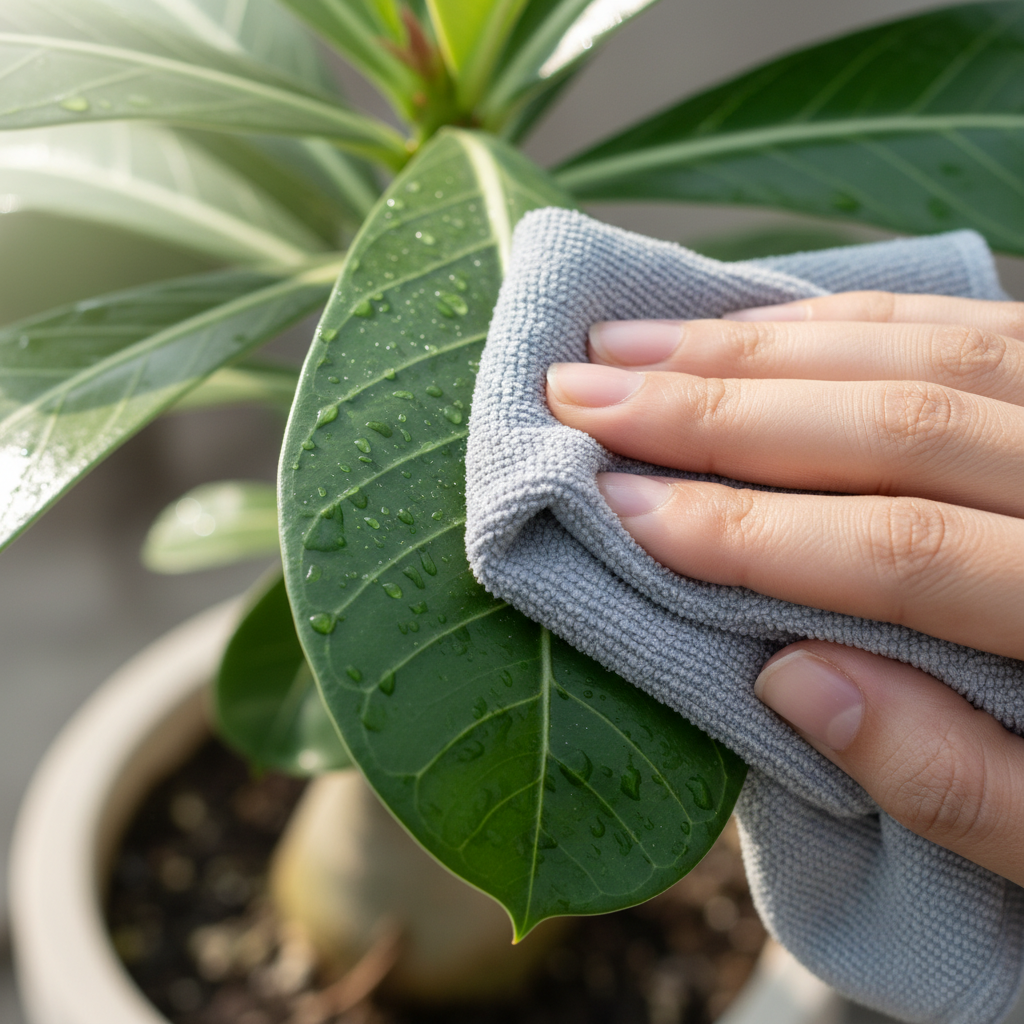
Routine inspection is your other great ally. A quick look over the new growth, leaf undersides and the nooks around the caudex each time you water means you catch trouble while it is still a handful of insects rather than an infestation. Wiping the leaves occasionally both removes dust and gives you a close look at the plant’s health.
Pro Tip — Neem as a Routine: A light preventive spray of diluted neem oil every few weeks during the growing season, applied in the evening or out of direct sun to avoid leaf burn, deters most common sap-sucking pests before they take hold. Keep the spray off open flowers.
Popular Varieties
The desert rose has been bred intensively, particularly in Thailand and Taiwan, into a remarkable range of flower forms and colours. Beyond the wild species itself, growers can choose from singles and doubles, solid colours and intricate stripes, and even variegated foliage, alongside hybrids with related Adenium species that bring still more variation to bloom shape and caudex character.
Care is essentially the same across all of them, since they share the species’ love of sun and hatred of wet feet. The choice comes down to the look you want, from a classic pink-trumpeted species plant to a dramatic near-black double or a softly variegated specimen. The table and profiles below cover some of the most widely grown.
| Variety | Flower / Leaf Appearance | Light Needs | Growth Rate | Availability |
|---|---|---|---|---|
| Species Adenium obesum | Single pink-to-crimson trumpets, green leaves | Full sun | Slow | Common |
| Black Widow | Deep crimson, near-black double blooms | Full sun | Slow | Specialist |
| Variegated Desert Rose | Cream-and-green foliage, pale pink flowers | Full sun | Very slow | Specialist |
| Double-flowered hybrids | Ruffled, rose-like layered petals | Full sun | Slow | Increasingly common |
| Picotee types | Pale petals edged in a contrasting band | Full sun | Slow | Specialist |
| White and pastel forms | Soft white to blush single trumpets | Full sun | Slow | Common |
Featured Varieties
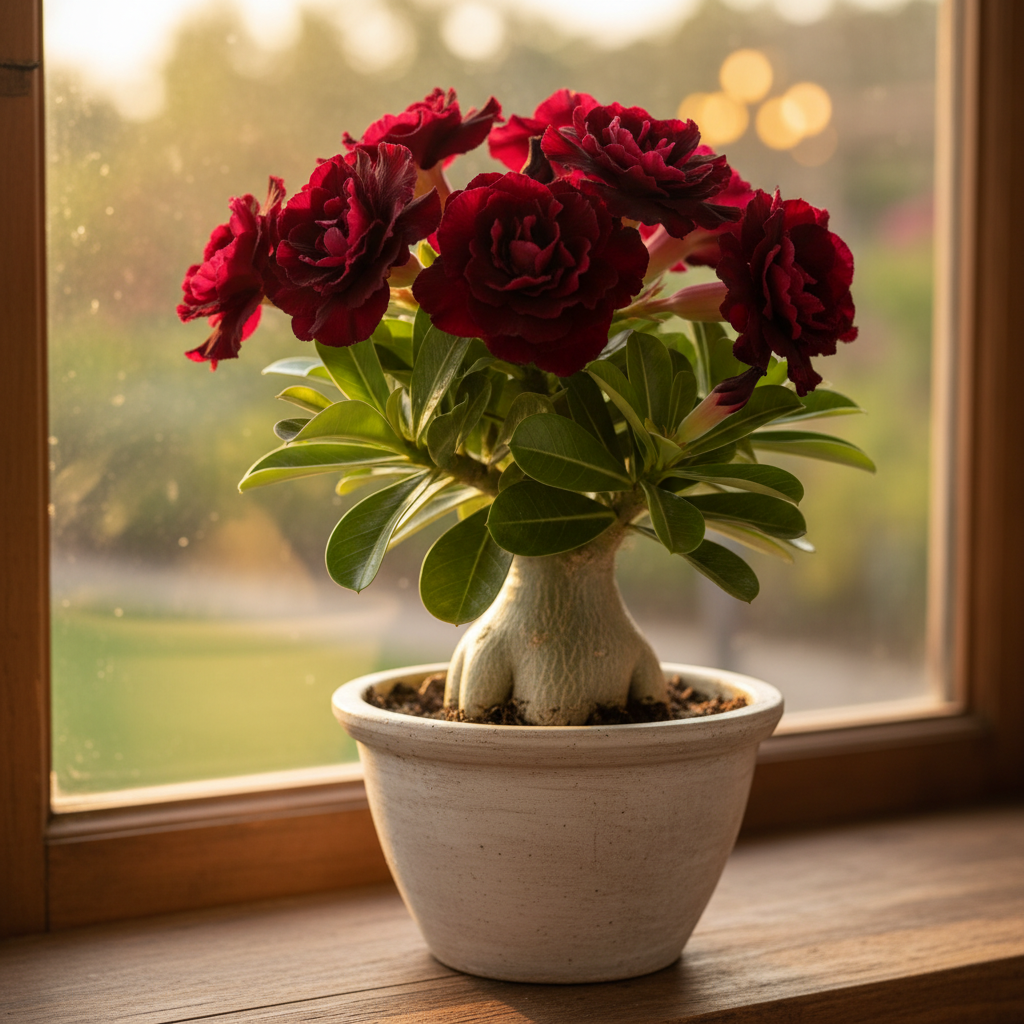
Black Widow
A dramatic hybrid prized for its dense, ruffled double flowers in the deepest crimson, so dark they can read as near-black in shade. It carries the same stout caudex and sun-loving habit as the species, making it a striking centrepiece for a bright windowsill.
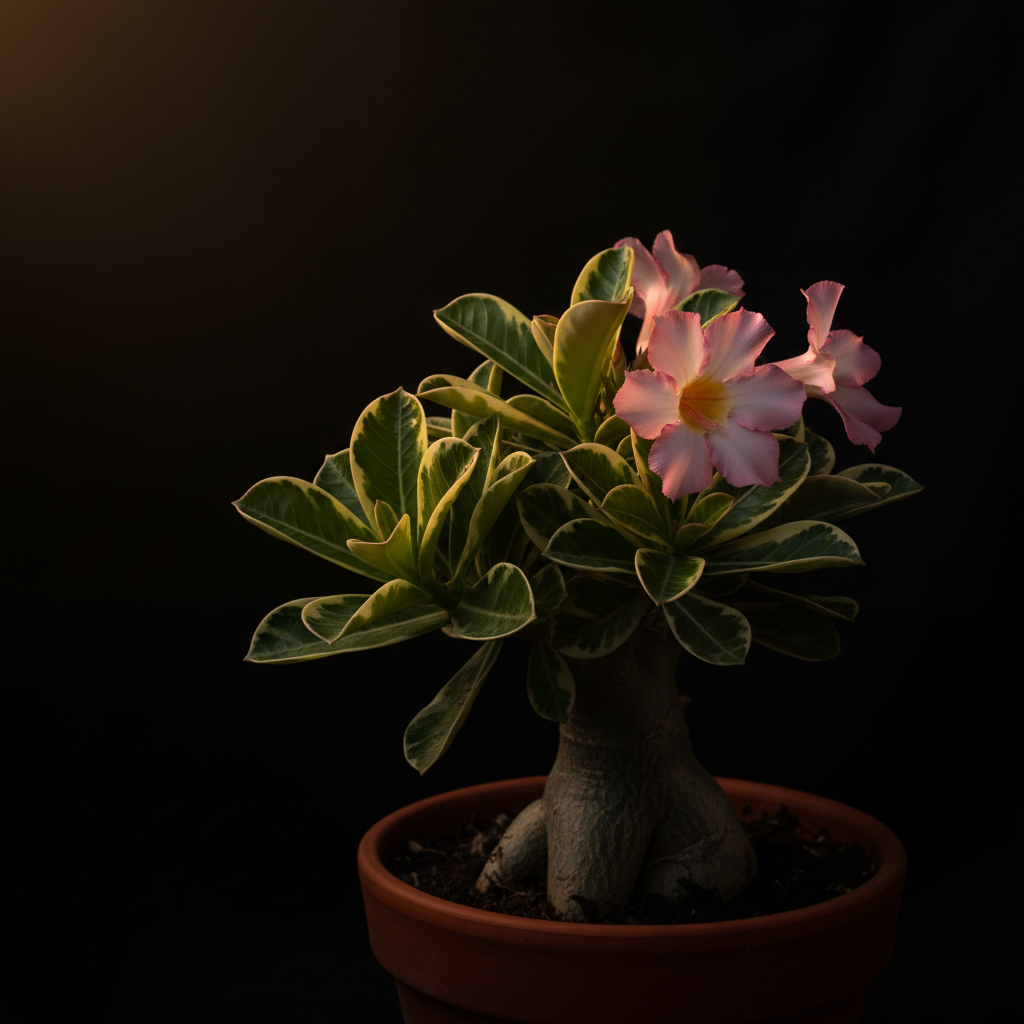
Variegated Desert Rose
Grown as much for its foliage as its flowers, this form carries green leaves edged and streaked with creamy yellow-white. The reduced chlorophyll makes it slower and a little more demanding, wanting strong light to keep the variegation crisp, but the effect is quietly elegant.
Variety Profiles in Detail
Species Desert Rose (Adenium obesum)
The wild species remains a favourite for good reason. Its single, five-petalled trumpets in shades of pink edged with deeper crimson are simple and elegant, and seed-grown plants build the fattest, most characterful caudex of all. For a grower who values the sculptural base above novelty in the flowers, the straight species is the place to start.
Double and Triple-Petalled Hybrids
Breeders have produced flowers with two or three layers of petals, giving the blooms a full, rose-like appearance that lasts well and makes a real show. These hybrids are increasingly available and grow much like the species, though some put a little more energy into flowering at the slight expense of caudex bulk.
Picotee and Striped Forms
Among the most collectable types, picotee forms carry pale petals neatly outlined in a contrasting darker band, while striped selections marble two colours across each bloom. They are typically sold by specialist growers and reward the bright, sunny conditions that bring out their best colour.
Choosing the Right Variety for Your Space
Since every desert rose wants the same full sun and lean, dry treatment, the deciding factor is simply what you find most beautiful and how much light you can offer. The variegated forms are the one exception worth flagging: their reduced chlorophyll makes them slower and hungrier for light, so reserve them for your very brightest spot. For a first desert rose, the straight species or a single-flowered seedling is the easiest and most rewarding introduction, with the showier doubles and picotees a natural next step once you have the watering rhythm settled.
Frequently Asked Questions
Why is my desert rose not flowering?
The usual culprit is insufficient light. A desert rose needs many hours of direct sun to set buds, so a plant that stays leafy but refuses to bloom almost always needs a brighter position. Other contributors include too little phosphorus and potassium in its feed, or watering so heavily that it grows foliage at the expense of flowers. Move it to your sunniest window, switch to a bloom-supporting feed, and be patient through the warm season.
Why is the caudex going soft?
A slightly soft, wrinkled caudex simply means the plant is thirsty and ready for water. A caudex that feels squishy, mushy or wet, especially near the soil line, is a sign of rot from overwatering and needs urgent action: unpot the plant, cut away the rot, let it callous, and repot into dry, gritty mix. Learning to tell thirst from rot by feel is one of the most useful skills with this plant.
My desert rose dropped all its leaves. Is it dying?
Not necessarily. Desert roses are partly deciduous and naturally shed their leaves as they enter winter dormancy or in response to a sudden change in conditions, such as a drop in temperature or light. If the caudex and branches remain firm, the plant is simply resting; cut back watering sharply and wait for fresh growth in spring. Leaf drop only signals trouble if it comes with a softening caudex.
How often should I water my desert rose?
There is no fixed schedule. Water thoroughly, then wait until the soil has dried out completely before watering again. In warm, bright summer conditions that might mean once or twice a week, while in winter a resting plant may want water only once every few weeks. Always check the soil and the firmness of the caudex rather than watering by the calendar.
Is the desert rose poisonous to cats and dogs?
Yes. The sap contains cardiac glycosides that are toxic to cats, dogs and people if ingested, and it can irritate skin and eyes. Keep the plant out of reach of pets and children, wash your hands after handling it, and wear gloves when pruning or taking cuttings. If ingestion is suspected, contact a vet or medical professional promptly.
Can I grow a desert rose outdoors?
In a warm climate that stays reliably above about 10 degrees Celsius (50 degrees Fahrenheit), a desert rose can live outdoors year round in full sun. In cooler regions it makes an excellent plant to move outside for the summer, where the extra light produces superb growth and flowering, then bring back indoors before the first cold nights of autumn. Acclimatise it gradually to direct sun when moving it out.
How big does a desert rose get?
As a houseplant it usually stays compact, often under a metre (around 3 feet) tall, growing slowly over many years. In ideal outdoor conditions in its native range it can reach two to three metres (6 to 10 feet), but indoors its slow pace and the limits of a pot keep it manageable. Pruning also lets you control its size and encourage a bushier, more branched shape.
When and how should I prune my desert rose?
Prune in early spring, just before the growing season, to shape the plant and encourage branching. Use a clean, sharp blade to cut back leggy or unwanted stems just above a node; the plant will usually respond by sending out several new branches below each cut, creating a fuller crown. Remember the sap is toxic and an irritant, so wear gloves and wash up afterwards.
Why are the leaves turning yellow?
Yellow leaves have several possible causes. The most common is overwatering, often alongside a softening caudex, in which case you should dry the plant out and check for rot. Yellowing can also be a natural part of seasonal leaf drop heading into dormancy, or occasionally a sign of a nutrient shortage during active growth. Consider the whole picture, especially the state of the caudex and the time of year, before deciding how to respond.






