
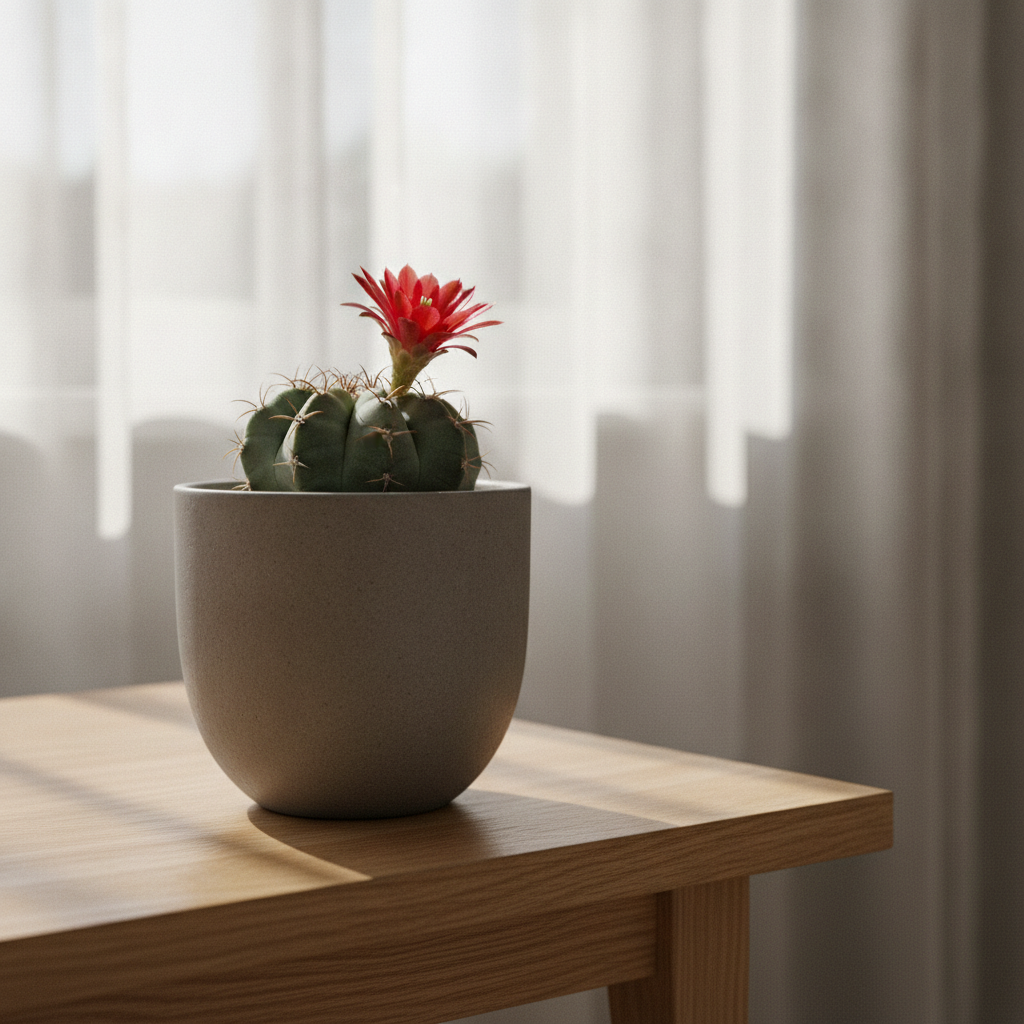
Few small cacti reward a windowsill grower as generously as the chin cactus. Known botanically as Gymnocalycium baldianum, this compact globe from the mountains of northern Argentina stays no larger than a teacup for most of its life, yet crowns itself each summer with silky, funnel-shaped flowers in a saturated ruby-red that is almost unheard of among cacti, most of which flower white, yellow or pale pink. The genus name comes from the Greek for “naked calyx,” a reference to the smooth, scale-free flower buds that distinguish these plants from their spinier relatives, while the common name points to the small chin-like bump that swells beneath each cluster of spines along the ribs.
The chin cactus has earned a lasting place on collectors’ shelves because it asks so little and gives so much. It tolerates the neglect that kills fussier plants, flowers reliably even when young, and rarely outgrows its welcome. That reputation for toughness, however, hides a few genuine make-or-break details, above all the cool, dry winter rest that unlocks its flowering and the mineral-heavy soil that keeps its roots alive. This guide covers everything from light and watering through soil, feeding, propagation and pests, and draws the line clearly between merely keeping a chin cactus alive and helping it truly thrive.
Contents
- Quick Reference
- Why Chin Cactus Makes a Forgiving Houseplant
- Light Requirements
- Watering & Humidity
- Soil, Potting & Repotting
- Fertilising
- Propagation
- Pests & Diseases
- Popular Varieties
- Frequently Asked Questions
Quick Reference: Chin Cactus at a Glance
| Light | Bright light with a few hours of gentle direct sun; shade from fierce midday summer sun |
| Watering | Soak thoroughly, then let the soil dry out completely; keep bone dry through winter |
| Temperature | 18 to 27 C (64 to 81 F) in growth; a cool winter rest at 8 to 12 C (46 to 54 F) |
| Humidity | Average room humidity is fine; prefers dry air and good ventilation |
| Fertiliser | Low-nitrogen cactus feed at half strength, roughly monthly in spring and summer |
| Toxicity | Non-toxic to cats, dogs and humans; the only hazard is the spines |
Why Chin Cactus Makes a Forgiving Houseplant
The chin cactus occupies a sweet spot that is rare in houseplants: it is genuinely easy for a beginner, yet interesting enough to hold a specialist’s attention for decades. Native to the grassy, rocky slopes of the Sierras of Catamarca and Córdoba in Argentina, where it grows at elevations between roughly 500 and 2,000 metres (1,600 to 6,600 feet), it evolved to survive baking summers, cold dry winters and long stretches without rain. Those conditions translate neatly into the life of a potted plant on a bright windowsill, which is why the species shrugs off the occasional missed watering, the holiday absence and the imperfect placement that would spell trouble for a fern or a calathea.
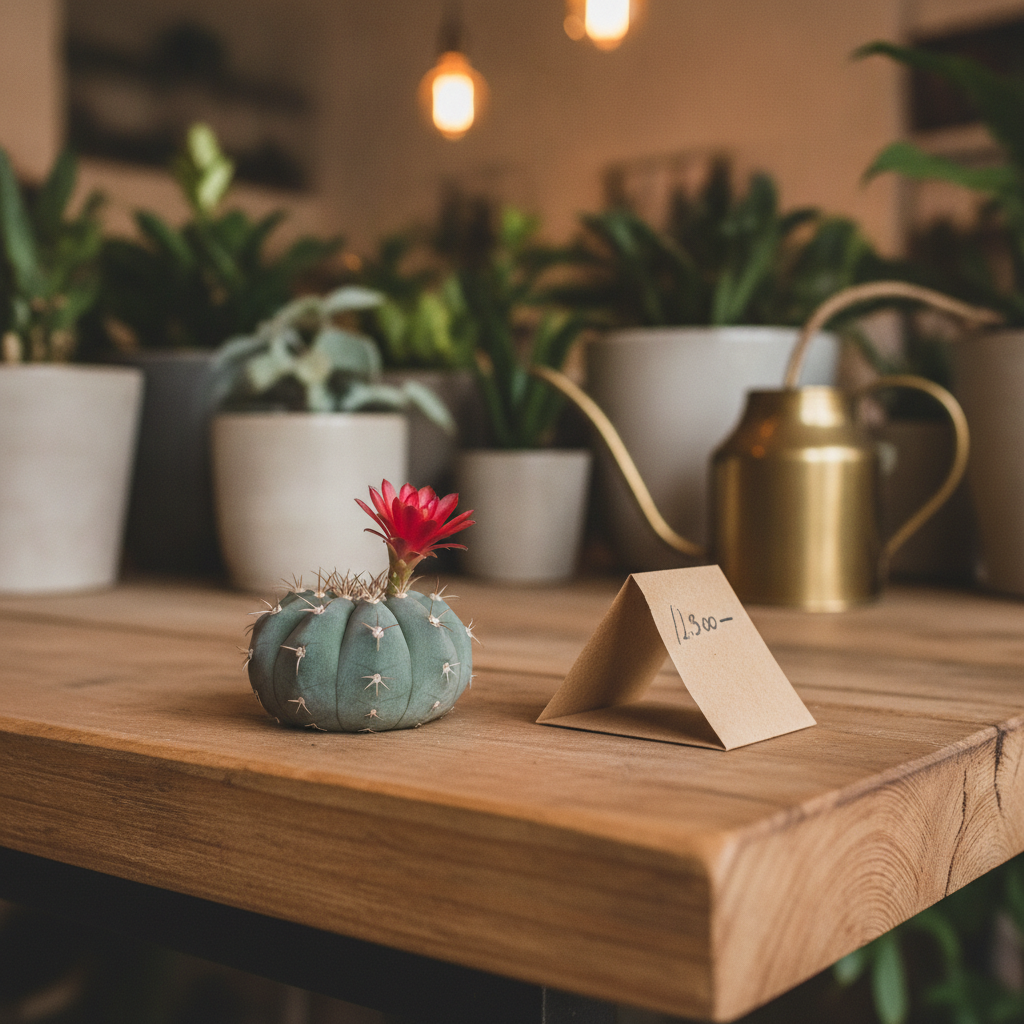
Its size is part of the appeal. A mature Gymnocalycium baldianum typically reaches only 6 to 7 centimetres (about 2.5 inches) across and rarely more than 10, so a whole collection can live comfortably on a single sill. The body is a solitary, slightly flattened globe in a distinctive matte blue-grey to dark greyish-green, divided into nine to eleven rounded ribs. Short, curved, pale-grey spines press close to the surface rather than bristling outward, which makes the plant far more approachable than a barrel or a cholla. Above all, the chin cactus flowers young and freely, producing its remarkable red blooms within a few years from seed, and there is little in indoor gardening quite as satisfying as a thumb-sized plant opening a flower nearly as wide as itself.
Important — Toxicity: The chin cactus is not toxic to cats, dogs or people, and the genus Gymnocalycium does not appear on the ASPCA list of poisonous plants. The only real risk is mechanical: the spines are sharp enough to prick curious pets and children, so place the plant where it will not be knocked or brushed against, and handle it with folded paper or thick gloves.
Light Requirements
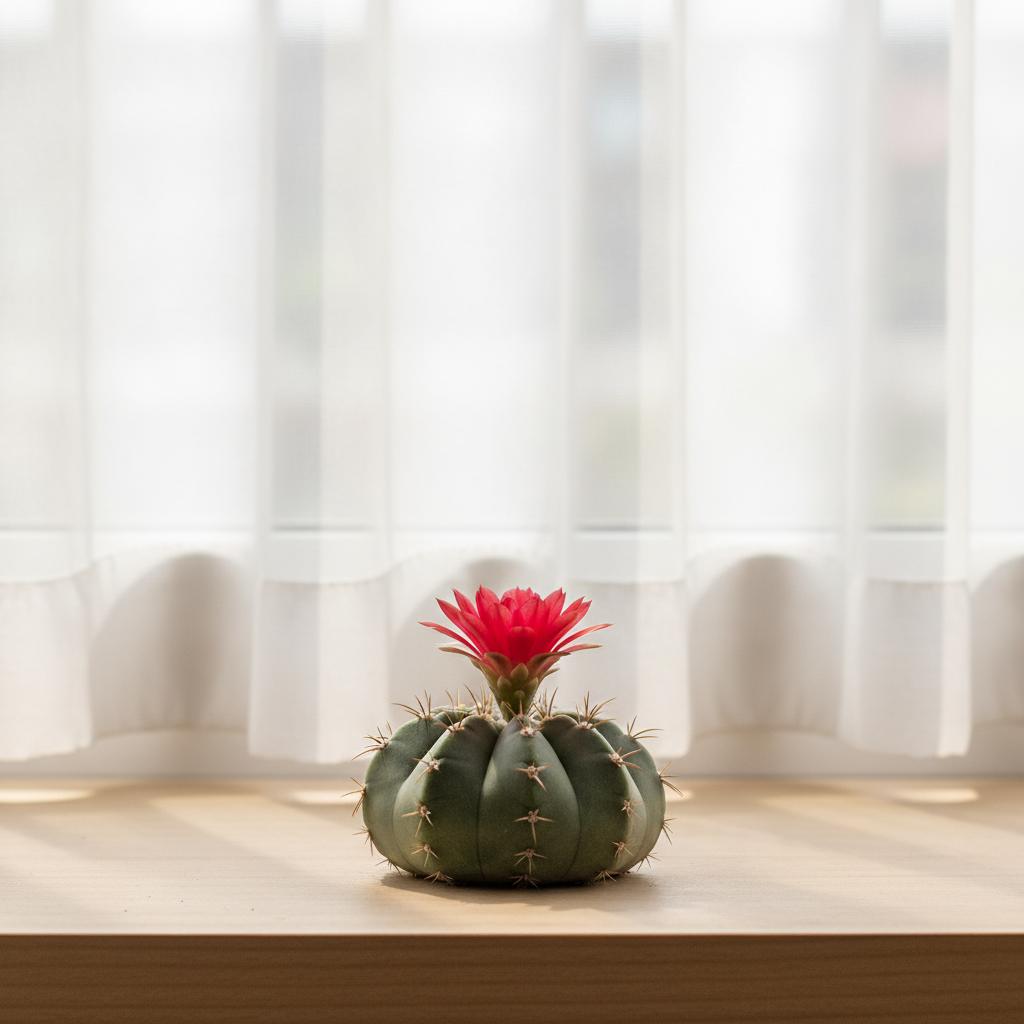
Light is where the chin cactus quietly departs from the cliche of the sun-worshipping desert plant. In the wild it grows tucked among tussock grasses and rock, receiving strong overhead light but often filtered or dappled through surrounding vegetation for part of the day. As a result it wants plenty of brightness but resents the relentless, unbroken midday sun that suits an Echinocactus or an Opuntia. The goal indoors is bright light with a few hours of gentle direct sun, morning or late afternoon, rather than a full day of scorching glare.
Get the balance right and the body stays a healthy, faintly waxy blue-green and the plant flowers well. Too little light and the cactus tells you plainly: it etiolates, stretching upward into a pale, elongated column instead of a tight globe, the ribs flatten, and flowering stops altogether. This distortion is permanent, so it pays to give good light from the start rather than trying to correct a stretched plant later.
Light Levels Explained
Cactus growers often talk in vague terms like “full sun,” but it helps to think in rough light categories and what each one does to this particular plant. The table below maps common indoor conditions to the outcome you can expect.
| Light Category | Approx. Level | Typical Location | Outcome |
|---|---|---|---|
| Gentle direct sun | 20,000 to 50,000 lux | East or west sill, or a shaded south sill | Ideal: tight growth, strong flowering |
| Bright indirect | 10,000 to 20,000 lux | Just back from a bright window | Good: healthy body, reliable flowers |
| Harsh midday sun | 50,000 lux and up | Unshaded south sill in summer | Risk of scorch and corky patches |
| Medium light | 5,000 to 10,000 lux | A metre or more from a window | Survives but seldom flowers |
| Low light | Below 5,000 lux | Interior wall, north corner | Etiolation, stretching, decline |
Window Orientation and Placement
South-facing window: The brightest option and often excellent from autumn through spring, when the sun is weaker. In high summer, an unshaded south sill can deliver enough heat and glare to scorch the body, so diffuse it with a sheer curtain or set the plant slightly back from the glass.
East-facing window: Arguably the best all-round position. Cool, bright morning sun gives the plant the direct light it craves without the punishing intensity of afternoon rays, and the body colours up nicely here.
West-facing window: A strong choice, offering several hours of warm afternoon sun. Watch for heat build-up behind glass on hot days, as trapped warmth can cook a small pot faster than you might expect.
North-facing window: Generally too dim for good growth in the northern hemisphere. A chin cactus may cling on here, but it will not flower and will slowly stretch. If a north sill is your only option, plan to supplement with a grow light.
Pro Tip — Acclimatise Before Summer: A plant moved abruptly from a dim winter spot into strong spring sun can burn within days. Reintroduce direct light gradually over two to three weeks, increasing exposure a little at a time, so the skin can build up its protective coating rather than blistering.
How Light Affects Flowering and Body Colour
Light does more than keep the plant compact; it directly governs whether those famous red flowers appear at all. A chin cactus that receives strong, consistent light through spring and summer builds the energy reserves it needs to set buds, and it will often reward a well-lit position with several flushes of bloom across the season. Body colour is another useful signal. Under ideal light the epidermis takes on a faint bronze or purplish blush at the ribs, a sign of healthy stress; a flat, pure green with soft new growth usually means the plant is reaching for more light.
Warning — Direct Sunlight: Sunscorch on a cactus is irreversible. It appears as bleached white, yellow or corky brown patches, always on the side facing the glass, and those marks never heal. Prevent it by shading during heatwaves and by never moving a plant straight into intense sun after a period in low light.
Artificial Lighting
The chin cactus responds well to a full-spectrum LED grow light, which makes it a practical choice for windowless rooms or for supplementing short winter days if you want to keep the plant in growth. Position the light 20 to 30 centimetres (8 to 12 inches) above the plant and run it for 12 to 14 hours a day. Bear in mind, though, that if you are deliberately giving the plant its cool winter rest to encourage flowering, you should let the days shorten naturally rather than propping them up with artificial light.
Seasonal Adjustments
Follow the sun through the year. From spring to early autumn, give the plant its brightest position while guarding against midsummer scorch. As light levels fall in autumn, move the cactus to the sunniest sill available and stop worrying about too much direct sun, since the weaker seasonal light is rarely strong enough to damage the plant. This natural dimming, combined with cooler temperatures and withheld water, is exactly the trigger the plant needs to prepare for its spring display.
Watering & Humidity
Watering is the single skill that separates a thriving chin cactus from a rotting one. The plant stores water in its swollen body precisely so it can endure drought, which means overwatering, not underwatering, is by far the most common cause of death. The guiding principle is simple: water thoroughly, then wait until the soil is completely dry before watering again. Everything else is a refinement of that rhythm.
When to Water
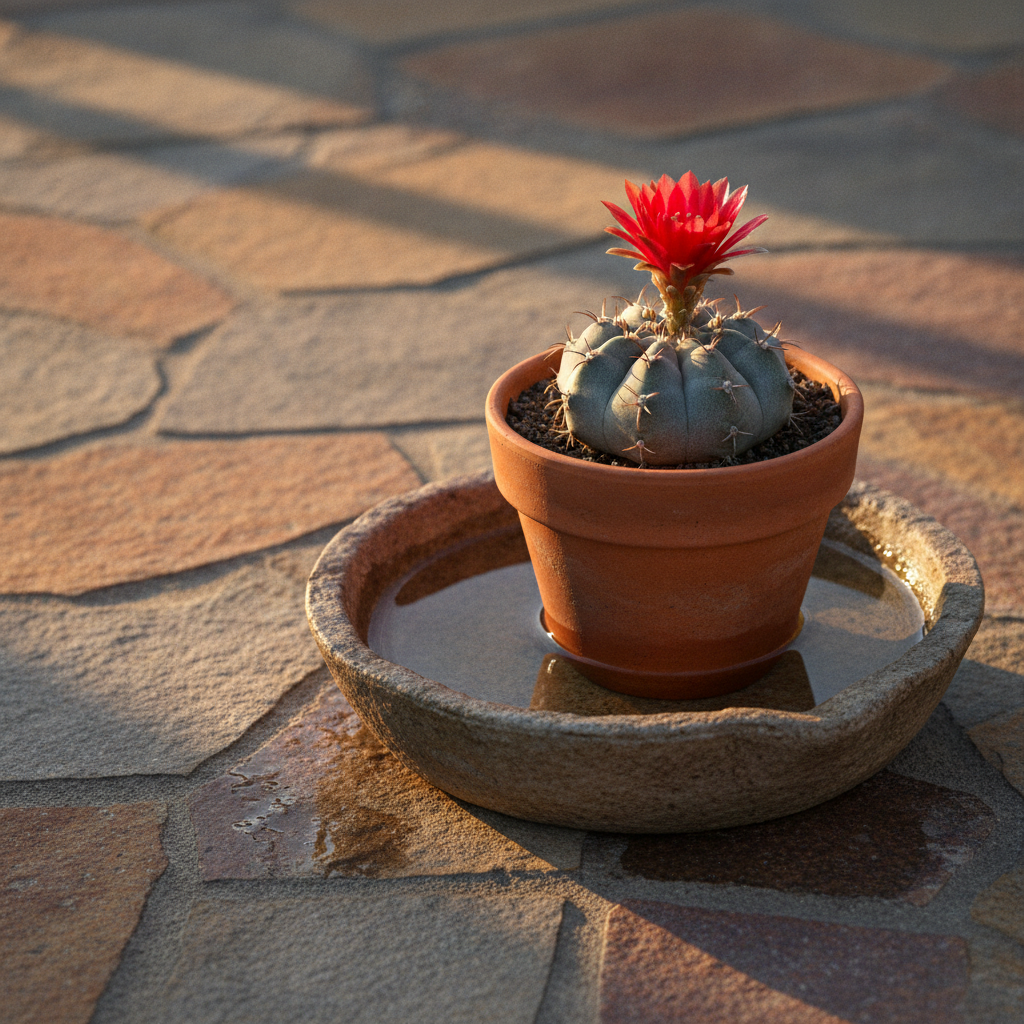
During the active growing season, from spring to early autumn, water whenever the potting mix has dried out entirely, which in a small pot in bright warmth might mean every 10 to 14 days. Do not water on a fixed calendar; check the soil first. Lift the pot to judge its weight, push a finger or a wooden skewer into the mix, and only water when it comes out dry. A chin cactus in doubt is always better left dry for a few more days.
The winter regime is entirely different, and it is the key to flowering. From late autumn through to early spring the plant should be kept almost completely dry and cool, mimicking the arid Argentine winter. This enforced rest, at temperatures around 8 to 12 C (46 to 54 F), is what sets flower buds for the coming year. A single light watering every four to six weeks is enough to stop the roots shrivelling entirely; anything more, combined with cold, invites rot. Resume normal watering only when you see the plant begin to grow or bud in spring.
Pro Tip — The Soak and Dry Method: When you do water, water properly. Drench the mix until water runs freely from the drainage holes, which forces air through the soil and encourages roots to grow deep. Then let the pot dry out fully before the next drink. Frequent shallow sips keep the surface damp, discourage strong rooting and raise the risk of rot.
How to Water Correctly
- Check that the soil is completely dry throughout, not just at the surface, before you begin.
- Water at the soil level with a narrow-spout can, or stand the pot in a shallow tray of water to soak up from below, keeping the body itself dry.
- Continue until water drains freely from the base, or until the surface is visibly moist if bottom-watering.
- Let the pot drain completely and never leave it standing in a saucer of water.
- Return the plant to its bright spot and do not water again until the mix has dried out entirely.
Signs of Overwatering vs. Underwatering
| Symptom | Overwatering | Underwatering |
|---|---|---|
| Body colour | Yellowing, translucent or blackened patches | Dull, greyish, slightly faded |
| Body texture | Soft, mushy, squishy to the touch | Wrinkled, shrunken, firm |
| Base of plant | Brown or black soft rot at soil line | Firm but visibly contracted |
| Roots | Brown, slimy, foul-smelling | Dry and papery but intact |
| Recovery | Often fatal once soft rot sets in | Rapid and full after a good soak |
The distinction matters because the two problems point in opposite directions. A wrinkled, firm plant is thirsty and will plump up within a day or two of watering, so there is no cause for alarm. A soft, discoloured plant that gives under gentle pressure is a far more serious sign, usually of rot that has already reached the roots or base.
Warning — Root Rot: If the base of the plant turns soft and brown, act immediately. Unpot the cactus, cut away all mushy tissue with a sterilised blade until only firm, pale-green flesh remains, dust the wound with sulphur or cinnamon, let it callus for several days, and replant in fresh dry mix. Caught early this can save the plant; left alone, rot spreads upward and kills it.
Humidity Requirements
Humidity is refreshingly unimportant for this plant. The chin cactus is perfectly happy in the dry air of a centrally heated home and actively prefers it to the damp, still conditions that suit tropical foliage plants. Ordinary room humidity, anywhere from 30 to 50 percent, is ideal, and there is no need to mist, group plants or run a humidifier.
If anything, the risk runs the other way. Persistently humid, stagnant air raises the chance of fungal problems and encourages pests such as mealybugs to settle in. Symptoms of an unhappy plant in this respect are usually indirect, showing up as mould on the soil surface or soft spots on the body rather than the crisping and browning you would see on a moisture-loving houseplant.
The most useful thing you can do is ensure good air movement around the plant. A gently circulating airflow keeps the surface dry, discourages fungus and helps the soil dry out at a healthy pace between waterings, which is far more valuable to a cactus than any effort to raise the humidity.
Water Quality
Chin cacti are not especially fussy about water, but they do slightly prefer soft, slightly acidic water. In hard-water areas, prolonged use of tap water can leave chalky mineral deposits on the soil and gradually shift the pH. If your tap water is very hard, rainwater or filtered water is a worthwhile upgrade, particularly for prized specimens. Where you do use tap water, letting it stand overnight allows some chlorine to dissipate and brings it to room temperature, which is gentler on the roots than a cold shock.
Soil, Potting & Repotting
If watering is the skill, soil is the safety net. The right potting mix forgives the occasional watering mistake by draining fast enough that the roots never sit in moisture, while the wrong mix, dense and water-retentive, turns a single overwatering into a death sentence. For a chin cactus the aim is a gritty, mineral-rich medium that holds just enough moisture to sustain the plant and then dries quickly.
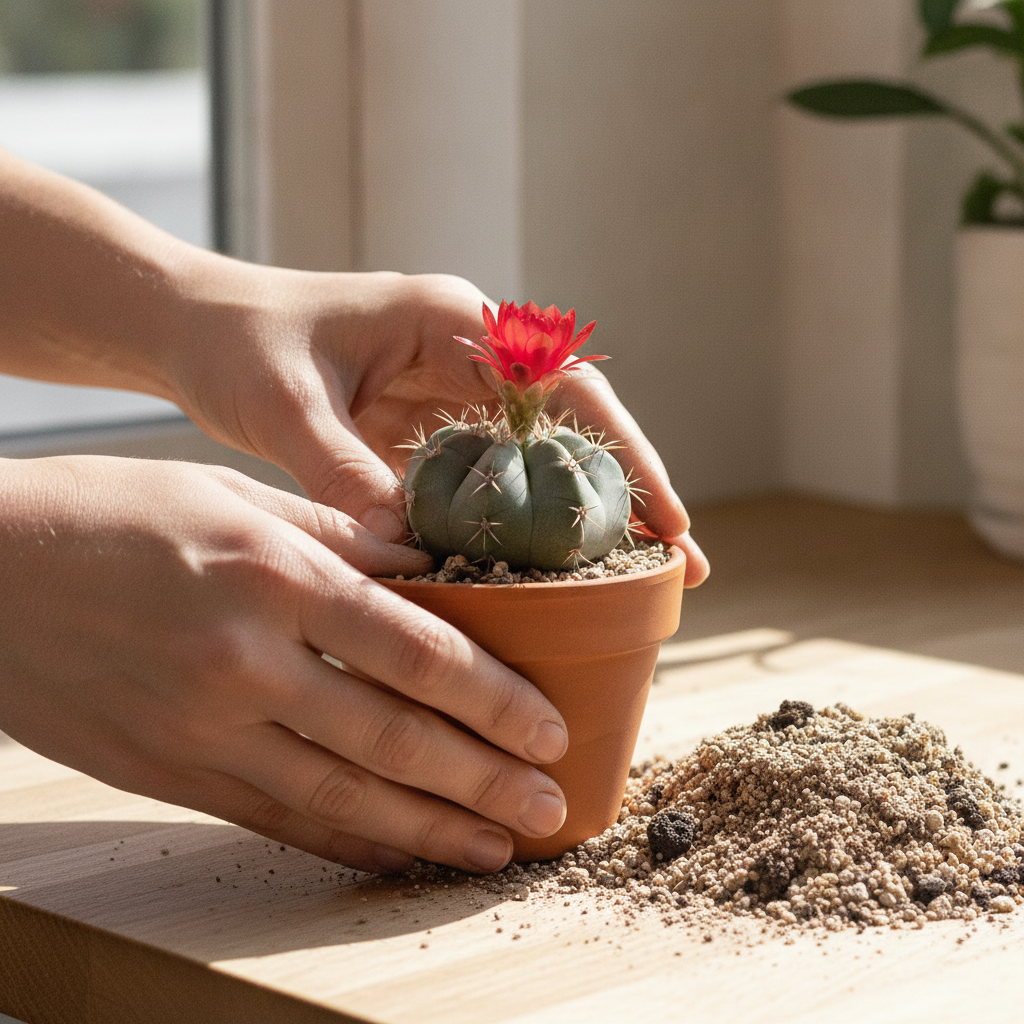
Ideal Soil Composition
A good chin cactus mix leans heavily on mineral content, more so than the bagged “cactus and succulent” composts sold in most garden centres, which are often too rich in peat or coir and hold water for too long. A reliable approach is to take a standard cactus compost and cut it with an equal volume, or more, of coarse mineral grit so that at least half the finished mix is inorganic material. The result should feel loose and crumbly and should never clump into a wet ball.
| Component | Proportion | Function |
|---|---|---|
| Cactus or standard compost | 40 to 50% | Holds a little moisture and provides light nutrition |
| Pumice or perlite | 25 to 30% | Creates air pockets and speeds drainage |
| Coarse grit or sharp sand | 20 to 30% | Adds weight and stops the mix compacting |
| Fine bark or coir | Up to 10% | Improves structure without holding excess water |
The chin cactus favours a slightly acidic to neutral soil, roughly pH 6.0 to 7.0. Most peat-free and mineral mixes fall naturally within this range, so it is rarely something you need to measure, but it is worth knowing if you keep the plant in hard-water conditions that push the pH upward over time. An occasional flush with rainwater helps keep the balance where the roots like it.
Pro Tip — Quick Mix Recipe: For a fuss-free blend, combine two parts of any bagged cactus compost with one part pumice and one part coarse horticultural grit. This 2:1:1 ratio drains freely, resists compaction and suits nearly every small globular cactus, so a single batch will serve a whole collection.
Choosing the Right Pot
Pot choice has a surprisingly large effect on a plant this small, because the volume of soil is tiny and dries or stays wet according to the container around it. The overriding principle is that the pot must never let the roots stay wet.
Drainage holes are non-negotiable. A chin cactus should never be planted in a container without a drainage hole, however attractive. Without an escape route for excess water, the mix stays saturated at the bottom and the roots rot. If you love a particular decorative cover pot, use it as an outer sleeve and keep the plant in a plain plastic nursery pot inside it.
Pot material: Terracotta is the classic and arguably the best choice, because its porous walls wick moisture out of the mix and let it dry evenly, which suits a plant that hates staying wet. Glazed ceramic and plastic hold moisture longer, so if you use them, be even more disciplined about letting the soil dry out fully between waterings.
Pot size: Choose a pot only slightly larger than the plant itself, leaving a centimetre or two of space around the body. An oversized pot holds a large reservoir of damp soil that the small root system cannot use, and that lingering moisture is a common cause of rot. Snug is safe.
When to Repot
The chin cactus grows slowly and dislikes disturbance, so repotting is an occasional task rather than an annual one. Every two to three years is usually enough, prompted by roots emerging from the drainage hole, a plant that has filled its pot, or a mix that has broken down and no longer drains freely. The best time is early spring, at the start of the growing season, so the plant can settle and root out before winter. Always repot into dry mix and wait about a week before the first watering, giving any roots damaged in the move time to heal rather than rot.
How to Repot: Step-by-Step
- Water the plant a few days beforehand, then let it dry, so the root ball holds together without being wet.
- Protect your hands with folded newspaper, thick gloves or a strip of foam, then ease the plant out by tipping the pot and supporting the body.
- Gently crumble away the old soil and inspect the roots, trimming any that are dead, brown or mushy with a sterilised blade.
- Set the plant in a clean pot only slightly larger than the last, positioning it at the same depth as before.
- Fill around the roots with fresh dry mix, firming lightly so the plant sits stable but not compacted.
- Wait about a week before watering, then resume the normal soak-and-dry routine.
Warning — Transplant Shock: Never water a freshly repotted cactus straight away. The repotting process inevitably breaks fine roots, and those open wounds are an easy entry point for rot if they meet damp soil. Keeping the plant dry for several days lets the wounds callus over, after which watering is safe.
Fertilising
The chin cactus is a slow, frugal grower that needs very little feeding, and a light hand here does far more good than a generous one. In its native habitat it survives on lean, mineral soils, so the goal indoors is a modest top-up of nutrients during the growing season rather than the steady rich diet a leafy houseplant would enjoy.
The most common feeding mistake is using too much nitrogen. High-nitrogen general-purpose fertilisers push soft, fast growth that leaves the body swollen and vulnerable to rot and pests, and can actually suppress flowering. A specialist cactus feed, which is low in nitrogen and higher in potassium and phosphorus, encourages firm growth and good bud formation instead.
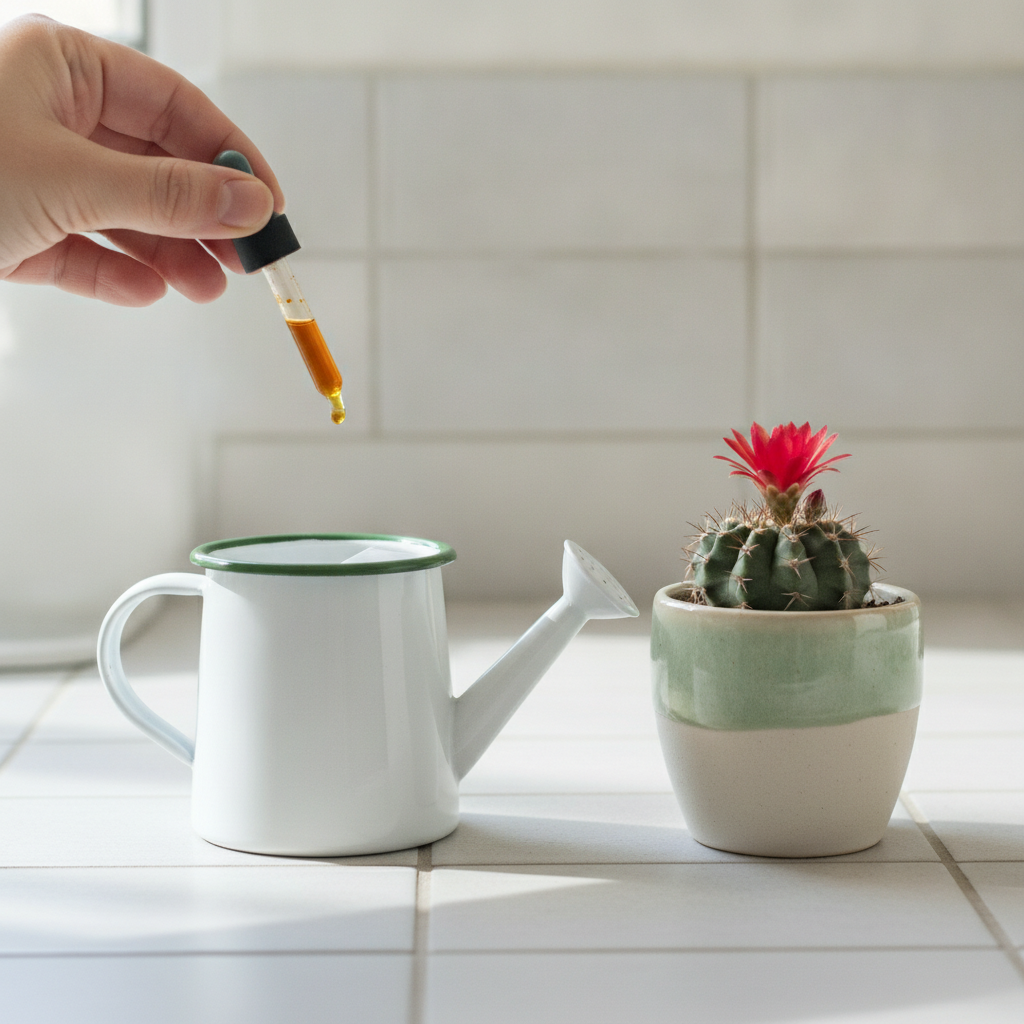
Understanding Plant Nutrients
Fertiliser labels carry three numbers, the N-P-K ratio, showing the percentages of nitrogen, phosphorus and potassium. For a chin cactus you want the first number, nitrogen, to be the lowest of the three. The table below summarises the main nutrients and what a shortage of each looks like.
| Nutrient | Symbol | Primary Function | Deficiency Symptoms |
|---|---|---|---|
| Nitrogen | N | Green growth and body tissue | Pale colour, very slow growth |
| Phosphorus | P | Roots and flower development | Poor rooting, few flowers |
| Potassium | K | Overall vigour and disease resistance | Weak growth, soft body |
| Calcium | Ca | Cell wall strength | Distorted new growth |
| Magnesium | Mg | Chlorophyll production | Yellowing on older tissue |
| Iron | Fe | Enzyme and pigment function | Yellowing on newest growth |
Types of Fertiliser
Liquid fertilisers: The most practical option for a small cactus, since you can dilute them precisely and apply them with a normal watering. A liquid cactus feed at half the recommended strength, mixed into the water during the growing season, gives you full control over how much the plant receives.
Slow-release granular: Convenient but harder to control, as the prills release nutrients gradually whenever the soil is moist. If you use them, choose a low-nitrogen formulation and apply at a reduced rate, because it is easy to overfeed a plant this small and slow.
Organic fertilisers: Gentle options such as heavily diluted worm-casting tea can work, but they are less predictable in their nutrient content and can encourage mould or fungus gnats in a mineral cactus mix. For most growers a measured synthetic cactus feed is simpler and cleaner.
Feeding Schedule
Feed only during the active growing season, from spring to early autumn, and stop entirely through the winter rest. Roughly one application a month, delivered with a normal watering, is ample. Many experienced growers feed even less, perhaps two or three times across the whole season, and their plants are none the worse for it. When in doubt, underfeed. Never fertilise a dormant winter plant, and never feed a dry one, as concentrated nutrients against dry roots can scorch them.
Pro Tip — Half Strength Is Plenty: Always dilute cactus feed to half the strength stated on the bottle, or even less. Cacti are adapted to lean soils and take up nutrients slowly, so a weak, occasional feed is used efficiently, while a full-strength dose risks a build-up of salts that damages the roots.
How to Fertilise
- Wait until the growing season is under way and the plant is showing signs of active growth.
- Dilute a low-nitrogen cactus fertiliser to half the recommended strength in your watering water.
- Water the plant with the solution only when the soil is due for watering, never onto dry roots.
- Flush the pot with plain water every few months to wash out any accumulated mineral salts.
- Stop feeding completely from autumn onward so the plant can enter its winter rest cleanly.
Warning — Salt Build-Up: A white, crusty deposit on the soil surface or around the pot rim signals a build-up of fertiliser salts, which can burn roots and stunt the plant. Prevent it by feeding weakly and flushing the pot occasionally with plain water until it runs clear from the base.
Propagation
Propagating a chin cactus is a slow but rewarding exercise, and there are two reliable routes: separating the offsets, or pups, that mature plants produce around their base, and raising new plants from seed. Because Gymnocalycium baldianum is often solitary and only offsets sparingly, division is the everyday method for most growers, while seed offers a way to raise many plants and to see the natural variation in flower colour.
Whichever method you choose, patience is essential. Cacti heal, root and grow at their own unhurried pace, and rushing any stage, especially by watering too soon, is the surest way to lose a cutting or a young plant to rot.
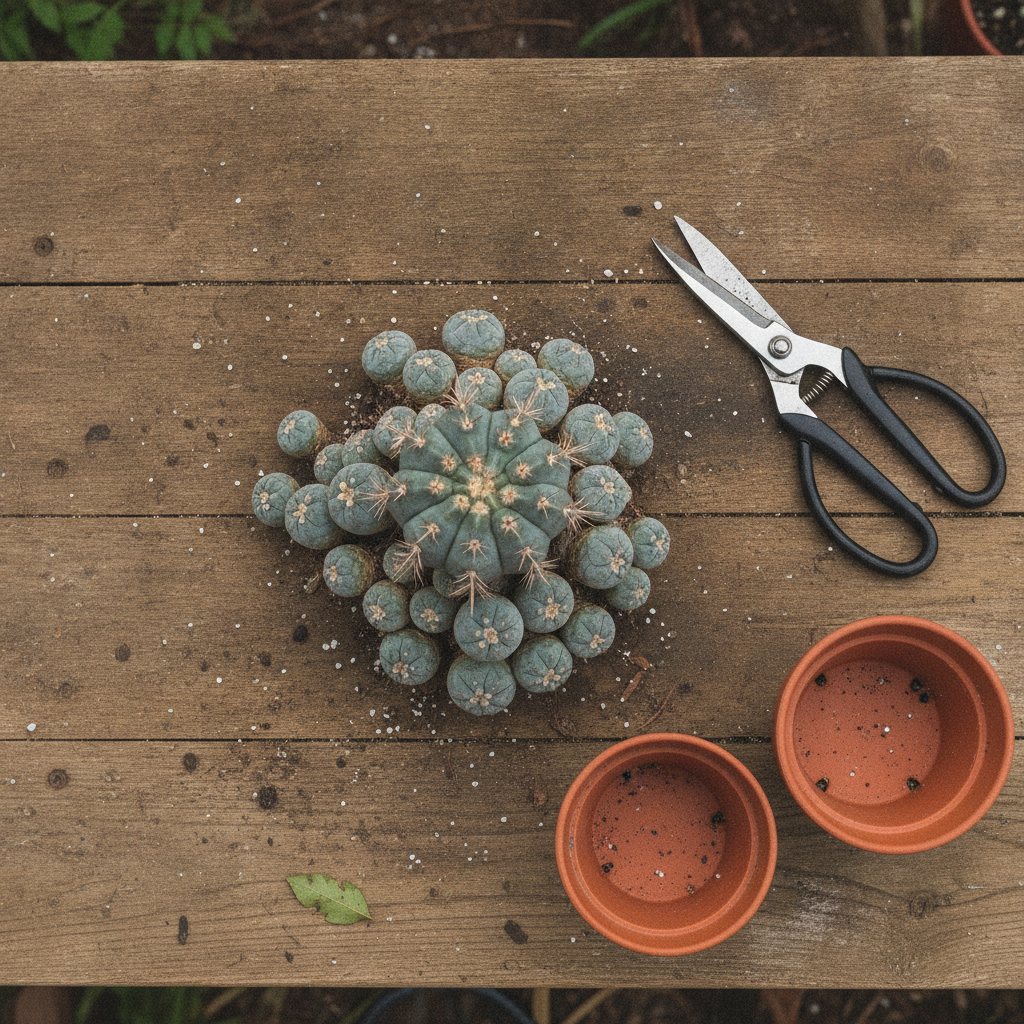
Understanding Offsets and Seed
An offset is a miniature clone of the parent, a small pup that forms at the base and can be detached once it has grown large enough to survive on its own. Because it is genetically identical to the parent, it will flower in the same colour and grow to the same form. Seed, by contrast, is the product of cross-pollination and carries genetic variation, which is why a batch of seedlings can produce subtle differences in body shape and flower shade. Note that the chin cactus is largely self-sterile, so setting viable seed usually requires two genetically different plants flowering at the same time.
Division of Offsets: Step-by-Step
This is the simplest and most reliable method when a plant has produced pups. It is best done in spring or early summer, when the plant is in active growth and wounds heal quickly.
- Choose an offset that has grown to a reasonable size, ideally with a few of its own roots already forming.
- Using a clean, sterilised blade, cut or gently twist the pup away from the parent at its narrowest point of attachment.
- Set the offset aside in a dry, shaded spot for several days to a week, until the cut surface has dried and calloused over.
- Pot the calloused pup into a small container of dry, gritty cactus mix, settling it just deep enough to stand upright.
- Wait a week, then begin watering sparingly, keeping the mix mostly dry until you see signs of new growth that confirm rooting.
Pro Tip — Always Let Cuts Callus: The single most important step in cactus propagation is allowing the cut surface to dry and form a callus before it touches soil or water. A fresh, moist wound planted straight away will almost always rot; a dry, calloused one roots cleanly. Give it a few days in the open air and resist the urge to hurry.
Growing from Seed: Step-by-Step
Seed is the way to raise a chin cactus in quantity, and although it demands patience, the species germinates readily and is a good choice for anyone wanting to try cactus sowing for the first time.
- Sow fresh seed thinly on the surface of a moist, sterile, gritty seed mix in spring, and do not bury it, as light aids germination.
- Cover the container with a clear lid or bag to hold humidity, and keep it warm at around 20 to 25 C (68 to 77 F).
- Keep the surface lightly moist and expect the tiny green seedlings to appear over one to several weeks.
- Once seedlings are established, ventilate gradually over a few weeks to acclimatise them to normal room air.
- Leave them undisturbed for several months before pricking out, then grow on slowly, aware that flowering-size plants take a few years.
Troubleshooting Propagation
| Problem | Likely Cause | Solution |
|---|---|---|
| Offset rots after potting | Planted before the cut calloused, or watered too soon | Allow longer drying; keep mix dry until rooted |
| Pup fails to root | Too little warmth or light, or mix kept bone dry | Provide warmth and bright light; mist mix very lightly |
| Seeds do not germinate | Old seed, buried too deep, or too cold | Use fresh seed, sow on the surface, keep warm |
| Seedlings damp off | Excess moisture and stagnant, humid air | Use sterile mix, ventilate, reduce surface wetness |
Pests & Diseases
A healthy chin cactus grown in bright light with a lean, dry regime is remarkably resistant to trouble, and most problems that do arise can be traced back to overwatering or poor air circulation. Still, a handful of pests target cacti, and it pays to inspect your plant regularly, paying particular attention to the crown, the spaces between the ribs and the roots, where trouble tends to hide.
Because a cactus grows so slowly, damage lingers. A scar or a pest infestation can mark the body for years, so the emphasis should always be on early detection and prompt, gentle treatment rather than dramatic intervention after the fact. Quarantine any new plant for a few weeks before it joins your collection.
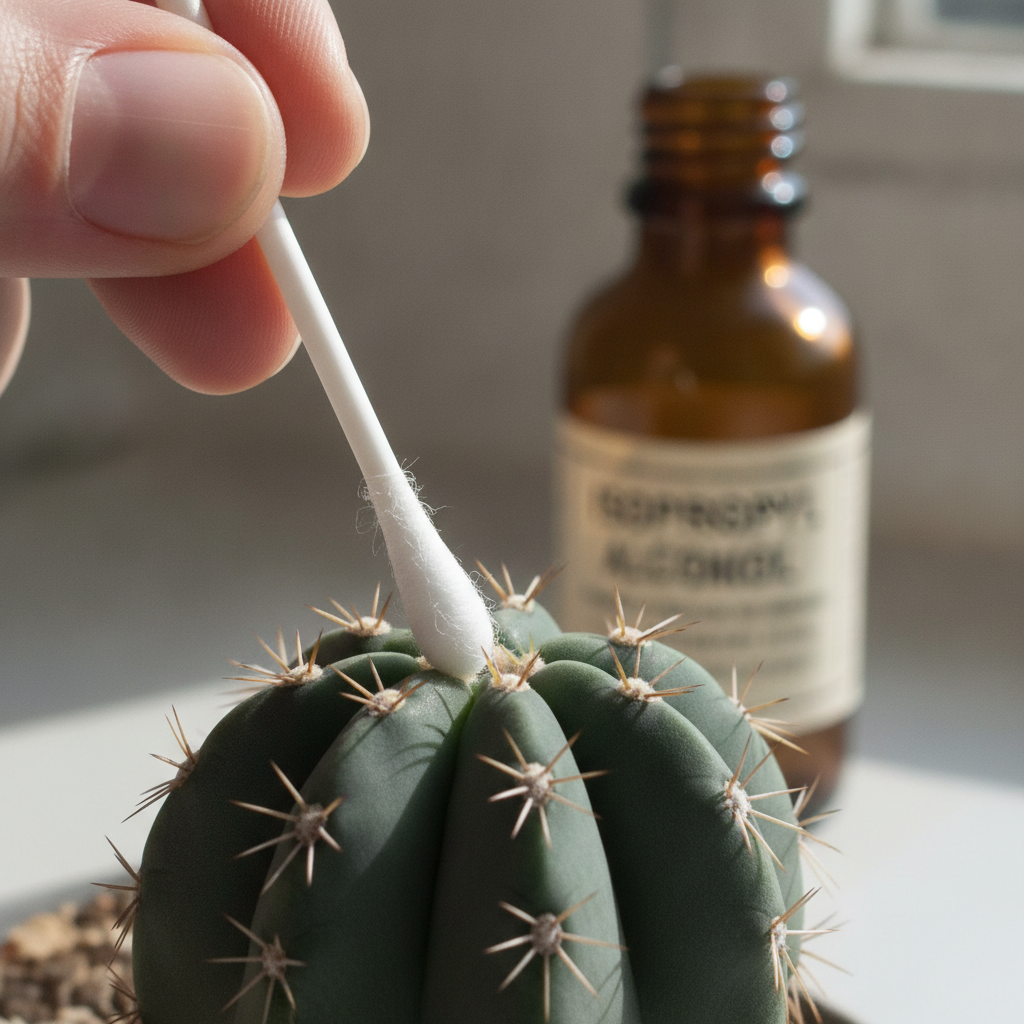
Common Pests
Mealybugs (Pseudococcus species)
The most frequent pest of the chin cactus, mealybugs appear as small, soft, white cottony blobs nestled between the ribs and around the crown. They pierce the plant to suck sap, weakening it and leaving sticky honeydew that can attract sooty mould. In a ribbed cactus they are easy to overlook until numbers build.
Treatment: Dab each insect directly with a cotton bud dipped in isopropyl alcohol, which kills it on contact. For heavier infestations, treat with a systemic insecticide or repeated horticultural soap sprays, and check the roots too, as related root mealybugs can lurk unseen in the soil.
Spider Mites (Tetranychus urticae)
These minuscule mites thrive in hot, dry, stagnant conditions and leave fine webbing and pale, bronzed or rusty scarring on the body, usually near the crown. They are almost too small to see, so the damage and webbing are often the first clues.
Treatment: Improve air circulation, wipe the body gently to remove webbing, and apply a miticide or repeated insecticidal soap treatments. Because they breed quickly, persistence over several weeks is usually needed to break the cycle.
Scale Insects (Diaspididae)
Scale insects show up as small, hard, brown or tan bumps stuck fast to the body. Beneath their protective shells they feed on sap, and being immobile once settled, they are easily mistaken for a natural marking on the plant.
Treatment: Scrape or lift them off gently with a fingernail or a cotton bud soaked in alcohol, then treat with a systemic insecticide if any remain. Inspect nearby plants, as scale spreads slowly from one specimen to the next.
Common Diseases
Root and Basal Rot (Fusarium and Pythium species)
By far the most serious threat to a chin cactus, rot is caused by fungi and water moulds that take hold when the roots or base sit in cold, damp soil. It usually begins out of sight at the roots or soil line and works upward, turning the tissue soft, brown and eventually black and collapsed.
Treatment: Act at the first sign. Unpot the plant, cut away every trace of soft, discoloured tissue with a sterilised blade until only firm green flesh remains, dust the wound with sulphur or cinnamon, let it callus, and replant in fresh dry mix. Prevention through careful watering and fast-draining soil is far more effective than any cure.
Fungal Leaf and Body Spot (various pathogens)
Persistently humid, stagnant conditions can allow fungal spots to develop on the body, appearing as sunken, discoloured or corky lesions. Unlike rot these are often superficial, but they mark the plant permanently and can spread if conditions remain damp.
Treatment: Improve ventilation, reduce watering and keep the body dry. A fungicide can halt an active spread, but the scars will remain, so prevention through airflow and dry conditions is the real remedy.
Pest and Disease Summary
| Pest / Disease | Identification | Treatment |
|---|---|---|
| Mealybugs | White cottony clusters between ribs | Alcohol on a cotton bud; systemic insecticide |
| Spider mites | Fine webbing, bronzed scarring near crown | Miticide, insecticidal soap, better airflow |
| Scale | Hard brown bumps fixed to the body | Scrape off; systemic insecticide |
| Root and basal rot | Soft brown or black tissue at base or roots | Cut out rot, callus, replant dry; prevent by careful watering |
| Fungal spot | Sunken corky lesions on the body | Improve airflow, reduce watering, fungicide |
Prevention Strategies
The best defence against nearly every problem on this list is simply good culture. A chin cactus grown in bright light, in a fast-draining mineral mix, watered only when dry and kept in moving air rarely troubles its owner. Most infestations and infections gain a foothold on plants weakened by overwatering, poor light or stagnant, humid conditions, so getting the basics right is worth more than any spray.
Regular, close inspection is the other half of prevention. Look over the plant whenever you water, checking the crown and the spaces between the ribs where pests hide, and quarantine every new plant for a few weeks before it joins the rest of your collection. Catching a single mealybug early is trivial; clearing an established colony from a whole shelf is not.
Pro Tip — Isolate and Inspect: Keep a small artist’s brush and a bottle of isopropyl alcohol near your plants. A weekly once-over with the brush dislodges early pests before they settle, and any newcomer can be dealt with on the spot, long before it becomes an infestation worth worrying about.
Popular Varieties
Strictly speaking, “chin cactus” is a common name for the whole genus Gymnocalycium, which contains around fifty species native to South America, so a grower drawn to Gymnocalycium baldianum quickly discovers a wide family of close relatives worth collecting. Within the species itself there is natural variation in flower colour, while the broader genus offers everything from clustering miniatures to boldly banded, brightly flowered forms.
All of them share the same easygoing temperament and the same basic needs described in this guide, which makes the chin cactus an ideal starting point for building a small, varied collection on a single windowsill. The table and profiles below cover the species and the relatives you are most likely to encounter.
| Variety | Body Appearance | Light Needs | Growth Rate | Availability |
|---|---|---|---|---|
| Red-flowered baldianum | Blue-grey globe, ruby-red flowers | Bright, gentle sun | Slow | Common |
| Pink and white forms | Blue-grey globe, pink or white flowers | Bright, gentle sun | Slow | Occasional |
| G. mihanovichii | Grey-green, banded ribs, pale flowers | Bright, gentle sun | Slow to moderate | Very common |
| G. bruchii | Small clustering mounds, pink flowers | Bright, gentle sun | Slow | Common |
| G. anisitsii | Ribbed green body, white flowers | Bright, gentle sun | Moderate | Occasional |
| G. saglionis | Large solitary globe, stout spines | Bright, tolerates more sun | Slow | Occasional |
Featured Varieties
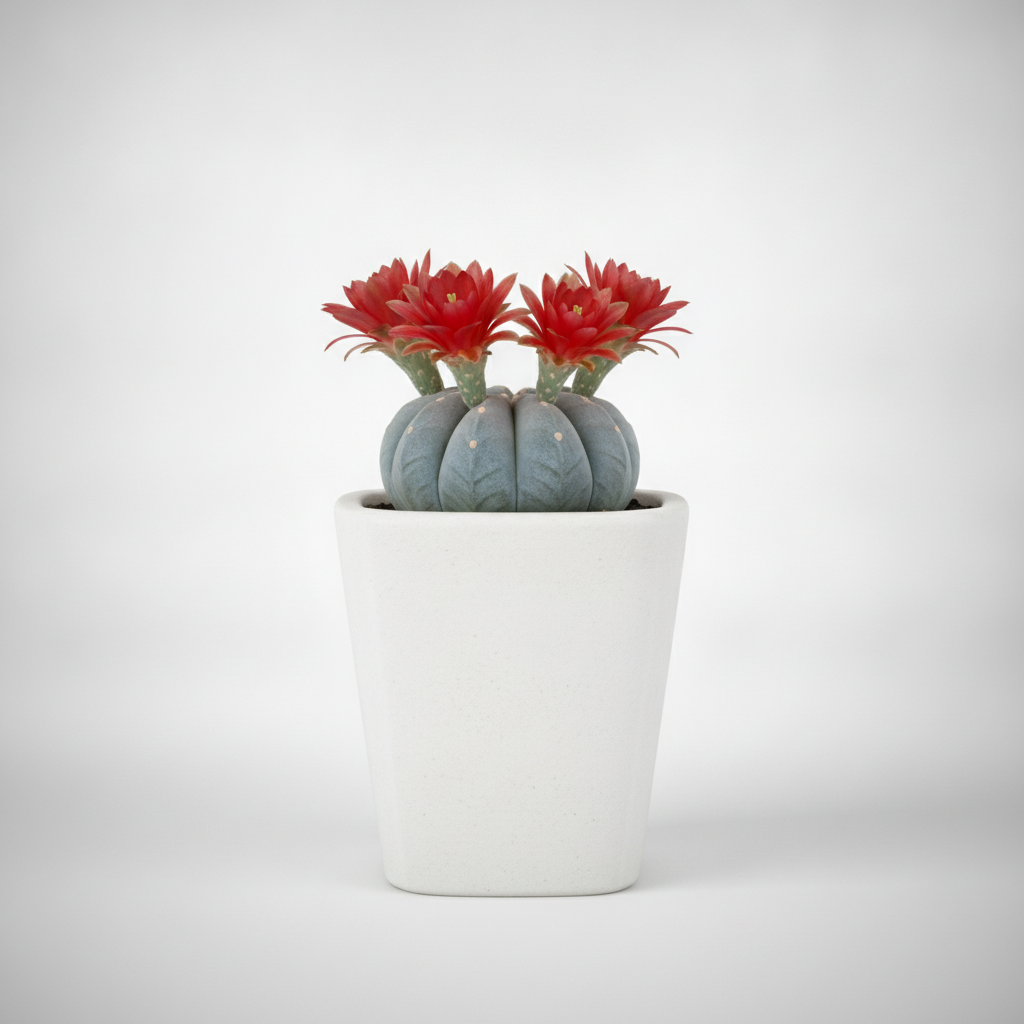
Red-Flowered Baldianum
The classic form and the reason the species is grown at all, this is a compact blue-grey globe crowned in summer with vivid, funnel-shaped ruby-red blooms. That intense red is genuinely rare among cacti and makes even a small plant a striking sight in full flower.
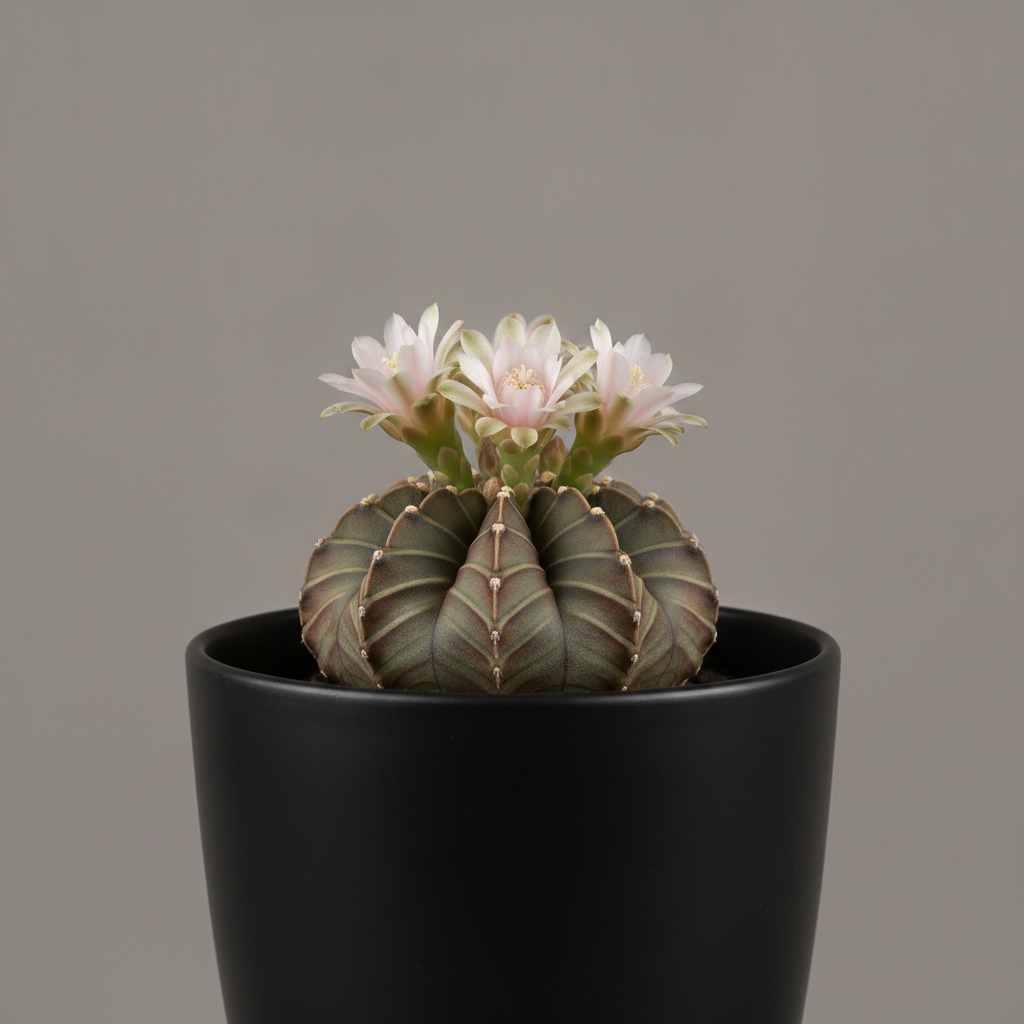
Gymnocalycium mihanovichii
Perhaps the most familiar chin cactus of all, this species has a smaller grey-green body marked with pronounced curved banding across its ribs. Its chlorophyll-free mutant forms, grafted onto a green rootstock, are sold everywhere as the colourful “moon cactus.”
Variety Profiles in Detail
Red-Flowered Baldianum (Gymnocalycium baldianum)
The type most gardeners mean by “chin cactus,” this is the plant described throughout this guide: a solitary, slightly flattened globe of matte blue-grey with nine to eleven rounded ribs, short curved pale spines, and its trademark ruby-red flowers borne at the crown in summer. It flowers young and freely, and pink, orange and white-flowered forms occasionally appear, offering variety for collectors who want more than the classic red.
Moon Cactus and Its Parent (Gymnocalycium mihanovichii)
The wild species is a modest grey-green globe with distinctive horizontal banding, but it is far better known through its mutant offspring. Certain seedlings lack chlorophyll and glow red, yellow or pink; unable to survive on their own, they are grafted onto a green cactus rootstock and sold as the ubiquitous moon cactus. The coloured top and the graft need the same bright, dry care as any chin cactus, though the union can be short-lived if either partner is stressed.
Dwarf Chin Cactus (Gymnocalycium bruchii)
A charming miniature that breaks the solitary habit, forming tight clusters of small heads that in time build into a low mound. It flowers early in the season in soft pink and is one of the hardiest members of the genus, tolerating cooler winter conditions than most. Its freely offsetting nature makes it the easiest chin cactus to propagate by division.
Choosing the Right Variety for Your Space
For most people the classic red-flowered Gymnocalycium baldianum is the ideal introduction, combining reliable flowering, compact size and genuine visual impact. If you are drawn to something clustering, G. bruchii rewards patience with a mound of pink-flowered heads, while the banded G. mihanovichii and its grafted moon-cactus forms suit anyone who wants bold novelty. Whichever you choose, the care is essentially the same, so a windowsill collection of several chin cacti asks no more of you than a single plant, and returns a longer, more varied flowering season.
Frequently Asked Questions
Why won’t my chin cactus flower?
The usual reason is the lack of a cool, dry winter rest. Chin cacti set their buds in response to a period of cold, roughly 8 to 12 C (46 to 54 F), and near-total drought through winter. Kept warm and watered year-round, the plant has no seasonal trigger to flower. Combine that winter rest with strong light through spring and summer, and blooms usually follow.
How often should I water a chin cactus?
There is no fixed schedule; water only when the soil has dried out completely. In warm, bright growing conditions that might mean every 10 to 14 days, but you should always check the soil rather than counting days. Through winter, cut watering right back to a light drink every four to six weeks at most, keeping the plant almost dry.
Is the chin cactus safe for cats and dogs?
Yes. Gymnocalycium is not toxic to cats, dogs or people and does not appear on the ASPCA list of poisonous plants. The only hazard is physical: the spines can prick a curious pet or child, so position the plant where it will not be knocked over or brushed against.
Why is my chin cactus turning brown or corky at the base?
A little firm, tan corking at the very base is a normal sign of age. Soft, dark, spreading brown at the base, however, is basal rot, almost always from overwatering or cold, damp soil. If the tissue is soft, unpot the plant, cut away all the rot until only firm green flesh remains, let it callus, and replant in dry, gritty mix.
My chin cactus has gone tall and thin. Can I fix it?
Stretching, or etiolation, is caused by too little light, and unfortunately the elongated growth cannot be reversed. Move the plant to a much brighter spot to prevent further distortion, and it will grow normally from there. If the shape bothers you, you can behead the plant above the stretched section, let the top callus and re-root it as a cutting, and it will resume compact growth.
How big does a chin cactus get?
It stays small. A mature Gymnocalycium baldianum is typically only 6 to 7 centimetres (about 2.5 inches) across and seldom exceeds 10, growing very slowly to reach that size over several years. This modest, unhurried habit is a large part of its appeal for windowsill growers with limited space.
Why is my chin cactus wrinkled or shrivelled?
A wrinkled but firm body is a sign of thirst, and it will plump up within a day or two of a thorough soak, so there is no need to worry. Be careful, though, not to confuse this with the soft, mushy shrivelling of rot. Thirsty plants are firm and dry; rotting plants are soft and often discoloured. A little winter shrivelling is also normal and expected during the dry rest.
Can I grow a chin cactus without any direct sun?
It can survive in bright indirect light, but it will grow slowly and is unlikely to flower well without some direct sun. A few hours of gentle morning or late-afternoon light makes a real difference to both compact growth and blooming. If you have no sunny window, a full-spectrum LED grow light is an effective substitute during the growing season.






