
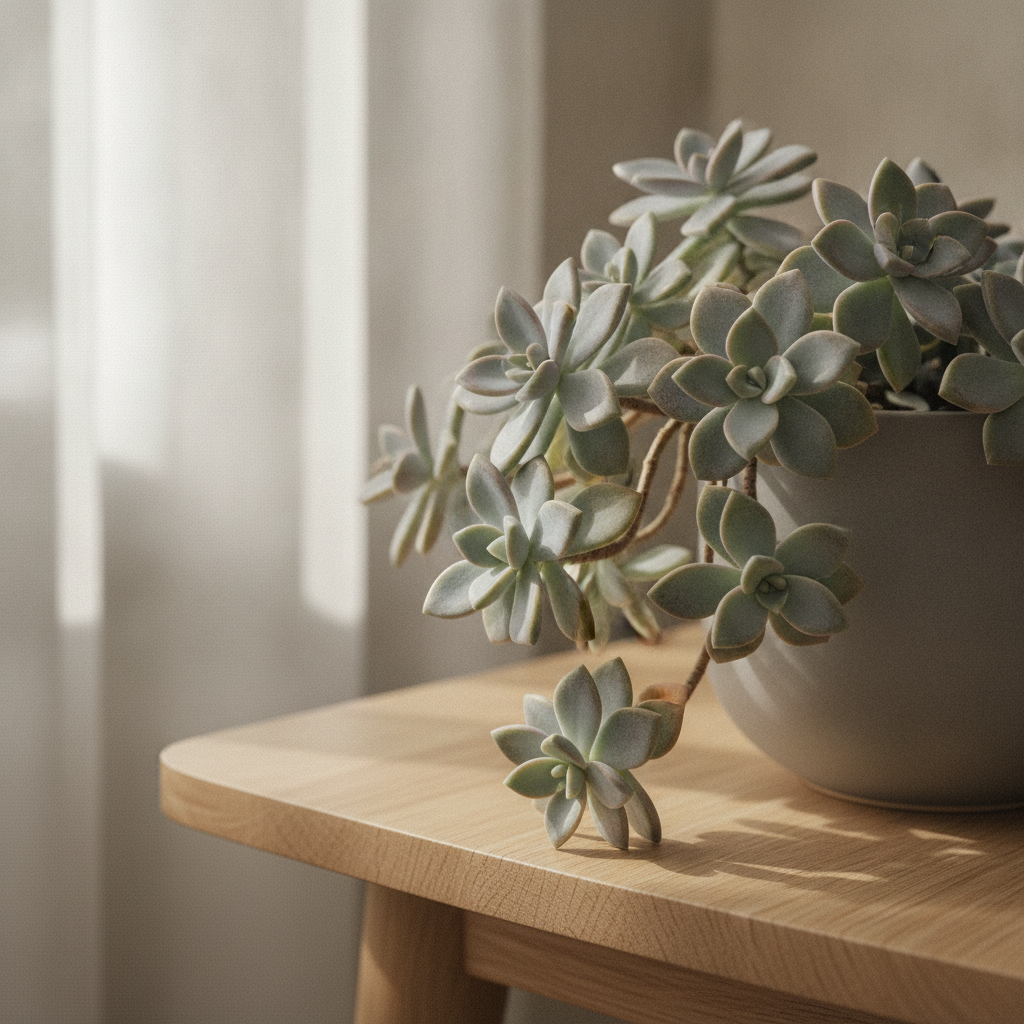
Few succulents look quite as otherworldly as the ghost plant. Its tight rosettes of plump, pointed leaves are sheathed in a chalky, powder-blue bloom that shifts to lavender, pink and pale gold depending on how much sun they drink in, giving the whole plant the faintly luminous, pearly quality that earned it the names ghost plant and mother of pearl. Graptopetalum paraguayense is one of the most forgiving members of the stonecrop family, a sprawling Mexican native that asks for little more than bright light, a gritty pot and the patience to leave it alone between waterings. This guide covers everything you need to keep one not just alive but genuinely thriving, from the soil under its roots to the rosettes you can grow from a single fallen leaf.
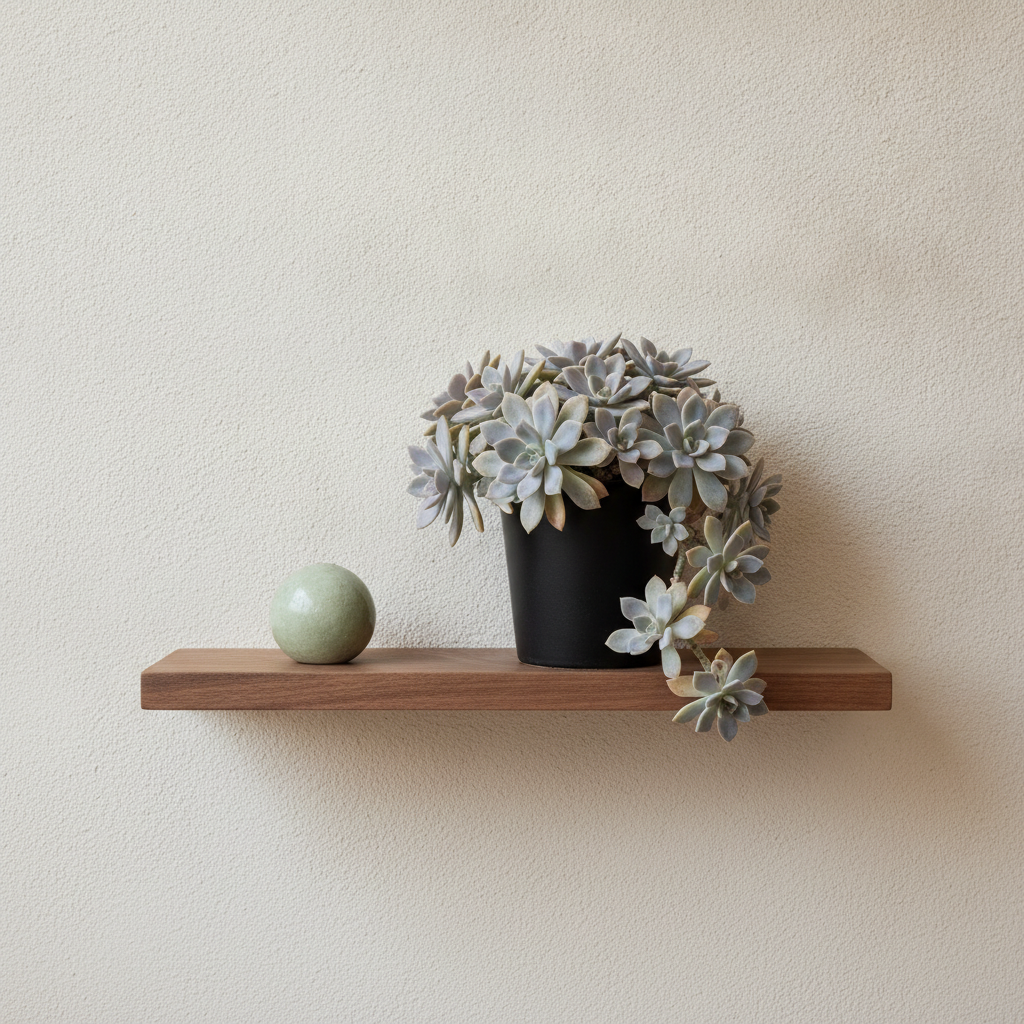
Quick Reference
The table below summarises everything at a glance. The sections that follow explain the reasoning behind each figure, because understanding why a ghost plant wants what it wants is the difference between a plant that merely survives on a windowsill and one that colours up, branches out and cascades over the rim of its pot.
| Common names | Ghost plant, mother of pearl plant, Mexican ghost plant |
| Botanical name | Graptopetalum paraguayense |
| Family | Crassulaceae (the stonecrop family) |
| Native range | Mountains of Tamaulipas, north-eastern Mexico |
| Light | Bright light with several hours of direct sun; full sun outdoors once acclimatised |
| Water | Soak thoroughly, then allow the soil to dry out completely; roughly every 10 to 14 days in growth |
| Soil | Gritty, fast-draining cactus and succulent mix |
| Temperature | 18 to 27 °C (64 to 81 °F) ideal; hardy to around -6 °C (21 °F) briefly |
| Humidity | Low to average; dislikes damp, stagnant air |
| Fertiliser | Dilute, low-nitrogen feed two or three times across spring and summer |
| Mature size | Rosettes 7 to 15 cm (3 to 6 in) across on trailing stems up to 30 cm (12 in) long |
| Toxicity | Generally regarded as non-toxic to cats and dogs |
| Difficulty | Very easy; one of the best succulents for beginners |
Why the Ghost Plant Makes Such a Good Houseplant
The ghost plant arrived in cultivation with a misleading passport. Its species name, paraguayense, suggests a Paraguayan origin, but the plant is firmly Mexican, native to the limestone cliffs of Tamaulipas where it grows in baking sun, sharp drainage and long dry spells. That mountain upbringing explains almost everything about how it behaves on a windowsill. A plant that evolved to store water in its leaves and weather months of drought is, almost by definition, a plant that tolerates the forgetful owner far better than the doting one.
What sets it apart from the many other rosette succulents on the market is its sheer resilience combined with its looks. The leaves carry a coating of natural wax called farina, or pruinose bloom, which scatters light and gives the plant its ghostly, frosted finish. In strong light the rosettes flush with pink and apricot tones; in shade they stay a cooler blue-grey and stretch out. Either way the stems lengthen and trail as the plant matures, making it equally at home in a shallow dish, a rockery or a hanging pot where the rosettes can spill over the side like a string of pale jewels.
It is also one of the most generous plants you can own. Ghost plant leaves are only loosely attached, and any that fall, whether knocked off by a passing sleeve or shed naturally, will happily root where they land and grow into new plants. A single mature rosette can populate an entire tray of pots within a year. For a beginner nervous about killing things, that combination of toughness and easy multiplication makes the difference between surviving with a plant and genuinely enjoying it.
Pro Tip — Handle by the stem: The pruinose bloom that gives the ghost plant its colour does not grow back once rubbed away, and the leaves detach at the lightest touch. Move the plant by gripping the pot or the woody base of a stem rather than the rosette, and site it somewhere it will not be brushed against in passing.
Light
Light is the single biggest lever you have over how a ghost plant looks. To survive, it needs only moderately bright light. To thrive, with compact rosettes, short internodes and that prized pink-and-pearl colouring, it wants a great deal more, ideally several hours of direct sun every day. The brightest windowsill in the home is rarely too bright for this plant.
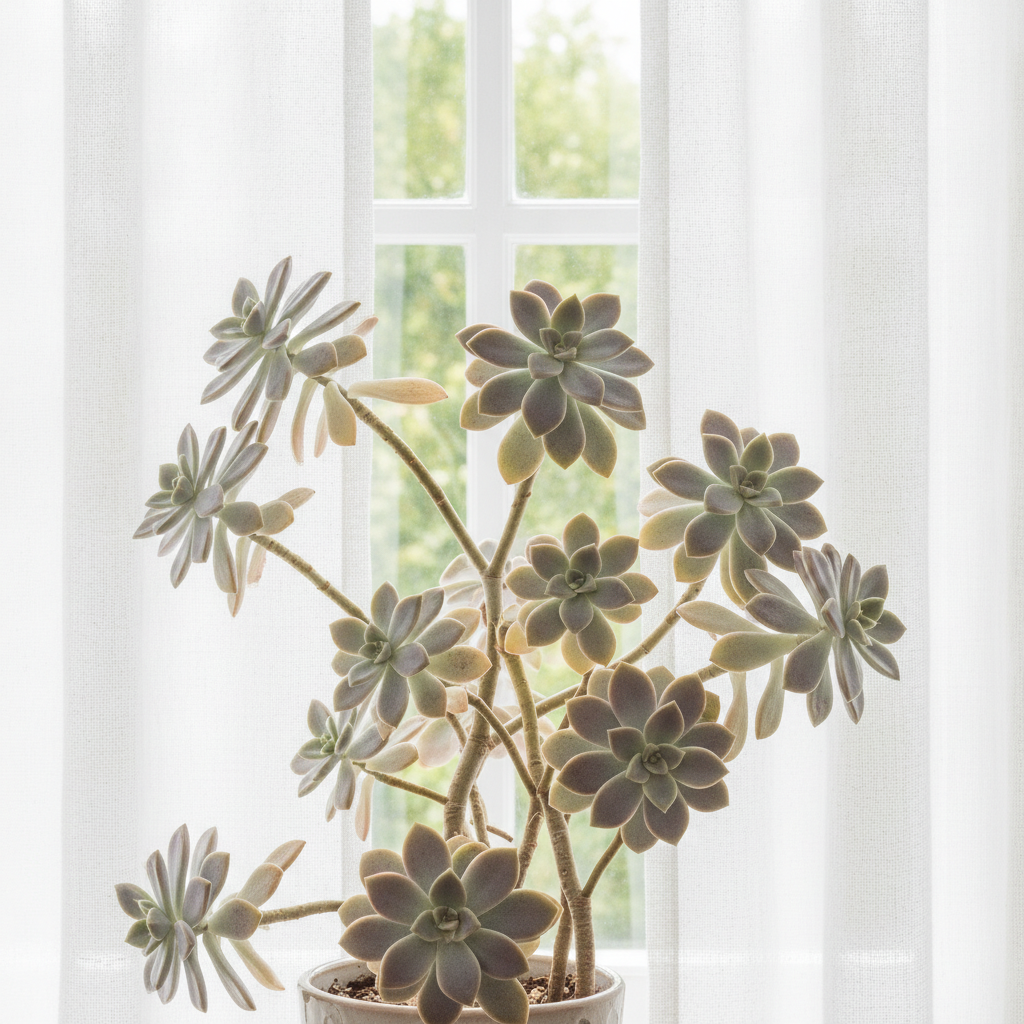
Indoors, a south or west-facing window is the natural home for a ghost plant in the northern hemisphere, with the position reversed in the southern hemisphere. An east window will keep it alive and reasonably happy, but a north-facing aspect almost never provides enough intensity, and you will see the plant pay for it. The classic symptom of insufficient light is etiolation: the rosette stretches, the gaps between leaves widen, the colour fades to a flat green-grey, and the once-tight rosette opens out into a loose, leggy spiral that reaches towards the glass. Etiolation cannot be reversed on a stem that has already stretched, so it is far better to prevent it by giving good light from the start.
Outdoors the ghost plant will take full sun in all but the most scorching climates, though the transition matters. A plant moved abruptly from a dim indoor spot into blazing midday sun can scorch, leaving permanent tan or brown patches on the leaves. Acclimatise it over a week or two, increasing exposure gradually, and it will reward you with the deepest colours it is capable of. If you grow under artificial light, a full-spectrum LED running for twelve to fourteen hours a day sits close enough to keep rosettes tight, though it rarely produces the same intensity of pink as real sun.
Pro Tip — Read the rosette: A ghost plant tells you about its light at a glance. Tight, blushed rosettes mean the light is right. Stretched, pale, wide-spaced leaves mean it wants more. Brown, dry, sunken patches mean it has had too much too fast and needs gentler acclimatisation.
Watering
If light is what makes a ghost plant beautiful, watering is what most often kills it. Almost every ghost plant lost in cultivation is lost to too much water rather than too little, because the fleshy leaves and stems that make the plant so drought-proof also make it acutely vulnerable to rot when kept wet. The guiding principle is simple: soak and dry. Water the plant thoroughly, let every drop drain away, and then do not water again until the soil is bone dry throughout the pot.
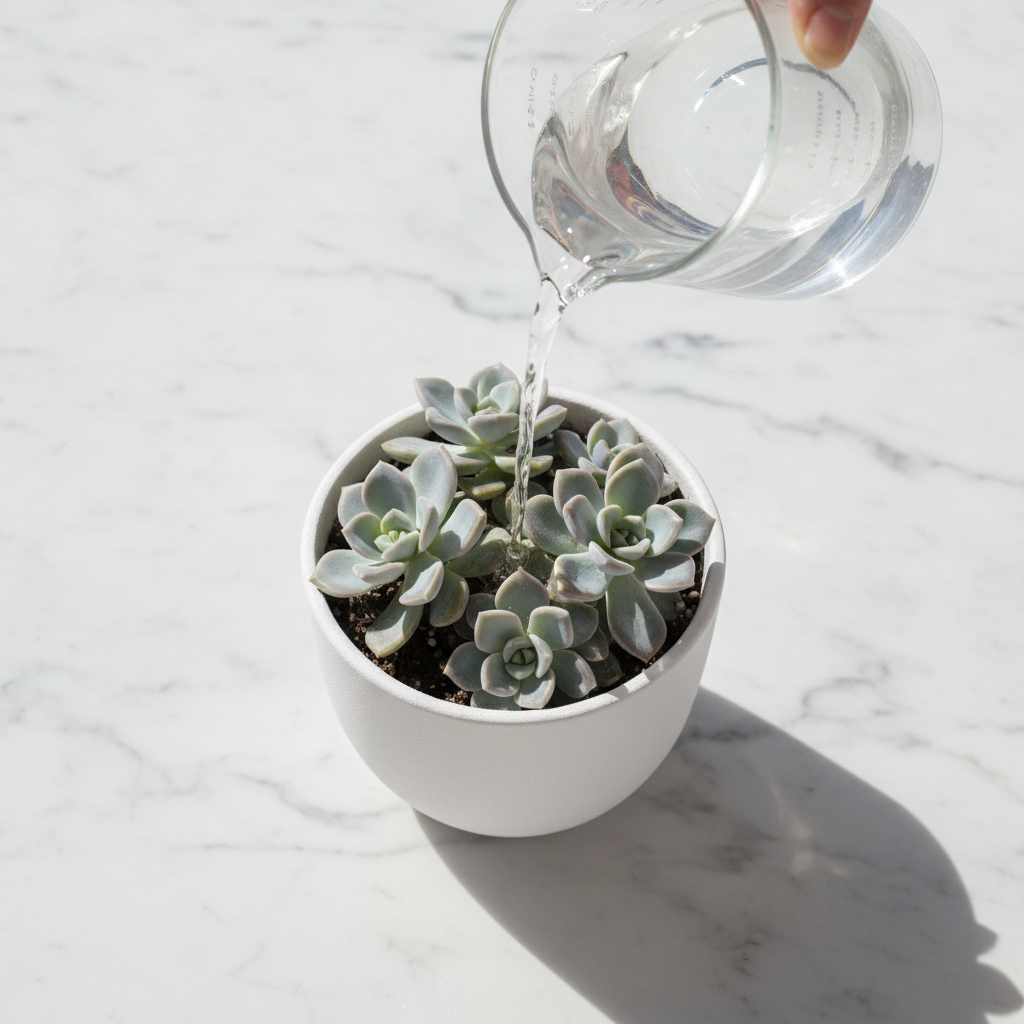
When you do water, water properly. Apply it to the soil rather than over the rosettes, since water trapped between the leaves can sit there and cause rot, and run it through until it pours from the drainage holes. This wets the entire root ball and flushes out any built-up salts. Then empty the saucer; a ghost plant should never sit in standing water. In active growth through spring and summer this rhythm tends to mean watering roughly every ten to fourteen days, but you should always go by the soil rather than the calendar. Push a finger into the mix or lift the pot to feel its weight; a dry pot is noticeably light.
In winter the plant slows down and its water needs fall sharply. Watering once every three or four weeks, or even less, is usually plenty for a plant kept cool and dormant. The leaves themselves are an honest gauge. Plump, firm leaves mean the plant is well hydrated and needs nothing. Leaves that look slightly soft, wrinkled or deflated are telling you it has drawn down its reserves and a good soak is welcome. Translucent, yellowing, mushy leaves, especially at the base of the rosette, are the warning sign of overwatering and the rot that follows, and they call for immediate action: stop watering, and if the stem is soft, behead the healthy top and re-root it.
Warning — When in doubt, wait: A thirsty ghost plant recovers within hours of a good drink. A waterlogged one rots from the roots up and is often beyond saving by the time the damage shows. If you are ever unsure whether to water, the safe answer is to wait a few more days.
Soil and Potting
Everything about watering a ghost plant successfully depends on the soil draining fast, so the mix is not a detail to skip. The single most common mistake is potting one in standard houseplant compost, which holds far too much moisture around roots that are built for sharp, gritty mountain scree. Even a careful waterer will struggle to keep a ghost plant healthy in dense, peaty soil.
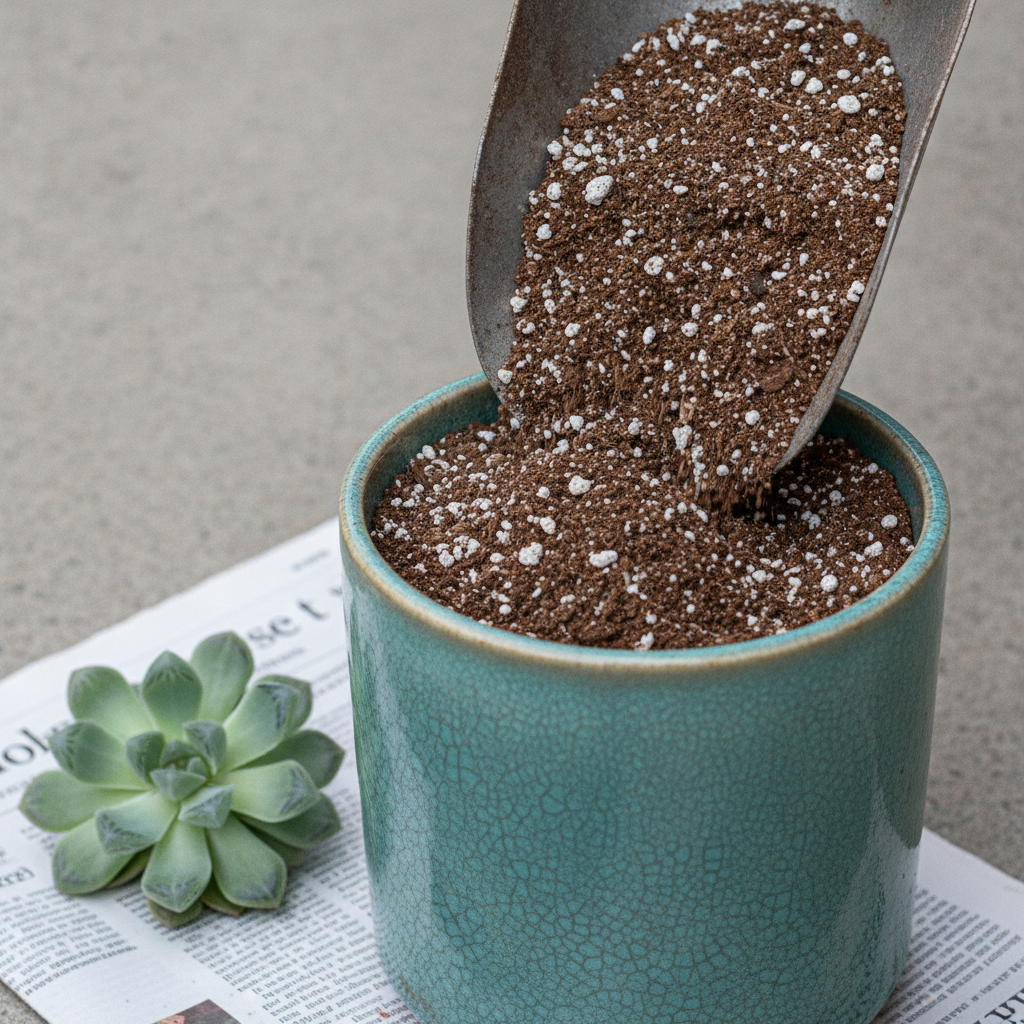
Reach instead for a purpose-made cactus and succulent compost, and improve it further by cutting it with extra grit. A reliable home blend is roughly two parts of a quality succulent mix to one part coarse material such as pumice, perlite, horticultural grit or coarse sand. The aim is a soil that water passes through within seconds rather than one that holds a soggy core long after the surface looks dry. When you pick up a handful and let go, it should crumble apart rather than clump.
The pot matters just as much as what goes in it. A drainage hole is non-negotiable; without one, water collects in the base and the roots sit and rot. Terracotta is the ideal material because it is porous and wicks moisture out of the soil, helping the mix dry quickly, which is exactly what this plant wants. Choose a pot only slightly larger than the root ball, since a ghost plant in an oversized container is surrounded by a large volume of slow-drying soil that works against it. Repotting is only needed every two or three years, best done in spring, and the plant should be dry going in. Wait about a week after repotting before watering, which gives any roots damaged in the move time to callous over rather than rot.
Fertilising
The ghost plant is a light feeder by nature, adapted to the lean, mineral soils of its native cliffs, and it is far happier underfed than overfed. In most homes it will grow perfectly well with very little supplementary feeding at all, and a heavy hand with fertiliser does more harm than good, forcing soft, weak, over-large growth that loses the compact form and bold colour that make the plant attractive.
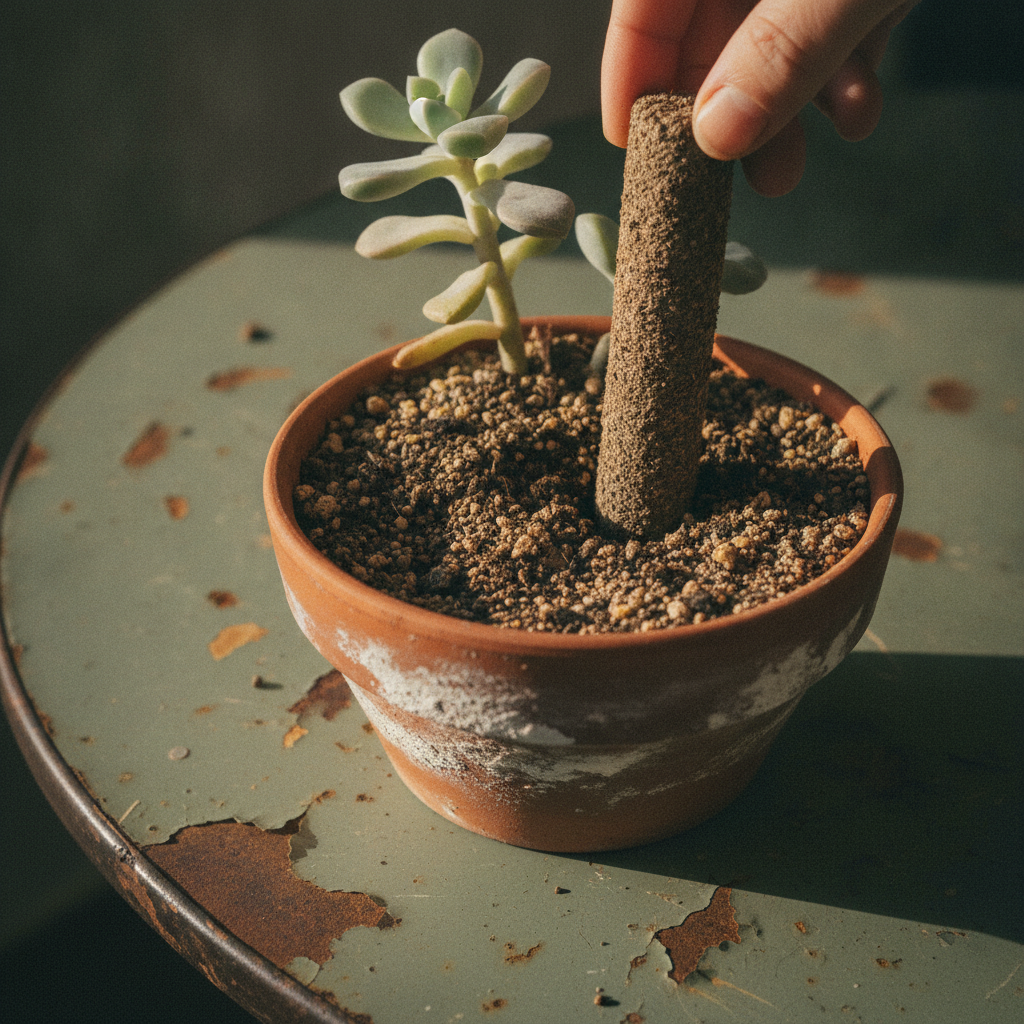
If you choose to feed, do so only during the active growing season of spring and summer, and keep it gentle. A balanced or low-nitrogen fertiliser formulated for cacti and succulents, diluted to half the strength stated on the label, applied two or three times across the whole season is ample. Always feed onto already-moist soil rather than dry roots, since fertiliser salts applied to a dry root ball can scorch it. Never feed a dormant plant in autumn or winter, when it is not growing and cannot use the nutrients, and never feed a sick or recently repotted plant, which needs rest rather than a push.
For most growers the honest answer is that fertiliser is optional. A ghost plant repotted into fresh mix every couple of years receives a slow trickle of nutrients from the new soil and may need no additional feed at all. If you do feed and notice leggy, pale, fast-stretching growth, that is usually a sign of too much feed combined with too little light, and the remedy is to ease off the fertiliser and move the plant somewhere brighter.
Propagation
This is where the ghost plant truly earns its keep, because it is one of the easiest of all plants to multiply. It will propagate readily from individual leaves, from stem cuttings and from the offsets it produces around its base, and the success rate is so high that most growers end up with more plants than they know what to do with. The best time is spring or summer, when warmth and light drive fast rooting, though a ghost plant will often root at almost any time of year.
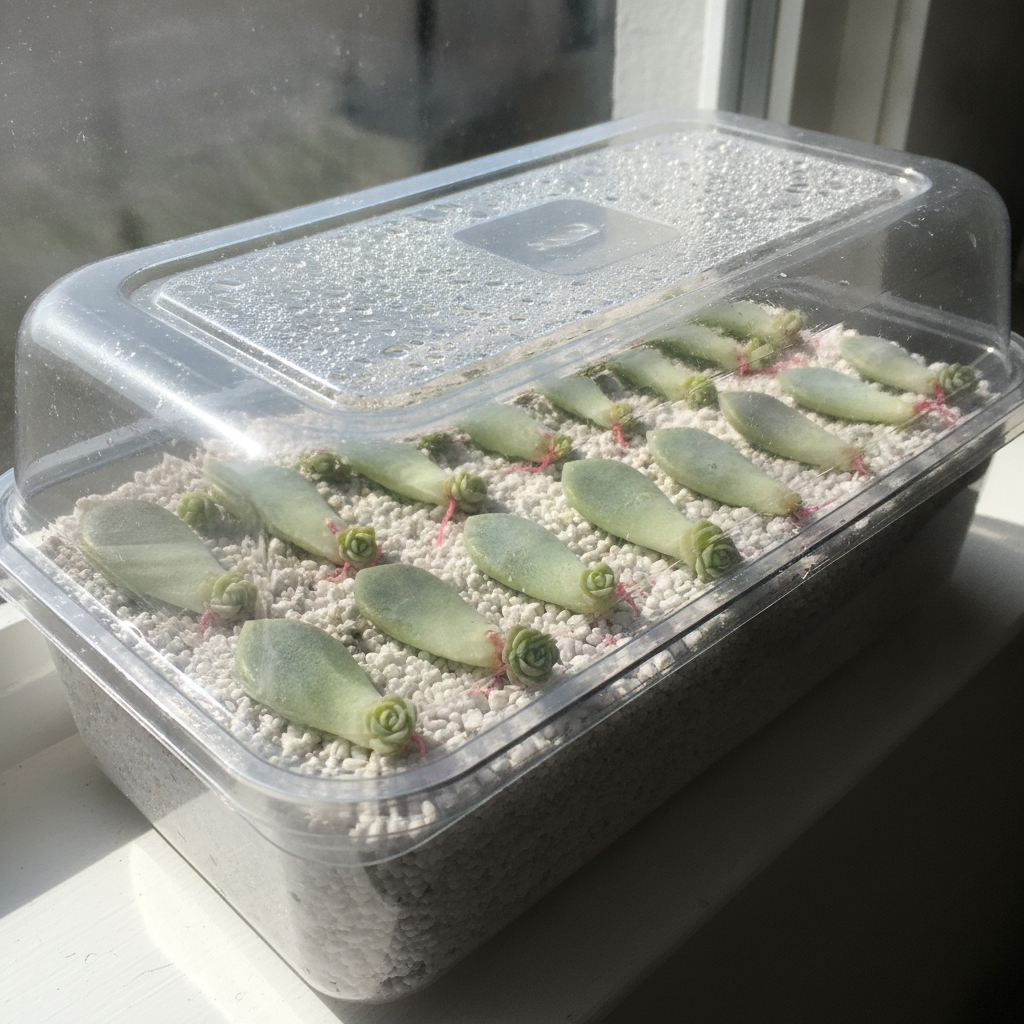
Leaf propagation is the method that delights newcomers. To take a leaf cutting, follow these steps:
- Gently twist a plump, healthy leaf from the stem, taking care to remove the whole leaf cleanly, including its base, since a torn leaf will not root.
- Lay the leaf on a tray of dry, gritty mix or perlite and leave it in a bright, warm spot out of harsh direct sun for two or three days, until the broken end calluses over.
- Once calloused, rest the leaf on top of the mix and mist it lightly every few days, or water the tray sparingly, keeping it barely damp rather than wet.
- Within a few weeks, tiny pink roots and a miniature rosette will emerge from the base of the leaf. The original leaf gradually shrivels as the baby plant draws on its reserves.
- When the new rosette is established and the parent leaf has withered away, pot the young plant up into its own small container of succulent mix.
Stem cuttings are faster if you want a sizeable plant sooner. Cut or snap off a rosette with a short length of stem attached, let the cut end callous for a few days, then push it into gritty mix and treat it like an established plant, watering only sparingly until roots take hold. Offsets, the small rosettes that appear around the base of a mature plant, can simply be detached once they have a few roots of their own and potted up directly. Whichever method you use, the cardinal rule is patience with water: a fresh cutting has no roots to drink, so keeping it on the dry side until it roots is what prevents it rotting before it can establish.
Pests and Problems
A healthy ghost plant grown in good light and a fast-draining pot is remarkably trouble-free, and the great majority of problems it does suffer are cultural rather than the work of pests. Learning to read the plant lets you catch most issues early, while the few insects that bother it are easy to manage if you spot them in time.
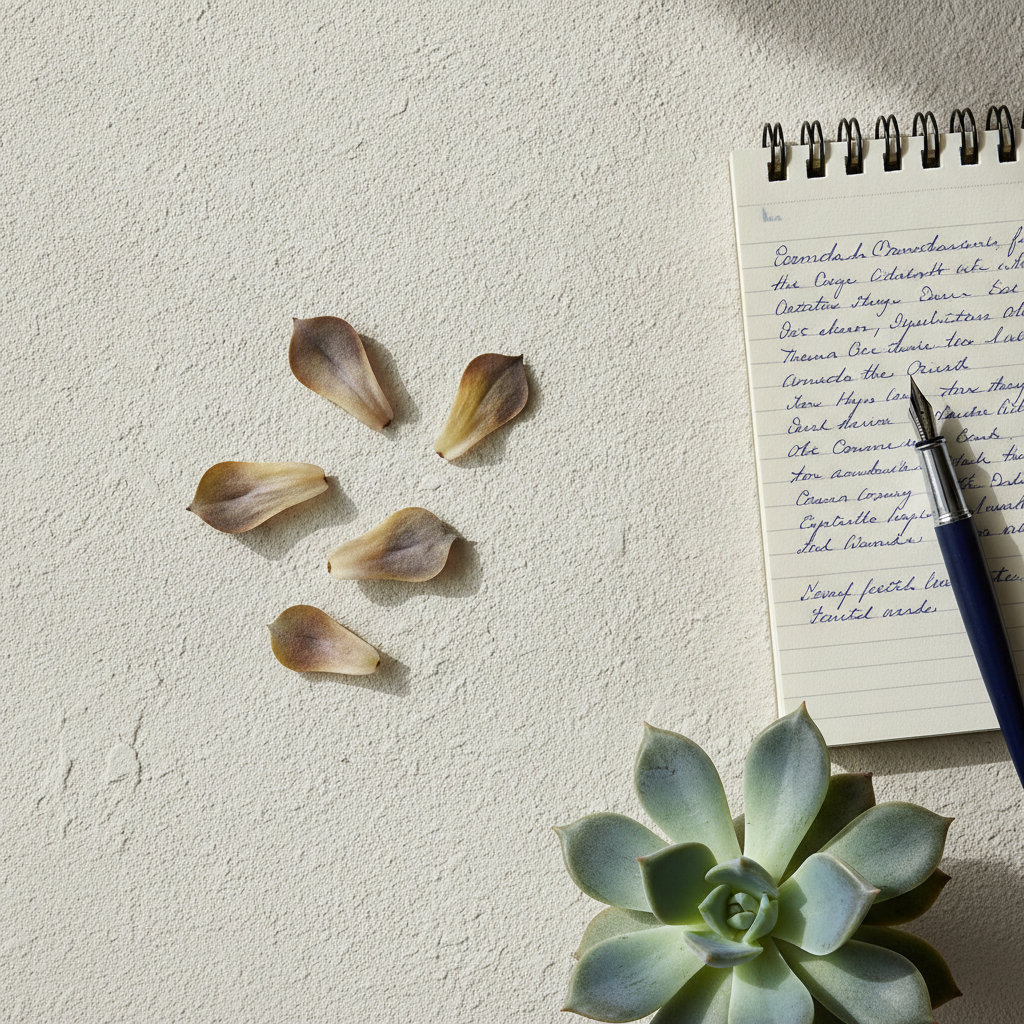
The most serious threat is root and stem rot, and it is almost always a consequence of overwatering or poorly draining soil. Soft, blackening, translucent tissue at the base of a stem is the signal that rot has set in. The only reliable rescue is to cut well above the affected area into clean, firm tissue, let the healthy top callous, and re-root it as a fresh cutting, treating the rotten remainder as a loss. Mushy, yellow, falling lower leaves point the same way and call for the soil to be allowed to dry out fully before any more water is given.
Among insects, mealybugs are the most common nuisance. They appear as small, white, cottony tufts tucked into the crevices between leaves and at the base of the rosette, where they suck sap and weaken the plant. Dab them directly with a cotton bud moistened in isopropyl alcohol, and repeat every few days until they are gone, checking the roots too if an infestation is stubborn, since root mealybugs can lurk below the soil. Aphids may gather on flower stalks in spring and are easily rinsed or wiped off, and vine weevil grubs can occasionally trouble plants grown outdoors by eating the roots. Good airflow, careful watering and the habit of inspecting new arrivals before introducing them to your collection prevent the overwhelming majority of pest problems before they begin.
Warning — Stretching is a light problem, not a pest: A ghost plant that suddenly grows tall, pale and loose has not caught a disease. It is starved of light. Move it to your brightest window, and propagate the stretched rosette tops if you want to restart with a compact plant.
Varieties and Close Relatives
The species itself, sometimes sold simply as mother of pearl, is the plant most people mean by ghost plant, prized for its frosted blue-grey rosettes that blush pink and gold in sun. Because Graptopetalum crosses so freely with its relatives Sedum and Echeveria, however, it has given rise to a family of intergeneric hybrids that share its easy temperament while offering a wider palette of colour. Two of these are especially worth seeking out and are cared for in exactly the same way as the true ghost plant.
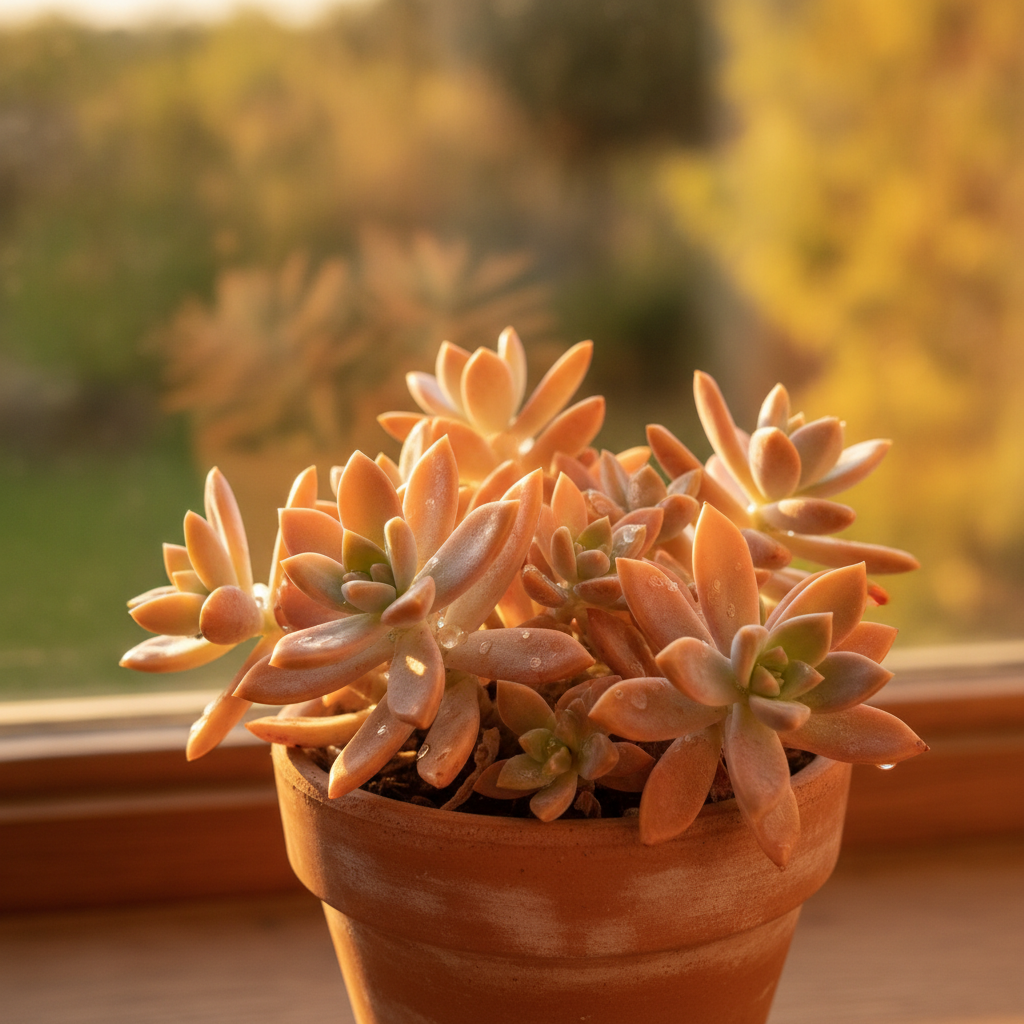
‘California Sunset’ is a Graptosedum hybrid between the ghost plant and a sedum, and it carries the same trailing habit and forgiving nature in warm peach, apricot and coral tones. In strong light the slender, pointed leaves deepen to a glowing sunset orange, fading to a softer yellow-green in shade. It is every bit as easy to propagate from fallen leaves as its parent.
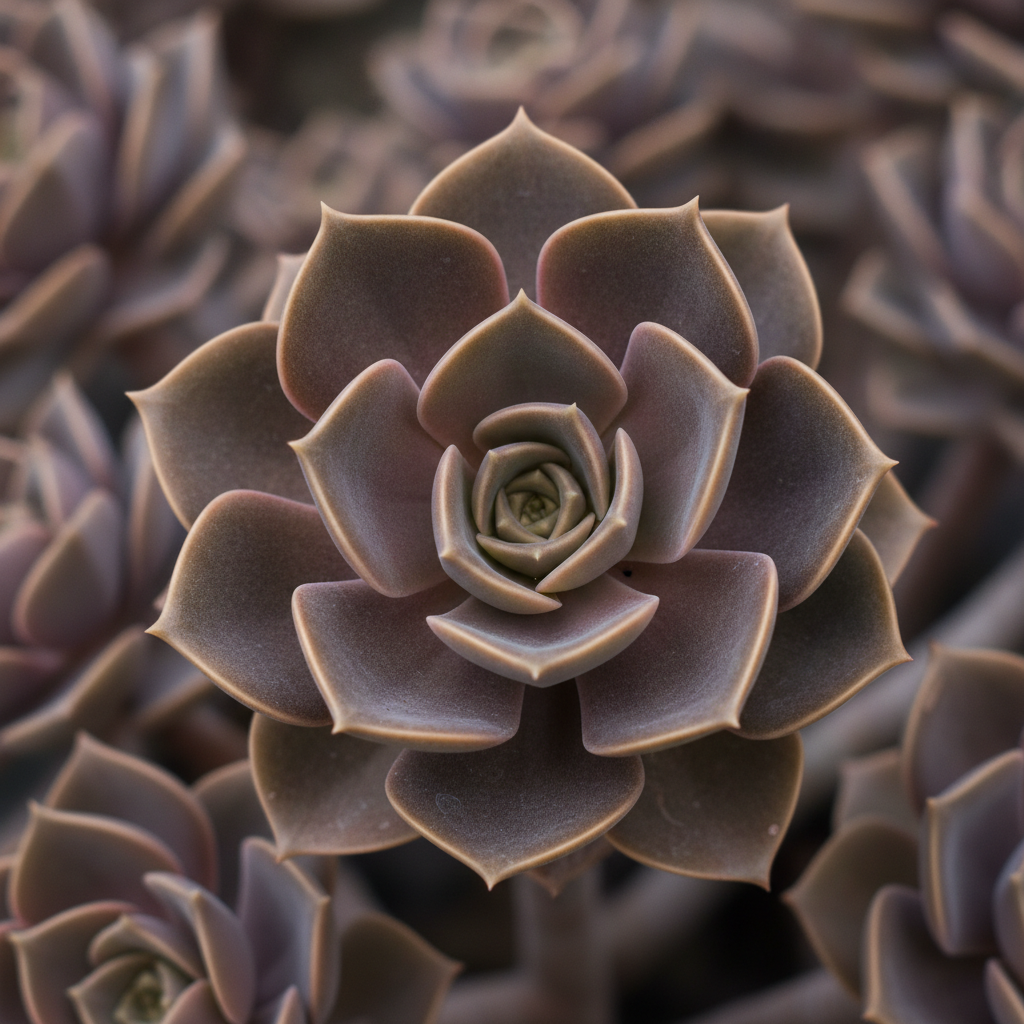
‘Fred Ives’ is a robust Graptoveria, a cross with an echeveria, and forms much larger rosettes than the species, often 20 cm (8 in) or more across. Its broad leaves shift through an unusual range of bronze, dusky purple and pinkish caramel with a silvery sheen, the colours intensifying with sun and cooler nights. It is a striking, sculptural plant that keeps the ghost plant’s effortless care.
Frequently Asked Questions
Why is my ghost plant stretching out and losing its colour?
This is etiolation, and it is caused by too little light. The plant stretches its stem and spaces its leaves further apart as it reaches towards the nearest light source, and the pink and pearl tones fade to a flat green-grey. The stretched growth will not tighten up again, so move the plant to your brightest window or add a grow light, and propagate the rosette tops if you want to restart with a compact, colourful plant.
How often should I water a ghost plant?
Water only when the soil has dried out completely, which in active growth usually works out at roughly every ten to fourteen days, and far less in winter. Rather than following a fixed schedule, check the soil and the leaves: dry, light soil and slightly soft leaves mean it is time, while firm, plump leaves mean it needs nothing yet. When in doubt, wait, because this plant tolerates drought far better than excess water.
Why are the lower leaves turning yellow and mushy?
Translucent, yellow, soft leaves, particularly at the base, are the classic sign of overwatering. Let the soil dry out fully and reduce how often you water. If the stem itself feels soft, rot has begun, and the best rescue is to cut off the healthy top above the damage, let it callous for a few days, and re-root it as a fresh cutting in gritty mix.
What is the white powdery coating on the leaves?
That is farina, a natural waxy bloom the plant produces to reflect strong sunlight and reduce water loss. It is a sign of health, not a problem, and it gives the ghost plant its characteristic frosted, pearly look. It rubs off permanently at a touch and does not grow back on that leaf, so handle the plant by its pot or stem rather than its leaves.
Is the ghost plant safe around pets?
Graptopetalum paraguayense is generally regarded as non-toxic to cats and dogs, which sets it apart from some other succulents in the same family. Even so, no plant is truly meant to be eaten, and a curious pet that chews on the fleshy leaves may suffer mild stomach upset, so it is sensible to keep it out of reach of animals that like to nibble.
Can I grow my ghost plant outdoors?
Yes, and it often colours up best outside in full sun. It is hardy down to around -6 °C (21 °F) for short spells, so in mild, frost-free or near frost-free climates it can live outdoors year round. In colder regions, grow it in a pot that can be brought inside or into a frost-free greenhouse before winter, and acclimatise it gradually whenever you move it between very different light levels to avoid sunburn.






