
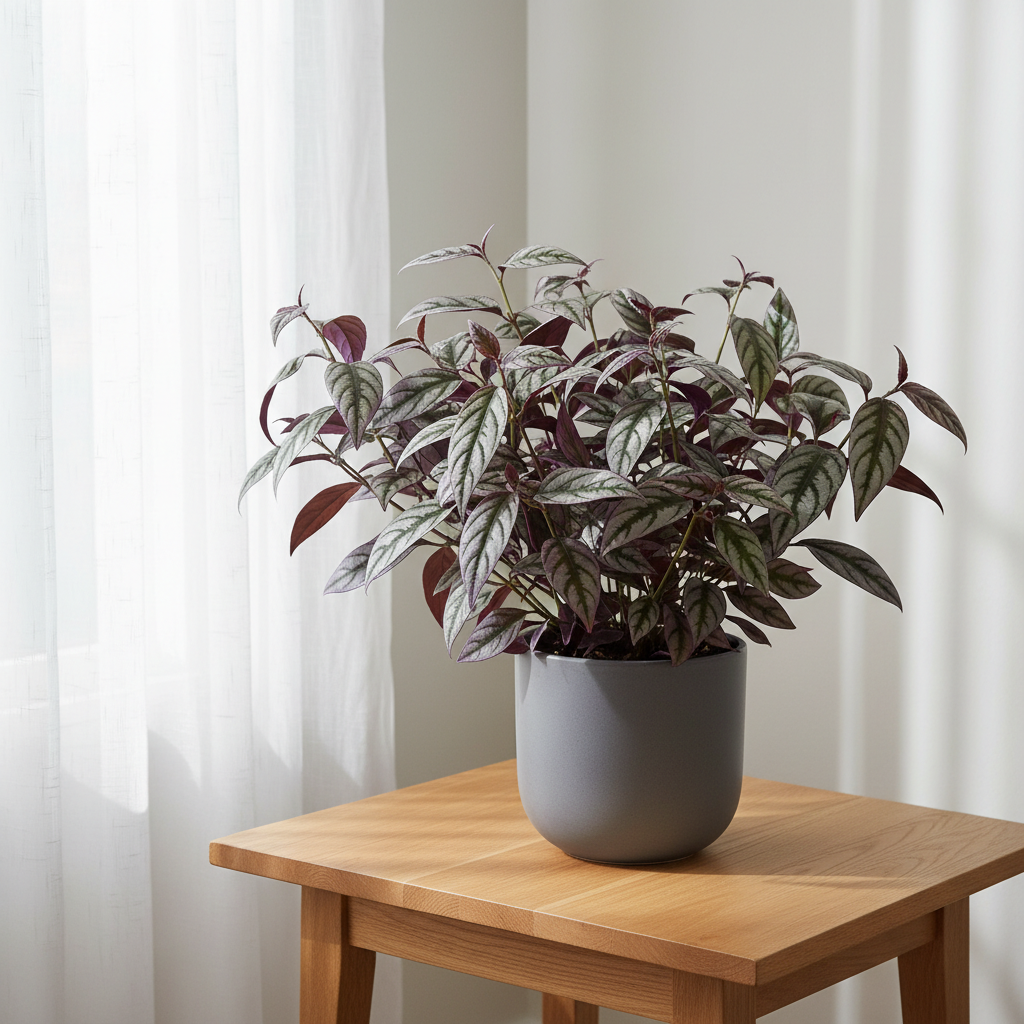
Few houseplants pull a double take quite like Persian shield. The leaves catch the light and turn from a muted plum at one angle to an almost mirror-like silver-purple at another, a trick of structural colour that has earned Strobilanthes dyerianus the nickname “royal purple plant” wherever it is grown. Native to the forest understorey of Myanmar (formerly Burma) and a member of the Acanthaceae family, it was introduced to Victorian glasshouses in the 1890s and has been pulling people closer to a leaf ever since.
Persian shield has a reputation for being either ridiculously easy or quietly disappointing, with surprisingly little middle ground. Surviving is straightforward: give it warmth, water and a window and it will hold on for months. But thriving, in the sense of producing those electric, metallic leaves that drew you to the plant in the first place, takes a few specific habits around humidity, light intensity and regular pinching. This guide walks through everything that matters, from a south-facing windowsill in summer to overwintering a leggy two-year-old plant and starting over from cuttings.
Contents
- Quick Reference
- Why Persian Shield Makes a Striking Houseplant
- Light Requirements
- Watering & Humidity
- Soil, Potting & Repotting
- Fertilising
- Propagation
- Pests & Diseases
- Popular Varieties
- Frequently Asked Questions
Quick Reference: Persian Shield at a Glance
| Light | Bright indirect light, with a few hours of gentle morning or filtered afternoon sun to maintain peak iridescence |
| Watering | Keep the top 2 to 3 cm (about 1 inch) of soil lightly moist; water thoroughly when it begins to dry, never letting the rootball go bone-dry |
| Temperature | 18 to 24 degrees C (65 to 75 degrees F); damaged below 13 degrees C (55 degrees F) |
| Humidity | High, ideally 60 to 80 percent; visibly suffers below 40 percent |
| Fertiliser | Balanced liquid feed at half strength every 2 to 4 weeks during spring and summer; pause in winter |
| Toxicity | Generally considered non-toxic to cats, dogs and humans, though ingestion may cause mild stomach upset; sap can irritate sensitive skin |
Why Persian Shield Makes a Striking Houseplant
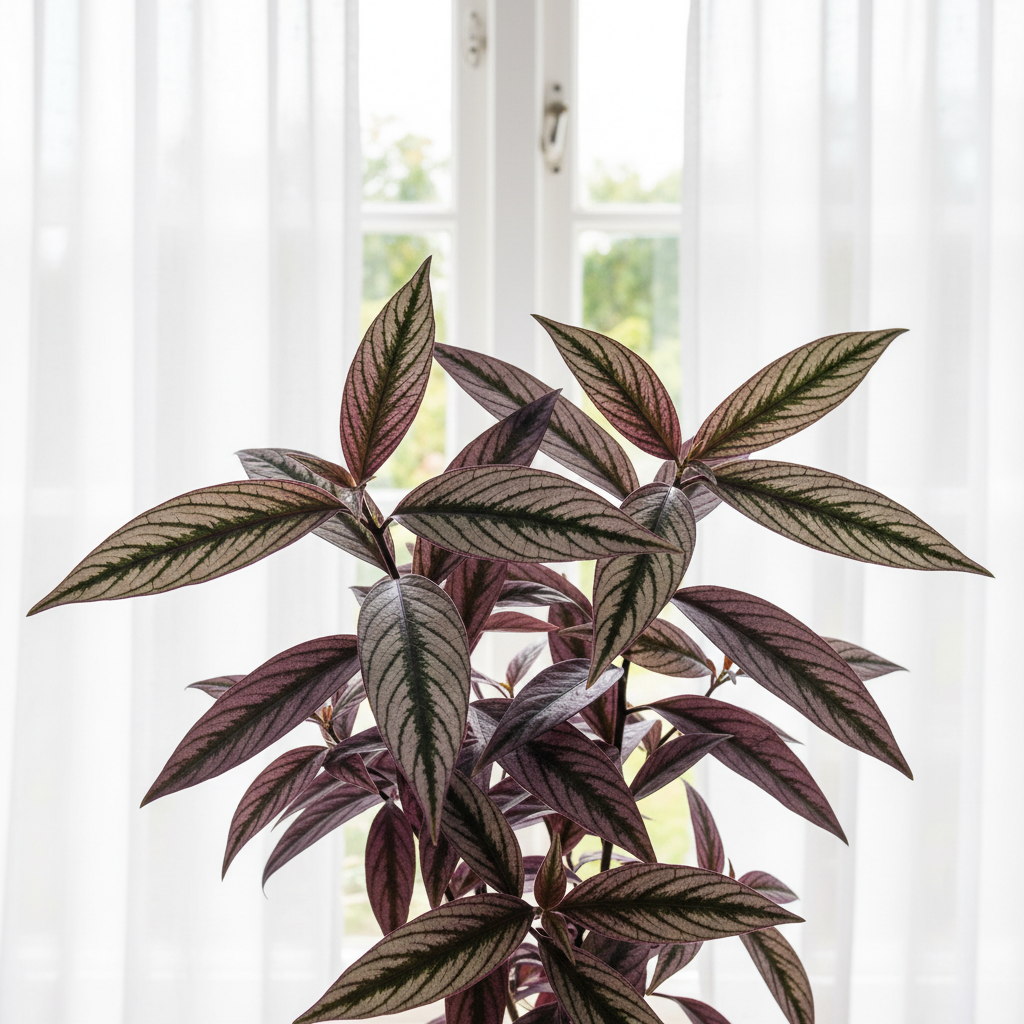
The defining feature of Persian shield is the way light interacts with its leaves rather than the leaves themselves. The upper surface carries a layer of tiny refractive cells over a base of red and green pigments, producing an iridescent metallic finish that shifts between violet, silver and bronze depending on viewing angle. The lance-shaped leaves are about 10 to 18 cm (4 to 7 inches) long, lightly quilted between the deep green to almost black veins, with a rich plum-purple underside that catches the eye whenever a breeze flips them. Few foliage plants offer that much visual interest from a single specimen.
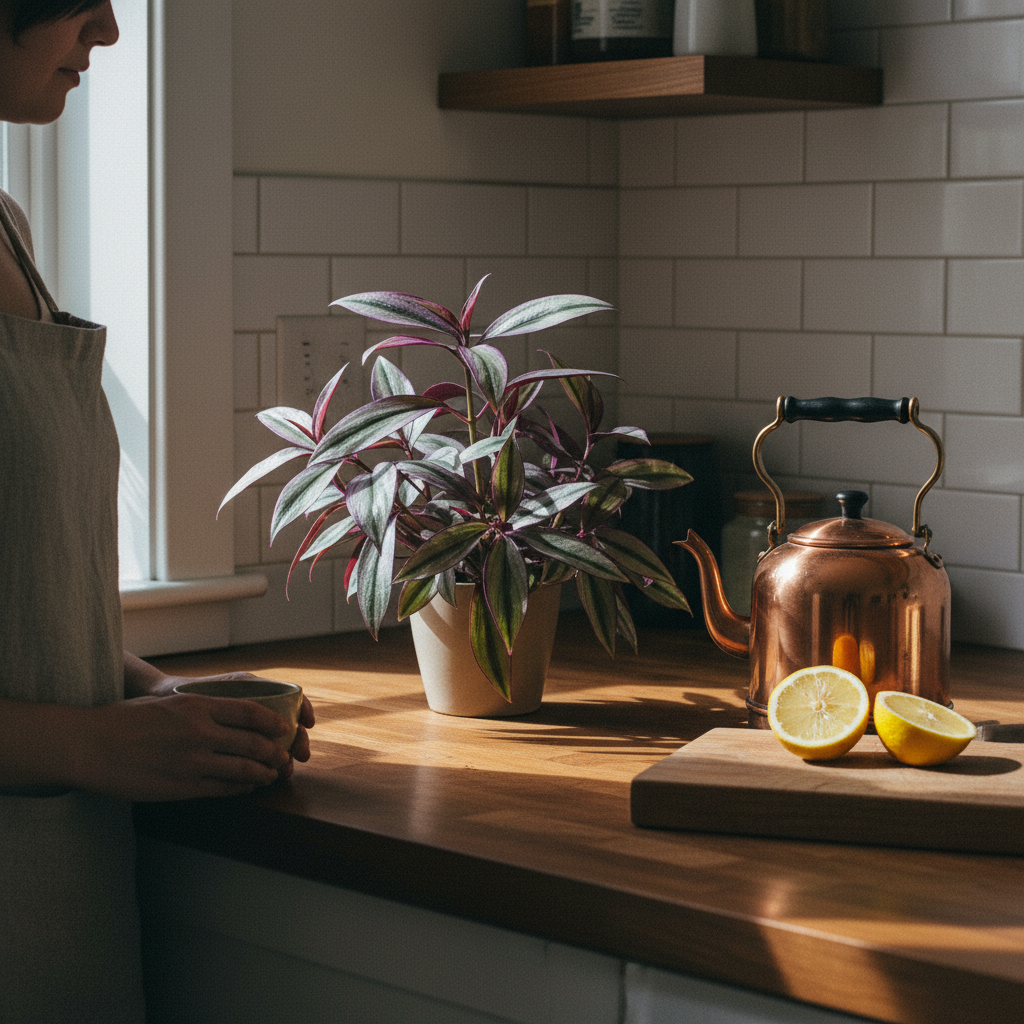
Beyond the obvious aesthetic appeal, Persian shield is a strong choice for plant keepers who like a fast result. It grows rapidly in warm weather, often putting on 30 cm (about 12 inches) in a single growing season, which means a small nursery cutting in spring can be a knee-high statement plant by autumn. It also takes well to pinching and shaping, so the same plant can be kept as a compact rounded bush, allowed to grow tall and shrub-like, or pinched back severely every few months to keep producing new leaves at the top, which are always the most vividly coloured.
Important — Toxicity: Persian shield is generally regarded as non-toxic to cats, dogs and humans, and is not listed on the ASPCA toxic plant register. That said, ingesting any quantity of leaf material may cause mild stomach upset in pets, and the sap can be a mild irritant on sensitive skin, so it is sensible to wear gloves when taking cuttings or pruning a mature plant.
Light Requirements
Light is the single most important factor in keeping Persian shield looking like Persian shield rather than a tired green plant in a purple-tinted pot. In its native Myanmar forests it grows in the dappled understorey, receiving filtered light through a high canopy rather than full tropical sun, and the leaf iridescence is a real-world adaptation to extracting more usable light from those conditions. Recreate that filtered brightness indoors and the metallic colour stays vibrant; deviate too far in either direction and the colour fades within weeks.
The sweet spot is bright indirect light with a couple of hours of soft direct sun, ideally morning or late-afternoon rays rather than the harsh overhead sun of midday. Light intensity in this range tracks roughly to 10,000 to 20,000 lux, which is much brighter than most homes feel to the human eye. A spot directly beside an east-facing window, or one or two metres back from a south or west window with a sheer curtain, will usually deliver that range comfortably year-round.
Light Levels Explained
Persian shield sits firmly in the bright indirect category but tolerates a wider range than you might expect. The table below maps the common indoor light tiers onto the specific outcomes you can expect over a few months at each level, which is useful when scouting a new spot in the home or judging whether an existing position is pulling its weight.
| Light Category | Approx. Level | Typical Location | Outcome |
|---|---|---|---|
| Direct sun | over 30,000 lux | On an unobstructed south or west windowsill at midday | Leaves bleach to pale lavender, edges scorch, iridescence flattens within weeks |
| Bright direct (gentle) | 15,000 to 25,000 lux | East window in the morning, or behind a sheer curtain on a south window | Optimal: deep saturation, full metallic shimmer, compact growth |
| Bright indirect | 10,000 to 15,000 lux | One to two metres from a south or west window, or right beside a north window in summer | Good colour, slightly looser growth, slower stem development |
| Medium | 5,000 to 10,000 lux | Several metres into a room with one large window | Stems lengthen, leaf spacing widens, colour shifts toward dull green-purple |
| Low | under 5,000 lux | Interior hallway, north-facing corner | Leggy growth, leaves revert to mostly green, iridescence largely lost |
Window Orientation and Placement
South-facing window: Excellent in autumn and winter when the sun is low and weak. In summer the plant should be set back a metre or two, or screened by a sheer curtain, to avoid bleaching the upper leaves. A south window with a sheer panel is arguably the single best year-round position in most temperate homes.
East-facing window: A reliable default. Morning sun is gentle enough to sit directly on the leaves without scorch, and the rest of the day provides bright indirect light. Plants placed within 30 cm (about 1 foot) of an east window typically hold their colour beautifully.
West-facing window: Works well, but the harsh late-afternoon rays of summer can be too intense if the plant is right against the glass. Setting it back 60 to 90 cm (2 to 3 feet), or using a sheer curtain, brings west exposure into the ideal range.
North-facing window: Survivable in spring and summer, marginal in winter. Expect dimmer colour and longer internodes, and consider supplementing with a grow light from October through March in northern latitudes.
Pro Tip — Read the New Growth: The newest pair of leaves at the tip of each stem tells you everything about whether the current light is working. If they emerge with deep purple iridescence and stay that way as they expand, the spot is right. If they come in green and only tint up slightly over time, the plant needs more light.
How Light Affects Leaf Colour and Iridescence
Persian shield’s metallic colour is the result of a thin layer of refractive cells sitting above the pigmented leaf tissue, and the plant invests in those cells when light is plentiful and dependable. In strong, even light the cells form a uniform layer that produces the characteristic mirror-like shimmer. In dim light the plant prioritises chlorophyll production over those refractive cells, and the leaves come in greener with only a faint purple flush. In overly harsh direct sun the upper cell layer is damaged and the leaves bleach pale, losing depth even though they still look “purple” from a distance.
Warning — Direct Sunlight: Persian shield will scorch in unfiltered midday sun, particularly in summer or after being moved suddenly from a dimmer spot. Acclimatise gradually by exposing the plant to slightly brighter conditions over 7 to 10 days, and avoid placing it on a south or west sill behind clear glass between 11 a.m. and 3 p.m. in the warmest months.
Artificial Lighting
Persian shield responds well to supplemental lighting, which makes it a strong candidate for offices, basements or any dark winter room. A standard full-spectrum LED grow light positioned 30 to 45 cm (12 to 18 inches) above the canopy, running 12 to 14 hours a day, will keep the colour saturated even with no natural light at all. Aim for a photosynthetic photon flux density (PPFD) of around 150 to 250 micromoles per square metre per second at the leaf surface. Cheap clip-on grow lights are usually enough; you do not need professional horticultural fixtures.
Seasonal Adjustments
As light intensity drops through autumn in temperate climates, Persian shield benefits from being moved closer to the window or rotated to the brightest exposure available. A plant happily sitting one metre back from a south window in July may need to be right against the glass by November to keep producing fully coloured leaves. Reverse the move in March or April as the sun strengthens, and add the sheer curtain again from May onwards. Rotate the pot a quarter turn every week or two so all sides receive equal light, otherwise the plant leans noticeably toward the brighter side within a month.
Watering & Humidity
Persian shield comes from a warm, humid forest floor where the soil is steadily moist but never waterlogged, and that is the easiest way to picture its watering needs. Unlike succulents or many aroids, it does not want to dry out between waterings, and even a short period of true drought will cause dramatic wilting that takes the plant a week to recover from. On the other hand it is also susceptible to root rot if left sitting in standing water, so the goal is consistent light moisture rather than alternating drought and flood.
When to Water
Check the top 2 to 3 cm (about 1 inch) of soil every two or three days during the growing season. When it feels just barely dry to the touch, water the plant thoroughly. In practice this usually works out to watering once every 4 to 6 days in summer, dropping to once every 8 to 12 days in winter when growth slows and light is dimmer. Watering by a fixed schedule rarely works, because pot size, light, temperature and humidity all change the rate at which the soil dries. A wooden chopstick or moisture meter pushed an inch into the rootball gives a more reliable reading than the surface alone.
Persian shield is one of the few foliage houseplants that will visibly wilt within hours of becoming truly dry, with leaves drooping flat against the stem like a closed umbrella. This is a useful early warning but a stressful experience for the plant, and repeated wilting episodes will cause leaf drop and stem dieback over time. If the leaves wilt, water immediately and let the pot rehydrate fully; the plant will usually perk back up within an hour or two, but a leaf or two at the base may yellow and fall in the following days.
Pro Tip — Lift the Pot: The single most reliable way to gauge whether Persian shield needs water is to lift the pot. A freshly watered plant in a 15 cm (6 inch) pot feels distinctly heavy; the same pot when the soil is approaching dryness feels noticeably lighter. After two or three weeks of doing this you will know the feel of “time to water” without thinking about it.
How to Water Correctly
- Take the plant to a sink or use a saucer underneath, since you want to water until liquid runs from the drainage holes.
- Pour room-temperature water slowly around the base of the stems, working your way around the pot so the entire rootball is wet rather than just one side.
- Continue until water flows freely from the drainage holes for a few seconds; this ensures the deeper roots are hydrated and flushes any accumulated salts.
- Let the pot drain for 10 to 15 minutes, then tip out any water that has collected in the saucer or cachepot.
- Return the plant to its spot, and avoid watering again until the top 2 to 3 cm (1 inch) of soil dries.
- If you forget for a few days and the leaves are clearly drooping, water immediately, but use lukewarm water rather than cold, which is less of a shock to dehydrated roots.
Signs of Overwatering vs. Underwatering
| Symptom | Overwatering | Underwatering |
|---|---|---|
| Leaf colour | Lower leaves yellow uniformly, sometimes with brown blotches | Leaves dull, then crisp brown at edges and tips |
| Leaf texture | Soft, slightly translucent, may smell musty when crushed | Papery, brittle, often curling inward along the midrib |
| Soil | Stays wet for more than a week, gnats appear, may develop a sour smell | Pulls away from the pot edges, hard to rewet, dust-dry at depth |
| Roots | Brown, soft, mushy, easy to slide off between fingers | Pale, dry, brittle but mostly intact, especially the larger anchor roots |
| Stem base | Discoloured dark patches, sometimes blackening at soil line | Thin and woody, occasionally cracking near the soil line |
Warning — Root Rot: Persian shield rots quickly in waterlogged soil, especially when temperatures are cool. If you suspect rot, unpot the plant immediately, trim away any soft brown roots with sterilised scissors, dust the cuts with cinnamon or a fungicide, and repot into fresh, only-slightly-moist soil. Withhold further water for a week to let damaged roots heal, then resume normal watering.
Humidity Requirements
If light is the first variable to get right with Persian shield, humidity is the close second. The plant evolved in monsoon-climate forests where ambient humidity routinely sits above 70 percent for months at a time, and indoor air below about 40 percent humidity will show on the leaves as crispy brown edges, leaf curl and an accelerated lower-leaf drop. Most modern centrally-heated homes run well below 40 percent through winter, which is why a healthy Persian shield in October often looks miserable by February without intervention.
The first symptoms of low humidity are subtle: a slight thinning of the leaves, edges that feel papery rather than supple, and a loss of the high-gloss iridescence even when light is good. These are easy to miss until they progress to obvious browning, by which point the plant has been stressed for weeks. A digital hygrometer beside the plant is the cheapest piece of equipment you can buy, and it will quickly show whether your home is in the comfortable range or not.
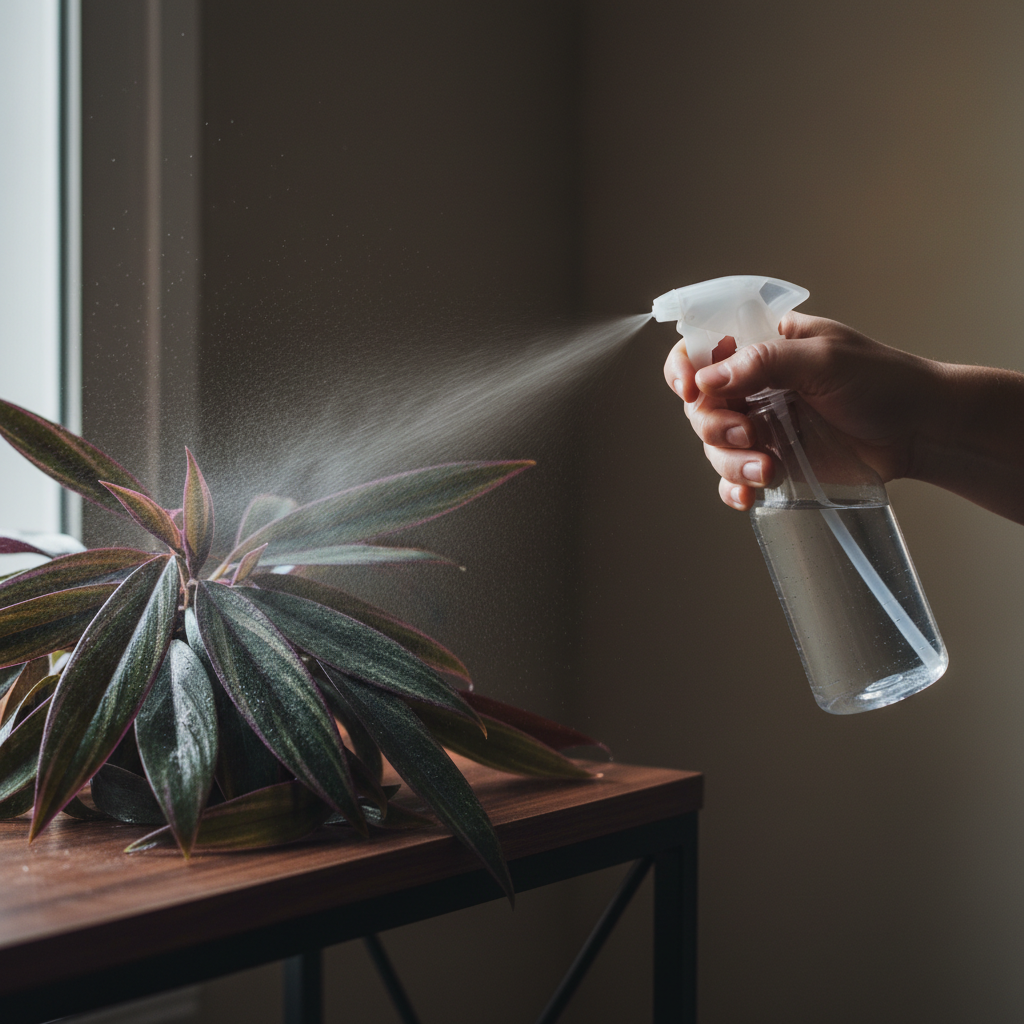
Raising humidity around Persian shield can be done in several ways. The most effective is a small ultrasonic humidifier set to run for a few hours a day in the same room, which will lift ambient humidity by 10 to 20 percentage points without any fuss. A pebble tray under the pot (a shallow dish of stones with water filling the gaps) provides a modest localised boost, especially useful in summer. Grouping Persian shield with other tropical plants raises humidity in their immediate microclimate as they transpire together. Misting helps in the short term but evaporates within an hour, so it is best treated as a supplement rather than a solution.
Water Quality
Persian shield is moderately tolerant of tap water in most regions, but it does react to extremes. Heavily chlorinated or fluoridated supplies can produce brown leaf tips over time, and very hard water leaves a faint white crust on the soil surface that the plant does not appreciate. If your tap water is on the harsh end, leaving filled watering cans uncovered overnight allows chlorine to dissipate, and using rainwater, filtered water or melted defrost water from the freezer a couple of times a month gives the plant a break from accumulated minerals. Water temperature also matters: very cold water straight from the tap can shock the roots, so let it sit until it reaches room temperature before pouring.
Soil, Potting & Repotting
Persian shield wants a soil mix that holds moisture without becoming soggy, and that contains enough organic matter to feed its fast spring growth. Pure standard potting compost is too dense on its own and tends to compact within a few months, leading to soggy patches at the bottom of the pot and dry patches at the top. The right mix drains freely when watered but still feels moist 24 hours later, and that balance comes down to combining a rich base with chunky aerating components.
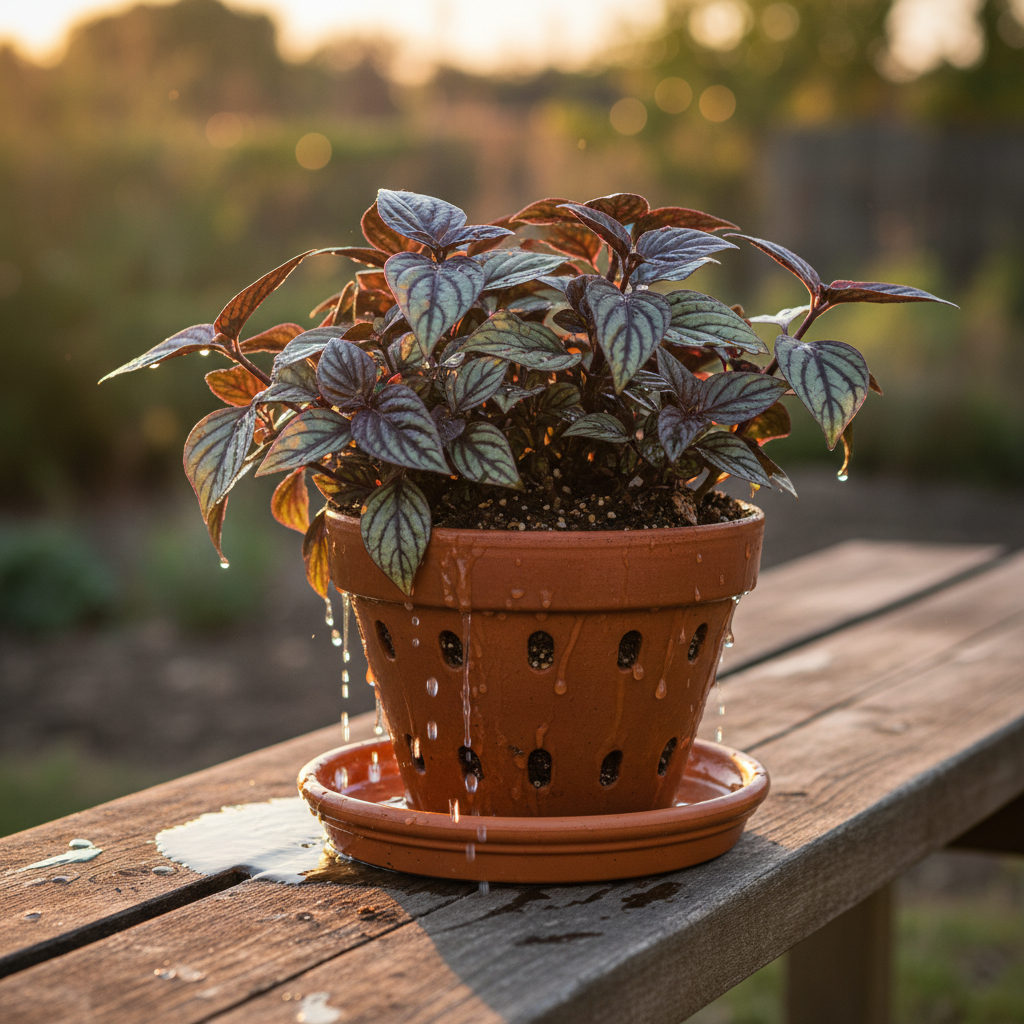
Ideal Soil Composition
A good Persian shield mix is built around 60 to 70 percent organic base material, with the rest made up of components that open the structure and improve drainage. The base supplies moisture retention and nutrients, while the chunky additions keep oxygen moving through the rootzone, which is essential for healthy root growth and rot prevention. The table below sets out a mix that works reliably across most climates and pot sizes.
| Component | Proportion | Function |
|---|---|---|
| Quality peat-free houseplant compost or coir-based mix | 60 percent | Holds moisture and supplies the bulk of nutrients |
| Perlite or pumice | 20 percent | Opens the structure, prevents compaction, improves drainage |
| Fine orchid bark or composted bark fines | 15 percent | Maintains long-term aeration as finer particles break down |
| Worm castings or well-rotted leafmould | 5 percent | Slow-release nitrogen and beneficial microbes for fast spring growth |
Aim for a slightly acidic to neutral pH between 5.5 and 7.0; Persian shield is not fussy within that range but will struggle in very alkaline soil, where iron uptake suffers and the new leaves come in pale and yellowing. Most peat-free and coir-based composts sit naturally in the right range, so unless you are mixing from raw ingredients you usually do not need to test or adjust.
Pro Tip — Quick Mix Recipe: If you keep a stash of aroid mix or premium houseplant mix on hand, blend three parts of that with one part standard peat-free compost for Persian shield. The aroid mix supplies the aeration, and the extra compost supplies the moisture retention this plant prefers over a typical Monstera or Philodendron.
Choosing the Right Pot
Persian shield grows quickly, so plan for slightly larger pot sizes than you would with a slower-growing tropical of similar height. A 12 to 15 cm (5 to 6 inch) pot suits a small starter plant, stepping up to 18 to 25 cm (7 to 10 inch) for a mature specimen. The plant has a moderately deep, branching root system rather than a flat surface mat, so deeper pots work better than shallow ones; avoid wide bonsai-style trays.
Drainage holes are non-negotiable. Any decorative pot without holes must be used as a cachepot only, with the plant in a plain nursery pot inside it that you can lift out for watering. Persian shield will not tolerate sitting in a centimetre of standing water at the bottom of a sealed pot, and will rot within a few weeks of that situation.
Pot material: Plastic, glazed ceramic and terracotta all work well, with different practical tradeoffs. Plastic and glazed ceramic retain moisture longer, which suits Persian shield’s preference for consistent moisture and reduces watering frequency. Terracotta is porous and dries faster, which gives some extra security against overwatering but requires more frequent attention in summer; it is a sensible choice in cooler or wetter climates where overwatering is the bigger risk.
Pot size: Go up one size at a time, typically 2 to 3 cm (about 1 inch) larger in diameter than the previous pot. Oversized pots hold large reservoirs of unused wet soil around the rootball, which slows root growth and significantly increases rot risk. The classic guidance to bury the plant in a vast pot to “save on repotting” backfires badly with Persian shield.
When to Repot
Repot every spring while the plant is still young and growing fast, then settle into an every-other-year schedule once it reaches mature size. Signs that a repot is overdue include roots circling the bottom of the rootball, roots emerging from the drainage holes, water running straight through the pot without being absorbed, and noticeably slower growth despite good conditions. Avoid repotting in autumn or winter unless rot or pest infestation forces your hand, because the plant cannot generate enough new roots in cooler, dimmer conditions to compensate for disturbance.
How to Repot: Step-by-Step
- Water the plant lightly the day before repotting so the rootball holds together but is not soaking wet.
- Prepare the new pot by adding 3 to 5 cm (about 2 inches) of fresh mix at the bottom, enough that the plant will sit at the same depth as before.
- Slide the plant out of the old pot by gently squeezing the sides and turning it upside down, supporting the base of the stems with your other hand.
- Tease the outer roots loose with your fingers and, if the rootball is heavily circled, make three or four shallow vertical cuts through the outer 5 mm with clean scissors to encourage new outward growth.
- Centre the plant in the new pot and add fresh mix around the sides, firming gently with your fingertips rather than packing it tight.
- Top up so the soil sits about 1 to 2 cm (half an inch) below the rim, water thoroughly, and let it drain completely before returning to its usual spot.
- Avoid fertilising for 4 to 6 weeks after repotting; the fresh mix supplies enough nutrients on its own and the recovering roots are easily burned.
Warning — Transplant Shock: Persian shield can drop several lower leaves after repotting, especially if many roots were disturbed. This is normal and the plant recovers within 2 to 3 weeks. Resist the urge to compensate with extra water or fertiliser, both of which make recovery harder, not easier. Keep the plant in stable bright indirect light and let it settle on its own.
Fertilising
Persian shield is a moderately heavy feeder by houseplant standards, reflecting its naturally fast growth rate in warm, humid conditions. Regular light feeding through the growing season produces larger, more deeply coloured leaves and visibly faster recovery after pinching or pruning. Skipping fertiliser entirely will not kill the plant, but it will produce noticeably smaller leaves and a paler colour within a few months as the original potting mix runs out of nutrients.
That said, Persian shield is also fairly sensitive to over-fertilisation, and the symptoms (browning leaf tips, salt crust on the soil, sudden leaf drop) can be mistaken for watering problems. The reliable approach is “little and often” with a dilute balanced feed, rather than occasional strong doses, and a careful pause through the dim months of late autumn and winter when the plant cannot use the nutrients you supply.
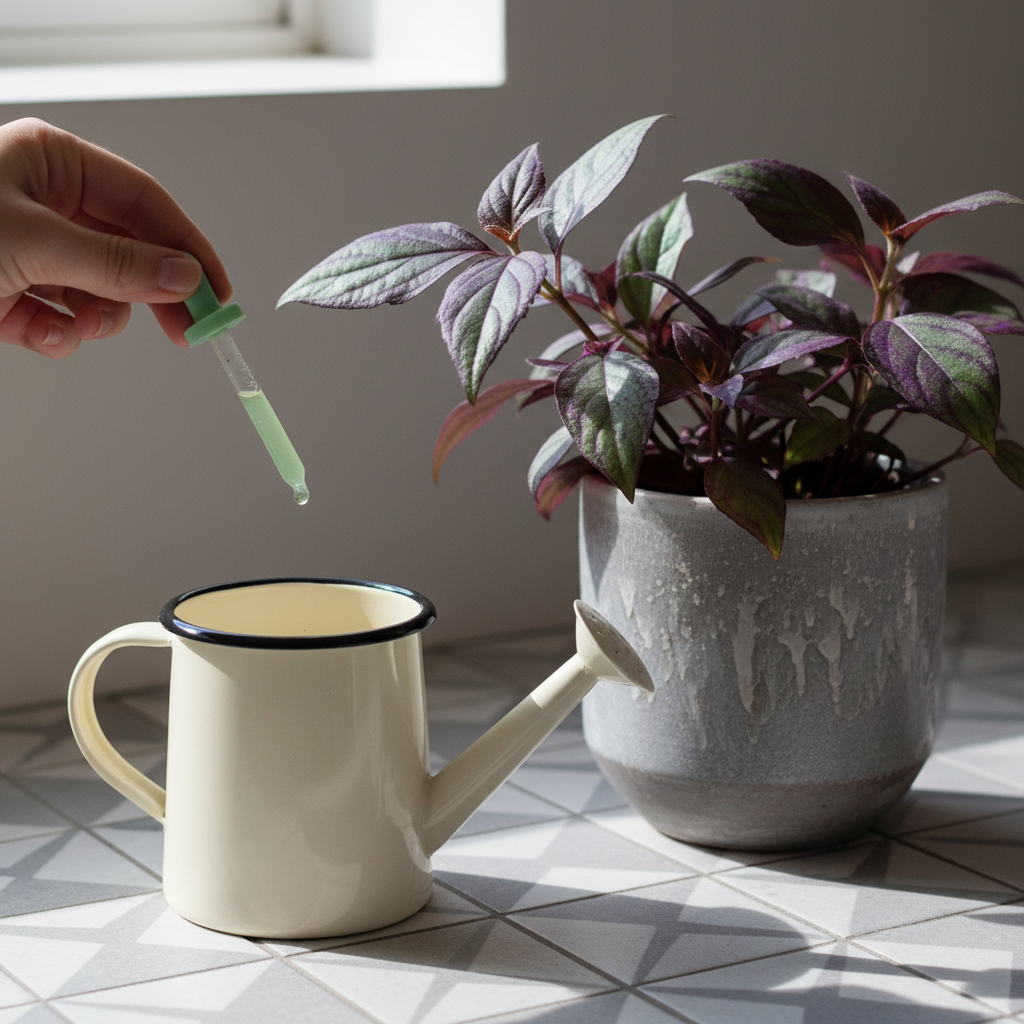
Understanding Plant Nutrients
Houseplant fertilisers are sold by their NPK ratio, which lists the percentage of three macronutrients: nitrogen (N) for foliage and stem growth, phosphorus (P) for roots, flowers and energy transfer, and potassium (K) for general vigour, disease resistance and cell wall strength. Persian shield benefits most from a balanced formula such as 10-10-10 or 7-7-7, or a slightly nitrogen-leaning leafy-plant feed such as 9-3-6 during the active growing months. There is no need to switch to a flowering-formula feed, since the plant is grown almost exclusively for its foliage indoors.
| Nutrient | Symbol | Primary Function | Deficiency Symptoms |
|---|---|---|---|
| Nitrogen | N | Leaf and stem growth, chlorophyll production | Older leaves yellow uniformly, growth slows, new leaves smaller and paler |
| Phosphorus | P | Root development, energy storage, flowering | Dull dark green leaves, occasional purple cast on stems, weak root growth |
| Potassium | K | Overall vigour, disease resistance, water regulation | Brown leaf margins, especially on older leaves; weak stems |
| Calcium | Ca | Cell wall structure, new growth | Distorted or curled new leaves, blackened growing tips |
| Magnesium | Mg | Central component of chlorophyll | Interveinal yellowing on older leaves while veins stay green |
| Iron | Fe | Chlorophyll synthesis, enzyme activity | Interveinal yellowing on new leaves, often pale lime green |
Types of Fertiliser
Liquid fertilisers: The most flexible option for Persian shield. Concentrated liquids let you mix at half strength every other watering, which suits the plant’s preference for steady gentle feeding. Look for a balanced formula or a slightly nitrogen-leaning leafy-plant feed, and always pour onto already-moist soil rather than bone-dry, which reduces root burn.
Slow-release granular: Convenient if you are away from home for stretches or simply forgetful. Sprinkle a small dose around the soil surface in spring and again in midsummer, following the manufacturer’s reduced houseplant rate (usually about half the outdoor rate). The downside is loss of fine control; if the plant signals nutrient stress mid-summer it is harder to adjust.
Organic fertilisers: Worm castings, well-rotted compost, fish or seaweed emulsion, and compost tea all work beautifully with Persian shield and produce noticeably resilient growth, but they can smell strong indoors and may attract fungus gnats. Top-dressing with a thin layer of worm castings in spring is the most apartment-friendly organic option.
Feeding Schedule
From early spring through to early autumn, feed Persian shield every 2 to 4 weeks with a balanced liquid fertiliser diluted to half the manufacturer’s recommended strength. In the height of summer, when growth is most vigorous, the upper end of that frequency is fine. From mid-October onward, reduce to once every 6 to 8 weeks, and from December through February pause entirely. Resume in March or whenever you see new leaves emerging in response to lengthening daylight.
Pro Tip — Half Strength, Twice as Often: Halving the recommended fertiliser concentration and feeding twice as often produces better results than full-strength monthly doses for Persian shield. The constant gentle nutrient supply matches its natural growth rhythm and avoids the boom-and-bust pattern of weak then burned new leaves.
How to Fertilise
- Water the plant lightly with plain water the day before, so the soil is evenly moist rather than dry.
- Mix the liquid fertiliser into room-temperature water at half the recommended strength; for a typical product this is around 2.5 ml per litre rather than 5 ml.
- Pour the solution slowly around the base of the stems until you see a small amount of liquid emerge from the drainage holes.
- Discard any runoff in the saucer; do not let the plant sit in fertiliser-laden water for hours.
- Every third or fourth watering, skip the fertiliser entirely and instead flush the pot with plain water to wash out accumulated salts, which prevents tip browning over time.
Warning — Salt Build-Up: Mineral salts from fertiliser and hard water accumulate in the soil over months and eventually cause leaf tip browning, weakened roots and stunted growth. A thorough plain-water flush every 6 to 8 weeks (water until plenty runs from the drainage holes, then repeat once more) keeps salt levels manageable. A white crust on the soil surface or pot rim is a clear signal that a flush is overdue.
Propagation
Persian shield is one of the easiest tropical houseplants to propagate, which is fortunate because mature plants tend to become leggy and lose their lower leaves after their second or third year. Most experienced keepers maintain a rolling supply of cuttings, retiring the parent plant to a quiet corner and replacing it with a fresh young clone every 18 to 24 months. The whole process takes about 4 to 8 weeks from cutting to rooted, potted plant.
Stem-tip cuttings are the standard method, taken from the soft green growth at the top of any healthy stem. The plant roots readily in plain water, in moist sphagnum moss, and in a damp soil-perlite mix, so the choice between methods is largely about your preferences and available materials. Spring and early summer give the fastest and most reliable results, since the parent is growing actively and warmer ambient temperatures accelerate root development.
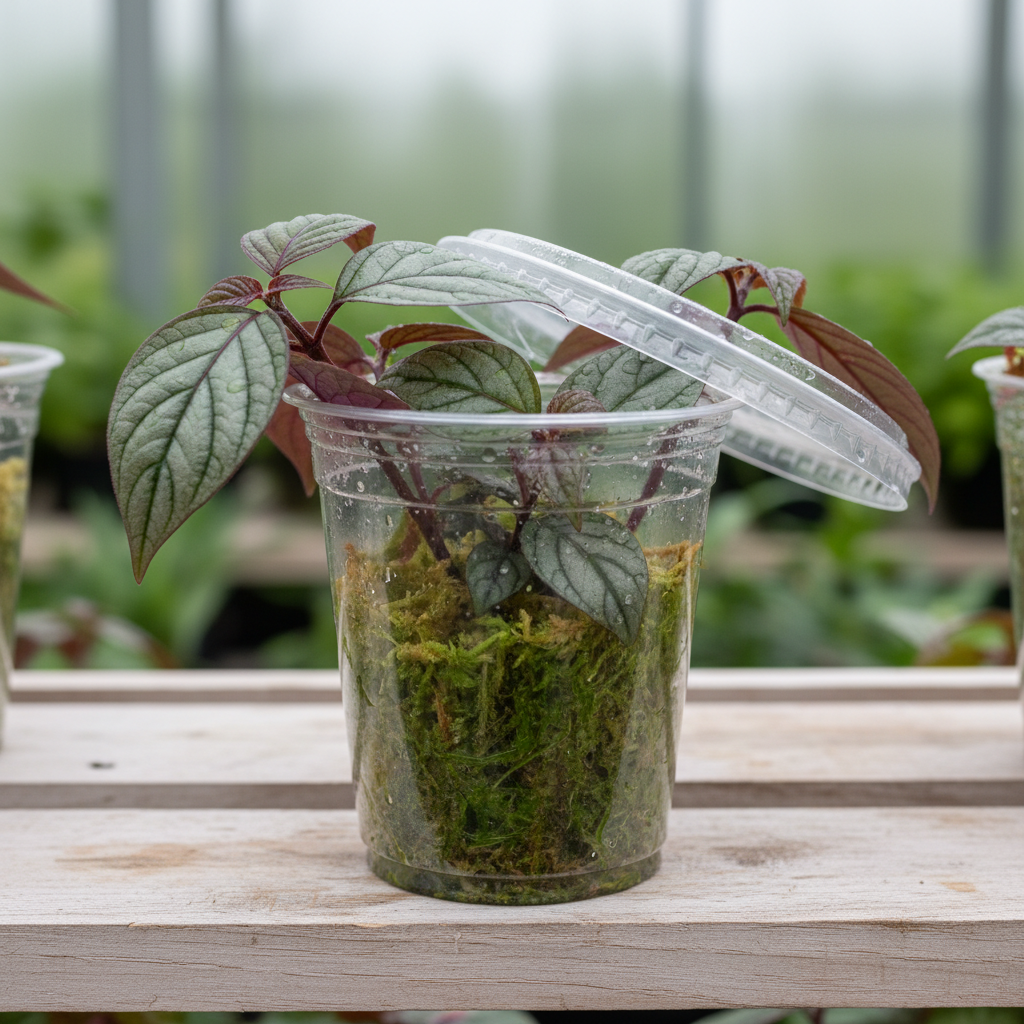
Understanding Nodes and Cuttings
A node is the slightly thickened point on a stem where leaves emerge, and it is where new roots form on a cutting. Persian shield carries pairs of leaves at each node on opposite sides of the stem, with smooth lengths of stem (internodes) between them. A successful cutting includes at least two nodes: the lower one to sit in the rooting medium where roots will emerge, and the upper one or two to carry leaves that drive photosynthesis. Cuttings without a node will not root, no matter how nice the leaf looks.
Water Propagation: Step-by-Step
The simplest method, with the bonus of visible root development through the glass. Persian shield typically shows its first white root tips within 7 to 10 days in warm bright conditions, and is ready to pot up after 3 to 5 weeks once roots reach 3 to 5 cm (about 1 to 2 inches) long.
- Select a healthy stem tip with at least 3 to 4 pairs of leaves and no flowers; soft new growth roots faster than older woody stems.
- Using sterilised scissors or a clean knife, cut just below a leaf node so the resulting cutting is 10 to 15 cm (4 to 6 inches) long with at least two nodes.
- Strip the lower pair (or two) of leaves so the bottom 3 to 5 cm of stem is bare; these submerged leaves would rot in water.
- Place the cutting in a clean glass of room-temperature water, with the bare nodes submerged and the remaining leaves above the waterline.
- Set the glass in bright indirect light at normal room temperature; avoid direct sun, which heats the water and stresses the cutting.
- Change the water every 3 to 5 days to keep it oxygenated and clear; this is the single most important variable in success rate.
- Once the roots reach 3 to 5 cm, pot the cutting into a small pot of moist standard potting mix, keep humidity high for the first week, and water carefully while the plant transitions from water roots to soil roots.
Pro Tip — Take Multiple Cuttings: Always take 3 or 4 cuttings rather than one. Persian shield roots so reliably that you will almost certainly end up with several new plants, and grouping 2 or 3 rooted cuttings into a single pot produces a bushy, full-looking plant much faster than a single cutting on its own.
Sphagnum Moss Propagation: Step-by-Step
A slightly more reliable method for cuttings that are slow to transition from water to soil, and one that avoids the brittle “water roots” that sometimes break off during repotting. The humidity inside a covered cup encourages fast rooting while the moss keeps the stem evenly moist without waterlogging.
- Soak a handful of long-fibre sphagnum moss in lukewarm water for 15 minutes, then squeeze out the excess so it is damp but not dripping.
- Take stem-tip cuttings as described above, with at least two nodes and the lower leaves removed.
- Loosely pack the damp moss into a clear plastic deli cup or seedling tray with a clear lid, and nestle the bare nodes of each cutting into the moss so it makes good contact.
- Close the lid almost fully, leaving a small gap for airflow, and place the container in bright indirect light at warm room temperature (ideally 21 to 25 degrees C, 70 to 77 degrees F).
- Check every few days; the moss should stay damp but should not develop standing water at the bottom. Remove the lid for a few minutes daily to refresh the air.
- After 3 to 5 weeks, gently lift a cutting; if there are several roots 2 to 3 cm long, pot the cutting into standard houseplant mix and gradually wean it off the humid environment over a week.
Troubleshooting Propagation
| Problem | Likely Cause | Solution |
|---|---|---|
| Cutting wilts and never recovers | Too few leaves left, or air too dry while it tries to root | Take a fresh cutting with 4 pairs of leaves and cover loosely with a clear plastic bag for the first week |
| Stem turns brown or mushy at the base | Water not changed often enough, or moss too wet, leading to bacterial rot | Trim back to clean tissue above the rot, restart in fresh water changed every 3 days |
| Leaves stay green but no roots after 4 weeks | Too cool, or cutting taken from old woody stem | Move to a warmer spot (above 21 degrees C) and prefer soft green tip growth for next attempt |
| Cutting roots but collapses when potted | Sudden drop in humidity, or transition to dry soil too quickly | Bag the freshly potted cutting for 5 to 7 days and water carefully to keep soil evenly moist |
Pests & Diseases
Persian shield is moderately pest-prone indoors, mostly because the conditions it prefers (warmth, high humidity, dense bushy growth) also suit a number of common houseplant pests. The good news is that none of the regulars are catastrophic on this plant if caught early, and routine inspection of the leaf undersides and leaf axils during your usual watering rounds catches most problems within a week of arrival.
Get into the habit of turning over a few leaves every time you water. The undersides of Persian shield leaves are a rich purple that contrasts visibly with the pale dots of spider mite damage, the white fluff of mealybugs, or the small green bodies of aphids, so a quick scan often reveals problems before they become serious. Isolating new plants for two or three weeks before placing them near your Persian shield prevents the most common route of introduction.
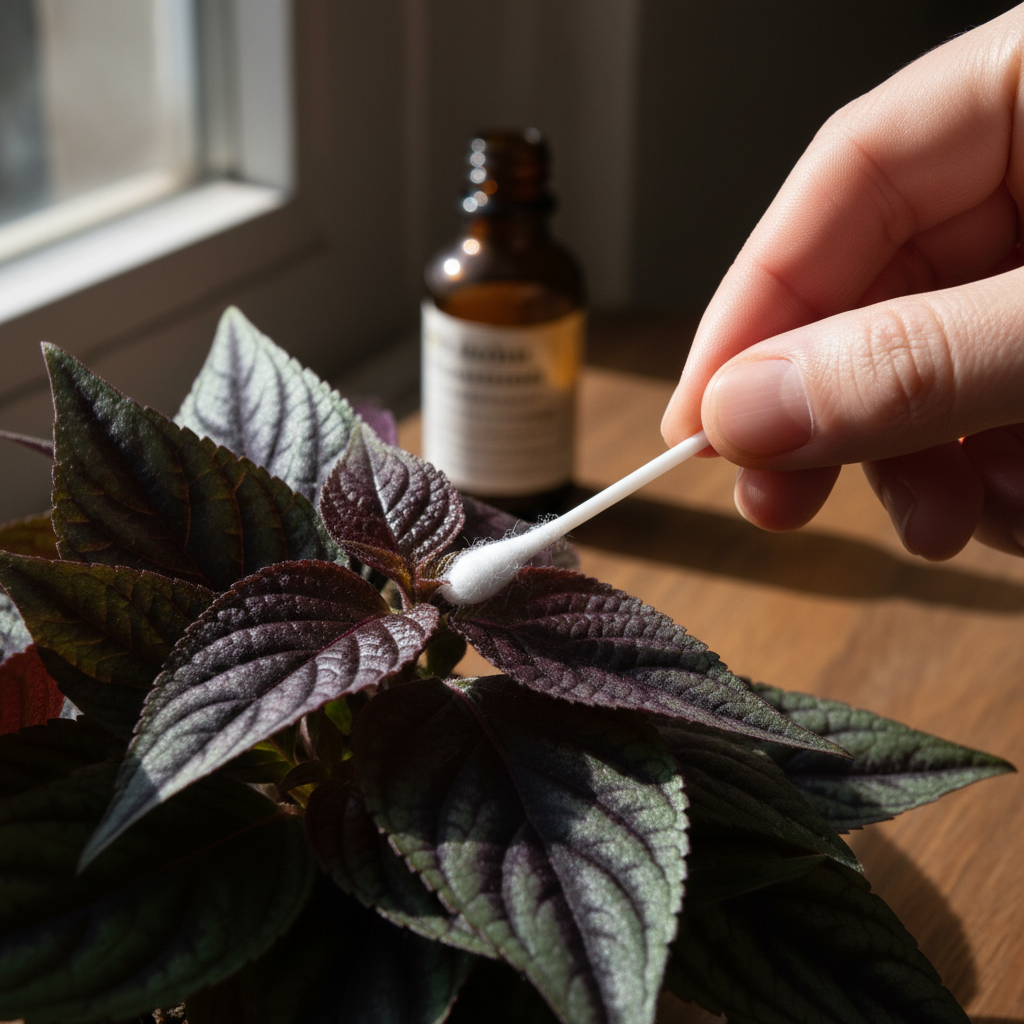
Common Pests
Spider Mites (Tetranychus urticae)
The most common pest on indoor Persian shield, and the one most directly tied to low humidity. The earliest signs are tiny pale dots stippling the upper leaf surface, often visible as a fine speckled pattern across the iridescence, followed by fine silken webbing in the leaf axils and on the undersides. Heavily infested leaves dry out, yellow and drop, and the plant can lose most of its foliage in a few weeks of unchecked spread.
Treatment: Rinse the entire plant under a lukewarm shower to physically dislodge mites and webbing, then spray thoroughly with insecticidal soap or a 1 to 2 percent neem oil solution, covering both leaf surfaces and the leaf axils. Repeat every 5 to 7 days for three rounds to break the life cycle. Raise the surrounding humidity above 50 percent during and after treatment, since spider mites struggle in humid conditions.
Mealybugs (Pseudococcus longispinus)
White, fluffy, cotton-like clusters tucked into leaf axils, along stems and on the undersides of leaves. Mealybugs suck sap and excrete sticky honeydew, which can become colonised by sooty black mould and further damage the leaves underneath. Persian shield’s dense, multi-stemmed growth habit gives mealybugs plenty of hiding places, so inspection needs to be patient and thorough.
Treatment: For small infestations, dab each visible mealybug with a cotton bud dipped in 70 percent isopropyl alcohol; the alcohol dissolves the protective waxy coating and kills the insect on contact. For larger infestations, follow up with a thorough spray of insecticidal soap or neem oil at weekly intervals for three to four rounds. Check all surrounding plants, since mealybugs spread easily between neighbours.
Aphids (Myzus persicae)
Small soft-bodied insects, usually pale green but occasionally black or pink, clustered on the tender new growth at stem tips. Aphids reproduce explosively in warm conditions and can carry plant viruses, so they should not be left to multiply even if the visible damage is mild. The first sign is often a slight curling or distortion of the newest leaves, followed by sticky honeydew on the leaves below.
Treatment: Rinse the plant under a strong stream of lukewarm water to dislodge the colonies, then apply insecticidal soap or a mild neem oil spray to the new growth and stem tips. Two or three weekly applications usually clear them entirely. For persistent infestations, a systemic insecticide sold for ornamental houseplants will reach pests hidden in tight new buds.
Whiteflies (Trialeurodes vaporariorum)
Tiny snow-white flies that lift off in a small cloud when the plant is disturbed. The adults are mostly a nuisance, but the immature stages on the leaf undersides suck sap and weaken the plant, producing yellow stippling similar to spider mite damage. Whiteflies thrive in warm dry rooms and can spread quickly to other houseplants.
Treatment: Yellow sticky traps placed at canopy level catch adults effectively and let you monitor population trends. Spray the leaf undersides with insecticidal soap or neem oil every 5 to 7 days for three to four rounds, since the eggs are not killed by sprays and continue hatching for two weeks after the initial treatment.
Common Diseases
Root Rot (Pythium and Phytophthora spp.)
The most common and most damaging disease of indoor Persian shield, almost always triggered by chronically waterlogged soil. The first sign is usually unexplained wilting that does not improve when you water (because the rotted roots can no longer absorb moisture), followed by yellowing lower leaves and a soft, darkened stem base. By the time the foliage looks unhappy, the roots are often already extensively damaged.
Treatment: Unpot immediately, wash off old soil, and trim away all soft brown roots with sterilised scissors. Dust the cuts with cinnamon or a horticultural fungicide, repot into fresh free-draining mix, and resist watering for at least a week so the damaged tissue can heal. If more than two thirds of the root system is rotted, propagating the surviving stem tips as cuttings is more likely to succeed than nursing the plant back to health.
Leaf Spot (Cercospora spp.)
Brown or tan circular spots, often with a slightly darker margin, scattered across the leaves. Leaf spot is a fungal disease that thrives in still, humid air with water sitting on the foliage for long periods, and tends to appear after misting routines that leave leaves wet overnight or after a Persian shield is moved into a cool draughty room.
Treatment: Remove affected leaves and dispose of them in the rubbish rather than compost. Improve airflow around the plant, mist only in the morning so leaves dry before nightfall, and apply a copper-based or neem-based fungicide to the remaining foliage if spread continues. Avoid getting water onto the leaves at all for a few weeks while the plant recovers.
Powdery Mildew (Erysiphe spp.)
A dusty white powder on the leaf surface, often appearing first on the upper leaves of a Persian shield kept in a humid but stagnant spot. Powdery mildew rarely kills the plant but does damage leaves cosmetically, and the iridescent finish is obviously compromised by a coating of white spores.
Treatment: Wipe affected leaves with a soft damp cloth, then spray with a solution of one teaspoon of baking soda and a few drops of mild dish soap per litre of water, or use a commercial fungicide. Increase airflow with a small fan on a low setting nearby, and avoid grouping the plant too tightly with others until the outbreak clears.
Pest and Disease Summary
| Pest / Disease | Identification | Treatment |
|---|---|---|
| Spider mites | Stippled leaves, fine webbing in axils, dry foliage | Shower, insecticidal soap or neem oil weekly for 3 rounds, raise humidity |
| Mealybugs | White cottony clusters in axils and on stems | Cotton bud with isopropyl alcohol, then neem oil sprays for 3 to 4 weeks |
| Aphids | Soft green or black insects on new growth, sticky residue | Strong water rinse, insecticidal soap, repeat weekly until clear |
| Whiteflies | Tiny white flies on leaf undersides, take flight when disturbed | Yellow sticky traps and neem oil sprays for 3 to 4 rounds |
| Root rot | Wilting that does not improve with watering, soft stem base | Unpot, trim rotted roots, repot dry, suspend watering for a week |
| Leaf spot | Brown circular spots, often with darker margins | Remove affected leaves, improve airflow, copper or neem fungicide |
| Powdery mildew | White dusty coating on leaf surfaces | Wipe leaves, baking soda spray or fungicide, increase airflow |
Prevention Strategies
Prevention with Persian shield comes down to three habits: inspect, isolate and ventilate. Inspect the leaf undersides and axils briefly every time you water, so any pest is caught while it is still 5 or 10 individuals rather than several hundred. Isolate any new plant entering the home for at least two weeks (ideally three) in a different room before placing it near established plants, since most pest introductions arrive on newly bought houseplants. Ventilate the growing area gently with an open door or a small low-speed fan a few times a week to discourage the still, humid stagnation that encourages fungal disease.
Beyond those three, a plant that is being cared for well is generally more resistant to pests and disease. Persian shield in steady bright light, adequate humidity and a thoughtful fertilising routine will shrug off a low-level mealybug introduction that would overwhelm a stressed plant. Conversely, a Persian shield struggling with too little light, dry air and erratic watering will succumb to almost any pest that finds it. Care quality is the cheapest pest control you can buy.
Pro Tip — Monthly Shower: Once a month, take Persian shield to a sink or shower and rinse the leaves thoroughly with lukewarm water, paying attention to the undersides and axils. This physical cleaning removes dust that dulls the iridescence, dislodges early-stage pests before they establish, and gives you a chance to inspect every surface up close. It is one of the most under-rated routine care tasks for any tropical houseplant.
Popular Varieties
Persian shield is most often grown and sold as the straight species Strobilanthes dyerianus, and the genus has comparatively few named cultivars relative to flashier houseplants like Philodendron or Hoya. The colour and leaf-form variation that exists tends to come from selected seedlings or vegetative sports rather than deliberate hybridisation, since the plant rarely sets seed in cultivation outside its native climate. That said, there are several recognisable forms in the trade, plus a handful of closely related Strobilanthes species that are sometimes sold under the same common name and worth knowing about.
When buying, the most useful question to ask is whether you are getting a species plant (with that classic balance of silver, purple and dark green) or a named selection with intensified colour or a specific growth habit. Both can be excellent houseplants, but the selections often have slightly more demanding humidity or light requirements to look their best, so it is worth matching the variety to the conditions you can offer.
| Variety | Leaf Appearance | Light Needs | Growth Rate | Availability |
|---|---|---|---|---|
| Species Strobilanthes dyerianus | Iridescent silver-purple upper, deep purple lower, dark green veins | Bright indirect with gentle direct | Fast | Widely available |
| ‘Exotica’ | More vivid silver-pink iridescence, slightly broader quilted leaves | Bright indirect, prefers high humidity | Fast | Specialist nurseries |
| Persian Shield ‘Compacta’ | Smaller, more closely set leaves with similar colouration | Bright indirect | Moderate | Occasional |
| Strobilanthes alternata ‘Goldfussia’ | Smaller, narrower dark purple leaves, less iridescence | Bright indirect to medium | Fast | Specialist nurseries |
| Strobilanthes anisophylla | Slender lance-shaped leaves, deep purple to bronze, modest shimmer | Bright indirect | Moderate | Rare |
| Strobilanthes hamiltoniana | Larger green leaves, grown for arching habit and violet flowers | Bright indirect | Fast | Rare in houseplant trade |
Featured Varieties
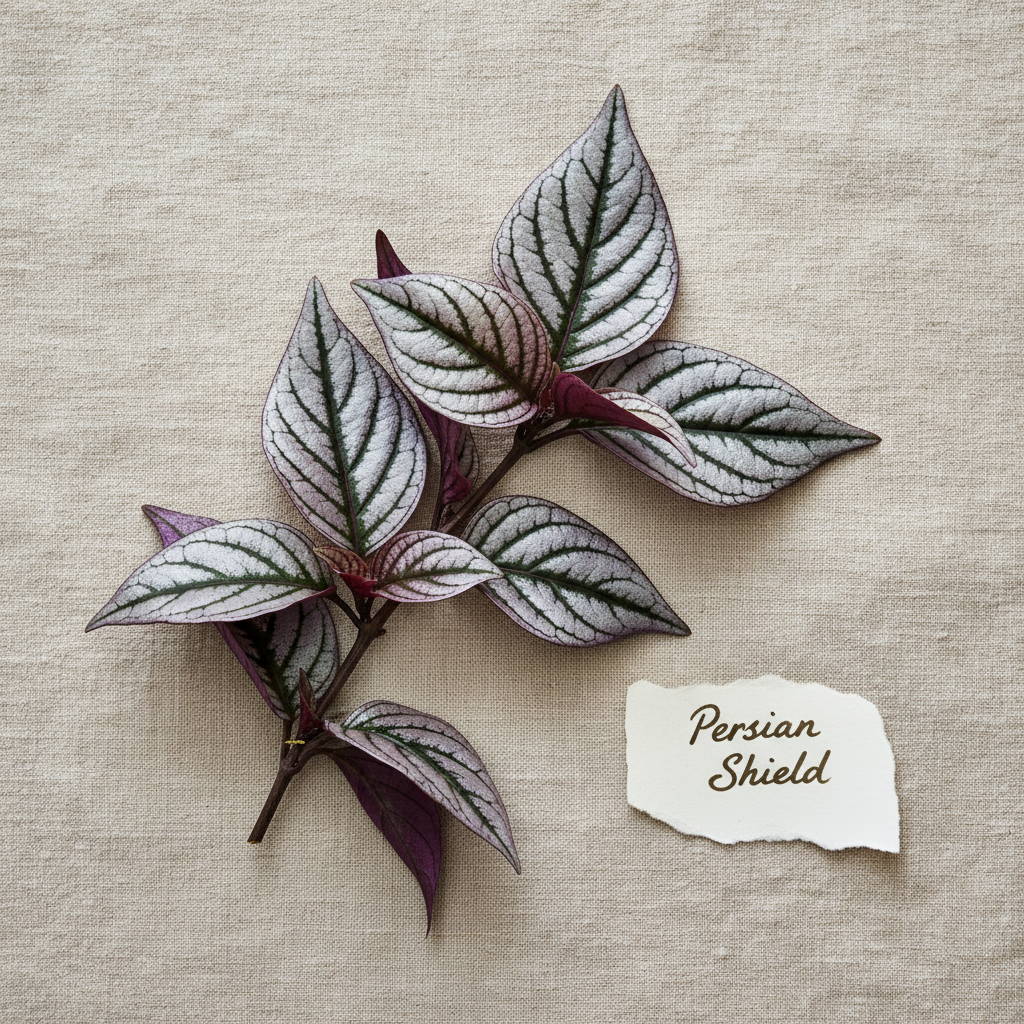
Species Persian Shield
The straight species Strobilanthes dyerianus as it occurs in cultivation today. Lance-shaped 10 to 18 cm (4 to 7 inch) leaves with iridescent silver-purple upper surfaces, dark green to nearly black venation, and rich plum undersides. This is the form you will encounter at most garden centres and what most general care advice refers to.
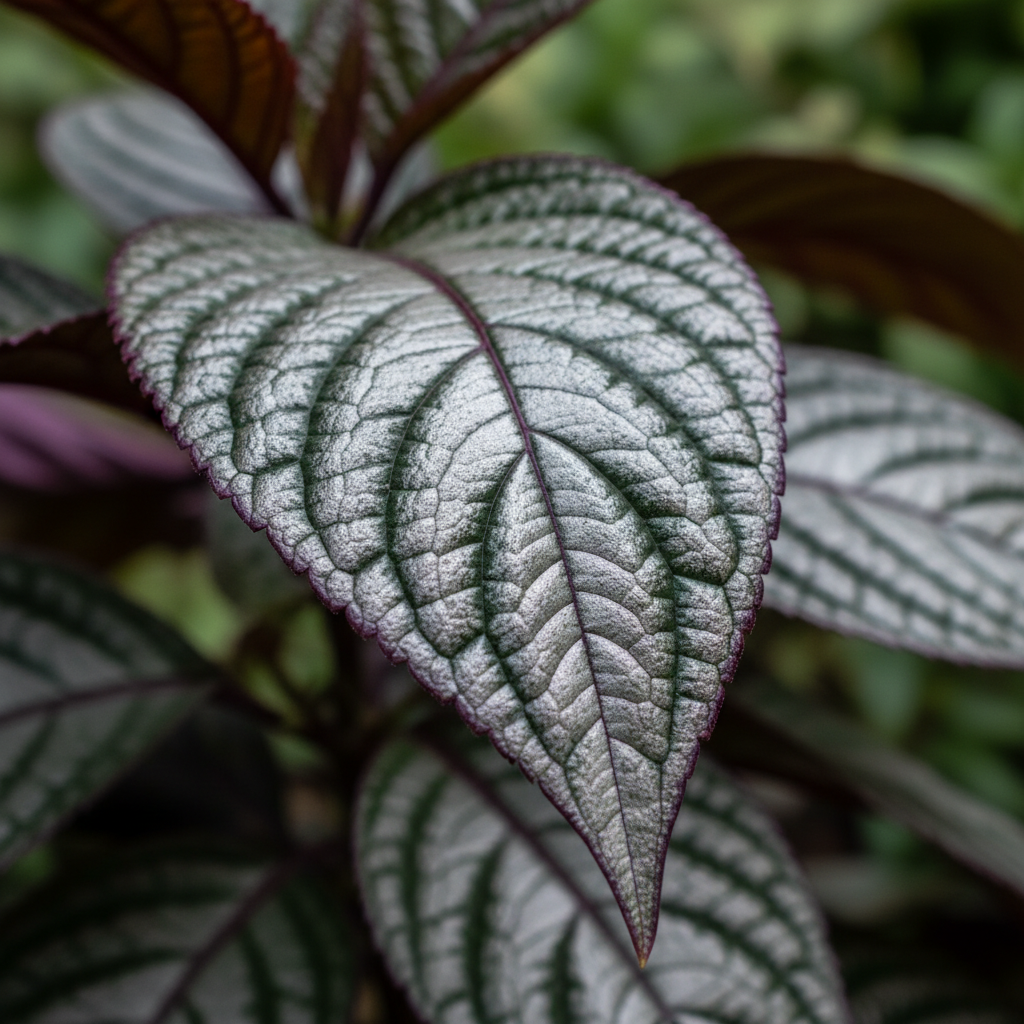
Persian Shield ‘Exotica’
A selected form with intensified silver-pink iridescence, slightly broader leaves and more pronounced quilting between the veins. ‘Exotica’ tends to demand a bit more humidity and steadier light than the species to maintain its richer colour, but rewards the extra attention with leaves that look almost holographic when caught in raking morning light.
Variety Profiles in Detail
Species Persian Shield (Strobilanthes dyerianus)
The original wild form, introduced from Myanmar in the late 19th century and the most widely cultivated to this day. Foliage is the headline feature; flowering is occasional and the small lavender-blue funnel-shaped blooms are pleasant but not the reason anyone keeps the plant. Mature size indoors ranges from 60 to 120 cm (24 to 48 inches) tall depending on conditions and how aggressively the plant is pinched. This is the reliable everyday choice, and most general Persian shield advice (including this guide) assumes the species form.
Persian Shield ‘Exotica’ (Strobilanthes dyerianus ‘Exotica’)
A vegetative selection that pushes the silver-pink iridescence even further than the species, with slightly broader, more deeply textured leaves. Photographs of ‘Exotica’ under good light show an almost rose-gold shimmer that the species rarely produces. The tradeoff is a marginally fussier plant: humidity below 50 percent shows on the leaves faster than on the species form, and dim light makes the colour fade more obviously. Worth seeking out if you have the right conditions.
Persian Shield ‘Compacta’
A naturally smaller-growing selection with shorter internodes, producing a denser, more rounded plant. Useful for windowsills and small tabletops where the full-size species would quickly outgrow the space. Colour and care are otherwise identical to the species form. Availability is patchy and varies by region; in some markets it is sold under names like ‘Dwarf Persian Shield’ rather than ‘Compacta’.
Goldfussia (Strobilanthes alternata)
A different species often sold under the Persian shield name in some regions. Goldfussia has smaller, narrower dark purple to bronze-green leaves with modest iridescence and a more open, vining habit. It is tougher and more drought-tolerant than true Persian shield, and is sometimes grown outdoors as a hedging plant in warm climates. A reasonable substitute if you struggle with the humidity demands of S. dyerianus.
Hamilton’s Strobilanthes (Strobilanthes hamiltoniana)
Better known to gardeners than houseplant collectors, Hamilton’s strobilanthes is grown for its arching habit and abundant violet-blue tubular flowers rather than coloured foliage. Leaves are plain mid-green and lance-shaped, with no iridescence. Worth mentioning here because it is occasionally mistaken for Persian shield online and shares much of the same care, though it tolerates lower humidity and brighter light.
Choosing the Right Variety for Your Space
For a first Persian shield, the straight species is almost always the right answer. It is widely available at modest prices, produces dramatically coloured foliage in any decently bright spot, and is forgiving enough to weather a few care mistakes while you learn its preferences. If you already keep humidity-loving plants successfully and want to push the visual envelope further, ‘Exotica’ is worth the hunt at specialist nurseries. For small spaces, ‘Compacta’ if you can find it, or simply a regularly-pinched species plant if you cannot, will keep the footprint manageable without sacrificing the iconic colour.
Frequently Asked Questions
Why is my Persian shield losing its purple colour?
The two most common causes are insufficient light and natural ageing. Persian shield needs bright indirect light with some gentle direct exposure to produce its full iridescence, and the colour fades visibly within a few weeks when the plant is too far from a window. Older lower leaves on mature plants also naturally lose intensity over time, while the newest tip leaves should always come in vivid. If the new leaves are dull as well, increase light before considering anything else.
Why are the leaves drooping even though the soil is moist?
If the soil is genuinely moist and the leaves are still drooping, the cause is usually root rot rather than thirst. Damaged roots cannot absorb water even from wet soil, and the leaves wilt as if the plant were dry. Unpot, inspect the roots, and trim any soft brown tissue with sterilised scissors before repotting into fresh free-draining mix. Other possible causes are sudden temperature drops, a cold draught from an open window, or chilled water poured straight onto warm roots.
Should I let Persian shield flower indoors?
Persian shield occasionally produces small lavender-blue funnel-shaped flowers indoors, usually in late autumn or winter. The flowers are pleasant but unremarkable, and the plant diverts significant energy into producing them, often at the cost of leaf size and colour. Many keepers pinch off flower buds as soon as they form to keep the focus on foliage. If you do let it flower, expect a brief period of less vigorous leaf growth afterwards and feed lightly to help it recover.
How do I keep Persian shield bushy instead of leggy?
Pinching is the answer, and the answer needs to be repeated regularly. Every 6 to 8 weeks during the growing season, pinch out the top pair of leaves on each stem just above a leaf node. This encourages two new shoots to develop from the node below, doubling the branch count over time and keeping the plant compact and full. A Persian shield that has not been pinched for a year will be tall, thin and almost bare at the base; one that has been pinched faithfully will be twice as bushy in the same space.
Can Persian shield live outdoors?
Yes, in the right climate. Persian shield is hardy in USDA zones 9 to 11 (roughly minimum winter temperatures above minus 1 degree C, 30 degrees F) where it can be grown as a perennial garden plant. In cooler climates it is often used as a summer container plant on a patio, then either composted at the end of the season or brought inside as a houseplant before the first frost. Even in summer outdoors it appreciates dappled shade rather than full sun, and a sheltered spot rather than wind exposure.
Why are the leaf edges turning crispy and brown?
The most common cause is low humidity, usually below 40 percent. Persian shield’s leaves are thin and lose moisture quickly when ambient air is dry, with the edges browning first because they are furthest from the leaf veins that supply water. Raise humidity with a small humidifier or a pebble tray, group with other tropical plants, and avoid placing the plant directly above radiators or near heating vents. Salt buildup from hard water or overfeeding can produce similar symptoms; a thorough soil flush every couple of months helps rule that out.
Is Persian shield safe around cats, dogs and children?
Persian shield is generally considered non-toxic to cats, dogs and humans, and is not listed on the ASPCA register of toxic plants. Ingestion in any quantity may cause mild stomach upset in pets, though, and the milky sap can be a mild skin irritant on sensitive individuals. Sensible precautions (placing the plant out of casual reach of pets and small children, washing hands after pruning, wearing gloves if you have skin sensitivities) cover the realistic risks comfortably.
How long does Persian shield live as a houseplant?
Individual plants typically remain attractive for 2 to 3 years before becoming inevitably leggy and losing their lower leaves, regardless of how well they are cared for. This is the plant’s natural growth pattern rather than a sign of failure. Almost everyone who keeps Persian shield long-term does so by taking cuttings every 12 to 18 months and starting fresh young plants, retiring the parent when the new generation is established. With this rolling-replacement approach you can have a beautiful Persian shield in your home indefinitely, even though no single plant lasts that long.
Can I grow Persian shield in water permanently?
Persian shield roots beautifully in water and will live in a clean jar of water for several months, but it will not thrive there long-term. After two or three months in water alone the growth slows, leaves shrink and the colour dulls, because the plant cannot extract enough nutrients from water no matter how often it is refreshed. Either add a small dose of hydroponic nutrient solution every few weeks, or transfer the cutting to soil within 2 to 3 months for a healthier, longer-lived plant.
My new Persian shield came home looking spectacular and faded within a month. What went wrong?
Commercial growers produce Persian shield under high-intensity grow lights, very high humidity and frequent feeding, conditions most homes cannot quite match. The colour you saw in the shop was real but maximum-effort; what you can sustain at home will be slightly less intense even with excellent care, simply because home conditions are gentler. Optimise light, humidity and feeding as described above and you will get most of the way back to that shop-floor look, but never quite all of it. Pinching back to encourage fresh young growth also helps, since the newest leaves always carry the strongest colour.






