
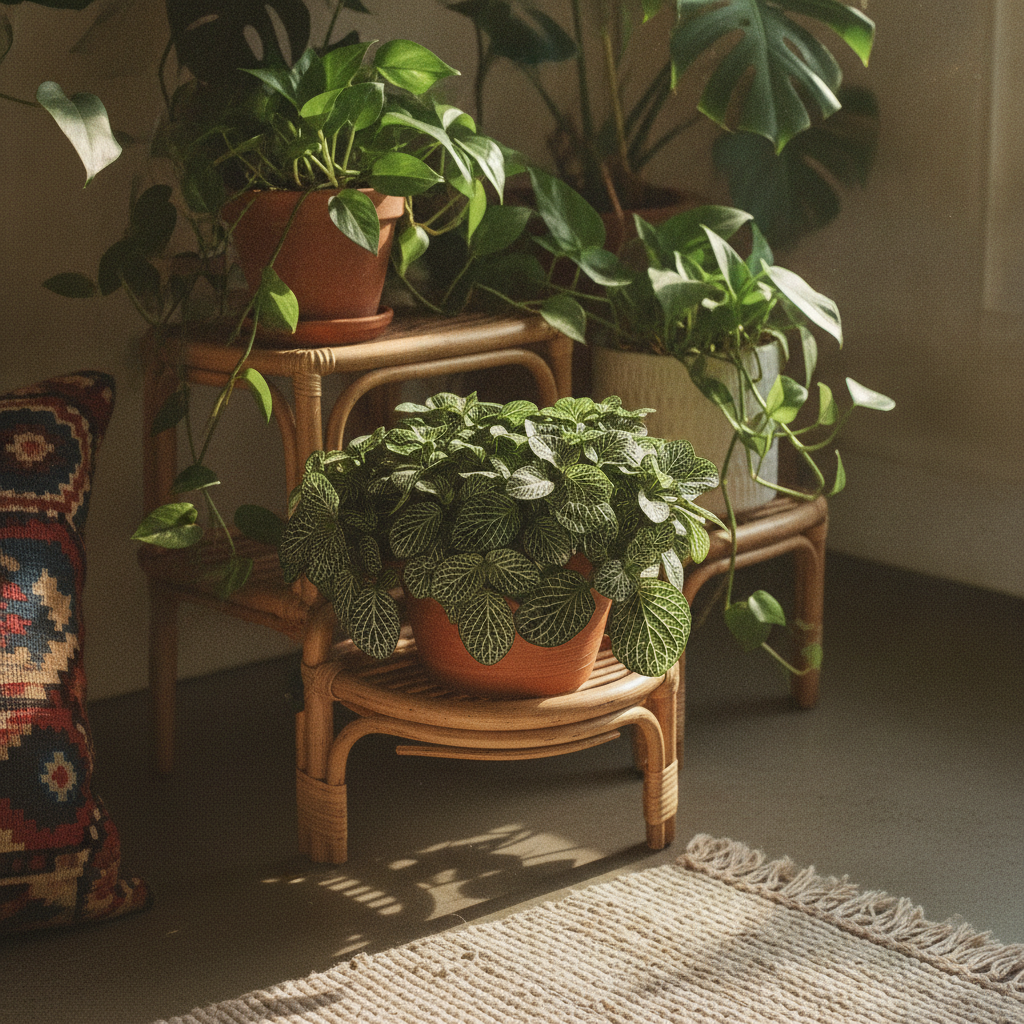
Few houseplants wear their personality quite as openly as the White Anne nerve plant (Fittonia verschaffeltii), a low, creeping evergreen whose deep green leaves are stitched through with a lattice of crisp white veins so precise they look hand-painted. A member of the Acanthaceae family and native to the warm, shaded understorey of the Peruvian rainforest and the wider Andean tropics, it spends its wild life carpeting the forest floor beneath taller plants, which tells you almost everything about what it wants indoors: warmth, gentle light, and air that never dries out for long. The White Anne cultivar is prized above the plain species for the brightness and density of its silvery-white venation, which glows against the matte green blade and lifts even a small pot into a living piece of pattern.
The nerve plant carries a reputation for being temperamental, and it has earned it in one specific way: when the soil dries out, the whole plant collapses into a dramatic faint, leaves and stems flopping as though it has given up entirely. Reach for the watering can and, within an hour or two, it springs back as if nothing happened. That theatrical honesty is exactly what makes it easy to keep alive once you understand it, because the plant tells you precisely what it needs. The gap between merely surviving and genuinely thriving comes down to consistency: steady moisture, high humidity, and stable warmth turn a sulky, curling specimen into a dense, glossy mound that spreads and flowers. This guide covers everything from light and water to soil, feeding, propagation and pests, so you can grow a White Anne that looks its best rather than one that lurches from faint to recovery.
Contents
- Quick Reference
- Why the White Anne Fittonia Makes a Rewarding Houseplant
- Light Requirements
- Watering & Humidity
- Soil, Potting & Repotting
- Fertilising
- Propagation
- Pests & Diseases
- Popular Varieties
- Frequently Asked Questions
Quick Reference: White Anne Fittonia at a Glance
| Botanical Name | Fittonia verschaffeltii ‘White Anne’ |
| Family | Acanthaceae |
| Common Names | White Anne nerve plant, white vein plant, mosaic plant |
| Mature Size | 10 to 15 cm (4 to 6 in) tall, spreading 30 cm (12 in) or more |
| Light | Bright indirect light to medium light; no direct sun |
| Watering | Keep soil evenly, lightly moist; never fully dry or waterlogged |
| Temperature | 18 to 26 degrees C (64 to 79 degrees F) |
| Humidity | High; 60 percent or above preferred |
| Fertiliser | Balanced liquid feed at half strength, monthly in spring and summer |
| Propagation | Stem tip cuttings in water, soil or moss |
| Toxicity | Non-toxic to cats, dogs and humans |
| Difficulty | Moderate; forgiving once humidity and moisture are stable |
Why the White Anne Fittonia Makes a Rewarding Houseplant
The appeal of the White Anne begins with its foliage and rarely needs anything more. Each leaf is a small oval, rarely longer than 6 to 8 cm (2.5 to 3 in), and the surface is divided by a fine network of bright white veins that fan out from the midrib to the leaf edge in a pattern reminiscent of stained glass or crazed porcelain. Because the plant grows low and spreads sideways rather than upward, a healthy specimen forms a dense, textured cushion of pattern that reads as a single luminous mass from across a room. It is a plant that rewards close looking, and one of the few whose interest comes entirely from leaf detail rather than flowers or dramatic size.
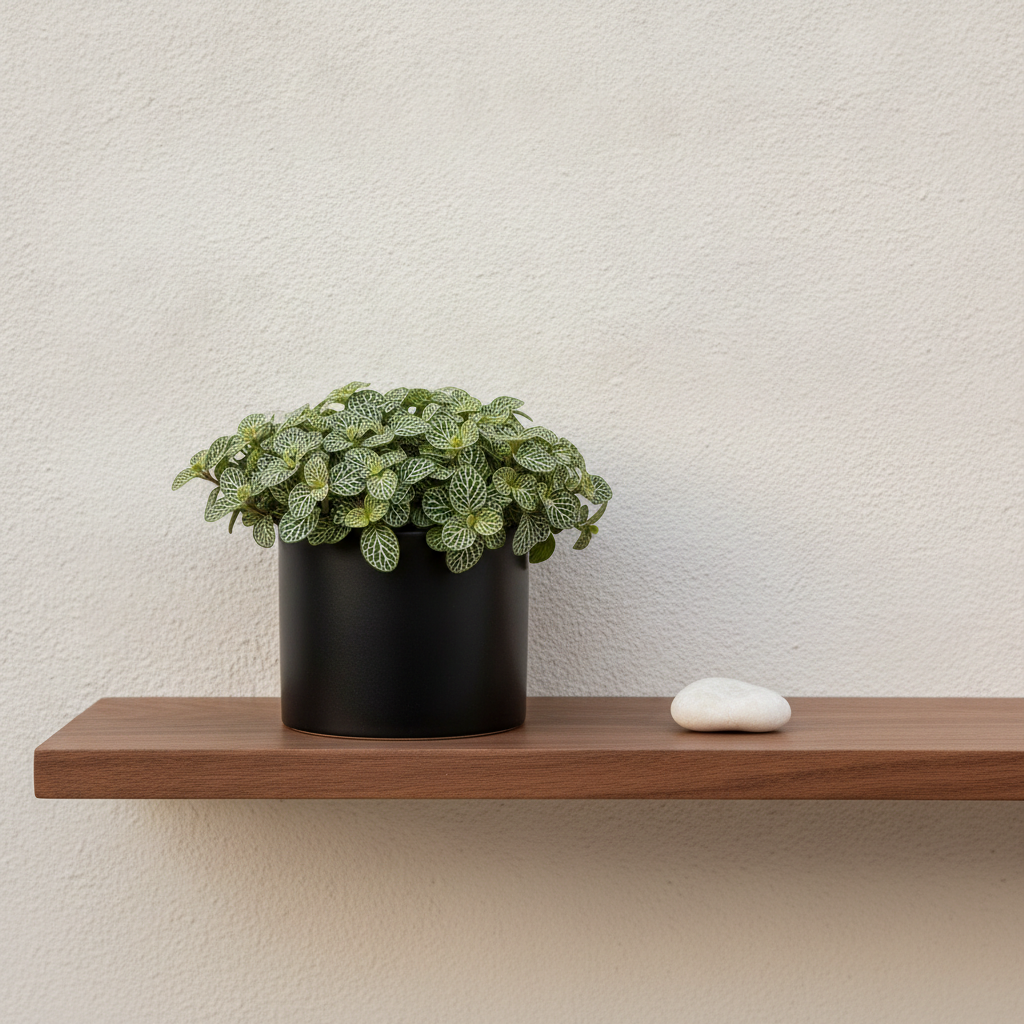
Beyond its looks, the White Anne suits modern homes in practical ways. It stays small, so it thrives on a shelf, a bathroom windowsill, a desk corner or inside a closed terrarium or bottle garden, where its love of humidity becomes an advantage rather than a chore. It tolerates the medium light found several feet back from a window, which makes it one of the more flexible plants for rooms without strong sun. And unlike many statement foliage plants, it is genuinely non-toxic, so it can share a home with cats, dogs and curious children without concern. Its one demand, steady moisture and humid air, is easy to meet once you build it into a routine, and the plant’s habit of fainting when thirsty means it will always remind you before any lasting harm is done.
Important — Toxicity: The nerve plant is listed as non-toxic to cats and dogs by the ASPCA and is not known to be poisonous to humans. It is one of the safest patterned foliage plants for pet households, though as with any plant it is sensible to discourage animals from chewing on it to protect the foliage.
Light Requirements
In the wild, the White Anne grows on the shaded rainforest floor, screened from the sun by a dense canopy overhead. The light that reaches it is soft, filtered and green, and this is the condition to recreate indoors. The plant is adapted to make the most of gentle, indirect light and has no defence against the intensity of direct sun, which its thin leaves cannot tolerate for more than a short exposure.
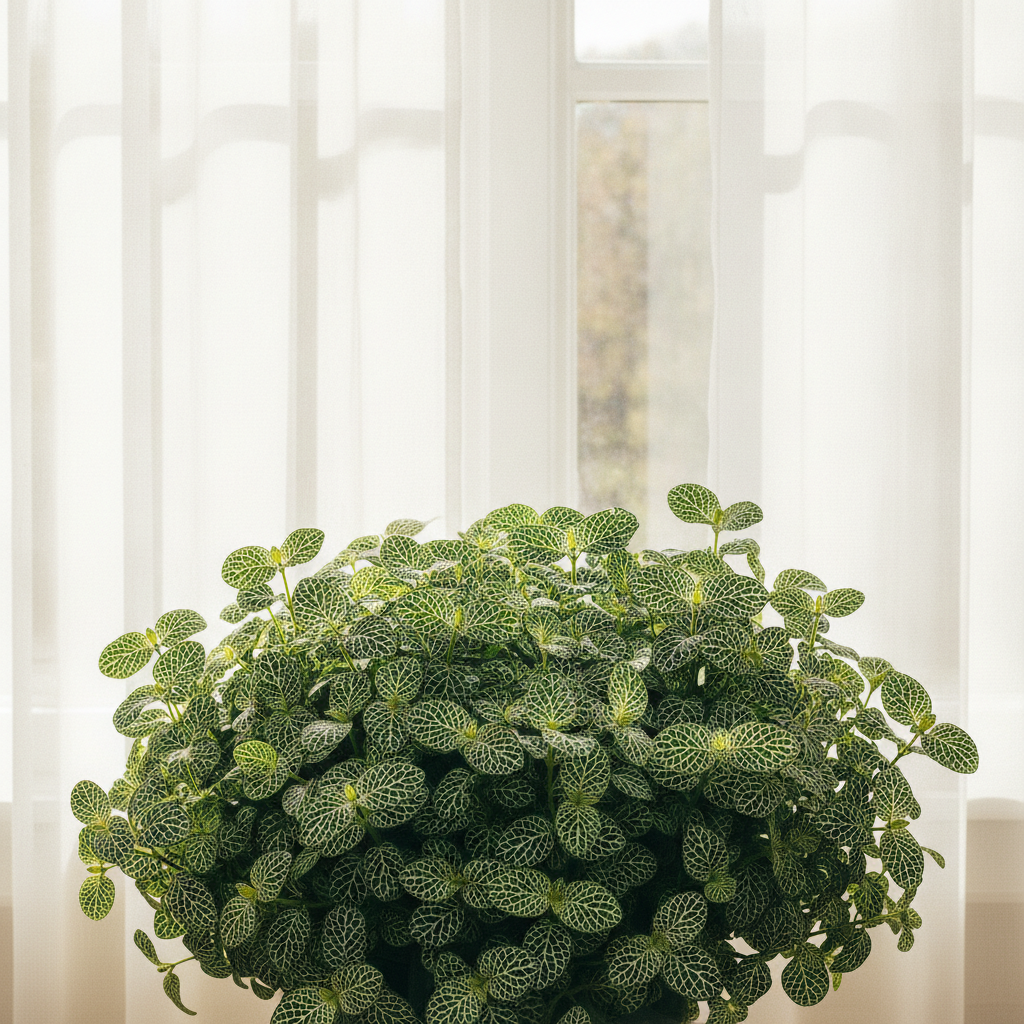
The ideal position is bright but indirect: a spot that receives plenty of ambient daylight without any beam of sun landing on the leaves. A location a metre or so back from an east or north window, or behind a sheer curtain at a brighter window, is close to perfect. Under these conditions the venation stays crisp and high in contrast, and the plant grows steadily and compactly. Too little light and the growth becomes leggy and the white markings fade; too much and the leaves scorch and curl.
Light Levels Explained
Understanding how different light intensities translate into real positions in your home makes it far easier to place a nerve plant well. The table below sets out the common categories, roughly what they measure in lux, and what each means for a White Anne.
| Light Category | Approx. Level | Typical Location | Outcome |
|---|---|---|---|
| Direct sun | 50,000 lux and above | On a south windowsill in full sun | Avoid; leaves scorch and curl within days |
| Bright indirect | 10,000 to 20,000 lux | Near an east window, or behind a sheer curtain | Ideal; strong venation and compact growth |
| Medium | 5,000 to 10,000 lux | A metre or two back from a bright window | Very good; steady, slightly slower growth |
| Low | 1,000 to 2,500 lux | A dim corner or interior room | Tolerated briefly; growth thins and pales |
| Very low | Below 1,000 lux | Windowless bathroom or hallway | Decline over time unless a grow light is added |
Window Orientation and Placement
South-facing window: The brightest exposure in the northern hemisphere, and too strong for a nerve plant if the plant sits directly in the light. Set it back into the room, or diffuse the light with a sheer curtain, and a south window becomes a good source of bright indirect light.
East-facing window: Often the sweet spot. Gentle morning sun is soft enough that the plant can sit close to the glass, and the light is bright for the rest of the day without becoming harsh.
West-facing window: Workable, but the strong afternoon sun means the plant should be set back or shaded. Direct west light in summer can scorch the leaves as readily as a south window.
North-facing window: A reliable, even light with no direct sun, which nerve plants handle well. Growth may be a touch slower, but the plant stays healthy and the markings hold their contrast.
Pro Tip — Read the Leaves: If the white veining begins to look washed out and the stems stretch with wide gaps between leaves, the plant is asking for more light. Move it closer to the window in stages over a week or two so it can adjust without shock.
How Light Affects Leaf Colour and Pattern
The striking contrast between the deep green blade and the white veins depends on balanced light. In good bright indirect conditions the green stays rich and the veins luminous, giving the leaf its full mosaic effect. In persistently low light the leaf produces more chlorophyll to compensate, and the green can spread and dull the white markings, muddying the pattern that makes the White Anne worth growing. The right light is therefore not only a matter of health but of appearance.
Warning — Direct Sunlight: The thin leaves of a nerve plant have no tolerance for direct sun. Even an hour of midday summer light through glass can leave crisp brown patches that never recover. Always filter or set back from any window that receives direct sun.
Artificial Lighting
Because it needs only moderate light, the White Anne responds very well to artificial lighting, which makes it an excellent candidate for offices, interior rooms and terrariums lit by LED. A standard full-spectrum LED grow light positioned 30 to 45 cm (12 to 18 in) above the plant, run for 10 to 12 hours a day, easily supplies everything it needs. Ordinary bright room lighting alone is usually not enough for long-term health, but it can supplement natural daylight in a dim spot.
Seasonal Adjustments
Light indoors changes markedly through the year. In winter, when days are short and the sun sits low, a nerve plant that was happy set back from a window in summer may need to move closer to the glass to keep receiving enough light. Reverse the move in spring as the sun strengthens, and watch for the first signs of scorch as summer light intensifies. A plant that has spent winter in a dim spot should be reintroduced to brighter conditions gradually rather than all at once.
Watering & Humidity
Watering is the single most important skill in nerve plant care, because this is a plant with no reserves. It has no thick roots, no succulent leaves and no tolerance for drought, so the moment its shallow root system runs dry it dramatises the fact by collapsing. Get watering right and almost everything else falls into place; get it wrong in either direction and the plant will tell you loudly.
When to Water
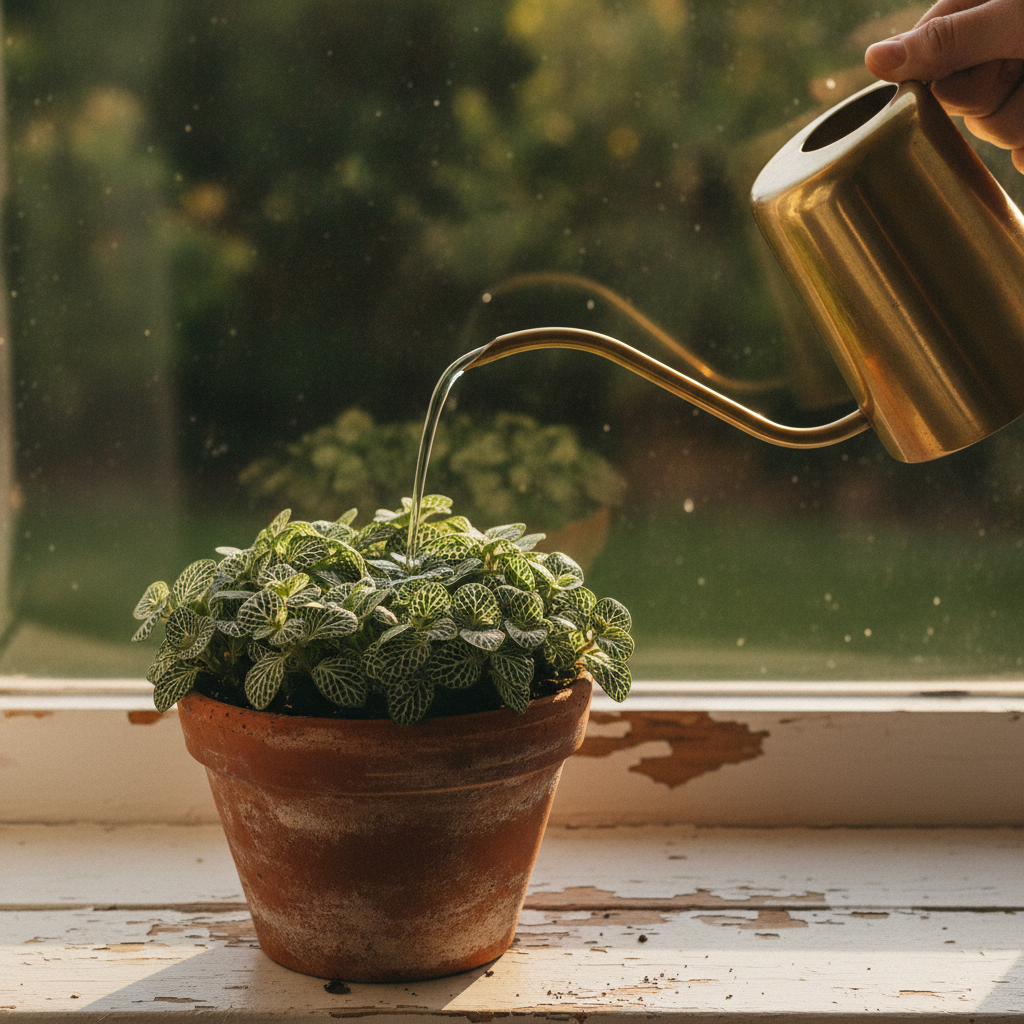
The goal is soil that stays consistently, lightly moist, never dust dry and never saturated. In practice this means checking the plant every couple of days and watering as soon as the top centimetre (roughly half an inch) of the mix begins to feel dry to the touch. In a warm, bright position through spring and summer this may mean watering two or three times a week; in cooler, darker winter conditions the plant uses far less and the interval stretches out. Let the plant and the pot guide you rather than a fixed schedule.
The famous faint is a genuine wilting response, not a harmless quirk to be relied upon. Each time the plant collapses it loses a little vigour, and repeated fainting stresses it and can cause leaf edges to crisp and die. Treat a wilt as a warning that you have left it slightly too long, and aim to water before it reaches that point rather than using the collapse as your cue.
Pro Tip — The Finger Test: Push a fingertip into the soil up to the first knuckle. If the surface feels dry but there is coolness and slight moisture just below, it is time to water. If it is still visibly damp at the surface, wait a day and check again.
How to Water Correctly
- Use room-temperature water, as cold water can shock the roots of this warmth-loving plant.
- Pour slowly and evenly over the soil surface, keeping water off the crown and leaves where possible to reduce the risk of rot and marking.
- Continue until water runs freely from the drainage holes, ensuring the whole root ball is moistened rather than just the top.
- Let the pot drain fully for a few minutes so no excess sits at the base.
- Empty the saucer or cache pot; never leave the plant standing in collected water.
Signs of Overwatering vs. Underwatering
| Symptom | Overwatering | Underwatering |
|---|---|---|
| Leaf colour | Yellowing, often from the lower leaves up | Dull, then browning and crisping at the edges |
| Leaf texture | Soft, limp and translucent | Thin, papery and dry to the touch |
| Whole plant | Wilts even though the soil is wet | Dramatic faint that recovers after watering |
| Soil | Stays soggy for days, may smell sour | Pulls away from the pot edge, bone dry |
| Stem base | Blackened, mushy and collapsing | Firm but shrivelled and dry |
Warning — Root Rot: A nerve plant that wilts while its soil is still wet is almost certainly suffering root rot, not thirst. Watering more at this point will kill it. Instead, unpot the plant, cut away any black, mushy roots, and repot into fresh, barely moist mix, then keep it warm and humid while it recovers.
Humidity Requirements
Humidity is where the nerve plant separates the casual grower from the successful one. Coming from a rainforest floor, it expects air that rarely falls below 60 percent humidity, and it shows its displeasure in dry rooms by crisping at the leaf edges and dropping its lowest leaves. Ordinary heated indoor air, especially in winter, sits far below this and is the most common reason a White Anne struggles even when watering is spot on.
The clearest sign that humidity is too low is browning that begins at the very tips and margins of the leaves while the soil moisture is correct. Younger leaves may also emerge smaller than they should, and overall growth slows. These symptoms are a request for damper air rather than more water at the roots.
Raising humidity reliably is best done by grouping the plant with others, standing the pot on a wide tray of pebbles topped up with water so evaporation rises around the foliage, or running a small humidifier nearby. The most dependable solution of all is to grow the White Anne in a terrarium, bottle garden or glass cloche, where the enclosed air holds moisture naturally and the plant can flourish with almost no attention. Misting helps a little but is short-lived and, if the leaves stay wet too long, can encourage fungal spotting, so it is a supplement rather than a solution.
Water Quality
Nerve plants are moderately sensitive to the minerals and chlorine in tap water, which over time can contribute to leaf-tip browning. If your tap water is very hard or heavily chlorinated, using filtered or rainwater, or leaving tap water to stand overnight before use, will keep the foliage cleaner and the tips greener. Room-temperature water is always preferable to cold, whatever its source.
Soil, Potting & Repotting
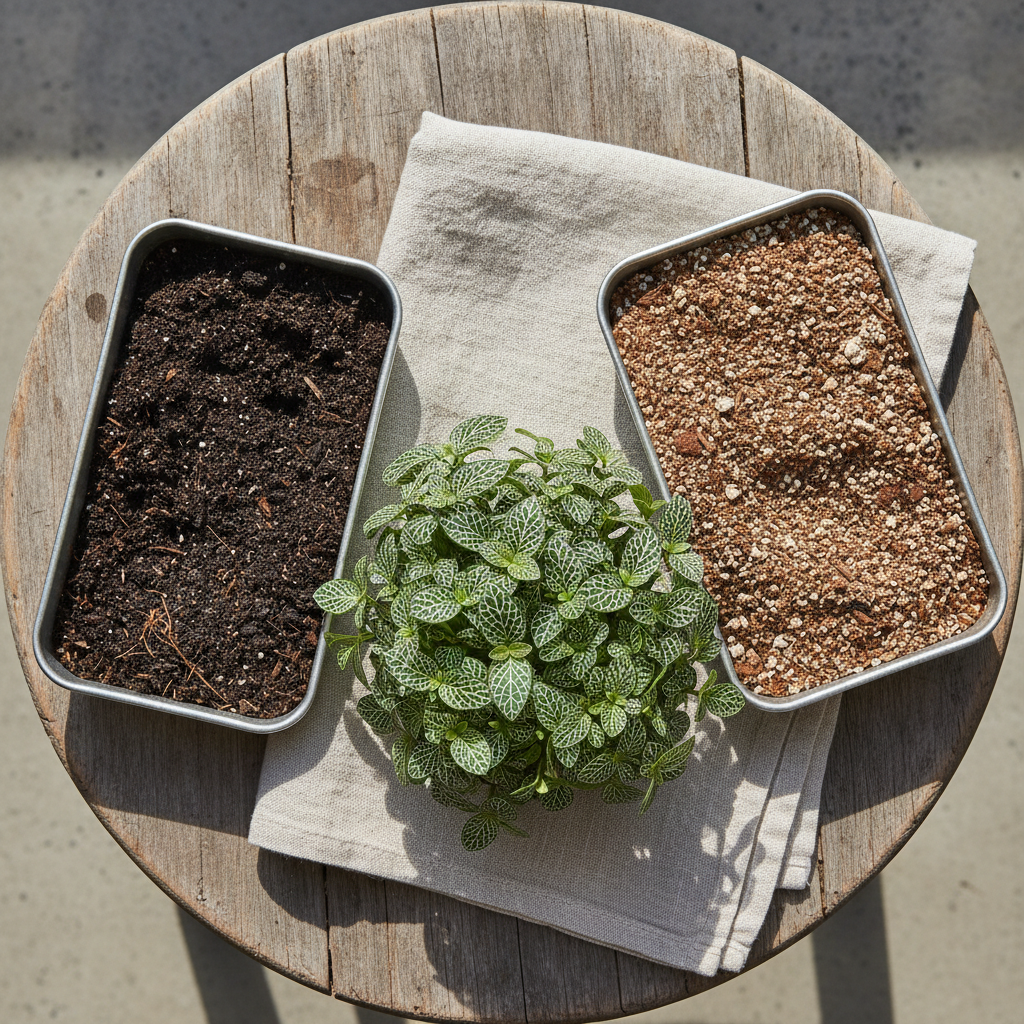
The right growing medium for a nerve plant has to perform a delicate balancing act: it must hold enough moisture to keep the shallow roots consistently damp, yet drain freely enough that water never pools and suffocates them. A dense, water-retentive potting soil left to sit wet is a direct route to root rot, while a fast, gritty mix dries too quickly for a plant that hates drought. The aim is a light, airy, moisture-retentive blend that stays evenly damp without turning to sludge.
Ideal Soil Composition
A good base is a quality peat-free houseplant compost, lightened and opened up with materials that add air and control moisture. Coir provides gentle water retention, perlite keeps the structure open and draining, and a little fine bark or worm castings adds texture and slow nutrition. Combined, these give the roots the damp-but-breathing environment they need.
| Component | Proportion | Function |
|---|---|---|
| Peat-free houseplant compost | Half | Main body of the mix, holds moisture and nutrients |
| Coco coir | One quarter | Retains even moisture without compacting |
| Perlite | One quarter | Opens the structure and improves drainage and aeration |
| Worm castings or fine bark | A handful | Adds texture and gentle, slow-release nutrition |
Nerve plants prefer a soil that is slightly acidic to neutral, in the region of pH 6.0 to 6.5, which most peat-free houseplant composts fall comfortably within. There is rarely any need to adjust the pH deliberately; simply avoid heavily limed or alkaline mixes.
Pro Tip — Quick Mix Recipe: For a fast, reliable blend, combine two handfuls of peat-free houseplant compost with one handful of coir and one handful of perlite. It should feel light and springy, hold together loosely when squeezed damp, and crumble apart again when you open your hand.
Choosing the Right Pot
Because a nerve plant is small and shallow-rooted, it does best in a modest pot that matches its root ball rather than a large one. A shallow, wide pot suits its spreading habit better than a deep one, and keeps the lower reaches of the soil from staying soggy where no roots reach.
Drainage holes are non-negotiable. Whatever the material or style, the pot must have holes at the base so excess water can escape. A decorative cache pot without drainage can be used as an outer cover, but the plant should sit in an inner pot that drains, and that inner pot must never stand in collected water.
Pot material: Plastic and glazed ceramic hold moisture longer and suit a plant that likes to stay damp, making them the easiest choice. Unglazed terracotta wicks moisture out through its walls and dries quickly, which can work against you with a thirsty nerve plant unless you are prepared to water more often.
Pot size: Choose a pot only a couple of centimetres wider than the current root ball. An oversized pot holds a large volume of wet soil that the small root system cannot use, and that standing moisture is exactly what invites rot.
When to Repot
Nerve plants are not fast growers and rarely need frequent repotting; every one to two years is usually enough. Signs it is time include roots emerging from the drainage holes, water running straight through without wetting the mix, soil that has broken down and compacted, or a plant that dries out noticeably faster than it used to. Spring, at the start of the active growing season, is the best time to repot so the plant can settle in as growth accelerates.
How to Repot: Step-by-Step
- Water the plant lightly a day beforehand so the root ball holds together and the plant is not stressed.
- Ease the plant out of its pot, supporting the crown, and gently tease apart any circling roots at the base.
- Inspect the roots, trimming away anything black, soft or clearly dead with clean scissors.
- Add a layer of fresh mix to the base of a pot only slightly larger than the last, and position the plant at the same depth it grew before.
- Fill around the roots with fresh mix, pressing gently to remove air pockets without compacting the soil hard.
- Water thoroughly to settle the mix, then return the plant to its warm, humid, brightly lit spot.
Warning — Transplant Shock: A nerve plant will often faint dramatically for a day or two after repotting as the disturbed roots re-establish. Resist the urge to overwater in response; keep the mix lightly moist and the humidity high, and it will recover on its own.
Fertilising
A nerve plant is a light feeder, but because it grows in a small volume of soil that is watered often, nutrients are steadily flushed away and need modest replacement during the growing season. Regular, gentle feeding keeps the foliage dense and the venation bright, while the plant’s small size and sensitive roots mean that too much fertiliser does far more harm than too little.
The season matters as much as the dose. From spring through to early autumn the plant is actively growing and can use a regular feed. In the darker, cooler months growth slows or stops, and feeding should stop with it, since a resting plant cannot use the nutrients and unused salts accumulate in the soil.
Understanding Plant Nutrients
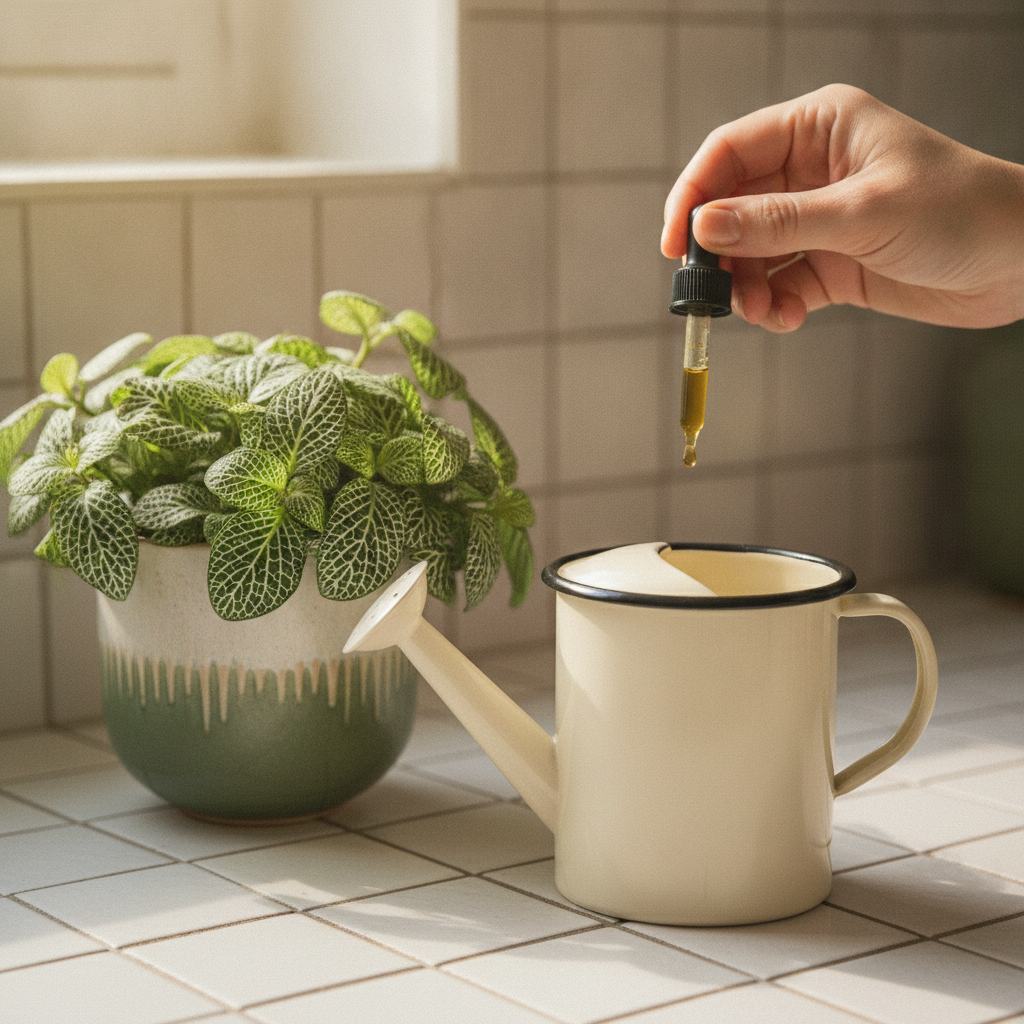
Most balanced houseplant fertilisers list three numbers on the label, the ratio of nitrogen, phosphorus and potassium, the three nutrients plants need in the largest amounts. For a foliage plant like the nerve plant, nitrogen for leaf growth is the most important of the three, but a balanced feed that also supplies the secondary nutrients and trace elements keeps the whole plant healthy and the leaf pattern strong.
| Nutrient | Symbol | Primary Function | Deficiency Symptoms |
|---|---|---|---|
| Nitrogen | N | Leaf and stem growth, rich green colour | Pale, yellowing older leaves and slow growth |
| Phosphorus | P | Root development and overall vigour | Weak roots, stunted, sluggish growth |
| Potassium | K | Water regulation and general resilience | Browning leaf edges and weak stems |
| Magnesium | Mg | Core of the chlorophyll molecule | Yellowing between the veins of older leaves |
| Iron | Fe | Chlorophyll production in new growth | Pale or yellow new leaves with green veins |
Types of Fertiliser
Liquid fertilisers: The most practical choice for a nerve plant, as they are easy to dilute precisely and to control. A balanced liquid houseplant feed diluted to half the recommended strength and applied with a normal watering gives steady, gentle nutrition.
Slow-release granular: Convenient in that a single application feeds for months, but harder to moderate for a small, sensitive plant, and it can release more than a nerve plant wants in warm, wet conditions. If used, apply at a reduced rate.
Organic fertilisers: Gentle options such as diluted worm-casting tea or a mild organic liquid feed suit the nerve plant well, providing slow, forgiving nutrition with little risk of burning the roots.
Feeding Schedule
Through spring and summer, feed roughly once a month with a balanced liquid fertiliser at half strength. Some growers prefer to feed more often at an even weaker dilution, which suits the plant’s preference for little and often. Stop feeding entirely from mid-autumn through winter while growth is at rest, and resume only when new leaves signal the return of active growth in spring.
Pro Tip — Feed a Damp Plant: Always apply fertiliser to already-moist soil, never to a dry root ball. Feeding a thirsty, dry plant concentrates the salts against parched roots and can scorch them. Water first if in doubt, then feed.
How to Fertilise
- Dilute a balanced liquid fertiliser to half the strength stated on the label.
- Make sure the soil is already lightly moist from a recent watering.
- Pour the diluted feed evenly over the soil until it just begins to drain from the base.
- Discard any run-off and never let the plant sit in fertiliser-laden water.
- Every couple of months, water thoroughly with plain water to flush out accumulated salts.
Warning — Salt Build-Up: A white crust on the soil surface or pot rim, along with browning leaf tips, signals a build-up of fertiliser salts. Flush the pot by running plenty of plain water through it until it drains freely, and ease off the feeding for a while.
Propagation
One of the great pleasures of the nerve plant is how readily it propagates. It roots so willingly from stem cuttings that a single healthy plant can quickly become several, and taking cuttings is also the best way to rejuvenate a specimen that has grown leggy or bare at the centre. Because the plant naturally spreads by rooting where its stems touch damp soil, it is genetically primed to make new roots from almost any node.
Spring and early summer are the ideal times, when the plant is growing actively and cuttings root fastest, but with warmth and humidity you can succeed at almost any time of year. The two most reliable methods are rooting cuttings in water and rooting them directly in soil or moss, and both are simple enough for a first-time propagator.
Understanding Nodes
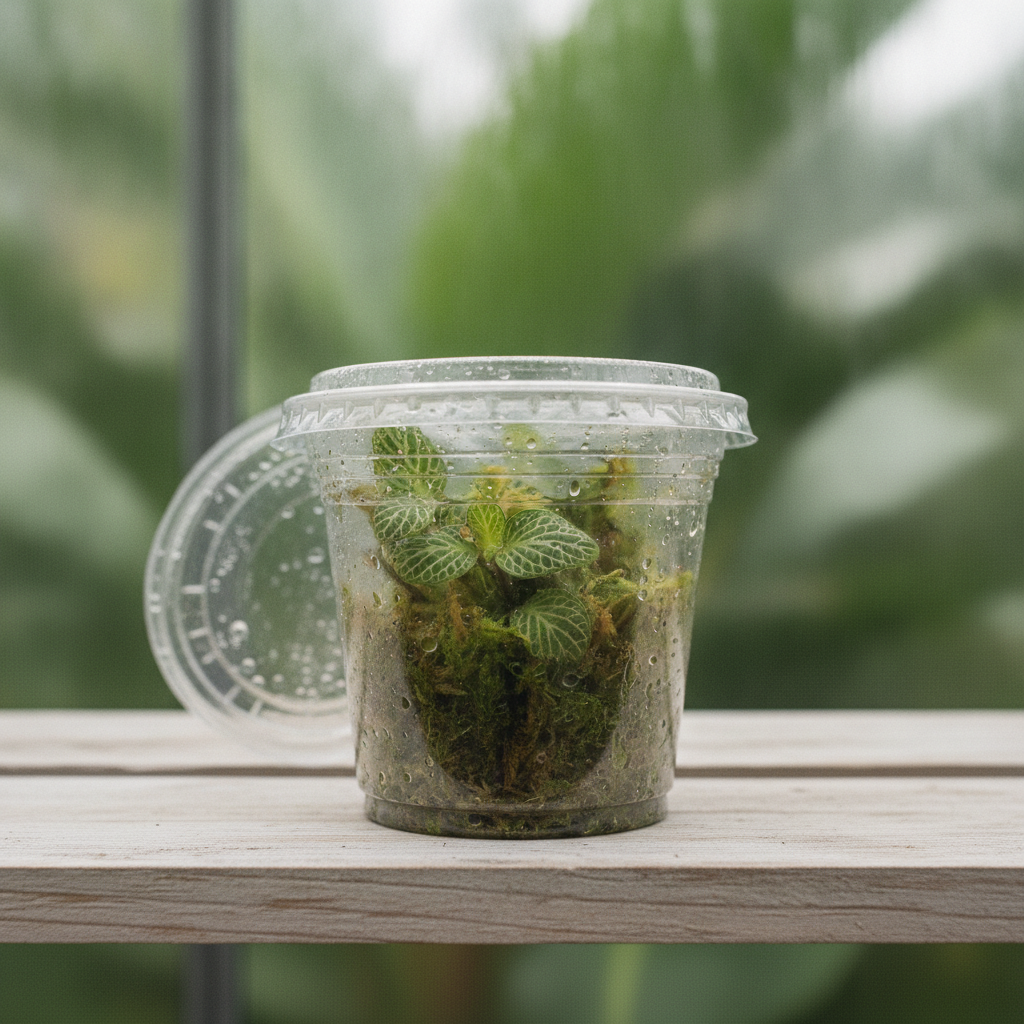
A node is the small joint on a stem where leaves attach and where dormant root cells wait to activate. Successful propagation depends on including at least one node below the water or soil line, because this is where new roots will emerge. A cutting with only leaves and no node will not root, so learning to spot these joints is the key to reliable success.
Water Propagation: Step-by-Step
Rooting in water lets you watch the roots develop and is very forgiving, which makes it a good place to start.
- Choose a healthy stem tip and cut a length of 8 to 10 cm (3 to 4 in) just below a node using clean, sharp scissors.
- Remove the lowest one or two pairs of leaves so that a bare node will sit below the water line.
- Place the cutting in a small glass of room-temperature water with the node submerged and the remaining leaves above the surface.
- Set the glass in bright indirect light and refresh the water every few days to keep it clean and oxygenated.
- Once roots reach 2 to 3 cm (about 1 in), usually within two to three weeks, pot the cutting into a small container of moist mix.
Pro Tip — Plant Roots Early: Do not wait for a long tangle of water roots before potting up. Water-formed roots are brittle and must adapt to soil, so transferring cuttings when roots are still short, around 2 to 3 cm, gives the smoothest transition and the least setback.
Soil and Moss Propagation: Step-by-Step
Rooting directly in damp soil or sphagnum moss avoids the water-to-soil transition altogether and often produces sturdier roots, at the cost of not being able to see progress.
- Take the same kind of stem-tip cutting, 8 to 10 cm long with a node exposed at the base.
- Insert the bare node into moist propagation mix or damp sphagnum moss so it is held firmly in contact with the medium.
- Cover the pot or cup with a clear lid, bag or dome to trap humidity around the cutting.
- Keep the medium lightly moist and warm, in bright indirect light, opening the cover briefly every few days for fresh air.
- After three to four weeks, a gentle tug that meets resistance shows roots have formed, at which point the cover can gradually be removed.
Troubleshooting Propagation
| Problem | Likely Cause | Solution |
|---|---|---|
| Cutting rots in water | No node submerged or dirty water | Recut below a node and refresh the water regularly |
| Cutting wilts and shrivels | Humidity too low for the rootless cutting | Cover to raise humidity while roots form |
| No roots after several weeks | Too cold, or the cutting lacked a node | Provide steady warmth and ensure a node is included |
| Roots form but plant stalls after potting | Transplant shock or dry air | Keep warm and humid and avoid overwatering while it settles |
Pests & Diseases
The nerve plant is not especially prone to pests, and a healthy, well-cared-for specimen is largely trouble-free. The humid conditions it enjoys, however, can occasionally attract sap-sucking insects and, if air movement is poor or the leaves stay wet, encourage fungal problems. Catching either early makes them simple to manage.
The most important habit is regular inspection. Turn a few leaves over each time you water and look along the stems and leaf joints, because most infestations are far easier to clear when they involve a handful of insects rather than a colony. A plant kept at the right moisture and humidity, with good airflow, resists problems far better than a stressed one.
Common Pests
Fungus Gnats (Bradysia species)
Small black flies that hover around the soil are the pest most associated with nerve plants, drawn by the constantly damp surface the plant requires. The adults are a nuisance rather than a danger, but their larvae feed on organic matter and fine roots in the soil and can weaken a small plant.
Treatment: Let the very top of the soil dry slightly between waterings to disrupt the larvae, cover the surface with a thin layer of grit, and use yellow sticky traps to catch the adults. A biological control such as beneficial nematodes clears persistent infestations.
Aphids (Aphidoidea)
Tiny green, black or pink insects that cluster on soft new growth and the undersides of leaves, sucking sap and leaving a sticky honeydew residue. Heavy infestations distort young leaves and slow growth.
Treatment: Rinse them off under a gentle stream of water, then treat with insecticidal soap or a diluted neem oil spray, repeating every few days until they are gone.
Mealybugs (Pseudococcidae)
White, cottony clusters tucked into leaf joints and along stems, mealybugs are slow-moving but persistent sap-feeders that thrive in warm, humid conditions and can be hard to shift once established.
Treatment: Dab each insect with a cotton bud dipped in diluted isopropyl alcohol, then follow up with neem oil across the whole plant, checking again after a week for any survivors.
Common Diseases
Root Rot (Pythium and Phytophthora)
The most serious threat to a nerve plant, root rot follows from soil kept waterlogged for too long. Roots turn black and mushy, the stem base softens, and the plant wilts despite wet soil, which is easily mistaken for thirst.
Treatment: Unpot the plant, cut away all blackened, soft roots with clean scissors, and repot into fresh, barely moist mix in a clean pot. Take healthy stem cuttings as insurance in case the parent cannot be saved.
Leaf Spot and Powdery Mildew
Fungal leaf spots appear as brown or dark lesions, while powdery mildew shows as a white, dusty coating on the leaves. Both are encouraged by leaves that stay wet and by stagnant, overly humid air with no movement.
Treatment: Remove affected leaves, improve air circulation around the plant, and avoid wetting the foliage when watering. A fungicidal spray can be used for stubborn cases.
Pest and Disease Summary
| Pest / Disease | Identification | Treatment |
|---|---|---|
| Fungus gnats | Small black flies around damp soil | Dry the surface, grit topping, sticky traps, nematodes |
| Aphids | Clusters on new growth, sticky honeydew | Rinse off, then insecticidal soap or neem oil |
| Mealybugs | White cottony tufts in leaf joints | Alcohol on a cotton bud, then neem oil |
| Root rot | Wilting in wet soil, blackened roots | Cut away rot and repot into fresh mix |
| Leaf spot and mildew | Brown lesions or white dusty coating | Remove leaves, improve airflow, keep foliage dry |
Prevention Strategies
The best defence is a plant that is never stressed. Consistent watering that keeps the soil evenly moist without waterlogging, high humidity paired with gentle air movement, and correct light all combine to make a nerve plant far more resistant to both pests and disease than a struggling one. Quarantine any new plant for a couple of weeks before placing it near your collection, since most infestations arrive on new arrivals.
Cleanliness matters too. Wipe dust from the leaves occasionally so you can see problems developing, remove fallen leaves and debris from the soil surface promptly, and use clean tools when taking cuttings or trimming. These small habits prevent the majority of issues from ever taking hold.
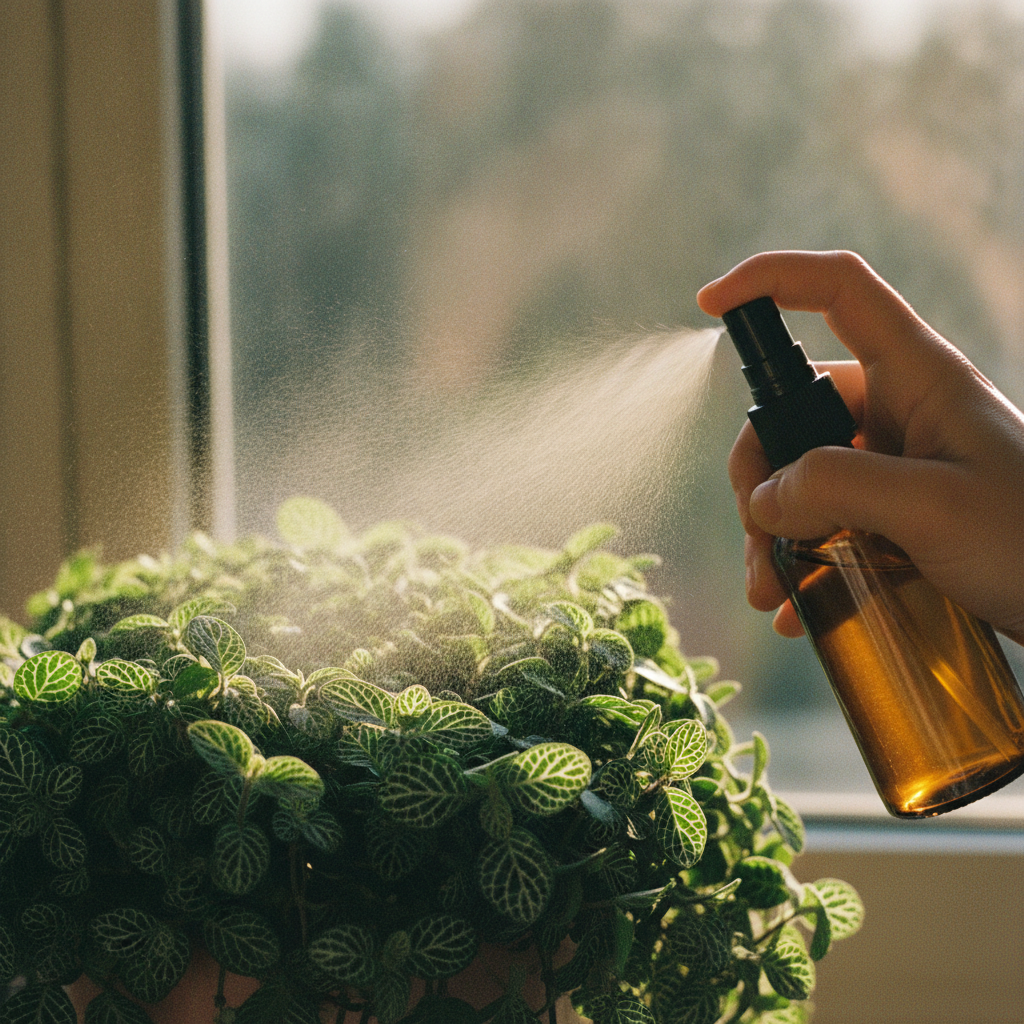
Pro Tip — Neem as Routine: A light monthly neem oil spray during the growing season, applied to the leaf undersides in the evening out of direct sun, keeps most sap-sucking pests from ever establishing and doubles as a mild preventive against fungal issues.
Popular Varieties
The White Anne belongs to a wider family of nerve plant cultivars bred for the colour and pattern of their venation, and all share the same care requirements. Once you have mastered one, you can grow any of them, and many collectors enjoy grouping several together to play the white, pink and red veining against one another in a single humid display.
The main differences between varieties lie in vein colour, leaf size and the boldness of the pattern. The Anne series, to which White Anne belongs, has slightly larger leaves and a more relaxed pattern than the tightly netted small-leaved forms, making it a little easier and faster to grow.
| Variety | Leaf Appearance | Light Needs | Growth Rate | Availability |
|---|---|---|---|---|
| White Anne | Green leaves with bright white veins | Bright indirect | Moderate | Common |
| Red Anne | Deep green with vivid carmine-red veins | Bright indirect | Moderate | Common |
| Pink Angel | Green flushed with rose-pink veining | Bright indirect | Moderate | Common |
| Mosaic (Frankie) | Broad pink veining across large leaves | Bright indirect | Moderate | Fairly common |
| Josan | Compact pink-veined leaves, dense habit | Bright indirect | Slow to moderate | Fairly common |
| Skeleton | Fine, tightly netted red-pink venation | Bright indirect | Slow | Less common |
Featured Varieties
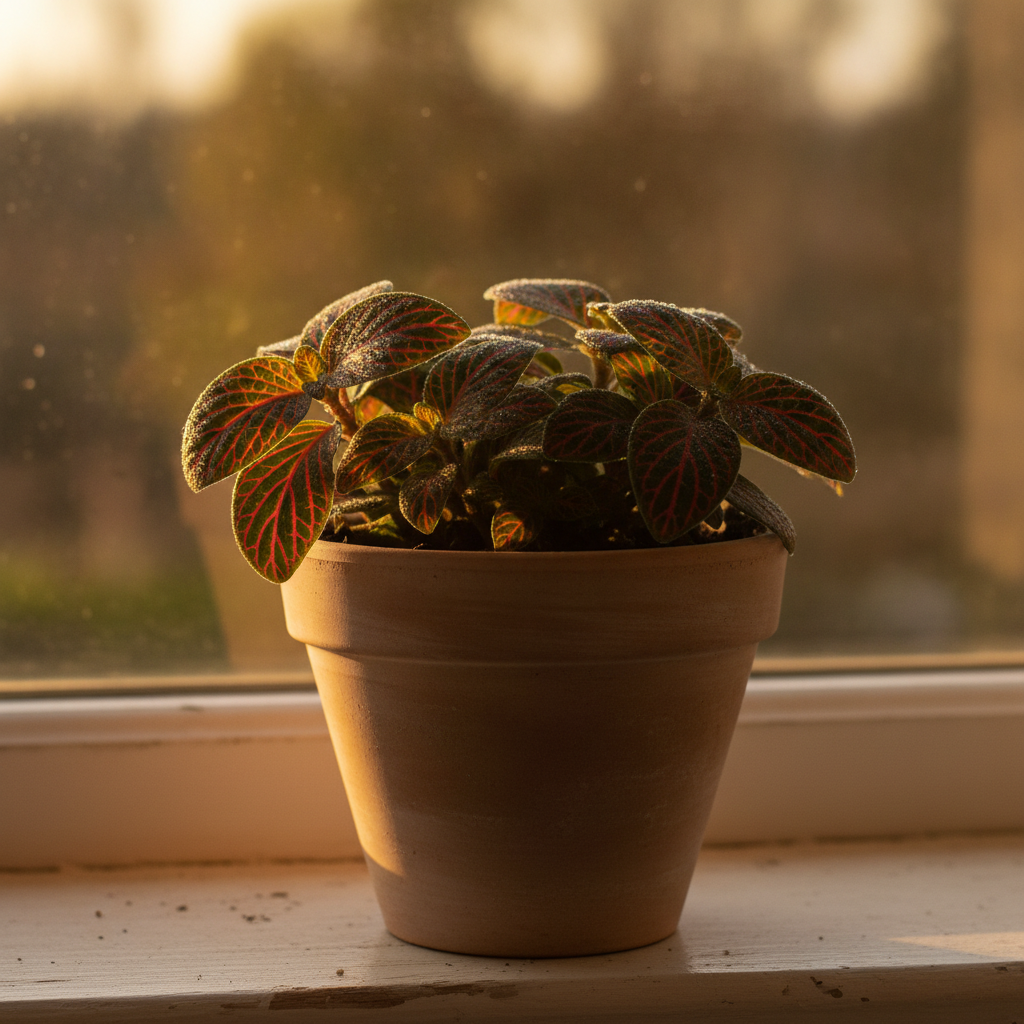
Red Anne
The bold counterpart to White Anne, with the same generous leaf size but veins in a vivid carmine red that stands out dramatically against the dark green blade. It is one of the easiest coloured forms to grow and makes a striking companion to the white-veined type.
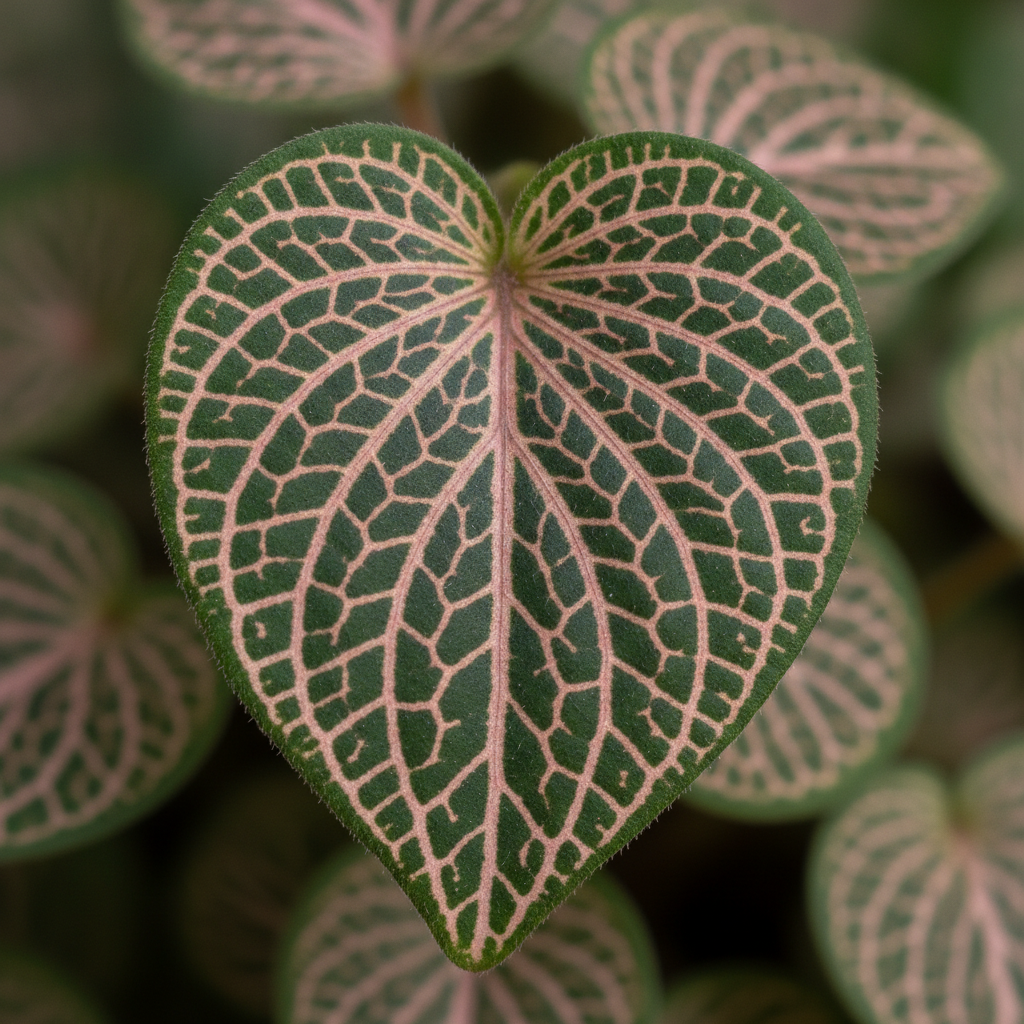
Pink Angel
A softer, romantic form whose green leaves are washed through with a fine network of rose-pink veining that deepens in good light. Pink Angel sits beautifully between the crispness of White Anne and the boldness of Red Anne in a mixed grouping.
Variety Profiles in Detail
White Anne (Fittonia verschaffeltii ‘White Anne’)
The subject of this guide and one of the most widely grown nerve plants, White Anne pairs comparatively large, rounded green leaves with a bold, bright white vein network. Its slightly larger leaves and more open pattern make it a touch more vigorous and forgiving than the finely netted forms, which is part of why it is so popular with beginners and collectors alike.
Mosaic, or Frankie (Fittonia albivenis Mosaic Group)
A showy form with broad, generous pink venation spread across large leaves, sometimes flushed so heavily that the pink dominates the green. It has the same care needs as the Anne types and brings a warmer, more saturated colour to a mixed nerve plant display.
Choosing the Right Variety for Your Space
Because every nerve plant shares the same requirements, the choice comes down entirely to colour and scale. White Anne and Red Anne, with their larger leaves and easier growth, are the best starting points and the most forgiving. If you want the finest, most intricate patterning, the small-leaved Skeleton and Josan types deliver it at the cost of slower growth and slightly fussier care. For a terrarium or bottle garden, any of them thrives, and a mix of white, pink and red veining in a single glass container makes one of the most rewarding closed displays you can grow.
Frequently Asked Questions
Why does my nerve plant keep collapsing?
The dramatic collapse, often called fainting, is the plant’s way of showing that its shallow roots have run dry. Water it and it will usually revive within an hour or two. If it collapses while the soil is still wet, the cause is the opposite, root rot from overwatering, and more water will make it worse. Aim to water before the plant reaches the point of fainting, since repeated collapses gradually weaken it.
Why are the leaf tips and edges turning brown?
Crisp brown tips and margins are the classic sign of air that is too dry. Nerve plants want humidity of 60 percent or more, and heated indoor air falls well below this. Raise the humidity with a pebble tray, a humidifier, a group of plants or a terrarium. Browning can also follow from mineral build-up, so switching to filtered or rainwater may help if your tap water is hard.
Is the White Anne nerve plant safe for cats and dogs?
Yes. The nerve plant is listed as non-toxic to both cats and dogs by the ASPCA and is not known to harm humans, which makes it one of the safest patterned houseplants for homes with pets and children. It is still sensible to discourage chewing, mainly to protect the plant’s delicate foliage.
How much light does a nerve plant actually need?
Bright indirect light is ideal, meaning plenty of ambient daylight but no direct sun on the leaves. It also copes with medium light a little further from a window, which makes it flexible for many rooms. Avoid both direct sun, which scorches the thin leaves, and deep shade, which dulls the white veining and causes leggy growth.
Can I grow a nerve plant in a terrarium?
Absolutely, and it is arguably the best way to grow one. The enclosed, humid environment of a terrarium or bottle garden meets the plant’s love of moist air perfectly, and its small, spreading size suits the scale of glass containers. Inside a terrarium a nerve plant will often thrive with far less day-to-day attention than one grown in open air.
How do I make my nerve plant bushier?
Regular pinching is the key. Nipping out the growing tips of the stems encourages the plant to branch from lower down, producing a fuller, denser cushion rather than long, bare trailing stems. Pinch throughout the growing season, and use the tips you remove as cuttings to propagate new plants. Good light and steady feeding also keep growth compact.
Does the nerve plant flower?
It can produce small spikes of insignificant white or pale yellow flowers, but the blooms are unremarkable and the plant is grown entirely for its foliage. Many growers pinch off the flower spikes as they appear so the plant channels its energy into leaves and stays compact rather than stretching to bloom.
Why is the white veining on my plant fading?
Fading, muddy venation is usually a light problem. In too little light the leaf produces extra chlorophyll and the green spreads at the expense of the white pattern. Move the plant to a brighter spot with more bright indirect light, making the change gradually over a week or two, and the contrast should sharpen again in the new growth.
How often should I repot a nerve plant?
Every one to two years is usually enough, since nerve plants grow slowly and prefer a snug pot. Repot in spring when you see roots emerging from the drainage holes, water running straight through, or soil that has compacted. Move up only one pot size, as an oversized pot holds too much wet soil and invites root rot.
My nerve plant has become leggy and bare in the middle. What can I do?
Legginess comes with age and low light, but it is easily fixed. Cut the long stems back hard, which prompts fresh branching from the base, and root the healthy tips you remove as cuttings. Planting several rooted cuttings back into the same pot quickly rebuilds a full, dense plant, and brighter light will keep the new growth compact.






