
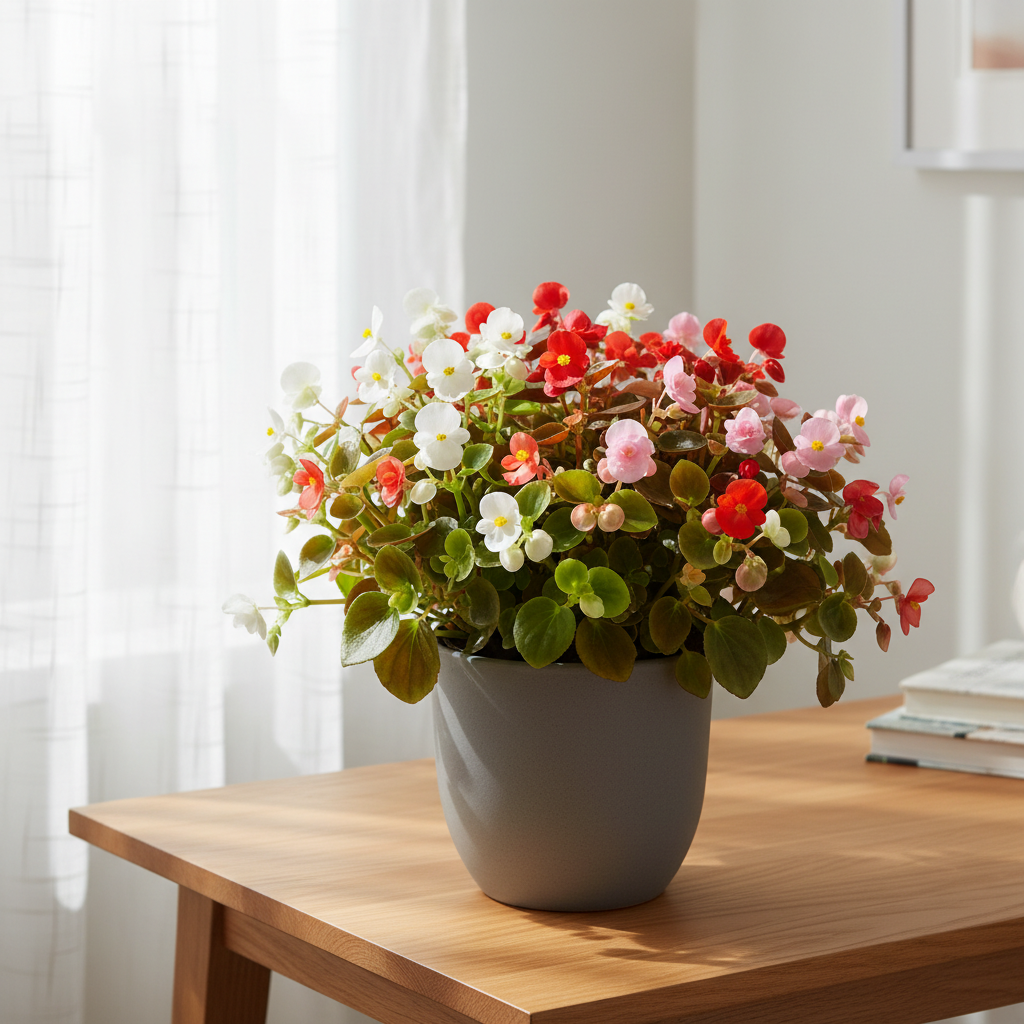
Few flowering houseplants earn their keep quite so reliably as the wax begonia. Known botanically as Begonia semperflorens (a name that translates loosely as “always flowering”) and sold under names like bedding begonia, fibrous begonia or simply semperflorens begonia, this compact little plant is one of those rare specimens that genuinely lives up to its botanical promise. Native to the rich, semi-shaded forest edges of Brazil and neighbouring parts of South America, it was brought into European cultivation in the nineteenth century and has since been bred into hundreds of cultivars, most descending from a tangled hybrid group now formally known as Begonia Semperflorens-Cultorum Group.
The wax begonia has a faintly old-fashioned reputation, partly because it dominates summer bedding schemes in parks and municipal planters, and partly because gardeners sometimes overlook how good it is as an indoor plant. Lift it out of the bedding context, give it a bright windowsill and a free-draining pot, and it transforms into a tidy mound of glossy waxy leaves topped almost continuously by clusters of single or double flowers in white, pink, coral or vivid red. This guide covers everything from minimum survival conditions to the small adjustments that turn a plant ticking along into one flowering its head off month after month, including the difference between varieties bred for shaded beds and those bred for the sun-soaked windowsill.
Contents
- Quick Reference
- Why Wax Begonia Makes a Cheerful Houseplant
- Light Requirements
- Watering and Humidity
- Soil, Potting and Repotting
- Fertilising
- Propagation
- Pests and Diseases
- Popular Varieties
- Frequently Asked Questions
Quick Reference: Wax Begonia at a Glance
| Botanical name | Begonia semperflorens (Semperflorens-Cultorum Group) |
| Family | Begoniaceae |
| Native range | Brazil and adjacent South America |
| Mature size | 15 to 30 cm tall and wide (6 to 12 in); some Big Series cultivars reach 45 cm (18 in) |
| Light | Bright indirect light indoors; green-leaved cultivars tolerate part shade, bronze-leaved cultivars enjoy several hours of direct morning sun |
| Watering | Allow the top 2 to 3 cm (1 in) of compost to dry between waterings; never soggy, never bone-dry for long |
| Temperature | 18 to 24 °C (64 to 75 °F); keep above 13 °C (55 °F) |
| Humidity | Average household humidity, 40 to 60 percent; tolerates dry indoor air better than most begonias |
| Fertiliser | Balanced liquid feed at half strength every two weeks in spring and summer; monthly in autumn; rest in winter |
| Flowering | Near-continuous in warmth and good light; clusters of single or double flowers in white, pink, coral and red |
| Toxicity | Mildly toxic to cats, dogs and small mammals; the tubers and stems contain soluble calcium oxalates |
| Lifespan indoors | Two to three years before tidy replacement; older plants flower less freely |
Why Wax Begonia Makes a Cheerful Houseplant
Wax begonias are loved indoors for the same qualities that make them so dependable in bedding schemes: they flower at the smallest provocation, they keep flowering, and they ask very little in return. A plant kept warm, watered moderately and given a few hours of bright light each day will produce buds within weeks of being potted up and then continue producing them, in tidy clusters of three to five blooms at a time, for most of the year. The flowers are not large in the way a hibiscus or a geranium bloom is, but they appear in such abundance that a healthy specimen can carry forty or fifty open flowers at once on a single 20 cm (8 in) plant.
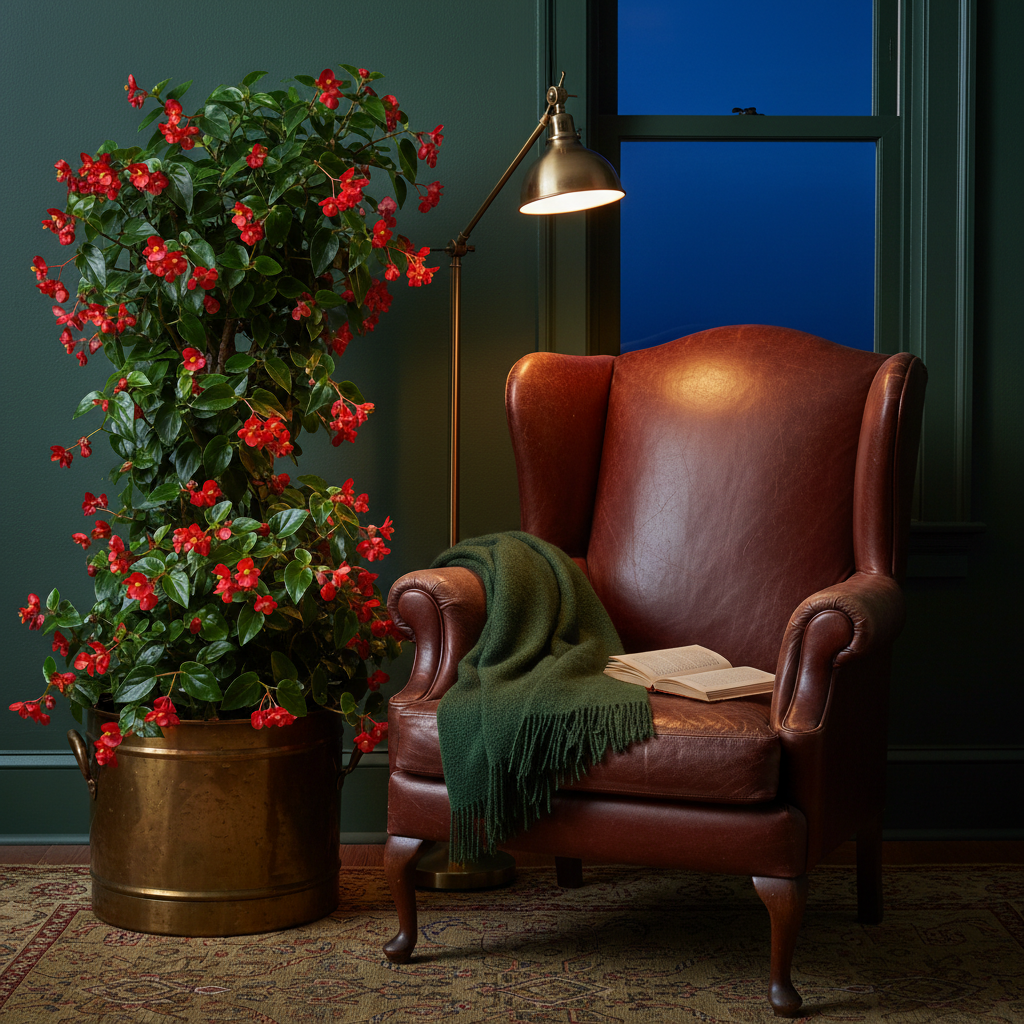
The plant’s structure is part of what makes it so well behaved indoors. Unlike rex and rhizomatous begonias, the wax begonia is fibrous-rooted and produces a dense, low mound that rarely needs staking or pruning. It does not climb, sprawl or shed leaves dramatically; it does not have a dormancy that strips it bare for half the year. The waxy cuticle on the leaves, which gives the plant its common name, makes the foliage genuinely glossy and surprisingly resistant to the dry air of a centrally heated home. Bronze-leaved cultivars in particular look almost lacquered in good light, and their dark backdrop intensifies the colour of every flower against it.
There is also a horticultural argument for the wax begonia that other flowering houseplants struggle to make. African violets demand consistent moisture and rotation; orchids need a moisture-and-light routine that many beginners find baffling; cyclamen go semi-dormant just as you are getting used to them. Wax begonias, by contrast, behave more like a slightly fussy foliage plant that also happens to flower. The same care that would keep a peace lily or a polka dot plant alive on a kitchen counter will keep a wax begonia in continuous bloom. That makes it one of the few genuinely beginner-friendly flowering houseplants, and a useful gateway into the wider, weirder world of the begonia genus.
One word of caution: Begonia semperflorens contains soluble calcium oxalates throughout its tissues, so it is classed as mildly toxic to cats, dogs, rabbits and other small mammals. Ingestion typically causes mouth irritation, drooling and occasional vomiting rather than serious harm, but plants are best kept on a shelf or windowsill out of curious reach. Humans should avoid chewing the leaves and stems, although the flowers of cultivated wax begonias are sometimes used as a peppery edible garnish; we would not recommend eating any plant material from a houseplant that has been routinely fed and treated with garden products.
Light Requirements
Light is the single most important factor in turning a surviving wax begonia into a thriving one. Outdoors in their native range, these plants grow at forest edges and in semi-open clearings where they receive several hours of direct sun and the rest of the day in dappled brightness. Indoors, that translates to bright, indirect light with a few hours of gentle direct sun if you can manage it. An east-facing windowsill that catches morning light is almost ideal; a west-facing window works equally well provided the hottest afternoon rays in midsummer are filtered through a sheer curtain. A south-facing aspect can be excellent for bronze-leaved cultivars in particular, but will need shading from June through August to avoid leaf scorch.
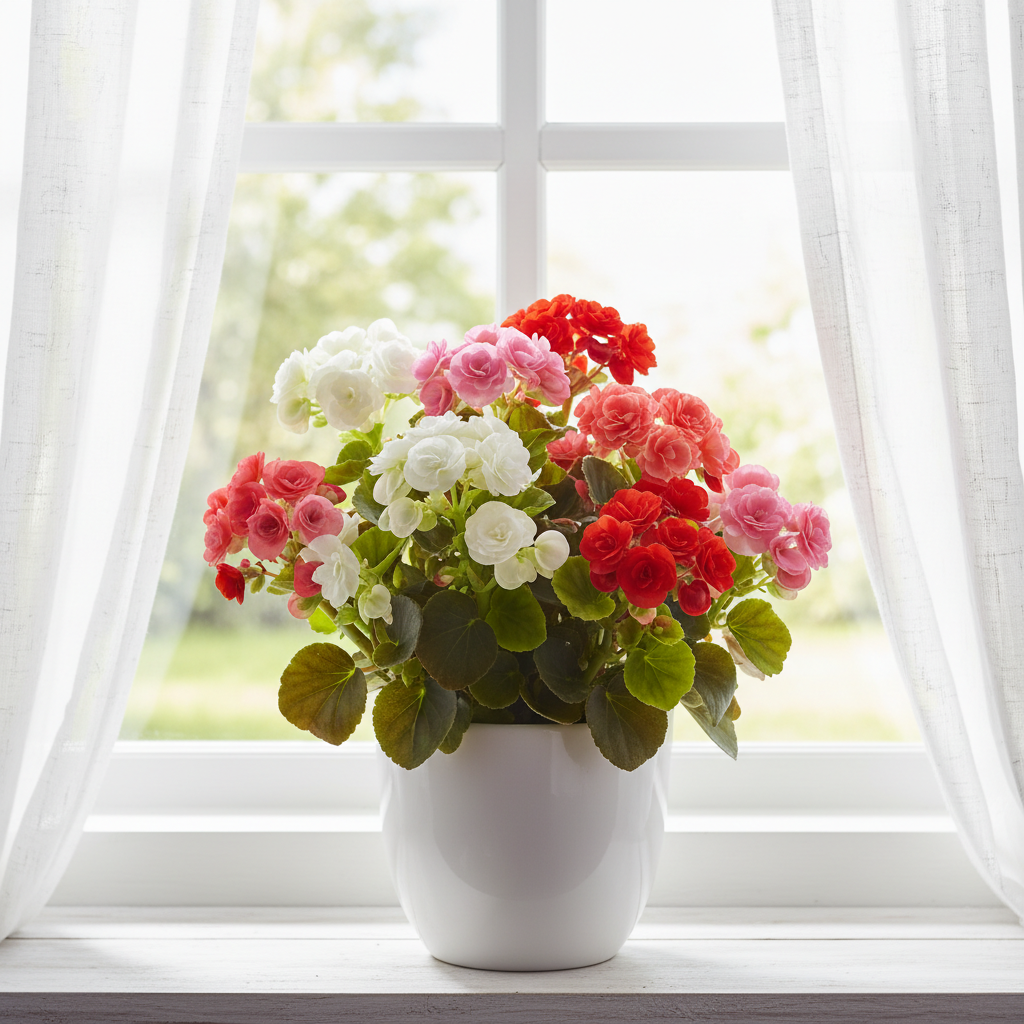
The two leaf colours behave quite differently with light, and the difference is worth knowing before you choose a position. Green-leaved cultivars (the older, more traditional bedding type) are well adapted to dappled and lightly shaded conditions and will sulk in fierce direct sun, often turning pale and crisping at the leaf margins. Bronze-leaved cultivars carry pigments that act as a natural sunscreen, and they take direct sun much better; in fact, they need more sun to develop the deep mahogany tones that distinguish them. Move a bronze-leaved wax begonia into a dim corner and it will gradually fade towards a muddy olive-green, losing the very feature that made you buy it.
The way to read your plant’s response is to watch the gap between leaves and the orientation of the foliage. A wax begonia in correct light produces tightly packed leaves on short internodes, with foliage held more or less horizontally and flowers borne just above the canopy. A plant in low light begins to stretch: internodes lengthen, leaves angle upwards as they reach for the window, and flowering slows or stops altogether. A plant in light that is too intense shows pale, sometimes bleached leaves, often with crisp brown patches on the most exposed surfaces. Use these signals rather than a light meter; the plant is already a good judge of its own environment.
Pro Tip — Rotate weekly: Wax begonias are strongly phototropic and will lean noticeably towards the brightest light within a week. Give the pot a quarter turn every time you water to keep the mound symmetrical and the flowers facing outwards in all directions.
Artificial light is well tolerated by this species, which is one reason it does so well in offices and shop windows. A full-spectrum LED grow light positioned 20 to 30 cm (8 to 12 in) above the canopy and run for ten to twelve hours a day in winter will keep a plant flowering through the dark months when natural daylight in northern latitudes is reduced to a few weak hours. If you grow wax begonias in a windowless bathroom or hallway purely as a foliage statement, the bronze cultivars will hold colour better than the green ones, although you should expect flowering to slow significantly without at least some bright source overhead.
Watering and Humidity
Wax begonias prefer their compost evenly moist but never waterlogged. The simplest rule is to let the top 2 to 3 cm (1 in) of compost dry between waterings, then water thoroughly until it runs out of the drainage holes and discard whatever collects in the saucer. In a warm, bright room with good airflow this typically means watering once every five to seven days in summer and every ten to fourteen days in winter, but the right cadence depends so much on pot size, temperature and humidity that a finger test of the compost is far more reliable than a fixed schedule.
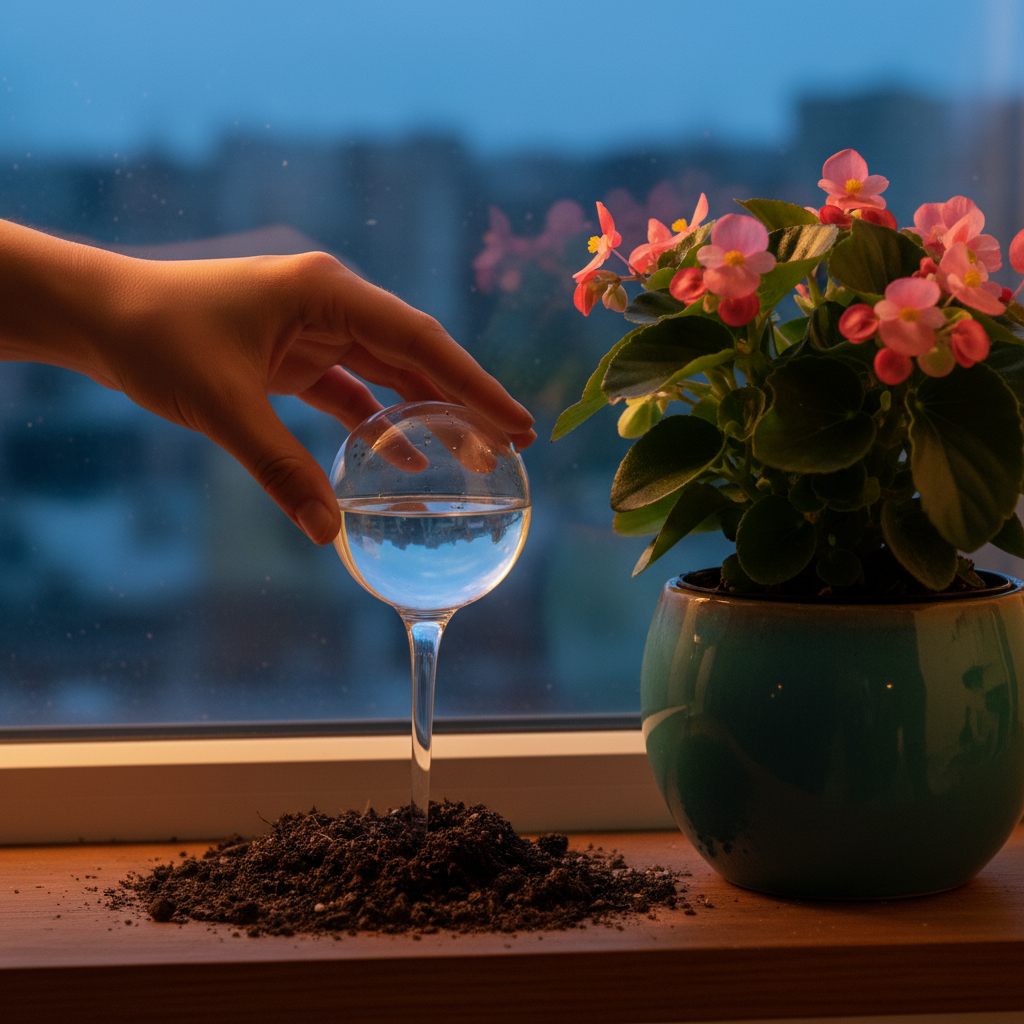
The two ways gardeners most often fail with wax begonias are overwatering and inconsistent watering. Overwatering produces the classic symptoms of root rot: lower leaves yellow and drop, stems blacken at soil level, the whole plant becomes limp despite damp compost, and a faintly sour smell rises from the pot. Once stems have collapsed the plant is rarely savable, although you can sometimes rescue the crown by taking healthy stem cuttings from anything still firm and green. Inconsistent watering produces a different problem: a plant that wilts dramatically when allowed to dry too far, recovers when watered, but drops flower buds in protest and finishes the season looking thin and lopsided.
Water quality matters less for wax begonias than for ferns or carnivorous plants, and ordinary tap water is fine in most regions. If your tap water is hard you may see a faint white crust accumulate on the soil surface over time, which is harmless but can be flushed out twice a year by watering several times in succession with rainwater or filtered water. Avoid splashing the foliage when you water from above: water trapped between dense rosettes of leaves can encourage botrytis (grey mould) in cool, still rooms. Bottom watering, where you stand the pot in a shallow tray of water for fifteen minutes until the surface is moist, is an excellent alternative and the method many commercial growers use.
Humidity requirements are refreshingly modest. Unlike the rex and tuberous begonias, which need rainforest-level humidity to look their best, wax begonias are happy in the 40 to 60 percent range typical of most homes. They will tolerate drier air in winter when central heating drops humidity into the twenties, although you may then see slight leaf-edge browning on the oldest leaves. There is no need to mist; misting can in fact be counterproductive, as droplets sitting on the waxy cuticle of cold leaves overnight create perfect conditions for fungal spotting. If your room is genuinely arid (a study with a wood-burning stove, for example), stand the pot on a pebble tray with water below the gravel, or group it with other plants to create a slightly moister microclimate.
Warning — Wilting deceives: A wax begonia that wilts dramatically can mean either bone-dry compost or rotted roots, two opposite problems with opposite remedies. Lift the pot before you water. If it feels light and the compost is dry to your finger, water. If it feels heavy and the compost is sodden, do not add more water; tip the plant out and inspect the roots instead.
Temperature affects watering needs profoundly. In a warm room above 22 °C (72 °F), with active growth and high transpiration, a 13 cm (5 in) potted plant might need water every four or five days. In a cool spare bedroom at 15 °C (59 °F), the same plant can stretch to twelve days or more between waterings. Wax begonias do not tolerate frost; below 10 °C (50 °F) growth halts and the plant becomes vulnerable to rot, so keep them in heated rooms during winter and well away from cold window glass on freezing nights.
Soil, Potting and Repotting
The ideal compost for a wax begonia is light, free-draining and slightly enriched, with enough body to hold moisture for a few days but enough air space to prevent stagnation. A good basic recipe is two parts peat-free multipurpose compost, one part perlite or pumice for drainage, and one part sieved leaf mould or fine composted bark for structure. A small handful of worm castings stirred through the mix adds slow-release nutrition and beneficial microbes, although it is not essential. Avoid heavy garden soils and pure coir straight from the bag; the first stays wet too long, the second drains so quickly that fertiliser washes through before the plant can use it.
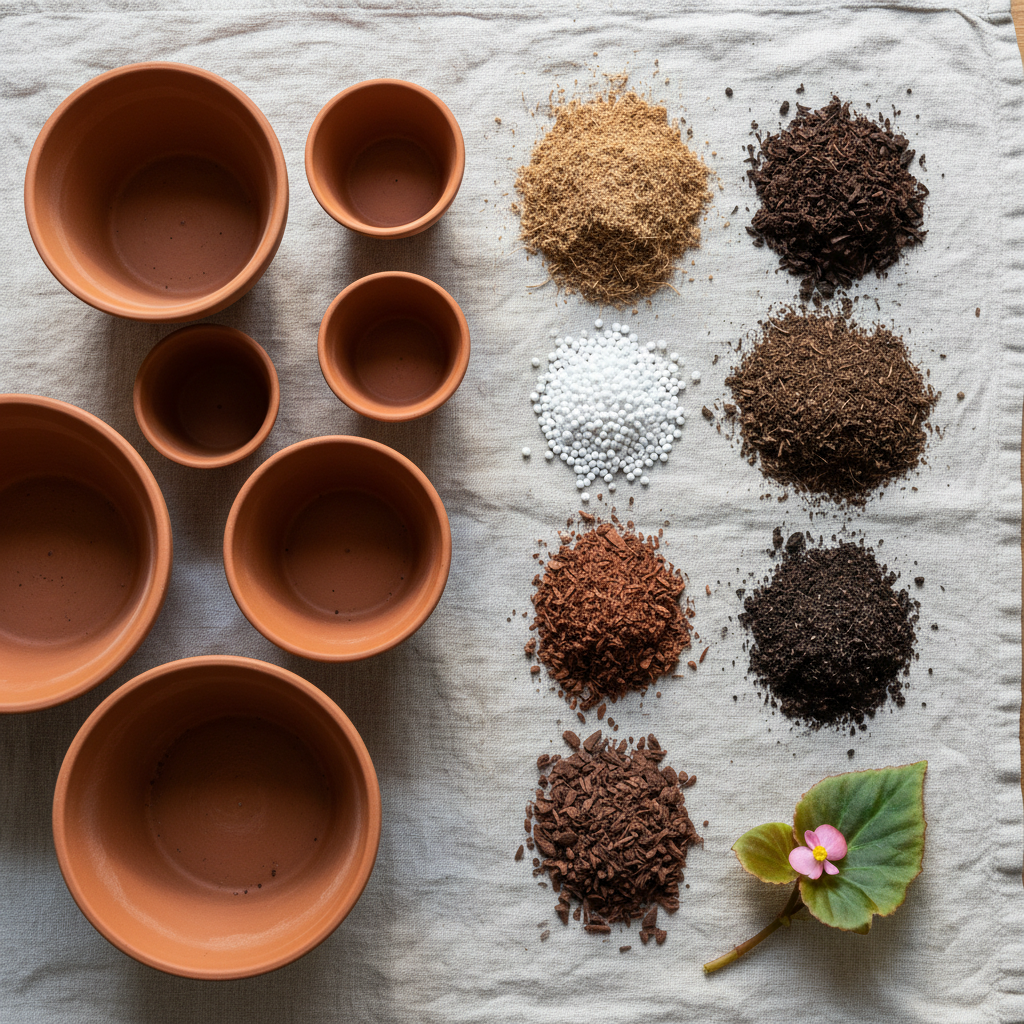
Choose a pot that is just slightly larger than the rootball. Wax begonias are not vigorous rooters, and oversized pots stay damp for too long after watering, inviting root problems. A 12 to 15 cm (5 to 6 in) pot is usually right for a young plant from a 9 cm nursery pot, and a mature specimen rarely needs more than 17 to 20 cm (7 to 8 in) at full size. Drainage holes are non-negotiable; if you are growing the plant in a decorative cachepot without holes, use a plastic nursery pot inside it and tip out any water that collects in the bottom of the outer container after each watering. Terracotta is excellent for wax begonias because it breathes through the pot wall and allows excess moisture to evaporate, but a glazed ceramic or plastic pot is fine if you adjust your watering rhythm slightly to allow for slower drying.
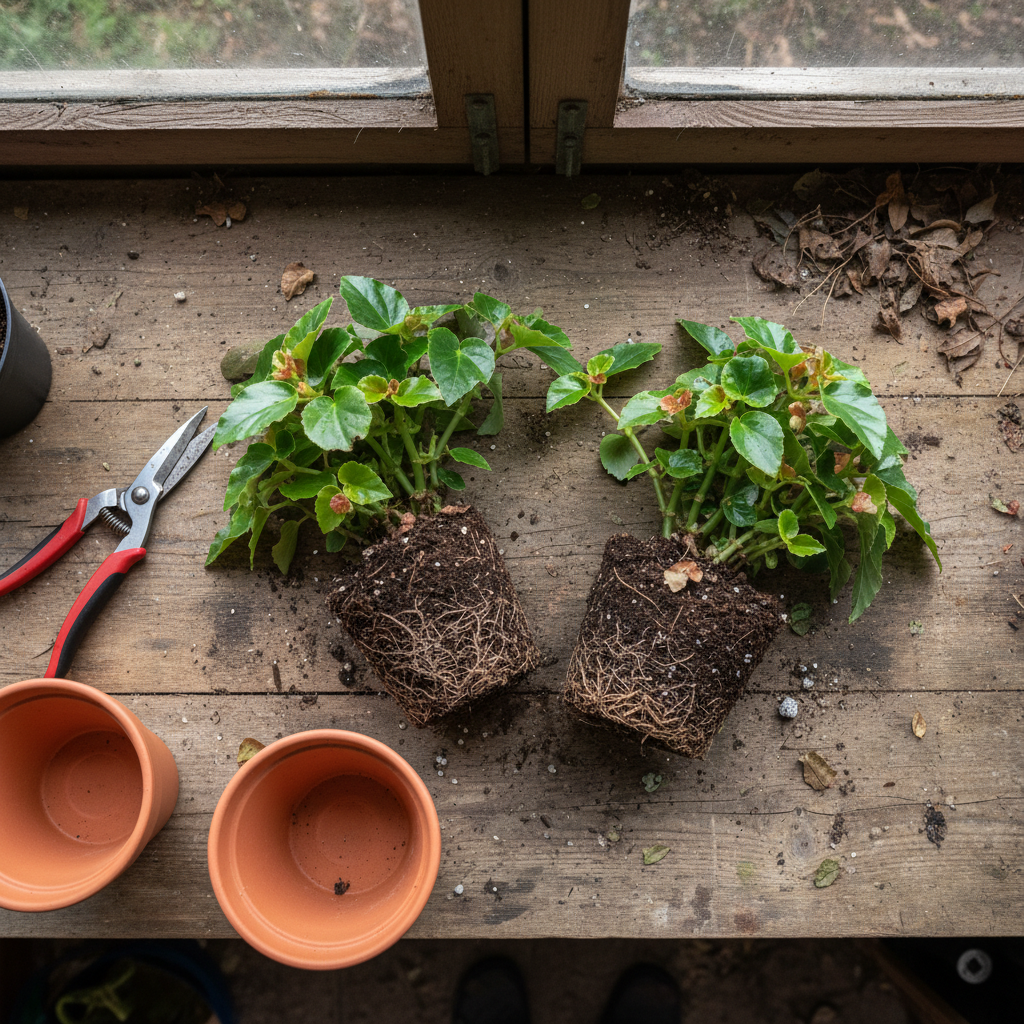
Repot in spring, just as new growth resumes, every other year or whenever roots are clearly circling the bottom of the pot. The signs to look for are roots pushing through the drainage holes, water running straight through without wetting the rootball, or the plant drying out so quickly that you cannot keep up with watering. To repot, water lightly the day before, then slide the plant from its current pot by gripping the stems at the base and tipping the pot sideways. Tease away the outer 1 to 2 cm of old compost, snip off any blackened or mushy roots with sterilised scissors, and place the rootball at the same depth in the new pot, never burying the crown. Fill in fresh compost around the sides, press gently to settle, and water in lightly. Avoid heavy watering for the first week to encourage roots to seek out the new compost.
You may also want to refresh the top inch of compost mid-season even in years when you do not repot. Scrape away the surface layer and replace with fresh mix combined with a sprinkle of slow-release pellets. This top-dressing replenishes the most exhausted part of the substrate without disturbing the roots and is particularly useful for older plants in their second or third year. The pH of the compost should sit between 6.0 and 6.8, comfortably within the range of most peat-free composts on the market, and is not something most growers need to actively monitor.
Fertilising
Continuous flowering is metabolically expensive, and a wax begonia in active growth uses nutrients faster than the same-sized foliage plant. Regular feeding is therefore not optional if you want the plant to look its best, but the dose should be modest and consistent rather than infrequent and heavy. A balanced liquid houseplant feed, NPK in roughly equal parts (for example 7-7-7 or 10-10-10), diluted to half the strength on the label and applied every two weeks during spring and summer, is the standard recommendation and works very well. In autumn, reduce to once a month; in winter, when light levels are low and growth slows, withhold feed entirely until the days lengthen again.
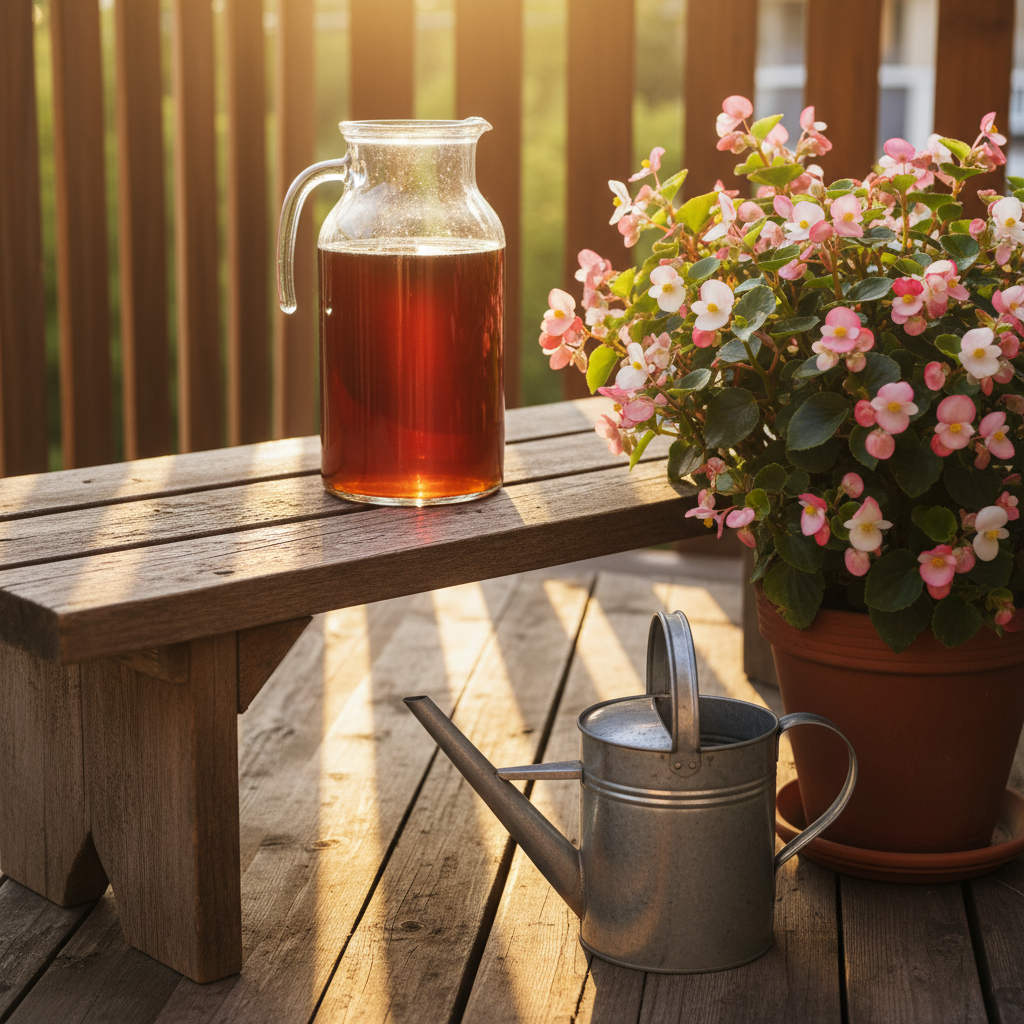
If your plant is a heavy bloomer and you want to encourage flowering specifically, a bloom-booster formula higher in phosphorus and potassium (something like 10-30-20) used every third feed will tip the balance towards bud production. Be careful not to use bloom boosters exclusively, however: a plant fed only high-phosphorus formulas eventually develops weak, pale new growth that cannot support the heavy flowering it is being pushed towards. Alternating a balanced feed with an occasional bloom feed keeps everything in proportion.
Slow-release granules pressed into the surface of the compost in early spring are a perfectly acceptable alternative to liquid feeding, particularly if you are forgetful or away from home often. A small handful of a balanced controlled-release fertiliser (look for products that release over three to four months) feeds the plant invisibly for an entire growing season. Combine with a single liquid feed every three to four weeks in midsummer to top up the nitrogen, and the plant will not miss anything.
Signs of underfeeding are subtle but identifiable: pale new leaves, slow growth, smaller or fewer flowers than usual, and a generally lacklustre look that does not respond to better light or more careful watering. Signs of overfeeding are more dramatic: crisp brown leaf margins, sudden leaf drop, a white crust of fertiliser salts on the soil surface, and sometimes a stunting of new growth as roots are chemically burned. If you suspect overfeeding, flush the pot thoroughly with three or four pot-volumes of plain water poured slowly through the compost, then withhold feed for a month before resuming at lower strength.
Pro Tip — Weakly, weekly: The orchid growers’ mantra of “weakly, weekly” works beautifully for wax begonias too. A quarter-strength feed added to every other watering, with one or two clean-water flushes a month, produces steadier growth and fewer salt issues than a full-strength feed every two weeks.
Propagation
Wax begonias propagate easily by three methods: stem cuttings, division of mature clumps, and seed. Stem cuttings are the most common and reliable, division is the simplest if you happen to be repotting a clumping older plant, and seed is rewarding but slow. Each method has its place depending on how many plants you want and how quickly you want them.
To take stem cuttings, select a healthy non-flowering shoot 8 to 10 cm (3 to 4 in) long and cut just below a node with a clean sharp blade. Strip the lower leaves so that two or three pairs remain at the top, dip the cut end in rooting hormone if you wish (the cuttings root readily without it), and insert the lower third into a small pot of moist compost mixed half-and-half with perlite. Cover the pot loosely with a clear plastic bag to maintain humidity and stand somewhere warm, around 20 to 22 °C (68 to 72 °F), in bright but indirect light. Roots typically appear within two to three weeks, signalled by new growth at the tip, and the plastic cover can come off once new leaves are visibly expanding. Pot on into individual 9 cm pots once roots fill the propagation cell.
Water rooting is even easier and a satisfying way to watch the process. Stand the cuttings in a clear glass of room-temperature water on a bright windowsill, with only the bottom node submerged and the leaves clear of the waterline. Change the water every three or four days. Roots appear from the submerged node within ten to fourteen days, and once they are 2 to 3 cm (1 in) long, pot the cutting into compost with the new roots gently buried. Expect a brief adjustment period of a week or two as the cutting transitions from water roots to soil roots; keep the compost evenly moist during this time.
Division works on older plants that have spread to fill their pot with multiple crowns at the soil surface. At repotting time in spring, slide the plant out of its pot, brush the compost away from the rootball, and locate the natural separations between crowns. Tease them apart by hand, or if the rootball is dense, slice cleanly through it with a sterilised knife. Each division should have its own healthy roots and at least two or three stems. Pot each division into its own appropriately sized container in fresh compost, water lightly, and keep out of direct sun for about a week while the divisions settle and resume active growth.
Seed propagation is the route most commercial growers use, and it is the only way to grow named series cultivars from scratch at home. Wax begonia seed is famously fine, often described as “dust-fine”, and is usually sold as pelleted seed to make handling easier. Sow on the surface of moist seed compost in late winter, do not cover the seed (it needs light to germinate), and stand the tray in a propagator at 21 to 24 °C (70 to 75 °F). Germination takes two to three weeks. Seedlings grow slowly at first and need fourteen to sixteen weeks before they reach planting-out size, which is why most home gardeners start from young plants rather than seed.
Pests and Diseases
Wax begonias indoors are generally healthier than most flowering houseplants, partly because their waxy leaf cuticle is mildly resistant to chewing insects and partly because their dense compact habit gives pests fewer hiding places than a sprawling, leafy plant. They are not immune, however, and the problems that do occur tend to follow predictable patterns linked to humidity, airflow and overcrowding.

Powdery mildew is by far the most common disease problem and the one most likely to drive an otherwise healthy plant into decline. It appears as a fine, white, talcum-like dusting on the upper surface of leaves, usually starting on older foliage close to the soil. It spreads in conditions of high humidity combined with poor airflow and cool nights, which is why it often appears in autumn when temperatures fluctuate and windows are closed. To treat, remove affected leaves into a sealed bag (not the compost heap), increase airflow around the plant with a small fan if necessary, and spray remaining foliage with a mixture of one teaspoon of bicarbonate of soda dissolved in a litre of water with a drop of mild liquid soap. Repeat weekly for three weeks. Commercial fungicides based on sulphur or potassium bicarbonate are effective if the bicarbonate spray fails to control it.
Botrytis, also known as grey mould, is the second main fungal problem, typically appearing as fuzzy grey-brown patches on flowers, buds and the oldest leaves. It thrives in stagnant moist air and is encouraged by overhead watering and overcrowding. Cut away all affected tissue, improve ventilation, water at the soil only and avoid wetting leaves, and dispose of fallen petals promptly. Botrytis is best prevented by environment rather than chemistry; once you fix the airflow problem it rarely returns.
Among insect pests, aphids are most likely, particularly in spring when soft new growth attracts them. Small green or pink aphids cluster at growing tips and on flower buds, deforming them as they feed. Light infestations wash off with a steady jet of lukewarm water in the sink; persistent ones respond to insecticidal soap or a homemade soft-soap spray (one teaspoon of pure liquid soap in a litre of warm water, sprayed both sides of every leaf and repeated every five days for three rounds). Whitefly, mealybugs and thrips occur less commonly but are treated by the same methods. Inspect the undersides of leaves and the leaf axils weekly to catch any infestation early, when control is straightforward.
Root rot is the most serious problem and is almost always self-inflicted. The signs are unmistakable: lower leaves yellow and drop, stems blacken from the base upwards, and the plant collapses despite damp compost. Tip the plant out and check: healthy roots are white or pale tan and firm; rotted roots are black or mushy and smell sour. If less than half the rootball is affected, snip away the dead material, repot into fresh compost in a smaller pot, and water sparingly for two to three weeks while it recovers. If most of the roots are gone, take healthy stem cuttings from any unaffected growth and start the plant over.
Warning — Quarantine new arrivals: Most pest outbreaks in a houseplant collection start with a single new plant brought home from a shop or swap. Keep newcomers in isolation for two to three weeks, inspect the undersides of all leaves and the soil surface twice during that period, and only move them into the main collection once you are certain they are clean.
Popular Varieties
Modern wax begonias are almost entirely sold as named series rather than individual cultivars: a series typically contains six to ten colours bred to flower simultaneously at the same height and habit, which makes them excellent for mass plantings but means that the choice indoors usually comes down to picking your favourite series and then your favourite shade within it. Two of the most widely grown groups stand out for indoor cultivation, one a long-established compact series with bronze foliage and the other a newer large-flowered group bred for impact.
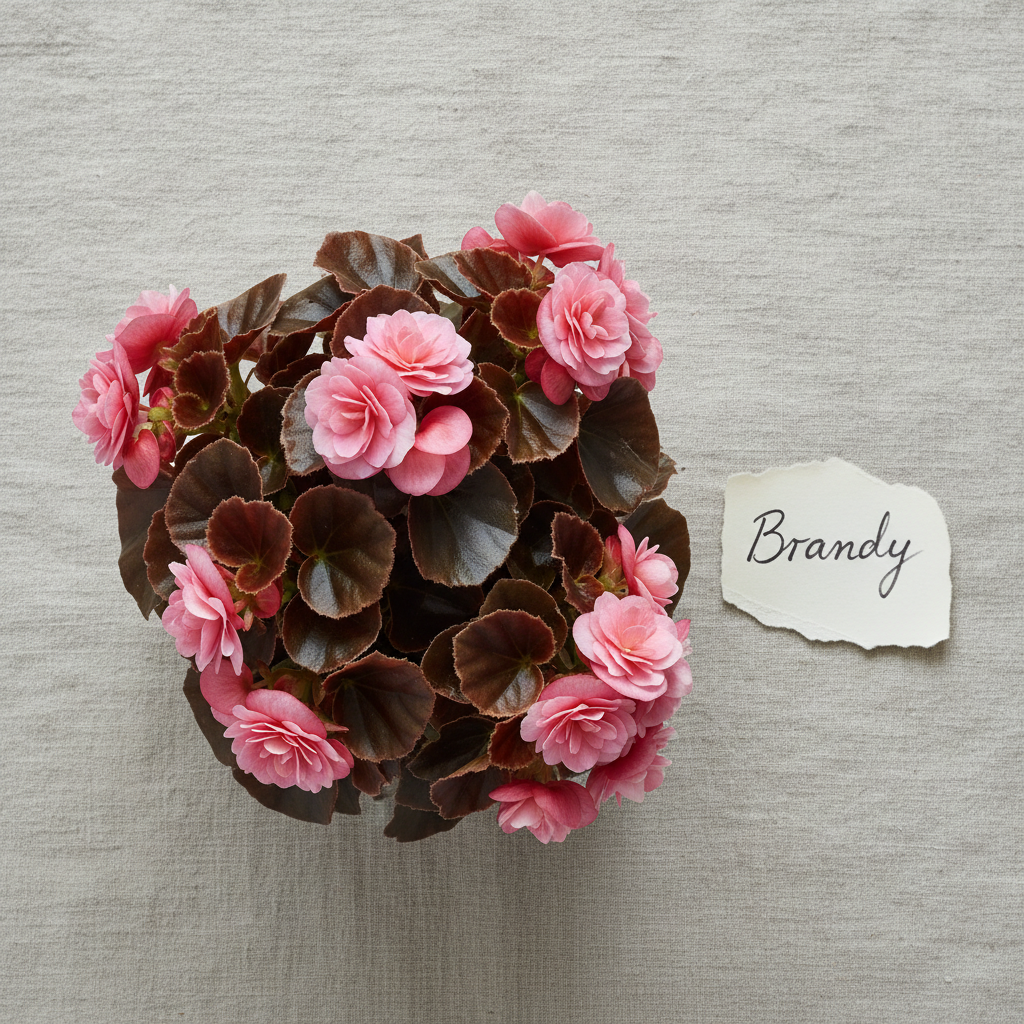
Cocktail Series ‘Brandy’
The Cocktail Series is the benchmark for compact bronze-leaved wax begonias and ‘Brandy’ is its most popular member. The plants form tight 20 cm (8 in) mounds of glossy mahogany-bronze foliage, almost lacquered in good light, topped by luminous pink semi-double flowers held just above the leaves. The other Cocktail varieties name themselves cheerfully: ‘Gin’ (rose-pink), ‘Vodka’ (deep red), ‘Rum’ (rose-pink with white centre) and ‘Whiskey’ (pure white). Indoors they reward bright light and are slightly more sun-tolerant than green-leaved cultivars, making them ideal for east or west windowsills.
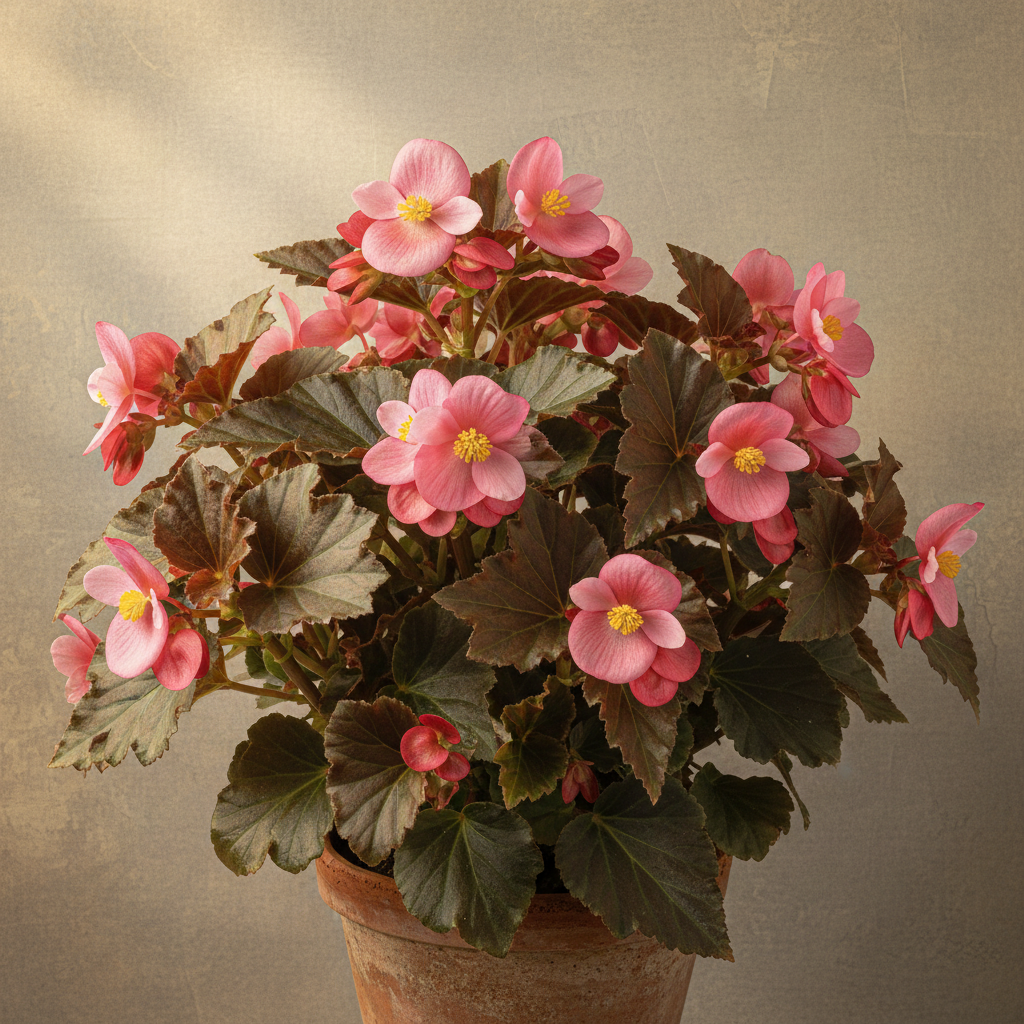
Big Series Rose Bronze Leaf
Where Cocktail is restrained, the Big Series goes the other way. Bred for visual impact in mass plantings, these are taller (45 cm or 18 in), broader plants carrying rosy-pink flowers roughly twice the diameter of standard wax begonia blooms. The leaves come in rich bronze or vibrant green forms; the Rose Bronze Leaf combination pairs deep mahogany foliage with hot pink flowers for one of the most dramatic effects available in the species. Big Series cultivars want a slightly larger pot, more sun and more frequent feeding than Cocktail types, but reward the extra effort with a much more substantial presence.
Other series worth knowing include the Senator Series, an older mid-sized group with bronze foliage in a wider range of flower colours including bicolours; the Olympia Series, a long-established compact green-leaved type best in shadier positions; the Ambassador Series, a similar compact group with notably weather-resistant flowers; and the slightly looser Bada Bing and Bada Boom Series, sold for their unusually heat-tolerant flowering, which translates indoors as a plant that handles warm sunlit windowsills without dropping buds. For a hanging or trailing effect, look for the closely related Begonia Dragon Wing or BabyWing types, which are botanically slightly different but bred in parallel and treated identically in care.
Frequently Asked Questions
Why is my wax begonia leggy and not flowering?
Almost always insufficient light. A wax begonia in low light stretches between leaves, holds its foliage upwards instead of horizontally, and stops producing flower buds. Move the plant gradually (over a week or two) to a brighter spot, ideally with a few hours of soft direct sun each day. While you wait for new growth to come in tidier, pinch out the tip of each stretched stem to encourage bushier branching from the lower nodes.
My wax begonia’s lower leaves are yellowing. What does it mean?
A few yellow lower leaves on an otherwise healthy plant is normal as old growth is shed. Widespread yellowing of the lower half of the plant, combined with damp compost, almost always means overwatering and early root rot. Let the plant dry out further between waterings, check that the pot drains freely, and consider repotting into fresh compost if symptoms persist. Yellowing combined with crisp dry leaves usually means the opposite: the plant has dried out too far between waterings and is shedding mature leaves to conserve moisture.
Are wax begonias safe for cats and dogs?
No. Begonia semperflorens, like most begonias, contains soluble calcium oxalates that cause mouth irritation, drooling and occasional vomiting if chewed or eaten. The toxicity is mild rather than dangerous, but pets that nibble plants should be kept away from begonias. Place the plant on a shelf or in a hanging basket out of reach if you share your home with curious cats, dogs or rabbits.
Can I grow wax begonia outdoors?
Yes, this is in fact the use for which most wax begonias are sold. They are popular bedding plants in temperate gardens, planted out after the last frost in May or June and flowering until the first autumn frosts kill them in September or October. Indoors, the plant can live for two or three years; outdoors in cold climates it is grown as a summer annual. Gardeners in frost-free regions can keep wax begonias outside as short-lived perennials.
Should I deadhead spent flowers?
Modern wax begonia series are mostly self-cleaning, meaning that the spent flowers drop neatly on their own and the plant continues producing new buds without intervention. You do not need to deadhead routinely, although removing fallen petals from the soil surface and the leaf rosettes helps prevent botrytis. If you grow an older non-self-cleaning cultivar, snipping off the spent flower clusters at their base every week or so does keep the display tidier and may slightly increase the rate of new bud formation.
How long does a wax begonia live indoors?
A well-cared-for wax begonia gives two to three years of strong indoor performance, sometimes longer. After that, the lower stems tend to become woody and bare, flowering slows even with attentive feeding, and the plant looks less attractive than it did in its first season. Rather than nurse a tired plant indefinitely, most growers take a fresh set of cuttings from the best growth in late summer, root them over autumn and winter, and pot them up as the replacement plant by spring. This rolling generation programme keeps a continuous supply of young, vigorous plants without ever needing to buy new stock.
What is the difference between wax begonia and other begonias?
Begonias are divided horticulturally into several broad groups based on root type and habit. Wax begonias (Begonia semperflorens) are fibrous-rooted, compact mound-formers grown primarily for continuous flowering. Rex begonias are rhizomatous, grown for spectacular foliage rather than flowers, and demand much higher humidity. Tuberous begonias have underground tubers, large showy flowers and a defined dormancy in winter. Cane begonias have tall jointed stems like bamboo and large angel-wing leaves. Rhizomatous begonias other than rex types include eyelash and species begonias, grown mostly for foliage. Each group has different care needs; do not assume that what works for a rex begonia will work for a wax begonia or vice versa.






