
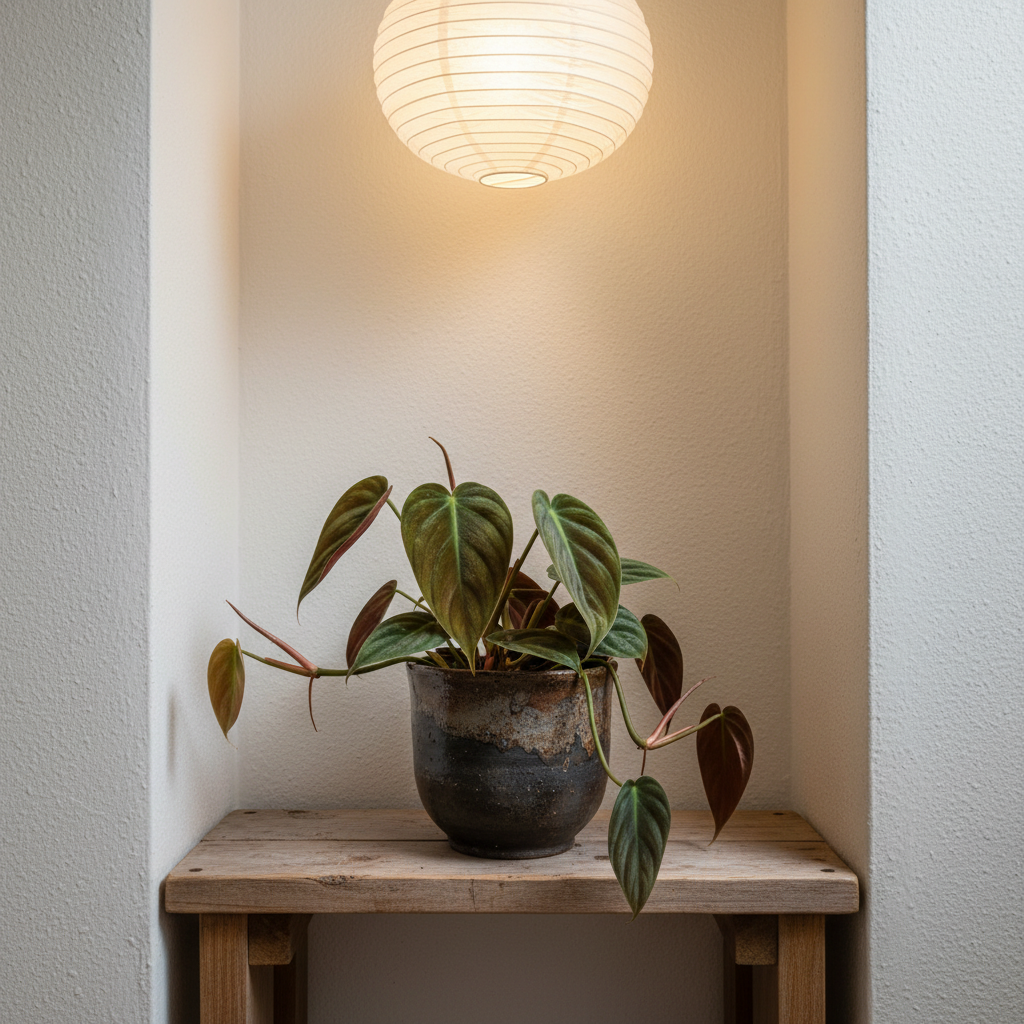
Few houseplants change the light in a room the way the velvet leaf philodendron does. Catch one in low afternoon sun and the heart-shaped leaves seem to drink the light, returning a copper-emerald shimmer that no glossy-leaved plant can match. Botanically it is Philodendron hederaceum f. micans, a velvety form of the common heartleaf philodendron native to Mexico, Central America and the Caribbean, where it scrambles through humid lowland forest from the leaf litter up into the lower canopy. In the houseplant trade it is sold under several casual names, most often simply Philodendron micans, Velvet Philodendron, Velvet-leaf Vine, or, confusingly, Philodendron andreanum, though that latter name technically refers to a different plant.
The plant’s reputation among indoor growers sits in a sweet spot: striking enough that it earns a place in carefully styled rooms, but tolerant enough that it forgives forgotten waterings and unfussy light. A healthy specimen pours over the edge of a shelf in cascading stems, or, given a moss pole, climbs steadily and rewards the grower with progressively larger, more dramatically iridescent leaves. This guide separates the bare minimum needed to keep a Philodendron micans alive from the conditions and habits that actually make it thrive, with the depth of treatment that the plant’s velvet finish, its aroid soil preferences and its propagation quirks all deserve.
Contents
- Quick Reference
- Why Velvet Leaf Philodendron Makes a Rewarding Houseplant
- Light Requirements
- Watering & Humidity
- Soil, Potting & Repotting
- Fertilising
- Propagation
- Pests & Diseases
- Popular Varieties
- Frequently Asked Questions
Quick Reference: Velvet Leaf Philodendron at a Glance
| Light | Bright indirect; tolerates medium; protect from direct midday sun |
| Watering | Water when the top 2 to 3 cm (about 1 inch) of substrate feels dry; typically every 7 to 10 days |
| Temperature | 18 to 27 °C (64 to 81 °F); avoid drops below 13 °C (55 °F) |
| Humidity | Prefers 60 to 80 percent; tolerates household 40 to 50 percent |
| Fertiliser | Balanced liquid feed at half strength every 4 to 6 weeks during the growing season |
| Toxicity | Toxic to cats, dogs and humans if chewed (calcium oxalate crystals) |
Why Velvet Leaf Philodendron Makes a Rewarding Houseplant
The first thing most owners notice about a Philodendron micans is the surface of the leaves. Where most popular philodendrons have glossy, light-bouncing foliage, this one is matte and softly fuzzed, the upper surface covered in microscopic papillae that scatter light and produce that characteristic suede-like iridescence. New leaves emerge tightly furled in coppery pink, slowly unrolling into deeper greens and warm bronzes as they mature, and the undersides reveal a quiet burgundy-red flush that catches the eye every time a stem moves. It is one of very few common houseplants where the colour of the leaves shifts visibly with the angle of light and the leaf’s stage of growth.
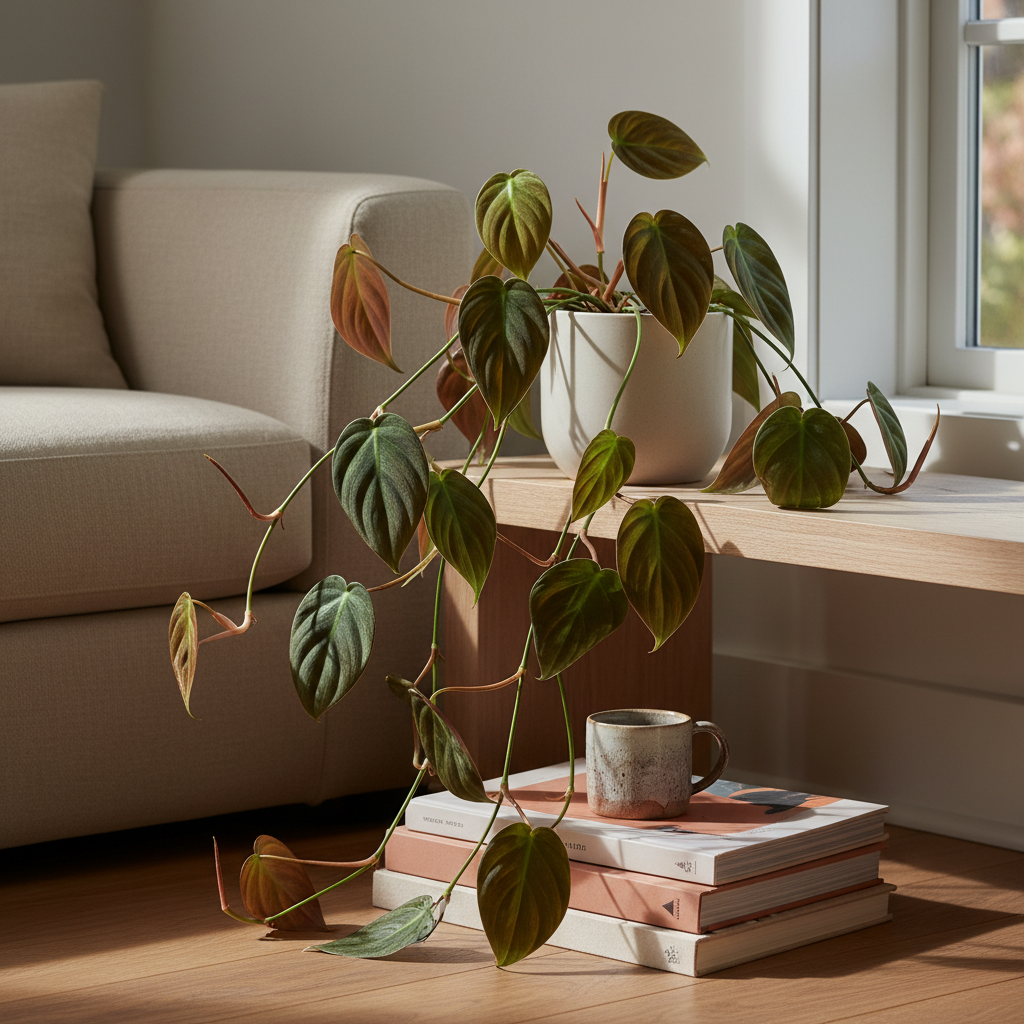
Beyond the looks, the velvet leaf philodendron earns its houseplant credentials with a forgiving constitution. It happily accepts a wide window of light, recovers gracefully from missed waterings, propagates from almost any stem section with a node, and grows fast enough in the warmer months to make the rewards of decent care visible within weeks. Compared to the more demanding velvet philodendrons such as Philodendron verrucosum or Philodendron gloriosum, micans is markedly more tolerant of average household conditions, which is why it has become the gateway velvet plant for many growers. It is also genuinely versatile in display: it looks equally at home in a hanging basket, draped over a tall shelf, trained up a moss pole, or grown in a compact tabletop pot where regular trimming keeps it bushy.
Important — Toxicity: All parts of Philodendron micans contain insoluble calcium oxalate crystals, which cause oral pain, drooling, vomiting and difficulty swallowing if chewed by cats, dogs or children. Keep trailing stems out of reach of curious mouths, and wash your hands after pruning to avoid skin irritation in sensitive individuals.
Light Requirements
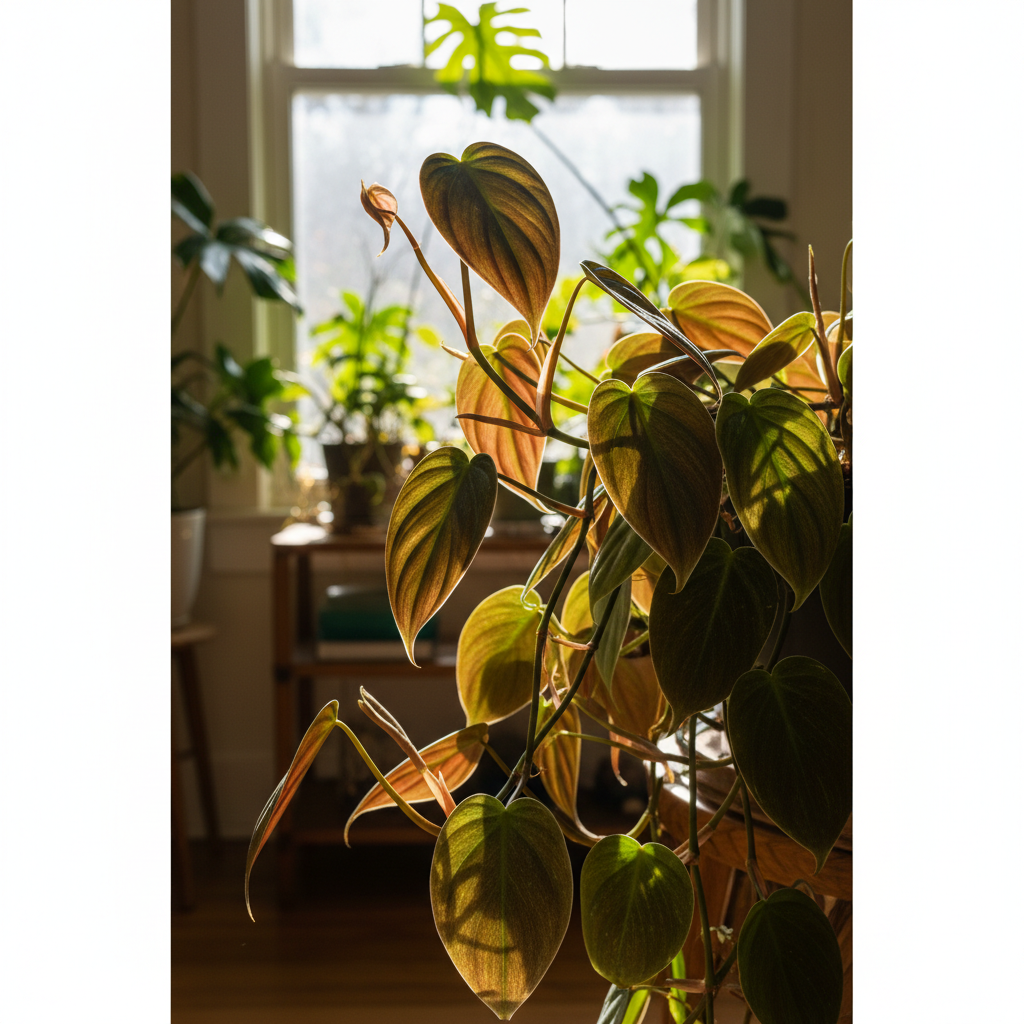
In its native range, Philodendron micans grows beneath a layer of taller trees and vines, climbing slowly upward through filtered light. That habit translates very directly into its preferences indoors. The plant is built to harvest moderate, diffused light over long periods rather than blast through brief bursts of intense sun, and the velvety upper surface of the leaves is itself an adaptation to capture light efficiently in shaded environments. Replicate something close to that and the plant rewards you with short internodes, rich pigment and steady new growth.
The ideal placement indoors is a spot that receives bright indirect light for most of the day, with perhaps an hour or two of gentle morning sun. Within a metre or two of an east-facing window is close to perfect, or a few metres back from a south- or west-facing window where sheer curtains break the intensity of midday rays. A micans grown in this range produces compact, deeply coloured leaves spaced closely along the stem, and the bronze sheen becomes obvious. Move the same plant to a darker corner and it will not die quickly, but the internodes stretch, the new leaves come in smaller and thinner, and the burgundy undersides fade toward a duller wine.
Light Levels Explained
Light requirements are often described in vague terms, but they can be quantified. Indoor light is usually measured in foot-candles or lux, where 1 foot-candle is roughly 10.76 lux. Inexpensive light meter apps for smartphones are surprisingly accurate for indoor plant decisions. The table below maps a Philodendron micans to the common indoor light tiers.
| Light Category | Approx. Level | Typical Location | Outcome |
|---|---|---|---|
| Direct sun | 30,000+ lux | South-facing window without curtains, midday | Leaf scorch, washed-out colour, dehydration |
| Bright indirect | 10,000 to 20,000 lux | 1 to 2 m from an east or filtered south window | Best growth, deep velvet, short internodes |
| Medium | 5,000 to 10,000 lux | Middle of a well-lit room with one large window | Steady growth, slightly longer internodes, acceptable colour |
| Low | 1,000 to 5,000 lux | Far corner of a room, north-facing window | Survival mode, slow growth, leggy stems, smaller leaves |
| Very low | Under 1,000 lux | Hallway, interior bathroom | Decline within a few months, leaf loss |
Window Orientation and Placement
South-facing window: Excellent year-round, provided the plant is set back at least 1 to 2 m from the glass, or the glass is covered with a sheer curtain. In summer, direct unfiltered south light at midday will scorch the leaves within hours.
East-facing window: The most reliable placement. The plant catches gentle morning sun, which is generally too weak to cause damage, and benefits from bright indirect light for the rest of the day. Place it directly on the windowsill or within half a metre of it.
West-facing window: Workable but trickier. Afternoon light from the west is stronger than morning light and can be harsh in summer. Set the plant back 1 m or use a sheer curtain during the warmest months, then move it closer as the days shorten.
North-facing window: Marginal. A micans placed directly on a north-facing sill will live, but expect slow, leggy growth and dulled colour. Supplement with a grow light for stronger performance.
Pro Tip — Read the Internodes: The distance between successive leaves on the stem (the internode) is the single most reliable signal of whether your micans is getting enough light. Short, compact internodes of 2 to 4 cm indicate the plant is happy. Internodes stretching to 8 cm or more, with small thin leaves, mean the plant is reaching for more light and needs to be moved.
How Light Affects Leaf Colour and Velvet
The depth and iridescence of the velvet finish is not a fixed trait, it is a response. In bright indirect light, the plant produces fully formed papillae on the leaf surface and accumulates the anthocyanin pigments that produce the burgundy undersides and the warm bronze cast on new growth. In low light, the papillae develop less densely, the surface looks duller and flatter, and the anthocyanin pigments are weaker because the plant has less surplus energy to invest in them. This is reversible. Move a faded micans into stronger indirect light and within two or three new leaves the colour returns. Conversely, a plant grown in low light and then moved abruptly into direct sun will burn before it has a chance to acclimatise.
Warning — Direct Sunlight: Velvet leaves are particularly vulnerable to sun scorch because the papillae trap heat as well as light. Even half an hour of direct midday sun in summer can produce irreversible bleached patches on previously healthy leaves. When increasing a plant’s light exposure, do so gradually over two to three weeks, moving it slightly closer to the window each week.
Artificial Lighting
Philodendron micans responds well to full-spectrum LED grow lights and they are a sensible investment if natural light is limited. A 20 to 40 watt full-spectrum panel placed 30 to 50 cm above the foliage, set on a timer for 12 to 14 hours a day, will keep the plant growing actively even in a windowless interior. Look for a colour rendering index above 90 and a balanced spectrum that includes both blue (around 450 nm) and red (around 660 nm) wavelengths. Pure red and blue “blurple” lights work biologically but make the foliage look unpleasant and obscure the plant’s actual colour. White-light full-spectrum LEDs are the better choice for display plants.
Seasonal Adjustments
Indoor light drops substantially in winter at higher latitudes. A spot that delivers bright indirect light in July may sit in low light by December. Move the plant 30 to 50 cm closer to the window as the days shorten, and consider rotating placements between rooms to follow the brightest light through the year. Conversely, in midsummer, watch for sun creeping further into the room as the angle of the sun rises and move the plant back if direct rays start landing on the leaves.
Watering & Humidity
The most common cause of an unhappy Philodendron micans is watering on a calendar rather than on what the plant and substrate are actually doing. Like most aroids, this plant evolved with thick, fleshy roots that hold reserves of water but rot quickly in stagnant wet soil. The aim is a clear wet-dry rhythm: thoroughly soak the substrate, then let the top portion dry out before watering again. Get the rhythm right and almost every other care detail becomes easier.
When to Water
Test the substrate before reaching for the watering can. Push a finger about 2 to 3 cm (an inch) into the mix near the edge of the pot. If it feels distinctly dry at that depth and the pot is noticeably lighter than when freshly watered, it is time to water. If the surface feels slightly damp or cool, wait another day or two and check again. A wooden chopstick or moisture meter inserted to half the pot’s depth gives a clearer read for chunky aroid mixes where the surface and the core can be at very different states of dryness.
How often this works out to in practice depends on pot size, substrate, temperature and time of year. In a 12 to 15 cm plastic nursery pot at typical room conditions, a Philodendron micans usually needs watering every 7 to 10 days during spring and summer, dropping to every 10 to 14 days in winter when growth slows. In a porous terracotta pot, expect to water 30 to 50 percent more often. A plant under intense grow lights or in a sunroom may need watering twice a week in midsummer. Forget the calendar, watch the plant and the pot.
Pro Tip — Pot Weight: Lift the pot just after a thorough watering, then again three or four days later. The difference in weight is unmistakeable, and within a week you will be able to tell at a glance whether the plant needs water without ever touching the substrate. It is the fastest reliable check for a busy household.
How to Water Correctly
- Take the plant to a sink or place it on a deep saucer that can catch run-off.
- Use room-temperature water that has been left to stand for an hour or two so that chlorine dissipates.
- Pour water slowly and evenly across the entire substrate surface, not just one spot, until water runs freely from the drainage holes.
- Let the water drain for at least ten minutes, then tip out any excess that has pooled in the saucer or cover pot.
- Wipe the rim of the pot dry to discourage fungus gnats, and return the plant to its usual spot.
- Do not water again until the top 2 to 3 cm of substrate is dry to the touch.
Signs of Overwatering vs. Underwatering
| Symptom | Overwatering | Underwatering |
|---|---|---|
| Leaf colour | Lower leaves turning yellow uniformly, often with brown edges | Older leaves crisping from the tips inward, pale tones |
| Leaf texture | Soft, limp, sometimes translucent | Dry, papery, curled and brittle |
| Soil | Persistently wet, often with a sour smell | Pulled away from the sides of the pot, dust-dry through |
| Roots | Brown, mushy, slipping off when touched | Pale tan, dry and wiry but otherwise intact |
| Stem base | Soft, dark, sometimes collapsing | Firm but slightly shrunken |
Warning — Root Rot: Root rot caused by chronic overwatering is the leading killer of Philodendron micans indoors. If the substrate has stayed sodden for more than a few days and you notice a sour smell or rapid yellowing of multiple leaves, unpot the plant immediately, trim away any brown mushy roots with sterilised scissors, dust the cuts with cinnamon or sulphur powder, and repot into fresh dry aroid mix. Do not water for at least four or five days afterwards.
Humidity Requirements
Philodendron micans is technically a humid-forest plant and prefers ambient humidity between 60 and 80 percent. In reality it copes well with average household humidity of 40 to 50 percent, which is one of the practical advantages it has over the more demanding velvet philodendrons. Leaves grown in higher humidity tend to be larger and more dramatically velvety, but a plant in average conditions still looks lovely.
Watch for the classic low-humidity symptoms: brown, papery leaf tips that develop without any change in watering, slow unfurling of new leaves, and a slightly faded, tired-looking velvet finish. These tend to appear in winter when central heating dries the air down to 25 to 30 percent. If you see them consistently, the air around the plant is too dry.
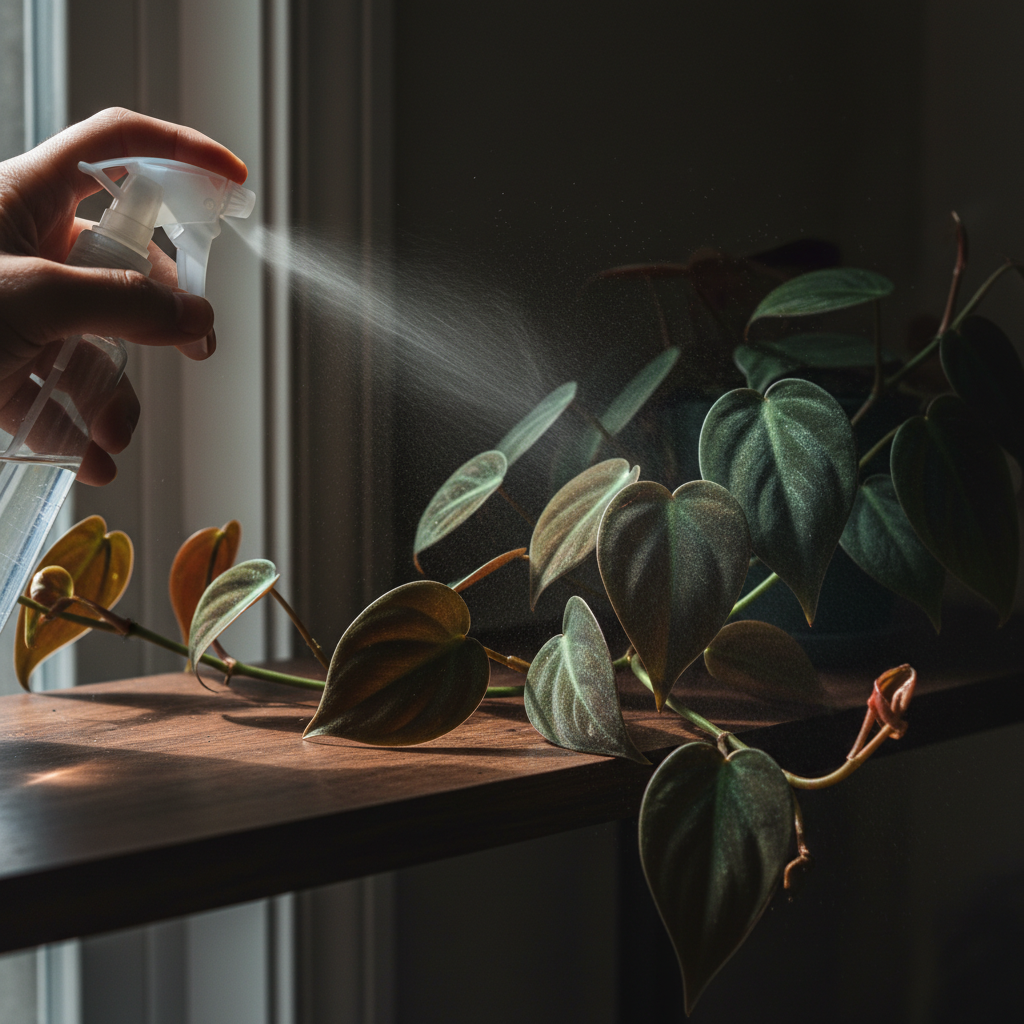
Raising humidity around the plant is straightforward: a small ultrasonic room humidifier set on a timer for the morning hours is the most effective option, lifting the local humidity by 10 to 20 percentage points. Grouping plants together creates a small microclimate where transpiration from each plant raises the humidity for its neighbours. A pebble tray filled with water beneath the pot helps marginally. Misting feels productive but its effect lasts minutes and matters less than people imagine. It does, however, do a useful job of cleaning the leaves and refreshing the velvet appearance, so it is not wasted effort.
Water Quality
Velvet leaf philodendron is not as sensitive to water quality as a calathea or a maranta, but it still does better with low-mineral water than with heavily chlorinated or fluoridated tap water. Leaving tap water to stand uncovered for an hour or two allows chlorine to dissipate; chloramine, which is now used in some water supplies, does not evaporate and requires a carbon filter to remove. Rainwater, distilled water and water from a domestic carbon filter are all safe long-term options. If you see crusty white mineral deposits on the soil surface or the rim of the pot, switch water sources or flush the pot thoroughly every few months.
Soil, Potting & Repotting
The soil a Philodendron micans sits in matters more than almost any other care decision. As a hemiepiphyte in the wild, its roots are accustomed to scrambling through loose leaf litter and clinging to bark, with abundant air around them at all times. The single most common reason indoor specimens decline is being potted into a dense, peat-heavy general-purpose potting compost that suffocates the roots and holds water far too long.
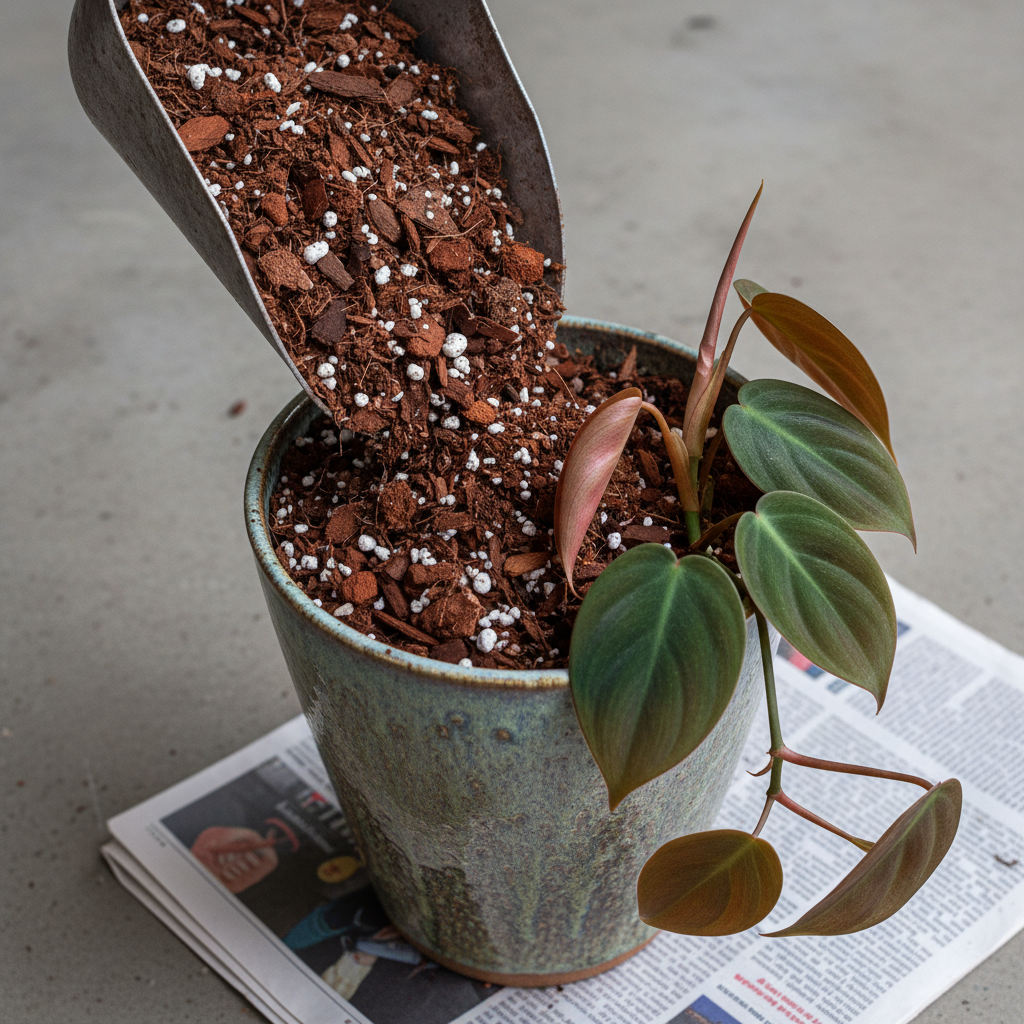
Ideal Soil Composition
Aim for a chunky, free-draining mix that holds moisture without staying sodden and contains enough air space that the roots can breathe between waterings. The classic indoor aroid mix is built around a base of regular potting compost or coco coir, lightened heavily with bark and perlite. The exact ratio varies with how often you can water — a chunkier mix dries faster and forgives generous waterings, while a denser mix holds moisture longer but punishes overwatering more harshly.
| Component | Proportion | Function |
|---|---|---|
| Indoor potting compost or coco coir | 40 percent | Base nutrient-holding matrix with moderate moisture retention |
| Orchid bark (fine to medium) | 30 percent | Creates large air pockets, mimics decaying bark in habitat |
| Perlite or pumice | 20 percent | Improves drainage and keeps the mix from compacting |
| Horticultural charcoal | 5 percent | Reduces odour and helps regulate root-zone chemistry |
| Worm castings | 5 percent | Slow-release nutrition and beneficial microbes |
The plant tolerates a pH range from slightly acidic to neutral, roughly 5.5 to 7.0. Most off-the-shelf indoor composts and aroid mixes fall comfortably within this range, so pH rarely needs to be adjusted unless you are using rainwater on coco coir, which can drift acidic over time. A small amount of dolomite lime or crushed eggshell mixed into the substrate at potting buffers against pH drops.
Pro Tip — Quick Mix Recipe: If you only have two ingredients on hand, four parts regular indoor potting compost to three parts orchid bark and two parts perlite produces a perfectly workable aroid mix. Skip the rest of the optional ingredients and the plant will still thrive, provided you remember to water only when the top dries.
Choosing the Right Pot
Pot choice influences how quickly the substrate dries and therefore how often you need to water. There is no single correct option, but there are sensible trade-offs.
Drainage holes are non-negotiable. A philodendron in a sealed cachepot without drainage will sit in pooled water and rot. If you fall in love with a decorative pot that lacks holes, use it as a cover for an inner nursery pot you can lift out when you water.
Pot material: Plastic and glazed ceramic retain moisture longer and suit growers who tend to underwater. Terracotta is porous, evaporates moisture through its walls, and dries the substrate noticeably faster, which suits growers who tend to overwater but means more frequent attention in dry interiors. For hanging baskets, plastic is usually the practical choice because the pot must be light.
Pot size: Pot the plant into a vessel that is only 2 to 4 cm wider than the existing rootball. An oversized pot holds far more wet substrate than the roots can reach, and that excess substrate stays soggy long enough to cause rot. Philodendron micans is genuinely happy to be a little snug.
When to Repot
Plan to repot every 18 to 24 months in active growth, or whenever you see thick roots circling the inside of the pot, emerging from the drainage holes, or pushing the substrate up above the rim. A plant that suddenly demands water every three or four days when it used to want it weekly is often pot-bound and ready for a fresh home. Early spring, just as new growth begins, is the best time to repot because the plant recovers fastest from any disturbance while in active growth.
How to Repot: Step-by-Step
- Water the plant lightly a day before repotting so the rootball holds together but is not waterlogged.
- Prepare the new pot: place a small handful of fresh aroid mix in the bottom, just enough so that the top of the rootball will sit 1 to 2 cm below the new pot’s rim.
- Tip the plant out by squeezing the sides of the old pot and gently pulling on the base of the stems, never on the trailing leaves.
- Tease apart the outer roots gently with your fingers, breaking up any tightly circling sections, and trim away any obviously brown or mushy roots with sterilised scissors.
- Centre the rootball in the new pot and trickle fresh mix down the sides, pressing lightly with your fingers to settle it without compacting it solid.
- Water thoroughly until water runs from the drainage holes, then let the pot drain completely.
- Return the plant to its usual spot and skip any fertiliser for the next four to six weeks while the roots recover.
Warning — Transplant Shock: A repotted Philodendron micans may droop noticeably for several days, drop a leaf or two, or pause new growth for a few weeks. This is normal as the disturbed root system rebuilds itself. Resist the urge to compensate with extra water or fertiliser. Steady warmth, indirect light and patience are all the plant needs to recover.
Fertilising
Philodendron micans is not a heavy feeder, but it does need a steady trickle of nutrients to support the production of new leaves and the maintenance of healthy roots. A common mistake is to over-fertilise in the hope of pushing faster growth, which produces salt build-up in the soil and burns the delicate root tips. The opposite mistake, never feeding at all, leads to pale leaves, weak new growth and eventual decline as the limited nutrients in a small pot of substrate are exhausted.
The sensible middle path is a balanced, dilute liquid feed delivered regularly through the growing season, paused or substantially reduced through winter. Plants that produce a new leaf every two or three weeks in summer are being fed at the right rate; plants that produce a leaf every two months in summer are usually underfed, underlit, or both.
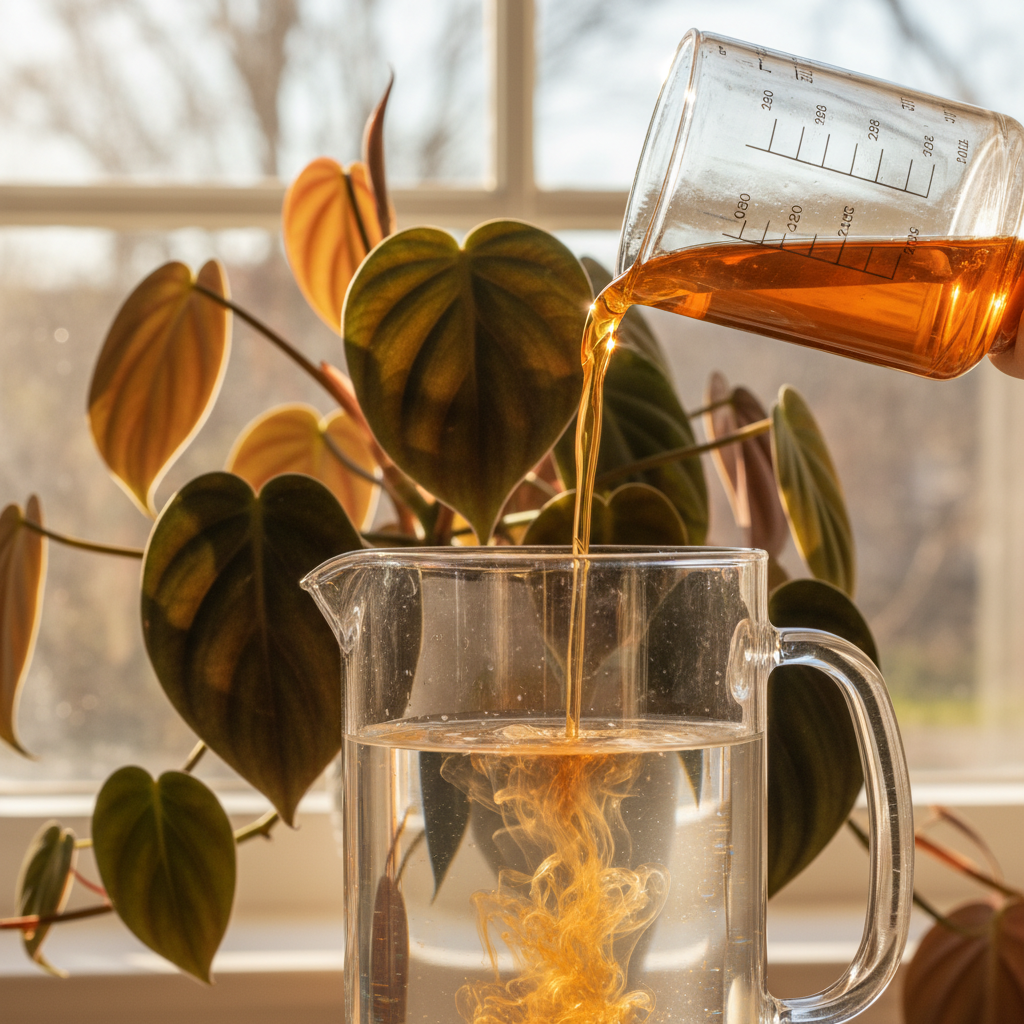
Understanding Plant Nutrients
Plant fertilisers are described by their NPK ratio, where N stands for nitrogen, P for phosphorus and K for potassium. A balanced houseplant feed is something close to 10-10-10 or 20-20-20, with the three numbers in roughly equal proportion. For foliage plants like Philodendron micans, a slightly nitrogen-leaning ratio such as 3-1-2 or 20-10-10 supports lush leaf growth. Beyond the headline three, plants also need calcium, magnesium, sulphur and a suite of micronutrients including iron, manganese, zinc and boron.
| Nutrient | Symbol | Primary Function | Deficiency Symptoms |
|---|---|---|---|
| Nitrogen | N | Leaf growth, chlorophyll production | Uniform pale yellowing of older leaves, slow growth |
| Phosphorus | P | Root development, energy transfer | Stunted growth, dark or purple-tinged older leaves |
| Potassium | K | Cell function, disease resistance | Brown leaf edges, weak stems |
| Calcium | Ca | Cell wall structure | Distorted new leaves, dieback of growing tip |
| Magnesium | Mg | Chlorophyll core, photosynthesis | Interveinal yellowing on older leaves |
| Iron | Fe | Chlorophyll synthesis | Interveinal yellowing on the newest leaves |
Types of Fertiliser
Liquid fertilisers: The default option for houseplants. Diluted into watering water, they deliver precise, immediately available nutrition and are easy to dial up or down. Choose a balanced or slightly nitrogen-leaning product and dilute to half the label rate for Philodendron micans.
Slow-release granular: Coated prills that release nutrients gradually over three to six months. Useful for growers who travel or struggle to remember to feed. Sprinkle a small pinch on the substrate surface in spring and the plant is fed for the season.
Organic fertilisers: Worm castings, compost tea, fish emulsion and seaweed extract feed the plant indirectly by supporting beneficial soil microbes. They are gentle and almost impossible to over-apply, but the nutrient profile is less predictable. Top-dressing with a thin layer of worm castings once or twice a year is a low-effort, high-reliability approach.
Feeding Schedule
During the active growing season from spring through early autumn, feed Philodendron micans with a balanced liquid fertiliser at half the recommended strength every four to six weeks. In late autumn, taper off feeding as growth slows. Through winter, when the plant is largely dormant or growing very slowly, either skip feeding entirely or apply a quarter-strength dose once during the season. Resume normal feeding when new growth begins to push out in early spring, often signalled by a flush of fresh coppery-pink leaves.
Pro Tip — Half Strength Always: The single best fertilising habit you can adopt for Philodendron micans is to dilute every product to half the label rate. The labels are written for outdoor plants in rapidly leaching soils. Indoors, in a small pot, the salts accumulate quickly and a half-strength dose is plenty.
How to Fertilise
- Always water the plant with plain water first if the substrate is dry, then feed an hour or two later. Fertilising a dry rootball can scorch the roots.
- Dilute the liquid fertiliser to half the recommended strength in room-temperature water.
- Pour the diluted feed evenly across the substrate surface until a small amount runs from the drainage holes.
- Empty any catchment saucer so the plant is not standing in fertiliser-laden water.
- Flush the pot with plain water every three or four feeds to wash out accumulated mineral salts.
Warning — Salt Build-Up: Crusty white deposits on the substrate surface or rim of the pot, combined with brown leaf tips that do not respond to humidity changes, point to fertiliser salt build-up. Flush the pot by running plain water through it three or four times its volume in a single watering session, then ease back on feeding frequency.
Propagation
Few popular houseplants propagate as willingly as Philodendron micans. Almost every section of stem with a node can be coaxed into rooting, and the success rate is high enough that propagation becomes part of routine care: every trim of a leggy stem yields material that can be turned into a new plant, gifted, or used to bush up the parent.
Two methods dominate in practice: rooting cuttings in damp sphagnum moss inside a humid enclosure, and water propagation in a clear jar. Both work; the moss method tends to produce sturdier root systems that transition more easily to soil, while water rooting is faster to set up and lets you watch the roots grow.
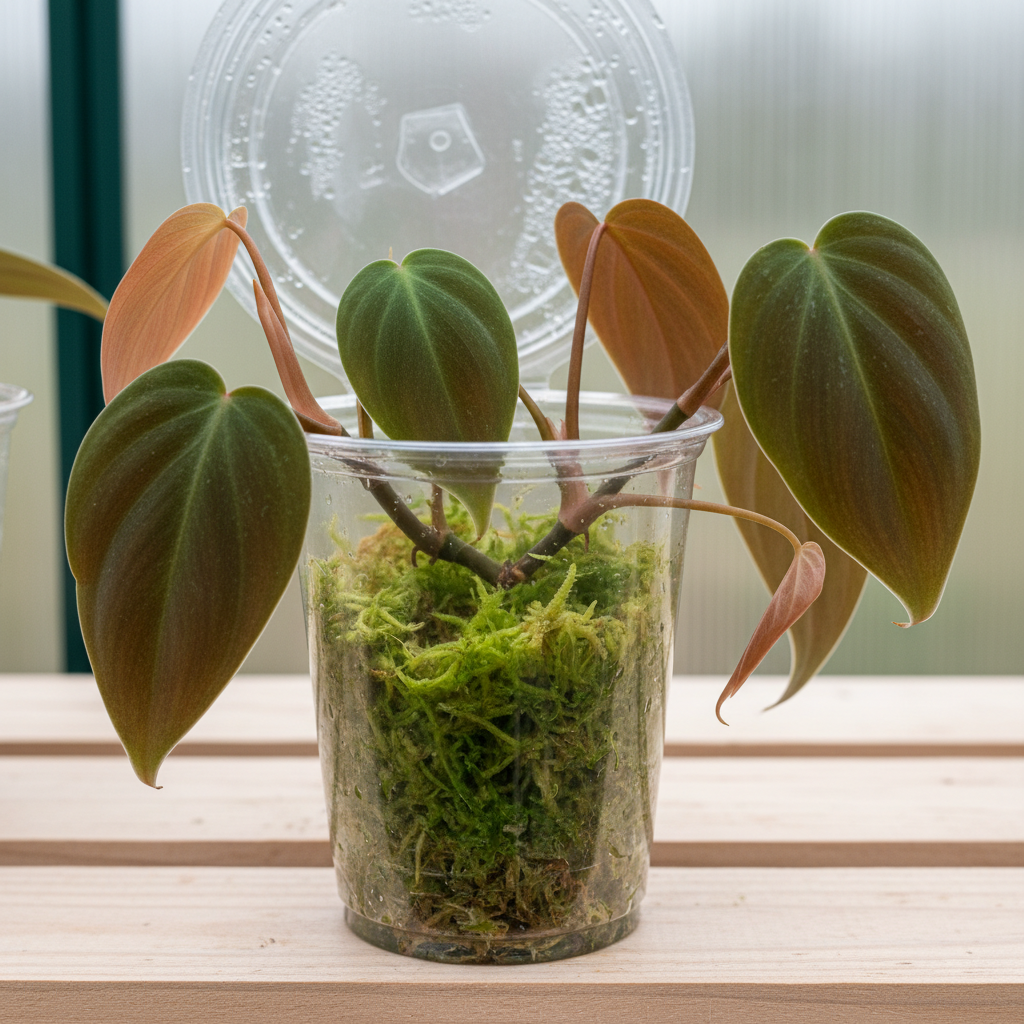
Understanding the Node
The node is the small swollen point on the stem where a leaf attaches. It is the only place from which new roots will emerge, and every viable cutting must contain at least one. On a healthy micans you can often see tiny brown nubs already developing on the underside of the stem at the node, which are aerial root initials waiting for moist conditions to extend. A cutting without a node will not root. A cutting with two or three nodes is more robust and roots more reliably than a single-node cutting, particularly for beginners.
Sphagnum Moss Propagation: Step-by-Step
This is the most reliable method for Philodendron micans and the one most experienced growers default to. It produces strong root systems that establish smoothly in soil, with very low failure rates.
- Select a healthy stem section with at least two nodes and one or two intact leaves. Avoid stems with damaged or yellowing leaves.
- Using sterilised scissors or a sharp knife, cut just below a node, leaving 1 to 2 cm of stem below the lowest node so the cutting has something to anchor.
- Remove the leaf closest to the cut so the node is bare and can be in direct contact with moss.
- Soak a handful of long-fibre sphagnum moss in clean room-temperature water for ten minutes, then squeeze out the excess so the moss is damp, not dripping.
- Loosely pack the damp moss into a clear plastic deli cup or small zip-top bag, deep enough to bury the lower node by 2 to 3 cm.
- Tuck the cutting in so the bare node is fully surrounded by moss, with the upper leaves above the moss.
- Loosely close the lid or zip to maintain humidity but allow some gas exchange. Place in bright indirect light at 21 to 26 °C (70 to 79 °F).
- Check every few days. The moss should stay damp; mist if it dries. Roots typically appear within 10 to 21 days, with new leaf growth following soon after.
- When the new roots are 3 to 5 cm long, pot the cutting into fresh aroid mix and water lightly. Keep in slightly higher humidity for the first two weeks to ease the transition.
Pro Tip — Skip Rooting Hormone: Philodendron micans roots so readily that commercial rooting hormone offers little benefit and can even slow things down if applied too heavily. The plant produces its own auxins at the node in response to moist contact. Save the hormone for woody cuttings of other plants.
Water Propagation: Step-by-Step
Water rooting is fast, visually satisfying and works well for Philodendron micans, although the resulting roots are slightly more brittle than moss-grown roots and can sulk briefly when first moved to soil.
- Take a cutting with one or two nodes and at least one leaf, cutting just below the lowest node with sterilised scissors.
- Remove the leaf at the lowest node so no foliage sits in the water (submerged leaves rot quickly and foul the water).
- Place the cutting in a clear glass jar of room-temperature water, ensuring the node is submerged but the remaining leaves are well above the waterline.
- Set the jar in bright indirect light. Avoid direct sun, which heats the water and stresses the cutting.
- Change the water every five to seven days, or sooner if it looks cloudy, refilling with fresh room-temperature water each time.
- Roots usually appear within 7 to 14 days. Wait until they are 5 to 8 cm long before potting up.
- Pot into a chunky moisture-retentive aroid mix and water generously the first time. The plant may droop for a few days while the water-grown roots adjust to soil; keep the substrate consistently slightly moist for the first three weeks.
Troubleshooting Propagation
| Problem | Likely Cause | Solution |
|---|---|---|
| Cutting blackens at the base | Bacterial rot from dirty water or contaminated moss | Recut above the blackened section, sterilise tools, start over with clean materials |
| No root growth after four weeks | Cool temperatures or insufficient light | Move to a warmer spot (22 °C+) with brighter indirect light |
| Roots form but no new leaves | Cutting establishing the root system first, normal | Wait another two to four weeks; pot up only when leaves resume |
| Cutting wilts after potting | Roots have not yet adjusted to absorbing from soil | Tent loosely with a clear plastic bag for one week to retain humidity |
Pests & Diseases
Philodendron micans is reasonably resilient against pests, but the velvety leaf surface gives certain insects extra purchase and can hide their presence in the early stages. Regular inspection — turning over leaves, checking the leaf axils and stem joints once a week — catches most infestations before they become serious. Healthy, well-watered plants are also markedly less attractive to pests than stressed ones, so most pest management starts with good cultural care rather than chemicals.
Disease pressure indoors is generally low, with root rot from chronic overwatering accounting for the majority of plant losses. Fungal and bacterial leaf infections do occur, particularly in cold rooms with stagnant air, but they are far less common than people fear.
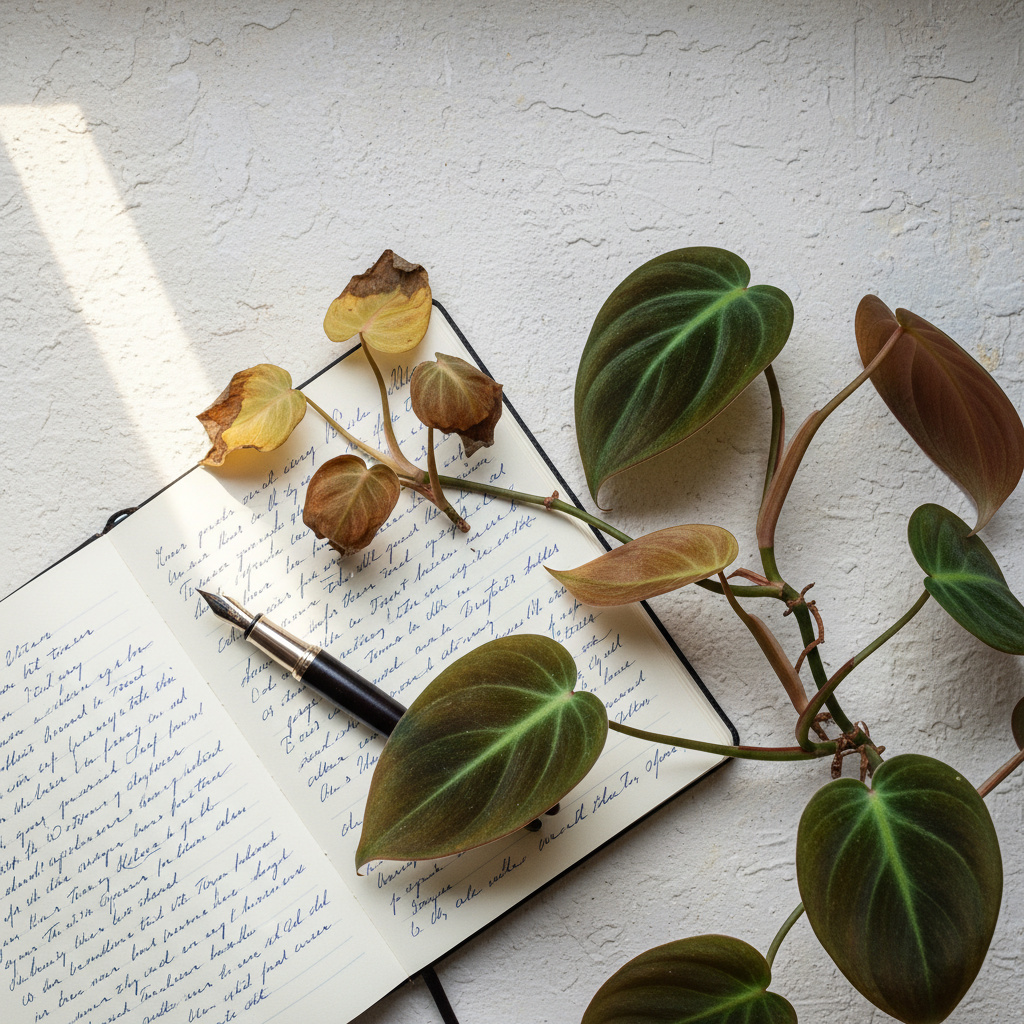
Common Pests
Spider Mites (Tetranychus urticae)
Tiny eight-legged arachnids, barely visible to the naked eye, that thrive in dry indoor air. They puncture leaf cells and feed on the contents, leaving the leaf surface stippled with pale dots that gradually merge into bronze, dry-looking patches. Fine webbing on the undersides of leaves and in leaf axils is a late-stage giveaway.
Treatment: Shower the entire plant thoroughly under lukewarm water, paying particular attention to the undersides of leaves. Follow up with weekly sprays of insecticidal soap or a diluted neem oil solution for three to four weeks to break the egg cycle. Raising humidity around the plant makes the environment less hospitable to mites.
Mealybugs (Pseudococcus longispinus)
Soft-bodied insects covered in a white, waxy, cotton-like coating, usually found tucked into leaf axils, along stems, and on the undersides of leaves near the veins. They feed on plant sap and excrete sticky honeydew, which attracts sooty mould and leaves leaves sticky to the touch.
Treatment: Dab each visible mealybug with a cotton bud dipped in 70 percent isopropyl alcohol — this dissolves the protective waxy coating and kills the insect on contact. Follow up with a full plant rinse and weekly sprays of insecticidal soap for at least three weeks. Quarantine the plant during treatment to prevent spread.
Thrips (Thrips tabaci)
Slender, tan to dark-coloured insects under 2 mm long that rasp at the leaf surface and feed on the sap that escapes. Damage shows up as silvery streaks and patches, often with tiny black dots of frass nearby. Thrips reproduce quickly and can move between plants on clothing, so prompt action matters.
Treatment: Trim and dispose of the worst-affected leaves. Spray the entire plant with insecticidal soap or a neem oil solution every five to seven days for at least four weeks. Place sticky blue or yellow traps near the plant to monitor and trap winged adults.
Fungus Gnats (Bradysia coprophila)
Small dark flies that hover around the substrate surface. The adults are mostly a nuisance, but their larvae feed on roots and organic matter in consistently wet soil, weakening seedlings and freshly potted cuttings in particular.
Treatment: Let the top 2 to 3 cm of substrate dry out fully between waterings to interrupt the larval life cycle. Top-dress with a 1 cm layer of horticultural sand or fine gravel to deter egg-laying. For active infestations, drench the substrate with a Bacillus thuringiensis subsp. israelensis (Bti) solution, which targets gnat larvae specifically.
Common Diseases
Root Rot (Pythium and Phytophthora spp.)
The most serious problem the plant faces indoors. Caused by water moulds that thrive in waterlogged, oxygen-poor soil. Symptoms above the soil include sudden yellowing of multiple lower leaves, soft drooping stems, and a sour smell from the substrate. Roots when unpotted are brown, mushy and slip out of their outer skin when pinched.
Treatment: Unpot immediately. Rinse the rootball under lukewarm water to expose the damage. Trim away every soft brown root with sterilised scissors back to firm white tissue. Dust cut surfaces with cinnamon or sulphur powder. Repot into fresh dry aroid mix in a clean pot, and do not water for four or five days. Going forward, water only when the top of the substrate is dry.
Bacterial Leaf Spot (Xanthomonas campestris)
Appears as small, water-soaked lesions on the leaves that expand into larger brown or black spots, sometimes with a yellow halo. Spreads through splashing water and contact between leaves, particularly in cool stagnant conditions.
Treatment: Remove affected leaves at the base of the petiole with sterilised scissors, and dispose of them. Improve air circulation around the plant and avoid wetting the foliage when watering. Severe outbreaks may warrant a copper-based fungicide, though good cultural correction usually clears the problem within a few weeks.
Pest and Disease Summary
| Pest / Disease | Identification | Treatment |
|---|---|---|
| Spider mites | Stippled leaves, fine webbing | Shower, insecticidal soap weekly for 3 to 4 weeks |
| Mealybugs | White cottony patches in axils | Alcohol swab, then insecticidal soap weekly |
| Thrips | Silvery streaks, tiny black dots | Trim damaged leaves, neem spray every 5 to 7 days |
| Fungus gnats | Small flies around substrate | Let substrate dry; Bti drench for larvae |
| Root rot | Yellow leaves, soft stems, sour smell | Unpot, trim rotten roots, repot in dry mix |
| Bacterial leaf spot | Brown spots with yellow halo | Remove leaves, improve airflow, copper if severe |
Prevention Strategies
Quarantining new plants for at least three weeks before adding them to your main collection is the single most effective prevention measure. Most indoor pest outbreaks can be traced to a newly purchased plant whose existing infestation went unnoticed in the first week. Inspect under leaves, in axils and at the soil surface during the quarantine period, and rinse the foliage thoroughly with lukewarm water on arrival.
Keep the plant’s living conditions stable. Stressed plants, whether from underwatering, low humidity, cold draughts or poor light, are more vulnerable to pest damage and recover more slowly from outbreaks. Wipe the leaves of your velvet leaf philodendron with a damp soft cloth every few weeks to remove dust and disturb the early stages of mite and thrips colonies. Avoid wetting the foliage in the evening, when leaves stay damp overnight and create a hospitable environment for fungal diseases.
Pro Tip — Inspection Routine: Make a habit of running a fingertip along the underside of a few random leaves whenever you water. The texture should be uniformly velvet-smooth. Any grit, stickiness, fine webbing or unfamiliar bump warrants a closer look with a magnifying glass. This 10-second check, done weekly, catches more than 90 percent of infestations in their earliest, most treatable phase.
Popular Varieties
Strictly speaking, “velvet leaf philodendron” refers to a single botanical form: Philodendron hederaceum f. micans, sometimes still listed by its older name Philodendron scandens micans. Unlike the regular heartleaf philodendron, micans has not been crossed and selected into a wide range of named cultivars. What growers do collect, however, is the wider group of velvety, dark-leaved climbing philodendrons that share its general aesthetic, and which sit beside it in any decent collection.
The two listed below are the ones most commonly encountered alongside Philodendron micans in plant shops and online sales. A handful of the rarer velvet philodendrons such as Philodendron verrucosum or Philodendron melanochrysum share the velvet trait but demand significantly higher humidity than micans does, and are best treated as separate plants for separate set-ups.
| Variety | Leaf Appearance | Light Needs | Growth Rate | Availability |
|---|---|---|---|---|
| Classic Micans | Small heart-shaped, deep velvet bronze-green, burgundy underside | Bright indirect | Moderate to fast | Widely available |
| Philodendron gigas | Large oblong-heart, velvet dark green, pale primary veins | Bright indirect | Moderate | Specialist sellers |
| Philodendron melanochrysum | Long pendulous velvet leaves, gold-green primary veins | Bright indirect, high humidity | Slow to moderate | Specialist sellers |
| Philodendron verrucosum | Velvet heart-shaped, contrasting veining, red petioles | Bright indirect, high humidity | Slow | Specialist sellers |
| Philodendron hederaceum (smooth) | Glossy bright green heart-shaped leaves | Bright indirect or medium | Fast | Widely available |
| Philodendron ‘El Choco Red’ | Reddish new growth maturing to velvet green | Bright indirect | Moderate | Specialist sellers |
Featured Varieties
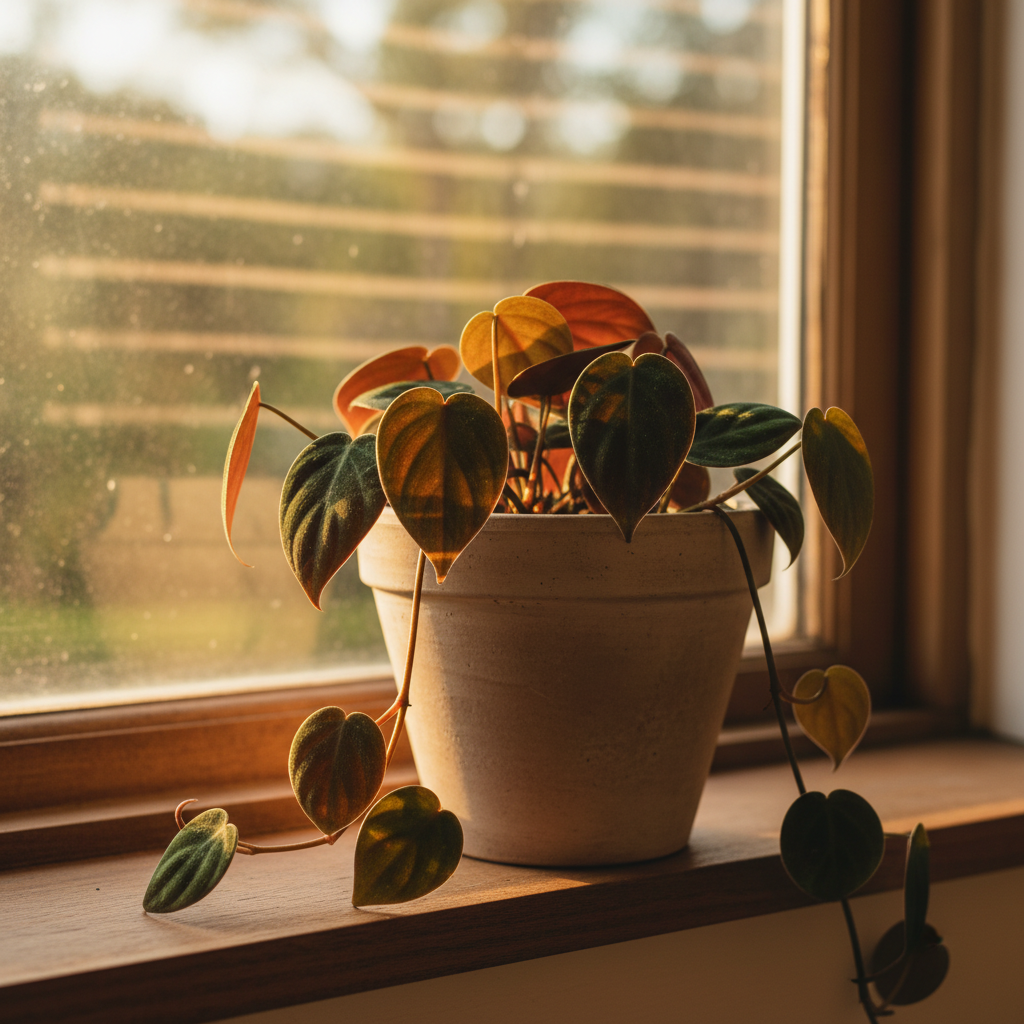
Classic Micans
The plant most people mean when they say “velvet philodendron”. Small to medium heart-shaped leaves with a deep velvet sheen, copper-bronze in strong light and rich green in lower light, with characteristic burgundy undersides. Trails or climbs equally well and roots from cuttings with very little effort.
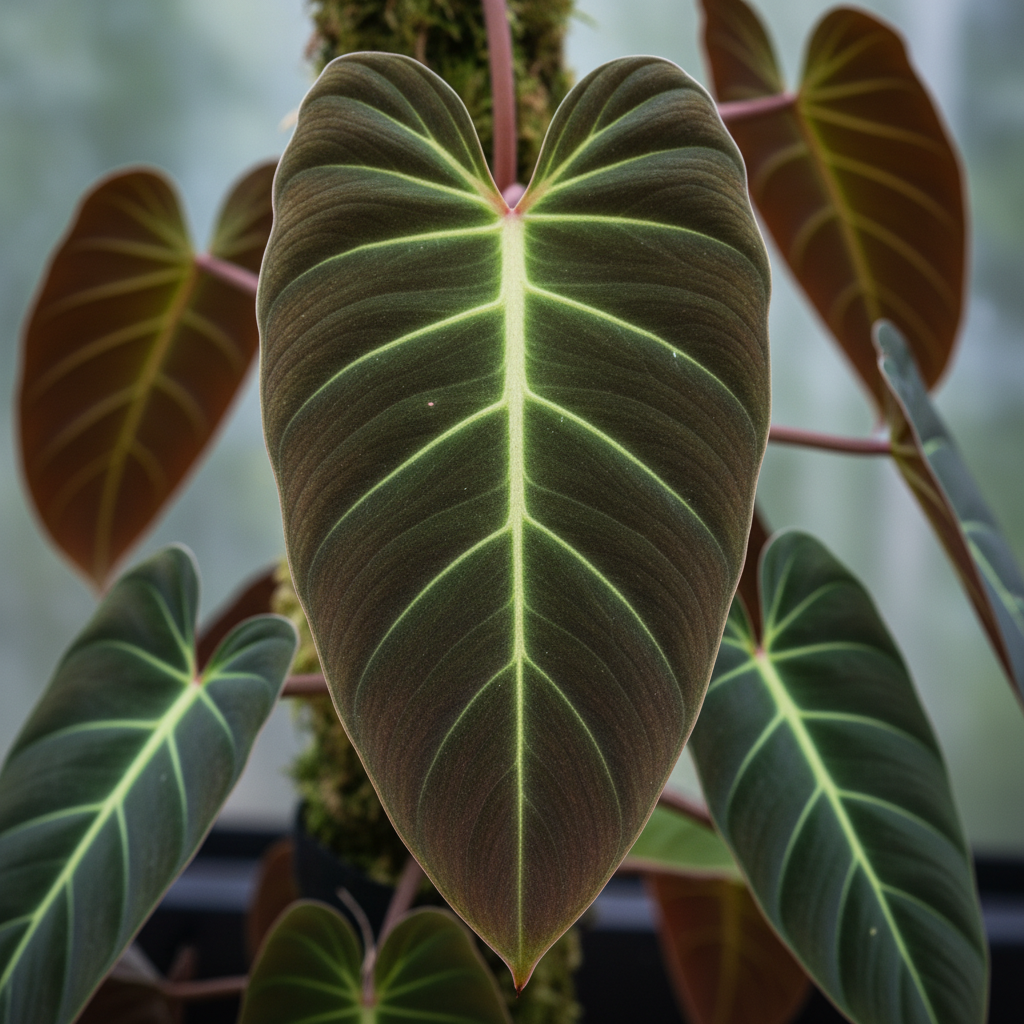
Philodendron gigas
A closely related velvety species from Panama with significantly larger, more elongated leaves than micans, reaching 60 to 80 cm on a mature climbing specimen. Pale primary veins stand out clearly against the dark velvet upper surface, and the undersides flush a wine red. Needs a moss pole or other climbing support to develop its full leaf size.
Variety Profiles in Detail
Classic Micans (Philodendron hederaceum f. micans)
Sometimes still sold under older synonyms such as Philodendron scandens micans, the classic micans is the form that started the velvet philodendron trend. Native from Mexico to the Caribbean, it scrambles along the ground and up trees as a hemiepiphyte, transitioning between juvenile small-leaved trailing growth and adult larger-leaved climbing growth depending on whether it has found a support to climb. In houseplant culture, almost all specimens stay in the juvenile, trailing phase, but giving the plant a moss pole or coir totem will encourage it to mature and produce noticeably larger, more dramatic foliage.
Philodendron gigas (Philodendron gigas)
Found growing in the cloud forests of Panama, Philodendron gigas is a true climber that holds onto its juvenile form only briefly before reaching for height. As it climbs, the leaves enlarge dramatically, taking on an elongated heart shape and developing a velvety surface that catches the light very much like micans, but on a much larger scale. The pale primary veins are more pronounced than in micans, giving the foliage an almost engraved appearance. Needs steady warmth, bright indirect light and humidity above 60 percent for its best leaf size.
Choosing the Right Variety for Your Space
For most homes, the classic Philodendron micans is the right answer. It is tolerant of average household humidity, forgiving of inconsistent watering, propagates readily and looks beautiful in almost any pot or basket. Reserve the more demanding velvet philodendrons such as gigas, melanochrysum and verrucosum for situations where you can guarantee humidity above 60 percent and temperatures consistently above 20 °C — typically a dedicated plant cabinet or a humid bathroom with adequate light. Mixing them into a low-humidity living room sets them up to fail, while the standard micans will be perfectly happy there.
Frequently Asked Questions
Why are my velvet leaf philodendron’s leaves turning yellow?
Yellowing on Philodendron micans is most often a watering issue. If multiple lower leaves are uniformly yellow and the substrate has been wet for several days, the cause is overwatering or root rot. If older leaves yellow gradually one at a time and the substrate has been dry, the cause is more likely underwatering or natural ageing. Yellowing concentrated on the newest leaves, with green veins still visible, points to an iron or magnesium deficiency that responds to a balanced liquid feed.
How fast does Philodendron micans grow?
In bright indirect light and warm conditions, a healthy plant will push out a new leaf every two to three weeks during spring and summer, with the stems extending by 5 to 15 cm a month. Growth slows substantially in winter and may pause entirely in cold rooms. Over a year, expect a young plant to roughly double in length, with mature specimens often producing trailing stems of 1 m or more.
Is Philodendron micans safe for cats and dogs?
No. All parts of the plant contain insoluble calcium oxalate crystals that cause oral pain, drooling, vomiting and difficulty swallowing if chewed by pets. The plant is also toxic to humans, especially small children, although serious harm from incidental contact is rare. Keep trailing stems out of reach of curious mouths, and consider hanging the plant or placing it on a high shelf in households with pets.
Should I let my micans trail or climb it on a moss pole?
Both are valid display choices and the plant grows happily either way. Trailing emphasises the cascading habit, the iridescent leaves catching light along a long sweep of stem. Climbing on a moss pole, conversely, encourages the plant to mature, producing progressively larger leaves with more pronounced velvet. If you want to see how striking the foliage can become, give the plant a support to climb. If you want immediate, low-maintenance impact, let it trail.
Why is my velvet leaf philodendron leggy with small leaves?
Long internodes — the bare stem between leaves — and small thin new leaves are classic symptoms of insufficient light. The plant is stretching toward the brightest source it can find. Move it closer to a window, supplement with a grow light, or both. Once the new leaves emerge in better light, the older leggy section can be trimmed off and rooted as fresh cuttings to bush up the parent.
Can I keep my velvet leaf philodendron outdoors in summer?
Yes, with care. In temperate climates, micans can spend the warmer months in a shaded outdoor spot once nights are reliably above 13 °C (55 °F). Acclimatise it gradually over a week or two by extending the daily outdoor period, and place it in deep shade or under a leafy canopy where it never receives direct sun. Bring it back indoors well before the first cool autumn nights, inspecting carefully for hitchhiker pests before reintroducing it to your collection.
How do I make my Philodendron micans bushier?
Two methods work together. First, prune. Cutting back the tip of any long stem just above a node encourages two new shoots to emerge from below the cut, doubling the branch count over time. Second, replant the pruned cuttings back into the same pot once they have rooted. Five or six well-spaced cuttings sharing a single pot fill in to produce a dense, full plant much faster than a single trailing stem can manage on its own.
My micans has lost its velvet sheen — what happened?
The papillae responsible for the velvet effect develop most strongly under bright indirect light. A plant moved from a bright spot to a darker one will produce subsequent leaves with less pronounced velvet and duller colour. The change is reversible: move the plant back into stronger indirect light and within two or three new leaves the velvet returns. Existing leaves that came in under low light will keep their faded look until they are eventually replaced.
Do I need to wipe the leaves of my velvet philodendron?
Yes, gently. Dust accumulating on the papillae dulls the iridescence and reduces light absorption. Wipe each leaf carefully with a soft damp microfibre cloth or a slightly damp cotton round every two to four weeks, supporting the underside of the leaf with one hand so you do not snap the petiole. Avoid leaf-shine products, which clog the velvety surface and can leave a permanent gloss that ruins the plant’s natural look.
When is the best time to repot a Philodendron micans?
Early spring, just as new growth pushes out after the winter slowdown, is the ideal moment. The plant recovers from any root disturbance fastest while in active growth, and you give the new substrate a full season to be colonised by roots before conditions tighten again. Mid-summer repotting works in a pinch if the plant is severely pot-bound or rot-affected, but avoid repotting in autumn or winter unless absolutely necessary.






