
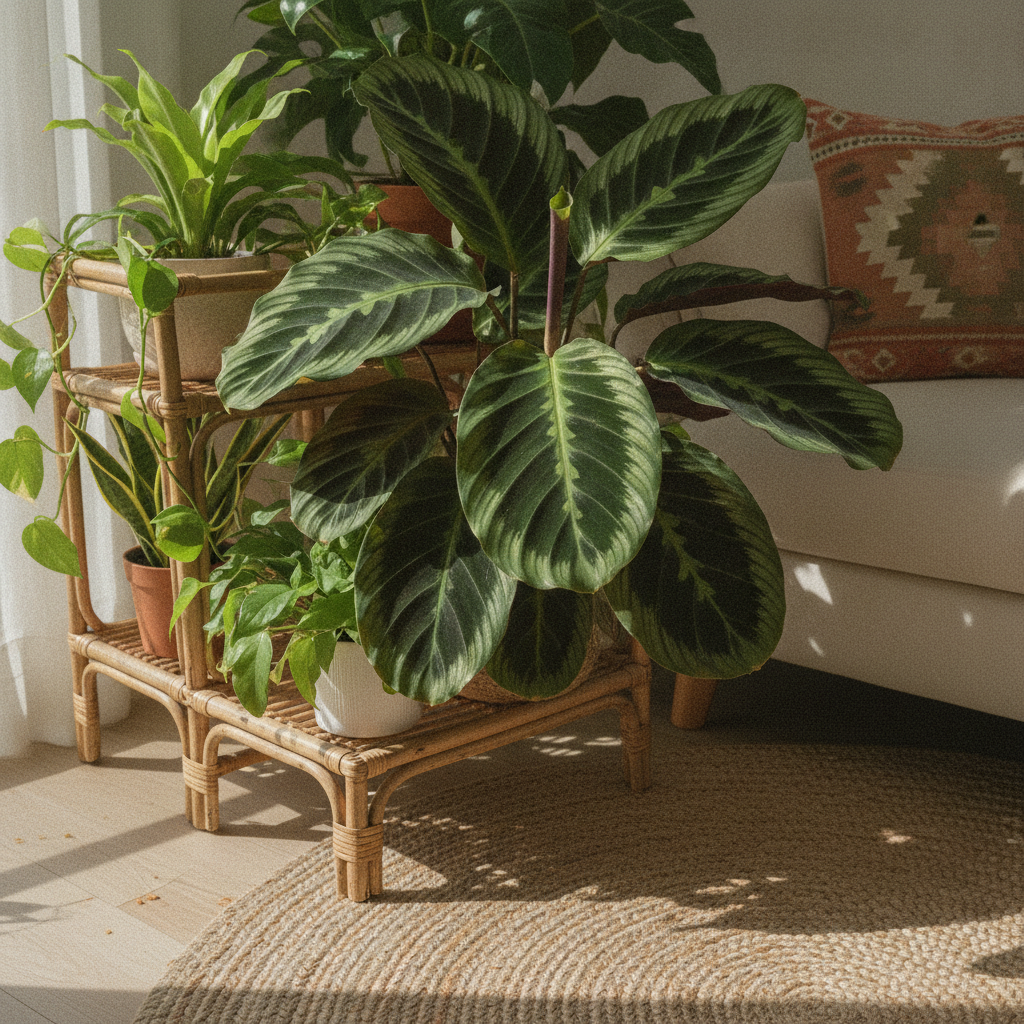
Run a fingertip across the leaf of a velvet leaf calathea and you understand the name instantly. Where most prayer plants offer a glossy or matte finish, Goeppertia zebrina (long grown and sold as Calathea zebrina) presents a surface like brushed suede, its deep emerald blades feathered with pale yellow-green chevrons that ripple out from a lighter midrib. Native to the humid Atlantic forests of southeastern Brazil, around Rio de Janeiro and São Paulo, it belongs to the arrowroot family Marantaceae and shares that family’s famous habit of folding its leaves upward at dusk, a nightly movement called nyctinasty that gives the whole group its “prayer plant” nickname.
The velvet leaf calathea has a reputation as a diva, and that reputation is only half deserved. It is not a difficult plant so much as an honest one: it tells you immediately when something is wrong, usually by crisping its leaf edges or curling inward. Learn to read those signals and provide the warm, humid, evenly moist conditions it evolved for, and it becomes a strikingly beautiful and surprisingly forgiving houseplant. This guide walks through every aspect of its care, from light and water to soil, feeding, propagation and pests, and draws a clear line between merely keeping the plant alive and coaxing it into the lush, tactile growth that makes it worth owning in the first place.
Contents
- Quick Reference
- Why Velvet Leaf Calathea Makes a Rewarding Houseplant
- Light Requirements
- Watering & Humidity
- Soil, Potting & Repotting
- Fertilising
- Propagation
- Pests & Diseases
- Popular Varieties
- Frequently Asked Questions
Quick Reference: Velvet Leaf Calathea at a Glance
| Light | Bright, indirect light; tolerates medium light. No direct midday sun. |
| Watering | Keep soil evenly moist; water when the top 2 to 3 cm (1 in) feels dry. Never soggy, never bone dry. |
| Temperature | 18 to 27 degrees C (64 to 81 degrees F). Avoid anything below 15 degrees C (59 degrees F). |
| Humidity | High, ideally 60 percent or above. Struggles below 50 percent. |
| Fertiliser | Balanced liquid feed at half strength, every 4 to 6 weeks in spring and summer. |
| Toxicity | Non-toxic and pet-safe. Harmless to cats, dogs and humans. |
Why Velvet Leaf Calathea Makes a Rewarding Houseplant
The first and most obvious reason to grow this plant is the foliage. The leaves are large, broadly oval and can reach 30 to 40 cm (12 to 16 in) on a mature specimen, held on slender petioles that lift them into a gently arching clump up to about 60 cm (24 in) tall indoors. Each blade carries a feathered pattern of light and dark green that genuinely resembles the striping of a zebra, and the velvety texture catches light in a way no photograph fully captures. Turn a leaf over and you find a rich purple-maroon underside, a flash of colour that shows every evening as the leaves rise.
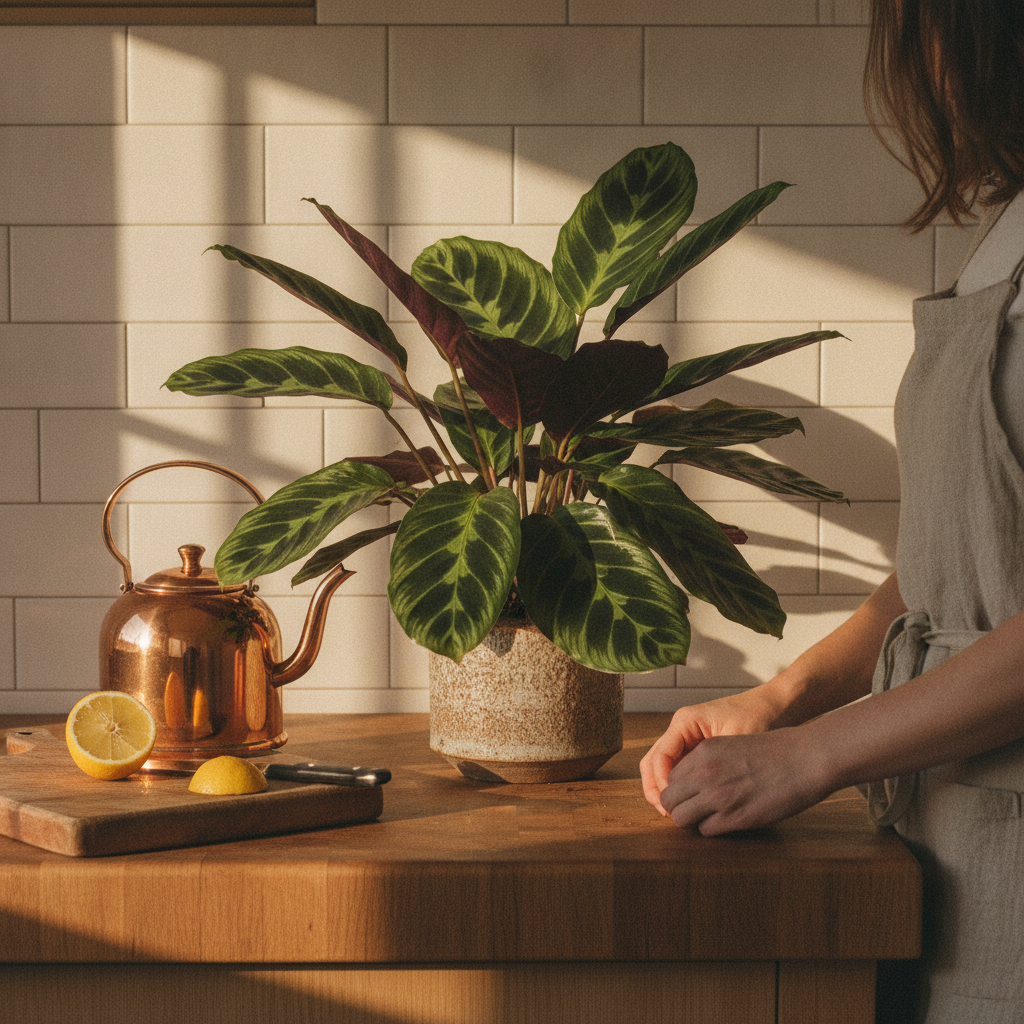
Beyond looks, the velvet leaf calathea earns its place through behaviour. The nightly folding and unfurling of the leaves makes it one of the most quietly animated plants you can own, a living clock that responds to the room’s light cycle. It stays compact enough for a side table, shelf or plant grouping, never outgrowing a typical living space the way a monstera or fiddle leaf fig eventually will. And crucially for households with animals, it is completely non-toxic, so a curious cat or dog batting at those moving leaves is in no danger.
Important — Toxicity: The velvet leaf calathea is listed as non-toxic to cats, dogs and humans by the ASPCA and comparable authorities. It is one of the safest statement foliage plants for a home with pets or small children. Even so, ingesting any plant material can cause mild stomach upset, so it is still sensible to discourage nibbling.
Light Requirements
In its native forest, Goeppertia zebrina grows on the shaded floor beneath a dense canopy, receiving only the dappled, filtered light that reaches through layers of leaves above. Recreating that quality of light indoors is the single most important thing you can do for the plant’s appearance. It wants brightness without a single ray of harsh, direct sun striking the leaf surface.
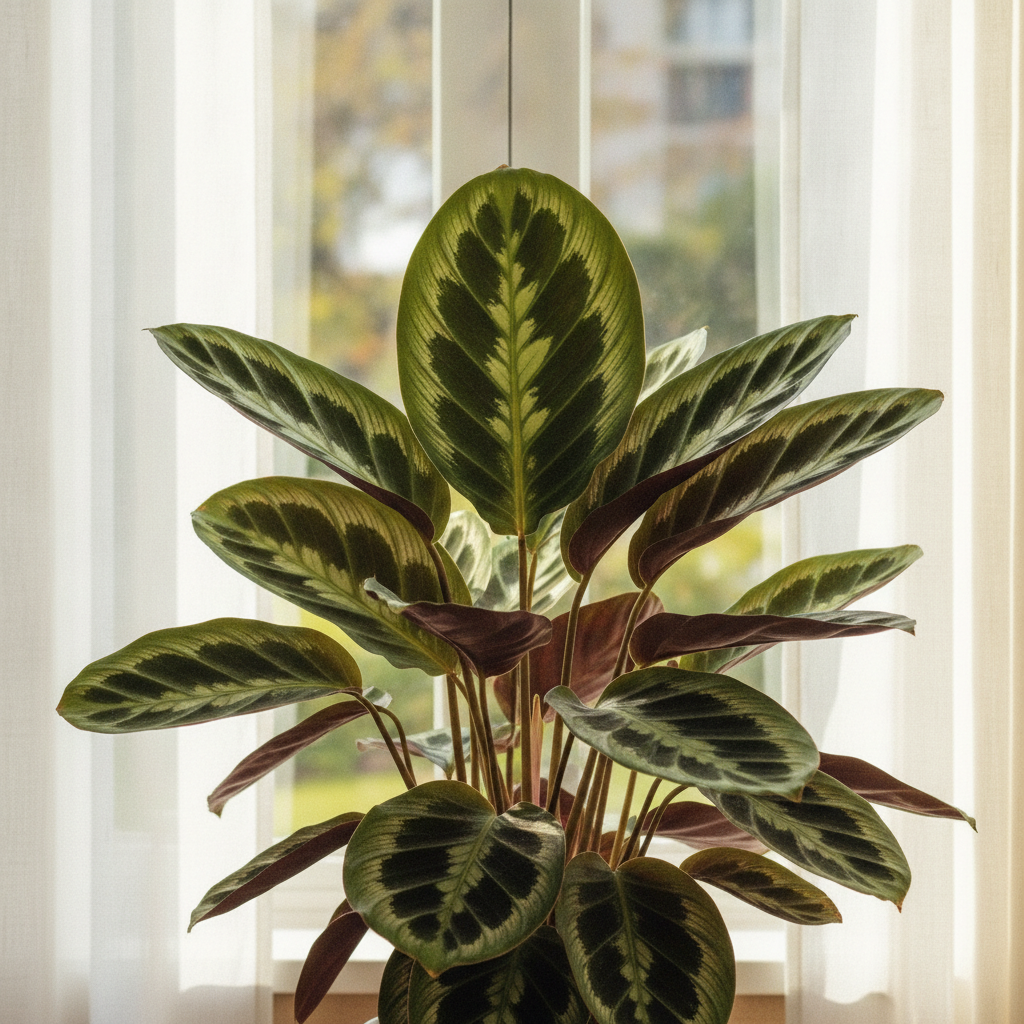
The ideal position is a spot that receives plenty of ambient daylight but where the sun itself never lands on the foliage, such as a metre or two back from a bright window, or directly beside a window screened with a sheer curtain. In this kind of light the plant grows steadily, keeps its markings crisp and unfolds its leaves fully each morning.
Light Levels Explained
Interior light is easy to misjudge because our eyes adjust automatically, making rooms feel brighter than they are for a plant. The table below sets out the practical categories and how each affects a velvet leaf calathea.
| Light Category | Approx. Level | Typical Location | Outcome |
|---|---|---|---|
| Direct sun | Over 50,000 lux | On an unshaded south or west sill | Scorched, bleached leaves; avoid |
| Bright indirect | 10,000 to 20,000 lux | Near an east window or behind a sheer curtain | Ideal; strong colour and steady growth |
| Medium | 5,000 to 10,000 lux | A metre or two into a bright room | Good; slightly slower growth |
| Low | 1,000 to 5,000 lux | A north corner or interior wall | Tolerated; leggy, muted markings |
| Very low | Under 1,000 lux | A dim hallway or windowless room | Decline over time; not recommended |
Window Orientation and Placement
South-facing window: Very bright in the northern hemisphere. Fine only if the plant is set well back from the glass or the window is diffused with a sheer curtain or blind. Placed directly on a south sill, the leaves will scorch within days.
East-facing window: Arguably the best choice. The gentle morning sun is rarely strong enough to burn, and the rest of the day delivers bright, indirect light. The plant can sit close to an east window without protection.
West-facing window: Workable, but the intense late-afternoon sun needs filtering. Position the plant slightly to one side or add a sheer curtain to soften the strongest hours.
North-facing window: Provides soft, even light with no risk of scorch, and the velvet leaf calathea will happily sit on a north sill. Growth is a little slower here, and in a dim north room you may want to supplement with a grow light through winter.
Pro Tip — Rotate for Even Growth: Because the plant leans gently toward its light source, give the pot a quarter turn each time you water. This keeps the clump symmetrical and stops all the leaves reaching in one direction.
How Light Affects Leaf Colour and Pattern
The contrast between the light and dark bands is strongest in bright, indirect light. In too little light the new leaves emerge smaller, the internodes stretch, and the striping fades toward a uniform dull green. In too much light the opposite happens: the leaf surface pales and bleaches, the velvety sheen dulls, and pale scorched patches develop that never recover. The sweet spot, where colour and texture are at their peak, is the same bright but shielded light the plant enjoys in the wild.
Warning — Direct Sunlight: Even an hour of direct midday or afternoon sun can leave permanent bleached or crisped patches on the velvety leaves. If you notice the surface looking washed out or faded, move the plant further from the window before the damage spreads.
Artificial Lighting
The velvet leaf calathea responds well to a full-spectrum LED grow light, which makes it a good candidate for interior spaces away from windows or for topping up short winter days. A light delivering roughly 5,000 to 10,000 lux at leaf level, running 10 to 12 hours a day on a timer, keeps growth steady. Keep the fixture far enough back that it does not raise leaf temperature, and remember that grow lights do nothing for humidity, which remains the plant’s real limiting factor indoors.
Seasonal Adjustments
As daylight weakens through autumn and winter, move the plant closer to its window to compensate, and expect growth to slow or pause entirely. When spring returns and the sun climbs higher and stronger, step it back again or reintroduce a diffusing curtain so the intensifying light does not catch the leaves. These small seasonal shifts matter more for calatheas than for tougher foliage plants.
Watering & Humidity
Watering is where most velvet leaf calatheas are won or lost. The plant wants its soil kept consistently, evenly moist, never waterlogged and never allowed to dry out completely. That narrow band between too wet and too dry is the crux of its reputation for fussiness, and it is entirely manageable once you stop watering by the calendar and start watering by the soil.
When to Water
Check the plant every few days by pushing a finger into the top of the pot. When the top 2 to 3 cm (about 1 in) of soil feels dry to the touch while the layer below stays lightly moist, it is time to water. In a warm, bright room this often works out to roughly once a week in summer, dropping to once every ten days or fortnight in winter, but treat those figures as a starting point, not a rule.
The plant will also tell you directly. Leaves that curl inward and edges that begin to crisp usually signal thirst or dry air, while yellowing lower leaves and a sour, waterlogged smell point to overwatering. Because the symptoms of too much and too little water can look similar at a glance, always confirm by feeling the soil before you reach for the watering can.
Pro Tip — Read the Leaves at Night: A healthy velvet leaf calathea folds its leaves up in the evening and opens them each morning. If the leaves stop moving, or stay curled during the day, it is often an early sign that watering or humidity has drifted off track.
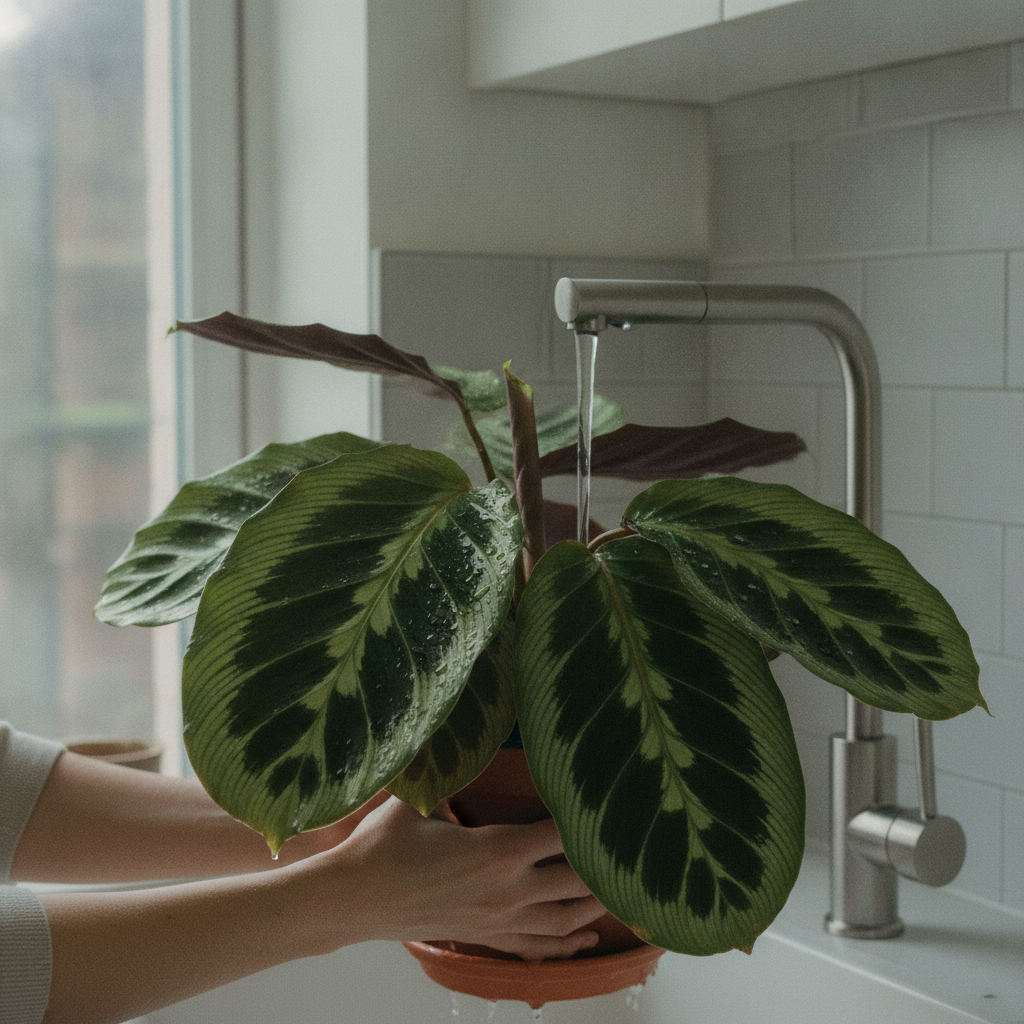
How to Water Correctly
- Use room-temperature water; cold water straight from the tap can shock the roots.
- Pour slowly and evenly over the whole soil surface until water begins to flow from the drainage holes.
- Let the pot drain fully for several minutes so no water sits at the base.
- Empty the saucer or cache pot; never leave the plant standing in collected water.
- Return the plant to its spot only once it has stopped dripping.
Signs of Overwatering vs. Underwatering
| Symptom | Overwatering | Underwatering |
|---|---|---|
| Leaf colour | Yellowing, often from the lower leaves up | Browning, crisping at the edges and tips |
| Leaf texture | Soft, limp, sometimes translucent | Dry, papery, tightly curled |
| Soil | Constantly wet, sometimes with a sour smell | Dry throughout, pulling away from the pot sides |
| Roots | Brown, mushy, foul-smelling | Dry and brittle but otherwise pale and firm |
| Stem base | Soft or blackened at the soil line | Firm but the whole plant may wilt |
Warning — Root Rot: Soil that stays saturated for long periods suffocates the roots and invites rot, the most common killer of this plant. If you notice mushy, dark roots and a bad smell, unpot immediately, trim away every affected root with sterile scissors, and repot into fresh, barely moist mix.
Humidity Requirements
If watering is the first key to this plant, humidity is the second, and the two are closely linked. Coming from a rainforest floor, the velvet leaf calathea expects the air to be consistently damp, ideally 60 percent relative humidity or higher. In the dry air of a heated or air-conditioned home, often 30 to 40 percent, the leaf edges brown and crisp no matter how carefully you water.
The classic symptoms of low humidity are crisp brown edges and tips, curling that does not relax in the morning, and slow, stunted new growth. These are cosmetic at first but signal that the plant is under constant stress.
The most reliable way to raise humidity is a small room humidifier running near the plant, which lifts the ambient level in a way nothing else matches. Grouping plants together creates a shared microclimate of higher moisture, and a wide pebble tray filled with water beneath the pot helps locally. Misting offers only a brief lift and, on velvety leaves, can encourage fungal spots, so it is the least effective option here. A bright bathroom or kitchen, where everyday activities keep the air moist, is often the happiest home for this plant.
Water Quality
Calatheas are notoriously sensitive to the minerals, chlorine, chloramine and fluoride found in much tap water, and a build-up shows as brown leaf tips and edges over time. Where your tap water is hard or heavily treated, switch to filtered water, collected rainwater or distilled water. If only tap water is available, leaving it to stand uncovered overnight lets some chlorine dissipate, though it does nothing for fluoride or dissolved salts. Given how much the leaf edges reveal, water quality is well worth getting right for this species.
Soil, Potting & Repotting
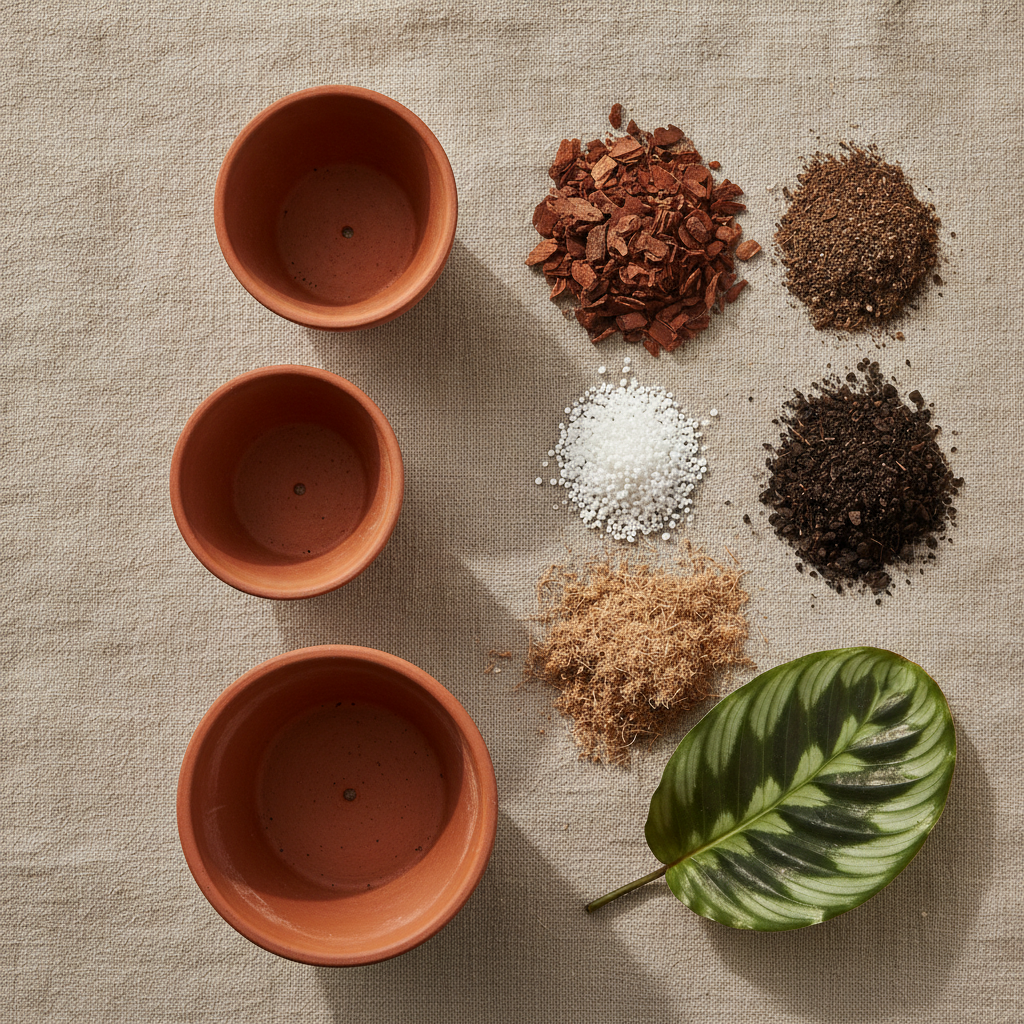
The perfect growing medium for a velvet leaf calathea resolves the same tension as its watering: it must hold moisture so the roots never dry out, yet drain and breathe freely so they never sit in water. A dense, water-retentive potting soil straight from the bag will stay soggy and rot the roots, while a fast-draining cactus mix dries too quickly and leaves the plant perpetually thirsty. The answer is a light, airy, moisture-retentive blend.
Ideal Soil Composition
Aim for a mix built around a moisture-holding base loosened with plenty of aerating material. The proportions below make a reliable calathea blend that stays evenly damp without turning to mud.
| Component | Proportion | Function |
|---|---|---|
| Coco coir or peat | 50 percent | Holds moisture evenly and forms the body of the mix |
| Perlite or pumice | 20 percent | Opens the structure and improves drainage and aeration |
| Fine orchid bark | 20 percent | Creates air pockets and stops compaction |
| Worm castings or compost | 10 percent | Adds gentle, slow-release nutrition |
The velvet leaf calathea prefers a slightly acidic soil, roughly pH 6.0 to 6.5, which coco coir and peat naturally provide. A small handful of horticultural charcoal in the mix helps keep it sweet and improves drainage further.
Pro Tip — Quick Mix Recipe: No time to measure? Start with a bag of quality peat-free houseplant compost and stir in roughly one-third by volume of perlite plus a couple of handfuls of fine orchid bark. That single tweak transforms a dense off-the-shelf soil into something a calathea can thrive in.
Choosing the Right Pot
The container matters as much as the soil, because it governs how quickly the mix dries and whether excess water can escape.
Drainage holes are non-negotiable. Whatever pot you choose, it must have holes at the base. A decorative cache pot without drainage is fine as an outer sleeve, but the plant should grow in an inner pot that drains freely and never sits in standing water.
Pot material: Plastic and glazed ceramic both hold moisture well and suit a plant that likes to stay damp. Unglazed terracotta wicks water out through its walls and can dry the mix faster than a calathea prefers, so if you love the look of terracotta, expect to water a little more often.
Pot size: Choose a pot only 2 to 3 cm (about 1 in) wider than the current root ball. An oversized pot holds a large volume of wet soil around a small root system, which dries slowly and raises the risk of rot.
When to Repot
The velvet leaf calathea is a slow, steady grower and does not need frequent repotting; every one to two years is plenty. Signs it is ready include roots emerging from the drainage holes or circling the surface, water running straight through without wetting the mix, or growth that has stalled despite good care. The best time to repot is spring or early summer, when the plant is actively growing and recovers fastest from the disturbance.
How to Repot: Step-by-Step
- Water the plant lightly a day ahead so the root ball is moist and holds together.
- Ease the plant out by tipping the pot and supporting the base of the clump; avoid pulling on the leaves.
- Gently tease away the loose old soil and inspect the roots, trimming any that are brown or mushy with sterile scissors.
- Add a layer of fresh mix to the new pot and set the plant so it sits at the same depth as before.
- Fill around the root ball with fresh mix, firming gently to remove large air gaps without compacting.
- Water thoroughly to settle the soil, then return the plant to bright, indirect light.
Warning — Transplant Shock: Expect some sulking after repotting; a little leaf curl or drooping is normal for a week or two. Keep humidity high, hold off on fertiliser until you see new growth, and resist the urge to overwater a plant that is simply settling in.
Fertilising
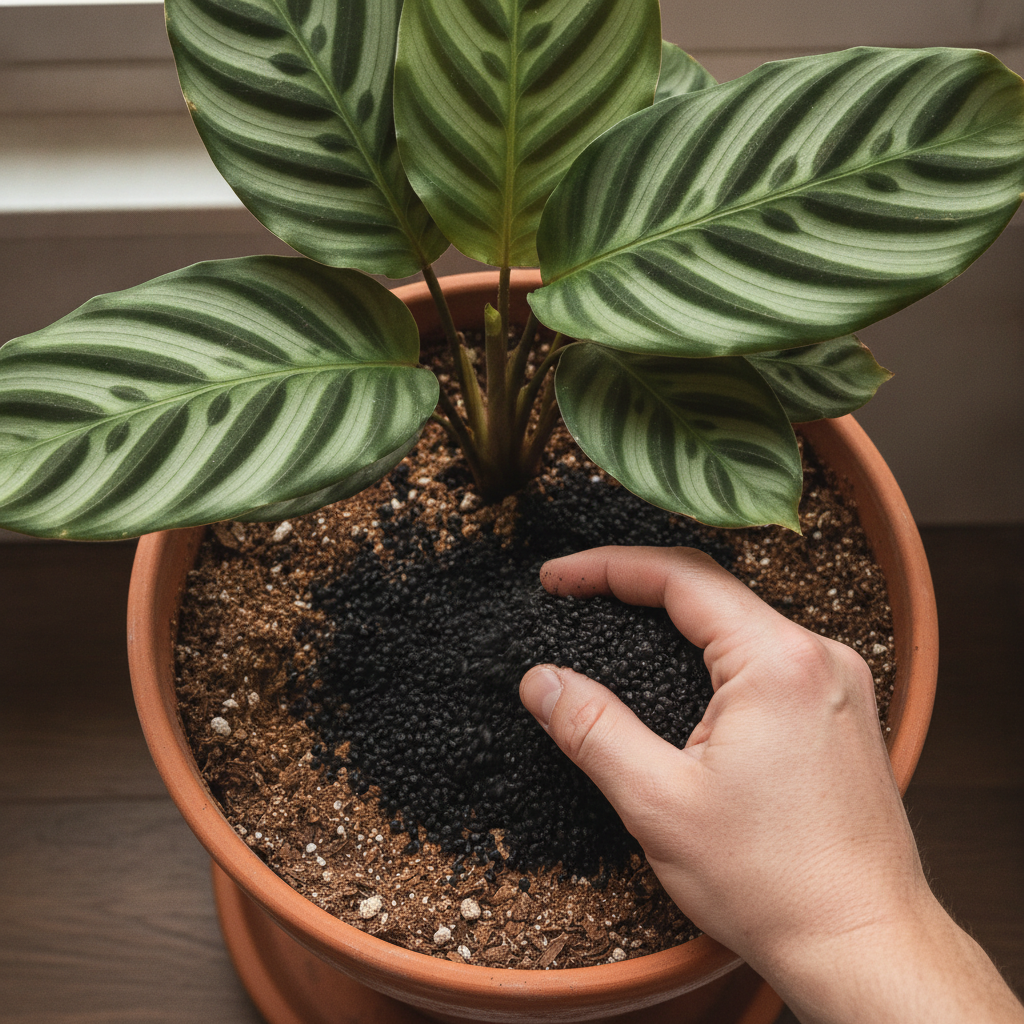
The velvet leaf calathea is a light feeder, and its needs are modest compared with fast-growing foliage plants. A little balanced nutrition through the growing season supports healthy leaves and good colour, but this is a plant far more easily harmed by too much fertiliser than by too little.
The reason for caution is the same sensitivity that shows in its response to water quality: calatheas react badly to a build-up of mineral salts, and over-fertilising quickly scorches the leaf edges. Restraint is the guiding principle.
Understanding Plant Nutrients
Fertilisers are labelled with an N-P-K ratio, the percentages of nitrogen, phosphorus and potassium they contain. For a foliage plant like this one, a balanced formula covers all the main needs, while a handful of secondary nutrients keep the leaves healthy and the colour strong.
| Nutrient | Symbol | Primary Function | Deficiency Symptoms |
|---|---|---|---|
| Nitrogen | N | Leaf and stem growth, green colour | Pale, yellowing older leaves; slow growth |
| Phosphorus | P | Root development and energy transfer | Stunted growth, dull foliage |
| Potassium | K | Overall vigour and water regulation | Brown leaf edges, weak stems |
| Calcium | Ca | Cell wall structure | Distorted, weak new leaves |
| Magnesium | Mg | Core of the chlorophyll molecule | Yellowing between leaf veins |
| Iron | Fe | Chlorophyll production | Pale new leaves with green veins |
Types of Fertiliser
Liquid fertilisers: The easiest to control and the best choice here, because you can dilute them well below the recommended strength and apply little and often. A balanced houseplant liquid feed diluted to half strength is ideal.
Slow-release granular: Convenient but harder to moderate, since the pellets keep releasing nutrients with every watering. If you use them, apply at half the stated rate to avoid a salt build-up.
Organic fertilisers: Worm castings, diluted seaweed extract and other gentle organic feeds suit this plant well, releasing nutrients slowly and mildly with little risk of scorching the sensitive leaf edges.
Feeding Schedule
Feed only during the active growing season, from spring through to early autumn, applying a half-strength balanced liquid feed every four to six weeks. Stop entirely in late autumn and winter, when the plant is resting and cannot use the extra nutrients, which would simply accumulate in the soil as harmful salts.
Pro Tip — Feed a Damp Pot: Always apply liquid feed to already-moist soil, never to a dry root ball. Fertilising dry roots concentrates the salts against them and can cause chemical burn; watering first protects those delicate roots.
How to Fertilise
- Dilute a balanced liquid fertiliser to half the recommended strength in room-temperature water.
- Water the plant normally first if the soil is dry, then apply the diluted feed.
- Pour evenly across the soil until a little drains from the base, carrying off any excess.
- Every couple of months, flush the pot with plain water to wash out accumulated salts.
Warning — Salt Build-Up: A white crust on the soil surface or around the pot rim, together with worsening brown leaf edges, signals a salt build-up from fertiliser or hard water. Flush the pot thoroughly by running water through it several times, and cut back on feeding.
Propagation
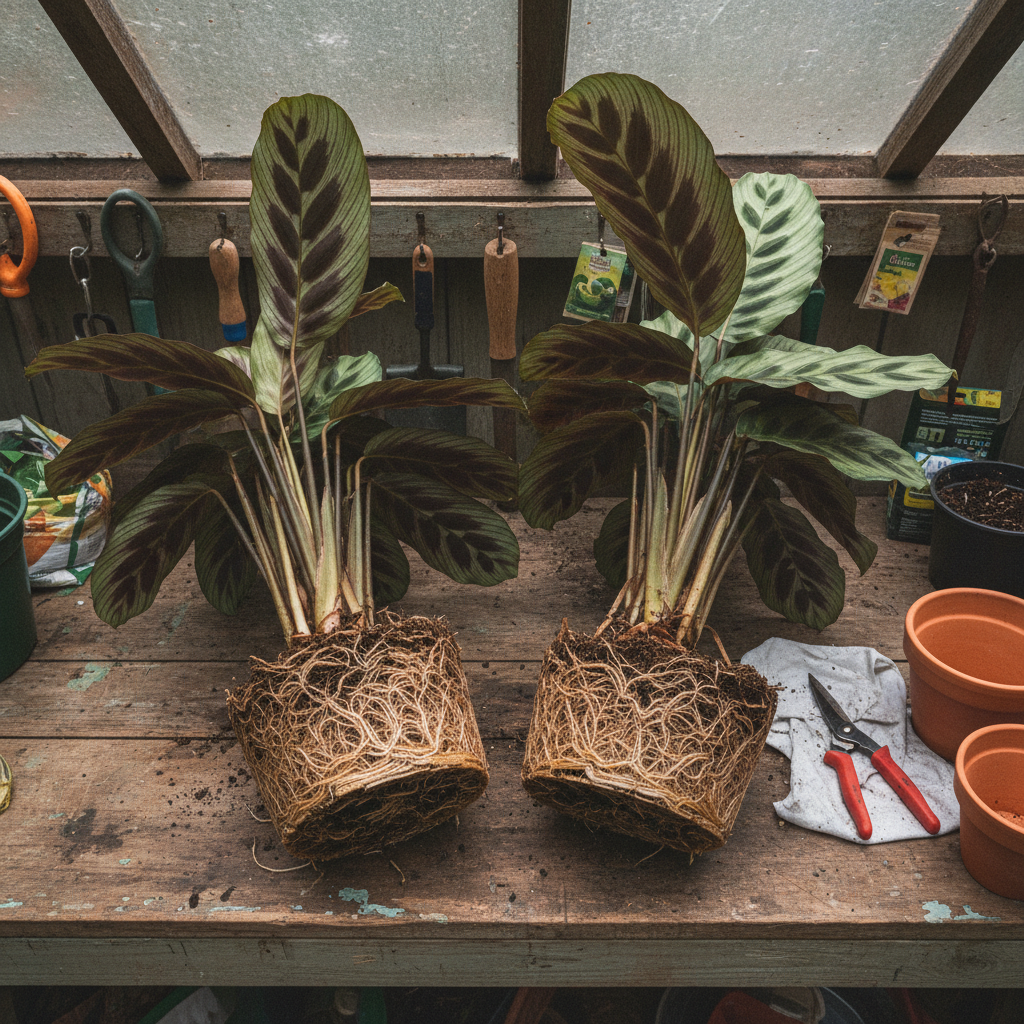
Unlike vining plants that root readily from a cutting in a jar of water, the velvet leaf calathea cannot be propagated from leaf or stem cuttings. It grows from a spreading underground rhizome and produces new shoots in a clumping habit, which means the one reliable way to make more plants is by division, separating an established clump into smaller sections that each carry their own roots and leaves.
This is best done in spring or early summer, ideally at the same time as repotting, so the plant only endures one disturbance. Division is straightforward, but calatheas dislike having their roots disturbed, so expect the divisions to sulk for a few weeks before they settle and resume growth.
Understanding the Rhizome and Clump
The plant’s growing points arise from a rhizome, a horizontal underground stem from which both roots and new leaf shoots emerge. A mature specimen is really a colony of these shoots crowded together. When you divide the plant, you are simply teasing this colony apart into self-sufficient pieces, each with a share of rhizome, roots and foliage, rather than trying to root a detached fragment that has no growing point of its own.
Division: Step-by-Step
Choose a healthy, well-established plant with several clumps of growth, and have fresh mix and small pots ready before you start so the divisions are not left exposed for long.
- Water the plant a day beforehand, then slide it out of its pot and set it on a clean surface.
- Gently brush and tease the soil away from the roots so you can see the natural clumps and where they separate.
- Ease the clump apart with your fingers, following the natural divisions; use a clean, sharp knife only where roots are too tangled to pull apart, making sure each section keeps healthy roots and at least two or three leaves.
- Pot each division into its own small container of fresh, lightly moist calathea mix, at the same depth it grew before.
- Water in gently to settle the soil around the roots.
- Place the new plants somewhere warm and bright but out of direct sun, and keep humidity high while they establish.
Pro Tip — Cover for Humidity: Slipping a clear plastic bag or propagator lid loosely over a fresh division for the first week or two traps moisture and eases the transition, since the disturbed roots cannot yet keep up with the leaves. Open it daily to let fresh air in and prevent mould.
Aftercare: Step-by-Step
The weeks immediately after division decide whether the new plants thrive or fail. Steady warmth, moisture and patience are everything.
- Keep the mix evenly moist but never soggy while the divisions recover.
- Maintain warmth of at least 18 degrees C (64 degrees F) and high humidity around the plants.
- Hold off on fertiliser until you see clear signs of new growth, usually after several weeks.
- Expect some curling or drooping at first and do not panic; new leaves signal that the roots have taken hold.
Troubleshooting Propagation
| Problem | Likely Cause | Solution |
|---|---|---|
| Division wilts and does not recover | Too few roots left on the section, or dry air | Keep humidity very high; ensure each division keeps ample roots next time |
| Leaves crisp and brown | Low humidity during recovery | Use a humidity cover or move to a more humid spot |
| Rot at the base | Soil kept too wet after division | Reduce watering; keep mix just moist, not saturated |
| No new growth for months | Cold, low light, or ordinary post-division pause | Provide warmth and bright indirect light, and be patient |
Pests & Diseases
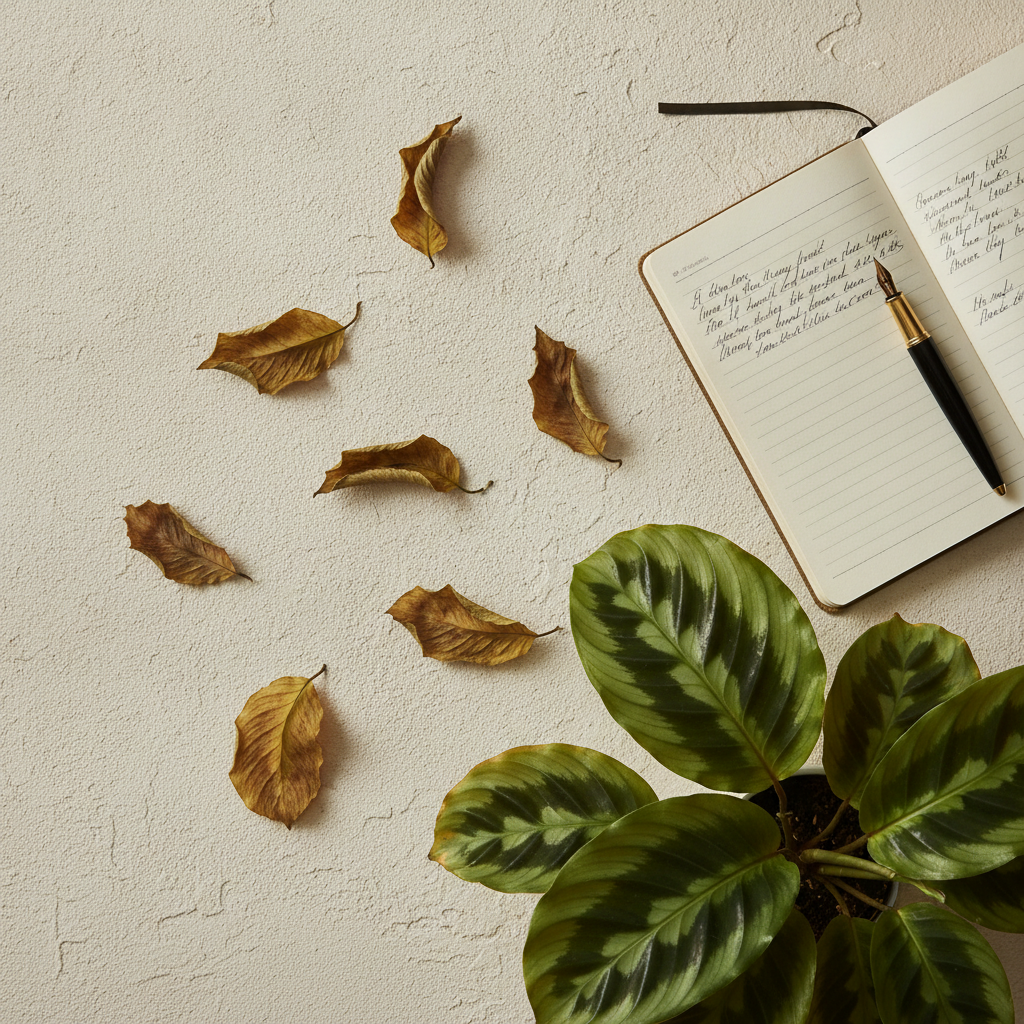
A well-cared-for velvet leaf calathea is reasonably resistant to pests, but the warm, humid conditions it enjoys can also suit certain insects, and its thin, sensitive leaves show damage quickly. The single most important pest to watch for is the spider mite, which thrives in exactly the dry, warm air that stresses the plant, so good humidity is both a care requirement and a first line of defence.
Inspect your plant regularly, paying attention to the undersides of leaves and the points where leaves meet the stems, since catching an infestation early makes it far easier to control. The section below covers the pests and diseases most likely to appear and how to deal with each.
Common Pests
Spider Mites (Tetranychus urticae)
The number one enemy of calatheas. These tiny mites thrive in dry air and cluster on leaf undersides, causing fine yellow stippling and, in bad cases, delicate webbing between the leaves and stems. Left unchecked they can weaken a plant rapidly.
Treatment: Raise humidity immediately, since mites hate moist air. Rinse the foliage thoroughly, then treat with insecticidal soap or neem oil, repeating every five to seven days until the mites are gone and checking neighbouring plants.
Thrips (Thysanoptera)
Slender, fast-moving insects that rasp at the leaf surface, leaving silvery patches, pale scarring and small black specks of excrement. They can also distort new growth as it emerges.
Treatment: Isolate the plant, prune the worst-affected leaves, and treat with neem oil or insecticidal soap. Blue sticky traps help catch the adults and monitor whether the problem is subsiding.
Mealybugs (Pseudococcidae)
Small, soft-bodied insects that look like tufts of white cotton wool tucked into leaf axils and along the stems. They suck sap and secrete sticky honeydew that can lead to sooty mould.
Treatment: Dab each insect directly with a cotton bud dipped in diluted isopropyl alcohol, then follow up with neem oil or insecticidal soap. Repeat weekly until no new bugs appear.
Fungus Gnats (Sciaridae)
Small dark flies that hover around the pot and lay eggs in constantly damp soil, where the larvae feed on organic matter and fine roots. They are more a symptom of overwet soil than a serious threat in themselves.
Treatment: Let the top of the soil dry a little more between waterings, use yellow sticky traps for the adults, and a layer of fine grit or a biological control such as beneficial nematodes will break the breeding cycle.
Common Diseases
Root Rot (Pythium and Phytophthora spp.)
The most serious disease of this plant, caused by soil kept waterlogged for too long. The roots turn brown and mushy, lower leaves yellow and wilt, and the base of the plant may soften and blacken.
Treatment: Act fast. Unpot the plant, wash the roots, and cut away every soft, dark root with sterile scissors. Repot into fresh, airy mix in a clean pot and water sparingly until the plant recovers.
Leaf Spot (various fungal and bacterial pathogens)
Brown or dark spots, sometimes ringed with yellow, that appear on the leaves when the foliage stays wet for long periods, often from misting or splashing in poorly ventilated conditions.
Treatment: Remove affected leaves, avoid wetting the foliage, and improve air circulation around the plant. In persistent cases a copper-based fungicide can help bring it under control.
Pest and Disease Summary
| Pest / Disease | Identification | Treatment |
|---|---|---|
| Spider mites | Yellow stippling, fine webbing on undersides | Raise humidity; neem or insecticidal soap |
| Thrips | Silvery scarring, black specks, distorted growth | Prune, isolate, neem oil, sticky traps |
| Mealybugs | White cottony tufts in leaf axils | Alcohol swab, then neem or soap |
| Fungus gnats | Small flies around damp soil | Dry soil surface, sticky traps, nematodes |
| Root rot | Mushy brown roots, yellowing base | Trim roots, repot, water less |
| Leaf spot | Brown spots ringed with yellow | Remove leaves, keep foliage dry, improve airflow |
Prevention Strategies
Prevention is far easier than cure with this plant. Keeping humidity high denies spider mites the dry conditions they need, while watering correctly, so the soil is moist but never waterlogged, removes the root rot and fungus gnat problems at their source. Together these two habits prevent the majority of trouble a velvet leaf calathea ever encounters.
Beyond that, quarantine any new plant for a couple of weeks before it joins your collection, wipe the leaves occasionally to remove dust and expose early pests, and give the plant a quick inspection each time you water. A healthy, unstressed plant is inherently more resistant, so consistent good care is itself the best defence.
Pro Tip — Neem as Routine: A monthly preventive spray of diluted neem oil on the leaf undersides, applied in the evening out of direct light, deters spider mites and other sap-suckers before they establish. Test on one leaf first, as very sensitive foliage can occasionally react.
Popular Varieties
The velvet leaf calathea is grown for the species itself rather than for a long list of cultivars, and its natural foliage is striking enough that little breeding has been needed. Even so, there are a couple of recognised forms, and the plant is often shelved alongside its velvety and patterned relatives in the wider prayer plant group, which are worth knowing when you are choosing between them.
The table below sets the true forms of Goeppertia zebrina alongside several closely related plants commonly confused or grouped with it, so you can see at a glance how they compare.
| Variety | Leaf Appearance | Light Needs | Growth Rate | Availability |
|---|---|---|---|---|
| Species form | Large velvety green with pale chevron bands | Bright indirect | Moderate | Common |
| ‘Humilior’ | Compact, slightly narrower velvety leaves | Bright indirect | Slow to moderate | Occasional |
| Goeppertia warscewiczii (Velvet Calathea) | Velvety dark green with fishtail markings, maroon reverse | Bright indirect | Moderate | Common |
| Goeppertia makoyana (Peacock Plant) | Thin, translucent leaves with fine peacock patterning | Bright indirect | Moderate | Very common |
| Goeppertia orbifolia (Orbifolia) | Large round leaves with silvery-green stripes | Bright indirect | Moderate | Common |
| Goeppertia rufibarba (Furry Feather) | Wavy, narrow leaves with a fuzzy underside | Bright indirect | Moderate to fast | Common |
Featured Varieties
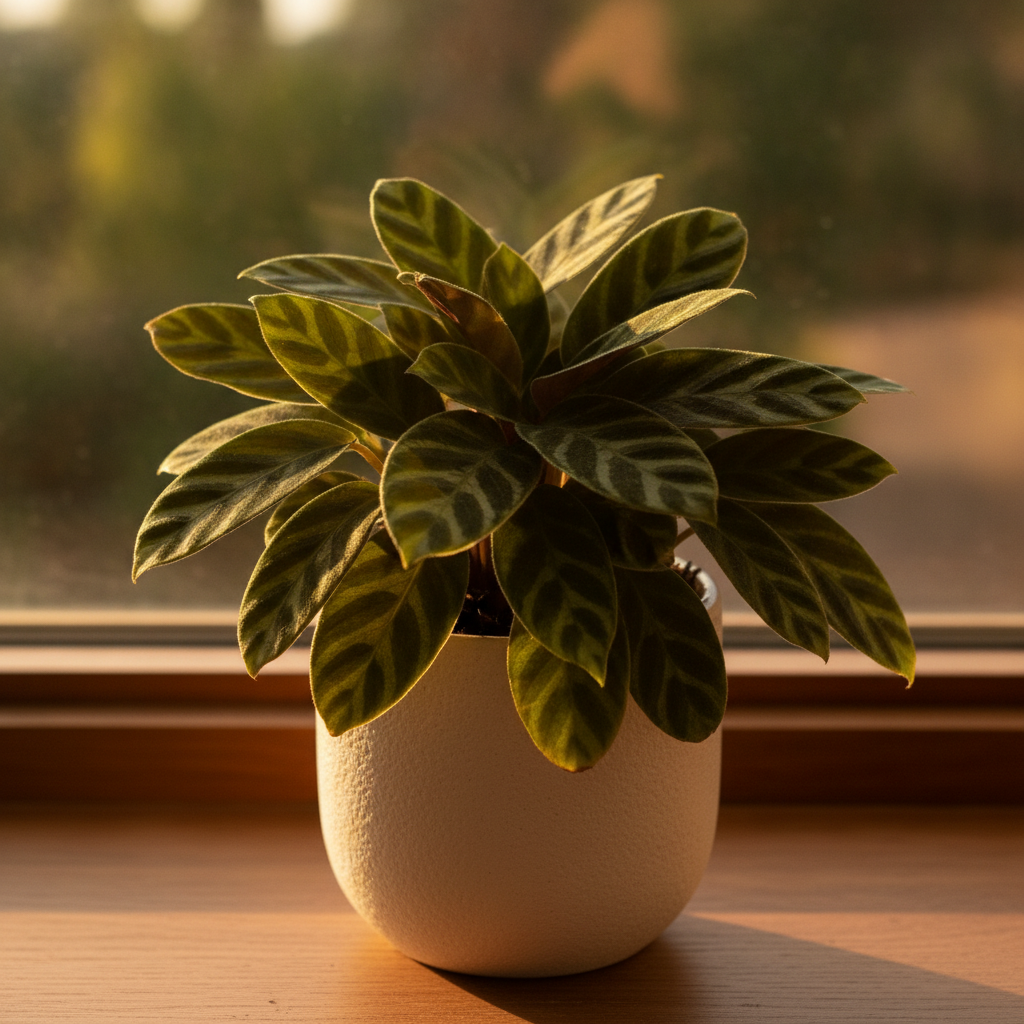
‘Humilior’
A naturally compact, dwarf form of the species. It carries the same velvety texture and feathered zebra banding on slightly shorter, narrower leaves held in a tighter rosette, making it a good pick for smaller spaces and shelves where the full species would soon outgrow its spot.
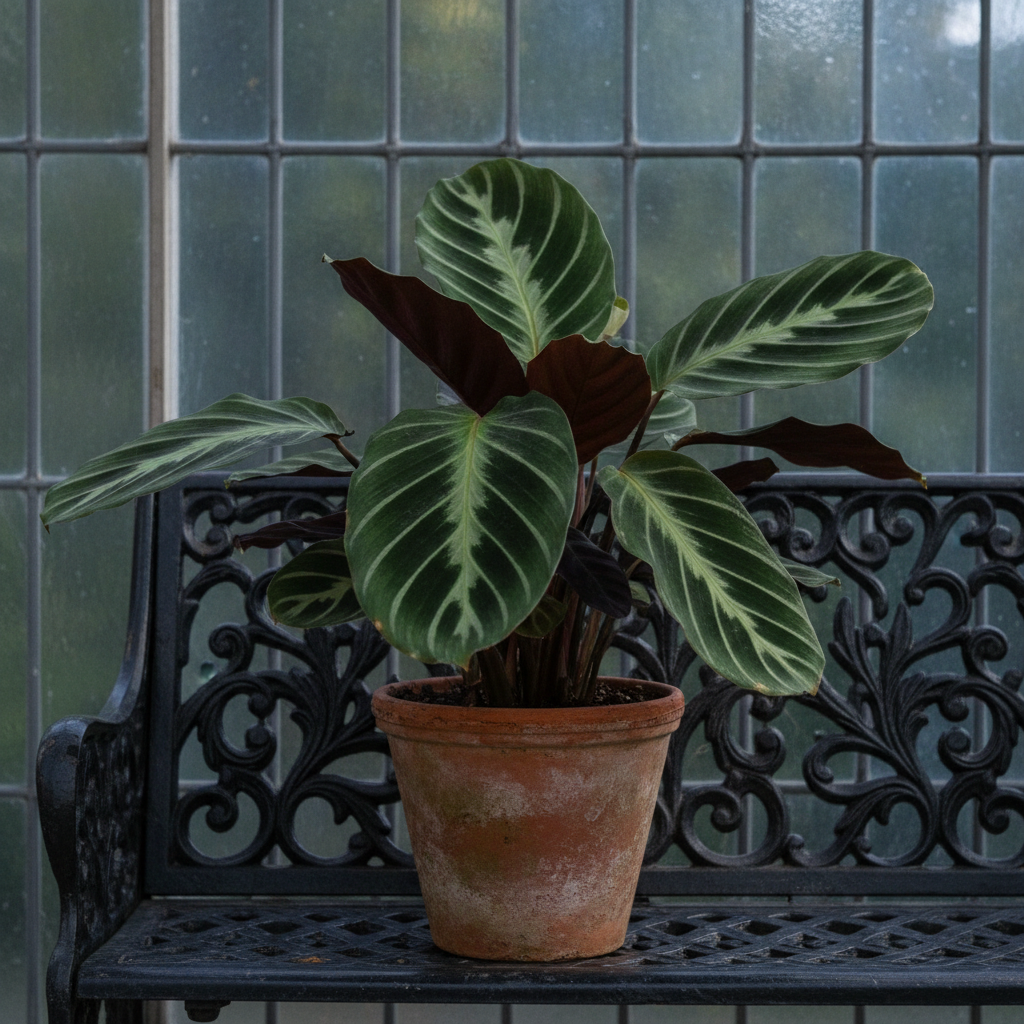
Standard Species Form
The classic Goeppertia zebrina most people mean by “velvet leaf calathea”. Broad velvety leaves up to 40 cm (16 in) long carry bold pale-green chevrons on emerald green, with vivid purple-maroon undersides. Given warmth and humidity it forms a generous, arching clump.
Variety Profiles in Detail
Velvet Calathea (Goeppertia warscewiczii)
Often confused with the velvet leaf calathea because of its similarly soft, velvety texture, this species carries dark green leaves marked with a lighter fishtail pattern and a deep maroon reverse. It is a little more vigorous and, unusually for the group, produces small cream-coloured flowers. Its care needs mirror those of G. zebrina almost exactly.
Peacock Plant (Goeppertia makoyana)
One of the most patterned members of the family, with thin, almost translucent leaves showing an intricate feathered design that resembles a peacock’s tail, and a purple flush beneath. It is thinner-leaved and even thirstier for humidity than the velvet leaf calathea, so it makes a natural companion once you have mastered the group’s basic needs.
Orbifolia (Goeppertia orbifolia)
Grown for its large, rounded leaves banded with broad silvery-green stripes, the orbifolia offers a bolder, cooler-toned look than the warm velvet of G. zebrina. It shares the same demands for humidity, filtered light and clean water, and the two make a handsome pairing that showcases the range of the genus.
Choosing the Right Variety for Your Space
For a compact spot or a shelf, reach for ‘Humilior’; for a statement clump on a side table or plant grouping, the full species form delivers the greatest impact. If you already grow the velvet leaf calathea happily and want to build a collection, the peacock plant and orbifolia broaden the palette without changing the routine, since every plant here wants the same warm, humid, brightly shaded conditions. Choose on the basis of leaf pattern and mature size, and remember that whichever you pick, the care recipe stays reassuringly consistent across the group.
Frequently Asked Questions
Why are the edges of my velvet leaf calathea turning brown and crispy?
Crispy brown edges almost always point to low humidity, though hard or fluoridated tap water and a build-up of fertiliser salts can add to the problem. Raise the humidity around the plant to 60 percent or more, switch to filtered, distilled or rainwater, and flush the soil occasionally to clear accumulated salts.
Why are the leaves curling?
Leaves that curl tightly during the day usually mean the plant is thirsty or the air is too dry. Check the soil and water if the top few centimetres have dried out, and raise the humidity. Remember that some curling in the evening is completely normal, as the plant naturally folds its leaves up at night.
Is the velvet leaf calathea safe for cats and dogs?
Yes. It is completely non-toxic to cats, dogs and humans, which makes it one of the best statement foliage plants for a home with pets. Ingesting any plant can still cause mild stomach upset, so it is wise to discourage nibbling, but there is no danger of poisoning.
Why is my calathea not opening its leaves in the morning?
The nightly folding and morning unfurling depends on a healthy plant and a clear light cycle. Leaves that stay closed during the day suggest stress, most often from underwatering, low humidity or insufficient light. Address those conditions and the daily movement usually returns within a week or two.
Can I propagate it from a leaf cutting?
No. Unlike pothos or philodendrons, the velvet leaf calathea will not root from a leaf or stem cutting, because its growing points come from an underground rhizome. The only reliable method is division, separating an established clump into rooted sections during spring repotting.
What water should I use for a velvet leaf calathea?
Calatheas are sensitive to the chlorine, chloramine, fluoride and minerals in many tap waters, which show as brown leaf tips over time. Filtered water, collected rainwater or distilled water is best. If you must use tap water, let it stand overnight to release some chlorine, though this does not remove fluoride or dissolved salts.
How often should I repot it?
This is a slow grower that only needs repotting every one to two years, or when roots emerge from the drainage holes and water runs straight through. Do it in spring or early summer, move up just one pot size, and use fresh, airy calathea mix to refresh the nutrients and structure.
Why is my velvet leaf calathea losing its markings?
Faded, muted patterning is usually a sign of too little light. The contrast between the light and dark bands is strongest in bright, indirect light, so move the plant closer to a well-lit but shielded window. Be careful not to overcorrect into direct sun, which bleaches the leaves in the opposite direction.
Is it the same as the zebra plant Aphelandra?
No, though the names overlap. The velvet leaf calathea (Goeppertia zebrina) is sometimes called the zebra plant, but a different, unrelated species, Aphelandra squarrosa, also goes by that name and has glossy, white-veined leaves and bright yellow flower bracts. When shopping, check the botanical name to be sure which plant you are buying.
Why does my plant have yellowing lower leaves?
An occasional yellow lower leaf on an otherwise healthy plant is normal ageing. Widespread yellowing, especially with soft, limp leaves and constantly wet soil, points to overwatering and possible root rot. Check the roots, let the soil dry a little more between waterings, and make sure the pot drains freely.






