
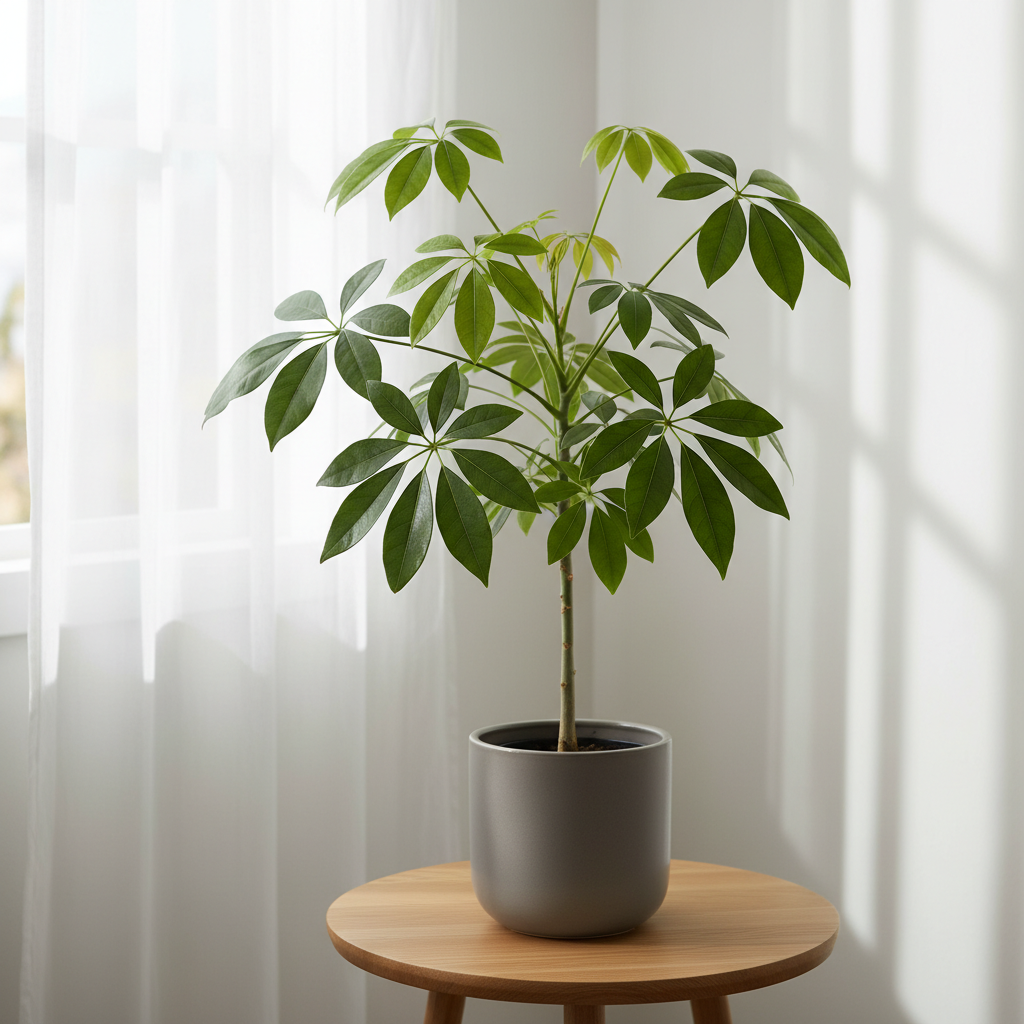
The umbrella plant is the houseplant that hides in plain sight. Walk into almost any hotel lobby, dentist’s waiting room or 1990s family living room and there it is in the corner: a glossy, palmate-leaved shrub three branches tall, calmly outlasting the decor around it. Botanically known as Schefflera arboricola, and sometimes sold under the older trade names dwarf umbrella tree or Hawaiian umbrella plant, it belongs to the ginseng family Araliaceae and is native to the warm, humid lowlands of Taiwan and the Chinese island of Hainan, where it grows as a small understory tree in subtropical broadleaf forest.
Its reputation is that of an almost indestructible beginner’s plant, and for the most part that is fair. Schefflera arboricola tolerates a wider range of light, watering and atmospheric neglect than most of its tropical neighbours, and it bounces back from mistakes that would kill a calathea or a fiddle leaf fig outright. The gap between a surviving umbrella plant and a thriving one, though, is bigger than people assume. Survival looks like a tall, leggy stem with a tuft of leaves at the top and bare wood below; thriving looks like a dense, branching little tree of lacquered green that fills its corner of the room and pushes out new growth every few weeks through spring and summer. This guide is written for the second outcome.
Contents
- Quick Reference
- Why the Umbrella Plant Makes a Reliable Houseplant
- Light Requirements
- Watering and Humidity
- Soil, Potting and Repotting
- Fertilising
- Propagation
- Pests and Diseases
- Popular Varieties
- Frequently Asked Questions
Quick Reference: Umbrella Plant at a Glance
| Light | Bright indirect light is ideal; tolerates a few hours of gentle direct sun and moderate light, but variegated cultivars need brighter conditions than plain green forms. |
| Watering | Water thoroughly when the top 3 to 5 cm (1 to 2 in) of soil have dried out. Approximately every 7 to 10 days in summer, every 14 to 21 days in winter. |
| Temperature | Comfortable between 16 and 24 °C (60 to 75 °F). Avoid prolonged exposure below 12 °C (54 °F) and any draughts of cold or hot dry air. |
| Humidity | 40 to 60 percent relative humidity is ideal but the plant tolerates standard room air down to about 30 percent without serious complaint. |
| Fertiliser | Balanced liquid houseplant feed at half strength every 3 to 4 weeks from spring through early autumn, none in winter. |
| Toxicity | Mildly toxic to cats, dogs and humans owing to calcium oxalate crystals and saponins. Keep out of reach of pets and small children. |
Why the Umbrella Plant Makes a Reliable Houseplant
Three qualities have kept Schefflera arboricola on plant-shop benches for the better part of half a century. The first is structural: this is a true woody plant, with a slender main trunk that hardens and a branching habit that can be shaped, pinched and trained much like a young indoor tree. Unlike most leafy aroids, which throw out single stems and need a moss pole to gain stature, the umbrella plant builds its own architecture. Pinch the growing tip and it responds by pushing two or three new branches just below the cut, gradually filling out into a dense, naturally rounded form.
The second is the leaf itself. Each leaf is a palmate compound, with seven to nine oval leaflets radiating from a central point like the ribs of an umbrella, hence the common name. The leaflets are typically 7 to 15 cm (3 to 6 in) long, glossy enough to catch a window highlight and stiff enough to hold their shape for years. In variegated forms the colour is split into emerald green and creamy gold or pale ivory in patterns that vary leaflet to leaflet, which gives a single specimen far more visual interest than its modest size implies.
The third is sheer tolerance. Schefflera arboricola handles the dry, climate-controlled air of an office building, the inconsistent watering of a holiday flat and the gentle neglect of a busy family without dropping into the dramatic decline that calatheas and ferns specialise in. It is not bulletproof, and it does have preferences that this guide will spell out, but the consequences of getting it slightly wrong are usually a lost leaf or two rather than a total collapse. For someone moving on from a pothos or a snake plant and wanting a plant with more presence, the umbrella plant is the natural next step up.
It is worth clearing up a frequent point of confusion. There are two plants commonly called the umbrella tree. The larger one, Schefflera actinophylla, is native to the rainforests of Queensland in Australia and to New Guinea, can reach 12 metres in the wild and is regarded as an invasive species in parts of the world including Florida and Hawaii. The plant in your living room is almost certainly the smaller, well-mannered Taiwanese species Schefflera arboricola, sometimes called the dwarf umbrella tree to distinguish them. The care described here applies to the dwarf species.
Important — Toxicity: All parts of Schefflera arboricola contain calcium oxalate crystals and small amounts of saponins. Chewing the leaves can cause oral irritation, drooling, vomiting and reduced appetite in cats and dogs, and skin irritation in some people from the sap. The plant is not deadly, but it should be kept out of reach of pets that nibble and of toddlers, and wear gloves if you are sensitive to plant sap when pruning.
Light Requirements
Light is the single biggest factor that separates a thriving umbrella plant from a survival specimen. In its native Taiwanese forest, Schefflera arboricola grows in dappled understory positions and in sunny clearings on forest edges, so the foliage is genetically prepared for a wide range of light intensities. Indoors that translates into a plant that will technically stay alive in dim conditions but only branches, fills out and pushes new growth when the light is genuinely bright.
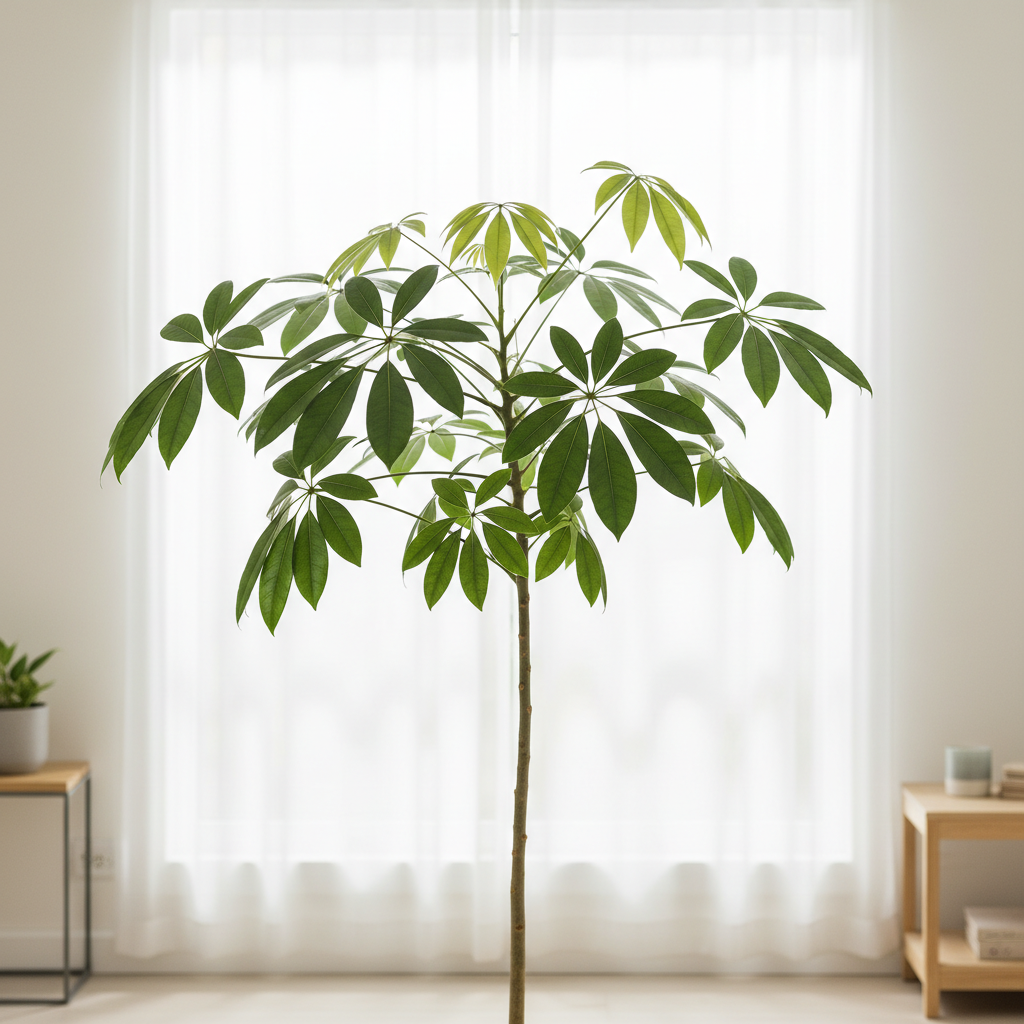
The ideal indoor position is a spot that receives several hours of bright filtered light each day, with perhaps a little direct sun in the early morning or late afternoon when the rays are softer. A position one to two metres back from an east-facing or south-facing window is usually perfect, as is a spot right beside a north window in the brightest part of the year. Variegated forms such as Gold Capella and Trinette need more light than the plain green species to keep their golden zones, and they are the first cultivars to revert to all green when underlit.
Light Levels Explained
Houseplant advice often divides interior light into five rough tiers. The table below maps those tiers onto realistic outcomes for an umbrella plant so you can match what you have to what the plant will do.
| Light Category | Approx. Level | Typical Location | Outcome |
|---|---|---|---|
| Direct sun | 10,000 lux and above | Sitting on an unshaded south or west windowsill in summer | Risk of leaf scorch on the youngest leaves, especially through window glass; gentle morning or late afternoon direct sun is fine. |
| Bright indirect | 2,500 to 10,000 lux | 1 m back from a south window, directly beside an east window, or behind a sheer curtain | Optimal. Tight branching, glossy new growth, strong variegation on cultivars. |
| Medium | 1,000 to 2,500 lux | Middle of a well-lit room, near a north window | Acceptable for plain green forms. Slower growth, longer internodes, variegated cultivars start to fade. |
| Low | 300 to 1,000 lux | Several metres into a room, far from any window | Survival only. Plant elongates and leans towards the brightest source; leaf production stalls. |
| Very low | Below 300 lux | Internal hallways, windowless bathrooms | Long-term decline. Lower leaves yellow and drop; eventual death without supplemental lighting. |
Window Orientation and Placement
South-facing window: The brightest position in most homes in the northern hemisphere. An umbrella plant can sit on the windowsill of a south-facing window in autumn and winter when the sun is weak, but during summer it should be moved one to two metres back from the glass or shielded by a sheer curtain to avoid leaf scorch on the upper foliage.
East-facing window: Probably the easiest position to get right. Soft direct sun in the morning, bright indirect light for the rest of the day, and no risk of midday scorch. Plain green forms can sit directly beside the glass; variegated forms thrive here.
West-facing window: Workable but slightly trickier. The afternoon sun coming through a west window in summer is hot, so the plant should be pulled back from the glass or filtered through a curtain. In winter the plant can sit right at the window without issue.
North-facing window: The dimmest natural light. A plain green Schefflera arboricola will live happily right at a north window, but variegated cultivars will fade and gradually lose their golden zones. If you have only a north window, choose Amate or another solid green form, or supplement with a grow light.
Pro Tip — Rotate Weekly: Umbrella plants are strongly phototropic and will lean towards the light source. Give the pot a quarter turn every time you water to keep the canopy symmetrical. Plants that grow leaning are very difficult to straighten once the wood has hardened.
How Light Affects Variegation and Form
The cultivars sold under names like Gold Capella, Trinette and Janine carry partial chlorophyll deficiency in some of their leaf tissue, which is what produces the gold or cream zones. Those zones photosynthesise weakly or not at all, so a variegated plant has to work harder than a plain green one to produce the same amount of sugar. In bright conditions this is fine. In moderate light the plant compensates by producing new leaves with progressively less variegation, and after a year or two of low light a Gold Capella can revert almost entirely to plain green. The reverted leaves are not faulty and the plant is not unwell, but the prized colour is gone and is hard to bring back without pruning the green growth out.
Light also shapes the architecture of the plant. Bright conditions produce short internodes, dense branching and stout woody stems. Dim conditions stretch the plant out: long bare stems, leaves clustered only at the very top, and a tendency to flop or lean towards the nearest window. If your umbrella plant looks more like a giraffe than a small tree, the cause is almost always not enough light.
Warning — Direct Sunlight: Hot summer sun coming straight through south or west window glass can scorch umbrella plant leaves within a single afternoon. The damage shows up as pale, papery patches on the upper surface of the most exposed leaves and never recovers; the marked leaves stay scarred until they drop. Move the plant or fit a sheer curtain before the first really hot week of summer rather than waiting to see whether it copes.
Artificial Lighting
Schefflera arboricola responds well to supplemental LED lighting and is one of the easier houseplants to keep in a windowless office space if grow lights are used correctly. A full-spectrum white LED of 20 to 30 watts, positioned 30 to 50 cm (12 to 20 in) above the canopy and run for 10 to 12 hours a day, will keep a medium-sized plant in active growth even without any natural light. The cheap pink-purple LEDs sold for seedlings are usable but tend to make the foliage look sickly; for a plant on display, choose a warm or neutral white spectrum.
Seasonal Adjustments
Light intensity inside a home in northern Europe and the northern United States can drop by 70 percent or more between June and December as the sun sits lower in the sky and the days shorten. A position that is perfect in summer may become marginal by November. It is worth moving the umbrella plant closer to its main window in autumn, even if that means sacrificing a bit of styling, and pulling it back again in spring once the sun strengthens. A digital lux meter or a free meter app on a smartphone is a useful sanity check; a reading of 1,500 to 3,000 lux for at least six hours a day keeps the plant comfortably in the bright indirect band.
Watering and Humidity
The umbrella plant’s root system is fibrous and quite sensitive to standing water. In its forest habitat the roots sit in a free-draining mix of leaf litter and porous mineral soil that is wetted by heavy rain and then drains rapidly, so the plant evolved to handle a cycle of thorough soaking followed by air returning to the root zone. Mimicking that cycle indoors gives the best results: water generously when the time comes, then let the top of the soil dry meaningfully before the next watering. Constantly damp soil and root rot are the most common ways an otherwise healthy umbrella plant is killed.
When to Water
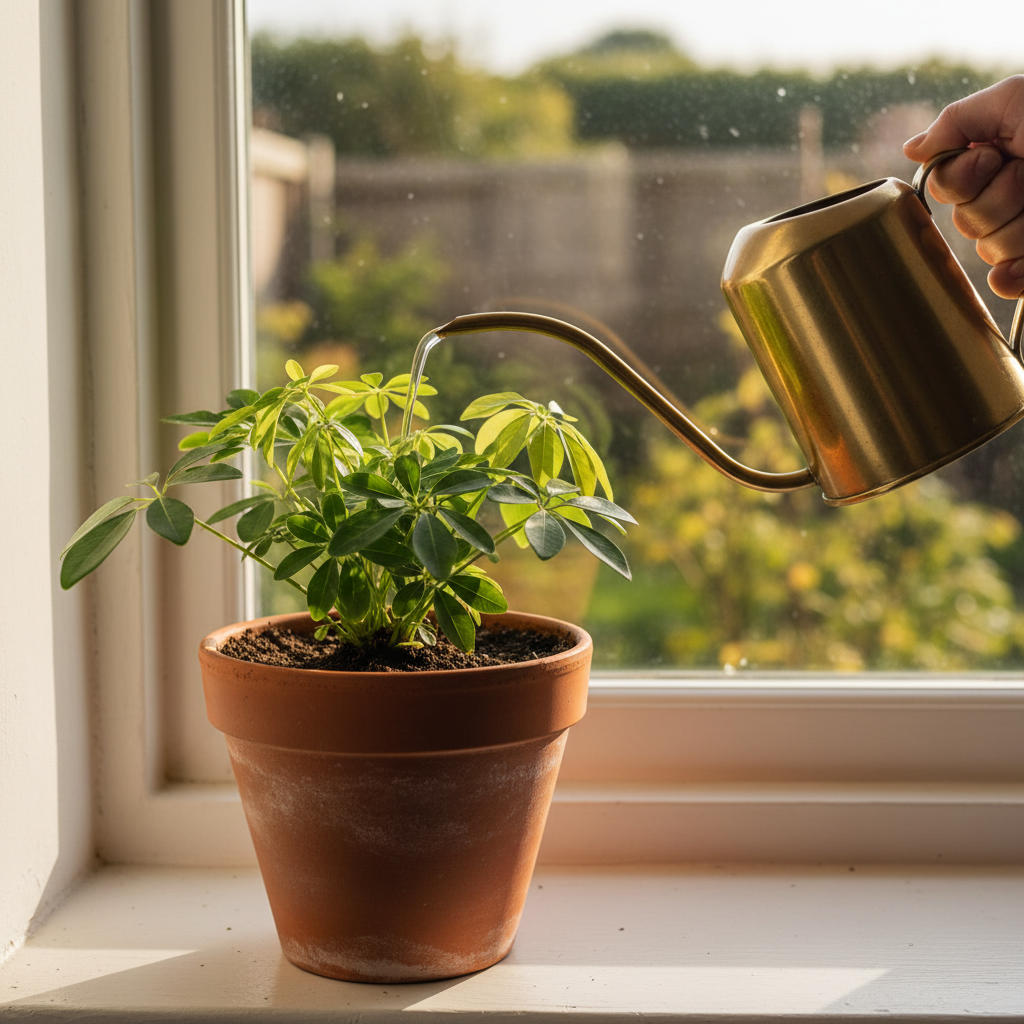
The reliable trigger is the top 3 to 5 cm (1 to 2 in) of soil drying out. Push a finger into the soil up to the second knuckle; if you feel any moisture, wait two or three more days and check again. If the soil feels just barely cool but dry, it is time to water. A wooden chopstick pushed into the root zone and pulled out works the same way: clean and dry means water, damp and dark means wait.
In practice this translates to watering an umbrella plant in a 20 cm (8 in) pot roughly once every 7 to 10 days through spring and summer, and once every 14 to 21 days in winter when growth slows and the soil dries more slowly. The exact interval depends on pot size, pot material, light intensity and the dryness of the air. Plants in unglazed terracotta in a bright position will need water far more often than the same plant in a glazed ceramic pot in moderate light. The right discipline is to water by feel, not by calendar.
Pro Tip — Lift the Pot: Once you know what a freshly watered pot weighs and what a thirsty pot weighs, you can tell with a single lift whether the plant needs water. This is the single most useful houseplant skill there is, and it works through any decorative cover pot or basket.
How to Water Correctly
- Take the plant to a sink or use a saucer big enough to catch the runoff. Watering a plant in place over a wooden floor is asking for trouble.
- Pour water slowly and evenly across the surface of the soil, working around the pot rather than dumping it in one spot. Let the surface absorb before adding more.
- Keep pouring until water runs freely from the drainage holes. A thorough watering should put about 20 to 30 percent of the pot’s volume through the soil.
- Wait two or three minutes for any final draining, then tip the saucer or let the pot drain in the sink.
- Return the plant to its position. Never leave it sitting in a saucer of standing water for more than half an hour.
- Empty any decorative cover pot at the same time. Cover pots without drainage holes hide pooled water that quickly rots roots.
Signs of Overwatering versus Underwatering
The two conditions look alike at the leaf level, which is why this is the most common diagnostic mistake new owners make. The decisive evidence is in the soil and the stem base, not the foliage.
| Symptom | Overwatering | Underwatering |
|---|---|---|
| Leaf colour | Yellowing, often starting on lower or older leaves first, sometimes with brown spots | Pale, dull green; tips and edges turn brown and crisp |
| Leaf texture | Soft, limp, sometimes translucent or watery near the petiole | Dry, papery and brittle, leaflets curling slightly inward |
| Soil | Persistently damp days after watering; may smell sour or musty | Pulls away from the pot edges; bone dry below the surface; water runs straight through without soaking in |
| Roots | Mushy, dark brown or black, slip off easily when pulled | Wiry, pale and brittle; may show no white tips |
| Stem base | Soft, darkened, sometimes with a sour smell at the soil line | Firm and hard, no discolouration |
Warning — Root Rot: If the stem base feels soft or smells sour, treat it as an emergency. Unpot the plant, wash the soil off the roots in tepid water, snip away every brown or mushy root with sterile scissors, and repot into fresh dry mix in a smaller pot. Withhold water for a week to let the cut surfaces callus. A plant caught early often recovers; a plant left for another fortnight in soggy soil rarely does.
Humidity Requirements
For a tropical plant the umbrella plant is fairly relaxed about humidity. Anywhere between 40 and 60 percent relative humidity is comfortable, which covers normal household conditions in most climates for most of the year. The plant will tolerate stretches at 30 percent without dramatic leaf loss, although tips and leaflet edges may brown slightly and new growth will be smaller.
The conditions that genuinely cause trouble are not low ambient humidity but the dry hot blasts of forced-air heating and air conditioning. A plant sitting directly over a radiator or in the airflow of a heat pump can lose moisture from its leaves faster than the roots can supply, leading to crisp leaflet edges and persistent leaf drop even when the soil is correctly moist. Move the plant away from any vent or radiator outlet by at least a metre and the problem usually solves itself.
If you do want to raise the humidity around the plant, the most effective approach is a small ultrasonic humidifier on a timer that runs for a few hours during the driest part of the day. Pebble trays do very little for a plant the size of a mature umbrella plant. Misting feels productive but adds humidity for only a few minutes per pass and, if done in cool conditions or onto already wet leaves, can encourage fungal spotting on the foliage. If you mist, do so in the morning when the leaves will dry quickly in increasing light.
Water Quality
The umbrella plant is more forgiving than calatheas or many palms when it comes to water quality, but it is not entirely indifferent. Hard tap water leaves white mineral residue on the soil surface and over time can push the soil pH out of the slightly acidic range the roots prefer. Water from a domestic water softener is high in sodium and is not recommended for any houseplant. The pragmatic options are to use rainwater collected in a clean container outside, to fill a watering can the night before and let it sit so any chlorine evaporates, or to use filtered water from a household carbon filter. Room-temperature water is always better than cold water straight from the tap, which can chill the roots briefly and slow growth.
Soil, Potting and Repotting
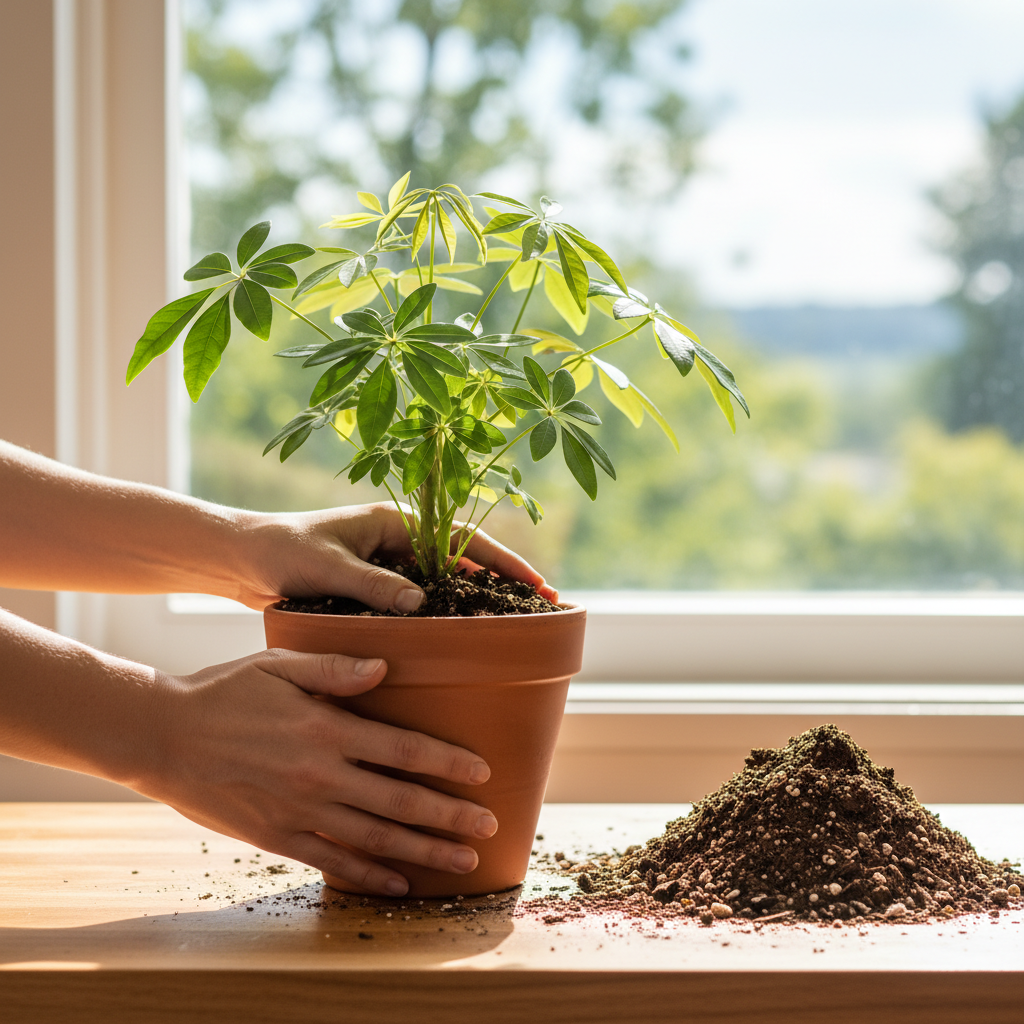
Because the umbrella plant’s main vulnerability is root rot from waterlogged soil, the substrate it sits in does more to determine its long-term health than almost any other factor. The aim is a mix that holds enough moisture to keep the plant hydrated for a week at a time and then drains and aerates fast enough that the air returns to the root zone before fungal pathogens can take hold.
Ideal Soil Composition
A good umbrella plant mix is built from a base of high-quality houseplant compost or peat-free multipurpose, lightened with chunky inorganic and organic amendments. The structural ingredients matter as much as the proportions: perlite and orchid bark create lasting air pockets, while coco coir and worm castings hold moisture and nutrients without going claggy. The table below shows a reliable starting point for a five-litre batch.
| Component | Proportion | Function |
|---|---|---|
| Quality houseplant compost or peat-free multipurpose | 50 percent | Provides the base structure, organic matter and most of the moisture-holding capacity |
| Coarse perlite | 20 percent | Creates permanent air spaces in the root zone and improves drainage |
| Orchid bark, fine to medium grade | 20 percent | Adds chunky structure that resists compaction over time |
| Coco coir | 10 percent | Holds moisture without going waterlogged and buffers pH slightly |
| Worm castings or fine compost | 1 small handful per 5 L | Slow-release nitrogen and beneficial soil microbes |
The umbrella plant prefers a soil pH in the slightly acidic to neutral range, roughly 6.0 to 6.5. Most commercial houseplant composts arrive in that range out of the bag, so unless you suspect a pH problem there is rarely any need to test or adjust it. Watering with rainwater for a year or two will keep it from drifting alkaline; watering exclusively with hard tap water can slowly push it the other way and cause faint chlorosis on new leaves.
Pro Tip — Quick Mix Recipe: If you do not want to measure ingredients, a usable shortcut is one bag of standard houseplant compost cut with one large handful of perlite and one large handful of orchid bark per three to four litres of compost. It is not the perfect mix, but it is hugely better than straight bagged compost and your umbrella plant will live for years in it.
Choosing the Right Pot
The container is part of the watering system, not just a decorative shell. Size, material and drainage all change how quickly the soil dries and therefore how forgiving the plant is of small mistakes.
Drainage holes are non-negotiable. The umbrella plant cannot live long term in a pot without drainage. If a decorative pot you love has no holes, treat it as a cover pot: place the plant in a slightly smaller plastic nursery pot with good drainage, slip that inside the cover pot, and lift it out to water. Empty any water that collects in the bottom of the cover pot every time.
Pot material: Unglazed terracotta dries the soil through the walls as well as the surface and is the most forgiving choice for anyone who tends to water too often. Glazed ceramic and plastic hold moisture longer and reward attentive watering. A heavy ceramic pot also adds useful ballast as the plant grows top-heavy. Avoid glass terrariums and self-watering pots; this is not a plant that wants its roots permanently moist.
Pot size: Move up one pot size at a time, typically from 14 to 17 cm to 20 cm and so on. The new pot should be 2 to 5 cm (1 to 2 in) wider than the previous one and only slightly deeper. Jumping from a small pot to a much larger one surrounds the root ball with damp unrooted soil that the plant cannot dry out fast enough and almost guarantees root rot.
When to Repot
An umbrella plant typically needs repotting every two to three years. The clearest signs are roots visibly circling the inside of the pot or escaping through the drainage holes, water that runs straight through the soil without ever wetting it, and a noticeable slowdown in growth despite good light and feeding. Spring is by far the best time to repot, when the plant is moving into its strongest growth phase and can recover quickly. Avoid repotting in autumn or winter unless you are rescuing a plant from root rot.
How to Repot: Step-by-Step
- Water the plant lightly a day before repotting so the root ball holds together but is not sodden.
- Prepare the new pot by adding a 2 to 3 cm (1 in) layer of fresh mix at the bottom.
- Slide the plant out by tipping the old pot sideways and squeezing the sides. If it resists, run a knife around the inside edge and try again.
- Loosen the outer 1 cm of root ball with your fingers, gently teasing out any circling roots. Snip away any that are brown, mushy or clearly dead.
- Position the plant in the new pot so the top of the root ball sits about 2 cm (1 in) below the rim. Add fresh mix around the sides, working it down with your fingers to eliminate large air pockets.
- Tap the pot firmly on the bench to settle the mix and top up if it sinks.
- Water thoroughly until water runs from the drainage holes, then place the plant in bright indirect light and leave it alone for two weeks. Hold off feeding for a month.
Warning — Transplant Shock: It is normal for an umbrella plant to drop a few leaves in the two to three weeks after repotting. The plant is rebuilding fine root hairs and redirecting water to new tissue. Resist the urge to water more often to compensate; soggy soil on a stressed root system is exactly what triggers root rot. Wait, keep light steady and let the plant settle.
Fertilising
An umbrella plant in fresh quality soil has enough built-in nutrition to grow contentedly for several months without any supplemental feeding. Once those reserves are used up, however, the plant becomes one of the steadier feeders among popular houseplants. It is a true woody plant, producing not only leaves but cambium, bark and structural stems, and that growth pattern requires a more balanced flow of nutrients than the all-leaves diet most houseplant feeds are formulated for.
The general rule is to feed lightly but consistently through the active growing season and to pause completely in winter. Overfeeding is more harmful than underfeeding: salt build-up in the soil burns the fine feeder roots and shows up as crisp brown leaflet tips, which look almost identical to underwatering damage and lead people to water more, which makes the problem worse.
Understanding Plant Nutrients
Every fertiliser bottle carries an NPK ratio: three numbers representing the percentage by weight of nitrogen, phosphorus and potassium. A balanced 10-10-10 or 20-20-20 feed sends roughly equal signals to leaf growth, root and flower development, and stem and disease resistance. For a foliage plant like the umbrella plant a slightly nitrogen-leaning ratio such as 3-1-2 works well, but any balanced houseplant feed will do the job. The minor and trace elements matter too, especially magnesium and iron for healthy green leaves.
| Nutrient | Symbol | Primary Function | Deficiency Symptoms |
|---|---|---|---|
| Nitrogen | N | Leaf and shoot growth, chlorophyll production | Uniform pale yellow leaves, slow growth, lower leaves first |
| Phosphorus | P | Root development, energy transfer, flowering | Dull leaves, purple or red tinge to undersides, weak roots |
| Potassium | K | Cell wall strength, water regulation, disease resistance | Brown crispy leaflet edges, weak stems prone to flopping |
| Calcium | Ca | Cell structure, healthy new growth | Distorted or curled new leaves, dead growing tips |
| Magnesium | Mg | Central atom of the chlorophyll molecule | Yellowing between the leaf veins on older leaves, veins stay green |
| Iron | Fe | Chlorophyll synthesis | Yellowing between veins on the newest leaves, veins stay green |
Types of Fertiliser
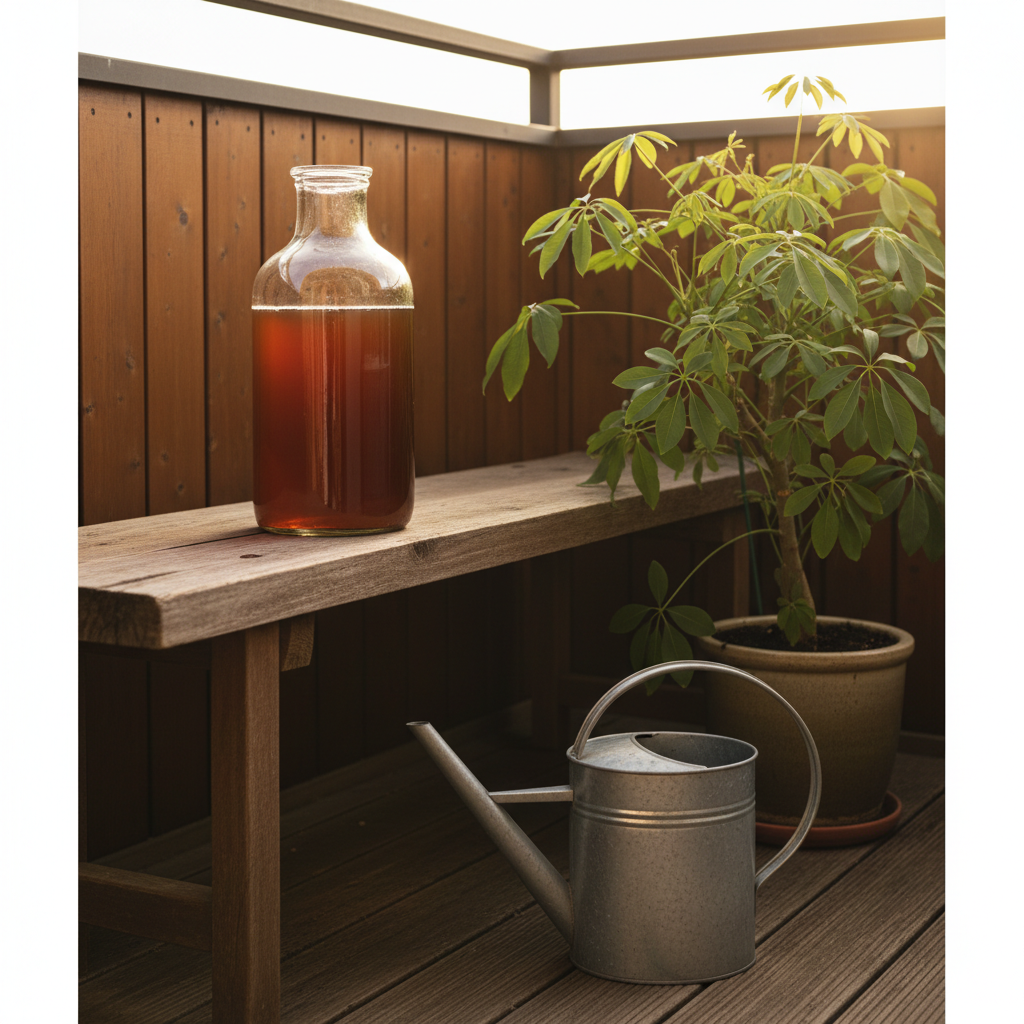
Liquid fertilisers: The most controllable option and the one I recommend by default. A balanced liquid houseplant feed mixed at half the recommended strength and applied every three to four weeks gives steady predictable growth. Liquid feeds work fast and are easy to flush from the soil if you suspect a build-up.
Slow-release granular: Prills coated with a permeable polymer that release nutrients gradually over three to six months. Convenient for owners who travel or forget, but harder to correct if the plant reacts badly. A pinch of slow-release prills scattered onto the soil surface in spring will feed an umbrella plant through the summer.
Organic fertilisers: Worm castings, seaweed extract, fish emulsion and home-brewed compost tea release nutrients slowly through microbial action and are very nearly impossible to overdose on. They smell stronger than synthetic feeds and the smell can linger indoors for an hour after application, but they build healthy soil biology over time and pair well with peat-free composts.
Feeding Schedule
For a typical home environment, feed the umbrella plant with a half-strength balanced liquid every third or fourth watering from early spring through the end of summer. Taper off in autumn as light intensity drops, and stop entirely from late November through February. If the plant continues to push out new leaves under grow lights through winter, a very dilute feed once every six weeks is fine, but most plants in natural light go properly dormant in winter and do not need any nutrition until the days lengthen again.
Pro Tip — Half Strength Every Time: The dose printed on a fertiliser bottle assumes you are feeding outdoor potted plants in full sun with daily watering. For an indoor umbrella plant in a slow growth cycle, half that strength is almost always plenty and quarter strength is fine for delicate cultivars. You can always feed more often; you cannot easily undo a salt burn.
How to Fertilise
- Mix the fertiliser into water at half the label strength in a clean watering can.
- Water the plant first with plain water if the soil is very dry. Feeding into bone-dry soil concentrates the salts and can burn fine roots.
- Pour the dilute feed evenly across the soil surface until it begins to drain from the drainage holes.
- Empty any feed that collects in the saucer or cover pot; do not let the plant sit in fertiliser solution.
- Once a quarter, flush the soil thoroughly with plain water to wash any accumulated salts out of the root zone.
Warning — Salt Build-Up: A white crust on the surface of the soil or a chalky ring around the rim of the pot is a sign of mineral salts accumulating from fertiliser, hard water or both. The cure is to take the plant to a sink and run several pot-volumes of plain water through it, letting it drain completely each time. Repeat every few months for plants that are fed regularly.
Propagation
The umbrella plant is reliably propagated by two methods: stem-tip cuttings and air layering. Both work because the plant produces aerial roots fairly readily at its nodes when conditions are right, and because the woody stem can sustain itself while a new root system forms. Seed propagation is possible from the small flower heads a mature plant occasionally produces, but it is slow, the seedlings vary, and very few home growers bother.
Spring and early summer are the best windows for either method. Warm temperatures, longer days and the plant’s natural growth surge mean cuttings root in roughly half the time they take in autumn or winter, and the failure rate drops accordingly. A propagation attempt in February will eventually succeed if conditions are right, but it is much more likely to rot out before it roots, so most home growers wait for April or May.
Understanding Nodes
Everything propagation depends on happens at the nodes. A node is the slightly thickened point on a stem where a leaf attaches and where dormant root primordia sit beneath the bark. With the right cue, usually moisture and warmth, those primordia push out into proper roots. A piece of stem with no node will not root no matter how perfect the conditions; a piece with one or two healthy nodes will root reliably. When you are choosing cuttings or planning where to air layer, the first thing to identify is where the nodes are along the stem.
Stem Cuttings: Step-by-Step
This is the simpler of the two methods and works best on younger, semi-hardwood stems where the bark is firm but not yet thickly woody. The success rate in spring on healthy stock is usually 70 to 90 percent.
- Choose a healthy stem tip with three to five sets of leaflets and at least two nodes along its length.
- Using sharp sterilised secateurs or a clean craft knife, cut just below a node at about a 45 degree angle. The cutting should be 10 to 15 cm (4 to 6 in) long.
- Strip the lowest one or two sets of leaves so that the bottom node is bare, leaving two or three sets at the top.
- Dip the cut end in rooting hormone gel or powder. This is not strictly essential for an umbrella plant but it shortens rooting time by a week or two and improves the success rate.
- Insert the cutting into a small pot of pre-moistened propagation mix, either fresh aroid mix cut with extra perlite, or pure damp perlite, or vermiculite. Push it in just deeply enough that the bare node is buried.
- Cover the pot loosely with a clear plastic bag or place inside a propagator to hold humidity around 80 percent. Leave a gap for ventilation; sealed bags grow mould.
- Place in bright indirect light at 21 to 24 °C (70 to 75 °F). Avoid direct sun, which cooks cuttings.
- Check every few days. The propagation mix should stay just moist, never wet. Roots usually appear within four to six weeks; a gentle tug that meets resistance is the sign that rooting has started.
Pro Tip — Take Several at Once: Cuttings fail unpredictably even under ideal conditions, so always take three or four at once. The successful ones can be potted together for a fuller-looking young plant, or grown on separately and given away.
Air Layering: Step-by-Step
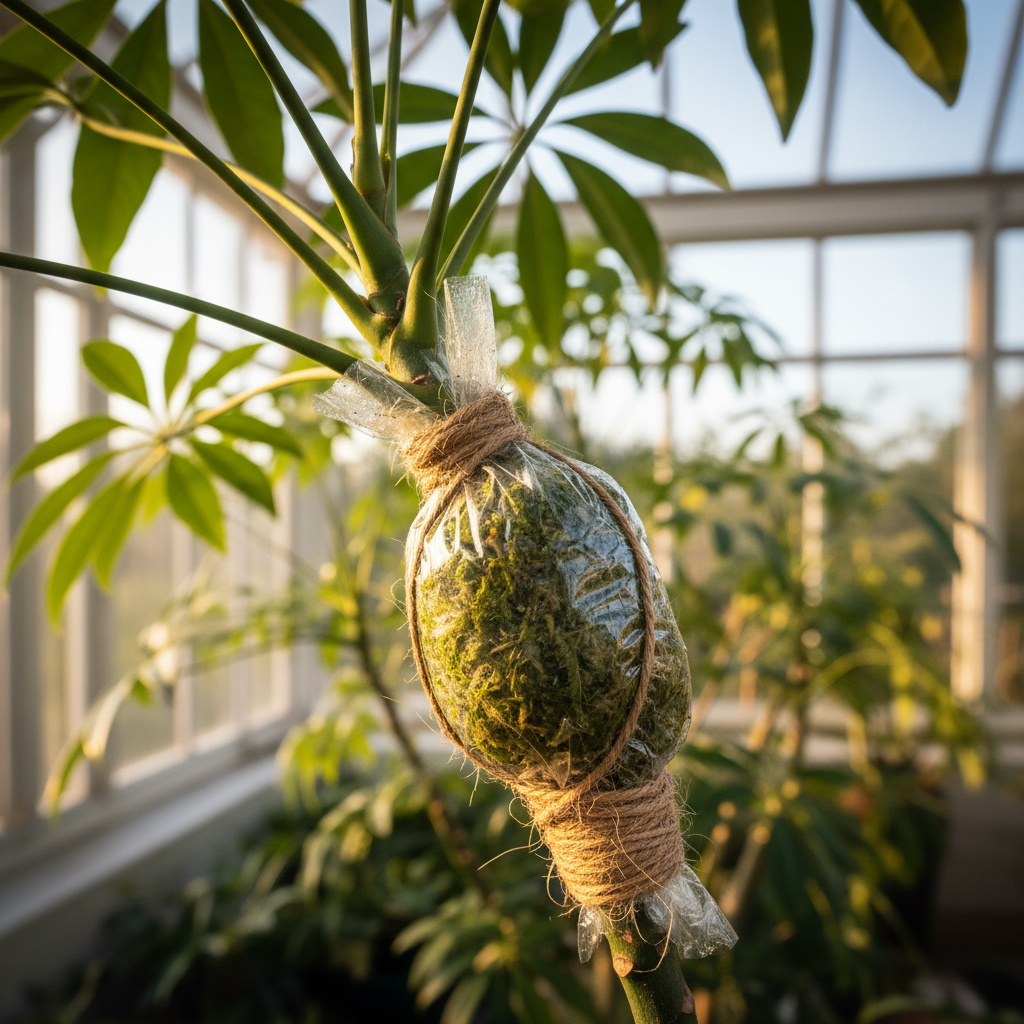
Air layering is the technique to reach for when your plant has gone leggy: a tall bare stem with a clump of leaves only at the top. Rather than cutting blind and hoping the cutting roots, you encourage roots to form on the parent stem while it is still attached and able to draw water and nutrients, then sever the section once a strong root system has developed. Success rates are very high, often above 90 percent, and the resulting plant is full-sized from day one.
- Identify a point on the bare stem 20 to 30 cm (8 to 12 in) below the lowest healthy leaves, ideally just below a node.
- Using a sharp sterile blade, make a shallow upward-slanting cut about a third of the way into the stem. Insert a small toothpick or matchstick into the cut to hold it open. Some growers prefer to score a 1 cm wide ring of bark off the stem instead; either approach works.
- Dust the wound with rooting hormone powder.
- Take a generous handful of long-fibred sphagnum moss, soak it in water for ten minutes, then squeeze out the excess until it is damp but not dripping.
- Pack the damp moss firmly around the wounded stem to form a ball roughly the size of an apple. The wound should be completely buried.
- Wrap the moss ball tightly in a sheet of clear plastic film or a clear plastic bag, sealing both ends to the stem with natural twine, tape or wire ties. The package should be sealed enough to retain moisture but not so airtight that it cannot breathe at all.
- Leave the bundle in place for four to eight weeks, depending on warmth and growth rate. White roots should become visible against the plastic as they develop.
- Once a dense network of roots fills the moss, cut the stem off just below the moss ball with sharp sterile secateurs.
- Carefully unwrap the plastic, leaving the moss attached to the new roots, and pot the rooted section into a pot of fresh aroid mix. Water lightly and keep humidity high for the first two weeks.
- The parent stump usually resprouts within a couple of months from dormant buds further down the stem, giving you two plants for one effort.
Troubleshooting Propagation
| Problem | Likely Cause | Solution |
|---|---|---|
| Cutting blackens at the cut end | Too wet, often in pure water or saturated mix | Move to a drier perlite-based mix; ensure ventilation; take a fresh cutting |
| Leaves drop within days | Low humidity around the cutting, or wilting from no roots yet | Increase humidity with a clear cover; reduce the leaf area on each cutting to lower transpiration |
| Air layer moss dries out | Plastic wrap not sealed tightly enough, or position too warm and bright | Re-wrap with new damp moss; move out of direct sun; check every week and rewet through a small slit if needed |
| No roots after eight weeks | Cutting taken in winter, no node included, or no rooting hormone on hardwood stem | Re-take in spring, ensure a clear node is buried, dust the cut surface with rooting hormone |
Pests and Diseases
The umbrella plant has the unenviable distinction of being a magnet for almost every common indoor pest, particularly when grown in warm, dry, still air. Scale, spider mites and mealybugs are the three that cause most of the damage. None of them is impossible to control if caught early, but a heavily infested umbrella plant can quickly look terrible and shed its lower leaves entirely. Regular inspection is the single most effective intervention you can make.
The plant is also susceptible to a small number of fungal and bacterial diseases, almost all of which are downstream of overwatering or persistently damp foliage. Cultural conditions, in other words, prevent disease far more effectively than chemistry ever will.
Common Pests
Scale Insects (Coccus hesperidum and related species)
Scale is the umbrella plant’s signature pest. Soft scale insects look like small flat brown or tan bumps stuck to the stems and the undersides of leaves along the veins. They feed by piercing the plant tissue and sucking sap, excreting a sticky honeydew that drips onto leaves below and turns the foliage shiny and tacky. A heavy infestation causes yellowing, leaf drop and stunted growth.
Treatment: Wipe individual scales off with a cotton bud dipped in isopropyl alcohol, then wash the whole plant with insecticidal soap. Repeat the soap wash weekly for at least three to four weeks to catch successive hatches; the waxy adult coat resists most contact insecticides, which is why mechanical removal matters. For heavy infestations a systemic insecticide such as imidacloprid drench works well but is overkill on a mild outbreak.
Spider Mites (Tetranychus urticae)
Spider mites are tiny eight-legged arachnids barely visible without a hand lens. They thrive in hot, dry conditions and on plants near heating vents. The first sign is usually a fine yellow stippling on the upper leaf surface where the mites have punctured cells from below; later you may see thin webbing in leaf axils and at the growing tip.
Treatment: Take the plant to a shower or sink and rinse the foliage thoroughly, especially the undersides, with tepid water. Follow with insecticidal soap or a neem oil spray to coat all leaf surfaces, and repeat every five to seven days for three weeks to break the mite life cycle. Raising humidity around the plant and moving it away from any heat source makes recurrence much less likely.
Mealybugs (Pseudococcus longispinus)
Mealybugs appear as cottony white tufts in leaf axils, on the undersides of leaves and at the growing tips. They are easier to spot than scale or mites and easier to dispatch, but they reproduce quickly and a small infestation can blow up within a fortnight if ignored.
Treatment: Dab each visible bug with a cotton bud soaked in isopropyl alcohol, which dissolves the waxy coating and kills on contact. Follow up with a thorough spray of insecticidal soap to catch the crawlers. Inspect again every few days for two weeks; mealybugs hide in tight axils that are easy to miss.
Aphids (Aphis gossypii)
Less common indoors than the previous three pests, aphids occasionally appear on new soft growth at the top of the plant, where they cluster as small green, yellow or black insects sucking sap and causing leaves to curl and distort.
Treatment: Wash off with a strong stream of water from a kitchen tap or shower, then follow up with insecticidal soap if numbers were high. Aphids on an indoor umbrella plant are almost always brought in from outside on another plant or in a bunch of cut flowers; quarantining new arrivals for two weeks prevents most outbreaks.
Common Diseases
Root Rot (Pythium and Phytophthora species)
Root rot is the disease that kills more umbrella plants than every pest combined. The pathogens are common waterborne soil fungi that opportunistically attack roots sitting in saturated low-oxygen conditions. Above ground the plant looks underwatered, with yellowing leaves and a wilting canopy; below ground the roots are brown and mushy and the stem base goes soft and sour-smelling.
Treatment: Unpot the plant immediately, wash all old soil off the roots, snip away every soft or discoloured root with sterile scissors, and repot into fresh dry mix in a clean smaller pot. Hold off watering for a week. If the stem base is also soft, take cuttings from healthy tissue higher up the plant as insurance.
Leaf Spot (Alternaria panax and others)
Brown or black circular spots on the leaves, sometimes with a yellow halo, usually triggered by water sitting on the foliage for long periods in cool conditions. The spots merge as they grow and eventually whole leaflets drop.
Treatment: Remove and dispose of affected leaves. Stop overhead misting and water only the soil. Improve air circulation around the plant. A copper fungicide spray is rarely necessary indoors and is reserved for severe cases.
Powdery Mildew (Erysiphe cichoracearum)
A white powdery dusting that appears on leaves in still humid conditions. The Amate cultivar was bred specifically for resistance to this disease and is a sensible choice in conservatories or kitchens where mildew is a recurring problem.
Treatment: Improve air circulation with a small fan running on its lowest setting, reduce overhead misting, and treat with a mild fungicide or a homemade spray of one teaspoon baking soda dissolved in a litre of water with a drop of mild detergent.
Pest and Disease Summary
| Pest / Disease | Identification | Treatment |
|---|---|---|
| Scale | Flat brown or tan bumps along stems and veins, sticky honeydew on lower leaves | Manual removal with alcohol cotton bud followed by weekly insecticidal soap for 3 to 4 weeks |
| Spider mites | Fine yellow stippling on upper leaves, fine webbing in axils | Rinse foliage and apply insecticidal soap or neem every 5 to 7 days for 3 weeks; raise humidity |
| Mealybugs | Cotton-wool tufts in leaf axils and on undersides | Spot-treat with alcohol on cotton bud, then insecticidal soap and a fortnight of close inspection |
| Aphids | Soft green or black insects clustered on new growth | Hose off in the shower, follow with insecticidal soap if needed |
| Root rot | Yellowing, wilting canopy, soft mushy roots, sour smell at stem base | Unpot, prune affected roots, repot in fresh dry mix and reduce watering frequency |
| Leaf spot | Circular brown spots with yellow halos on leaves | Remove affected leaves, stop overhead misting, improve airflow |
| Powdery mildew | White powdery dust on leaves in still humid conditions | Increase airflow, treat with baking soda spray or mild fungicide |
Prevention Strategies
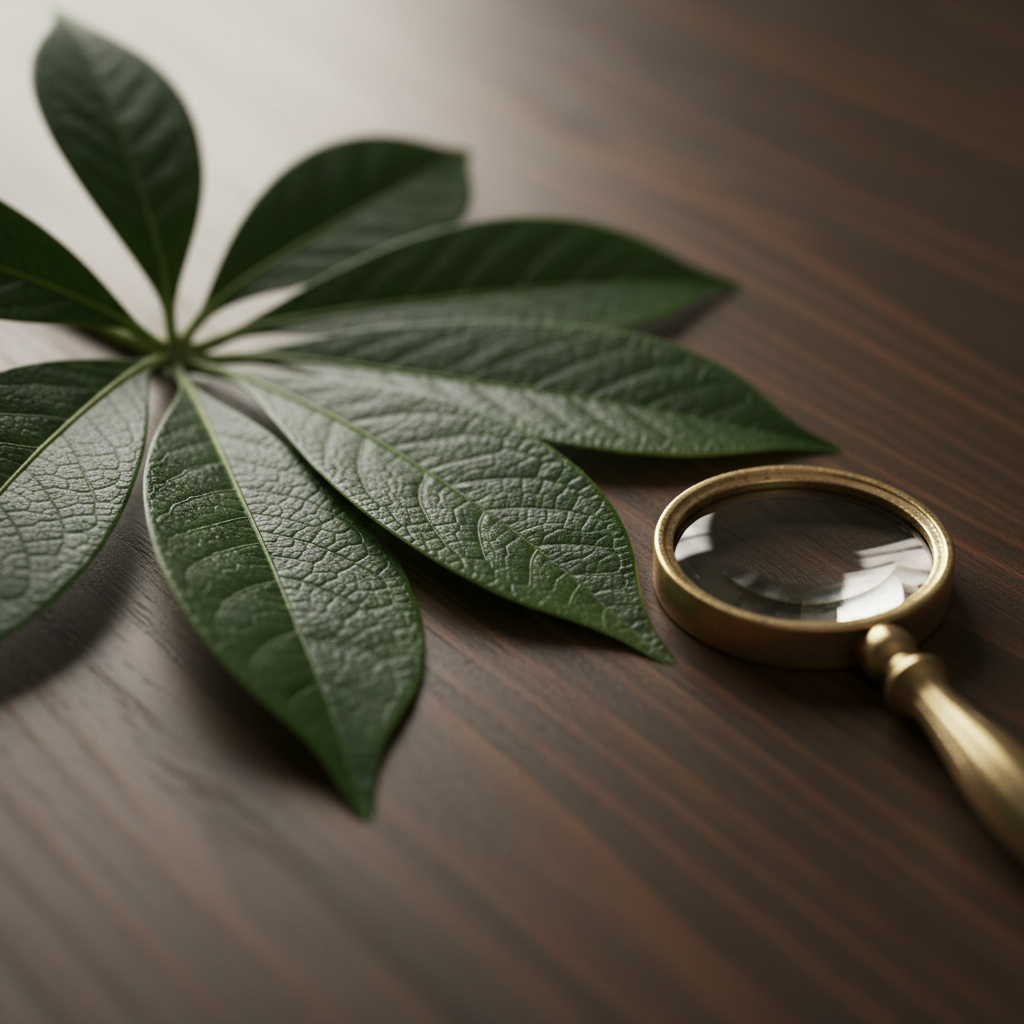
Almost every pest and disease problem on an umbrella plant has the same set of contributing causes: dry stagnant air, dusty leaves, infrequent inspection and a newly arrived plant that was not quarantined. A quick weekly inspection with a hand lens of the leaf axils and the undersides of the lower leaves catches scale and mealybugs at the stage where wiping them off with alcohol takes ten minutes rather than a six-week control programme.
New plants brought into the home should spend two to three weeks in a separate room before joining the rest of the collection, with their own watering schedule and inspection routine. This single habit prevents the majority of pest outbreaks that take down whole houseplant collections. Wiping the leaves with a damp microfibre cloth every two to three weeks both improves photosynthesis by removing dust and gives a chance to spot any infestation in its earliest stages.
Pro Tip — Neem Oil Programme: A monthly preventive spray of dilute neem oil (one teaspoon neem to one litre of water with a drop of mild detergent as an emulsifier) coats the leaves with a film that deters most sap-sucking pests from settling. Apply in the evening to dry leaves, and avoid the day before strong sun, which can cause the oil to scorch the foliage.
Popular Varieties
The wild species of Schefflera arboricola has glossy mid-green leaflets and a fairly upright habit. Decades of nursery selection have produced a substantial family of variegated and habit cultivars that have largely displaced the wild type in the houseplant trade. Choosing the right cultivar for your space is partly about colour and partly about light: the more cream or gold in the leaves, the brighter the position the plant will need to retain that colour.
The cultivars below are the ones you are most likely to encounter in plant shops in Europe, the United Kingdom and the United States, in rough order of how commonly they turn up.
| Variety | Leaf Appearance | Light Needs | Growth Rate | Availability |
|---|---|---|---|---|
| Wild type (species) | Uniform glossy mid-green leaflets, 7 to 9 per leaf | Medium to bright indirect | Moderate | Common |
| Gold Capella | Variegated with bold creamy yellow patches on green | Bright indirect, more light than the species | Moderate | Common |
| Trinette | Variegated with creamy ivory and pale green zones | Bright indirect | Moderate | Common |
| Amate | Uniform deep emerald, broader and more leathery | Medium to bright indirect | Moderate to fast | Common |
| Janine | Compact form with cream and green marbling | Bright indirect | Slow to moderate | Specialist nurseries |
| Renate | Wavy leaflet edges, mid-green | Medium to bright indirect | Moderate | Specialist nurseries |
| Dazzle | Heavy gold variegation, sometimes with almost-white leaflets | Bright indirect, the most light-hungry cultivar | Slow | Specialist nurseries |
| Charlotte | Pale lime-green variegation with cream margins | Bright indirect | Slow to moderate | Specialist nurseries |
Featured Varieties
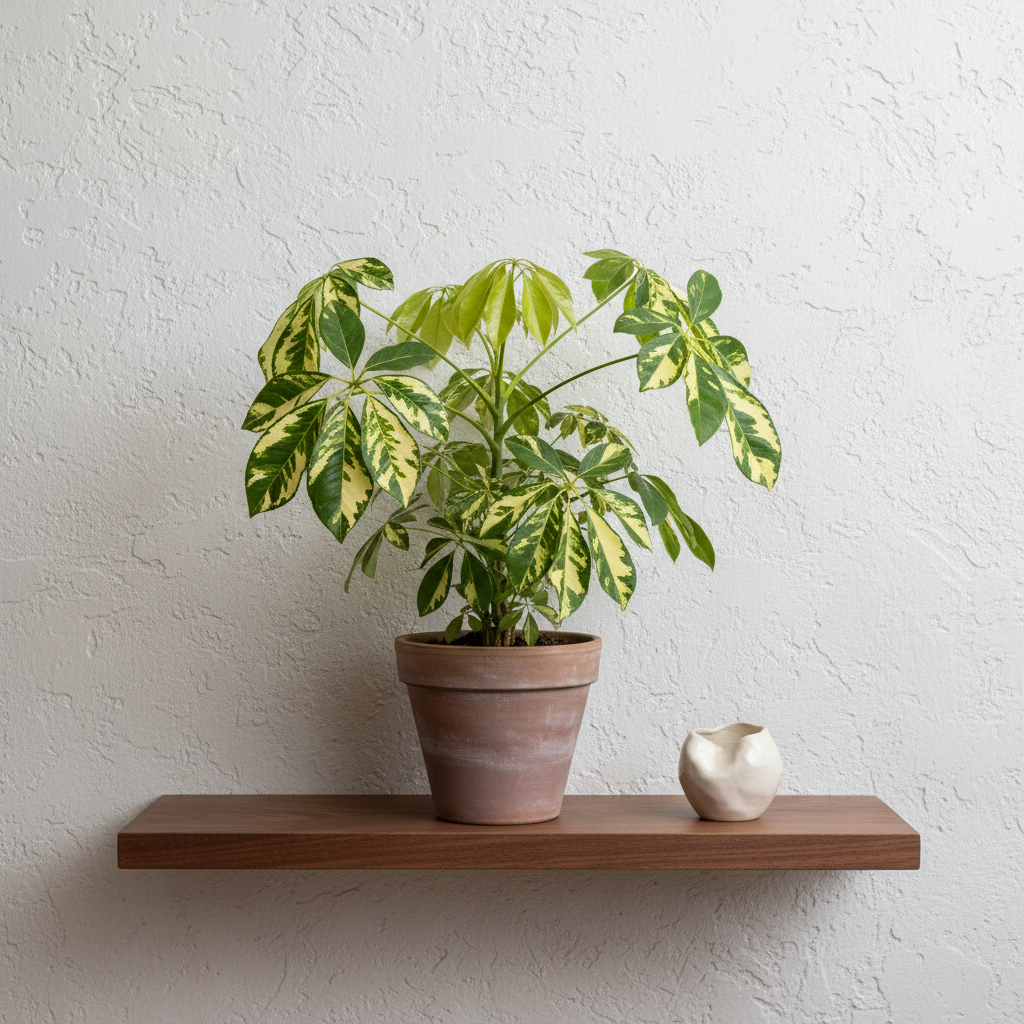
Gold Capella
The most widely grown variegated Schefflera arboricola. Each leaflet carries bold splashes of creamy gold across a deep green base, with the variegation forming irregular streaks down the leaflet centre. Slightly more open and airy in habit than the species, and the colour holds well in bright indirect light. The first cultivar to revert if the position is too dim.
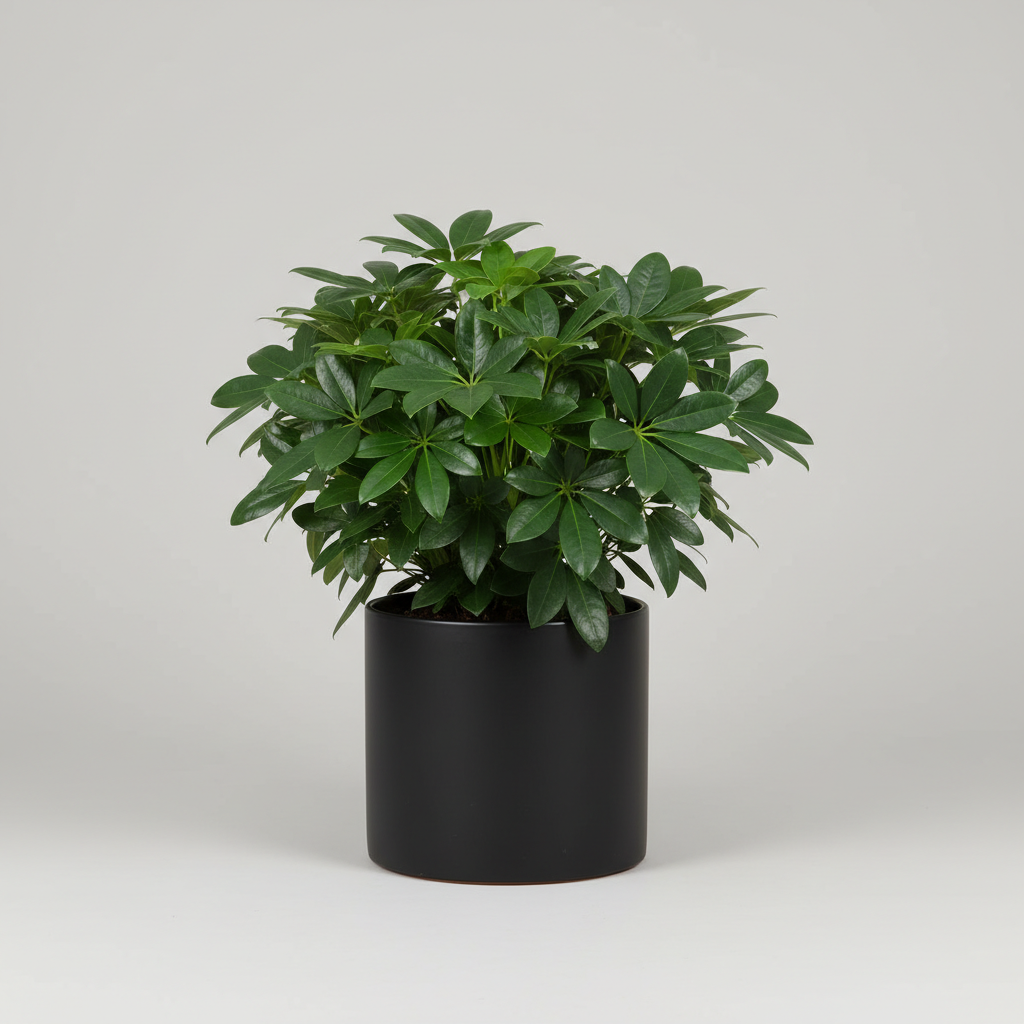
Amate
A modern selection bred for uniform deep glossy emerald foliage and superior resistance to powdery mildew. The leaflets are broader and more leathery than those of the wild type, and the plant tends to branch densely from the base, producing a fuller silhouette without pinching. The cultivar of choice for offices, conservatories and any position with moderate rather than bright light.
Variety Profiles in Detail
Gold Capella (Schefflera arboricola ‘Gold Capella’)
Probably the most commercially successful umbrella plant cultivar ever introduced. Selected in the 1970s for its stable, bold variegation, Gold Capella combines the easy care of the species with the visual impact of cream-and-gold foliage. Older plants can reach two metres indoors, although they look best pinched at around 1.2 to 1.5 metres to keep them dense. In a bright east-facing position the variegation can take on almost neon intensity; in a dimmer spot it fades to a muted green and cream. Worth the slightly higher light requirement for the visual payoff.
Trinette (Schefflera arboricola ‘Trinette’)
Trinette is often confused with Gold Capella and is sometimes sold under the same name, but the variegation tends towards cream and ivory rather than yellow and gold, giving the plant a softer pastel look. The leaflets are slightly narrower and the habit a touch more upright. Good in a position that gets a few hours of soft direct morning sun.
Amate (Schefflera arboricola ‘Amate’)
Amate was bred in the 1990s for the commercial interior landscape industry, which needed a cultivar that would survive office lighting without dropping leaves or developing mildew. The resulting plant is the most forgiving of all umbrella plant cultivars and the easiest recommendation for a beginner or for a less-than-perfect position. The trade-off is that the uniform dark green can look slightly austere next to a colourful variegated form.
Janine (Schefflera arboricola ‘Janine’)
A compact-growing cultivar with marbled cream and green leaflets, typically reaching no more than 80 cm to a metre indoors. Janine is harder to find than Gold Capella or Amate but is an excellent choice where space is limited, such as on a shelf or a side table where a taller plant would be unwieldy.
Dazzle (Schefflera arboricola ‘Dazzle’)
The most heavily variegated cultivar in commerce, with some leaflets almost entirely cream or pale ivory. Beautiful in bright conditions but demanding: Dazzle needs the brightest indirect light you can offer to keep the variegation from collapsing, and its reduced chlorophyll means it grows more slowly and is less tolerant of mistakes than its plainer cousins. Best treated as a collector’s plant.
Choosing the Right Variety for Your Space
For a bright living room with an east or south aspect, Gold Capella, Trinette or Dazzle will all reward the light with strong variegation. For a moderately lit room with a north window or further back from the light, Amate or the plain species is the right pick. If space is tight, look for Janine or for the smaller young specimens of any cultivar; once an umbrella plant has reached a metre or more, pinching back will keep its size in check almost indefinitely.
Frequently Asked Questions
Why are the leaves of my umbrella plant turning yellow?
The most common cause is overwatering, particularly when older lower leaves yellow first and the soil stays damp for days after watering. Less commonly, persistent low light causes the same yellowing pattern, and a long-running nutrient deficiency can produce uniformly pale leaves. Check the soil moisture and the stem base before reaching for fertiliser; if the soil is soggy, reduce watering and inspect the roots.
Why is my umbrella plant leggy with bare lower stems?
Leggy growth is almost always a light problem. Move the plant closer to a window or add a supplemental LED grow light, then pinch out the growing tip to encourage branching just below the cut. New shoots will fill in over the following months. For a severely leggy plant, air layering the top section gives you a full-sized new plant and the stump usually resprouts.
Can I keep an umbrella plant outside in summer?
Yes, in mild climates the plant benefits from a summer outdoors in dappled shade. Acclimatise it gradually over a week, starting with a few hours of soft morning light and building up, and never put it straight into full direct sun. Bring it back inside well before night temperatures drop below 12 °C (54 °F), inspecting carefully for hitchhiking pests before it rejoins your indoor collection.
How do I prune an umbrella plant?
Use sharp sterile secateurs and cut just above a node, ideally where you would like a new branch to form. The plant responds to pruning by pushing two or three shoots from dormant buds below the cut, so even modest pinching produces noticeably bushier growth within a month or two. Prune in spring or early summer for the fastest recovery; avoid major cuts in autumn or winter.
Is my umbrella plant safe around cats and dogs?
It is mildly toxic. Calcium oxalate crystals and saponins in the leaves and stems cause oral irritation, drooling and vomiting in cats and dogs if chewed, and very occasionally more serious symptoms. The plant is not lethal in the doses a pet would normally ingest, but it is enough of an irritant that most animals stop after one taste. Keep it out of reach of pets that habitually chew foliage, and contact a vet if you see persistent symptoms.
Why is my umbrella plant losing leaves?
Sudden leaf drop is most often a stress response to a change in conditions: a move to a new room, a cold draught, a sudden change in watering routine, or transplant shock after repotting. The plant should stabilise within two to four weeks once conditions are steady. Persistent leaf drop over months points to a deeper problem, usually root rot or pest infestation; inspect the roots and the stem base carefully if the loss continues.
Why are the leaflet tips turning brown and crisp?
Brown crispy tips usually indicate one of three issues: low humidity (especially from a nearby radiator or air vent), fertiliser salt build-up in the soil, or the use of hard or chlorinated tap water over a long period. Diagnose by elimination: move the plant away from heat sources, flush the soil with several pot-volumes of plain water, and switch to rainwater or filtered water for a few months to see which factor was responsible.
Will my umbrella plant flower indoors?
Rarely, but it can happen on mature plants in very bright conditions. The flowers are small whitish or greenish clusters held on short stalks above the foliage and are not the reason anyone grows the plant. Indoors most umbrella plants never flower at all, which is no reflection on their health.
How fast does an umbrella plant grow?
In good conditions a young umbrella plant grows 30 to 60 cm (12 to 24 in) per year, slowing as it matures and as the canopy fills out. Plants in moderate light grow significantly slower. After about five years a well-grown plant has typically reached its intended display size and growth is best controlled by pinching the tips rather than pursued for height.
My variegated umbrella plant is reverting to all green. Can I save the variegation?
Reverted growth has more chlorophyll than variegated growth and will out-compete the original tissue if left in place. Prune any all-green branches back to a section that still shows variegation, and increase the light intensity in the plant’s position. Future new growth from below the cut is more likely to maintain its colour. If most of the plant has reverted, take cuttings from the remaining variegated stems and start a new specimen rather than trying to rescue the original.
What is the difference between Schefflera arboricola and Schefflera actinophylla?
Schefflera arboricola is the smaller dwarf umbrella tree native to Taiwan, with leaflets typically 7 to 15 cm long and a mature indoor height of one to two metres. Schefflera actinophylla is the much larger Australian umbrella tree, with leaflets up to 30 cm long and an outdoor mature height of 10 to 12 metres. The species sold as a houseplant is almost always the smaller arboricola; the larger species is now invasive in parts of Florida and Hawaii and is rarely offered for indoor use.






