
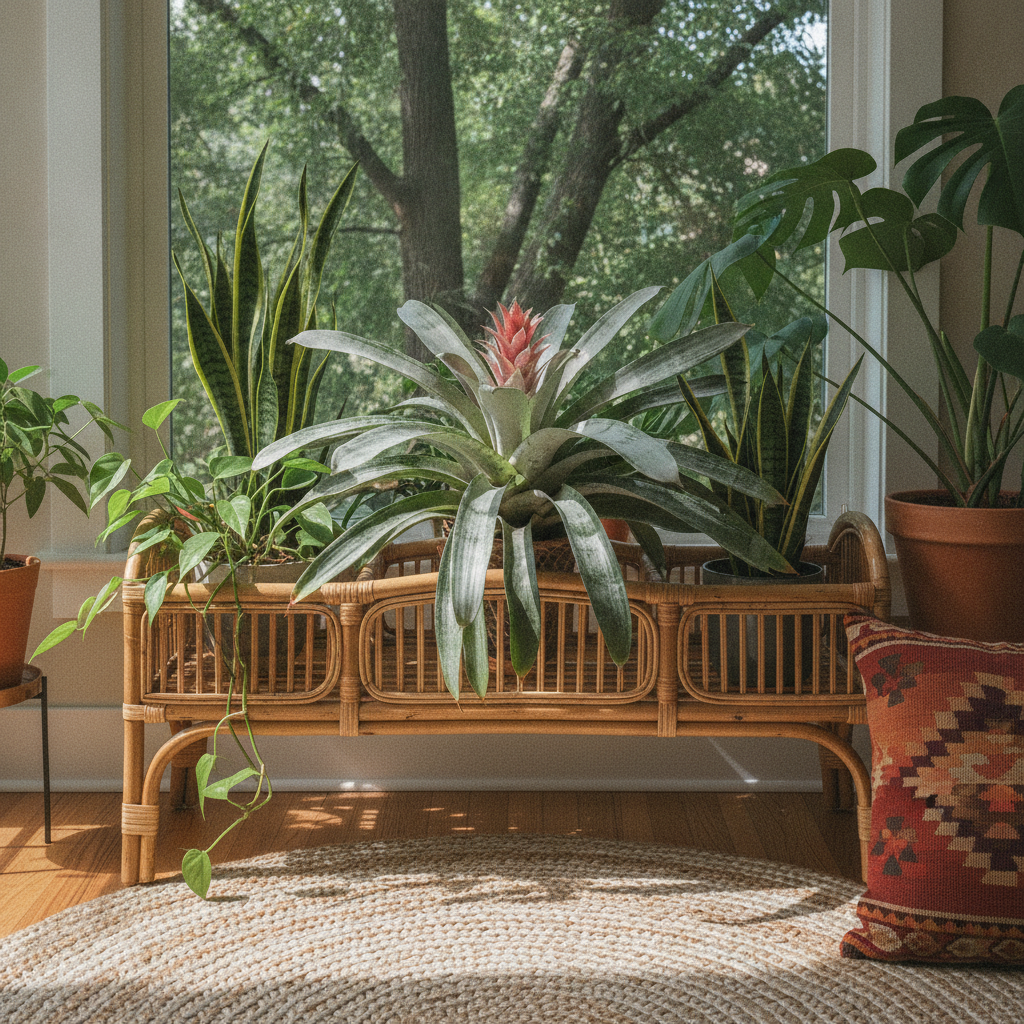
Few houseplants announce themselves quite like the silver vase plant. Known botanically as Aechmea fasciata and sold under common names such as the urn plant or silver vase bromeliad, it carries a broad rosette of arching, silver-dusted leaves that fan outward from a watertight central cup. From the heart of a mature plant rises a vivid rose-pink flower spike studded with small blue and violet blooms, a display that can hold its colour for several months. Native to the humid Atlantic coastal forests of south-eastern Brazil, this species grows in the wild as an epiphyte, perching on tree branches and gathering rain and debris in its leafy tank rather than rooting in soil.
The silver vase plant has a reputation as one of the most forgiving and architectural of the tank bromeliads, and that reputation is well earned. It asks for surprisingly little once you understand that it drinks through its central cup as much as through its roots. Keeping it alive is straightforward, yet coaxing the best silver banding, the strongest leaf posture and, eventually, that signature pink bract takes a slightly more deliberate hand. This guide walks through everything from light and watering to the plant’s unusual once-in-a-lifetime flowering and the offsets it leaves behind, so you can move from simply keeping a silver vase plant to genuinely growing one well.
Contents
- Quick Reference
- Why Silver Vase Plant Makes a Striking Houseplant
- Light Requirements
- Watering & Humidity
- Soil, Potting & Repotting
- Fertilising
- Propagation
- Pests & Diseases
- Popular Varieties
- Frequently Asked Questions
Quick Reference: Silver Vase Plant at a Glance
| Light | Bright, indirect light; tolerates a little gentle morning sun |
| Watering | Keep the central cup topped up with fresh water; keep the potting mix barely moist |
| Temperature | 18 to 27 degrees C (64 to 81 F); avoid below 13 degrees C (55 F) |
| Humidity | Moderate to high, ideally 50 to 60 per cent |
| Fertiliser | Weak, dilute feed during the growing season; bromeliads are light feeders |
| Toxicity | Non-toxic to cats and dogs, though the spiny leaf margins can scratch |
Why Silver Vase Plant Makes a Striking Houseplant
The appeal of the silver vase plant starts with its foliage, which looks good every day of the year whether or not the plant is in bloom. The broad, leathery leaves are coated in fine scales called trichomes that scatter light and give the surface its characteristic powdery, silver-grey sheen, broken by horizontal bands of paler frosting. These same trichomes are functional as well as beautiful, because in the wild they absorb moisture and nutrients straight from the air and from water pooled in the rosette. The result is a plant that reads as sculptural and almost metallic, holding its shape with a tidy, symmetrical urn form that suits modern and minimalist interiors as readily as it does a jungly, plant-filled corner.
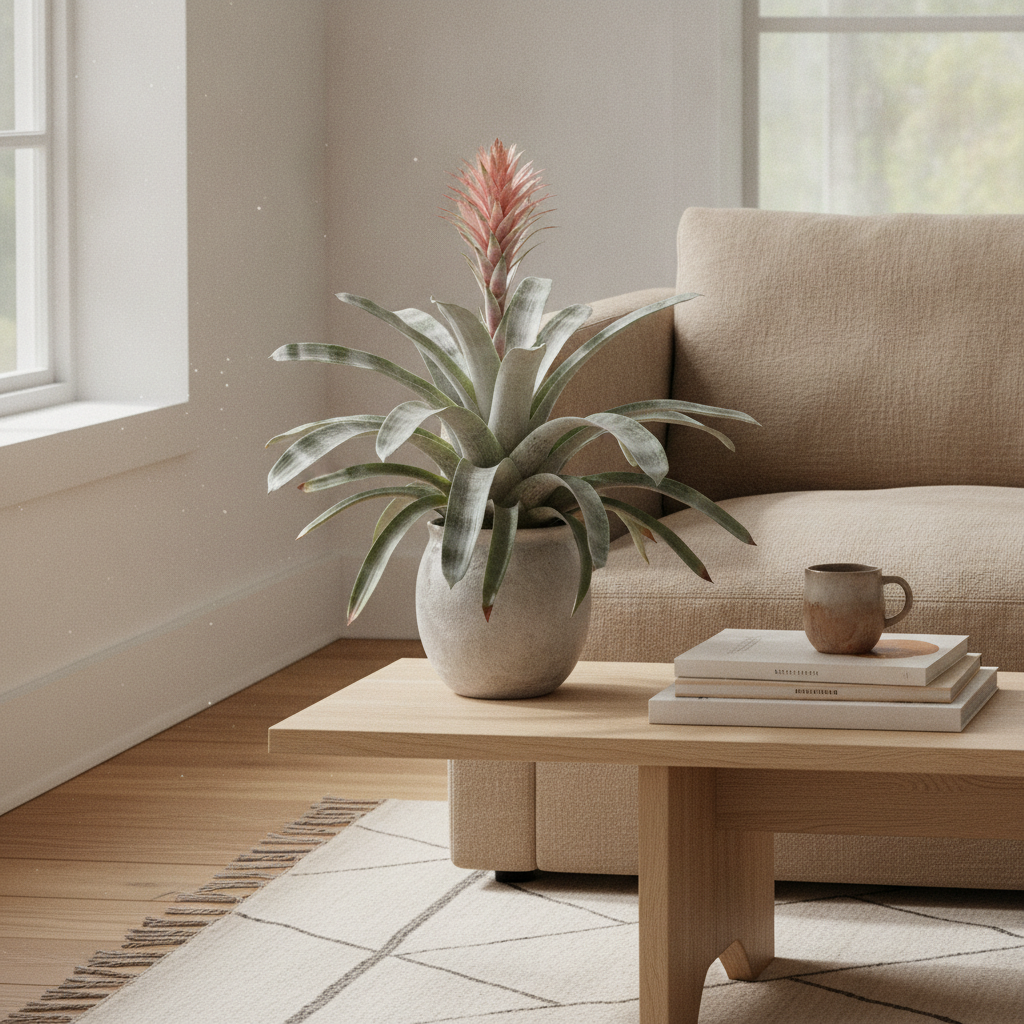
Beyond looks, the silver vase plant is genuinely low-maintenance for anyone who can resist the urge to fuss. Because it stores water in its central tank, it shrugs off the occasional missed watering far better than most leafy houseplants, and its slow growth means it rarely outgrows its spot or needs frequent repotting. It is also remarkably long-lived as a clump even though each individual rosette flowers only once. When the time comes, that flowering is the reward for patient care: a thick, coral-pink bract pushes up from the centre and persists for months, while tiny true flowers emerge from between the bract’s scales. For a houseplant that combines year-round structure, a spectacular finale and forgiving habits, the silver vase plant is hard to beat.
Important — Toxicity: The silver vase plant is listed as non-toxic to cats and dogs by the ASPCA, so an exploratory nibble is unlikely to cause poisoning. The real hazard is physical: the leaf margins carry small, sharp spines that can scratch curious pets or children, so place the plant where it will not be brushed against constantly.
Light Requirements
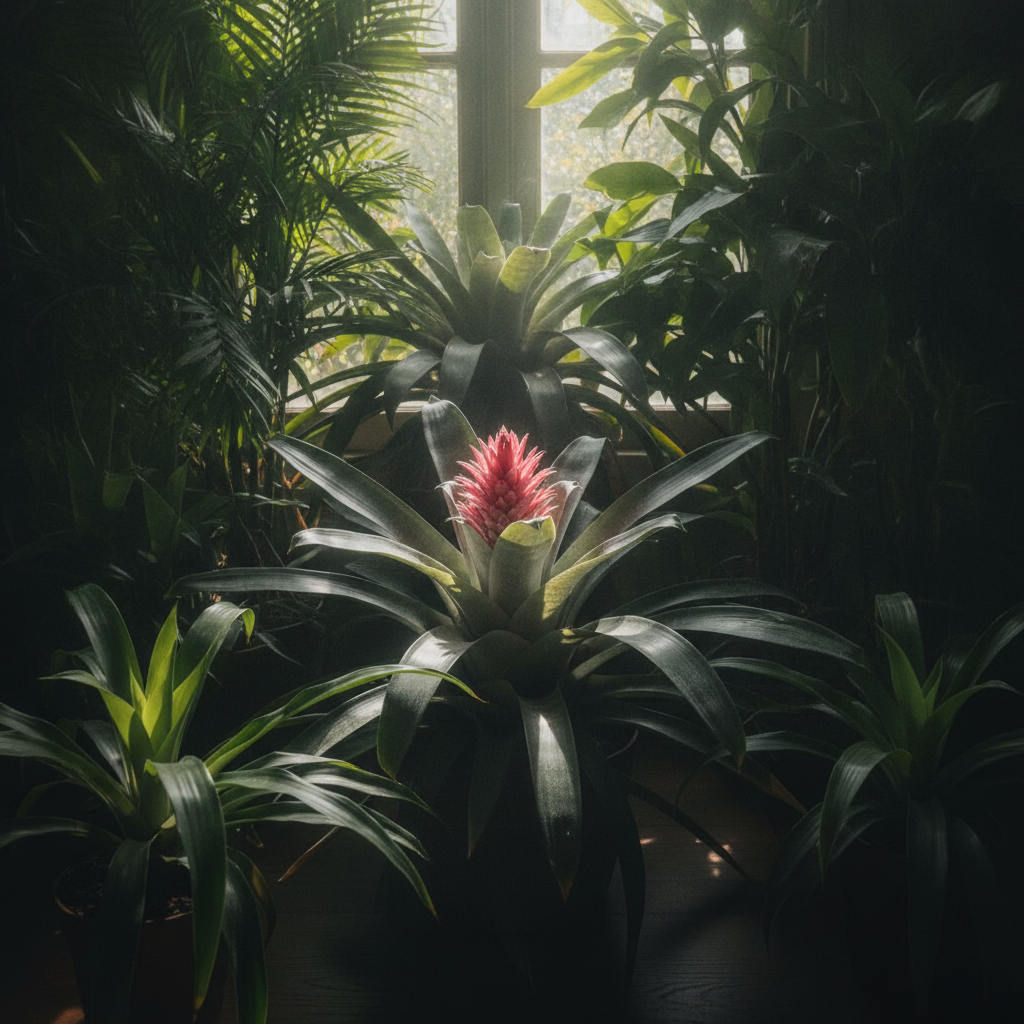
Light is the single biggest lever you have over how good a silver vase plant looks. In its native forest canopy it grows in bright, dappled conditions, catching plenty of light filtered through the leaves above without sitting in scorching, unbroken sun. Indoors, that translates to a position with bright, indirect light for most of the day, which keeps the rosette compact, deepens the silver banding and gives the plant the energy reserves it eventually needs to flower.
A plant kept too dark will survive for a long time, but it will tell you it is unhappy. The leaves stretch and flop outward, the gaps between the silver bands widen and dull, and the chances of ever seeing a bract drop close to zero. Move such a plant gradually into brighter light and you will often see the next leaves emerge tighter and more silvery within a couple of months.
Light Levels Explained
Houseplant light is often described in vague terms, so the table below sets out roughly what each category means and how the silver vase plant responds to it. Lux figures are approximate and meant only as a guide, since the duration of light through the day matters as much as its peak intensity.
| Light Category | Approx. Level | Typical Location | Outcome |
|---|---|---|---|
| Direct sun | 50,000 lux and above | On an unshaded south-facing sill | Risk of bleaching and brown scorch on the leaf tips |
| Bright indirect | 10,000 to 25,000 lux | Near an east or filtered south window | Ideal: strong silver banding, compact form, best flowering odds |
| Medium | 5,000 to 10,000 lux | A metre or two back from a bright window | Healthy but slower, with slightly looser banding |
| Low | 1,000 to 5,000 lux | A north window or interior wall | Survives but stretches; flowering very unlikely |
| Very low | Below 1,000 lux | A dim hallway or far corner | Slow decline, dull leaves, eventual weakening |
Window Orientation and Placement
South-facing window: The brightest option in the northern hemisphere and a fine choice as long as you diffuse the harshest midday rays with a sheer curtain or set the plant a little back from the glass. Unfiltered summer sun directly on the leaves can bleach the silver coating and scorch the tips.
East-facing window: Arguably the sweet spot. Gentle morning sun followed by bright ambient light for the rest of the day gives the silver vase plant exactly the intensity it likes without the heat stress of afternoon sun.
West-facing window: Works well, though the afternoon sun is stronger and warmer than morning light, so a light curtain or a half-metre of distance from the glass helps during the height of summer.
North-facing window: Usable for keeping the plant ticking over, but the light is often too weak to maintain bold banding or trigger flowering. If a north window is your only option, consider supplementing with a grow light.
Pro Tip — Read the Banding: Use the leaves themselves as a light meter. Crisp, closely spaced silver bands and a tight rosette mean the light is right. Widely spaced, faded banding and leaves that splay out flat are a clear signal to move the plant somewhere brighter.
How Light Affects Foliage and Flowering
The silvery frosting that gives this plant its name is most pronounced under good light, because the trichomes develop more densely when the plant is well lit. Insufficient light produces greener, less patterned leaves, while excessive direct sun can fade the colour and leave pale, papery patches. Light is also closely tied to flowering. A mature, well-lit silver vase plant builds up the reserves it needs to bloom, whereas a plant in shade may grow for years and never produce a bract. This is one of the few houseplants where bumping up the light is the most reliable way to encourage a flower.
Warning — Direct Sunlight: Acclimatise the plant slowly to any increase in light. Moving a silver vase plant straight from a shaded spot into strong direct sun can cause rapid sunscald, showing up as bleached or brown dry patches on the upper leaf surfaces that never recover.
Artificial Lighting
The silver vase plant responds well to supplementary lighting, which makes it a good candidate for rooms that lack a bright window. A full-spectrum LED grow light positioned 30 to 45 cm (12 to 18 inches) above the rosette and run for 10 to 12 hours a day can maintain healthy banding and, in a mature plant, even help nudge it towards flowering. Because the plant is fairly compact, a single modest panel or bulb is usually enough.
Seasonal Adjustments
Light intensity indoors drops sharply through autumn and winter, so a position that was perfect in summer may become too dim by December. Move the plant closer to the window for the darker months, and consider cleaning the glass and the leaves to make the most of what light there is. As spring returns and the sun climbs higher, ease the plant back to its original spot or add a curtain to head off the stronger summer rays.
Watering & Humidity
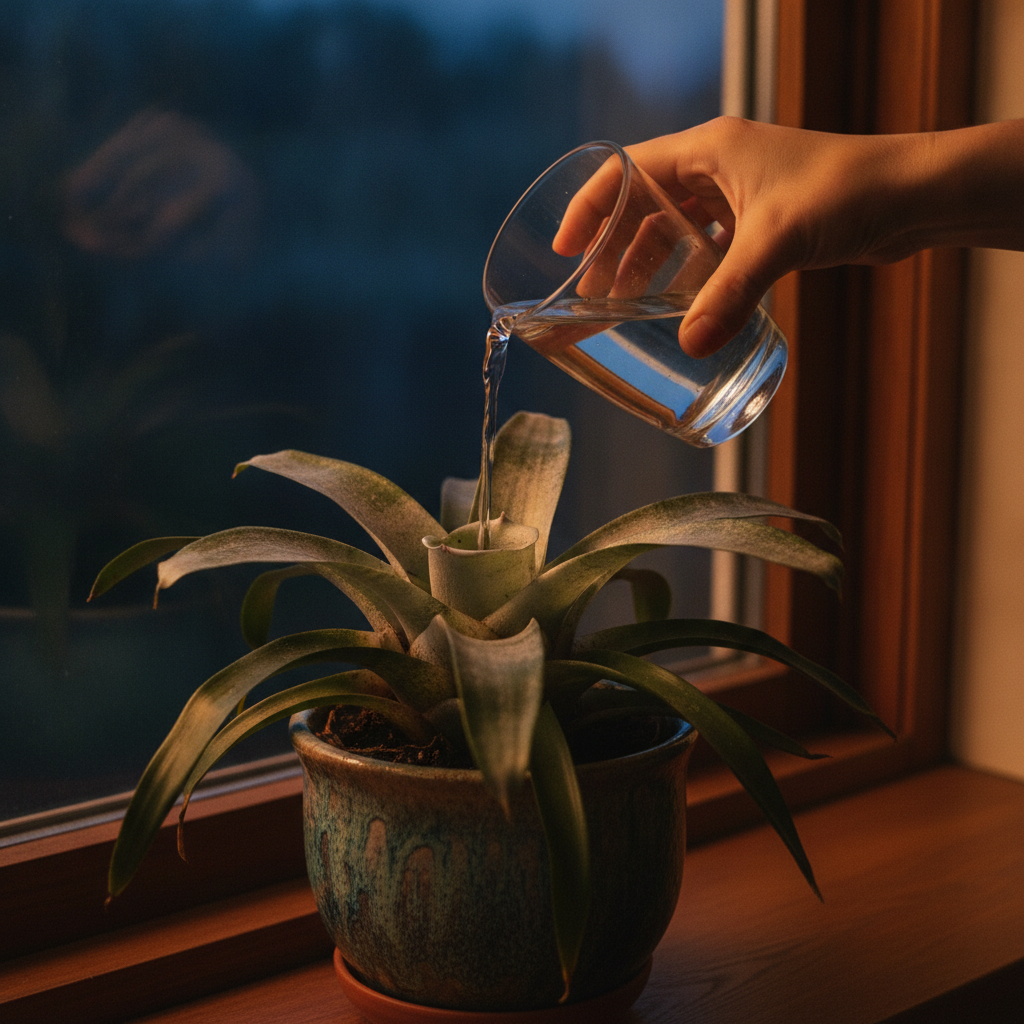
Watering is where the silver vase plant differs most from a conventional houseplant, and understanding it is the key to success. As a tank bromeliad, the plant is built to collect and hold water in the cup formed at the centre of its rosette. In the wild this reservoir is its main source of moisture, while the roots serve largely to anchor it to a branch. Indoors you essentially water in two places at once: a small amount into the potting mix, and a steady supply into the central cup.
When to Water
Keep the central cup filled with about 2 to 4 cm of water at all times during the growing season, topping it up as the level drops. Just as important as keeping it filled is keeping it fresh: every week or two, tip the old water out and refill, ideally by flushing it through so stagnant water and any debris are washed away. Stagnant water left for long periods can turn foul and encourage rot at the base of the leaves.
The potting mix needs far less attention. Let the top few centimetres dry out between waterings and then add only enough to lightly moisten the mix, never enough to leave it soggy. In practice the soil might need watering every week or two, while the cup is checked far more often. In winter, reduce both: keep a little water in the cup but allow it to run lower, and water the mix sparingly to prevent rot in the cooler, slower months.
Pro Tip — Flush the Cup: Once a month, take the plant to the sink and pour fresh water through the central cup until it overflows and runs out. This single habit refreshes the reservoir, rinses away mineral build-up and dust, and does more to prevent rot and crown problems than almost anything else.
How to Water Correctly
- Check the central cup first. If it holds less than about 2 cm of water, it needs topping up.
- Empty any old or cloudy water from the cup by gently tipping the plant over a sink.
- Pour fresh water slowly into the centre of the rosette until it holds 2 to 4 cm, allowing a little to overflow to flush the reservoir.
- Feel the potting mix; if the top few centimetres are dry, add a small amount of water to the surface to lightly moisten it.
- Let any excess drain fully from the pot and never leave the pot standing in a saucer of water.
- Wipe up spills and make sure water has not collected in the saucer beneath the pot.
Signs of Overwatering vs. Underwatering
| Symptom | Overwatering | Underwatering |
|---|---|---|
| Leaf colour | Yellowing, especially at the base of the rosette | Dull, greyish and slightly faded overall |
| Leaf texture | Soft, mushy leaf bases that pull away easily | Leaves curl inward and feel thin or papery |
| Soil or mix | Constantly wet, sometimes with a sour smell | Bone dry and pulling away from the pot edge |
| Roots | Brown, soft and rotten | Dry and brittle but otherwise intact |
| Plant base | Rot spreading from the crown and central cup | Cup empty and leaves drooping for want of water |
Warning — Root and Crown Rot: The fastest way to kill a silver vase plant is to keep its potting mix waterlogged. Soggy soil suffocates the anchoring roots and rot can creep up into the crown, which is usually fatal. When in doubt, err on the side of a drier mix and rely on the central cup to keep the plant hydrated.
Humidity Requirements
Coming from humid Brazilian forests, the silver vase plant enjoys moderate to high humidity, ideally somewhere around 50 to 60 per cent. It is more tolerant of average indoor humidity than many tropical plants thanks to its moisture-absorbing trichomes and its water-holding cup, but very dry air, such as that near a radiator in winter, will gradually take its toll.
The signs of air that is too dry are usually subtle: browning, crisping leaf tips and a slightly faded look to the foliage. These are rarely serious on their own, but they do detract from the plant’s clean appearance and can hint that conditions are harsher than the plant would like.
Raising humidity is straightforward. Grouping the plant with other houseplants creates a more humid microclimate, while a pebble tray topped up with water beneath the pot lifts local moisture without wetting the roots. In very dry homes a small humidifier nearby is the most reliable fix. Occasional misting of the leaves does little harm and helps keep the trichomes clean, though it is no substitute for genuinely humid air.
Water Quality
Because water sits in the central cup for days at a time, water quality matters more here than for most plants. Hard tap water leaves mineral deposits that can mark the leaves and build up in the cup, and bromeliads can be sensitive to the salts and chlorine in some tap supplies. Where possible, use rainwater, distilled water or filtered water, especially for the central cup. If you only have hard tap water, let it stand overnight before use and flush the cup more often to keep deposits from accumulating.
Soil, Potting & Repotting
An epiphyte that naturally grows on bark needs a growing medium quite unlike standard potting compost. The silver vase plant wants a mix that is fast-draining and airy enough that water rushes through and the roots are never left sitting wet. A dense, moisture-retentive compost is the enemy here, because it holds the very wetness around the roots that leads to rot.
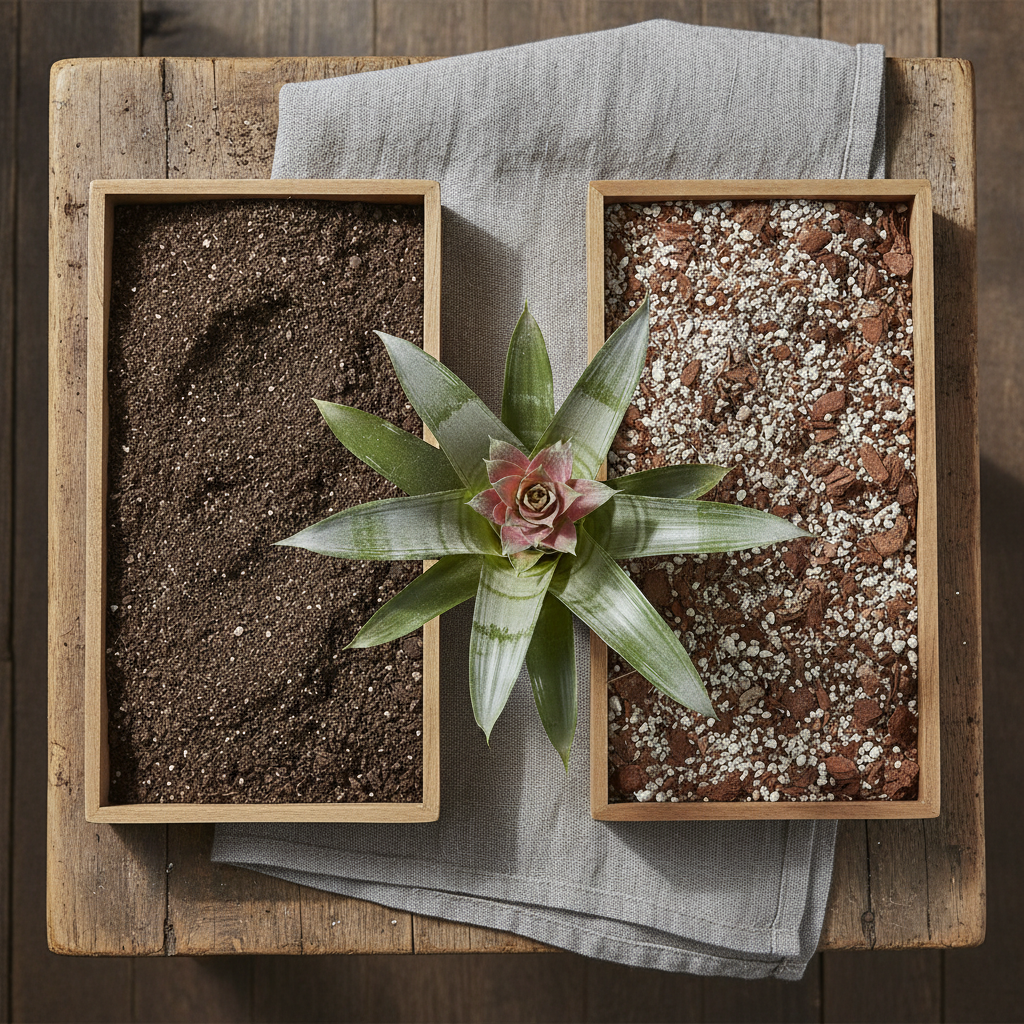
Ideal Soil Composition
The goal is a loose, chunky blend that mimics the bark and leaf litter the plant would cling to in the wild. A purpose-made bromeliad or orchid mix works beautifully, and it is easy to assemble something suitable from a few common ingredients. The table below gives a reliable starting point that you can adjust to what you have available.
| Component | Proportion | Function |
|---|---|---|
| Orchid bark (fine to medium) | 40 per cent | Provides structure, air pockets and excellent drainage |
| Coco coir or peat-free compost | 30 per cent | Holds a little moisture and supports the roots |
| Perlite or pumice | 20 per cent | Keeps the mix open and prevents compaction |
| Coarse sand or fine grit | 10 per cent | Adds weight for stability and aids drainage |
The silver vase plant prefers a slightly acidic medium, broadly in the range of pH 5.0 to 6.5, which a bark-based bromeliad or orchid mix naturally provides. There is no need to chase an exact figure, but it is worth avoiding heavily limed composts that push the mix towards alkaline.
Pro Tip — Quick Mix Recipe: If you want a fuss-free blend, combine two parts orchid bark, one part peat-free houseplant compost and one part perlite. It drains fast, stays airy and suits the silver vase plant’s epiphytic roots without any further tinkering.
Choosing the Right Pot
The silver vase plant has a small, shallow root system relative to its leafy bulk, so it does not need a large or deep pot. In fact a pot that is too big holds more damp mix than the roots can use, raising the risk of rot. A snug pot, only a little wider than the root ball, is ideal and also helps anchor what can become a top-heavy plant.
Drainage holes are non-negotiable. Whatever pot you choose, it must have drainage holes so that excess water from the mix can escape freely. Without them, water collects at the base and the roots will rot, no matter how careful you are with the cup.
Pot material: A heavier pot in terracotta or glazed ceramic helps counterbalance the spreading rosette and stop the plant tipping over, particularly once it sends up a flower spike. Terracotta has the added benefit of breathing and wicking away excess moisture, which suits this rot-prone species.
Pot size: Match the pot to the root ball rather than to the size of the leaves. A mature silver vase plant is often perfectly happy in a pot only 13 to 15 cm (5 to 6 inches) across, and resisting the urge to over-pot is one of the easiest ways to keep it healthy.
When to Repot
The silver vase plant rarely needs repotting and resents being disturbed, so do it only when necessary. A mature plant will usually stay in the same pot for its whole flowering life. The main reasons to repot are to refresh a mix that has broken down and gone soggy, to move a recently bought plant out of a poor nursery medium, or to pot up the offsets that appear after flowering. Spring and early summer are the best times, giving the plant a full season to settle before the slower months.
How to Repot: Step-by-Step
- Water the plant lightly a day beforehand and empty the central cup so it is easier and safer to handle.
- Wearing gloves to guard against the spiny leaf margins, ease the plant out of its old pot by squeezing the sides and supporting the base.
- Gently tease away the old, spent mix from around the roots, taking care not to snap the relatively few anchoring roots.
- Part-fill a clean pot, only slightly larger than the last, with fresh free-draining bromeliad mix.
- Settle the plant at the same depth it sat before, never burying the base of the rosette, and fill around the roots with mix.
- Firm the mix gently so the plant is stable, then water the mix lightly and refill the central cup with fresh water.
- Keep the newly potted plant out of strong direct sun for a week or two while it re-establishes.
Warning — Transplant Shock: Never plant the silver vase plant deeper than it grew before. Burying the crown or packing wet mix against the base of the rosette invites rot and can kill the plant. Keep the base sitting proud of the mix and let the roots, not the crown, sit in the soil.
Fertilising
Silver vase plants are light feeders, and this is one area where less really is more. In the wild they draw modest nutrients from rainwater, airborne dust and the debris that collects in the cup, so they are adapted to lean conditions. Overfeeding does more harm than underfeeding, weakening the silver banding, causing the rosette to stretch and risking a build-up of harmful salts.
A light, dilute feed through the growing season is plenty. The aim is to supply a gentle background of nutrients rather than to push fast growth, which this naturally slow plant neither wants nor needs.
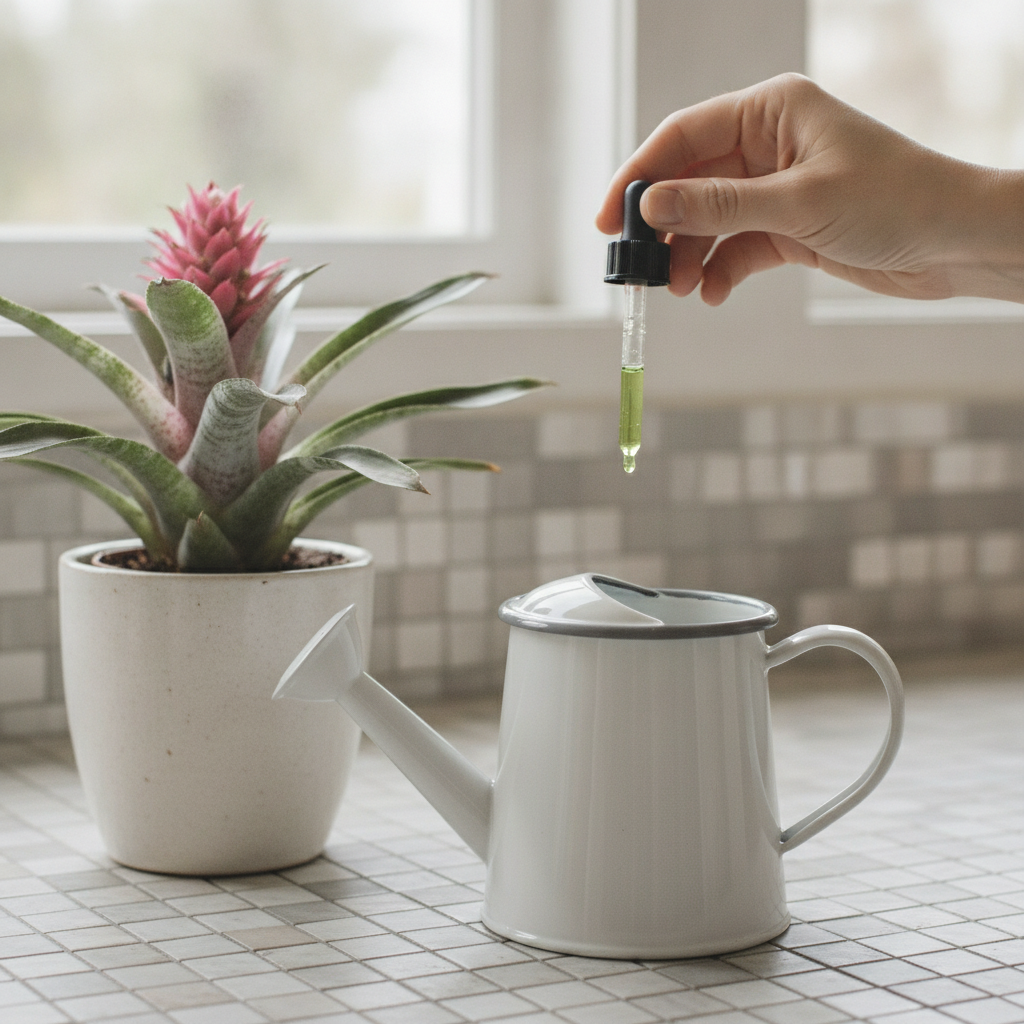
Understanding Plant Nutrients
Fertiliser labels carry three numbers, the N-P-K ratio, showing the percentages of nitrogen, phosphorus and potassium. These are the nutrients plants use in the largest amounts, supported by a handful of secondary and trace elements. For the silver vase plant a balanced formula at a fraction of its normal strength covers all the bases, but it helps to know what each element does and how a shortage shows up.
| Nutrient | Symbol | Primary Function | Deficiency Symptoms |
|---|---|---|---|
| Nitrogen | N | Leaf growth and overall vigour | Pale, slow growth and an overall washed-out look |
| Phosphorus | P | Root development and flowering | Weak roots and reluctance to bloom |
| Potassium | K | General health and stress resistance | Yellowing or browning leaf edges |
| Calcium | Ca | Cell-wall strength and new growth | Distorted or weak emerging leaves |
| Magnesium | Mg | Core of the chlorophyll molecule | Yellowing between the veins of older leaves |
| Iron | Fe | Chlorophyll production | Yellowing on the youngest leaves while veins stay green |
Types of Fertiliser
Liquid fertilisers: The easiest type to control, because you can dilute them heavily and apply little and often. A balanced houseplant feed at a quarter to half its recommended strength is well suited to the silver vase plant, mixed into the water you use for the soil or applied very weakly to the cup.
Slow-release granular: Convenient but harder to dose precisely for a plant that needs so little. If you use granules, apply them sparingly to the potting mix at a fraction of the stated rate, and never drop them into the central cup where they can concentrate and burn.
Organic fertilisers: Gentle options such as well-diluted seaweed or worm-cast extracts release nutrients slowly and are unlikely to scorch. They suit the silver vase plant’s modest appetite, though they still need to be used at low strength.
Feeding Schedule
Feed only during the active growing season, roughly from spring through to early autumn, and stop entirely in winter when the plant is barely growing. Once a month at a heavily diluted strength is ample, and many growers feed even less often than that with no ill effect. When you do feed, applying the dilute solution to the potting mix or as a very weak addition to the cup both work, provided you keep the concentration low.
Pro Tip — Dilute Hard: Mix bromeliad feed far weaker than you think you need, around a quarter of the strength suggested for ordinary houseplants. A silver vase plant will always do better slightly underfed than overfed, and a weak monthly dose during summer is all it asks for.
How to Fertilise
- Mix a balanced liquid fertiliser to a quarter or half of its normal recommended strength using clean water.
- Make sure the potting mix is already slightly moist, never bone dry, before applying any feed.
- Pour the dilute solution onto the potting mix, or add only a very weak amount to the central cup.
- Once every couple of months, flush the cup and the mix with plain water to clear any accumulated salts.
- Skip feeding altogether in winter and resume only when active growth picks up in spring.
Warning — Salt Build-Up: Because water lingers in the cup, fertiliser salts can concentrate there and scorch the tender leaf bases. Never put full-strength feed into the cup, and flush it periodically with fresh water to wash any residue away.
Propagation
Propagating the silver vase plant is both simple and slightly poignant, because it is tied to the natural end of the parent’s life. Each rosette flowers only once, and after that single spectacular bloom the mother plant slowly declines over the following months and years. Before it goes, however, it produces offsets, commonly called pups, at its base, and these are the future of your plant.
This is the only practical way to multiply a silver vase plant at home. The species does not propagate from leaf or stem cuttings, and growing from seed is a slow specialist exercise. For almost everyone, propagation means waiting for the pups and then separating them once they are large enough to fend for themselves.
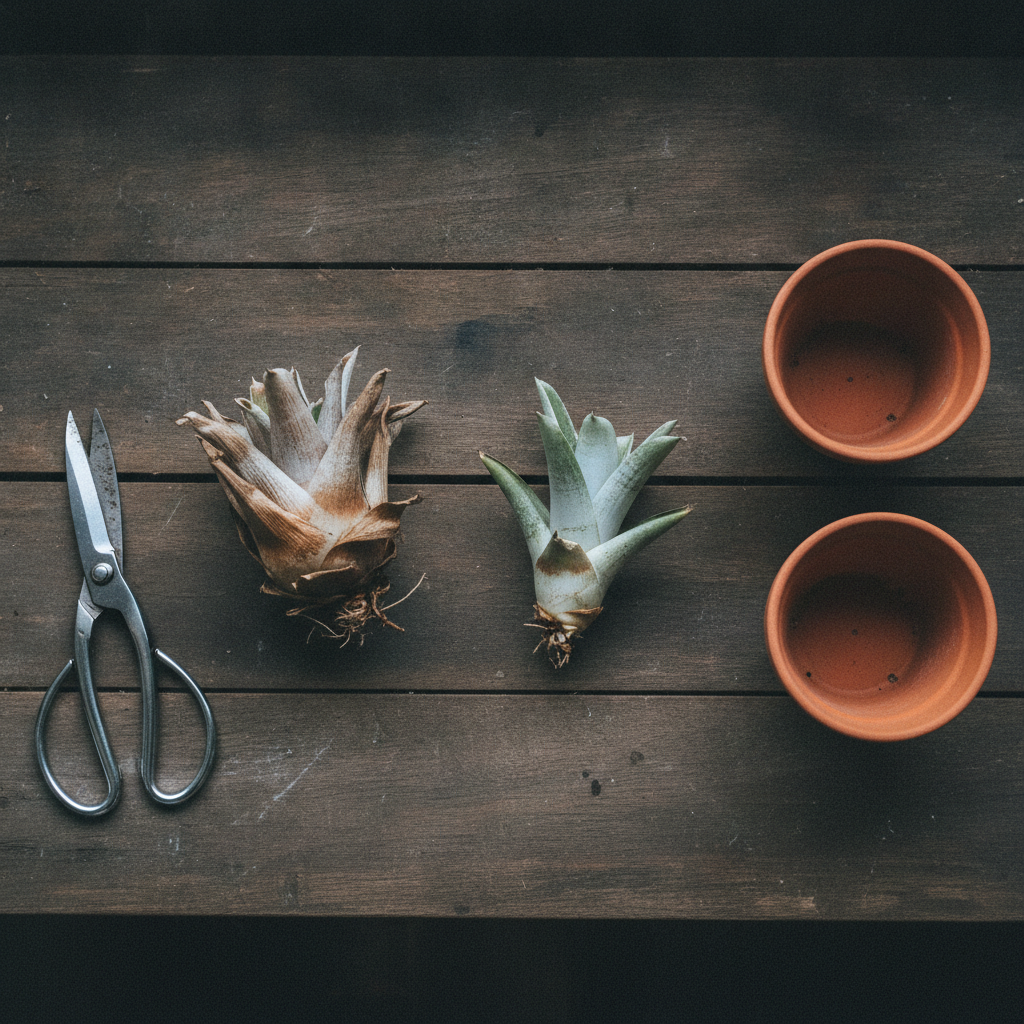
Understanding Pups and the Flowering Cycle
After the bract has faded, the mother plant channels its remaining energy into producing one or more pups around its base. These start as small rosettes nestled between the lower leaves and gradually grow, often drawing on the parent for support until they have roots of their own. The mother may look tired and increasingly tatty during this period, but it is worth keeping her in place because she is actively feeding the next generation. Only when a pup has reached roughly a third to a half of the mother’s size, and ideally formed a few roots of its own, is it ready to be separated.
Separating Pups: Step-by-Step
Dividing the pups from the parent is the main propagation method and is best done in spring or summer when the offsets are growing strongly. Patience is the only real skill required: a pup taken too early, before it has built up some size and a few roots, is much harder to establish.
- Wait until each pup is at least a third the size of the mother and shows signs of its own roots.
- Wearing gloves, ease the whole plant out of its pot so you can clearly see where the pup joins the parent.
- Using a clean, sharp knife, cut the pup away from the mother, taking a small section of the base and any roots with it.
- Let the cut surfaces dry in the air for a few hours, which helps guard against rot.
- Pot each pup into a small pot of fresh, free-draining bromeliad mix, settling it just deep enough to stand upright.
- Add a little water to the new pup’s central cup and keep the mix barely moist while it roots in.
- Place the young plants somewhere warm and bright but out of direct sun until they are clearly established.
Pro Tip — Let Pups Grow On: If you are not in a hurry, you can leave the pups attached and let the original pot become a clustering colony of rosettes. A clump of several silver vase plants at different stages can be far more striking than a single plant, and the pups will flower in their own time.
Encouraging a Reluctant Plant to Flower
If a mature plant simply will not bloom, there is a well-known trick that exploits the plant’s response to ethylene gas. Enclose the dry plant, with its cup emptied, in a clear plastic bag together with a ripe apple for a week or so. The apple releases ethylene, which can trigger the plant to initiate a flower spike over the following weeks to months. It is not guaranteed, but it is a reliable nudge for a healthy, well-grown plant that is old enough to flower.
Troubleshooting Propagation
| Problem | Likely Cause | Solution |
|---|---|---|
| Pup rots after separation | Cut surface kept too wet or potted into soggy mix | Let the cut dry first and use a barely moist, free-draining mix |
| Pup fails to root | Separated too early before forming roots | Reattach is not possible, so keep warm and bright and wait patiently |
| Mother produces no pups | Plant has not yet flowered or is stressed | Ensure good light and patience; pups follow flowering |
| Pup grows slowly | Too little light or too cool | Move to a warmer, brighter spot out of direct sun |
Pests & Diseases
The silver vase plant is reasonably resistant to pests, but it is not immune, and its tough leaves and water-filled cup create a few particular vulnerabilities. Most problems are easy to manage if caught early, which is why a regular look over the plant, including the leaf bases and undersides, pays off.
By far the most common issues with this species are not pests at all but problems of culture, chiefly rot from an over-wet potting mix or a stagnant cup. Keep the watering balance right and you will sidestep the majority of trouble before it starts.
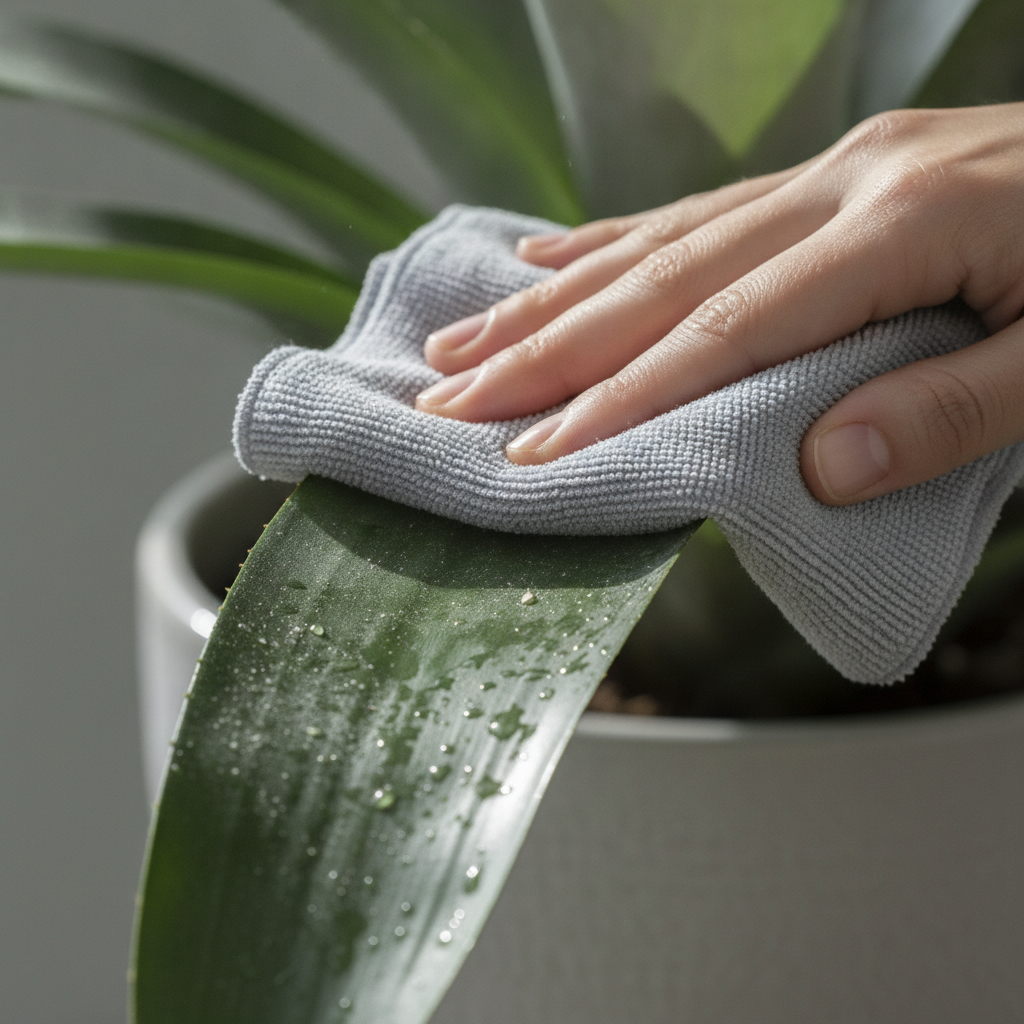
Common Pests
Scale Insects (Coccoidea)
Scale are the classic bromeliad pest and show up as small, brown, limpet-like bumps along the leaves, often following the bands or hiding in the leaf axils. They suck sap and excrete sticky honeydew, which can lead to sooty mould. Because they sit still and blend in with the banding, they are easily missed until numbers build up.
Treatment: Scrape or wipe them off with a cloth or a cotton bud dipped in diluted isopropyl alcohol, then treat with horticultural oil or insecticidal soap, repeating every week or two until clear. Check regularly afterwards, as scale can be persistent.
Mealybugs (Pseudococcidae)
Mealybugs appear as small, white, cottony tufts tucked into the protected crevices where the leaves meet the centre. Like scale, they feed on sap and weaken the plant while producing honeydew. The sheltered leaf axils of a bromeliad make an ideal hiding place for them.
Treatment: Dab each insect with a cotton bud soaked in diluted alcohol to dissolve its waxy coat, then follow up with insecticidal soap or neem oil. Inspect the leaf bases carefully, as mealybugs love to lurk deep in the rosette.
Aphids (Aphidoidea)
Aphids are less common on bromeliads but may gather on a soft, emerging flower spike, clustering as tiny green or black insects that distort new growth. They multiply quickly in warm conditions and, again, leave honeydew behind.
Treatment: Rinse them off with a gentle spray of water, then treat any survivors with insecticidal soap. Keep an eye on the developing bract, which is the most likely target.
Common Diseases
Root and Crown Rot (Pythium and Phytophthora)
This is the most serious threat to the silver vase plant and almost always stems from a waterlogged mix or water trapped against the crown. The base of the plant turns soft, brown and foul-smelling, and leaves pull away with little resistance. Once rot reaches the crown it is usually fatal.
Treatment: Prevention is the only reliable cure. Use a free-draining mix, never let the pot sit in water, and keep the crown clear of soggy compost. If you catch rot very early in a pup, removing the affected tissue and repotting into dry, fresh mix occasionally saves it.
Fungal Leaf Spot (various fungi)
Leaf spot shows as dark or water-soaked patches on the leaves, sometimes with a yellow halo, and tends to appear when conditions are too wet and air movement is poor. It is rarely fatal but can disfigure the foliage.
Treatment: Remove badly affected leaves, improve air circulation and avoid wetting the foliage unnecessarily. A copper-based fungicide can help in stubborn cases.
Pest and Disease Summary
| Pest / Disease | Identification | Treatment |
|---|---|---|
| Scale insects | Brown limpet-like bumps on leaves and axils | Wipe off, then oil or insecticidal soap repeatedly |
| Mealybugs | White cottony tufts in leaf crevices | Dab with alcohol, then soap or neem oil |
| Aphids | Clusters of tiny insects on the flower spike | Rinse off and treat with insecticidal soap |
| Root and crown rot | Soft, brown, smelly base and loose leaves | Prevent with dry mix and a clear crown |
| Fungal leaf spot | Dark or water-soaked patches on leaves | Remove leaves, improve airflow, copper fungicide |
Prevention Strategies
The best defence is good routine care. Keep the plant in bright light with decent air movement, water correctly so the mix is never waterlogged, and refresh the central cup regularly. Wiping the leaves now and then keeps the trichomes clean and gives you a chance to spot any pests before they take hold.
Quarantine any new plant for a couple of weeks before placing it near your other houseplants, since scale and mealybugs often arrive as hitchhikers. A quick inspection of the leaf axils whenever you flush the cup is usually all it takes to keep this resilient plant trouble-free.
Pro Tip — Spot-Treat Early: A cotton bud dipped in diluted isopropyl alcohol is the single most useful tool for a bromeliad grower. Touched directly onto scale or mealybugs as soon as you see them, it dissolves their protective coating and stops a minor sighting from becoming an infestation.
Popular Varieties
Although the wild species is striking enough on its own, growers have selected and named a number of cultivars of Aechmea fasciata that play on its colour and patterning. Most share the same care needs, so the choice comes down largely to looks and to what you can find for sale.
The variations range from sturdier, more heavily banded commercial forms to variegated selections with cream or yellow striping and darker, purple-tinged types. The table below summarises the most widely grown, followed by closer profiles of a couple of standouts.
| Variety | Leaf Appearance | Light Needs | Growth Rate | Availability |
|---|---|---|---|---|
| Species (A. fasciata) | Silver-grey leaves with bold white banding | Bright indirect | Slow | Very common |
| ‘Primera’ | Robust, heavily silver-banded leaves, large pink bract | Bright indirect | Slow | Common |
| ‘Variegata’ | Cream to yellow lengthwise stripes over silver | Bright indirect | Slow | Occasional |
| ‘Purpurea’ | Darker, purple-bronze flushed foliage | Bright indirect to some sun | Slow | Occasional |
| ‘Morgana’ | Deep purplish leaves with silver banding | Bright indirect | Slow | Less common |
| ‘Friederike’ | Strong silver banding, vigorous habit | Bright indirect | Slow | Less common |
Featured Varieties
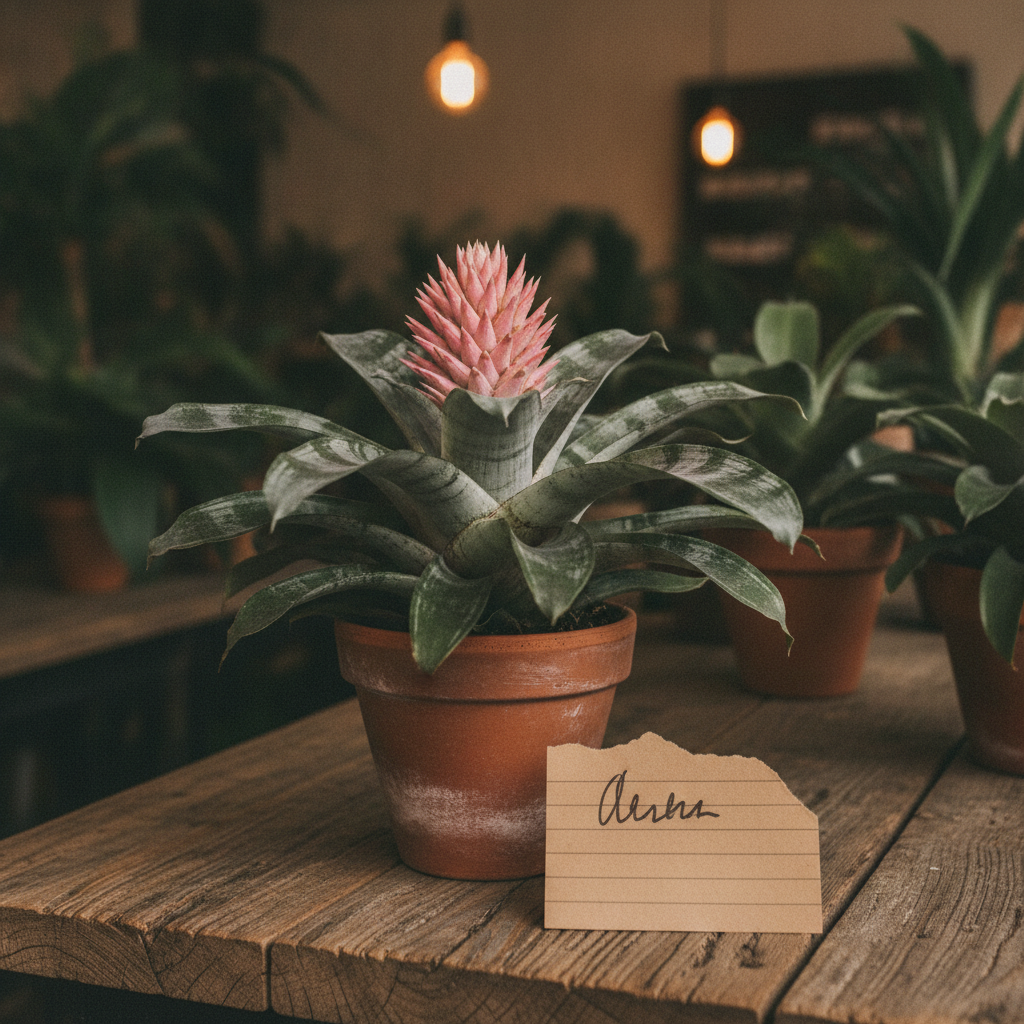
‘Primera’
The robust, commercially grown form most people picture when they think of the silver vase plant, with sturdy, heavily banded grey-green leaves and a large, vivid rose-pink bract. It is the toughest and most readily available selection.
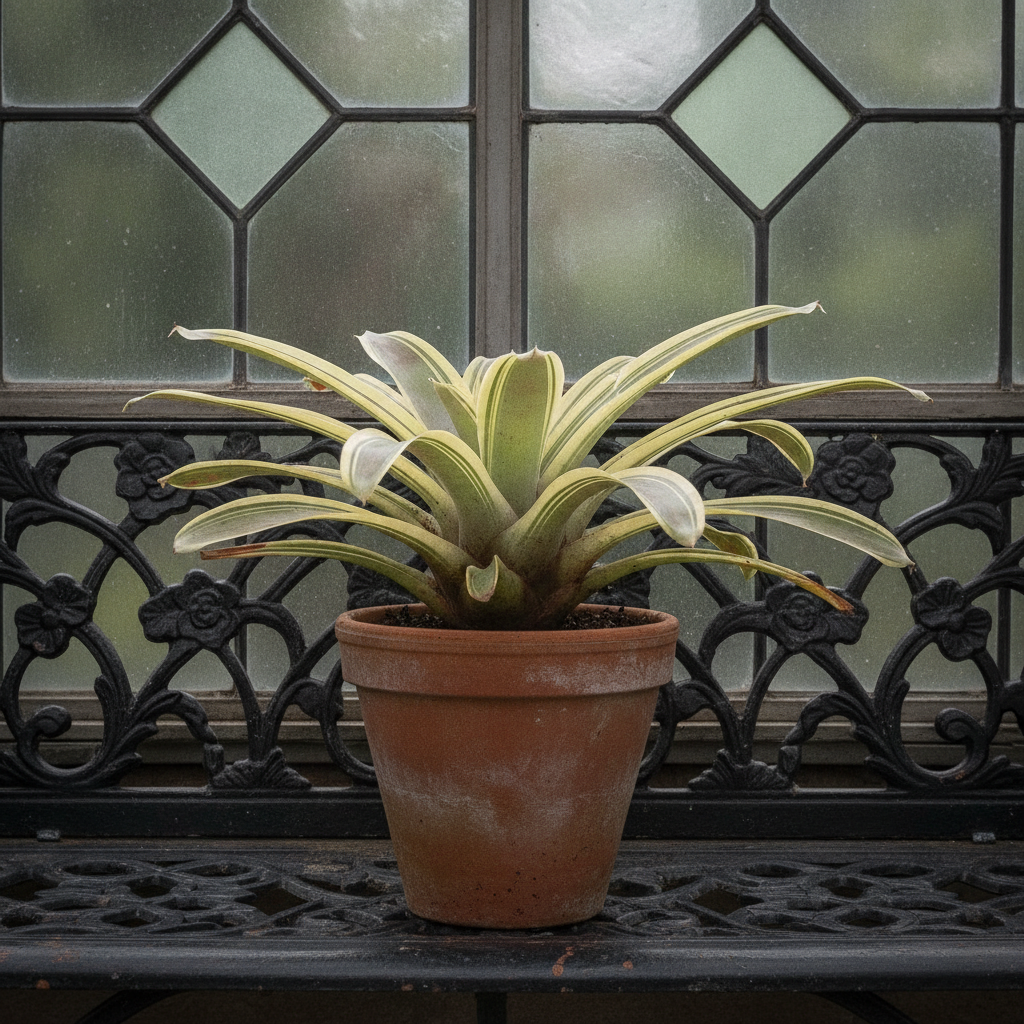
‘Variegata’
A showier selection whose leaves carry creamy yellow stripes running lengthwise over the silver banding, giving a brighter, two-tone rosette. It is a little less vigorous than the species but a real eye-catcher.
Variety Profiles in Detail
‘Primera’ (Aechmea fasciata ‘Primera’)
Bred for the houseplant trade, ‘Primera’ is prized for its uniform, dependable habit and its strong silver banding. Its sturdy rosette holds its shape well and supports a particularly large, long-lasting pink bract. If you buy a silver vase plant from a garden centre, there is a good chance it is this cultivar or something very close to it. It is forgiving of slightly less than perfect conditions, which makes it an excellent first bromeliad.
‘Variegata’ (Aechmea fasciata ‘Variegata’)
This variegated form layers creamy to yellow longitudinal striping over the familiar silver bands, so the rosette catches the eye even when it is not in flower. The variegation does mean slightly less chlorophyll, so the plant grows a touch more slowly and appreciates bright but gentle light to keep the colours clean without scorching. It is a rewarding choice for collectors who want something a little less ordinary.
Choosing the Right Variety for Your Space
For most homes the species or the dependable ‘Primera’ is the easiest and most striking option, offering the full silver-and-pink effect with the least fuss. If you have good, bright but filtered light and want extra interest in the foliage, a variegated or purple-flushed selection rewards the slightly more careful conditions they prefer. Whichever you choose, the care is essentially the same, so let availability and your own taste guide the decision.
Frequently Asked Questions
Should I keep water in the central cup of my silver vase plant?
Yes. The central cup is the plant’s main water reservoir, so keep it topped up with about 2 to 4 cm of fresh water during the growing season. The important detail is to refresh it regularly rather than letting it sit and stagnate, and to use rainwater or filtered water where you can.
Why is my silver vase plant dying after it flowered?
This is completely normal and not a sign of poor care. Each rosette of a silver vase plant flowers only once and then slowly declines over the following months while it produces pups at its base. Keep caring for the plant during this time, separate or grow on the pups, and your silver vase plant lives on through the next generation.
How do I get my silver vase plant to bloom?
First make sure the plant is mature and growing in bright, indirect light, which is the most common reason for a refusal to flower. If a healthy mature plant still will not bloom, you can try the apple trick: enclose the plant, with its cup emptied, in a clear bag with a ripe apple for about a week, as the ethylene the apple gives off can trigger flowering over the following weeks to months.
Is the silver vase plant safe for cats and dogs?
It is listed as non-toxic to cats and dogs by the ASPCA, so it is among the safer choices for a pet household. The main risk is mechanical rather than chemical, because the leaf edges carry small spines that can scratch, so position the plant where pets are unlikely to brush against it constantly.
Why are the tips of my silver vase plant turning brown?
Brown, crispy tips usually point to air that is too dry, hard or chemically treated water, or a build-up of salts. Try raising the humidity around the plant, switch to rainwater or filtered water for the cup, and flush the cup and mix occasionally to clear any mineral residue.
How often should I repot a silver vase plant?
Rarely. A silver vase plant has a small root system and dislikes disturbance, so a mature plant often stays in the same pot for its whole flowering life. Repot only to refresh a broken-down mix, to move a new plant out of poor compost, or to pot up separated pups, and do it in spring or summer.
My silver vase plant’s leaves are losing their silver colour. What is wrong?
Fading silver banding is almost always a light problem. The trichomes that create the silvery frosting develop best in bright, indirect light, so a plant in too dim a spot grows greener and less patterned. Move it gradually somewhere brighter and the newer leaves should emerge with stronger banding.
How long does the pink flower bract last?
The colourful bract is remarkably long-lived, typically holding its pink for several months, often three to six. The small blue and violet true flowers that emerge from it are short-lived, but the bract itself remains decorative long after they have faded, which is a large part of the plant’s appeal.
Can I grow a silver vase plant mounted, like an air plant?
You can, because it is naturally epiphytic. Mounted on a piece of bark or driftwood, it makes an unusual feature, though it then needs more frequent attention to keep the cup filled and the roots from drying out completely. For most people, growing it potted in a free-draining mix is simpler and just as healthy.
Why is the base of my silver vase plant soft and smelly?
A soft, foul-smelling base is a sign of crown or root rot, almost always caused by a waterlogged potting mix or water trapped against the crown. Sadly it is often fatal once it reaches the centre of the plant. Focus on prevention by using a free-draining mix, never letting the pot stand in water, and keeping the crown clear of soggy compost.






