
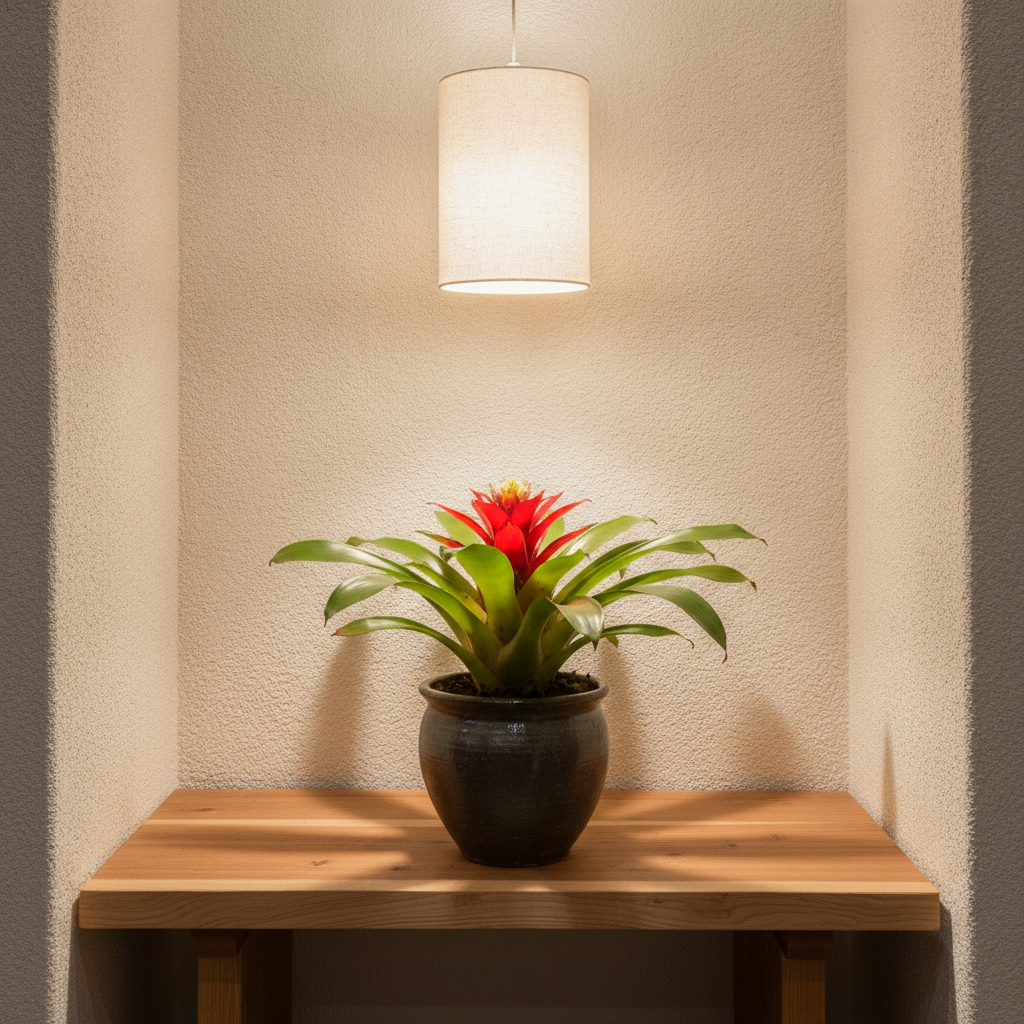
Few houseplants deliver a splash of colour as generous or as long-lasting as the scarlet star bromeliad. Known botanically as Guzmania lingulata, this tropical epiphyte produces a smooth rosette of arching green leaves from which rises a vivid crown of scarlet bracts, a display that can hold its colour for two to four months. Native to the humid rainforests of Central and South America, from southern Mexico and the West Indies down through Colombia, Ecuador and Brazil, it spends its wild life perched on tree branches rather than rooted in the ground. That epiphytic heritage shapes almost everything about how it should be cared for indoors.
The scarlet star has a reputation for being fussy, but that reputation is only half deserved. It is genuinely forgiving of neglect in some respects and unusually particular in others, and the difference between a plant that merely survives and one that truly thrives comes down to understanding a handful of quirks: how it drinks through the cup at its centre, how much light it can take before its leaves scorch, and the fact that it flowers only once in its life before passing the baton to a new generation of pups. This guide walks through every aspect of its care, from watering technique and light levels to propagation, pests and the most popular varieties you are likely to find.
Contents
- Quick Reference
- Why Scarlet Star Bromeliad Makes a Rewarding Houseplant
- Light Requirements
- Watering & Humidity
- Soil, Potting & Repotting
- Fertilising
- Propagation
- Pests & Diseases
- Popular Varieties
- Frequently Asked Questions
Quick Reference: Scarlet Star Bromeliad at a Glance
| Light | Bright, indirect light. No direct midday sun. |
| Watering | Keep the central cup topped up with fresh water; keep the potting mix lightly moist. |
| Temperature | 18 to 27 degrees C (64 to 81 degrees F). Avoid below 13 degrees C (55 degrees F). |
| Humidity | High, ideally 50 to 70 per cent. |
| Fertiliser | Very light feeder. Quarter-strength balanced feed once a month in the growing season. |
| Toxicity | Non-toxic to cats, dogs and humans. |
Why Scarlet Star Bromeliad Makes a Rewarding Houseplant
The most obvious appeal of Guzmania lingulata is the sheer staying power of its colour. What most people take for a flower is in fact a rosette of modified leaves, called bracts, that surround the true flowers at the centre. Those small tubular blooms, usually white or pale yellow, are almost an afterthought; it is the bracts that blaze scarlet, orange or deep red for weeks on end. Because the display is built from long-lived foliage rather than short-lived petals, a single scarlet star in bloom will hold court on a windowsill for the better part of a season, outlasting almost any cut arrangement or flowering pot plant you could put beside it.

Beyond the colour, the scarlet star earns its place for being genuinely low-maintenance once you understand it. It has a small, shallow root system that exists mainly for anchorage, so it tolerates cramped pots and rarely demands repotting. It has no thorns, drops no messy petals, and unlike many tropical showpieces it is completely non-toxic, making it a safe choice in homes with curious cats, dogs or small children. Its compact size, typically 30 to 45 centimetres (12 to 18 inches) across, suits shelves, desks and coffee tables where a larger plant would overwhelm the space.
Important — Toxicity: The scarlet star bromeliad is listed as non-toxic to cats and dogs by the ASPCA and poses no poisoning risk to humans. The leaf edges can be slightly stiff, so very determined chewing may cause mild mouth irritation, but there are no toxic compounds to worry about.
Light Requirements
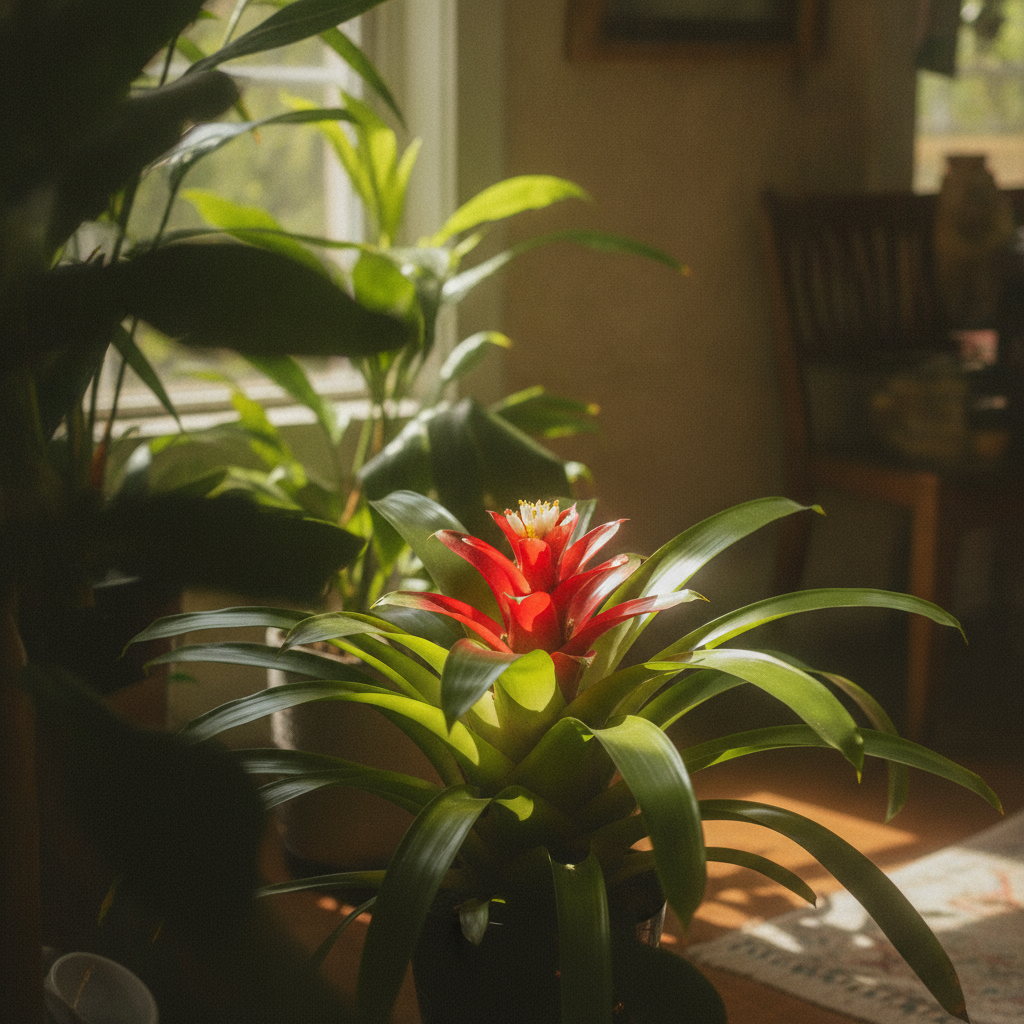
In the wild the scarlet star grows on the trunks and branches of rainforest trees, bathed in the bright but broken light that filters down through the canopy. Recreating that quality of light indoors is the single most important thing you can do for the plant’s colour and health. It wants brightness without the harshness of unfiltered sun striking its leaves directly.
The ideal position is a spot with plenty of ambient daylight, a metre or so back from a bright window, or directly beside a window screened by a sheer curtain. In these conditions the leaves stay a healthy mid-green and the bracts retain their intense, saturated colour. Too little light and the plant survives but grows lax, the leaves stretching and paling; too much direct sun and the foliage bleaches or develops scorched brown patches that never recover.
Light Levels Explained
Light indoors is easy to misjudge because our eyes adjust so readily. The table below translates the usual descriptive categories into rough figures and typical locations, so you can place a scarlet star with confidence rather than guesswork.
| Light Category | Approx. Level | Typical Location | Outcome |
|---|---|---|---|
| Direct sun | Over 50,000 lux | On a south windowsill, unscreened | Leaves scorch and bleach; avoid |
| Bright indirect | 10,000 to 20,000 lux | Near an east or screened south window | Ideal; best colour and form |
| Medium | 5,000 to 10,000 lux | A metre or two into a bright room | Good; growth a little slower |
| Low | 1,000 to 2,500 lux | North room, away from windows | Survives; leaves stretch, bracts fade |
| Very low | Under 1,000 lux | Interior hallway or corner | Decline over time; not recommended |
Window Orientation and Placement
South-facing window: Very bright, and the best light of any orientation in the northern hemisphere, but only usable if you diffuse it. Set the plant back from the glass or hang a sheer curtain to soften the midday rays, otherwise the leaves will scorch within days.
East-facing window: Often the sweet spot for a scarlet star. Gentle morning sun followed by bright ambient light for the rest of the day gives exactly the quality this plant evolved for, with little risk of burning.
West-facing window: Workable, but the afternoon sun here is stronger and hotter than the morning equivalent. Keep the plant a short distance back from the glass or use a light screen through the summer months.
North-facing window: The safest orientation for avoiding scorch, and adequate through spring and summer, though light may be too weak in winter to keep the bracts vivid. A position right at the glass makes the most of what light there is.
Pro Tip — Read the Leaves: The plant tells you whether the light is right. Healthy mid-green leaves and a compact rosette mean you have it dialled in. Pale, yellowish or stretched leaves reaching towards the window mean too little light; bleached, papery or brown-patched leaves mean too much direct sun. Adjust position by half a metre and watch how the new growth responds.
How Light Affects Bract Colour
The intensity of the scarlet crown is directly tied to light. A plant grown in bright indirect conditions produces bracts of a deep, glowing red or orange, while the same plant in a dim corner will unfurl a washed-out, muted version of the same colour. If your bloom looks disappointingly pale, insufficient light is the most likely culprit. That said, resist the temptation to solve the problem by moving a blooming plant into direct sun, as the sudden change will scorch the leaves faster than it improves the bracts.
Warning — Direct Sunlight: The soft leaves of Guzmania lingulata have little defence against direct sun. Even a couple of hours of unscreened midday light through glass can leave permanent bleached or brown scorch marks. When moving a plant to a brighter position, increase the exposure gradually over a week or two rather than all at once.
Artificial Lighting
The scarlet star responds well to supplementary lighting, which is useful in darker homes or through the short days of winter. A full-spectrum LED grow light positioned 30 to 45 centimetres (12 to 18 inches) above the plant and run for 10 to 12 hours a day provides ample energy without the heat that would dry out the central cup. Because the plant is grown as much for its foliage and bracts as for its true flowers, ordinary bright LED lighting is perfectly sufficient; there is no need for specialist bloom-boosting fixtures.
Seasonal Adjustments
As the sun’s angle drops and daylight shortens through autumn and winter, a scarlet star that was perfectly happy a metre back from a summer window may need to move closer to the glass to keep receiving enough light. Reverse the move in spring, when the strengthening sun can once again reach and scorch a plant sitting too near an unscreened window. A rotation of a quarter turn each week also keeps the rosette growing evenly rather than leaning towards the light.
Watering & Humidity
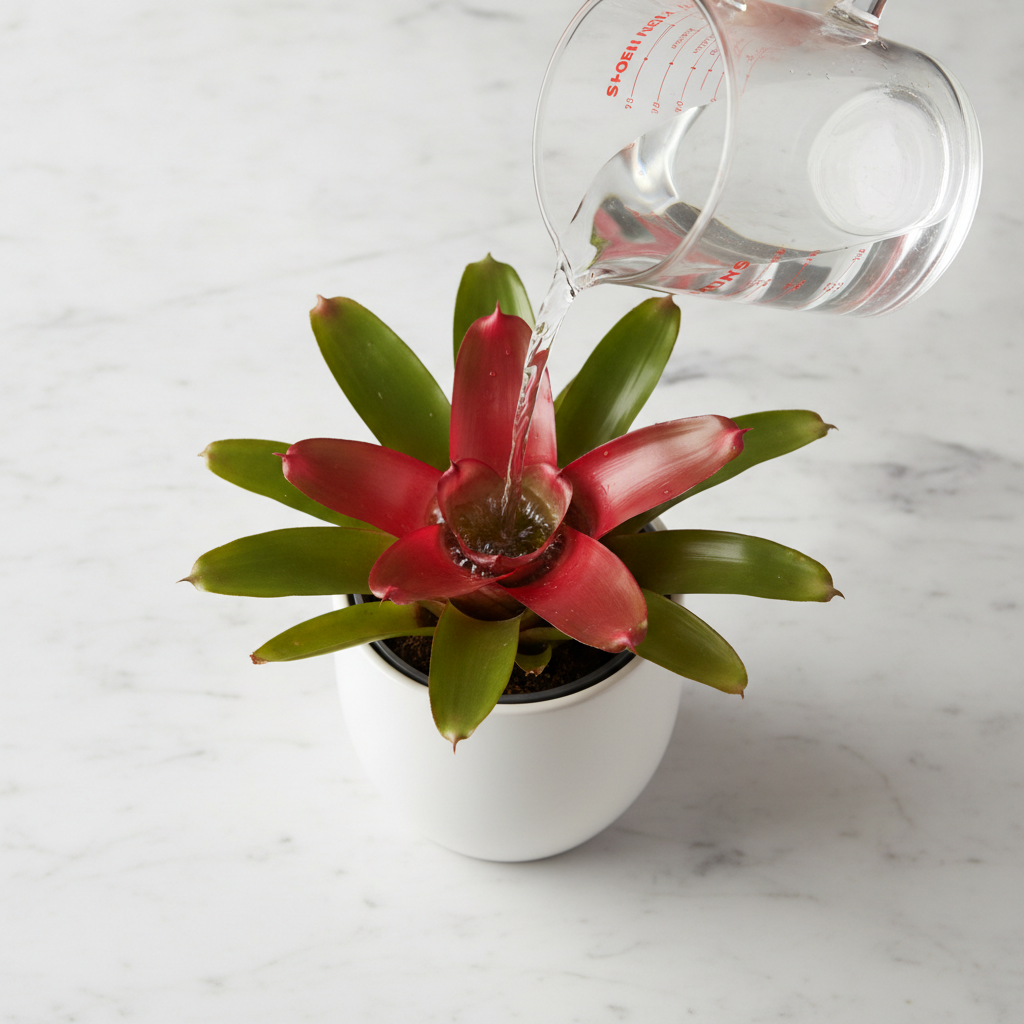
Watering is where the scarlet star departs most dramatically from ordinary houseplants, and where most people go wrong. As an epiphyte, it takes up much of its water not through its modest roots but through the watertight cup formed by the overlapping bases of its leaves at the centre of the rosette. This central tank is the plant’s primary reservoir, and keeping it correctly filled, fresh and clean is the heart of good bromeliad care.
When to Water
Keep the central cup filled with water at all times, topping it up whenever it runs low. Roughly once a week, tip out the old water completely and refill with fresh, which prevents the tank from becoming stagnant and starting to smell or rot. The potting medium itself should be kept lightly moist but never waterlogged; because the roots are there mainly for grip, they resent sitting in sodden compost far more than a conventional plant would.
Frequency depends on conditions. In a warm, well-lit room in summer you may top up the cup and lightly moisten the mix twice a week, while in a cool, dim winter room every ten days may be plenty. Let the temperature, light and the feel of the medium guide you rather than a fixed calendar. The one constant is that the cup should rarely be allowed to run bone dry for long.
Pro Tip — Flush the Tank: Every couple of weeks, take the plant to a sink and gently flush the central cup with a stream of fresh water, letting it overflow and wash out any accumulated dust, debris or mineral residue. This mimics the cleansing effect of rainfall in the wild and is the single best habit for preventing cup rot.
How to Water Correctly
- Check the central cup first. If it holds only a little water, tip it out so you are not simply topping up stale water.
- Pour fresh, room-temperature water slowly into the cup until it is full but not overflowing the leaf bases.
- Add a little water to the potting medium as well, just enough to keep it lightly moist, and let any excess drain freely from the bottom.
- Never let the pot stand in a saucer of collected water, as the roots will rot in standing moisture.
- Once every week or two, empty the cup entirely and flush it with fresh water before refilling, to keep the reservoir clean.
Signs of Overwatering vs. Underwatering
| Symptom | Overwatering | Underwatering |
|---|---|---|
| Leaf colour | Yellowing, especially at the base | Dull, greyish-green cast |
| Leaf texture | Soft, mushy leaf bases | Thin, curling or crisping leaf tips |
| Central cup | Stagnant, cloudy or foul-smelling water | Dry cup for extended periods |
| Roots and base | Blackened, rotting crown; plant loosens in pot | Roots dry and brittle |
| Overall | Base collapses; plant topples | Slow decline, papery leaf edges |
Warning — Root and Crown Rot: The fastest way to kill a scarlet star is to let stagnant water sit in the cup for weeks or to keep the potting mix permanently soggy. Both lead to rot at the base of the rosette, which is almost always fatal once it takes hold. If the leaves loosen or the crown turns soft and dark, the plant is likely beyond saving, though any healthy pups can still be rescued.
Humidity Requirements
As a rainforest native, the scarlet star is happiest in humidity of 50 to 70 per cent, noticeably higher than the average centrally heated home provides. It will tolerate ordinary room humidity, but drier air shows quickly in the form of brown, crispy leaf tips.
Brown tips, a general lack of lustre in the leaves and slow growth are the usual signs that the air is too dry for the plant’s liking. These symptoms are most common in winter, when heating systems strip moisture from indoor air.
Raising humidity is straightforward. Grouping the scarlet star with other plants creates a moister micro-climate, and standing the pot on a tray of pebbles part-filled with water lifts local humidity without wetting the roots. A room humidifier is the most reliable solution of all, particularly through the heating season, and misting the foliage occasionally does no harm, though it is less effective than the other methods on its own.
Water Quality
Bromeliads in the tank group are sensitive to the minerals and chemicals in hard tap water, which can build up in the cup and mark the leaves. Wherever possible, water with rainwater, distilled water or filtered water, all of which are gentler on the plant. If you must use tap water, letting it stand overnight allows some chlorine to dissipate, though it does nothing for dissolved minerals. Softened water should be avoided entirely, as the sodium it contains is harmful to the plant.
Soil, Potting & Repotting
Because the scarlet star draws most of its water and nutrients through its cup and leaves rather than its roots, its potting requirements are unlike those of a typical houseplant. What it needs above all is a medium that anchors the plant while draining fast and staying airy, closer to what an orchid wants than a fern.
Ideal Soil Composition
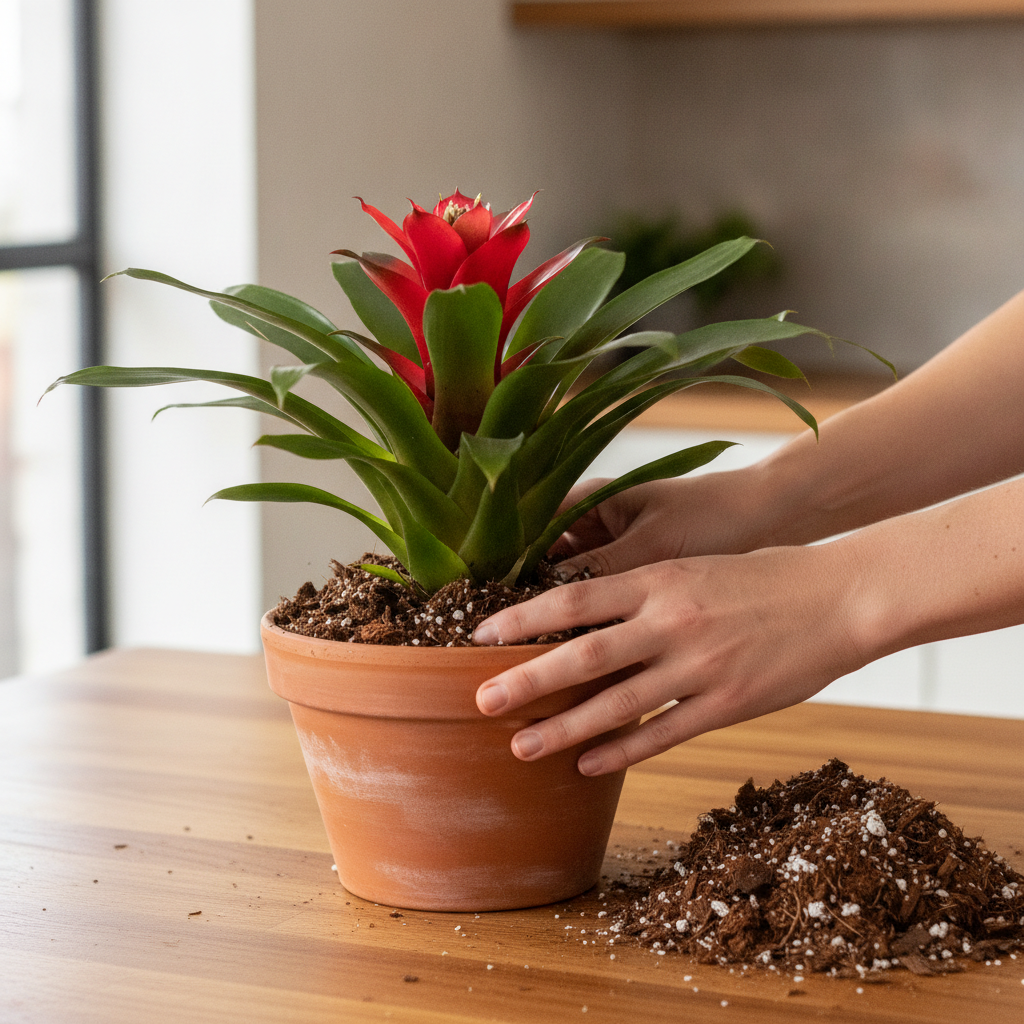
A good scarlet star mix is chunky and open, allowing water to run straight through and air to reach the roots. Ordinary bagged potting compost used on its own holds far too much water and will suffocate or rot the roots. A blend based on orchid bark, with perlite for aeration and a little coir or peat to hold a touch of moisture, gives the balance the plant wants.
| Component | Proportion | Function |
|---|---|---|
| Orchid bark (fine to medium) | 50 per cent | Structure, drainage and air around the roots |
| Perlite or pumice | 25 per cent | Keeps the mix open and free-draining |
| Coco coir or peat | 20 per cent | Holds a little moisture without becoming soggy |
| Horticultural charcoal | 5 per cent | Keeps the mix sweet and helps prevent souring |
The scarlet star prefers a slightly acidic root environment, in the region of pH 5.0 to 6.0. A bark-based mix naturally sits in this range, so no special adjustment is usually needed as long as you avoid alkaline tap water and lime-heavy composts.
Pro Tip — Quick Mix Recipe: For a fuss-free blend, combine two handfuls of fine orchid bark, one handful of perlite and one handful of coco coir, with a pinch of horticultural charcoal. This drains fast, holds just enough moisture and suits almost any tank bromeliad, not only the scarlet star.
Choosing the Right Pot
The scarlet star has a small root ball and a top-heavy rosette, which shapes the ideal pot: shallow enough not to hold a reservoir of wet mix, yet stable enough that a blooming plant does not topple over.
Drainage holes are non-negotiable. Whatever pot you choose must have generous drainage, because any water that lingers around the roots invites rot. If you love a decorative cover pot without holes, use it only as an outer sleeve and lift the plant out to water, letting it drain fully before returning it.
Pot material: Terracotta is an excellent choice because its porous walls wick away excess moisture and add weight low down for stability. Plastic works too and retains moisture longer, which can suit drier homes, but call for a little more care not to overwater.
Pot size: Resist the urge to pot up into something large. A scarlet star is happiest in a snug pot, typically 12 to 15 centimetres (5 to 6 inches) across, that matches its modest roots. An oversized pot holds a mass of damp mix the roots cannot use, which only raises the risk of rot.
When to Repot
Repotting is rarely needed. A scarlet star flowers only once and then slowly declines, so a mature plant may never need moving on at all. The main reasons to repot are to replace tired, broken-down mix on a plant you have had a while, or to settle a newly bought plant that arrived in unsuitable compost. Pups are the exception, as they are potted up individually once separated from the parent. The best time for any repotting is spring, at the start of the active growing season.
How to Repot: Step-by-Step
- Water the plant lightly the day before so the roots and mix hold together during the move.
- Ease the plant out of its pot, supporting the base of the rosette rather than pulling on the leaves.
- Gently tease away the old mix from the roots, discarding anything that is broken down or soggy.
- Part-fill a clean pot with fresh bark-based mix and settle the plant so the base of the rosette sits at the same level as before.
- Fill in around the roots with more mix, pressing lightly to hold the plant firm without compacting it.
- Water the mix lightly, fill the central cup with fresh water, and return the plant to bright, indirect light.
Warning — Planting Depth: Never bury the base of the rosette below the surface of the mix. Planting too deep traps moisture against the crown and causes rot. The point where the leaves emerge should sit right at soil level, no lower.
Fertilising
The scarlet star is a famously light feeder. In the wild it gleans on the trickle of nutrients washed down through the canopy in rainwater and dust, so it is adapted to lean conditions and is easily harmed by too much feeding. Less is very much more with this plant.
Because the plant flowers only once, no amount of fertiliser will coax a fresh bloom from a rosette that has already flowered. Feeding instead supports healthy leaf growth and, crucially, the development of strong pups that will carry the plant into its next generation.
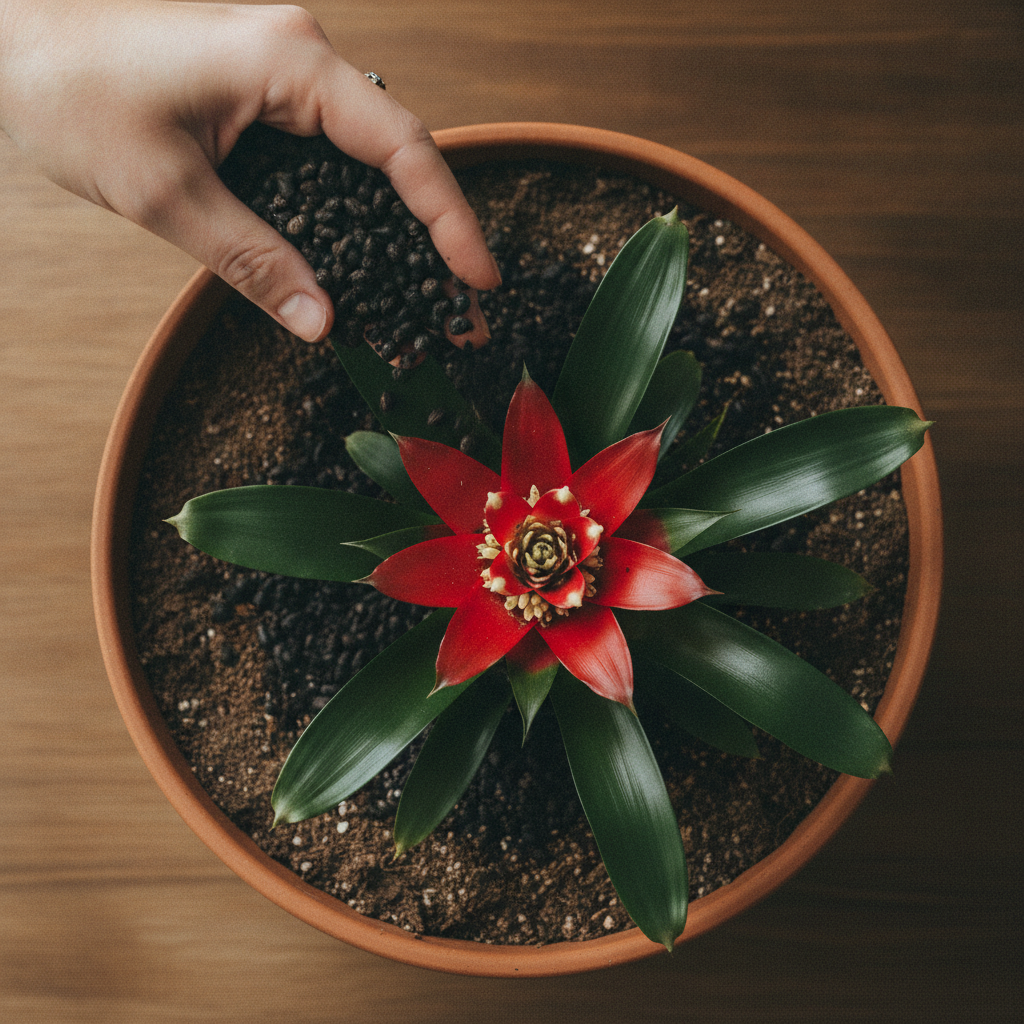
Understanding Plant Nutrients
Fertilisers are labelled with three numbers, the N-P-K ratio, standing for nitrogen, phosphorus and potassium, the three nutrients plants need in the largest amounts. A balanced feed diluted well below its normal strength suits the scarlet star. The table below summarises the main nutrients and what a shortage of each looks like.
| Nutrient | Symbol | Primary Function | Deficiency Symptoms |
|---|---|---|---|
| Nitrogen | N | Leaf growth and green colour | Pale, yellowing older leaves; slow growth |
| Phosphorus | P | Root development and energy transfer | Dull leaves, weak roots, stunted pups |
| Potassium | K | Overall vigour and stress tolerance | Browning leaf edges, weak growth |
| Calcium | Ca | Cell wall strength | Distorted or weak new growth |
| Magnesium | Mg | Core of the chlorophyll molecule | Yellowing between leaf veins |
| Iron | Fe | Chlorophyll production | Pale new leaves with green veins |
Types of Fertiliser
Liquid fertilisers: The easiest option for a scarlet star, because they can be diluted to the very low strength it prefers and applied precisely. A balanced houseplant feed at a quarter of its recommended strength is ideal.
Slow-release granular: Convenient but harder to control, and easy to overdose on such a light feeder. If you use it, apply at half the recommended rate and keep the granules away from the central cup.
Organic fertilisers: Gentle options such as diluted worm-casting tea or a thin top-dressing of worm castings release nutrients slowly and are very hard to overdo, making them well suited to this plant.
Feeding Schedule
Feed only during the active growing season of spring and summer, roughly once a month, and stop altogether through autumn and winter when growth naturally slows. A quarter-strength balanced liquid feed applied to the potting mix, or very sparingly to the cup, is all the plant needs. When in doubt, skip a feed rather than risk overdoing it.
Pro Tip — Dilute, Then Dilute Again: Whatever the label suggests for houseplants, halve it and then halve it again for a scarlet star. A very weak feed given occasionally will always serve this plant better than a strong one, and there is no upside to pushing more nutrients into a plant adapted to scarcity.
How to Fertilise
- Mix a balanced liquid houseplant feed to a quarter of its recommended strength in fresh water.
- Water the plant normally first, so nutrients are never applied to a dry root ball.
- Apply the diluted feed to the potting mix, or add a very small amount to the central cup.
- Flush the cup with plain fresh water a few days later to prevent any fertiliser salts building up inside it.
Warning — Salt Build-Up: Fertiliser salts left sitting in the central cup can burn the tender leaf bases and encourage rot. Always flush the cup with clean water in the days after feeding, and never leave a concentrated feed standing in the tank.
Propagation
Propagating a scarlet star is one of the most satisfying parts of growing it, because it is bound up with the plant’s remarkable life cycle. Guzmania lingulata is monocarpic, meaning each rosette flowers only once and then gradually dies. Before it goes, though, it produces offsets, known as pups, around its base, and these become the next generation.
This means propagation is not an optional extra but the natural way to keep a scarlet star going indefinitely. A single plant bought in flower will, with a little patience, hand you two or three new plants over the year or two that follow, each capable of blooming in turn.
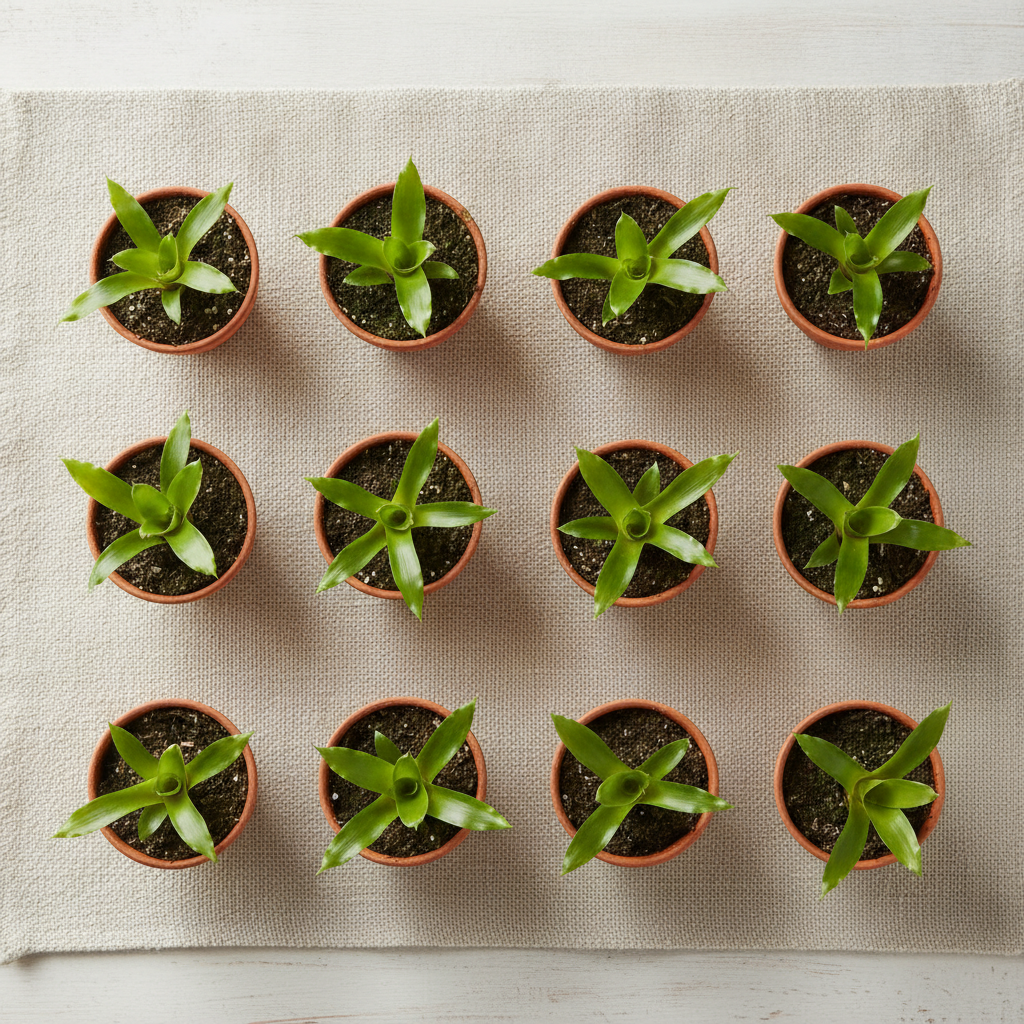
Understanding Pups and the Life Cycle
Once the bracts begin to fade, usually some months after you bring a plant home, the mother rosette starts to divert its energy into producing pups at soil level between the lower leaves. As the parent slowly yellows and dies back, these pups swell and grow, drawing on the parent until they have roots and a rosette of their own. The old rosette is not a sign of failure but the expected end of its cycle, and the pups are the plant’s insurance policy.
Dividing Pups: Step-by-Step
The reliable way to propagate is to separate the pups once they are large enough to fend for themselves, ideally when each has reached about a third to a half of the parent’s size and has begun forming its own small roots.
- Wait until a pup is at least a third of the mother plant’s size and shows signs of its own roots at the base.
- Ease the whole plant out of its pot so you can see clearly where the pup joins the parent.
- Using a clean, sharp knife, cut the pup away from the mother, taking any roots it has already formed with it.
- Let the cut surface dry for a few hours, which reduces the chance of rot at the wound.
- Pot the pup into a small container of fresh bark-based mix, settling it so the rosette base sits at soil level.
- Water lightly, add a little fresh water to the pup’s own small cup, and keep it warm and humid in bright, indirect light while it establishes.
Pro Tip — Patience Pays: The bigger the pup when you remove it, the faster it establishes and the sooner it will flower. If in doubt, wait. A pup left until it is half the parent’s size will settle almost without a check, while one taken too early may sulk for months or fail entirely.
Encouraging a Pup to Bloom: Step-by-Step
A mature pup will usually flower of its own accord after a year or two of good growth, but you can nudge a stubborn one into bloom with a well-known trick using ethylene gas, which naturally triggers flowering in bromeliads.
- Make sure the plant is mature and well grown, as the trick will not work on an undersized pup.
- Empty the water from the central cup so the ethylene is not diluted away.
- Place the whole plant inside a clear plastic bag together with a ripe apple, which gives off ethylene as it ages.
- Seal the bag loosely and keep it out of direct sun for about a week to ten days.
- Remove the plant and resume normal care; a bract should begin to emerge over the following couple of months.
Troubleshooting Propagation
| Problem | Likely Cause | Solution |
|---|---|---|
| Pup rots after separation | Cut surface kept too wet; mix too heavy | Let the wound dry before potting; use a fast-draining mix |
| Pup wilts and stalls | Removed too small, with too few roots | Keep warm and humid; next time wait until larger |
| No pups forming | Parent still in active bloom, or too young | Be patient; pups appear as the bracts fade |
| Pup grows but will not flower | Too little light, or simply not yet mature | Increase light; use the apple-and-bag ethylene trick |
Pests & Diseases
The scarlet star is not especially prone to pests, and a healthy, well-cared-for plant will often sail through its life untroubled. When problems do arise, they tend to be either sap-sucking insects that take hold in dry indoor air or, far more commonly, rot brought on by watering mistakes.
The best defence is vigilance. Because the plant has smooth, open leaves, pests are easy to spot early if you look, and catching an infestation at the first few insects makes it far simpler to deal with than a colony that has spread across the whole rosette.
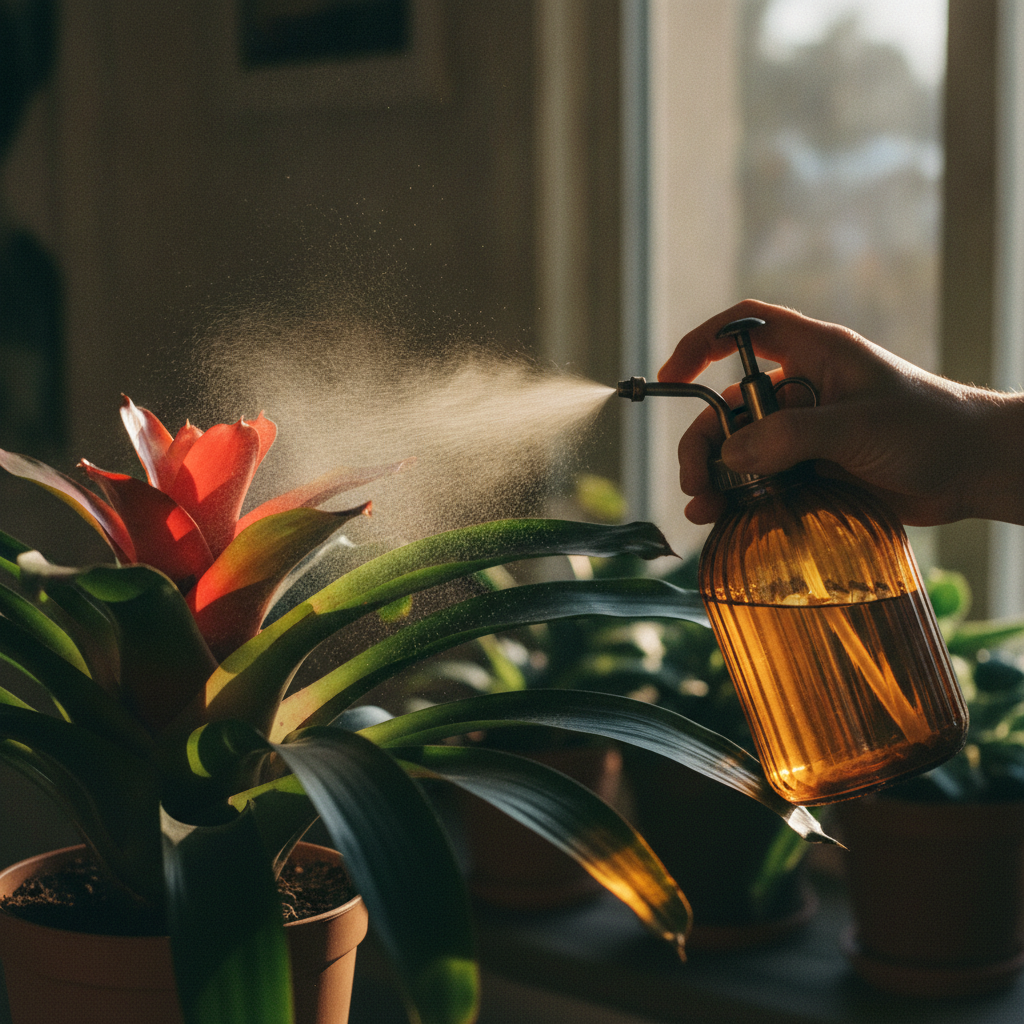
Common Pests
Scale (Coccoidea)
Scale insects appear as small, brown, limpet-like bumps clinging to the leaves, often along the midrib or undersides. They suck sap and can weaken the plant, and they excrete a sticky honeydew that can lead to sooty mould.
Treatment: Scrape or rub off individual scales with a cotton bud dipped in diluted isopropyl alcohol, then treat the plant with a horticultural oil or neem spray. Repeat weekly until no new scales appear.
Mealybugs (Pseudococcidae)
Mealybugs look like small tufts of white cotton wool tucked into the leaf bases and the sheltered folds of the rosette. Like scale, they feed on sap and secrete honeydew, and they can hide deep in the crown where they are easy to miss.
Treatment: Dab each insect with a cotton bud soaked in diluted alcohol, then follow up with a neem or insecticidal soap spray, paying close attention to the leaf axils where they gather.
Aphids (Aphidoidea)
Aphids are small green, black or pinkish insects that cluster on soft new growth and, in particular, on the tender emerging bract. They multiply quickly and can distort young tissue if left unchecked.
Treatment: Rinse them off with a gentle stream of water, then spray with insecticidal soap or neem oil. Small outbreaks can often be wiped away by hand before they take hold.
Common Diseases
Crown and Root Rot (Pythium and Phytophthora)
By far the most serious threat to a scarlet star, rot sets in when water sits stagnant in the cup for too long or when the potting mix is kept permanently soggy. The base of the rosette turns soft, dark and foul-smelling, and the leaves loosen and pull away easily.
Treatment: Rot in the crown is usually fatal for that rosette. The best course is prevention through fresh cup water and a free-draining mix. If the mother is lost, look for healthy pups at the base and separate them promptly to save the line.
Fungal Leaf Spot (Various fungi)
Leaf spot shows as brown or black patches, sometimes with a yellow halo, most often where the foliage stays wet and air movement is poor. It is unsightly rather than usually fatal, but it can spread in stagnant, humid conditions.
Treatment: Remove affected leaves, improve air circulation and avoid leaving water sitting on the foliage overnight. A copper-based fungicide can help in stubborn cases.
Pest and Disease Summary
| Pest / Disease | Identification | Treatment |
|---|---|---|
| Scale | Brown limpet-like bumps on leaves | Alcohol swab, then neem or horticultural oil |
| Mealybugs | White cottony tufts in leaf bases | Alcohol swab, then neem or insecticidal soap |
| Aphids | Clusters on new growth and bracts | Rinse off, then insecticidal soap |
| Crown and root rot | Soft, dark, smelly base; loose leaves | Prevent; rescue healthy pups |
| Fungal leaf spot | Brown or black patches on leaves | Remove leaves, improve airflow |
Prevention Strategies
Almost every problem a scarlet star runs into can be headed off by good routine care. Keeping the cup fresh, the mix free-draining and the air reasonably humid removes the conditions that both pests and rot depend on, and a quick weekly glance over the leaves catches insects while they are still few.
New plants are the usual way pests arrive, so it pays to isolate any newcomer for a couple of weeks before letting it join the rest of your collection. Good airflow around the plant, without exposing it to cold draughts, further reduces the risk of fungal trouble.
Pro Tip — Neem as Routine: A light neem oil spray every few weeks through the growing season works as a gentle preventative, deterring sap-suckers before they establish. Apply it in the evening or out of direct sun so the treated leaves do not scorch, and keep it out of the central cup.
Popular Varieties
Although the classic scarlet star is defined by its blazing red crown, Guzmania lingulata and its close relatives have been bred and selected into a wide range of colours, from the familiar scarlet through orange, yellow, deep crimson and softer pinks. The plant that reaches the shops is very often a named cultivar or a hybrid, chosen for the size and colour of its bract.
Care is essentially identical across the group, so you can choose purely on looks. The differences lie in the shade and shape of the inflorescence and, in a few cases, the overall size of the rosette, which is worth bearing in mind if space is tight.
| Variety | Bract Appearance | Light Needs | Growth Rate | Availability |
|---|---|---|---|---|
| Guzmania lingulata (species) | Classic bright scarlet star | Bright indirect | Moderate | Very common |
| ‘Minor’ | Dwarf form, scarlet-red bract | Bright indirect | Moderate | Common |
| ‘Rana’ | Broad orange-yellow branched spike | Bright indirect | Moderate | Common |
| ‘Amaranth’ | Deep crimson to magenta bract | Bright indirect | Moderate | Occasional |
| ‘Empire’ | Rich, tall red bract | Bright indirect | Moderate | Occasional |
| ‘Cherry’ | Glossy cherry-red crown | Bright indirect | Moderate | Occasional |
| ‘Ostara’ | Upright orange-red bract | Bright indirect | Moderate | Occasional |
Featured Varieties
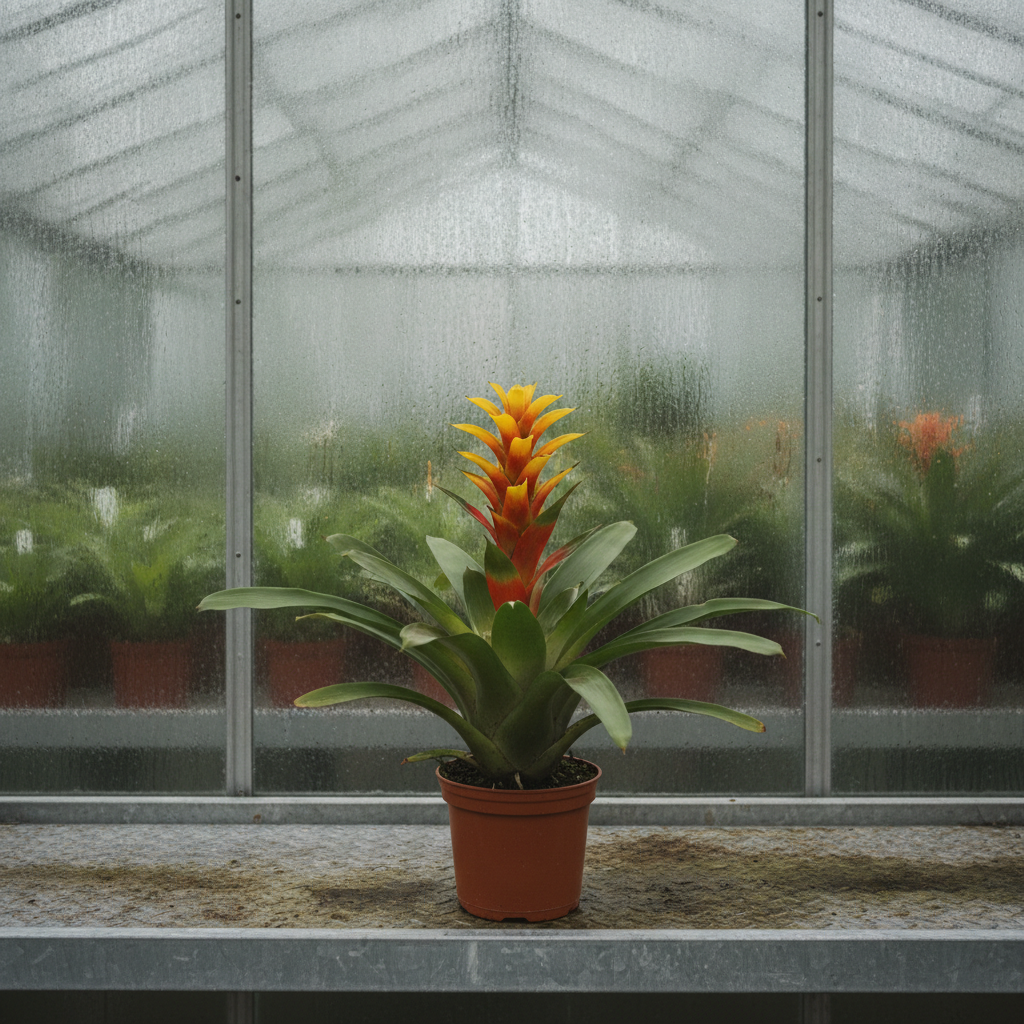
‘Rana’
A larger, more branched selection whose stout inflorescence blends vivid orange and yellow rather than pure red. Its broad, generous rosette makes it a bold specimen where you have the space to show it off.
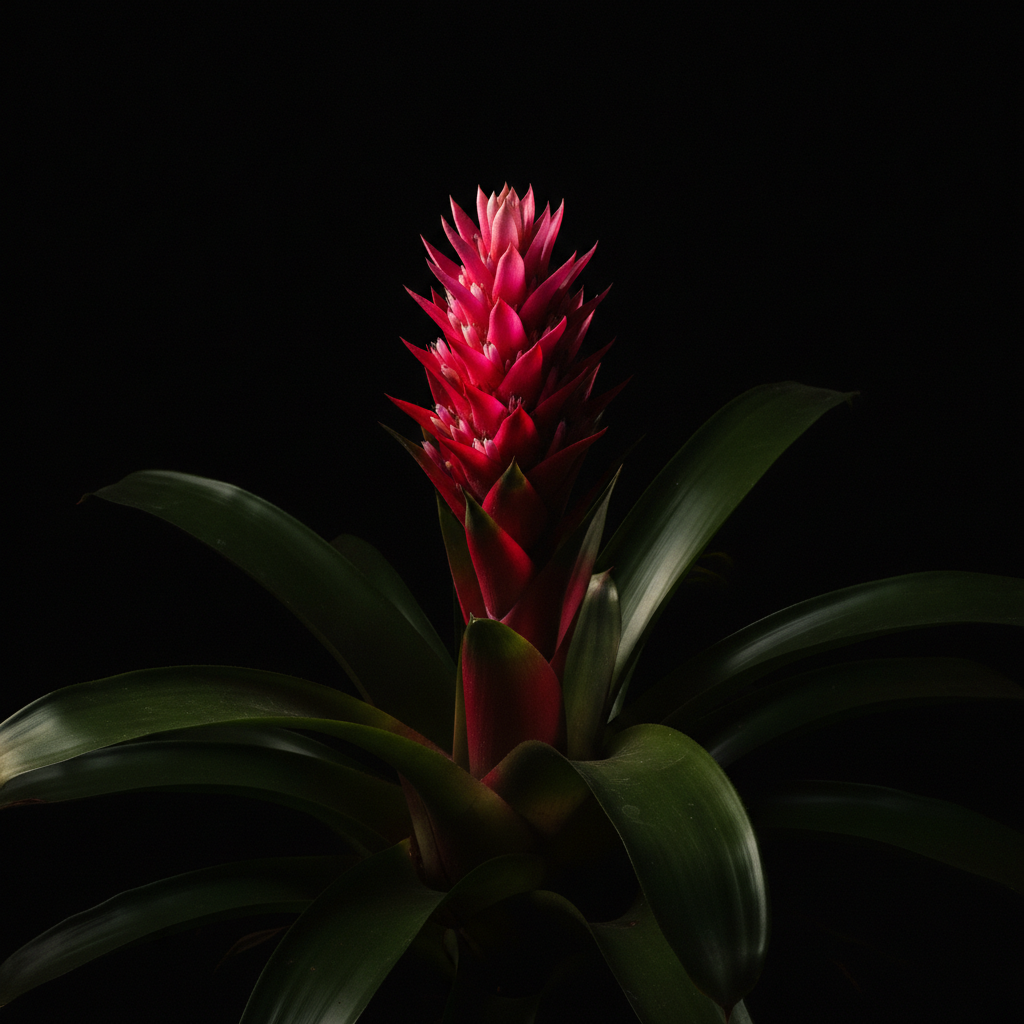
‘Amaranth’
Prized for its unusually deep, saturated crimson-to-magenta bract, ‘Amaranth’ offers a moodier, more sophisticated take on the classic scarlet star and stands out beautifully against dark foliage or a plain backdrop.
Variety Profiles in Detail
Guzmania lingulata ‘Minor’ (Guzmania lingulata)
The dwarf form of the species, ‘Minor’ carries the familiar scarlet star on a more compact rosette, typically no more than 25 to 30 centimetres (10 to 12 inches) across. It is the ideal choice for a desk, a narrow shelf or any spot where the full-size plant would feel too big, and it is one of the most widely sold forms of all.
Guzmania ‘Rana’ (Guzmania hybrid)
A robust hybrid with a broad, arching rosette and a substantial, multi-branched inflorescence in warm orange and yellow tones. ‘Rana’ reads as sunnier and softer than the pure-red types, and its size makes it a genuine focal point rather than a background plant.
Guzmania ‘Amaranth’ (Guzmania hybrid)
Distinguished by the depth of its colour, ‘Amaranth’ produces a tall bract in rich crimson shading towards magenta, a striking departure from the usual bright scarlet. It holds its colour just as long as the species and looks especially good in a modern, minimal setting.
Choosing the Right Variety for Your Space
Because every scarlet star wants the same bright, indirect light and cup-based watering, the choice comes down to colour and scale. For a small space, a compact form such as ‘Minor’ fits neatly and still delivers the full colour show. For a room where you want a plant to make a statement, a larger hybrid like ‘Rana’ earns its keep. And if your taste runs to deeper, richer tones, ‘Amaranth’ or one of the crimson selections gives the classic bromeliad silhouette in a more unexpected colour. Whichever you pick, the care in this guide applies without change.
Frequently Asked Questions
Why is my scarlet star bromeliad dying after flowering?
This is completely normal and not a sign that you have done anything wrong. Guzmania lingulata is monocarpic, so each rosette flowers only once and then slowly dies over the following months. As it declines it produces pups around its base, which become your next plants. Keep caring for the plant as usual so those pups grow strong.
Do I water the soil or the central cup?
Both, but the cup is the priority. Keep the central tank topped up with fresh water and flush it out weekly to keep it clean, while keeping the potting mix only lightly moist. The roots exist mainly for anchorage and rot easily if left in soggy compost, so never overwater the soil.
How long do the scarlet bracts last?
The colourful bract display typically holds for two to four months, and sometimes longer in good conditions. Bright, indirect light keeps the colour at its most intense, while a dim position will cause the bract to fade faster and look washed out.
Is the scarlet star bromeliad safe around pets?
Yes. It is listed as non-toxic to both cats and dogs and poses no poisoning risk to people, which makes it one of the safer colourful houseplants for a home with animals or children. The leaf edges are slightly firm, so discourage persistent chewing, but there are no harmful compounds.
Why are the leaf tips turning brown?
Brown, crispy leaf tips almost always point to air that is too dry, or occasionally to mineral build-up from hard tap water. Raise the humidity by grouping plants, using a pebble tray or running a humidifier, and switch to rainwater or filtered water if your tap water is hard.
How do I get a pup to flower?
Give a well-grown pup bright, indirect light and a year or two to mature, and it will usually flower on its own. To force a reluctant one, empty the cup, seal the plant in a clear bag with a ripe apple for about a week, then resume normal care. The ethylene the apple releases triggers the bloom, which should appear over the following couple of months.
What is the best water to use?
Rainwater, distilled water or filtered water are all ideal, because tank bromeliads are sensitive to the minerals and chlorine in hard tap water. If you only have tap water, let it stand overnight before using it, and avoid softened water entirely, as its sodium content is harmful to the plant.
Does it need a lot of fertiliser?
No, quite the opposite. The scarlet star is a very light feeder adapted to lean conditions, so a quarter-strength balanced feed once a month through spring and summer is ample. Overfeeding does more harm than good, and no amount of fertiliser will make an already-flowered rosette bloom again.






