

Few houseplants put on a performance quite like the rose painted calathea. Known botanically as Goeppertia roseopicta (and still widely sold under its former name Calathea roseopicta), this member of the prayer plant family carries broad, glossy oval leaves brushed with feathery strokes of pink and cream, each blade ringed by a soft rose-coloured halo and lined underneath in deep wine-red. Native to the humid lowland rainforests of north-western Brazil, it grows on the shaded forest floor where dappled light, constant warmth and saturated air shape everything about the way it behaves indoors.
The rose painted calathea has a reputation as a fussy plant, and that reputation is only half deserved. It will survive a surprising range of neglect, but the gap between merely surviving and truly thriving is wider here than with almost any other common houseplant. A neglected specimen limps along with crisping edges and faded markings, while a well-tended one unfurls vivid new leaves and lifts them skyward each evening in the nightly ritual that gives prayer plants their name. This guide covers everything that separates the two outcomes, from light and water quality to the exact way the foliage responds to its environment.
Contents
- Quick Reference
- Why Rose Painted Calathea Makes a Rewarding Houseplant
- Light Requirements
- Watering & Humidity
- Soil, Potting & Repotting
- Fertilising
- Propagation
- Pests & Diseases
- Popular Varieties
- Frequently Asked Questions
Quick Reference: Rose Painted Calathea at a Glance
| Light | Medium to bright indirect light; no direct sun |
| Watering | Keep evenly moist; water when the top 2 to 3 cm (about 1 in) dries |
| Temperature | 18 to 27 °C (65 to 81 °F); never below 15 °C (59 °F) |
| Humidity | High; 60 per cent or above preferred |
| Fertiliser | Balanced feed at half strength, monthly in spring and summer |
| Toxicity | Non-toxic to cats, dogs and humans |
Why Rose Painted Calathea Makes a Rewarding Houseplant
The first reason most people bring home a rose painted calathea is simply how it looks. The leaves are large for the plant’s compact size, often 15 to 20 cm (6 to 8 in) long, and each one is painted with a pattern that no two specimens share exactly. A dark green field is overlaid with a brushstroke of pale pink or cream tracing the central vein, then circled by a lighter feathered ring that fades from rose to silvery green toward the margin. Turn a leaf over and the underside glows a rich purple-red, a colour that catches the light whenever the plant lifts its foliage.
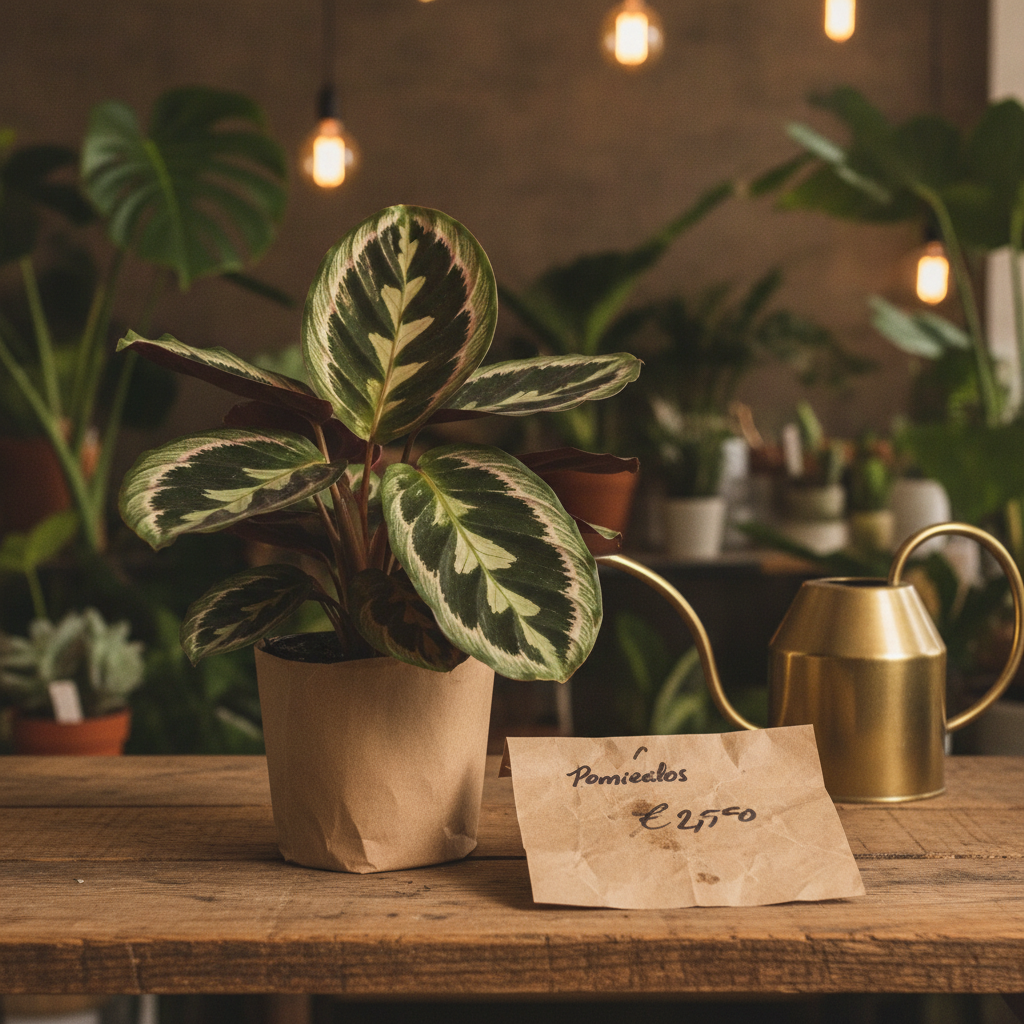
Beyond appearance, this plant earns its place for its behaviour. Like all members of the family Marantaceae, it performs nyctinasty: a daily rhythm in which the leaves rise and fold upward at dusk and lower again at dawn, driven by changes in water pressure within a swollen joint called the pulvinus at the base of each leaf. The effect is genuinely captivating, and it gives the plant a sense of being alive in a way that static foliage never quite manages. It is also a useful diagnostic, because a healthy plant moves visibly while a stressed one becomes sluggish or stops moving altogether.
Important — Toxicity: The rose painted calathea is non-toxic to cats, dogs and humans, making it one of the safest statement foliage plants for homes with curious pets or small children. Even so, no plant material is meant to be eaten, and chewing leaves may cause mild stomach upset.
Light Requirements
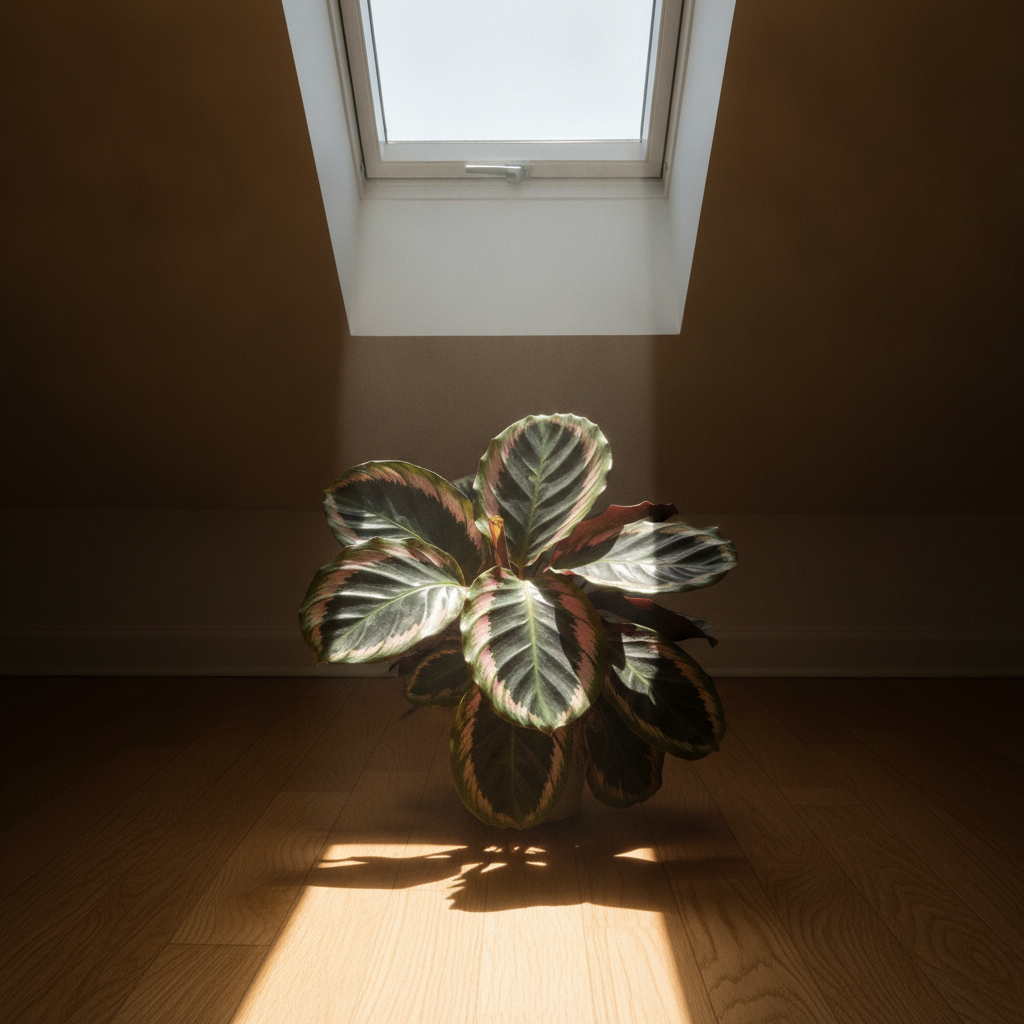
In its native rainforest, the rose painted calathea lives beneath a dense canopy that filters and softens the tropical sun before it ever reaches the forest floor. Recreating that filtered light is the single most important thing you can do to keep the leaf markings vivid. The plant wants brightness without harshness: enough light to read by comfortably all day, but never a beam of direct sun falling across the foliage.
Medium to bright indirect light suits it best. A position a metre or two back from a bright window, or directly beside a window that faces away from the midday sun, will keep growth steady and colour strong. Too little light and the plant survives but grows slowly, with smaller leaves and muted patterning; too much direct sun and the delicate markings bleach out while the edges scorch.
Light Levels Explained
Indoor light is far dimmer than most people assume, and a spot that feels bright to the eye may deliver only a fraction of outdoor intensity. The table below translates common placements into practical outcomes for this plant.
| Light Category | Approx. Level | Typical Location | Outcome |
|---|---|---|---|
| Direct sun | Over 50,000 lux | On a south-facing sill | Bleached, scorched leaves; avoid |
| Bright indirect | 10,000 to 20,000 lux | Near an east or north window | Ideal; vivid colour, steady growth |
| Medium | 5,000 to 10,000 lux | A metre back from a bright window | Good; slightly slower growth |
| Low | 1,000 to 5,000 lux | Interior corner of a lit room | Survives; faded markings, leggy |
| Very low | Under 1,000 lux | Hallway, windowless room | Decline; not viable long-term |
Window Orientation and Placement
South-facing window: The brightest exposure in the northern hemisphere and usually too intense for an unfiltered position. Set the plant well back from the glass, or diffuse the light with a sheer curtain, to protect the foliage from the midday sun.
East-facing window: An excellent choice. The gentle morning sun is rarely strong enough to scorch, and the plant can sit close to the glass to enjoy several hours of soft light before the brighter afternoon passes to the other side of the house.
West-facing window: Workable, but the harsher afternoon sun calls for a little distance from the glass or a light curtain, much as with a south aspect.
North-facing window: A reliable, low-risk position that delivers gentle, even light all day. Growth may be a touch slower than at an east window, but the markings stay rich and the plant is in no danger of scorching.
Pro Tip — Rotate for Even Growth: Calatheas lean noticeably toward their light source. Give the pot a quarter turn each time you water so every side receives its share and the plant keeps a balanced, upright shape.
How Light Affects Leaf Colour
The pink and cream patterning of the rose painted calathea is at its most saturated under bright, filtered light. In a position that is too dim, new leaves emerge smaller and the contrast between the dark green field and the pale brushwork softens until the plant looks almost uniformly green. Move it somewhere brighter, still out of direct sun, and successive leaves recover their vivid markings. The colour is essentially a record of the light the plant received while each leaf was forming.
Warning — Direct Sunlight: Even an hour of direct midday sun can leave permanent pale, papery patches where the leaf tissue has burned. These scorch marks never recover, so err toward gentler light whenever you are unsure.
Artificial Lighting
The rose painted calathea responds well to full-spectrum LED grow lights, which makes it a good candidate for rooms with little natural light. A light positioned 30 to 45 cm (12 to 18 in) above the plant and run for 10 to 12 hours a day supplies plenty of energy without the heat or intensity of direct sun. Grow lights are also a useful way to top up natural light through the short days of winter.
Seasonal Adjustments
As daylight weakens through autumn and winter, consider moving the plant a little closer to its window to compensate for the lower intensity and shorter days. When spring returns and the sun climbs higher and stronger, ease it back again to avoid scorch. These small seasonal shifts keep the light it receives roughly constant across the year.
Watering & Humidity
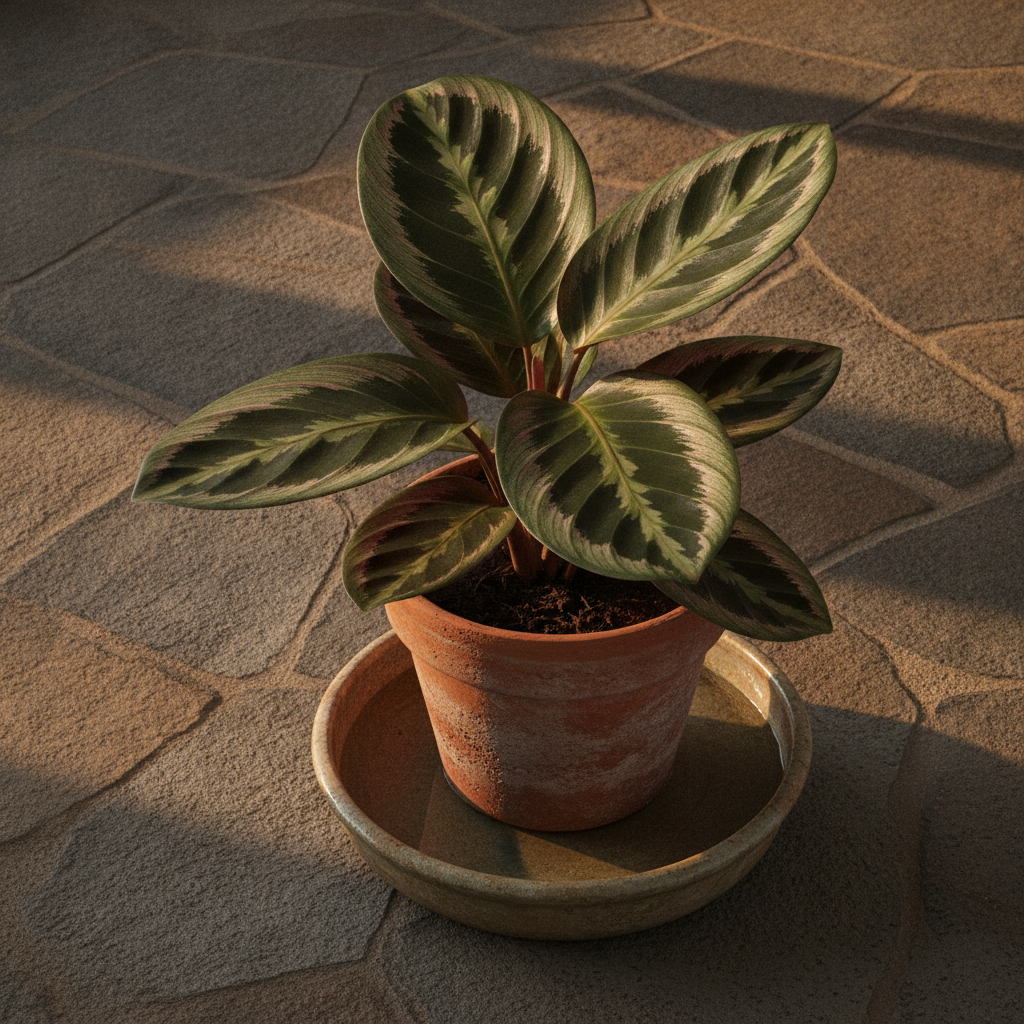
Watering is where most rose painted calatheas live or die, and it is also where the plant is least forgiving of guesswork. It wants soil that stays consistently moist but never waterlogged, a balance that is easier to describe than to maintain. The roots resent both drought and standing water, so the goal is to keep the medium evenly damp, like a wrung-out sponge, and to react to the plant’s own pace of drying rather than to a fixed weekly schedule.
When to Water
Check the soil with a finger every few days and water once the top 2 to 3 cm (about 1 in) has dried out while the layer below remains slightly moist. In a warm, bright spot during the growing season this may mean watering once or twice a week; in winter, with cooler temperatures and weaker light, the interval stretches considerably. Let the plant, not the calendar, set the rhythm.
The leaves themselves give early warning of thirst. When the soil dries too far, the foliage curls inward more tightly than its normal nightly fold and the edges may begin to crisp. Catch this stage and a thorough watering usually restores the plant within a day. Ignore it and the damage becomes permanent at the leaf tips.
Pro Tip — Lift the Pot: Get to know the weight of the pot just after a thorough watering and again when the soil has dried to the right point. Lifting it becomes a faster, more reliable moisture gauge than poking the surface, especially once you have learned the feel of your particular plant.
How to Water Correctly
- Use room-temperature water that is free of fluoride and chlorine; see the note on water quality below.
- Pour slowly and evenly across the soil surface, or stand the pot in a dish of water and let it soak up from below for 15 to 20 minutes.
- Continue until water runs freely from the drainage holes, ensuring the entire root ball is moistened.
- Let the pot drain completely before returning it to its saucer or cover pot.
- Tip away any water that collects in the saucer so the roots never sit in it.
Signs of Overwatering vs. Underwatering
| Symptom | Overwatering | Underwatering |
|---|---|---|
| Leaf colour | Yellowing, often from lower leaves up | Browning, starting at the edges |
| Leaf texture | Soft, limp, sometimes translucent | Crisp, dry and tightly curled |
| Soil | Stays wet for days, may smell sour | Dry well below the surface, pulling from pot sides |
| Roots | Brown, mushy and foul-smelling | Dry, brittle and pale |
| Stem base | Soft and darkened | Firm but shrivelled |
Warning — Root Rot: Soil left soggy for long periods starves the roots of oxygen and invites rot, the most common killer of this plant. If you notice yellowing leaves and a sour smell, unpot the plant, trim away any brown mushy roots with sterile scissors and repot into fresh, well-draining mix.
Humidity Requirements
Humidity is not optional for the rose painted calathea; it is central to keeping the foliage intact. Coming from a rainforest understorey where the air rarely dries out, the plant prefers relative humidity of 60 per cent or more, well above the 30 to 50 per cent typical of heated or air-conditioned homes. The lower the humidity, the faster the leaf edges turn brown and brittle.
The classic symptom of dry air is crisping along the leaf margins and tips while the centre of the leaf stays healthy. This is distinct from the uniform browning of underwatering, and it points to the surrounding air rather than the soil. A hygrometer takes the guesswork out of diagnosing the problem.
The most effective way to raise humidity is a small room humidifier running near the plant, which lifts the ambient moisture reliably. Grouping plants together, standing the pot on a tray of pebbles topped up with water, or moving the plant to a naturally humid room such as a bathroom all help as well. Misting offers only fleeting relief and, on a plant prone to fungal spotting, can do more harm than good if the leaves stay wet for long.
Water Quality
The rose painted calathea is unusually sensitive to the minerals and additives in tap water. Fluoride, chlorine and dissolved salts accumulate in the leaf tissue over time and show up as brown tips and edges, even when watering and humidity are otherwise correct. Wherever possible, water with rainwater, distilled water or filtered water, or leave tap water to stand uncovered for 24 hours so the chlorine can dissipate before use.
Soil, Potting & Repotting
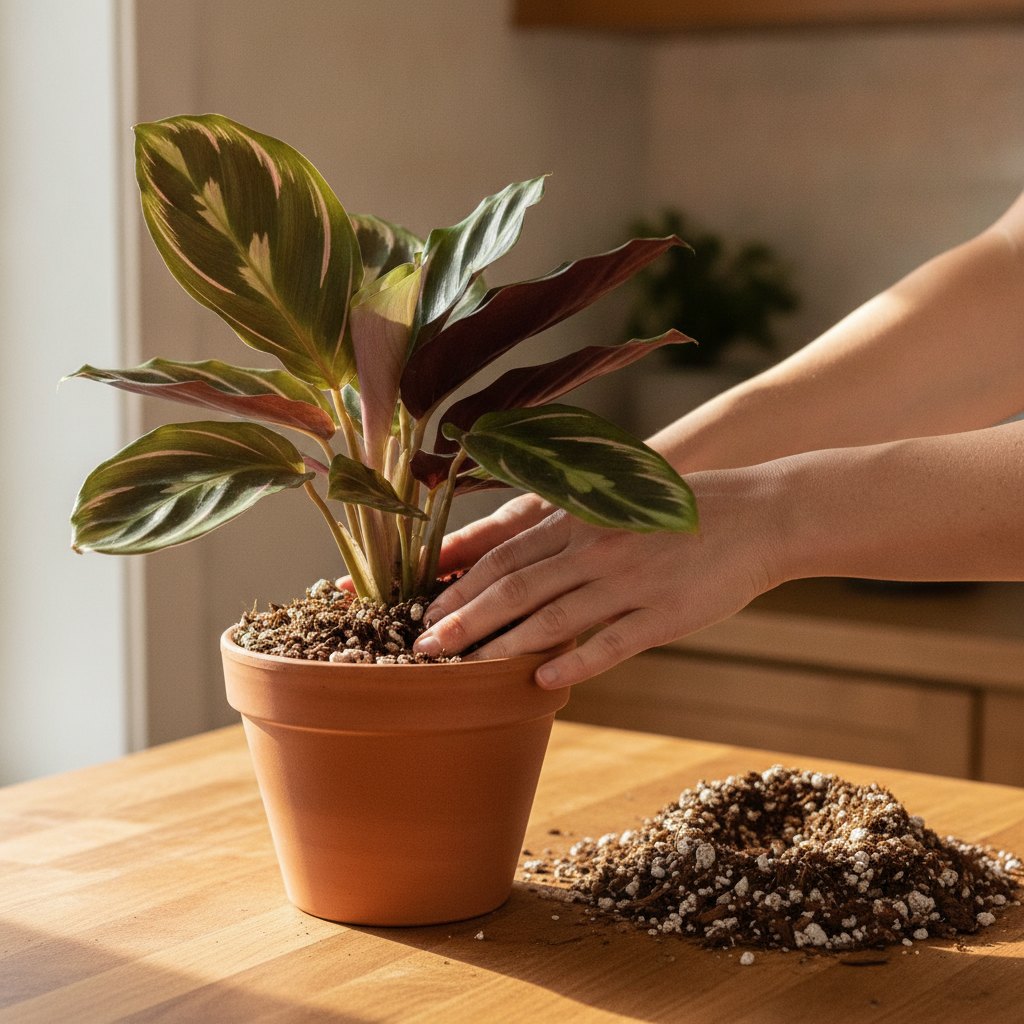
The right growing medium reconciles the plant’s two seemingly opposite demands: constant moisture and excellent drainage. A good calathea mix holds water long enough to keep the roots evenly damp while draining freely enough that they never sit in standing water. An ordinary bag of dense, peat-heavy potting compost on its own stays too wet and compacts over time, so it needs lightening with airy materials.
Ideal Soil Composition
Aim for a fluffy, moisture-retentive but airy blend. A reliable starting point combines a quality peat-free houseplant compost with a generous proportion of perlite for drainage and aeration, plus orchid bark or coco coir to add structure and hold moisture without compaction.
| Component | Proportion | Function |
|---|---|---|
| Peat-free houseplant compost | 50 per cent | Base medium; holds moisture and nutrients |
| Perlite | 25 per cent | Improves drainage and aeration |
| Coco coir | 15 per cent | Retains moisture without compacting |
| Fine orchid bark | 10 per cent | Adds structure and air pockets |
The rose painted calathea prefers a slightly acidic to neutral soil, with a pH of roughly 6.0 to 6.5. Most peat-free houseplant composts fall comfortably within this range, so pH rarely needs adjusting unless your water is very hard and alkaline over the long term.
Pro Tip — Quick Mix Recipe: For a fast, forgiving blend, combine two handfuls of peat-free compost with one handful of perlite and a half handful of coco coir. The result drains in seconds yet stays damp for days, which is exactly what this plant wants.
Choosing the Right Pot
Pot choice has a direct effect on how often you water and how healthy the roots stay. The aim is a container that supports the moist-but-drained balance rather than working against it.
Drainage holes are non-negotiable. Whatever pot you choose, it must have holes in the base. A decorative cover pot without drainage traps water around the roots and is the quickest route to rot; if you use one, lift the inner pot out to water and drain, then return it once it has stopped dripping.
Pot material: Plastic and glazed ceramic hold moisture longer and suit this thirsty plant better than unglazed terracotta, which wicks water away through its porous walls and dries the soil more quickly. If you love the look of terracotta, expect to water more often.
Pot size: Choose a pot only 2 to 3 cm (about 1 in) wider than the current root ball. An oversized pot holds a large volume of damp soil that the modest root system cannot use quickly, and that excess moisture invites rot.
When to Repot
The rose painted calathea grows at a modest pace and prefers to be slightly snug, so it needs repotting only every one to two years. Tell-tale signs that it is ready include roots emerging from the drainage holes, water running straight through without wetting the soil, or the plant drying out far faster than it used to. The best time to repot is spring, at the start of the active growing season, so the plant can recover quickly.
How to Repot: Step-by-Step
- Water the plant a day beforehand so the root ball is hydrated and slides out cleanly.
- Ease the plant from its pot by tipping it and supporting the base, rather than pulling on the stems.
- Gently tease away the old soil from the outer roots and inspect them, trimming any that are brown or mushy with sterile scissors.
- Add a layer of fresh mix to the new pot and position the plant at the same depth it grew before.
- Fill around the root ball with fresh mix, firming lightly to remove large air pockets without compacting it.
- Water thoroughly and return the plant to its usual spot, keeping it out of direct sun while it settles.
Warning — Transplant Shock: Calatheas dislike root disturbance and often sulk for a week or two after repotting, with curled or drooping leaves. Resist the urge to overwater or fertilise a stressed plant; keep conditions stable, maintain humidity, and let it recover at its own pace.
Fertilising
The rose painted calathea is a light feeder. In the wild it draws modest nutrition from a thin layer of decomposing leaf litter, and indoors it needs only gentle, regular feeding through the growing season rather than heavy doses. Too much fertiliser does far more harm than too little, building up as salts that scorch the sensitive roots and leaf edges.
Feed only while the plant is actively growing, from spring through to early autumn, and pause entirely through the darker months when growth naturally slows. A plant in low light or recovering from stress should not be fed at all until it is growing again.
Understanding Plant Nutrients
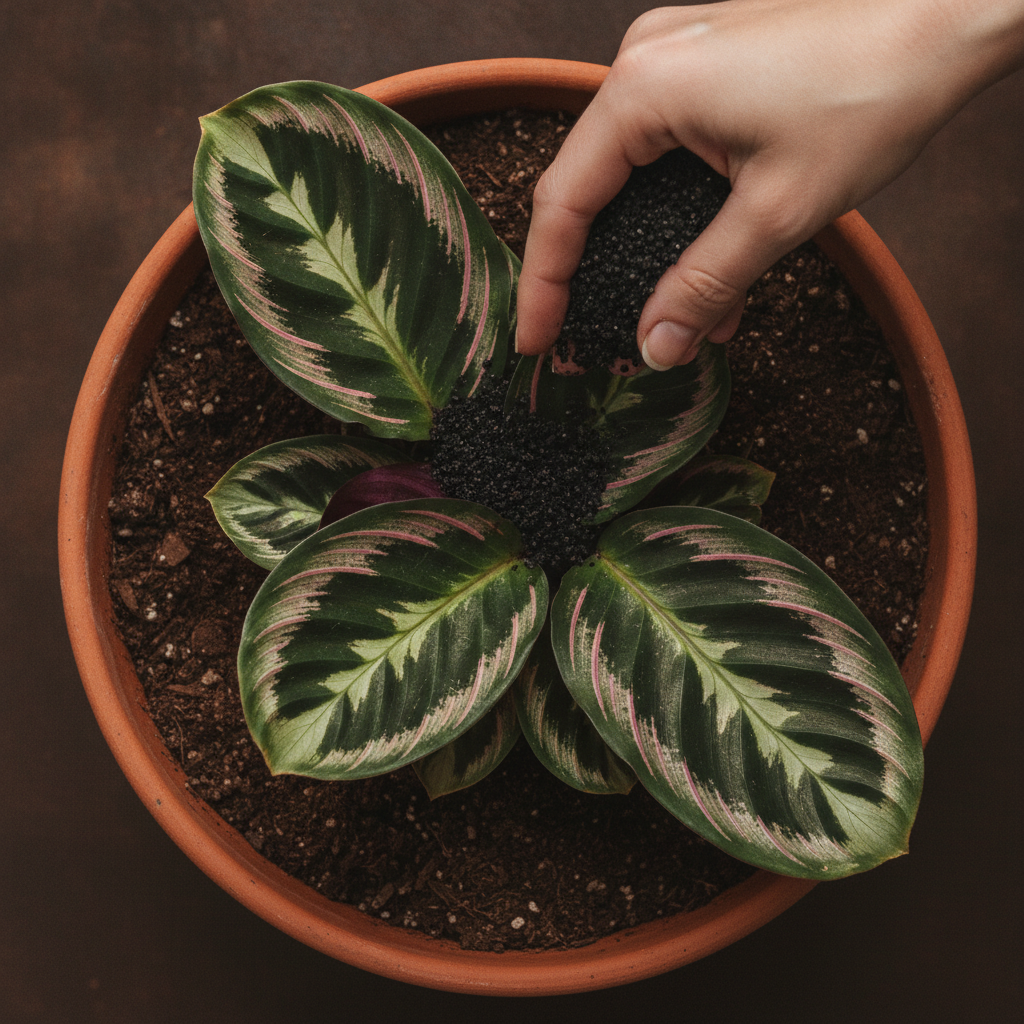
Most fertilisers are labelled with an N-P-K ratio, the relative proportions of nitrogen, phosphorus and potassium, the three nutrients plants use in the largest amounts. A balanced houseplant feed supplies these alongside the secondary nutrients and trace elements a foliage plant needs to keep its leaves healthy and well coloured.
| Nutrient | Symbol | Primary Function | Deficiency Symptoms |
|---|---|---|---|
| Nitrogen | N | Leaf and stem growth, green colour | Pale, yellowing older leaves; stunted growth |
| Phosphorus | P | Root development and energy transfer | Weak roots; dull, slow growth |
| Potassium | K | Overall vigour and water regulation | Browning leaf edges; weak stems |
| Magnesium | Mg | Core of the chlorophyll molecule | Yellowing between leaf veins |
| Iron | Fe | Chlorophyll formation in new leaves | Pale or yellow new growth, green veins |
Types of Fertiliser
Liquid fertilisers: The easiest type to control, diluted into water and applied during a normal watering. Because you set the strength each time, they suit a sensitive plant like this one well; simply use them at half the recommended dose.
Slow-release granular: Coated pellets that release nutrients gradually over months. Convenient, but harder to dial back if the plant shows signs of overfeeding, so use them sparingly and at the lower end of any guidance.
Organic fertilisers: Gentle options such as diluted worm-casting tea or a light top-dressing of worm castings feed slowly and are very hard to overdo, which makes them a forgiving choice for those nervous about chemical burn.
Feeding Schedule
A balanced liquid feed at half strength, applied roughly once a month through spring and summer, is plenty for the rose painted calathea. Skip feeding entirely from mid-autumn through winter. This light, seasonal approach keeps new growth coming without risking the salt build-up the plant is so quick to punish.
Pro Tip — Feed a Damp Pot: Always fertilise soil that is already moist, never bone dry. Applying feed to dry soil concentrates the salts against thirsty roots and can scorch them; watering first dilutes and distributes the nutrients safely.
How to Fertilise
- Dilute a balanced liquid houseplant fertiliser to half the strength shown on the label.
- Water the plant lightly first if the soil is dry, so the roots are not in direct contact with concentrated feed.
- Apply the diluted solution evenly across the soil until it begins to drain from the base.
- Every few months, flush the pot with plain water to wash out accumulated salts.
Warning — Salt Build-Up: A white crust on the soil surface or pot rim, together with browning leaf edges, signals salt accumulation from fertiliser or hard water. Flush the soil thoroughly with several pots’ worth of clean water to leach the salts away, and ease off on feeding.
Propagation
Unlike the trailing aroids that root readily from a cutting in a glass of water, the rose painted calathea cannot be propagated from leaf or stem cuttings. It grows from a central clump of underground rhizomes, and the only reliable way to make new plants is to divide that clump into smaller sections, each with its own roots and leaves.
Division is best done in spring, ideally at the same time as repotting, so the disturbance is bundled into a single recovery period. A mature, well-established plant with several distinct growing points is the ideal candidate; a young or sparse plant is better left to bulk up first.
Understanding the Rhizome Clump
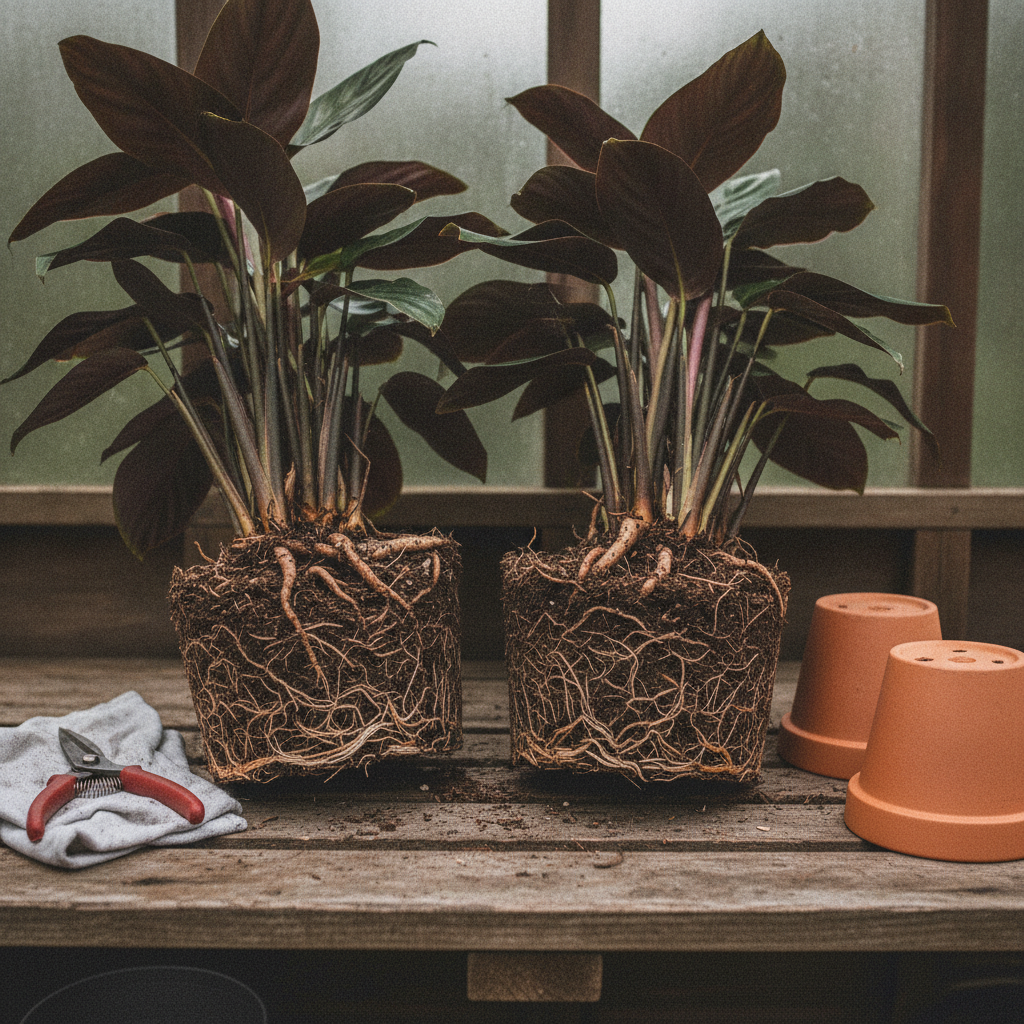
The rose painted calathea spreads by sending up new leaves from a network of fleshy underground rhizomes. Over time these form a dense clump with multiple crowns, and it is the natural separation between these crowns that makes division possible. Understanding that the plant is really a colony of connected shoots, rather than a single stem, takes the mystery out of dividing it.
Division: Step-by-Step
The aim is to separate the clump into two or more sections without tearing the roots more than necessary. Work gently and keep each new piece generously sized; small fragments struggle to establish.
- Water the plant the day before so the roots are hydrated and pliable.
- Slide the whole plant from its pot and gently brush away enough soil to see the natural divisions between crowns.
- Tease the clump apart with your fingers, or cut through the rhizome with a clean, sharp knife, making sure each section has healthy roots and at least two or three leaves.
- Pot each division into its own appropriately sized container of fresh, well-draining mix.
- Water thoroughly and place the new plants somewhere warm, humid and out of direct sun.
Pro Tip — Cover for Humidity: Freshly divided sections recover faster in high humidity. Loosely covering each new pot with a clear plastic bag or propagator lid for the first couple of weeks traps moisture and eases the transition, as long as you open it daily for fresh air.
Aftercare: Step-by-Step
The weeks after division are the most delicate. The plant has lost part of its root system and will droop and sulk while it rebuilds; steady, gentle conditions matter more than anything else now.
- Keep the soil lightly and evenly moist, but never soggy, while new roots form.
- Maintain warmth of at least 20 °C (68 °F) and high humidity around the divisions.
- Hold off on fertiliser for at least a month, until you see signs of fresh growth.
- Expect some leaf droop and even the loss of an older leaf; new growth from the centre is the sign of success.
Troubleshooting Propagation
| Problem | Likely Cause | Solution |
|---|---|---|
| Divisions wilt and collapse | Root system too small or too disturbed | Keep humidity very high; use larger divisions next time |
| No new growth after weeks | Cold, low light or simple slow recovery | Warm up, improve light gently and be patient |
| Soft, blackening base | Rot from overwatering after division | Reduce watering; remove affected tissue; improve drainage |
| Leaf edges crisp badly | Air too dry during recovery | Raise humidity and shelter from draughts |
Pests & Diseases
A healthy, well-cared-for rose painted calathea is reasonably resistant to pests, but the warm, humid conditions it loves are also attractive to certain insects, and the same humidity can encourage fungal disease if the leaves stay wet. Most problems are far easier to manage when caught early, so a quick inspection of the foliage, especially the undersides, each time you water pays dividends.
The plant’s thin leaves make it especially vulnerable to spider mites, which thrive in the dry air the calathea already dislikes. Keeping humidity high therefore does double duty, supporting the plant and discouraging its most persistent pest at the same time.
Common Pests
Spider Mites (Tetranychus urticae)
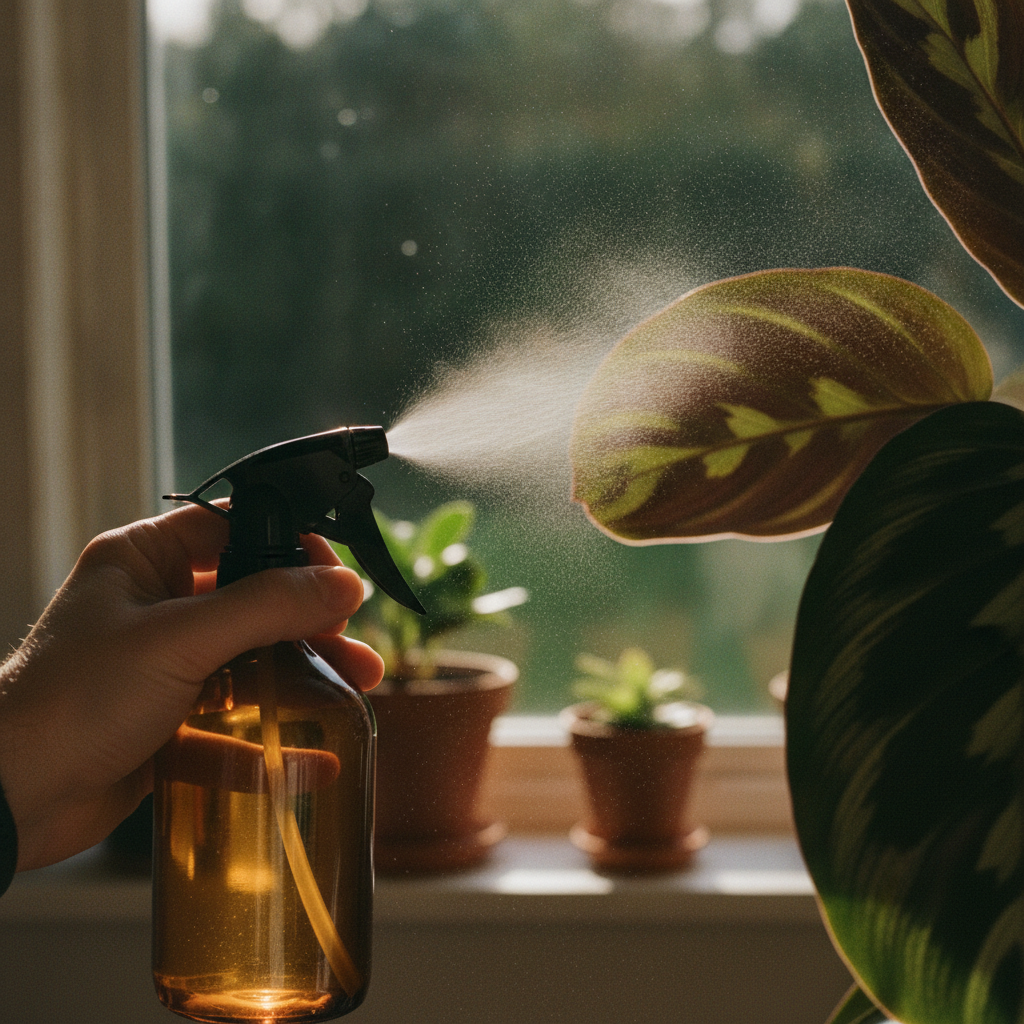
The most common and damaging pest on this plant. Spider mites are tiny, often invisible to the naked eye, and reveal themselves through fine webbing in the leaf axils and a stippled, speckled fading across the foliage. They multiply explosively in dry air.
Treatment: Rinse the plant thoroughly, raise humidity sharply, and treat the leaves, undersides included, with insecticidal soap or neem oil every few days until the population is gone. Isolate the plant while you treat it.
Mealybugs (Pseudococcus species)
Small, soft-bodied insects that look like specks of white cotton wool, clustering where the leaves meet the stems. They suck sap and weaken the plant, leaving a sticky residue behind.
Treatment: Dab each insect directly with a cotton bud dipped in diluted isopropyl alcohol, then follow up with neem oil to catch any that were missed. Repeat weekly until clear.
Fungus Gnats (Bradysia species)
Small black flies that hover around the soil surface. The adults are merely a nuisance, but their larvae feed on roots in the consistently moist soil this plant requires, so they are a common sight on calatheas.
Treatment: Let the very top layer of soil dry between waterings, use yellow sticky traps to catch the adults, and apply a biological control such as Bacillus thuringiensis to the soil to break the breeding cycle.
Common Diseases
Root Rot (Pythium and Phytophthora species)
The most serious disease of this plant, caused by waterlogged soil that suffocates the roots and lets pathogenic fungi take hold. Symptoms include yellowing leaves, a soft and darkened stem base and a sour smell from the soil.
Treatment: Unpot the plant, cut away all brown, mushy roots with sterile scissors, and repot into fresh, well-draining mix in a clean pot. Reduce watering and improve drainage to prevent a recurrence.
Leaf Spot (Helminthosporium and others)
A fungal infection that appears as small water-soaked or brown spots, often ringed with a yellow halo, spreading where leaves stay wet for long periods. High humidity combined with poor air movement encourages it.
Treatment: Remove affected leaves, improve air circulation, and avoid wetting the foliage when watering. A copper-based fungicide can help in stubborn cases.
Pest and Disease Summary
| Pest / Disease | Identification | Treatment |
|---|---|---|
| Spider mites | Fine webbing, stippled fading leaves | Rinse, raise humidity, neem oil or insecticidal soap |
| Mealybugs | White cottony clusters at leaf joints | Alcohol on a cotton bud, then neem oil |
| Fungus gnats | Small flies around the soil | Dry the topsoil, sticky traps, Bacillus thuringiensis |
| Root rot | Yellow leaves, soft base, sour soil | Trim roots, repot, reduce watering |
| Leaf spot | Brown spots with yellow halos | Remove leaves, improve airflow, keep foliage dry |
Prevention Strategies
Prevention rests on the same habits that keep the plant healthy in the first place. Maintain high humidity to deter spider mites, water carefully to avoid the soggy soil that breeds rot and gnats, and ensure gentle air movement so the foliage dries between waterings without exposing the plant to cold draughts.
Quarantine every new plant for a fortnight before letting it join your collection, and inspect the undersides of the leaves regularly. Catching a handful of mites or a single mealybug is a minor task; catching an established infestation that has spread across several plants is a far larger one.
Pro Tip — Neem Oil Routine: A light monthly wipe or spray of diluted neem oil over the leaves, undersides included, works as a preventive that discourages most common pests before they take hold. Apply it in the evening or out of direct light so the treated leaves do not scorch.
Popular Varieties
The rose painted calathea has been bred into a number of distinct cultivars, each playing on the same theme of patterned leaves and rosy halos in a slightly different key. They share identical care, so choosing between them comes down purely to which leaf pattern you find most striking.
Some cultivars lean toward pale, silvery centres, others toward dramatic near-black leaves outlined in vivid pink. The table below sets out the most widely available, and the featured cards that follow show two of the most popular up close.
| Variety | Leaf Appearance | Light Needs | Growth Rate | Availability |
|---|---|---|---|---|
| Medallion | Feathery silver-green centre, pink halo, burgundy reverse | Bright indirect | Moderate | Very common |
| Dottie | Near-black leaves outlined in vivid magenta-pink | Bright indirect | Moderate | Common |
| Rosy | Soft pink centre with a thin green margin | Bright indirect | Moderate | Common |
| Cynthia | Bold cream-and-green feathering, deep pink underside | Bright indirect | Moderate | Occasional |
| Surprise Star | Heavily speckled cream and green, pink flush | Bright indirect | Moderate | Occasional |
| Eclipse | Dark leaves with a bright contrasting outline | Bright indirect | Moderate | Less common |
Featured Varieties
Medallion
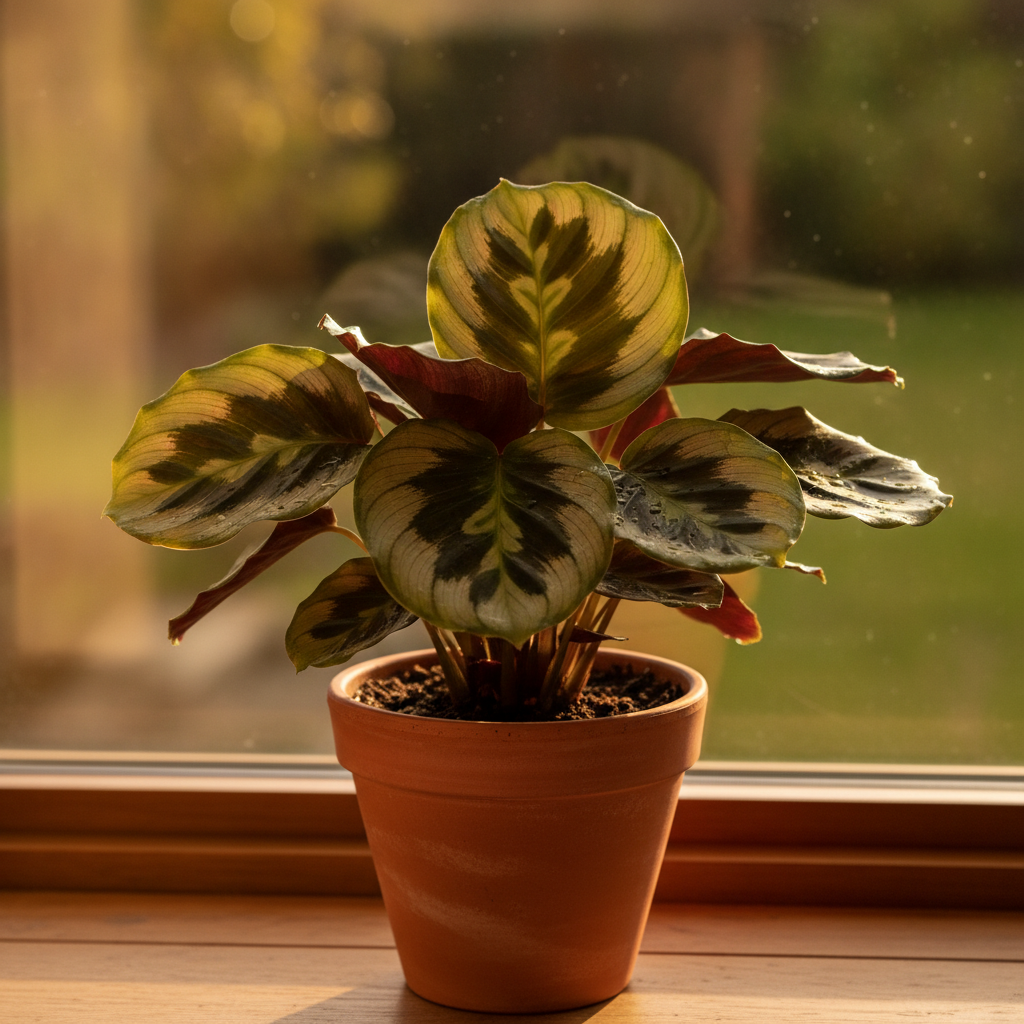
The best-known cultivar by far, with large rounded leaves whose feathery silver-green centres radiate from a dark green core, ringed by a delicate pink halo and backed by a deep burgundy underside. It is the variety most people picture when they think of a rose painted calathea.
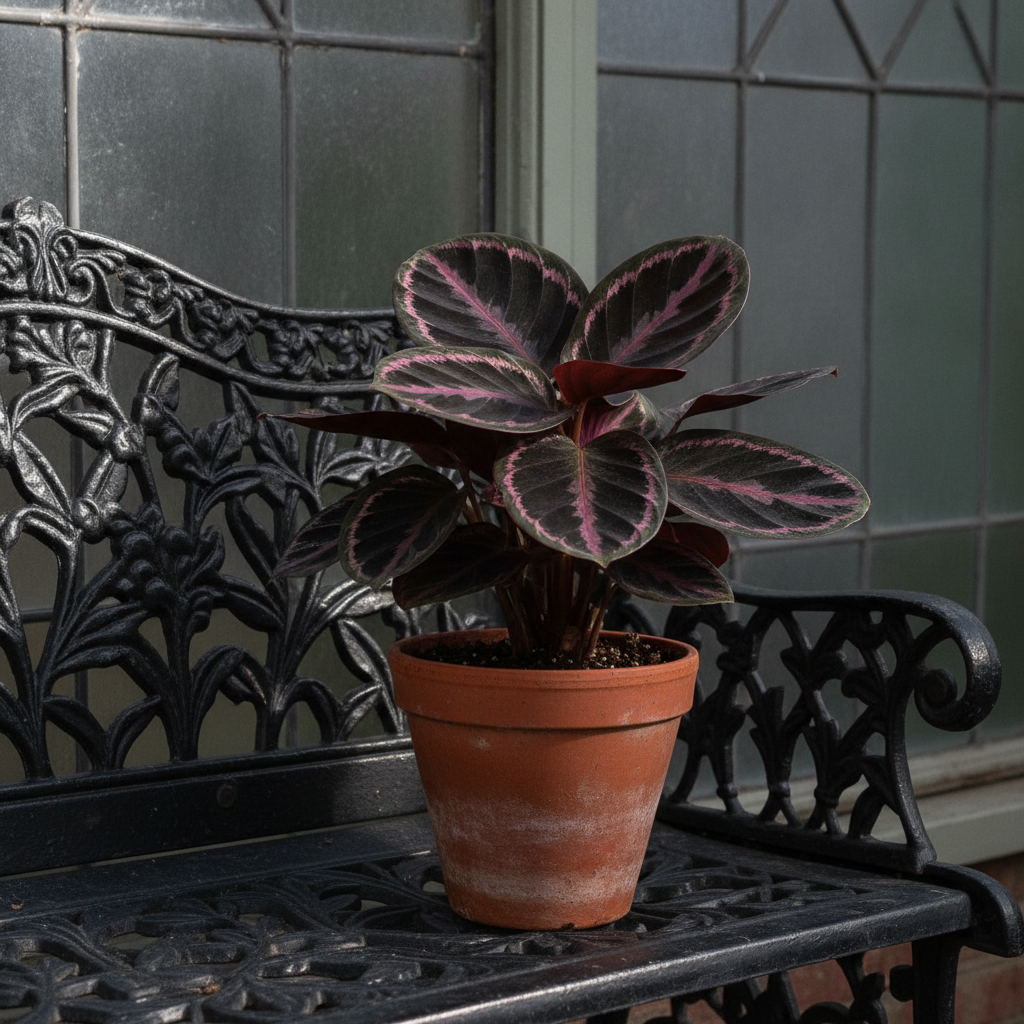
Dottie
The dramatic, moody counterpoint to Medallion, with glossy near-black, deep purple-green leaves outlined by a single vivid magenta-pink ring. The high contrast makes it one of the most sought-after cultivars and a striking feature against a pale wall.
Variety Profiles in Detail
Medallion (Goeppertia roseopicta ‘Medallion’)
Medallion is the archetype of the species in cultivation. Its broad, almost circular leaves carry the fullest expression of the rose painted pattern, and its reliability and wide availability make it the natural first choice for anyone new to the plant.
Dottie (Goeppertia roseopicta ‘Dottie’)
Dottie trades the silvery centre of Medallion for darkness, its leaves so deeply pigmented they read as black in lower light. The single bright pink outline that traces each leaf gives it a graphic, modern look that has made it a favourite among collectors.
Rosy (Goeppertia roseopicta ‘Rosy’)
Rosy is the softest of the group, with a generous wash of pale pink filling most of the leaf and only a thin green margin around the edge. Younger leaves are the pinkest, deepening toward green as they age, so a healthy plant carries a gentle gradient of colour.
Choosing the Right Variety for Your Space
Because every cultivar needs the same warmth, humidity and filtered light, the decision is purely aesthetic. Choose Medallion for the classic feathered look, Dottie for high-contrast drama, or Rosy for a softer, pinker mood. Whichever you pick, give it the conditions outlined in this guide and it will reward you with the patterned foliage and quiet nightly movement that make this one of the most loved plants in the prayer plant family.
Frequently Asked Questions
Why are the leaf edges on my rose painted calathea turning brown?
Brown, crispy edges almost always point to dry air or mineral build-up from tap water, and often both. Raise the humidity to 60 per cent or above, switch to rainwater, distilled or filtered water, and the new leaves should emerge clean. Existing brown edges will not turn green again, but you can trim them for tidiness.
Why does my calathea’s leaves curl up?
Some curling is normal: the leaves fold upward each evening and open again by morning. Curling that persists through the day usually signals thirst or low humidity. Check the soil, and if the top few centimetres are dry, water thoroughly; the leaves should relax within a day.
Is the rose painted calathea safe for cats and dogs?
Yes. Like all true calatheas, it is non-toxic to cats, dogs and humans, which is one of its great advantages over many statement foliage plants. It is a genuinely pet-safe choice, though no plant is meant to be eaten and nibbling may cause mild stomach upset.
Why does my plant move its leaves at night?
This daily raising and lowering of the leaves is called nyctinasty, and it is a hallmark of the prayer plant family. It is driven by changes in water pressure in a joint called the pulvinus at the base of each leaf. Far from a problem, visible nightly movement is a reassuring sign of a healthy, well-watered plant.
How often should I water a rose painted calathea?
There is no fixed schedule. Water when the top 2 to 3 cm (about 1 in) of soil has dried while the layer below stays slightly moist, which may be once or twice a week in warm, bright conditions and far less in winter. The aim is consistently moist soil that never becomes soggy or bone dry.
Can I propagate it from a leaf cutting?
No. Unlike pothos or philodendrons, the rose painted calathea will not root from a leaf or stem cutting. It grows from underground rhizomes, so the only reliable method is division, separating a mature clump into sections that each have their own roots and leaves, ideally in spring.
Why are the lower leaves turning yellow?
The occasional yellowing of an old lower leaf is natural ageing and nothing to worry about. Several leaves yellowing at once, especially alongside soggy soil or a sour smell, points to overwatering and possible root rot. Check the soil moisture and drainage, and ease back on watering if the medium is staying wet too long.
My calathea has stopped moving its leaves. What is wrong?
Reduced or absent leaf movement is a sign of stress, most often from underwatering, very low humidity or a cold position. Review the basics: keep the soil evenly moist, raise the humidity and ensure the temperature stays above 15 °C (59 °F). Once the plant is comfortable again, the nightly rhythm usually returns.
Does it need a special pot?
No special pot is required, but it must have drainage holes, and a plastic or glazed ceramic container suits this moisture-loving plant better than porous terracotta. Choose one only slightly larger than the root ball, since an oversized pot holds excess damp soil that encourages rot.
Why is my plant losing its pink colour?
Faded markings are usually a light issue. In too little light, new leaves emerge with weaker contrast and less pink. Move the plant somewhere brighter, still out of direct sun, and subsequent leaves should recover their vivid patterning. Conversely, too much direct sun bleaches the colour, so the target is bright but filtered light.






