
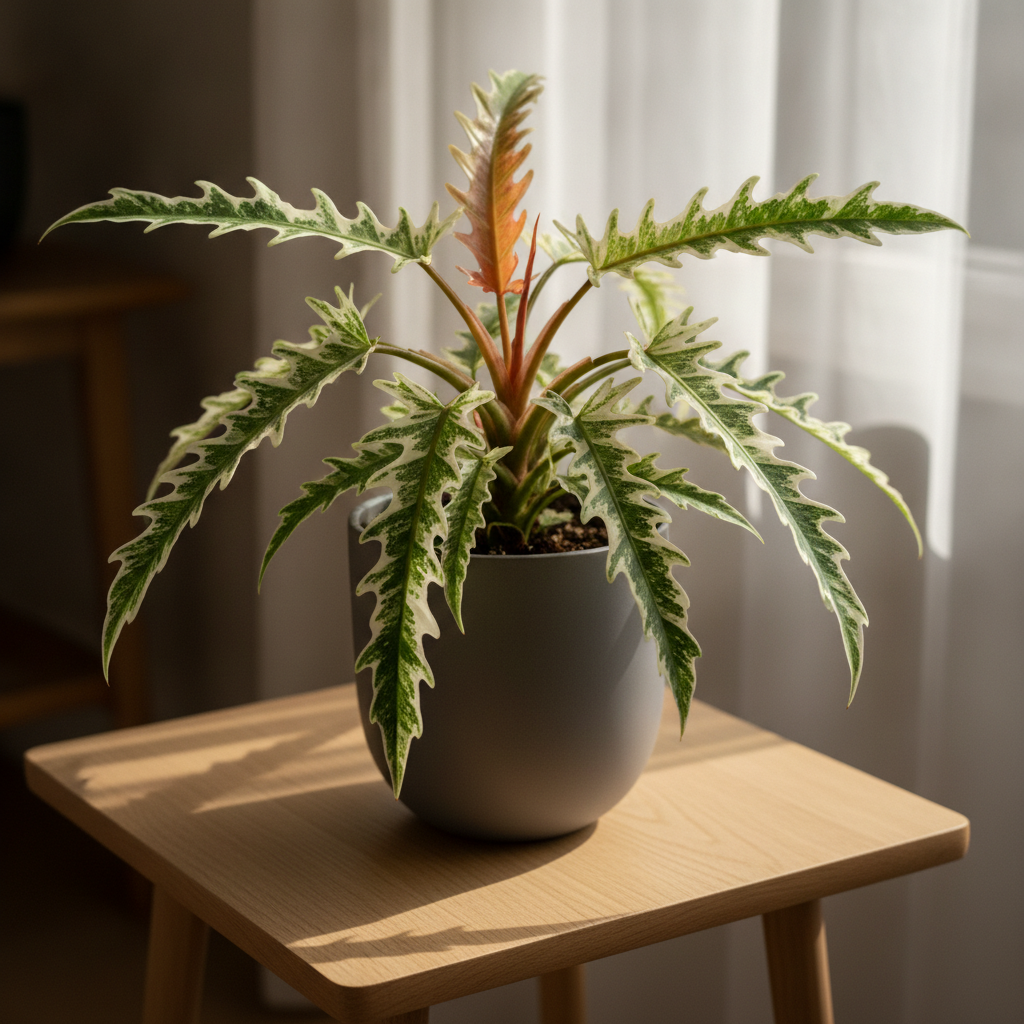
Few houseplants earn their name as literally as the Ring of Fire philodendron. Each new leaf pushes out tinted in molten orange and red before settling into a marbled patchwork of cream, white and green, all carried on a long, jagged blade edged like a saw. Philodendron ‘Ring of Fire’ is a slow, deliberate grower that rewards patience rather than haste, and that single quality shapes almost everything about how it should be kept. This guide covers what the plant needs to merely survive, and what it takes for it to genuinely thrive and keep producing those fiery new leaves indoors.
Quick Reference
The table below summarises the conditions the Ring of Fire philodendron prefers. Use it as a fast orientation, then read the relevant sections for the reasoning and the finer detail that makes the difference between a stalled plant and one in active growth.
| Factor | Requirement |
|---|---|
| Botanical name | Philodendron ‘Ring of Fire’ |
| Common names | Ring of Fire, Serrated Philodendron |
| Light | Bright indirect light; variegation fades in shade |
| Water | When the top 3 to 5 cm (1 to 2 in) of mix dries |
| Soil | Chunky, airy aroid mix that drains fast |
| Temperature | 18 to 29 degrees C (65 to 85 degrees F) |
| Humidity | 60 percent or higher preferred; 50 percent tolerated |
| Feeding | Balanced dilute feed monthly in spring and summer |
| Growth rate | Slow, especially highly variegated forms |
| Mature size indoors | 1 to 1.8 m (3 to 6 ft) tall on a support |
| Toxicity | Toxic to pets and humans if ingested |
Why Grow the Ring of Fire as a Houseplant
The Ring of Fire is a hybrid aroid, generally attributed to a cross involving Philodendron tortum and Philodendron wendlandii, though its exact parentage is debated among growers. What is not in dispute is its appearance. The leaves are long and narrow with deeply cut, sawtooth margins, and they carry a shifting variegation that can range from near-solid green to almost entirely cream depending on the individual plant and the conditions it is grown in. The fireworks happen at the growing tip, where each emerging leaf arrives flushed with orange, red and pink pigments that gradually give way to the mature marbled pattern.
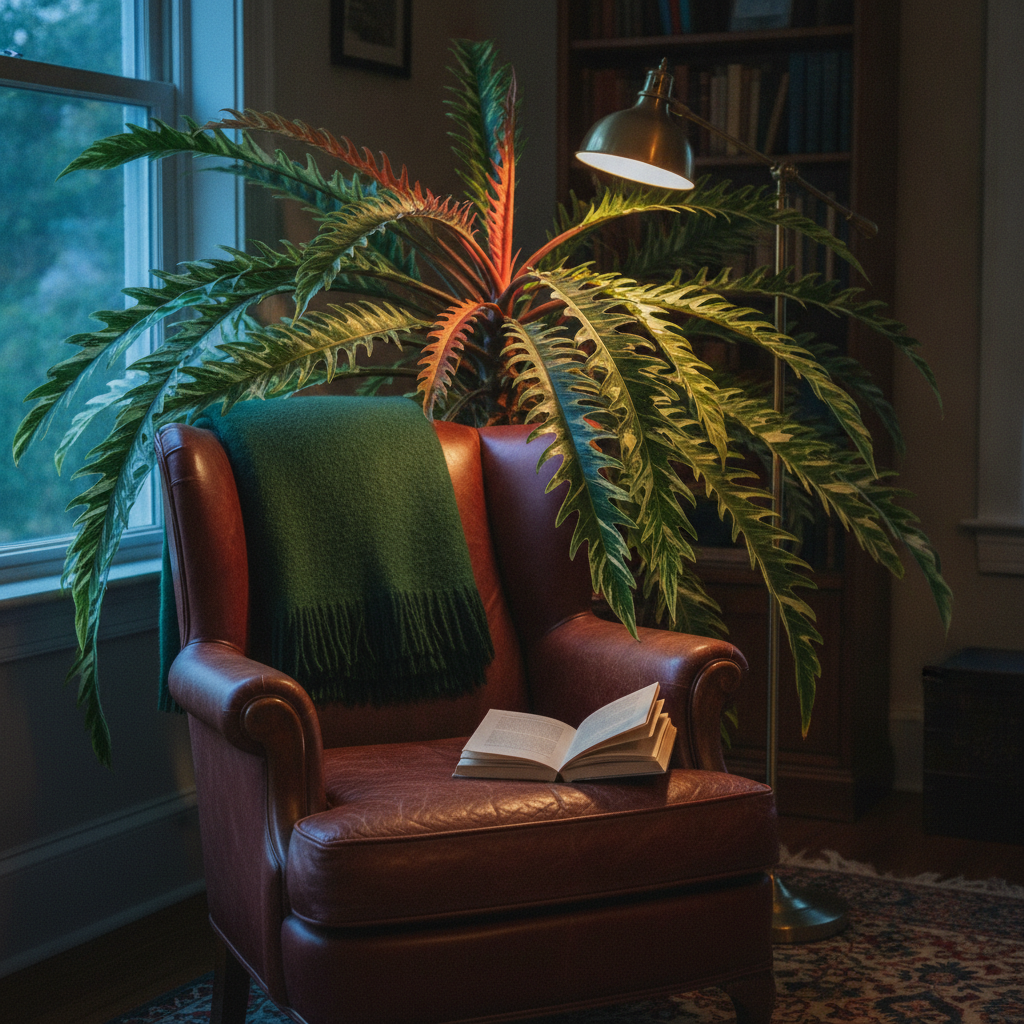
As a houseplant the Ring of Fire is prized for that drama, but it is worth being honest about temperament. This is a slow grower, and the most heavily variegated specimens are slower still, because the pale tissue carries little or no chlorophyll and therefore contributes nothing to the plant’s energy budget. A new leaf every few weeks in peak season is a realistic expectation, not a leaf a week. For collectors who enjoy watching each leaf develop, that pace is part of the appeal. For anyone wanting fast, jungle-like coverage, it is the wrong plant. It is a climbing aroid by nature, so given a moss pole or other support it will produce progressively larger, more dramatic leaves rather than the small juvenile foliage it makes when left to sprawl.
Light
Light is the single most important factor for this plant, because light is what drives variegation and the intensity of the fiery new growth. Bright, indirect light is the target. An east-facing window where the plant catches gentle morning sun, or a position a metre or so back from a brighter south or west window, suits it well. In good light the new leaves emerge with their strongest orange and red tones and the variegated sections stay crisp and well defined.
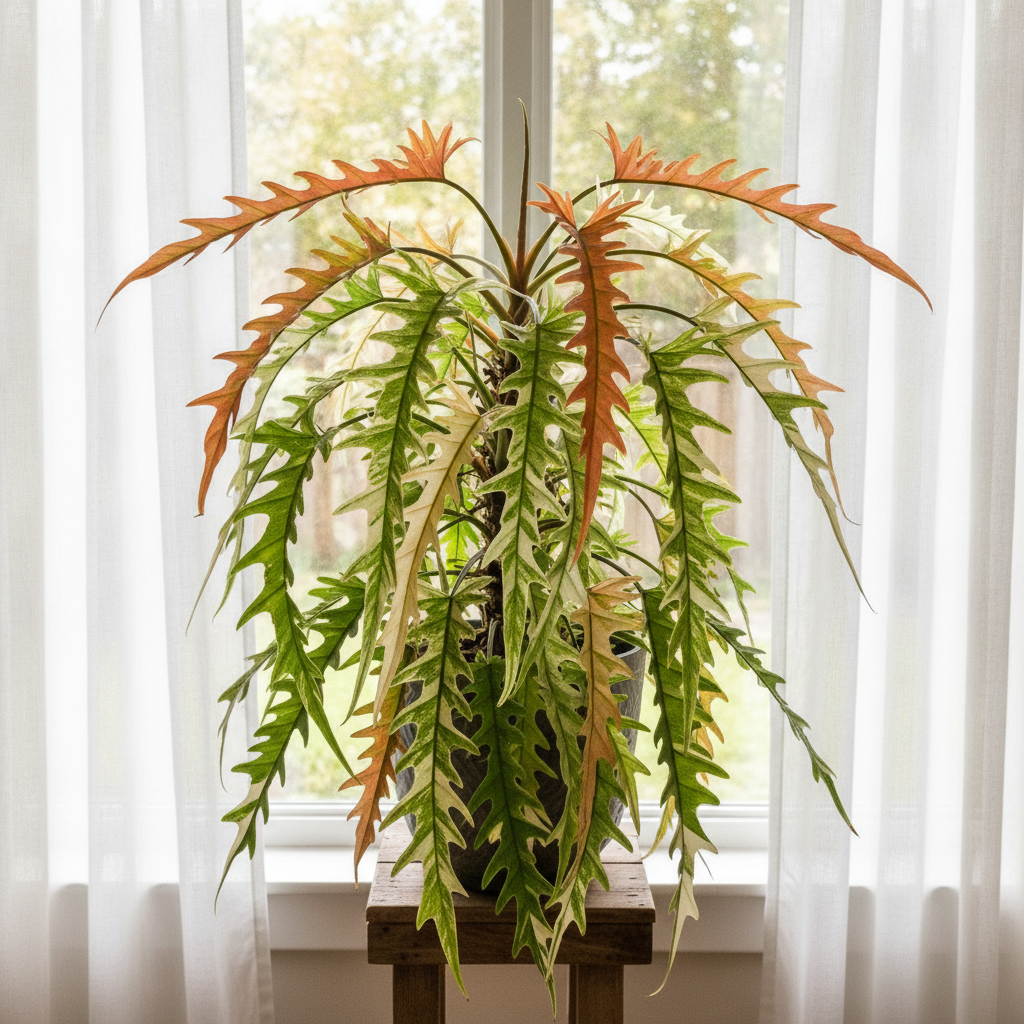
In low light the plant will survive, but it will not thrive in any meaningful sense. The variegation dulls and reverts toward green as the plant tries to maximise the photosynthetic surface it has, new leaves arrive smaller and lose much of their fiery colour, and the already slow growth can stall completely. At the other extreme, harsh direct midday sun through glass will scorch the pale, chlorophyll-poor sections of the leaves, leaving crisp bleached patches that do not recover. The aim is therefore strong light that has been softened, whether by a sheer curtain, a slight distance from the glass, or the canopy of a taller plant in front of the window.
Pro Tip – Even Variegation: Rotate the pot a quarter turn each time you water. The Ring of Fire grows toward its light source, and regular rotation keeps the stem upright and the variegation developing evenly around the whole plant rather than only on the window side.
Watering
Watering a Ring of Fire is an exercise in restraint. Like most climbing philodendrons it has thick roots that resent sitting in soggy mix, and because the plant grows slowly it uses water slowly too. The reliable approach is to water thoroughly once the top 3 to 5 cm (1 to 2 in) of the mix has dried out, then let the excess drain away completely. Tip the saucer so the pot never stands in collected water.
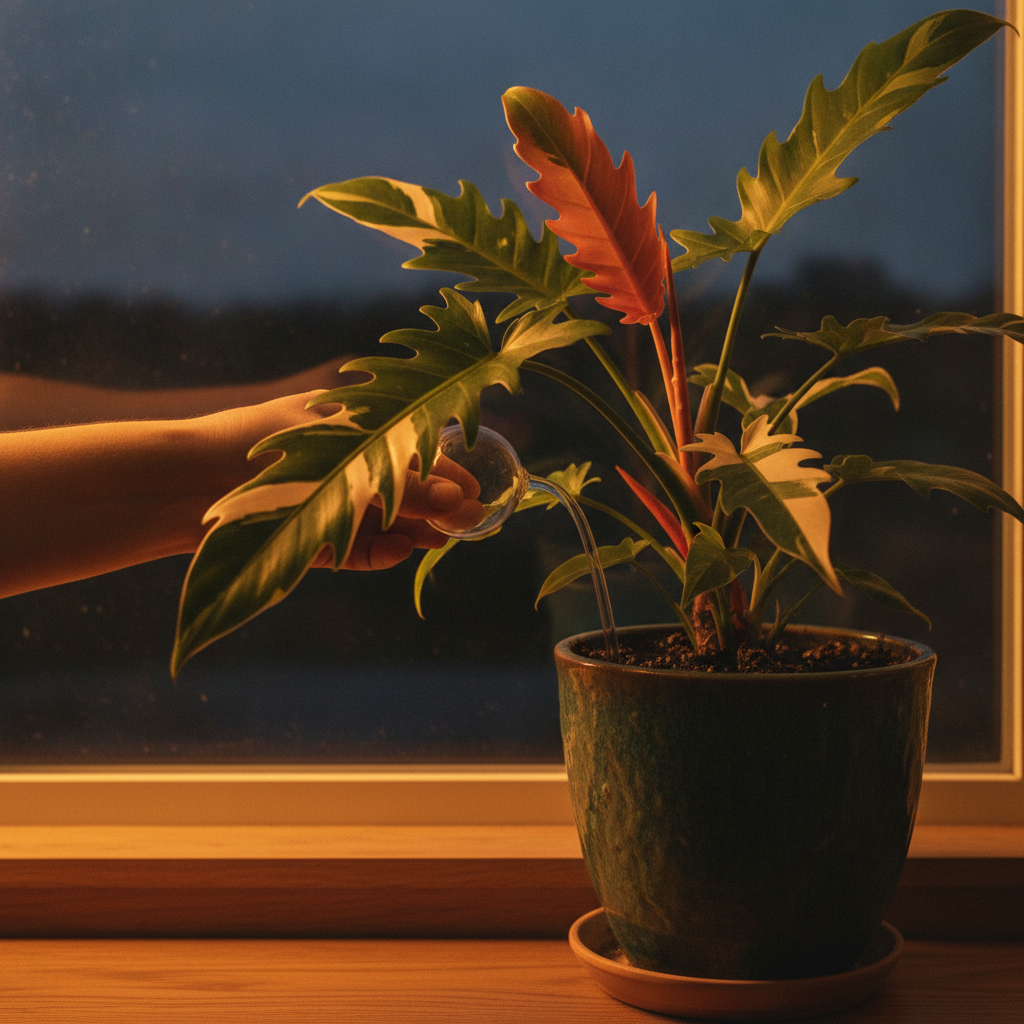
The frequency that translates to depends entirely on your conditions, so judge by the mix rather than the calendar. In a warm, bright spot in summer that might mean watering every five to seven days, while in a cooler, dimmer room in winter it could stretch to every two or three weeks. Push a finger into the substrate or lift the pot to feel its weight; a freshly watered pot is noticeably heavier than a dry one. Lukewarm water is gentler on the roots than cold water straight from the tap. If your tap water is heavily chlorinated or very hard, the plant will appreciate filtered or rainwater, though it is not as fussy on this point as a calathea.
The danger sign to watch for is overwatering, which is by far the most common way this plant is killed. Yellowing lower leaves, a soft or mushy stem base, and a persistent damp, sour smell from the mix all point to roots that are staying too wet. Underwatering shows up differently, as drooping, curling leaves and dry, crisping edges, and it is generally easier to correct. When in doubt with a Ring of Fire, wait a day and check again rather than watering pre-emptively.
Soil
The right substrate is what makes a sensible watering routine possible. As an epiphytic climber, the Ring of Fire is adapted to anchoring in loose forest debris where its roots get plenty of air, so a dense, water-retentive potting compost will suffocate it. A chunky, open aroid mix is the goal: something that holds a little moisture but drains freely and never compacts into a solid mass.
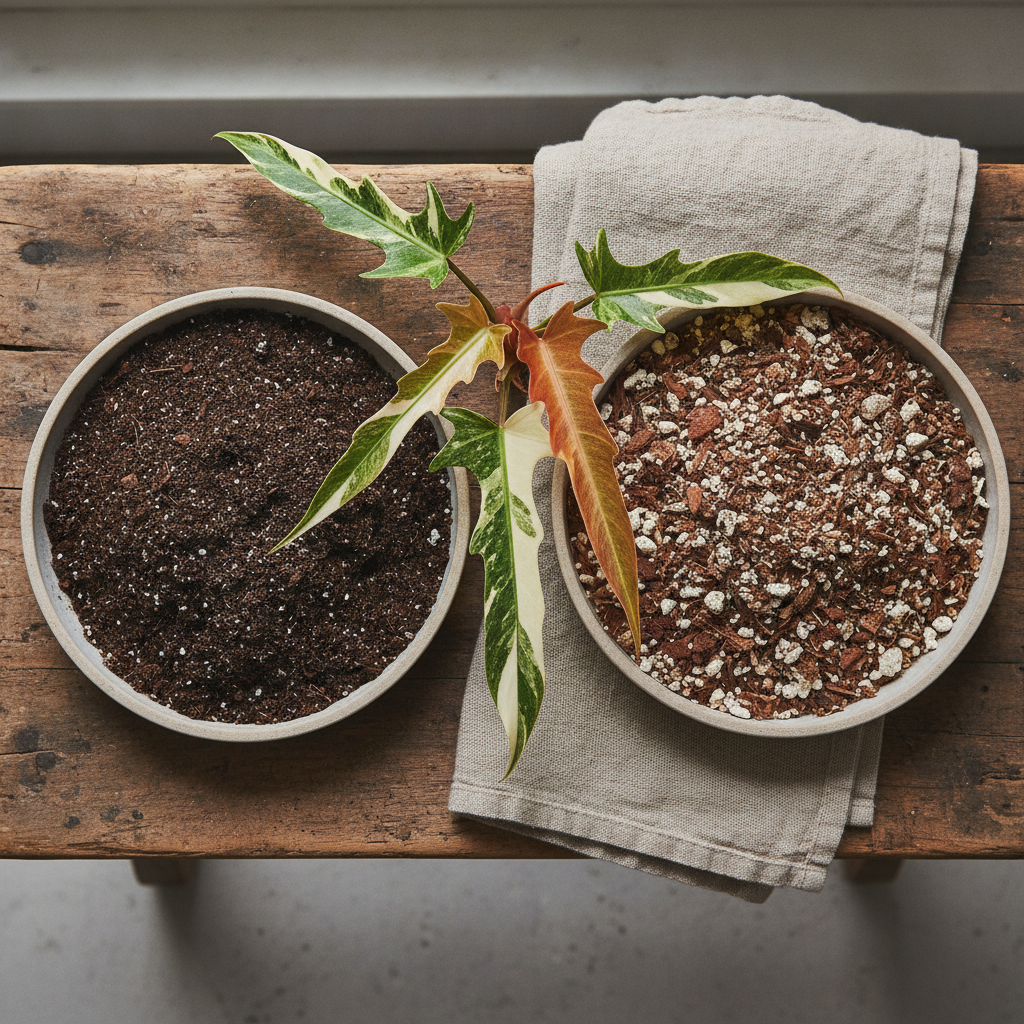
A dependable recipe combines a base of good quality potting soil with roughly equal parts orchid bark and perlite, plus a generous handful of coco coir or coco chips to hold gentle moisture. Many growers add a little horticultural charcoal and a scattering of worm castings for slow nutrition. The exact proportions matter less than the overall character, which should feel loose and chunky in the hand and let water run straight through. Whatever blend you choose, the pot must have drainage holes, as no mix can compensate for water with nowhere to go.
Repot only when the plant is genuinely rootbound, which for such a slow grower may be every two to three years. Move it up just one pot size at a time, because a Ring of Fire surrounded by a large volume of damp, unused mix is far more prone to root rot than one kept slightly snug. Spring, at the start of the active growing season, is the best time to repot so the plant can recover quickly.
Warning – Compaction: Ordinary bagged houseplant compost used on its own will pack down tight within months, starving the roots of oxygen and holding water against them. Always open it up with bark and perlite before potting a Ring of Fire.
Fertilising
Because the Ring of Fire grows slowly, its appetite for feed is modest, and overfeeding does more harm than underfeeding. During the active growing months of spring and summer, a balanced liquid houseplant fertiliser diluted to half the recommended strength, applied roughly once a month, is plenty. Always feed onto already-moist mix rather than dry roots, as concentrated fertiliser drawn into dry tissue can scorch the fine root hairs.
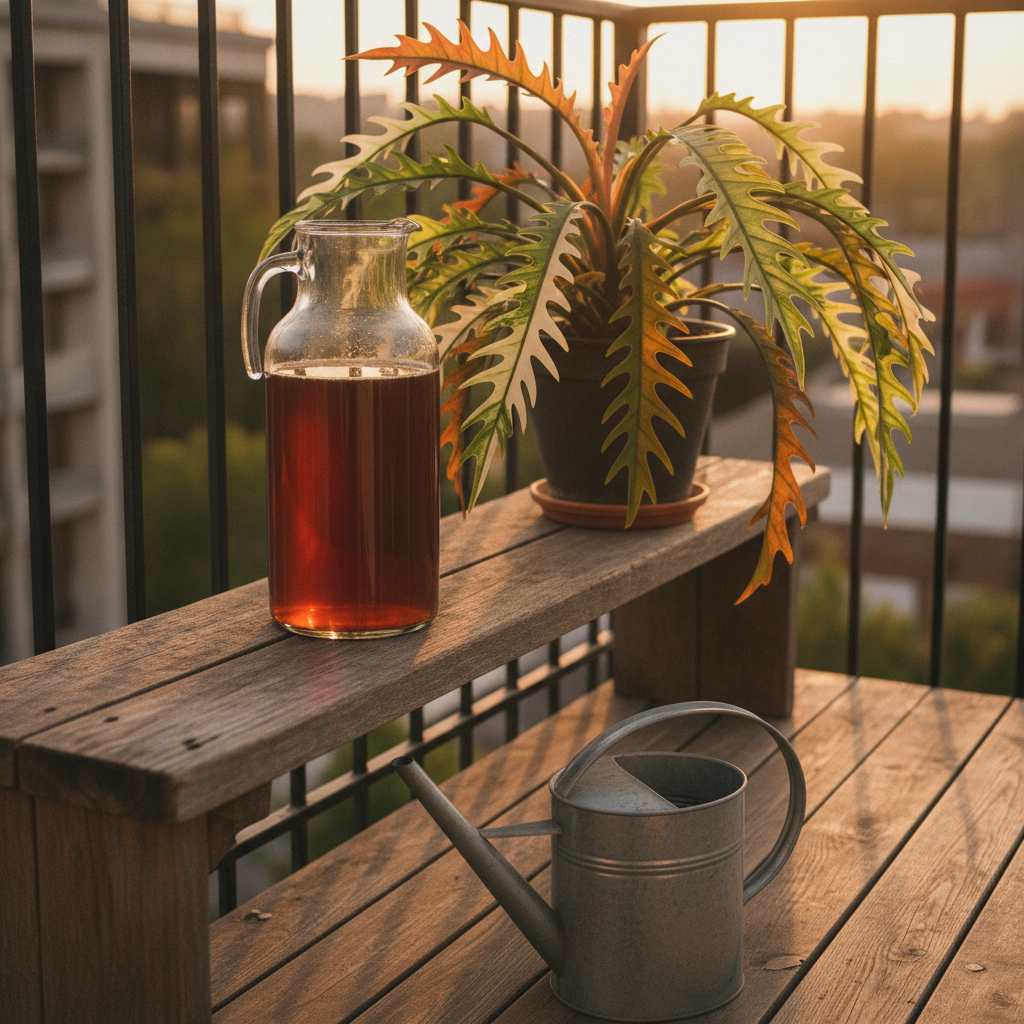
In autumn and winter, when growth naturally slows or pauses, stop feeding altogether. Pushing fertiliser at a plant that is not actively taking it up simply allows mineral salts to build up in the mix, and that accumulation can burn the roots and brown the leaf tips. If you notice a white crust forming on the surface of the soil or around the pot rim, flush the mix thoroughly with plain water to wash the excess salts through, and ease back on the feeding next season.
A balanced formula, where the three main nutrient numbers are roughly equal, suits this plant well and supports both healthy foliage and steady root development. Specialist aroid feeds work nicely, but they are not essential; a standard, gentle houseplant feed used with a light hand gives excellent results.
Propagation
The Ring of Fire is propagated from stem cuttings, each of which must include at least one node, the slightly swollen joint where leaves and aerial roots emerge. A cutting without a node will not produce new roots no matter how long you wait, so the node is the one non-negotiable. Because the plant is slow and often expensive, many growers take cuttings only when repotting or pruning rather than carving up a healthy specimen for the sake of it.
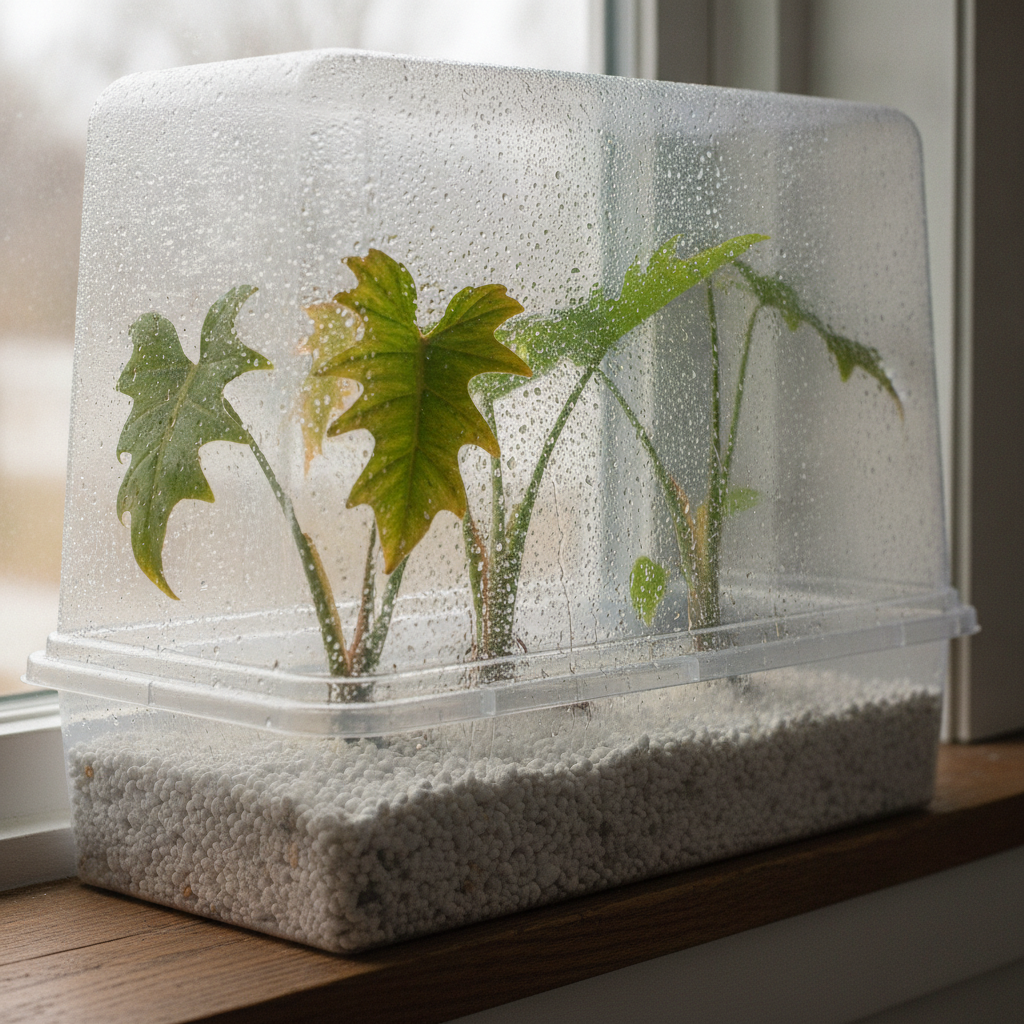
To take a cutting, follow these steps:
- Choose a healthy section of stem with at least one node and ideally one or two leaves, and identify the node clearly before cutting.
- Using clean, sharp scissors or a blade wiped with isopropyl alcohol, cut just below the node so the node sits at the base of the cutting.
- Let the cut surface dry and callus over for a few hours to reduce the risk of rot.
- Set the cutting into damp sphagnum moss or a tray of moist perlite, or suspend it in water, keeping the node submerged or buried while leaves stay above.
- Cover with a humidity dome or loose clear bag and keep it warm and brightly lit but out of direct sun.
- Once roots reach 3 to 5 cm (1 to 2 in), usually after several weeks, pot the cutting into a standard chunky aroid mix and keep it slightly more humid than usual while it establishes.
Patience is essential, as this plant roots more slowly than common philodendrons such as the heartleaf. Warmth speeds the process considerably, so a spot around 24 to 27 degrees C (75 to 81 degrees F), or a gentle propagation heat mat, makes a noticeable difference. Highly variegated cuttings carrying little green tissue will root and grow especially slowly, and a cutting with no chlorophyll at all will eventually fail because it cannot feed itself.
Pests and Problems
The Ring of Fire is not unusually pest-prone, but like all indoor aroids it can attract the usual sap-sucking insects, particularly when air is dry or when a new plant brings them home. The most common culprits are spider mites, which leave fine webbing and a stippled, dusty look on the leaves, mealybugs, which appear as white cottony tufts in the leaf axils, thrips, which cause silvery scarring and distorted new growth, and fungus gnats, whose larvae thrive in soil kept too wet.
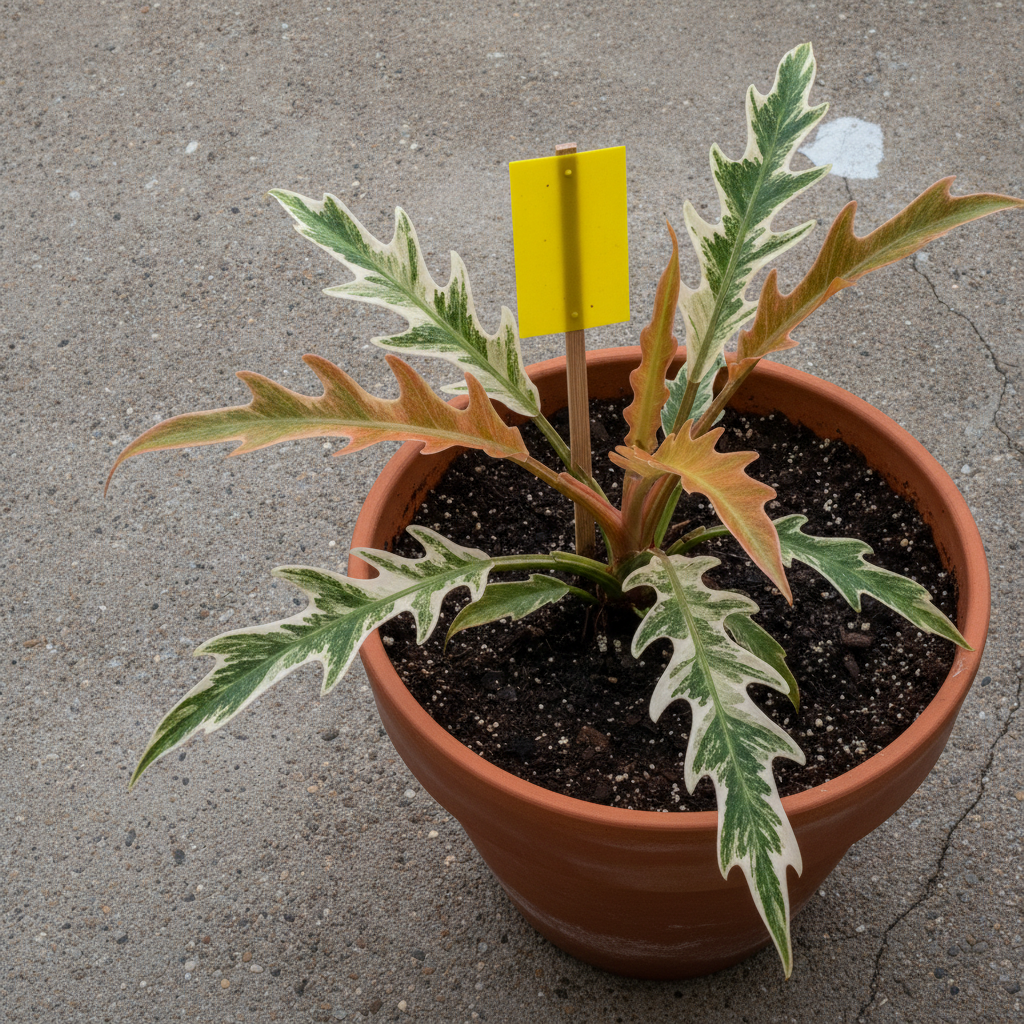
Catching trouble early makes all the difference, so inspect the undersides of leaves and the leaf joints whenever you water. At the first sign of insects, isolate the plant from your other houseplants, wipe the foliage with a damp cloth, and treat with insecticidal soap or a diluted neem oil spray, repeating every week or so until the problem clears. Yellow sticky traps pushed into the pot help monitor and reduce flying adults. For fungus gnats specifically, the real fix is cultural: let the top of the mix dry out more thoroughly between waterings to break the larvae’s life cycle.
Beyond pests, most complaints with this plant trace back to watering and light. Yellowing lower leaves usually mean the mix is staying too wet, brown crispy edges point to low humidity or a build-up of fertiliser salts, fading variegation signals that the plant needs more light, and bleached, scorched patches indicate too much direct sun on the pale tissue. Reading these signals as feedback rather than disasters is the key to keeping a Ring of Fire happy over the long term.
Warning – Toxicity: Every part of the Ring of Fire contains insoluble calcium oxalate crystals, which cause intense burning and swelling of the mouth and throat if chewed. Keep it well out of reach of pets and young children, and wash your hands after handling cut stems, as the sap can irritate skin.
Varieties
The Ring of Fire is itself a named cultivar rather than a species, but it does not come true to a single fixed look. Because variegation in this plant is unstable and varies from leaf to leaf and plant to plant, growers tend to distinguish forms by how much pale tissue they carry. The two ends of that spectrum are worth knowing before you buy, because they behave very differently in growth rate and price.
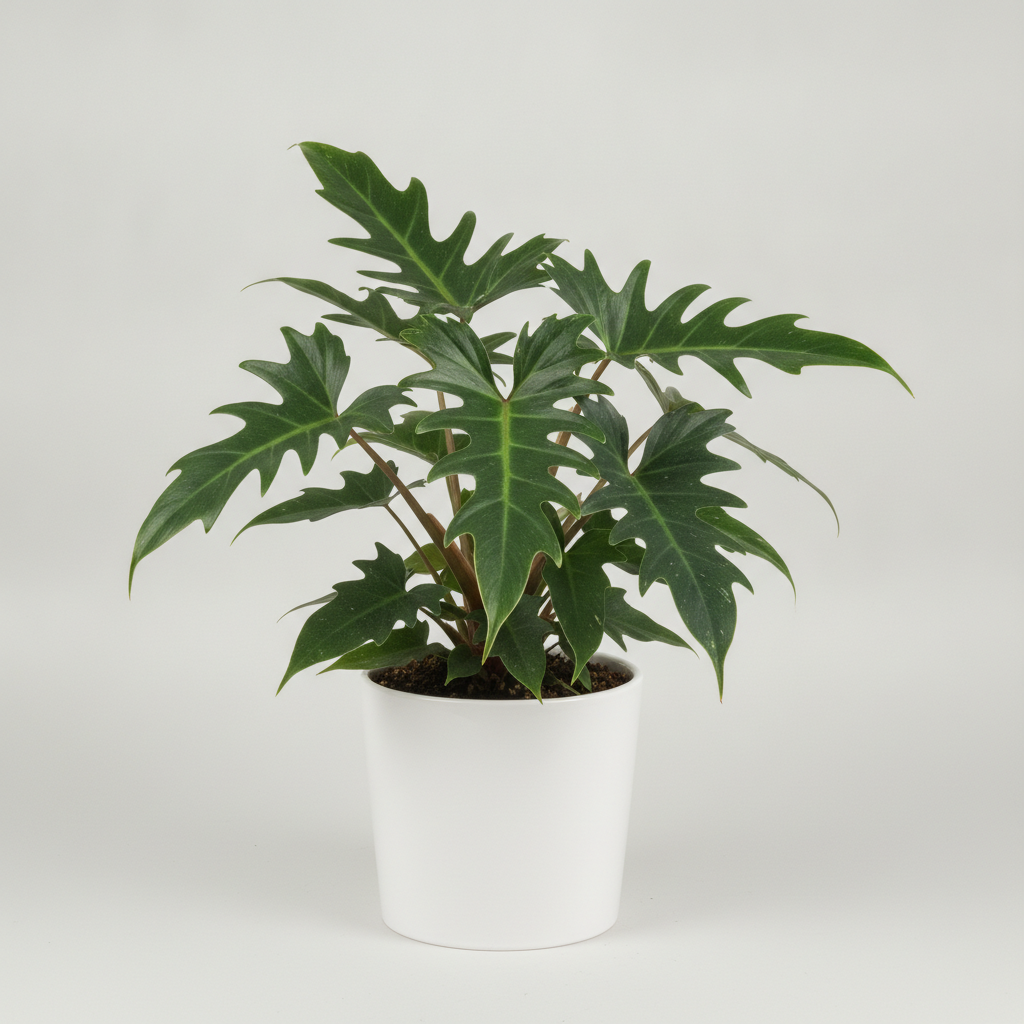
The Green Ring of Fire carries mostly deep green, serrated leaves with only faint creamy marbling. With far more chlorophyll to work with, it grows noticeably faster and more vigorously than its variegated siblings, and it is the easiest and most forgiving form for a first-time grower. It still produces the warm-toned new growth, just with less of the dramatic cream and white contrast.
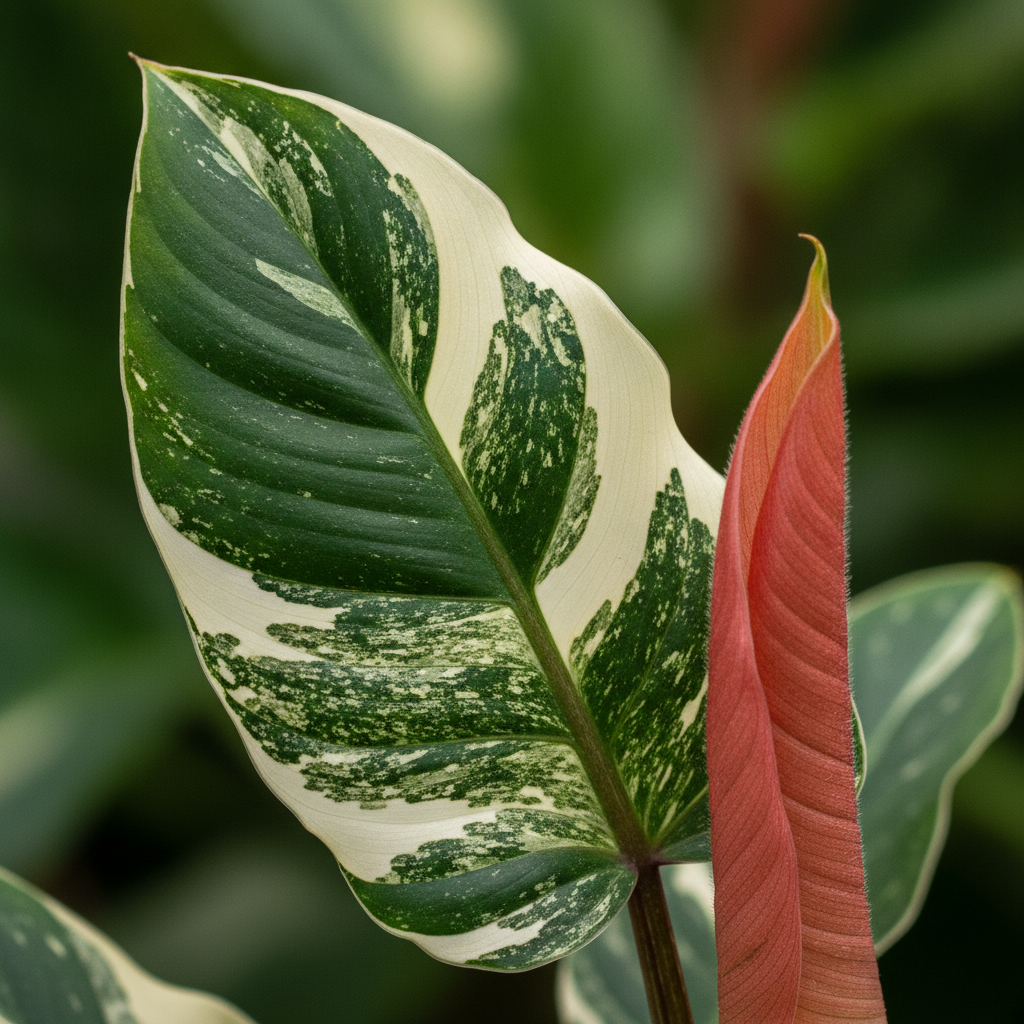
The Highly Variegated Ring of Fire shows broad cream and white sectors against green, with the most intense pink-to-red new leaves. It is the most coveted and the most expensive form, but the trade-off is real: with so little chlorophyll it grows extremely slowly, needs the brightest indirect light to hold its colour, and is the more demanding of the two to keep in good health.
Frequently Asked Questions
Why is my Ring of Fire growing so slowly?
Slow growth is normal for this hybrid, and the more variegation a plant carries, the slower it goes, because the pale tissue does not photosynthesise. If growth has stopped entirely, the most likely causes are insufficient light, cold temperatures, or the natural winter slowdown. Brighter indirect light and warmth are the surest ways to encourage new leaves.
Why are the new leaves losing their orange and red colour?
The fiery tones of fresh growth are strongest in bright light. If new leaves are emerging dull or quickly turning plain green, the plant is almost certainly not getting enough light. Move it closer to a bright window, while still protecting it from harsh direct midday sun that would scorch the pale sections.
Is the Ring of Fire philodendron safe around pets?
No. Like all philodendrons it contains insoluble calcium oxalate crystals and is toxic to cats, dogs and humans if chewed or swallowed, causing painful oral irritation and swelling. Keep it out of reach of curious animals and children, and contact a vet or doctor if ingestion is suspected.
Does it need a moss pole?
It does not strictly need one, but it benefits greatly from a support. As a climbing aroid, the Ring of Fire produces larger, more dramatic leaves when its aerial roots can grip a moss pole or similar totem. Left to sprawl it will keep growing but tends to produce smaller foliage and a less tidy shape.
Why are the leaf tips turning brown and crispy?
Crispy brown tips and edges usually point to low humidity or a build-up of fertiliser salts in the mix, and sometimes to inconsistent watering. Raise the humidity around the plant, flush the soil with plain water to clear any salt accumulation, and keep your watering routine even, letting only the top few centimetres dry between drinks.






