
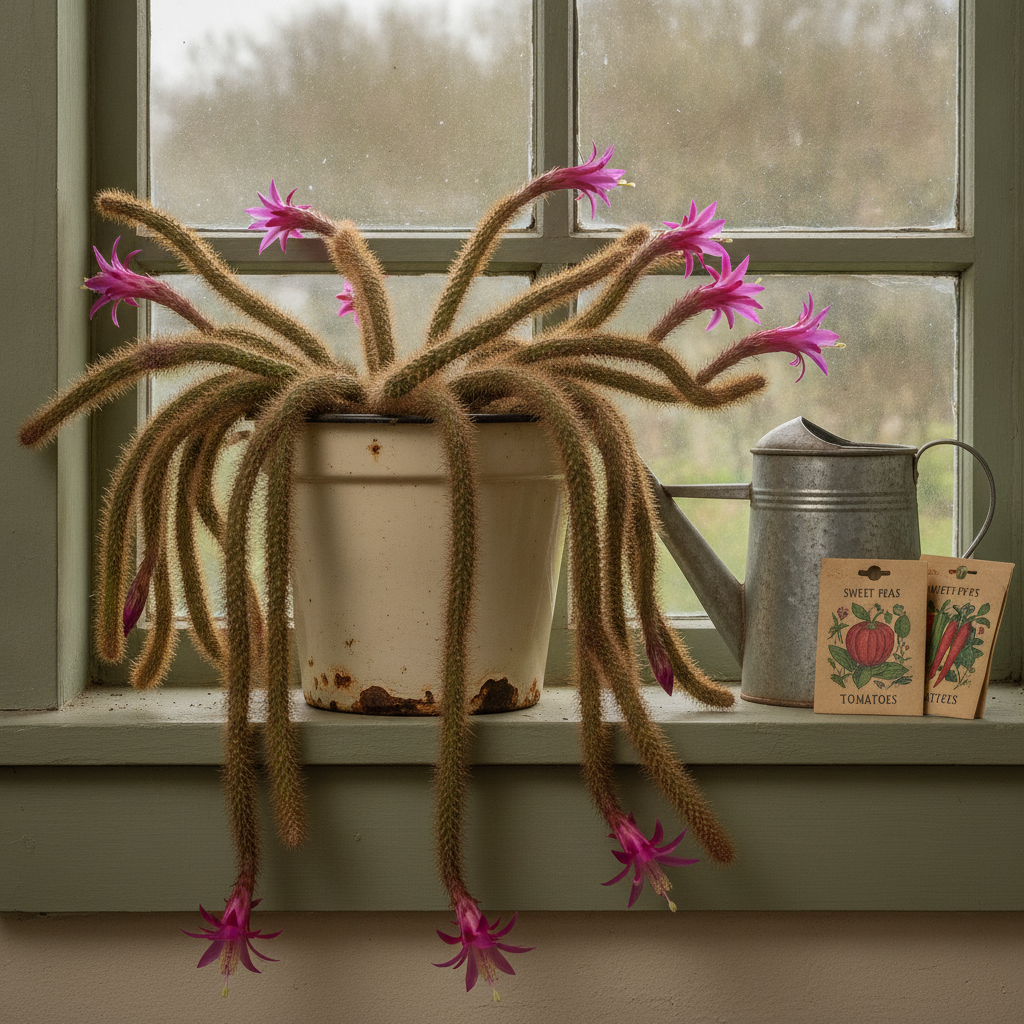
Few houseplants combine the casual toughness of a cactus with the theatrical flowering of a tropical bloomer quite like the rat tail cactus. Known botanically as Disocactus flagelliformis and sometimes sold under its older name Aporocactus flagelliformis, this trailing epiphyte is native to the rocky outcrops and dry oak forests of central and south-western Mexico, where its long pendant stems dangle from cliff faces and tree crotches rather than standing upright in desert sand. The common name comes from those slender, ribbed, densely bristled stems, which can trail to well over a metre and genuinely resemble the tails of rats or, more charitably, lengths of coiled rope. It is also widely sold as the whip cactus.
What lifts this plant from curiosity to cherished collectible is the spring flowering. For a week or two in mid-spring, mature stems erupt along their length with vivid magenta to crimson tubular blooms, each lasting several days, turning an unassuming hanging plant into one of the most spectacular flowering cacti a windowsill can hold. The rat tail cactus is famously forgiving, fast-growing and easy to propagate, which makes it an excellent choice for beginners, yet getting it to flower reliably year after year takes a little understanding of its rhythm. This guide covers everything from the bare minimum needed to keep a rat tail cactus alive to the finer points that separate a plant that merely survives from one that trails luxuriantly and blooms on cue every spring.
Contents
- Quick Reference
- Why the Rat Tail Cactus Makes a Rewarding Houseplant
- Light Requirements
- Watering and Humidity
- Soil, Potting and Repotting
- Fertilising
- Propagation
- Pests and Diseases
- Popular Varieties
- Frequently Asked Questions
Quick Reference: Rat Tail Cactus at a Glance
| Light | Bright light with several hours of direct morning or filtered sun; the brightest spot you can offer indoors |
| Watering | Regular through spring and summer once the top of the mix dries; sparse in winter to force a cool dry rest |
| Temperature | 18 to 27 degrees Celsius (64 to 81 Fahrenheit) when growing; a cool winter rest near 7 to 12 degrees Celsius (45 to 54 Fahrenheit) to set flower buds |
| Humidity | Average household humidity of 40 to 50 per cent is ample; tolerates dry air well |
| Fertiliser | A high-potassium or balanced cactus feed every two to four weeks in the growing season only |
| Toxicity | Non-toxic to cats, dogs and humans, but the fine bristly spines are a skin irritant |
Why the Rat Tail Cactus Makes a Rewarding Houseplant
The rat tail cactus earns its place on a grower’s shelf for three reasons: it is hard to kill, it grows quickly enough to feel responsive, and it flowers more reliably and more brilliantly than almost any other easy cactus. Because it is an epiphyte rather than a true desert dweller, it is more tolerant of regular watering than the barrel and pad cacti most people picture, which removes one of the most common sources of beginner anxiety. A young plant in a hanging basket will add 20 to 30 centimetres of trailing stem in a single good season, so progress is visible within weeks rather than the glacial creep of a slow succulent.
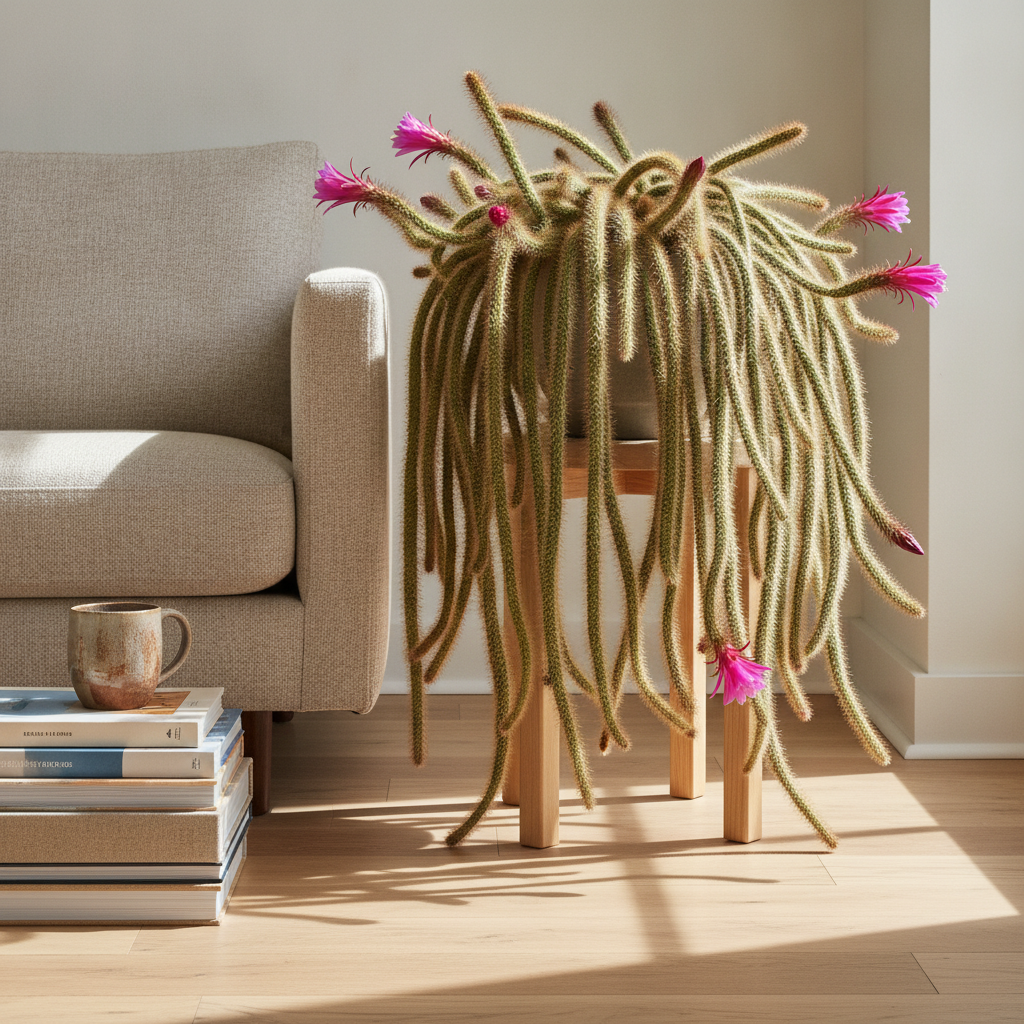
The plant also suits the way most people actually live. It thrives in the bright, slightly neglected conditions of a sunny window where more demanding tropicals would sulk, and its trailing form makes the most of vertical space that upright plants cannot use. Hung in a window or set on a high shelf, it draws the eye downward in a curtain of green that becomes a curtain of magenta in spring. For collectors of flowering plants who lack the patience or conditions for orchids, the rat tail offers a comparable payoff with a fraction of the fuss, and it propagates so readily that a single plant quickly becomes a supply of gifts.
Important — Toxicity: The rat tail cactus is not toxic to cats, dogs or people, so it poses no poisoning risk if a pet nibbles a stem. The real hazard is mechanical. The stems are clothed in fine, easily detached bristly spines that lodge in skin and are fiddly to remove, so handle the plant with care and keep it out of the reach of curious hands and paws.
Light Requirements
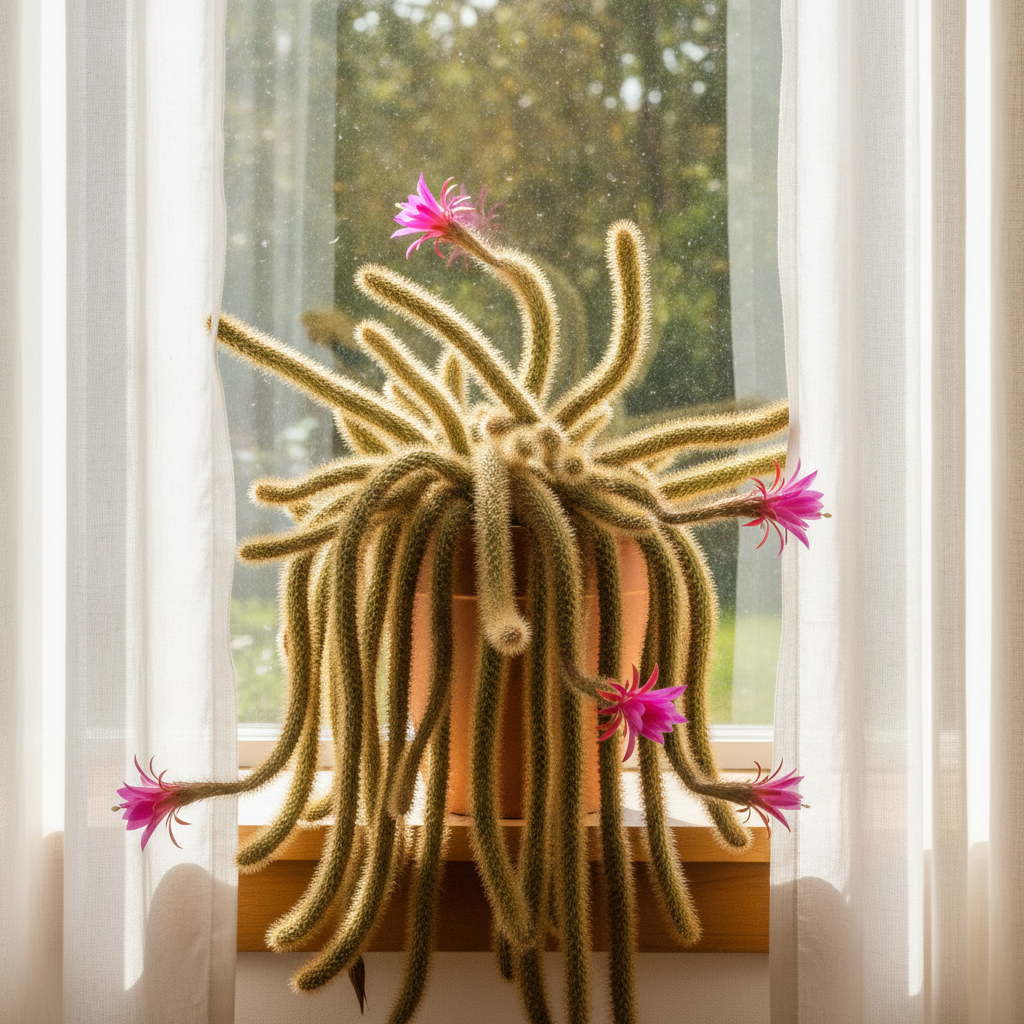
Light is the single biggest factor in whether a rat tail cactus simply grows or actually flowers. In the wild it scrambles over exposed rock and through the open canopy of dry forest, receiving strong light for much of the day with perhaps a little dappling. Indoors it wants the brightest position you can give it, and unlike many trailing houseplants it positively welcomes some direct sun, particularly the gentler rays of morning and late afternoon.
The ideal indoor spot is at or very close to a bright window where the plant receives at least three to four hours of direct sun a day alongside bright ambient light for the rest. Stems grown in good light stay plump, deep green and densely spined, and they are far more likely to initiate flower buds. Stems grown in shade become thin, pale and stretched, reaching toward the light, and such a plant will rarely if ever bloom.
Light Levels Explained
Indoor light is far dimmer than most people assume, and the difference between a metre from the window and right against the glass can be the difference between a flowering plant and a foliage-only one. The table below sets out roughly how the rat tail cactus responds across the usual spectrum of household light levels.
| Light Category | Approx. Level | Typical Location | Outcome |
|---|---|---|---|
| Direct sun | 20,000 lux and above | On a south or east windowsill | Excellent; morning and filtered sun is ideal, though harsh midday summer glare through glass can scorch |
| Bright indirect | 10,000 to 20,000 lux | Right beside a bright window | Very good growth and reliable flowering |
| Medium | 5,000 to 10,000 lux | A metre or two back from a bright window | Survives and grows slowly, but flowering becomes unreliable |
| Low | 1,000 to 5,000 lux | A dim corner or north room | Stems stretch and thin; no flowering; long-term decline |
| Very low | Below 1,000 lux | Interior wall, far from any window | Unsuitable; the plant will weaken steadily |
Window Orientation and Placement
South-facing window: In the northern hemisphere a south window offers the most light and is generally the best home for a rat tail cactus. The only caution is high summer, when midday sun magnified through glass can scorch stems; a sheer curtain during the hottest hours, or a position slightly to one side of the direct beam, prevents this.
East-facing window: An excellent choice. The plant catches several hours of gentle morning sun, which it relishes, then bright ambient light through the afternoon without the risk of scorching. Many growers find an east window produces the healthiest growth with the least intervention.
West-facing window: Also very suitable. West light arrives in the afternoon and can be intense in summer, so the same gentle shading advice as for a south window applies during heatwaves, but in general a west window supports strong growth and good flowering.
North-facing window: Generally too dim for this sun-loving cactus. A plant on a north sill will hang on but is unlikely ever to flower and will tend to produce weak, etiolated stems. If a north window is your only option, supplement with a grow light.
Pro Tip — Rotate for Even Growth: Because the stems lean hard toward the strongest light, give the basket a quarter turn every week or two. This keeps the trailing curtain even all the way round rather than bald on the shaded side, and it prevents the whole plant pulling lopsidedly toward the glass.
How Light Affects Flowering
Flower initiation in the rat tail cactus depends on a combination of strong light during the growing season and a cool, dry, bright rest over winter. Light is the foundation: a plant kept too dim simply will not accumulate the energy to form buds, no matter how perfect its winter rest. Stems that grew in good light the previous summer carry the flowers, so the brighter the position from spring through autumn, the more generous the following spring’s display. Pale, soft, distantly spaced spines and stems that flop without firmness are all signs of insufficient light and a warning that flowering will be poor.
Warning — Direct Sunlight: While the rat tail cactus loves sun, a plant moved abruptly from a dim spot into full summer glare can scorch, developing pale, papery or browned patches that never recover. Acclimatise a plant to stronger light over a week or two, and shade it during the fiercest midday hours of high summer.
Artificial Lighting
The rat tail cactus responds well to supplementary lighting, which can rescue a plant in a dim home and even coax flowering where natural light falls short. A full-spectrum LED grow light positioned 20 to 40 centimetres above the stems and run for 10 to 12 hours a day provides plenty of energy. Because the plant needs a shorter, cooler photoperiod over winter to set buds, reduce the running time of artificial lights in the colder months rather than keeping them on a fixed summer schedule all year.
Seasonal Adjustments
As autumn light weakens, move the plant to the brightest available window and resist the urge to compensate with extra warmth and water. The shortening days and cooler temperatures are exactly the cues the plant needs. In spring, as light strengthens and buds appear, return the plant to its prime growing position and resume normal care. Plants summered outdoors in a sheltered, brightly lit spot often flower especially well, but they must be hardened off gradually and brought back inside well before the first frost.
Watering and Humidity
Watering the rat tail cactus is where its epiphytic nature matters most. This is not a plant to treat like a desert cactus that is left bone dry for months. In the wild its roots cling to rock and bark where rain drains away fast but arrives regularly through the growing season, so the plant is adapted to frequent moisture followed by sharp drainage. The art is to water generously while it is growing and then to withhold almost entirely through its winter rest.
When to Water
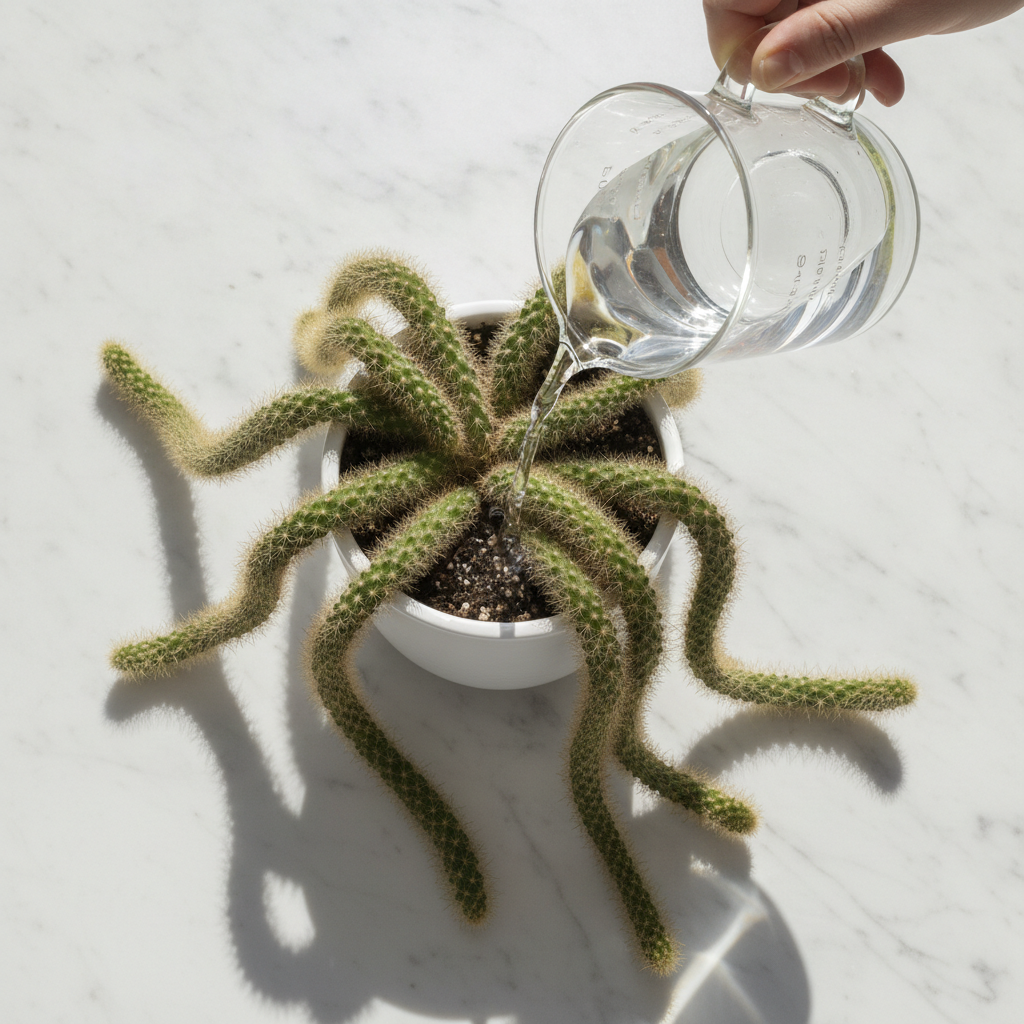
From spring through to early autumn, while the plant is actively growing, water whenever the top two to three centimetres of the mix have dried out. In a warm, bright spot this may mean watering once a week or even more often in peak summer. Always water thoroughly so that it runs from the drainage holes, then let the pot drain completely before returning it to its place. The plant should never sit in standing water.
From late autumn the picture reverses completely. To trigger flowering the following spring, the plant needs a cool, dry rest of roughly two to three months. During this period water only just enough to stop the stems shrivelling badly, perhaps a small drink once every three to four weeks, and keep it cool and bright. Once buds appear in late winter or early spring, gradually increase watering again and the plant will swing back into active growth.
Pro Tip — Read the Stems: The stems themselves are an excellent moisture gauge. Plump, firm stems mean the plant is well hydrated and can wait. Stems that feel slightly soft or look faintly wrinkled are telling you it is time to water during the growing season. During the winter rest a little wrinkling is acceptable and even desirable, so do not panic and over-water.
How to Water Correctly
- Check the mix first; water only when the top few centimetres have dried during the growing season.
- Use room-temperature water and pour evenly over the surface, avoiding a constant splash on the same spot.
- Continue until water flows freely from the drainage holes, ensuring the whole root ball is wetted.
- Let the pot drain fully for several minutes; tip out any water that collects in the saucer or cover pot.
- Return the plant to its bright position and do not water again until the surface has dried appropriately.
Signs of Overwatering vs. Underwatering
| Symptom | Overwatering | Underwatering |
|---|---|---|
| Stem colour | Yellowing, then translucent or brown and mushy patches | Dull, faded green, sometimes with a reddish stress tint |
| Stem texture | Soft, squashy, collapsing sections, often at the base | Wrinkled, shrunken, leathery but still firm |
| Mix condition | Stays wet for days, may smell sour | Pulls away from the pot edge and dries out very fast |
| Roots | Black, slimy and falling apart | Dry and brittle but otherwise intact |
| Base of plant | Brown, soft rot creeping up from soil level | Firm, though growth stalls |
Warning — Root Rot: Overwatering, especially in cool conditions or a dense, water-retentive mix, is the most common way to kill a rat tail cactus. Soft, browning stems at soil level signal advancing rot. Act fast by unpotting the plant, cutting away all mushy tissue with a clean blade, letting healthy sections callous, and rerooting them in fresh gritty mix rather than trying to save a collapsing root ball.
Humidity Requirements
One of the great conveniences of the rat tail cactus is that it has no special humidity needs. Ordinary household air of 40 to 50 per cent suits it perfectly, and it tolerates the dry conditions of a centrally heated room far better than most epiphytes. This makes it a much lower-maintenance choice than humidity-hungry plants such as ferns or calatheas.
Problems linked to air moisture are rare with this plant. Very dry air combined with under-watering during the growing season can cause stems to wrinkle, but the cure is correct watering rather than raising humidity. Excessively humid, stagnant air is more of a risk than dry air, as it encourages fungal problems on the dense stems.
There is therefore no need to mist, group plants for humidity or run a humidifier for a rat tail cactus. If anything, good air movement around the plant is more valuable than added moisture, helping the stems dry between waterings and reducing the chance of rot and fungal spotting.
Water Quality
The rat tail cactus is not especially fussy about water quality and copes with most tap water. In hard-water areas, mineral salts can accumulate over time and leave a pale crust on the mix and pot, so an occasional thorough flush with rainwater or distilled water helps keep the root zone clean. Room-temperature water is always preferable to cold water straight from the tap, which can shock the roots.
Soil, Potting and Repotting
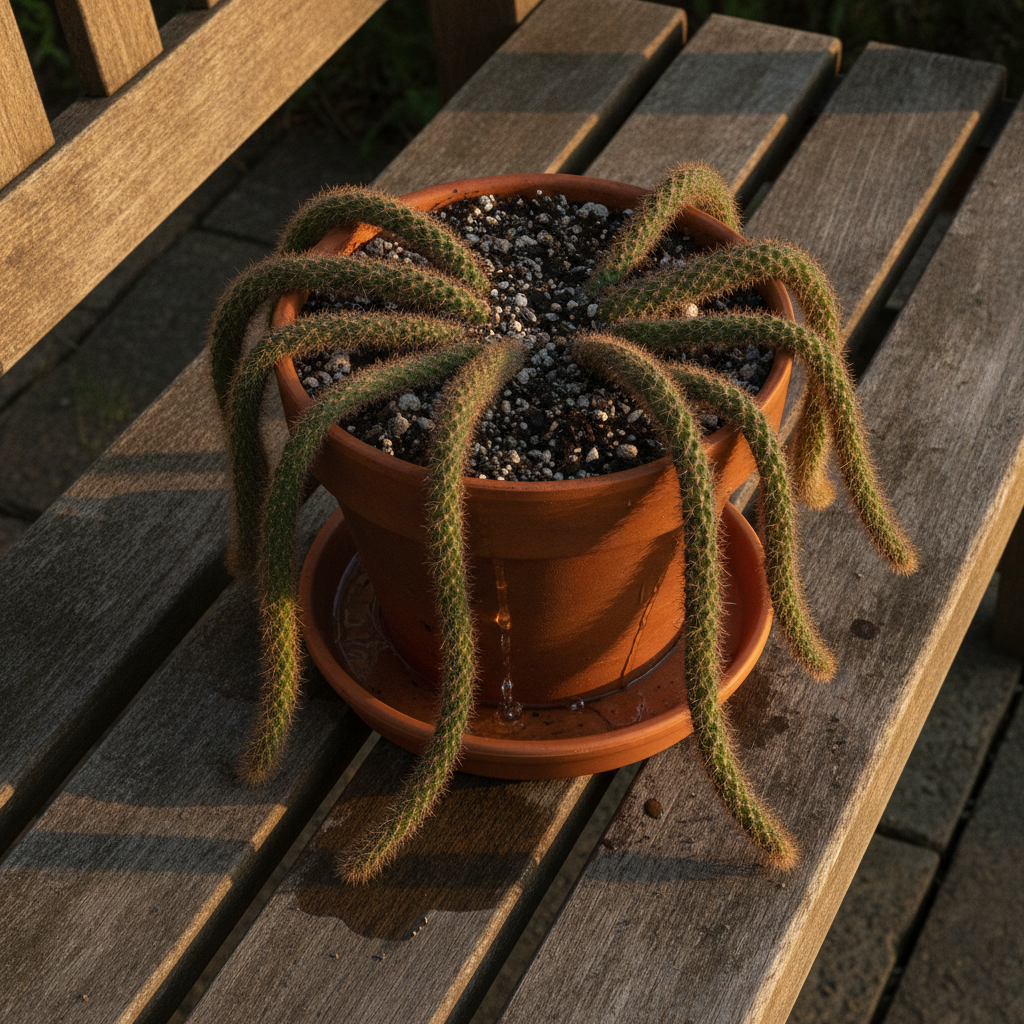
Because it is an epiphyte adapted to fast-draining footholds on rock and bark, the rat tail cactus needs an open, gritty, free-draining mix above all else. A heavy, water-retentive compost is the surest route to root rot. The aim is a medium that holds a little moisture and nutrition but drains within seconds and admits plenty of air to the roots.
Ideal Soil Composition
A good base is a proprietary cactus and succulent compost, which can be used as it comes for convenience but is improved considerably by extra grit. Many growers prefer to build a custom blend that leans toward the epiphytic, adding a little organic matter such as fine bark or coir for moisture retention while keeping the overall structure sharp and open.
| Component | Proportion | Function |
|---|---|---|
| Cactus or succulent compost | Roughly half | Base structure with light moisture and nutrient retention |
| Coarse perlite or pumice | About a quarter | Opens the mix and guarantees fast drainage and aeration |
| Fine orchid bark or coir | About a quarter | Echoes the epiphytic habit, holding a little moisture without waterlogging |
| Coarse grit or horticultural sand | A handful | Adds weight and extra sharp drainage at the root zone |
The rat tail cactus prefers a slightly acidic to neutral root environment, roughly in the range of pH 6.0 to 6.5, which most cactus mixes naturally provide. There is no need to test or adjust pH for healthy plants; simply avoid very alkaline conditions, which an occasional flush with rainwater helps prevent in hard-water areas.
Pro Tip — Quick Mix Recipe: For a reliable blend, combine two parts shop-bought cactus compost, one part coarse perlite or pumice and one part fine orchid bark, with a generous handful of grit stirred through. Water should run straight out the bottom of the pot within a second or two. If it pools on the surface, add more perlite.
Choosing the Right Pot
Given the trailing habit, a hanging basket or a raised pot that lets the stems cascade freely shows the plant at its best and keeps the brittle stems from snapping against a surface. Whatever vessel you choose, drainage and an appropriate size matter more than looks.
Drainage holes are non-negotiable. This plant must never sit in water, so any pot needs at least one generous drainage hole. Decorative cover pots without holes are fine only if the plant sits inside in a plastic nursery pot that can be lifted out to drain after every watering.
Pot material: Terracotta is an excellent choice because its porous walls wick away excess moisture and help guard against rot, which suits this rot-prone plant well. Plastic and glazed ceramic hold moisture longer, so if you use them, be more conservative with watering and lean on a grittier mix to compensate.
Pot size: The rat tail cactus actually flowers better when slightly snug in its pot, so resist the urge to overpot. Choose a container only a little larger than the root ball; an oversized pot holds a reservoir of damp mix around the roots that invites rot and discourages blooming.
When to Repot
Repot only every two to three years, or when roots are clearly filling the pot and growth has slowed. The best time is spring, after flowering has finished and as the plant moves into active growth, which lets it recover quickly. Because the trailing stems are long and brittle and the spines are an irritant, repotting a mature specimen is a two-person job or at least one done slowly and with thick gloves and a sleeve of folded newspaper to support the stems.
How to Repot: Step-by-Step
- Water lightly a day or two beforehand so the root ball holds together, and let the surface dry on the day itself.
- Protect your hands with thick gloves and gather the trailing stems gently into a loose bundle wrapped in folded newspaper or a towel.
- Ease the plant from its pot, supporting the base, and tease away the old loose mix from around the roots.
- Inspect the roots, trimming any that are blackened, soft or rotten with a clean, sharp blade.
- Settle the plant into a pot only slightly larger, at the same depth as before, and fill around it with fresh gritty mix.
- Firm the mix lightly, then wait several days before watering to let any damaged roots callous over.
Warning — Transplant Shock: Do not water a freshly repotted rat tail cactus immediately. Disturbed roots and unavoidable small breakages are open wounds that rot easily if wet. Waiting three to five days before the first watering gives those wounds time to seal and dramatically reduces the risk of losing the plant to rot after repotting.
Fertilising
Although it grows on lean substrates in the wild, the rat tail cactus is a relatively hungry plant by cactus standards during its active season, and regular feeding makes a clear difference to both growth and flowering. The key, as with watering, is to confine feeding to the growing months and stop entirely through the winter rest.
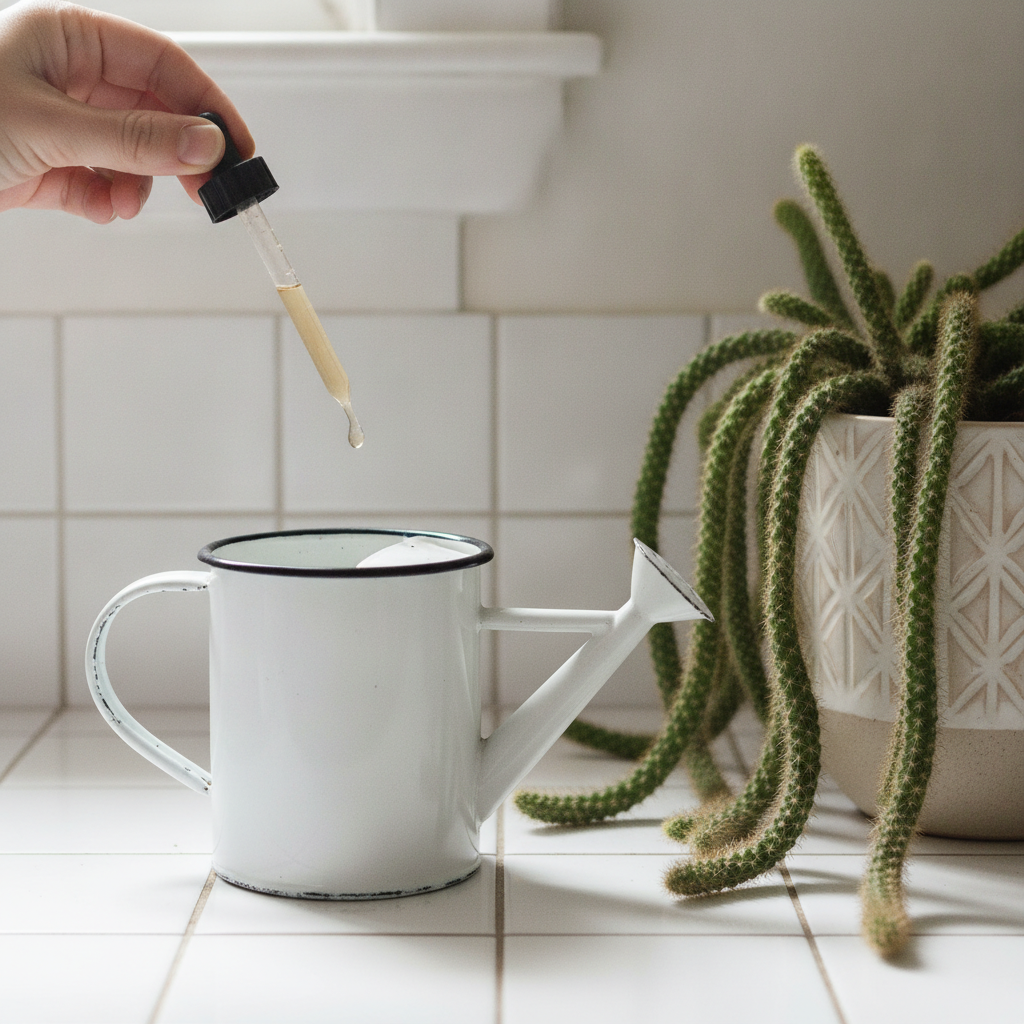
A feed that is not too heavy in nitrogen is best. High-nitrogen fertilisers push soft, sappy stem growth at the expense of flowers, whereas a formula richer in potassium encourages firm stems and abundant blooms. Many growers use a dedicated cactus fertiliser, or a high-potash tomato feed at reduced strength, to maximise the spring display.
Understanding Plant Nutrients
Fertilisers are labelled with three numbers giving the ratio of nitrogen, phosphorus and potassium, the three nutrients plants use in the largest quantities. For a flowering cactus like this one, a balanced or potassium-leaning ratio serves better than a high-nitrogen lawn-style feed. The table below outlines the main nutrients and what their shortage looks like.
| Nutrient | Symbol | Primary Function | Deficiency Symptoms |
|---|---|---|---|
| Nitrogen | N | Drives green stem growth | Pale, slow, weak growth overall |
| Phosphorus | P | Supports roots and flower formation | Poor rooting and sparse flowering |
| Potassium | K | Firms stems and promotes blooming | Soft growth, few flowers, low stress tolerance |
| Calcium | Ca | Builds strong cell walls | Distorted or weak new growth |
| Magnesium | Mg | Central to chlorophyll | Yellowing on older stems |
| Iron | Fe | Needed for green pigment | Yellowing on newest growth |
Types of Fertiliser
Liquid fertilisers: The most practical option for this plant. Diluted into the watering can, they are easy to control and can be stopped instantly for the winter rest. A cactus feed or a half-strength high-potash tomato feed applied with watering works very well.
Slow-release granular: Convenient but harder to switch off, which is a drawback for a plant that needs a clear dormant period with no feeding. If you use granules, choose a low dose and apply only in early spring so the supply tails off naturally by autumn.
Organic fertilisers: Gentle options such as dilute worm-casting tea provide a mild, balanced supply with little risk of burning. They are a fine choice for growers who prefer organic methods, though they tend to be lower in the potassium that drives flowering.
Feeding Schedule
Feed every two to four weeks from spring, once growth resumes, through to the end of summer. Taper off in early autumn and stop completely through the winter rest, resuming only when active growth and buds reappear in spring. A useful rhythm is to begin feeding as flower buds swell, support the plant through flowering and the flush of summer growth, then withdraw feed to usher it into dormancy.
Pro Tip — Feed at Half Strength: Always dilute fertiliser to half the dose recommended on the bottle. The rat tail cactus responds well to a little and often, and a weaker solution applied regularly avoids the fertiliser burn and salt build-up that a full-strength feed can cause in a small pot.
How to Fertilise
- Water the plant lightly first if the mix is very dry, so the feed does not contact parched roots directly.
- Mix a liquid fertiliser into your watering water at half the recommended strength.
- Apply it as a normal watering, wetting the whole root zone until it drains from the bottom.
- Let the pot drain fully and tip away any run-off so salts do not concentrate in a saucer.
- Resume plain water for the next watering or two before feeding again.
Warning — Salt Build-Up: Fertiliser salts accumulate in the mix over time and can scorch roots, showing as browned, crusty growth and a white deposit on the soil or pot. Flush the pot thoroughly with plain water every couple of months during the feeding season, letting plenty run through, to wash these salts away.
Propagation
Propagation is where the rat tail cactus truly shines for the impatient grower. Few plants are easier to multiply, and a single healthy specimen can supply a whole shelf of new plants or a steady stream of gifts. The standard method is stem cuttings, which root quickly and reliably, while seed is possible but far slower and rarely worth the wait.
The best time to take cuttings is spring or early summer, when the plant is in active growth and wounds heal fastest. Because the stems are brittle, cuttings often present themselves naturally when a section snaps off during handling or repotting, and these accidental pieces root just as well as deliberate cuttings.
Understanding the Stems
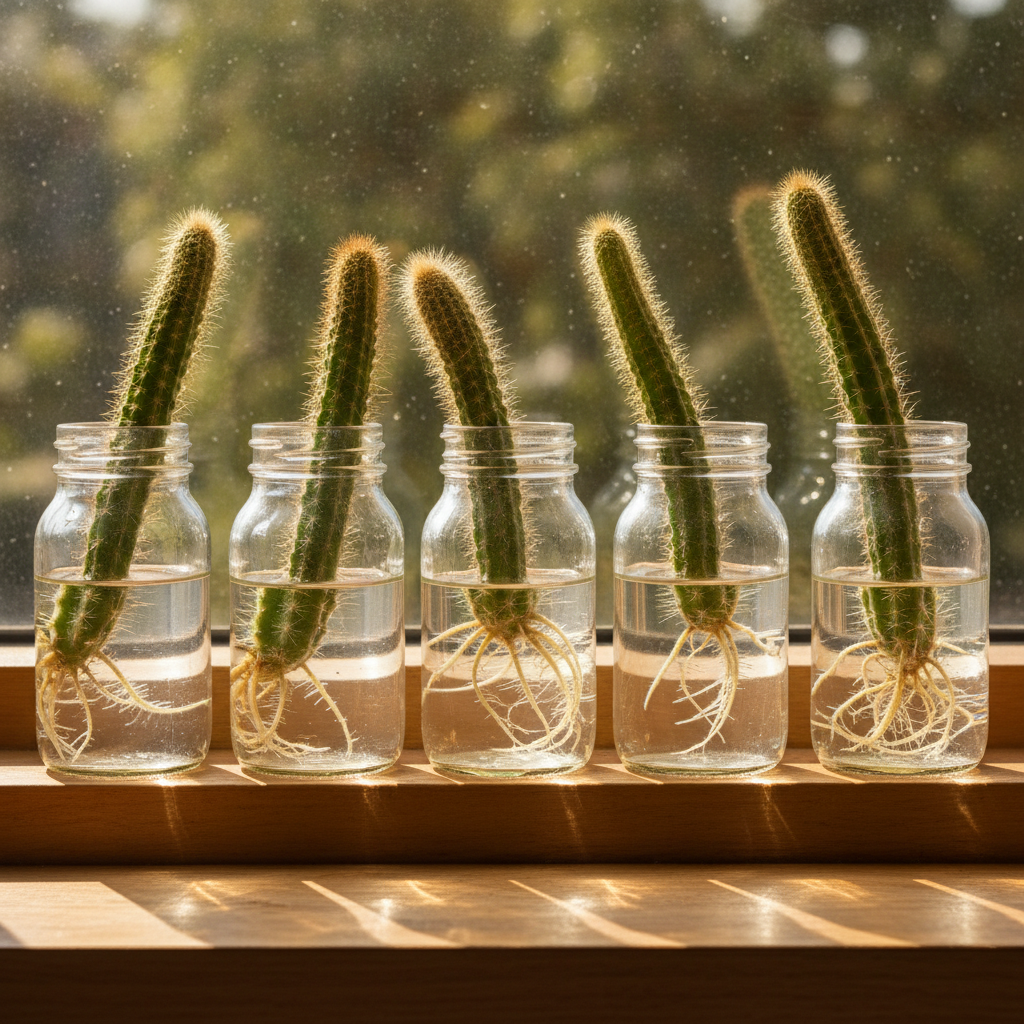
Each rat tail stem is a self-contained propagule. Cut or broken into sections of around 10 to 15 centimetres, every healthy piece is capable of forming its own roots from the cut end and growing into a new plant. The crucial step that beginners often miss is allowing the cut to dry and callous before it touches any moisture, because a fresh wet wound on a cactus is an open invitation to rot.
Stem Cuttings in Soil: Step-by-Step
Rooting directly in a gritty mix is the most reliable method and produces sturdy plants that never need transferring from water to soil.
- Wearing gloves, cut or select healthy stem sections of 10 to 15 centimetres, ideally with the natural growing tip on at least some pieces.
- Lay the cuttings in a dry, shaded spot for three to seven days until the cut ends form a dry, calloused seal.
- Insert the calloused end a couple of centimetres into a pot of barely moist gritty cactus mix, several cuttings to a pot for a full look.
- Place the pot in bright, indirect light and keep it warm, watering only very lightly until roots establish.
- After three to six weeks a gentle tug should meet resistance, signalling roots; from then on water as for a mature plant.
Pro Tip — Plant in Clusters: Root several cuttings together in one pot rather than singly. The rat tail cactus naturally looks best as a full curtain of many stems, and starting a clutch of cuttings together gives you a lush, shapely plant far sooner than waiting for one cutting to branch out.
Water Rooting: Step-by-Step
Rooting in water is a popular alternative that lets you watch progress, though the roots it produces are slightly more delicate and the cuttings must still be calloused first.
- Callous the cuttings for several days exactly as for soil propagation.
- Suspend each cutting so only the very base touches the water in a jar, keeping most of the stem dry.
- Set the jar in bright, indirect light and refresh the water every few days to keep it clean.
- When roots reach two to three centimetres, pot the cutting into gritty mix and keep it lightly moist while it adjusts.
Troubleshooting Propagation
| Problem | Likely Cause | Solution |
|---|---|---|
| Cutting turns soft and brown | Planted before calousing, or kept too wet | Discard the rotten cutting; callous future cuttings longer and keep the mix barely moist |
| No roots after many weeks | Too cold, too dark, or cutting from old wood | Move somewhere warmer and brighter and be patient; use vigorous young stems |
| Cutting shrivels badly | Air too dry and no roots yet to draw water | A little patience is normal, but a humidity tent or light misting of the air can help it hold on |
| Rooted cutting fails after potting | Over-watered once moved to soil | Treat newly potted cuttings cautiously, letting the mix dry well between drinks |
Pests and Diseases
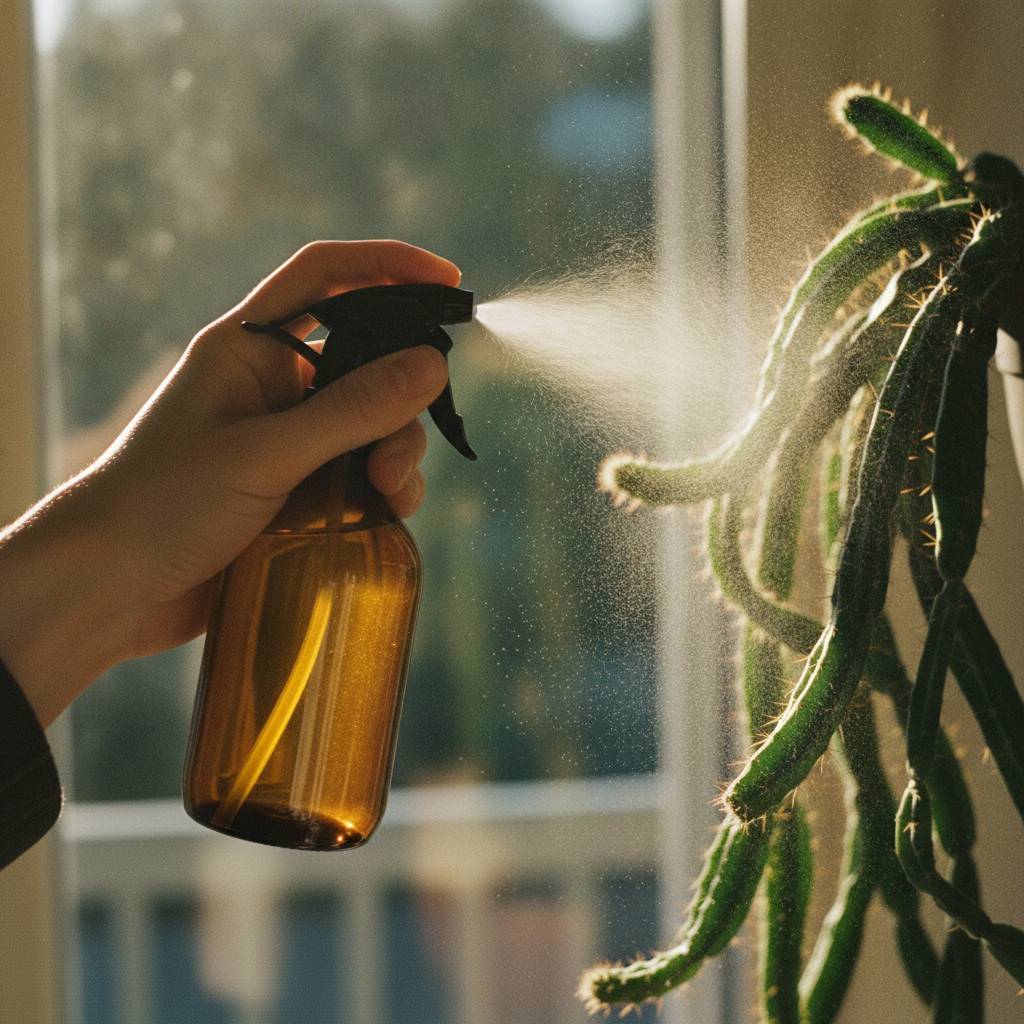
The rat tail cactus is robust and not especially prone to pests, but like any houseplant it can fall victim to the usual sap-suckers, and its dense, spiny stems can make infestations awkward to spot and to treat. Regular inspection, made easier by the plant’s habit of hanging at eye level, is the best defence.
By far the most serious threats, however, are not insects but the diseases that follow over-watering. Root and stem rot account for more dead rat tail cacti than every pest combined, so cultural care remains the foundation of plant health.
Common Pests
Mealybugs (Pseudococcus species)
Mealybugs are the most frequent pest, showing as small, white, cottony tufts tucked between the ribs and among the spines where they are easily hidden. They suck sap, weaken the plant and leave sticky honeydew that can turn sooty and black.
Treatment: Dab each insect with a cotton bud dipped in diluted isopropyl alcohol, then treat the whole plant with a neem oil or insecticidal soap solution, repeating weekly until the infestation clears. Isolate the plant while treating to protect your other plants.
Scale Insects (Coccidae family)
Scale appear as small, hard, brown, limpet-like bumps clinging to the stems. Static and easily mistaken for part of the plant, they too drain sap and excrete honeydew, causing yellowing and weak growth over time.
Treatment: Scrape or rub them off gently with a fingernail or cotton bud soaked in diluted alcohol, then follow up with neem oil to catch the mobile young. Persistent inspection over several weeks is needed to break the cycle.
Spider Mites (Tetranychus urticae)
Spider mites thrive in hot, dry conditions and are tiny enough to escape casual notice, betraying themselves through fine webbing among the spines and a stippled, dull, faintly bronzed look to the stems. They reproduce explosively in warm rooms.
Treatment: Rinse the plant where practical, then apply neem oil or a miticide and repeat at regular intervals to break the rapid life cycle. Improving air circulation discourages their return.
Common Diseases
Root and Stem Rot (Pythium and Fusarium species)
The number one killer of this plant, root rot is caused by soggy, airless conditions in which fungal and water-mould pathogens attack the roots and creep up into the stem bases, turning them soft, brown and mushy. By the time it shows above the soil it is often well advanced.
Treatment: Unpot the plant, cut away every soft, discoloured section back to firm healthy tissue with a sterile blade, let the wounds callous, and reroot the salvageable stems in fresh dry gritty mix. Prevent recurrence by watering correctly and using a free-draining medium.
Fungal Leaf and Stem Spot (various fungi)
In damp, stagnant, poorly ventilated conditions, fungal spotting can appear as small, sunken, discoloured lesions on the stems. While rarely fatal, it disfigures the plant and can spread if conditions stay humid and still.
Treatment: Remove affected stem sections, improve air movement around the plant, reduce watering and avoid wetting the stems unnecessarily. A copper-based or general fungicide can help in stubborn cases.
Pest and Disease Summary
| Pest / Disease | Identification | Treatment |
|---|---|---|
| Mealybugs | White cottony tufts between ribs and spines | Alcohol dab plus repeated neem oil |
| Scale | Hard brown bumps on stems | Scrape off and treat with neem oil |
| Spider mites | Fine webbing and dull stippled stems | Rinse and apply neem oil or miticide |
| Root and stem rot | Soft, brown, mushy bases | Cut back to healthy tissue and reroot |
| Fungal spot | Sunken discoloured lesions | Remove parts, improve airflow, fungicide if needed |
Prevention Strategies
Prevention rests on two pillars: correct culture and vigilance. A plant grown in bright light, a gritty mix and a sensibly sized pot, watered with restraint and never left sodden, is naturally resistant to both rot and pests. Good air movement around the hanging stems keeps fungal trouble at bay and makes conditions less comfortable for mites.
Inspect new arrivals carefully and keep them apart from your collection for a couple of weeks, since most infestations are introduced on incoming plants. Check your rat tail cactus whenever you water, parting the stems to look between the ribs where mealybugs and scale love to hide, and act at the first sign of trouble while it is still easy to control.
Pro Tip — Neem as Routine Defence: A monthly preventative spray of dilute neem oil through the growing season deters mealybugs, scale and mites before they take hold. Apply it in the evening or out of direct sun so the oil does not magnify the light and mark the stems, and never spray a plant that is dry at the root.
Popular Varieties
The straight species, Disocactus flagelliformis, remains the most widely grown form and is hard to better for sheer flowering generosity, but its ease of crossing with related epiphytic cacti has produced a lively range of hybrids. These crosses keep the trailing, whip-like habit while expanding the colour range and, in some cases, producing thicker, sturdier stems and even larger blooms.
For most growers the choice comes down to the classic species for its dense magenta display, or one of the named hybrids for a particular flower colour or a slightly more robust plant. All share the same easy care, so selection is purely a matter of taste and availability.
| Variety | Stem Appearance | Light Needs | Growth Rate | Availability |
|---|---|---|---|---|
| Species (Disocactus flagelliformis) | Slender, densely bristled, trailing to a metre or more | Bright, some direct sun | Fast | Common |
| Mallison’s Rat Tail (Disocactus × mallisonii) | Thicker, firmer stems with very large red flowers | Bright, some direct sun | Moderate to fast | Occasional |
| Aporophyllum hybrids | Trailing stems, blooms in pink, orange, red and bicolours | Bright, some direct sun | Fast | Specialist nurseries |
| White or pale forms | As species but with paler pink to near-white flowers | Bright, some direct sun | Fast | Rare |
Featured Varieties
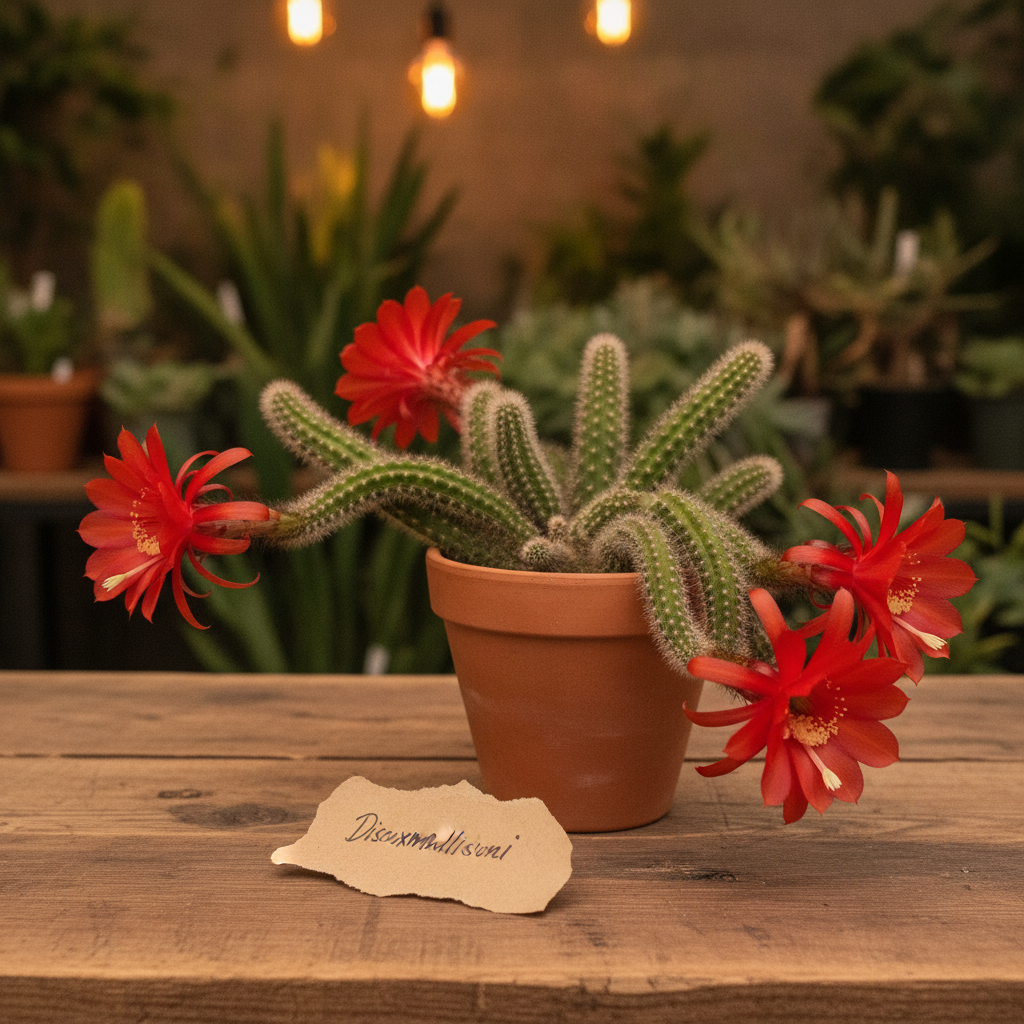
Mallison’s Rat Tail
A vigorous hybrid with noticeably thicker, more substantial stems than the species and large, brilliant scarlet-red trumpet flowers. Its sturdier growth makes it a little easier to handle and a striking choice where bold red blooms are wanted.
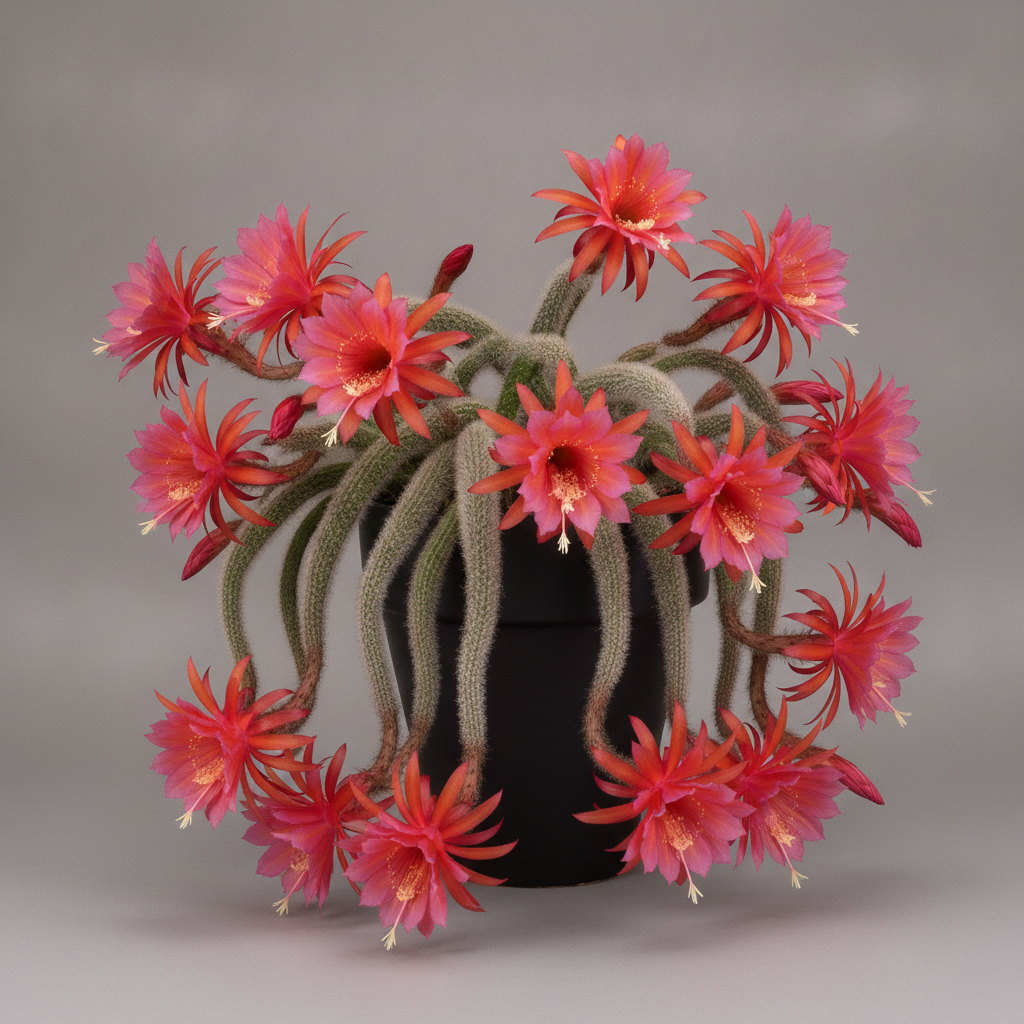
Aporophyllum Hybrids
Modern crosses between the rat tail cactus and its larger-flowered epiphyllum relatives, these keep the trailing spiny stems but bloom in an expanded palette of pinks, oranges, reds and bicolours, often with showier, larger flowers than the species.
Variety Profiles in Detail
Species Rat Tail Cactus (Disocactus flagelliformis)
The original and still the benchmark, the species produces the longest, most slender trailing stems and a dense spring flush of vivid magenta to pink tubular flowers along their length. It is the most widely available form, the easiest to source as cuttings, and the standard against which the hybrids are judged.
Mallison’s Rat Tail (Disocactus × mallisonii)
A celebrated old hybrid, sometimes listed under its former name Aporocactus mallisonii, raised by crossing the rat tail cactus with a larger-flowered relative. The result has thicker, firmer, more upright then trailing stems and produces large, intense red flowers. It is slightly less common but prized for its bold blooms and tidier habit.
Aporophyllum Hybrids (Aporophyllum cultivars)
This group gathers the many named crosses between Disocactus and Epiphyllum, bred chiefly for flower size and colour. They trail much like the species but offer a far wider colour range, including soft pinks, hot oranges and rich reds, and are the route to take for collectors seeking something beyond the classic magenta. They are mostly found through specialist cactus and succulent nurseries.
Choosing the Right Variety for Your Space
For a first rat tail cactus, the species is the obvious and most rewarding choice, widely sold, inexpensive and astonishingly free-flowering in a bright window. If you want a particular flower colour or a sturdier plant that is easier to handle, seek out Mallison’s Rat Tail or one of the Aporophyllum hybrids from a specialist grower. Whichever you choose, give it the brightest spot you have, a gritty mix and a cool winter rest, and any of these forms will reward you with one of the most spectacular spring displays in the houseplant world.
Frequently Asked Questions
Why is my rat tail cactus not flowering?
The two usual culprits are too little light and the lack of a proper winter rest. The plant needs a very bright position with some direct sun through the growing season to build up energy, and then a cool, dry, bright spell of two to three months over winter to set buds. A plant kept warm and watered all year, or grown in a dim spot, will produce stems but rarely flowers.
How often should I water a rat tail cactus?
During spring and summer, water whenever the top two to three centimetres of mix have dried, which often means weekly in a warm, bright room. In winter, cut back drastically to a small drink every three to four weeks, just enough to stop severe shrivelling, as part of the cool rest that triggers flowering.
Is the rat tail cactus safe around pets?
Yes, it is not toxic to cats, dogs or people, so it will not poison a pet that chews a stem. The real concern is the fine bristly spines, which detach easily and can lodge painfully in mouths, paws or skin, so it is still best displayed out of reach of pets and small children.
Why are the stems going soft and brown?
Soft, brown, mushy stems almost always indicate rot from over-watering or poor drainage, particularly in cool conditions. Reduce watering immediately, check the roots, cut away any affected tissue back to firm green growth, and reroot healthy sections in fresh gritty mix if the base is failing.
How fast does a rat tail cactus grow?
It is one of the faster-growing cacti. In a bright spot with good care, established plants can add 20 to 30 centimetres of trailing stem in a single growing season, so a young cutting becomes an impressive hanging specimen within a couple of years.
Can I grow a rat tail cactus from a cutting?
Very easily. Cut or use a broken stem section of 10 to 15 centimetres, let the cut end dry and callous for several days, then insert it into gritty cactus mix. Roots usually form within three to six weeks. This is the quickest and most reliable way to make new plants.
What kind of pot is best for a rat tail cactus?
A hanging basket or raised pot suits the trailing habit and protects the brittle stems. Terracotta is ideal because it breathes and helps the mix dry out, reducing rot risk. Whatever you choose must have drainage holes, and a snug pot rather than an oversized one actually encourages better flowering.
Do the flowers last long?
Each individual bloom lasts only a few days, but a healthy plant opens flowers in succession along its stems over a period of a week or two in mid-spring, so the overall display is generous even though no single flower is long-lived. Good light and a proper winter rest produce the most flowers.






