

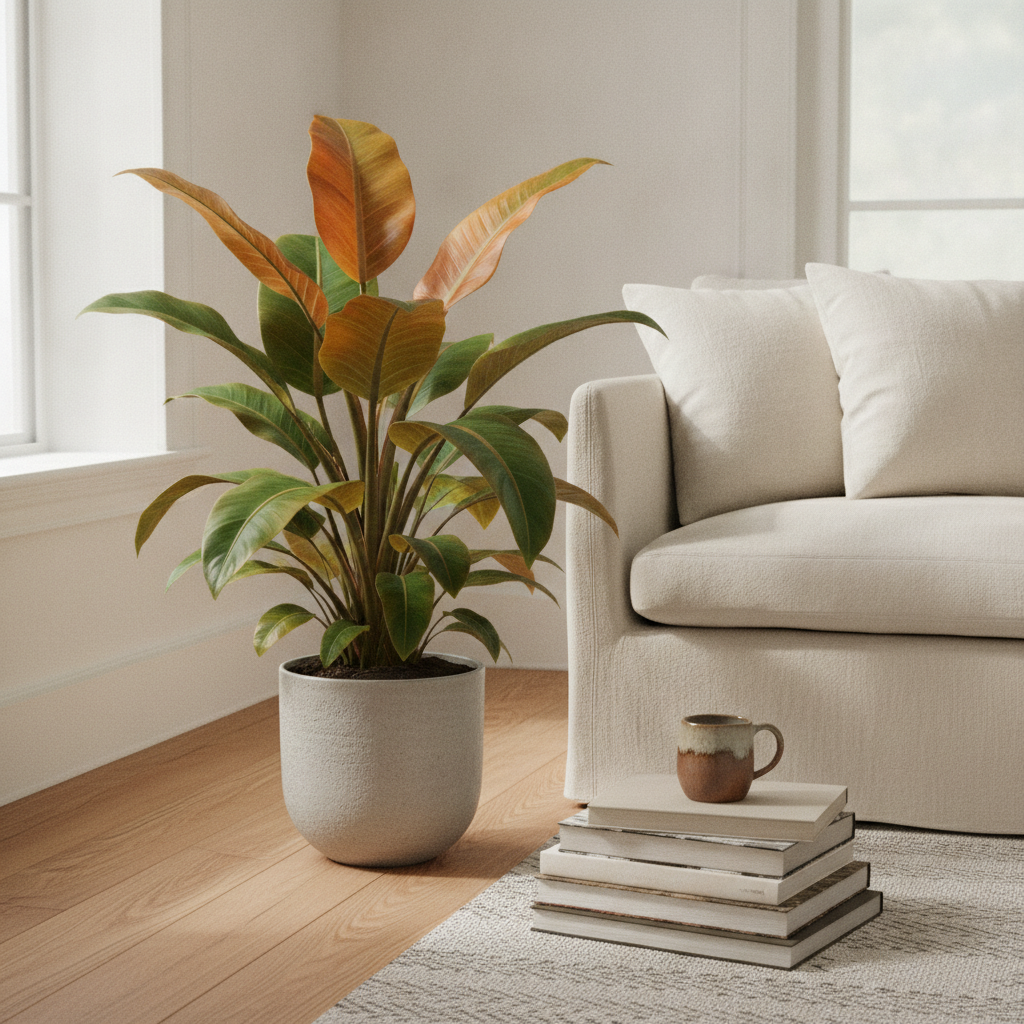
Few houseplants put on a colour show quite like the Prince of Orange philodendron. A self-heading hybrid of Philodendron erubescens, it unfurls each new leaf in a glowing copper-orange that slowly ripens through amber and chartreuse to a settled deep green, so a healthy plant carries several stages of that gradient at once. Unlike its climbing cousins, it grows from a central crown into a tidy rosette rather than a trailing vine, which makes it one of the easier coloured-leaf aroids to keep looking full and shapely indoors. The difference between a Prince of Orange that merely survives and one that genuinely thrives comes down to a handful of details: enough bright, indirect light to fuel the orange pigment, a chunky mix that never stays soggy, and steady warmth and humidity. Get those right and the plant rewards you with a near-constant rotation of fiery new growth.
Quick Reference
The table below summarises the conditions a Prince of Orange needs to thrive indoors. Use it as a snapshot, then read the sections that follow for the reasoning behind each figure and the adjustments that suit your particular home.
| Common name | Prince of Orange philodendron, orange philodendron |
| Botanical name | Philodendron erubescens ‘Prince of Orange’ |
| Plant family | Araceae (the aroids) |
| Growth habit | Self-heading rosette, non-climbing |
| Mature size | 45 to 60 cm (18 to 24 in) tall and wide indoors |
| Light | Bright, indirect light |
| Water | When the top 2 to 4 cm (1 to 1.5 in) of mix is dry |
| Soil | Chunky, free-draining aroid mix |
| Temperature | 18 to 27 degrees C (64 to 81 degrees F) |
| Humidity | 50 to 60 per cent or higher |
| Fertiliser | Balanced feed, monthly in the growing season |
| Propagation | Division of the crown and basal offsets |
| Toxicity | Toxic to cats, dogs and humans if chewed |
Why the Prince of Orange Makes a Rewarding Houseplant
The Prince of Orange is a patented hybrid bred from Philodendron erubescens, the blushing philodendron native to the rainforests of Colombia and surrounding parts of tropical South America. Where the wild parent climbs, this cultivar was selected for a self-heading habit, meaning it produces its leaves from a tight central crown and stays as a compact, shrubby rosette rather than sending out a long vine. For an indoor grower that habit is a gift: the plant fills a pot attractively, needs no moss pole or trellis, and keeps its dramatic foliage at eye level where you can actually appreciate it.
That foliage is the whole point. Each leaf emerges a vivid, almost neon orange, then transitions over several weeks through warm amber and yellow-green before maturing to a glossy deep green. Because the plant is always pushing new growth from the centre, a well-grown specimen displays the full gradient simultaneously, like a slow-motion sunset frozen in a pot. The colour is genuinely light-dependent, which is the single most useful thing to understand about the plant: starve it of light and the new leaves come in muddier and greener, while generous bright indirect light produces the saturated copper tones that make people stop and ask what it is.
Beyond its looks, the Prince of Orange earns its keep by being forgiving. It tolerates ordinary household conditions better than many of the fussier coloured aroids, recovers gracefully from the occasional missed watering, and rarely outgrows its welcome thanks to its modest mature size. It is the kind of plant that suits a confident beginner ready to move beyond a pothos, as well as a collector who wants a reliable splash of warm colour among a shelf of greens.
Pro Tip — Reading the colour: Treat your newest leaves as a light meter. If fresh growth comes in a rich orange and holds the tone for a week or two, your light levels are spot on. If new leaves are pale, green from the start, or quick to fade, move the plant somewhere brighter.
Light
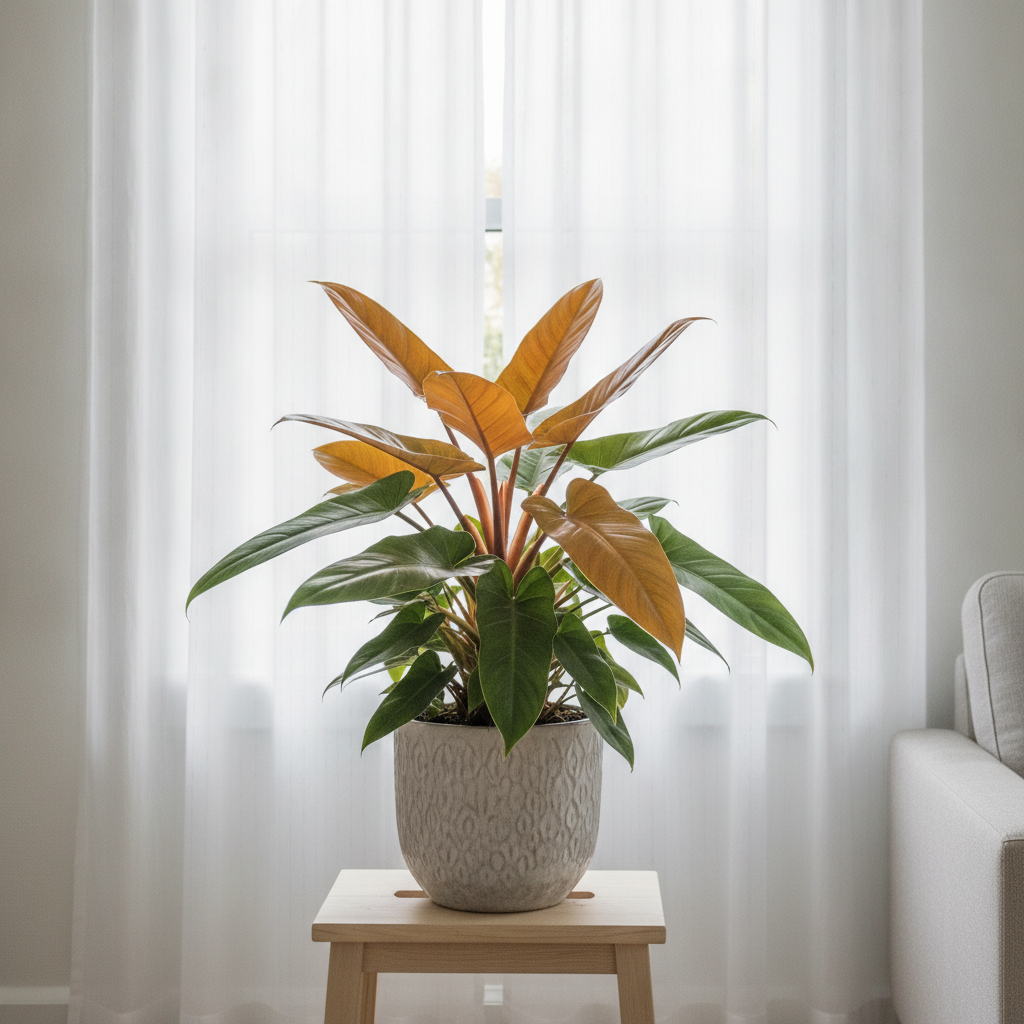
Light is where the Prince of Orange separates surviving from thriving more dramatically than almost any other care factor. The plant will stay alive in moderate light, but its defining colour simply will not develop properly without plenty of bright, indirect exposure. The orange and amber pigments in the new foliage are produced in response to good light levels, so the brighter the spot, within reason, the more saturated and longer-lasting the colour.
The ideal position is a metre or so back from an east or west-facing window, or directly in a north-facing window in the northern hemisphere, where the plant receives several hours of strong but diffused light each day. A south-facing window works beautifully provided the harsh midday sun is softened by a sheer curtain or by setting the plant slightly off to one side. Direct, unfiltered sun falling on the leaves for long stretches will scorch them, leaving bleached or crispy brown patches that do not recover, so the goal is brightness without a direct beam striking the foliage.
In a darker room, or through the short days of winter, a full-spectrum LED grow light makes an enormous difference and is the most reliable way to keep colour strong year round. Position it 30 to 45 cm (12 to 18 in) above the crown and run it for ten to twelve hours a day. Whatever the source, rotate the pot a quarter turn every week or two so the rosette grows evenly rather than leaning toward the light, which keeps the plant symmetrical and full on all sides.
Warning — Sudden moves: A plant acclimatised to a dim corner can sunburn if you abruptly relocate it to a bright window. Increase light over a week or two, shifting it gradually closer, so the leaves adjust without shock.
Watering
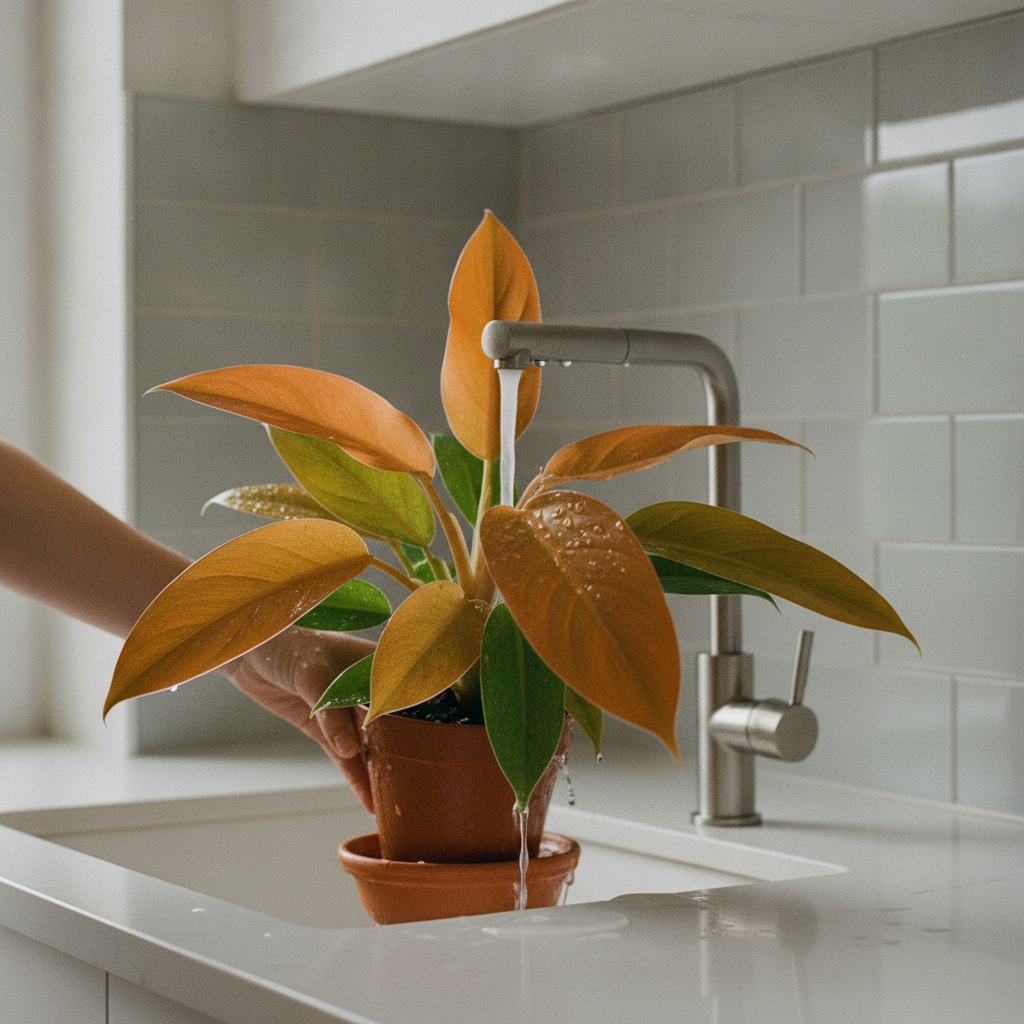
The Prince of Orange likes its soil to be kept lightly moist during active growth but never waterlogged, and the surest way to kill one is to overwater it. As an aroid with relatively fine roots, it is highly susceptible to root rot when left sitting in saturated mix, so the rhythm to aim for is a thorough soak followed by a partial dry-down rather than constant dampness. In practice, water when the top 2 to 4 cm (1 to 1.5 in) of the mix feels dry to the touch. Pushing a finger into the surface, or lifting the pot to judge its weight, is far more reliable than watering on a fixed calendar.
When you do water, do it properly. Pour evenly across the surface, or run the pot under a tap, until water flows freely from the drainage holes, which ensures the entire root ball is wetted and flushes out accumulated mineral salts. Let the pot drain completely and never leave it standing in a full saucer, as the trapped water is the most common route to rot. If your tap water is heavily chlorinated or very hard, letting it stand overnight or using filtered or rainwater will spare the leaf tips from the brown edges that mineral build-up can cause.
Watering needs shift with the seasons. Through spring and summer the plant drinks steadily and the surface dries quickly, so you may water once or twice a week. In autumn and winter, as growth slows and light wanes, the mix stays wet far longer and the interval can stretch to every ten days or fortnight. Always let the plant’s actual dryness, not the date, set the pace. Drooping leaves that perk up within hours of watering signal you waited a touch too long, while yellowing lower leaves and a persistently wet, sour-smelling mix point to overwatering.
Soil
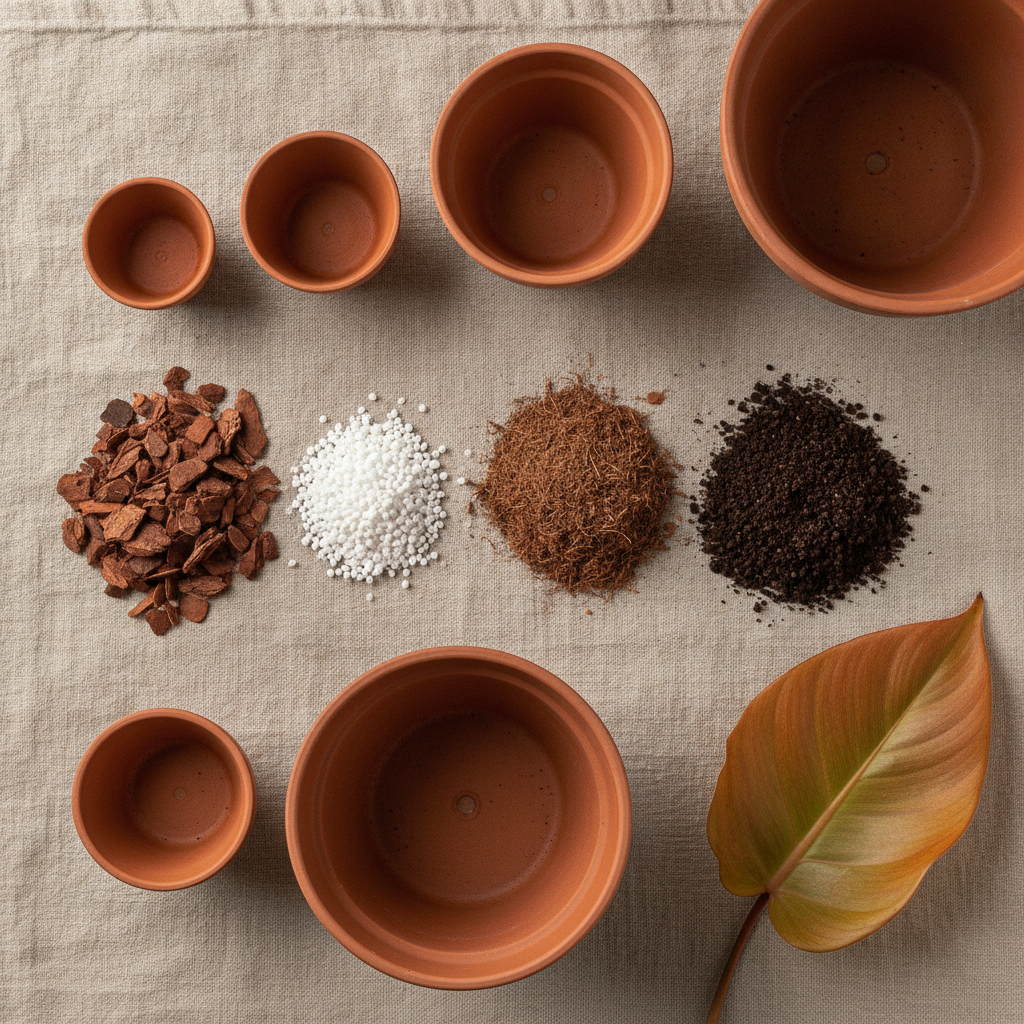
In the wild, Philodendron erubescens roots into loose forest-floor litter and the crevices of trees, so its roots expect plenty of air alongside moisture. A dense, water-retentive potting soil suffocates them, which is why the single best thing you can do for a Prince of Orange is to plant it in a chunky, free-draining aroid mix. The mix should hold enough moisture to stay lightly damp after watering yet drain fast enough that no part of it turns to mud.
A reliable blend starts with a quality peat-free or peat-based potting compost as the base, lightened generously with chunky ingredients. A good working ratio is roughly equal parts potting mix, orchid bark and perlite, with a couple of handfuls of coco coir or worm castings stirred in for moisture retention and gentle nutrition. The bark creates the air pockets the roots crave, the perlite keeps everything draining, and the coir stops the mix drying out too violently. If you prefer to buy ready-made, a bagged aroid or monstera mix is a convenient shortcut that needs little adjustment.
Whatever the mix, the pot matters just as much. Always choose a container with drainage holes, and favour a pot only slightly larger than the root ball, since a vast pot holds a reservoir of wet mix the small root system cannot use, inviting rot. Terracotta is a forgiving choice because its porous walls let excess moisture evaporate. Repot every one to two years, or when roots circle the base or push through the drainage holes, refreshing the mix and moving up just one pot size. Spring, as growth accelerates, is the ideal time to do it.
Pro Tip — The squeeze test: Wet a handful of your finished mix and squeeze it. It should clump briefly then fall apart, with water running out rather than staying packed like a mud pie. If it holds together as a dense ball, add more bark and perlite before you plant.
Fertilising
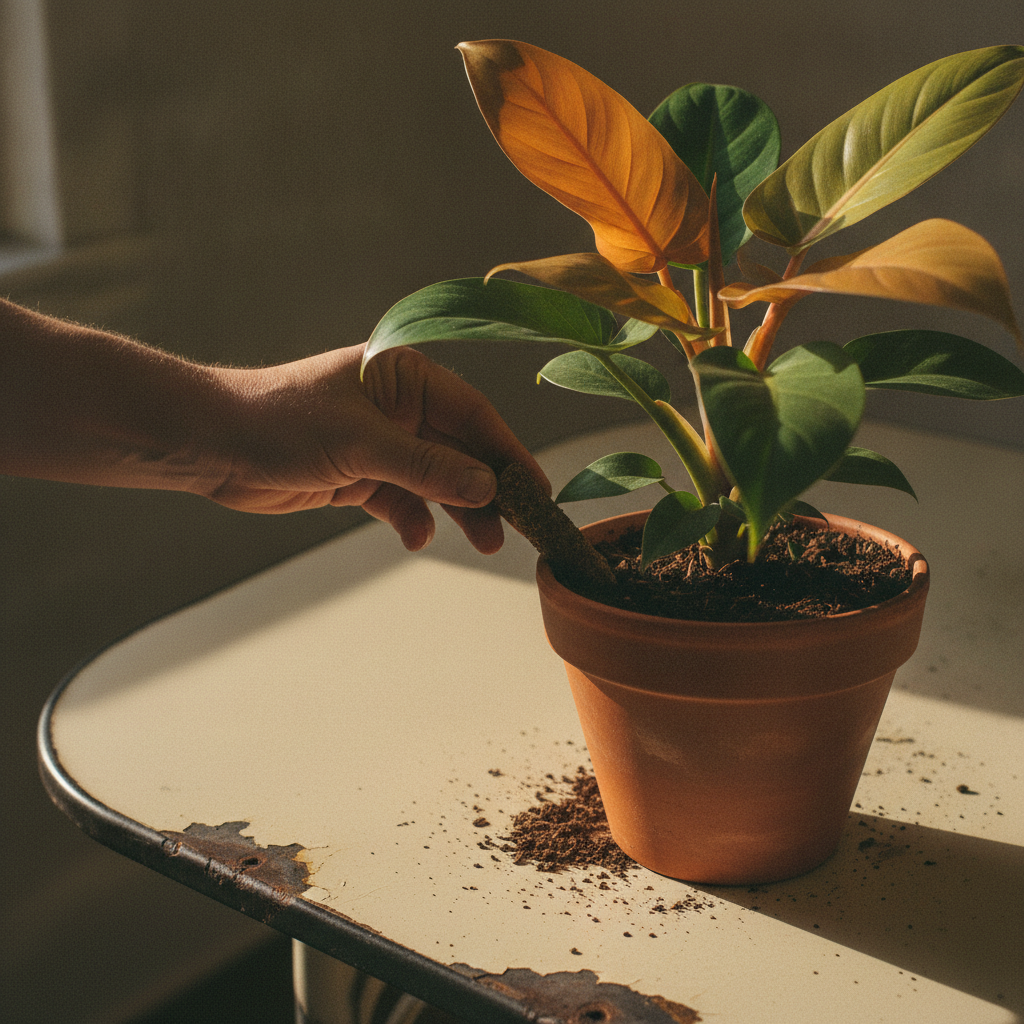
Because the Prince of Orange is constantly producing new leaves, it appreciates a steady supply of nutrients through the growing season, but it is not a heavy feeder and is easily harmed by too much. A balanced liquid houseplant fertiliser, diluted to roughly half the strength printed on the label, applied once a month from spring through to early autumn, is plenty to sustain vigorous, well-coloured growth. Always feed onto already-damp soil rather than a bone-dry root ball, as fertiliser applied to dry roots can scorch them.
If you prefer a lower-effort approach, a slow-release granular or stick fertiliser worked into the surface in spring will trickle nutrients out over several months and removes the need to remember a monthly routine. Either way, suspend feeding through late autumn and winter when growth naturally slows, since nutrients the plant cannot use simply accumulate in the mix as salts. Those salts are a real risk: they build up over time and burn the fine roots and leaf tips, so flushing the pot thoroughly with plain water every couple of months keeps the levels in check.
The signs of getting it wrong are easy to read once you know them. Sparse, slow growth with pale leaves can indicate underfeeding in a plant that has exhausted its mix, while a crust of white deposits on the soil surface, browning leaf tips and weak, leggy growth all point to overfeeding. When in doubt, feed less rather than more, because a slightly hungry Prince of Orange recovers far faster than one with chemically burned roots.
Propagation
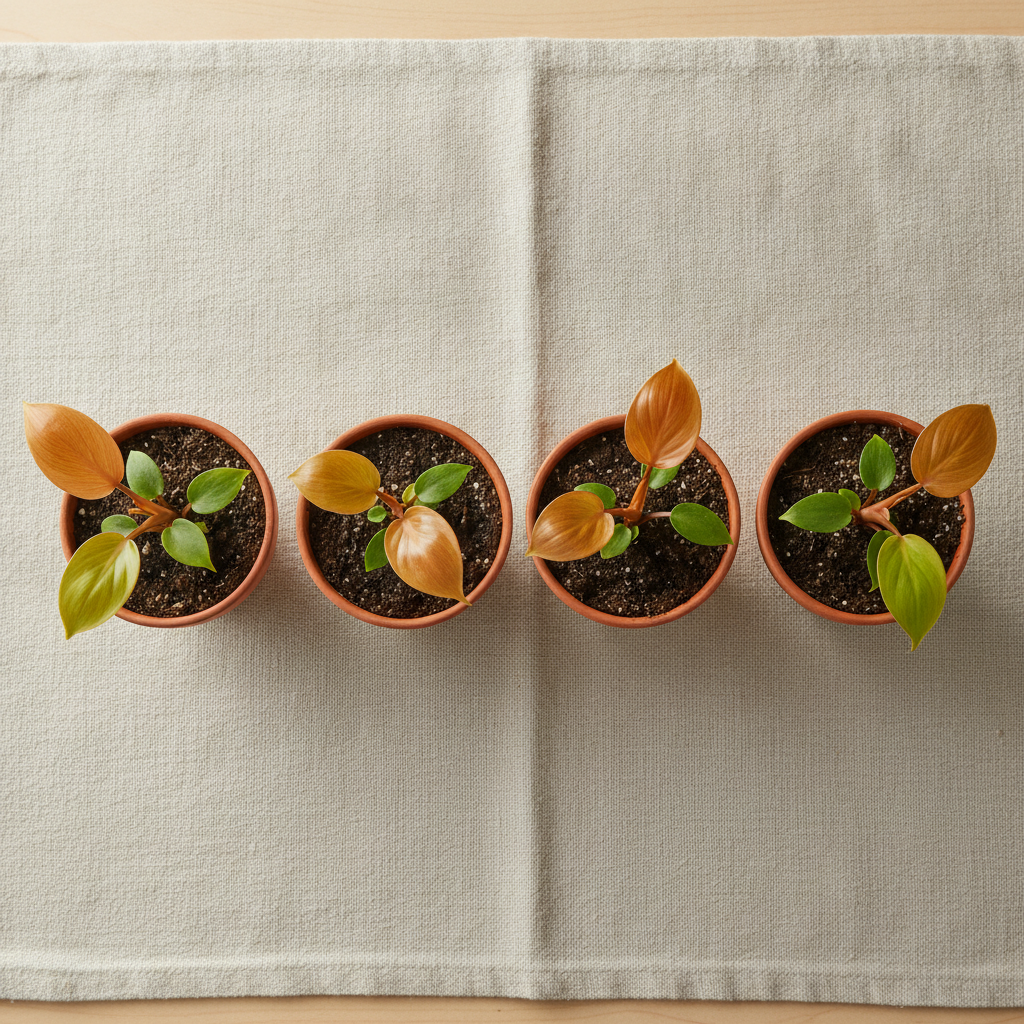
Propagating a Prince of Orange works differently from the trailing philodendrons most growers cut their teeth on. Because it is a self-heading plant that grows from a central crown rather than a vine, you cannot simply snip a length of stem and root a node in water. Instead, the plant multiplies by division: over time a mature specimen produces offsets, small plantlets that emerge from the base around the main crown, and these can be separated to make new plants. This is best done in spring, ideally combined with a scheduled repotting, when the plant has the energy of the growing season ahead of it.
The key to success is patience and clean tools. Only divide offsets that have developed a few of their own roots, and use a sterilised blade to minimise the risk of introducing disease into the cut surfaces. Work gently, since the roots are relatively delicate, and pot each division straight into the same chunky mix the parent enjoys.
- Water the plant a day ahead so the root ball is hydrated and slides from its pot easily.
- Ease the whole plant out and gently tease the mix away from the roots until you can see where the offsets join the parent crown.
- Identify an offset that has its own small cluster of roots, then separate it from the parent, teasing the roots apart by hand where possible and using a sterilised knife only where they will not come free.
- Pot the division into a small container of fresh aroid mix, setting it at the same depth it grew before, and firm the mix lightly around the roots.
- Water it in, then place it somewhere warm with bright, indirect light and keep the mix lightly moist while it establishes over the following weeks.
A freshly divided offset may sulk for a few weeks as it settles, and that is normal. Resist the urge to overwater it in sympathy, keep the humidity up around it, and new growth from the centre is your sign that the division has rooted and taken hold. If your plant is still young and has not yet produced offsets, the kindest thing is simply to grow it on, as a vigorous mature crown will eventually offer up divisions of its own.
Pests and Common Problems
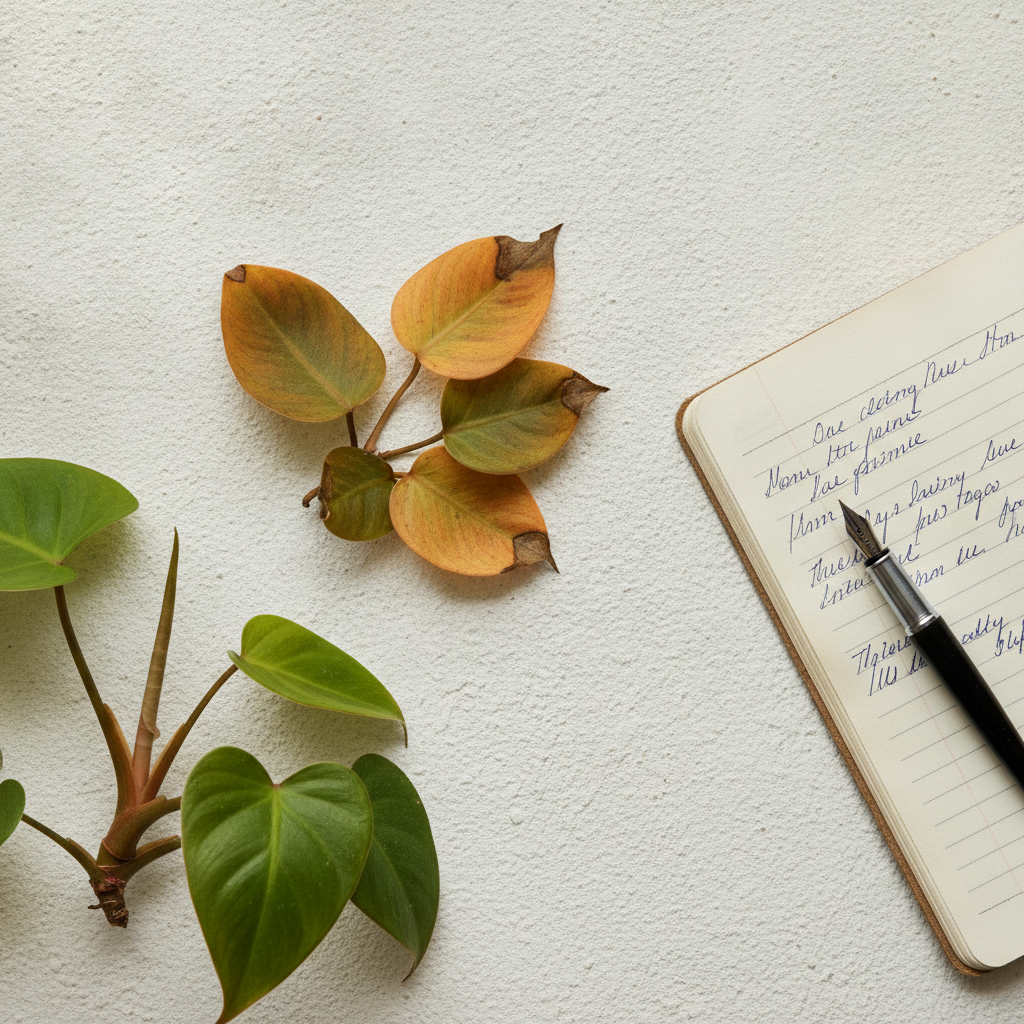
The Prince of Orange is reasonably resilient, but like any indoor aroid it can attract the usual cast of sap-sucking pests, especially when air is dry or a new plant arrives carrying hitchhikers. Spider mites are the most common nuisance, thriving in warm, dry conditions and betraying themselves with fine webbing and a stippled, dusty look on the leaves. Mealybugs appear as small cottony white tufts tucked into leaf joints and along stems, while thrips cause silvery scarring and distorted new growth, and fungus gnats hover around persistently wet soil. Inspecting your plant whenever you water, including the undersides of the leaves, catches infestations while they are still easy to deal with.
Treatment is straightforward if you act early. Isolate an affected plant to protect your collection, then wipe the leaves and rinse the pests off in the shower or sink. Follow up with insecticidal soap or a diluted neem oil spray, repeating every week or so until the problem clears, and dab stubborn mealybugs directly with a cotton bud dipped in isopropyl alcohol. For fungus gnats, the lasting fix is to let the top of the mix dry out more between waterings, since it is the wet surface that their larvae depend on.
Most of the troubles people blame on pests, though, are actually cultural. Yellowing lower leaves usually mean overwatering, the most frequent complaint of all, while brown, crispy leaf edges point to dry air, under-watering or a build-up of mineral salts. Faded, greenish new growth that lacks the signature orange almost always signals too little light. Drooping that recovers after a drink means the plant was simply thirsty, and pale, leggy, stretched-out growth tells you to move it somewhere brighter. The table below ties the most common symptoms to their likely causes and fixes.
| Symptom | Likely cause | What to do |
|---|---|---|
| Yellowing lower leaves | Overwatering or soggy mix | Let the mix dry further; check drainage and pot size |
| Brown, crispy leaf edges | Dry air, under-watering or salt build-up | Raise humidity, water more evenly, flush the pot |
| Pale, green new growth | Insufficient light | Move to a brighter, indirect spot or add a grow light |
| Bleached or scorched patches | Direct sun on the leaves | Filter the light or shift the plant back from the glass |
| Drooping leaves | Thirst or root stress | Water thoroughly; reassess your watering rhythm |
| Fine webbing, stippled leaves | Spider mites | Rinse, raise humidity, treat with neem or soap |
Warning — Toxicity: Like all philodendrons, the Prince of Orange contains insoluble calcium oxalate crystals and is toxic to cats, dogs and people if chewed or swallowed, causing painful mouth irritation, drooling and swelling. Keep it well out of reach of curious pets and children.
Varieties and Similar Philodendrons
The Prince of Orange belongs to a family of self-heading Philodendron erubescens hybrids bred for dramatic, colour-shifting new growth. If you fall for its glowing leaves, two close relatives offer a similar look with their own character and are well worth seeking out to build a warm-toned collection.
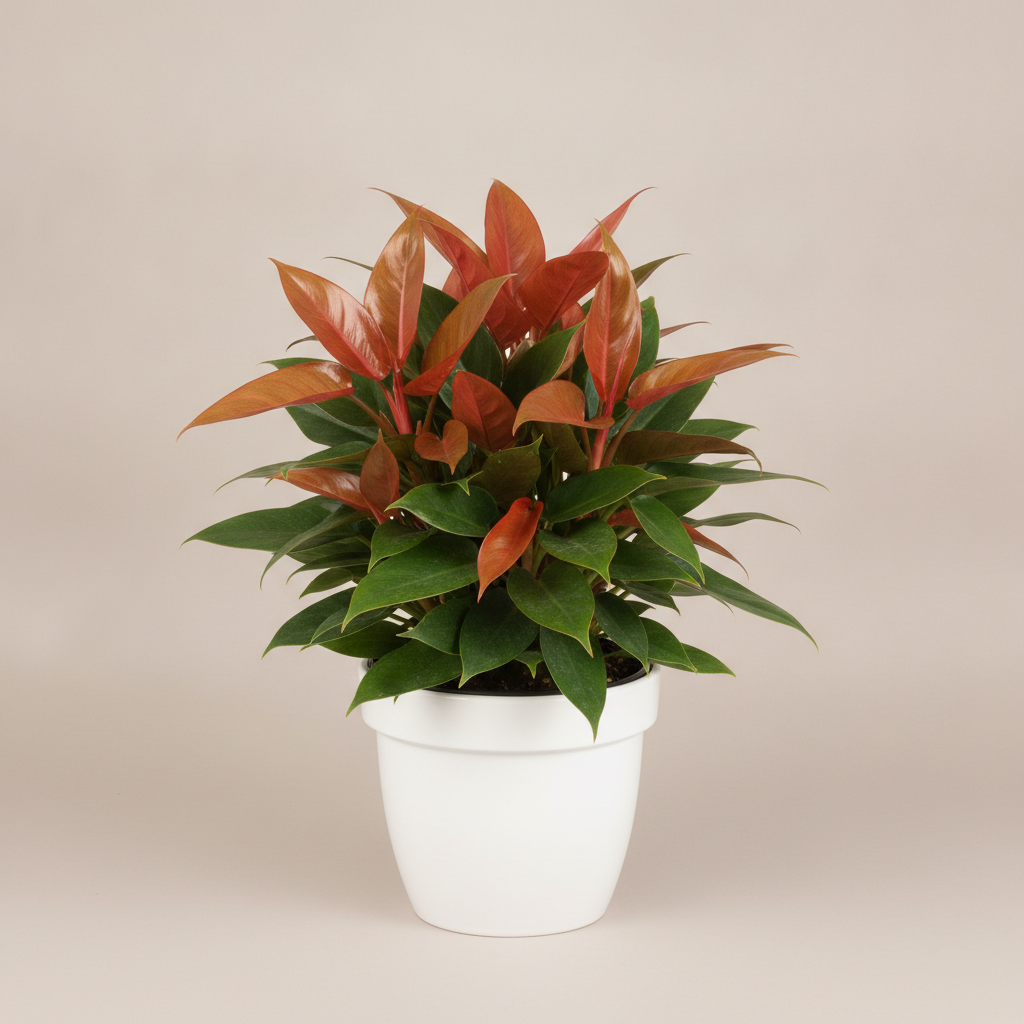
McColley’s Finale
A sister hybrid whose new leaves emerge a fiery brick-red rather than orange, deepening to a rich green as they mature. It shares the same compact, self-heading habit and identical care needs, making it an easy companion to the Prince of Orange and a striking contrast on the same shelf.
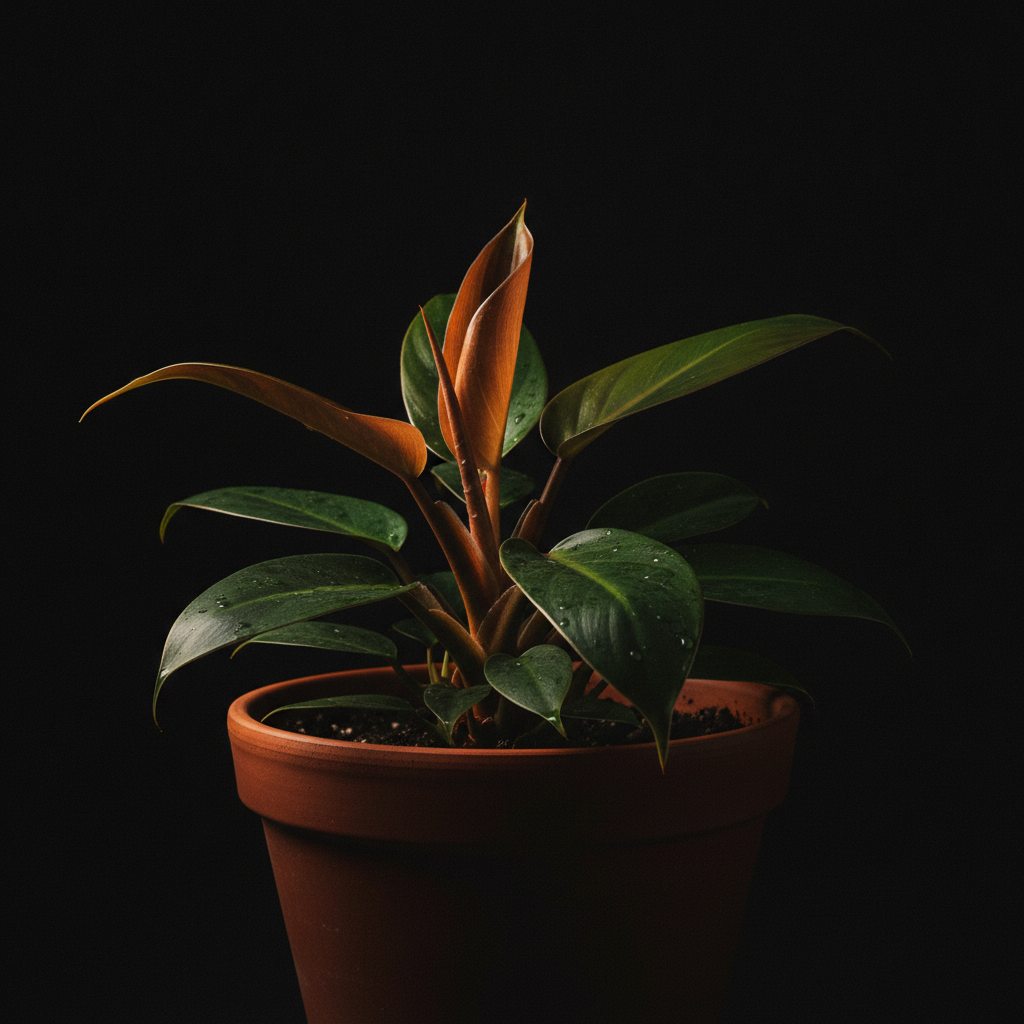
Philodendron ‘Autumn’
Named for its seasonal palette, ‘Autumn’ flushes new growth in coppery bronze-red tones that settle to a warm green, giving a slightly more subdued, woodland feel than the Prince of Orange. Compact and equally undemanding, it rounds out the trio of colour-changing self-heading philodendrons.
Frequently Asked Questions
Why are my Prince of Orange’s new leaves not orange?
The most likely reason is insufficient light. The orange and amber pigments develop in response to bright, indirect light, so in a dim spot new leaves come in greener and the colour is muted and short-lived. Move the plant closer to a bright window, taking care to avoid direct midday sun, or add a full-spectrum grow light, and the next flush of growth should return to its proper saturated tone.
Is the Prince of Orange a climbing plant?
No. Unlike vining philodendrons such as the heartleaf, the Prince of Orange is self-heading, meaning it grows as a compact rosette from a central crown and does not climb. It needs no moss pole or trellis and stays tidy and shrubby, which is part of its appeal for smaller spaces.
How big does a Prince of Orange get?
Indoors it typically reaches around 45 to 60 cm (18 to 24 in) tall and a similar spread, making it a manageable tabletop or floor plant that rarely outgrows its position. Its modest size and slow, steady growth mean it seldom needs more than an occasional pot upgrade.
Why are the lower leaves turning yellow?
Occasional yellowing of the oldest, lowest leaves is natural as the plant sheds them with age. Widespread or rapid yellowing, however, almost always means overwatering. Check that the mix is draining freely and the pot is not sitting in water, and allow the top few centimetres to dry out before watering again.
Is the Prince of Orange safe around pets?
No. It contains insoluble calcium oxalate crystals and is toxic to cats, dogs and humans if chewed, causing oral irritation, drooling and swelling. It is not usually life-threatening but is decidedly unpleasant, so site the plant somewhere pets and small children cannot reach it.
How often should I repot it?
Every one to two years is usually right, or whenever you see roots circling the base or escaping the drainage holes. Move up just one pot size, refresh the chunky aroid mix, and do it in spring so the plant can recover quickly with the growing season ahead. Repotting is also the natural moment to divide off any offsets for propagation.






