
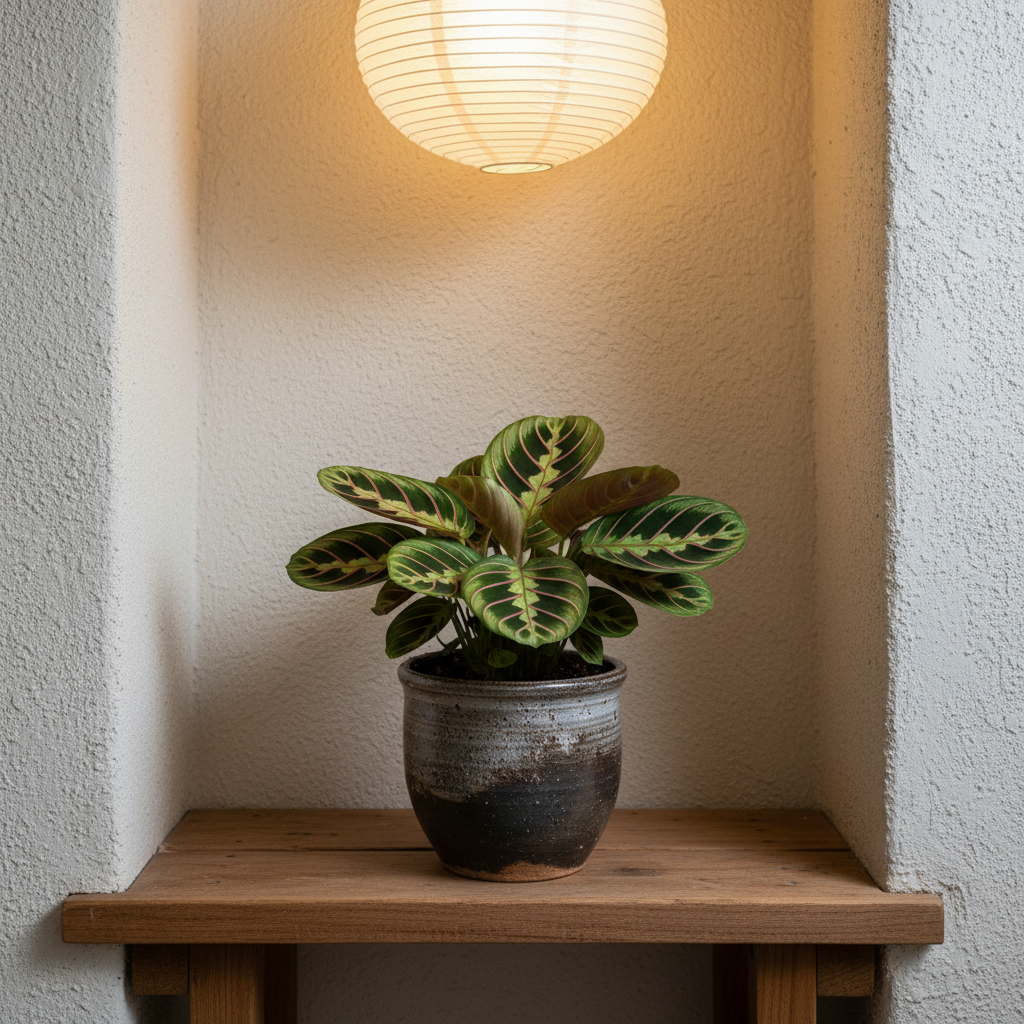
Few houseplants offer the small daily theatre of the prayer plant. Its patterned leaves, painted with herringbone bands of cream, pink and dark green, lie flat in the morning, drift slowly through the day, and lift upward at dusk as if folded in quiet supplication. Botanists call this movement nyctinasty; growers tend to call it the reason they bought the plant in the first place. The species behind the show is Maranta leuconeura, a low, spreading perennial from the humid understorey of Brazilian rainforests, and the source of several of the most striking foliage cultivars in the houseplant trade.
Prayer plants have a reputation that hovers somewhere between forgiving and fussy, and the truth depends entirely on how closely you can mimic a shaded, breezy forest floor. The plant will survive in conditions a little drier and a little brighter than ideal, but to actually thrive, with leaves held flat and wide and held high through summer, it needs warm, even moisture, soft humidity and indirect light. This guide covers the difference, from the quick reference table below through to propagation, varieties and the questions new owners ask most.
Contents
- Quick Reference
- Why Prayer Plant Makes a Rewarding Houseplant
- Light Requirements
- Watering & Humidity
- Soil, Potting & Repotting
- Fertilising
- Propagation
- Pests & Diseases
- Popular Varieties
- Frequently Asked Questions
Quick Reference: Prayer Plant at a Glance
| Light | Bright indirect light; tolerates medium light. No direct midday sun, which scorches leaves and bleaches the colour. |
| Watering | Keep soil consistently lightly moist, never soggy. Water when the top 1 to 2 cm (about half an inch) feels just dry. Use tepid, low-mineral water. |
| Temperature | 18 to 27 degrees C (65 to 80 F). Avoid anything below 13 degrees C (55 F) and protect from cold draughts. |
| Humidity | 50 to 70 per cent ideal. Tolerates 40 per cent in cooler months, but leaf edges brown below that. |
| Fertiliser | Balanced liquid feed at quarter to half strength every 3 to 4 weeks from spring to early autumn. Nothing in winter. |
| Toxicity | Non-toxic to cats, dogs and humans according to the ASPCA. Safe around pets and children. |
Why Prayer Plant Makes a Rewarding Houseplant
The prayer plant occupies an unusual niche in the houseplant world. It is dramatic without being demanding of space, ornamental without needing a window-front position, and animated in a way that almost no other foliage plant manages. The leaf movements that give it its common name are driven by tiny swollen joints called pulvini at the base of each leaf, which pump water in and out of cells on a circadian cycle to raise the leaves at night and lower them again by morning. For a plant that rarely flowers indoors, that nightly rearrangement is most of the entertainment, and it is reliable enough that you can almost set a watch by it.
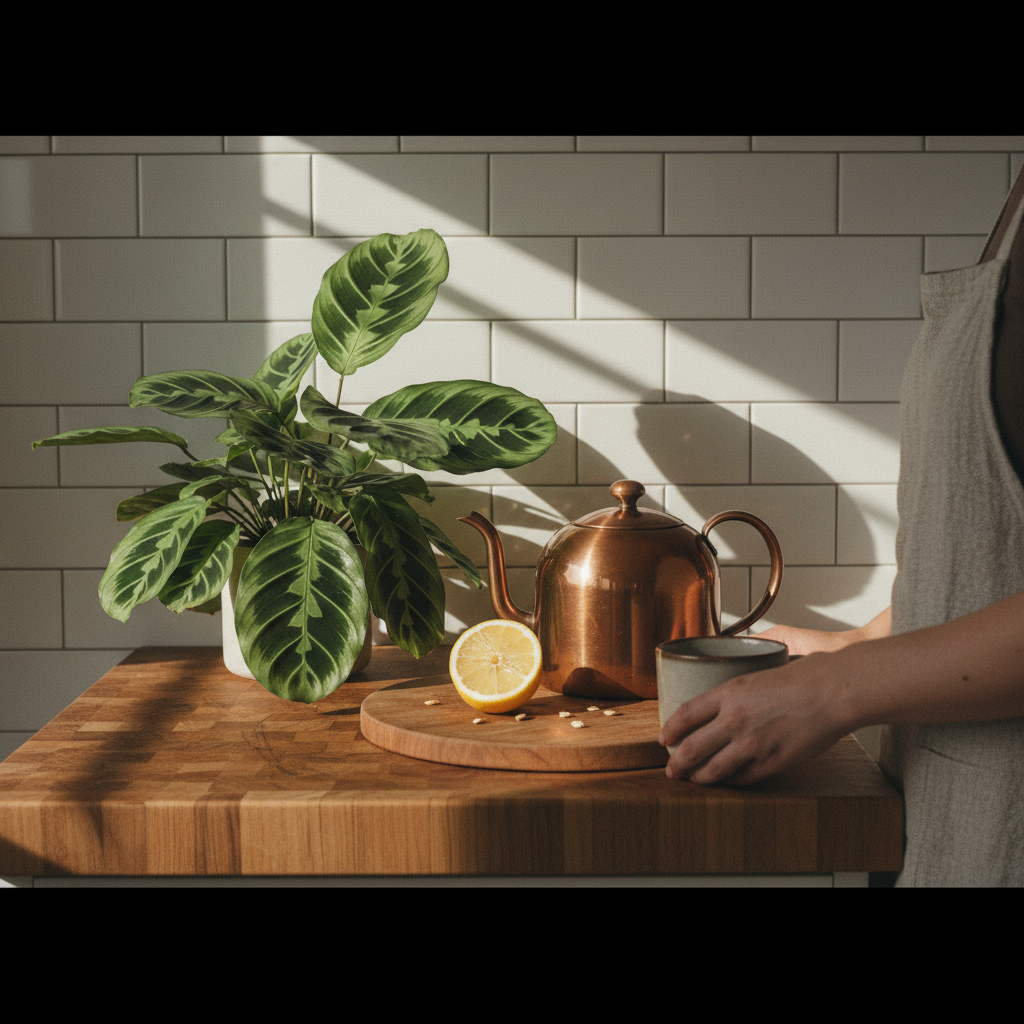
Beyond the movement, the foliage carries some of the most painterly markings in the genus. The species type holds dark green leaves quilted with a paler central spine and twin rows of olive blotches along the midrib, while named cultivars such as ‘Fascinator’ carry vivid magenta veins that look hand-painted under a soft window. The plant is genuinely compact, rarely exceeding 30 centimetres (about 12 inches) in height and spreading roughly the same across, which makes it ideal for shelves, side tables and the back rows of plant groupings where a taller specimen would block the light. A mature plant fills its pot with overlapping rosettes that drape gently over the rim.
Prayer plants are also one of the safer choices for households with curious cats, dogs or small children, since the ASPCA lists Maranta leuconeura as non-toxic. That removes one of the constant low-grade anxieties that comes with growing aroids and lilies indoors. They are not aggressive growers, do not drop heavy stems, and will sit politely in the same pot for two or three years between repotting. What they ask for in return is fairly specific: warmth, soft water, steady moisture and humidity that does not crash. Meet those four, and the plant rewards the attention with foliage that looks better in person than in any photograph.
Light Requirements
Prayer plants evolved on the shaded floor of Brazilian rainforests, where the dense overhead canopy filters sunlight into a soft, dappled, diffuse mosaic. That ancestry sets the rules for placement indoors. The plant wants bright, indirect light, the kind that lets you read a book comfortably in the middle of the day without switching on a lamp, but it does not want direct sun. A few hours of gentle morning light through an east-facing window is acceptable and often improves leaf colour, but the strong midday or afternoon sun of a south- or west-facing window will scorch the foliage within days, leaving dry tan patches in the centre of leaves and a generally bleached, washed-out appearance across the plant.
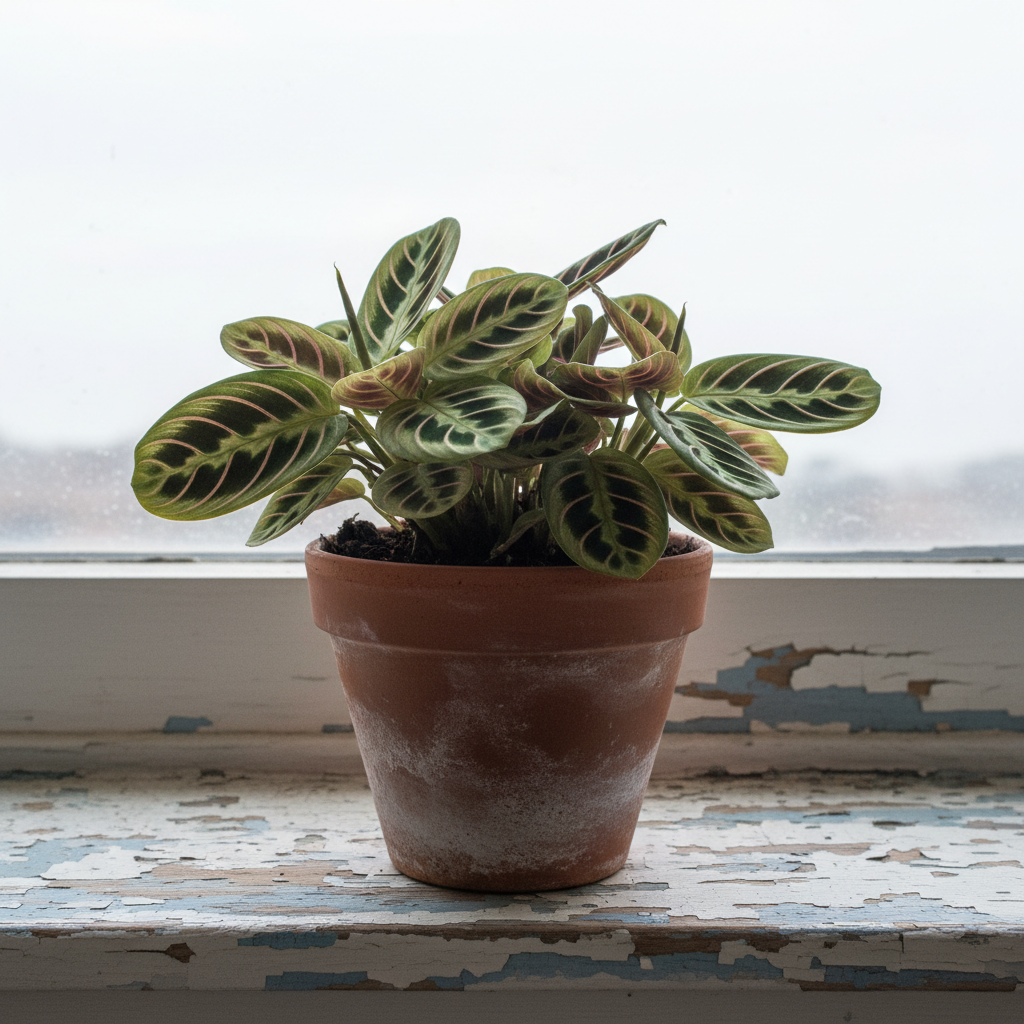
The most reliable positions in a home are a north-facing windowsill, a spot a metre or so back from an east-facing window, or anywhere a south- or west-facing window is filtered by a sheer curtain or by larger plants in front. Light requirements shift slightly with the seasons. In high summer, when the sun is at its strongest, pull the plant a little further from the glass; in midwinter, when daylight in northern Europe and parts of the United States can drop to a handful of usable hours, you can move it closer or supplement with a low-wattage full-spectrum grow lamp on a timer. Prayer plants will tolerate quite low light for short periods, but in deep shade they stop producing new leaves, the existing foliage loses its strongest pattern contrast, and the nightly folding movements become slower and less pronounced.
Pro Tip — Reading the leaves: Prayer plant leaves are an excellent light meter. If new leaves emerge smaller and paler than older ones, the light is too low. If existing leaves develop dry tan patches in the centre or the colour bleaches out, the light is too strong. Even, well-marked new growth in the normal size range means the position is right.
One detail often missed in care articles is that the prayer plant’s famous nyctinastic movement is itself partly light-driven. The leaves lift in response to the drop in light intensity at dusk and lower again as light returns at dawn, with input from the plant’s internal circadian rhythm. A plant kept in a windowless room under constant artificial light may continue to move on its rhythm for a while, but the cycle eventually weakens. If the nightly performance is part of why you grow the plant, give it a position where it can sense the natural rise and fall of daylight; this matters more than any specific lux reading.
Watering & Humidity
Watering is the area where most prayer plant problems begin, and almost always for the same two reasons: tap water that is too hard, and a watering rhythm that swings between bone-dry and soaked. The plant comes from a forest floor where the substrate stays evenly damp under a thick layer of leaf litter, and that is the texture the roots expect indoors. Aim to keep the top 1 to 2 centimetres (about half an inch) of mix lightly moist most of the time, watering thoroughly as soon as that top layer feels just dry to the touch. In a warm, brightly lit summer position that often means watering every 5 to 7 days; in cooler, dimmer winter conditions it may stretch to every 10 to 14 days.
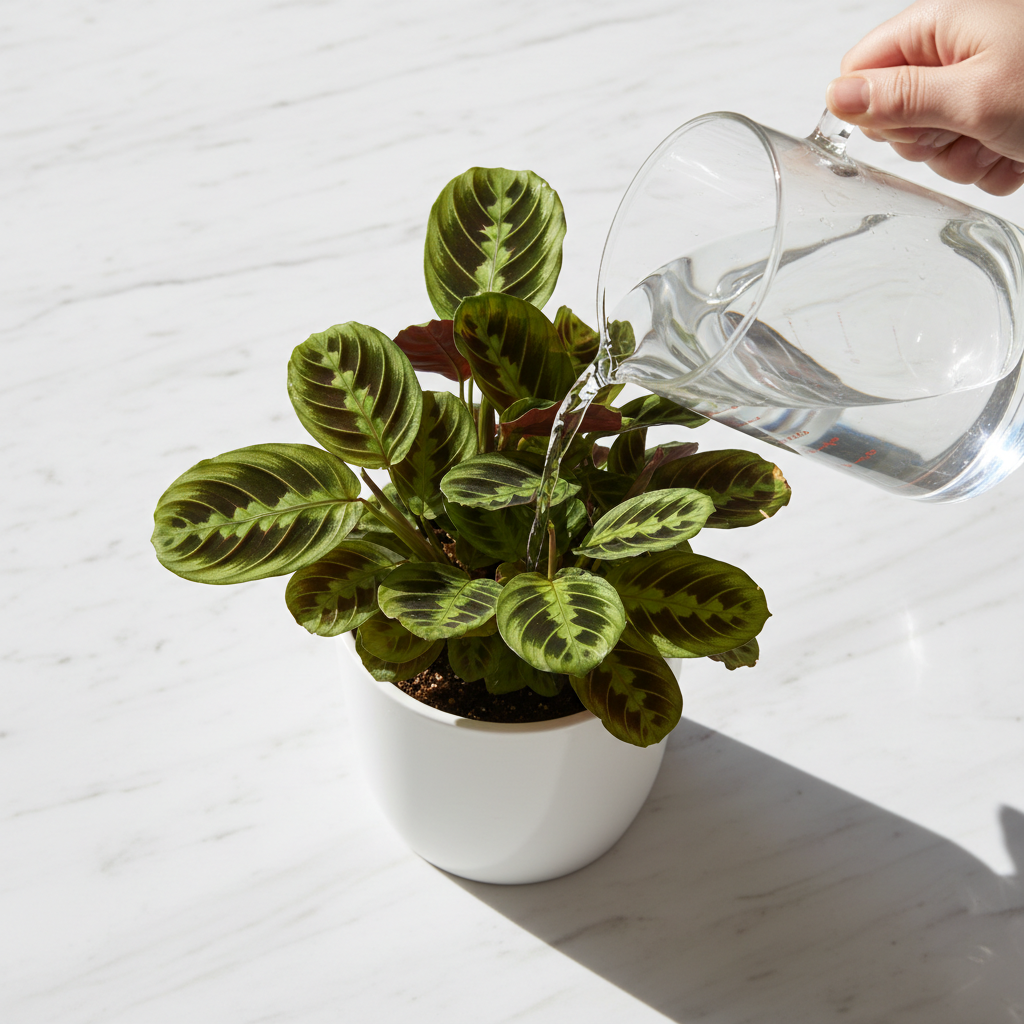
The technique matters as much as the frequency. When you water, do it thoroughly: pour slowly until water runs freely from the drainage holes, then wait a minute and pour a little more. This soaks the entire root ball evenly and flushes out salts that accumulate from fertiliser and tap minerals. Always empty the saucer afterwards. Prayer plant roots are fine and shallow, and they will rot within a fortnight if left standing in water. Avoid little daily top-ups, which keep only the upper layer wet while leaving the lower root ball dry, and avoid the opposite habit of waiting until the leaves curl tightly before drenching the plant; both extremes show up in the foliage within a week.
Warning — Water quality: Prayer plants are unusually sensitive to fluoride, chlorine and dissolved minerals. In hard-water areas, tap water straight from the tap will produce brown leaf tips and progressive marginal browning within a few months. Use filtered water, rainwater or tap water left to stand uncovered for 24 hours so chlorine can dissipate, and bring it to room temperature before pouring.
Humidity is the other half of the equation. Prayer plants thrive at 50 to 70 per cent relative humidity and start to suffer below 40 per cent. In most modern homes, especially in winter with central heating running, ambient humidity sits between 20 and 35 per cent, which is too dry for sustained growth. The symptoms are predictable: crispy brown edges that gradually creep inward, leaves that fail to unfurl smoothly, and new growth that emerges already brown-tipped. The simplest reliable fix is a small electric humidifier running nearby for a few hours each day; pebble trays help a little but rarely move the dial more than a few percentage points. Grouping the prayer plant with other foliage plants raises local humidity through their combined transpiration and also makes for a more attractive arrangement.
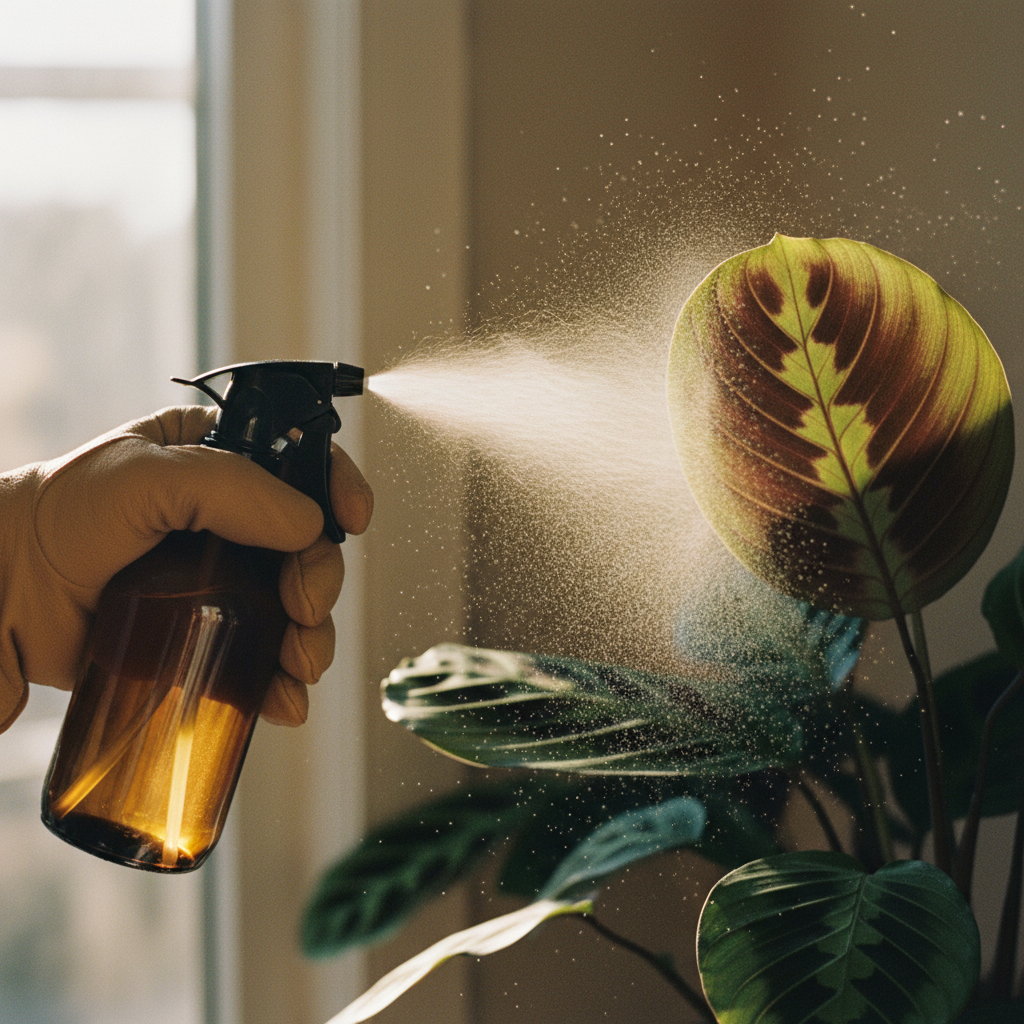
Misting is often recommended but should be used cautiously. A brief light mist in the morning, on a day with good air circulation, can help freshen the foliage; heavy misting that leaves water sitting on the leaves overnight invites fungal leaf spot and bacterial blight, both of which prayer plants are susceptible to. The bathroom and kitchen, where steam from showers and cooking lifts ambient humidity for parts of the day, are often unexpectedly good locations, provided they have enough indirect light.
Soil, Potting & Repotting
Prayer plants want a soil mix that holds moisture without ever turning into a saturated brick. In their native habitat they root into a loose layer of decomposing leaf litter and soft humus that drains quickly between rains, and the indoor mix should aim at the same effect. A reliable recipe starts with two parts good quality peat-free houseplant compost, one part fine orchid bark or coco husk chips, and one part perlite, with a small handful of horticultural charcoal if you have it. The bark and perlite keep the structure open so air can reach the fine roots, and the compost holds enough moisture between waterings to keep the mix lightly damp.
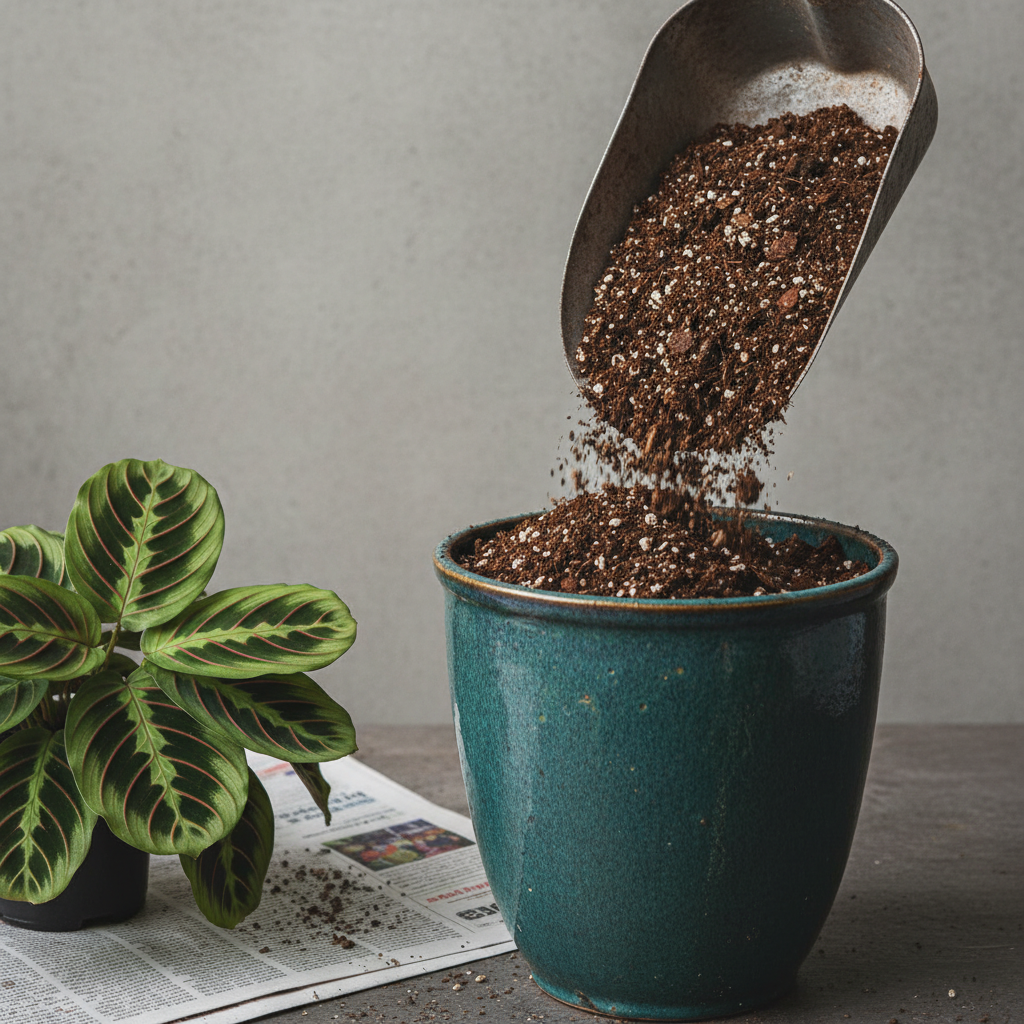
Container choice matters more than it first appears. Prayer plants have a shallow, spreading root system rather than a deep tap-root, and they generally do better in a wide, low pot than a tall narrow one. Terracotta is breathable and helps prevent waterlogging but dries quickly, which can be a chore for a plant that wants steady moisture; glazed ceramic and plastic hold moisture longer and are usually more forgiving in a dry home, provided drainage holes are generous. Whatever the material, the pot must have at least one good drainage hole. Decorative cover pots without holes are fine as outers but never as the only container.
Repotting is needed every 2 to 3 years, ideally in early spring just as new growth resumes. The signs are familiar: water running straight through the pot without soaking in, roots circling the inside of the container or pushing out of the drainage holes, and growth that has visibly slowed despite good care. Move the plant up by a single pot size, typically 2 to 3 centimetres (about 1 inch) wider in diameter; over-potting into a much larger container leads to soil that stays wet long after the roots can absorb it, which invites rot. After repotting, water in well, then keep the plant out of direct light for a week or so while it settles.
Pro Tip — Refresh between repotting: In the year between full repottings, scrape off the top centimetre of old mix in spring and replace it with fresh compost. This restores nutrients, removes any crusty mineral build-up from tap water and fertiliser, and gives the plant a small boost without disturbing the roots.
Fertilising
Prayer plants are light to moderate feeders. In the forest understorey they grow in soils enriched by a constant slow rain of decomposing leaves, which delivers a thin, steady supply of nutrients rather than the heavy seasonal pulses many other plants experience. The most successful indoor approach mirrors that pattern: a balanced liquid fertiliser at quarter to half strength, applied every 3 to 4 weeks from early spring through to early autumn. Anything stronger and more frequent leads to salt build-up in the soil, which the plant signals through the same brown leaf edges that hard tap water produces.
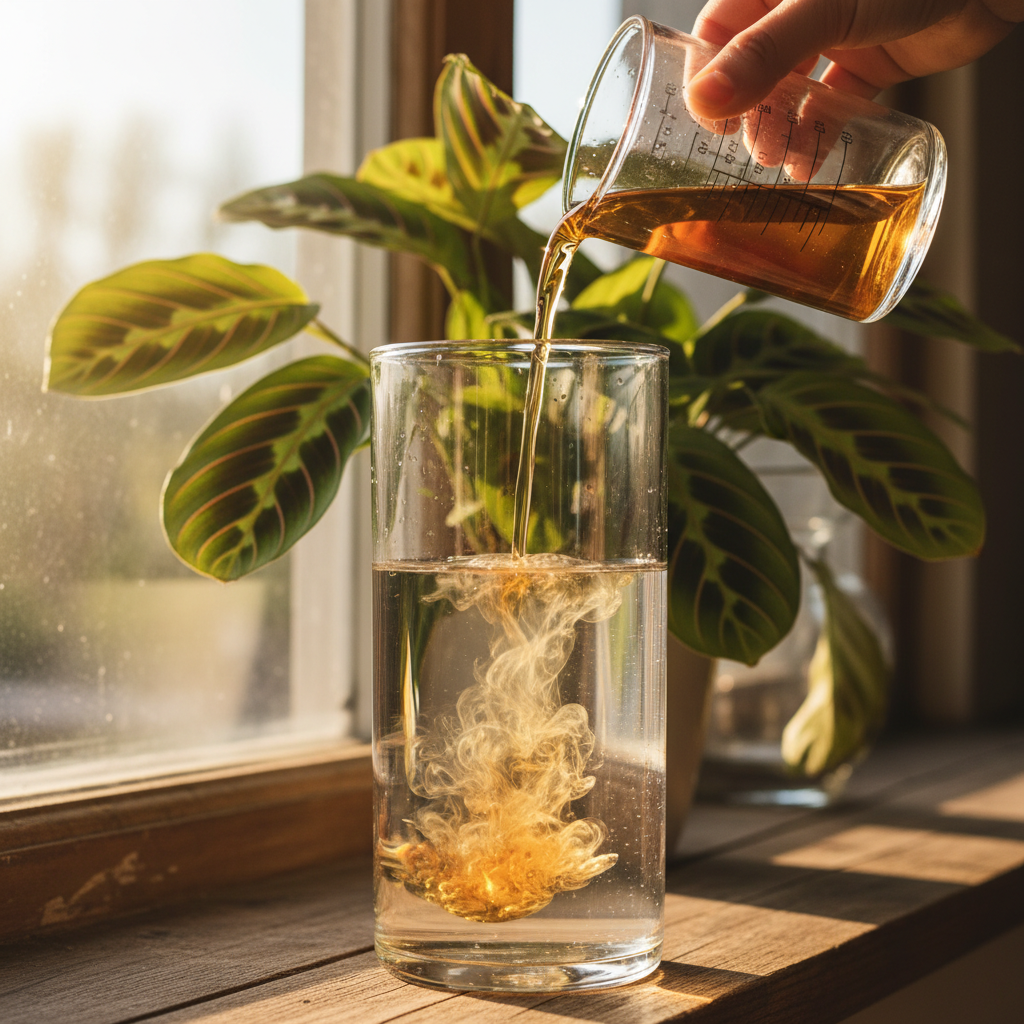
A general purpose houseplant fertiliser with an NPK ratio close to balanced, such as 10-10-10 or 5-5-5, suits the plant well. Formulations marketed for foliage plants, with a slightly higher nitrogen number, are also appropriate. Always dilute according to the lower end of the manufacturer’s recommendation and water with the mixed solution onto already moist soil, never onto bone-dry mix, as that concentrates the salts at the root tips and can cause chemical burn. Through winter, when light levels drop and growth pauses, suspend feeding entirely. The roots cannot use the nutrients and unused salts simply accumulate.
Slow-release granular fertilisers can be used as a low-maintenance alternative, scattered lightly across the soil surface in spring at no more than half the manufacturer’s recommended rate. They release nutrients gradually with each watering through the season and remove the need to remember a feeding schedule. Whichever method you use, plan to flush the pot thoroughly with plain water every two or three months by watering until a generous volume drains out of the bottom. This rinses out accumulated salts and keeps the root zone clean. Signs of over-feeding tend to appear first as a white crust on the soil surface or on the inside of the pot rim, followed by tan-edged leaves; the response in both cases is to flush thoroughly and reduce or pause feeding for a month.
Propagation
Prayer plants propagate readily by two methods: stem-tip cuttings rooted in water or substrate, and division of mature clumps. Both are reliable, and the choice usually depends on what the parent plant has to offer. Cuttings work well on a long, leggy plant with healthy stems and clear leaf nodes; division suits a mature, multi-crowned specimen that has filled its pot.
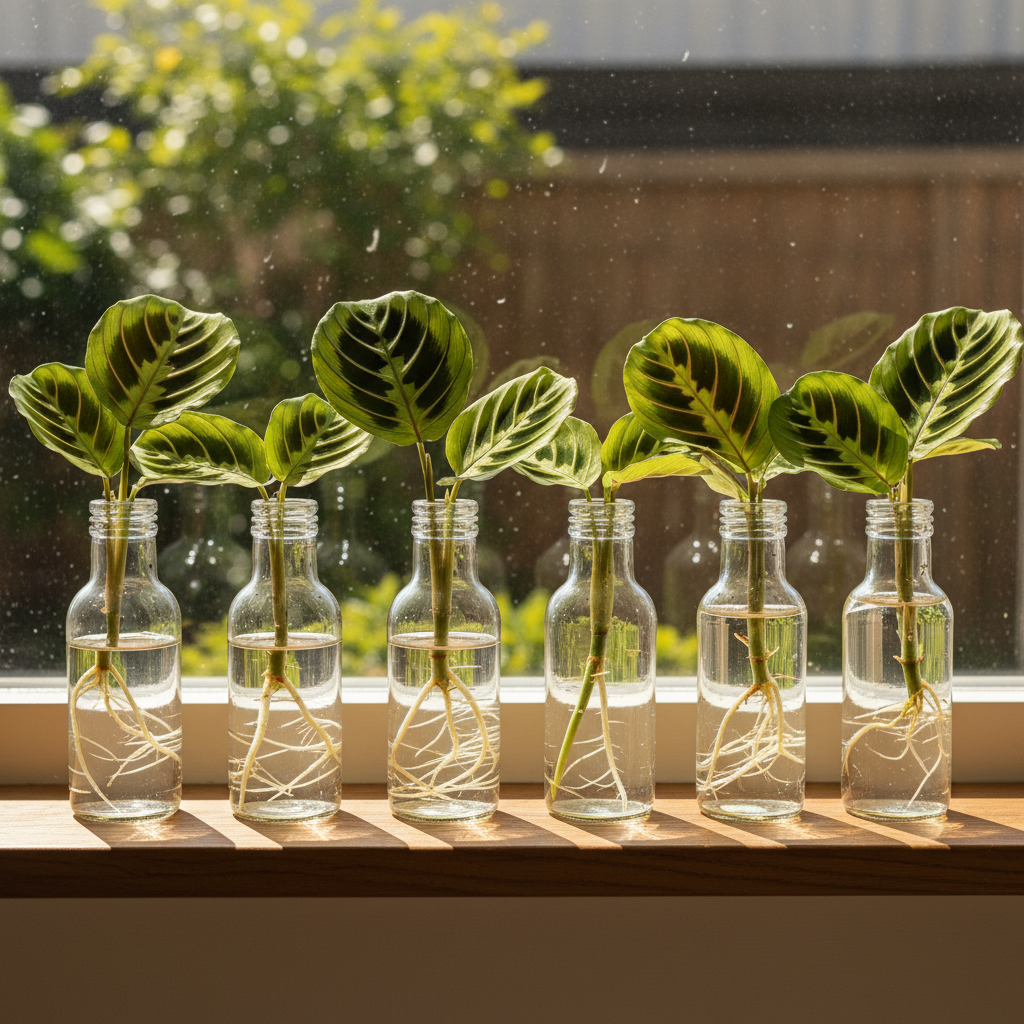
Stem-tip cuttings in water
- In late spring or early summer, choose a healthy stem with at least three or four leaves. Locate a node (the slightly swollen joint where leaves meet the stem) and make a clean cut with sharp scissors or a clean blade just below it, leaving 2 to 4 centimetres (about 1 inch) of stem beneath the lowest node.
- Remove the lowest leaf or two so the bottom node sits bare. This is where roots will emerge.
- Place the cutting in a small clear glass of room-temperature filtered or rainwater so the lower node is submerged and the remaining leaves stay above the water line.
- Set the glass on a bright windowsill out of direct sun. Change the water every 3 or 4 days to keep it clear and oxygenated.
- Fine white roots should appear within 2 to 4 weeks. Once they reach 3 to 5 centimetres (about 1 to 2 inches) long, pot the cutting into a small pot of the standard prayer plant mix, keep it consistently moist, and treat it as a young plant for the next month while it settles.
Division
A mature prayer plant often grows into several distinct crowns connected by surface rhizomes. Division is best timed to coincide with a routine repotting in early spring. Slide the plant out of its pot and gently tease the root ball apart with your fingers, working from the outside in. Look for natural separation points where two crowns share only a few connecting roots, and either pull them apart by hand or cut between them with a clean blade. Each division should carry several leaves and a good portion of healthy white root. Pot each new division into an appropriately sized container of fresh mix, water in well, and keep the new plants in slightly higher humidity for two or three weeks while they recover. Avoid feeding for the first month.
Pro Tip — Faster rooting: If cuttings root slowly in water, switch to rooting them directly in a 50:50 mix of damp perlite and sphagnum moss inside a clear plastic bag or covered propagator. The higher humidity speeds rooting noticeably, and the young roots that develop in substrate transplant more cleanly into compost than water-grown roots, which can sulk when first moved into soil.
Pests & Diseases
Prayer plants are not unusually pest-prone, but the warm, humid conditions they prefer happen to suit several common houseplant pests as well. The most frequent uninvited guest is the spider mite, which thrives precisely when humidity drops too low, exactly the conditions a struggling prayer plant is already complaining about. Spider mites are tiny, almost invisible to the naked eye, and the first signs are fine pale stippling on the upper leaf surface and barely visible silk webbing in leaf axils and along stems. Caught early, a few thorough showers under a tepid tap, combined with raising humidity, will usually clear them. Persistent infestations respond well to a weekly neem oil spray or insecticidal soap applied to both leaf surfaces, including the undersides where the mites cluster.
Mealybugs occasionally appear as small white cottony masses tucked into leaf axils and along the stems; dab each visible cluster with a cotton bud dipped in 70 per cent isopropyl alcohol, then follow with neem oil sprays at weekly intervals for a month to catch any newly hatched crawlers. Fungus gnats, those small dark flies that hover over moist compost, indicate a top layer that stays too wet for too long; let the surface dry out further between waterings, top-dress the soil with a thin layer of horticultural grit or sand, and place yellow sticky traps to catch the adults. Scale insects are a rarer visitor on prayer plants but can be removed by hand with a soft toothbrush and treated with horticultural oil if the infestation is light.
Disease problems are almost always linked to watering and air-circulation mistakes. Root rot, caused by waterlogged soil and the various Pythium and Phytophthora pathogens that thrive in it, is the most common killer of indoor prayer plants. Symptoms are a sudden yellowing and limpness of multiple leaves at once, a sour smell from the soil, and dark mushy roots when the plant is lifted out of its pot. Recovery is possible if caught early: remove the plant, trim away every dark, soft root with sterile scissors, repot into fresh, drier mix in a clean pot, and water sparingly until new growth shows. Fungal leaf spot, appearing as small brown or black spots with a yellow halo, follows from water sitting on the leaves overnight; improve air movement, water at soil level rather than over the foliage, and remove affected leaves with a clean cut at the petiole.
Warning — Quarantine new arrivals: Many pest problems begin with a new plant brought home from a nursery or shop. Keep new houseplants in a separate room for two weeks, inspect them carefully, including the undersides of leaves, and treat any sign of pests before moving them in with your collection. This single habit prevents most infestations.
Popular Varieties
Almost every prayer plant sold in shops belongs to one of a handful of named varieties or botanical forms of Maranta leuconeura. The two that dominate the trade are the boldly veined ‘Fascinator’, often listed as variety erythroneura, and the rounded, spot-marked ‘Kerchoveana’, sometimes called the rabbit’s foot prayer plant. Both share the same care requirements covered in this guide; they differ only in foliage colouring and slight variations in vigour.
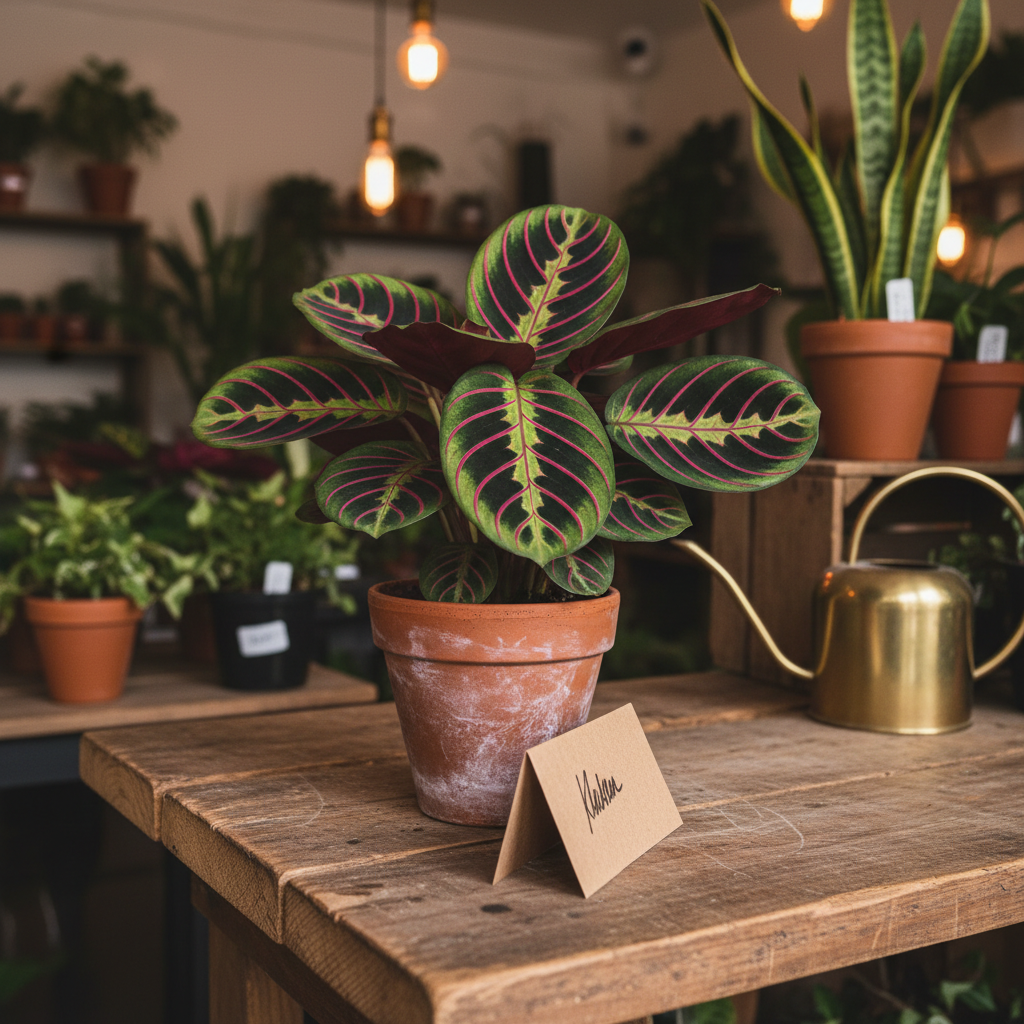
The most photographed of the prayer plants. ‘Fascinator’ carries deep forest-green leaves with vivid magenta-red veins fanning outward from a pale chartreuse central spine, with darker olive blotches running along either side of the midrib. Leaf undersides flush a soft purple, which becomes visible when the leaves fold up at night. It is the variety most likely to be sold simply as a ‘red prayer plant’ or under the older botanical name Maranta leuconeura var. erythroneura. Vigour is moderate; given good humidity, it grows steadily through the warmer months and looks particularly striking under soft side light, which picks out the red veining.
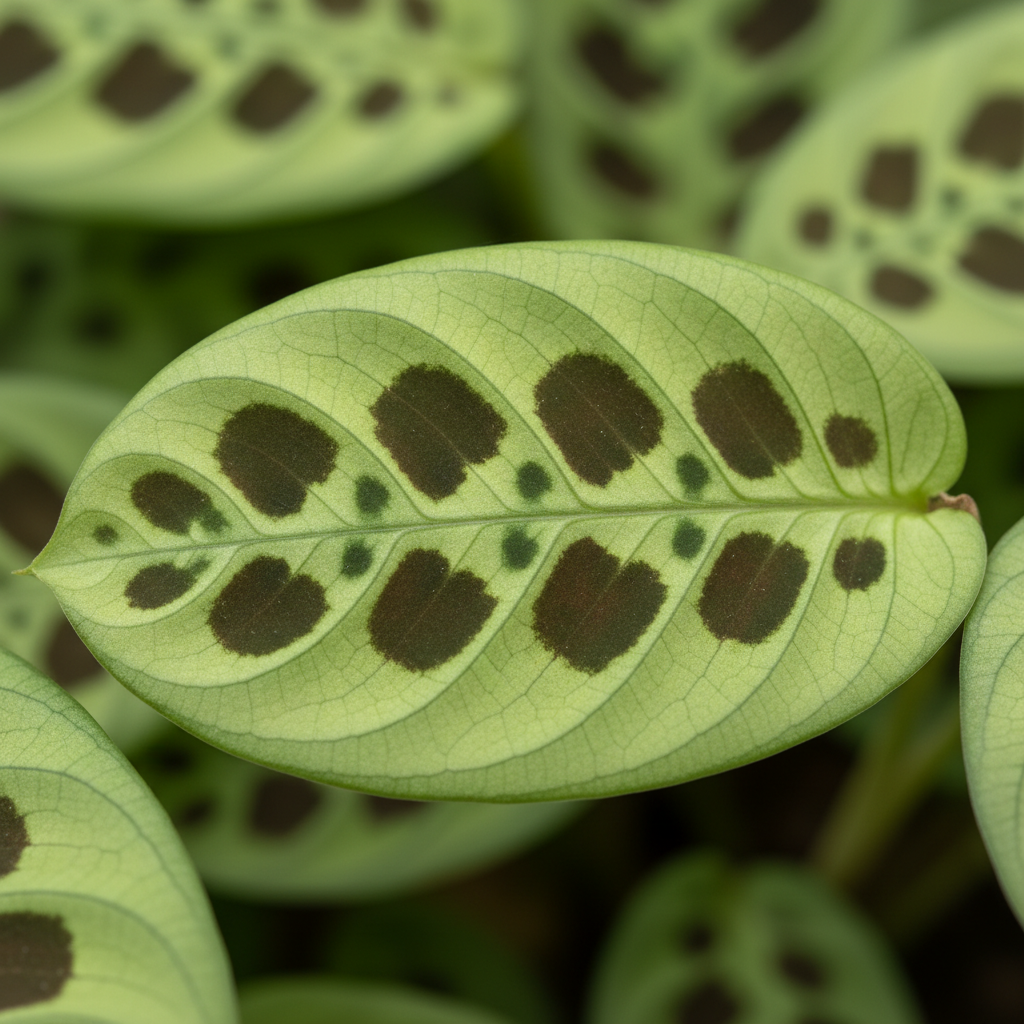
A softer, more pastoral cultivar. ‘Kerchoveana’ has light apple-green leaves with two rows of dark olive-brown blotches arranged along either side of the cream midrib, said to resemble rabbit footprints, which is the source of its common name. The leaves are slightly larger and rounder than ‘Fascinator’, and the overall plant tends to be a touch more forgiving of less-than-ideal humidity. It is an excellent choice for first-time prayer plant owners who want the characteristic foliage and nightly leaf movement without the high-contrast colouring that makes brown tips on ‘Fascinator’ so visually obvious.
Less commonly seen but worth seeking out are Maranta leuconeura var. massangeana, with strikingly dark, almost black background colour and silvery veins set against the midrib, and the white-veined ‘Lemon Lime’, a more recent introduction with pale lime-yellow venation against mid-green leaves. Both are members of the same species and share identical care requirements with the more familiar varieties. The wider Maranta genus, and its close relatives Calathea, Stromanthe and Ctenanthe, contains many similar plants with the same nightly leaf-folding behaviour; if you find yourself drawn to one, the rest of the family rewards exploration. Note, however, that Calathea and Stromanthe are considerably fussier about humidity and water quality than Maranta, so the prayer plant is the gentlest introduction to this group.
Frequently Asked Questions
Why are the leaves on my prayer plant turning brown at the edges?
Brown leaf edges have three usual causes, often overlapping. The most common is low humidity, particularly through the heating season; aim for 50 per cent or above and consider a small humidifier. The second is water quality, since prayer plants are sensitive to fluoride, chlorine and dissolved minerals; switch to filtered, rain or stood tap water. The third is salt build-up from over-fertilising or infrequent flushing; flush the pot thoroughly with plain water and pause feeding for a month. Trim damaged edges with sharp scissors in a tapered cut that follows the natural leaf shape rather than a flat straight line.
Why aren’t the leaves folding up at night any more?
The nyctinastic movement weakens or stops when the plant is stressed, most often by very low light, severe dehydration or sustained low humidity. Check that the plant receives a clear day-to-night light cycle (not constant artificial light), that the soil is consistently lightly moist, and that humidity is not crashing overnight. Newly acquired plants sometimes pause their movement for the first few weeks while they acclimatise to the new environment; this usually resolves on its own.
Is the prayer plant safe for cats and dogs?
Yes. The ASPCA lists Maranta leuconeura as non-toxic to cats and dogs. The plant is also considered safe around children and small mammals such as rabbits and guinea pigs. As with any houseplant, ingestion of large quantities may still cause mild gastrointestinal upset, so it is sensible to discourage casual grazing, but accidental nibbling is not a poisoning concern.
How often should I water my prayer plant?
Rather than a fixed schedule, water when the top 1 to 2 centimetres (about half an inch) of soil feels just dry. In a warm, brightly lit summer this usually means every 5 to 7 days; in cooler, dimmer winter conditions every 10 to 14 days. The exact interval depends on light, temperature, pot size and substrate, so check by touch rather than by date. The soil should stay lightly moist throughout, never bone dry and never soggy.
Why are my prayer plant’s leaves curling?
Tightly curled leaves usually mean the plant is underwatered or the surrounding air is too dry. Check the soil; if the top few centimetres are bone dry, water thoroughly and the leaves should begin to relax within a few hours. If the soil is moist but leaves are still curled, low humidity is the likely cause. Curling can also indicate root damage from past overwatering, in which case the plant should be unpotted and the roots inspected.
Can I keep a prayer plant in a bathroom?
Yes, often very successfully, provided the bathroom has a window that lets in enough indirect light through the day. The naturally elevated humidity from showers and baths suits the plant well. Avoid windowless bathrooms or those with only frosted glass on a north wall, where light is too low for sustained growth.
Does the prayer plant flower indoors?
Occasionally. A well-cared-for, mature plant may produce small, delicate white or pale lavender flowers on thin stems through summer. The blooms are botanically interesting rather than showy, and most growers value the plant for its foliage. Indoor flowering is uncommon and not a sign of better care than usual; it simply happens when the plant reaches a certain maturity in good conditions.
My prayer plant has become leggy and bare at the base. What can I do?
Legginess usually indicates that the plant has been growing in light that is slightly too low for too long, or that lower leaves have dropped from inconsistent watering. The fix is twofold: prune the longest, barest stems back to a node a few centimetres above the soil to encourage branching from the base, and use the trimmed material as cuttings to root and replant alongside the parent. Within a season the plant will look denser, and the cuttings will have grown into new rosettes that fill out the pot.






