
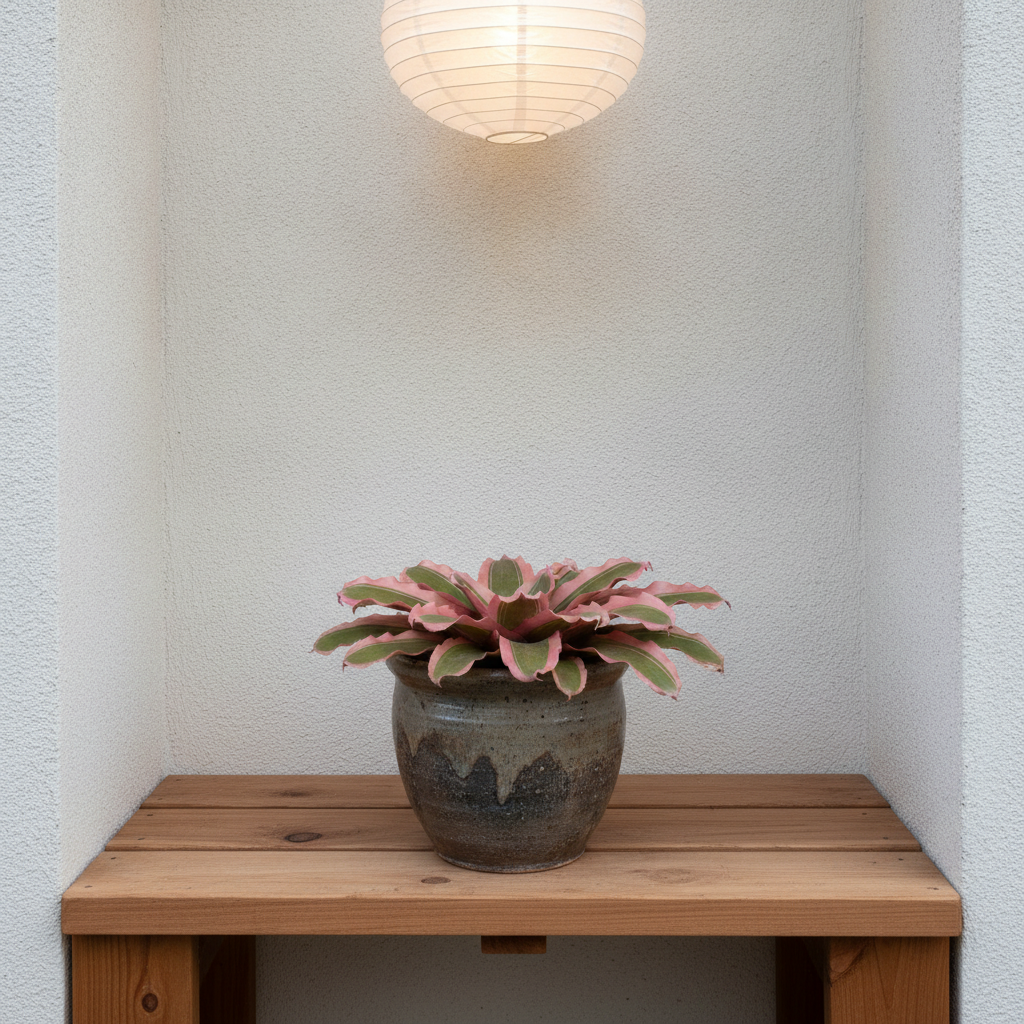
Few small houseplants make as much of an impression from so close to the ground as the pink earth star. Botanically Cryptanthus bivittatus, it is a terrestrial bromeliad native to the shaded forest floors of eastern Brazil, where it grows in leaf litter rather than perched in the branches like its epiphytic cousins. The genus name comes from the Greek for “hidden flower”, a nod to the small white blooms that sit almost buried in the centre of the rosette. Grown indoors it is prized not for those flowers but for its foliage: a flat, symmetrical star of wavy-edged, strap-shaped leaves banded in green and rose-pink, the colour deepening toward the crimped margins. Sold under a handful of common names, including earth star, starfish plant and pink starlite, it rarely climbs above 10 to 15 centimetres (4 to 6 inches) tall while spreading two or three times that across.
The pink earth star has a reputation as a slightly temperamental plant, but that reputation is largely undeserved and comes down to a few specific needs rather than any general fussiness. It asks for steady warmth, humidity above the household average, bright light without harsh sun, and a careful hand with water and fertiliser. Meet those conditions and it is remarkably long-lived and undemanding. This guide covers everything that separates a merely surviving earth star, one that clings on with dull, greenish leaves, from a thriving one whose rosette glows pink and steadily produces a ring of offsets. We will work through light, watering and humidity, soil and repotting, feeding, propagation, pests and diseases, and the most popular varieties, before finishing with the questions new owners ask most often.
Contents
- Quick Reference
- Why the Pink Earth Star Makes a Rewarding Houseplant
- Light Requirements
- Watering & Humidity
- Soil, Potting & Repotting
- Fertilising
- Propagation
- Pests & Diseases
- Popular Varieties
- Frequently Asked Questions
Quick Reference: Pink Earth Star at a Glance
| Light | Bright, indirect light. No harsh midday sun, but enough brightness to hold the pink colour. |
| Watering | Keep the mix lightly and evenly moist. Let the top centimetre dry between waterings; never waterlogged. |
| Temperature | 18 to 27 degC (64 to 81 degF). Avoid anything below 15 degC (59 degF). |
| Humidity | High. 60 per cent or above is ideal; tolerates 50 per cent with effort. |
| Fertiliser | Light feeder. Quarter to half-strength balanced liquid feed once a month in spring and summer only. |
| Toxicity | Non-toxic to cats, dogs and humans. One of the safest bromeliads for pet households. |
Why the Pink Earth Star Makes a Rewarding Houseplant
The pink earth star earns its place on a windowsill through a combination of colour, compactness and safety. Its flat rosette rarely outgrows a small pot, which makes it ideal for people short on space, for terrariums and bottle gardens, and for grouping into dish arrangements with other small foliage plants. Unlike the tank bromeliads that hold water in a central cup, Cryptanthus is terrestrial and roots into ordinary potting media, so it behaves much like a conventional houseplant and does not require the specialist cup-watering routine that puts many people off bromeliads.
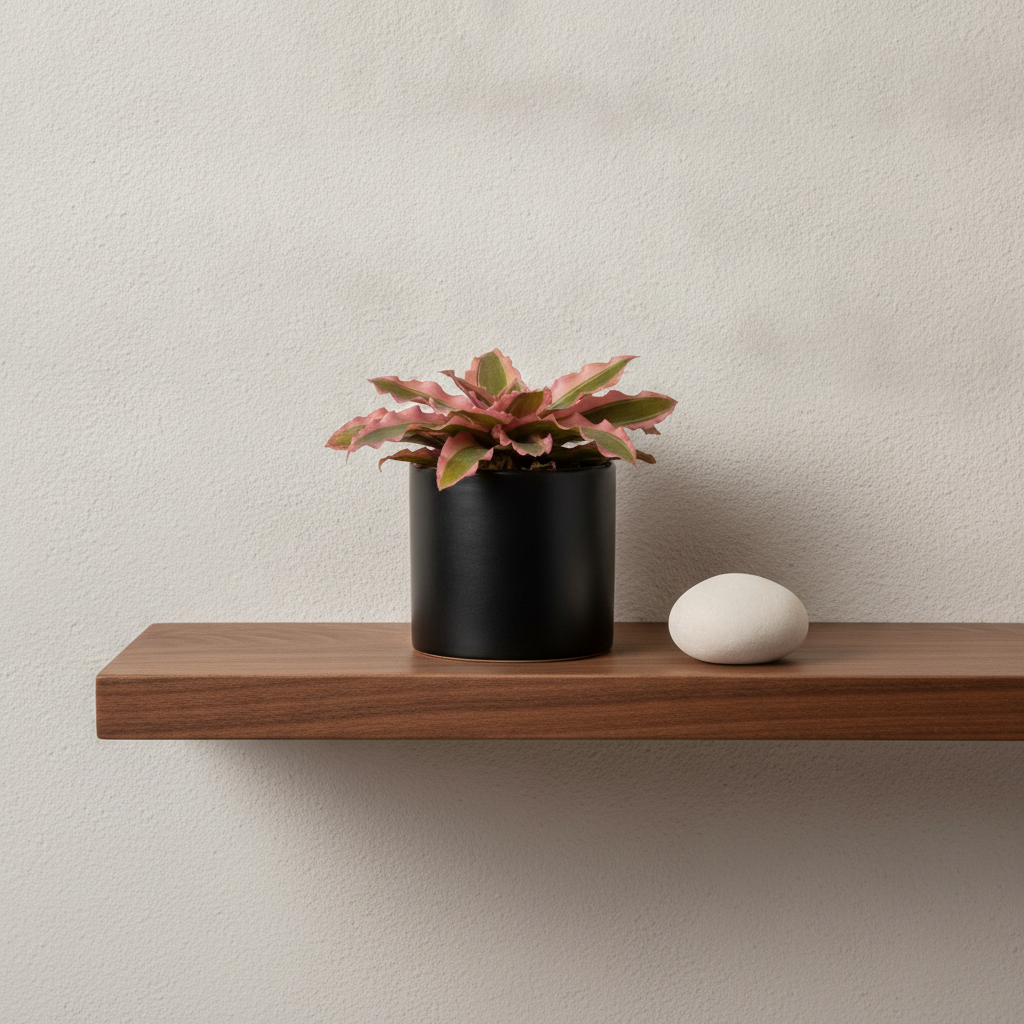
Colour is the main draw. In good light the leaves develop broad bands of rose and salmon-pink over an olive-green base, and the effect is genuinely striking on a plant that fits in the palm of a hand. That colour is also a built-in health gauge: a well-lit, well-watered earth star flushes pink, while a stressed or under-lit one fades toward flat green, telling you at a glance when conditions need adjusting. A further point in its favour, and an important one for many households, is safety. Bromeliads in the genus Cryptanthus are listed as non-toxic to cats and dogs, so a curious pet or child is not put at risk by a nibbled leaf, which cannot be said of many popular houseplants.
Important — Toxicity: The pink earth star is non-toxic to cats, dogs and people, making it one of the safest choices for homes with pets. The leaf edges can be finely serrated, so the main hazard is a minor scratch rather than any poisoning, and grazing animals will usually leave the stiff foliage alone.
Light Requirements
Light is the single biggest factor in whether a pink earth star lives up to its name. In the wild it grows on the dappled floor of the Brazilian Atlantic forest, receiving bright but filtered light through the canopy above. Indoors it wants the equivalent: plenty of ambient brightness, but very little direct sun striking the leaves. Get this balance right and the pink pigments intensify; get it wrong in either direction and the plant either bleaches and scorches or fades to a dull, stretched green.
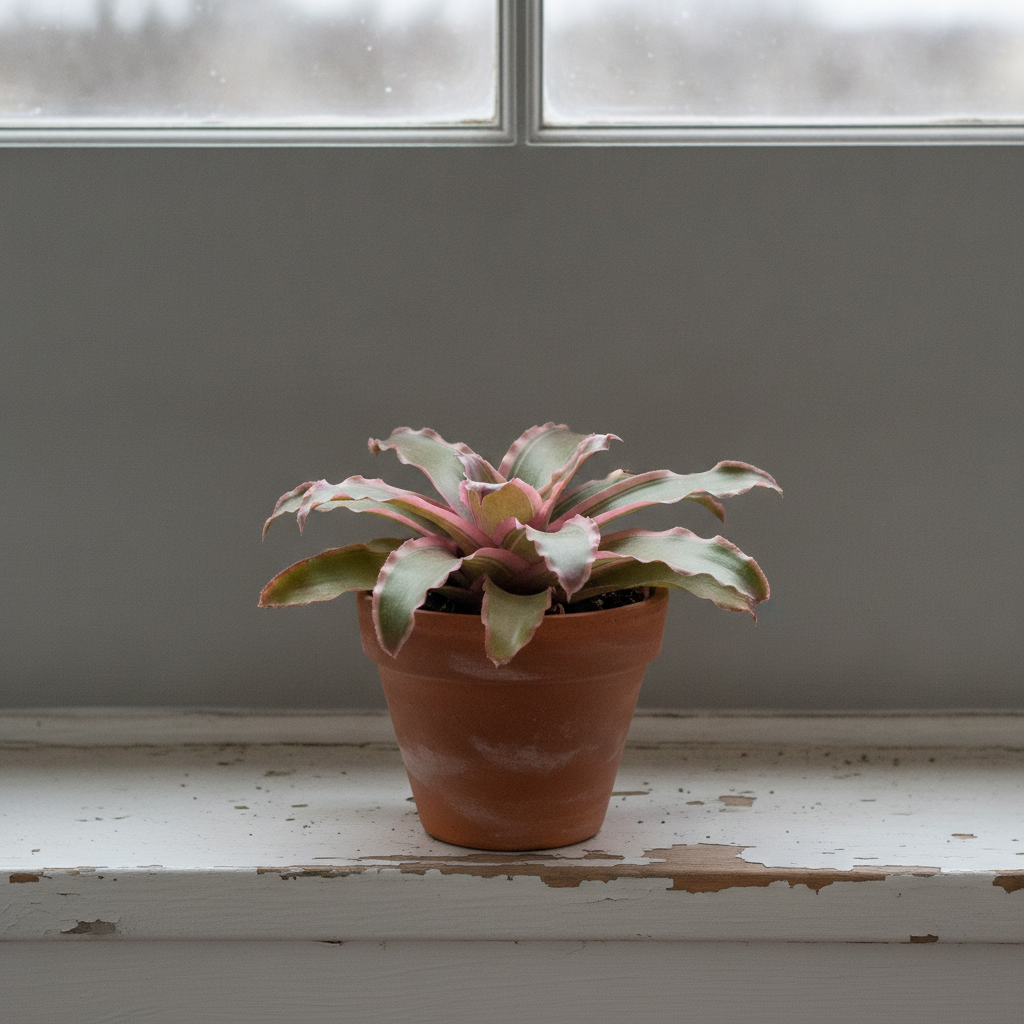
The ideal position is a spot that stays bright all day but sits just out of the path of direct beams, such as a metre back from a large window or immediately beside an east-facing one. The colour is your feedback loop. If the rose banding is strong and even, the light is right. If new growth comes in pale green and the rosette starts to elongate and reach, the plant needs more brightness. If the leaf tips brown and the surfaces look bleached or dry, it is getting too much direct sun.
Light Levels Explained
Because “bright indirect light” means different things in different homes, it helps to think in rough measured terms. The pink earth star performs best somewhere in the medium to bright indirect band, holding good colour across a fairly wide range as long as scorching sun and deep shade are both avoided.
| Light Category | Approx. Level | Typical Location | Outcome |
|---|---|---|---|
| Direct sun | Over 50,000 lux | On a south windowsill, midday | Leaves bleach and scorch; brown patches |
| Bright indirect | 10,000 to 20,000 lux | Beside an east window, or back from a south one | Best colour and compact form |
| Medium indirect | 5,000 to 10,000 lux | A metre or two into a bright room | Good growth, colour slightly softer |
| Low | 1,000 to 2,500 lux | North room, away from the window | Fades to green, growth stalls, rosette stretches |
| Very low | Under 500 lux | Interior corner, hallway | Decline over time; not sustainable |
Window Orientation and Placement
South-facing window: The brightest exposure, and usable only with care. Set the plant well back from the glass or filter the light through a sheer curtain, because unbroken midday sun through a south window will scorch the leaves within days.
East-facing window: Often the best choice. The gentle direct light of early morning is soft enough not to burn, and the bright ambient light for the rest of the day keeps the colour strong. An earth star can usually sit right on an east-facing sill.
West-facing window: Workable, but the stronger afternoon sun means the plant should be positioned a little back from the glass or lightly shaded during the hottest part of the day.
North-facing window: Provides even, gentle light with no risk of scorching, and an earth star will survive here, but in the northern hemisphere a north window in winter may not supply enough intensity to hold strong pink colour. Expect a greener, softer look.
Pro Tip — Rotate for Symmetry: The star-shaped rosette is at its most beautiful when perfectly even. Give the pot a quarter turn every week or two so that all sides receive equal light, otherwise the plant will lean and grow lopsided toward the brightest side.
How Light Affects Leaf Colour
The pink and rose tones in the foliage are produced by pigments that the plant makes in greater quantity when light is plentiful, in much the same way that many outdoor plants redden in strong sun. Under generous bright indirect light the bands turn a deep, saturated pink. In dimmer conditions the plant conserves resources, produces less pigment, and the leaves drift back toward plain green. If your earth star has faded, moving it somewhere brighter, but still out of direct sun, will usually restore the colour over the course of new growth rather than instantly.
Warning — Direct Sunlight: Do not try to boost colour by moving the plant into direct sun. The leaves of Cryptanthus bivittatus scorch easily, and sunburn shows as pale, bleached, or crispy brown patches that never recover. Increase brightness gradually and keep the light diffused.
Artificial Lighting
Earth stars respond very well to artificial light, which is one reason they are popular in enclosed terrariums lit by LED. A standard full-spectrum grow light positioned 30 to 45 centimetres (12 to 18 inches) above the plant, run for 10 to 12 hours a day, will keep the colour strong even in a room with poor natural light. Because the plant is low and compact, a single small fixture is usually enough, and the even, controllable output of an LED makes it easy to give the plant exactly the level it prefers without any risk of scorching.
Seasonal Adjustments
Light intensity indoors drops sharply in winter, and a spot that was perfect in summer may become too dim by December. As the days shorten, move the plant closer to the window, or supplement with a grow light, to maintain colour and prevent the rosette from stretching. When spring returns and the sun climbs higher and stronger, reverse the process and pull the plant back from any window where direct beams now reach it, so the leaves are not caught out by the sudden increase in intensity.
Watering & Humidity
Watering an earth star is a balancing act between two dislikes: it resents both drought and soggy roots. Because it is terrestrial, it does not store water in a central tank the way many bromeliads do, so it depends entirely on the moisture in its shallow root zone. The aim is a mix that stays lightly and evenly damp, drying only at the very surface between waterings, never bone dry and never waterlogged.
When to Water
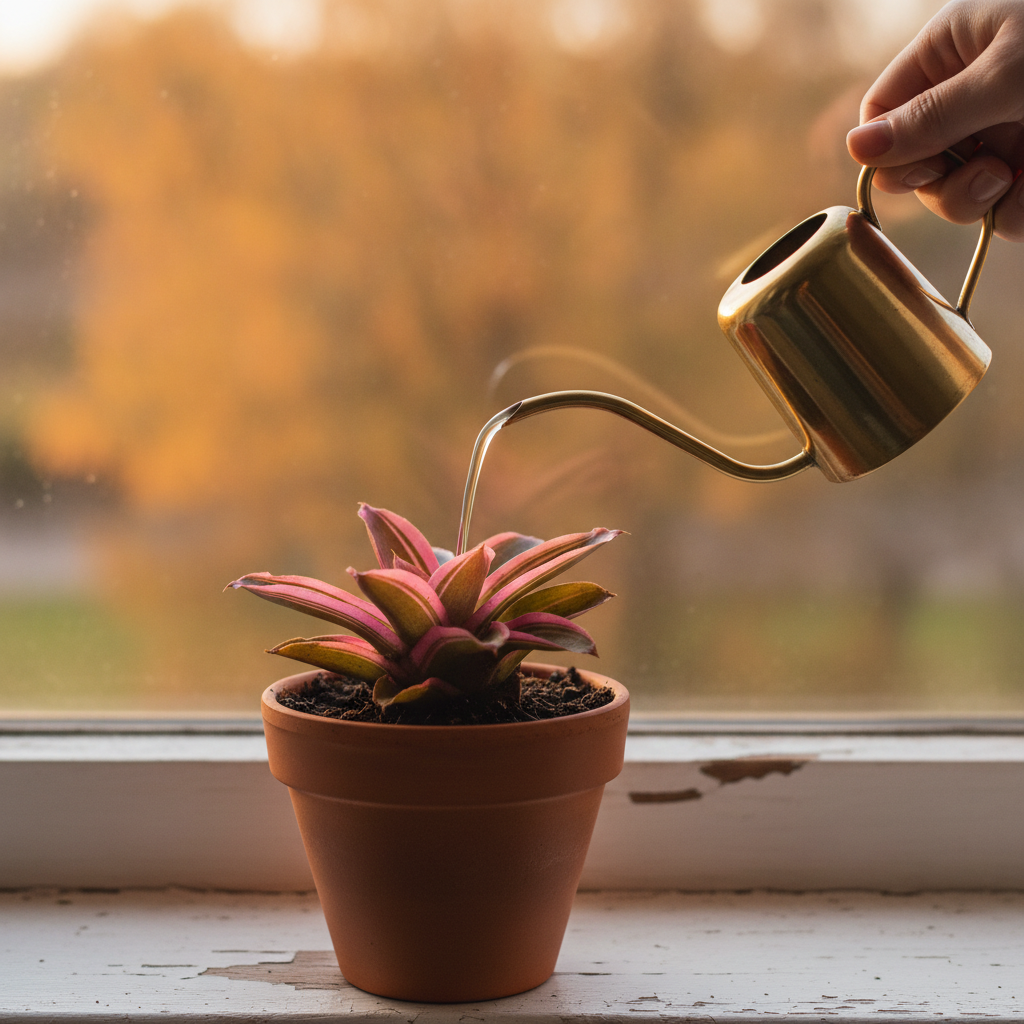
Check the top of the mix with a finger. When the top centimetre (about half an inch) has dried but the soil below is still slightly cool and damp, it is time to water. In a warm, bright room during the growing season this usually falls every four to seven days, but the interval depends heavily on your pot, mix and conditions, so test rather than water on a fixed calendar.
In winter, when growth slows and evaporation is lower, the plant needs noticeably less. Ease back and let a little more of the surface dry between waterings, while still never allowing the root ball to dry out completely. Overwatering in the low light and cool temperatures of winter is the single most common way to kill an earth star, so if in doubt during the colder months, wait a day.
Pro Tip — Water the Soil, Not the Crown: Unlike tank bromeliads, Cryptanthus should not have water sitting in the centre of its rosette. Direct the flow onto the soil at the base and avoid pooling water in the crown, where trapped moisture can trigger rot at the growing point.
How to Water Correctly
- Check that the top centimetre of mix has dried before watering.
- Use room-temperature water, ideally rainwater, distilled or filtered water rather than hard tap water.
- Pour slowly onto the soil around the base of the plant, keeping water out of the central crown.
- Continue until water runs freely from the drainage holes, wetting the whole root zone evenly.
- Let the pot drain completely and empty the saucer, so the roots never stand in leftover water.
Signs of Overwatering vs. Underwatering
| Symptom | Overwatering | Underwatering |
|---|---|---|
| Leaf colour | Yellowing, especially at the base; browning centre | Dull, faded colour with dry tips |
| Leaf texture | Soft, mushy, translucent leaf bases | Curling, crisping and papery edges |
| Soil | Constantly wet, sour smelling | Pulls away from the pot sides, dusty dry |
| Roots | Brown, soft, foul-smelling | Dry and brittle, but not rotten |
| Crown / base | Rotting, collapsing at the centre | Firm but the whole rosette looks limp and flat |
Warning — Root and Crown Rot: The fastest way to lose an earth star is to keep it too wet, particularly with water sitting in the crown. If the centre turns brown and mushy, act quickly: remove the plant, cut away all soft tissue, let any healthy pups callus, and repot into fresh, sharply draining mix. A collapsed crown on the mother rosette is usually fatal, but the offsets can often be saved.
Humidity Requirements
Humidity is where many earth stars quietly struggle. Coming from a humid forest floor, the plant is happiest at 60 per cent relative humidity or higher, well above the 30 to 40 per cent typical of a centrally heated or air-conditioned room. It will tolerate around 50 per cent, but dry air is a slow stressor that shows up as crisp leaf tips and greater vulnerability to spider mites.
The signs of insufficient humidity are browning, papery leaf edges and tips, growth that seems to stall despite correct watering and light, and a general loss of the plush, healthy look the leaves have in humid air. Because the plant is small, it responds well and quickly to any measure that raises the local humidity around it.
The most reliable ways to raise humidity are to grow the plant in a terrarium or glass cloche, where its small size is a real advantage, to group it with other plants so their combined transpiration lifts the local moisture, to stand the pot on a wide tray of pebbles topped up with water that sits just below the pot base, or to run a small room humidifier nearby during dry spells and winter heating. Occasional misting gives a brief lift but is not a substitute for genuinely humid air, and misting into the crown should be avoided.
Water Quality
Like many bromeliads, Cryptanthus is sensitive to the minerals and additives in hard tap water, and prolonged use can show as brown leaf tips and a build-up of salts in the mix. Where possible, water with rainwater, distilled water or filtered water. If you must use tap water, letting it stand overnight allows some chlorine to dissipate, though it does nothing for dissolved minerals or fluoride, so softer water sources remain the better long-term choice.
Soil, Potting & Repotting
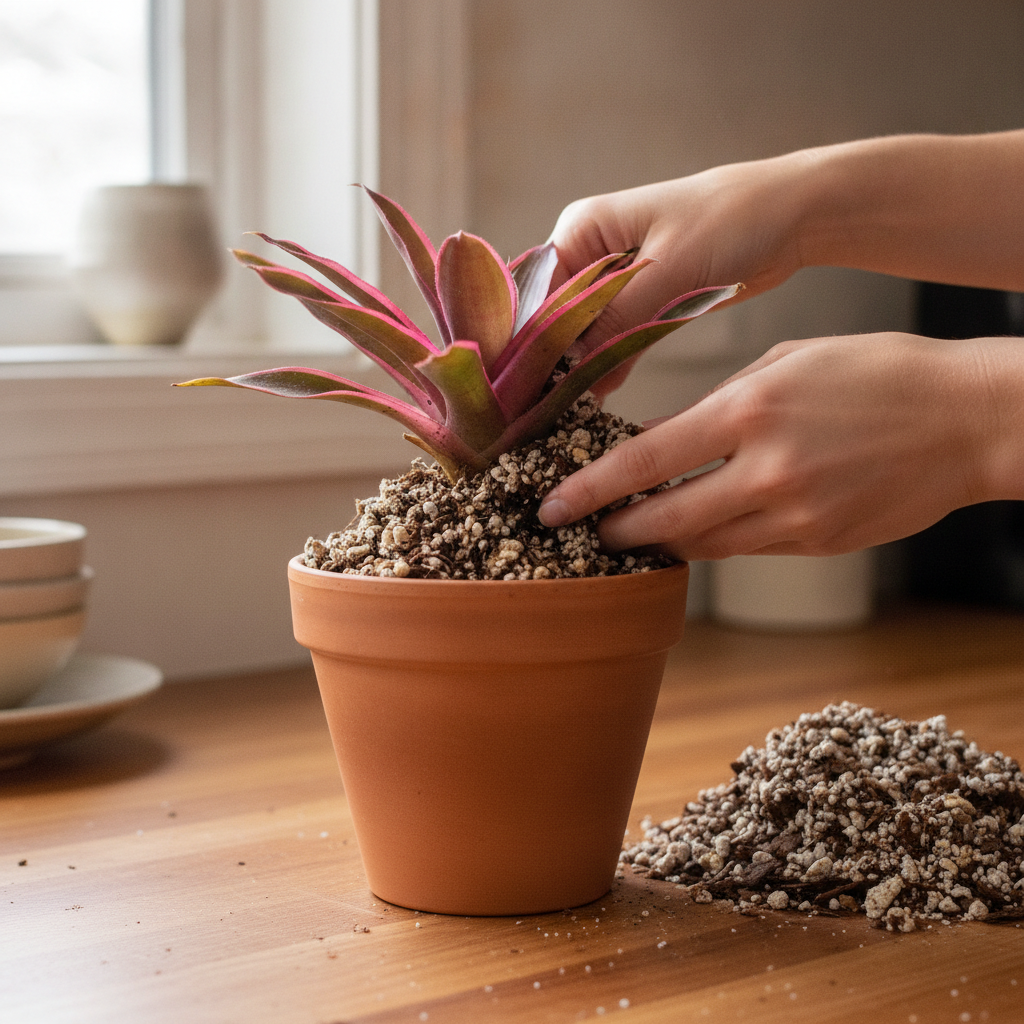
The pink earth star has a small, shallow root system that wants a mix which holds a little moisture while draining freely and admitting air. Heavy, water-retentive potting soil is the wrong choice, because it stays wet around those fine roots and invites rot. The right medium feels open and springy, holds together when damp but never turns to mud.
Ideal Soil Composition
A good earth star mix borrows from both orchid and standard bromeliad growing. The goal is a blend of a moisture-holding base such as peat-free coir or a quality houseplant compost, opened up generously with bark and perlite so that water drains through quickly and air can reach the roots.
| Component | Proportion | Function |
|---|---|---|
| Coir or peat-free compost | Half | Holds gentle moisture and provides a rooting base |
| Orchid bark (fine) | One quarter | Creates air pockets and structure, prevents compaction |
| Perlite or pumice | One quarter | Sharpens drainage and keeps the mix from staying sodden |
| Optional handful of sphagnum moss | Small addition | Retains a little extra humidity around fine roots in dry rooms |
Earth stars prefer a slightly acidic root environment, roughly pH 5.0 to 6.5, which a coir and bark based mix naturally provides. Avoid adding lime or other alkaline amendments, and steer clear of dense garden soil, which compacts and holds far too much water for this plant.
Pro Tip — Quick Mix Recipe: If you want a no-fuss blend, combine two handfuls of peat-free houseplant compost, one handful of fine orchid bark and one handful of perlite. This ratio drains fast, resists compaction and suits the earth star’s shallow roots without any further tinkering.
Choosing the Right Pot
Because the plant grows wide and flat with shallow roots, a shallow, broad pot suits it far better than a deep one. A deep pot simply holds a reservoir of wet mix below the roots that never dries and encourages rot. A wide, low pan or half-pot lets the rosette spread naturally and keeps the root zone in the free-draining upper layer where it belongs.
Drainage holes are non-negotiable. Whatever pot you choose must have holes in the base. Decorative cachepots without drainage will drown the plant; if you use one for looks, keep the earth star in a plain inner pot that can be lifted out to drain and never left standing in collected water.
Pot material: Terracotta is a safe default because its porous walls wick away excess moisture and forgive the occasional heavy hand with the watering can. Glazed ceramic and plastic both hold water longer, which can be an advantage in very dry homes but means you must water more cautiously to avoid keeping the roots sodden.
Pot size: Keep the pot snug. Earth stars are happy slightly underpotted and dislike swimming in a large volume of damp mix. Choose a pot only a little wider than the current rosette, and increase size only modestly when you do move up.
When to Repot
The pink earth star is slow-growing and rarely needs frequent repotting. Every two years is usually enough, mainly to refresh the mix before it breaks down and starts holding too much water. The best time is spring, at the start of the growing season. Signs that a repot is due include mix that has turned dense and slow to drain, roots appearing at the surface or drainage holes, or a mother plant that has produced a crowded ring of offsets you want to divide.
How to Repot: Step-by-Step
- Water lightly a day before, so the root ball holds together but is not saturated.
- Ease the plant out gently, supporting the flat rosette from below rather than pulling on the leaves.
- Tease away most of the old mix from the shallow roots and inspect them, trimming any that are brown or soft.
- Part-fill a clean, shallow pot with fresh free-draining mix.
- Set the plant so the base of the rosette sits at the surface, never buried, and fill around the roots.
- Firm the mix gently to remove large air gaps, keeping the crown clear and proud of the soil.
- Water in lightly and return the plant to bright, indirect light and humid conditions to settle.
Warning — Transplant Shock: Do not bury the crown when repotting. Planting an earth star too deep, with soil packed against the base of the leaves, is a common cause of rot after repotting. Keep the rosette sitting right at the surface and hold off on fertiliser for a month while it re-establishes.
Fertilising
The pink earth star is a light feeder, and restraint is the guiding principle. In the wild it draws modest nutrition from decaying leaf litter, and indoors it is easily harmed by too much fertiliser, which scorches the sensitive roots and leaf tips. A little feeding in the growing season supports steady growth and good colour, but more is emphatically not better with this plant.
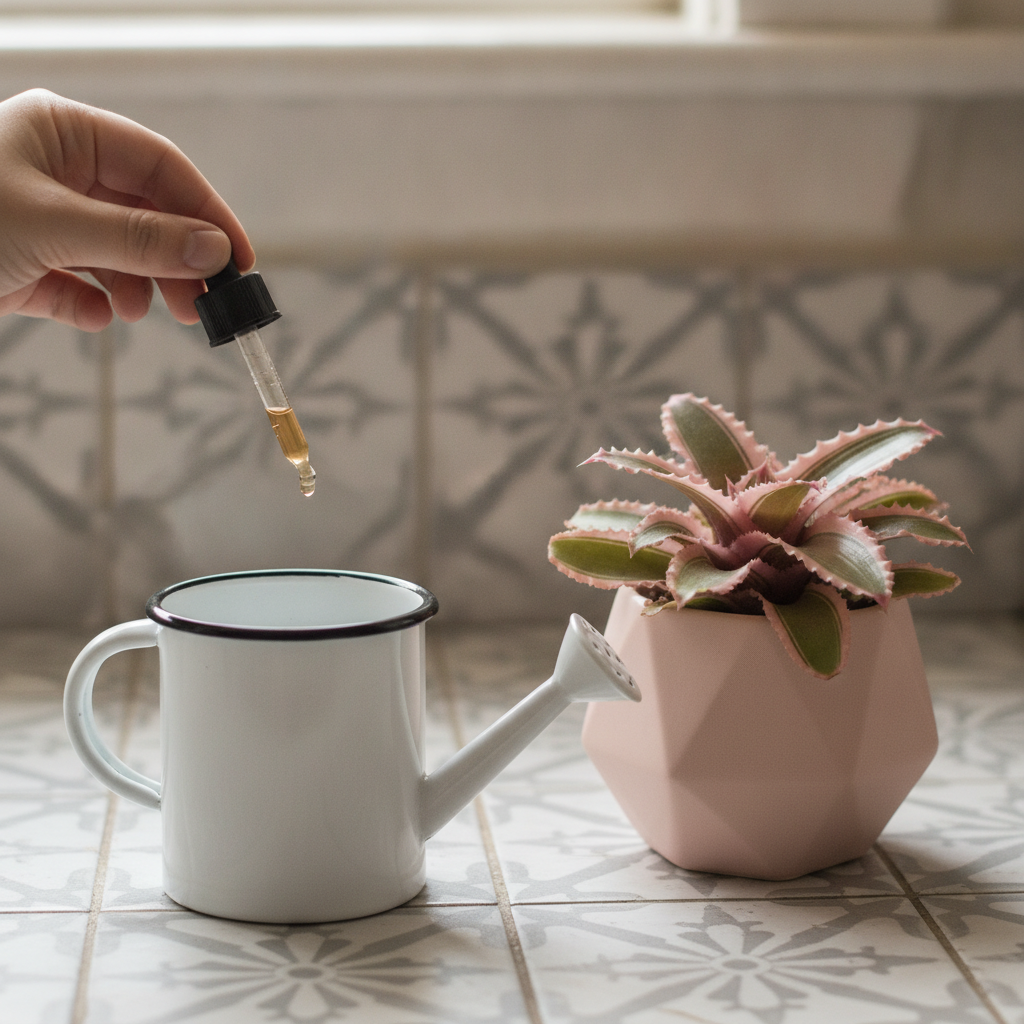
Feed only from spring through summer, when the plant is actively growing, and stop entirely in autumn and winter. A balanced liquid houseplant feed diluted to a quarter or at most half of its normal strength, applied about once a month, is plenty. Always apply feed to already-damp mix, never to dry roots, to avoid concentrating salts against them.
Understanding Plant Nutrients
Fertiliser labels show three numbers, the N-P-K ratio, standing for nitrogen, phosphorus and potassium, the three nutrients plants need in the largest quantities. A balanced, roughly equal ratio suits foliage bromeliads like the earth star. The table below outlines the main nutrients and what a shortage of each tends to look like.
| Nutrient | Symbol | Primary Function | Deficiency Symptoms |
|---|---|---|---|
| Nitrogen | N | Leaf growth and overall vigour | Pale, slow, weak growth |
| Phosphorus | P | Root development and flowering | Poor roots, dull foliage |
| Potassium | K | General health and stress tolerance | Yellow or scorched leaf edges |
| Calcium | Ca | Cell wall strength, new growth | Distorted or weak new leaves |
| Magnesium | Mg | Core of the chlorophyll molecule | Yellowing between leaf veins |
| Iron | Fe | Chlorophyll production | Pale new leaves with green veins |
Types of Fertiliser
Liquid fertilisers: The easiest and safest option for earth stars, because you control the concentration precisely and can dilute well below the label rate. A balanced liquid feed at quarter strength, applied monthly in the growing season, gives reliable results.
Slow-release granular: Convenient but harder to control on such a small, sensitive plant, where a standard dose can easily be too strong. If you use granules, apply at well below the recommended rate and keep them away from the crown.
Organic fertilisers: Gentle options such as heavily diluted seaweed or worm-cast tea feed lightly and are forgiving, which suits the earth star’s low nutritional needs and its dislike of mineral salt build-up.
Feeding Schedule
A simple rhythm works best: feed once a month from early spring to late summer at quarter to half strength, and give nothing at all from autumn through winter, when the plant is resting and unused nutrients simply accumulate as harmful salts in the mix. If you are ever unsure, under-feed. An earth star will forgive scant feeding far more readily than an overdose.
Pro Tip — Less Is Safer: When in doubt, halve the dose again. The pink earth star shows fertiliser damage as brown, burnt leaf tips long before it ever shows signs of hunger, so erring on the weak side of feeding is always the safer bet.
How to Fertilise
- Dilute a balanced liquid feed to a quarter or half of the label strength in room-temperature water.
- Make sure the mix is already damp, watering first if needed.
- Apply the diluted feed to the soil around the base, keeping it out of the crown.
- Let any excess drain away and empty the saucer so salts are not left behind.
- Every few months, flush the pot with plain water to wash out accumulated mineral salts.
Warning — Salt Build-Up: Fertiliser salts and hard-water minerals accumulate over time and burn the roots and leaf tips. Flush the mix thoroughly with plain, soft water every couple of months, letting water run freely through and out of the drainage holes to carry the excess away.
Propagation
Propagating the pink earth star is straightforward and, happily, is built into the plant’s natural life cycle. Like most bromeliads, Cryptanthus is monocarpic: each rosette flowers only once, in its case producing small, inconspicuous white flowers nestled in the centre, and then slowly begins to decline. Before and after flowering it produces offsets, known as pups, around its base, and these are the plant’s way of carrying on. Dividing those pups is the standard and only reliable method of propagation at home.
This means propagation is not so much an optional project as a routine part of ownership. A healthy earth star will hand you a small colony of pups over time, and separating them both multiplies your plants and rejuvenates the group as the original mother eventually fades. There is no need for water rooting or leaf cuttings, which do not work for this plant.
Understanding Offsets and Pups
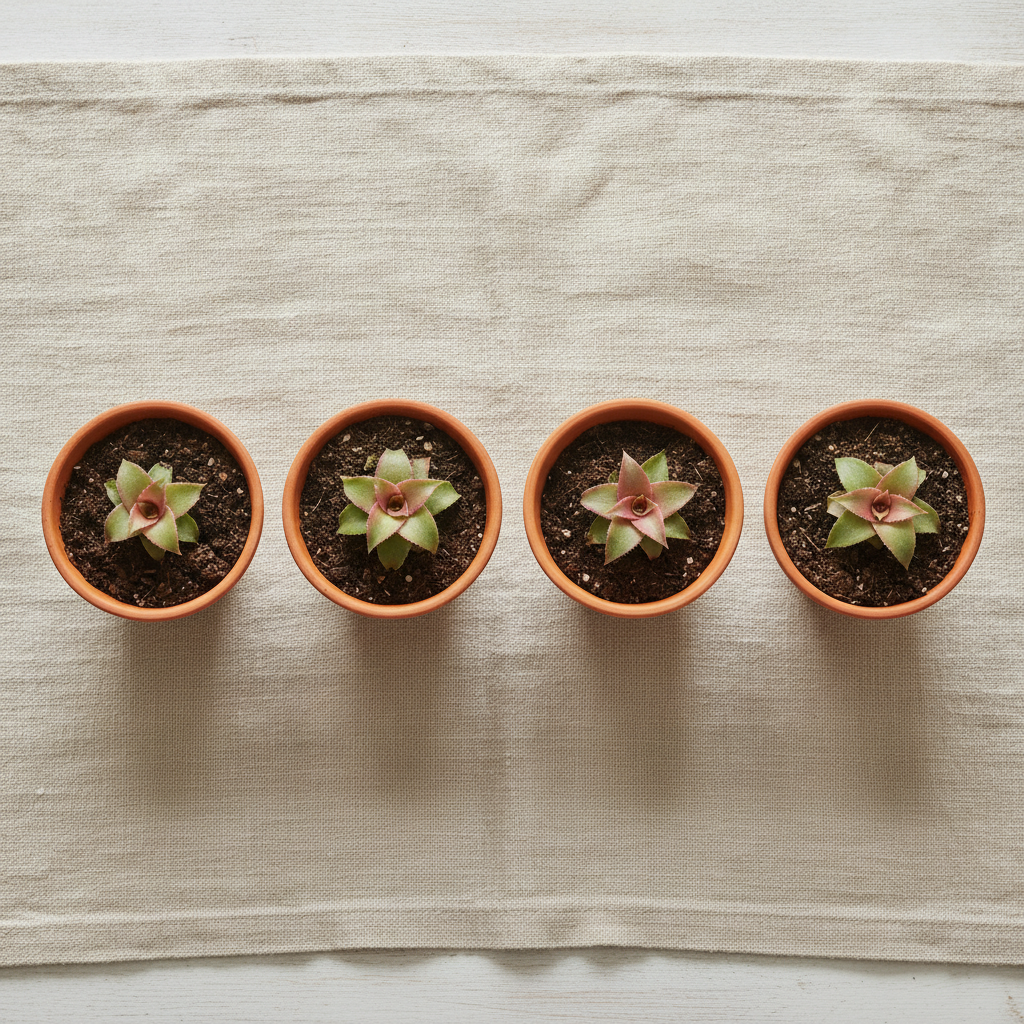
Pups emerge as miniature rosettes from between the leaves at the base of the mother plant, sometimes on short stolons. They are best left attached until they have grown to roughly a third to a half of the parent’s size and, ideally, have started to form their own small roots. A pup removed too early, with no roots and little stored energy, is far harder to establish, so patience at this stage pays off.
Dividing Pups: Step-by-Step
The most dependable method is to remove well-grown pups and pot them individually. This is best done in spring or early summer, when warmth and light help the young plants establish quickly.
- Wait until a pup is at least a third of the mother’s size, ideally with a few roots of its own.
- Ease the whole plant out of its pot so you can see where the pup joins the parent.
- Using a clean, sharp blade, cut the pup away with any roots it has already formed.
- Let the cut surfaces dry and callus for a few hours to reduce the risk of rot.
- Pot each pup into a small container of damp, free-draining mix, setting the base at the surface.
- Keep warm, humid and in bright indirect light, and water sparingly until new growth confirms rooting.
Pro Tip — Raise Humidity for Pups: Young offsets root fastest in warm, humid air. Covering the newly potted pups with a clear dome or placing them in a propagator or terrarium for the first few weeks keeps humidity high and dramatically improves the success rate.
Potting Rooted Pups: Step-by-Step
If a pup has already developed a decent set of roots while attached, establishing it is even simpler and the plant barely misses a beat.
- Separate the well-rooted pup cleanly from the mother with its roots intact.
- Choose a small, shallow pot only slightly larger than the pup’s root system.
- Pot into the same free-draining mix used for adults, keeping the crown at the surface.
- Water in lightly and keep in warm, bright indirect light with elevated humidity.
- Resume normal care once you see new leaves unfurling from the centre.
Troubleshooting Propagation
| Problem | Likely Cause | Solution |
|---|---|---|
| Pup rots after separation | Cut kept too wet, or crown buried | Let cuts callus, use drier mix, keep crown at surface |
| Pup fails to root | Removed too early with no roots | Wait until pups are larger and have started rooting |
| Pup stays small and static | Too little warmth, light or humidity | Warm, humid, bright spot; enclose to lift humidity |
| Mother declines after flowering | Natural monocarpic life cycle | Expected; let the pups take over as the parent fades |
Pests & Diseases
The pink earth star is not especially prone to pests, but its love of humid, warm conditions means problems, when they arrive, tend to hide among the tightly packed leaf bases of the rosette. Most trouble is preventable with good airflow, correct watering and a habit of inspecting new plants before they join your collection.
By far the most serious threat to this plant is not an insect at all but rot, brought on by overwatering, water sitting in the crown, or a mix that stays too wet. Keep that under control and an earth star will usually stay healthy for years. When pests do appear, catching them early, while they are still confined to a leaf or two, makes treatment far easier.
Common Pests
Mealybugs (Pseudococcus species)
Mealybugs are the most common pest on Cryptanthus, appearing as small, white, cottony tufts tucked into the leaf axils and the sheltered centre of the rosette, where they feed on sap and weaken the plant. Because the rosette gives them so many hiding places, they can build up unnoticed.
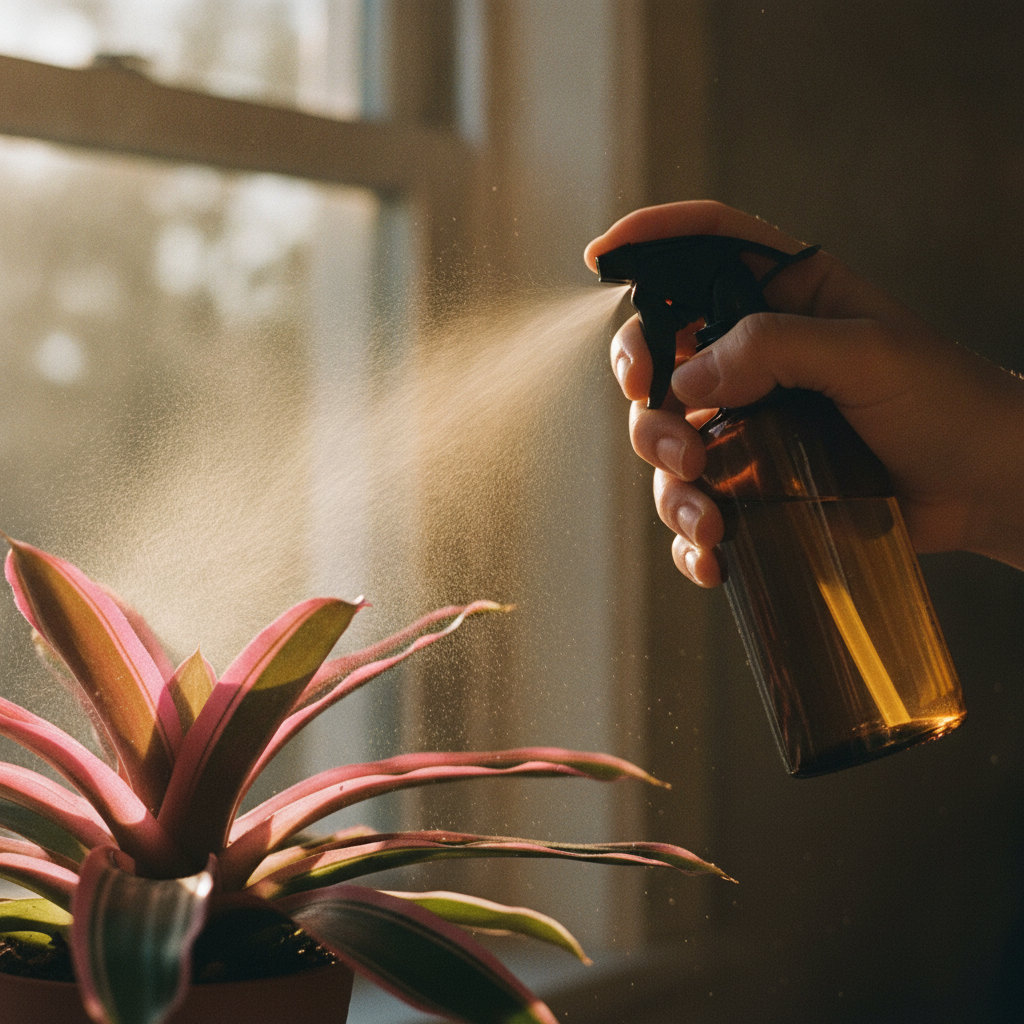
Treatment: Dab each insect with a cotton bud dipped in isopropyl alcohol, then treat the whole plant with insecticidal soap or a dilute neem oil spray, repeating weekly until no new bugs appear. Check the leaf bases carefully, as survivors deep in the rosette will restart the infestation.
Scale (Coccidae family)
Scale insects show up as small, hard or waxy brown bumps clinging to the leaves, often along the undersides and midribs. They are easy to mistake for part of the plant, and like mealybugs they drain sap and leave the foliage looking tired and sticky with honeydew.
Treatment: Scrape or wipe off the scales with an alcohol-dampened cloth or cotton bud, then follow up with neem oil or a horticultural oil to smother any juveniles. Repeat treatments over several weeks are usually needed to break the cycle.
Spider Mites (Tetranychus urticae)
Spider mites thrive in dry air, exactly the conditions that also stress an earth star, so they are most likely to appear when humidity has been allowed to drop. They cause fine pale stippling on the leaves and, in bad cases, faint webbing between the foliage.
Treatment: Rinse the plant, raise the humidity, and treat with neem oil or insecticidal soap, paying attention to the leaf undersides. Because mites multiply quickly, treat every few days over two to three weeks and address the dry-air conditions that invited them.
Common Diseases
Crown and Root Rot (Pythium and Phytophthora species)
Rot is the earth star’s number one killer, caused by overwatering, poor drainage or water pooling in the crown. It shows as a browning, softening and eventual collapse of the centre of the rosette, or mushy, foul-smelling roots below the soil. Once the growing point has rotted, the mother plant cannot recover.
Treatment: Act at the first sign. Unpot the plant, cut away all soft, discoloured tissue with a clean blade, and repot any firm, healthy portions or pups into fresh, sharply draining mix. Then correct the underlying cause by watering less, improving drainage and keeping the crown dry.
Fungal Leaf Spot (Fusarium and related fungi)
Leaf spot appears as brown or blackish patches, sometimes with a yellow halo, usually where leaves have stayed wet in stagnant, humid air. It is more a cosmetic and secondary problem than a plant-killer, but it signals that airflow and watering habits need attention.
Treatment: Remove affected leaves, improve air circulation, avoid wetting the foliage and let the surface dry between waterings. A copper-based or general houseplant fungicide can be used if the spotting continues to spread.
Pest and Disease Summary
| Pest / Disease | Identification | Treatment |
|---|---|---|
| Mealybugs | White cottony tufts in leaf axils and crown | Alcohol swab, then neem or insecticidal soap |
| Scale | Hard brown bumps on leaves and midribs | Wipe off, then treat with horticultural oil |
| Spider mites | Fine stippling and faint webbing in dry air | Rinse, raise humidity, neem or soap sprays |
| Crown and root rot | Soft, brown, collapsing centre or roots | Cut out rot, repot dry, water far less |
| Fungal leaf spot | Brown or black patches on damp leaves | Remove leaves, improve airflow, fungicide if needed |
Prevention Strategies
Prevention rests on a few simple habits. Inspect new plants and isolate them for a couple of weeks before adding them to a collection, so hitchhiking pests are caught before they spread. Water correctly and keep the crown dry, which heads off the rot that causes most losses. Provide good air movement, which discourages both fungal disease and pests that favour still, stagnant air.
Beyond that, keep the plant in good health generally, because a well-lit, appropriately humid, unstressed earth star resists trouble far better than one that is already struggling. Wipe or rinse the leaves occasionally to remove dust and give yourself a regular chance to spot the earliest signs of pests among the leaf bases.
Pro Tip — Inspect the Rosette Centre: The tightly packed heart of the rosette is where both pests and rot take hold first and hide longest. Make a habit of gently checking the crown and leaf axils whenever you water, and you will catch nearly every problem while it is still easy to fix.
Popular Varieties
The pink earth star belongs to a large and colourful genus, and Cryptanthus bivittatus itself has given rise to several named cultivars selected for stronger pink, red or striped colouring. Alongside them, the wider earth star group offers dramatically different patterns, from banded zebra markings to near-black foliage, all sharing the same low, star-shaped growth habit and the same basic care.
Because they are all grown for foliage rather than flowers, choosing a variety is simply a matter of the colour and pattern you prefer. The named forms below are the ones most often found in shops and collections, and they can be mixed together in a single dish or terrarium for a patchwork of colour.
| Variety | Leaf Appearance | Light Needs | Growth Rate | Availability |
|---|---|---|---|---|
| Pink Starlight | Cream-and-pink lengthwise stripes flushing rose | Bright indirect | Slow | Common |
| Ruby | Deep burgundy-red suffused with bronze | Bright indirect | Slow | Common |
| Red Star | Green centre with strong red-pink outer bands | Bright indirect | Slow | Common |
| Elaine | Soft pink and cream with a pearly sheen | Bright indirect | Slow | Occasional |
| Cryptanthus zonatus | Wavy leaves cross-banded like a zebra | Bright indirect | Slow | Occasional |
| Cryptanthus acaulis | Plain green, undemanding earth star | Medium to bright indirect | Slow | Occasional |
| Black Mystic | Very dark maroon to near-black banding | Bright indirect | Slow | Specialist |
Featured Varieties
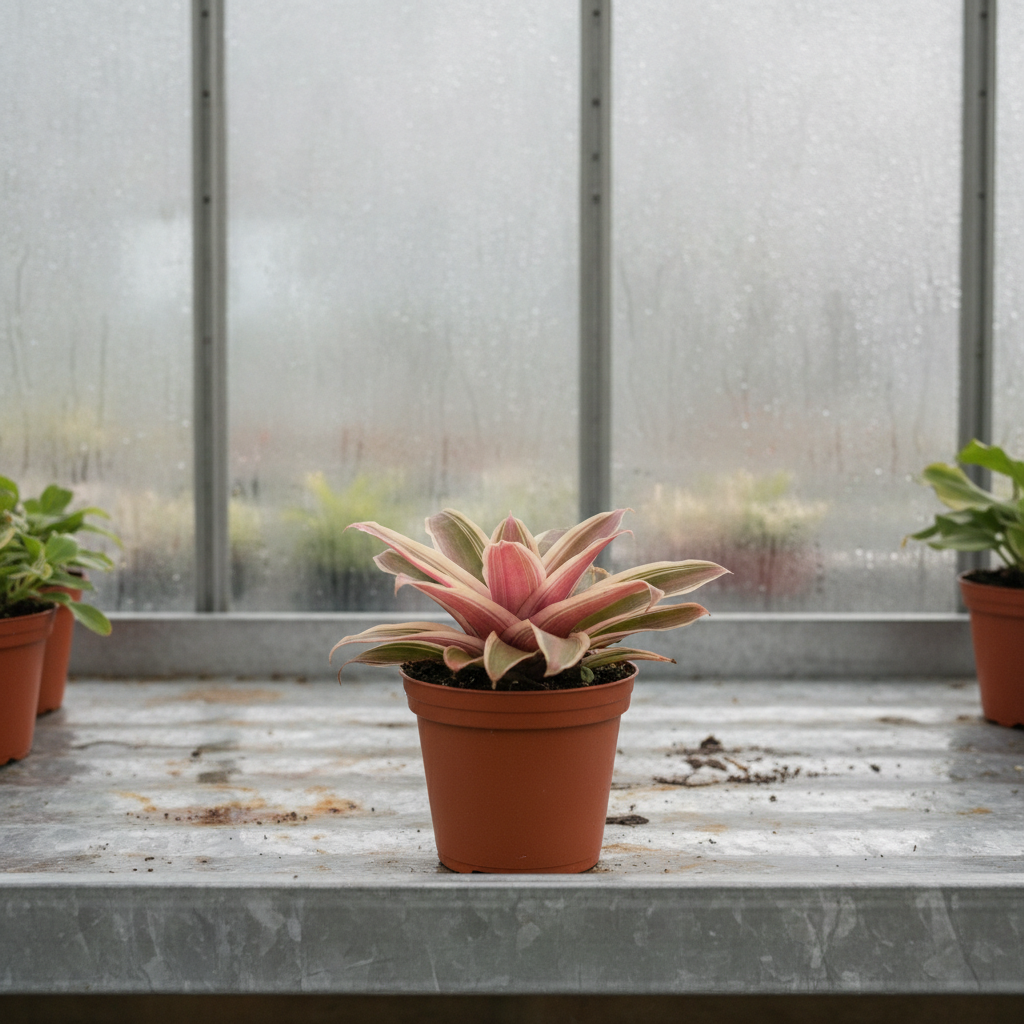
Pink Starlight
The best-known pink form, with broad cream-and-pink lengthwise stripes that flush a strong rose in good light. It is the variety most people picture when they hear “pink earth star” and the easiest to find.
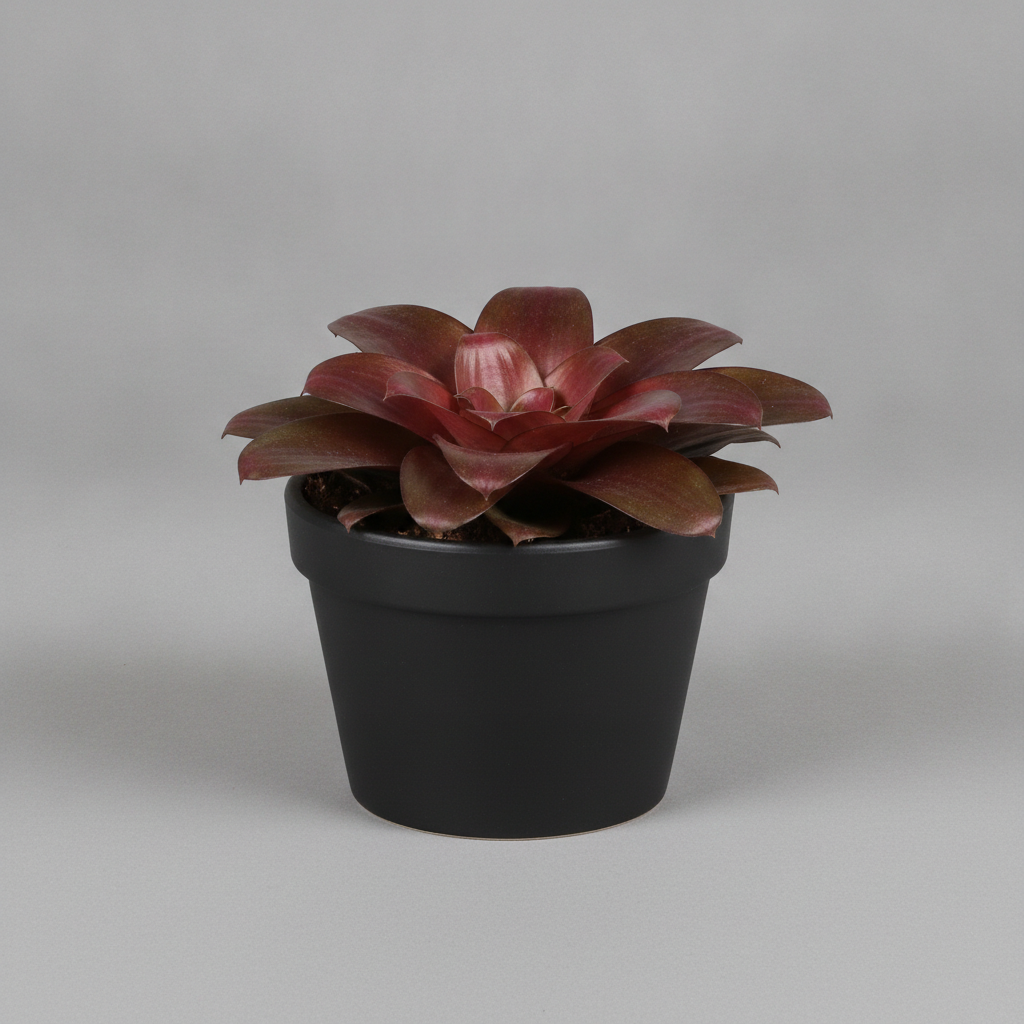
Ruby
A rich, dark form whose leaves deepen to burgundy-red suffused with bronze, especially in bright light. It offers a bolder, moodier alternative to the pink types and contrasts beautifully with them in a group planting.
Variety Profiles in Detail
Pink Starlight (Cryptanthus bivittatus ‘Pink Starlight’)
The archetypal pink earth star, with longitudinal cream and pink stripes over a green base. Its colour is highly light-responsive, turning deep rose in bright indirect light and fading toward pale green in shade, making it both the showiest and the most useful indicator of correct conditions.
Ruby (Cryptanthus bivittatus ‘Ruby’)
Selected for its dark, saturated colouring, Ruby matures to a deep burgundy-red with bronze undertones. It shares identical care with the pink forms but reads as far more dramatic, and its darker pigments hold up especially well under strong, filtered light.
Zebra Earth Star (Cryptanthus zonatus)
A related species rather than a bivittatus cultivar, but grown alongside it under the earth star name. Its wavy leaves are cross-banded in silvery grey and brown like a zebra, offering pattern rather than pink, and it thrives on exactly the same routine.
Choosing the Right Variety for Your Space
For a bright spot where you want maximum colour, the pink and red forms such as Pink Starlight, Ruby and Red Star reward you with the strongest tones. In a slightly dimmer position, the plain green Cryptanthus acaulis or the patterned zebra type will look better than a pink variety struggling to hold colour it cannot make without enough light. Because every earth star shares the same compact habit and care, the simplest approach is to plant several contrasting varieties together in one shallow dish or terrarium, giving a living mosaic of pinks, reds, greens and stripes that all thrive under one routine.
Frequently Asked Questions
Why is my pink earth star losing its pink colour?
The most common reason is too little light. The pink pigments only develop strongly in bright, indirect light, so a plant kept in a dim spot drifts back toward plain green. Move it somewhere brighter, but still out of direct sun, and the colour should return as new leaves grow in.
Is the pink earth star safe for cats and dogs?
Yes. Bromeliads in the genus Cryptanthus are non-toxic to cats, dogs and humans, which makes the earth star one of the safest houseplants for a home with pets. The only minor caution is the finely toothed leaf edges, which can cause a slight scratch.
Do I water an earth star in its central cup like other bromeliads?
No. Unlike tank bromeliads, Cryptanthus is terrestrial and takes up water through its roots, not a central reservoir. Water the soil directly and keep water out of the crown, where it can cause the centre of the rosette to rot.
My earth star flowered and now looks like it is dying. Is that normal?
Yes, this is the plant’s natural life cycle. Each rosette flowers only once and then slowly declines over many months, but before and after flowering it produces pups around its base. Let those offsets grow on and take over; the plant is renewing itself rather than simply dying.
Why are the tips of my earth star’s leaves turning brown?
Brown, crispy tips usually point to low humidity, hard or mineral-rich water, or excess fertiliser. Raise the humidity around the plant, switch to rainwater or filtered water, and feed only lightly. If the whole leaf browns and softens instead, suspect overwatering and rot rather than dry air.
How big does a pink earth star get?
It stays small. A mature rosette is typically only 10 to 15 centimetres (4 to 6 inches) tall and perhaps 20 to 30 centimetres (8 to 12 inches) across. This compact size is exactly what makes it such a good choice for terrariums, dish gardens and small windowsills.
Can I grow an earth star in a terrarium?
Absolutely, and it is one of the best terrarium plants there is. Its small size, love of high humidity and tolerance of artificial light all suit an enclosed planting perfectly. Just ensure the terrarium has some airflow and that the mix drains, so the crown never sits in stagnant moisture.
How often should I repot my pink earth star?
Rarely. Because it is slow-growing with shallow roots, repotting every couple of years is usually enough, mainly to refresh the mix. Repot in spring, keep to a shallow, snug pot, and take the opportunity to divide any pups the mother plant has produced.
Why won’t my earth star grow any bigger?
Earth stars are naturally slow and small, so limited growth is normal rather than a problem. If it seems completely static, check that it has enough warmth, light and humidity, and that you are giving a little dilute feed in the growing season. Remember, too, that an older mother plant slows down as it puts its energy into producing pups.
What temperature does a pink earth star need?
Warm and steady. Aim for 18 to 27 degC (64 to 81 degF) and avoid anything below about 15 degC (59 degF), as well as cold draughts and sudden temperature swings. As a tropical plant it is not frost hardy and should be kept as a warm indoor houseplant year-round in temperate climates.






