
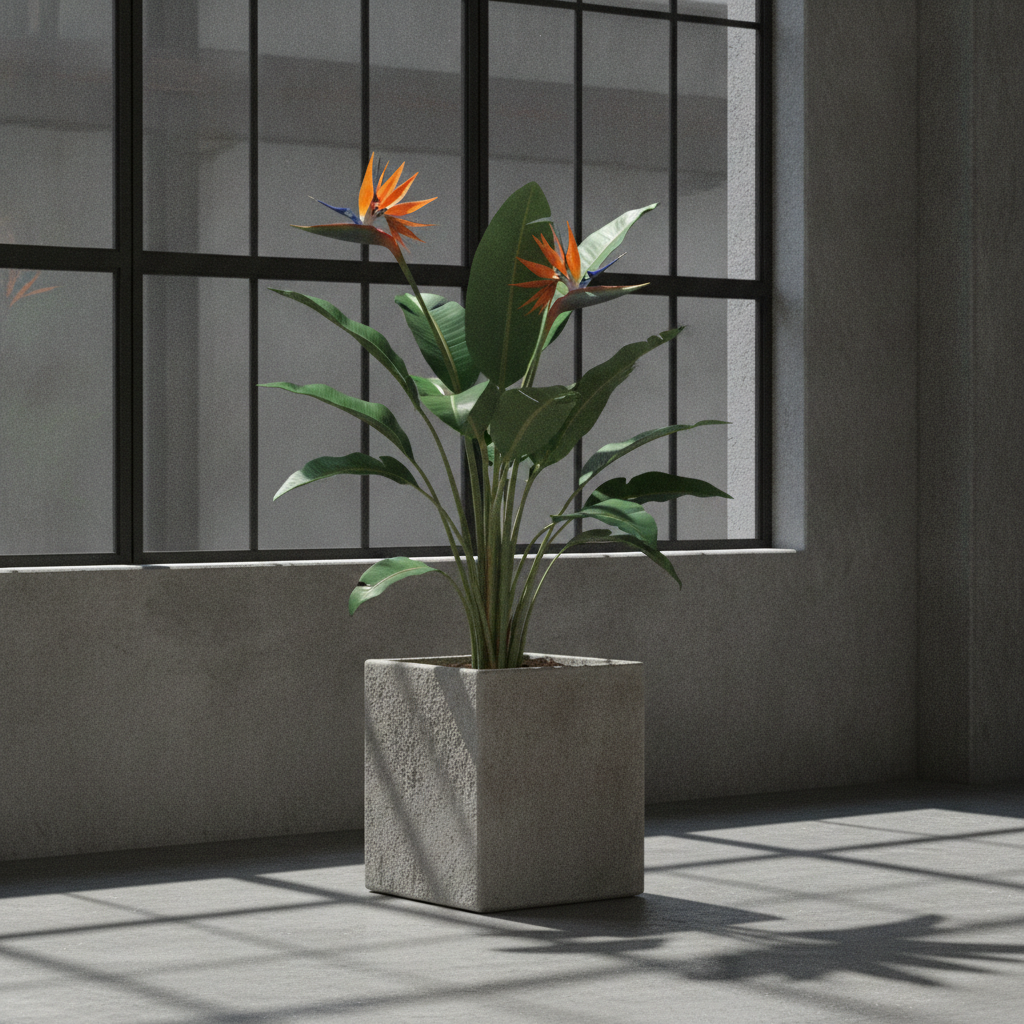
Few houseplants carry the theatrical presence of the orange bird of paradise. Where most foliage plants earn their place through quiet greenery, Strelitzia reginae stakes its claim with architecture: broad, blue-green paddles held aloft on long stalks, and, in maturity, a flower so improbable it looks assembled rather than grown. The bloom emerges from a horizontal boat-shaped bract in a burst of vivid orange sepals and electric-blue petals, poised like the crested head of a wading bird. It is this resemblance that gave the plant both its common name and its other epithet, the crane flower.
Native to the coastal scrub and riverbanks of the Eastern Cape in South Africa, this evergreen perennial has spent decades becoming a fixture of bright living rooms, conservatories and hotel lobbies across the world. It rewards patient owners with structure year round and, given enough light and maturity, with those unmistakable flowers. This guide covers everything from the light levels that coax it into bloom to the division method that turns one large clump into several, along with the honest caveats about why a healthy-looking plant may still refuse to flower.
Quick Reference
The table below distils the core requirements of Strelitzia reginae into a single reference. Treat these as the conditions under which the plant thrives rather than merely survives, and read the fuller sections that follow for the reasoning behind each figure.
| Common names | Orange bird of paradise, crane flower, crane lily |
| Botanical name | Strelitzia reginae |
| Family | Strelitziaceae |
| Origin | Eastern Cape, South Africa |
| Mature size (indoors) | 1.5 to 2 metres (5 to 6.5 feet) tall and wide |
| Light | Bright light with several hours of direct sun |
| Water | Evenly moist in growth, top few centimetres drying between waterings |
| Soil | Rich, loamy, freely draining mix |
| Temperature | 18 to 27 degrees C (64 to 81 degrees F) |
| Humidity | Average to moderate, tolerant of ordinary rooms |
| Feeding | Regularly through spring and summer, a hungry plant |
| Propagation | Division of the clump, or seed for the very patient |
| Toxicity | Mildly toxic to cats, dogs and people if eaten |
| Difficulty | Easy to grow, harder to flower |
Why the Orange Bird of Paradise Makes a Great Houseplant
The appeal of Strelitzia reginae begins with scale and silhouette. A single established plant produces a fan of leaves radiating from the base, each blade a smooth oval up to 45 centimetres (18 inches) long carried on a stiff petiole that can be equally long again. The effect is sculptural, closer to a small banana plant than to a typical trailing or bushy houseplant, and it fills vertical space in a room without the sprawl that comes with vining species. For anyone furnishing a bright corner, a stairwell landing or a double-height window, the plant reads as a permanent green fixture rather than a temporary accessory.
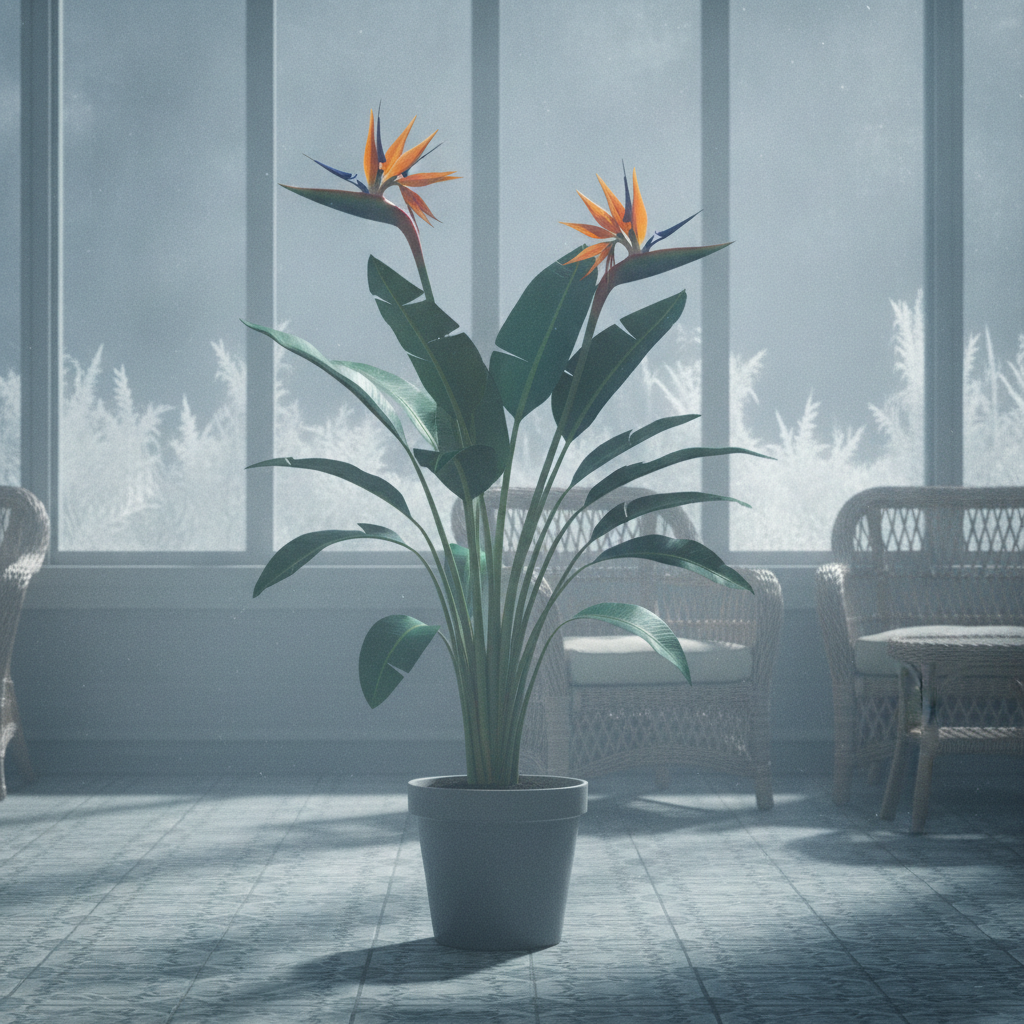
The second draw is, of course, the flower. When a plant reaches maturity and receives adequate light, it sends up a stout stalk topped by a horizontal green-and-pink spathe. From this sheath emerge a succession of blooms, each with three brilliant orange sepals standing upright and two blue petals fused into an arrow-like tongue. A single spathe can release several flowers over a period of weeks, and cut stems last remarkably well in a vase, which is why the crane flower is a staple of the florist trade. Outdoors in frost-free climates the plant can bloom for much of the year; indoors, flowering tends to concentrate in the brighter months but is never guaranteed, a point worth being honest about before buying.
Beyond looks, the orange bird of paradise is forgiving of the ordinary indignities of indoor life. It tolerates average household humidity, shrugs off brief lapses in watering thanks to its fleshy roots, and is not especially prone to the fungal and bacterial troubles that plague thinner-leaved tropicals. It is a slow but steady grower, which means it rarely outpaces its surroundings or demands constant intervention. In short, it offers the drama of a specimen plant with the constitution of something far more pedestrian, a combination that keeps it perennially popular.
Pro Tip – Buy the biggest you can: Because flowering depends on maturity, a larger, older plant is far more likely to bloom in your care than a young one. If flowers matter to you, invest in an established specimen with several fans of leaves rather than waiting years for a small plant to catch up.
Light
Light is the single most important factor in the life of an orange bird of paradise, and the one most often responsible for disappointment. In its native habitat the plant grows in open, sunny positions, and it carries that appetite for brightness indoors. To simply keep the foliage healthy it needs a consistently bright spot; to have any hope of flowering it needs more than that, ideally four to six hours of direct sun each day. A position directly in or beside a south-facing or west-facing window is close to ideal in temperate climates, while an east-facing window will keep the plant alive but is often too dim to trigger blooms.
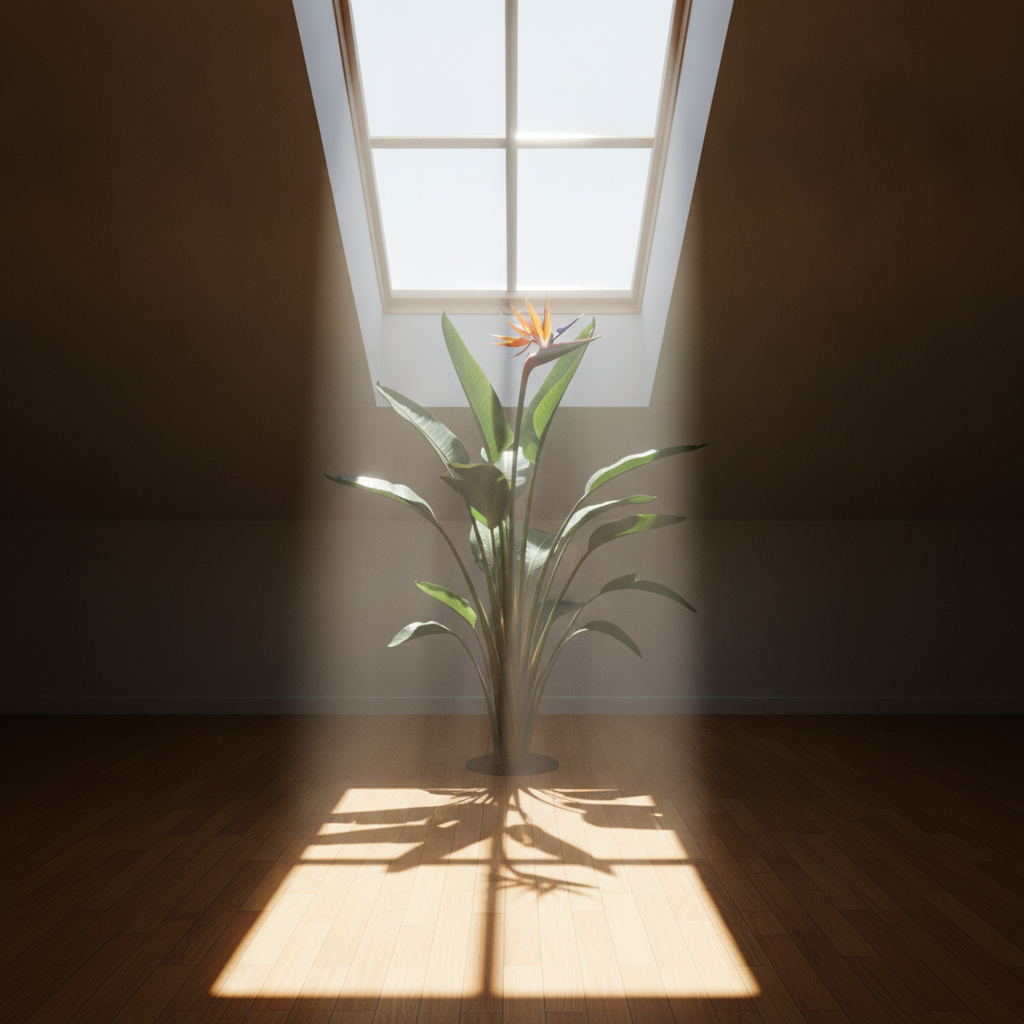
The plant will tell you when it is under-lit. Leaves become smaller and spaced further apart, growth slows to a crawl, and new petioles lengthen and weaken as the plant reaches toward the nearest window, sometimes leaning so far it needs staking. None of this is fatal, but it signals that the conditions are enough for maintenance and nothing more. If a naturally bright position is not available, a full-spectrum LED grow light running for ten to twelve hours a day can make up much of the shortfall, particularly through the dim months of winter.
There is a modest caveat about intensity. A plant that has spent months in low light and is then moved abruptly into fierce summer sun can scorch, developing pale or bleached patches on the leaves that had acclimatised to shade. The solution is to increase exposure gradually over a week or two rather than relocating in a single step. Rotating the pot a quarter turn every week or so also keeps growth even, since the plant will otherwise crowd all its leaves toward the light and grow lopsided.
Watering
The orange bird of paradise likes to be kept evenly moist during its active growth in spring and summer, but it is not a bog plant and resents sitting in waterlogged soil. The reliable approach is to water thoroughly when the top three to five centimetres (one to two inches) of the mix have dried, allowing water to run freely from the drainage holes and then discarding whatever collects in the saucer. This wet-then-slightly-dry rhythm mirrors the plant’s natural cycle of rain and drying wind, and its fleshy roots store enough moisture to carry it comfortably between drinks.
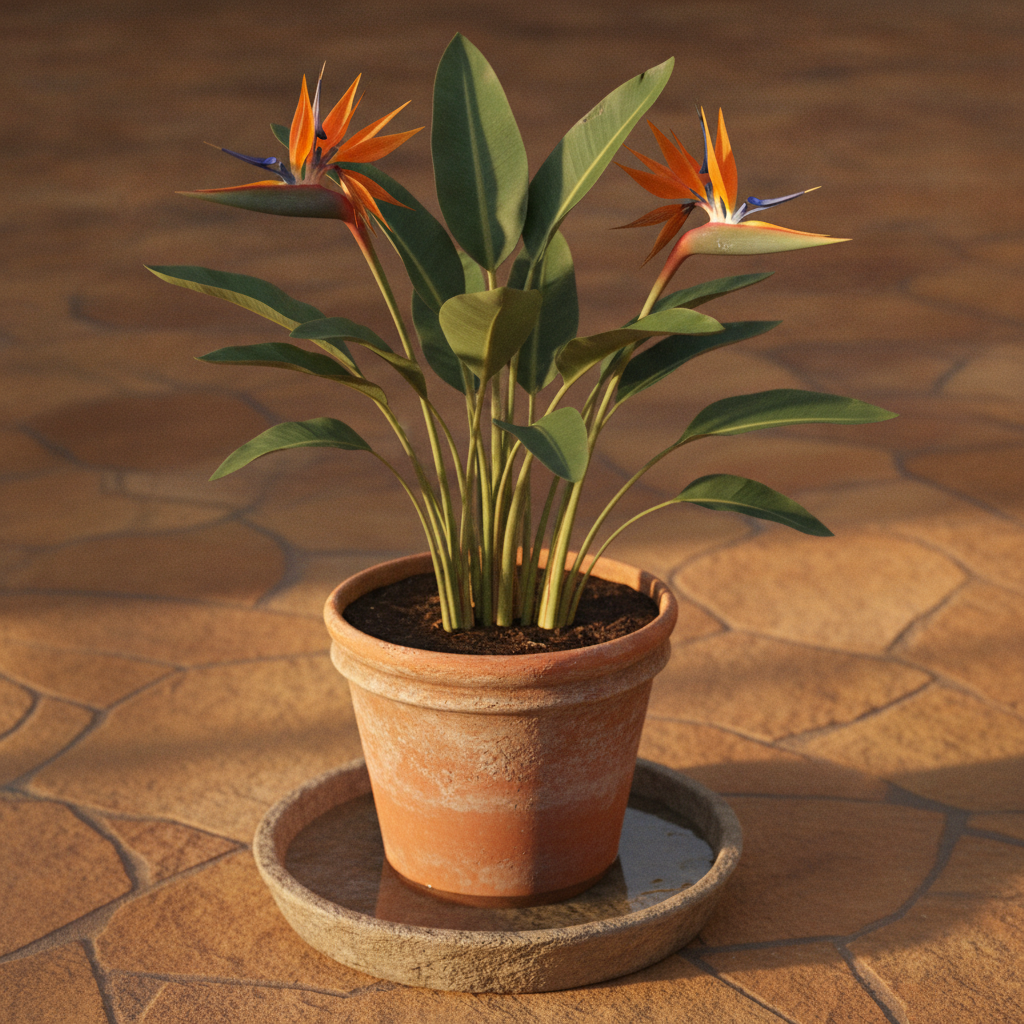
Because a mature plant develops a thick, congested mass of roots, water can sometimes channel straight down the sides of the root ball and out of the pot without ever wetting the centre. Standing the pot in a tray of water for twenty to thirty minutes, so the mix draws moisture up from below, is a useful way to rehydrate a stubbornly dry root ball fully. Whichever method you use, the goal is thorough saturation followed by genuine drainage, never a permanent shallow puddle.
Watering needs fall sharply in autumn and winter, when lower light and cooler temperatures slow the plant down. During this rest, let the mix dry out more between waterings, checking with a finger rather than working to a fixed schedule. Overwatering in the cold months is the most common way to kill an otherwise robust plant: the roots, unable to use the excess, begin to rot, and by the time the leaves yellow and collapse the damage is often advanced. If in doubt during winter, wait a few more days before reaching for the watering can.
Warning – Winter overwatering: The single fastest route to root rot is keeping the soil wet during the cold, dim months when the plant is barely growing. Let the mix dry more deeply in winter and always empty the saucer. Soggy roots in cool conditions rarely recover.
Soil
A good growing medium for Strelitzia reginae balances two competing demands: it must hold enough moisture and nutrition to satisfy a vigorous, hungry plant, yet drain freely enough that the roots never suffocate. A rich, loam-based potting compost forms an excellent foundation, opened up with roughly a third by volume of coarse material such as perlite, orchid bark or horticultural grit. The organic matter feeds the plant and buffers moisture, while the coarse fraction creates the air pockets that keep the root zone healthy.
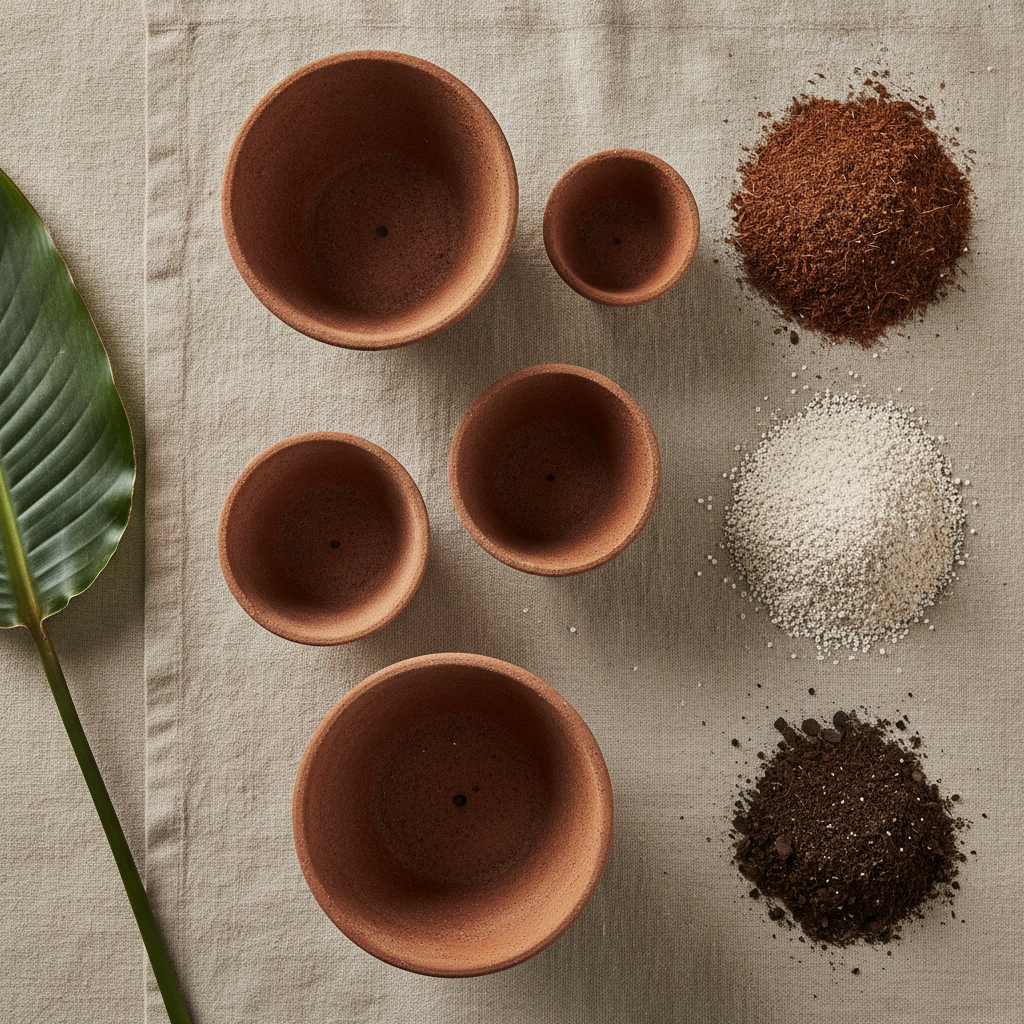
The plant is comfortable in a slightly acidic to neutral medium and is not fussy about precise pH, but it does object to two extremes: a dense, peaty mix that stays wet and airless, and a lean, gritty cactus-style blend that dries out and starves it. Avoid both. If you garden with a general-purpose houseplant compost, simply amending it with extra drainage material and a little well-rotted organic matter will usually produce a medium the plant is happy in for years.
Repotting is best undertaken in spring, but it should be done sparingly. The orange bird of paradise flowers more freely when its roots are somewhat crowded, so resist the urge to move it into a much larger container every year. A plant that fills its pot and is slightly root-bound is closer to blooming than one drowning in fresh compost. Refresh the top few centimetres of mix annually and move up only one pot size when the roots have genuinely filled the current one, typically every two to three years. Be aware that the roots are brittle and the crown resents disturbance, so handle the root ball gently and expect a short sulk after any repotting.
Fertilising
The orange bird of paradise is a hungry plant, and generous feeding through the growing season is one of the levers you can pull to encourage both lush foliage and flowers. From early spring to late summer, a balanced liquid fertiliser applied every two weeks, or a controlled-release granular feed worked into the surface at the start of the season, will keep the plant well nourished. Because it is a strong grower with a large leaf area to support, it uses far more feed than a compact tabletop plant would, and under-feeding shows up as pale, sluggish growth.
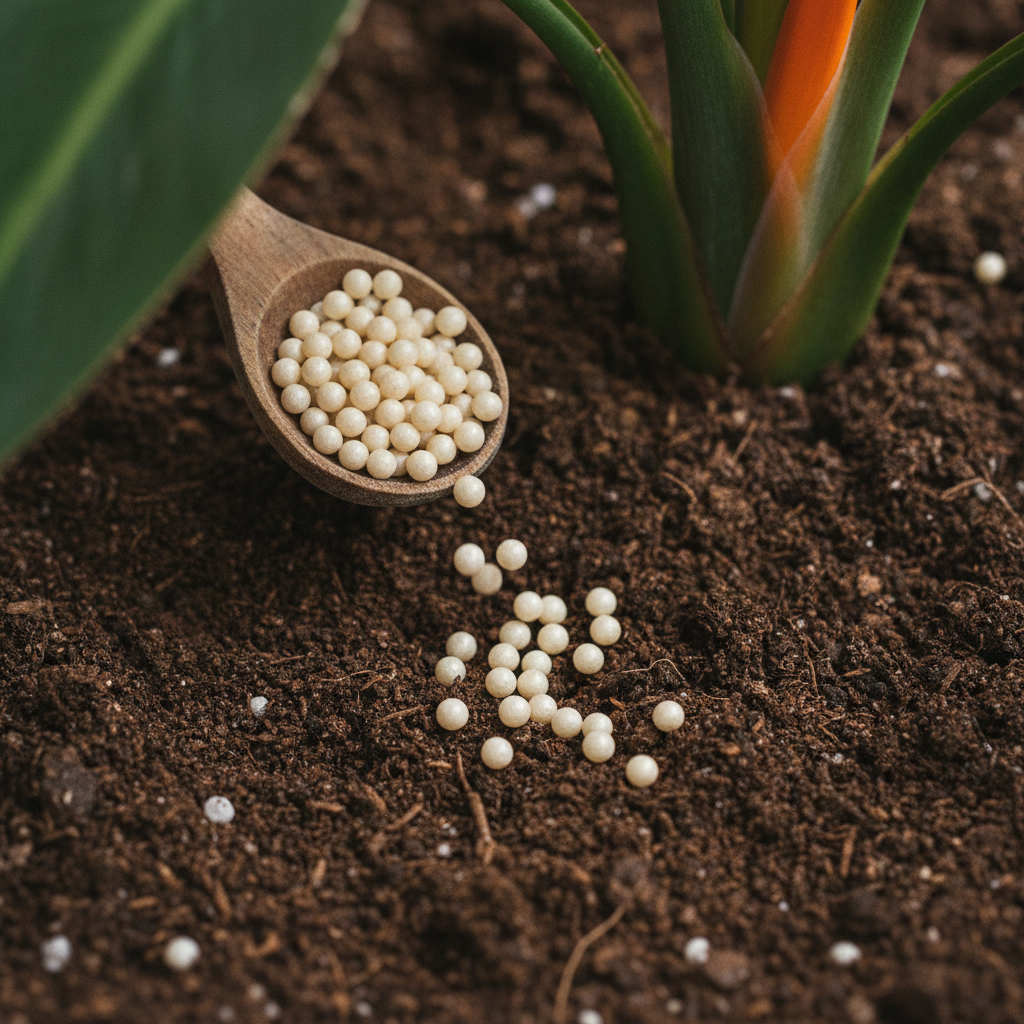
If flowering is your aim, the balance of nutrients matters. A feed with a high proportion of nitrogen drives leafy growth at the expense of blooms, so as an established plant approaches flowering size it is worth switching to a fertiliser richer in potassium and phosphorus, of the sort marketed for flowering plants or even for tomatoes. Some growers use a general feed through spring and then shift to a bloom-oriented feed in early summer to nudge a mature plant toward setting flower stalks.
Feeding should stop, or slow to a bare minimum, from autumn through winter while the plant rests. Fertilising a dormant plant does no good and can lead to a build-up of mineral salts in the mix, which shows as browning leaf tips and a whitish crust on the soil surface. If you notice such a crust, flush the pot thoroughly with plain water a couple of times to leach out the excess, and ease off the feeding rate when growth resumes.
Propagation
The orange bird of paradise is propagated most reliably by division, splitting an established clump into smaller plants each with their own roots and shoots. Unlike many houseplants, it cannot be grown from a leaf or stem cutting, because it has no nodes along a trailing stem to root from. Division is best done in spring, ideally combined with a scheduled repotting so the plant is disturbed only once. The plant is slow to re-establish and may pause for a season after being split, so patience is part of the process.
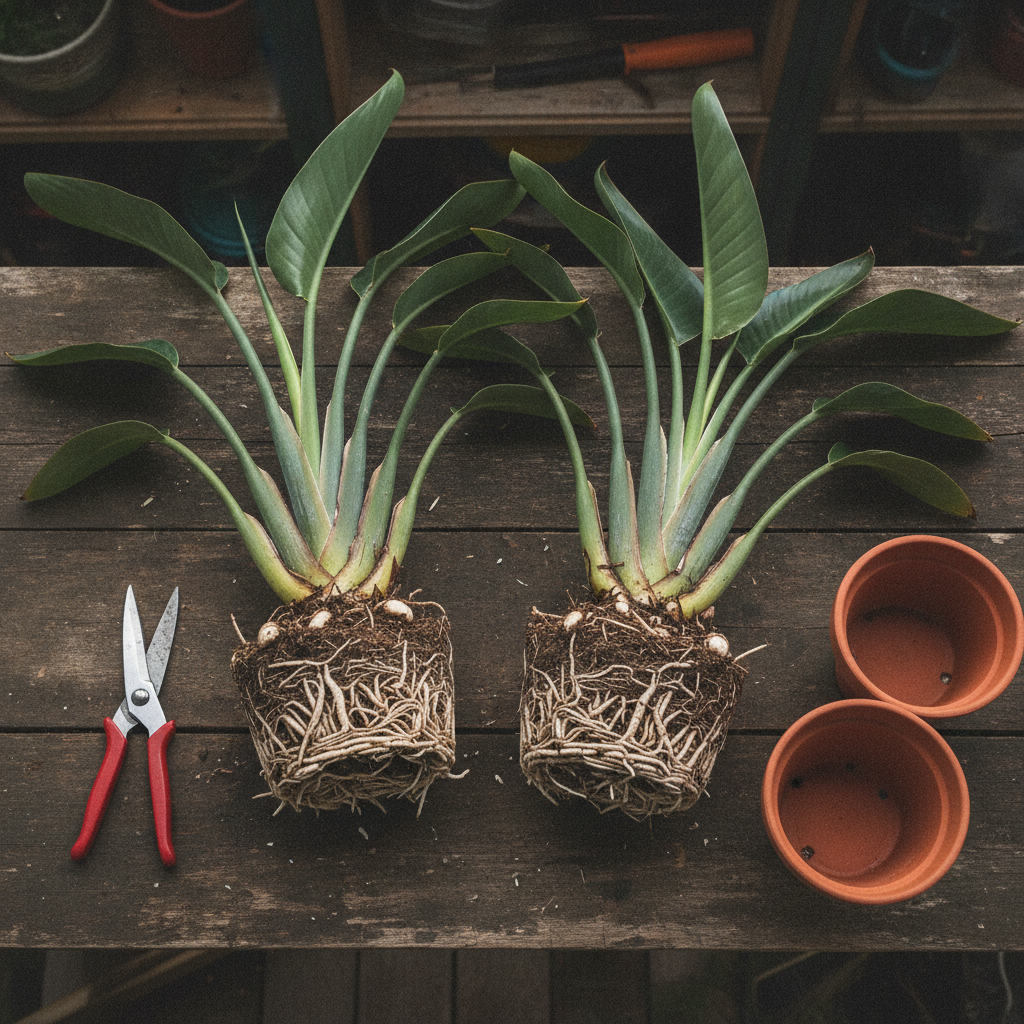
To divide a mature plant, work through the following steps:
- Water the plant a day beforehand so the root ball is moist and slightly more pliable, then slide the whole plant out of its pot.
- Gently tease and brush away enough soil to see where the plant naturally separates into distinct fans, each with its own cluster of leaves and roots.
- Using a clean, sharp knife or spade, cut through the thick rhizome to separate a section that carries at least one healthy fan of leaves and a good portion of roots.
- Dust the cut surfaces with a little cinnamon or leave them to air for an hour to reduce the risk of rot entering the wounds.
- Pot each division into a container only slightly larger than its roots, using the same free-draining mix described above, and firm it in gently.
- Water lightly, place the divisions in bright but not scorching light, and keep the mix only just moist until fresh growth signals that new roots have taken hold.
Growing from seed is possible but demands considerable patience. Fresh seed, recognisable by its tuft of orange fluff, may take anywhere from one to several months to germinate even under warm, consistent conditions, and a seed-grown plant can take four to seven years or more to reach flowering size. For most growers, division of an existing plant, or simply buying a mature specimen, is a far quicker route to the crane flower.
Pro Tip – Bigger divisions establish faster: Resist the temptation to split a clump into many tiny pieces. A division with several leaves and a generous root mass will settle and resume growing far more quickly than a small fragment, which may sulk for a year or fail altogether.
Pests and Problems
For a plant of its size and vigour, the orange bird of paradise is relatively untroubled by pests, but its broad leaves and sheltered leaf axils can harbour the usual indoor offenders. Scale insects appear as small brown limpet-like bumps along the stalks and midribs, mealybugs as white cottony tufts in the crevices where leaves meet stems, and spider mites as fine speckling and webbing on the undersides of leaves, usually in hot, dry conditions. Aphids may cluster on tender new growth and any developing flower stalks.
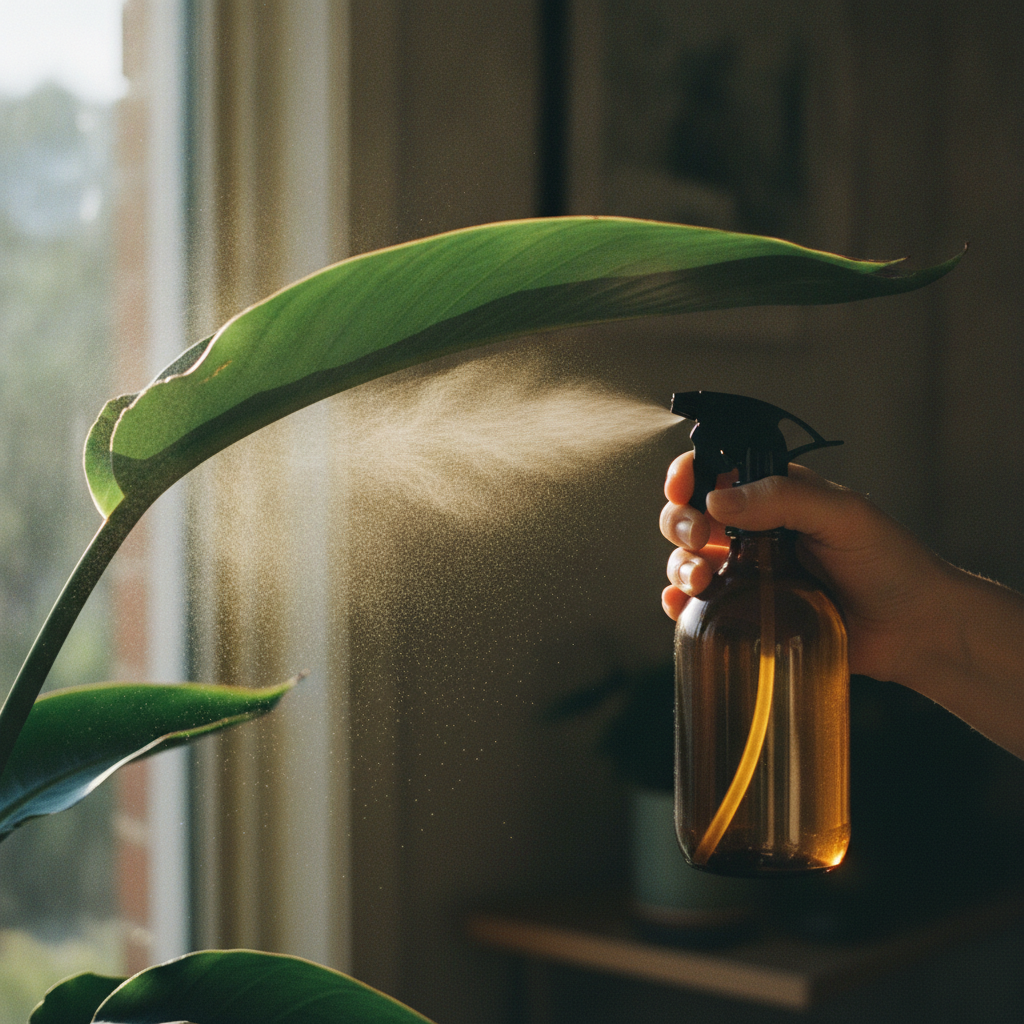
Because the leaves are large and smooth, they are easy to keep clean, and regular inspection is the best defence. Wiping both surfaces with a damp cloth removes dust that would otherwise reduce photosynthesis and dislodges early infestations before they spread. For an established problem, a horticultural soap or neem oil spray applied to all leaf surfaces, especially the undersides, and repeated every week or so until the pest is gone, is usually enough. Individual scale insects can be lifted off with a cotton bud dipped in dilute isopropyl alcohol.
Most complaints about this plant, however, have nothing to do with pests. Yellowing lower leaves usually point to overwatering and the beginnings of root rot, particularly in winter, while brown, crispy leaf edges suggest under-watering, very dry air or a build-up of fertiliser salts. Split or torn leaves are entirely normal and not a sign of ill health; in the wild the leaves tear along their veins to let wind pass through, and indoor plants do the same. The most frequent frustration of all, a healthy plant that simply will not flower, is almost always a matter of insufficient light or insufficient maturity rather than any disease, and the remedy is more sun and more time.
Warning – Mildly toxic: The leaves, flowers and especially the seeds of Strelitzia reginae contain compounds that can cause vomiting and digestive upset if eaten by cats, dogs or people. Keep the plant, and any fallen seeds, out of reach of curious pets and small children.
Varieties
While the classic orange-and-blue form is by far the most familiar, Strelitzia reginae has produced a couple of distinctive selections worth knowing, and the wider genus offers a giant cousin for those wanting something even bolder. The two most notable variations of the species itself are shown below.
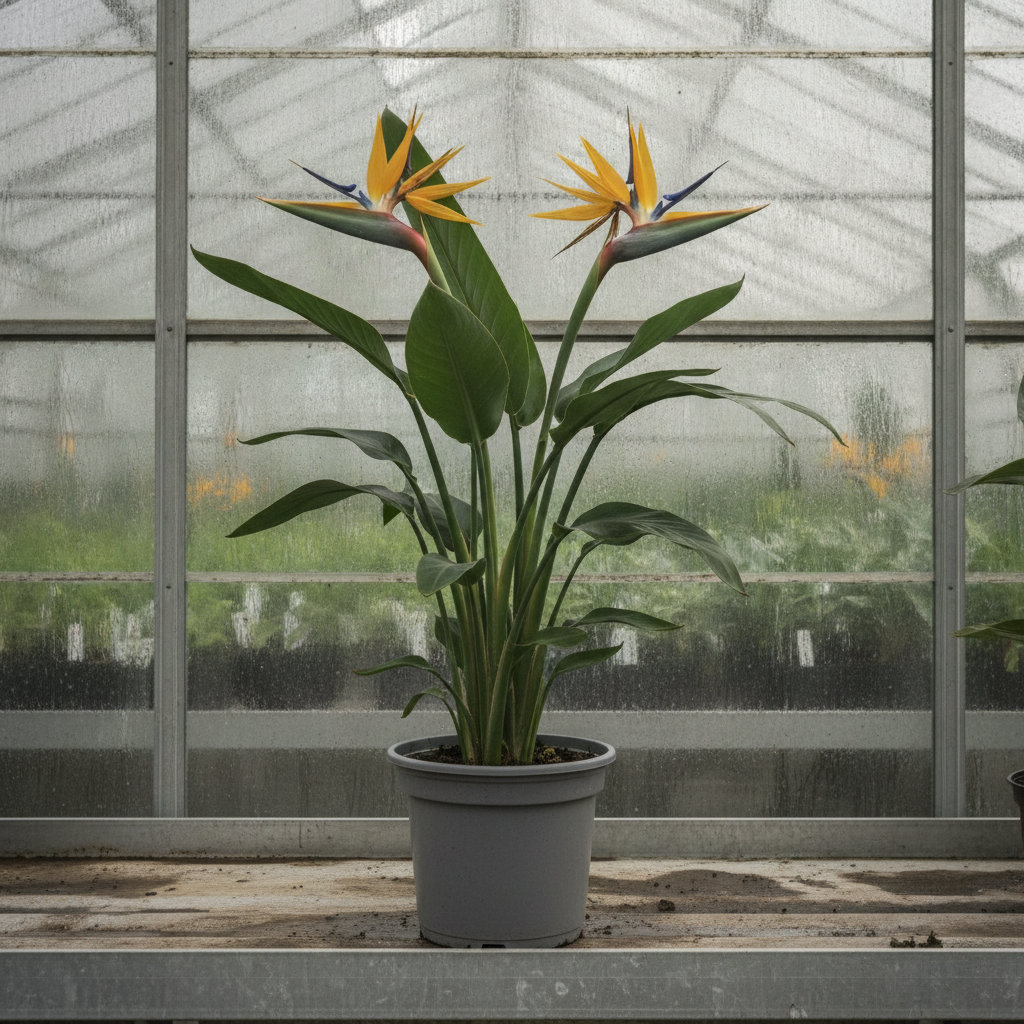
Mandela’s Gold: A yellow-flowered selection developed at the Kirstenbosch National Botanical Garden in South Africa and named in honour of Nelson Mandela. It carries the same crane-shaped bloom and blue-green foliage as the species but replaces the vivid orange sepals with clear golden-yellow, giving a softer, sunnier effect. It is grown exactly like the standard form.
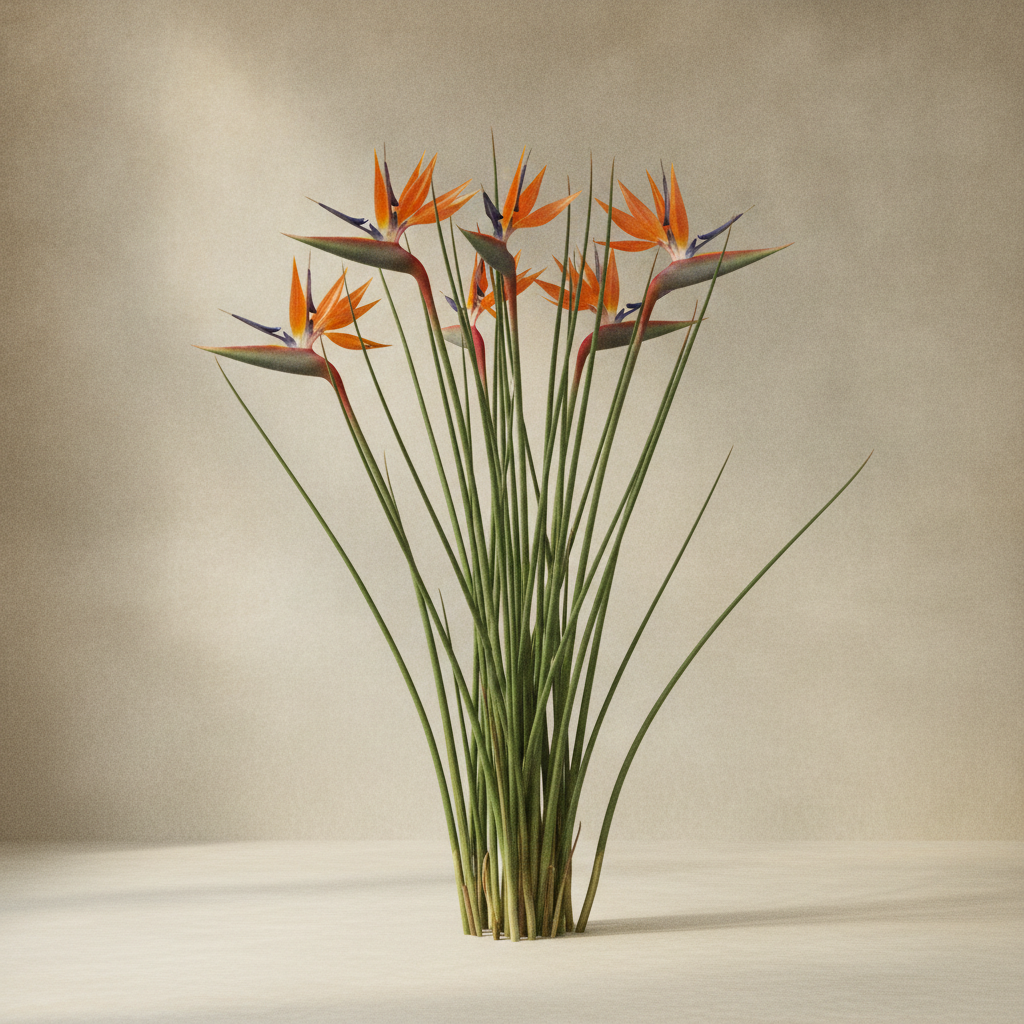
Rush-leaved bird of paradise: A striking natural variant in which the broad leaf blades are reduced almost to nothing, leaving tall, narrow, rush-like stalks that give the plant a spiky, architectural silhouette. It produces the same orange and blue flowers on top of this sparse foliage, is notably drought-tolerant, and is prized by collectors for its unusual form.
Beyond the species, gardeners often confuse the orange bird of paradise with its towering relative Strelitzia nicolai, the giant white bird of paradise, which can reach several metres and bears white-and-blue flowers. That plant is grown chiefly for its dramatic banana-like foliage rather than its rarely seen indoor blooms, and it needs considerably more space. For most homes, the compact and free-flowering Strelitzia reginae remains the more practical choice.
Frequently Asked Questions
Why won’t my bird of paradise flower?
The two usual reasons are insufficient light and insufficient maturity. The plant needs several hours of direct sun each day to bloom, and it will not flower until it is well established, often four to seven years old with several fans of leaves. A plant kept in gentle indirect light may stay perfectly green and healthy for years without ever producing a single flower. Move it to your brightest window, feed it through the growing season with a bloom-oriented fertiliser, and allow it to become slightly pot-bound.
How big does an orange bird of paradise get indoors?
Indoors a mature Strelitzia reginae typically reaches 1.5 to 2 metres (5 to 6.5 feet) in both height and spread, forming a substantial clump. It is a slow grower, so it takes several years to reach full size, and its eventual dimensions can be kept in check somewhat by limiting pot size.
Why are the leaves splitting?
Splitting along the leaf veins is entirely natural and not a cause for concern. In the wild the leaves tear so that wind passes through rather than tugging at the whole blade, and indoor plants split for the same reason, sometimes helped along by handling or draughts. It does not harm the plant. Brown, crispy edges, by contrast, do indicate a problem, usually dry air, under-watering or salt build-up.
Is the orange bird of paradise safe around pets?
No, it is mildly toxic. The foliage and flowers, and particularly the seeds, contain compounds that can cause drooling, vomiting and digestive upset if a cat, dog or child eats them. The plant is not among the most dangerous houseplants, but it is best kept out of reach of animals and children inclined to nibble.
How often should I repot it?
Only every two to three years, and only when the roots have genuinely filled the pot. The plant flowers better when slightly crowded, so frequent repotting into ever-larger containers can actually delay blooming. Refresh the top layer of compost each spring and move up just one pot size when the roots demand it, handling the brittle root ball gently.
Can I grow it from a cutting?
Not in the usual sense. The orange bird of paradise has no trailing stems or nodes to root, so leaf and stem cuttings will not work. It is propagated by dividing an established clump into rooted sections, or, for the very patient, by seed. Division in spring is the reliable home method.






