
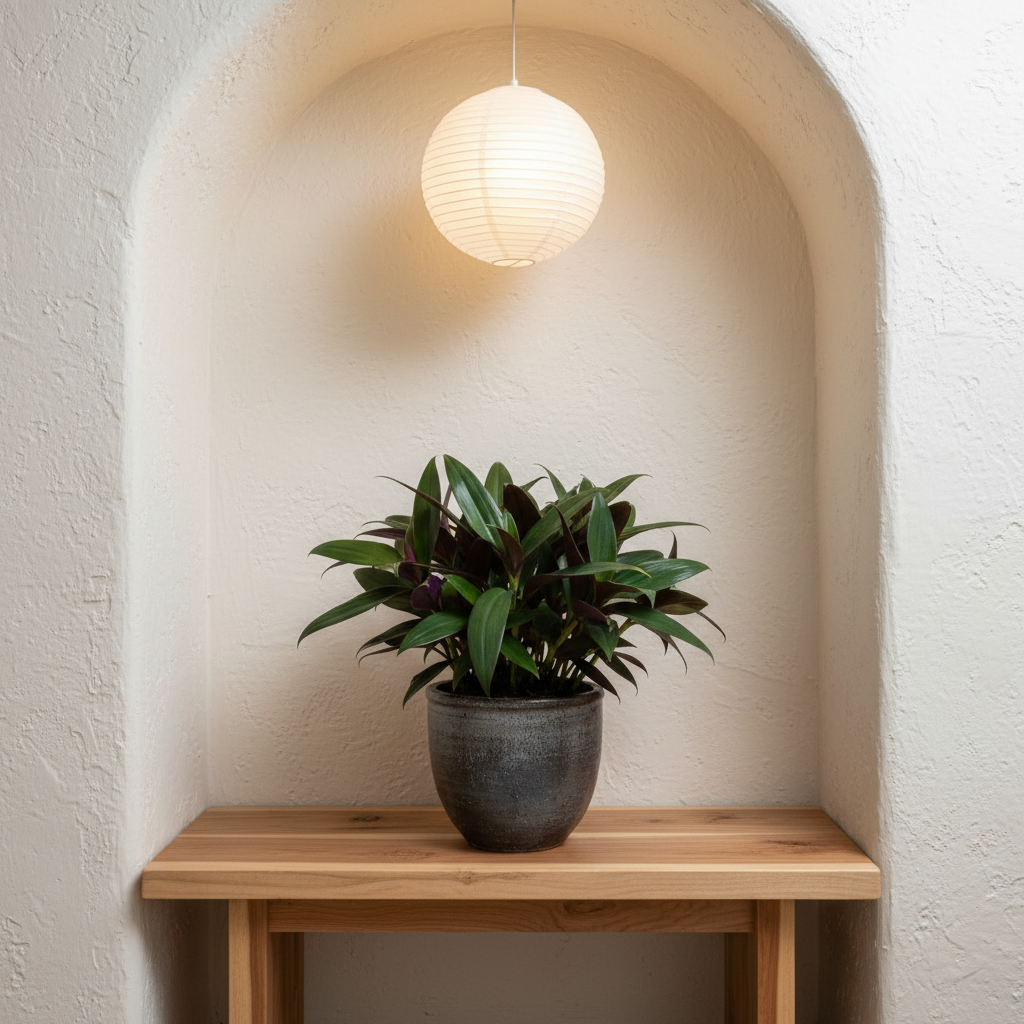
Among the most unmistakable foliage plants ever to settle into a living room, Moses-in-the-Cradle (Tradescantia spathacea) wears its colour scheme like a stage curtain. The lance-shaped leaves are deep glossy green on the upper surface and intense royal-purple beneath, arranged in a tight upright rosette that seems to lean outward as it matures. It carries a small genealogy of common names earned across centuries of cottage and conservatory cultivation: Moses-in-the-Cradle, Moses-in-the-Bulrushes, Boat Lily, Oyster Plant and Cradle Lily, each one referencing the same curious flower the plant produces, in which tiny white blooms nestle inside a boat-shaped purple bract.
Native to southern Mexico, Belize and Guatemala, the species is a member of the Commelinaceae family and a close relative of the wandering and inch plants familiar from many a windowsill. It has wandered widely beyond its home range, naturalising across tropical regions of the world, but indoors it stays where you put it and asks for very little in return. The plant earns its place on every easy-care list, but there is still a meaningful gap between simply keeping it alive and coaxing it into the saturated, glowing colour the species is capable of. This guide covers both. It walks through light, water, soil, fertiliser, propagation, pests and named varieties in enough depth that you can match conditions to the plant rather than the other way around, and it flags the few areas where this otherwise relaxed houseplant has genuine preferences.
Contents
- Quick Reference
- Why Moses-in-the-Cradle Makes a Rewarding Houseplant
- Light Requirements
- Watering and Humidity
- Soil, Potting and Repotting
- Fertilising
- Propagation
- Pests and Diseases
- Popular Varieties
- Frequently Asked Questions
Quick Reference: Moses-in-the-Cradle at a Glance
| Light | Bright indirect light; tolerates a few hours of gentle direct sun and accepts medium light at the cost of colour intensity |
| Watering | Water thoroughly when the top 2 to 3 cm (about 1 in) of soil has dried; reduce to once every two to three weeks in winter |
| Temperature | 18 to 27 degrees C (65 to 80 degrees F); damage begins below 10 degrees C (50 degrees F) |
| Humidity | 40 to 60 per cent is ideal, but tolerates ordinary household air without complaint |
| Fertiliser | Balanced liquid feed at half strength every four to six weeks during spring and summer; pause in winter |
| Toxicity | Mildly toxic to cats, dogs and humans; sap can cause skin irritation in sensitive people; keep away from young children and pets that chew |
Why Moses-in-the-Cradle Makes a Rewarding Houseplant
What sets Tradescantia spathacea apart in a crowded houseplant market is the way it delivers bold colour without complication. Many strongly variegated or pigmented plants demand high light, careful watering and specific humidity to look their best, but Moses-in-the-Cradle keeps its purple undersides whether grown in a bright south window or a dimmer corner. The intensity of the colour shifts with light, deepening to an almost wine-tinted violet in stronger illumination and softening to a quieter plum in shade, but the contrast between the green tops and purple beneath is always there. That structural pigmentation means the plant photographs well, looks dramatic in cuttings on a tabletop and pulls double duty as a small flowering plant when its boat-shaped bracts open in late spring and summer.
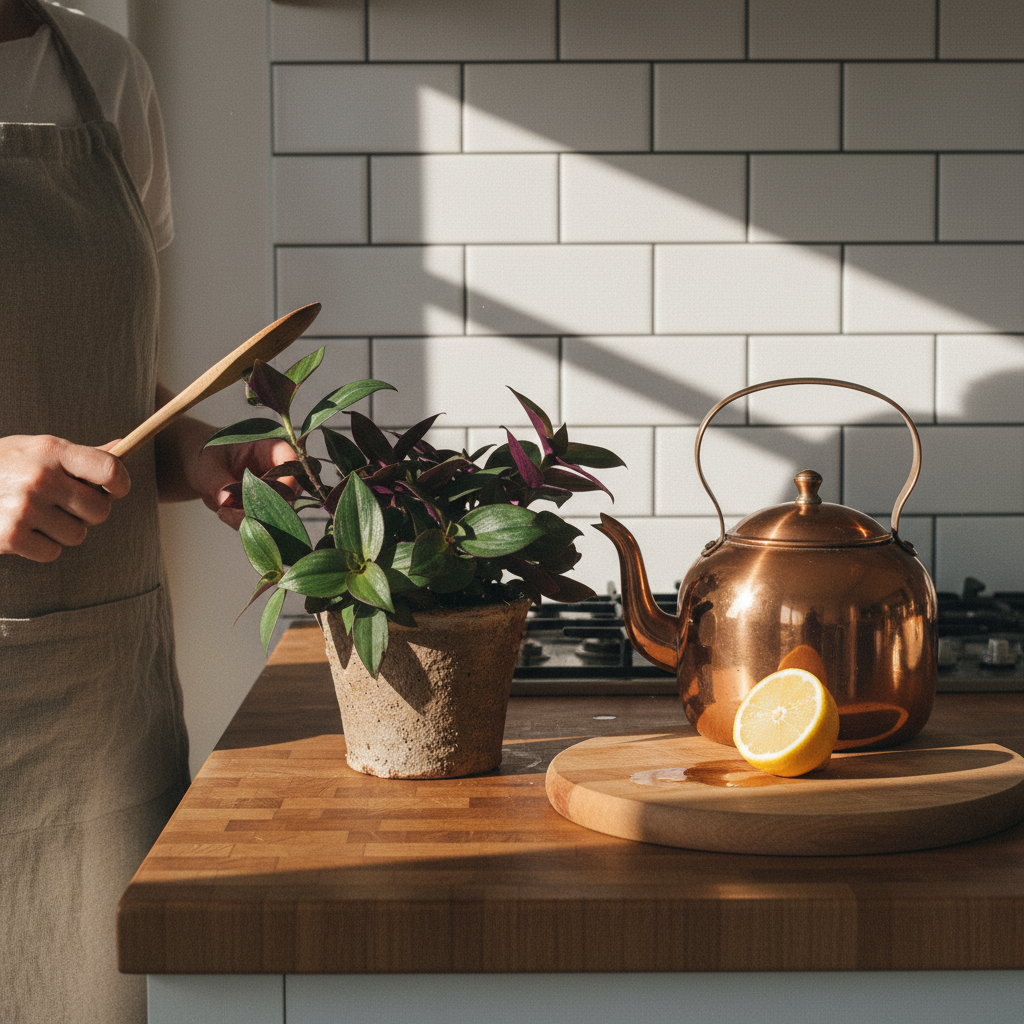
The plant is also unusually forgiving of the everyday lapses that finish off fussier species. It withstands missed waterings, recovers from a bone-dry stretch by pushing fresh leaves from the centre of the rosette and quickly fills out after a hard cutback. Most rosettes reach 30 to 45 cm (12 to 18 in) tall and roughly the same across when grown indoors, while the dwarf cultivars stay around 15 to 20 cm (6 to 8 in), small enough to suit a windowsill or a compact desk. New leaves emerge tightly furled from the centre and unfurl in stages, and mature plants regularly produce small white three-petalled flowers tucked deep inside paired purple bracts, the cradle that gives the plant its name. There is one important caveat before bringing the plant home, especially for households with curious pets or small children, and it is worth setting it down clearly.
Important — Toxicity: All parts of Tradescantia spathacea contain calcium oxalate crystals and a clear sap that can cause skin irritation, oral burning and gastrointestinal upset if chewed or ingested. The ASPCA lists the plant as toxic to cats and dogs. Reactions in humans are typically mild and limited to itchy hands or a stinging mouth, but the plant should be kept out of reach of pets that nibble and children who explore by mouth. Wear gloves when taking cuttings if your skin reacts to plant saps in general.
Light Requirements
Light is the single variable that does most to control how Moses-in-the-Cradle looks. Almost every other care decision adjusts to whatever light level you can offer, because the plant survives a wide range and thrives toward the brighter end. In its native understorey it grows in dappled sun and along forest edges, conditions that translate well to a window that receives strong indirect light for most of the day.
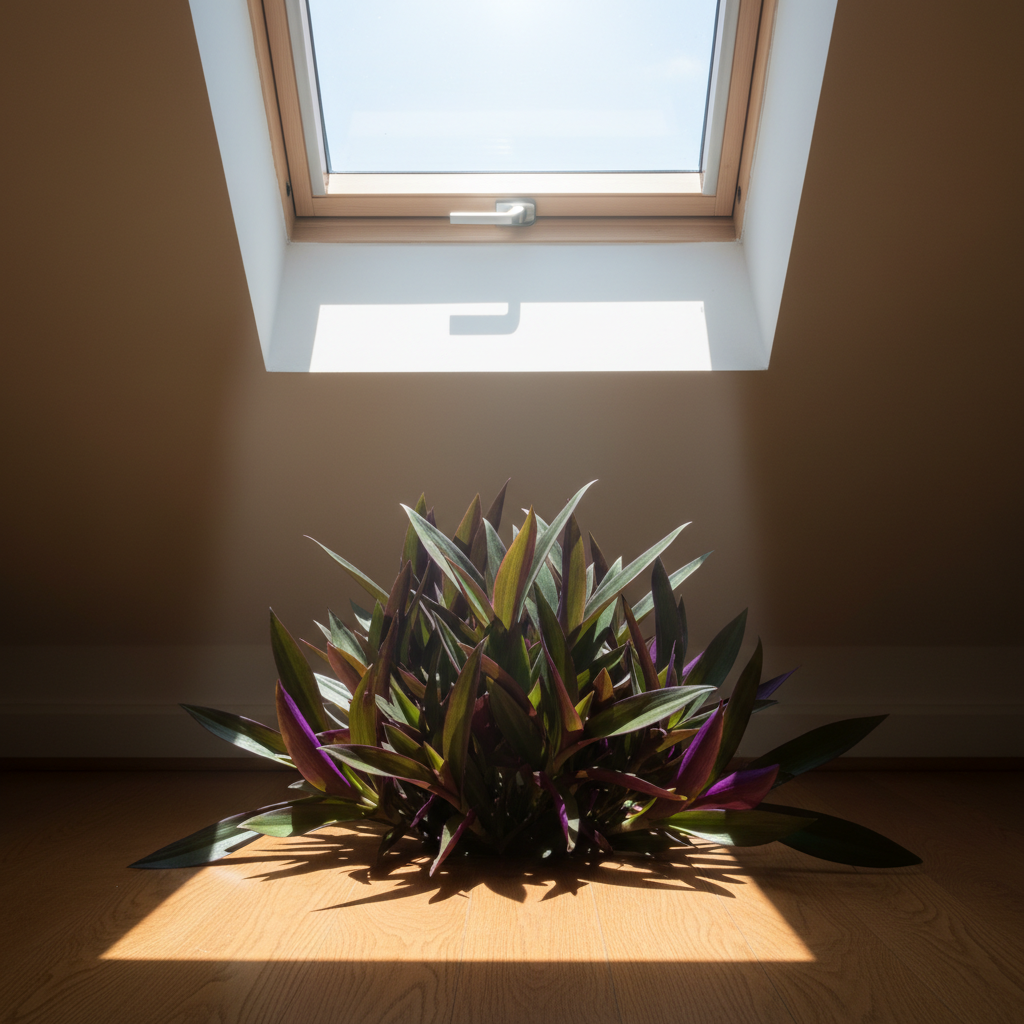
The ideal placement is a position with several hours of bright indirect light each day and one or two hours of gentle direct sun, typically morning or late afternoon. In those conditions the rosette stays compact, the leaves are short and broad, the green of the upper surface darkens to forest depth and the purple beneath turns to an electric, almost backlit violet. Move the same plant into a north-facing room and it will still grow, just more slowly and with longer, looser leaves that lean toward the brightest available light, while the purple softens to a quieter plum.
Light Levels Explained
Houseplant guides often use vague terms like bright or medium light, which can be hard to translate to a specific spot in a real room. The table below gives a practical breakdown of light tiers as they apply to Tradescantia spathacea, along with the approximate illuminance level measured in lux and the outcome you can expect from each.
| Light Category | Approx. Level | Typical Location | Outcome |
|---|---|---|---|
| Direct sun | 30,000 lux and above | Unobstructed south or west window in summer | Risk of leaf scorch on the upper surface; tolerable in winter |
| Bright indirect | 10,000 to 20,000 lux | Within 1 m of an east, south or west window with a sheer curtain | Optimal; deepest colour, tightest rosette, regular flowering |
| Medium | 5,000 to 10,000 lux | A few metres from a bright window; bright north window | Good growth, slightly looser rosette, full colour retained |
| Low | 1,000 to 5,000 lux | Interior corner of a well-lit room | Slower growth, longer leaves leaning to the light, muted purple |
| Very low | Below 1,000 lux | Far from any window, hallway with no daylight | Survives for months but declines; consider grow lights |
Window Orientation and Placement
South-facing window: Excellent in autumn, winter and early spring, when the low sun never quite becomes harsh. From late spring through summer the direct midday sun in a south window will eventually bleach the upper leaves to a yellowish green and may scorch the tips. Step the plant back 30 to 60 cm (12 to 24 in), or filter the light with a sheer curtain, and the result is close to perfect.
East-facing window: The most reliably good position year-round. Soft morning sun for a few hours feeds the colour without overheating the leaves, then bright ambient light carries the plant through the rest of the day.
West-facing window: Strong afternoon light can be useful in colder months but tends to be too intense from May to August. A light curtain or a small step back from the glass solves it.
North-facing window: Workable but slow. Growth is steady and the plant stays healthy; the rosette opens up a little and the purple turns more muted. North windows in the northern hemisphere suit the dwarf forms better than the full-sized species because the longer leaves of the standard form stretch noticeably in low light.
Pro Tip — Read the New Leaves: The newest leaves at the centre of the rosette are the most honest reporters of light. If they emerge short and broad with deep colour from day one, the position is right. If they push up long, pale and droopy, the plant needs more light. Adjust before the whole rosette stretches.
How Light Affects Pigmentation and Form
The deep purple on the leaf undersides is produced by anthocyanin pigments, the same family of compounds responsible for the red of autumn leaves and the colour of red cabbage. Anthocyanin production is stimulated by light, and in particular by the ultraviolet and blue wavelengths abundant in unfiltered daylight. In bright conditions the plant produces more of the pigment, both as a sunscreen for the chloroplasts above and as a way to harvest stray light that filters through the leaf. In lower light, anthocyanin production drops, the purple fades and the green top can also lose some of its richness. None of this is a problem in itself, but it is the reason a Moses-in-the-Cradle grown in a sunroom looks like a different plant from the same cultivar grown in a dim hallway.
Warning — Direct Sunlight: A plant accustomed to bright indirect light can scorch within a few hours if moved suddenly into a sun-baked south or west window in summer. Acclimatise over seven to ten days by moving it closer to the window in small daily steps, and watch for pale, papery patches on the upper leaves, which are the first sign of sunburn.
Artificial Lighting
Moses-in-the-Cradle responds beautifully to full-spectrum LED grow lights, which means it is one of the easier candidates for an interior shelf with no natural daylight. A modest 20 to 30 watt LED panel running for 10 to 14 hours a day at a distance of 30 to 45 cm (12 to 18 in) above the rosette will produce the same compact form and deep colour you would expect from a bright window. The plant uses photoperiod cues to time its flowering, so a steady daily cycle, ideally set on a timer, encourages bloom production. Avoid running the lights around the clock, as the plant uses the dark period for respiration and stress recovery.
Seasonal Adjustments
In temperate regions, the available indoor light can drop by as much as 80 per cent between high summer and midwinter. A position that was filtered and bright in July can be the dimmest spot in the room by December. Move the plant closer to the window in autumn, swap a heavy curtain for a sheer one and consider supplementing with a grow light through the darkest months if you want to maintain growth. In spring, move the plant back gradually as the light strengthens, and watch the newest leaves for the first sign of scorching.
Watering and Humidity
Watering this plant is more about reading the soil than following a schedule. Tradescantia spathacea stores moisture in its fleshy, slightly succulent leaves and stems, which means it handles a missed watering far better than it handles a permanently damp pot. The single most common mistake with this species is overwatering, and almost every case of root rot, mushy stem bases or sudden collapse can be traced back to soil that never dries out.
When to Water
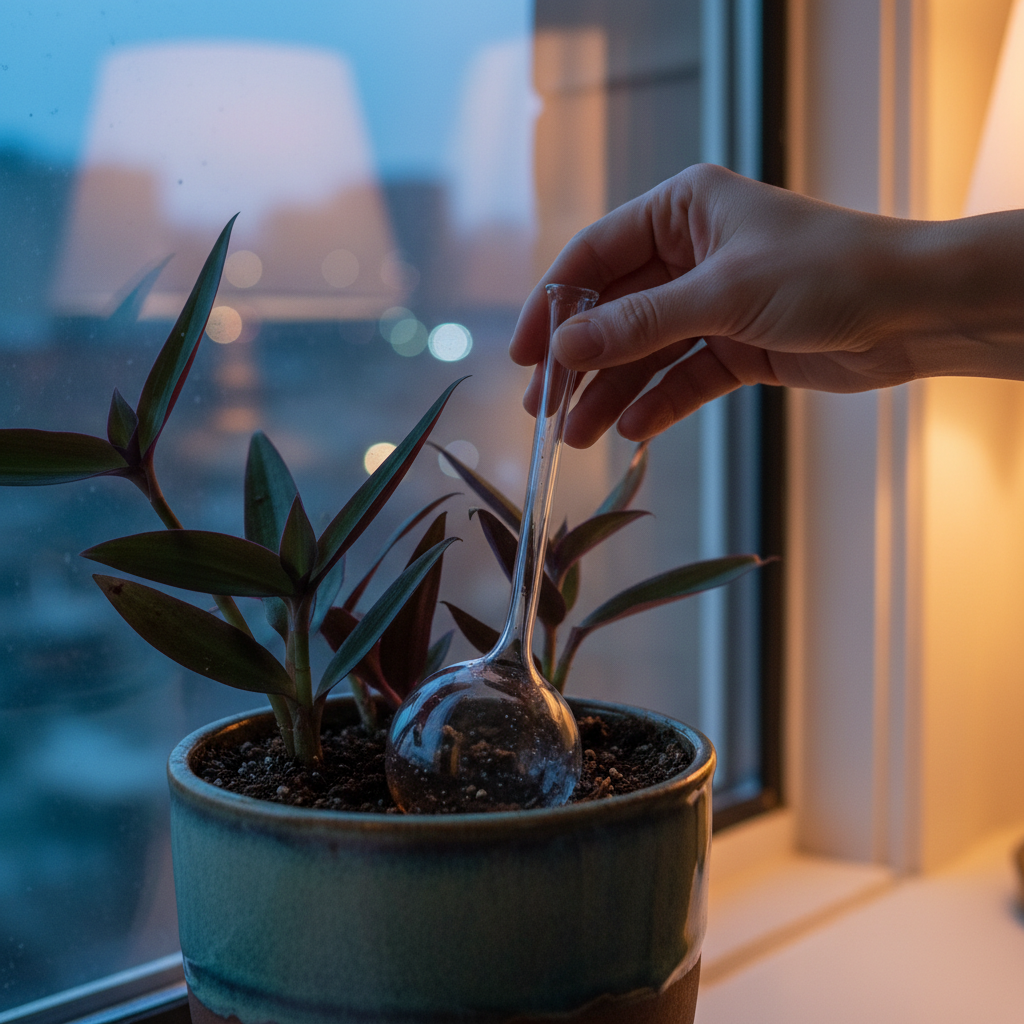
The reliable rule is to wait until the top 2 to 3 cm (about 1 in) of soil has dried, then water thoroughly. In a bright room with a small pot, that point arrives every seven to ten days in spring and summer. In a cooler or dimmer position, or in winter, the interval stretches to every two to three weeks. The plant gives clear visual cues: the leaves dull slightly and lose their stiffness when thirsty, and the soil pulls back a fraction from the edge of the pot. Wait too long and the lower leaves yellow and crisp at the edges; respond at the first soft droop and recovery is immediate.
The combination of soil moisture and temperature drives the schedule, not the calendar. A plant on a warm, sunny shelf may need water twice a week in July; the same plant in a cool bedroom in February may want it only once a month. Use your finger or a wooden skewer pushed into the soil rather than guessing, especially in the early weeks after bringing a new plant home.
Pro Tip — Pot Weight Test: Lift the pot just after a thorough watering and again a week later. The difference is dramatic, and you will quickly calibrate your hand to detect when the plant is genuinely dry. This trick removes most of the guesswork from watering and is more reliable than meter readings, which can drift with mineral build-up.
How to Water Correctly
- Check the top 2 to 3 cm of soil with a finger; only water if it feels dry to the touch.
- Take the plant to the sink or a deep saucer; this saves carrying a brimming pot through the house and protects the leaves from splashes.
- Pour room-temperature water slowly around the base of the plant, avoiding the centre of the rosette where water can pool and rot the new growth.
- Continue until water runs freely from the drainage holes; this flushes accumulated salts and ensures the entire root ball is moist.
- Let the pot drain for ten to fifteen minutes before returning it to its decorative cover, and tip away any water that collects in the saucer.
- Resist the urge to water again until the topsoil has dried; this is the rhythm the plant prefers.
Signs of Overwatering vs. Underwatering
| Symptom | Overwatering | Underwatering |
|---|---|---|
| Leaf colour | Yellowing that begins at the base of the rosette and spreads upward | Tips and edges turn brown and papery while the centre stays green |
| Leaf texture | Soft, limp, sometimes translucent at the base | Curled inward, dull and slightly leathery to the touch |
| Soil | Stays wet for more than a week; smells sour or musty | Pulls away from the pot edges; dust-dry several centimetres down |
| Roots | Brown, mushy and easily pulled from the root ball | White but thin and brittle; some die-back at the tips |
| Stem base | Blackened, mushy and collapsing at the soil line | Wrinkled, slightly shrunken, but still firm |
Warning — Root Rot: If the stem base feels soft or blackened and the lower leaves are collapsing in succession, the plant has root rot. Unpot it immediately, cut away every soft root and stem with a sterile blade, dust the cuts with cinnamon or sulphur powder and repot into fresh dry mix. Withhold water for a week and resume cautiously. Catch this early and the plant almost always recovers; ignore it for another two weeks and the entire rosette can collapse overnight.
Humidity Requirements
Moses-in-the-Cradle is one of the few tropical foliage houseplants that genuinely does not mind ordinary household humidity. Its waxy, slightly succulent leaves resist water loss, and it sails through dry winter air at 30 to 35 per cent that would crisp the edges of a calathea. That said, the plant looks visibly happier in the 40 to 60 per cent range. New leaves emerge cleanly without papery tips, and the colour holds slightly better.
The first sign of air that is too dry is the appearance of fine brown tips on the longest outer leaves, sometimes accompanied by a slight curl. This is rarely fatal but can become unsightly if it continues, because the affected tips do not heal. Trim them off cleanly with sharp scissors, following the natural taper of the leaf, and then address the underlying cause.
Raising humidity is easier than most guides suggest. Grouping plants together creates a soft microclimate of pooled transpiration; a shallow tray of pebbles and water under the pot adds another five to ten percentage points; and a small cool-mist humidifier running near the plants does the rest. Misting the leaves directly is mostly decorative because the effect dissipates within minutes, and on this plant the residue can leave hard-water spots on the glossy upper surface.
Water Quality
The species tolerates most tap water without complaint, but in regions with hard water or heavily chlorinated supplies the leaf tips can brown over time as fluoride and salts accumulate. If your tap water leaves white deposits on glassware, it will eventually do the same in the soil. The simplest fix is to leave a watering can on the counter overnight before use, which lets chlorine dissipate, and to flush the pot occasionally with distilled or filtered water to wash out accumulated salts. Rainwater is excellent if you can collect it.
Soil, Potting and Repotting
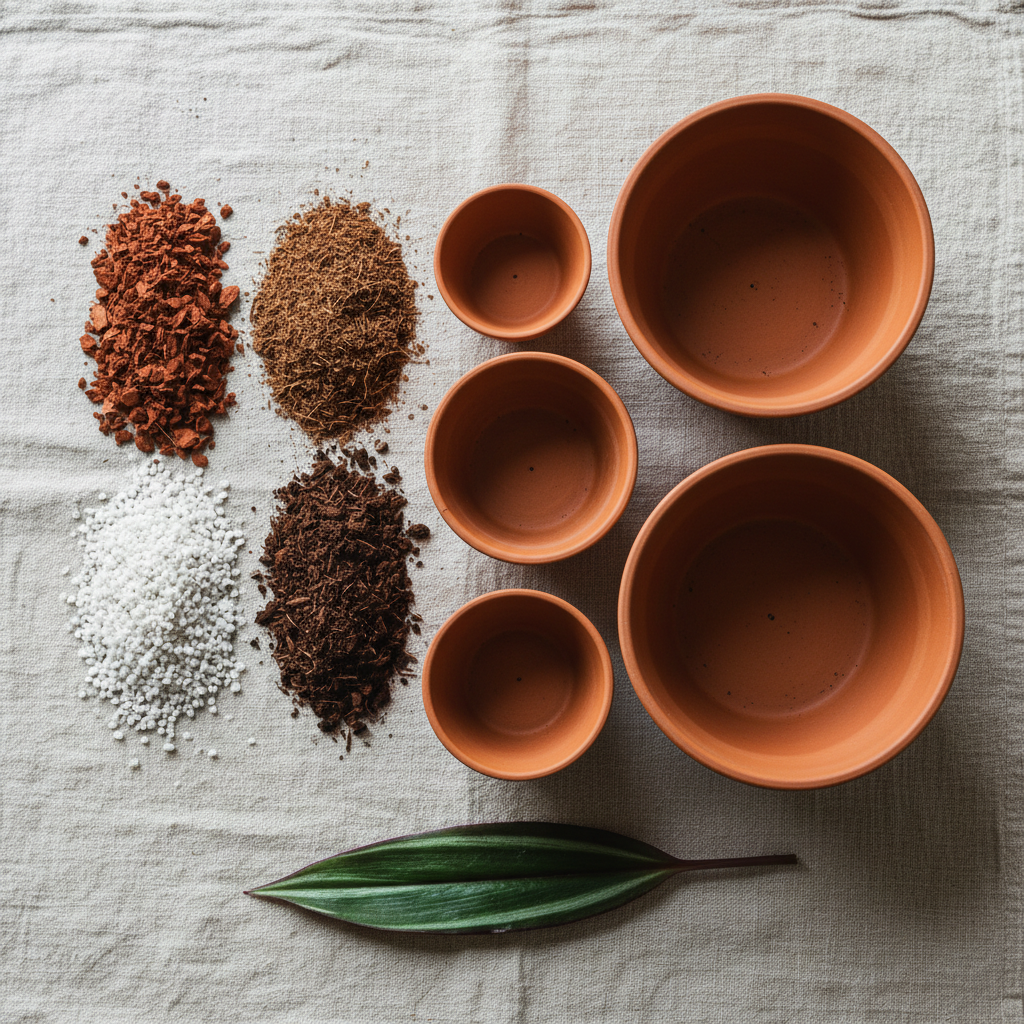
The right soil makes Moses-in-the-Cradle almost impossible to kill. Because the plant has fleshy, water-storing tissues, it needs a substrate that drains quickly and dries down predictably between waterings. Heavy peat-based mixes that stay sodden for days are the wrong starting point; chunky, well-aerated blends with plenty of air space are exactly right.
Ideal Soil Composition
Aim for a mix that holds enough moisture to keep the roots from drying instantly but drains freely within thirty seconds of watering. The plant tolerates a wide pH range but performs best in slightly acidic to neutral soil, roughly pH 6.0 to 7.0, which is what most commercial houseplant mixes provide out of the bag. The structure matters more than the exact recipe, so the proportions below are a guide rather than a prescription.
| Component | Proportion | Function |
|---|---|---|
| All-purpose houseplant mix | 50 per cent | Holds moisture and provides baseline nutrition |
| Perlite or pumice | 25 per cent | Opens up the structure; prevents compaction |
| Fine orchid bark | 15 per cent | Creates air pockets and improves drainage |
| Coarse sand or horticultural grit | 5 per cent | Adds weight and ensures fast bottom drainage |
| Worm castings or compost | 5 per cent | Slow-release nutrition and beneficial microbes |
The plant will accept a much simpler blend in practice. A 70:30 mix of standard houseplant soil and perlite works for the majority of growers and produces healthy plants for years. The more elaborate recipe above is for those who want to push the plant toward its best colour and growth rate, or who tend to water heavily and need extra insurance against rot.
Pro Tip — Quick Mix Recipe: If you have only one bag of supermarket houseplant compost and a handful of perlite, scoop three parts compost into a bowl, add one part perlite and stir with your hands until the white specks are evenly distributed. That single change is the difference between a soggy pot and a thriving one.
Choosing the Right Pot
The pot is the second half of the drainage equation. A perfect mix in a sealed pot still drowns the roots, while an average mix in a porous, well-drained pot still grows a healthy plant. Choose the container with the same care you choose the soil.
Drainage holes are non-negotiable. Every pot used for Moses-in-the-Cradle needs at least one generous drainage hole, ideally more. Pots without holes can be used as decorative covers around an inner nursery pot, but never as the direct planter. If you must use a closed pot, drill drainage holes before planting; even a tropical plant will not survive long with water sitting on its roots.
Pot material: Terracotta is an excellent choice because the unglazed clay wicks excess moisture out of the soil and lets the root ball breathe, which makes overwatering harder. Glazed ceramic and plastic pots both work, but they hold moisture for longer and need a more careful watering hand. Self-watering pots, with a reservoir below the soil, are not the best fit for this species; they tend to keep the lower roots permanently moist, which suits leafier plants but encourages rot here.
Pot size: The roots are modest in volume, and the plant grows better when slightly snug than when swimming in a vast pot. Choose a container 2 to 3 cm (about 1 in) wider in diameter than the current root ball when repotting, no more. An oversized pot holds a large volume of damp soil that the roots cannot use, and that is where rot finds its opening.
When to Repot
Healthy plants generally need repotting every 18 to 24 months. The reliable signals are roots poking through the drainage holes, water that runs straight through without wetting the soil and a noticeable slowdown in new leaf production despite good light and feeding. Refresh the top 2 to 3 cm of soil yearly even when not fully repotting; this brings new nutrients into the root zone and is far less disruptive than a full transplant. The best time to repot is early spring, just as growth resumes, but the plant is tough enough to tolerate repotting at any season if necessary.
How to Repot: Step-by-Step
- Water the plant lightly a day or two before repotting; slightly moist soil holds together better than dust-dry soil and makes the transition smoother.
- Prepare the new pot by adding a layer of fresh mix to the bottom, enough that the top of the root ball will sit 1 to 2 cm below the rim.
- Slide the plant out by inverting the pot with the rosette supported between your fingers; tap the rim against a hard edge if the root ball is stuck.
- Inspect the roots, gently tease apart the outer surface and trim any blackened, mushy or circling roots with sterile scissors.
- Position the plant in the new pot so the rosette sits at the same depth as before; do not bury the crown deeper, as the stem base can rot.
- Fill in around the root ball with fresh mix, pressing gently with your fingers to settle the soil without compacting it.
- Water thoroughly until it drains from the bottom, then leave the plant in moderate light for a week or two to recover before returning it to its brightest spot.
Warning — Transplant Shock: Expect a brief pause in growth, mild leaf droop and perhaps the loss of one or two of the oldest outer leaves in the week after repotting. This is normal and does not call for emergency action. What does not belong is rapid yellowing of multiple new leaves or a soft, blackening stem base, both of which point to root damage during the move or soil that is too dense and wet.
Fertilising
Moses-in-the-Cradle is not a heavy feeder. Its native habitat is a leaf-littered forest floor where nutrients arrive slowly and steadily rather than in concentrated doses, and the plant carries that thrifty habit into a pot. A light but consistent feeding routine produces better results than infrequent, heavy applications, and over-fertilising is one of the few care mistakes that can damage this otherwise robust plant.
The aim is to support steady leaf production during the growing season without pushing the rosette into unnaturally fast growth, which results in pale, soft leaves that lose their compact form and rich purple. Used carefully, fertiliser improves the look of the plant; used heavily, it works against the very qualities that make the species interesting.
Understanding Plant Nutrients
Plant fertilisers are described by their N-P-K ratio, the percentages of nitrogen, phosphorus and potassium they contain, alongside smaller amounts of secondary nutrients and micronutrients. A balanced product like a 10-10-10 or 20-20-20 provides each of the three main nutrients in equal measure and suits Moses-in-the-Cradle well, since the plant produces both foliage and flowers and benefits from a complete diet rather than a nitrogen-heavy push.
| Nutrient | Symbol | Primary Function | Deficiency Symptoms |
|---|---|---|---|
| Nitrogen | N | Drives leaf production and chlorophyll synthesis | Pale, yellowing older leaves; slow growth |
| Phosphorus | P | Supports root development and flowering | Stunted growth; purple tinge on older leaves |
| Potassium | K | Regulates water use and overall plant vigour | Brown leaf margins; weak stems |
| Calcium | Ca | Builds strong cell walls | Distorted new leaves; tip die-back |
| Magnesium | Mg | Central atom of chlorophyll | Yellowing between the veins of older leaves |
| Iron | Fe | Aids chlorophyll production | Yellowing between the veins of newest leaves |
Types of Fertiliser
Liquid fertilisers: The most flexible option for houseplants. Diluted to half the strength on the label and applied with a regular watering once every four to six weeks during spring and summer, a balanced liquid feed keeps the plant in steady growth without overwhelming it. The advantage of liquid is precise control over dose and timing, which matters most with plants that prefer a light hand.
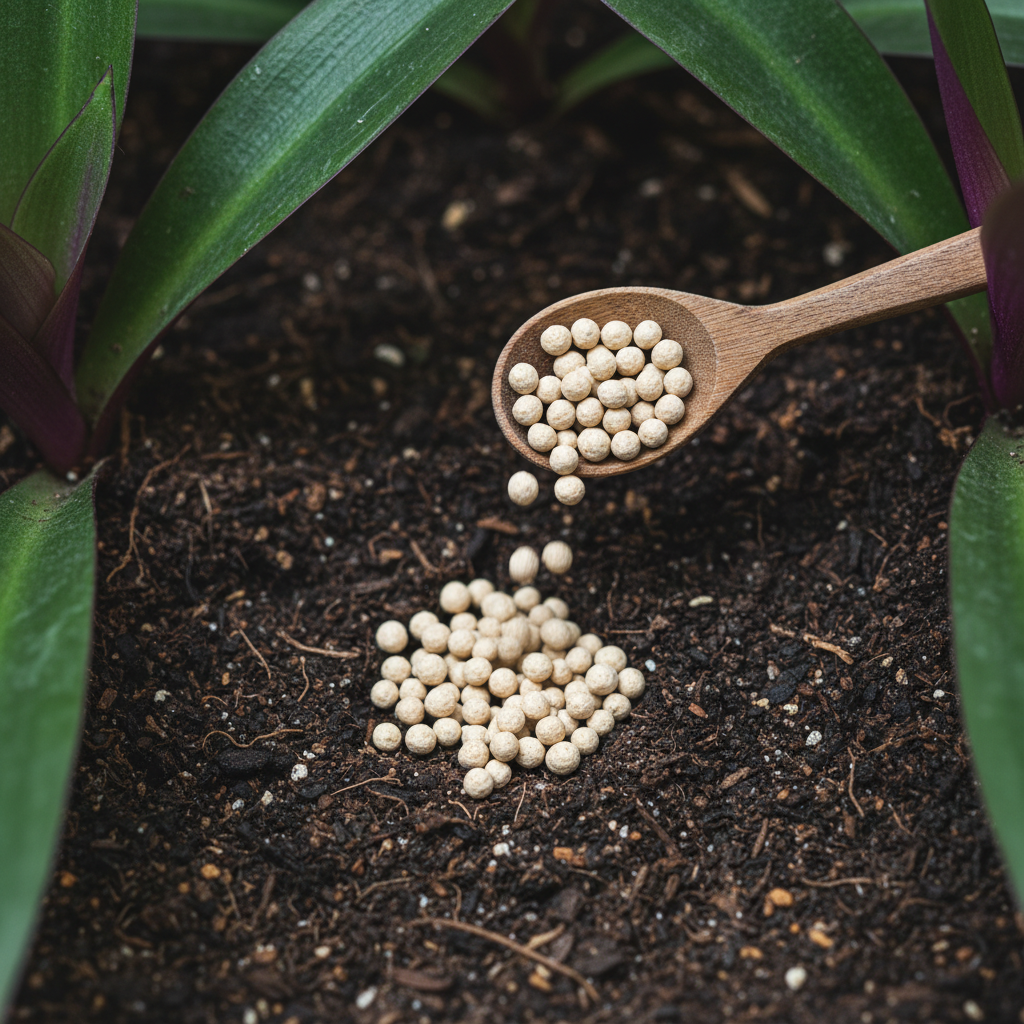
Slow-release granular: Coated prills release nutrients gradually over three to six months as soil moisture and temperature dictate. A small spoonful sprinkled across the top of the soil in early spring will often supply everything the plant needs for the full growing season. The downside is reduced control: once applied, the granules continue to release whether the plant wants more food or not. Use the lighter end of the recommended dose for this species.
Organic fertilisers: Worm castings, dilute compost tea, fish emulsion and seaweed extracts are excellent for Moses-in-the-Cradle. They release nutrients slowly, support beneficial soil microbes and are essentially impossible to overdose with at reasonable rates. A monthly drink of half-strength seaweed extract in spring and summer is a low-risk routine that produces visibly healthier leaves and stronger colour.
Feeding Schedule
From early spring to early autumn, feed every four to six weeks with a balanced liquid fertiliser at half strength, or apply a single dose of slow-release granules at the start of the season. From late autumn through winter, stop feeding entirely. The plant slows down, takes up far less of any nutrient applied, and unused fertiliser accumulates as salts in the soil, where it can scorch the roots. Resume feeding only when you see clear signs of new growth from the centre of the rosette.
Pro Tip — Half Is Plenty: Almost every commercial fertiliser is dosed for outdoor garden plants that grow vigorously in full sun. Houseplants in moderate light need a fraction of that dose. Halving the label rate, or even quartering it, is the standard houseplant adjustment and almost always produces better results than following the bottle.
How to Fertilise
- Water the plant first with plain water, so the roots are hydrated before any fertiliser arrives; never apply liquid feed to bone-dry soil.
- Mix your liquid fertiliser at half the label strength in a clean watering can; use fresh water at room temperature.
- Pour the diluted feed around the base of the plant, avoiding the centre of the rosette and the leaves themselves.
- Allow the pot to drain freely; the goal is to wet the entire root zone, not to leave standing nutrient solution in the saucer.
- Mark the date on a calendar and wait at least four weeks before repeating; in low light or cooler conditions, stretch the gap to six weeks.
Warning — Salt Build-Up: Over time, especially with chemical fertilisers, mineral salts accumulate in the soil and can be seen as white crust on the pot rim or surface. This salt layer scorches root tips and reads as brown, crispy leaf edges that progress inward. Flush the pot with plain water every three to four months by watering thoroughly until at least three times the pot’s volume has drained through, which carries the excess salts out.
Propagation
Few popular houseplants are easier to propagate than Moses-in-the-Cradle. The plant roots quickly from stem cuttings, sends up offsets readily from the base and divides cleanly at the crown. A single mature rosette can yield half a dozen new plants in a single afternoon, and the cuttings root so reliably that growers often refer to the species as a beginner’s first success story. The plant also self-seeds in warm climates, which is one reason it is regulated as invasive in parts of Florida and the Caribbean.
Spring and early summer are the best seasons for propagation because warm temperatures and bright light accelerate root development. Cuttings taken in winter still root, just more slowly, and benefit from a heat mat under the propagation tray. The two methods covered below are stem cuttings in water and division at the crown; both are reliable, and beginners often have their highest success with the water method because root development is visible from day one.

Understanding the Stem Node
Every Tradescantia cutting roots from a node, the slightly swollen point on the stem where leaves attach. Each node contains dormant root and shoot tissue, and once the node is in contact with moisture, root primordia emerge within days. Cuttings without an intact node will not root, no matter how leafy or how long they sit in water. When taking cuttings, always include at least one node, ideally two, and remove any leaves that would otherwise sit below the water line, since submerged leaves rot quickly and foul the water.
Water Propagation: Step-by-Step
Water propagation is forgiving, visually rewarding and reliably successful with Moses-in-the-Cradle. Use clear glass jars so you can watch root development; this also helps you spot any rot early and intervene before it spreads. The method works equally well for the species and for the variegated cultivars.
- Choose a healthy outer offshoot or a stem with at least two nodes and a small tuft of leaves at the top; avoid the youngest central growth.
- Cut cleanly with a sterile blade just below a node, leaving a stem section of 8 to 12 cm (3 to 5 in) below the leaves.
- Strip any leaves that would sit below the water line; bare nodes are what you want submerged.
- Place the cutting in a clean glass jar filled with room-temperature water, with the leafy top above the rim and the lower nodes immersed.
- Set the jar in bright indirect light, well away from direct midday sun, which heats the water and stresses the cutting.
- Change the water every five to seven days, or sooner if it clouds; clean water carries oxygen, which roots need to develop.
- After two to three weeks, when the new roots are 3 to 5 cm long, pot the cutting into a small container of well-draining mix and water gently.
- Keep the newly potted cutting in slightly higher humidity for the first fortnight by loosely tenting a clear plastic bag over the pot or grouping it with other plants.
Pro Tip — Take Several at Once: Rather than rooting a single cutting, take three to five at the same time and bundle them into one new pot. Tradescantia rarely branches dramatically from a single stem, so a fuller, bushier plant is the product of multiple cuttings grown together, not of a single piece. This is the trick that turns a slow start into an established-looking specimen within a few months.
Division: Step-by-Step
Established Moses-in-the-Cradle plants produce side offsets, often called pups, which grow from the base of the parent rosette. After a season or two, a single original plant becomes a small clump of two or three rosettes sharing the same pot. Division separates these into individual plants, refreshes the parent and yields several new specimens in one go. It is the cleanest method for the dwarf cultivars, which form tight clumps rather than long stems.
- Water the plant lightly a day before; moist soil makes the roots easier to separate without breakage.
- Slide the entire root ball out of its pot onto a sheet of newspaper or a clean potting bench.
- Gently brush away the loose soil to reveal the natural divisions between rosettes; each pup should have its own roots and at least three or four leaves of its own.
- Where the rosettes share a thick connecting stem, cut cleanly through it with a sterile blade so each piece keeps a substantial portion of its own root system.
- Pot each division into a small container of well-draining mix, settling the root ball at the same depth it grew at before.
- Water lightly and place in bright indirect light for two weeks while the new plants settle; resume normal care once the first new leaf emerges from the centre.
Troubleshooting Propagation
| Problem | Likely Cause | Solution |
|---|---|---|
| Cutting rotting at the base in water | Submerged leaves or stagnant water | Strip lower leaves; change water every five days; use a clean jar |
| No roots after three weeks | Cool conditions; cutting taken below a node | Move to a warmer, brighter spot; take a fresh cutting with a clear node |
| Cutting wilts after potting | Sudden drop in humidity for water-grown roots | Tent the pot loosely with a clear bag for ten days while roots adapt |
| Division pieces yellowing | Root damage or planting too deep | Replant at the original depth; pause feeding for a month while roots re-establish |
Pests and Diseases
Pest pressure on Moses-in-the-Cradle is generally low. The thick, slightly waxy leaves resist most chewing insects, and the strong sap that makes the plant mildly irritating to humans also deters many sap-suckers. The species is not, however, immune. The most common problems arrive in dry indoor air or when a new plant introduces stowaways from the nursery, and they are all manageable if caught early.
The best defence is a habit of regular inspection. Every time you water, glance at the undersides of the lower leaves, the centre of the rosette and the soil surface. Most pests double their population every few days in indoor conditions, so the cost of catching them early is enormous. A two-minute check during routine care prevents the kind of infestation that takes weeks to bring back under control.
Common Pests
Spider Mites (Tetranychus urticae)
Spider mites are the most likely pest on Moses-in-the-Cradle, particularly in hot, dry indoor air. They are barely visible to the naked eye, appearing as tiny moving dots on the undersides of the leaves, and the first symptom is usually a fine pale stippling on the upper leaf surface. As populations build, very fine webbing appears between the leaf bases.
Treatment: Rinse the entire plant under a strong but soft shower of room-temperature water, paying particular attention to the undersides of leaves and the leaf axils. Follow up with a spray of insecticidal soap or a diluted neem oil solution every five to seven days for three weeks to break the life cycle. Raising the humidity around the plant makes the indoor environment less hospitable to mites and reduces re-infestation.
Mealybugs (Pseudococcus longispinus)
Mealybugs look like small tufts of cotton wool nestled into the leaf axils and at the base of the rosette. They feed by piercing the leaves and stems, secreting a sticky honeydew that can lead to sooty mould on the leaf surface. They reproduce quickly and a small colony can multiply into a serious infestation within a month.
Treatment: Dab each visible mealybug with a cotton bud soaked in 70 per cent isopropyl alcohol; the alcohol dissolves their waxy coating and kills them on contact. For larger infestations, spray the entire plant with insecticidal soap weekly for four weeks, lifting leaves to reach hidden colonies. Quarantine the plant from others until you have seen no new mealybugs for two weeks.
Aphids (Aphidoidea spp.)
Aphids are less common on this species but occasionally appear on the youngest growth or on flower stems. They are small soft-bodied insects, usually green or black, clustering on tender tissue and weakening it. Their honeydew, like that of mealybugs, attracts ants and supports sooty mould.
Treatment: A firm jet of water in the sink dislodges most aphids in one go and is often the only step required. For a stubborn colony, follow with insecticidal soap or a 1 per cent dilution of neem oil sprayed every five days for two weeks. Pinch off any heavily infested flower stems and dispose of them outside the home.
Fungus Gnats (Bradysia spp.)
Fungus gnats are small dark flies that hover around the pot and lay eggs in the top layer of damp soil. The adults are mostly a nuisance, but the larvae feed on roots and can damage seedlings and young divisions. A persistent gnat problem is almost always a sign that the soil is being kept too wet.
Treatment: Let the top of the soil dry more thoroughly between waterings; the larvae need moist conditions and die in dry topsoil within a few days. Add yellow sticky traps near the pot to catch the flying adults, and consider a top-dressing of fine horticultural grit, which prevents adults from laying eggs in the soil.
Common Diseases
Root and Crown Rot (Pythium and Phytophthora spp.)
This is by far the most damaging issue for Moses-in-the-Cradle and is caused almost entirely by overwatering and poor drainage. Water-mould pathogens flourish in soggy soil and attack the roots and stem base, where they cause blackening, softening and eventual collapse of the rosette.
Treatment: Unpot the plant, wash the roots, cut away every soft and blackened section back to firm white tissue, dust the cuts with cinnamon or sulphur powder and repot into completely fresh, dry, well-draining mix. Withhold water for a week and resume cautiously, allowing the topsoil to dry between waterings. Plants caught early usually recover and resume growth within a month.
Leaf Spot (Cercospora spp.)
Leaf spot appears as small brown or black spots, often with a yellow halo, on the upper leaf surface. It thrives where the air is stagnant and where water sits on the foliage overnight. The disease is rarely fatal but spoils the appearance of the plant if left to spread.
Treatment: Remove and dispose of badly affected leaves, improve air movement around the plant with a small fan or a more open shelf, and water at the soil rather than over the foliage. A copper-based fungicide can be used in stubborn cases but is rarely necessary for houseplants.
Pest and Disease Summary
| Pest / Disease | Identification | Treatment |
|---|---|---|
| Spider mites | Pale stippling on leaves; fine webbing in axils | Water rinse; insecticidal soap or neem every 5 to 7 days; raise humidity |
| Mealybugs | Cottony white clusters in leaf axils | 70 per cent isopropyl alcohol on a cotton bud; weekly soap sprays |
| Aphids | Soft green or black insects on new growth | Strong water rinse; insecticidal soap every 5 days |
| Fungus gnats | Small flies around the soil surface | Dry out the topsoil; yellow sticky traps; grit top-dressing |
| Root rot | Soft, blackened stem base and roots | Cut out all soft tissue; repot in fresh dry mix; reduce watering |
| Leaf spot | Brown spots with yellow halos on leaves | Remove affected leaves; improve airflow; water at soil only |
Prevention Strategies
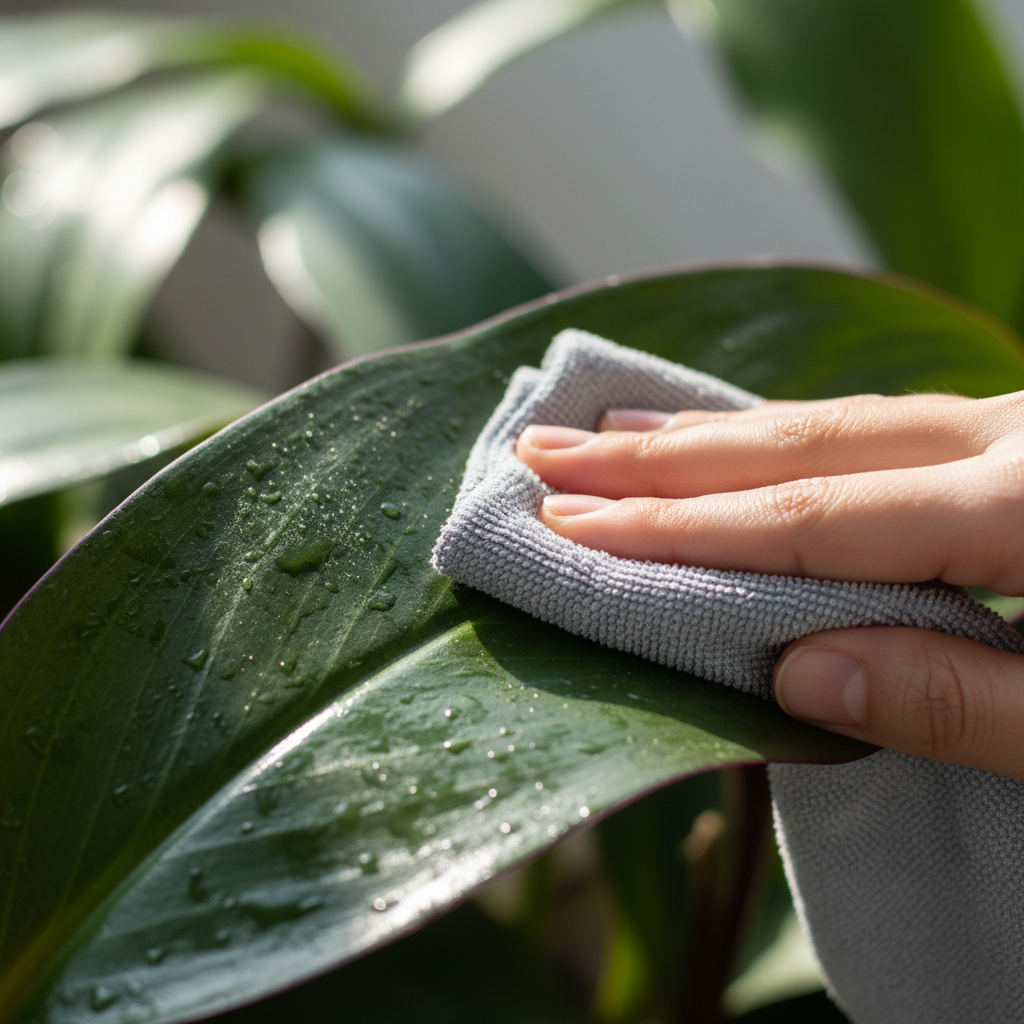
Preventing pests is far easier than treating an established infestation, and the principles are straightforward. Inspect every new plant on arrival, quarantine it for two weeks in a separate room before adding it to your collection, and keep the leaves of all your plants clean. Dust on foliage hides the early signs of mites and scale, and a quick wipe with a damp cloth every fortnight makes a measurable difference.
Equally important is matching watering to the plant. Most disease problems in houseplants trace back to roots that have spent too long in saturated soil, and Moses-in-the-Cradle is no exception. A predictable cycle of thorough watering followed by clear drying down is the simplest, most effective protection against the conditions that root rot and fungus gnats need to take hold.
Pro Tip — Neem Oil for Maintenance: A monthly preventive spray of 1 per cent neem oil mixed with a drop of mild liquid soap and water keeps most common pests at bay and is gentle enough for the waxy leaves of Tradescantia spathacea. Apply in the evening when the plant is not in direct sun, and avoid using neem in the height of summer when temperatures over 30 degrees C (86 degrees F) can cause leaf damage.
Popular Varieties
The straight species accounts for most plants sold under the name Moses-in-the-Cradle, but a small number of selected cultivars have become widely available and worth seeking out. They divide neatly into two groups: variegated forms that add cream, pink and yellow striping to the leaves, and compact forms that stay below 20 cm tall and suit smaller spaces or table arrangements. A few specialist nurseries also carry the rare all-purple selections, in which both surfaces of the leaf carry pigment.
Care for the cultivars is essentially identical to the species. The variegated forms benefit from slightly brighter light to keep their colour distinct, since variegated tissue contains less chlorophyll and so needs more light to feed the rest of the leaf, while the dwarf forms can tolerate slightly lower light because their compact form does not stretch as visibly when underlit.
| Variety | Leaf Appearance | Light Needs | Growth Rate | Availability |
|---|---|---|---|---|
| Straight species | Glossy green above, royal purple beneath | Bright indirect | Moderate | Very common |
| ‘Tricolor’ | Cream, pink and green stripes above, purple beneath | Bright indirect to filtered direct | Moderate | Common |
| ‘Sitara’ | Compact green and purple rosette, slimmer leaves | Medium to bright indirect | Slow | Common |
| ‘Vittata’ | Yellow and green striped above, purple beneath | Bright indirect to filtered direct | Moderate | Occasional |
| ‘Hawaiian Dwarf’ | Small tight rosette, deep green and purple | Medium to bright indirect | Slow | Occasional |
| ‘Concolor’ | Pale silvery-green above, soft lavender beneath | Bright indirect | Moderate | Rare |
Featured Varieties
‘Tricolor’
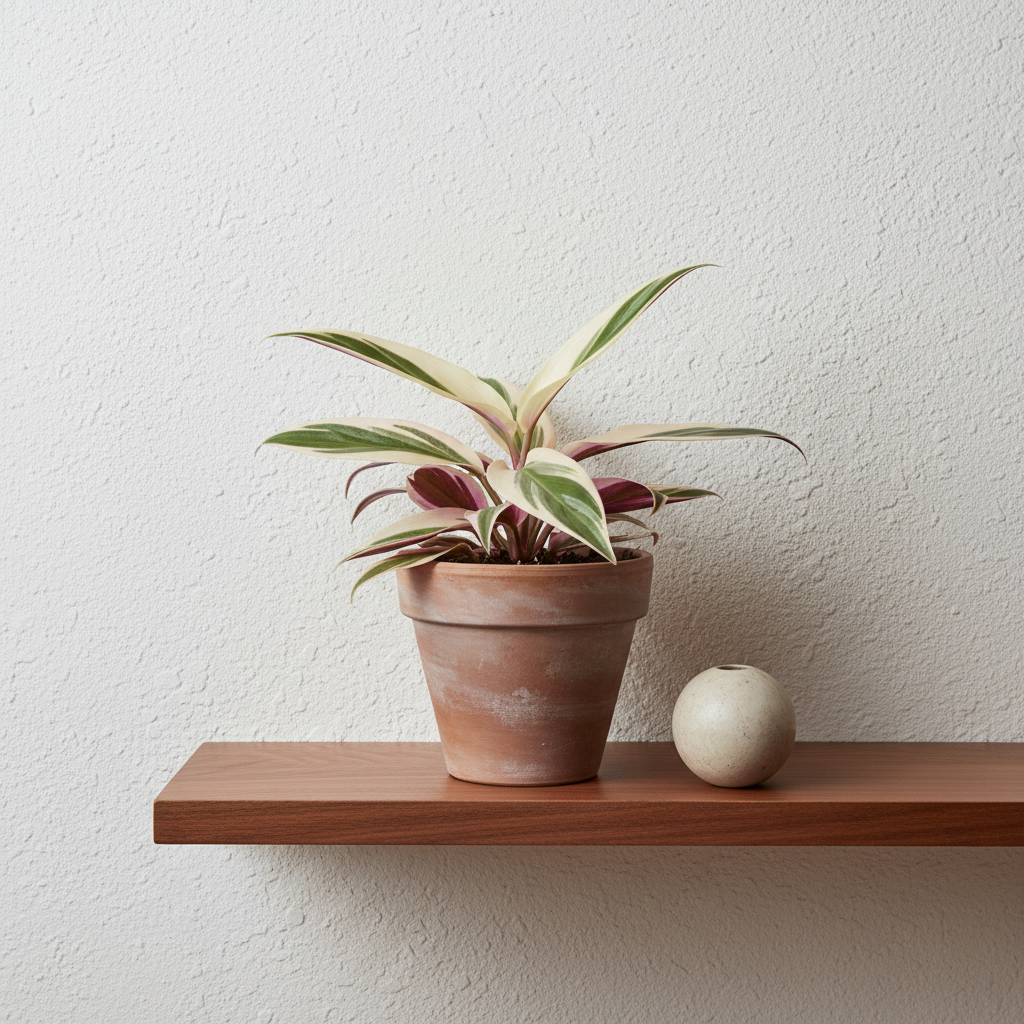
The most widely grown selection after the straight species. Each leaf is striped lengthwise with cream, soft pink and green on the upper surface, with the familiar deep magenta-purple beneath. The pink in the variegation intensifies in brighter light, so this is the cultivar that responds most dramatically to a well-lit position.
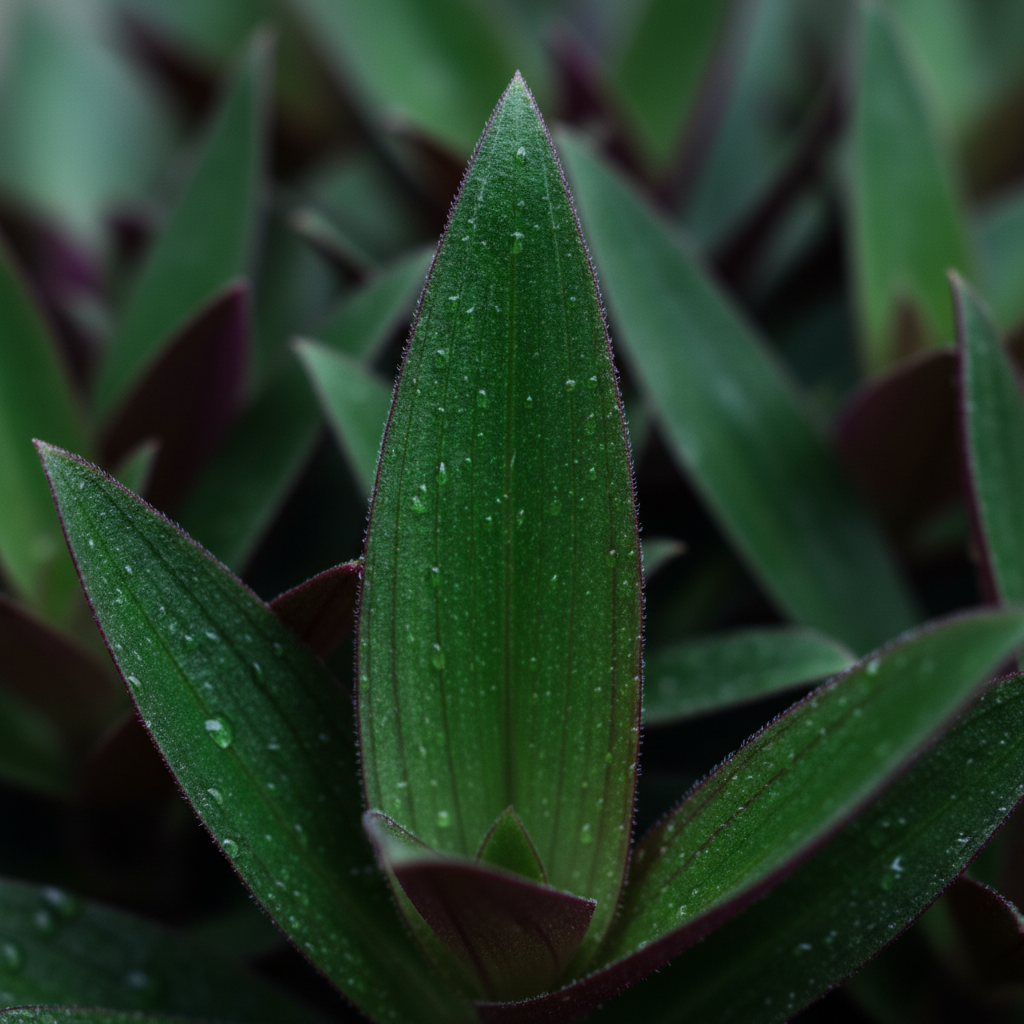
‘Sitara’
A compact dwarf form with tight rosettes of shorter, slimmer leaves, deep green above and purple beneath, rarely exceeding 20 cm (8 in) in height. The slow growth rate and small footprint suit windowsills, desks and table centrepieces, and the plant produces flowers earlier in its life than the standard form.
Variety Profiles in Detail
Straight species (Tradescantia spathacea)
The classic form remains the easiest to find and arguably the most striking. Mature rosettes reach 30 to 45 cm tall and the same wide, with leaves up to 30 cm long. The boat-shaped purple bracts and small white flowers appear most prolifically in spring and summer, often hidden among the leaf bases and noticed only by close inspection.
‘Tricolor’ (Tradescantia spathacea ‘Tricolor’)
The most decorative cultivar. The cream and green stripes on each leaf are accented by varying amounts of pink, with the strongest pink colour appearing in plants grown in bright filtered light. Reverting (the loss of variegation in favour of solid green leaves) does occur and is best controlled by removing any all-green leaves as soon as they appear.
‘Sitara’ (Tradescantia spathacea ‘Sitara’)
Sometimes labelled simply as Dwarf Oyster Plant. A reliable compact selection that holds its tight rosette form regardless of light, although the purple deepens noticeably in brighter conditions. Excellent in shallow ceramic dishes or grouped as a low edging in larger planted arrangements.
‘Vittata’ (Tradescantia spathacea ‘Vittata’)
A less commonly available variegated form with strong yellow and green vertical stripes on the upper leaf surface and rich purple beneath. The contrast is softer than ‘Tricolor’ but still distinctly variegated, and the plant has the same growth habit as the species.
‘Hawaiian Dwarf’ (Tradescantia spathacea ‘Hawaiian Dwarf’)
Even smaller than ‘Sitara’, this selection rarely exceeds 15 cm in height and produces miniature versions of the green and purple leaves in a particularly tight rosette. It is the best choice for terrariums and small enclosed displays where the standard form would quickly outgrow its space.
Choosing the Right Variety for Your Space
Match the cultivar to the role you want the plant to play. A standing position with strong light suits the straight species or ‘Tricolor’, where the size and saturation of the leaves can be appreciated; a smaller windowsill or grouped arrangement suits ‘Sitara’ or ‘Hawaiian Dwarf’, where the compact rosettes hold their shape without crowding. If you want to lean into the colour, ‘Tricolor’ in a bright east window is the most ornate combination available in the species; if you prefer quiet structure, the straight green and purple of the species in a glazed black pot is one of the most graphic compositions any easy-care houseplant can offer.
Frequently Asked Questions
Why is my Moses-in-the-Cradle losing its purple colour?
Fading purple is almost always a sign of insufficient light. Anthocyanin pigments respond directly to light intensity, and a plant moved from a bright window into a dimmer room produces less of them within a few weeks. Move the plant closer to the brightest window in the house, add a sheer curtain to soften any harsh direct sun and the colour will return in the next round of new leaves.
Why are the leaf tips turning brown?
Brown tips most often point to low humidity, salt build-up in the soil or inconsistent watering. Check the humidity first; if it sits below 35 per cent, grouping plants together or adding a small humidifier usually solves it. If humidity is fine, flush the pot thoroughly with plain water to clear accumulated fertiliser salts, and revisit your watering rhythm to make sure the plant is not swinging between bone-dry and waterlogged.
Is Moses-in-the-Cradle safe around cats and dogs?
No. The plant contains calcium oxalate crystals and an irritating sap, and the ASPCA lists it as toxic to cats and dogs. Symptoms of ingestion include mouth irritation, excessive drooling, vomiting and difficulty swallowing. Keep the plant out of reach of pets that chew, and consider one of the many non-toxic alternatives like spider plant or Boston fern if your household includes a determined nibbler.
Will Moses-in-the-Cradle flower indoors?
Yes, regularly. Mature, well-lit plants produce small clusters of white three-petalled flowers nestled inside paired purple bracts at the base of the rosette. The bracts give the plant its common name, looking like a tiny cradle holding the white flower like a baby. Bloom is most prolific in spring and summer and is one of the clearest signs that the plant is happy with its light and feeding.
Why are the lower leaves yellowing and dying?
A small amount of natural leaf turnover is normal: as new growth emerges from the centre of the rosette, the oldest outer leaves yellow and drop, and this is part of the plant’s ordinary rhythm. Trouble starts when several leaves yellow at once or when the yellowing creeps upward quickly. The most common cause is overwatering and the early stages of root rot; let the soil dry more between waterings and check the stem base for softness before assuming a more exotic cause.
How fast does Moses-in-the-Cradle grow?
Growth is moderate. In bright indirect light with regular watering and a half-strength feed every month or so, expect a new leaf from the centre every two to three weeks during spring and summer, and a noticeable widening of the rosette across a single growing season. A small offset added in spring will often reach the parent’s size by the following autumn. Growth slows in winter and may stop entirely in the darkest months, which is normal and not a sign of trouble.
Can I grow it outdoors in the garden?
In USDA zones 9 to 11, yes, where winters stay above 5 degrees C (40 degrees F) and frost is unusual. In those climates the plant is often used as a ground cover and grows vigorously, to the point of being listed as invasive in parts of Florida and the Caribbean. In cooler climates, treat it as a summer container plant that comes indoors well before the first frost, or grow it as a year-round houseplant.
Why are new leaves emerging long and pale?
This is the classic sign of insufficient light. The plant stretches its newest leaves toward the brightest available source, and they emerge longer, thinner and lighter in colour than they would under good light. Move the plant closer to a brighter window and the next round of new leaves will return to a healthy, compact size.
Should I cut off old flower stalks?
Old, finished bracts can be left in place or snipped off with sharp scissors, depending on personal preference. Removing them tidies the appearance of the plant and prevents any seed set, which is particularly worth doing in warm climates where seedlings can establish in nearby pots. Leaving them gives the plant a slightly wilder, more naturalistic look.
Can I grow Moses-in-the-Cradle from seed?
You can, though it is rarely worth the effort given how readily the plant roots from cuttings. Fresh seed sown on the surface of damp seed compost germinates within two to four weeks at warm temperatures. Seedlings of cultivars rarely match the parent plant in colour or form, so cuttings or division are the preferred methods for keeping the named varieties true.






