
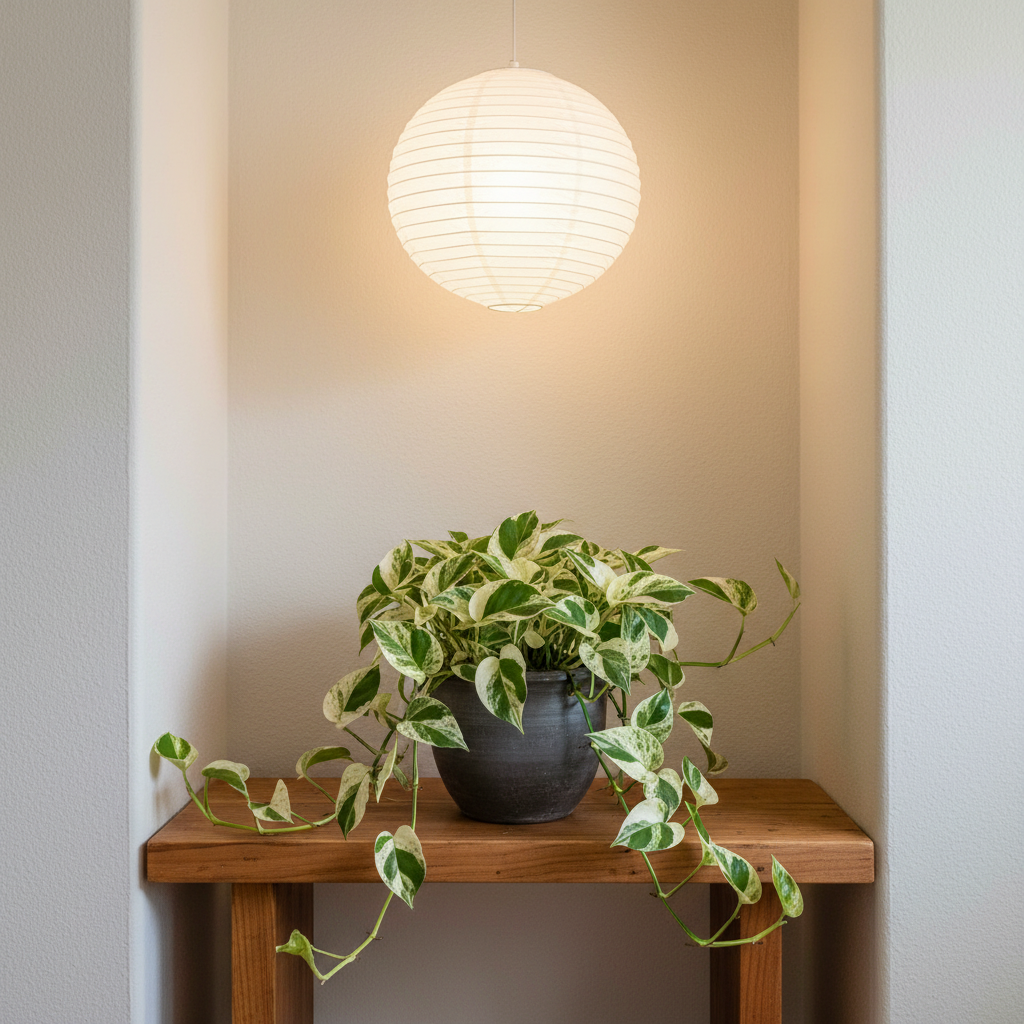
The Marble Queen Pothos (Epipremnum aureum ‘Marble Queen’) is one of those rare houseplants that looks like it was painted by hand and grows like it was bred for survival. Each heart-shaped leaf is splashed with creamy white and rich green in a pattern that never quite repeats, and yet underneath that delicate appearance sits a tough, fast-growing tropical vine that asks for very little in return. It is the cultivar that most gardeners think of when they picture a “variegated pothos”, and it has been a fixture on shelves, mantels and bookcases for the better part of a century.
Unlike the bright yellow-and-green Golden Pothos that crowds garden centres, the Marble Queen carries a cooler, almost porcelain palette. Some leaves emerge predominantly green with thin white streaks; others arrive nearly white with only a brushstroke of chlorophyll. That variation is genetic, environmental and a little bit luck, which is part of the plant’s charm. Give it enough light and it will produce a constant succession of new variegated foliage. Keep it in a dim corner and it will quietly revert to greener leaves, conserving energy until conditions improve.
Quick Reference
Before diving into detail, here is a concise overview of what the Marble Queen Pothos needs to thrive indoors. Use this table as a quick check when you are buying a new plant or troubleshooting an existing one, and treat the sections below as the longer explanation behind each row.
| Botanical name | Epipremnum aureum ‘Marble Queen’ |
| Common names | Marble Queen Pothos, Variegated Pothos, Devil’s Ivy |
| Plant family | Araceae |
| Native range | French Polynesia (Mo’orea), naturalised across the tropics |
| Growth habit | Trailing or climbing evergreen vine |
| Mature size indoors | Vines 1.8 to 3 metres (6 to 10 feet) long, leaves 8 to 15 cm (3 to 6 inches) |
| Light | Bright indirect light, tolerates medium light with reduced variegation |
| Water | Allow top 2 to 3 cm (1 inch) of soil to dry between waterings |
| Humidity | 40 to 60 percent ideal, tolerates household 30 percent |
| Temperature | 18 to 27 degrees Celsius (65 to 80 degrees Fahrenheit) |
| Soil | Chunky, well-draining aroid mix with bark and perlite |
| Fertiliser | Balanced liquid feed at half strength, monthly in growing season |
| Propagation | Stem cuttings in water or soil, air layering, division |
| Toxicity | Toxic to cats, dogs and humans if ingested (calcium oxalate) |
| Difficulty | Beginner-friendly |
In this guide
- Why grow Marble Queen Pothos as a houseplant
- Light requirements
- Watering
- Soil and potting
- Fertilising
- Propagation
- Pests and common problems
- Varieties and lookalikes
- Frequently asked questions
Why Grow Marble Queen Pothos as a Houseplant
The case for Marble Queen Pothos is unusually strong because the plant manages to be both visually distinctive and almost impossible to kill. Most variegated houseplants pay for their beauty in difficulty: a Pink Princess Philodendron throws tantrums about light, a variegated Monstera demands a humidity strategy, and a String of Pearls will rot at a glance. The Marble Queen, by contrast, descends from Epipremnum aureum, a tropical vine that has been climbing trees and rooting in everything from forest litter to limestone for millions of years. The cultivar inherits that resilience while wearing it under a marbled coat.
Indoors, the species is famously forgiving. It accepts a wide range of light conditions, recovers easily from missed waterings, takes well to most ordinary potting mixes, and tolerates the dry, climate-controlled air that defeats more delicate tropicals. The Marble Queen specifically asks for a little more light than its all-green cousin in order to maintain its variegation, but that extra demand is modest and never approaches the brightness a succulent or fig would need.
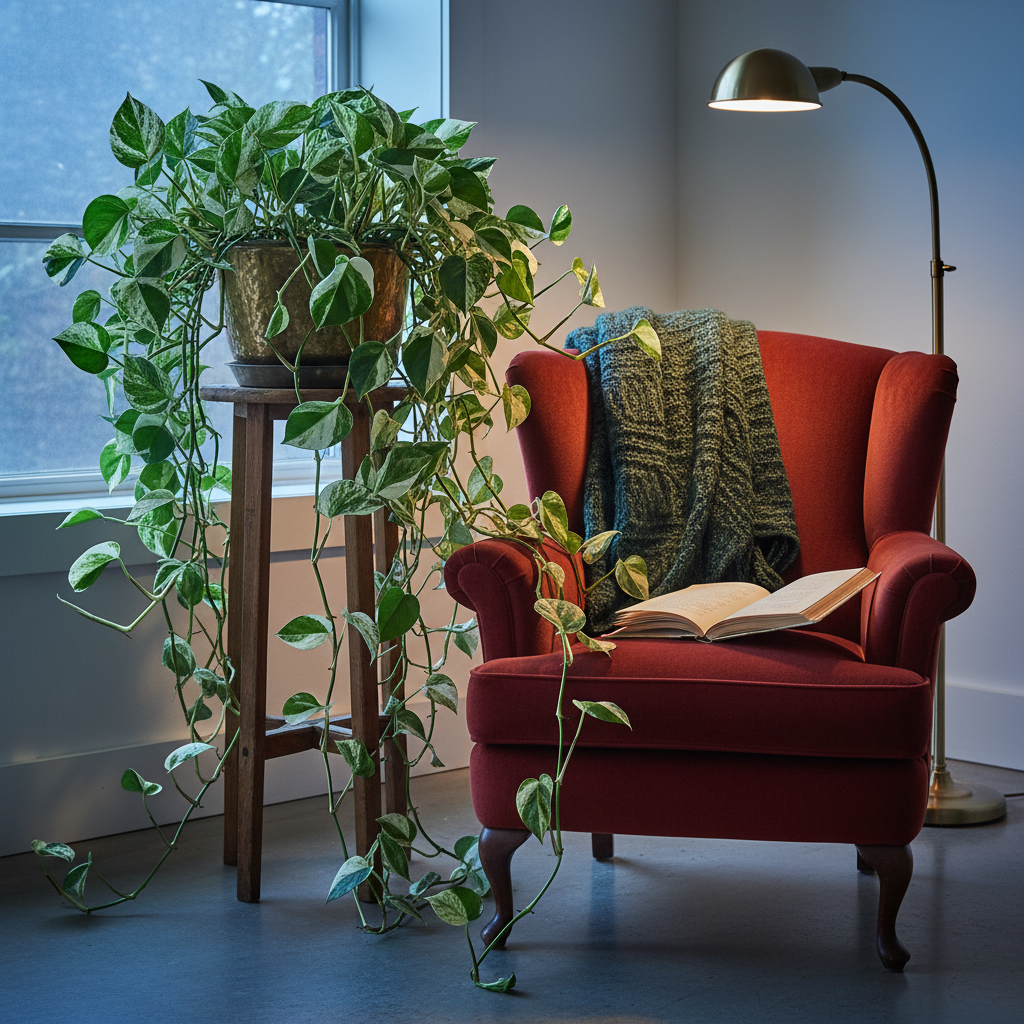
The plant is also remarkably versatile in placement. The trailing habit suits a high shelf, the top of an armoire or a hanging planter, where vines can grow downward unobstructed. Many growers instead train it upward on a moss pole or trellis, which encourages larger, more deeply variegated leaves and gives the vine the climbing structure it would have used in the wild. Either approach is biologically sound; the only mistake is leaving the plant on a low table, where the vines pile awkwardly on the surface rather than displaying their natural cascade.
Beyond appearance, Marble Queen Pothos earns its keep by being practical. It propagates with embarrassing ease, so one specimen can quickly become several. It signals stress visibly and slowly, giving even inattentive owners time to react. And it has been studied (in the famous NASA Clean Air Study of 1989) for its contribution to indoor air filtration. The findings of that study have since been moderated, since real homes do not behave like sealed test chambers, but the plant’s role in lifting the visual quality of a room is not in doubt.
Pro Tip — Buy with intent: When choosing a Marble Queen at a nursery, lift the pot and look at the underside. Healthy specimens have firm, pale roots showing at the drainage holes and at least one new growth point on top with the freshest variegation. Avoid plants whose newest leaves are pure green, which signals weeks in low light.
Light Requirements
Light is the single most important factor in keeping a Marble Queen Pothos looking its best. The cream and white patches on the leaves are areas of low or absent chlorophyll, which means they cannot perform photosynthesis. The green portions of each leaf have to supply the entire plant with energy, and so the plant needs more total light than an all-green cultivar to do the same work. Give it too little and the next round of leaves will emerge with more green and less white, as the plant prioritises survival over decoration. Give it too much harsh direct sun and the pale areas will scorch, leaving brown crisped patches that never recover.
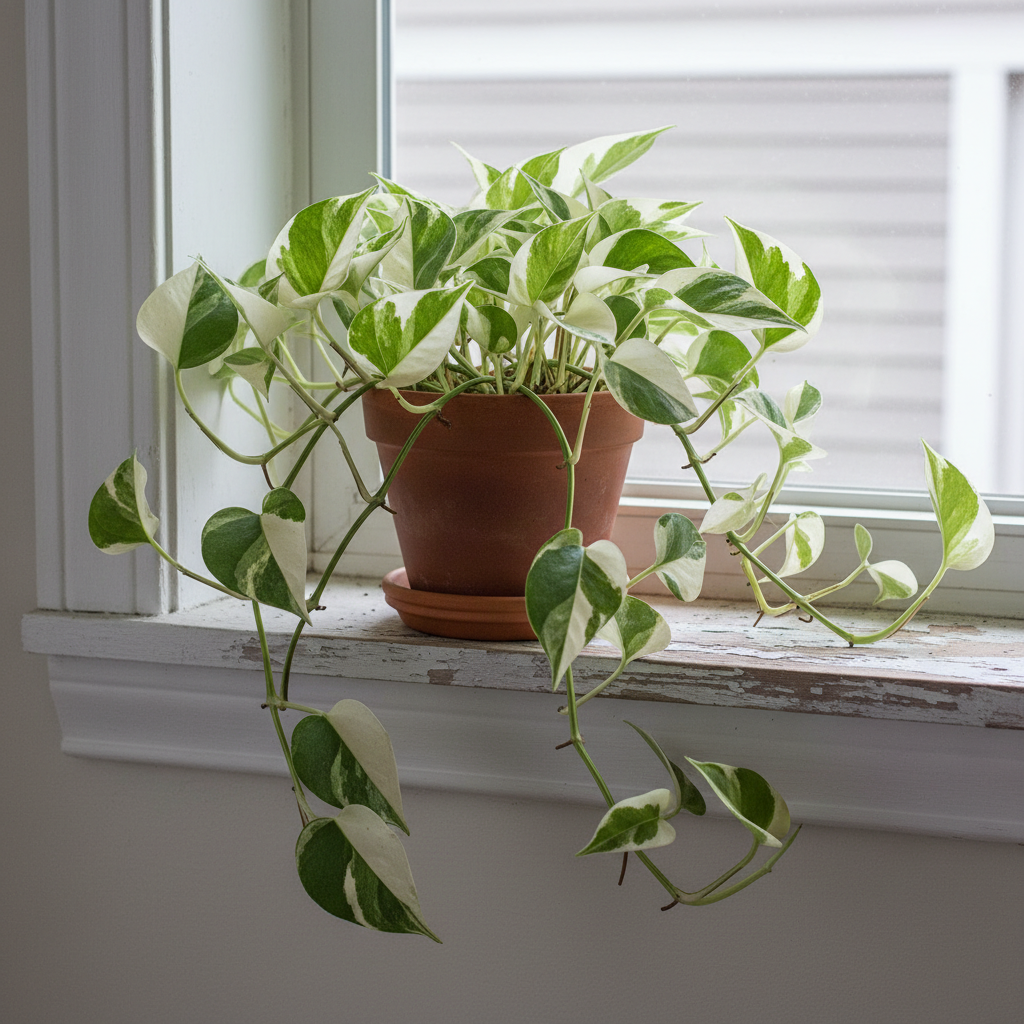
The ideal position is bright indirect light, which in practical terms means somewhere between half a metre and two metres from a window that gets a reasonable amount of daylight. An east-facing window is excellent, since the morning sun is gentle enough to fall directly on the leaves without burning them. A west or south window works too, provided the plant sits a little back from the glass or is filtered by a sheer curtain. A north window will keep the plant healthy but tends to produce greener foliage over time, because the light intensity drops below the threshold the variegation needs.
Read the plant’s own response rather than measuring lux with a meter. New leaves emerging predominantly white are a sign of high light. Leaves emerging as a balanced mix of cream and green sit in the sweet spot. New leaves that come out almost entirely green, especially after a previously well-variegated plant has been moved, signal that the light is now too low. The plant will not reverse already-grown leaves, so the variegated foliage you bought is safe; only the new growth changes.
If natural light is genuinely limited, a basic full-spectrum LED grow-light placed 30 to 45 centimetres above the plant for 10 to 12 hours a day is sufficient to maintain variegation. There is no need for industrial horticultural lighting; an inexpensive consumer grow bulb in a regular lamp socket will do the work. Conversely, if a window is so bright that the plant looks pale and washed out or shows brown crisp edges, move it back, add a curtain or rotate it to the side of the room.
Warning — Reversion is gradual: If new leaves come in greener than the rest of the plant, do not panic and add fertiliser. Variegation is a light problem, not a nutrient problem. Move the plant closer to the window and wait two months for the next growth cycle to confirm improvement.
Watering
The Marble Queen forgives most watering sins except sustained overwatering, which is the only reliable way to kill it. The roots are adapted to a tropical regime of heavy rain followed by free drainage, so they expect the soil to wet through, drain quickly, and then dry out somewhat before the next soak. Treating the plant like a fern, with constantly damp soil, leads to root rot. Treating it like a succulent, with weeks of bone-dry conditions, slows growth and crisps the leaf tips but rarely kills it outright. The right rhythm sits between those extremes.
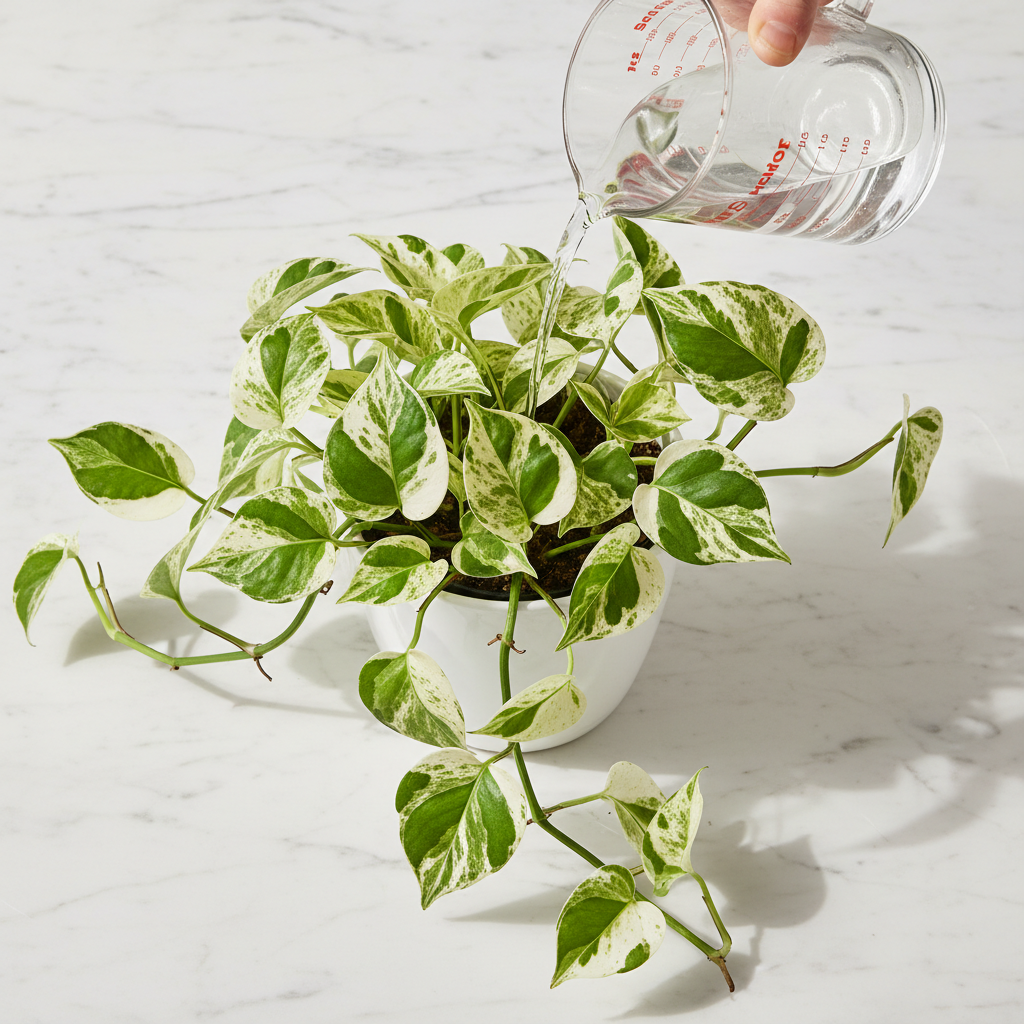
The reliable rule is to let the top 2 to 3 centimetres (about an inch) of soil dry out between waterings. Push a finger into the soil; if it feels damp at fingertip depth, wait. If it feels dry, water thoroughly until water runs out of the drainage holes, then tip out anything that collects in the saucer so the roots do not sit in standing water. In a warm bright room in summer this will mean watering roughly once a week. In a cool dim room in winter it can stretch to every two or even three weeks. The plant tells you when it is thirsty: leaves go softly limp and feel papery rather than firm. After a thorough watering they re-inflate within a few hours.
Water quality matters less for pothos than it does for prayer plants or carnivorous species, but very hard or chlorinated tap water can leave white mineral crusts on the soil surface and the pot rim. If your tap water is heavily treated, leaving it uncovered overnight allows chlorine to dissipate, or use filtered or collected rainwater. Use water at room temperature; very cold water shocks the roots and can cause new leaves to come in distorted.
The biggest single watering mistake is on a fixed schedule. “Every Sunday” sounds tidy but ignores the plant’s actual conditions: a hot dry July week empties a pot far faster than a damp grey week in November. Check the soil first, water in response, and you will avoid both the dry-stress brown tips and the soggy black-stemmed rot that come from rigid timetables.
Pro Tip — The pot weight test: Lift the pot just after watering and again a few days later. With a little practice you can judge moisture by weight alone, which is faster than a finger test and works well for plants on high shelves. A pot that feels surprisingly heavy is still wet; a pot that feels light is ready for water.
Soil and Potting
Soil for a Marble Queen Pothos should accomplish three things at once: hold enough moisture to keep the plant comfortable between waterings, drain quickly enough that the roots are never sitting in saturated mud, and contain enough air pockets for the roots to breathe. The thick, white aerial roots that pothos produce along its stems are a clue to what the plant wants underground. In the wild it grows on the litter layer of a tropical forest, where decomposing leaves, bark and fine soil sit in a loose, lumpy structure that water passes through readily.
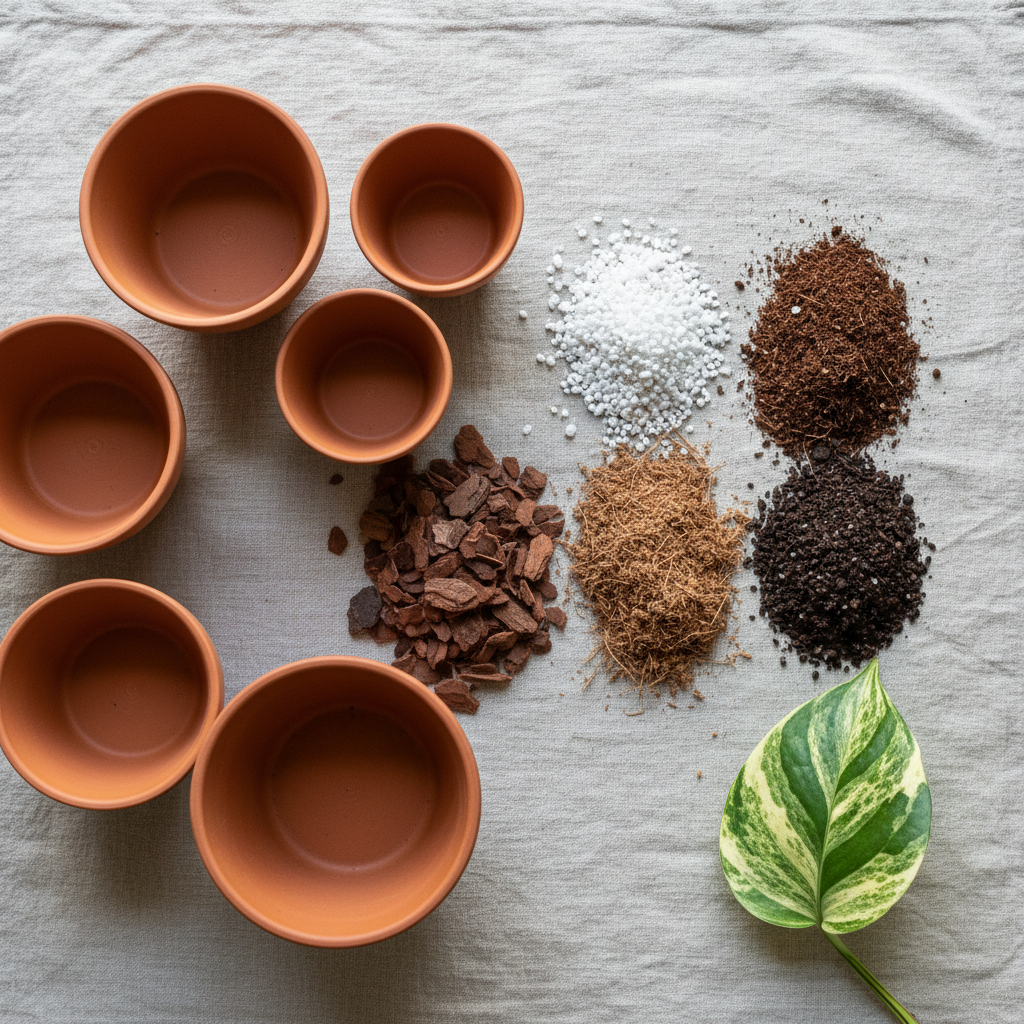
A reliable home mix is two parts standard houseplant compost, one part medium-grade orchid bark and one part perlite, with an optional small handful of horticultural charcoal or worm castings stirred in. The compost holds nutrients and moisture, the bark creates lasting air pockets and gives the roots something chunky to grip, and the perlite keeps the mix from compacting over time. If you would rather buy something pre-mixed, any commercial aroid mix will do; avoid pure peat or pure coco coir, which compact and stay wet for too long.
The pot itself is more important than many growers realise. Terracotta is breathable and wicks moisture out through the walls, which suits a plant that hates wet feet, but it also dries out faster and needs more frequent watering. Glazed ceramic and plastic hold moisture longer and are easier to manage in dry homes. Whatever the material, the pot must have drainage holes; a beautiful pot without holes can be used as a cachepot with the plant nested in a plastic grower’s pot inside. Size the pot 2 to 3 centimetres wider than the existing root ball; oversized pots hold too much wet soil around small root systems and invite rot.
Repot every two years or when roots are circling the bottom of the pot, escaping the drainage holes or visibly pushing the plant upward. Spring or early summer is the best time, when the plant is in active growth and can recover quickly. Slip the plant out, tease the roots gently to loosen the outer layer, trim any dead or mushy sections, and settle it into fresh mix in the new pot. Water lightly and place it back in its usual spot; full sun exposure right after repotting can stress the plant.
Fertilising
Marble Queen Pothos is not a heavy feeder and gets into more trouble from over-fertilising than under-fertilising. The plant’s growth rate is set primarily by light and temperature, not nutrients; pumping fertiliser into a low-light corner does not push more leaves out, it just builds up salts in the soil and can scorch the roots. The right approach is a light, regular feed during the growing season and nothing at all over winter.
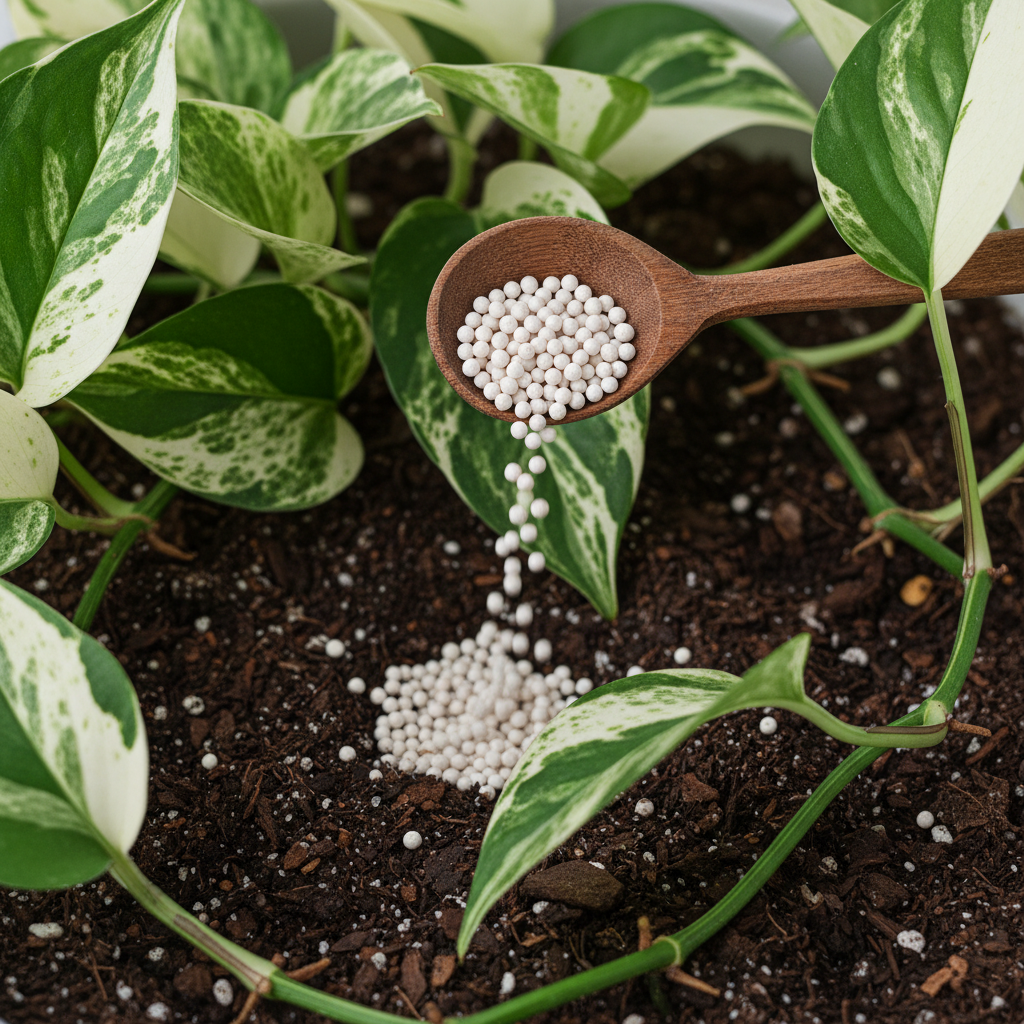
A balanced liquid houseplant fertiliser (an N-P-K ratio close to 10-10-10 or 20-20-20 by mass on the label) diluted to half the recommended strength and applied once a month from early spring through to early autumn covers all the plant’s nutritional needs. Slow-release granules pressed into the soil surface every three to four months are an even simpler alternative for growers who do not want to remember a feeding schedule. Organic options such as worm castings worked into the top layer of soil or a weak compost tea every six weeks suit the plant equally well, and they have the side benefit of feeding soil microbes rather than just the plant.
Stop fertilising entirely from late autumn through to early spring. Even an evergreen tropical slows down when daylight is short and indoor temperatures drop, and feeding a resting plant builds up unused salts that will burn the roots. If you see a white crusty deposit forming on the soil surface or the pot rim, that is mineral build-up; flush the soil thoroughly with several pot-volumes of plain water at the kitchen sink and skip the next two feeds.
Signs of over-fertilising include brown crispy leaf tips, yellowing of older leaves, and an unhealthy salt crust on the soil. Signs of genuine nutrient deficiency, by contrast, are pale uniformly yellow new growth and stunted leaf size despite good light. The two conditions look different and call for opposite responses, so make sure you have ruled out salt build-up before doubling the feed.
Pro Tip — Less is more: If in doubt, under-feed. A Marble Queen left unfertilised for a year will grow more slowly but stay healthy. A Marble Queen fertilised at full strength every week will burn its roots within a few months and may not recover.
Propagation
Propagation is where Marble Queen Pothos earns its reputation as a gift plant. Almost any segment of stem with a node will root, and within a few weeks one trim from a long vine becomes a small new plant. The three reliable methods are stem cuttings in water, stem cuttings directly in soil, and air layering. Each suits a slightly different situation.
Stem cuttings in water
This is the most popular method because it is visual and almost foolproof. The steps are simple:
- Choose a healthy section of vine with at least two or three nodes (the small bumps on the stem where leaves and aerial roots emerge).
- Cut just below a node with clean scissors or secateurs, leaving the top leaf intact.
- Remove the lowest leaf so a bare node sits below the water line.
- Place the cutting in a clear glass of room-temperature water with the bare node submerged and the remaining leaves above the surface.
- Set the glass in bright indirect light and change the water every five to seven days.
- White roots appear within one to three weeks. Once they reach 5 to 7 centimetres (2 to 3 inches), pot the cutting into a small container of moist aroid mix.
Stem cuttings in soil
This method skips the water-to-soil transition, which is the moment when many water-rooted cuttings stall. Take the cutting in the same way, but dip the cut end in rooting hormone (optional but helpful) and push it directly into a small pot of pre-moistened aroid mix with the bare node buried. Keep the soil consistently lightly moist for the first three weeks. The cutting will not show roots above ground, but a gentle tug after a month indicates whether it has anchored. Soil-rooted cuttings tend to be hardier in the long term because they never have to adapt from aquatic to terrestrial roots.
Air layering
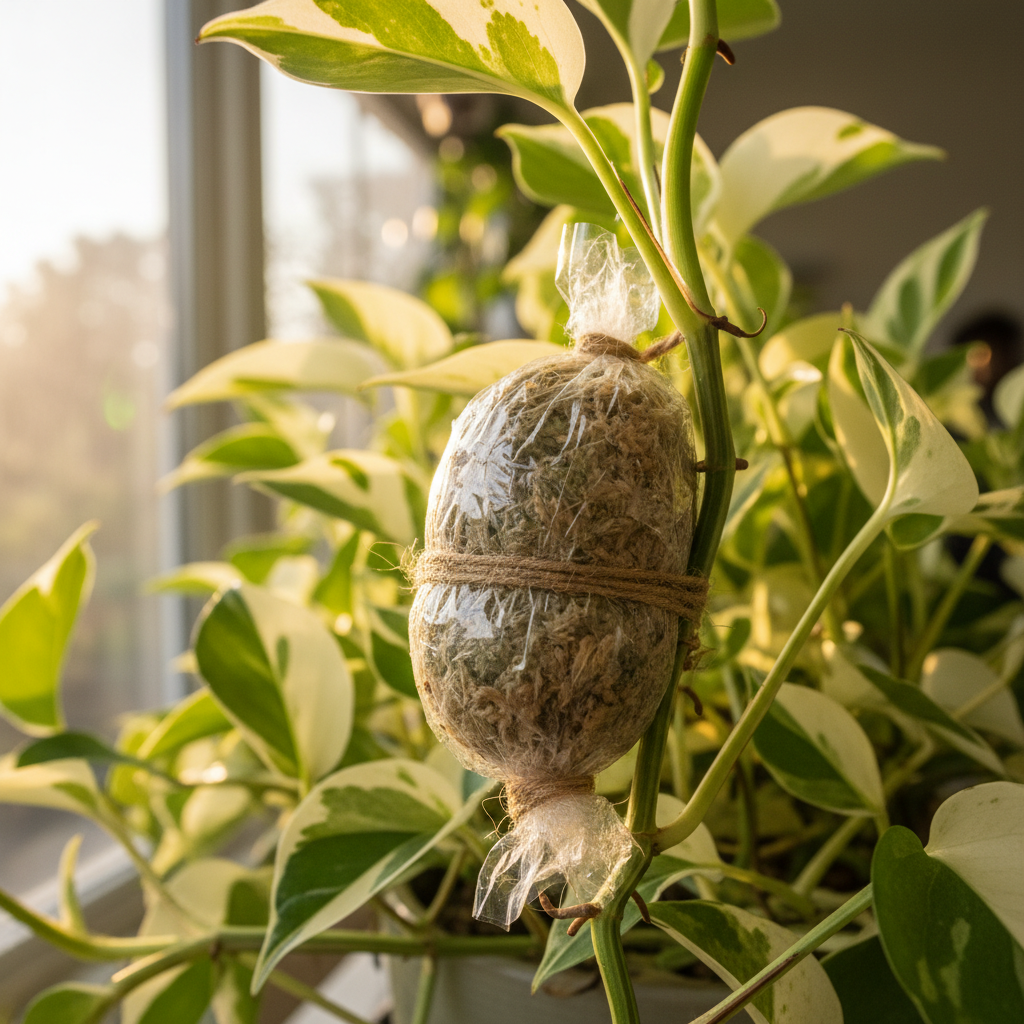
Air layering is the slowest method but the highest-success-rate option for a particularly long, mature vine where you want the cutting to be substantial from day one. Choose a healthy node along the vine, wrap it in a generous handful of damp sphagnum moss, and cover the moss with clear plastic film secured with natural twine or twist ties above and below the node. Keep the moss damp by misting through a small opening every few days. After four to six weeks, white roots will be visibly threading through the moss. Cut the vine just below the rooted node, unwrap the film, and pot the new section directly into aroid mix.
One important consideration with Marble Queen Pothos specifically is that variegation is partly carried in the stem tissue. Choose cuttings from sections of vine where the existing leaves show good cream-and-green balance, not stretches that have already reverted to all-green. A solid-green cutting will produce a solid-green plant; a well-marbled stem will pass that pattern to its descendants.
Pests and Common Problems
Marble Queen Pothos is not a pest magnet, but no houseplant is immune. The usual indoor culprits all show up occasionally, and most are easy to defeat if caught early. Routine inspections every two to three weeks (lifting a few leaves to check undersides and leaf axils) catch infestations while they are small enough to wipe off by hand.
Mealybugs
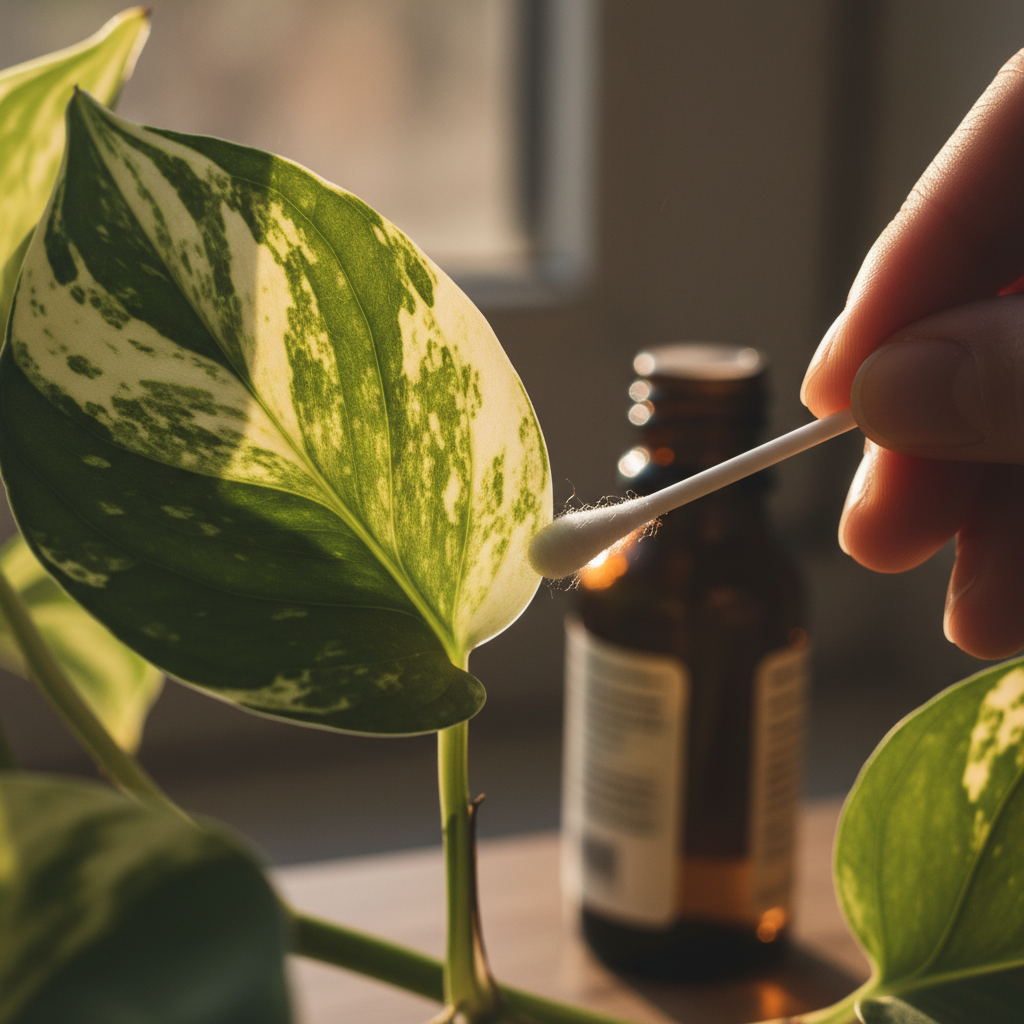
Mealybugs are the most common Marble Queen pest. They look like tiny white cotton tufts and cluster in leaf axils, where the leaf joins the stem, and on the undersides of leaves. Dab each cluster with a cotton bud dipped in 70 percent isopropyl alcohol; the bugs collapse within seconds. For a heavier infestation, spray the whole plant with a mix of one tablespoon dishwashing liquid and one tablespoon neem oil per litre of water, repeating every seven days for three weeks to catch successive hatches.
Spider mites
Spider mites thrive in dry indoor air and show up as fine pale stippling on leaves and almost invisible webbing on the undersides. Shower the plant thoroughly in the sink or bath to dislodge them physically, then follow up with a miticidal spray or insecticidal soap. Raising the ambient humidity to 50 percent or above makes the plant unattractive to spider mites long-term.
Scale
Scale insects look like small brown waxy bumps stuck to the stems and the undersides of leaves. Once attached they are largely immobile but they continue to feed and excrete sticky honeydew, which encourages sooty mould. Scrape them off with a fingernail or cotton bud, then treat with alcohol or systemic insecticide if the infestation is widespread.
Yellow leaves
A single yellow leaf at the base of a vine is usually old age and nothing to worry about. Multiple yellow leaves with brown soggy stems indicate overwatering and probable root rot; tip the plant out, trim any black slimy roots, and repot into fresh dry mix. Yellow leaves with crispy brown edges typically point to underwatering, salt build-up or scorching sun.
Brown leaf tips
Brown crispy tips are almost always an environmental rather than a pest issue. Common causes are very low humidity (under 30 percent), fluoride in tap water, salt build-up from over-fertilising, or letting the plant dry out far past its preferred threshold. Adjust the relevant factor and trim the dead tissue with sharp scissors following the natural leaf shape.
Variegation loss
Reverting (new leaves coming in mostly green) is not a disease but a light problem. Move the plant to a brighter location and prune back the all-green sections of vine, which removes the more vigorous green growth and encourages the plant to push variegated leaves from older nodes.
Warning — Quarantine new plants: Most pest outbreaks arrive on new plants from nurseries or plant swaps. Keep any new addition isolated from the rest of your collection for two to three weeks and inspect it under bright light before moving it next to existing plants.
Varieties and Lookalikes
Marble Queen sits in a family of variegated pothos cultivars that are frequently confused with each other. Two in particular are worth knowing because they appear constantly in shops mislabelled as Marble Queen or sold beside it as supposed alternatives. Both are close relatives, but each has a distinct look and slightly different care requirements.
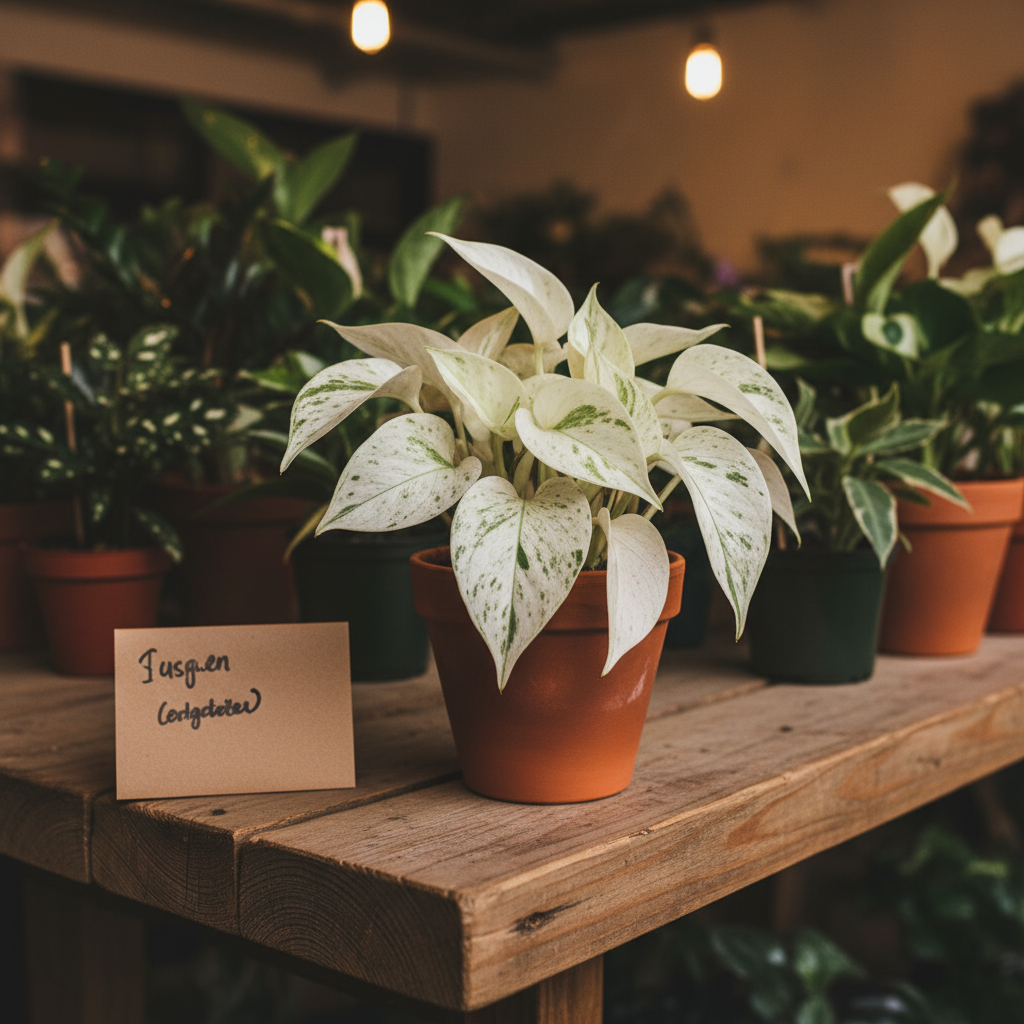
Snow Queen
Snow Queen takes the variegation one step further: the leaves are dominated by white, with only narrow ribbons of green running through them. The lower chlorophyll content makes Snow Queen distinctly slower-growing than Marble Queen and slightly more demanding about light. It is a stunning plant in its own right but is not a forgiving substitute for Marble Queen; expect to give it the brightest indirect window you have and water with extra care, since its smaller green area is easier to overwhelm.
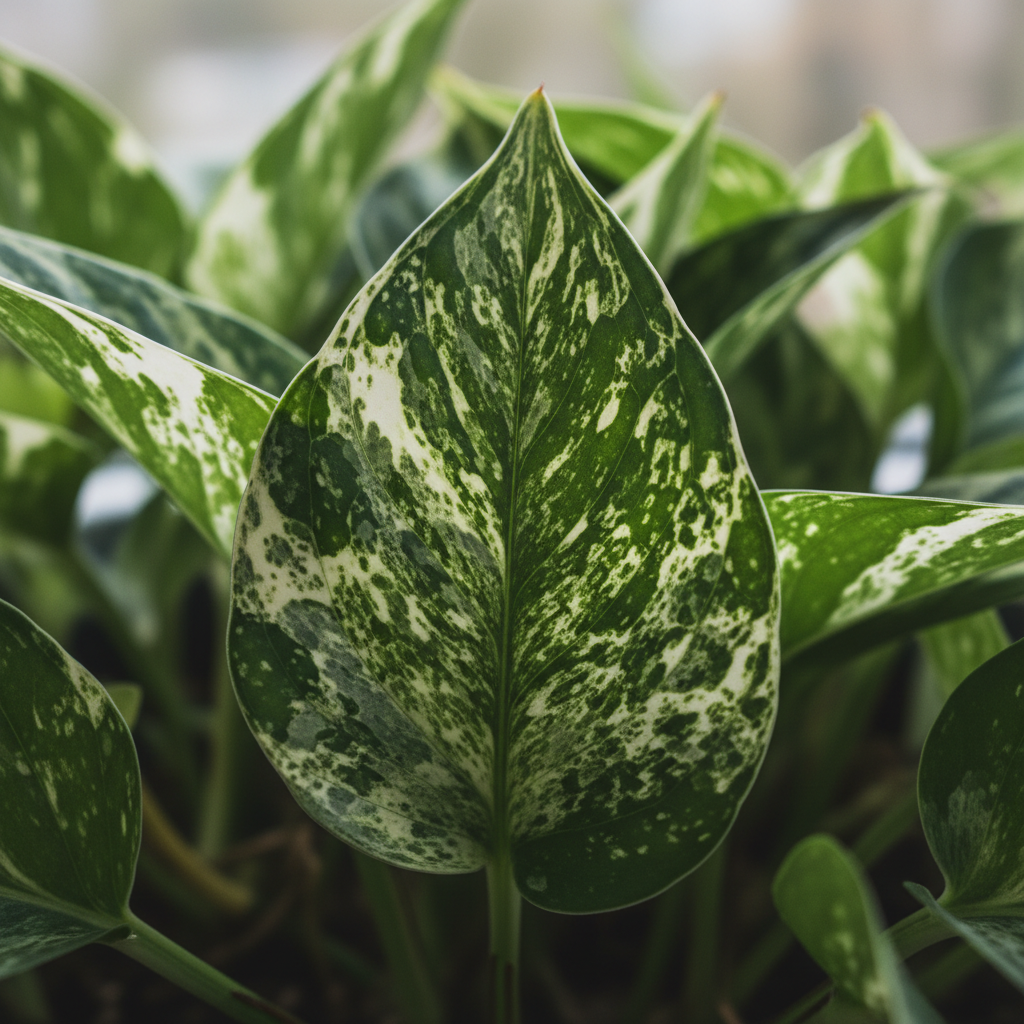
Pearls and Jade
Pearls and Jade is a sport of Marble Queen developed at the University of Florida and patented in 2009. Its leaves are smaller and narrower than the parent’s, the variegation is concentrated around the leaf edges rather than across the whole surface, and the green centres often carry a soft grey-green undertone. The plant grows more compactly and is well suited to small spaces and tight shelves. Care is identical to standard Marble Queen.
Other pothos cultivars worth knowing
Golden Pothos (the unnamed wild-type Epipremnum aureum) is the green-and-yellow original and shares the same care. Neon Pothos is an all-chartreuse cultivar with no variegation and the easiest care of the group. Manjula is a more recent University-of-Florida cultivar with broad, wavy leaves splashed in cream, silver-green and white in a softer painterly pattern than Marble Queen. N’Joy is a compact white-and-green cultivar with sharply defined patches rather than marbling. None of these is technically a Marble Queen, but if a shop label is suspect, the leaf colour and edge pattern will distinguish them.
Frequently Asked Questions
Is Marble Queen Pothos toxic to pets?
Yes. All parts of the plant contain insoluble calcium oxalate crystals, which cause oral irritation, drooling, vomiting and difficulty swallowing if a cat, dog or child chews on them. The reaction is unpleasant but rarely life-threatening. Place the plant out of reach in pet households, particularly because the trailing vines are visually tempting to play with.
Why are my new leaves coming in greener than the rest of the plant?
The light is too low for the plant to sustain full variegation. Move it closer to a window or supplement with a grow-light. Older leaves keep their original variegation, so the plant is not losing what you already have.
How fast does Marble Queen Pothos grow?
In ideal conditions a healthy vine adds 30 to 45 centimetres (12 to 18 inches) per growing season. The cultivar is slower than the unvariegated Golden Pothos because it carries less chlorophyll, but it is still markedly faster than most other variegated aroids.
Can I grow it permanently in water?
Yes. Marble Queen will live indefinitely in a vase of clean water with the occasional drop of dilute hydroponic fertiliser. Growth is slower and the leaves smaller than in soil, but it is a low-maintenance way to keep the plant alive on a desk or windowsill. Change the water every two weeks and rinse the roots gently to prevent slime build-up.
Should I prune my pothos?
Pruning is optional but encourages fuller growth. Cutting a long vine just above a node prompts the plant to branch from that point, producing a denser, bushier shape rather than a single long trailing strand. Always use clean sharp scissors and propagate the trimmings to expand your collection.
Why do the aerial roots reach for surfaces?
In the wild the vine climbs tree trunks, and the aerial roots anchor it to the bark and tap into pockets of moisture and leaf litter. Indoors you can either ignore them (they are harmless, just slightly untidy) or give the plant a moss pole to climb, which they will gladly grip and which produces larger more deeply variegated leaves over time.
How long does a Marble Queen Pothos live?
With reasonable care, indefinitely. Pothos are essentially continuously growing vines, so the plant you have today can be propagated again and again and effectively never dies; the original specimen simply becomes a series of cuttings. Many household pothos plants have been in the same family for thirty years or more.






